
Neurologic Emergencies CHAPTER 19: Focused Lecture
T
Published · 59 slides · 0 views
1 / 1


Description
Neurologic Emergencies CHAPTER 19: Focused Lecture National EMS Education Standard Competences (1 of 2) Medicine Applies fundamental knowledge to provide basic and selected advanced emergency care and transportation based on assessment
Related Topics
Share
Embed code
Download this presentation From Below
"Neurologic Emergencies CHAPTER 19: Focused Lecture" is the property of its rightful owner. Permission is granted to download and print the materials on this website for personal, non-commercial use only, and to display it on your personal computer provided you do not modify the materials and that you retain all copyright notices contained in the materials. By downloading content from our website, you accept the terms of this agreement.
Presentation Transcript
01
Neurologic Emergencies CHAPTER 19: Focused Lecture<br>
02
National EMS Education Standard Competences (1 of 2) Medicine
Applies fundamental knowledge to provide basic and selected advanced emergency care and transportation based on assessment findings for an acutely ill patient.<br>
Applies fundamental knowledge to provide basic and selected advanced emergency care and transportation based on assessment findings for an acutely ill patient.<br>
03
National EMS Education Standard Competences (2 of 2) Neurology
Anatomy, presentations, and management of
Decreased level of responsiveness
Anatomy, physiology, pathophysiology, assessment, and management of
Seizure
Stroke/transient ischemic attack
Status epilepticus
Headache<br>
Anatomy, presentations, and management of
Decreased level of responsiveness
Anatomy, physiology, pathophysiology, assessment, and management of
Seizure
Stroke/transient ischemic attack
Status epilepticus
Headache<br>
04
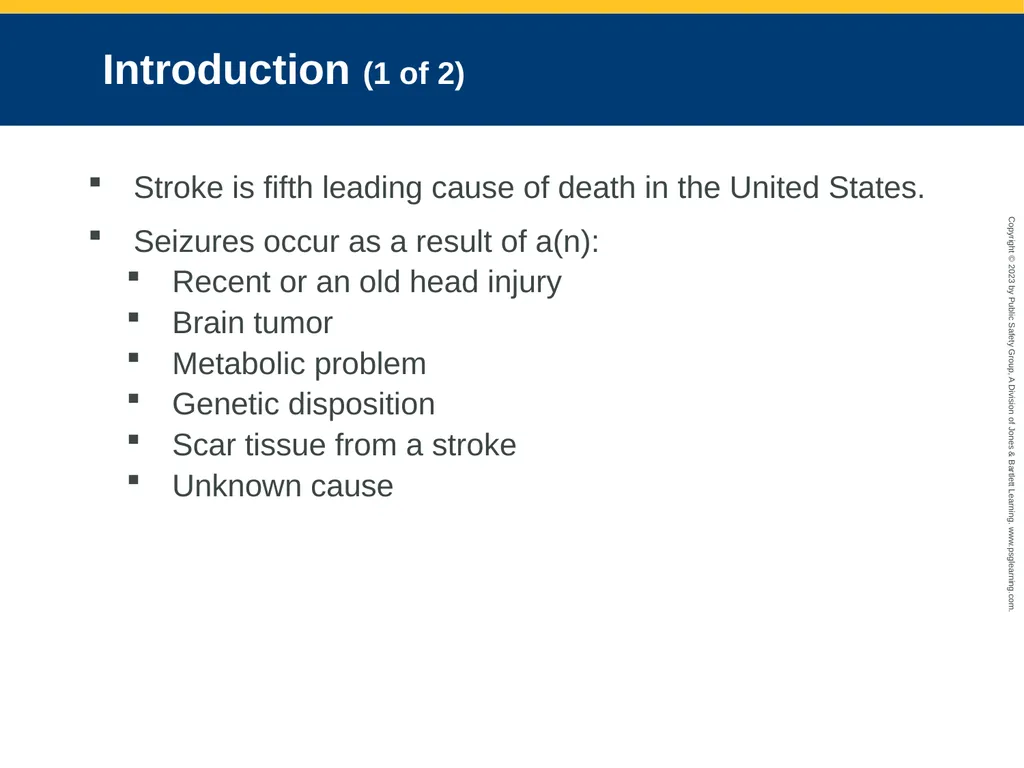
Introduction (1 of 2) Stroke is fifth leading cause of death in the United States.
Seizures occur as a result of a(n):
Recent or an old head injury
Brain tumor
Metabolic problem
Genetic disposition
Scar tissue from a stroke
Unknown cause<br>
Seizures occur as a result of a(n):
Recent or an old head injury
Brain tumor
Metabolic problem
Genetic disposition
Scar tissue from a stroke
Unknown cause<br>
05
Introduction (2 of 2) Altered mental status is a common presentation in patients with a wide variety of medical problems.
Reflexes that protect an awake person may not function when the nervous system is depressed.<br>
Reflexes that protect an awake person may not function when the nervous system is depressed.<br>
06
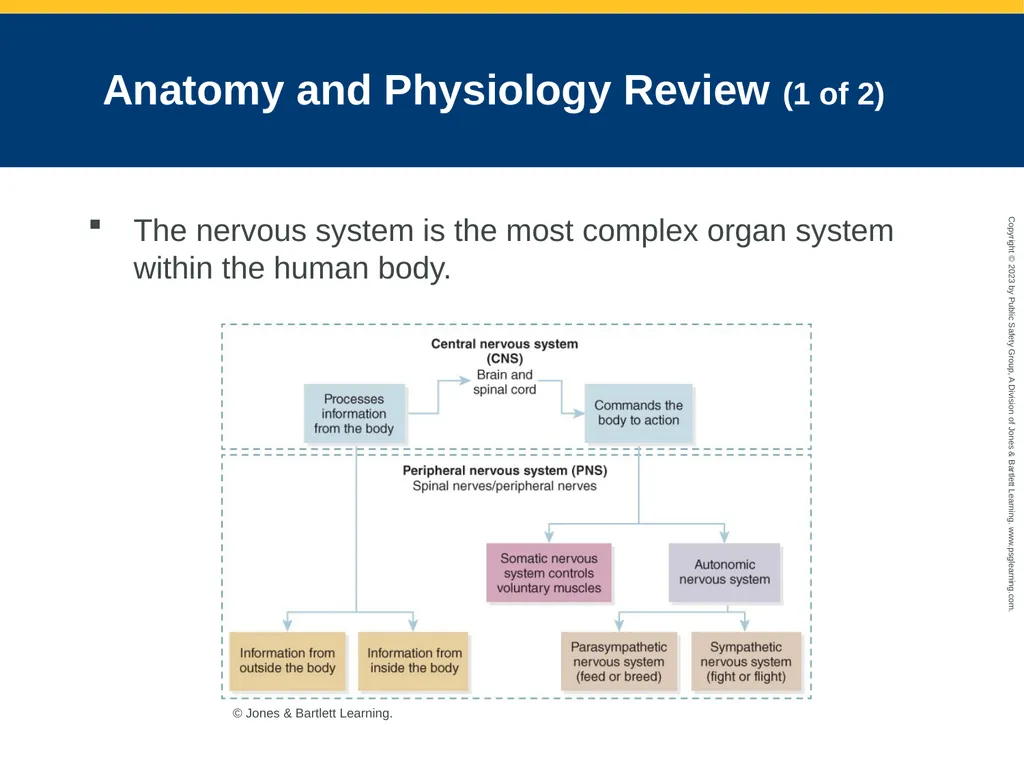
Anatomy and Physiology Review (1 of 2) The nervous system is the most complex organ system within the human body. © Jones & Bartlett Learning.<br>
07
Anatomy and Physiology Review (2 of 2) Responsible for fundamental functions
Major structures of the nervous system are divided into:
Central nervous system (CNS)
Peripheral nervous system (PNS)<br>
Major structures of the nervous system are divided into:
Central nervous system (CNS)
Peripheral nervous system (PNS)<br>
08
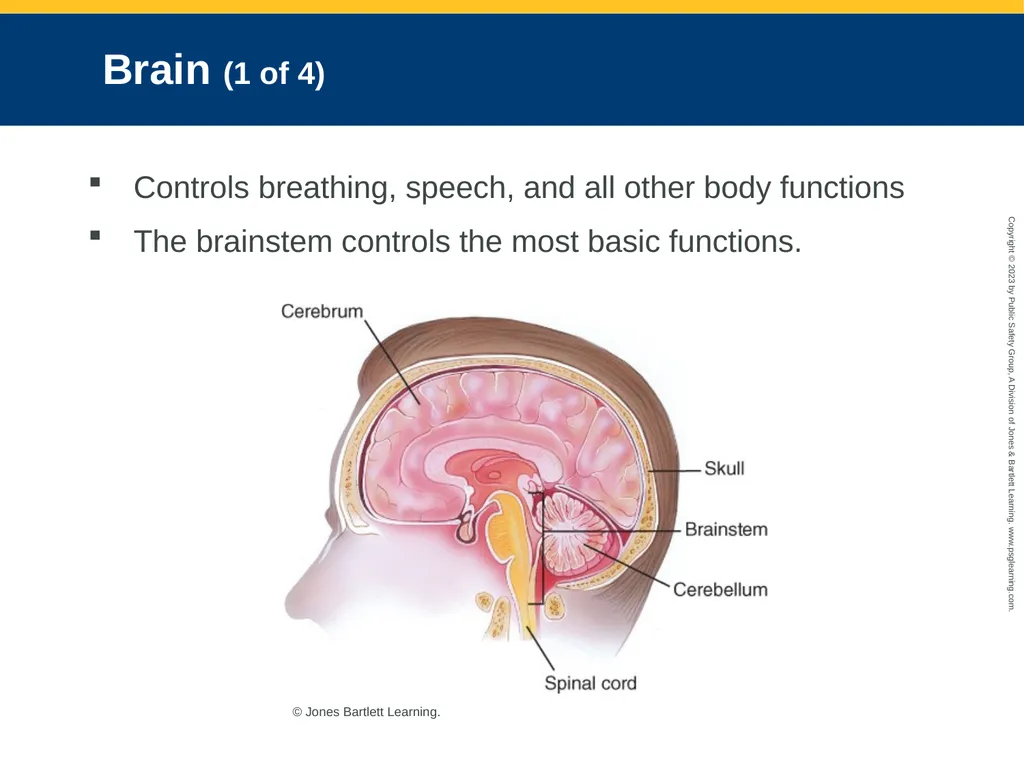
Brain (1 of 4) Controls breathing, speech, and all other body functions
The brainstem controls the most basic functions. © Jones Bartlett Learning.<br>
The brainstem controls the most basic functions. © Jones Bartlett Learning.<br>
09
Brain (2 of 4) Cerebellum controls muscle and body coordination.
Cerebrum is divided into right and left cerebral hemispheres.
Front controls emotion and thought.
Middle controls touch and movement.
Back processes sight.<br>
Cerebrum is divided into right and left cerebral hemispheres.
Front controls emotion and thought.
Middle controls touch and movement.
Back processes sight.<br>
10
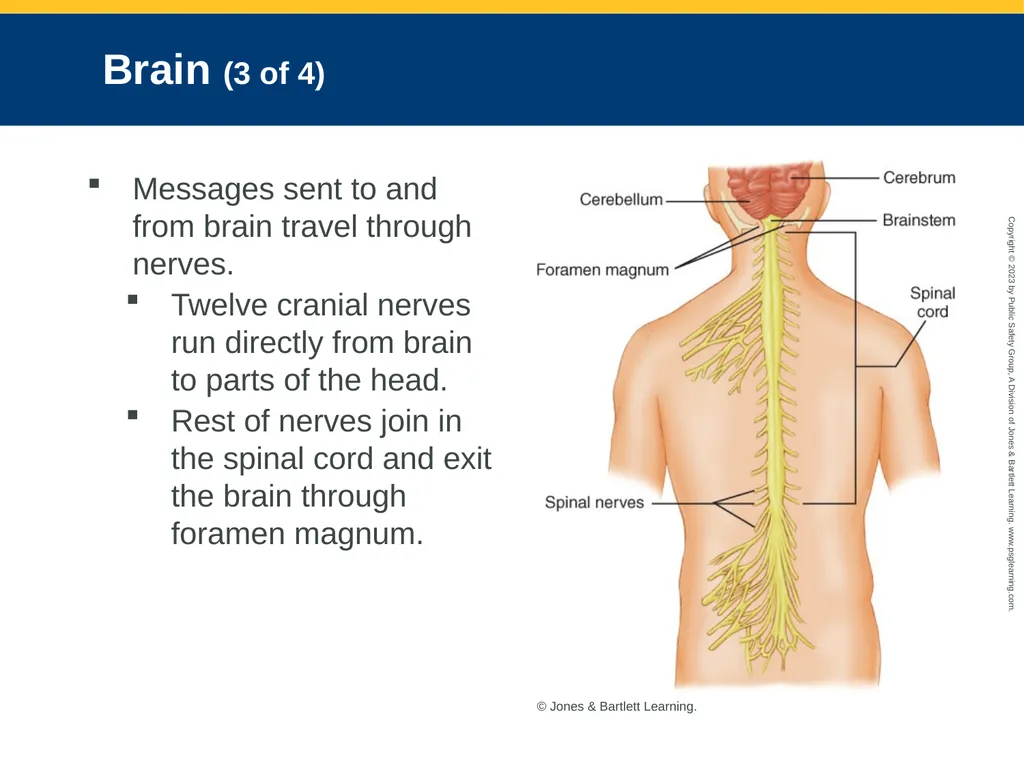
Brain (3 of 4) Messages sent to and from brain travel through nerves.
Twelve cranial nerves run directly from brain to parts of the head.
Rest of nerves join in the spinal cord and exit the brain through foramen magnum. © Jones & Bartlett Learning.<br>
Twelve cranial nerves run directly from brain to parts of the head.
Rest of nerves join in the spinal cord and exit the brain through foramen magnum. © Jones & Bartlett Learning.<br>
11
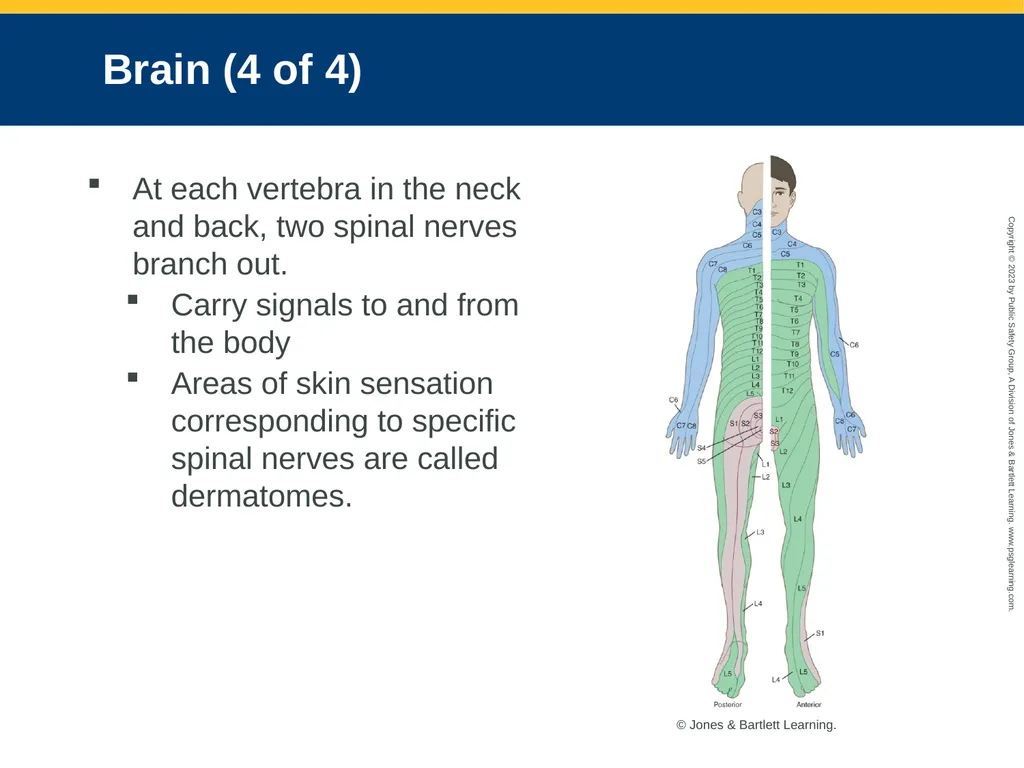
Brain (4 of 4) At each vertebra in the neck and back, two spinal nerves branch out.
Carry signals to and from the body
Areas of skin sensation corresponding to specific spinal nerves are called dermatomes. © Jones & Bartlett Learning.<br>
Carry signals to and from the body
Areas of skin sensation corresponding to specific spinal nerves are called dermatomes. © Jones & Bartlett Learning.<br>
12
Neurons and Impulse Transmission
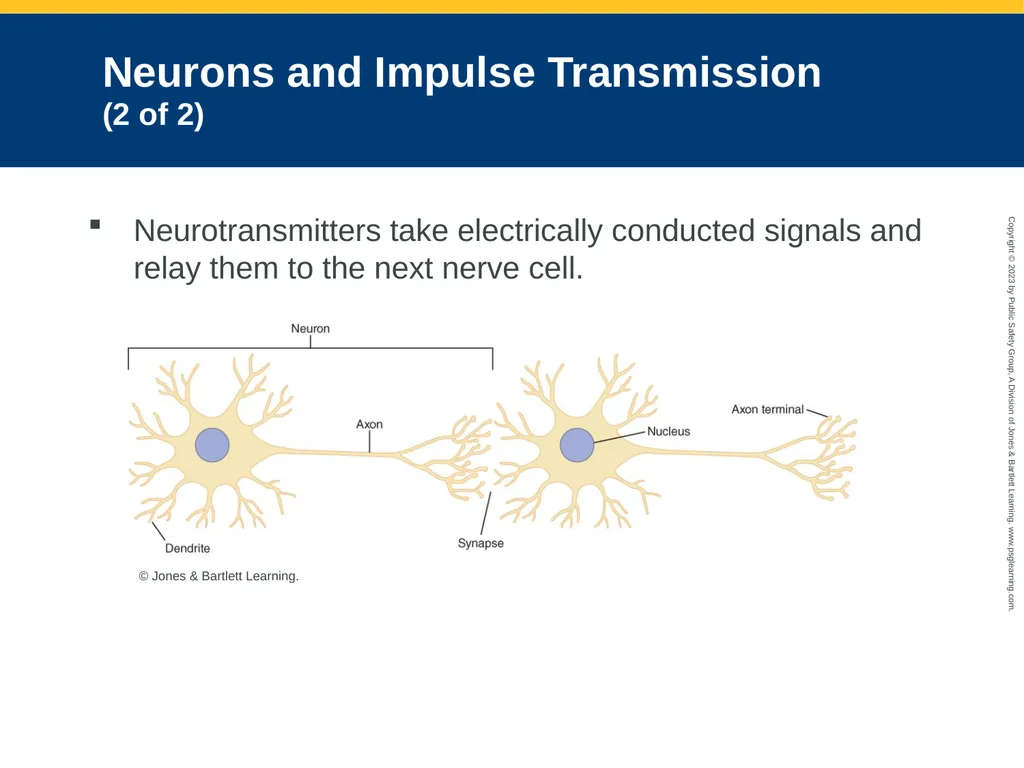
(1 of 2) Neurons are composed of three basic parts: cell body, axon, and dendrites.
Interaction between two neurons occurs at a synapse.
Synapse is present wherever a nerve cell terminates.
Most neurons use neurotransmitters to transmit their signal across a synapse to other neurons.<br>
Interaction between two neurons occurs at a synapse.
Synapse is present wherever a nerve cell terminates.
Most neurons use neurotransmitters to transmit their signal across a synapse to other neurons.<br>
13
Neurons and Impulse Transmission
(2 of 2) Neurotransmitters take electrically conducted signals and relay them to the next nerve cell. © Jones & Bartlett Learning.<br>
14
Pathophysiology Many different disorders may cause brain dysfunction or other neurologic symptoms.
Brain is most sensitive to changes in oxygen, glucose, and temperature.
Other brain disorders include infection and tumor.<br>
Brain is most sensitive to changes in oxygen, glucose, and temperature.
Other brain disorders include infection and tumor.<br>
15
Stroke (1 of 11) Interruption of blood flow to the brain that is sudden and results in the loss of brain function
Do not delay your response to a patient with a potential stroke.
Without oxygen, brain cells cease to function and begin to die.<br>
Do not delay your response to a patient with a potential stroke.
Without oxygen, brain cells cease to function and begin to die.<br>
16
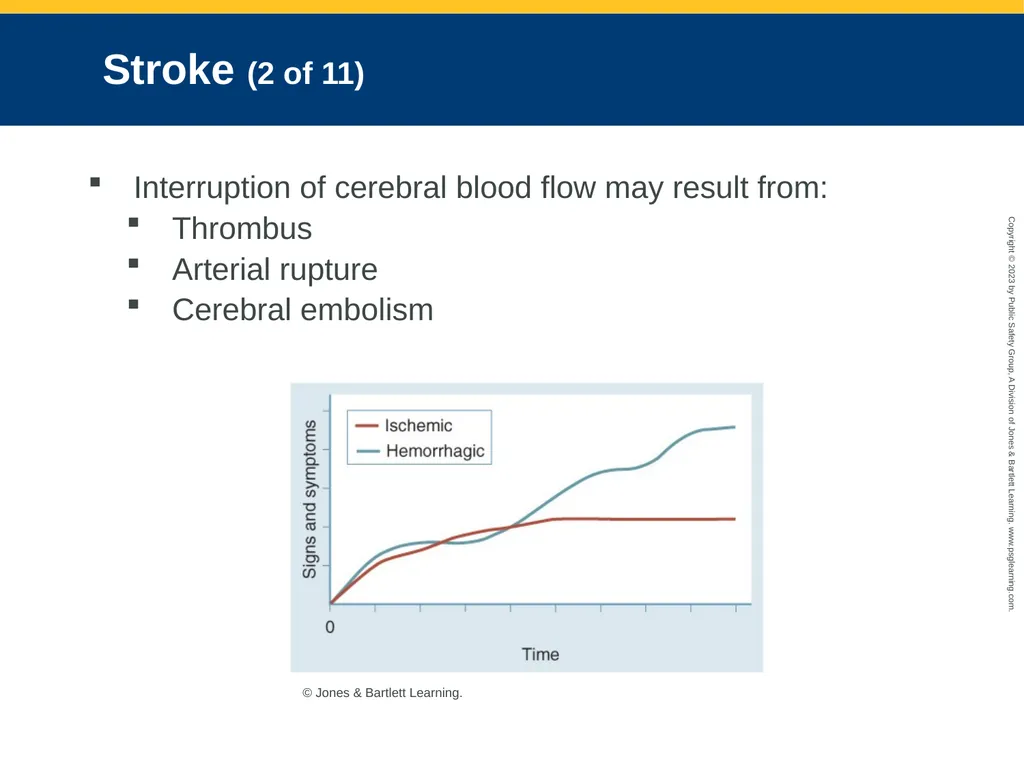
Stroke (2 of 11) Interruption of cerebral blood flow may result from:
Thrombus
Arterial rupture
Cerebral embolism © Jones & Bartlett Learning.<br>
Thrombus
Arterial rupture
Cerebral embolism © Jones & Bartlett Learning.<br>
17
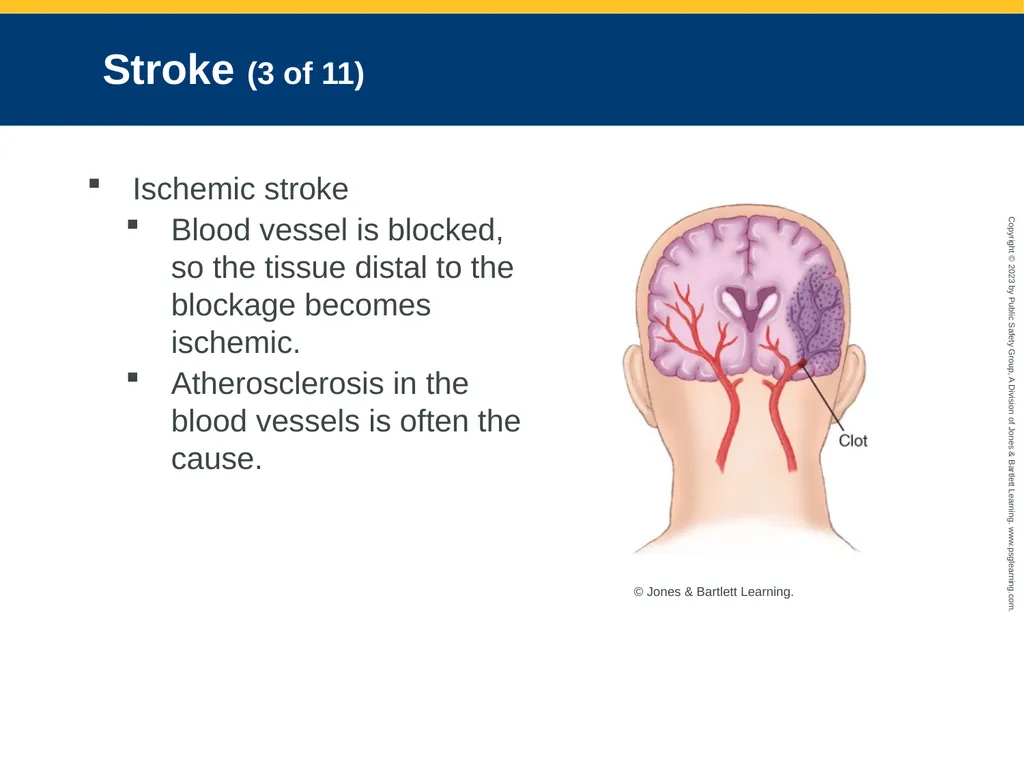
Stroke (3 of 11) Ischemic stroke
Blood vessel is blocked, so the tissue distal to the blockage becomes ischemic.
Atherosclerosis in the blood vessels is often the cause. © Jones & Bartlett Learning.<br>
Blood vessel is blocked, so the tissue distal to the blockage becomes ischemic.
Atherosclerosis in the blood vessels is often the cause. © Jones & Bartlett Learning.<br>
18
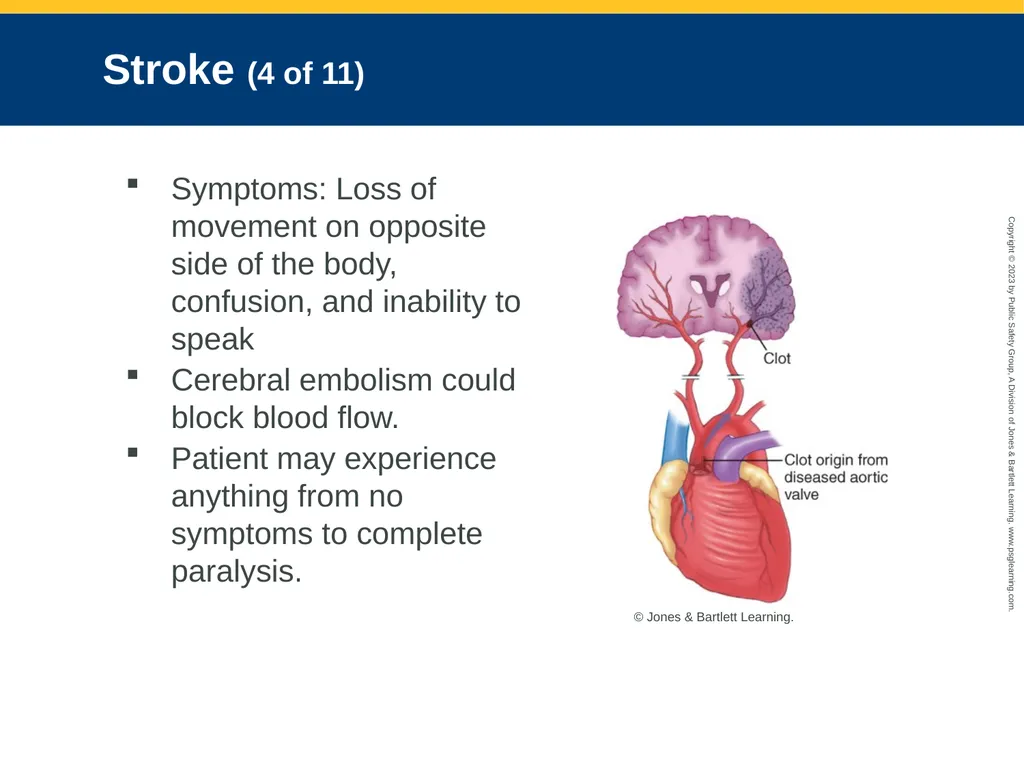
Stroke (4 of 11) Symptoms: Loss of movement on opposite side of the body, confusion, and inability to speak
Cerebral embolism could block blood flow.
Patient may experience anything from no symptoms to complete paralysis. © Jones & Bartlett Learning.<br>
Cerebral embolism could block blood flow.
Patient may experience anything from no symptoms to complete paralysis. © Jones & Bartlett Learning.<br>
19
Stroke (5 of 11) Hemorrhagic stroke
Results from bleeding inside the brain
People at highest risk have chronic, poorly controlled hypertension.
Often fatal
Symptoms
Sudden onset of a severe headache
Rapidly decreasing LOC<br>
Results from bleeding inside the brain
People at highest risk have chronic, poorly controlled hypertension.
Often fatal
Symptoms
Sudden onset of a severe headache
Rapidly decreasing LOC<br>
20
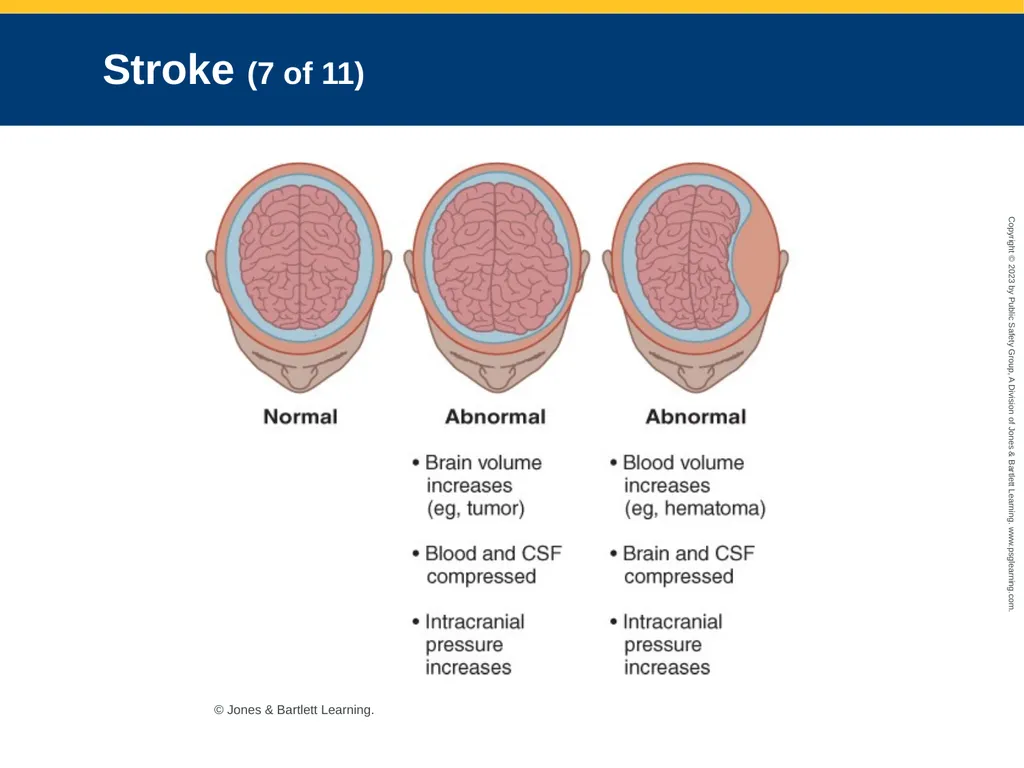
Stroke (6 of 11) Intracranial pressure
Hemorrhagic strokes occur as a result of bleeding within the brain
As bleeding continues
ICP increases
Amount of blood available to the brain decreases
Intracranial contents shift (herniation)<br>
Hemorrhagic strokes occur as a result of bleeding within the brain
As bleeding continues
ICP increases
Amount of blood available to the brain decreases
Intracranial contents shift (herniation)<br>
21
Stroke (7 of 11) © Jones & Bartlett Learning.<br>
22
Stroke (8 of 11) Transient ischemic attack (TIA)
Normal processes in the body will destroy a blood clot in the brain.
Stroke symptoms subside on their own within 24 hours.
Warning sign of an acute stroke in the future<br>
Normal processes in the body will destroy a blood clot in the brain.
Stroke symptoms subside on their own within 24 hours.
Warning sign of an acute stroke in the future<br>
23
Stroke (9 of 11) Signs and symptoms
Facial drooping
Sudden weakness or numbness
Decreased or absent movement and sensation on one side of the body
Ataxia or loss of balance
Sudden vision loss in one eye<br>
Facial drooping
Sudden weakness or numbness
Decreased or absent movement and sensation on one side of the body
Ataxia or loss of balance
Sudden vision loss in one eye<br>
24
Stroke (10 of 11) Dysphagia
Decreased level of responsiveness
Aphasia
Slurred speech
Sudden and severe headache
Confusion
Dizziness
Coma<br>
Decreased level of responsiveness
Aphasia
Slurred speech
Sudden and severe headache
Confusion
Dizziness
Coma<br>
25
Stroke (11 of 11) Left hemisphere problems
May cause aphasia, paralysis of the right side of the body
Right hemisphere problems
Can cause paralysis of the left side of the body
Words may be slurred and hard to understand
Bleeding in the brain
Intracerebral hemorrhage<br>
May cause aphasia, paralysis of the right side of the body
Right hemisphere problems
Can cause paralysis of the left side of the body
Words may be slurred and hard to understand
Bleeding in the brain
Intracerebral hemorrhage<br>
26
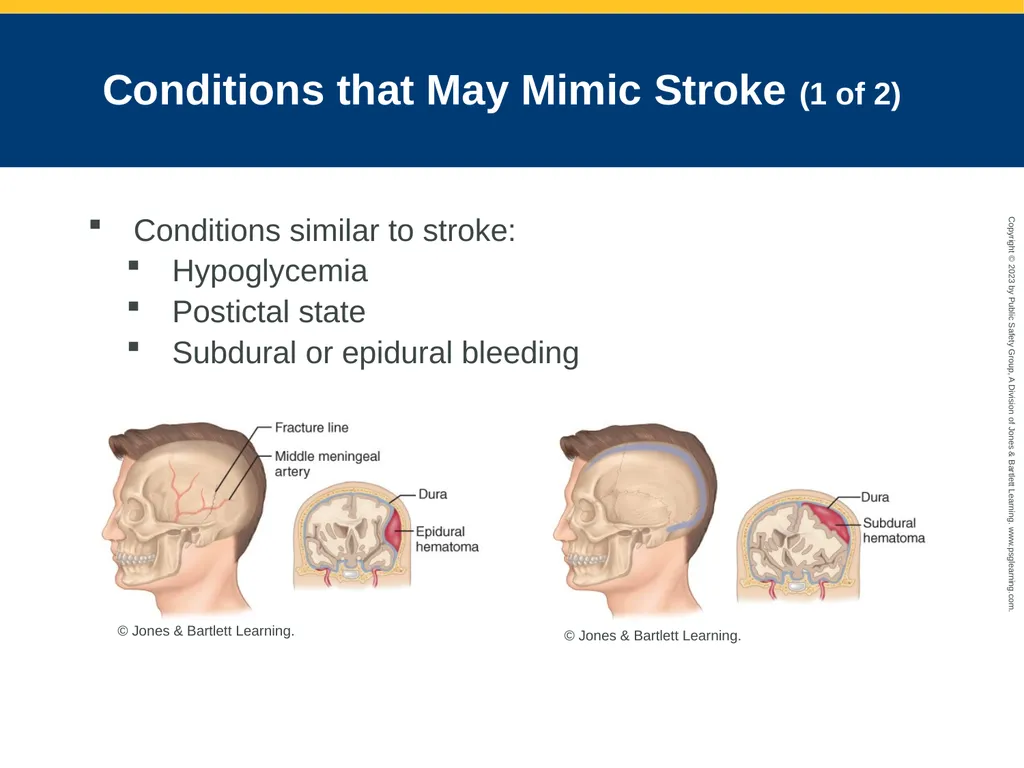
Conditions that May Mimic Stroke (1 of 2) Conditions similar to stroke:
Hypoglycemia
Postictal state
Subdural or epidural bleeding © Jones & Bartlett Learning. © Jones & Bartlett Learning.<br>
Hypoglycemia
Postictal state
Subdural or epidural bleeding © Jones & Bartlett Learning. © Jones & Bartlett Learning.<br>
27
Conditions that May Mimic Stroke (2 of 2) Subdural bleeding and epidural bleeding usually occur as results of trauma.
Onset of strokelike signs and symptoms may be subtle.<br>
Onset of strokelike signs and symptoms may be subtle.<br>
28
Seizures (1 of 10) Sudden, erratic firings of neurons
Patients experience a wide array of signs and symptoms.
Can be limited to one hand shaking or a metallic taste in the mouth, or involve the movement of every limb or complete loss of consciousness<br>
Patients experience a wide array of signs and symptoms.
Can be limited to one hand shaking or a metallic taste in the mouth, or involve the movement of every limb or complete loss of consciousness<br>
29
Seizures (2 of 10) Types of seizures
Generalized or focal
Tonic-clonic seizures
Pseudoseizures
Absence seizures
Status epilepticus<br>
Generalized or focal
Tonic-clonic seizures
Pseudoseizures
Absence seizures
Status epilepticus<br>
30
Seizures (3 of 10) Tonic-clonic seizures
Aura
Loss of responsiveness
Tonic phase
Hypertonic phase
Clonic phase
Postseizure
Postictal phase<br>
Aura
Loss of responsiveness
Tonic phase
Hypertonic phase
Clonic phase
Postseizure
Postictal phase<br>
31
Seizures (4 of 10) Pseudoseizures
Generalized neurologic event
May not notice difference from a generalized seizure
Root cause is of psychiatric origin.
Patient not intentionally causing behavior
Relatively organized motion during seizure<br>
Generalized neurologic event
May not notice difference from a generalized seizure
Root cause is of psychiatric origin.
Patient not intentionally causing behavior
Relatively organized motion during seizure<br>
32
Seizures (5 of 10) Absence seizures
Present with little or no movement
A child is the typical patient.
Classically, child will stop moving.
Usually last no more than several seconds
No postictal period or confusion
Brought on by flashing lights or hyperventilation<br>
Present with little or no movement
A child is the typical patient.
Classically, child will stop moving.
Usually last no more than several seconds
No postictal period or confusion
Brought on by flashing lights or hyperventilation<br>
33
Seizures (6 of 10) Focal seizures
Aware
No change in level of responsiveness
Numbness, weakness, or dizziness
Visual changes and unusual smells or tastes
May cause twitching of muscles and extremities
Impaired-awareness
Altered mental status
Lip smacking, eye blinking, isolated convulsions
Unpleasant smells and visual hallucinations<br>
Aware
No change in level of responsiveness
Numbness, weakness, or dizziness
Visual changes and unusual smells or tastes
May cause twitching of muscles and extremities
Impaired-awareness
Altered mental status
Lip smacking, eye blinking, isolated convulsions
Unpleasant smells and visual hallucinations<br>
34
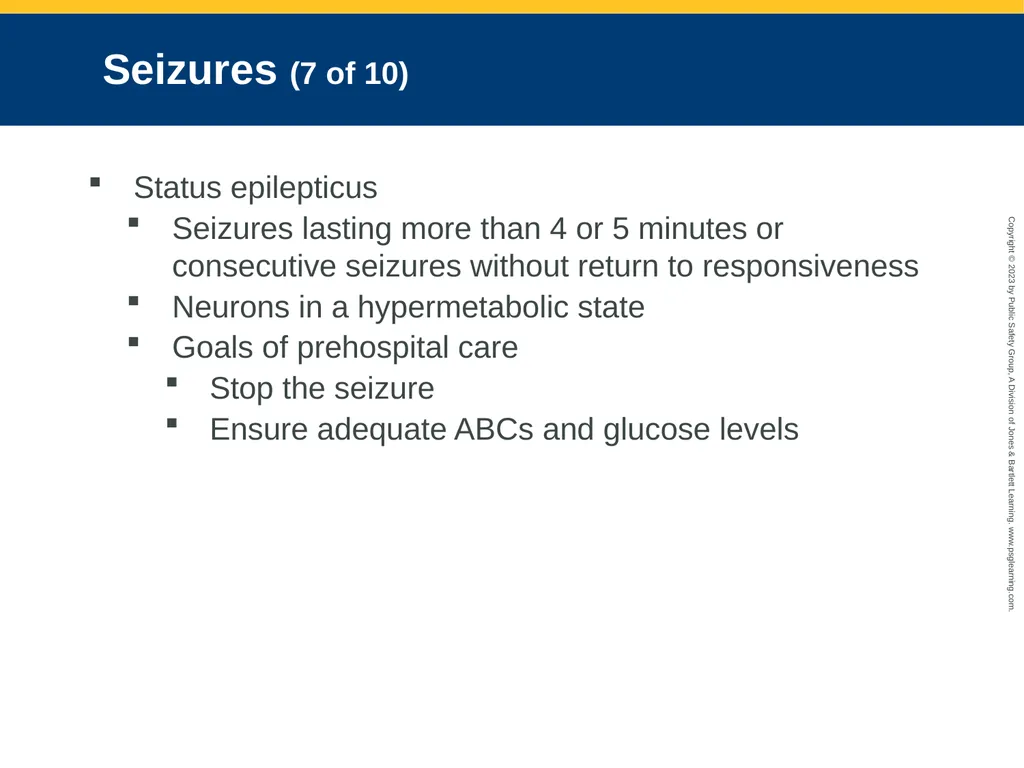
Seizures (7 of 10) Status epilepticus
Seizures lasting more than 4 or 5 minutes or consecutive seizures without return to responsiveness
Neurons in a hypermetabolic state
Goals of prehospital care
Stop the seizure
Ensure adequate ABCs and glucose levels<br>
Seizures lasting more than 4 or 5 minutes or consecutive seizures without return to responsiveness
Neurons in a hypermetabolic state
Goals of prehospital care
Stop the seizure
Ensure adequate ABCs and glucose levels<br>
35
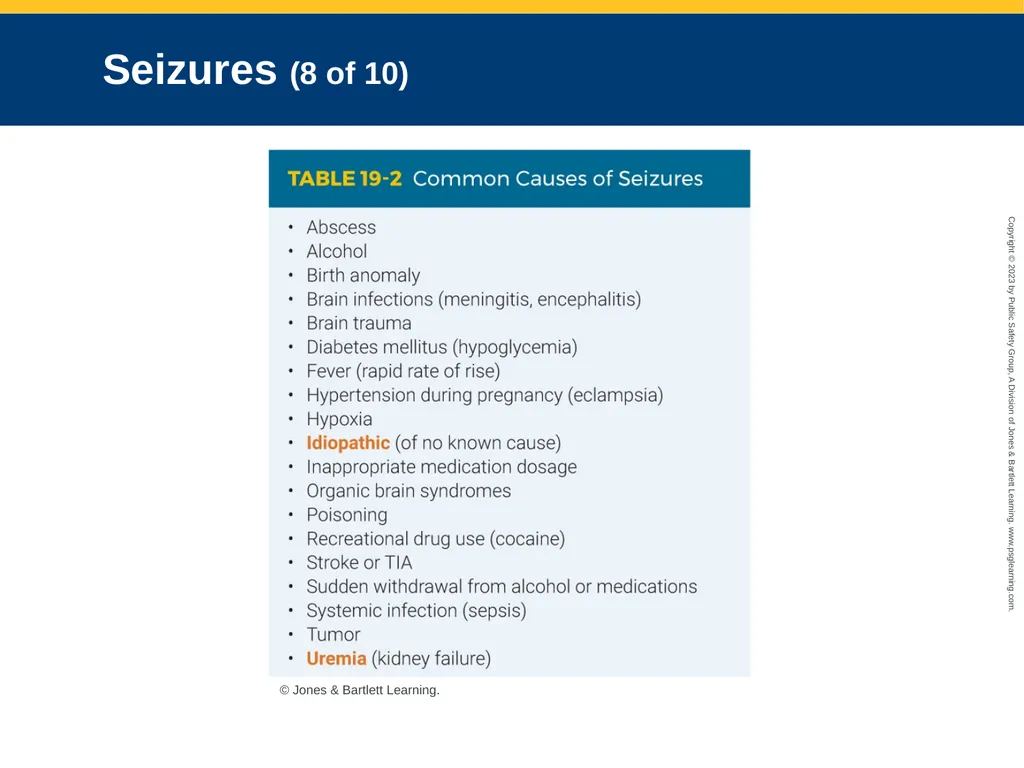
Seizures (8 of 10) © Jones & Bartlett Learning.<br>
36
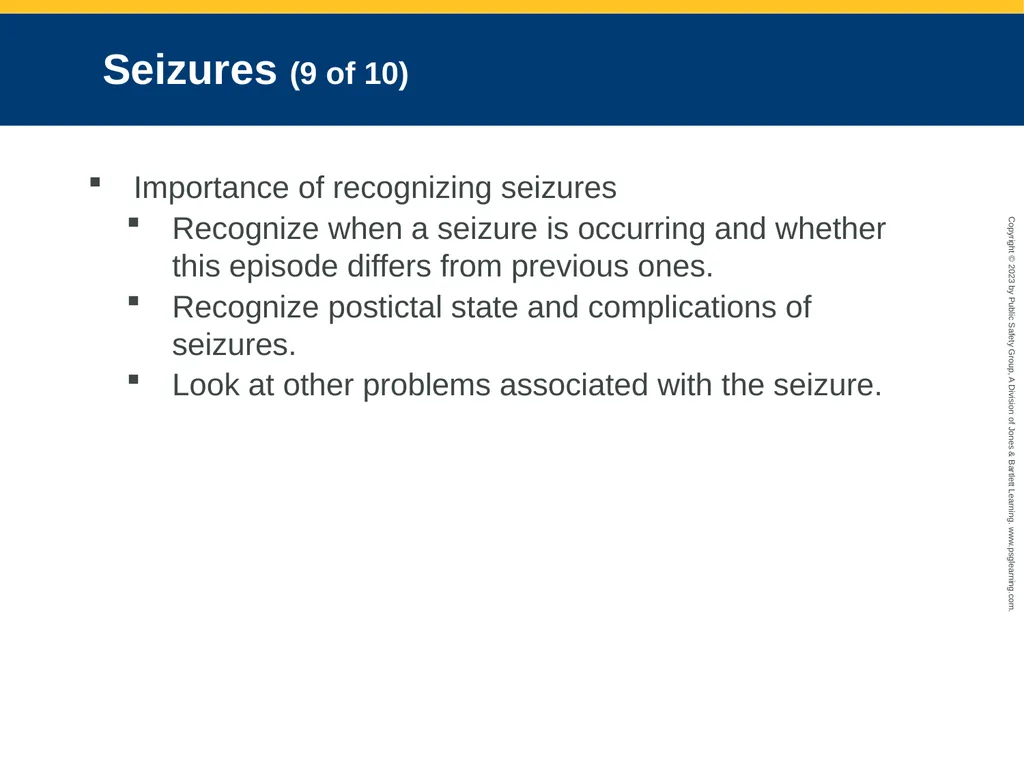
Seizures (9 of 10) Importance of recognizing seizures
Recognize when a seizure is occurring and whether this episode differs from previous ones.
Recognize postictal state and complications of seizures.
Look at other problems associated with the seizure.<br>
Recognize when a seizure is occurring and whether this episode differs from previous ones.
Recognize postictal state and complications of seizures.
Look at other problems associated with the seizure.<br>
37
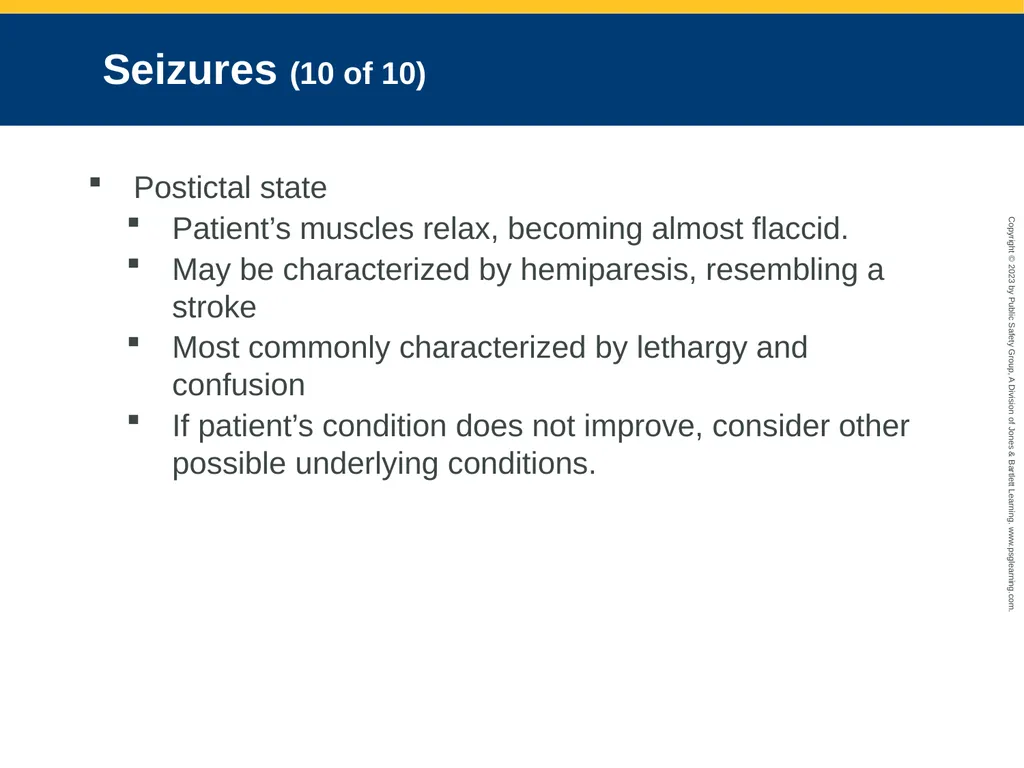
Seizures (10 of 10) Postictal state
Patient’s muscles relax, becoming almost flaccid.
May be characterized by hemiparesis, resembling a stroke
Most commonly characterized by lethargy and confusion
If patient’s condition does not improve, consider other possible underlying conditions.<br>
Patient’s muscles relax, becoming almost flaccid.
May be characterized by hemiparesis, resembling a stroke
Most commonly characterized by lethargy and confusion
If patient’s condition does not improve, consider other possible underlying conditions.<br>
38
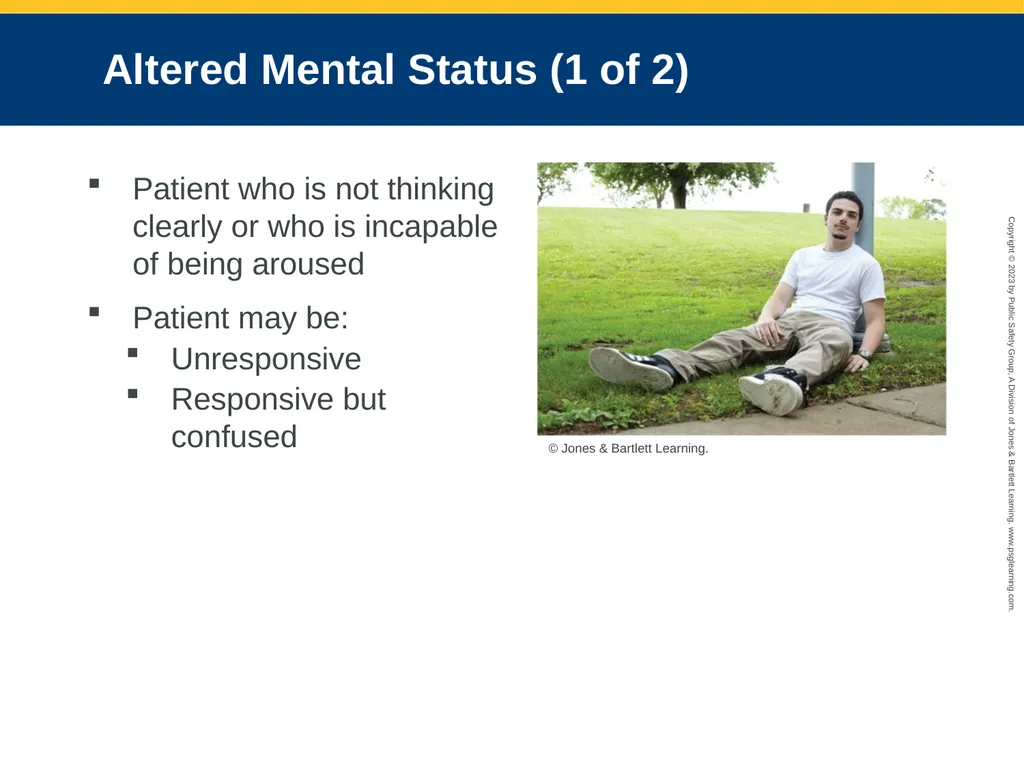
Altered Mental Status (1 of 2) Patient who is not thinking clearly or who is incapable of being aroused
Patient may be:
Unresponsive
Responsive but confused © Jones & Bartlett Learning.<br>
Patient may be:
Unresponsive
Responsive but confused © Jones & Bartlett Learning.<br>
39
Altered Mental Status (2 of 2) Causes include:
Hypoglycemia, hypoxia
Hypoxemia
Brain infection
Body temperature abnormalities
Unrecognized head injury
Severe alcohol or drug intoxication
Psychological causes and adverse effects of medications<br>
Hypoglycemia, hypoxia
Hypoxemia
Brain infection
Body temperature abnormalities
Unrecognized head injury
Severe alcohol or drug intoxication
Psychological causes and adverse effects of medications<br>
40
Syncope (1 of 2) Fainting
Sudden and temporary loss of consciousness with accompanying loss of postural tone
Can be a sign of life-threatening cardiac dysrhythmia, stroke, or other serious medical condition<br>
Sudden and temporary loss of consciousness with accompanying loss of postural tone
Can be a sign of life-threatening cardiac dysrhythmia, stroke, or other serious medical condition<br>
41
Syncope (2 of 2) Potential causes:
Problems with cardiac rhythm or conduction
Problems with cardiac muscle
Myocardial infarction
Dehydration
Hypoglycemia
Vasovagal episode<br>
Problems with cardiac rhythm or conduction
Problems with cardiac muscle
Myocardial infarction
Dehydration
Hypoglycemia
Vasovagal episode<br>
42
Headache Tension headaches
Caused by residual muscle contractions within the face and head
Attributed to stress, cortisol levels, depression
Migraine
Thought to be caused by instability within clusters of neurons and changes in blood vessel size
Cluster headaches
Rare vascular headaches that occur in groups<br>
Caused by residual muscle contractions within the face and head
Attributed to stress, cortisol levels, depression
Migraine
Thought to be caused by instability within clusters of neurons and changes in blood vessel size
Cluster headaches
Rare vascular headaches that occur in groups<br>
43
Patient Assessment Brain is very sensitive to fluctuating levels of oxygen, glucose, and temperature.
Key to identifying a neurologic problem is to look for both obvious and subtle changes.<br>
Key to identifying a neurologic problem is to look for both obvious and subtle changes.<br>
44
Scene Size-Up Take standard precautions.
Consider MOI or history of present illness.
If the nearest stroke center is more than 1 hour away, request air medical transport.<br>
Consider MOI or history of present illness.
If the nearest stroke center is more than 1 hour away, request air medical transport.<br>
45
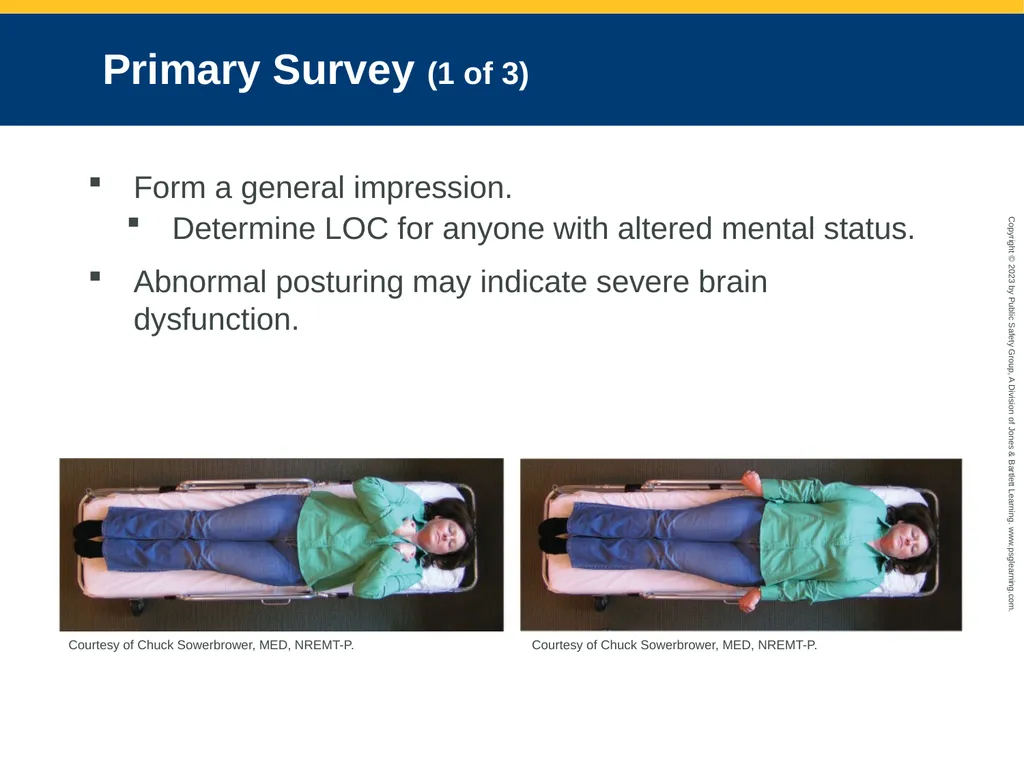
Primary Survey (1 of 3) Form a general impression.
Determine LOC for anyone with altered mental status.
Abnormal posturing may indicate severe brain dysfunction. Courtesy of Chuck Sowerbrower, MED, NREMT-P. Courtesy of Chuck Sowerbrower, MED, NREMT-P.<br>
Determine LOC for anyone with altered mental status.
Abnormal posturing may indicate severe brain dysfunction. Courtesy of Chuck Sowerbrower, MED, NREMT-P. Courtesy of Chuck Sowerbrower, MED, NREMT-P.<br>
46
Primary Survey (2 of 3) Focus on airway and breathing on arrival.
Evaluate the airway for patency.
Provide suction and position the patient to prevent aspiration.
Provide ventilatory support at 10 to 12 breaths/min.
Circulation
If no pulse is found, immediately begin cardiopulmonary resuscitation.<br>
Evaluate the airway for patency.
Provide suction and position the patient to prevent aspiration.
Provide ventilatory support at 10 to 12 breaths/min.
Circulation
If no pulse is found, immediately begin cardiopulmonary resuscitation.<br>
47
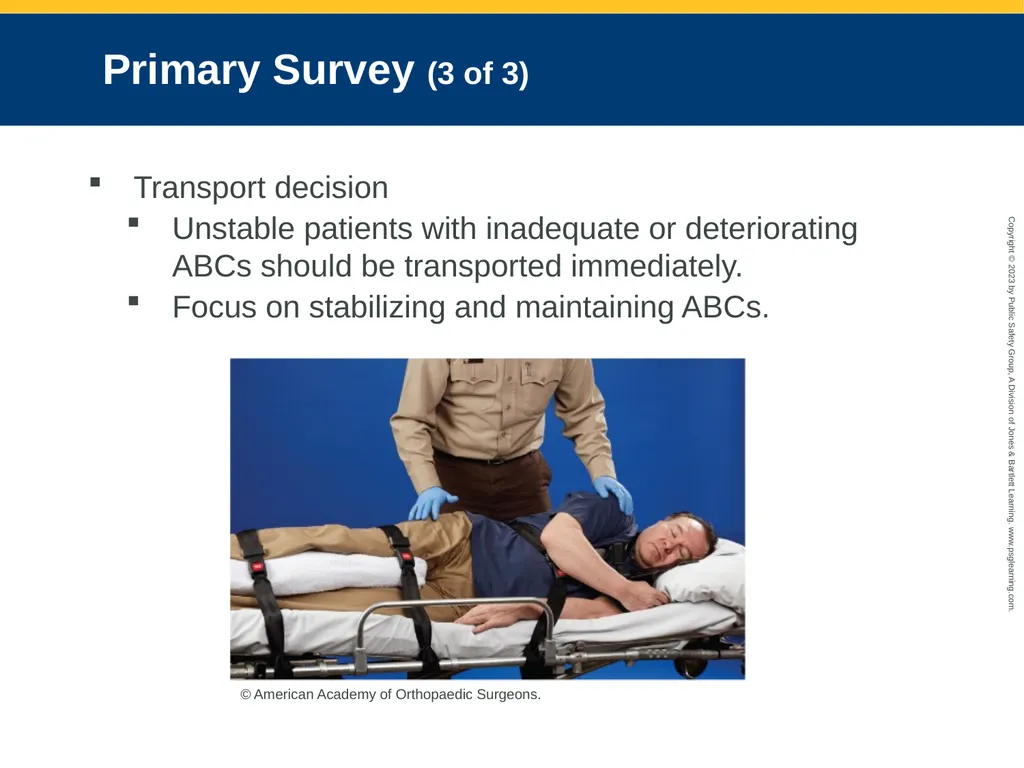
Primary Survey (3 of 3) Transport decision
Unstable patients with inadequate or deteriorating ABCs should be transported immediately.
Focus on stabilizing and maintaining ABCs. © American Academy of Orthopaedic Surgeons.<br>
Unstable patients with inadequate or deteriorating ABCs should be transported immediately.
Focus on stabilizing and maintaining ABCs. © American Academy of Orthopaedic Surgeons.<br>
48
History Taking Investigate the chief complaint.
Obtain history from patients in stable condition.
If the patient is unresponsive, gather any history of the present illness from family or bystanders.
Evaluate patient’s speech.
Look for any obvious trauma.
Obtain a SAMPLE history.<br>
Obtain history from patients in stable condition.
If the patient is unresponsive, gather any history of the present illness from family or bystanders.
Evaluate patient’s speech.
Look for any obvious trauma.
Obtain a SAMPLE history.<br>
49
Secondary Assessment Perform as soon as possible.
Look for potential causes of neurologic signs and symptoms.
Assess for injuries.
Rapid identification of a stroke is imperative.
Use common stroke assessment tools.<br>
Look for potential causes of neurologic signs and symptoms.
Assess for injuries.
Rapid identification of a stroke is imperative.
Use common stroke assessment tools.<br>
50
Reassessment (1 of 2) Routine monitoring should include:
Heart rate
Blood pressure
Respiratory rate and pattern
Pulse oximetry and/or ETCO2
Glucose level monitoring
GCS scores<br>
Heart rate
Blood pressure
Respiratory rate and pattern
Pulse oximetry and/or ETCO2
Glucose level monitoring
GCS scores<br>
51
Reassessment (2 of 2) Provide emotional support.
Notify the receiving facility of your patient’s chief complaint and your assessment findings.
Document your findings and interventions.<br>
Notify the receiving facility of your patient’s chief complaint and your assessment findings.
Document your findings and interventions.<br>
52
Emergency Medical Care (1 of 8) Best treatment is determined by performing thorough assessment and maintaining the ABCs.
Medications available for prehospital treatment of hypoglycemia
Dextrose
Glucagon<br>
Medications available for prehospital treatment of hypoglycemia
Dextrose
Glucagon<br>
53
Emergency Medical Care (2 of 8) Hypoglycemia is more lethal than hyperglycemia.
Ensure that the IV line is patent before you attempt to give the D50.
Ensure patients do not aspirate.
No safe way to lower a high blood glucose level in the field<br>
Ensure that the IV line is patent before you attempt to give the D50.
Ensure patients do not aspirate.
No safe way to lower a high blood glucose level in the field<br>
54
Emergency Medical Care (3 of 8) Stroke
Assume that a patient with TIA or stroke symptoms is experiencing a stroke.
Administer supplemental oxygen.
Establish IV access, and obtain blood samples.
Elevate the patient’s head 30º.
Ensure that the airway is clear.
Watch for seizures and call early for paramedic backup.<br>
Assume that a patient with TIA or stroke symptoms is experiencing a stroke.
Administer supplemental oxygen.
Establish IV access, and obtain blood samples.
Elevate the patient’s head 30º.
Ensure that the airway is clear.
Watch for seizures and call early for paramedic backup.<br>
55
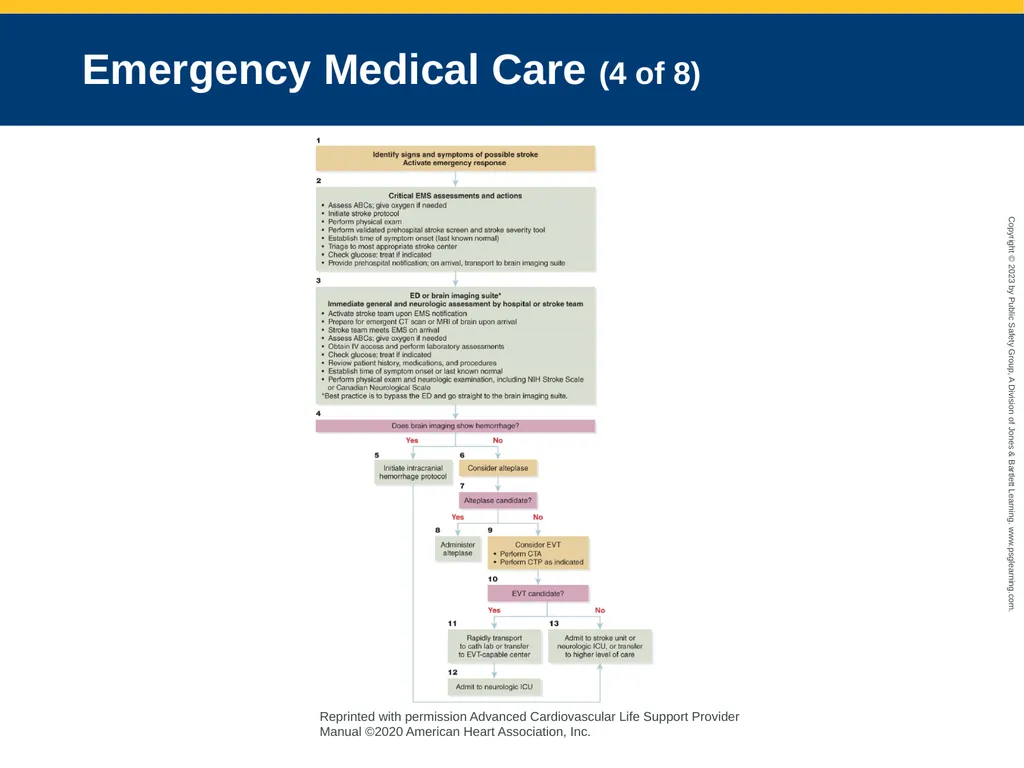
Emergency Medical Care (4 of 8) Reprinted with permission Advanced Cardiovascular Life Support Provider Manual ©2020 American Heart Association, Inc.<br>
56
Emergency Medical Care (5 of 8) Transient ischemic attack
Follow same management guidelines as for stroke.
Close neurologic assessment is needed.
Reinforce that TIA is a warning sign of a serious or potentially deadly problem.<br>
Follow same management guidelines as for stroke.
Close neurologic assessment is needed.
Reinforce that TIA is a warning sign of a serious or potentially deadly problem.<br>
57
Emergency Medical Care (6 of 8) Seizures
Patients require definitive evaluation and treatment at the hospital.
Administer oxygen.
Suction the airway, provide positive-pressure ventilations, and transport quickly.
Gain IV access as a medication route even if fluid resuscitation is not needed.<br>
Patients require definitive evaluation and treatment at the hospital.
Administer oxygen.
Suction the airway, provide positive-pressure ventilations, and transport quickly.
Gain IV access as a medication route even if fluid resuscitation is not needed.<br>
58
Emergency Medical Care (7 of 8) Syncope
Determine whether the patient experienced trauma during the fall.
Take cervical spine precautions as needed.
Focus on blood glucose level and likely cardiac causes.
Provide supplemental oxygen; gain IV access.
Provide fluids as appropriate.
Syncope can be a sign of life-threatening medical conditions.<br>
Determine whether the patient experienced trauma during the fall.
Take cervical spine precautions as needed.
Focus on blood glucose level and likely cardiac causes.
Provide supplemental oxygen; gain IV access.
Provide fluids as appropriate.
Syncope can be a sign of life-threatening medical conditions.<br>
59
Emergency Medical Care (8 of 8) Headache
Can indicate a serious problem
Give standard care.
Ask patients about medications taken.
Do not use lights or sirens if transporting.<br>
Can indicate a serious problem
Give standard care.
Ask patients about medications taken.
Do not use lights or sirens if transporting.<br>