Neutrinos in multimessanger astronomy solution for exercises 15th International Neutrino Summer School 2024 Maurizio Spurio, maurizio.spuriounibo.it Università di Bologna and INFN M. Spurio -Neutrinos in multimessanger astronomy-XV INSS24
"Neutrinos in multimessanger astronomy solution for" is the property of its rightful owner. Permission is granted to
download and print the materials on this website for personal, non-commercial use only, and to display it
on your personal computer provided you do not modify the materials and that you retain all copyright
notices contained in the materials. By downloading content from our website, you accept the terms of this
agreement.
Presentation Transcript
01
Neutrinos in multimessanger astronomy solution for exercises 15th International Neutrino Summer School 2024 Maurizio Spurio, maurizio.spurio@unibo.it
Università di Bologna and INFN M. Spurio -Neutrinos in multimessanger astronomy-XV INSS24 1<br>
02
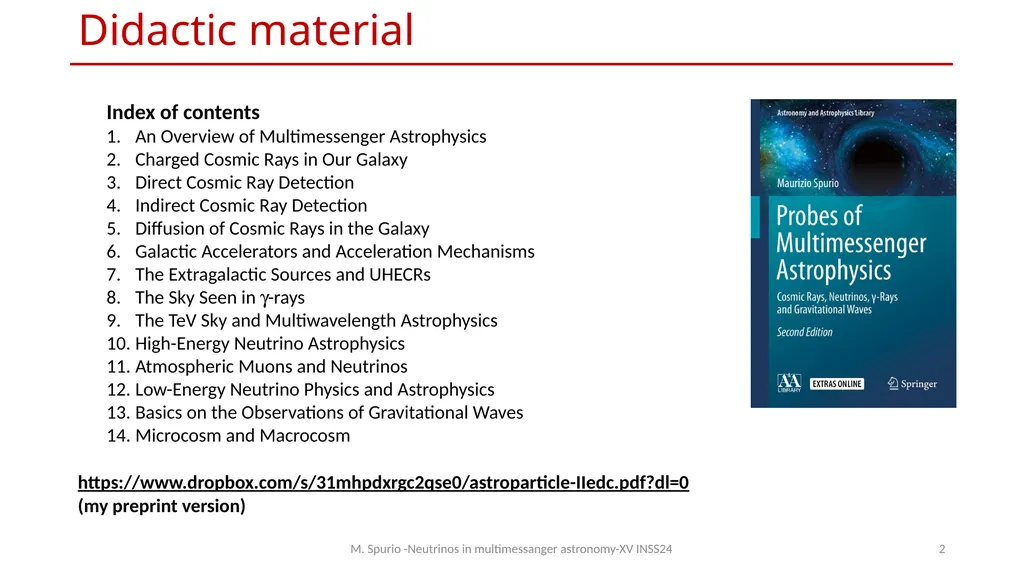
Didactic material Index of contents
An Overview of Multimessenger Astrophysics
Charged Cosmic Rays in Our Galaxy
Direct Cosmic Ray Detection
Indirect Cosmic Ray Detection
Diffusion of Cosmic Rays in the Galaxy
Galactic Accelerators and Acceleration Mechanisms
The Extragalactic Sources and UHECRs
The Sky Seen in g-rays
The TeV Sky and Multiwavelength Astrophysics
High-Energy Neutrino Astrophysics
Atmospheric Muons and Neutrinos
Low-Energy Neutrino Physics and Astrophysics
Basics on the Observations of Gravitational Waves
Microcosm and Macrocosm M. Spurio -Neutrinos in multimessanger astronomy-XV INSS24 2 https://www.dropbox.com/s/31mhpdxrgc2qse0/astroparticle-IIedc.pdf?dl=0 (my preprint version)<br>
03
Answers to exercises and discussion arguments M. Spurio -Neutrinos in multimessanger astronomy-XV INSS24 3<br>
04
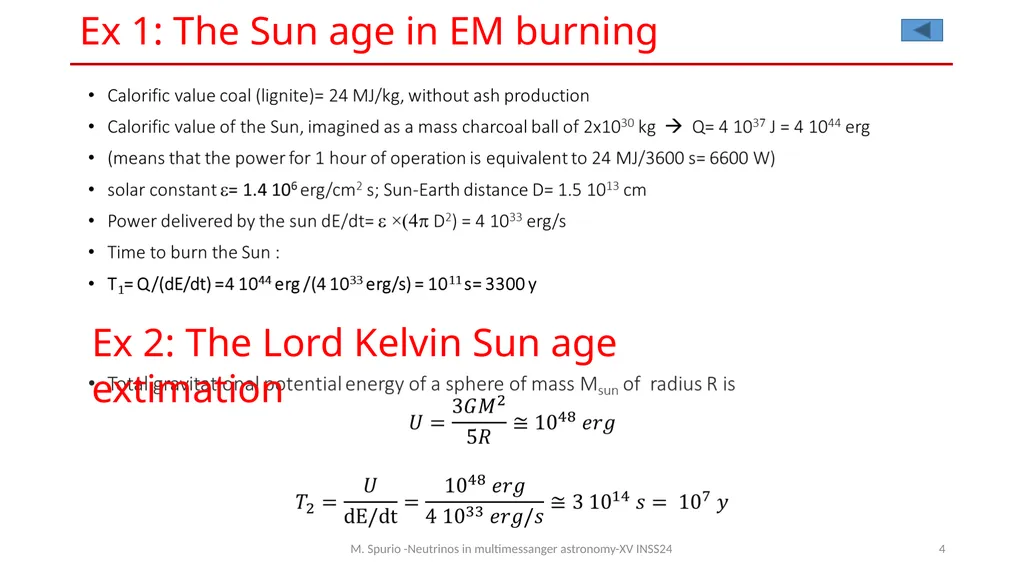
Ex 1: The Sun age in EM burning Ex 2: The Lord Kelvin Sun age extimation 4 M. Spurio -Neutrinos in multimessanger astronomy-XV INSS24<br>
05
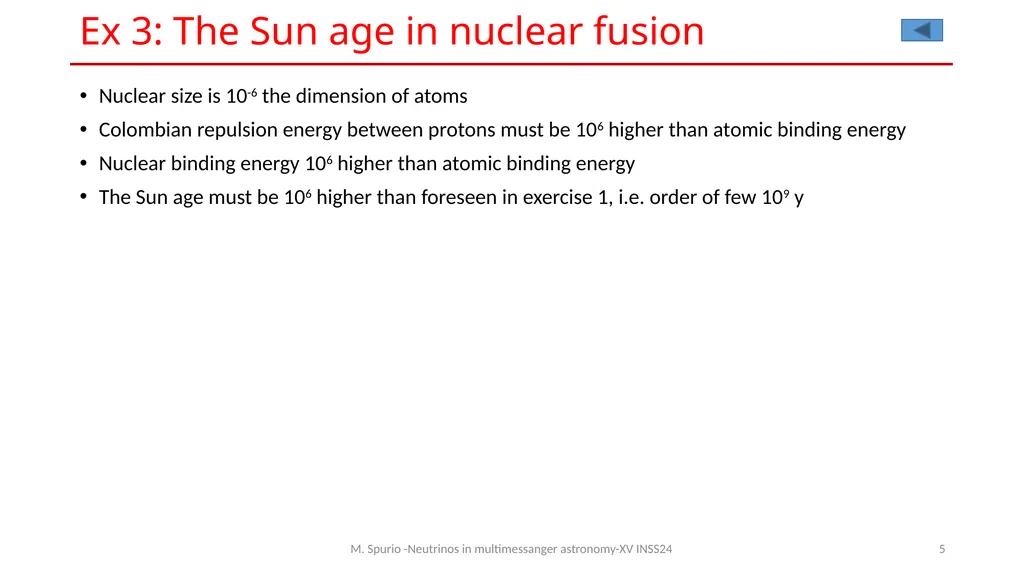
Ex 3: The Sun age in nuclear fusion Nuclear size is 10-6 the dimension of atoms
Colombian repulsion energy between protons must be 106 higher than atomic binding energy
Nuclear binding energy 106 higher than atomic binding energy
The Sun age must be 106 higher than foreseen in exercise 1, i.e. order of few 109 y 5 M. Spurio -Neutrinos in multimessanger astronomy-XV INSS24<br>
06
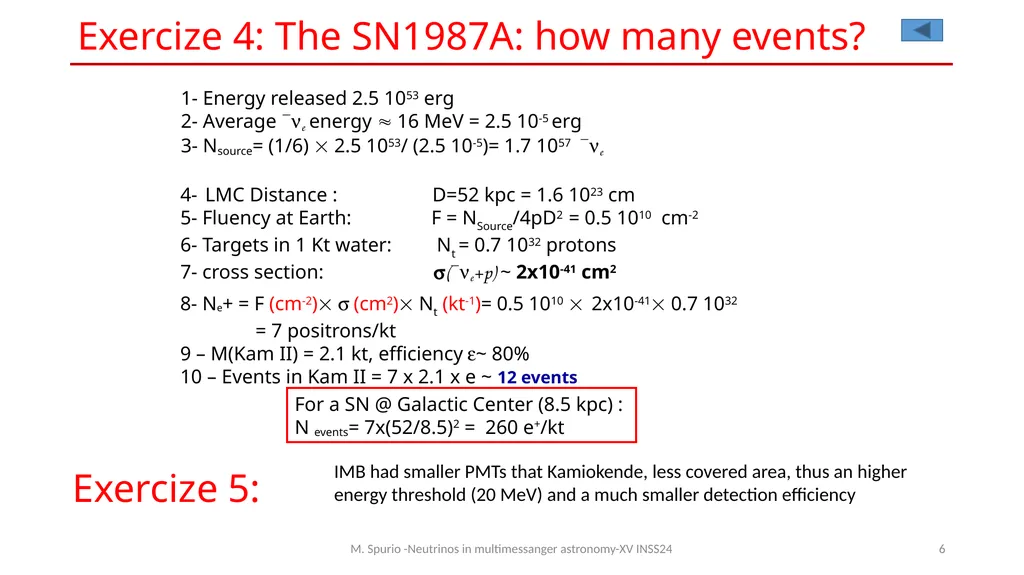
Exercize 4: The SN1987A: how many events? 1- Energy released 2.5 1053 erg
2- Average ne energy 16 MeV = 2.5 10-5 erg
3- Nsource= (1/6) 2.5 1053/ (2.5 10-5)= 1.7 1057 ne 4- LMC Distance : D=52 kpc = 1.6 1023 cm
5- Fluency at Earth: F = NSource/4pD2 = 0.5 1010 cm-2
6- Targets in 1 Kt water: Nt = 0.7 1032 protons
7- cross section: s(ne+p) ~ 2x10-41 cm2 8- Ne+ = F (cm-2) s (cm2) Nt (kt-1)= 0.5 1010 2x10-41 0.7 1032
= 7 positrons/kt
9 – M(Kam II) = 2.1 kt, efficiency e~ 80%
10 – Events in Kam II = 7 x 2.1 x e ~ 12 events For a SN @ Galactic Center (8.5 kpc) :
N events= 7x(52/8.5)2 = 260 e+/kt Exercize 5: IMB had smaller PMTs that Kamiokende, less covered area, thus an higher energy threshold (20 MeV) and a much smaller detection efficiency 6 M. Spurio -Neutrinos in multimessanger astronomy-XV INSS24<br>
07
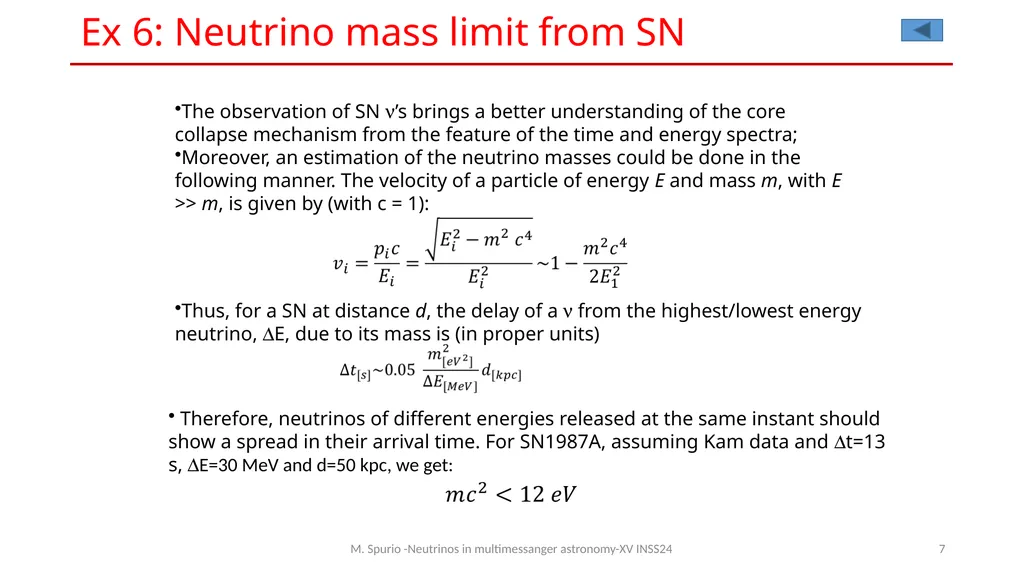
The observation of SN n’s brings a better understanding of the core collapse mechanism from the feature of the time and energy spectra;
Moreover, an estimation of the neutrino masses could be done in the following manner. The velocity of a particle of energy E and mass m, with E >> m, is given by (with c = 1): Thus, for a SN at distance d, the delay of a n from the highest/lowest energy neutrino, DE, due to its mass is (in proper units) Therefore, neutrinos of different energies released at the same instant should show a spread in their arrival time. For SN1987A, assuming Kam data and Dt=13 s, DE=30 MeV and d=50 kpc, we get: Ex 6: Neutrino mass limit from SN 7 M. Spurio -Neutrinos in multimessanger astronomy-XV INSS24<br>
08
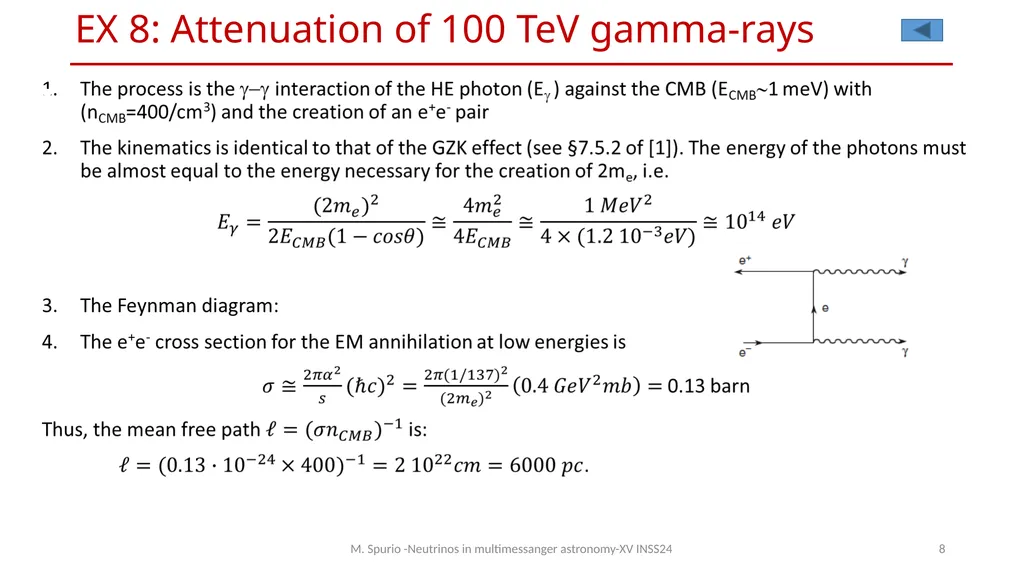
EX 8: Attenuation of 100 TeV gamma-rays M. Spurio -Neutrinos in multimessanger astronomy-XV INSS24 8<br>
09
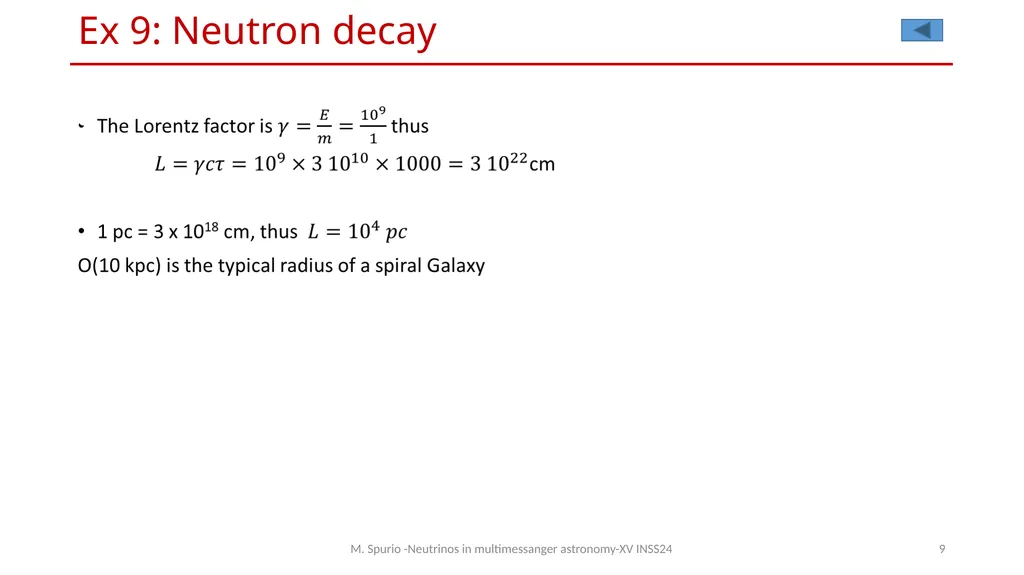
Ex 9: Neutron decay M. Spurio -Neutrinos in multimessanger astronomy-XV INSS24 9<br>
10
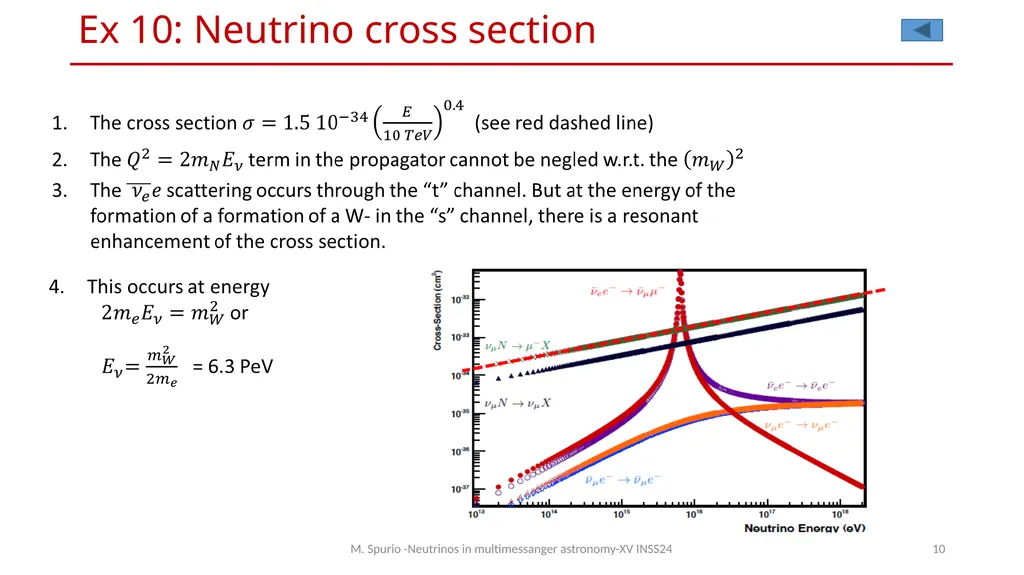
Ex 10: Neutrino cross section M. Spurio -Neutrinos in multimessanger astronomy-XV INSS24 10<br>
11
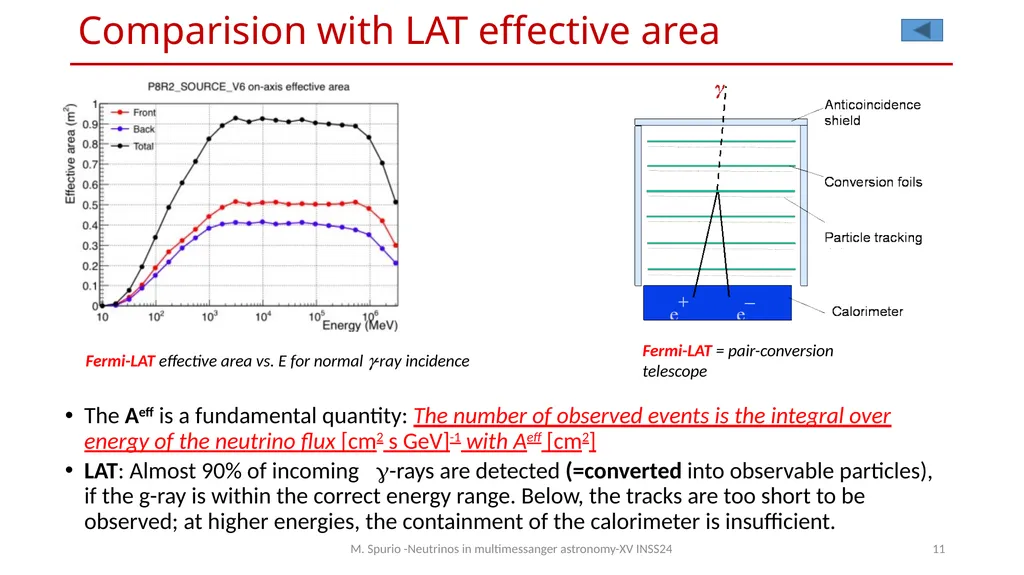
Comparision with LAT effective area The Aeff is a fundamental quantity: The number of observed events is the integral over energy of the neutrino flux [cm2 s GeV]-1 with Aeff [cm2]
LAT: Almost 90% of incoming -rays are detected (=converted into observable particles), if the g-ray is within the correct energy range. Below, the tracks are too short to be observed; at higher energies, the containment of the calorimeter is insufficient. Fermi-LAT effective area vs. E for normal g-ray incidence Fermi-LAT = pair-conversion telescope M. Spurio -Neutrinos in multimessanger astronomy-XV INSS24 11<br>
12
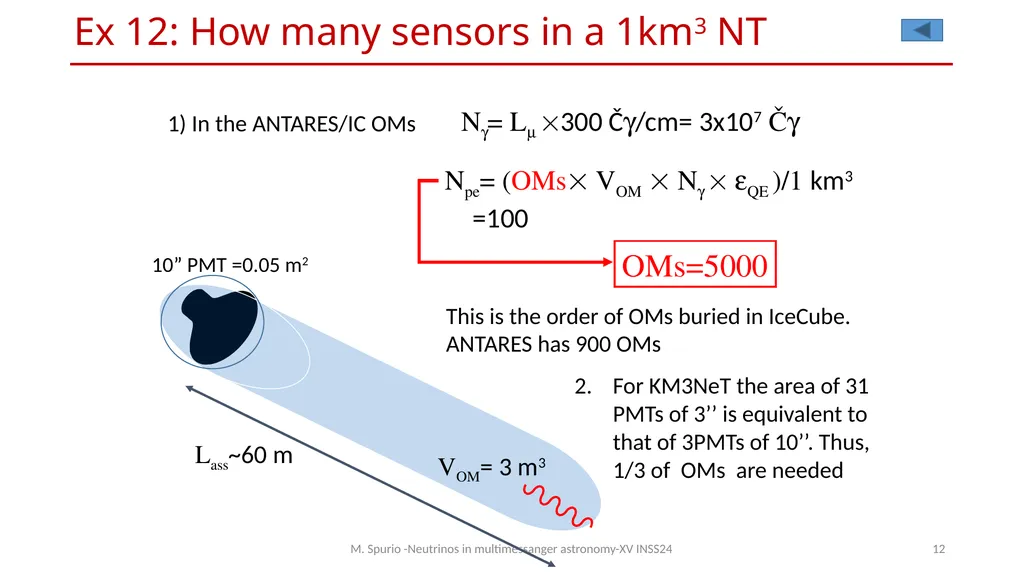
Ex 12: How many sensors in a 1km3 NT 10” PMT =0.05 m2 Lass~60 m VOM= 3 m3 Npe= (OMs VOM Ng eQE )/1 km3
=100 Ng= Lm 300 Čg/cm= 3x10⁷ Čg OMs=5000 This is the order of OMs buried in IceCube. ANTARES has 900 OMs 1) In the ANTARES/IC OMs For KM3NeT the area of 31 PMTs of 3’’ is equivalent to that of 3PMTs of 10’’. Thus, 1/3 of OMs are needed M. Spurio -Neutrinos in multimessanger astronomy-XV INSS24 12<br>
13
M. Spurio -Neutrinos in multimessanger astronomy-XV INSS24 13<br>