
New Clinical Trial Regulation: Information
LS
Published · 52 slides · 0 views

1 / 1

Description
New Clinical Trial Regulation: Information sessions for sponsors March 10, 2023 Regulatory aspects of the implementation of CTR and work in CTIS: updates and clarifications, tips for a smooth validation Anne Lenaers DG PRE authorisation
Related Topics
Share
Embed code
Download this presentation From Below
"New Clinical Trial Regulation: Information" is the property of its rightful owner. Permission is granted to download and print the materials on this website for personal, non-commercial use only, and to display it on your personal computer provided you do not modify the materials and that you retain all copyright notices contained in the materials. By downloading content from our website, you accept the terms of this agreement.
Presentation Transcript
01
New Clinical Trial Regulation: Information sessions for sponsors March 10, 2023 Regulatory aspects of the implementation of CTR and work in CTIS:
updates and clarifications, tips for a smooth validation Anne Lenaers
DG PRE authorisation<br>
updates and clarifications, tips for a smooth validation Anne Lenaers
DG PRE authorisation<br>
02
Overview Introduction to CTR
Clarifications
New information and updates
Regulatory tips for a smooth validation
Answers to some of your questions
Important links<br>
Clarifications
New information and updates
Regulatory tips for a smooth validation
Answers to some of your questions
Important links<br>
03
Overview Introduction to CTR
Clarifications
New information and updates
Regulatory tips for a smooth validation
Answers to some of your questions
Important links<br>
Clarifications
New information and updates
Regulatory tips for a smooth validation
Answers to some of your questions
Important links<br>
04
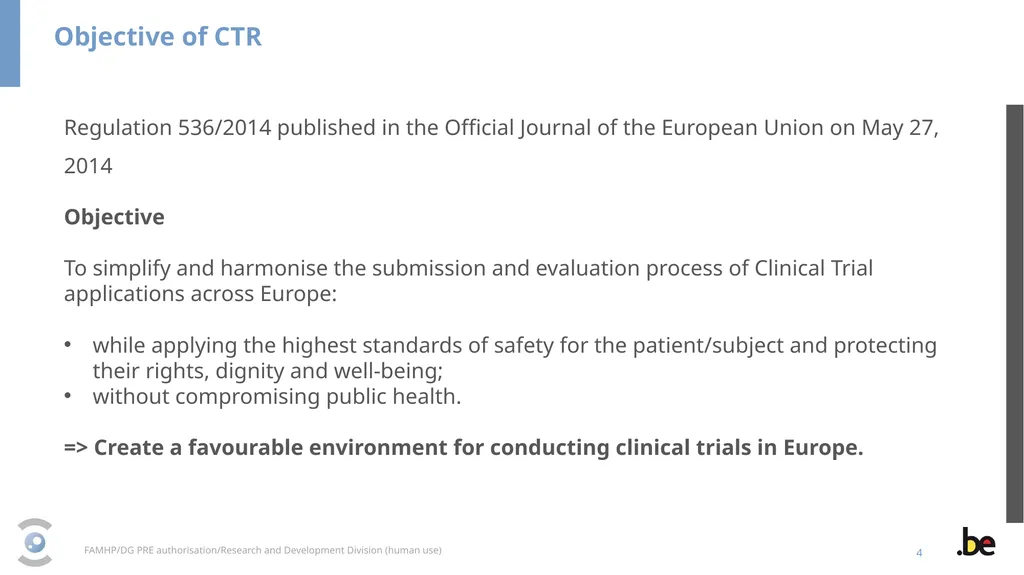
Objective of CTR Regulation 536/2014 published in the Official Journal of the European Union on May 27, 2014
Objective
To simplify and harmonise the submission and evaluation process of Clinical Trial applications across Europe:
while applying the highest standards of safety for the patient/subject and protecting their rights, dignity and well-being;
without compromising public health.
=> Create a favourable environment for conducting clinical trials in Europe.<br>
Objective
To simplify and harmonise the submission and evaluation process of Clinical Trial applications across Europe:
while applying the highest standards of safety for the patient/subject and protecting their rights, dignity and well-being;
without compromising public health.
=> Create a favourable environment for conducting clinical trials in Europe.<br>
05
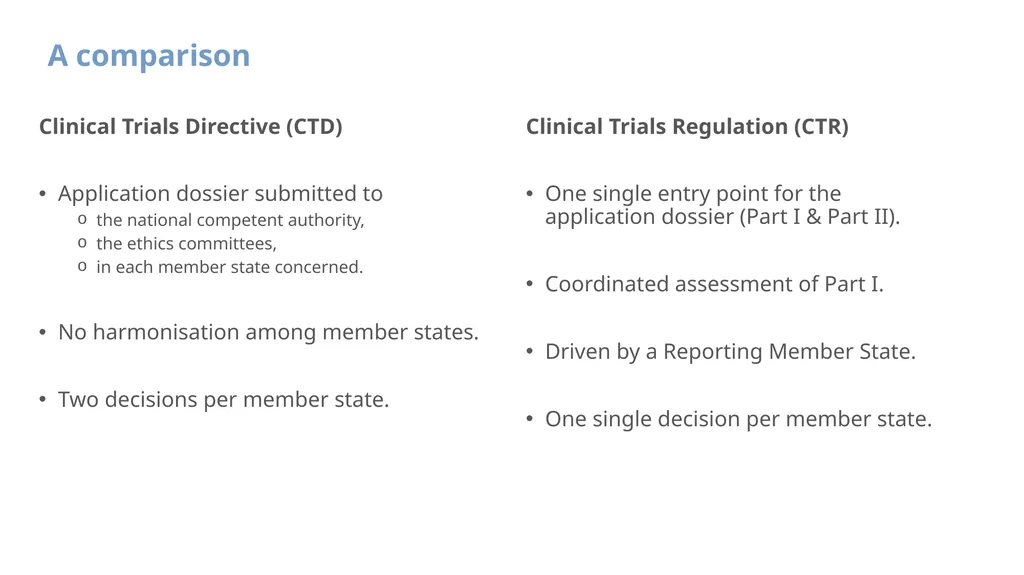
A comparison Clinical Trials Directive (CTD)
Application dossier submitted to
the national competent authority,
the ethics committees,
in each member state concerned.
No harmonisation among member states.
Two decisions per member state. Clinical Trials Regulation (CTR)
One single entry point for the application dossier (Part I & Part II).
Coordinated assessment of Part I.
Driven by a Reporting Member State.
One single decision per member state.<br>
Application dossier submitted to
the national competent authority,
the ethics committees,
in each member state concerned.
No harmonisation among member states.
Two decisions per member state. Clinical Trials Regulation (CTR)
One single entry point for the application dossier (Part I & Part II).
Coordinated assessment of Part I.
Driven by a Reporting Member State.
One single decision per member state.<br>
06
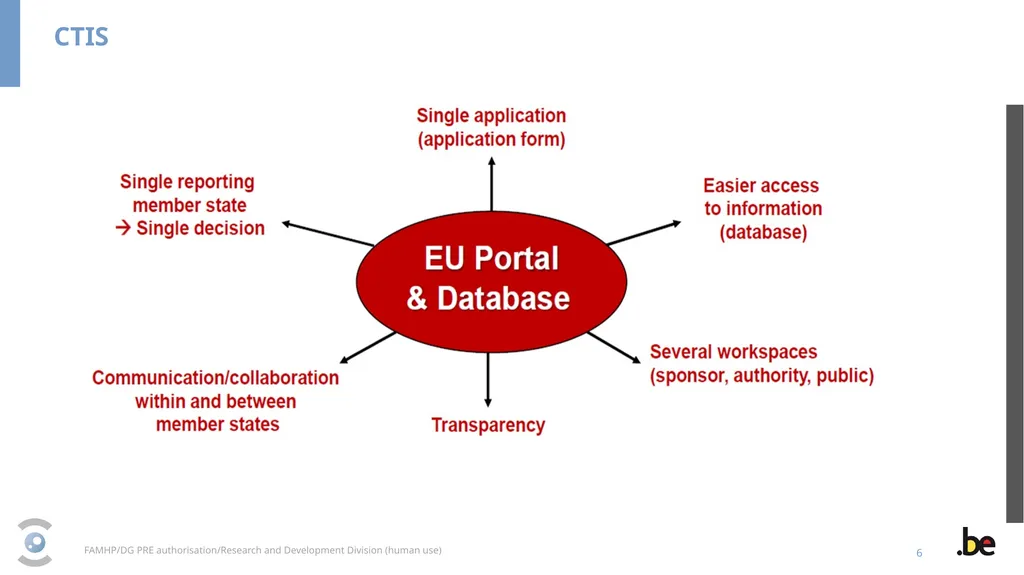
CTIS<br>
07
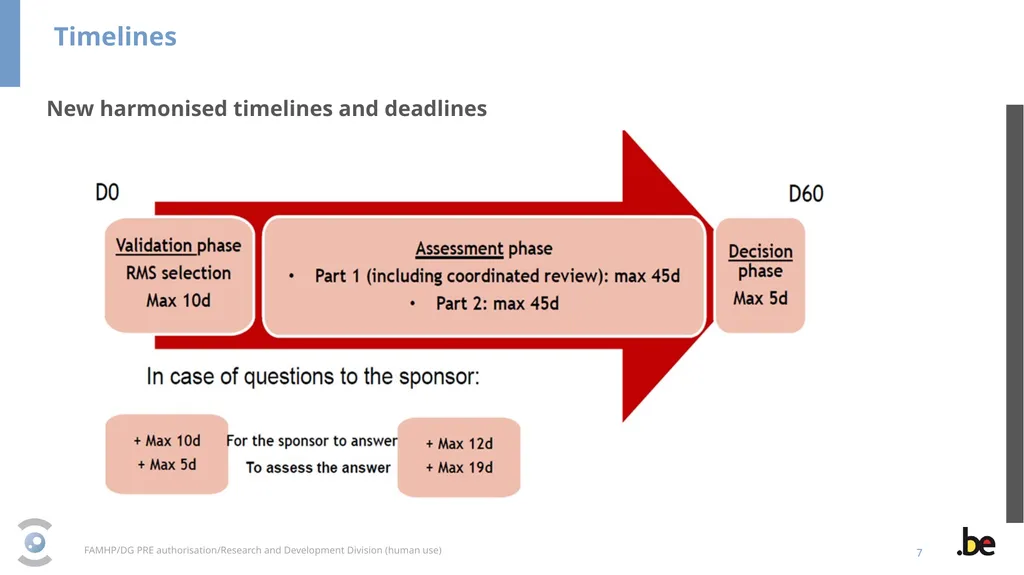
Timelines New harmonised timelines and deadlines<br>
08
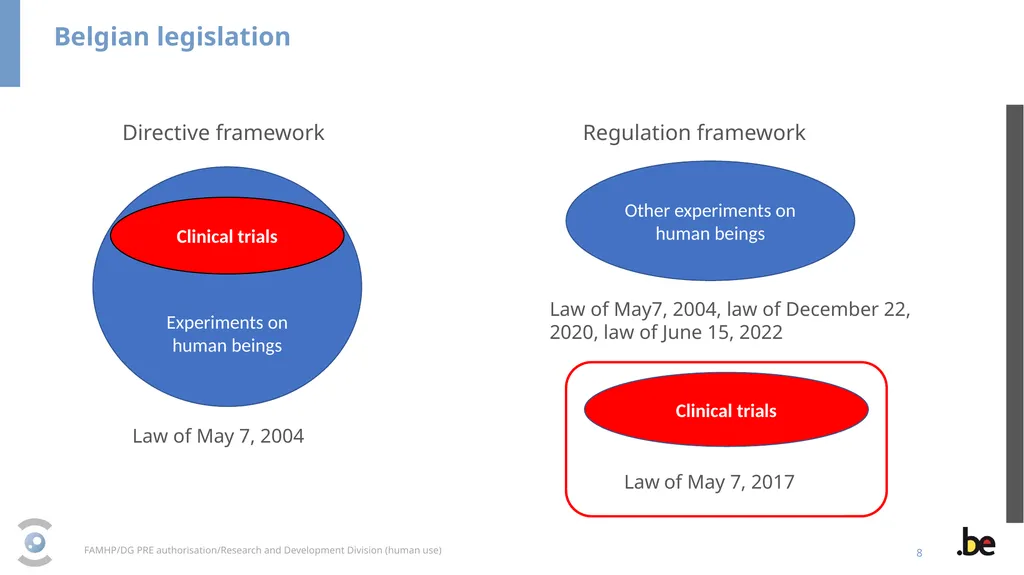
Belgian legislation Directive framework Regulation framework Experiments on human beings Clinical trials Law of May7, 2004, law of December 22, 2020, law of June 15, 2022 Other experiments on human beings Clinical trials Law of May 7, 2004 Law of May 7, 2017<br>
09
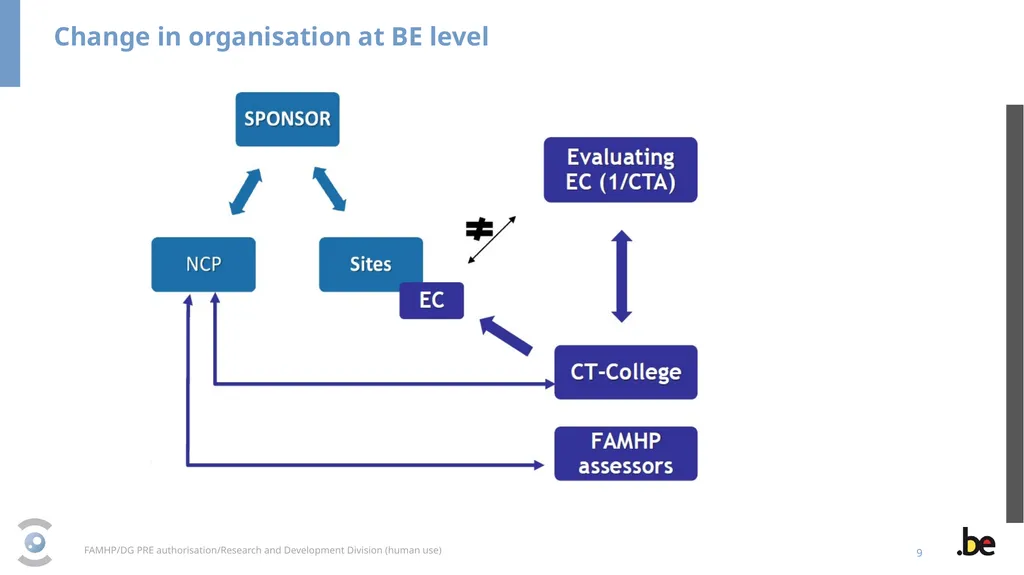
Change in organisation at BE level<br>
10
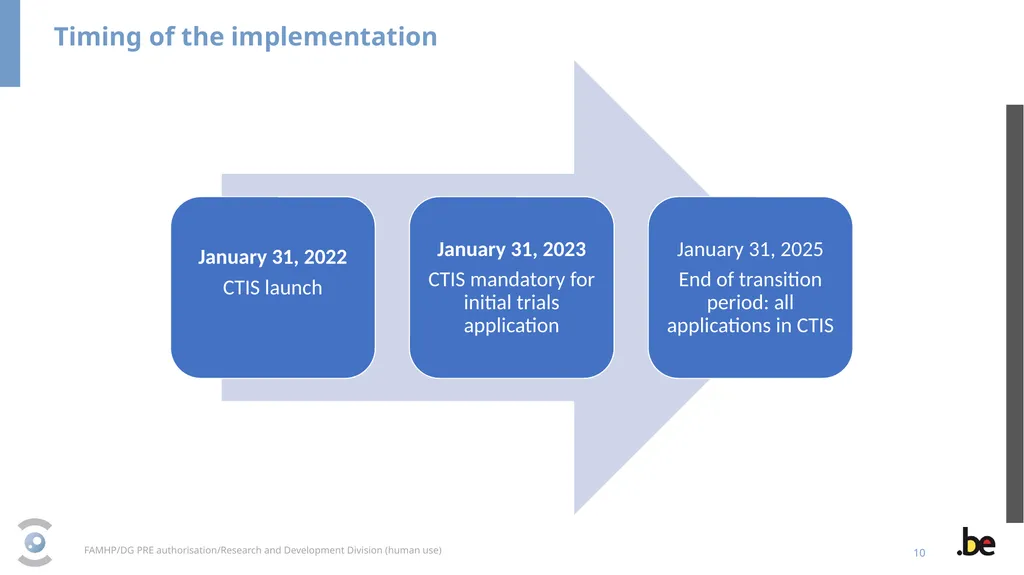
Timing of the implementation<br>
11
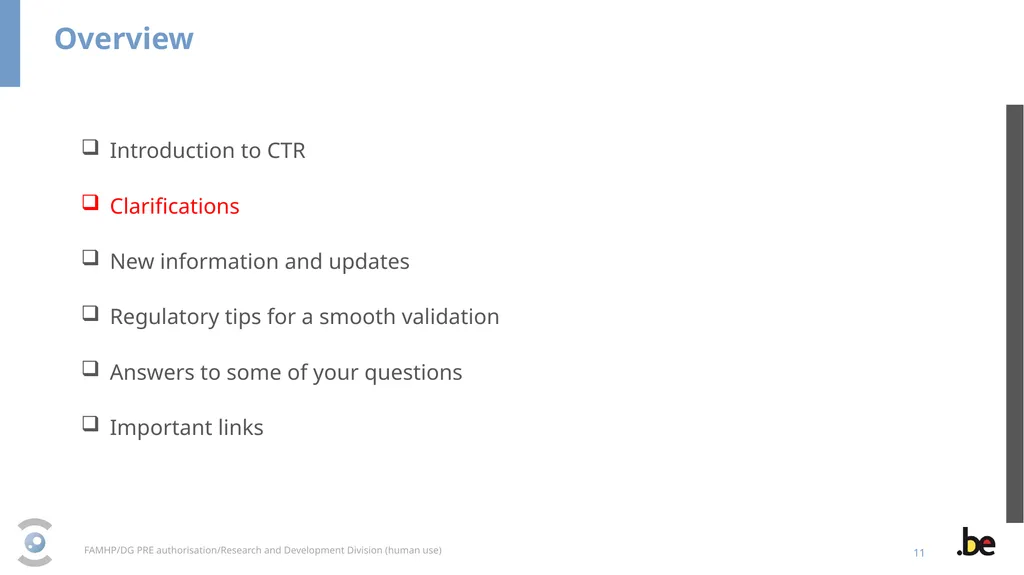
Overview Introduction to CTR
Clarifications
New information and updates
Regulatory tips for a smooth validation
Answers to some of your questions
Important links<br>
Clarifications
New information and updates
Regulatory tips for a smooth validation
Answers to some of your questions
Important links<br>
12
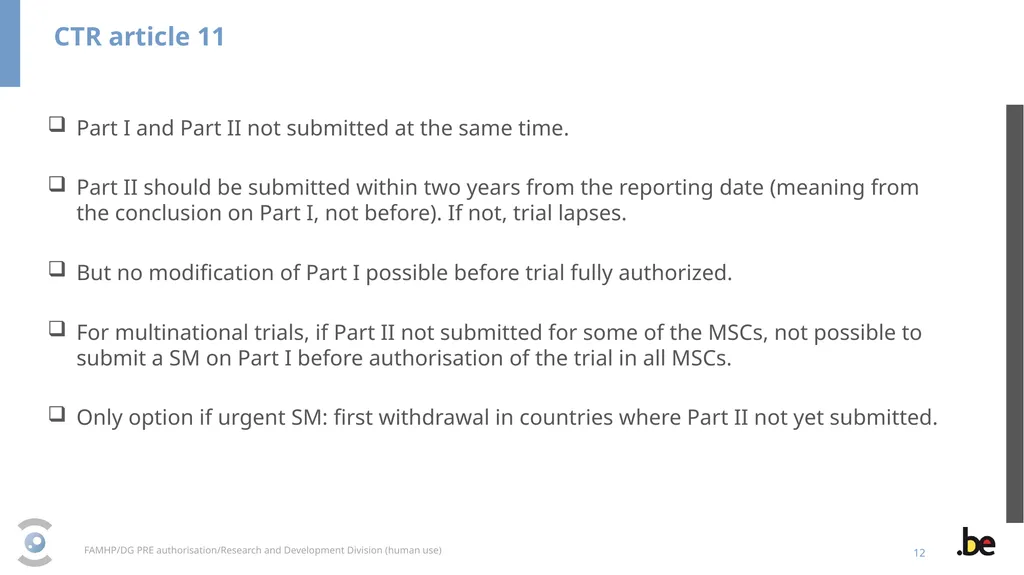
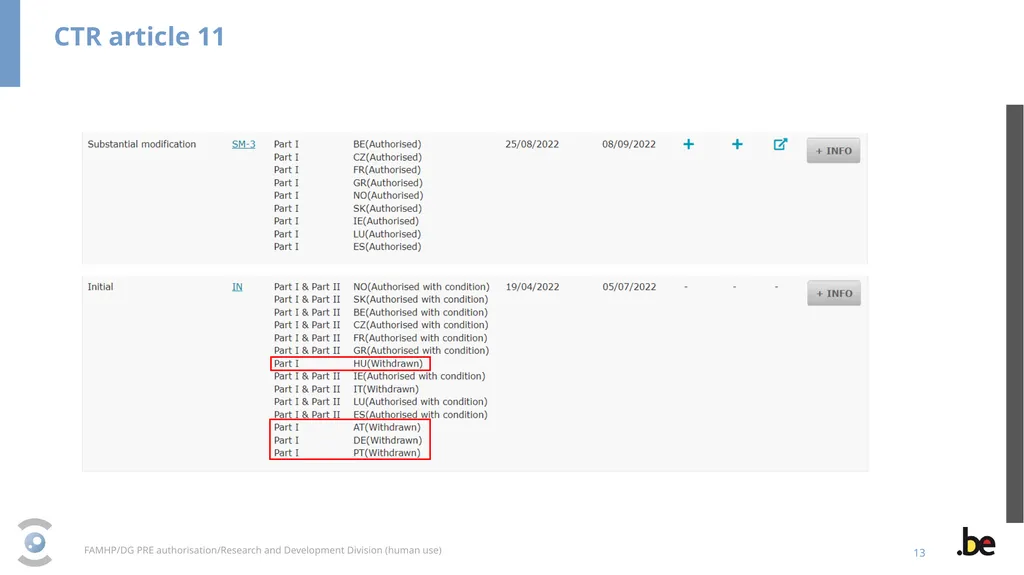
CTR article 11 Part I and Part II not submitted at the same time.
Part II should be submitted within two years from the reporting date (meaning from the conclusion on Part I, not before). If not, trial lapses.
But no modification of Part I possible before trial fully authorized.
For multinational trials, if Part II not submitted for some of the MSCs, not possible to submit a SM on Part I before authorisation of the trial in all MSCs.
Only option if urgent SM: first withdrawal in countries where Part II not yet submitted.<br>
Part II should be submitted within two years from the reporting date (meaning from the conclusion on Part I, not before). If not, trial lapses.
But no modification of Part I possible before trial fully authorized.
For multinational trials, if Part II not submitted for some of the MSCs, not possible to submit a SM on Part I before authorisation of the trial in all MSCs.
Only option if urgent SM: first withdrawal in countries where Part II not yet submitted.<br>
13
CTR article 11<br>
14
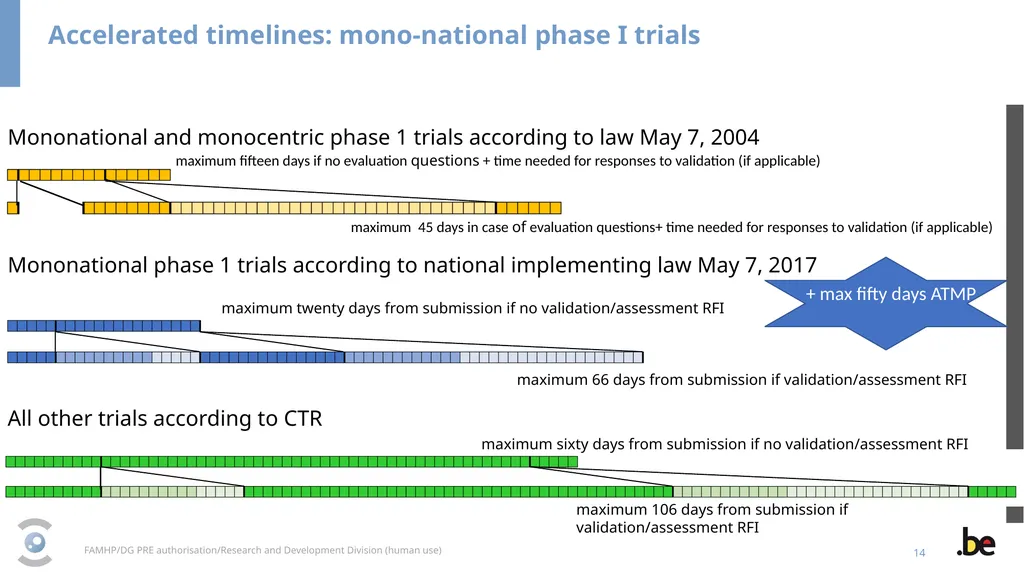
Mononational and monocentric phase 1 trials according to law May 7, 2004
Mononational phase 1 trials according to national implementing law May 7, 2017
All other trials according to CTR Accelerated timelines: mono-national phase I trials<br>
Mononational phase 1 trials according to national implementing law May 7, 2017
All other trials according to CTR Accelerated timelines: mono-national phase I trials<br>
15
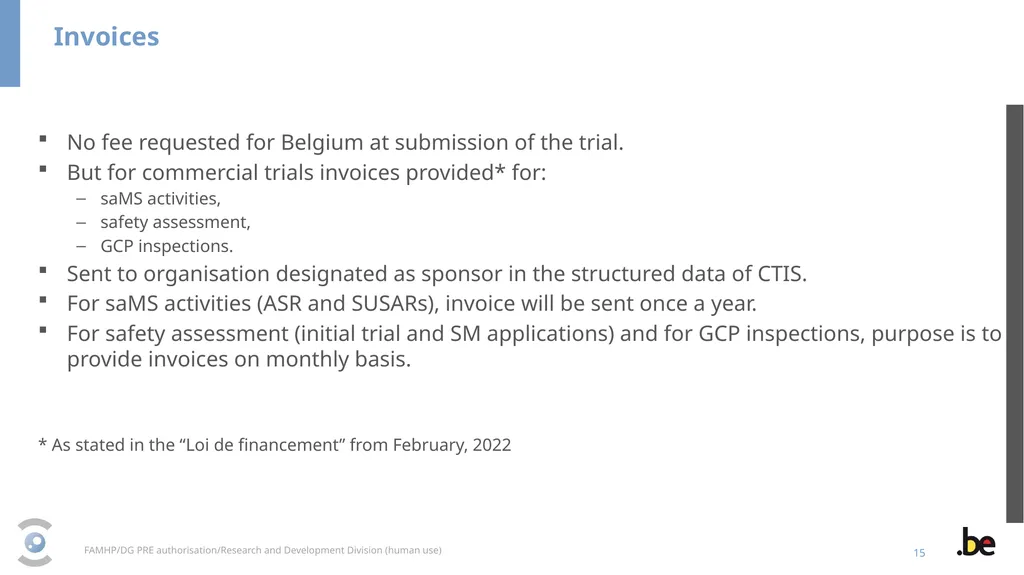
Invoices No fee requested for Belgium at submission of the trial.
But for commercial trials invoices provided* for:
saMS activities,
safety assessment,
GCP inspections.
Sent to organisation designated as sponsor in the structured data of CTIS.
For saMS activities (ASR and SUSARs), invoice will be sent once a year.
For safety assessment (initial trial and SM applications) and for GCP inspections, purpose is to provide invoices on monthly basis.
* As stated in the “Loi de financement” from February, 2022<br>
But for commercial trials invoices provided* for:
saMS activities,
safety assessment,
GCP inspections.
Sent to organisation designated as sponsor in the structured data of CTIS.
For saMS activities (ASR and SUSARs), invoice will be sent once a year.
For safety assessment (initial trial and SM applications) and for GCP inspections, purpose is to provide invoices on monthly basis.
* As stated in the “Loi de financement” from February, 2022<br>
16
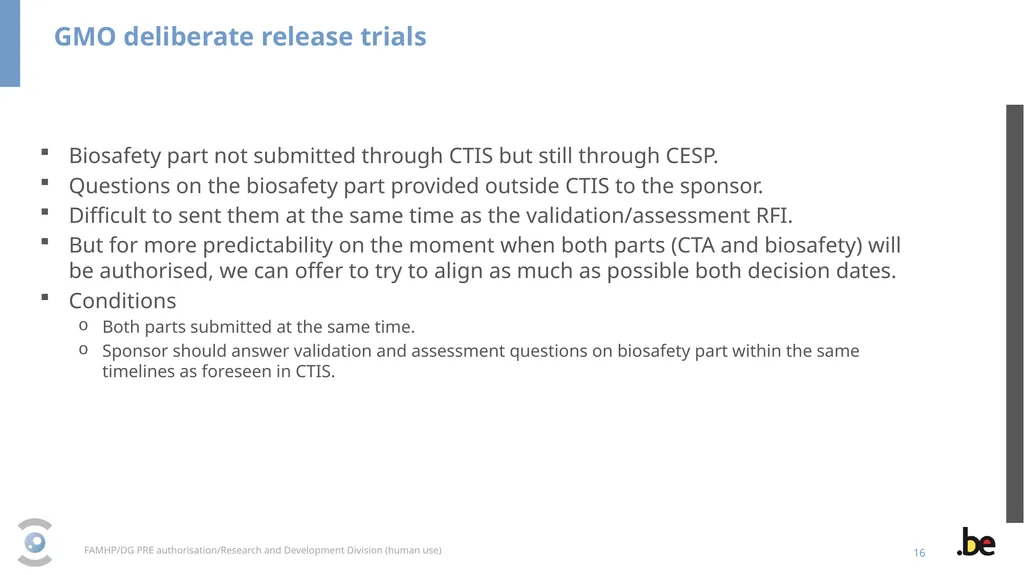
GMO deliberate release trials Biosafety part not submitted through CTIS but still through CESP.
Questions on the biosafety part provided outside CTIS to the sponsor.
Difficult to sent them at the same time as the validation/assessment RFI.
But for more predictability on the moment when both parts (CTA and biosafety) will be authorised, we can offer to try to align as much as possible both decision dates.
Conditions
Both parts submitted at the same time.
Sponsor should answer validation and assessment questions on biosafety part within the same timelines as foreseen in CTIS.<br>
Questions on the biosafety part provided outside CTIS to the sponsor.
Difficult to sent them at the same time as the validation/assessment RFI.
But for more predictability on the moment when both parts (CTA and biosafety) will be authorised, we can offer to try to align as much as possible both decision dates.
Conditions
Both parts submitted at the same time.
Sponsor should answer validation and assessment questions on biosafety part within the same timelines as foreseen in CTIS.<br>
17
Overview Introduction to CTR
Clarifications
New information and updates
Regulatory tips for a smooth validation
Answers to some of your questions
Important links<br>
Clarifications
New information and updates
Regulatory tips for a smooth validation
Answers to some of your questions
Important links<br>
18
CTR Q&A in Eudralex volume 10 New version 6.3 published on February 17, 2023.
New question/answer related to IMPD-Quality: (2.15) for the case where the sponsor of a clinical trial is not the product owner of the IMP and should not have access to the quality IMPD.<br>
New question/answer related to IMPD-Quality: (2.15) for the case where the sponsor of a clinical trial is not the product owner of the IMP and should not have access to the quality IMPD.<br>
19
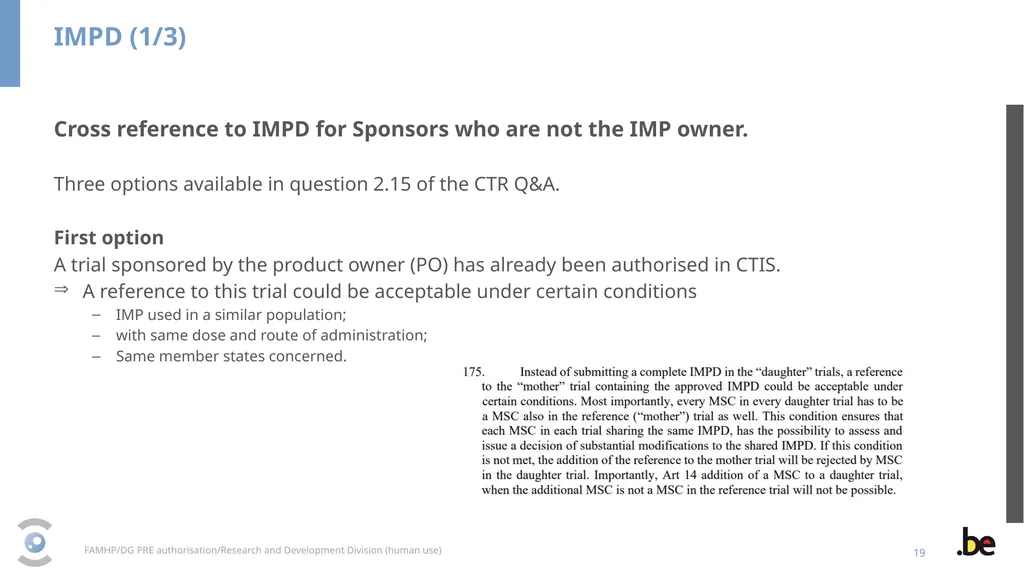
IMPD (1/3) Cross reference to IMPD for Sponsors who are not the IMP owner.
Three options available in question 2.15 of the CTR Q&A.
First option
A trial sponsored by the product owner (PO) has already been authorised in CTIS.
A reference to this trial could be acceptable under certain conditions
IMP used in a similar population;
with same dose and route of administration;
Same member states concerned.<br>
Three options available in question 2.15 of the CTR Q&A.
First option
A trial sponsored by the product owner (PO) has already been authorised in CTIS.
A reference to this trial could be acceptable under certain conditions
IMP used in a similar population;
with same dose and route of administration;
Same member states concerned.<br>
20
IMPD (2/3) Cross reference to IMPD for Sponsors who are not the IMP owner.
Second option
The PO transitions a trial with the same IMP from CTD to CTR.
A reference to this trial could be acceptable under certain conditions
IMP used in a similar population;
with same dose and route of administration;
Same member states concerned.<br>
Second option
The PO transitions a trial with the same IMP from CTD to CTR.
A reference to this trial could be acceptable under certain conditions
IMP used in a similar population;
with same dose and route of administration;
Same member states concerned.<br>
21
IMPD (3/3) “IMPD-Q only” application
Third option
No trial with the same IMPD already authorised in CTIS.
Currently no possibility in CTIS to upload an IMPD in the dossier that would not be accessible to the sponsor.
Third option proposed and described at point 129 of the question 2.15 in the CTR Q&A
Two applications submitted in parallel in CTIS.
New trial submitted.
PO agrees to submit an “IMPD-Q only” application (Part I only) in parallel.
Same MSCs and RMS mandatory for new trial and “IMPD-Q only” application
Validation an assessment RFI on IMPD provided to the PO.
“IMPD-Q only” application not approved and cannot be used for further trials.
Procedure should be repeated for each new application (addition of a MSC, SM or new trial).<br>
Third option
No trial with the same IMPD already authorised in CTIS.
Currently no possibility in CTIS to upload an IMPD in the dossier that would not be accessible to the sponsor.
Third option proposed and described at point 129 of the question 2.15 in the CTR Q&A
Two applications submitted in parallel in CTIS.
New trial submitted.
PO agrees to submit an “IMPD-Q only” application (Part I only) in parallel.
Same MSCs and RMS mandatory for new trial and “IMPD-Q only” application
Validation an assessment RFI on IMPD provided to the PO.
“IMPD-Q only” application not approved and cannot be used for further trials.
Procedure should be repeated for each new application (addition of a MSC, SM or new trial).<br>
22
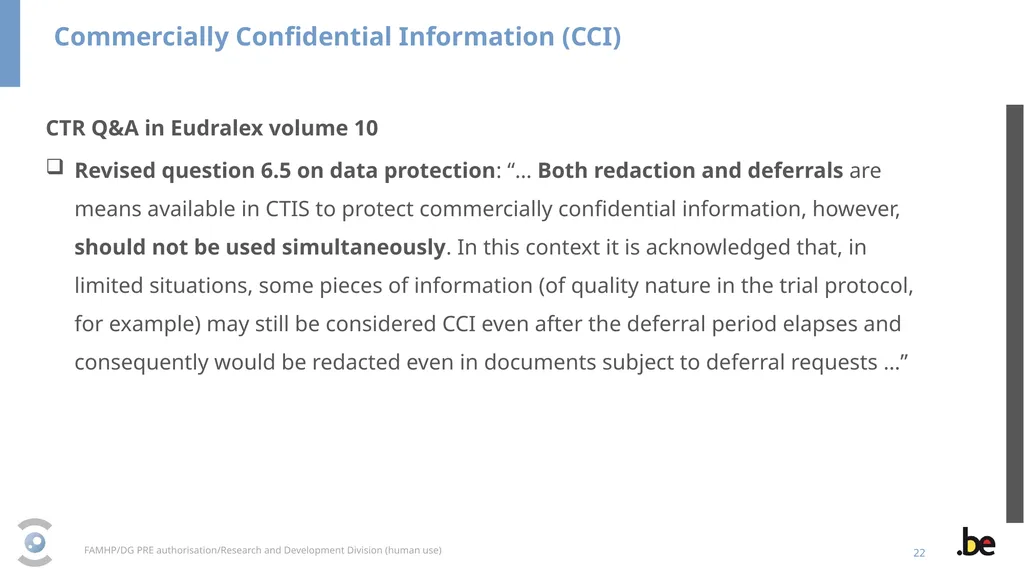
Commercially Confidential Information (CCI) CTR Q&A in Eudralex volume 10
Revised question 6.5 on data protection: “… Both redaction and deferrals are means available in CTIS to protect commercially confidential information, however, should not be used simultaneously. In this context it is acknowledged that, in limited situations, some pieces of information (of quality nature in the trial protocol, for example) may still be considered CCI even after the deferral period elapses and consequently would be redacted even in documents subject to deferral requests …”<br>
Revised question 6.5 on data protection: “… Both redaction and deferrals are means available in CTIS to protect commercially confidential information, however, should not be used simultaneously. In this context it is acknowledged that, in limited situations, some pieces of information (of quality nature in the trial protocol, for example) may still be considered CCI even after the deferral period elapses and consequently would be redacted even in documents subject to deferral requests …”<br>
23
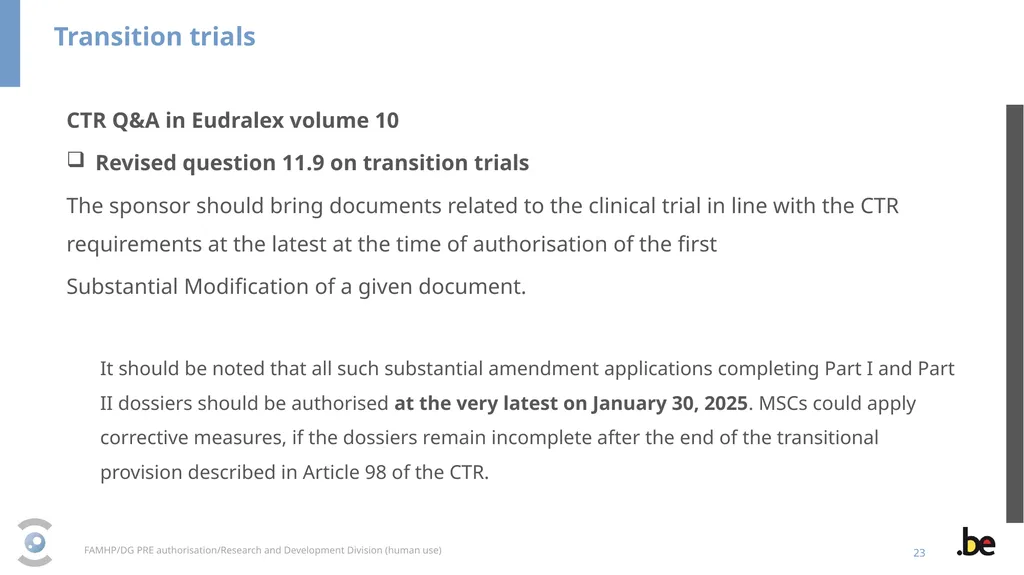
Transition trials CTR Q&A in Eudralex volume 10
Revised question 11.9 on transition trials
The sponsor should bring documents related to the clinical trial in line with the CTR requirements at the latest at the time of authorisation of the first
Substantial Modification of a given document.
It should be noted that all such substantial amendment applications completing Part I and Part II dossiers should be authorised at the very latest on January 30, 2025. MSCs could apply corrective measures, if the dossiers remain incomplete after the end of the transitional provision described in Article 98 of the CTR.<br>
Revised question 11.9 on transition trials
The sponsor should bring documents related to the clinical trial in line with the CTR requirements at the latest at the time of authorisation of the first
Substantial Modification of a given document.
It should be noted that all such substantial amendment applications completing Part I and Part II dossiers should be authorised at the very latest on January 30, 2025. MSCs could apply corrective measures, if the dossiers remain incomplete after the end of the transitional provision described in Article 98 of the CTR.<br>
24
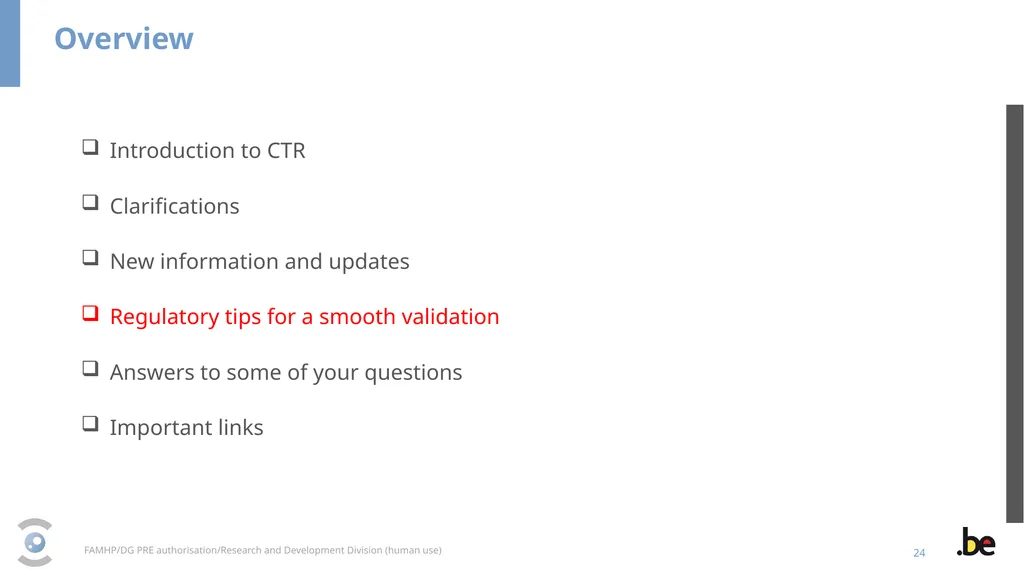
Overview Introduction to CTR
Clarifications
New information and updates
Regulatory tips for a smooth validation
Answers to some of your questions
Important links<br>
Clarifications
New information and updates
Regulatory tips for a smooth validation
Answers to some of your questions
Important links<br>
25
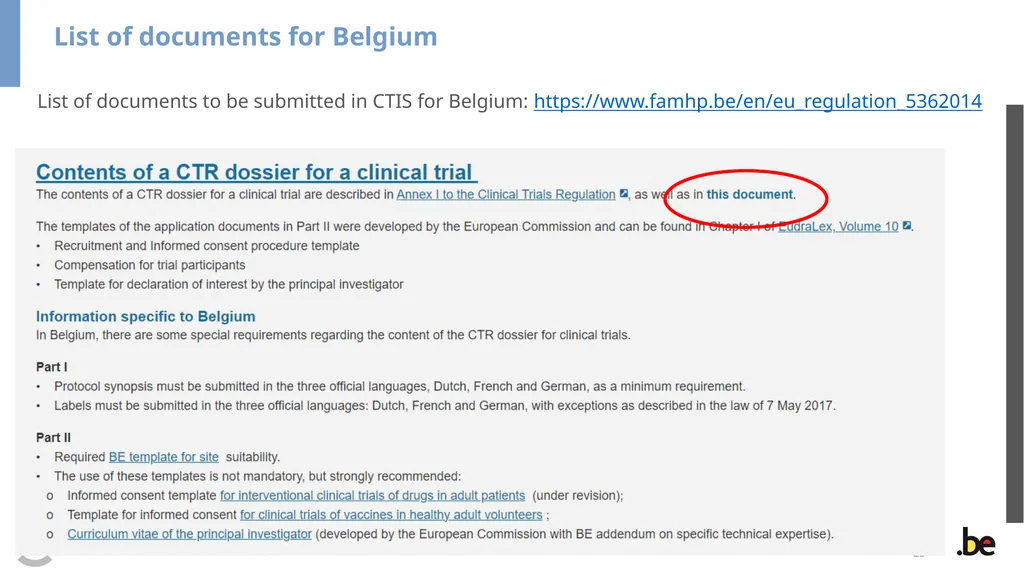
List of documents for Belgium List of documents to be submitted in CTIS for Belgium: https://www.famhp.be/en/eu_regulation_5362014<br>
26
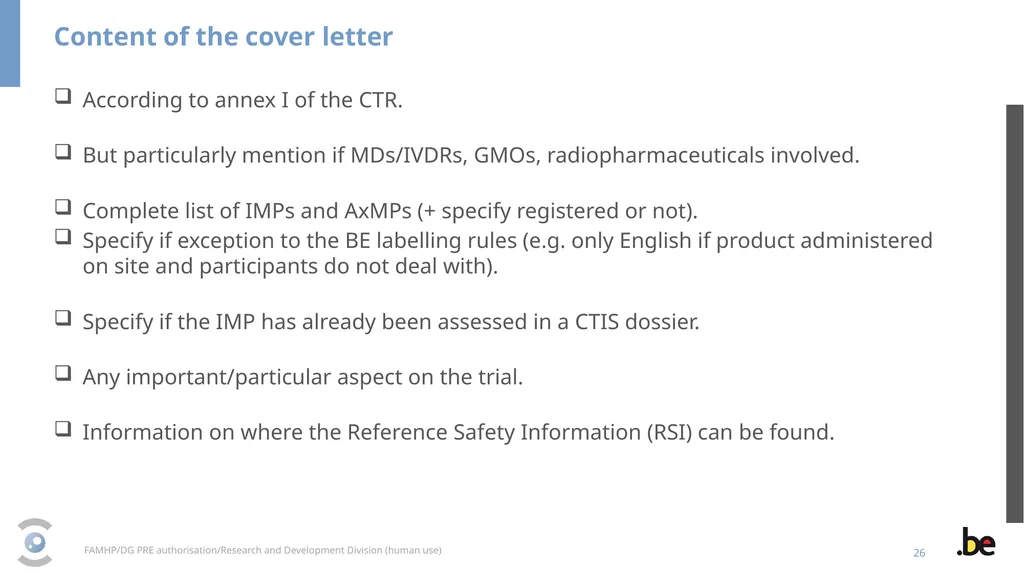
Content of the cover letter According to annex I of the CTR.
But particularly mention if MDs/IVDRs, GMOs, radiopharmaceuticals involved.
Complete list of IMPs and AxMPs (+ specify registered or not).
Specify if exception to the BE labelling rules (e.g. only English if product administered on site and participants do not deal with).
Specify if the IMP has already been assessed in a CTIS dossier.
Any important/particular aspect on the trial.
Information on where the Reference Safety Information (RSI) can be found.<br>
But particularly mention if MDs/IVDRs, GMOs, radiopharmaceuticals involved.
Complete list of IMPs and AxMPs (+ specify registered or not).
Specify if exception to the BE labelling rules (e.g. only English if product administered on site and participants do not deal with).
Specify if the IMP has already been assessed in a CTIS dossier.
Any important/particular aspect on the trial.
Information on where the Reference Safety Information (RSI) can be found.<br>
27
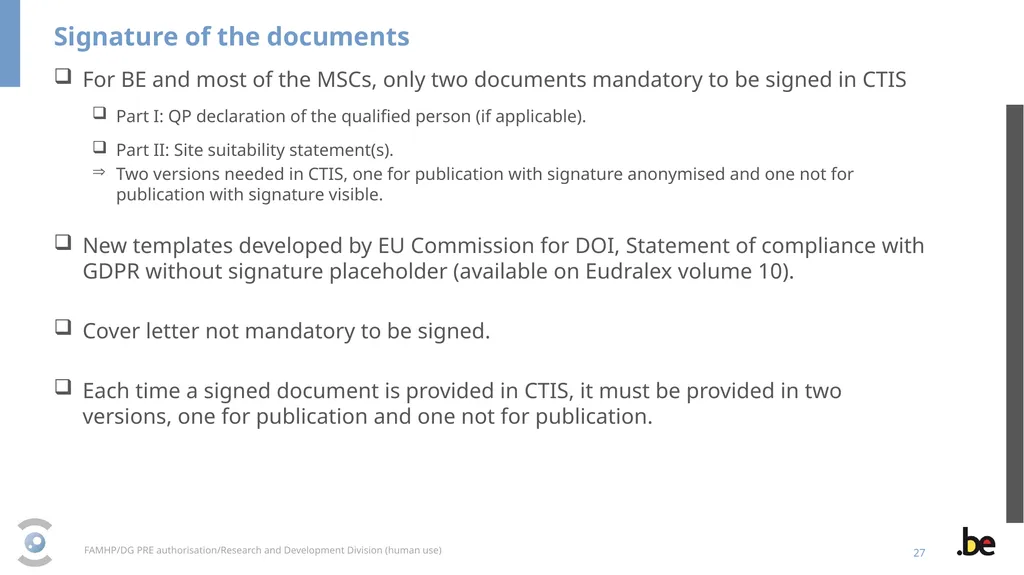
Signature of the documents For BE and most of the MSCs, only two documents mandatory to be signed in CTIS
Part I: QP declaration of the qualified person (if applicable).
Part II: Site suitability statement(s).
Two versions needed in CTIS, one for publication with signature anonymised and one not for publication with signature visible.
New templates developed by EU Commission for DOI, Statement of compliance with GDPR without signature placeholder (available on Eudralex volume 10).
Cover letter not mandatory to be signed.
Each time a signed document is provided in CTIS, it must be provided in two versions, one for publication and one not for publication.<br>
Part I: QP declaration of the qualified person (if applicable).
Part II: Site suitability statement(s).
Two versions needed in CTIS, one for publication with signature anonymised and one not for publication with signature visible.
New templates developed by EU Commission for DOI, Statement of compliance with GDPR without signature placeholder (available on Eudralex volume 10).
Cover letter not mandatory to be signed.
Each time a signed document is provided in CTIS, it must be provided in two versions, one for publication and one not for publication.<br>
28
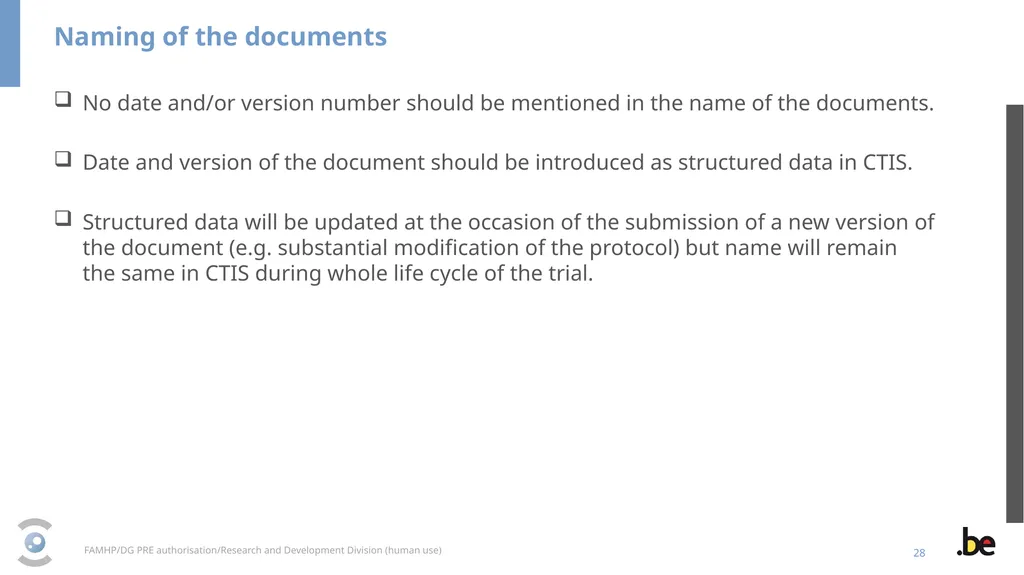
Naming of the documents No date and/or version number should be mentioned in the name of the documents.
Date and version of the document should be introduced as structured data in CTIS.
Structured data will be updated at the occasion of the submission of a new version of the document (e.g. substantial modification of the protocol) but name will remain the same in CTIS during whole life cycle of the trial.<br>
Date and version of the document should be introduced as structured data in CTIS.
Structured data will be updated at the occasion of the submission of a new version of the document (e.g. substantial modification of the protocol) but name will remain the same in CTIS during whole life cycle of the trial.<br>
29
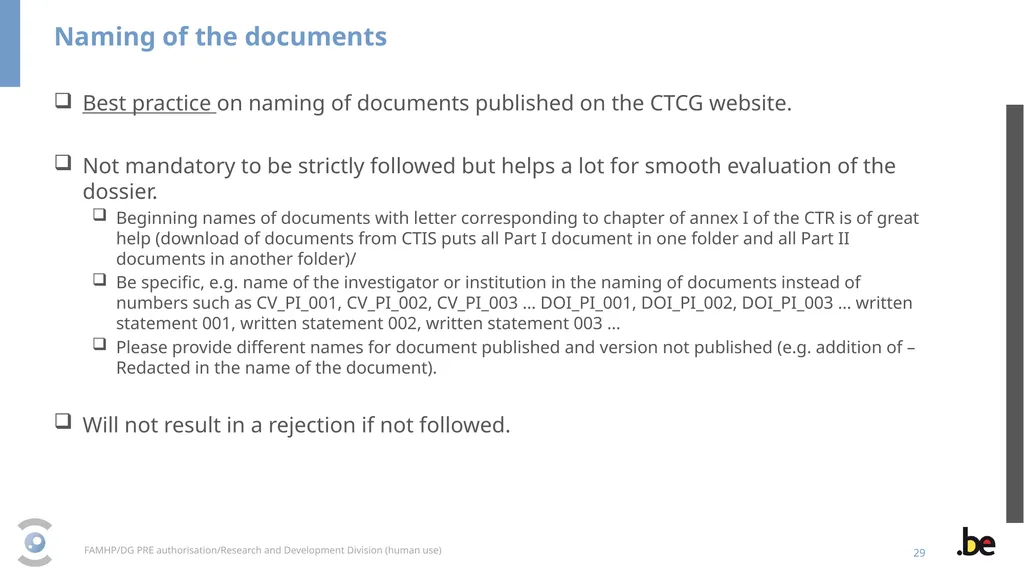
Naming of the documents Best practice on naming of documents published on the CTCG website.
Not mandatory to be strictly followed but helps a lot for smooth evaluation of the dossier.
Beginning names of documents with letter corresponding to chapter of annex I of the CTR is of great help (download of documents from CTIS puts all Part I document in one folder and all Part II documents in another folder)/
Be specific, e.g. name of the investigator or institution in the naming of documents instead of numbers such as CV_PI_001, CV_PI_002, CV_PI_003 … DOI_PI_001, DOI_PI_002, DOI_PI_003 … written statement 001, written statement 002, written statement 003 …
Please provide different names for document published and version not published (e.g. addition of –Redacted in the name of the document).
Will not result in a rejection if not followed.<br>
Not mandatory to be strictly followed but helps a lot for smooth evaluation of the dossier.
Beginning names of documents with letter corresponding to chapter of annex I of the CTR is of great help (download of documents from CTIS puts all Part I document in one folder and all Part II documents in another folder)/
Be specific, e.g. name of the investigator or institution in the naming of documents instead of numbers such as CV_PI_001, CV_PI_002, CV_PI_003 … DOI_PI_001, DOI_PI_002, DOI_PI_003 … written statement 001, written statement 002, written statement 003 …
Please provide different names for document published and version not published (e.g. addition of –Redacted in the name of the document).
Will not result in a rejection if not followed.<br>
30
Patient facing documents To be submitted in Part I.
At least in the official national language(s) of the region(s) where the trial is conducted.
EN is optional.
As stated in annex II of CTR Q&A.
Still some unclarity on which documents should be submitted, still discussed at EU level. Will be clarified asap.<br>
At least in the official national language(s) of the region(s) where the trial is conducted.
EN is optional.
As stated in annex II of CTR Q&A.
Still some unclarity on which documents should be submitted, still discussed at EU level. Will be clarified asap.<br>
31
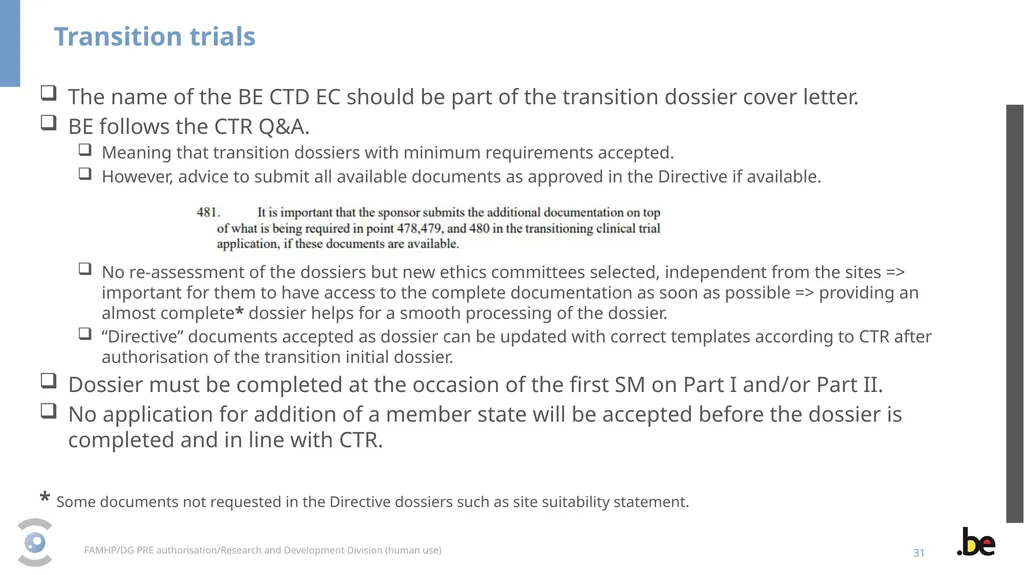
Transition trials The name of the BE CTD EC should be part of the transition dossier cover letter.
BE follows the CTR Q&A.
Meaning that transition dossiers with minimum requirements accepted.
However, advice to submit all available documents as approved in the Directive if available.
No re-assessment of the dossiers but new ethics committees selected, independent from the sites => important for them to have access to the complete documentation as soon as possible => providing an almost complete* dossier helps for a smooth processing of the dossier.
“Directive” documents accepted as dossier can be updated with correct templates according to CTR after authorisation of the transition initial dossier.
Dossier must be completed at the occasion of the first SM on Part I and/or Part II.
No application for addition of a member state will be accepted before the dossier is completed and in line with CTR.
* Some documents not requested in the Directive dossiers such as site suitability statement.<br>
BE follows the CTR Q&A.
Meaning that transition dossiers with minimum requirements accepted.
However, advice to submit all available documents as approved in the Directive if available.
No re-assessment of the dossiers but new ethics committees selected, independent from the sites => important for them to have access to the complete documentation as soon as possible => providing an almost complete* dossier helps for a smooth processing of the dossier.
“Directive” documents accepted as dossier can be updated with correct templates according to CTR after authorisation of the transition initial dossier.
Dossier must be completed at the occasion of the first SM on Part I and/or Part II.
No application for addition of a member state will be accepted before the dossier is completed and in line with CTR.
* Some documents not requested in the Directive dossiers such as site suitability statement.<br>
32
Other regulatory tips Answer to the RFI
A written answer has to be provided in the RFI section of CTIS for each consideration. But missing or modified/updated documents must be provided in Part I and/or Part II of the dossier which has to be updated by using the update function.
Substantial modifications
Please clearly indicate what has changed in the dossier and which documents have been updated.
It is requested to provide track changes and clear versions of updated documents.
Questions on unclear validation or assessment consideration
May be raised to CTR@fagg-afmps.be.<br>
A written answer has to be provided in the RFI section of CTIS for each consideration. But missing or modified/updated documents must be provided in Part I and/or Part II of the dossier which has to be updated by using the update function.
Substantial modifications
Please clearly indicate what has changed in the dossier and which documents have been updated.
It is requested to provide track changes and clear versions of updated documents.
Questions on unclear validation or assessment consideration
May be raised to CTR@fagg-afmps.be.<br>
33
Overview Introduction to CTR
Clarifications
New information and updates
Regulatory tips for a smooth validation
Answers to some of your questions
Important links<br>
Clarifications
New information and updates
Regulatory tips for a smooth validation
Answers to some of your questions
Important links<br>
34
Legal representative For a Sponsor established outside of the EU/EEA, a legal representative is required in Belgium. It is our understanding from CTR art 74 that the sponsor’s legal representative shall be the addressee for all communications with the sponsor. Does this imply that the sponsor’s legal representative will be the one submitting the CTA through the CTIS?
Not necessarily<br>
Not necessarily<br>
35
GMP documentation Is there any case where a copy of non-EU Manufacturer's and Importer's Authorisation (MIA) need to be submitted as part of a CTA in CTIS?
Yes, for nonregistered products if one or several non-EU manufacturers involved in manufacturing of the IMP:
- MIA of the importer;
- and QP declaration of the qualified person.
Should be provided in the CTIS dossier.
In this case, would a certified translation to English of the MIA be acceptable?
Yes. You can also find the English versions of MIAs on Eudra-GMP.<br>
Yes, for nonregistered products if one or several non-EU manufacturers involved in manufacturing of the IMP:
- MIA of the importer;
- and QP declaration of the qualified person.
Should be provided in the CTIS dossier.
In this case, would a certified translation to English of the MIA be acceptable?
Yes. You can also find the English versions of MIAs on Eudra-GMP.<br>
36
Studies without IMP We have studies with no IMP administration. These studies consist in blood draw to perform in vitro tests. Until now, these studies were only submitted to ethics committees and not to the competent authorities. Does this type of study fall under the CTR regulation?
No. The scope of the CTR has not changed compared to the CTD.
Applications should be clinical trials (studies on medicinal products/IMPs).
We refer you to the annex I of the Eudralex CTR Q&A where the decision tree helps to determine if the study is a clinical trial or not.<br>
No. The scope of the CTR has not changed compared to the CTD.
Applications should be clinical trials (studies on medicinal products/IMPs).
We refer you to the annex I of the Eudralex CTR Q&A where the decision tree helps to determine if the study is a clinical trial or not.<br>
37
Modification of Part I when submitting Part II (Article 11) Can we amend documents that have been approved in Part 1 when submitting Part 2 (new information in the IMPD for example)?
No. This is a Part I substantial modification.
Part II should first be submitted and considered acceptable.
Trial can be authorised as both conclusion on Part I and on Part II will be available.
After authorisation, SM on Part I can be submitted.
As stated before, with current CTIS functionalities, no SM on Part I can be submitted before submission of Part II and authorization of the trial.<br>
No. This is a Part I substantial modification.
Part II should first be submitted and considered acceptable.
Trial can be authorised as both conclusion on Part I and on Part II will be available.
After authorisation, SM on Part I can be submitted.
As stated before, with current CTIS functionalities, no SM on Part I can be submitted before submission of Part II and authorization of the trial.<br>
38
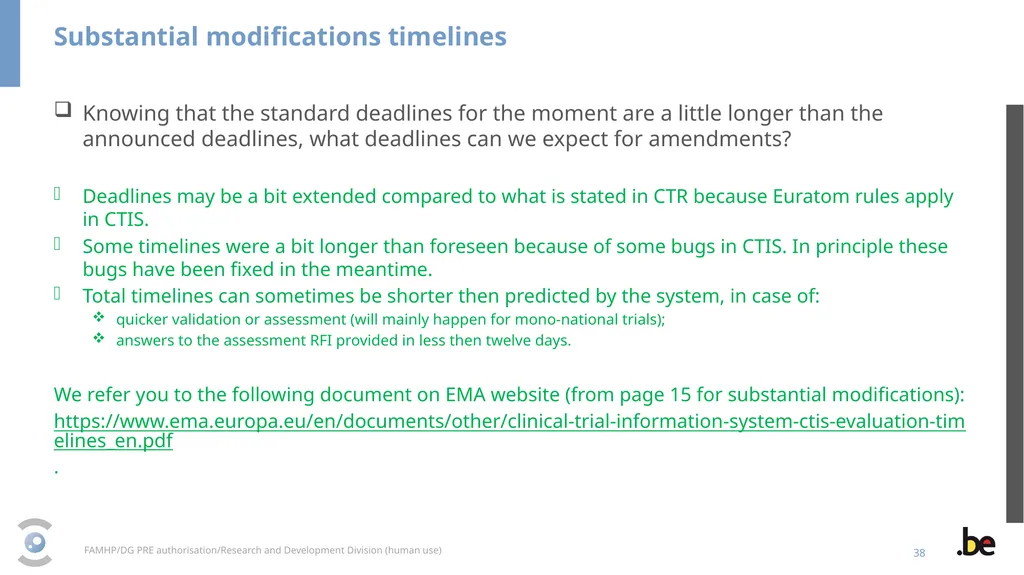
Substantial modifications timelines Knowing that the standard deadlines for the moment are a little longer than the announced deadlines, what deadlines can we expect for amendments?
Deadlines may be a bit extended compared to what is stated in CTR because Euratom rules apply in CTIS.
Some timelines were a bit longer than foreseen because of some bugs in CTIS. In principle these bugs have been fixed in the meantime.
Total timelines can sometimes be shorter then predicted by the system, in case of:
quicker validation or assessment (will mainly happen for mono-national trials);
answers to the assessment RFI provided in less then twelve days.
We refer you to the following document on EMA website (from page 15 for substantial modifications):
https://www.ema.europa.eu/en/documents/other/clinical-trial-information-system-ctis-evaluation-timelines_en.pdf.<br>
Deadlines may be a bit extended compared to what is stated in CTR because Euratom rules apply in CTIS.
Some timelines were a bit longer than foreseen because of some bugs in CTIS. In principle these bugs have been fixed in the meantime.
Total timelines can sometimes be shorter then predicted by the system, in case of:
quicker validation or assessment (will mainly happen for mono-national trials);
answers to the assessment RFI provided in less then twelve days.
We refer you to the following document on EMA website (from page 15 for substantial modifications):
https://www.ema.europa.eu/en/documents/other/clinical-trial-information-system-ctis-evaluation-timelines_en.pdf.<br>
39
IMPs and AMPs distribution rules Change in the IMPs and AxMPs distribution rules
“Recommendation paper on decentralised elements in clinical trials”.
An overview of the national provisions is available in the appendix.<br>
“Recommendation paper on decentralised elements in clinical trials”.
An overview of the national provisions is available in the appendix.<br>
40
Safety reporting rules Change in the Safety reporting rules to health authorities, ethics committees and investigators according to CTR (including SUSARs, aggregated reports and Data Monitoring Committee report).
Eudralex CTR Q&A, chapter 7 on safety reporting.
EMA guideline on Data Monitoring Committees.
EMA Q&A on Data Monitoring Committees issues – in particular answer to question 7.<br>
Eudralex CTR Q&A, chapter 7 on safety reporting.
EMA guideline on Data Monitoring Committees.
EMA Q&A on Data Monitoring Committees issues – in particular answer to question 7.<br>
41
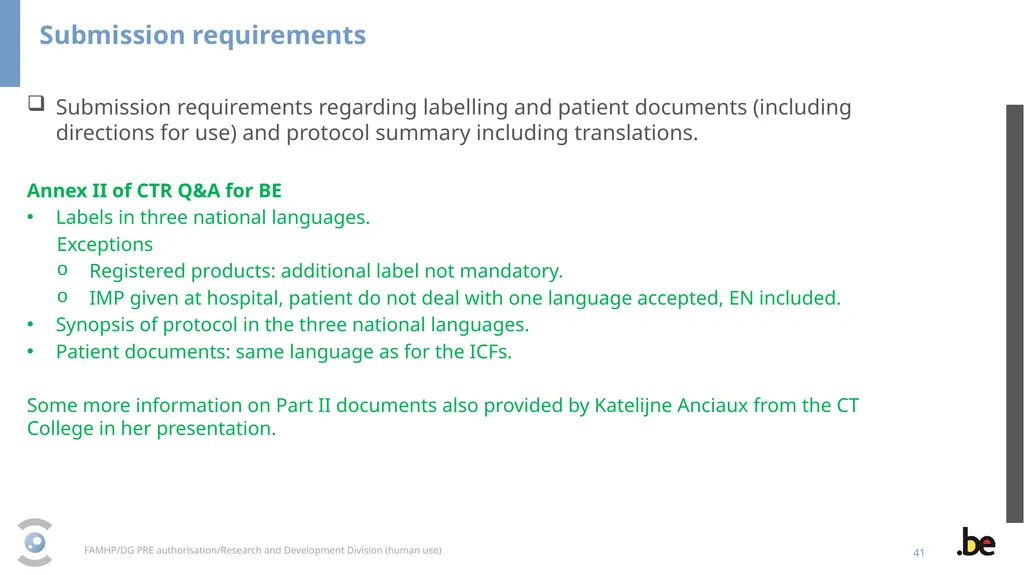
Submission requirements Submission requirements regarding labelling and patient documents (including directions for use) and protocol summary including translations.
Annex II of CTR Q&A for BE
Labels in three national languages.
Exceptions
Registered products: additional label not mandatory.
IMP given at hospital, patient do not deal with one language accepted, EN included.
Synopsis of protocol in the three national languages.
Patient documents: same language as for the ICFs.
Some more information on Part II documents also provided by Katelijne Anciaux from the CT College in her presentation.<br>
Annex II of CTR Q&A for BE
Labels in three national languages.
Exceptions
Registered products: additional label not mandatory.
IMP given at hospital, patient do not deal with one language accepted, EN included.
Synopsis of protocol in the three national languages.
Patient documents: same language as for the ICFs.
Some more information on Part II documents also provided by Katelijne Anciaux from the CT College in her presentation.<br>
42
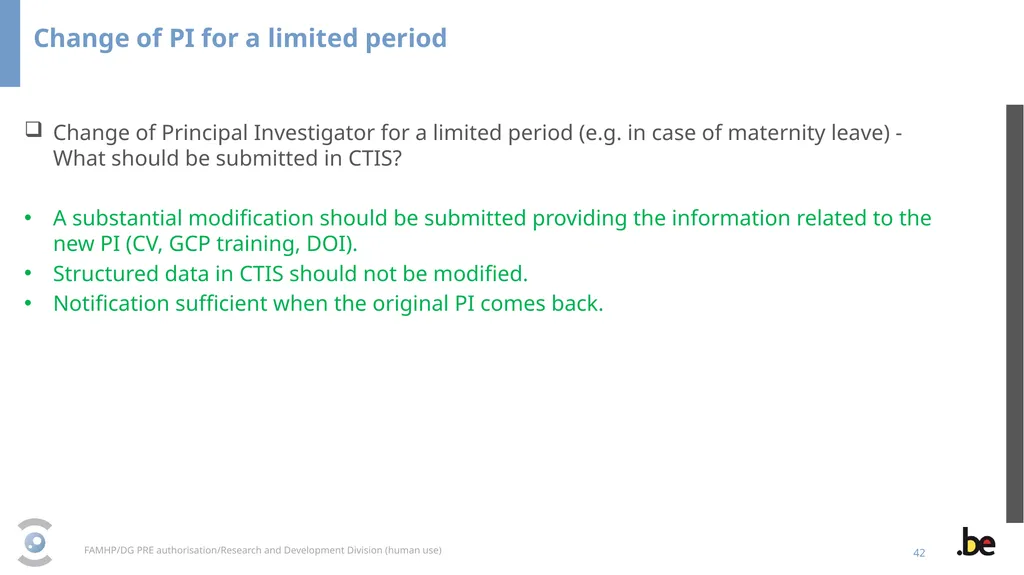
Change of PI for a limited period Change of Principal Investigator for a limited period (e.g. in case of maternity leave) - What should be submitted in CTIS?
A substantial modification should be submitted providing the information related to the new PI (CV, GCP training, DOI).
Structured data in CTIS should not be modified.
Notification sufficient when the original PI comes back.<br>
A substantial modification should be submitted providing the information related to the new PI (CV, GCP training, DOI).
Structured data in CTIS should not be modified.
Notification sufficient when the original PI comes back.<br>
43
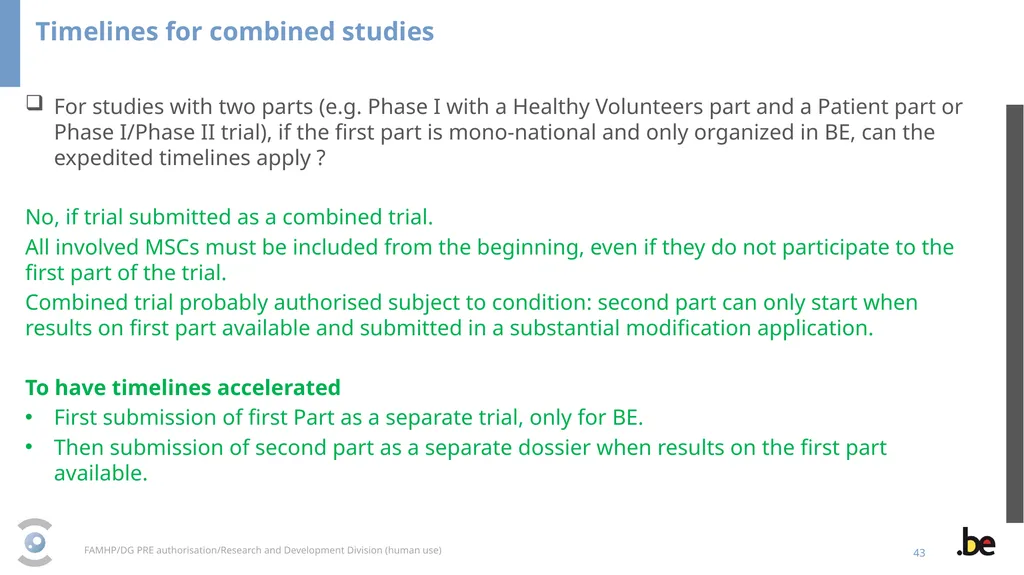
Timelines for combined studies For studies with two parts (e.g. Phase I with a Healthy Volunteers part and a Patient part or Phase I/Phase II trial), if the first part is mono-national and only organized in BE, can the expedited timelines apply ?
No, if trial submitted as a combined trial.
All involved MSCs must be included from the beginning, even if they do not participate to the first part of the trial.
Combined trial probably authorised subject to condition: second part can only start when results on first part available and submitted in a substantial modification application.
To have timelines accelerated
First submission of first Part as a separate trial, only for BE.
Then submission of second part as a separate dossier when results on the first part available.<br>
No, if trial submitted as a combined trial.
All involved MSCs must be included from the beginning, even if they do not participate to the first part of the trial.
Combined trial probably authorised subject to condition: second part can only start when results on first part available and submitted in a substantial modification application.
To have timelines accelerated
First submission of first Part as a separate trial, only for BE.
Then submission of second part as a separate dossier when results on the first part available.<br>
44
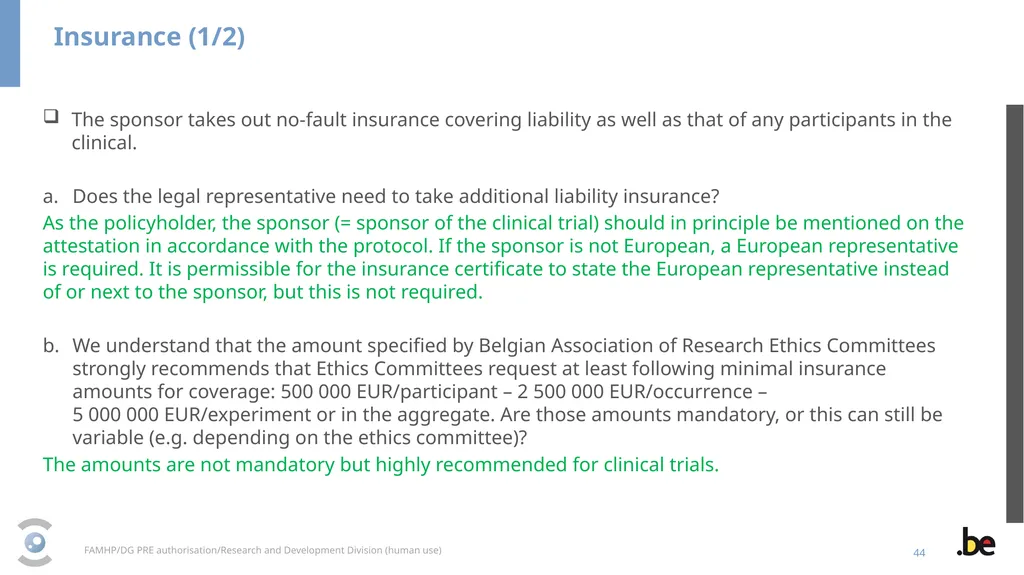
Insurance (1/2) The sponsor takes out no-fault insurance covering liability as well as that of any participants in the clinical.
a. Does the legal representative need to take additional liability insurance?
As the policyholder, the sponsor (= sponsor of the clinical trial) should in principle be mentioned on the attestation in accordance with the protocol. If the sponsor is not European, a European representative is required. It is permissible for the insurance certificate to state the European representative instead of or next to the sponsor, but this is not required.
b. We understand that the amount specified by Belgian Association of Research Ethics Committees strongly recommends that Ethics Committees request at least following minimal insurance amounts for coverage: 500 000 EUR/participant – 2 500 000 EUR/occurrence – 5 000 000 EUR/experiment or in the aggregate. Are those amounts mandatory, or this can still be variable (e.g. depending on the ethics committee)?
The amounts are not mandatory but highly recommended for clinical trials.<br>
a. Does the legal representative need to take additional liability insurance?
As the policyholder, the sponsor (= sponsor of the clinical trial) should in principle be mentioned on the attestation in accordance with the protocol. If the sponsor is not European, a European representative is required. It is permissible for the insurance certificate to state the European representative instead of or next to the sponsor, but this is not required.
b. We understand that the amount specified by Belgian Association of Research Ethics Committees strongly recommends that Ethics Committees request at least following minimal insurance amounts for coverage: 500 000 EUR/participant – 2 500 000 EUR/occurrence – 5 000 000 EUR/experiment or in the aggregate. Are those amounts mandatory, or this can still be variable (e.g. depending on the ethics committee)?
The amounts are not mandatory but highly recommended for clinical trials.<br>
45
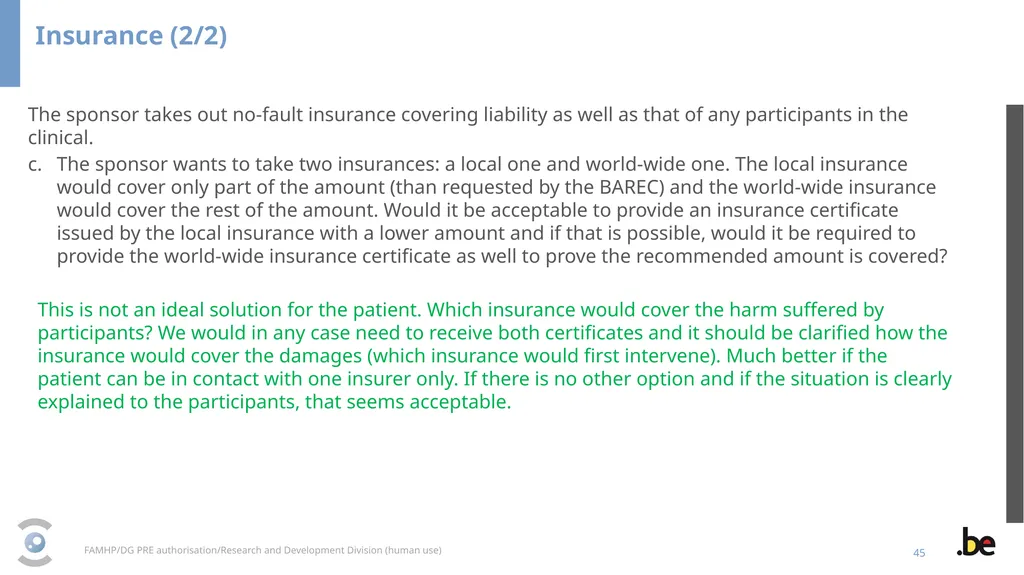
Insurance (2/2) The sponsor takes out no-fault insurance covering liability as well as that of any participants in the clinical.
The sponsor wants to take two insurances: a local one and world-wide one. The local insurance would cover only part of the amount (than requested by the BAREC) and the world-wide insurance would cover the rest of the amount. Would it be acceptable to provide an insurance certificate issued by the local insurance with a lower amount and if that is possible, would it be required to provide the world-wide insurance certificate as well to prove the recommended amount is covered?
This is not an ideal solution for the patient. Which insurance would cover the harm suffered by participants? We would in any case need to receive both certificates and it should be clarified how the insurance would cover the damages (which insurance would first intervene). Much better if the patient can be in contact with one insurer only. If there is no other option and if the situation is clearly explained to the participants, that seems acceptable.<br>
The sponsor wants to take two insurances: a local one and world-wide one. The local insurance would cover only part of the amount (than requested by the BAREC) and the world-wide insurance would cover the rest of the amount. Would it be acceptable to provide an insurance certificate issued by the local insurance with a lower amount and if that is possible, would it be required to provide the world-wide insurance certificate as well to prove the recommended amount is covered?
This is not an ideal solution for the patient. Which insurance would cover the harm suffered by participants? We would in any case need to receive both certificates and it should be clarified how the insurance would cover the damages (which insurance would first intervene). Much better if the patient can be in contact with one insurer only. If there is no other option and if the situation is clearly explained to the participants, that seems acceptable.<br>
46
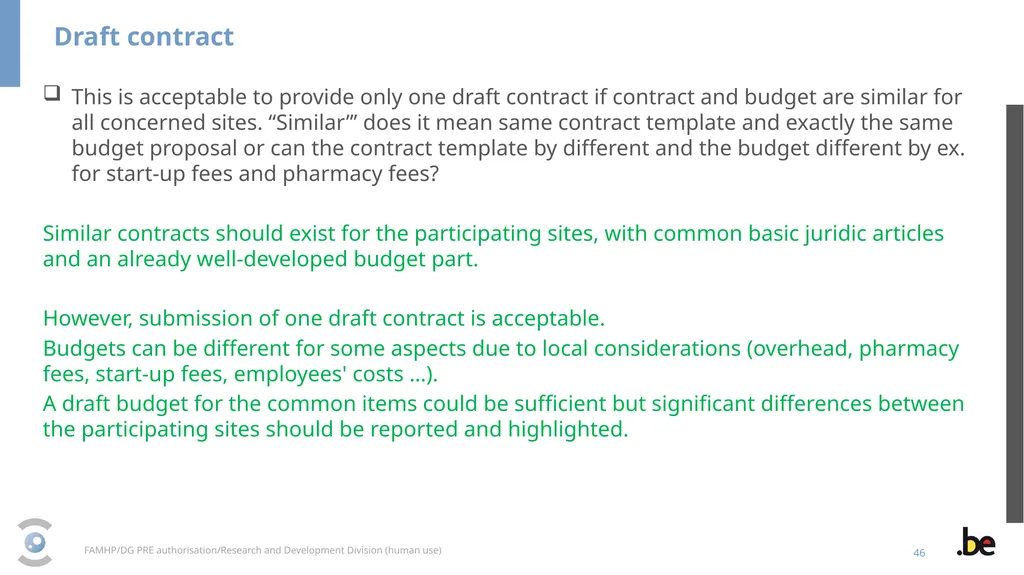
Draft contract This is acceptable to provide only one draft contract if contract and budget are similar for all concerned sites. “Similar”’ does it mean same contract template and exactly the same budget proposal or can the contract template by different and the budget different by ex. for start-up fees and pharmacy fees?
Similar contracts should exist for the participating sites, with common basic juridic articles and an already well-developed budget part.
However, submission of one draft contract is acceptable.
Budgets can be different for some aspects due to local considerations (overhead, pharmacy fees, start-up fees, employees' costs …).
A draft budget for the common items could be sufficient but significant differences between the participating sites should be reported and highlighted.<br>
Similar contracts should exist for the participating sites, with common basic juridic articles and an already well-developed budget part.
However, submission of one draft contract is acceptable.
Budgets can be different for some aspects due to local considerations (overhead, pharmacy fees, start-up fees, employees' costs …).
A draft budget for the common items could be sufficient but significant differences between the participating sites should be reported and highlighted.<br>
47
Overview Introduction to CTR
Clarifications
New information and updates
Regulatory tips for a smooth validation
Answers to some of your questions
Important links<br>
Clarifications
New information and updates
Regulatory tips for a smooth validation
Answers to some of your questions
Important links<br>
48
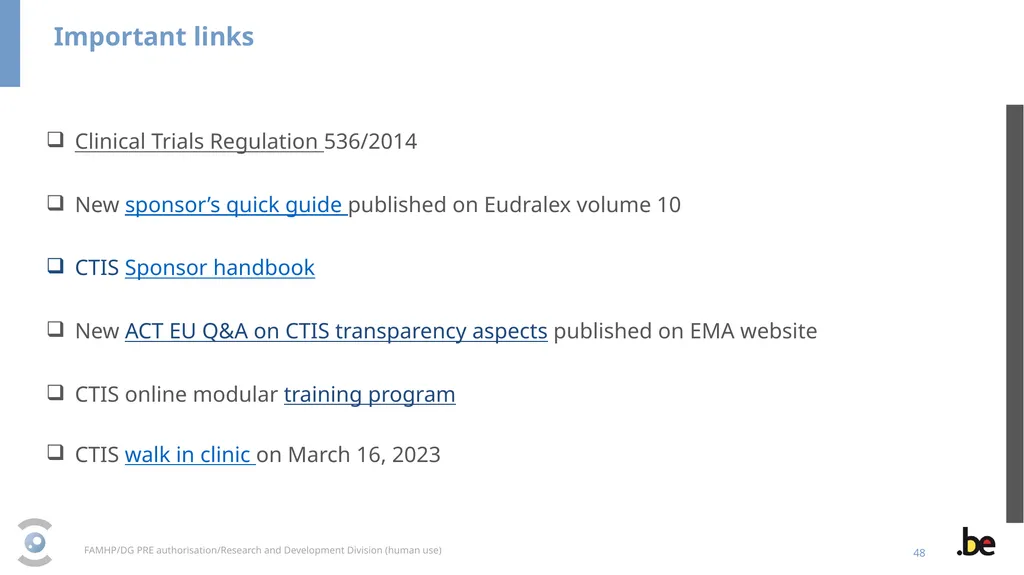
Important links Clinical Trials Regulation 536/2014
New sponsor’s quick guide published on Eudralex volume 10
CTIS Sponsor handbook
New ACT EU Q&A on CTIS transparency aspects published on EMA website
CTIS online modular training program
CTIS walk in clinic on March 16, 2023<br>
New sponsor’s quick guide published on Eudralex volume 10
CTIS Sponsor handbook
New ACT EU Q&A on CTIS transparency aspects published on EMA website
CTIS online modular training program
CTIS walk in clinic on March 16, 2023<br>
49
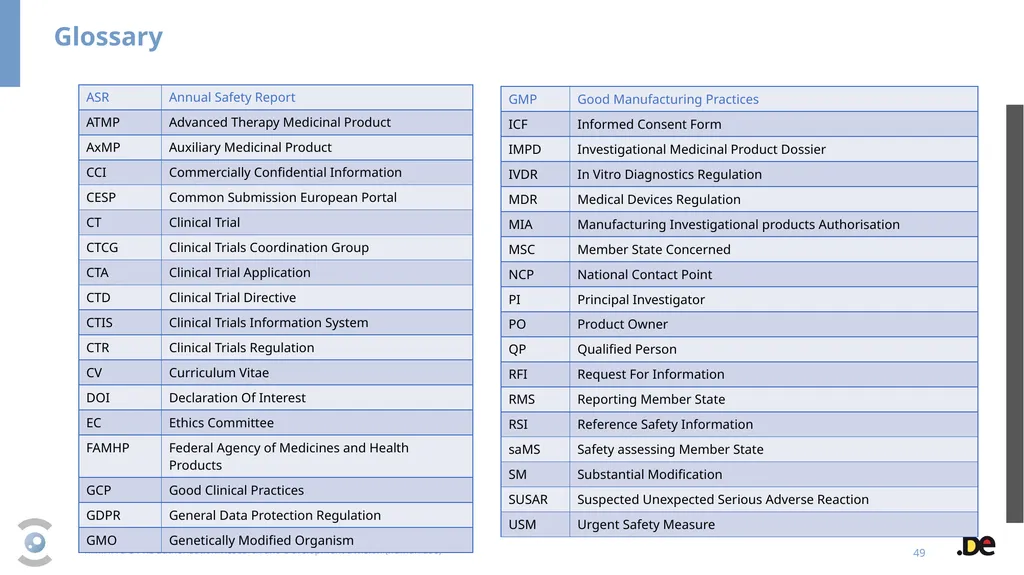
Glossary<br>
50
Thanks a lot for your attention<br>
51
Contact Federal Agency for Medicines and Health Products – FAMHP
Avenue Galilée - Galileelaan 5/03
1210 BRUSSELS
tel. + 32 2 528 40 00
fax + 32 2 528 40 01
e-mail welcome@fagg-afmps.be
www.famhp.be
Follow the FAMHP on Facebook, Twitter and LinkedIn<br>
Avenue Galilée - Galileelaan 5/03
1210 BRUSSELS
tel. + 32 2 528 40 00
fax + 32 2 528 40 01
e-mail welcome@fagg-afmps.be
www.famhp.be
Follow the FAMHP on Facebook, Twitter and LinkedIn<br>