New Hire Training Machine Guarding Introduction Possible machinery-related injuries include: Crushed fingers or hands Amputations Burns Blindness A good rule to remember is: Any machine part, function, or process which may cause injury must
"New Hire Training Machine Guarding Introduction" is the property of its rightful owner. Permission is granted to
download and print the materials on this website for personal, non-commercial use only, and to display it
on your personal computer provided you do not modify the materials and that you retain all copyright
notices contained in the materials. By downloading content from our website, you accept the terms of this
agreement.
Presentation Transcript
01
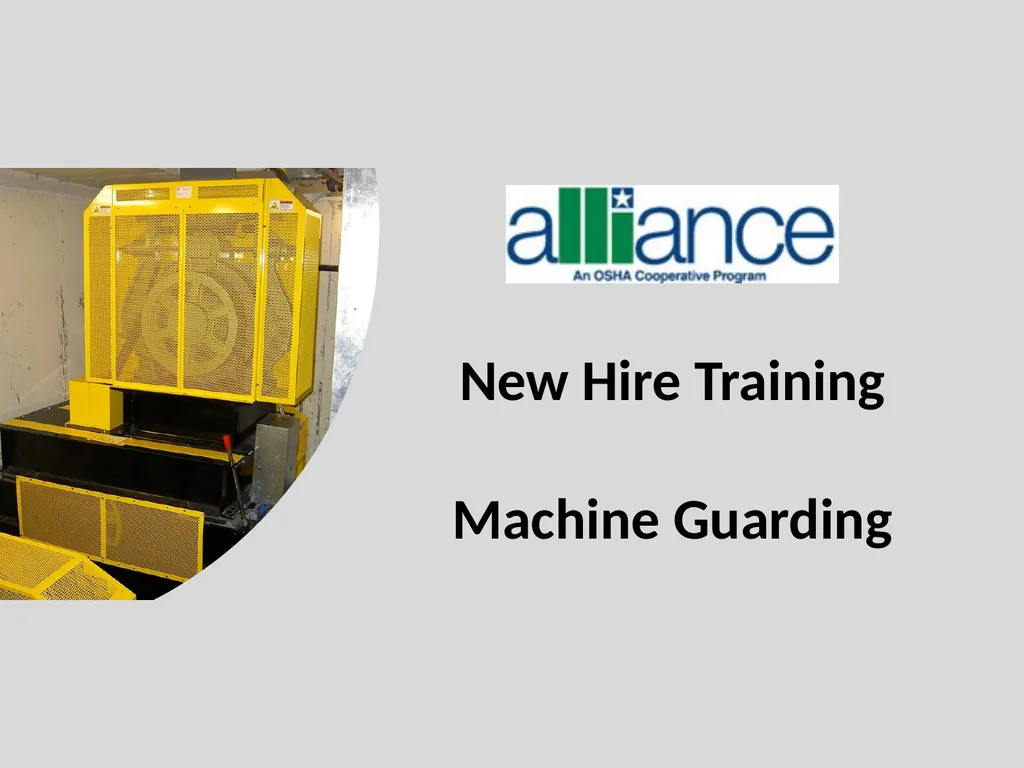
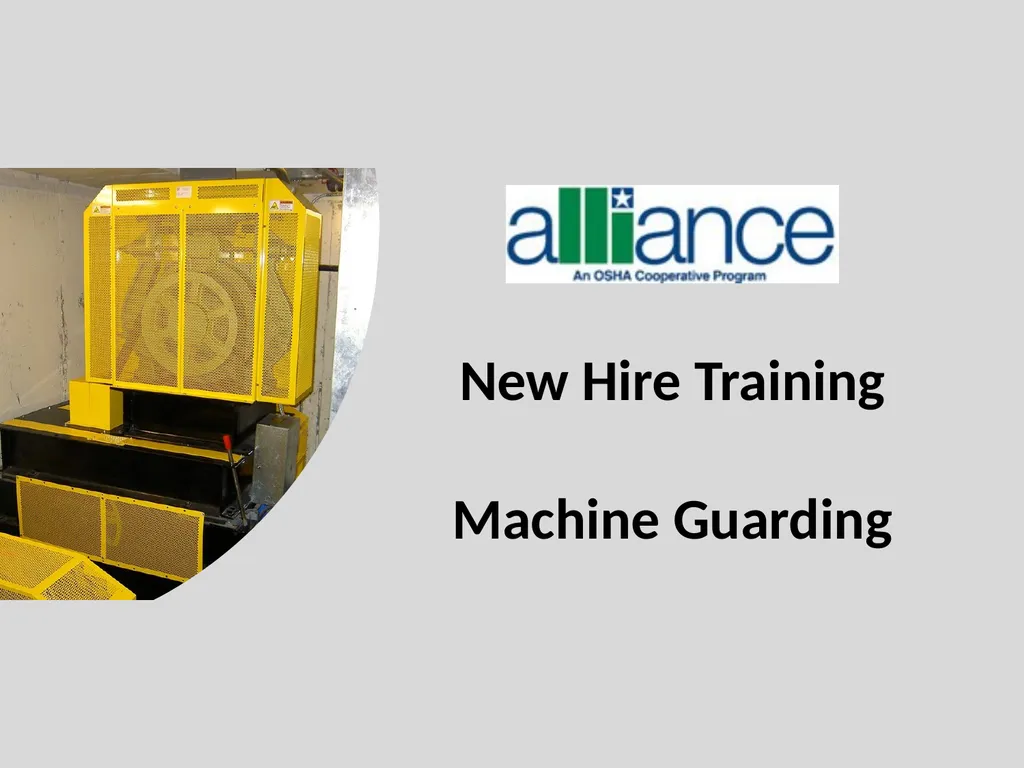
New Hire Training
Machine Guarding<br>
02
Introduction Possible machinery-related injuries include:
Crushed fingers or hands
Amputations
Burns
Blindness
A good rule to remember is:
Any machine part, function, or process which may cause injury must be safeguarded. Machine Guarding Many accidents result from persons working on, or around, moving machinery. These accidents could have been prevented by the installation and proper maintenance of guarding. The goal of this training is to make the guarding of all equipment as easily understood as possible and re-enforce the safe working procedures that must always be in place around dangerous equipment.<br>
03
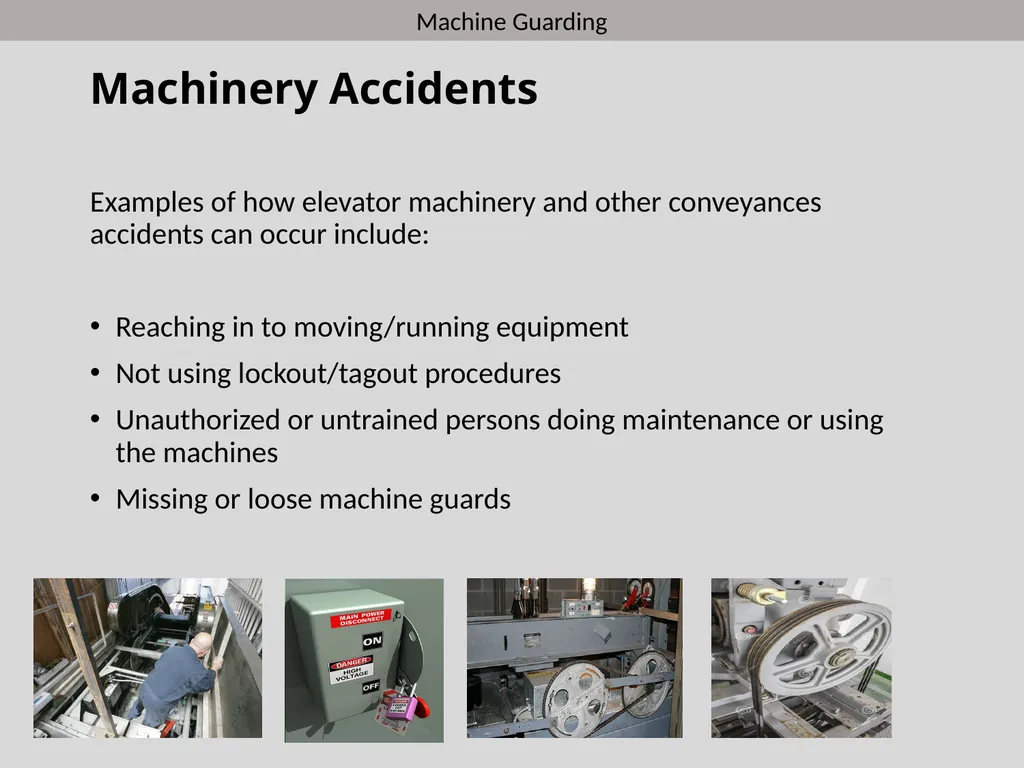
Machinery Accidents Examples of how elevator machinery and other conveyances accidents can occur include:
Reaching in to moving/running equipment
Not using lockout/tagout procedures
Unauthorized or untrained persons doing maintenance or using the machines
Missing or loose machine guards Machine Guarding<br>
04
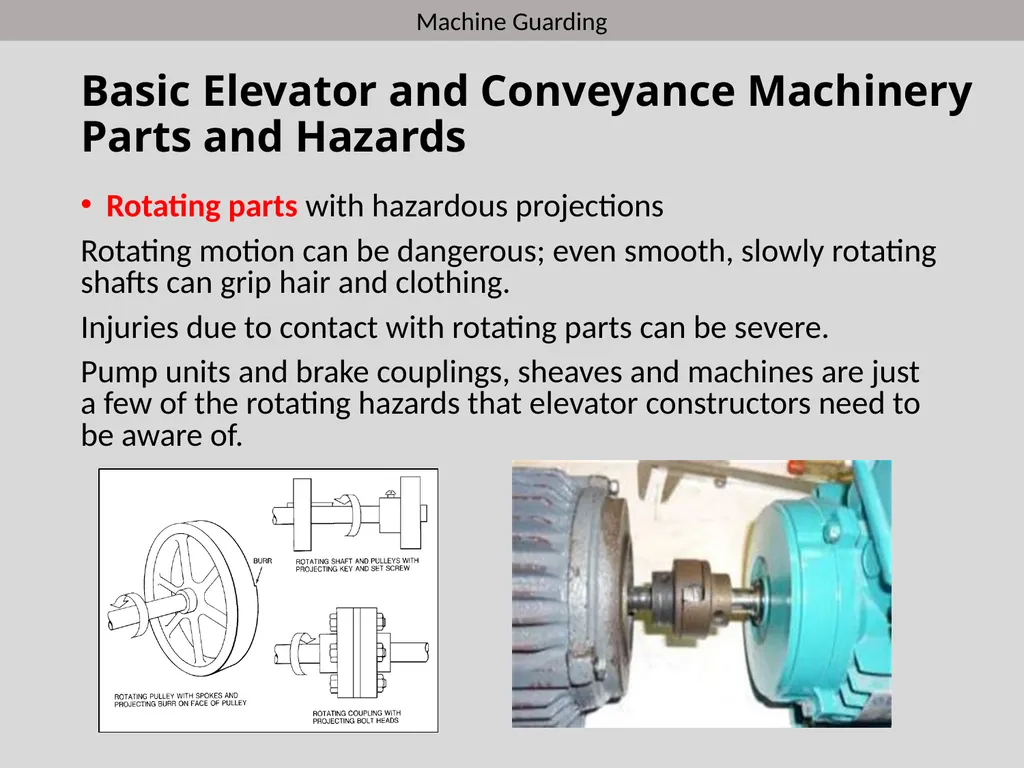
Basic Elevator and Conveyance Machinery Parts and Hazards Rotating parts with hazardous projections
Rotating motion can be dangerous; even smooth, slowly rotating shafts can grip hair and clothing.
Injuries due to contact with rotating parts can be severe.
Pump units and brake couplings, sheaves and machines are just a few of the rotating hazards that elevator constructors need to be aware of. Machine Guarding<br>
05
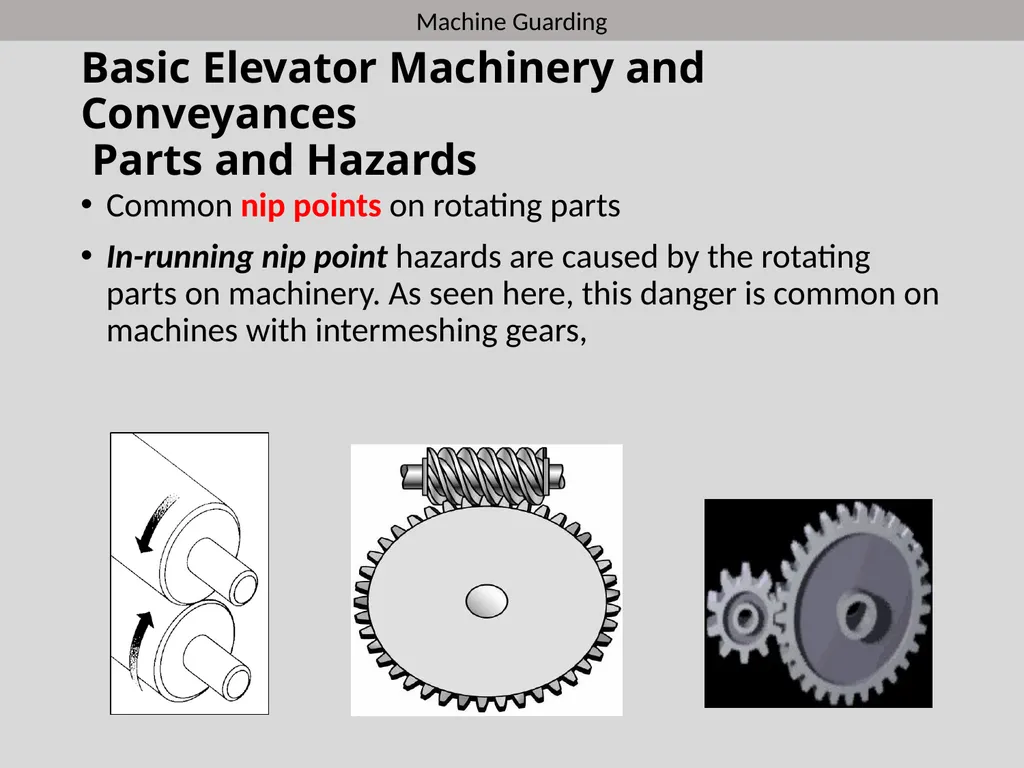
Basic Elevator Machinery and Conveyances Parts and Hazards Common nip points on rotating parts
In-running nip point hazards are caused by the rotating parts on machinery. As seen here, this danger is common on machines with intermeshing gears, Machine Guarding<br>
06
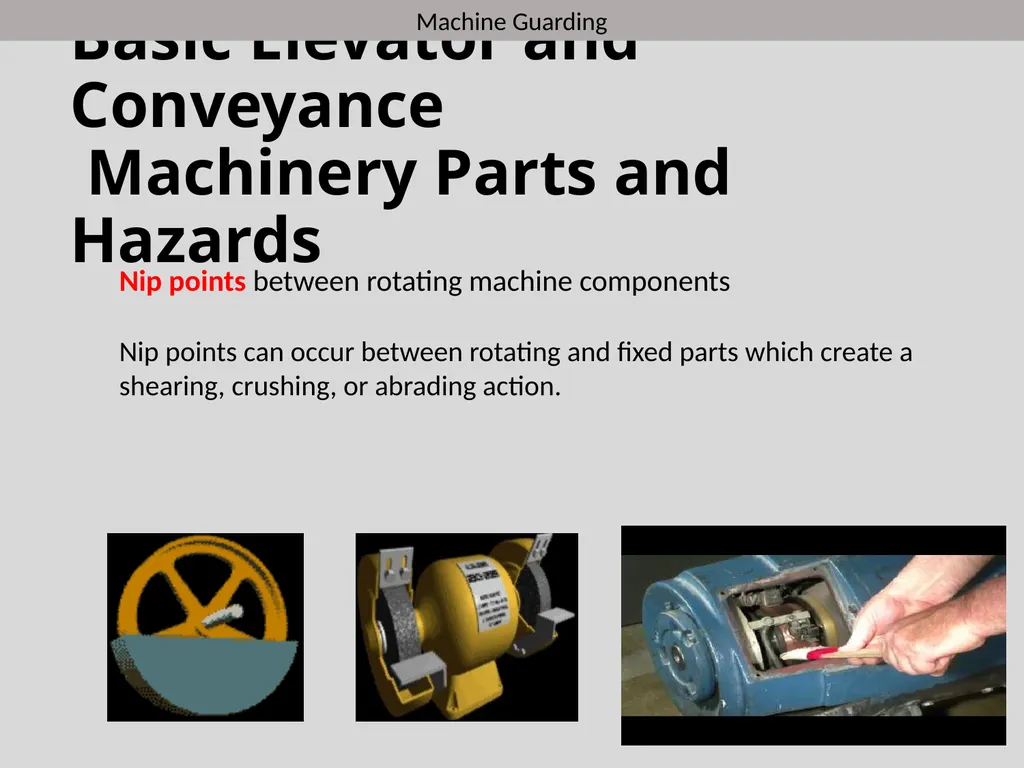
Basic Elevator and Conveyance Machinery Parts and Hazards Nip points between rotating machine components
Nip points can occur between rotating and fixed parts which create a
shearing, crushing, or abrading action. Machine Guarding<br>
07
Requirements for guards Guards must meet these minimum general requirements:
Prevent contact: The guard must prevent hands, arms, and any other part of a worker's body from making contact with dangerous moving parts.
Be secured: Workers should not be able to easily remove or tamper with the guard
Protect from falling objects: The guard should ensure that no objects can fall into moving parts.
Create no new hazards: A guard defeats its own purpose if it creates a hazard of its own such as a shear point, a jagged edge, or an unfinished surface which can cause a laceration.
Create no interference: Any guard which impedes a worker from performing the job quickly and comfortably might soon be overridden or disregarded.
Allow safe lubrication: If possible, one should be able to lubricate the machine without removing the guards. Machine Guarding<br>
08
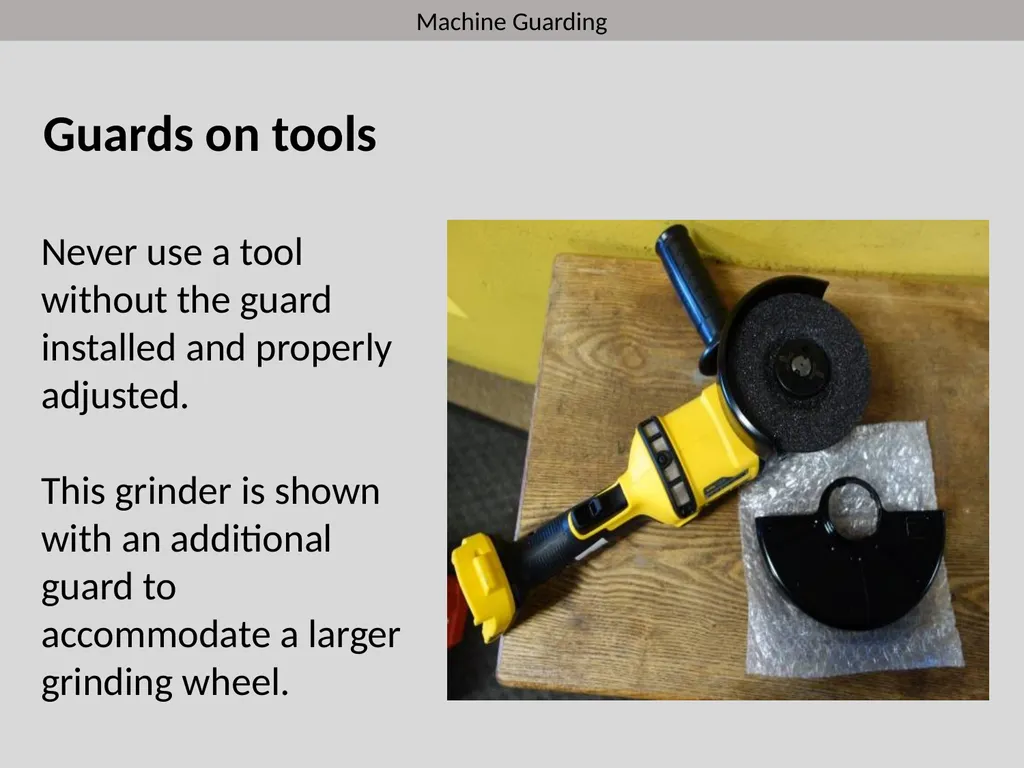
Machine Guarding Guards on tools Never use a tool without the guard installed and properly adjusted.
This grinder is shown with an additional guard to accommodate a larger grinding wheel.<br>
09
Summary Guards are essential for protecting workers from needless and preventable machinery-related injuries
All parts of the machine that move while the machine is working, must be guarded
A good rule to remember is: Any machine part, function, or process which may cause injury must be guarded Machine Guarding<br>
10
Through the Alliance between OSHA’s 10 Regional Offices and the Elevator Contractors of America (ECA), Elevator Industry Work Preservation Fund (EIWPF), International Union of Elevator Constructors (IUEC), National Association of Elevator Contractors (NAEC), National Elevator Industry Educational Program (NEIEP), and National Elevator Industry Inc. (NEII), collectively known as The Elevator Industry Safety Partners, developed this Industry Specific Training for informational purposes only. It does not necessarily reflect the official views of OSHA or the U.S. Department of Labor. March 2025
Under the Occupational Safety and Health Act, employers are responsible (http://www.osha.gov/as/opa/worker/employer-responsibility.html) for providing a safe and healthy workplace and workers have rights (https://www.osha.gov/workers). OSHA can help answer questions or concerns from employers and workers. OSHA's On-Site Consultation Program (https://www.osha.gov/consultation) offers free and confidential advice to small and medium-sized businesses, with priority given to high-hazard worksites. For more information, contact your regional or area OSHA office (https://www.osha.gov/contactus/bystate), call 1-800-321-OSHA (6742), or visit https://www.osha.gov/.<br>