
New Labour Codes Jan 2026 www.krayman.com
KL
Published · 26 slides · 0 views

1 / 1



Description
New Labour Codes Jan 2026 www.krayman.com Government of India has made effective all the 4 Labour Codes from 21 Nov 2025 onwards These codes will replace 29 existing central labour laws are applicable across India Central Rules under all
Related Topics
Share
Embed code
Download this presentation From Below
"New Labour Codes Jan 2026 www.krayman.com" is the property of its rightful owner. Permission is granted to download and print the materials on this website for personal, non-commercial use only, and to display it on your personal computer provided you do not modify the materials and that you retain all copyright notices contained in the materials. By downloading content from our website, you accept the terms of this agreement.
Presentation Transcript
01
New Labour Codes Jan 2026 www.krayman.com<br>
02
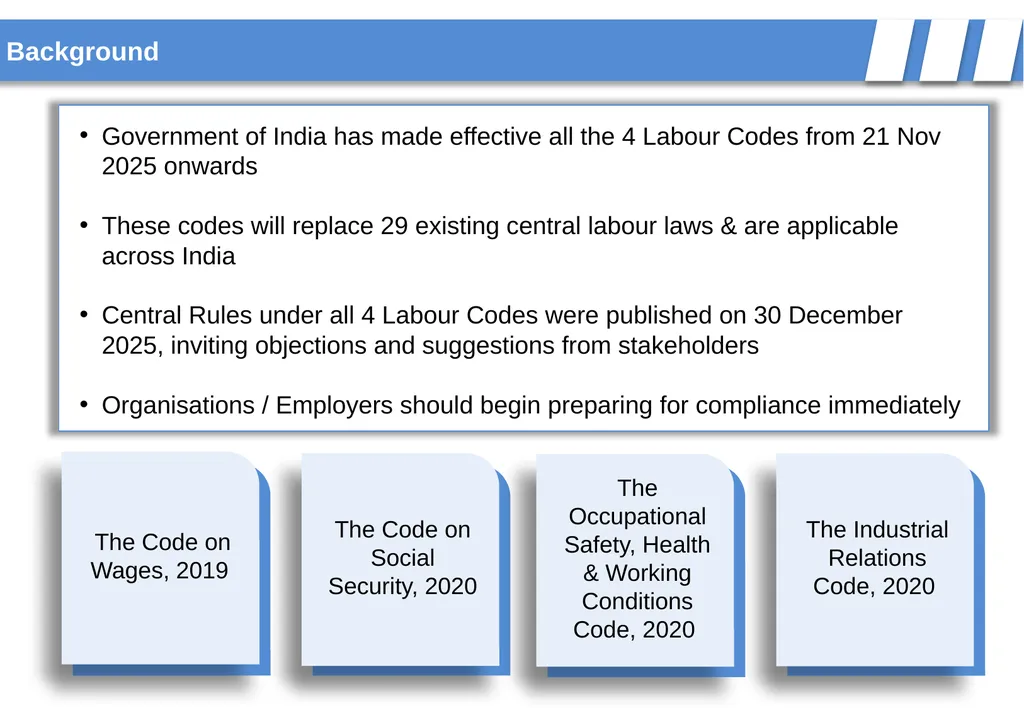
Government of India has made effective all the 4 Labour Codes from 21 Nov 2025 onwards
These codes will replace 29 existing central labour laws & are applicable across India
Central Rules under all 4 Labour Codes were published on 30 December 2025, inviting objections and suggestions from stakeholders
Organisations / Employers should begin preparing for compliance immediately Background<br>
These codes will replace 29 existing central labour laws & are applicable across India
Central Rules under all 4 Labour Codes were published on 30 December 2025, inviting objections and suggestions from stakeholders
Organisations / Employers should begin preparing for compliance immediately Background<br>
03
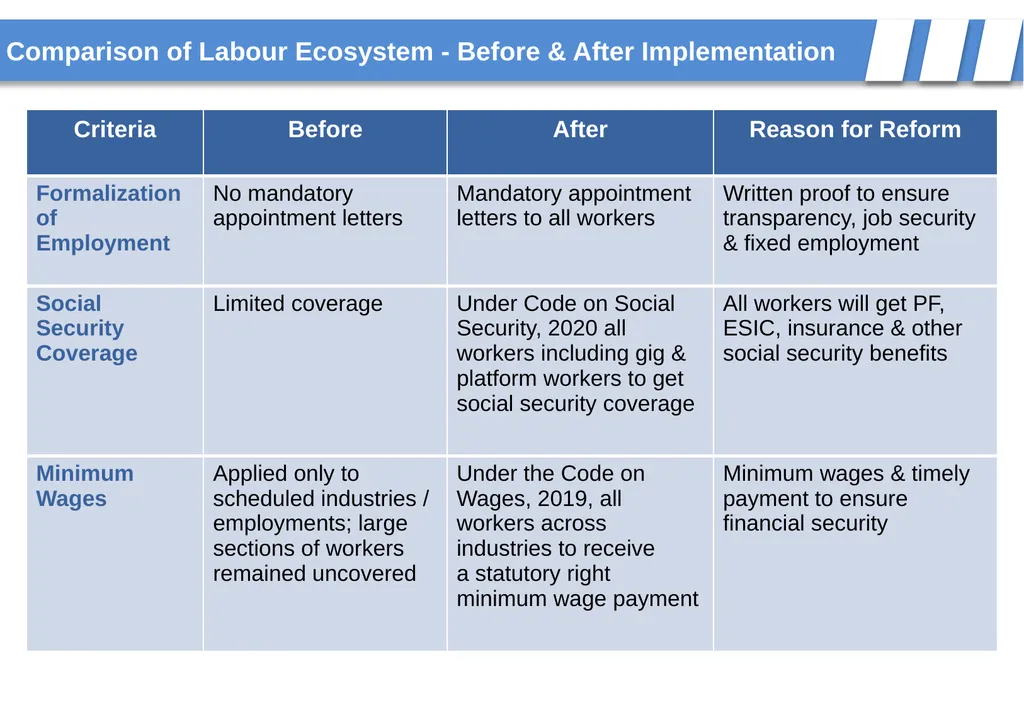
Comparison of Labour Ecosystem - Before & After Implementation<br>
04
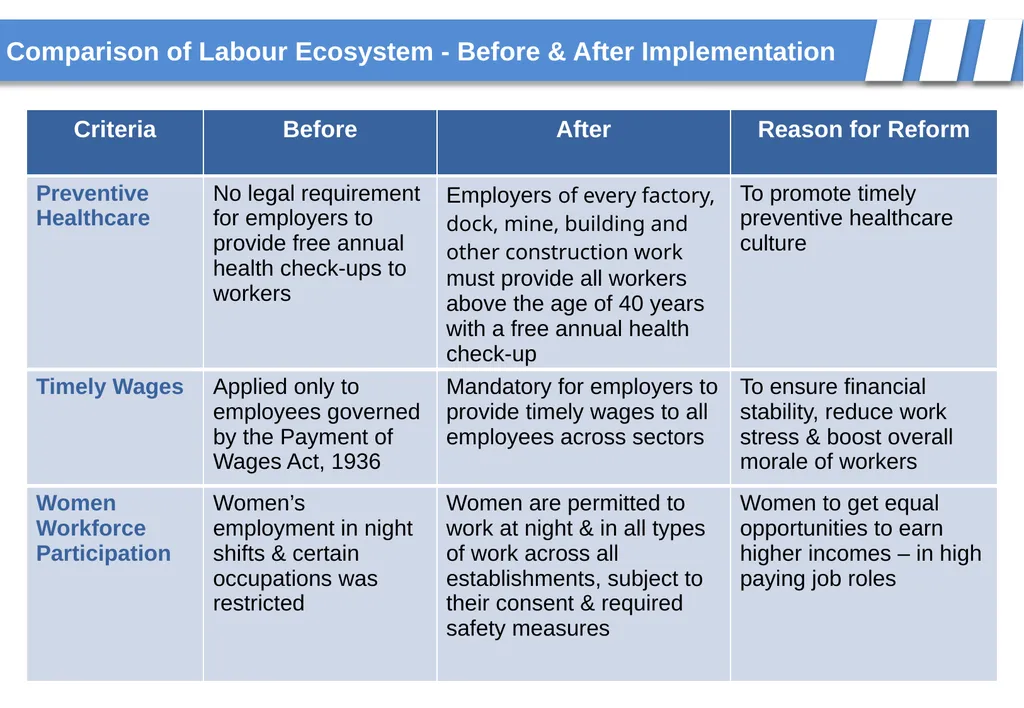
Comparison of Labour Ecosystem - Before & After Implementation<br>
05
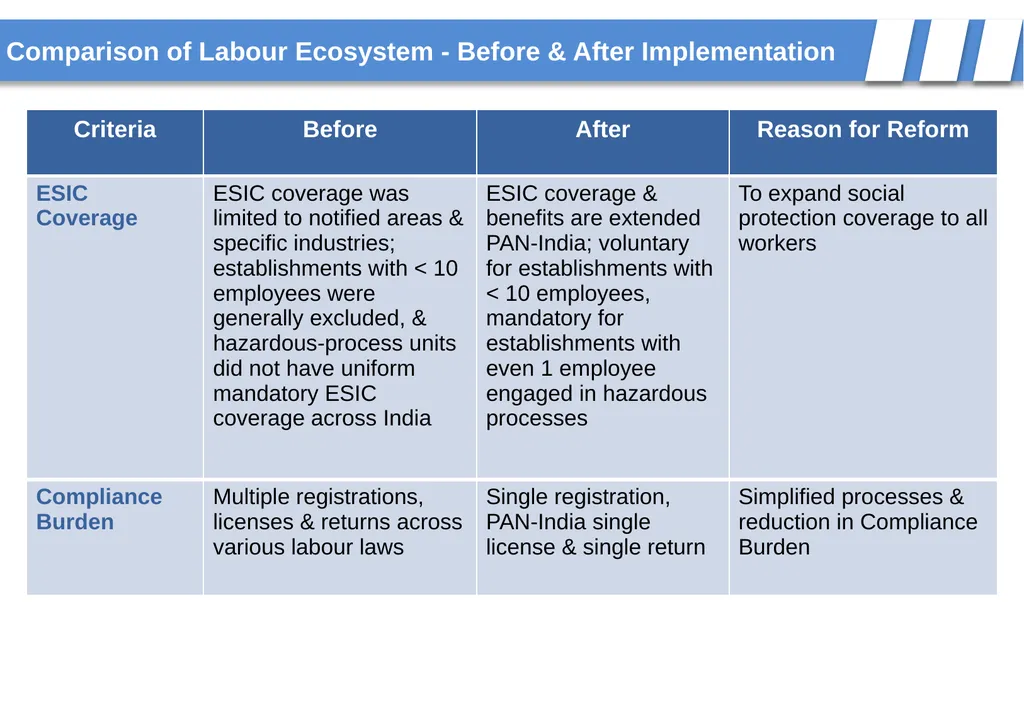
Comparison of Labour Ecosystem - Before & After Implementation<br>
06
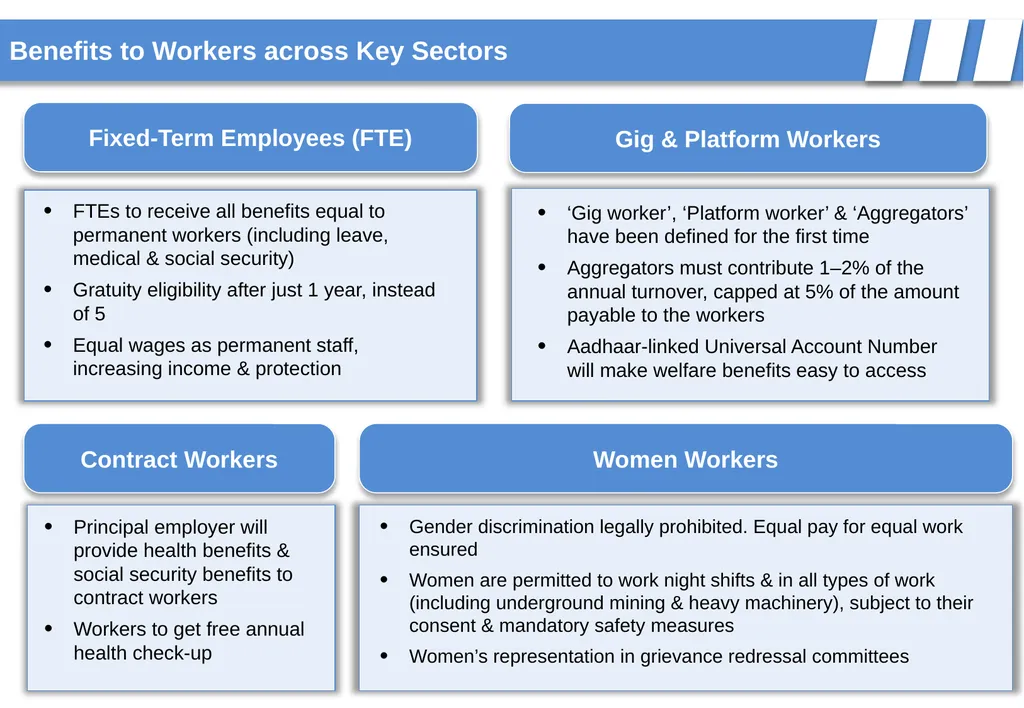
Benefits to Workers across Key Sectors FTEs to receive all benefits equal to permanent workers (including leave, medical & social security)
Gratuity eligibility after just 1 year, instead of 5
Equal wages as permanent staff, increasing income & protection Principal employer will provide health benefits & social security benefits to contract workers
Workers to get free annual health check-up ‘Gig worker’, ‘Platform worker’ & ‘Aggregators’ have been defined for the first time
Aggregators must contribute 1–2% of the annual turnover, capped at 5% of the amount payable to the workers
Aadhaar-linked Universal Account Number will make welfare benefits easy to access Gender discrimination legally prohibited. Equal pay for equal work ensured
Women are permitted to work night shifts & in all types of work (including underground mining & heavy machinery), subject to their consent & mandatory safety measures
Women’s representation in grievance redressal committees Gig & Platform Workers Fixed-Term Employees (FTE) Contract Workers Women Workers<br>
Gratuity eligibility after just 1 year, instead of 5
Equal wages as permanent staff, increasing income & protection Principal employer will provide health benefits & social security benefits to contract workers
Workers to get free annual health check-up ‘Gig worker’, ‘Platform worker’ & ‘Aggregators’ have been defined for the first time
Aggregators must contribute 1–2% of the annual turnover, capped at 5% of the amount payable to the workers
Aadhaar-linked Universal Account Number will make welfare benefits easy to access Gender discrimination legally prohibited. Equal pay for equal work ensured
Women are permitted to work night shifts & in all types of work (including underground mining & heavy machinery), subject to their consent & mandatory safety measures
Women’s representation in grievance redressal committees Gig & Platform Workers Fixed-Term Employees (FTE) Contract Workers Women Workers<br>
07
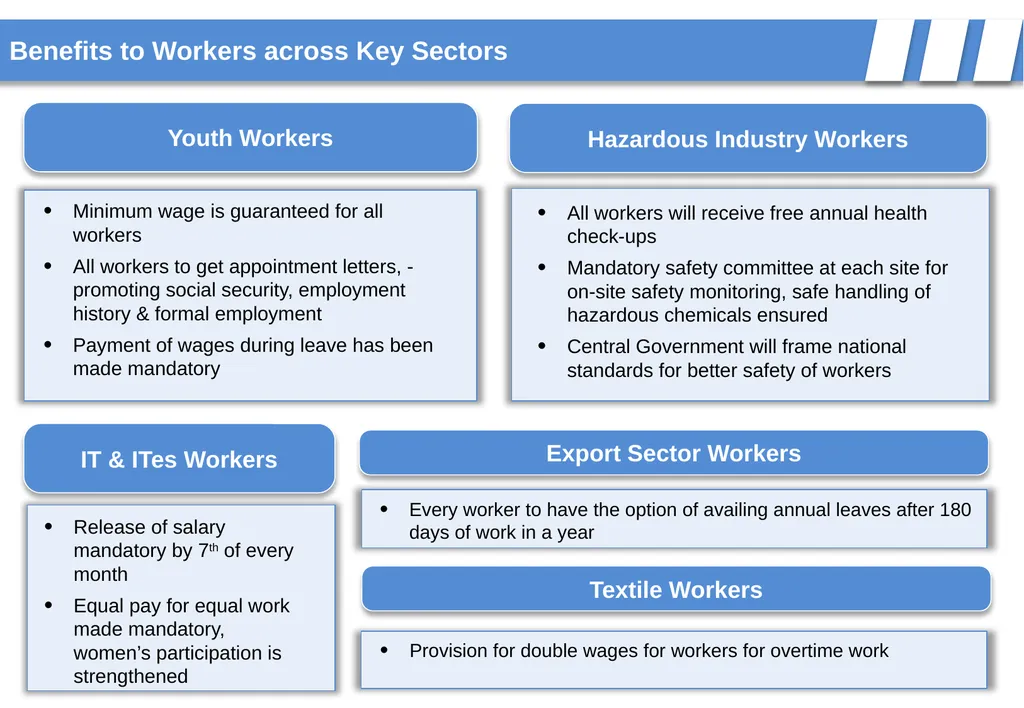
Benefits to Workers across Key Sectors Minimum wage is guaranteed for all workers
All workers to get appointment letters, - promoting social security, employment history & formal employment
Payment of wages during leave has been made mandatory Release of salary mandatory by 7th of every month
Equal pay for equal work made mandatory, women’s participation is strengthened All workers will receive free annual health check-ups
Mandatory safety committee at each site for on-site safety monitoring, safe handling of hazardous chemicals ensured
Central Government will frame national standards for better safety of workers Every worker to have the option of availing annual leaves after 180 days of work in a year Hazardous Industry Workers Youth Workers IT & ITes Workers Export Sector Workers Textile Workers Provision for double wages for workers for overtime work<br>
All workers to get appointment letters, - promoting social security, employment history & formal employment
Payment of wages during leave has been made mandatory Release of salary mandatory by 7th of every month
Equal pay for equal work made mandatory, women’s participation is strengthened All workers will receive free annual health check-ups
Mandatory safety committee at each site for on-site safety monitoring, safe handling of hazardous chemicals ensured
Central Government will frame national standards for better safety of workers Every worker to have the option of availing annual leaves after 180 days of work in a year Hazardous Industry Workers Youth Workers IT & ITes Workers Export Sector Workers Textile Workers Provision for double wages for workers for overtime work<br>
08
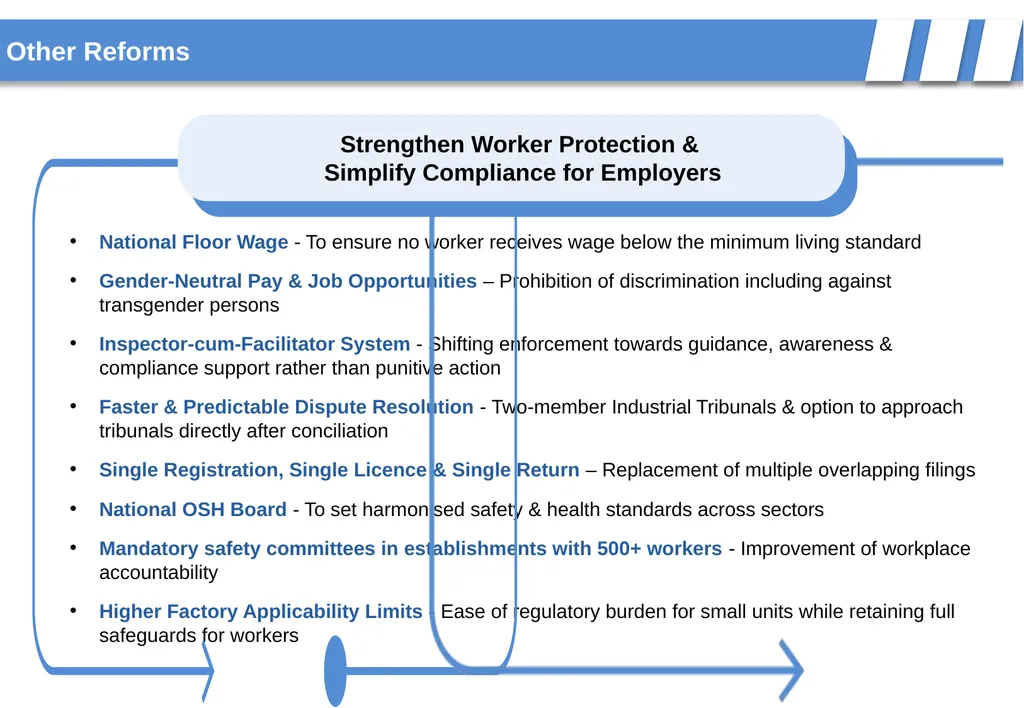
National Floor Wage - To ensure no worker receives wage below the minimum living standard
Gender-Neutral Pay & Job Opportunities – Prohibition of discrimination including against transgender persons
Inspector-cum-Facilitator System - Shifting enforcement towards guidance, awareness & compliance support rather than punitive action
Faster & Predictable Dispute Resolution - Two-member Industrial Tribunals & option to approach tribunals directly after conciliation
Single Registration, Single Licence & Single Return – Replacement of multiple overlapping filings
National OSH Board - To set harmonised safety & health standards across sectors
Mandatory safety committees in establishments with 500+ workers - Improvement of workplace accountability
Higher Factory Applicability Limits - Ease of regulatory burden for small units while retaining full safeguards for workers Other Reforms<br>
Gender-Neutral Pay & Job Opportunities – Prohibition of discrimination including against transgender persons
Inspector-cum-Facilitator System - Shifting enforcement towards guidance, awareness & compliance support rather than punitive action
Faster & Predictable Dispute Resolution - Two-member Industrial Tribunals & option to approach tribunals directly after conciliation
Single Registration, Single Licence & Single Return – Replacement of multiple overlapping filings
National OSH Board - To set harmonised safety & health standards across sectors
Mandatory safety committees in establishments with 500+ workers - Improvement of workplace accountability
Higher Factory Applicability Limits - Ease of regulatory burden for small units while retaining full safeguards for workers Other Reforms<br>
09
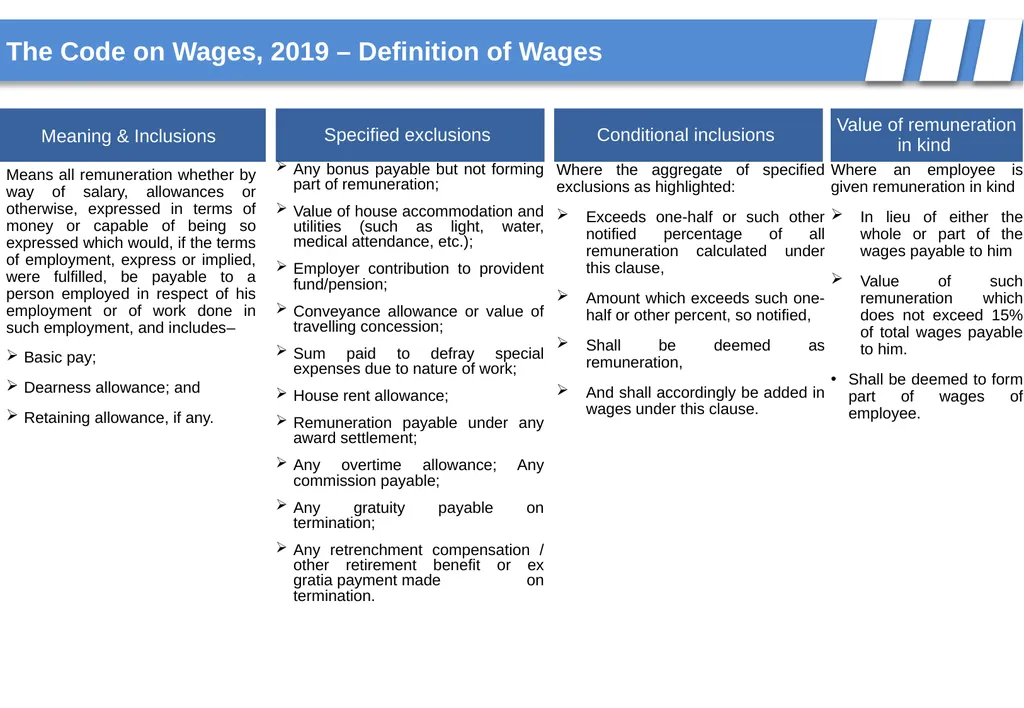
The Code on Wages, 2019 – Definition of Wages Means all remuneration whether by way of salary, allowances or otherwise, expressed in terms of money or capable of being so expressed which would, if the terms of employment, express or implied, were fulfilled, be payable to a person employed in respect of his employment or of work done in such employment, and includes–
Basic pay;
Dearness allowance; and
Retaining allowance, if any. Meaning & Inclusions Specified exclusions Conditional inclusions Value of remuneration in kind Any bonus payable but not forming part of remuneration;
Value of house accommodation and utilities (such as light, water, medical attendance, etc.);
Employer contribution to provident fund/pension;
Conveyance allowance or value of travelling concession;
Sum paid to defray special expenses due to nature of work;
House rent allowance;
Remuneration payable under any award settlement;
Any overtime allowance; Any commission payable;
Any gratuity payable on termination;
Any retrenchment compensation / other retirement benefit or ex gratia payment made on termination. Where an employee is given remuneration in kind
In lieu of either the whole or part of the wages payable to him
Value of such remuneration which does not exceed 15% of total wages payable to him.
Shall be deemed to form part of wages of employee. Where the aggregate of specified exclusions as highlighted:
Exceeds one-half or such other notified percentage of all remuneration calculated under this clause,
Amount which exceeds such one-half or other percent, so notified,
Shall be deemed as remuneration,
And shall accordingly be added in wages under this clause.<br>
Basic pay;
Dearness allowance; and
Retaining allowance, if any. Meaning & Inclusions Specified exclusions Conditional inclusions Value of remuneration in kind Any bonus payable but not forming part of remuneration;
Value of house accommodation and utilities (such as light, water, medical attendance, etc.);
Employer contribution to provident fund/pension;
Conveyance allowance or value of travelling concession;
Sum paid to defray special expenses due to nature of work;
House rent allowance;
Remuneration payable under any award settlement;
Any overtime allowance; Any commission payable;
Any gratuity payable on termination;
Any retrenchment compensation / other retirement benefit or ex gratia payment made on termination. Where an employee is given remuneration in kind
In lieu of either the whole or part of the wages payable to him
Value of such remuneration which does not exceed 15% of total wages payable to him.
Shall be deemed to form part of wages of employee. Where the aggregate of specified exclusions as highlighted:
Exceeds one-half or such other notified percentage of all remuneration calculated under this clause,
Amount which exceeds such one-half or other percent, so notified,
Shall be deemed as remuneration,
And shall accordingly be added in wages under this clause.<br>
10
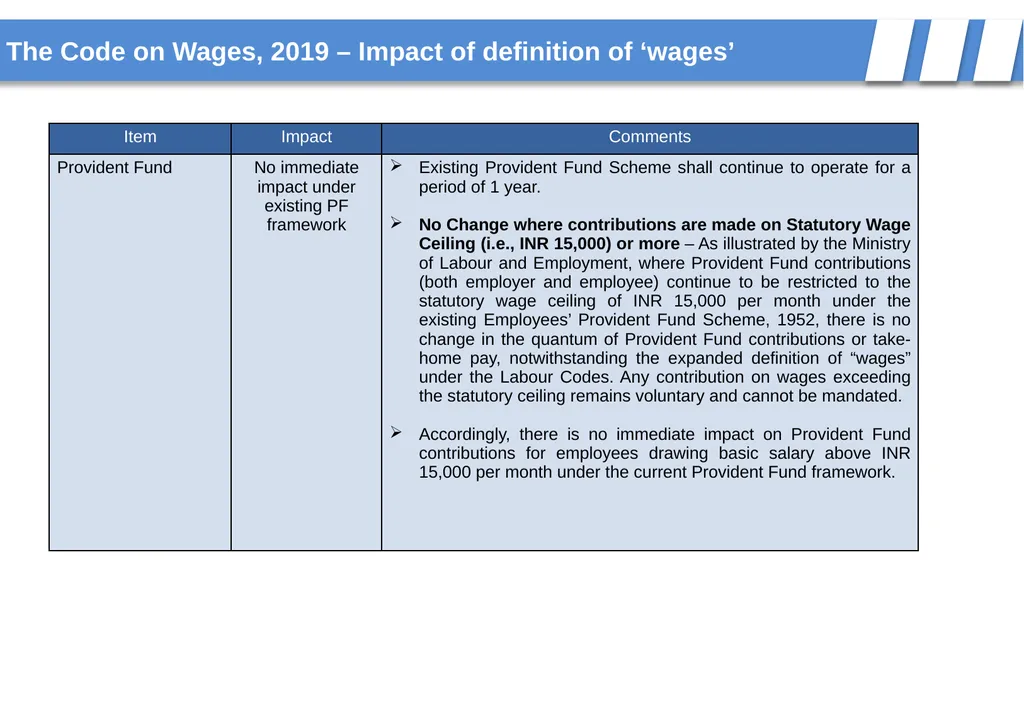
The Code on Wages, 2019 – Impact of definition of ‘wages’<br>
11
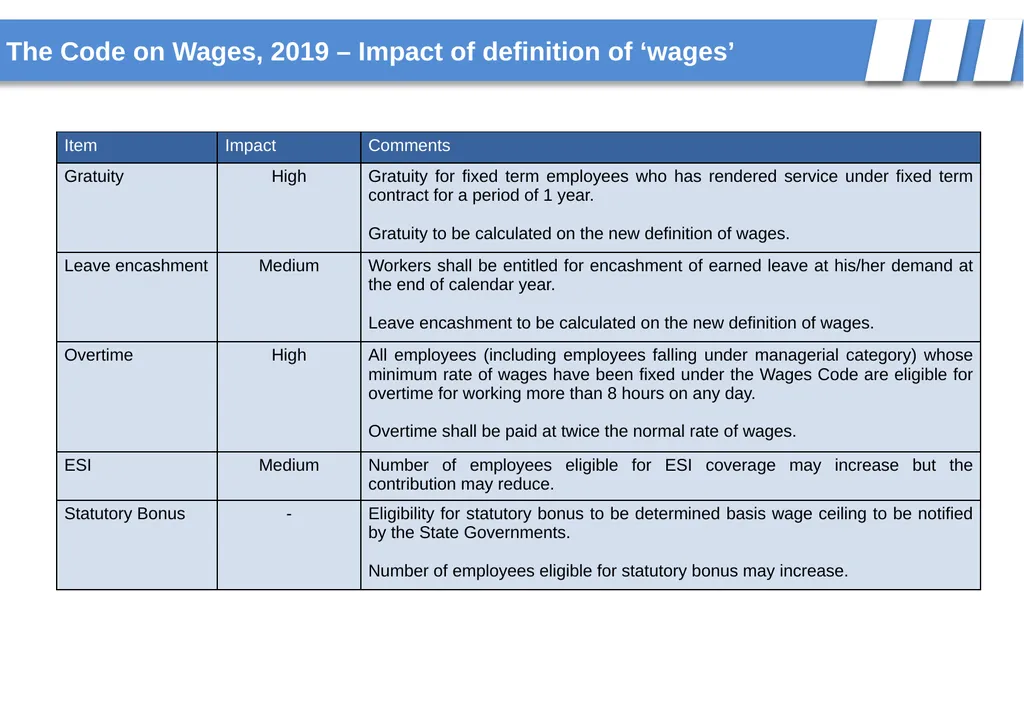
The Code on Wages, 2019 – Impact of definition of ‘wages’<br>
12
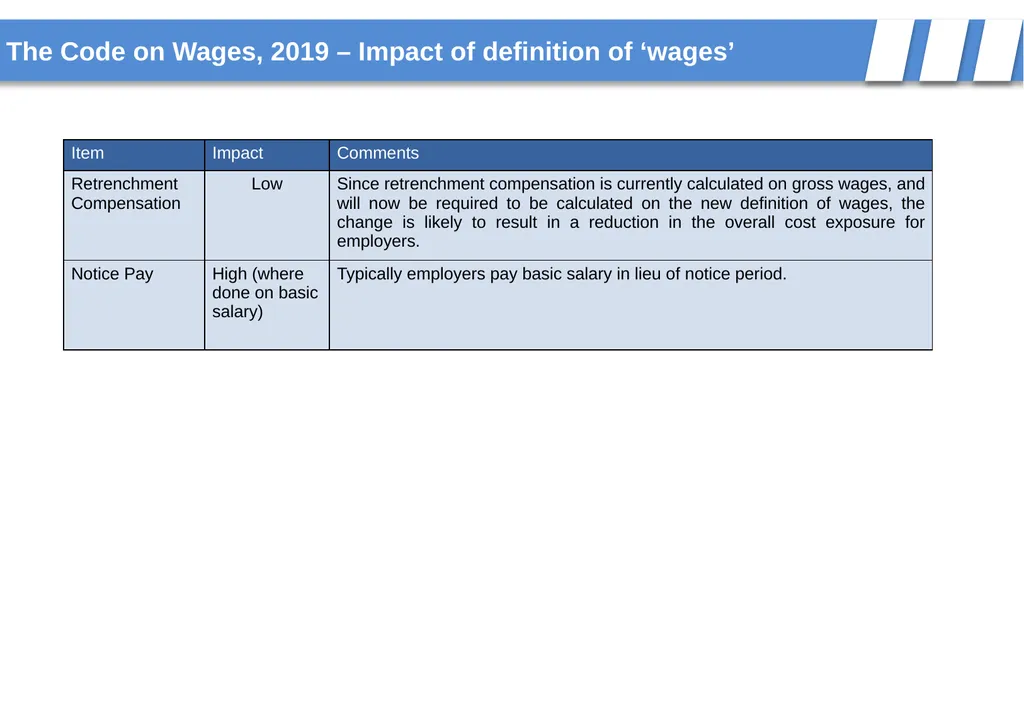
The Code on Wages, 2019 – Impact of definition of ‘wages’<br>
13
Inspector-cum-Facilitator & Compounding of Offences<br>
14
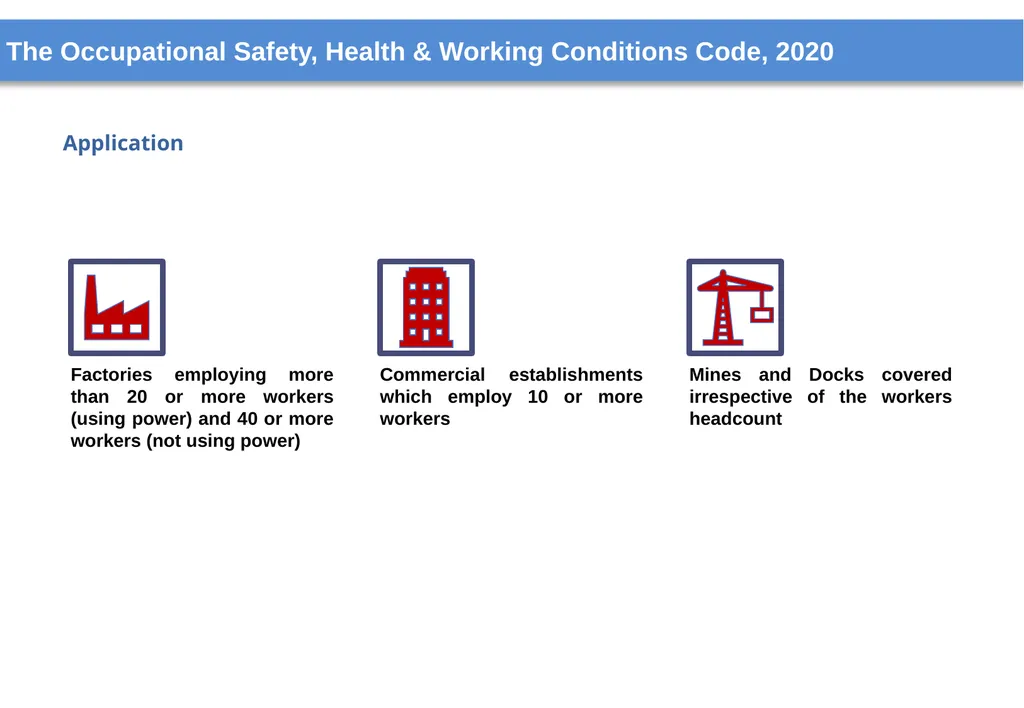
Application The Occupational Safety, Health & Working Conditions Code, 2020<br>
15
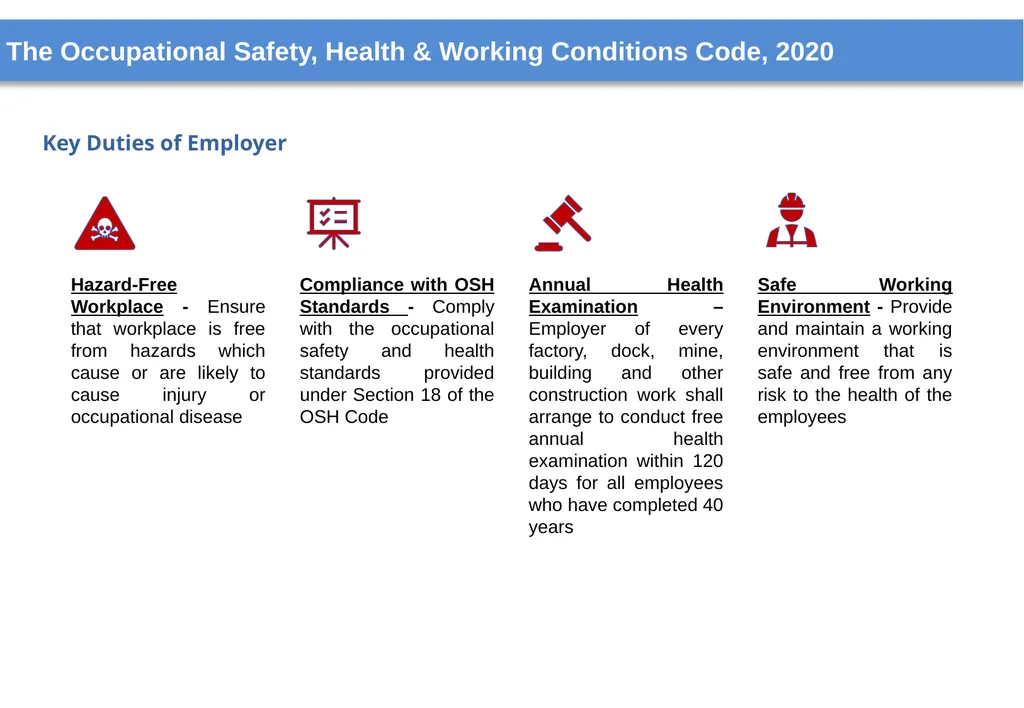
Key Duties of Employer The Occupational Safety, Health & Working Conditions Code, 2020<br>
16
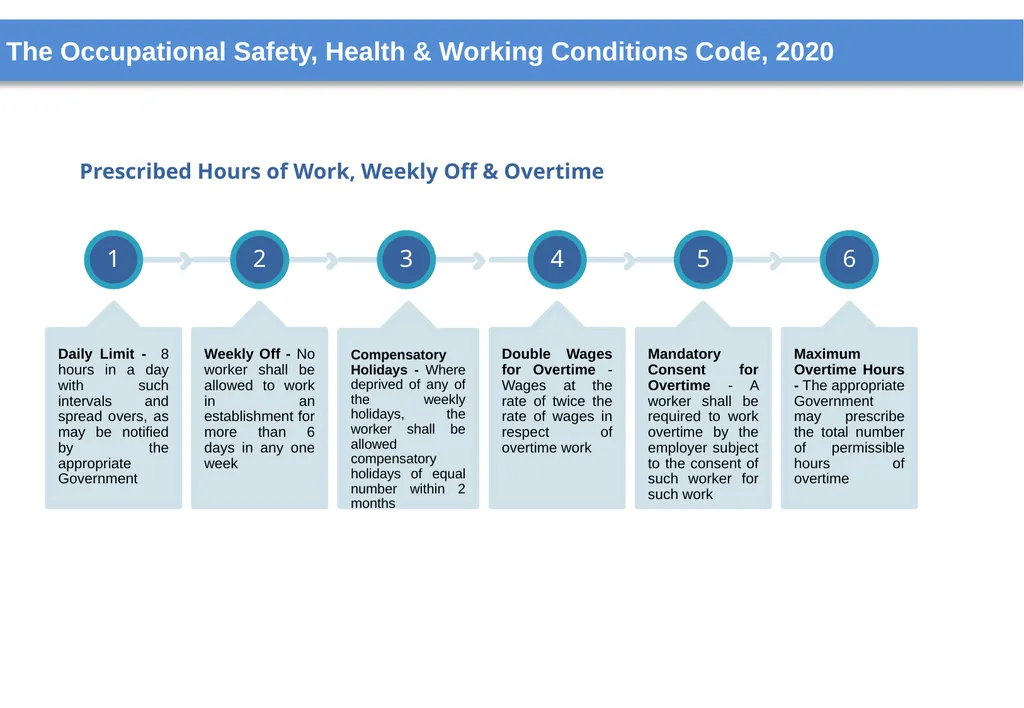
Prescribed Hours of Work, Weekly Off & Overtime The Occupational Safety, Health & Working Conditions Code, 2020<br>
17
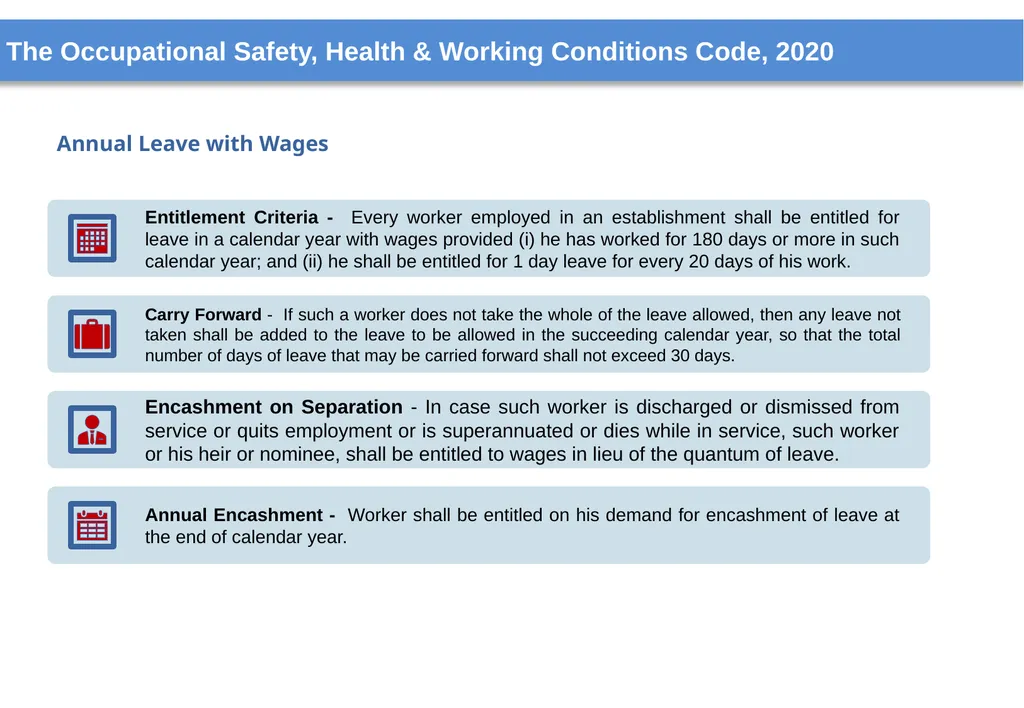
Annual Leave with Wages The Occupational Safety, Health & Working Conditions Code, 2020<br>
18
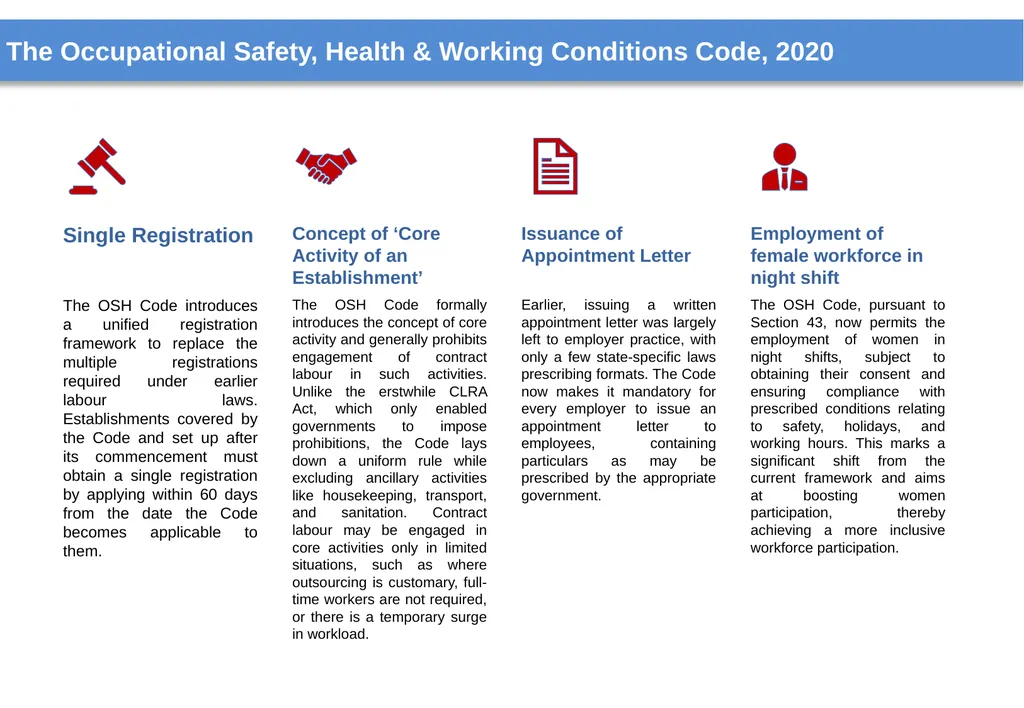
The Occupational Safety, Health & Working Conditions Code, 2020<br>
19
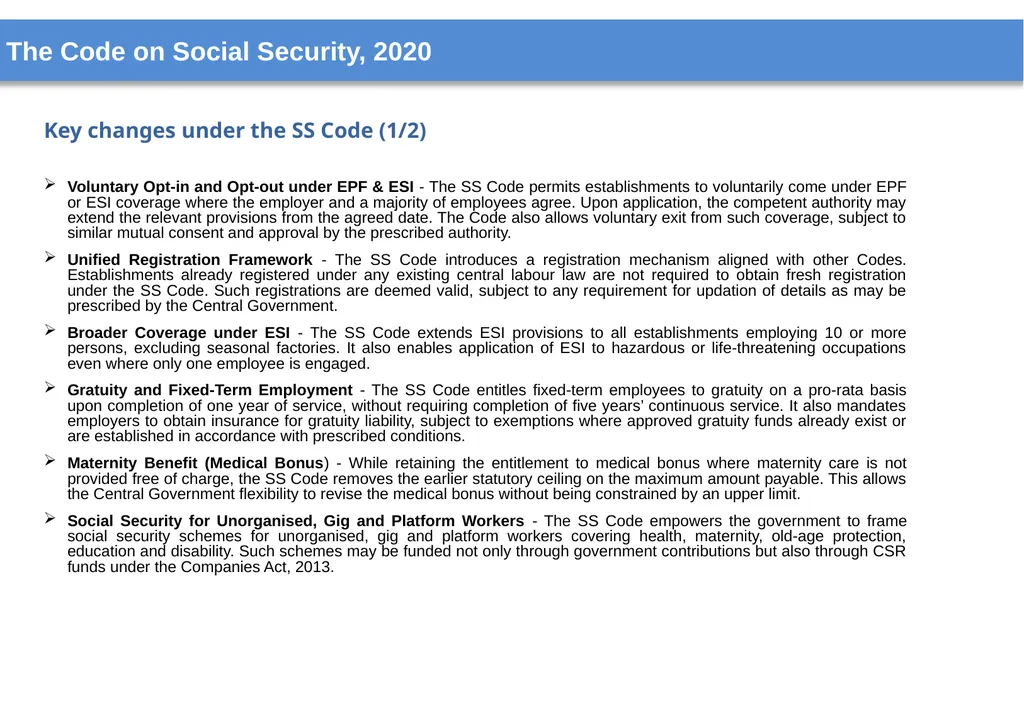
Key changes under the SS Code (1/2) Voluntary Opt-in and Opt-out under EPF & ESI - The SS Code permits establishments to voluntarily come under EPF or ESI coverage where the employer and a majority of employees agree. Upon application, the competent authority may extend the relevant provisions from the agreed date. The Code also allows voluntary exit from such coverage, subject to similar mutual consent and approval by the prescribed authority.
Unified Registration Framework - The SS Code introduces a registration mechanism aligned with other Codes. Establishments already registered under any existing central labour law are not required to obtain fresh registration under the SS Code. Such registrations are deemed valid, subject to any requirement for updation of details as may be prescribed by the Central Government.
Broader Coverage under ESI - The SS Code extends ESI provisions to all establishments employing 10 or more persons, excluding seasonal factories. It also enables application of ESI to hazardous or life-threatening occupations even where only one employee is engaged.
Gratuity and Fixed-Term Employment - The SS Code entitles fixed-term employees to gratuity on a pro-rata basis upon completion of one year of service, without requiring completion of five years’ continuous service. It also mandates employers to obtain insurance for gratuity liability, subject to exemptions where approved gratuity funds already exist or are established in accordance with prescribed conditions.
Maternity Benefit (Medical Bonus) - While retaining the entitlement to medical bonus where maternity care is not provided free of charge, the SS Code removes the earlier statutory ceiling on the maximum amount payable. This allows the Central Government flexibility to revise the medical bonus without being constrained by an upper limit.
Social Security for Unorganised, Gig and Platform Workers - The SS Code empowers the government to frame social security schemes for unorganised, gig and platform workers covering health, maternity, old-age protection, education and disability. Such schemes may be funded not only through government contributions but also through CSR funds under the Companies Act, 2013. The Code on Social Security, 2020<br>
Unified Registration Framework - The SS Code introduces a registration mechanism aligned with other Codes. Establishments already registered under any existing central labour law are not required to obtain fresh registration under the SS Code. Such registrations are deemed valid, subject to any requirement for updation of details as may be prescribed by the Central Government.
Broader Coverage under ESI - The SS Code extends ESI provisions to all establishments employing 10 or more persons, excluding seasonal factories. It also enables application of ESI to hazardous or life-threatening occupations even where only one employee is engaged.
Gratuity and Fixed-Term Employment - The SS Code entitles fixed-term employees to gratuity on a pro-rata basis upon completion of one year of service, without requiring completion of five years’ continuous service. It also mandates employers to obtain insurance for gratuity liability, subject to exemptions where approved gratuity funds already exist or are established in accordance with prescribed conditions.
Maternity Benefit (Medical Bonus) - While retaining the entitlement to medical bonus where maternity care is not provided free of charge, the SS Code removes the earlier statutory ceiling on the maximum amount payable. This allows the Central Government flexibility to revise the medical bonus without being constrained by an upper limit.
Social Security for Unorganised, Gig and Platform Workers - The SS Code empowers the government to frame social security schemes for unorganised, gig and platform workers covering health, maternity, old-age protection, education and disability. Such schemes may be funded not only through government contributions but also through CSR funds under the Companies Act, 2013. The Code on Social Security, 2020<br>
20
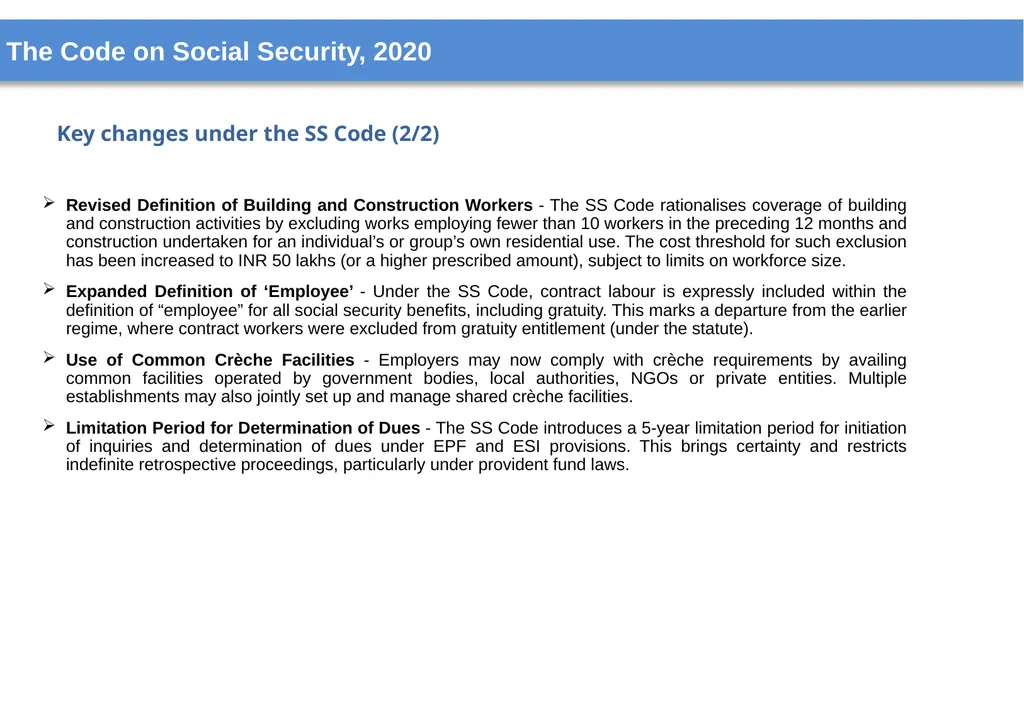
Key changes under the SS Code (2/2) Revised Definition of Building and Construction Workers - The SS Code rationalises coverage of building and construction activities by excluding works employing fewer than 10 workers in the preceding 12 months and construction undertaken for an individual’s or group’s own residential use. The cost threshold for such exclusion has been increased to INR 50 lakhs (or a higher prescribed amount), subject to limits on workforce size.
Expanded Definition of ‘Employee’ - Under the SS Code, contract labour is expressly included within the definition of “employee” for all social security benefits, including gratuity. This marks a departure from the earlier regime, where contract workers were excluded from gratuity entitlement (under the statute).
Use of Common Crèche Facilities - Employers may now comply with crèche requirements by availing common facilities operated by government bodies, local authorities, NGOs or private entities. Multiple establishments may also jointly set up and manage shared crèche facilities.
Limitation Period for Determination of Dues - The SS Code introduces a 5-year limitation period for initiation of inquiries and determination of dues under EPF and ESI provisions. This brings certainty and restricts indefinite retrospective proceedings, particularly under provident fund laws. The Code on Social Security, 2020<br>
Expanded Definition of ‘Employee’ - Under the SS Code, contract labour is expressly included within the definition of “employee” for all social security benefits, including gratuity. This marks a departure from the earlier regime, where contract workers were excluded from gratuity entitlement (under the statute).
Use of Common Crèche Facilities - Employers may now comply with crèche requirements by availing common facilities operated by government bodies, local authorities, NGOs or private entities. Multiple establishments may also jointly set up and manage shared crèche facilities.
Limitation Period for Determination of Dues - The SS Code introduces a 5-year limitation period for initiation of inquiries and determination of dues under EPF and ESI provisions. This brings certainty and restricts indefinite retrospective proceedings, particularly under provident fund laws. The Code on Social Security, 2020<br>
21
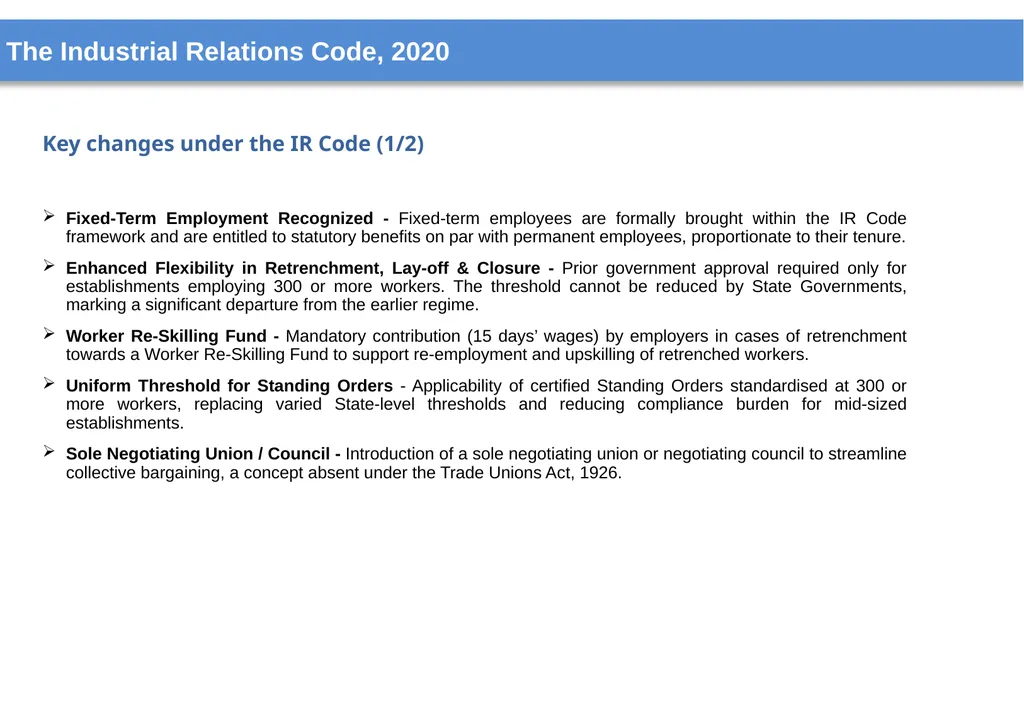
Key changes under the IR Code (1/2) Fixed-Term Employment Recognized - Fixed-term employees are formally brought within the IR Code framework and are entitled to statutory benefits on par with permanent employees, proportionate to their tenure.
Enhanced Flexibility in Retrenchment, Lay-off & Closure - Prior government approval required only for establishments employing 300 or more workers. The threshold cannot be reduced by State Governments, marking a significant departure from the earlier regime.
Worker Re-Skilling Fund - Mandatory contribution (15 days’ wages) by employers in cases of retrenchment towards a Worker Re-Skilling Fund to support re-employment and upskilling of retrenched workers.
Uniform Threshold for Standing Orders - Applicability of certified Standing Orders standardised at 300 or more workers, replacing varied State-level thresholds and reducing compliance burden for mid-sized establishments.
Sole Negotiating Union / Council - Introduction of a sole negotiating union or negotiating council to streamline collective bargaining, a concept absent under the Trade Unions Act, 1926. The Industrial Relations Code, 2020<br>
Enhanced Flexibility in Retrenchment, Lay-off & Closure - Prior government approval required only for establishments employing 300 or more workers. The threshold cannot be reduced by State Governments, marking a significant departure from the earlier regime.
Worker Re-Skilling Fund - Mandatory contribution (15 days’ wages) by employers in cases of retrenchment towards a Worker Re-Skilling Fund to support re-employment and upskilling of retrenched workers.
Uniform Threshold for Standing Orders - Applicability of certified Standing Orders standardised at 300 or more workers, replacing varied State-level thresholds and reducing compliance burden for mid-sized establishments.
Sole Negotiating Union / Council - Introduction of a sole negotiating union or negotiating council to streamline collective bargaining, a concept absent under the Trade Unions Act, 1926. The Industrial Relations Code, 2020<br>
22
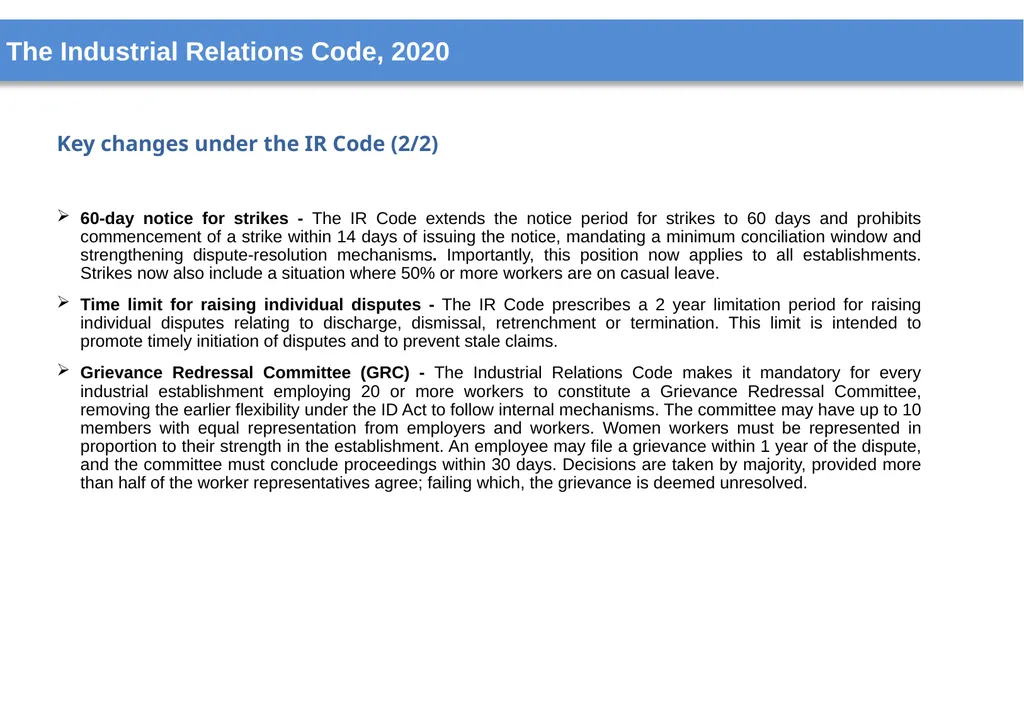
Key changes under the IR Code (2/2) 60-day notice for strikes - The IR Code extends the notice period for strikes to 60 days and prohibits commencement of a strike within 14 days of issuing the notice, mandating a minimum conciliation window and strengthening dispute-resolution mechanisms. Importantly, this position now applies to all establishments. Strikes now also include a situation where 50% or more workers are on casual leave.
Time limit for raising individual disputes - The IR Code prescribes a 2 year limitation period for raising individual disputes relating to discharge, dismissal, retrenchment or termination. This limit is intended to promote timely initiation of disputes and to prevent stale claims.
Grievance Redressal Committee (GRC) - The Industrial Relations Code makes it mandatory for every industrial establishment employing 20 or more workers to constitute a Grievance Redressal Committee, removing the earlier flexibility under the ID Act to follow internal mechanisms. The committee may have up to 10 members with equal representation from employers and workers. Women workers must be represented in proportion to their strength in the establishment. An employee may file a grievance within 1 year of the dispute, and the committee must conclude proceedings within 30 days. Decisions are taken by majority, provided more than half of the worker representatives agree; failing which, the grievance is deemed unresolved. The Industrial Relations Code, 2020<br>
Time limit for raising individual disputes - The IR Code prescribes a 2 year limitation period for raising individual disputes relating to discharge, dismissal, retrenchment or termination. This limit is intended to promote timely initiation of disputes and to prevent stale claims.
Grievance Redressal Committee (GRC) - The Industrial Relations Code makes it mandatory for every industrial establishment employing 20 or more workers to constitute a Grievance Redressal Committee, removing the earlier flexibility under the ID Act to follow internal mechanisms. The committee may have up to 10 members with equal representation from employers and workers. Women workers must be represented in proportion to their strength in the establishment. An employee may file a grievance within 1 year of the dispute, and the committee must conclude proceedings within 30 days. Decisions are taken by majority, provided more than half of the worker representatives agree; failing which, the grievance is deemed unresolved. The Industrial Relations Code, 2020<br>
23
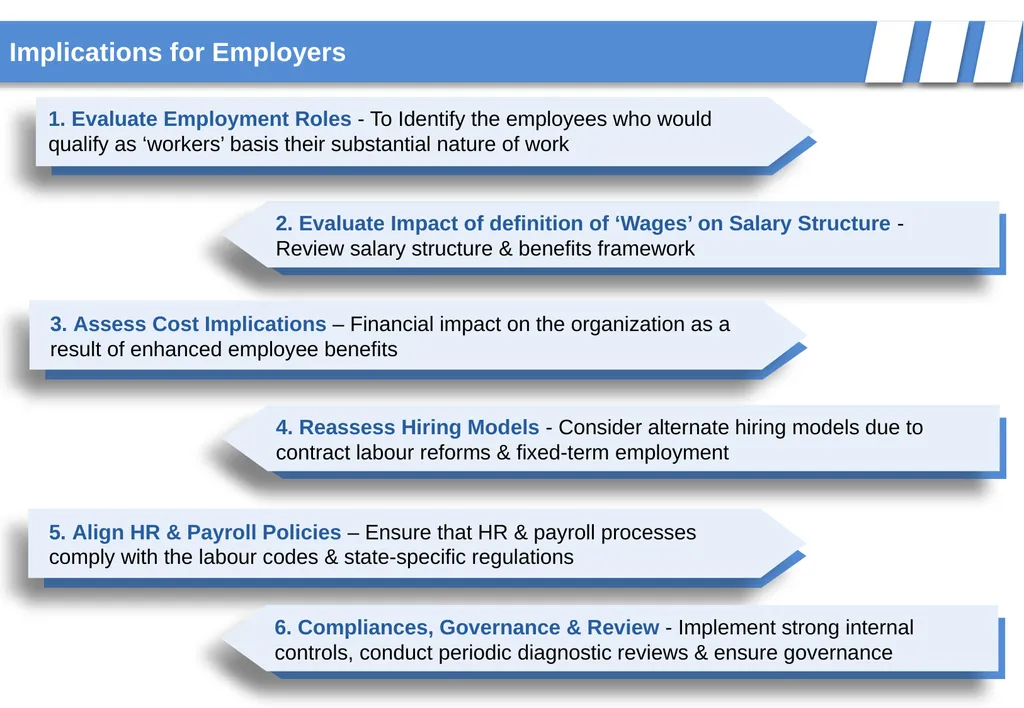
Implications for Employers 1. Evaluate Employment Roles - To Identify the employees who would qualify as ‘workers’ basis their substantial nature of work 2. Evaluate Impact of definition of ‘Wages’ on Salary Structure - Review salary structure & benefits framework 3. Assess Cost Implications – Financial impact on the organization as a result of enhanced employee benefits 4. Reassess Hiring Models - Consider alternate hiring models due to contract labour reforms & fixed-term employment 5. Align HR & Payroll Policies – Ensure that HR & payroll processes comply with the labour codes & state-specific regulations 6. Compliances, Governance & Review - Implement strong internal controls, conduct periodic diagnostic reviews & ensure governance<br>
24
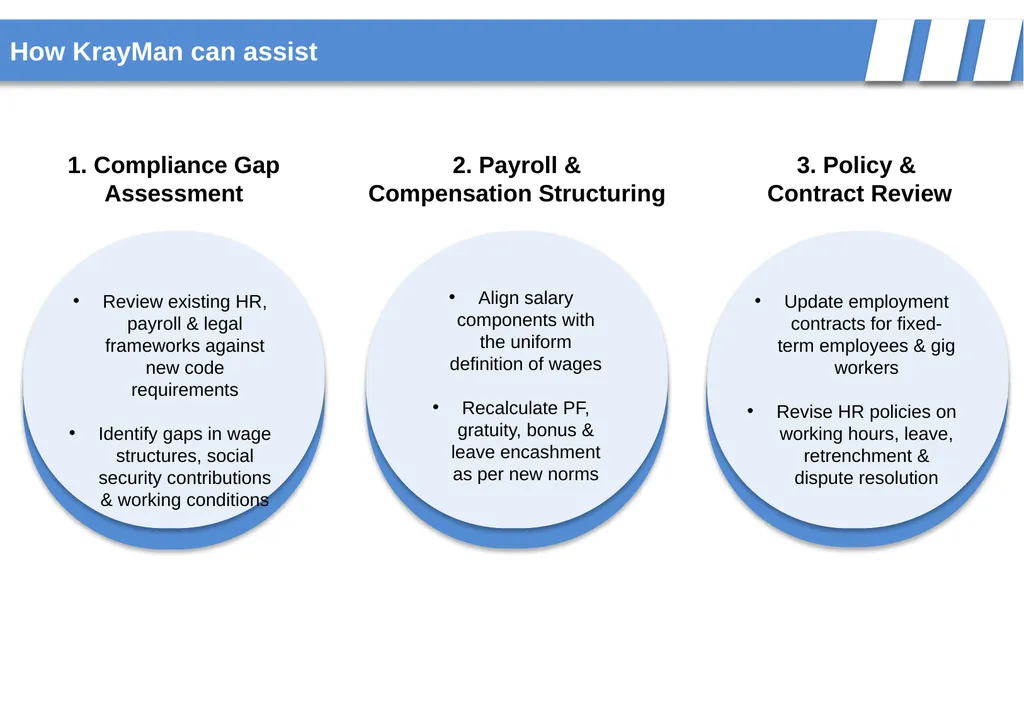
How KrayMan can assist 1. Compliance Gap Assessment 2. Payroll & Compensation Structuring 3. Policy &
Contract Review Align salary components with the uniform definition of wages
Recalculate PF, gratuity, bonus & leave encashment as per new norms Review existing HR, payroll & legal frameworks against new code requirements
Identify gaps in wage structures, social security contributions & working conditions Update employment contracts for fixed-term employees & gig workers
Revise HR policies on working hours, leave, retrenchment & dispute resolution<br>
Contract Review Align salary components with the uniform definition of wages
Recalculate PF, gratuity, bonus & leave encashment as per new norms Review existing HR, payroll & legal frameworks against new code requirements
Identify gaps in wage structures, social security contributions & working conditions Update employment contracts for fixed-term employees & gig workers
Revise HR policies on working hours, leave, retrenchment & dispute resolution<br>
25
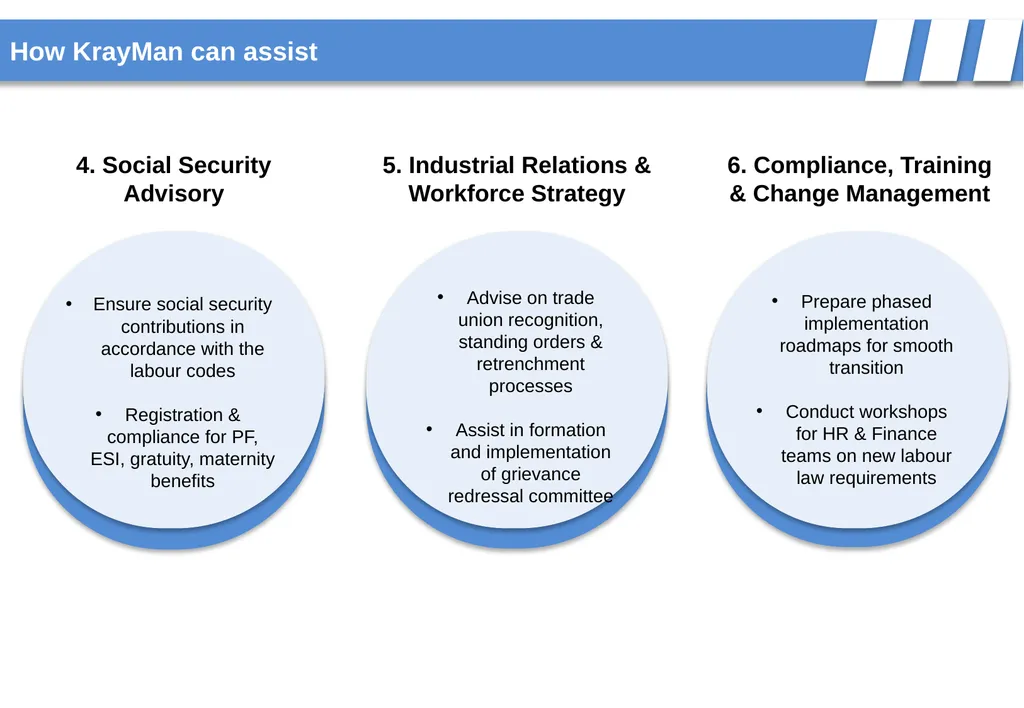
How KrayMan can assist 4. Social Security Advisory 5. Industrial Relations & Workforce Strategy 6. Compliance, Training & Change Management Advise on trade union recognition, standing orders & retrenchment processes
Assist in formation and implementation of grievance redressal committee Ensure social security contributions in accordance with the labour codes
Registration & compliance for PF, ESI, gratuity, maternity benefits Prepare phased implementation roadmaps for smooth transition
Conduct workshops for HR & Finance teams on new labour law requirements<br>
Assist in formation and implementation of grievance redressal committee Ensure social security contributions in accordance with the labour codes
Registration & compliance for PF, ESI, gratuity, maternity benefits Prepare phased implementation roadmaps for smooth transition
Conduct workshops for HR & Finance teams on new labour law requirements<br>
26
THANK YOU MORE INFORMATION www.krayman.com Disclaimer:
This document contains information of general nature. The information is only for general guidance & is not meant to be a substitute for professional advice in any manner. In case the reader requires any specific inputs / suggestions / advice from our end, please contact us separately. Member of Aliant+ Global Network<br>
This document contains information of general nature. The information is only for general guidance & is not meant to be a substitute for professional advice in any manner. In case the reader requires any specific inputs / suggestions / advice from our end, please contact us separately. Member of Aliant+ Global Network<br>