
New Rules 2023 Major Changes in Enforcement Death

Description: New Rules 2023 Major Changes in Enforcement Death of the All But One Better Definition of Illegal Equipment Rule 1-5-3a- Towels Towels of any color except ball or flag are acceptable Prior limitations in size still exists: no less than 4
Related Topics
Download Presentation
"New Rules 2023 Major Changes in Enforcement Death" is the property of its rightful owner. Permission is granted to download and print the materials on this website for personal, non-commercial use only, and to display it on your personal computer provided you do not modify the materials and that you retain all copyright notices contained in the materials. By downloading content from our website, you accept the terms of this agreement.
Presentation Transcript
slide1. New Rules 2023 Major Changes in Enforcement
Death of the All But One<br>
slide2. Better Definition of Illegal Equipment Rule 1-5-3a- Towels Towels of any color except ball or flag are acceptable
Prior limitations in size still exists:
no less than 4” wide & 12 “ length or
greater than 18” wide & 36” length
Prior limitation in size of school and manufacturer logos still exist:
only one school logo/trademark that exceed 2 ¼”<br>
slide3. Definition of Player Out of Bounds Rule 2-29-1 Until this year football did not have a definition of out of bounds- just in bounds
Art.1 A player or other person is out of bounds when any part of the player is touching ANYTHING- other than another player or official who is on or outside the end line or sideline. Once a player is out of bounds, he remains out of bounds until returning to the field with a foot or other body part while not maintaining contact out of bounds “
Prevents very rare play when a player out of bounds reaches across end line or sideline and touches a live ball.<br>
slide4. Example 5-11 Wide receiver A83 accidentally steps on the sideline and after taking two steps out of bounds jumps. While in the air, he (a) controls the ball and lands inbounds, or (b) bats the ball to A87 who catches the ball, and then A83 lands either in or out of bounds.
Ruling: in both (a) & (b) it is an incomplete pass.
The receiver was out of bounds when he touched the ball because he had last touched out of bounds and had not re-established himself inbounds. The ball was dead when it was touched by an out-of-bounds player. No illegal participation.<br>
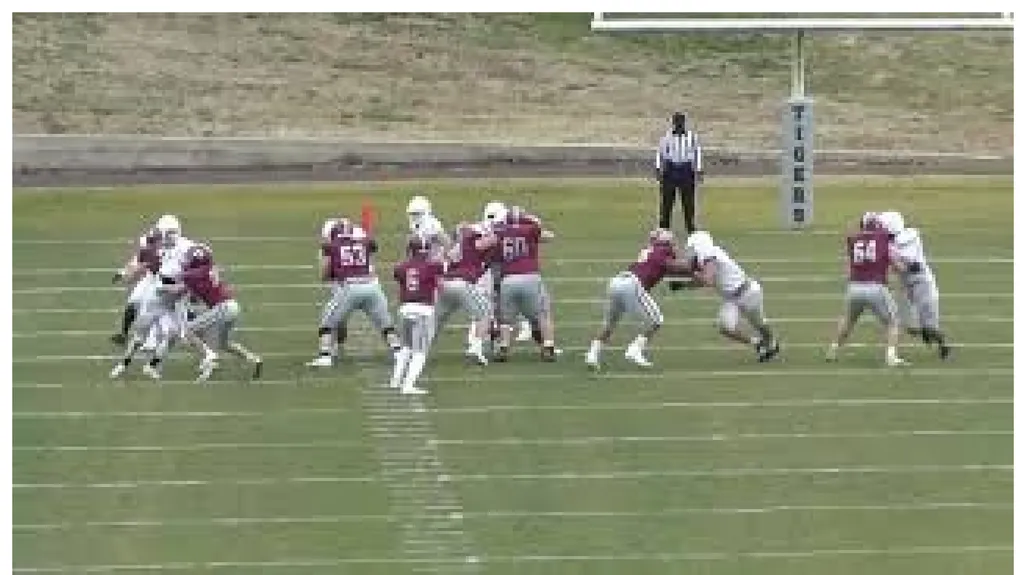
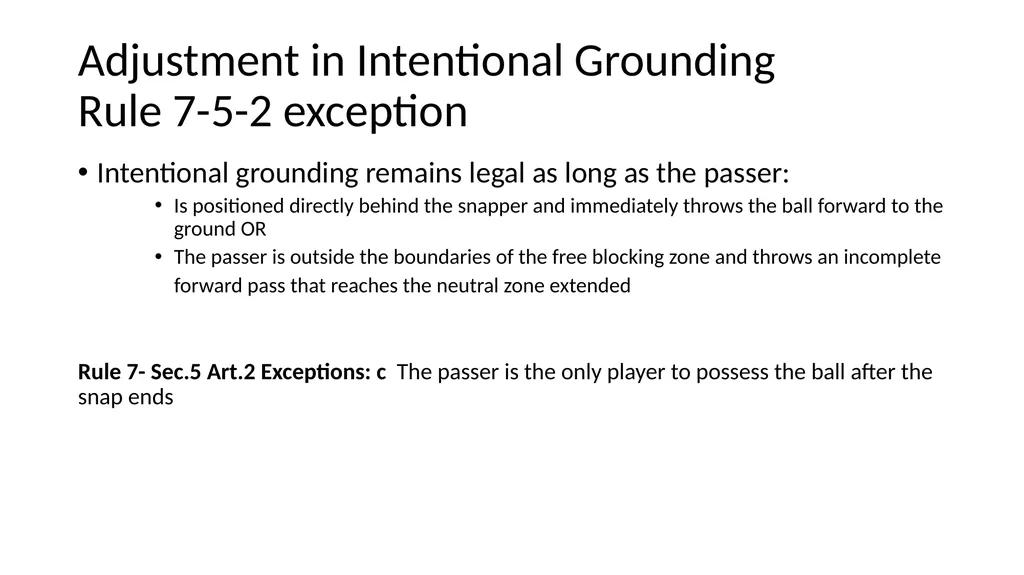
slide6. Adjustment in Intentional Grounding Rule 7-5-2 exception Intentional grounding remains legal as long as the passer:
Is positioned directly behind the snapper and immediately throws the ball forward to the ground OR
The passer is outside the boundaries of the free blocking zone and throws an incomplete
forward pass that reaches the neutral zone extended
Rule 7- Sec.5 Art.2 Exceptions: c The passer is the only player to possess the ball after the snap ends<br>
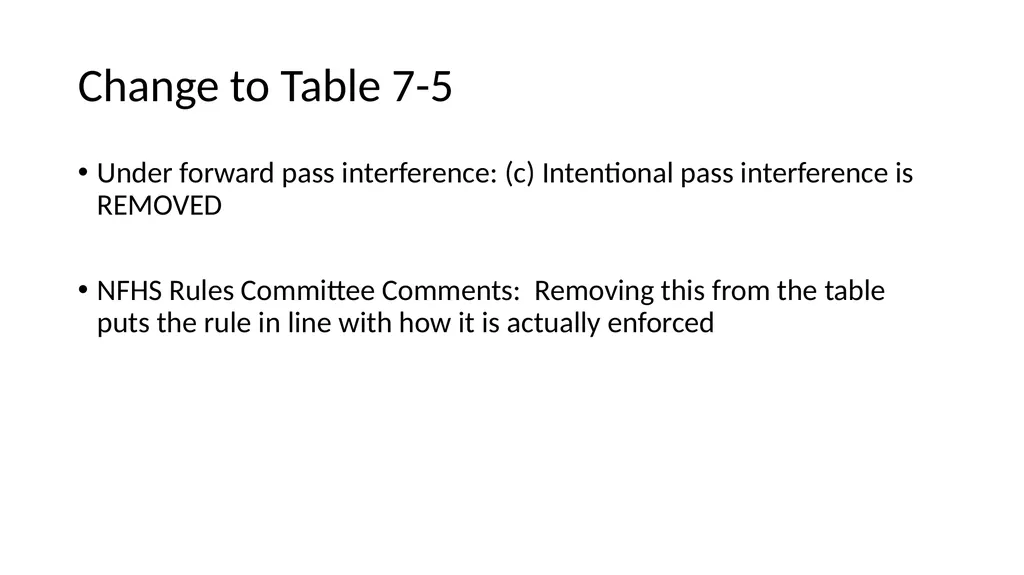
slide8. Change to Table 7-5 Under forward pass interference: (c) Intentional pass interference is REMOVED
NFHS Rules Committee Comments: Removing this from the table puts the rule in line with how it is actually enforced<br>
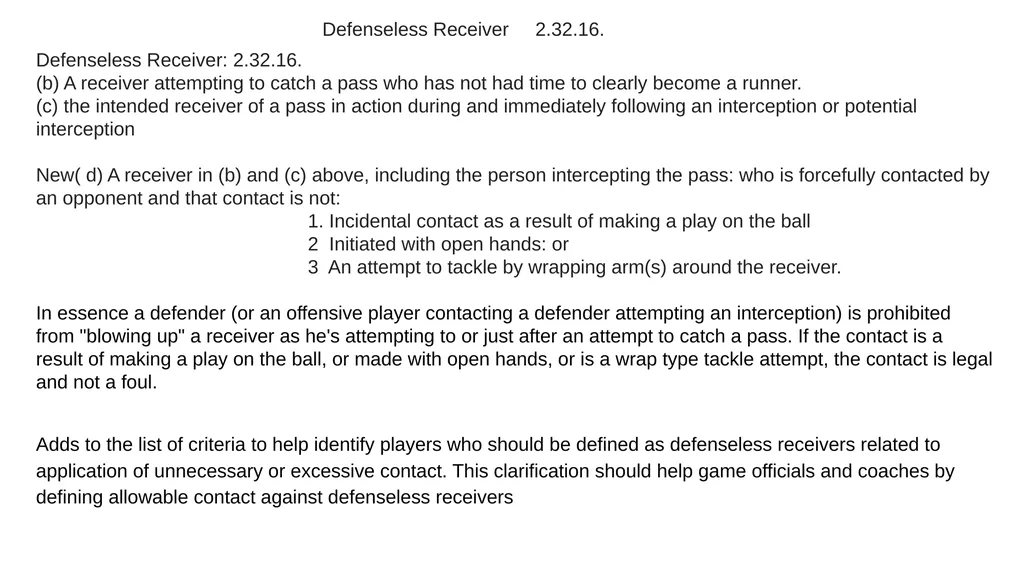
slide9. Defenseless Receiver: 2.32.16.
(b) A receiver attempting to catch a pass who has not had time to clearly become a runner. (c) the intended receiver of a pass in action during and immediately following an interception or potential interception
New( d) A receiver in (b) and (c) above, including the person intercepting the pass: who is forcefully contacted by an opponent and that contact is not:
1. Incidental contact as a result of making a play on the ball
2 Initiated with open hands: or
3 An attempt to tackle by wrapping arm(s) around the receiver.
In essence a defender (or an offensive player contacting a defender attempting an interception) is prohibited from "blowing up" a receiver as he's attempting to or just after an attempt to catch a pass. If the contact is a result of making a play on the ball, or made with open hands, or is a wrap type tackle attempt, the contact is legal and not a foul.
Adds to the list of criteria to help identify players who should be defined as defenseless receivers related to application of unnecessary or excessive contact. This clarification should help game officials and coaches by defining allowable contact against defenseless receivers Defenseless Receiver 2.32.16.<br>
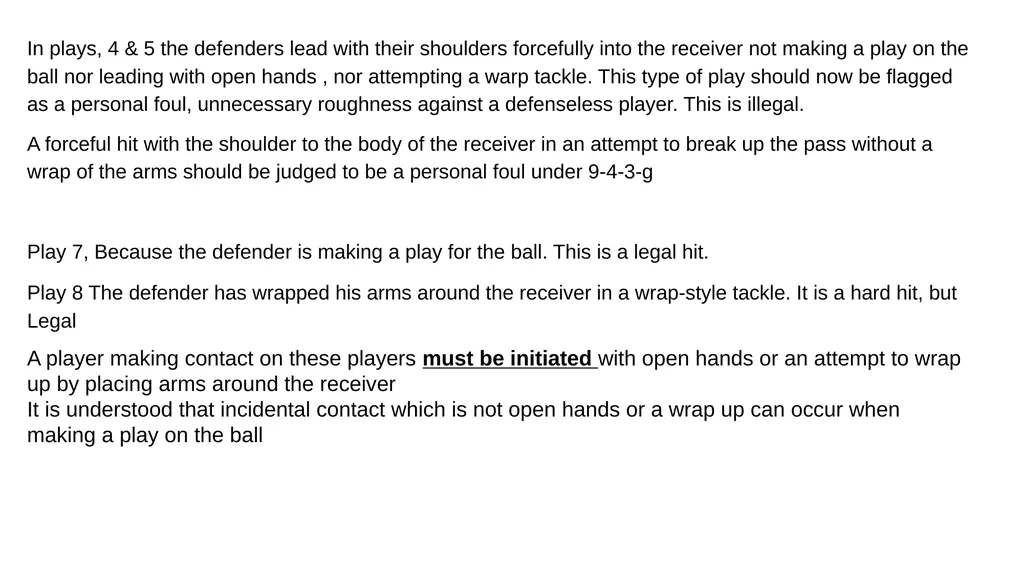
slide12. In plays, 4 & 5 the defenders lead with their shoulders forcefully into the receiver not making a play on the ball nor leading with open hands , nor attempting a warp tackle. This type of play should now be flagged as a personal foul, unnecessary roughness against a defenseless player. This is illegal.
A forceful hit with the shoulder to the body of the receiver in an attempt to break up the pass without a wrap of the arms should be judged to be a personal foul under 9-4-3-g
Play 7, Because the defender is making a play for the ball. This is a legal hit.
Play 8 The defender has wrapped his arms around the receiver in a wrap-style tackle. It is a hard hit, but Legal
A player making contact on these players must be initiated with open hands or an attempt to wrap up by placing arms around the receiver
It is understood that incidental contact which is not open hands or a wrap up can occur when making a play on the ball<br>
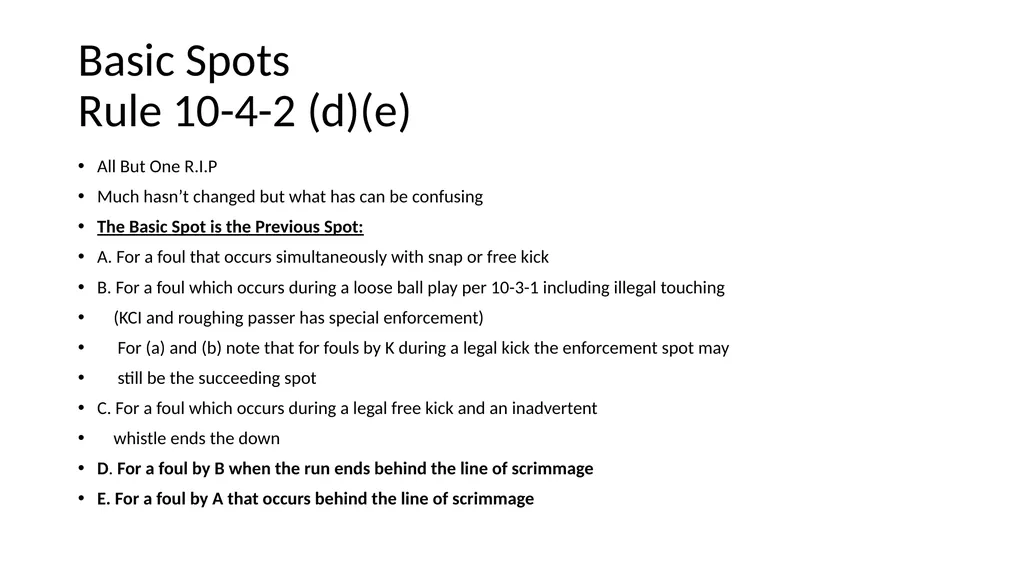
slide14. Basic Spots Rule 10-4-2 (d)(e) All But One R.I.P
Much hasn’t changed but what has can be confusing
The Basic Spot is the Previous Spot:
A. For a foul that occurs simultaneously with snap or free kick
B. For a foul which occurs during a loose ball play per 10-3-1 including illegal touching
(KCI and roughing passer has special enforcement)
For (a) and (b) note that for fouls by K during a legal kick the enforcement spot may
still be the succeeding spot
C. For a foul which occurs during a legal free kick and an inadvertent
whistle ends the down
D. For a foul by B when the run ends behind the line of scrimmage
E. For a foul by A that occurs behind the line of scrimmage<br>
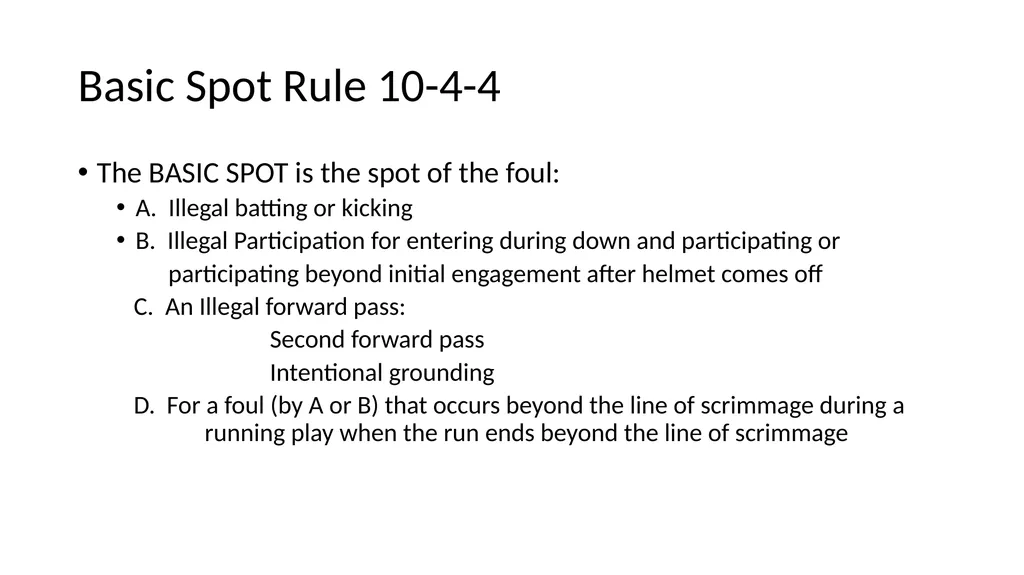
slide15. Basic Spot Rule 10-4-4 The BASIC SPOT is the spot of the foul:
A. Illegal batting or kicking
B. Illegal Participation for entering during down and participating or
participating beyond initial engagement after helmet comes off
C. An Illegal forward pass:
Second forward pass
Intentional grounding
D. For a foul (by A or B) that occurs beyond the line of scrimmage during a running play when the run ends beyond the line of scrimmage<br>
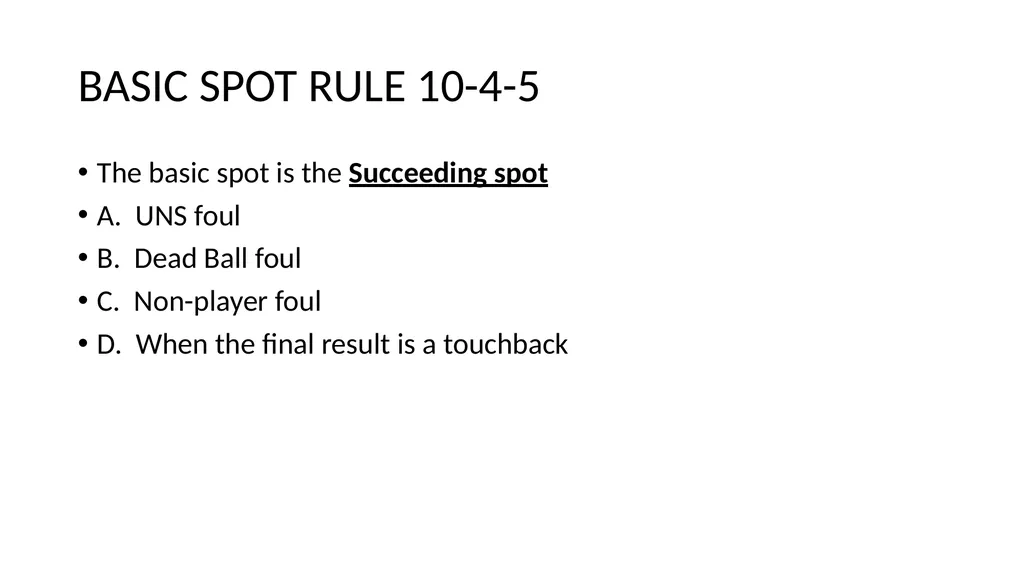
slide16. BASIC SPOT RULE 10-4-5 The basic spot is the Succeeding spot
A. UNS foul
B. Dead Ball foul
C. Non-player foul
D. When the final result is a touchback<br>
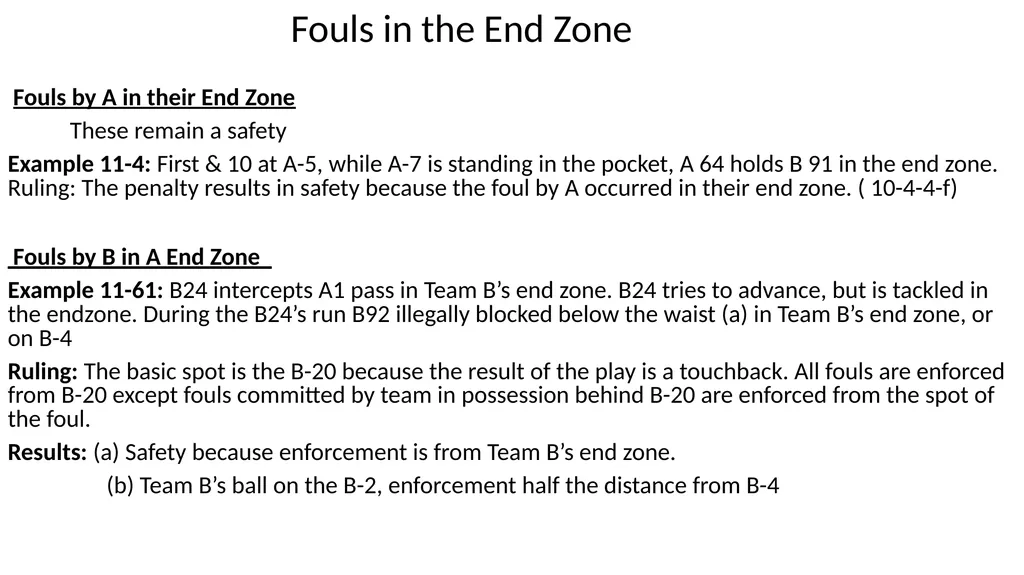
slide17. Fouls in the End Zone Fouls by A in their End Zone
These remain a safety
Example 11-4: First & 10 at A-5, while A-7 is standing in the pocket, A 64 holds B 91 in the end zone. Ruling: The penalty results in safety because the foul by A occurred in their end zone. ( 10-4-4-f)
Fouls by B in A End Zone
Example 11-61: B24 intercepts A1 pass in Team B’s end zone. B24 tries to advance, but is tackled in the endzone. During the B24’s run B92 illegally blocked below the waist (a) in Team B’s end zone, or on B-4
Ruling: The basic spot is the B-20 because the result of the play is a touchback. All fouls are enforced from B-20 except fouls committed by team in possession behind B-20 are enforced from the spot of the foul.
Results: (a) Safety because enforcement is from Team B’s end zone.
(b) Team B’s ball on the B-2, enforcement half the distance from B-4<br>
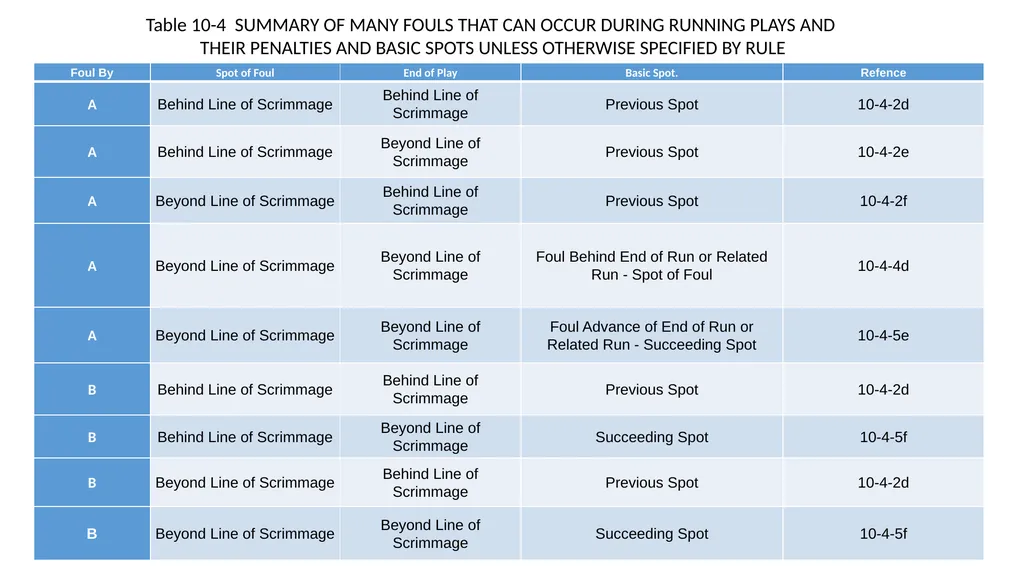
slide18. Table 10-4 SUMMARY OF MANY FOULS THAT CAN OCCUR DURING RUNNING PLAYS AND
THEIR PENALTIES AND BASIC SPOTS UNLESS OTHERWISE SPECIFIED BY RULE<br>
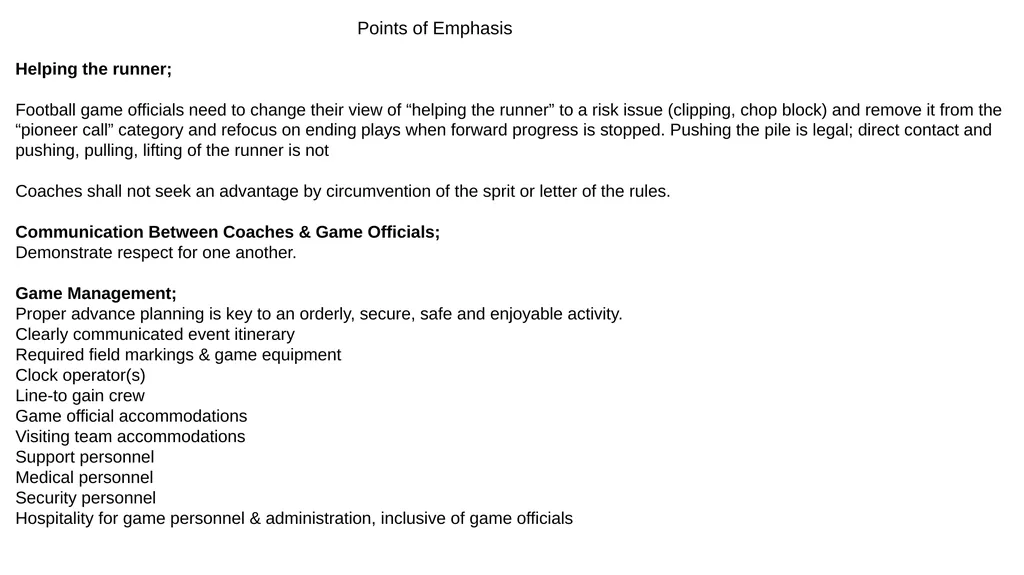
slide19. Points of Emphasis Helping the runner;
Football game officials need to change their view of “helping the runner” to a risk issue (clipping, chop block) and remove it from the “pioneer call” category and refocus on ending plays when forward progress is stopped. Pushing the pile is legal; direct contact and pushing, pulling, lifting of the runner is not
Coaches shall not seek an advantage by circumvention of the sprit or letter of the rules.
Communication Between Coaches & Game Officials;
Demonstrate respect for one another.
Game Management;
Proper advance planning is key to an orderly, secure, safe and enjoyable activity.
Clearly communicated event itinerary
Required field markings & game equipment
Clock operator(s)
Line-to gain crew
Game official accommodations
Visiting team accommodations
Support personnel
Medical personnel
Security personnel
Hospitality for game personnel & administration, inclusive of game officials<br>
Death of the All But One<br>
slide2. Better Definition of Illegal Equipment Rule 1-5-3a- Towels Towels of any color except ball or flag are acceptable
Prior limitations in size still exists:
no less than 4” wide & 12 “ length or
greater than 18” wide & 36” length
Prior limitation in size of school and manufacturer logos still exist:
only one school logo/trademark that exceed 2 ¼”<br>
slide3. Definition of Player Out of Bounds Rule 2-29-1 Until this year football did not have a definition of out of bounds- just in bounds
Art.1 A player or other person is out of bounds when any part of the player is touching ANYTHING- other than another player or official who is on or outside the end line or sideline. Once a player is out of bounds, he remains out of bounds until returning to the field with a foot or other body part while not maintaining contact out of bounds “
Prevents very rare play when a player out of bounds reaches across end line or sideline and touches a live ball.<br>
slide4. Example 5-11 Wide receiver A83 accidentally steps on the sideline and after taking two steps out of bounds jumps. While in the air, he (a) controls the ball and lands inbounds, or (b) bats the ball to A87 who catches the ball, and then A83 lands either in or out of bounds.
Ruling: in both (a) & (b) it is an incomplete pass.
The receiver was out of bounds when he touched the ball because he had last touched out of bounds and had not re-established himself inbounds. The ball was dead when it was touched by an out-of-bounds player. No illegal participation.<br>
slide6. Adjustment in Intentional Grounding Rule 7-5-2 exception Intentional grounding remains legal as long as the passer:
Is positioned directly behind the snapper and immediately throws the ball forward to the ground OR
The passer is outside the boundaries of the free blocking zone and throws an incomplete
forward pass that reaches the neutral zone extended
Rule 7- Sec.5 Art.2 Exceptions: c The passer is the only player to possess the ball after the snap ends<br>
slide8. Change to Table 7-5 Under forward pass interference: (c) Intentional pass interference is REMOVED
NFHS Rules Committee Comments: Removing this from the table puts the rule in line with how it is actually enforced<br>
slide9. Defenseless Receiver: 2.32.16.
(b) A receiver attempting to catch a pass who has not had time to clearly become a runner. (c) the intended receiver of a pass in action during and immediately following an interception or potential interception
New( d) A receiver in (b) and (c) above, including the person intercepting the pass: who is forcefully contacted by an opponent and that contact is not:
1. Incidental contact as a result of making a play on the ball
2 Initiated with open hands: or
3 An attempt to tackle by wrapping arm(s) around the receiver.
In essence a defender (or an offensive player contacting a defender attempting an interception) is prohibited from "blowing up" a receiver as he's attempting to or just after an attempt to catch a pass. If the contact is a result of making a play on the ball, or made with open hands, or is a wrap type tackle attempt, the contact is legal and not a foul.
Adds to the list of criteria to help identify players who should be defined as defenseless receivers related to application of unnecessary or excessive contact. This clarification should help game officials and coaches by defining allowable contact against defenseless receivers Defenseless Receiver 2.32.16.<br>
slide12. In plays, 4 & 5 the defenders lead with their shoulders forcefully into the receiver not making a play on the ball nor leading with open hands , nor attempting a warp tackle. This type of play should now be flagged as a personal foul, unnecessary roughness against a defenseless player. This is illegal.
A forceful hit with the shoulder to the body of the receiver in an attempt to break up the pass without a wrap of the arms should be judged to be a personal foul under 9-4-3-g
Play 7, Because the defender is making a play for the ball. This is a legal hit.
Play 8 The defender has wrapped his arms around the receiver in a wrap-style tackle. It is a hard hit, but Legal
A player making contact on these players must be initiated with open hands or an attempt to wrap up by placing arms around the receiver
It is understood that incidental contact which is not open hands or a wrap up can occur when making a play on the ball<br>
slide14. Basic Spots Rule 10-4-2 (d)(e) All But One R.I.P
Much hasn’t changed but what has can be confusing
The Basic Spot is the Previous Spot:
A. For a foul that occurs simultaneously with snap or free kick
B. For a foul which occurs during a loose ball play per 10-3-1 including illegal touching
(KCI and roughing passer has special enforcement)
For (a) and (b) note that for fouls by K during a legal kick the enforcement spot may
still be the succeeding spot
C. For a foul which occurs during a legal free kick and an inadvertent
whistle ends the down
D. For a foul by B when the run ends behind the line of scrimmage
E. For a foul by A that occurs behind the line of scrimmage<br>
slide15. Basic Spot Rule 10-4-4 The BASIC SPOT is the spot of the foul:
A. Illegal batting or kicking
B. Illegal Participation for entering during down and participating or
participating beyond initial engagement after helmet comes off
C. An Illegal forward pass:
Second forward pass
Intentional grounding
D. For a foul (by A or B) that occurs beyond the line of scrimmage during a running play when the run ends beyond the line of scrimmage<br>
slide16. BASIC SPOT RULE 10-4-5 The basic spot is the Succeeding spot
A. UNS foul
B. Dead Ball foul
C. Non-player foul
D. When the final result is a touchback<br>
slide17. Fouls in the End Zone Fouls by A in their End Zone
These remain a safety
Example 11-4: First & 10 at A-5, while A-7 is standing in the pocket, A 64 holds B 91 in the end zone. Ruling: The penalty results in safety because the foul by A occurred in their end zone. ( 10-4-4-f)
Fouls by B in A End Zone
Example 11-61: B24 intercepts A1 pass in Team B’s end zone. B24 tries to advance, but is tackled in the endzone. During the B24’s run B92 illegally blocked below the waist (a) in Team B’s end zone, or on B-4
Ruling: The basic spot is the B-20 because the result of the play is a touchback. All fouls are enforced from B-20 except fouls committed by team in possession behind B-20 are enforced from the spot of the foul.
Results: (a) Safety because enforcement is from Team B’s end zone.
(b) Team B’s ball on the B-2, enforcement half the distance from B-4<br>
slide18. Table 10-4 SUMMARY OF MANY FOULS THAT CAN OCCUR DURING RUNNING PLAYS AND
THEIR PENALTIES AND BASIC SPOTS UNLESS OTHERWISE SPECIFIED BY RULE<br>
slide19. Points of Emphasis Helping the runner;
Football game officials need to change their view of “helping the runner” to a risk issue (clipping, chop block) and remove it from the “pioneer call” category and refocus on ending plays when forward progress is stopped. Pushing the pile is legal; direct contact and pushing, pulling, lifting of the runner is not
Coaches shall not seek an advantage by circumvention of the sprit or letter of the rules.
Communication Between Coaches & Game Officials;
Demonstrate respect for one another.
Game Management;
Proper advance planning is key to an orderly, secure, safe and enjoyable activity.
Clearly communicated event itinerary
Required field markings & game equipment
Clock operator(s)
Line-to gain crew
Game official accommodations
Visiting team accommodations
Support personnel
Medical personnel
Security personnel
Hospitality for game personnel & administration, inclusive of game officials<br>