
New vaccines Introduction Prioritization and
MS
Published · 31 slides · 0 views
1 / 1



Description
New vaccines Introduction Prioritization and Sequencing Framework Introduction to the approach and methodology Date of online session Agenda 2 To be updated by country Agenda 1 Introductions and Objectives 2 Approach and Methodology 3
Related Topics
Share
Embed code
Download this presentation From Below
"New vaccines Introduction Prioritization and" is the property of its rightful owner. Permission is granted to download and print the materials on this website for personal, non-commercial use only, and to display it on your personal computer provided you do not modify the materials and that you retain all copyright notices contained in the materials. By downloading content from our website, you accept the terms of this agreement.
Presentation Transcript
01
New vaccines Introduction Prioritization and Sequencing Framework
Introduction to the approach and methodology
Date of online session<br>
Introduction to the approach and methodology
Date of online session<br>
02
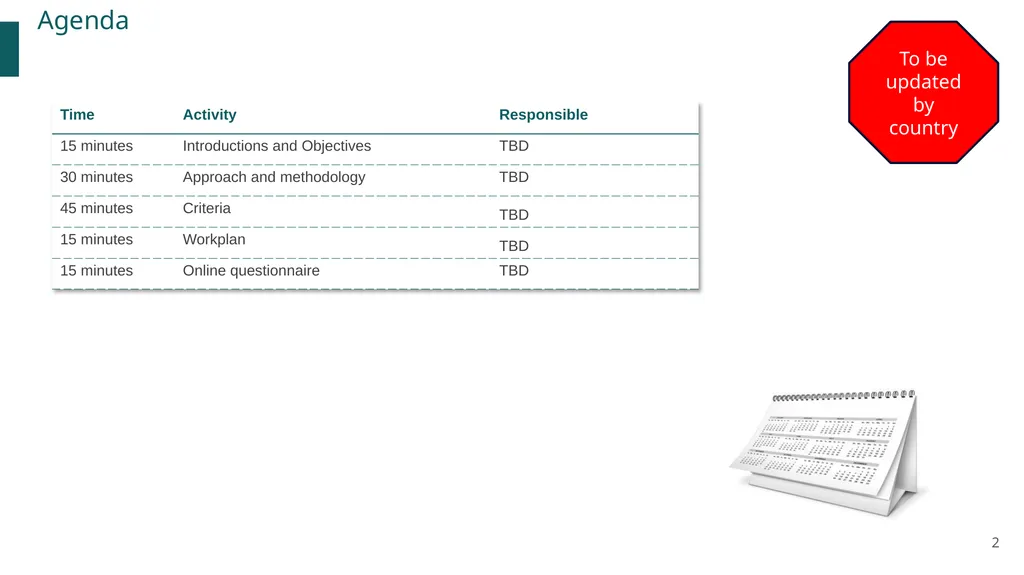
Agenda 2 To be updated by country<br>
03
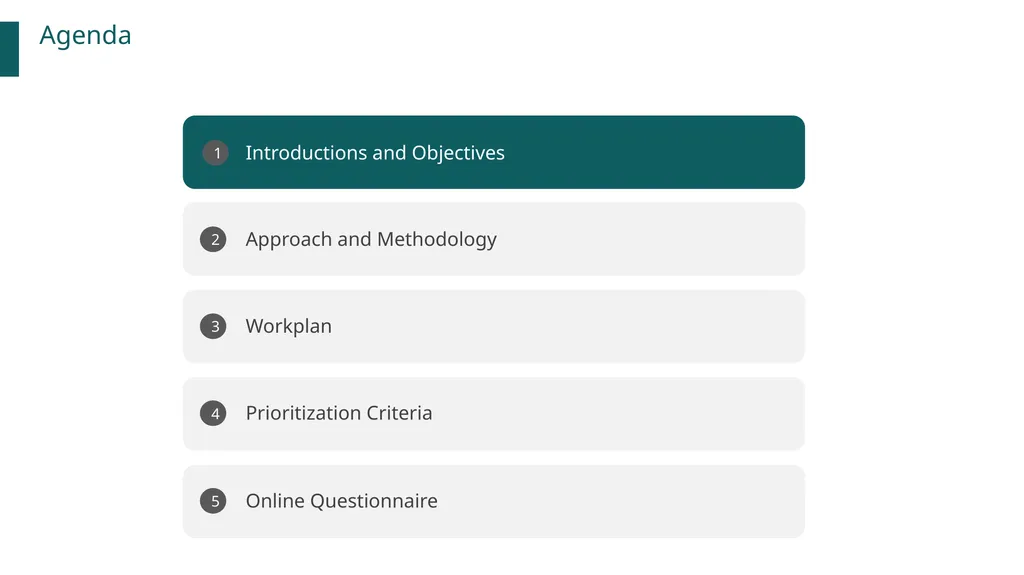
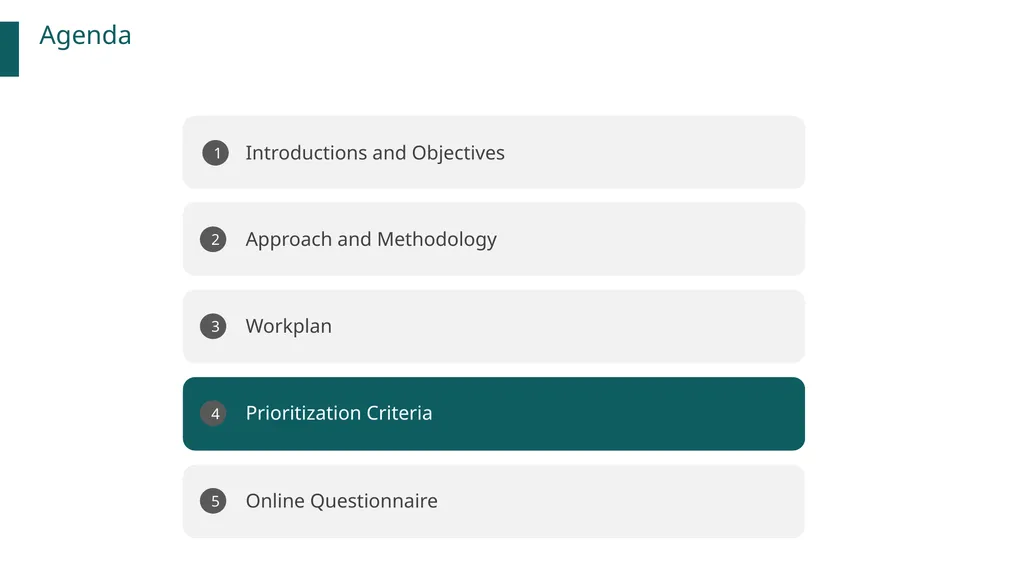
Agenda 1 Introductions and Objectives 2 Approach and Methodology 3 Workplan 4 Prioritization Criteria 5 Online Questionnaire<br>
04
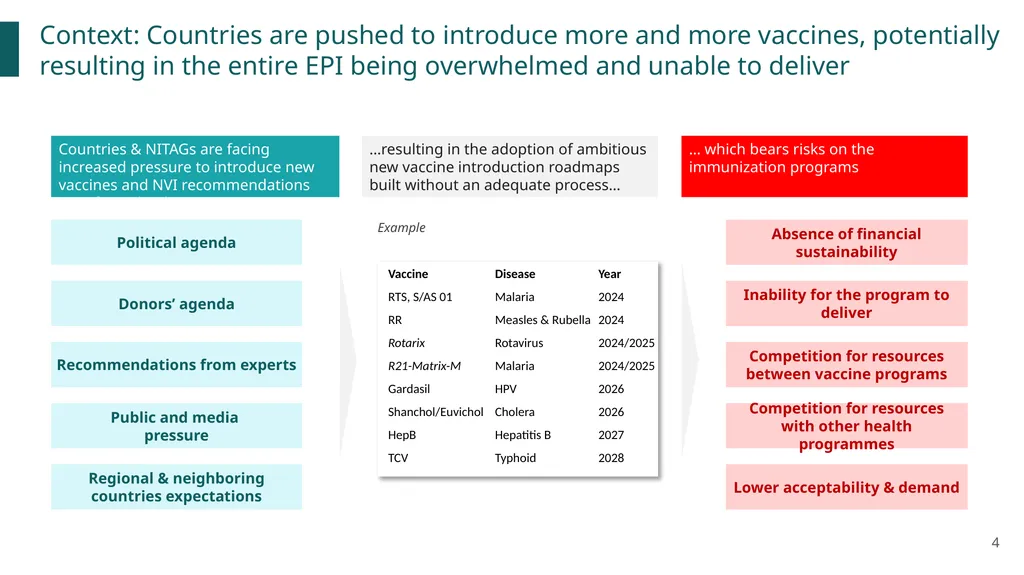
Context: Countries are pushed to introduce more and more vaccines, potentially resulting in the entire EPI being overwhelmed and unable to deliver Countries & NITAGs are facing increased pressure to introduce new vaccines and NVI recommendations are often siloed… …resulting in the adoption of ambitious new vaccine introduction roadmaps built without an adequate process… … which bears risks on the immunization programs Political agenda Donors’ agenda Public and media
pressure Absence of financial sustainability Inability for the program to deliver Competition for resources between vaccine programs Competition for resources with other health programmes Example Lower acceptability & demand Recommendations from experts Regional & neighboring countries expectations 4<br>
pressure Absence of financial sustainability Inability for the program to deliver Competition for resources between vaccine programs Competition for resources with other health programmes Example Lower acceptability & demand Recommendations from experts Regional & neighboring countries expectations 4<br>
05
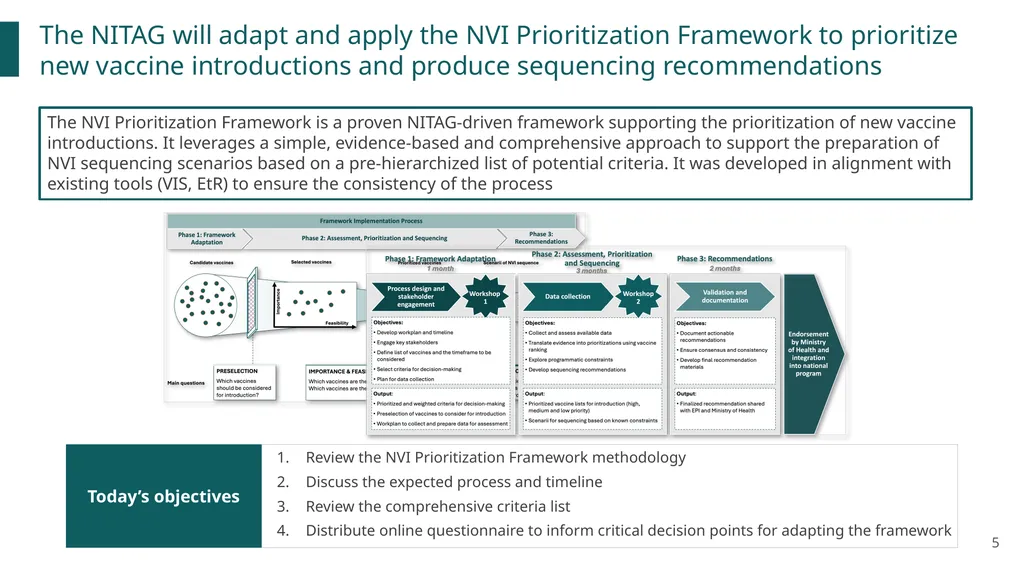
The NITAG will adapt and apply the NVI Prioritization Framework to prioritize new vaccine introductions and produce sequencing recommendations 5 The NVI Prioritization Framework is a proven NITAG-driven framework supporting the prioritization of new vaccine introductions. It leverages a simple, evidence-based and comprehensive approach to support the preparation of NVI sequencing scenarios based on a pre-hierarchized list of potential criteria. It was developed in alignment with existing tools (VIS, EtR) to ensure the consistency of the process Review the NVI Prioritization Framework methodology
Discuss the expected process and timeline
Review the comprehensive criteria list
Distribute online questionnaire to inform critical decision points for adapting the framework Today’s objectives<br>
Discuss the expected process and timeline
Review the comprehensive criteria list
Distribute online questionnaire to inform critical decision points for adapting the framework Today’s objectives<br>
06
Agenda 1 Introductions and Objectives 2 Approach and Methodology 3 Workplan 4 Prioritization Criteria 5 Online Questionnaire<br>
07
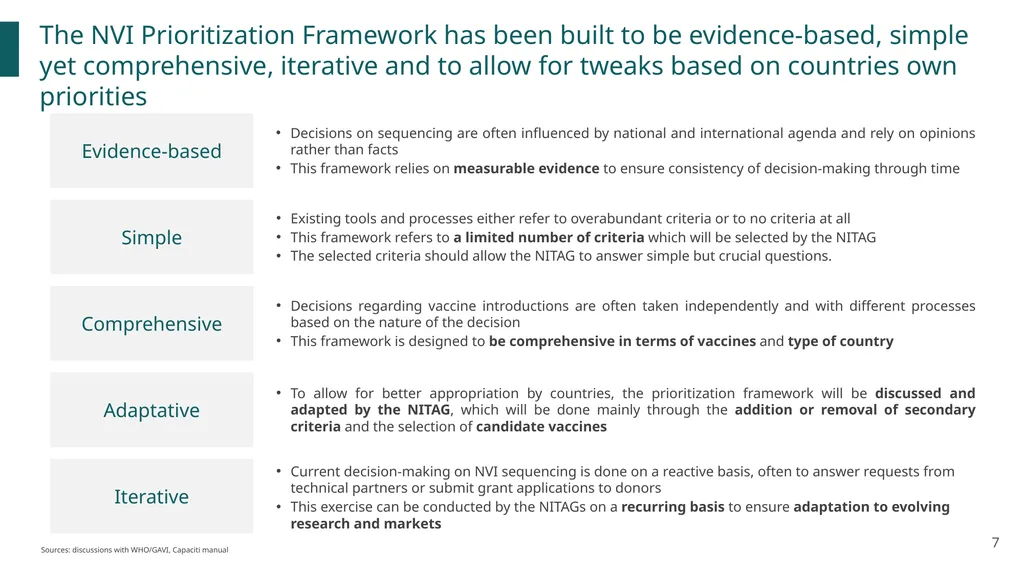
Comprehensive Decisions regarding vaccine introductions are often taken independently and with different processes based on the nature of the decision
This framework is designed to be comprehensive in terms of vaccines and type of country The NVI Prioritization Framework has been built to be evidence-based, simple yet comprehensive, iterative and to allow for tweaks based on countries own priorities Evidence-based Simple Adaptative Decisions on sequencing are often influenced by national and international agenda and rely on opinions rather than facts
This framework relies on measurable evidence to ensure consistency of decision-making through time Existing tools and processes either refer to overabundant criteria or to no criteria at all
This framework refers to a limited number of criteria which will be selected by the NITAG
The selected criteria should allow the NITAG to answer simple but crucial questions. Iterative Current decision-making on NVI sequencing is done on a reactive basis, often to answer requests from technical partners or submit grant applications to donors
This exercise can be conducted by the NITAGs on a recurring basis to ensure adaptation to evolving research and markets To allow for better appropriation by countries, the prioritization framework will be discussed and adapted by the NITAG, which will be done mainly through the addition or removal of secondary criteria and the selection of candidate vaccines 7 Sources: discussions with WHO/GAVI, Capaciti manual<br>
This framework is designed to be comprehensive in terms of vaccines and type of country The NVI Prioritization Framework has been built to be evidence-based, simple yet comprehensive, iterative and to allow for tweaks based on countries own priorities Evidence-based Simple Adaptative Decisions on sequencing are often influenced by national and international agenda and rely on opinions rather than facts
This framework relies on measurable evidence to ensure consistency of decision-making through time Existing tools and processes either refer to overabundant criteria or to no criteria at all
This framework refers to a limited number of criteria which will be selected by the NITAG
The selected criteria should allow the NITAG to answer simple but crucial questions. Iterative Current decision-making on NVI sequencing is done on a reactive basis, often to answer requests from technical partners or submit grant applications to donors
This exercise can be conducted by the NITAGs on a recurring basis to ensure adaptation to evolving research and markets To allow for better appropriation by countries, the prioritization framework will be discussed and adapted by the NITAG, which will be done mainly through the addition or removal of secondary criteria and the selection of candidate vaccines 7 Sources: discussions with WHO/GAVI, Capaciti manual<br>
08
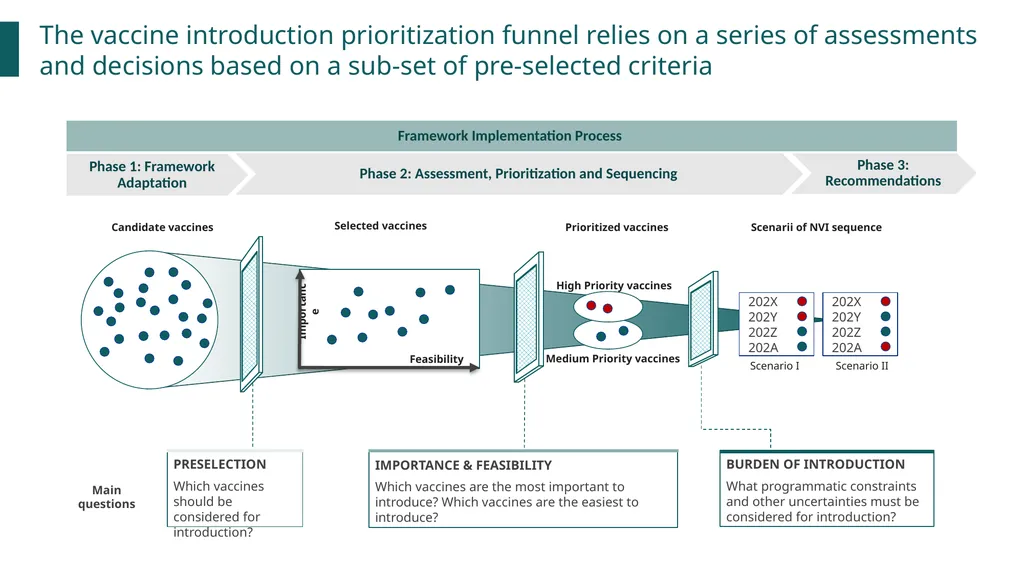
The vaccine introduction prioritization funnel relies on a series of assessments and decisions based on a sub-set of pre-selected criteria Candidate vaccines Prioritized vaccines Selected vaccines 202X
202Y
202Z
202A 202X
202Y
202Z
202A Scenario I Scenario II Main questions Phase 1: Framework Adaptation Phase 2: Assessment, Prioritization and Sequencing Phase 3: Recommendations Framework Implementation Process Scenarii of NVI sequence Medium Priority vaccines High Priority vaccines<br>
202Y
202Z
202A 202X
202Y
202Z
202A Scenario I Scenario II Main questions Phase 1: Framework Adaptation Phase 2: Assessment, Prioritization and Sequencing Phase 3: Recommendations Framework Implementation Process Scenarii of NVI sequence Medium Priority vaccines High Priority vaccines<br>
09
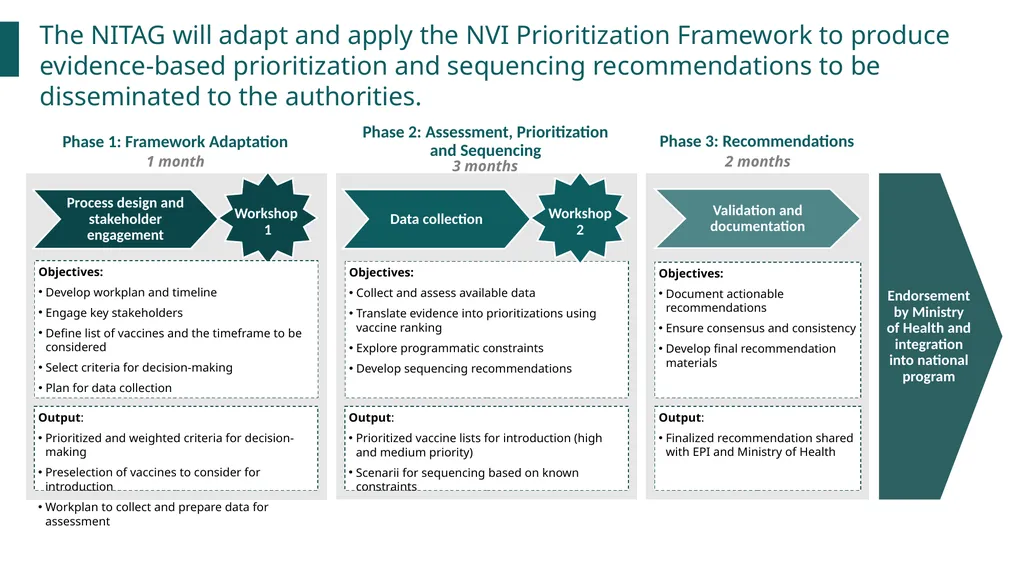
The NITAG will adapt and apply the NVI Prioritization Framework to produce evidence-based prioritization and sequencing recommendations to be disseminated to the authorities. Validation and documentation Objectives:
Document actionable recommendations
Ensure consensus and consistency
Develop final recommendation materials Process design and stakeholder engagement Workshop
1 Objectives:
Develop workplan and timeline
Engage key stakeholders
Define list of vaccines and the timeframe to be considered
Select criteria for decision-making
Plan for data collection Phase 1: Framework Adaptation Objectives:
Collect and assess available data
Translate evidence into prioritizations using vaccine ranking
Explore programmatic constraints
Develop sequencing recommendations Data collection Workshop
2 Phase 2: Assessment, Prioritization and Sequencing Phase 3: Recommendations Endorsement by Ministry of Health and integration into national program Output:
Prioritized and weighted criteria for decision-making
Preselection of vaccines to consider for introduction
Workplan to collect and prepare data for assessment Output:
Prioritized vaccine lists for introduction (high and medium priority)
Scenarii for sequencing based on known constraints Output:
Finalized recommendation shared with EPI and Ministry of Health 1 month 3 months 2 months<br>
Document actionable recommendations
Ensure consensus and consistency
Develop final recommendation materials Process design and stakeholder engagement Workshop
1 Objectives:
Develop workplan and timeline
Engage key stakeholders
Define list of vaccines and the timeframe to be considered
Select criteria for decision-making
Plan for data collection Phase 1: Framework Adaptation Objectives:
Collect and assess available data
Translate evidence into prioritizations using vaccine ranking
Explore programmatic constraints
Develop sequencing recommendations Data collection Workshop
2 Phase 2: Assessment, Prioritization and Sequencing Phase 3: Recommendations Endorsement by Ministry of Health and integration into national program Output:
Prioritized and weighted criteria for decision-making
Preselection of vaccines to consider for introduction
Workplan to collect and prepare data for assessment Output:
Prioritized vaccine lists for introduction (high and medium priority)
Scenarii for sequencing based on known constraints Output:
Finalized recommendation shared with EPI and Ministry of Health 1 month 3 months 2 months<br>
10
Agenda 1 Introductions and Objectives 2 Approach and Methodology 3 Workplan 4 Prioritization Criteria 5 Online Questionnaire<br>
11
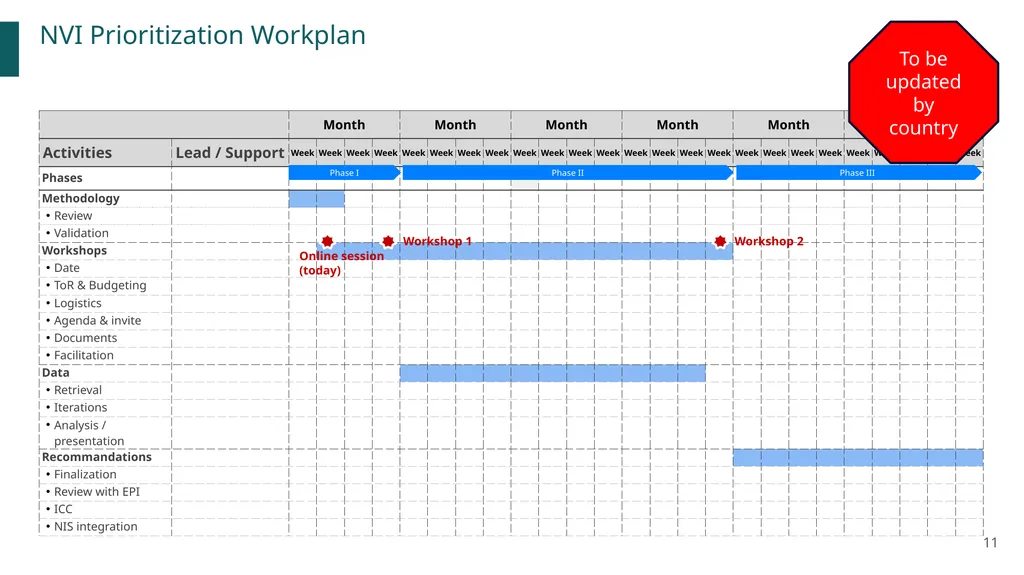
NVI Prioritization Workplan 11 Phase I Phase III Workshop 1 Workshop 2 Online session
(today) Phase II To be updated by country<br>
12
Agenda 1 Introductions and Objectives 2 Approach and Methodology 3 Workplan 4 Prioritization Criteria 5 Online Questionnaire<br>
13
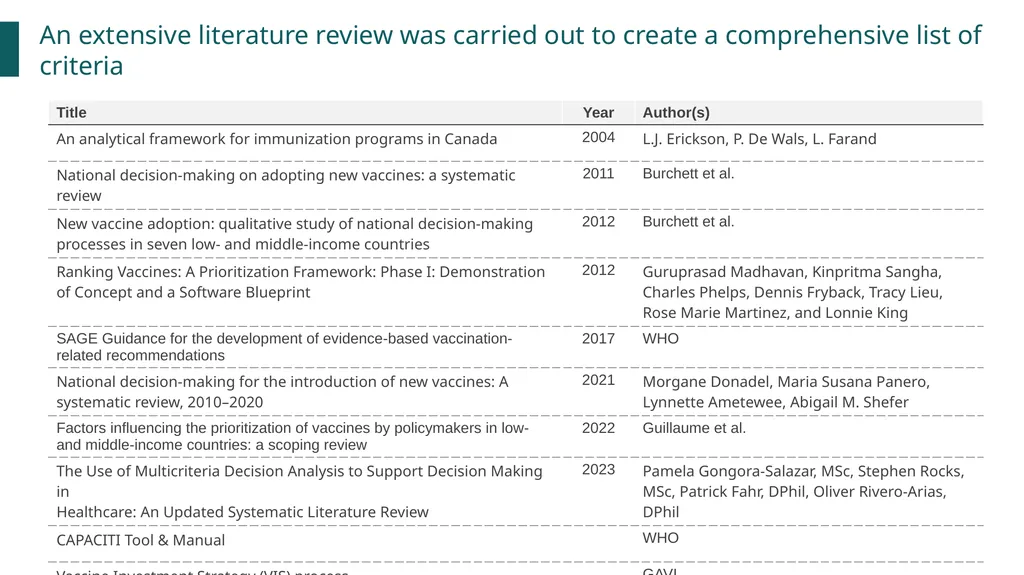
An extensive literature review was carried out to create a comprehensive list of criteria<br>
14
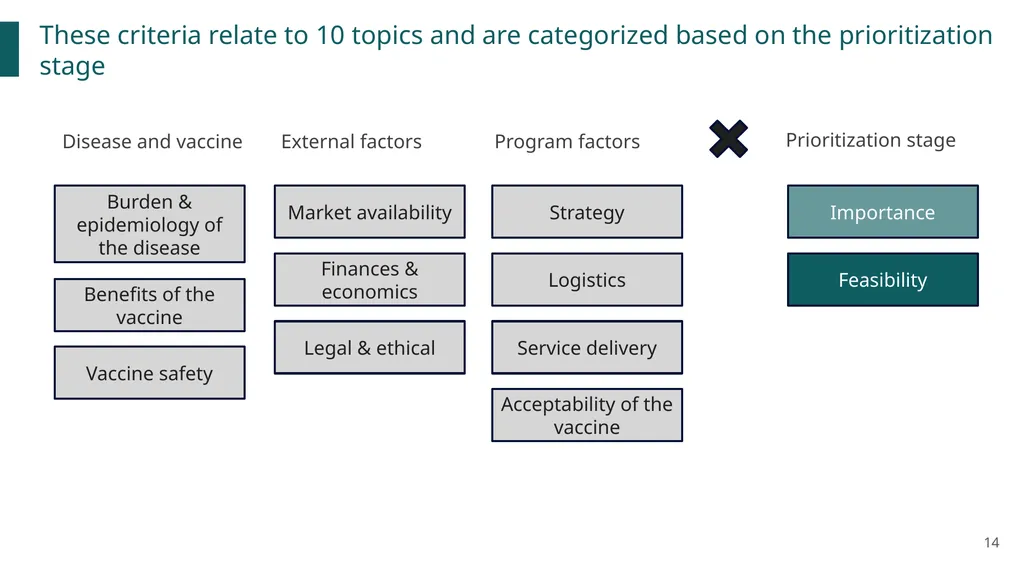
These criteria relate to 10 topics and are categorized based on the prioritization stage 14 Disease and vaccine Program factors Burden & epidemiology of the disease Benefits of the vaccine Vaccine safety Strategy Logistics Service delivery External factors Market availability Finances & economics Legal & ethical Acceptability of the vaccine Prioritization stage Importance Feasibility<br>
15
71 criteria have been identified<br>
16
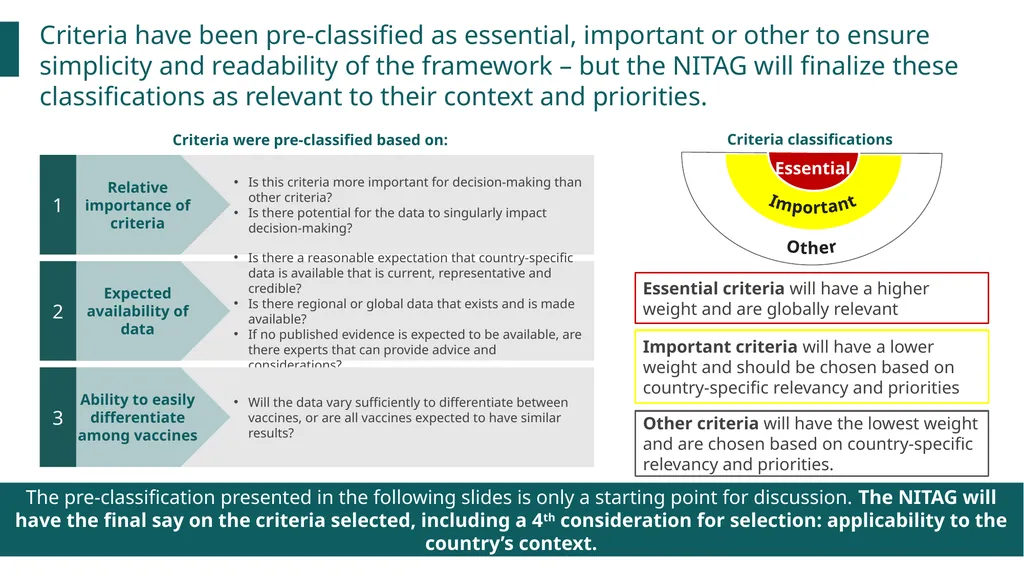
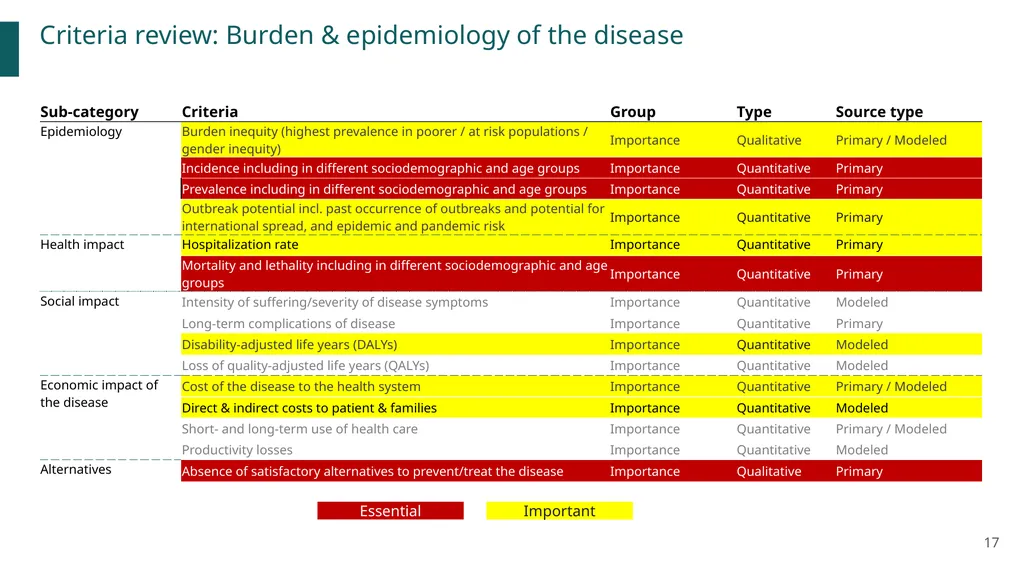
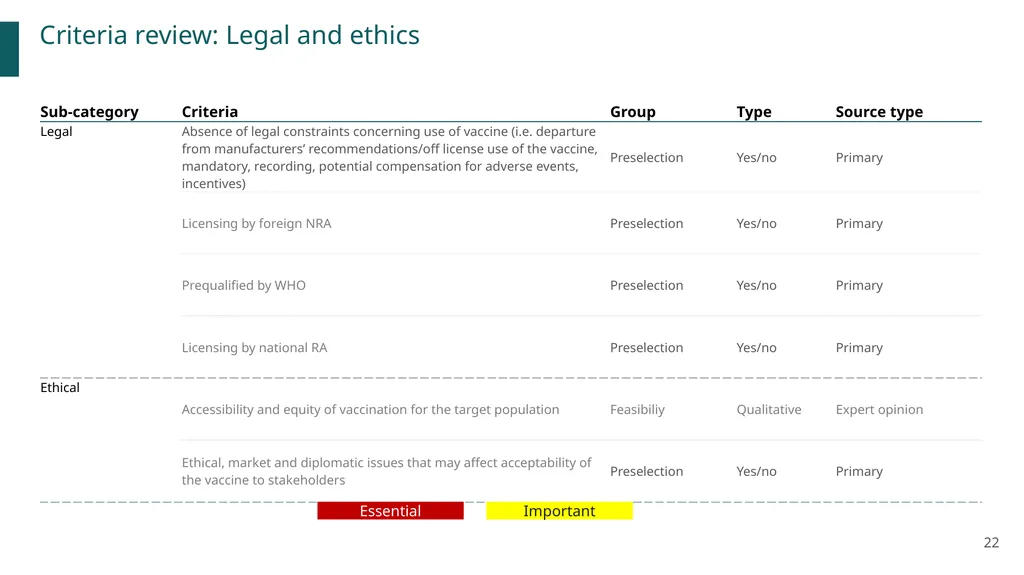
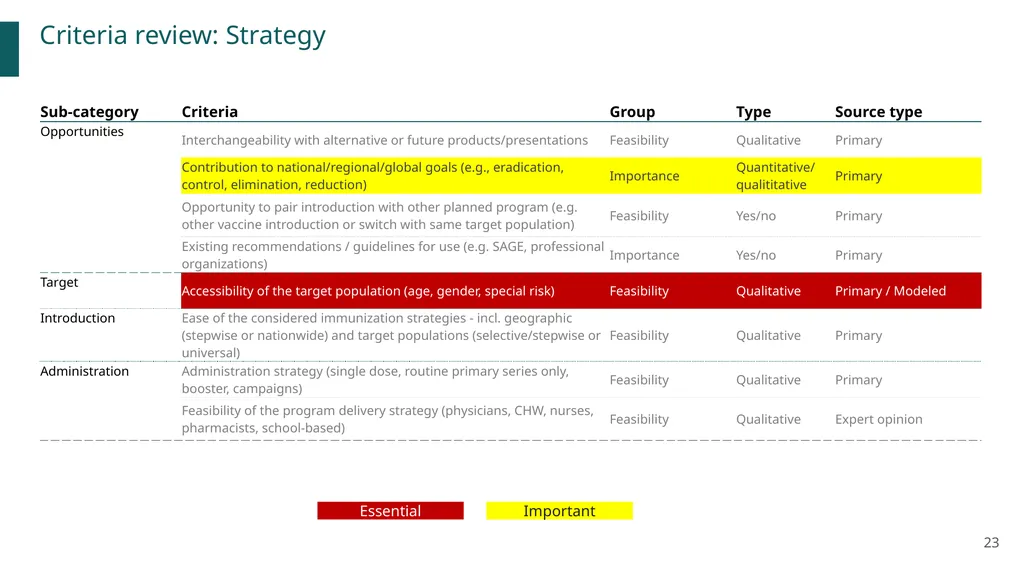
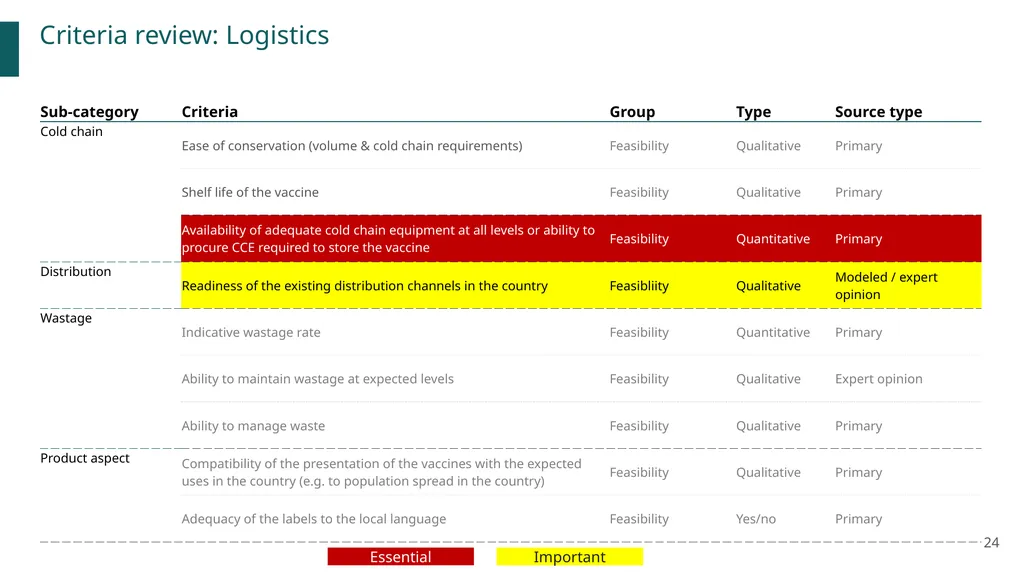
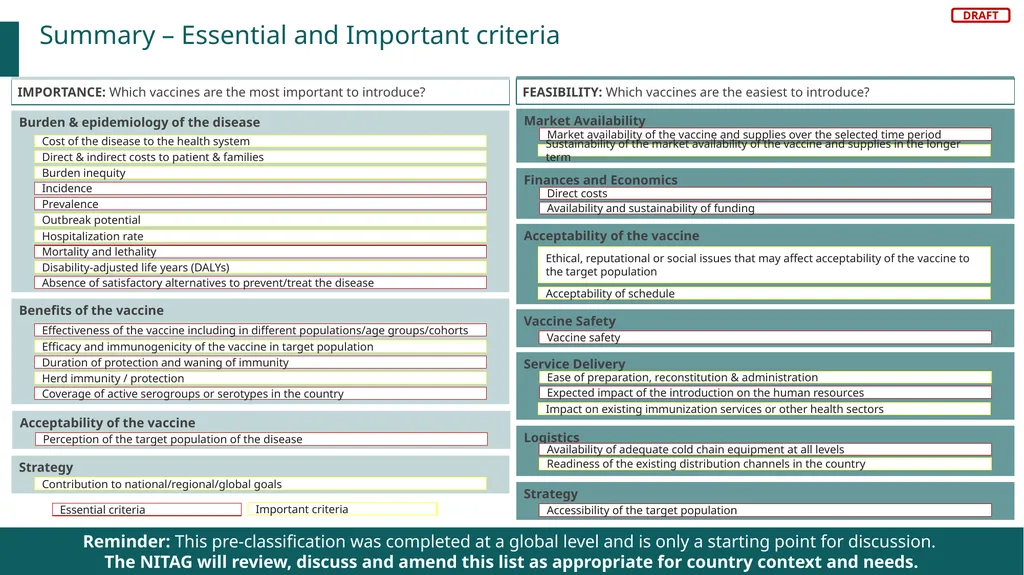
Criteria have been pre-classified as essential, important or other to ensure simplicity and readability of the framework – but the NITAG will finalize these classifications as relevant to their context and priorities. Criteria were pre-classified based on: Criteria classifications The pre-classification presented in the following slides is only a starting point for discussion. The NITAG will have the final say on the criteria selected, including a 4th consideration for selection: applicability to the country’s context. Essential criteria will have a higher weight and are globally relevant Important criteria will have a lower weight and should be chosen based on country-specific relevancy and priorities Other criteria will have the lowest weight and are chosen based on country-specific relevancy and priorities.<br>
17
Criteria review: Burden & epidemiology of the disease 17 Essential Important<br>
18
Criteria review: Benefits of the vaccine 18 Essential Important<br>
19
Criteria review: Vaccine safety 19 Essential Important<br>
20
Criteria review: Market availability 20 Essential Important<br>
21
Criteria review: Finances and economics 21 Essential Important<br>
22
Criteria review: Legal and ethics 22 Essential Important<br>
23
Criteria review: Strategy 23 Essential Important<br>
24
Criteria review: Logistics 24 Essential Important<br>
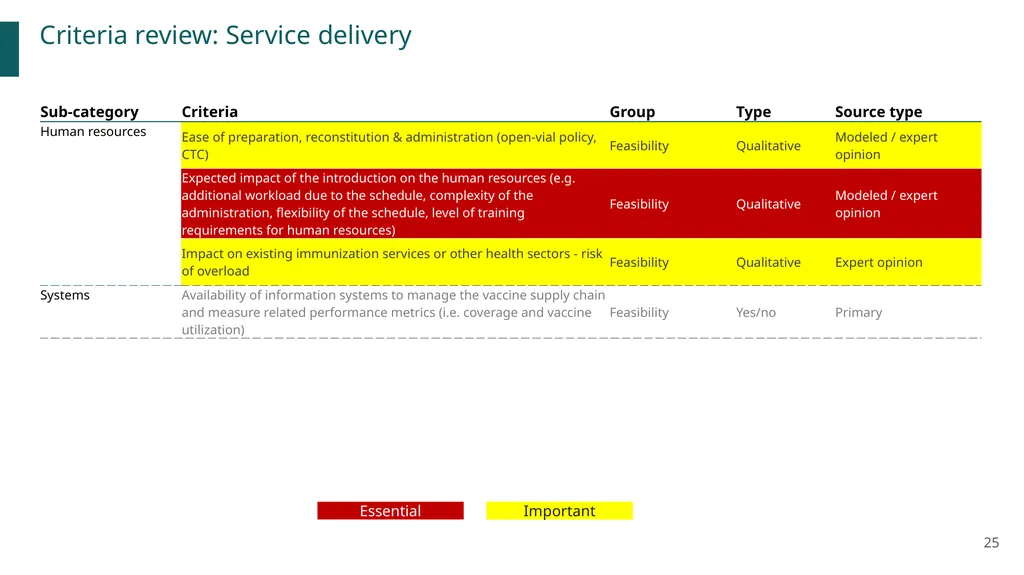
25
Criteria review: Service delivery 25 Essential Important<br>
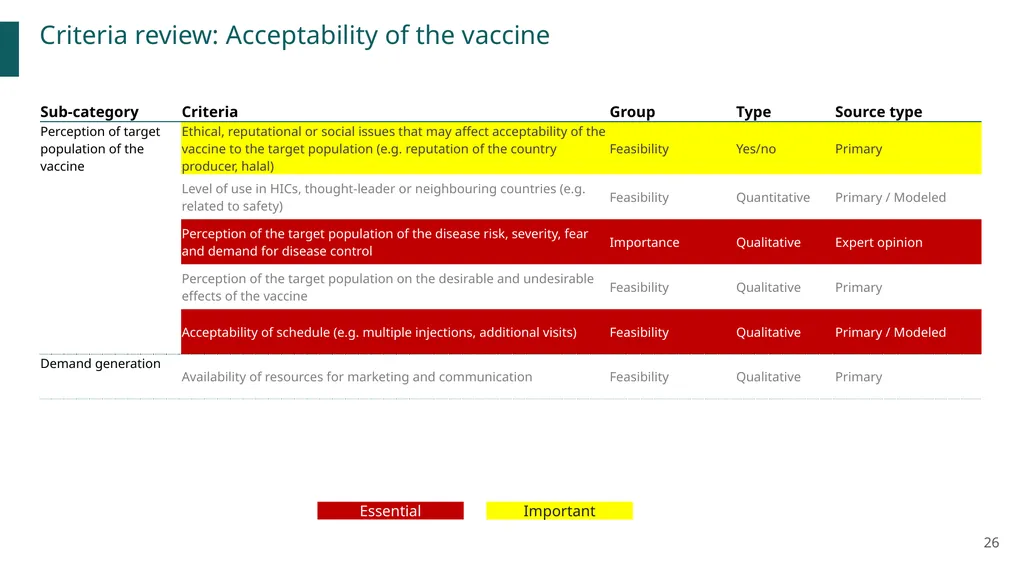
26
Criteria review: Acceptability of the vaccine 26 Essential Important<br>
27
Summary – Essential and Important criteria DRAFT 27 Reminder: This pre-classification was completed at a global level and is only a starting point for discussion.
The NITAG will review, discuss and amend this list as appropriate for country context and needs.<br>
The NITAG will review, discuss and amend this list as appropriate for country context and needs.<br>
28
Agenda 1 Introductions and Objectives 2 Approach and Methodology 3 Workplan 4 Prioritization Criteria 5 Online Questionnaire<br>
29
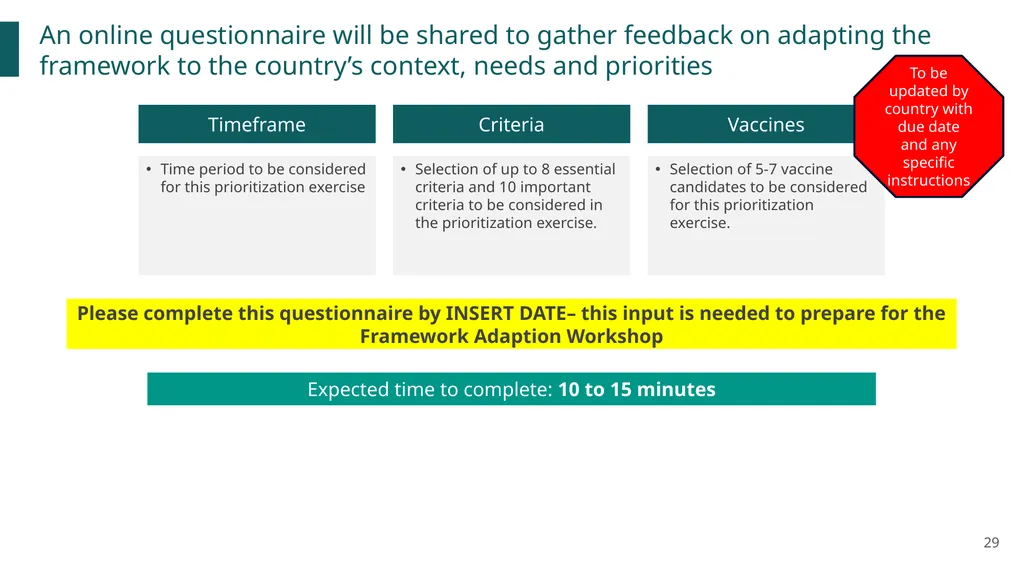
An online questionnaire will be shared to gather feedback on adapting the framework to the country’s context, needs and priorities 29 Expected time to complete: 10 to 15 minutes Please complete this questionnaire by INSERT DATE– this input is needed to prepare for the Framework Adaption Workshop To be updated by country with due date and any specific instructions<br>
30
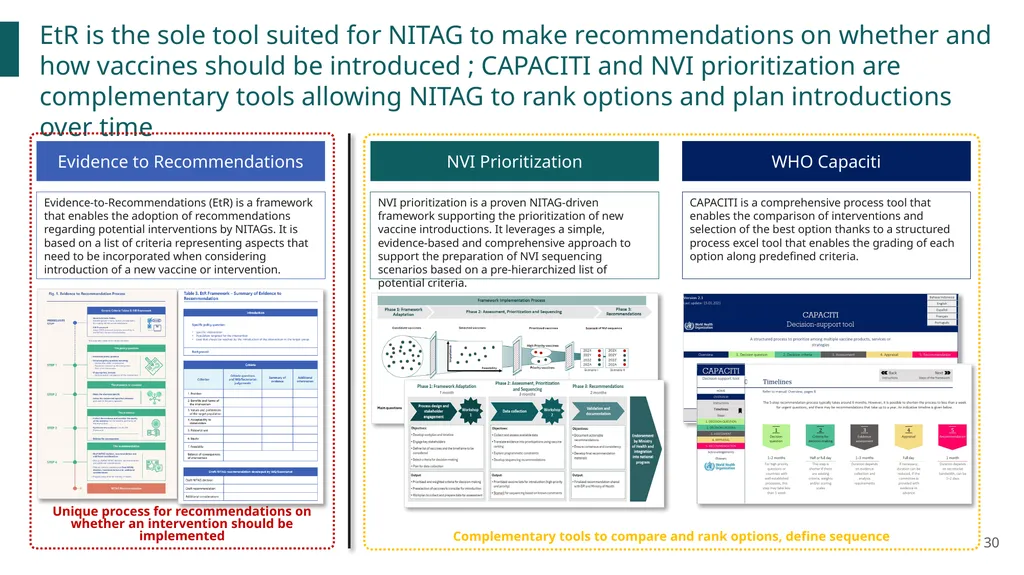
WHO Capaciti CAPACITI is a comprehensive process tool that enables the comparison of interventions and selection of the best option thanks to a structured process excel tool that enables the grading of each option along predefined criteria. EtR is the sole tool suited for NITAG to make recommendations on whether and how vaccines should be introduced ; CAPACITI and NVI prioritization are complementary tools allowing NITAG to rank options and plan introductions over time 30 Evidence to Recommendations NVI Prioritization Evidence-to-Recommendations (EtR) is a framework that enables the adoption of recommendations regarding potential interventions by NITAGs. It is based on a list of criteria representing aspects that need to be incorporated when considering introduction of a new vaccine or intervention. NVI prioritization is a proven NITAG-driven framework supporting the prioritization of new vaccine introductions. It leverages a simple, evidence-based and comprehensive approach to support the preparation of NVI sequencing scenarios based on a pre-hierarchized list of potential criteria. Unique process for recommendations on whether an intervention should be implemented Complementary tools to compare and rank options, define sequence<br>
31
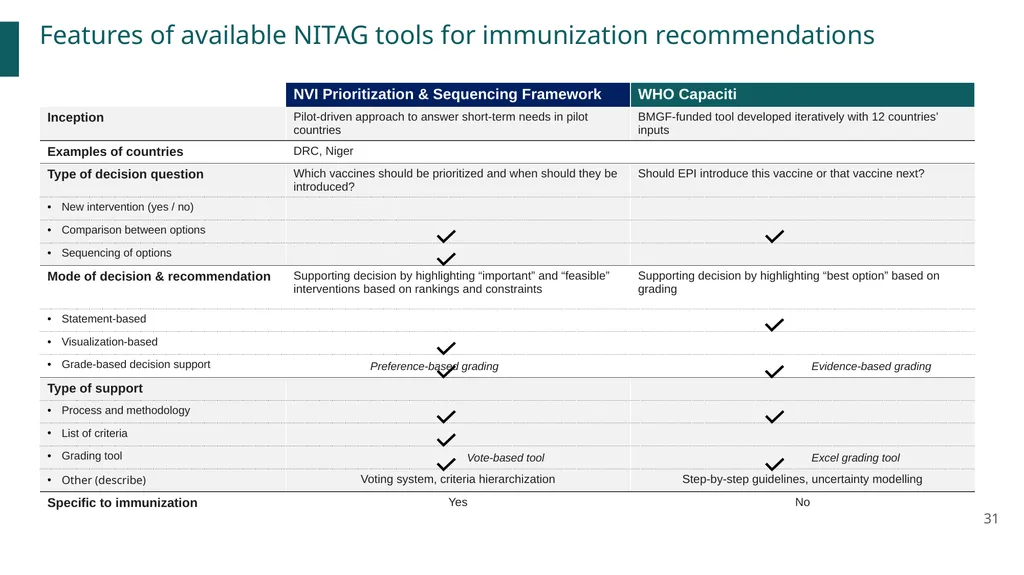
Features of available NITAG tools for immunization recommendations 31<br>