Nicolaus Copernicus Why Is He So Important? Copernicus is responsible for spreading the theory that the Earth revolves around the Sun, not the other way around. Heliocentric model the Sun is the center of the Universe Helped to start
"Nicolaus Copernicus Why Is He So Important?" is the property of its rightful owner. Permission is granted to
download and print the materials on this website for personal, non-commercial use only, and to display it
on your personal computer provided you do not modify the materials and that you retain all copyright
notices contained in the materials. By downloading content from our website, you accept the terms of this
agreement.
Presentation Transcript
01
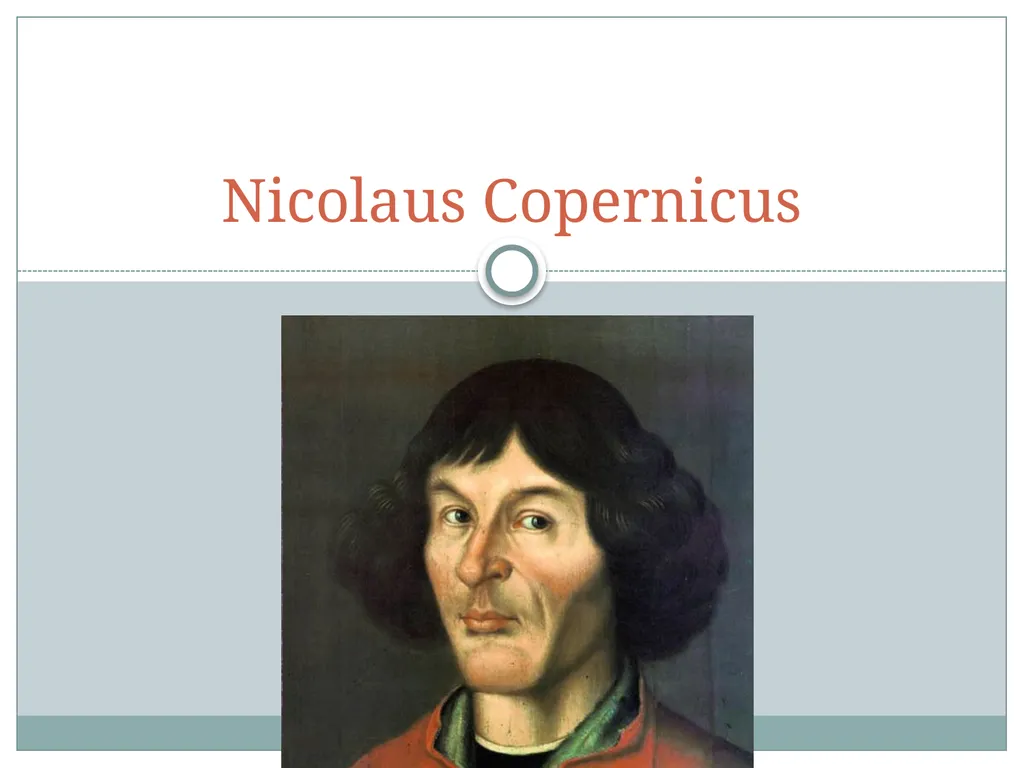
Nicolaus Copernicus<br>
02
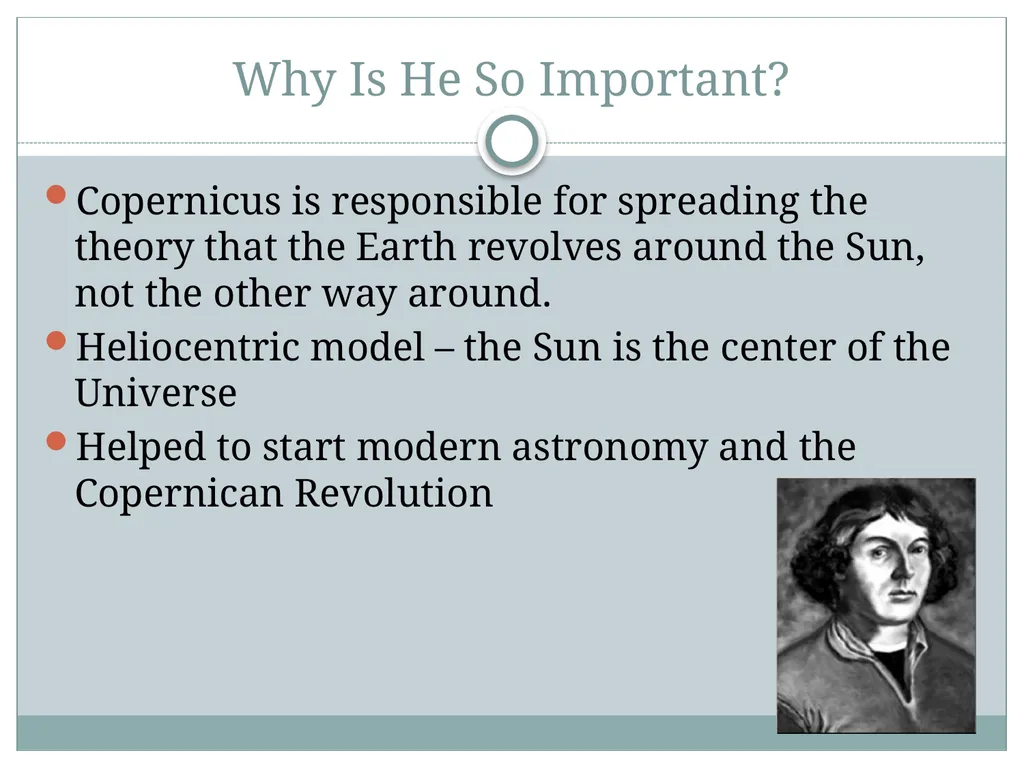
Why Is He So Important? Copernicus is responsible for spreading the theory that the Earth revolves around the Sun, not the other way around.
Heliocentric model – the Sun is the center of the Universe
Helped to start modern astronomy and the Copernican Revolution<br>
03
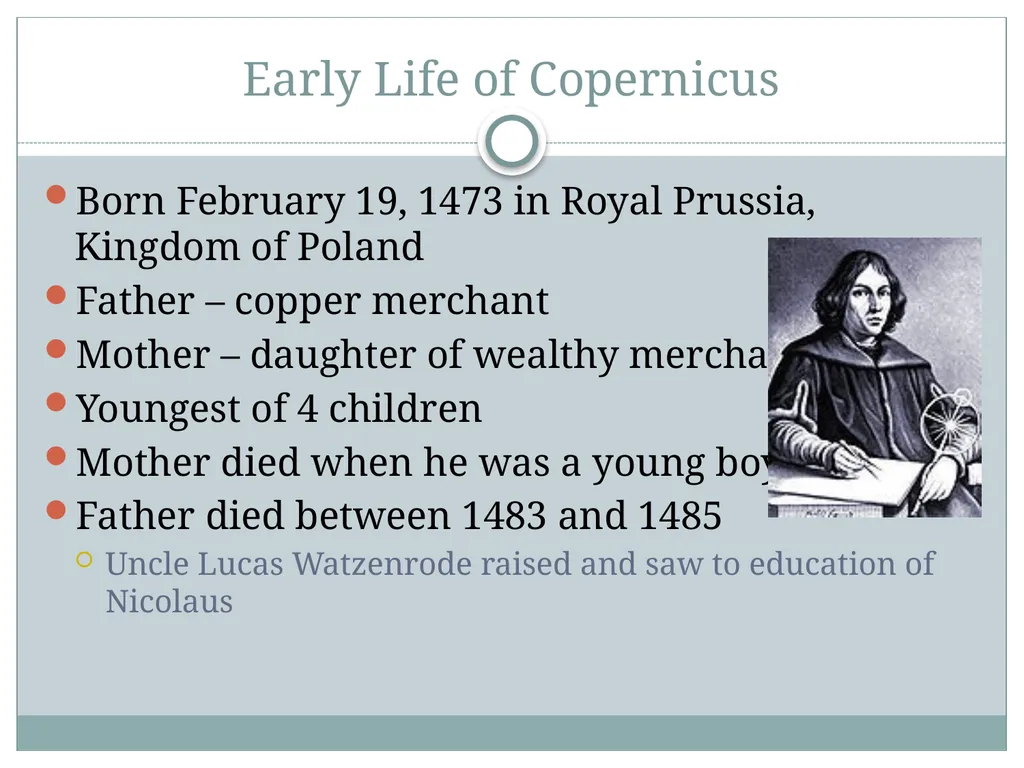
Early Life of Copernicus Born February 19, 1473 in Royal Prussia, Kingdom of Poland
Father – copper merchant
Mother – daughter of wealthy merchant
Youngest of 4 children
Mother died when he was a young boy
Father died between 1483 and 1485
Uncle Lucas Watzenrode raised and saw to education of Nicolaus<br>
04
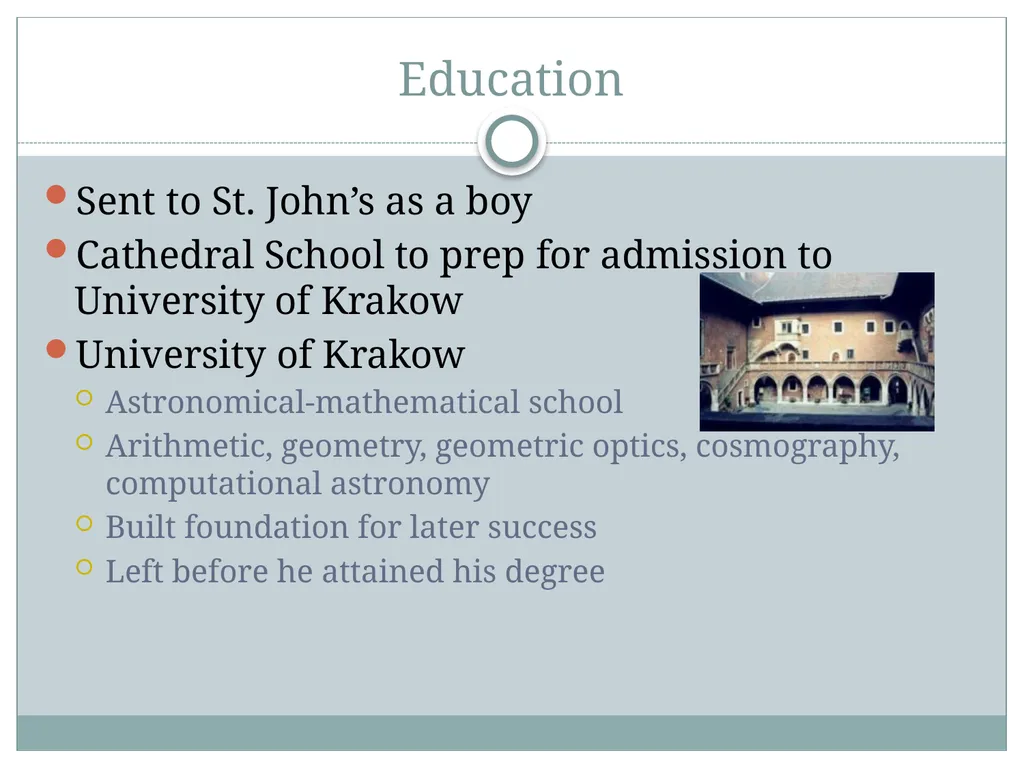
Education Sent to St. John’s as a boy
Cathedral School to prep for admission to University of Krakow
University of Krakow
Astronomical-mathematical school
Arithmetic, geometry, geometric optics, cosmography, computational astronomy
Built foundation for later success
Left before he attained his degree<br>
05
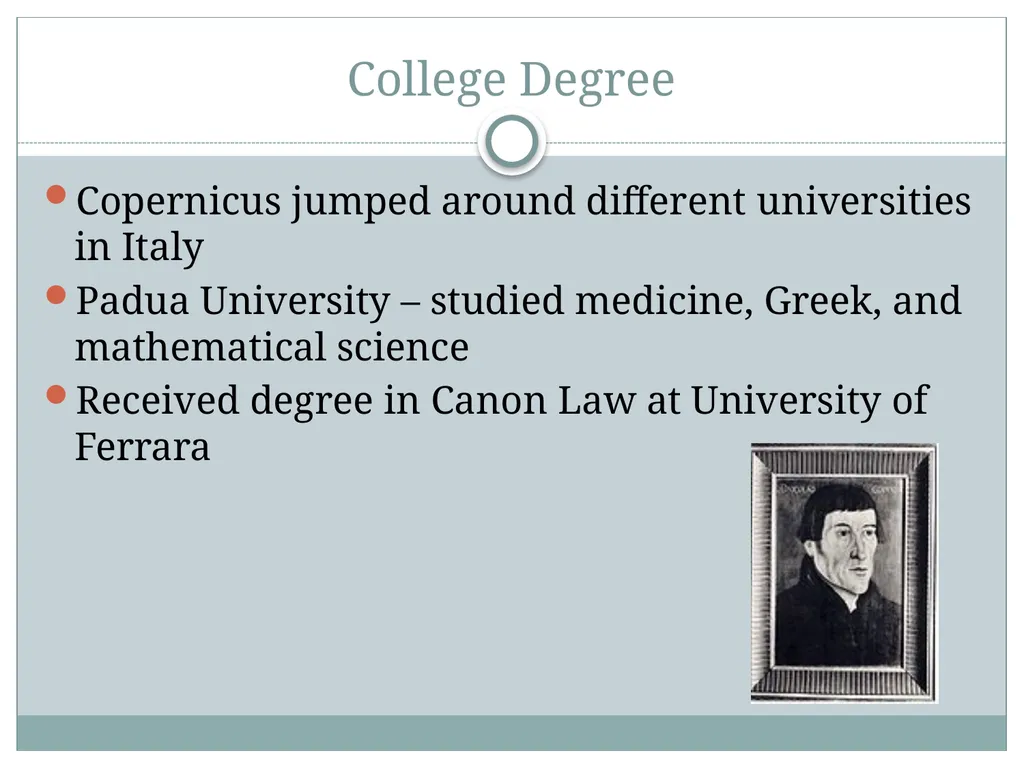
College Degree Copernicus jumped around different universities in Italy
Padua University – studied medicine, Greek, and mathematical science
Received degree in Canon Law at University of Ferrara<br>
06
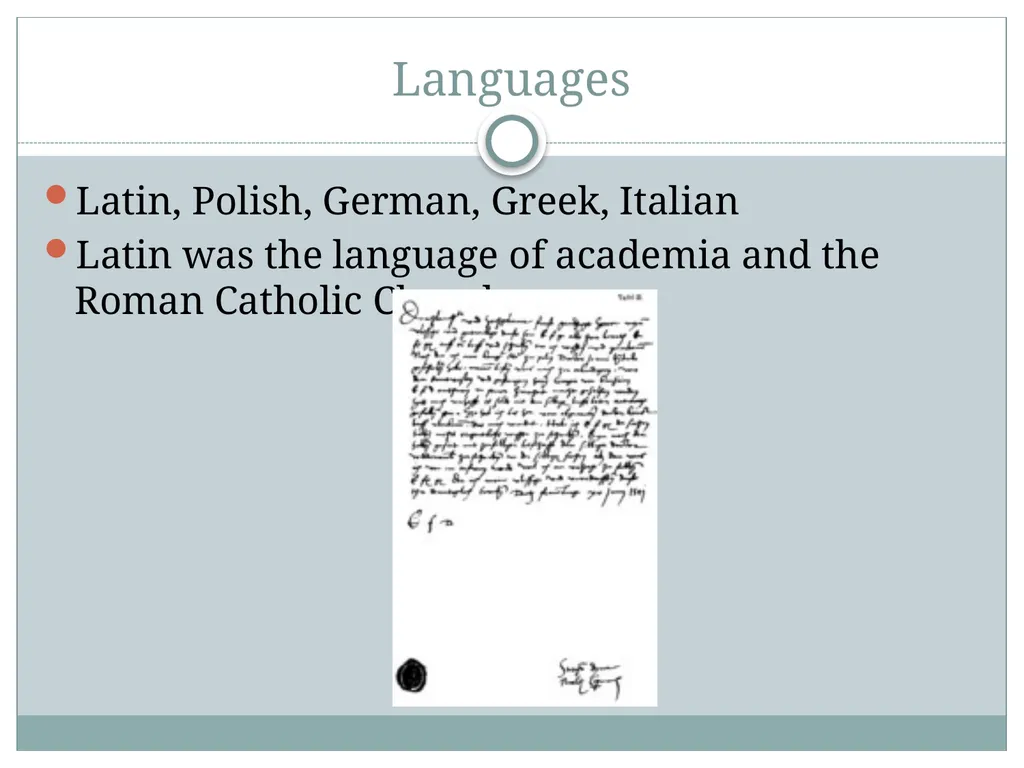
Languages Latin, Polish, German, Greek, Italian
Latin was the language of academia and the Roman Catholic Church<br>
07
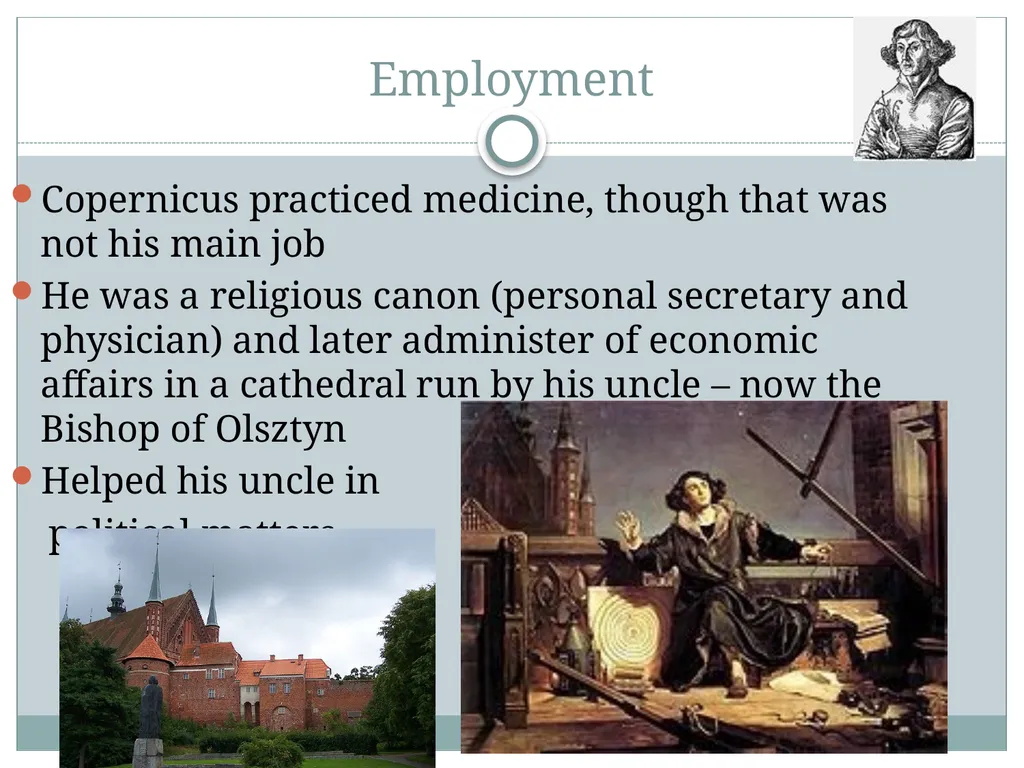
Employment Copernicus practiced medicine, though that was not his main job
He was a religious canon (personal secretary and physician) and later administer of economic affairs in a cathedral run by his uncle – now the Bishop of Olsztyn
Helped his uncle in
political matters<br>
08
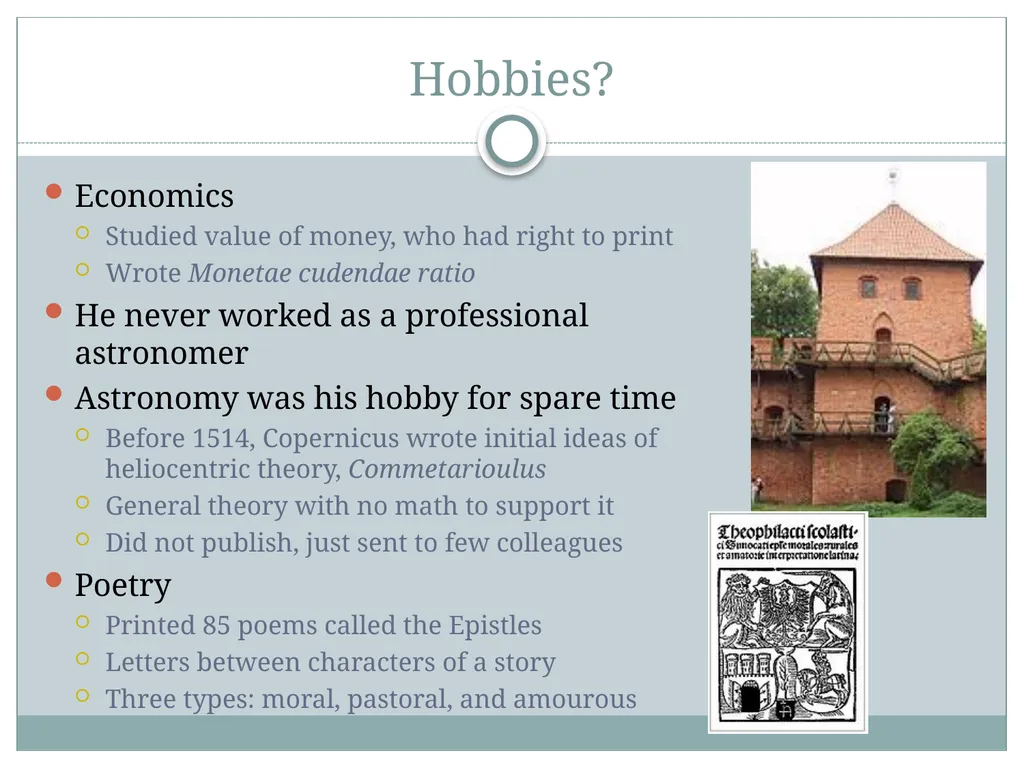
Hobbies? Economics
Studied value of money, who had right to print
Wrote Monetae cudendae ratio
He never worked as a professional astronomer
Astronomy was his hobby for spare time
Before 1514, Copernicus wrote initial ideas of heliocentric theory, Commetarioulus
General theory with no math to support it
Did not publish, just sent to few colleagues
Poetry
Printed 85 poems called the Epistles
Letters between characters of a story
Three types: moral, pastoral, and amourous<br>
09
Astronomy Though never his job, he intensely pursued astronomy
Intensive observations of Mars, Saturn and the Sun
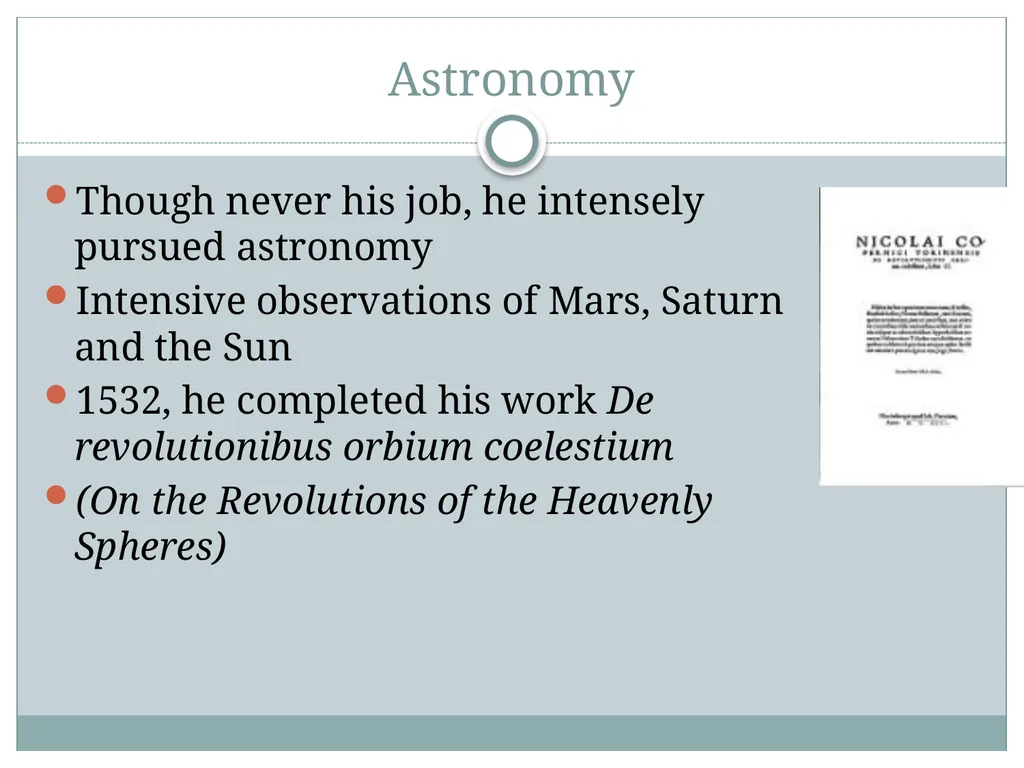
1532, he completed his work De revolutionibus orbium coelestium
(On the Revolutions of the Heavenly Spheres)<br>
10
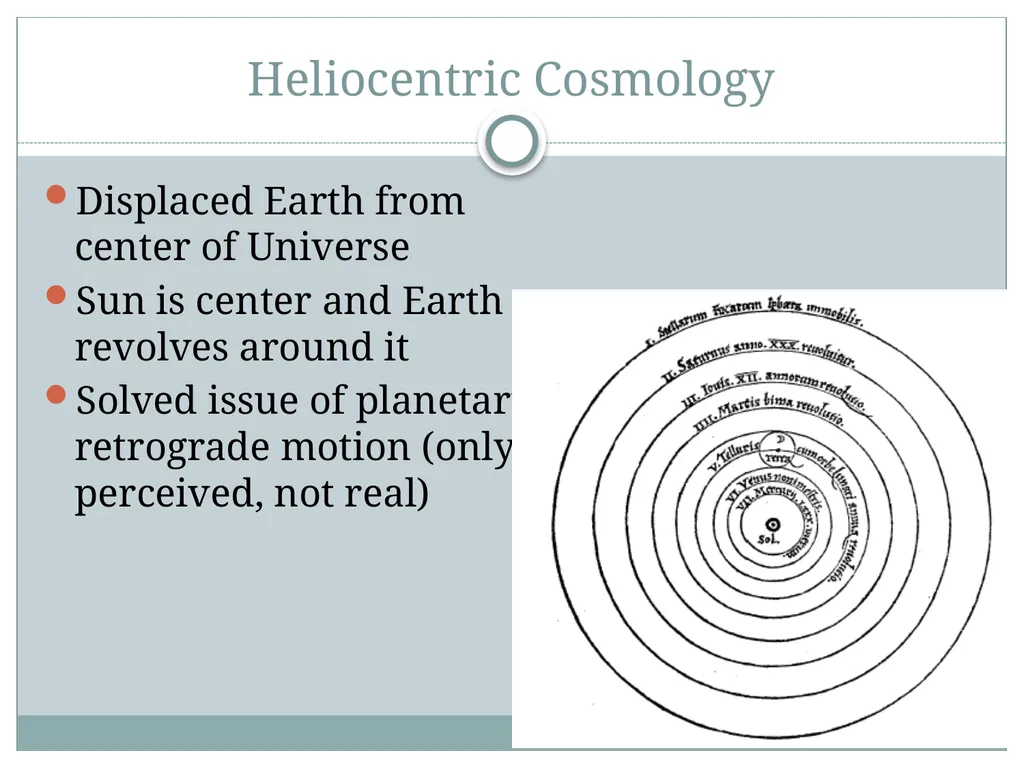
Heliocentric Cosmology Displaced Earth from center of Universe
Sun is center and Earth revolves around it
Solved issue of planetary retrograde motion (only perceived, not real)<br>
11
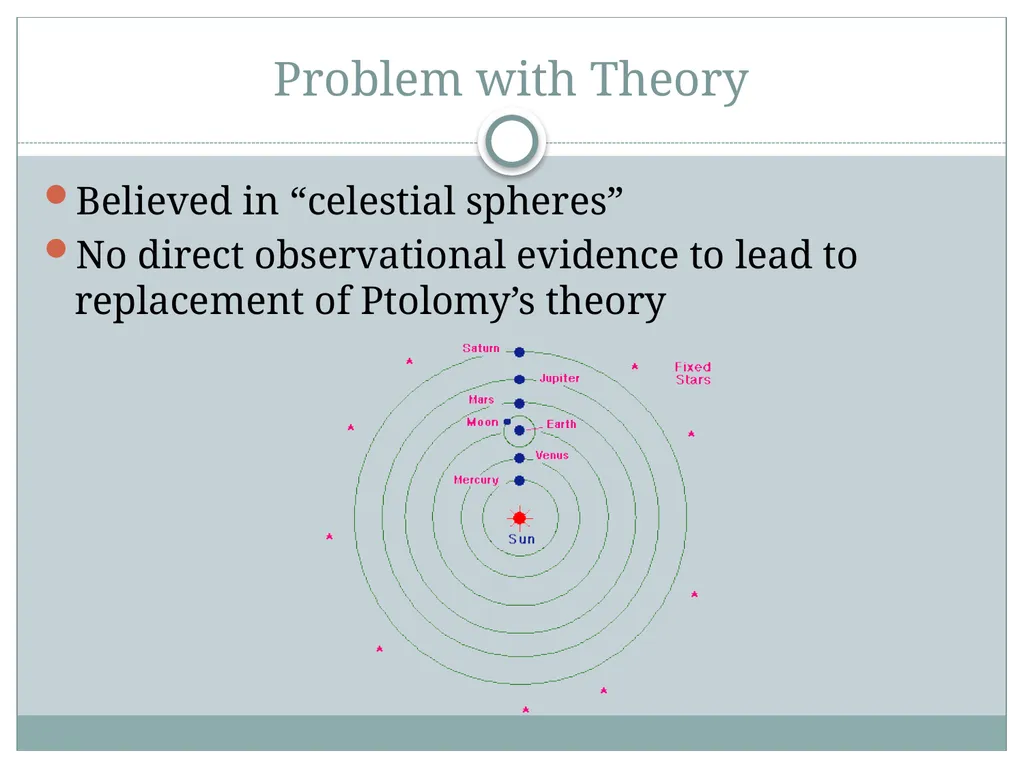
Problem with Theory Believed in “celestial spheres”
No direct observational evidence to lead to replacement of Ptolomy’s theory<br>
12
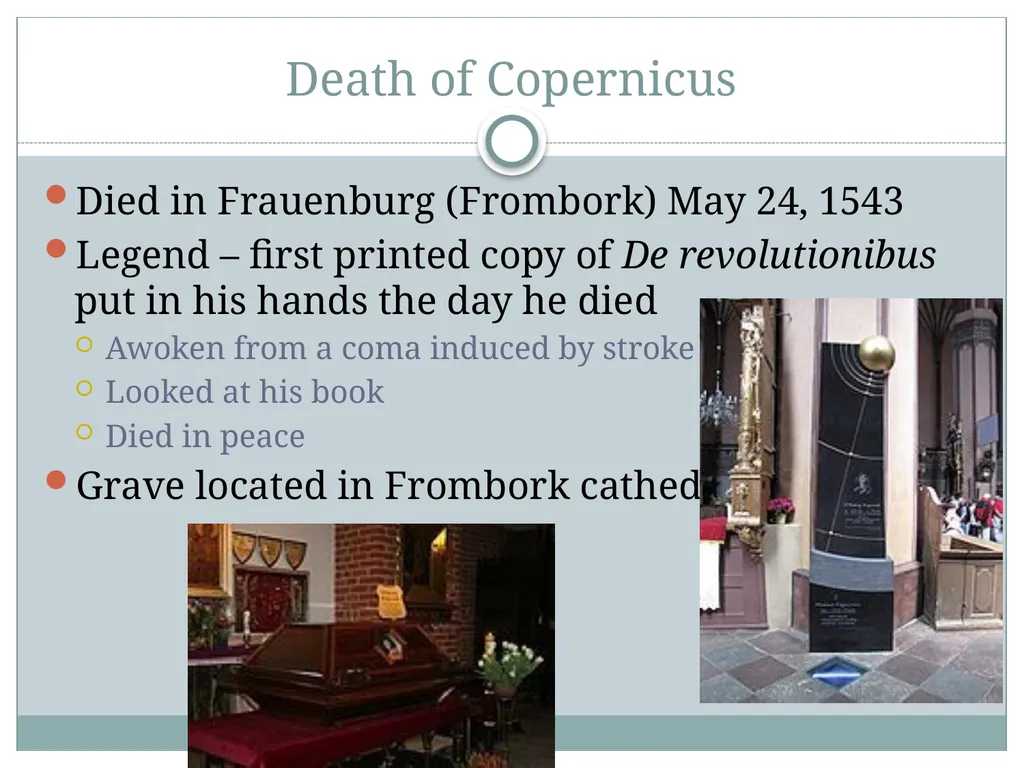
Death of Copernicus Died in Frauenburg (Frombork) May 24, 1543
Legend – first printed copy of De revolutionibus put in his hands the day he died
Awoken from a coma induced by stroke
Looked at his book
Died in peace
Grave located in Frombork cathedral<br>
13
Skepticism After his death, lectures were given about his theory and Pope Clement VII and catholic cardinals were interested
His persecution came from Protestant Church and Martin Luther
Theory found implausible by majority of his contemporaries and most astronomers and natural philospophers until the mid 17th century<br>
14
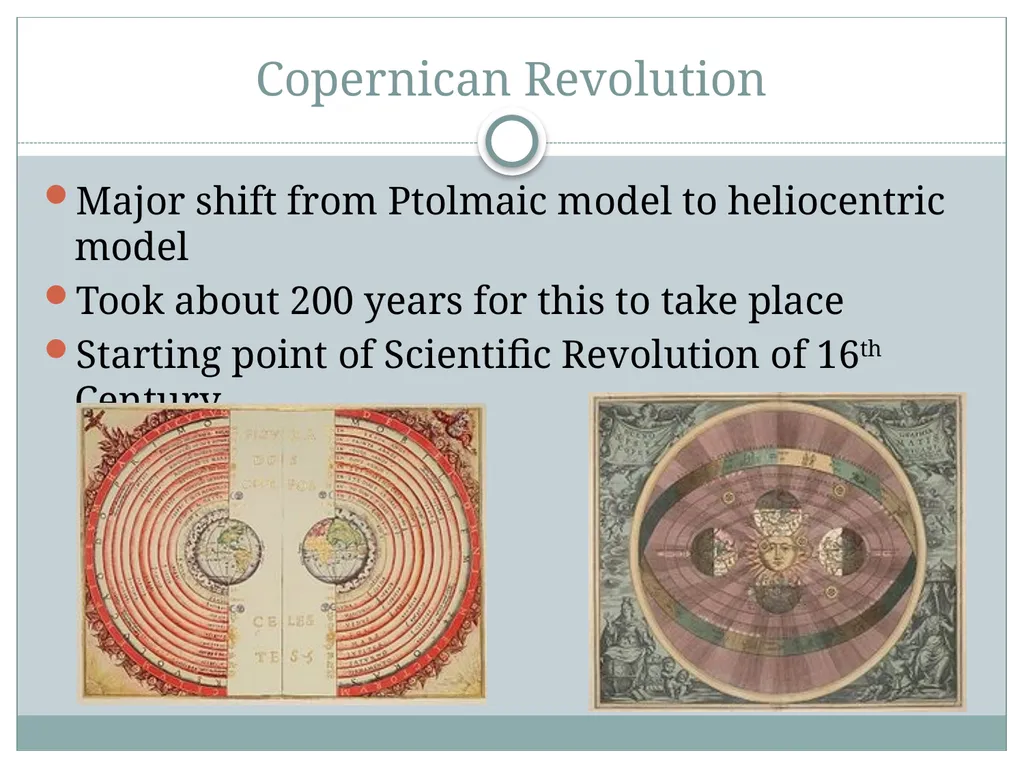
Copernican Revolution Major shift from Ptolmaic model to heliocentric model
Took about 200 years for this to take place
Starting point of Scientific Revolution of 16th Century<br>
15
Supporters Johannes Kepler (1571-1630)
Galileo Galilei (1564-1642)
Sir Isaac Newton’s Theory of Universala Gravitation (1687)<br>