04
Acknowledgements Co- Authors:
Ian Sliney, GHSC-PSM Country Director, Cameroon
Patrick Gaparayi, former GHSC-PSM Country Director, Cameroon
Tiburce Nyiama, GHSC-PSM Technical Director, Cameroon
Catherine Tadzong, GHSC-PSM M&E Advisor, Cameroon
Joseph Fonyuy, Former GHSC-PSM HSS Advisor, Cameroon
Glenn Mupphy, GHSC-PSM WIM Specialist, Cameroon
Dissongo Jean II, RDPH, Littoral
Bikoti Joseph Marie, RFHP Administrator
Etoa Mebara, DMO New Bell
Yongui Victorine, RTG HIV Coordinator, Littoral
Hysantine Arrey, Supply Chain Manager, Littoral 2019 Global Health Supply Chain Summit, Johannesburg, S. Africa<br>
05
Outline Background and justification
Methodology
Results
Conclusion 2019 Global Health Supply Chain Summit, Johannesburg, S. Africa<br>
06
Background The USAID Global Health Supply Chain Program-Procurement and Supply Management (GHSC-PSM) project ensures an uninterrupted supply of medicines and other health commodities globally
In Cameroon, GHSC-PSM has three objectives:
Global commodity procurement and logistics
Systems strengthening technical assistance
Global collaboration to improve long-term availability of health commodities 2019 Global Health Supply Chain Summit, Johannesburg, S. Africa<br>
07
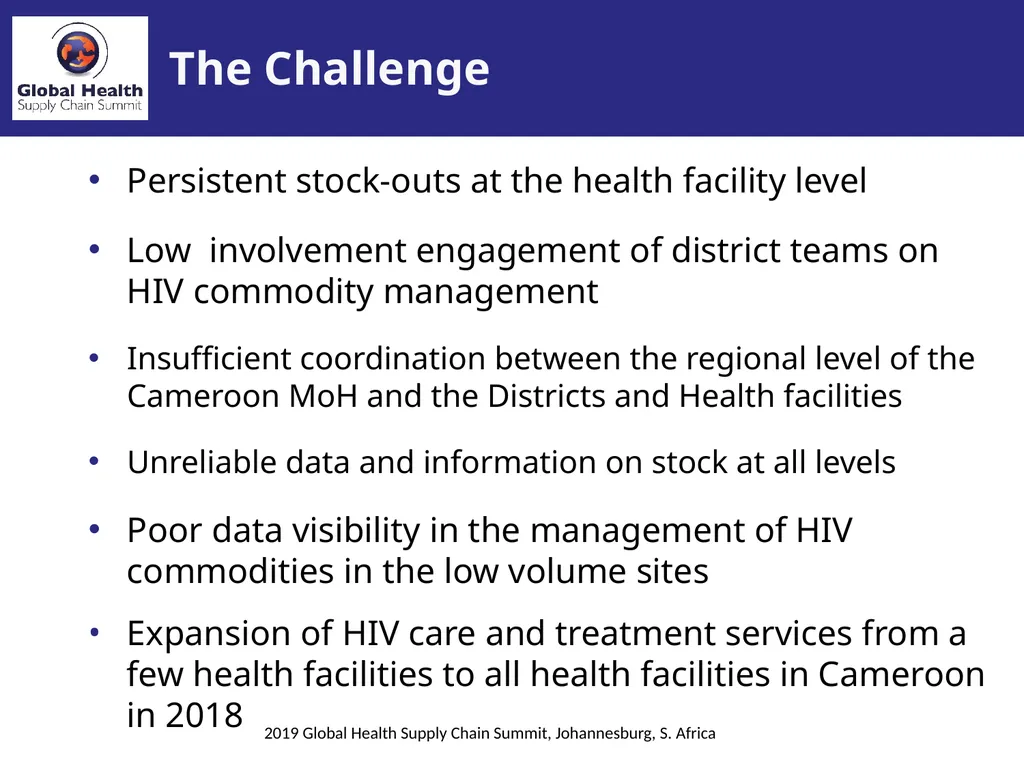
The Challenge Persistent stock-outs at the health facility level
Low involvement engagement of district teams on HIV commodity management
Insufficient coordination between the regional level of the Cameroon MoH and the Districts and Health facilities
Unreliable data and information on stock at all levels
Poor data visibility in the management of HIV commodities in the low volume sites
Expansion of HIV care and treatment services from a few health facilities to all health facilities in Cameroon in 2018 2019 Global Health Supply Chain Summit, Johannesburg, S. Africa<br>
08
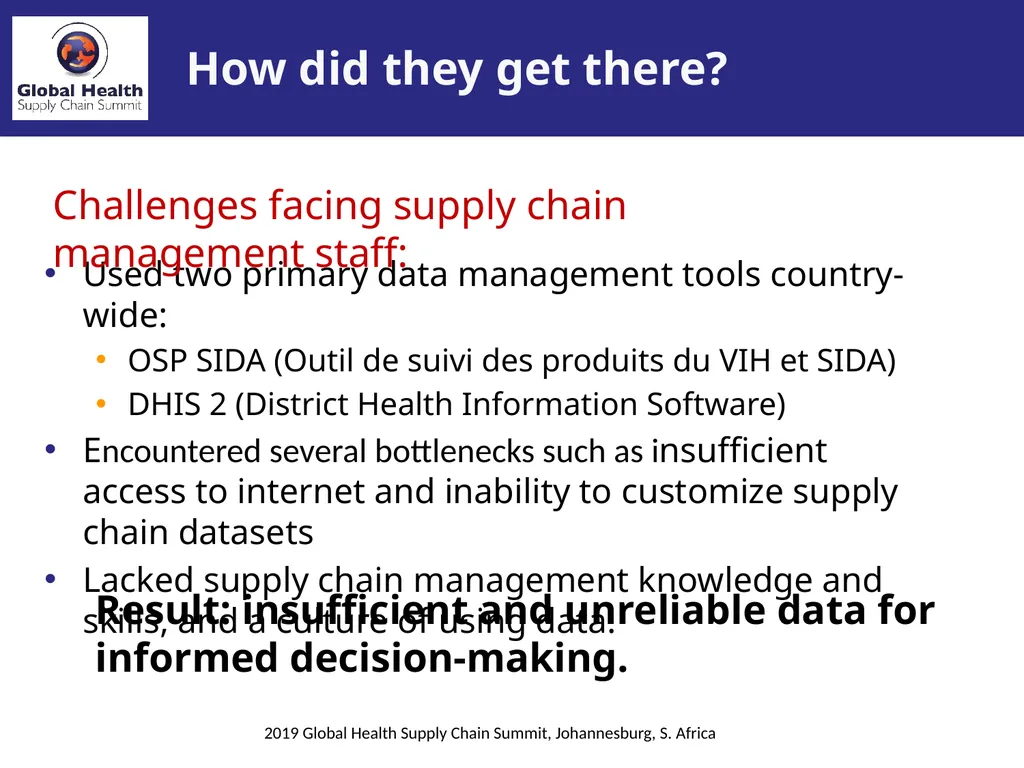
How did they get there? Used two primary data management tools country-wide:
OSP SIDA (Outil de suivi des produits du VIH et SIDA)
DHIS 2 (District Health Information Software)
Encountered several bottlenecks such as insufficient access to internet and inability to customize supply chain datasets
Lacked supply chain management knowledge and skills, and a culture of using data. 2019 Global Health Supply Chain Summit, Johannesburg, S. Africa Result: insufficient and unreliable data for informed decision-making. Challenges facing supply chain management staff:<br>
09
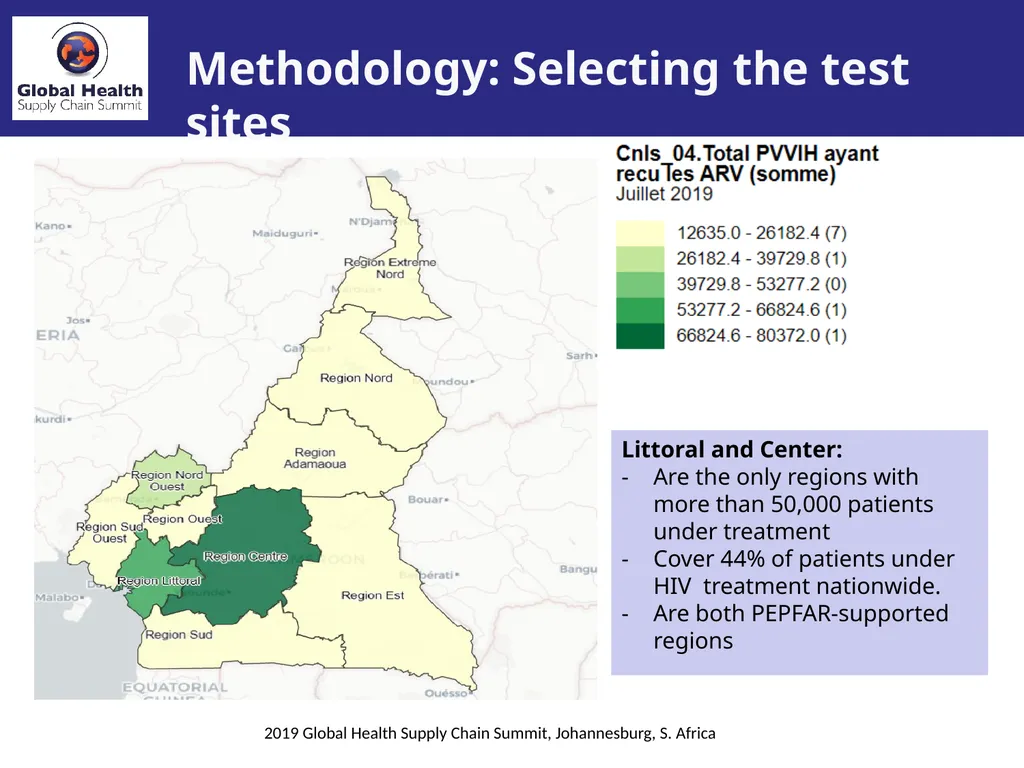
Methodology: Selecting the test sites 2019 Global Health Supply Chain Summit, Johannesburg, S. Africa Littoral and Center:
Are the only regions with more than 50,000 patients under treatment
Cover 44% of patients under HIV treatment nationwide.
Are both PEPFAR-supported regions<br>
10
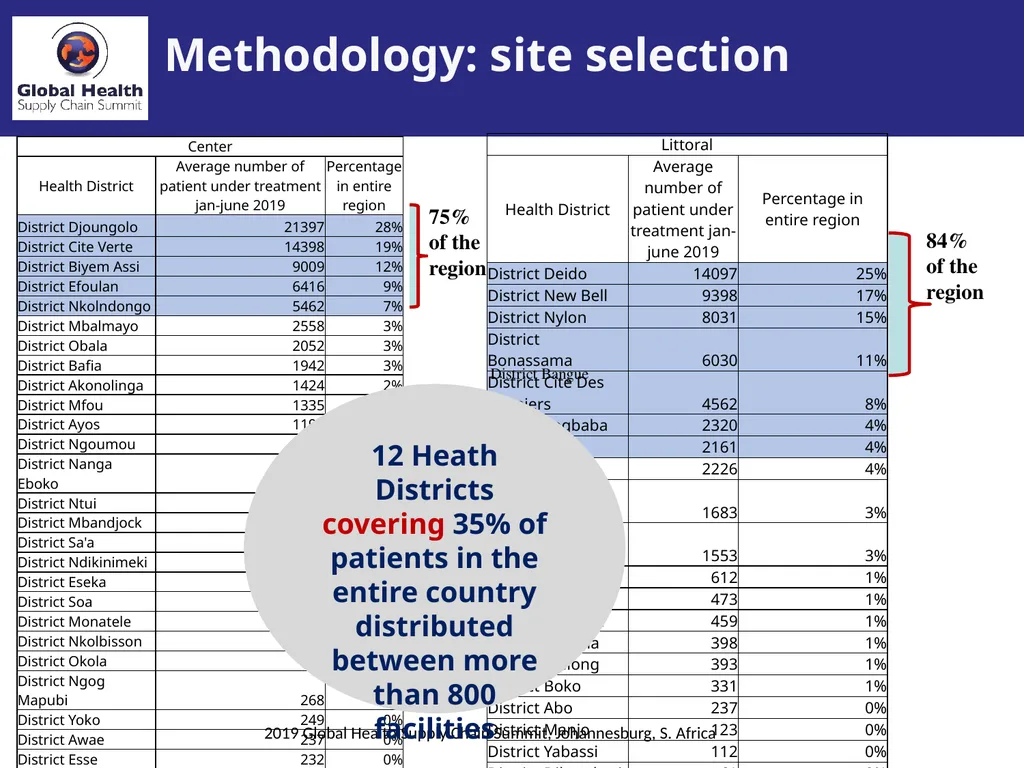
Methodology: site selection 2019 Global Health Supply Chain Summit, Johannesburg, S. Africa 75%
of the region 84% of the region 12 Heath Districts covering 35% of patients in the entire country distributed between more than 800 facilities District Bangue<br>
11
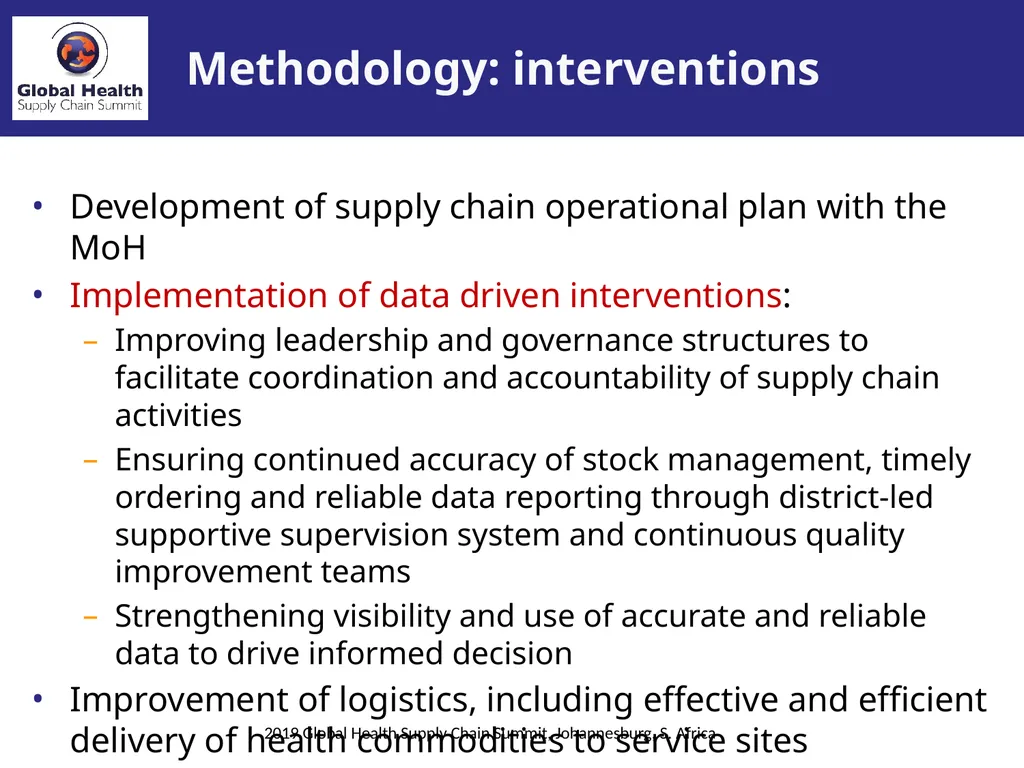
Methodology: interventions Development of supply chain operational plan with the MoH
Implementation of data driven interventions:
Improving leadership and governance structures to facilitate coordination and accountability of supply chain activities
Ensuring continued accuracy of stock management, timely ordering and reliable data reporting through district-led supportive supervision system and continuous quality improvement teams
Strengthening visibility and use of accurate and reliable data to drive informed decision
Improvement of logistics, including effective and efficient delivery of health commodities to service sites 2019 Global Health Supply Chain Summit, Johannesburg, S. Africa<br>
12
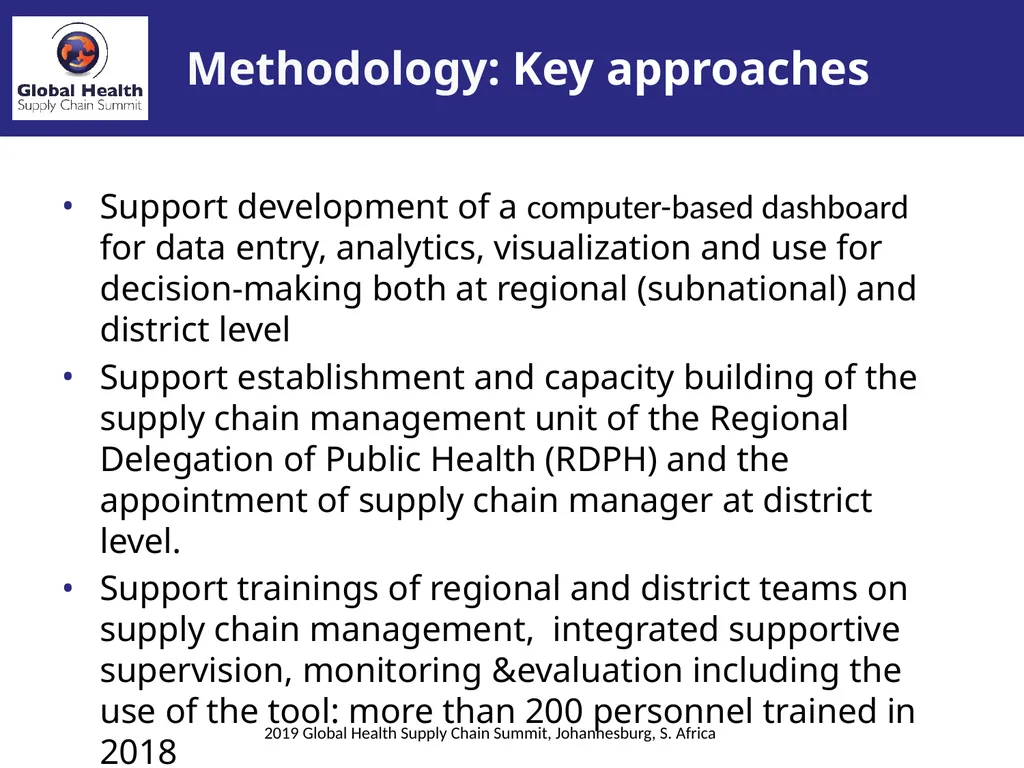
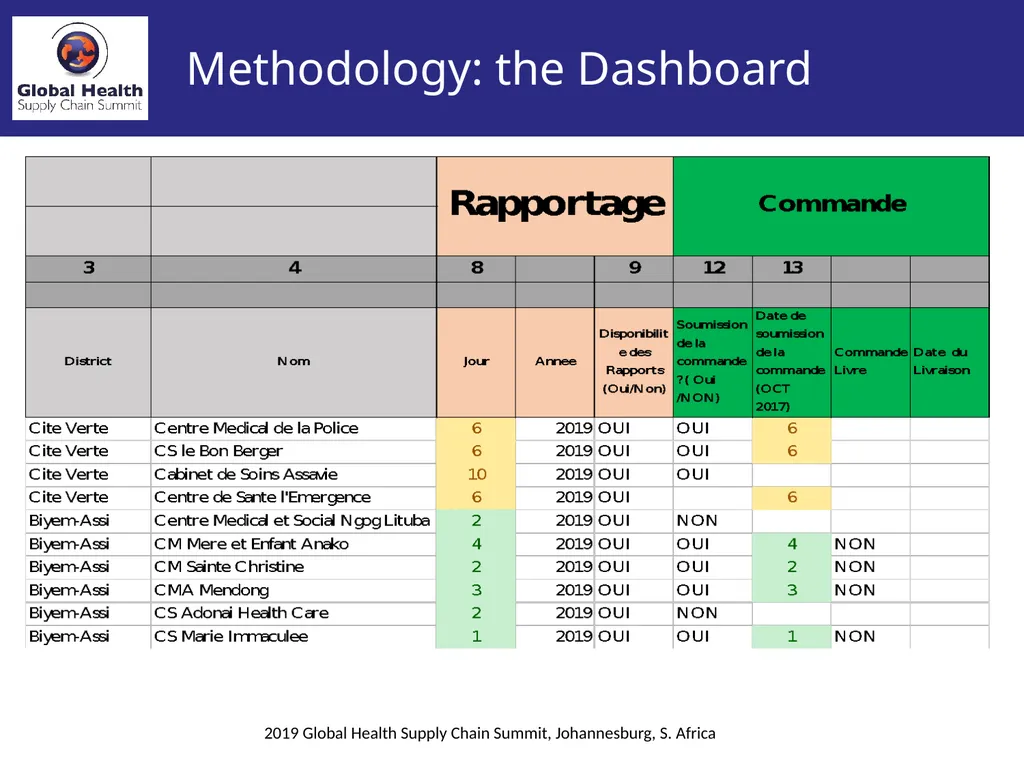
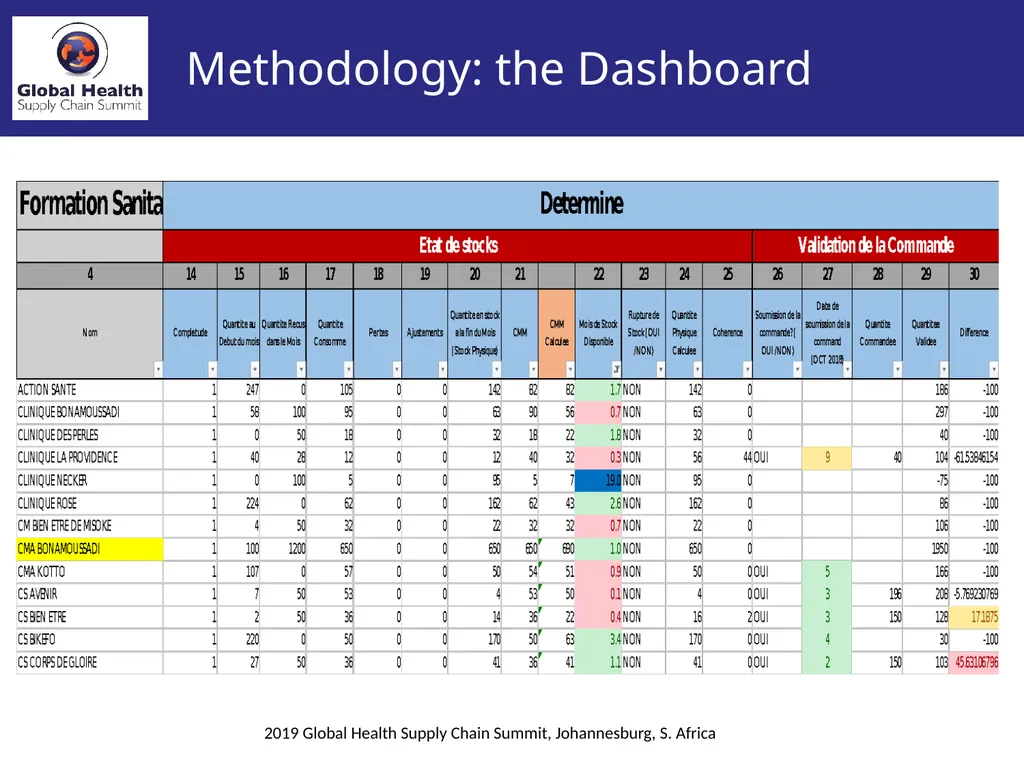
Methodology: Key approaches Support development of a computer-based dashboard for data entry, analytics, visualization and use for decision-making both at regional (subnational) and district level
Support establishment and capacity building of the supply chain management unit of the Regional Delegation of Public Health (RDPH) and the appointment of supply chain manager at district level.
Support trainings of regional and district teams on supply chain management, integrated supportive supervision, monitoring &evaluation including the use of the tool: more than 200 personnel trained in 2018 2019 Global Health Supply Chain Summit, Johannesburg, S. Africa<br>
13
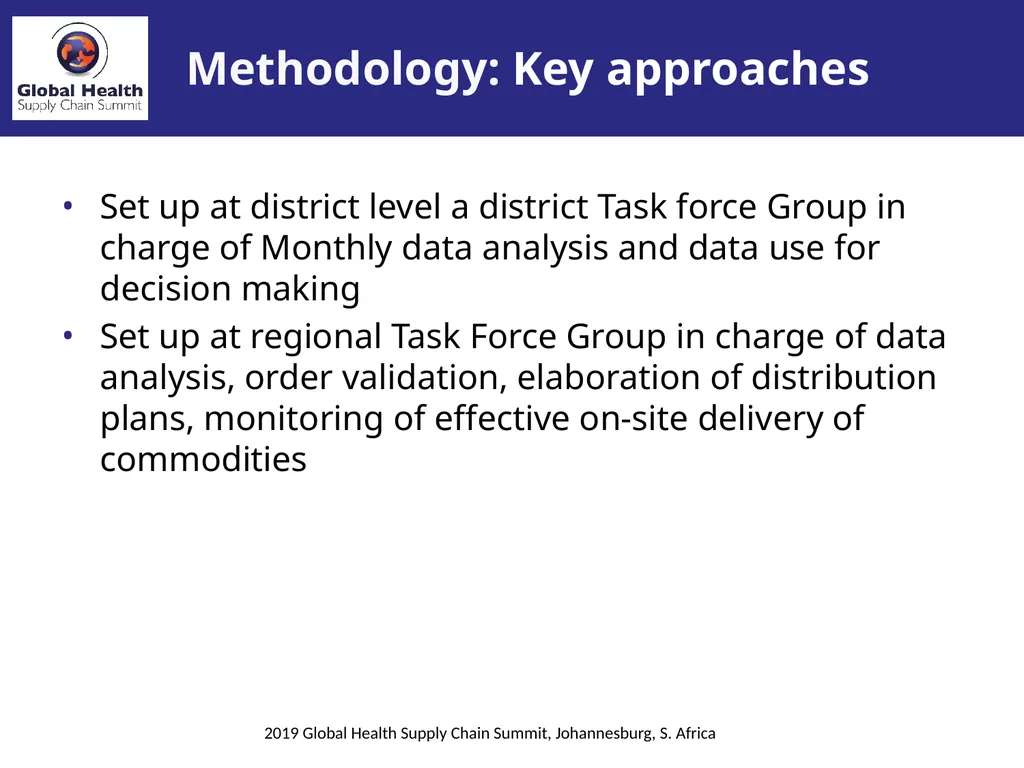
Methodology: Key approaches Set up at district level a district Task force Group in charge of Monthly data analysis and data use for decision making
Set up at regional Task Force Group in charge of data analysis, order validation, elaboration of distribution plans, monitoring of effective on-site delivery of commodities 2019 Global Health Supply Chain Summit, Johannesburg, S. Africa<br>
14
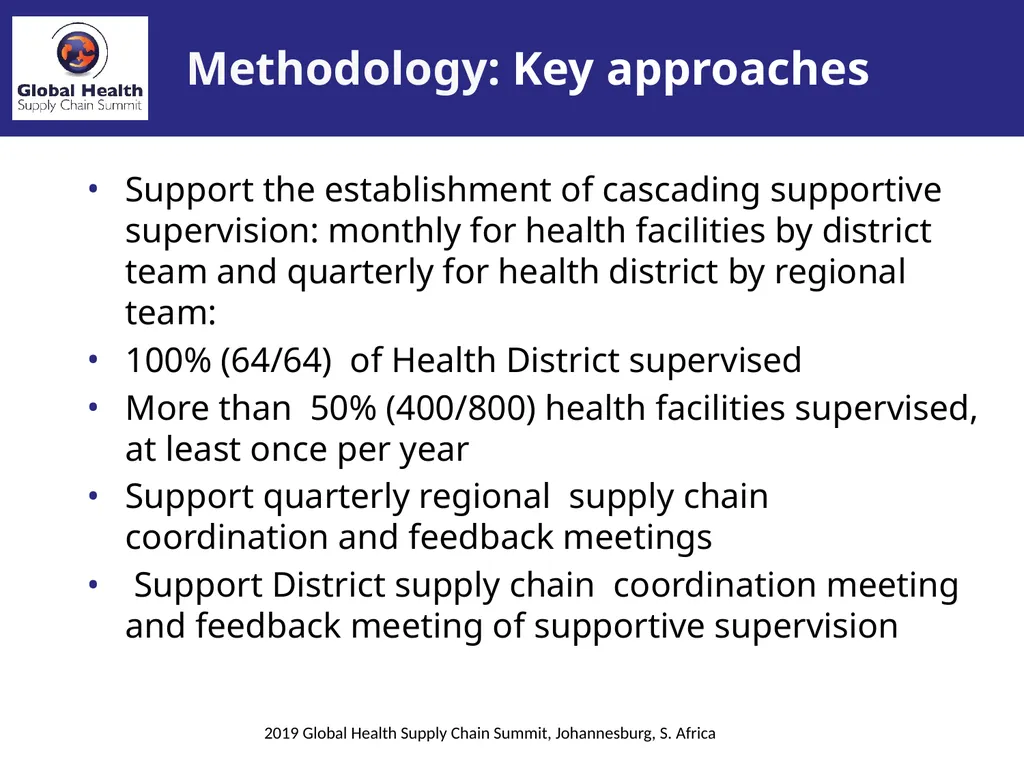
Methodology: Key approaches Support the establishment of cascading supportive supervision: monthly for health facilities by district team and quarterly for health district by regional team:
100% (64/64) of Health District supervised
More than 50% (400/800) health facilities supervised, at least once per year
Support quarterly regional supply chain coordination and feedback meetings
Support District supply chain coordination meeting and feedback meeting of supportive supervision 2019 Global Health Supply Chain Summit, Johannesburg, S. Africa<br>
15
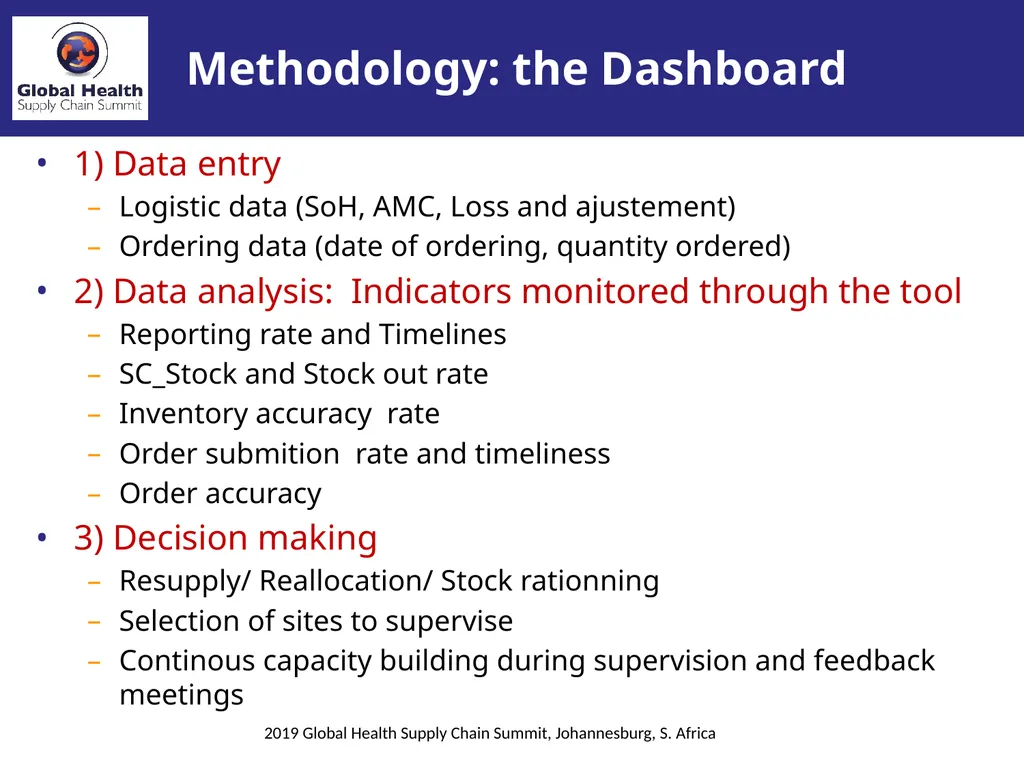
Methodology: the Dashboard 1) Data entry
Logistic data (SoH, AMC, Loss and ajustement)
Ordering data (date of ordering, quantity ordered)
2) Data analysis: Indicators monitored through the tool
Reporting rate and Timelines
SC_Stock and Stock out rate
Inventory accuracy rate
Order submition rate and timeliness
Order accuracy
3) Decision making
Resupply/ Reallocation/ Stock rationning
Selection of sites to supervise
Continous capacity building during supervision and feedback meetings 2019 Global Health Supply Chain Summit, Johannesburg, S. Africa<br>
16
Methodology: the Dashboard 2019 Global Health Supply Chain Summit, Johannesburg, S. Africa<br>
17
Methodology: the Dashboard 2019 Global Health Supply Chain Summit, Johannesburg, S. Africa<br>
18
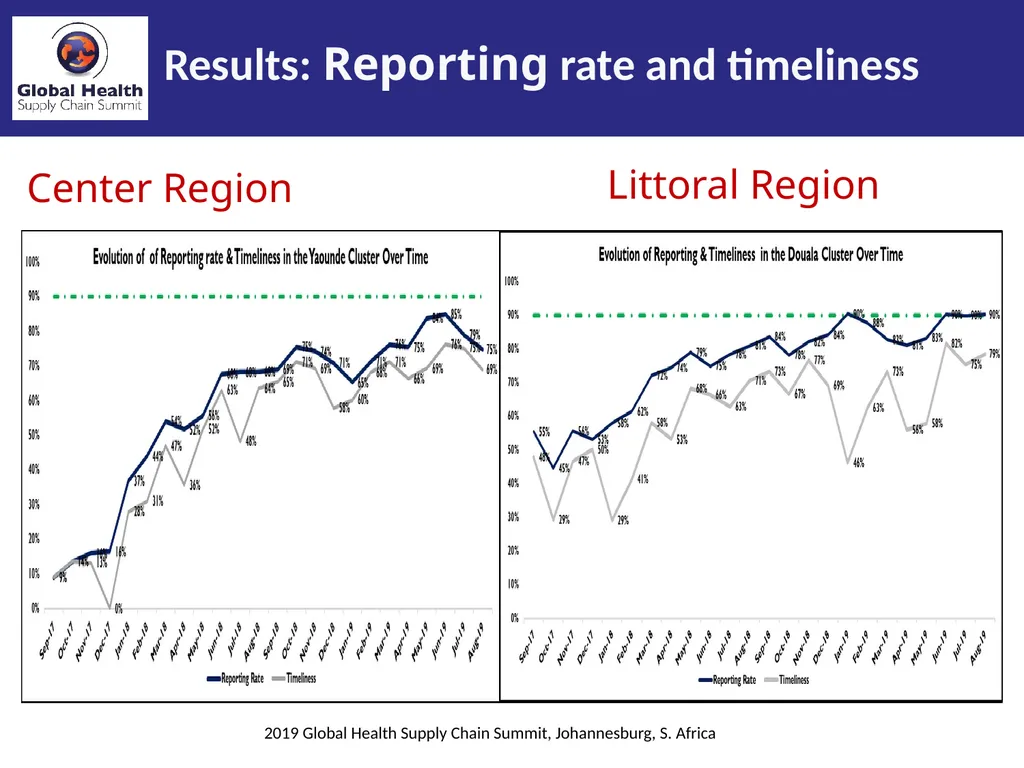
Results: Reporting rate and timeliness 2019 Global Health Supply Chain Summit, Johannesburg, S. Africa Center Region Littoral Region<br>
19
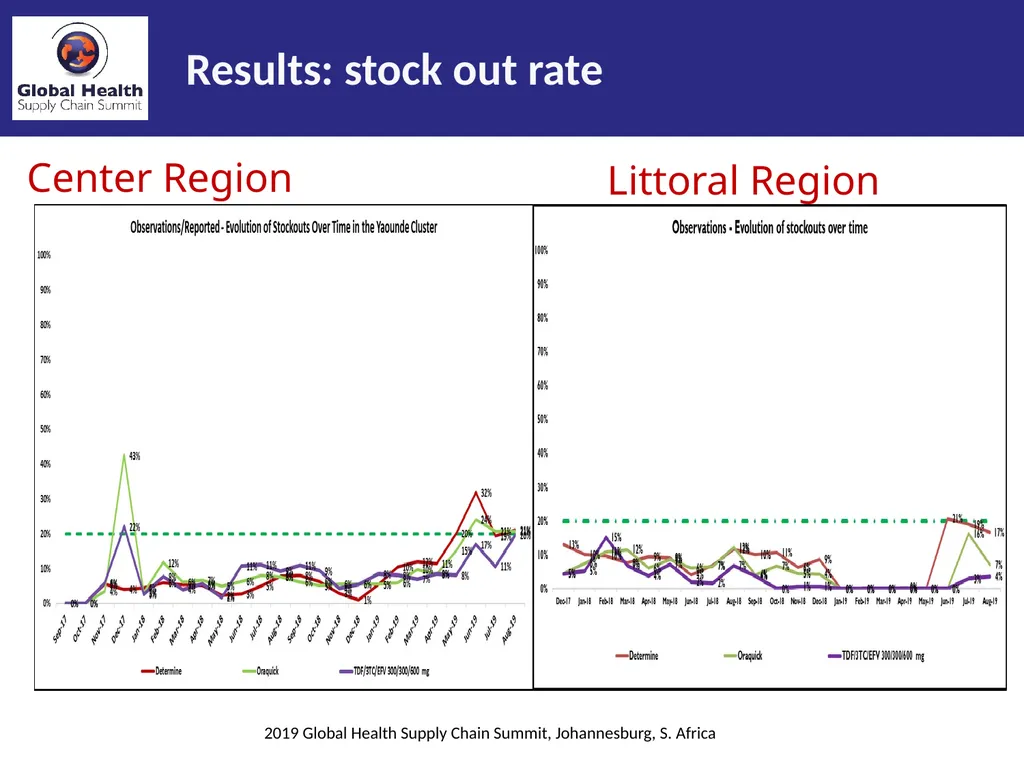
Results: stock out rate 2019 Global Health Supply Chain Summit, Johannesburg, S. Africa Center Region Littoral Region<br>
20
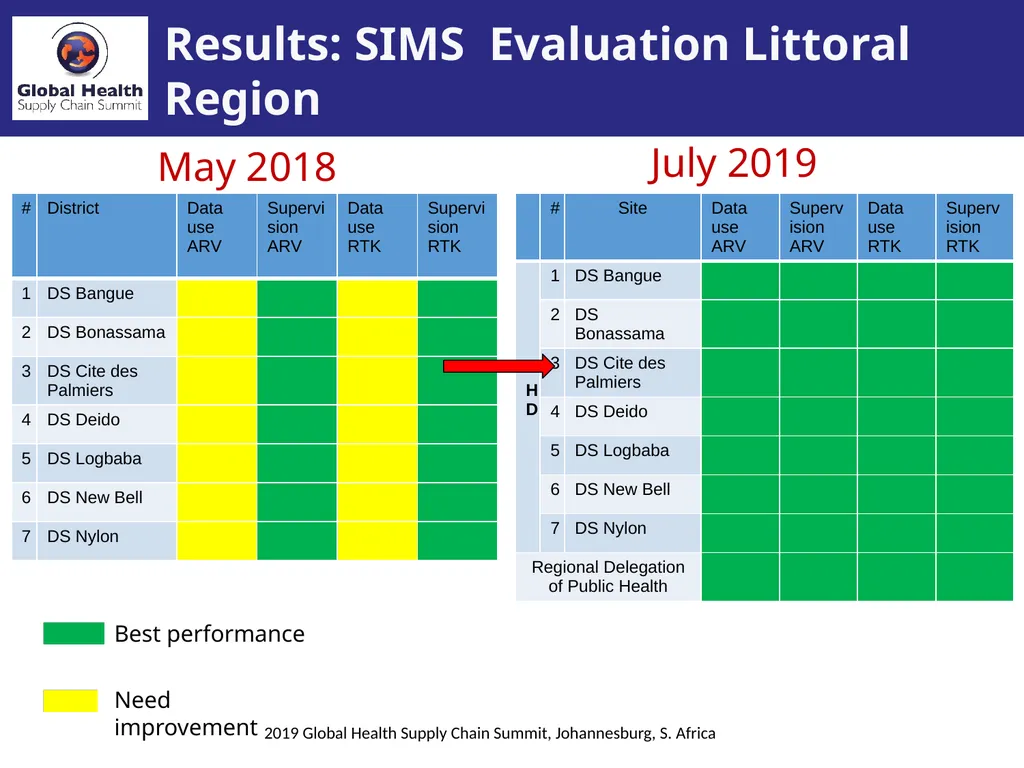
Results: SIMS Evaluation Littoral Region 2019 Global Health Supply Chain Summit, Johannesburg, S. Africa May 2018 July 2019 Best performance Need improvement<br>
21
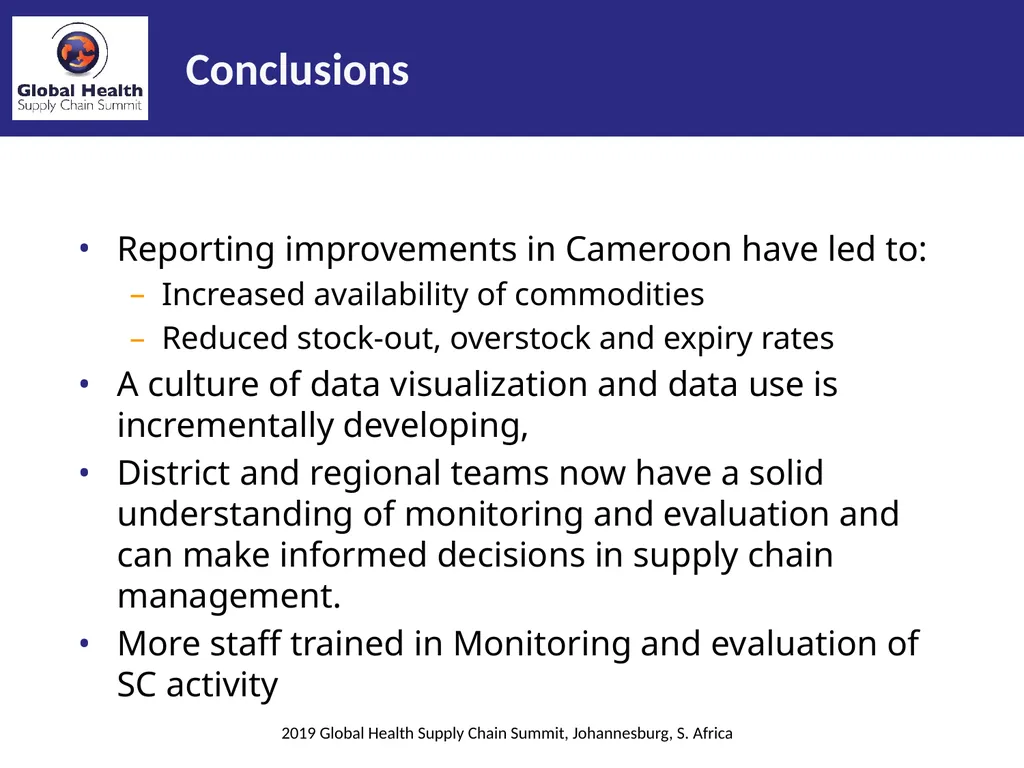
Conclusions Reporting improvements in Cameroon have led to:
Increased availability of commodities
Reduced stock-out, overstock and expiry rates
A culture of data visualization and data use is incrementally developing,
District and regional teams now have a solid understanding of monitoring and evaluation and can make informed decisions in supply chain management.
More staff trained in Monitoring and evaluation of SC activity 2019 Global Health Supply Chain Summit, Johannesburg, S. Africa<br>
22
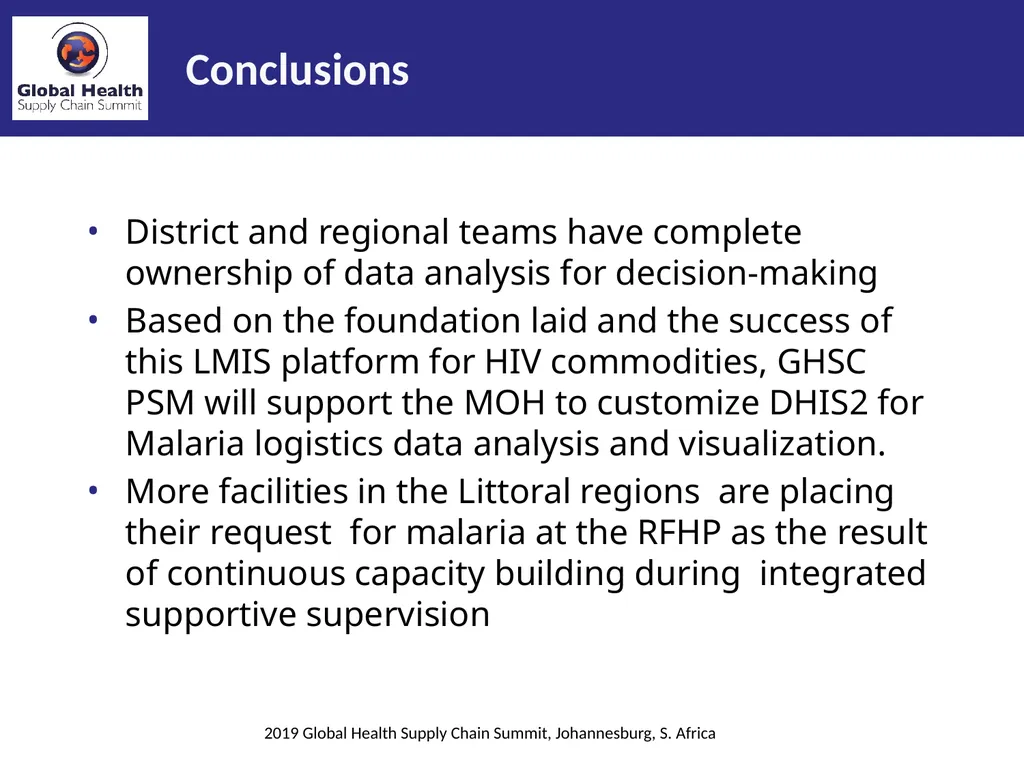
Conclusions District and regional teams have complete ownership of data analysis for decision-making
Based on the foundation laid and the success of this LMIS platform for HIV commodities, GHSC PSM will support the MOH to customize DHIS2 for Malaria logistics data analysis and visualization.
More facilities in the Littoral regions are placing their request for malaria at the RFHP as the result of continuous capacity building during integrated supportive supervision 2019 Global Health Supply Chain Summit, Johannesburg, S. Africa<br>