Nobody Gets Hurt: The Hurt Based Approach to Safety Traditional Safety Model Incidents are classified into consequence categories based on the treatment provided Benefits of Traditional Approach Supports historical benchmarking Consistent
"Nobody Gets Hurt: The Hurt Based Approach to" is the property of its rightful owner. Permission is granted to
download and print the materials on this website for personal, non-commercial use only, and to display it
on your personal computer provided you do not modify the materials and that you retain all copyright
notices contained in the materials. By downloading content from our website, you accept the terms of this
agreement.
Presentation Transcript
01
Nobody Gets Hurt: The Hurt Based Approach to Safety<br>
02
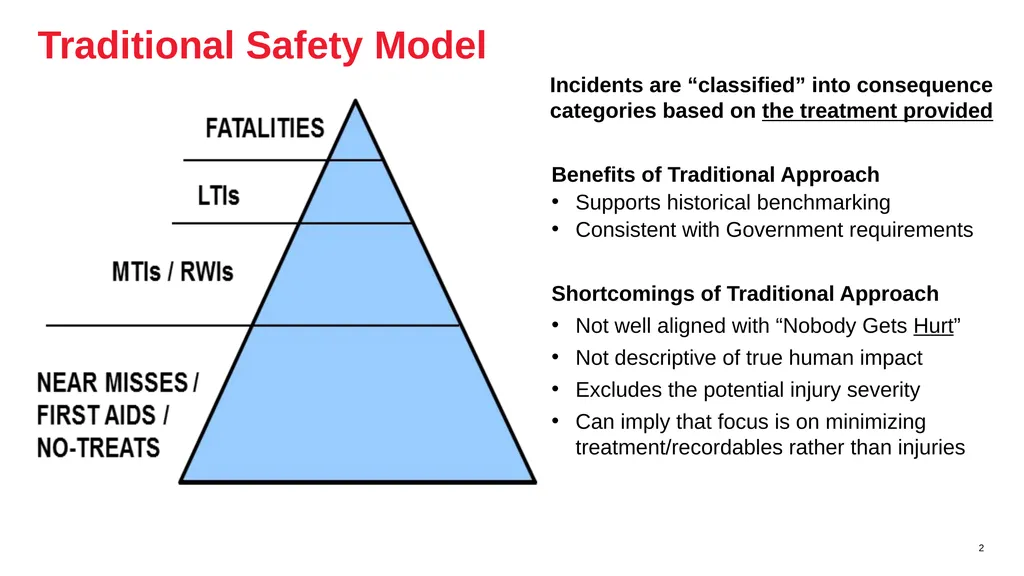
Traditional Safety Model Incidents are “classified” into consequence categories based on the treatment provided
Benefits of Traditional Approach
Supports historical benchmarking
Consistent with Government requirements
Shortcomings of Traditional Approach
Not well aligned with “Nobody Gets Hurt”
Not descriptive of true human impact
Excludes the potential injury severity
Can imply that focus is on minimizing treatment/recordables rather than injuries<br>
03
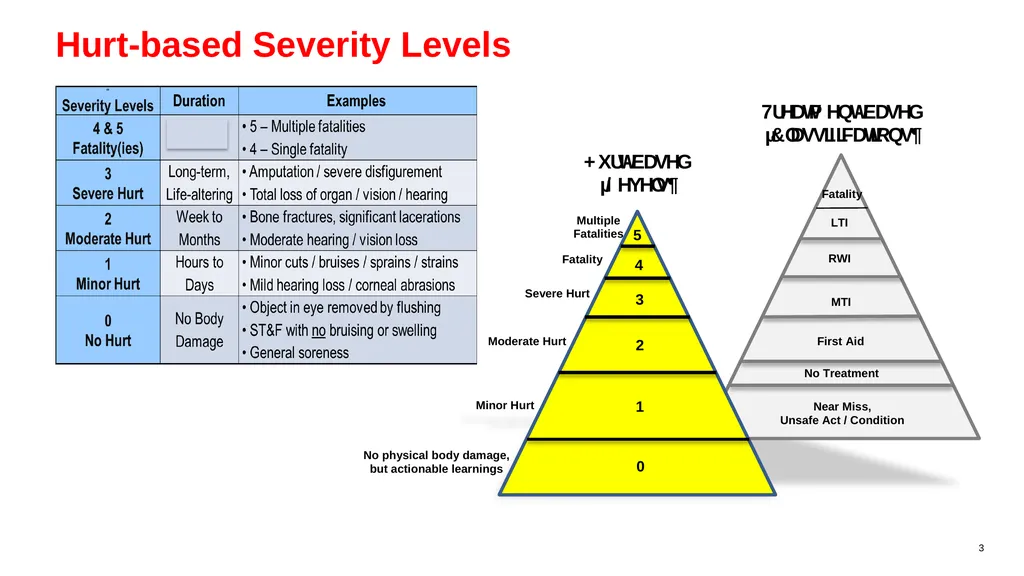
Hurt-based Severity Levels<br>
04
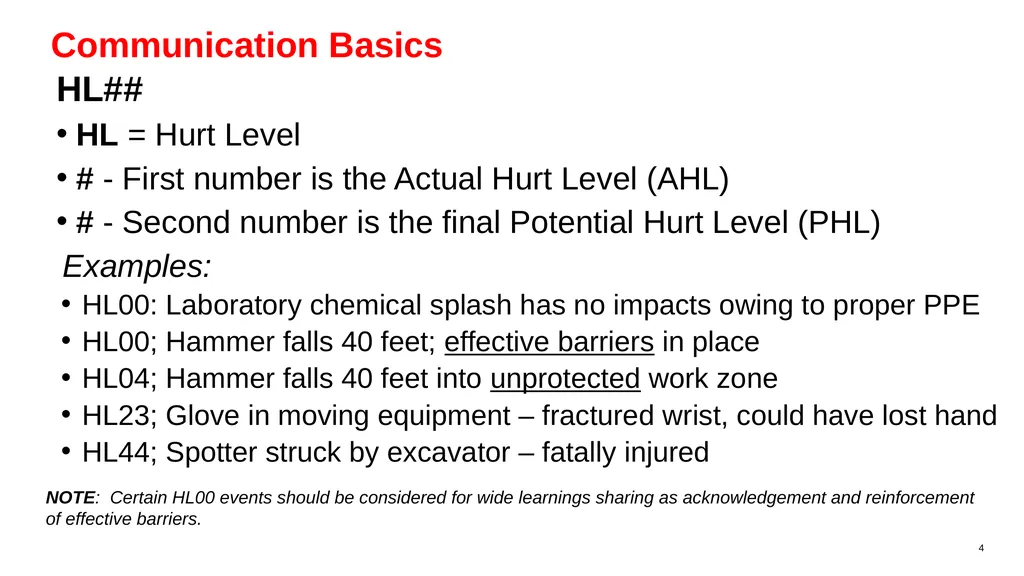
Communication Basics HL##
HL = Hurt Level
# - First number is the Actual Hurt Level (AHL)
# - Second number is the final Potential Hurt Level (PHL)
Examples:
HL00: Laboratory chemical splash has no impacts owing to proper PPE
HL00; Hammer falls 40 feet; effective barriers in place
HL04; Hammer falls 40 feet into unprotected work zone
HL23; Glove in moving equipment – fractured wrist, could have lost hand
HL44; Spotter struck by excavator – fatally injured NOTE: Certain HL00 events should be considered for wide learnings sharing as acknowledgement and reinforcement of effective barriers.<br>
05
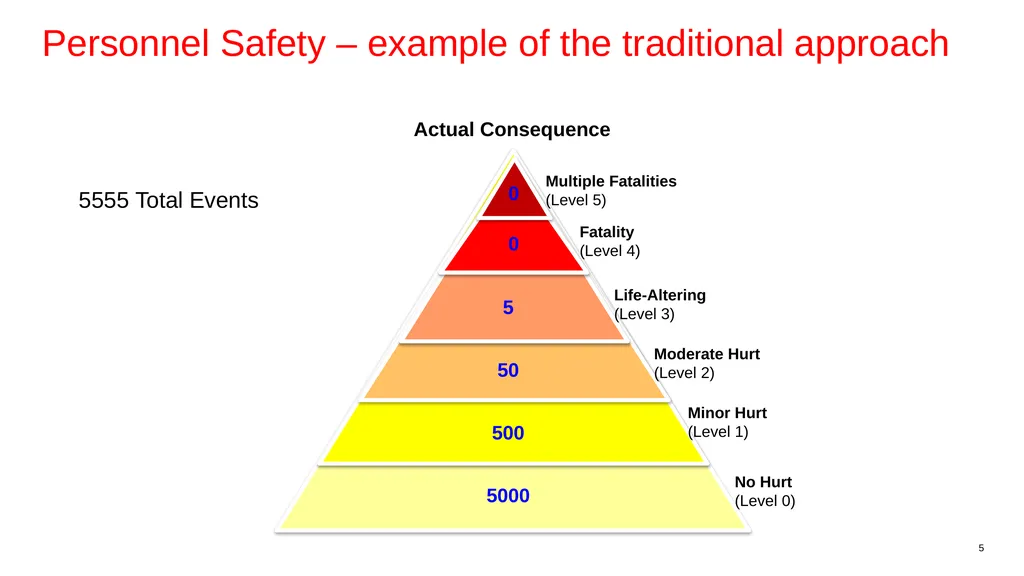
5555 Total Events Actual Consequence Personnel Safety – example of the traditional approach<br>
06
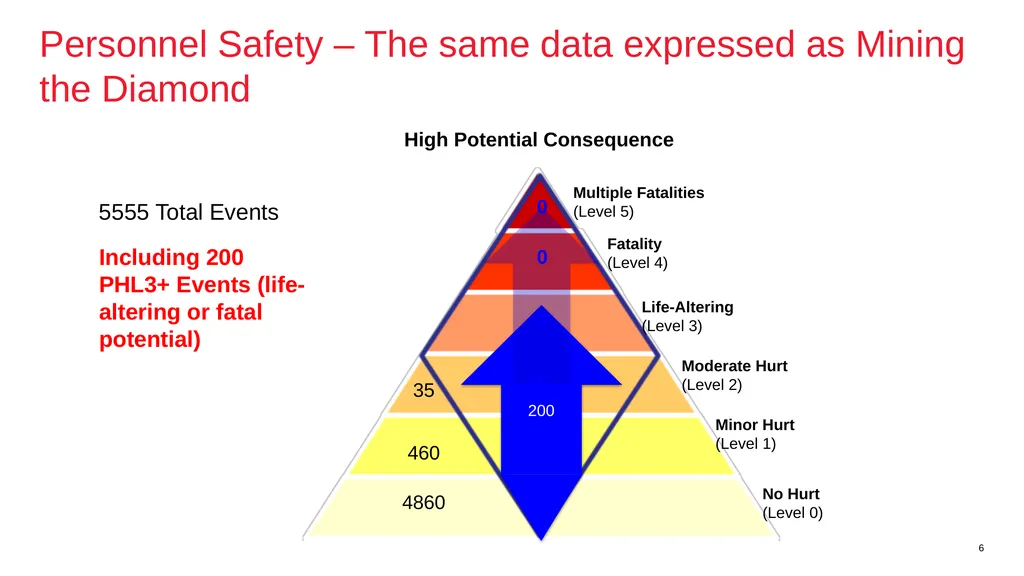
Personnel Safety – The same data expressed as Mining the Diamond 5555 Total Events Including 200 PHL3+ Events (life-altering or fatal potential) High Potential Consequence<br>
07
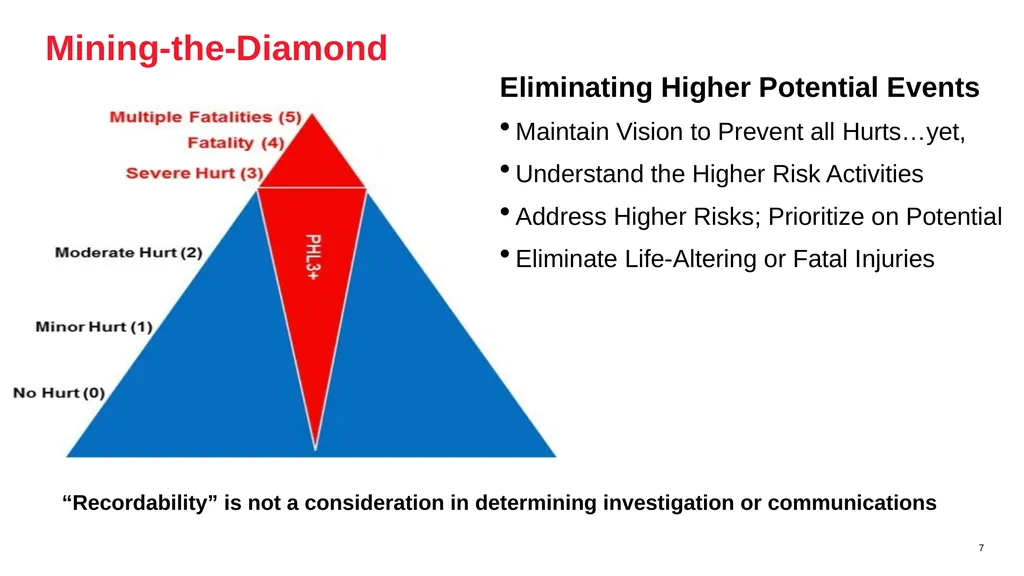
Mining-the-Diamond Eliminating Higher Potential Events
Maintain Vision to Prevent all Hurts…yet,
Understand the Higher Risk Activities
Address Higher Risks; Prioritize on Potential
Eliminate Life-Altering or Fatal Injuries “Recordability” is not a consideration in determining investigation or communications<br>
08
Assessment Scenarios<br>
09
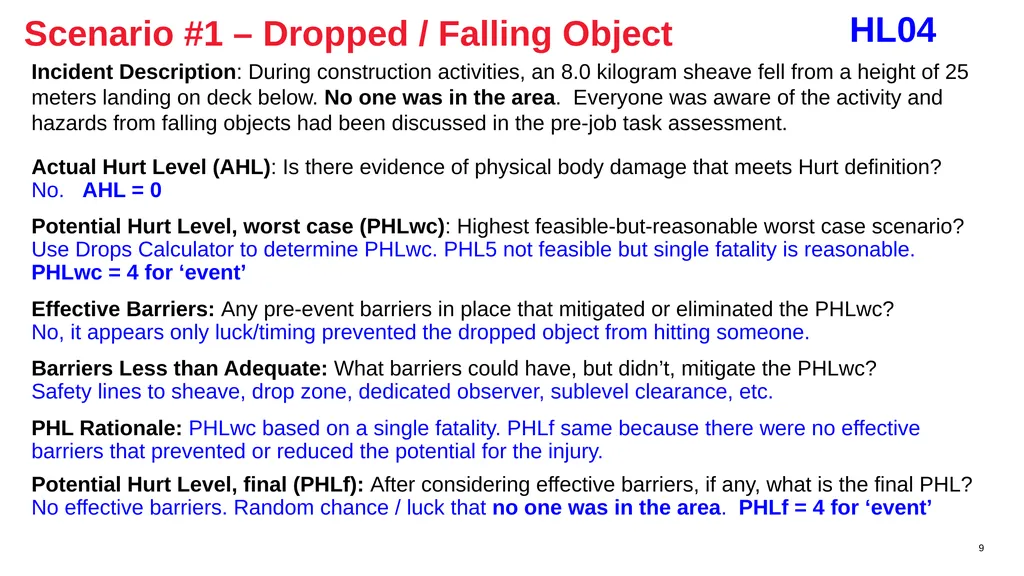
Scenario #1 – Dropped / Falling Object Incident Description: During construction activities, an 8.0 kilogram sheave fell from a height of 25 meters landing on deck below. No one was in the area. Everyone was aware of the activity and hazards from falling objects had been discussed in the pre-job task assessment.
Actual Hurt Level (AHL): Is there evidence of physical body damage that meets Hurt definition?
No. AHL = 0
Potential Hurt Level, worst case (PHLwc): Highest feasible-but-reasonable worst case scenario?
Use Drops Calculator to determine PHLwc. PHL5 not feasible but single fatality is reasonable.
PHLwc = 4 for ‘event’
Effective Barriers: Any pre-event barriers in place that mitigated or eliminated the PHLwc?
No, it appears only luck/timing prevented the dropped object from hitting someone.
Barriers Less than Adequate: What barriers could have, but didn’t, mitigate the PHLwc?
Safety lines to sheave, drop zone, dedicated observer, sublevel clearance, etc.
PHL Rationale: PHLwc based on a single fatality. PHLf same because there were no effective barriers that prevented or reduced the potential for the injury.
Potential Hurt Level, final (PHLf): After considering effective barriers, if any, what is the final PHL?
No effective barriers. Random chance / luck that no one was in the area. PHLf = 4 for ‘event’ HL04<br>
10
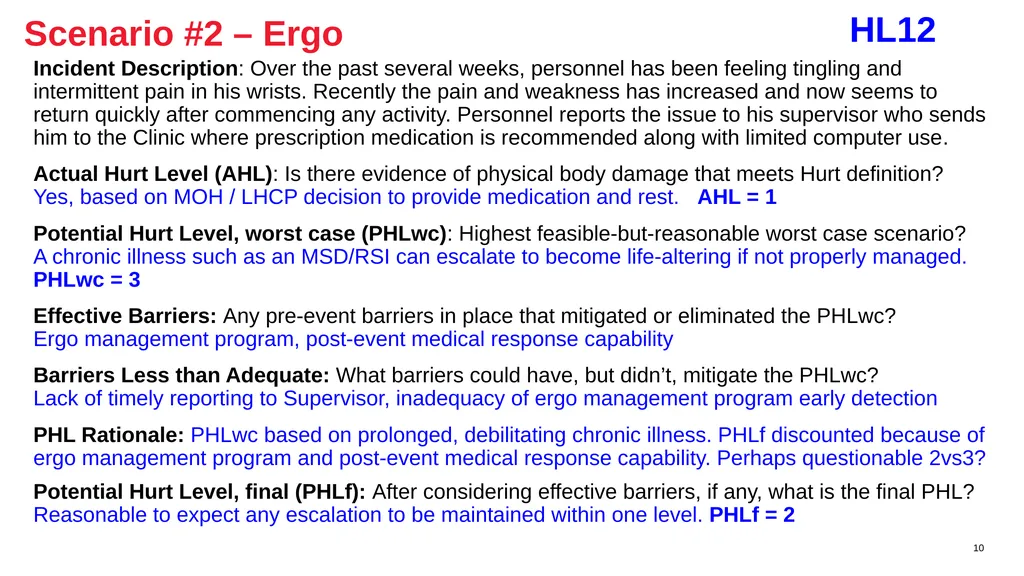
Incident Description: Over the past several weeks, personnel has been feeling tingling and intermittent pain in his wrists. Recently the pain and weakness has increased and now seems to return quickly after commencing any activity. Personnel reports the issue to his supervisor who sends him to the Clinic where prescription medication is recommended along with limited computer use.
Actual Hurt Level (AHL): Is there evidence of physical body damage that meets Hurt definition?
Yes, based on MOH / LHCP decision to provide medication and rest. AHL = 1
Potential Hurt Level, worst case (PHLwc): Highest feasible-but-reasonable worst case scenario?
A chronic illness such as an MSD/RSI can escalate to become life-altering if not properly managed.
PHLwc = 3
Effective Barriers: Any pre-event barriers in place that mitigated or eliminated the PHLwc?
Ergo management program, post-event medical response capability
Barriers Less than Adequate: What barriers could have, but didn’t, mitigate the PHLwc?
Lack of timely reporting to Supervisor, inadequacy of ergo management program early detection
PHL Rationale: PHLwc based on prolonged, debilitating chronic illness. PHLf discounted because of ergo management program and post-event medical response capability. Perhaps questionable 2vs3?
Potential Hurt Level, final (PHLf): After considering effective barriers, if any, what is the final PHL?
Reasonable to expect any escalation to be maintained within one level. PHLf = 2 Scenario #2 – Ergo HL12<br>