
NON AQUEOUS SOLVENTS Dr. PRINCY K.G. ASSOCIATE
MJ
Published · 29 slides · 0 views

1 / 1



Description
NON AQUEOUS SOLVENTS Dr. PRINCY K.G. ASSOCIATE PROFESSOR DEPARTMENT OF CHEMISTRY CARMEL COLLEGE, MALA INTRODUCTION :- An inorganic nonaqueous solvent is a solvent other than water, that is not an organic compound. examples are liquid
Related Topics
Share
Embed code
Download this presentation From Below
"NON AQUEOUS SOLVENTS Dr. PRINCY K.G. ASSOCIATE" is the property of its rightful owner. Permission is granted to download and print the materials on this website for personal, non-commercial use only, and to display it on your personal computer provided you do not modify the materials and that you retain all copyright notices contained in the materials. By downloading content from our website, you accept the terms of this agreement.
Presentation Transcript
01
NON AQUEOUS SOLVENTS Dr. PRINCY K.G.
ASSOCIATE PROFESSOR
DEPARTMENT OF CHEMISTRY
CARMEL COLLEGE, MALA<br>
ASSOCIATE PROFESSOR
DEPARTMENT OF CHEMISTRY
CARMEL COLLEGE, MALA<br>
02
INTRODUCTION :- An inorganic nonaqueous solvent is a solvent other than water, that is not an organic compound. examples are liquid ammonia, liquid sulfur dioxide, sulfuryl chloride and sulfurychloride fluridef, phosphoryl chloride, dinitrogen tetroxide, antimony trichloride, bromine pentafluoride, hydrogen fluoride, pure sulfuric acid and other inorganic acids. These solvents are used in chemical research and industry for reactions.<br>
03
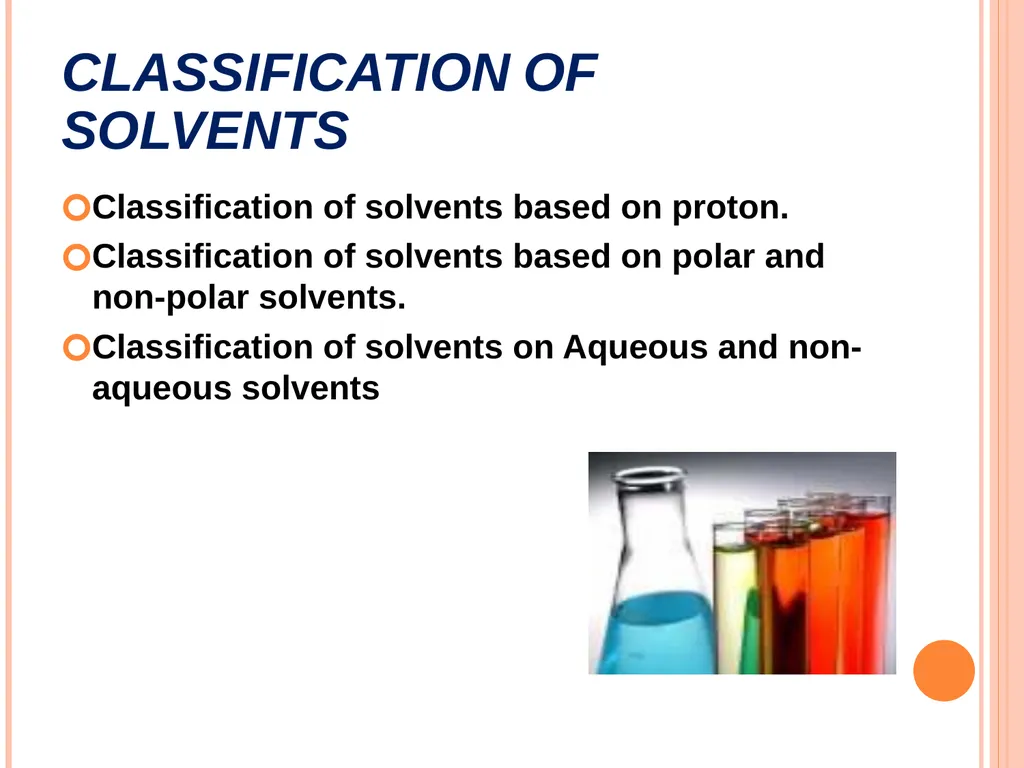
CLASSIFICATION OF SOLVENTS Classification of solvents based on proton.
Classification of solvents based on polar and non-polar solvents.
Classification of solvents on Aqueous and non- aqueous solvents<br>
Classification of solvents based on polar and non-polar solvents.
Classification of solvents on Aqueous and non- aqueous solvents<br>
04
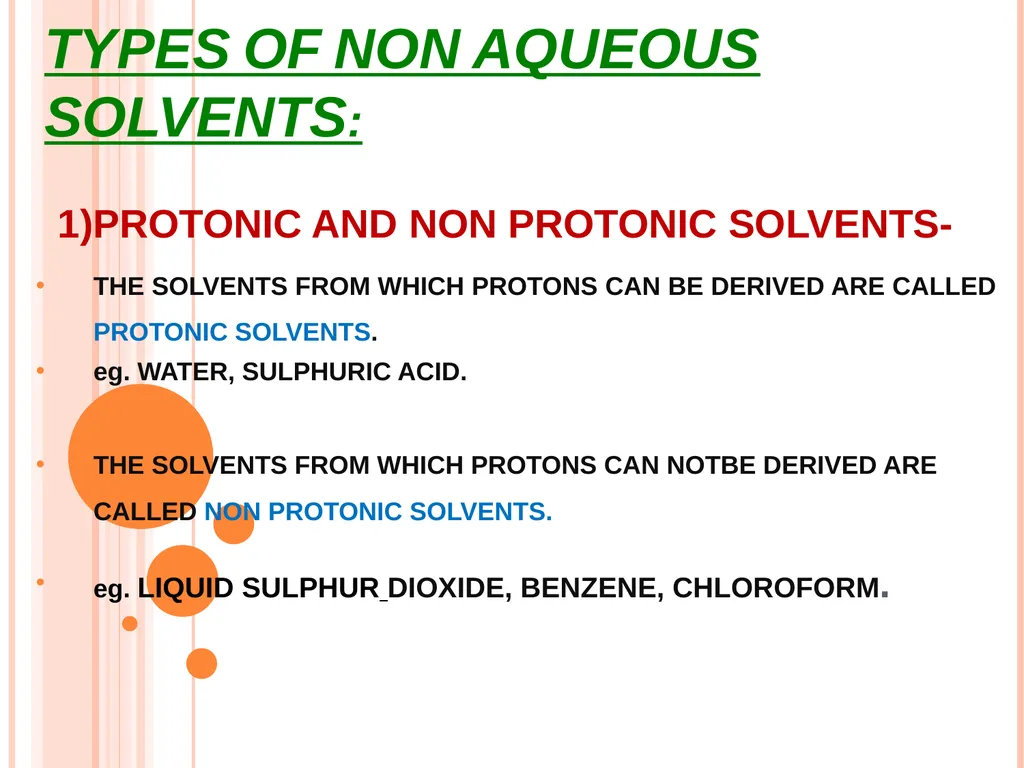
TYPES OF NON AQUEOUS SOLVENTS: 1)PROTONIC AND NON PROTONIC SOLVENTS-
THE SOLVENTS FROM WHICH PROTONS CAN BE DERIVED ARE CALLED PROTONIC SOLVENTS.
eg. WATER, SULPHURIC ACID.
THE SOLVENTS FROM WHICH PROTONS CAN NOTBE DERIVED ARE CALLED NON PROTONIC SOLVENTS.
eg. LIQUID SULPHUR DIOXIDE, BENZENE, CHLOROFORM.<br>
THE SOLVENTS FROM WHICH PROTONS CAN BE DERIVED ARE CALLED PROTONIC SOLVENTS.
eg. WATER, SULPHURIC ACID.
THE SOLVENTS FROM WHICH PROTONS CAN NOTBE DERIVED ARE CALLED NON PROTONIC SOLVENTS.
eg. LIQUID SULPHUR DIOXIDE, BENZENE, CHLOROFORM.<br>
05
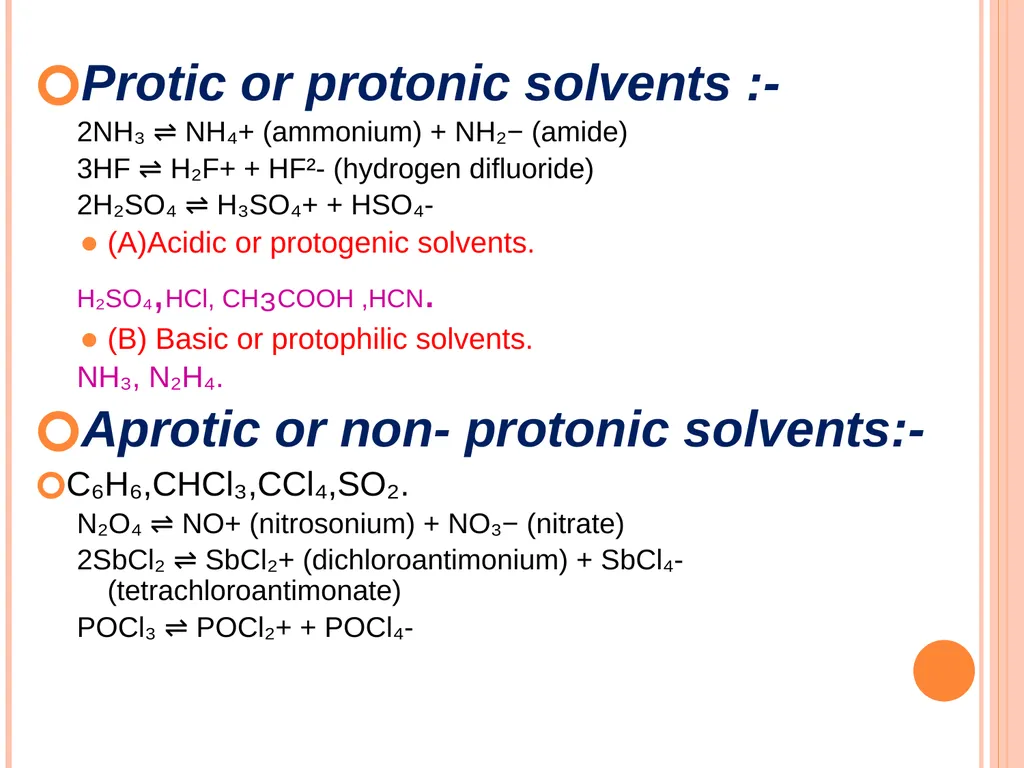
Protic or protonic solvents :-
2NH₃ ⇌ NH₄+ (ammonium) + NH₂− (amide)
3HF ⇌ H₂F+ + HF²- (hydrogen difluoride)
2H₂SO₄ ⇌ H₃SO₄+ + HSO₄-
(A)Acidic or protogenic solvents.
H₂SO₄,HCl, CH₃COOH ,HCN.
(B) Basic or protophilic solvents.
NH₃, N₂H₄.
Aprotic or non- protonic solvents:-
C₆H₆,CHCl₃,CCl₄,SO₂.
N₂O₄ ⇌ NO+ (nitrosonium) + NO₃− (nitrate)
2SbCl₂ ⇌ SbCl₂+ (dichloroantimonium) + SbCl₄- (tetrachloroantimonate)
POCl₃ ⇌ POCl₂+ + POCl₄-<br>
2NH₃ ⇌ NH₄+ (ammonium) + NH₂− (amide)
3HF ⇌ H₂F+ + HF²- (hydrogen difluoride)
2H₂SO₄ ⇌ H₃SO₄+ + HSO₄-
(A)Acidic or protogenic solvents.
H₂SO₄,HCl, CH₃COOH ,HCN.
(B) Basic or protophilic solvents.
NH₃, N₂H₄.
Aprotic or non- protonic solvents:-
C₆H₆,CHCl₃,CCl₄,SO₂.
N₂O₄ ⇌ NO+ (nitrosonium) + NO₃− (nitrate)
2SbCl₂ ⇌ SbCl₂+ (dichloroantimonium) + SbCl₄- (tetrachloroantimonate)
POCl₃ ⇌ POCl₂+ + POCl₄-<br>
06
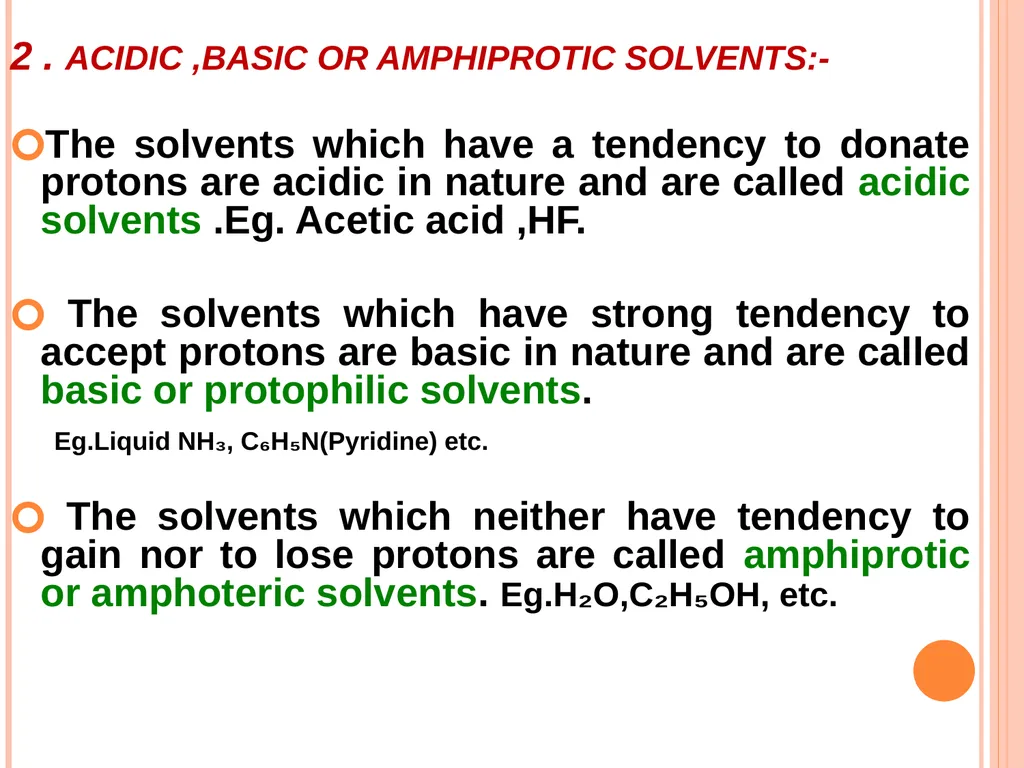
2 . ACIDIC ,BASIC OR AMPHIPROTIC SOLVENTS:-
The solvents which have a tendency to donate protons are acidic in nature and are called acidic solvents .Eg. Acetic acid ,HF.
The solvents which have strong tendency to accept protons are basic in nature and are called basic or protophilic solvents.
Eg.Liquid NH₃, C₆H₅N(Pyridine) etc.
The solvents which neither have tendency to gain nor to lose protons are called amphiprotic or amphoteric solvents. Eg.H₂O,C₂H₅OH, etc.<br>
The solvents which have a tendency to donate protons are acidic in nature and are called acidic solvents .Eg. Acetic acid ,HF.
The solvents which have strong tendency to accept protons are basic in nature and are called basic or protophilic solvents.
Eg.Liquid NH₃, C₆H₅N(Pyridine) etc.
The solvents which neither have tendency to gain nor to lose protons are called amphiprotic or amphoteric solvents. Eg.H₂O,C₂H₅OH, etc.<br>
07
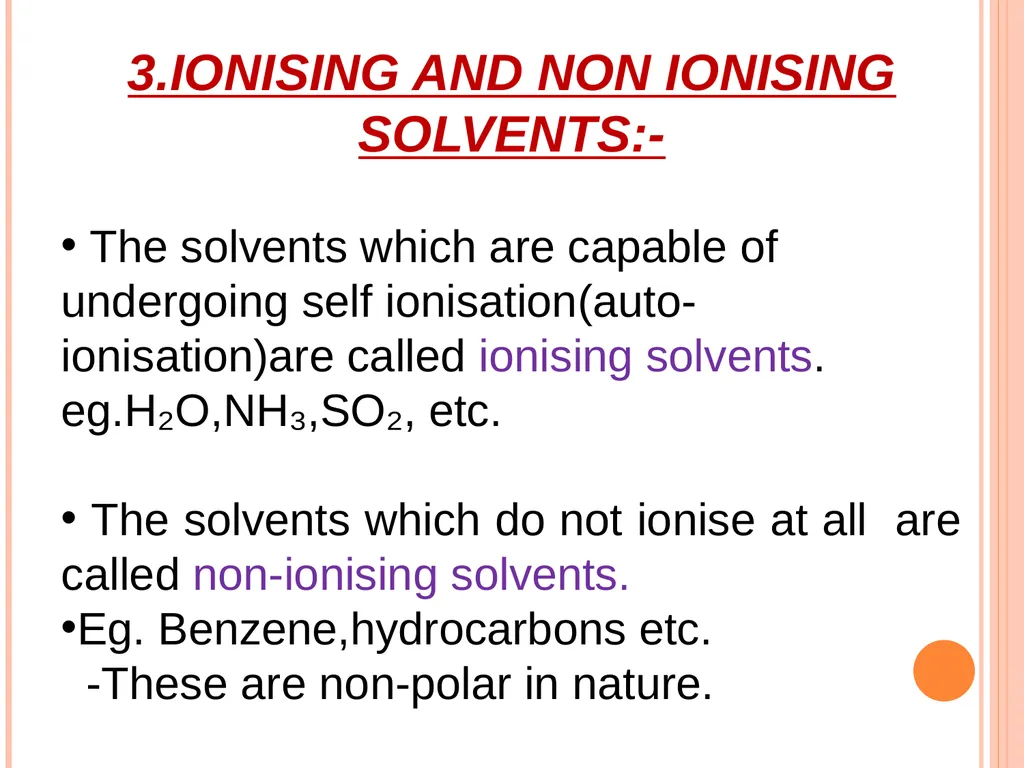
3.IONISING AND NON IONISING SOLVENTS:-
The solvents which are capable of undergoing self ionisation(auto-ionisation)are called ionising solvents. eg.H₂O,NH₃,SO₂, etc.
The solvents which do not ionise at all are called non-ionising solvents.
Eg. Benzene,hydrocarbons etc.
-These are non-polar in nature.<br>
The solvents which are capable of undergoing self ionisation(auto-ionisation)are called ionising solvents. eg.H₂O,NH₃,SO₂, etc.
The solvents which do not ionise at all are called non-ionising solvents.
Eg. Benzene,hydrocarbons etc.
-These are non-polar in nature.<br>
08
4.CO-ORDINATING AND NON CO-ORDINATING SOLVENTS :- The solvents which are capable of coordinating with the metal ions or anions of the solute are called co-ordinating solvents. eg. NH₃, SO₂ ,DMSO, DMF etc.
On the other hand, the solvents which are not capable of co-ordinating with the metal ions are called non co-ordinating solvents.
eg.CCl₄, Saturated hydrocarbons etc.<br>
On the other hand, the solvents which are not capable of co-ordinating with the metal ions are called non co-ordinating solvents.
eg.CCl₄, Saturated hydrocarbons etc.<br>
09
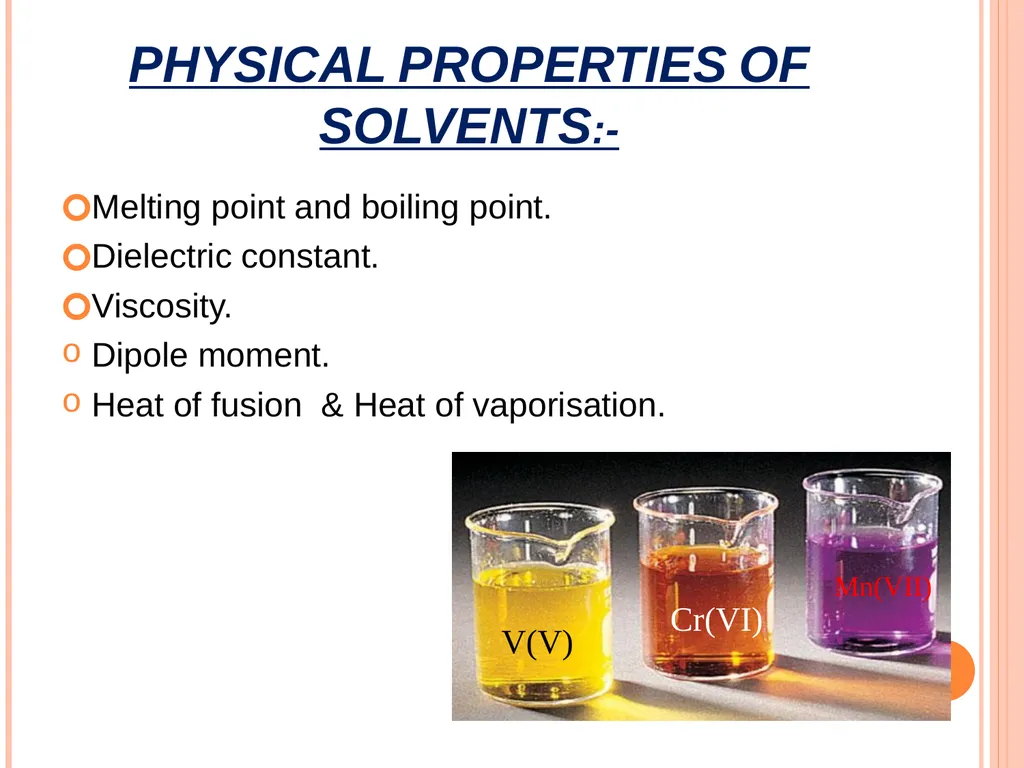
PHYSICAL PROPERTIES OF SOLVENTS:- Melting point and boiling point.
Dielectric constant.
Viscosity.
Dipole moment.
Heat of fusion & Heat of vaporisation.<br>
Dielectric constant.
Viscosity.
Dipole moment.
Heat of fusion & Heat of vaporisation.<br>
10
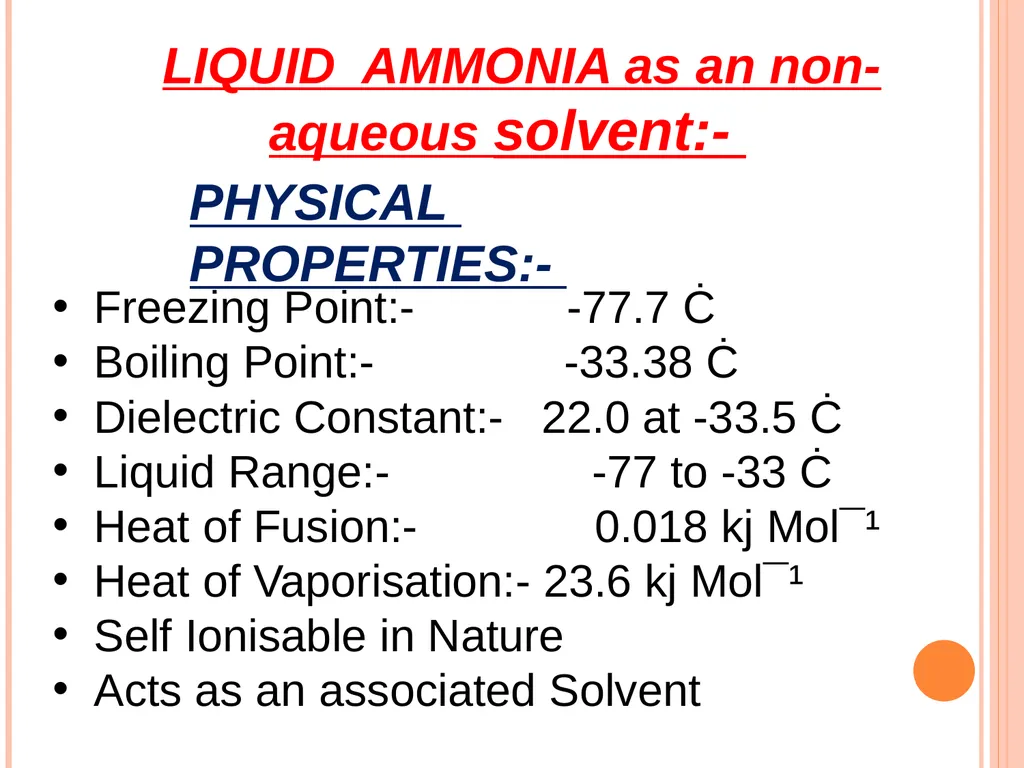
LIQUID AMMONIA as an non-aqueous solvent:-
Freezing Point:- -77.7 Ċ
Boiling Point:- -33.38 Ċ
Dielectric Constant:- 22.0 at -33.5 Ċ
Liquid Range:- -77 to -33 Ċ
Heat of Fusion:- 0.018 kj Mol¯¹
Heat of Vaporisation:- 23.6 kj Mol¯¹
Self Ionisable in Nature
Acts as an associated Solvent PHYSICAL PROPERTIES:-<br>
Freezing Point:- -77.7 Ċ
Boiling Point:- -33.38 Ċ
Dielectric Constant:- 22.0 at -33.5 Ċ
Liquid Range:- -77 to -33 Ċ
Heat of Fusion:- 0.018 kj Mol¯¹
Heat of Vaporisation:- 23.6 kj Mol¯¹
Self Ionisable in Nature
Acts as an associated Solvent PHYSICAL PROPERTIES:-<br>
11
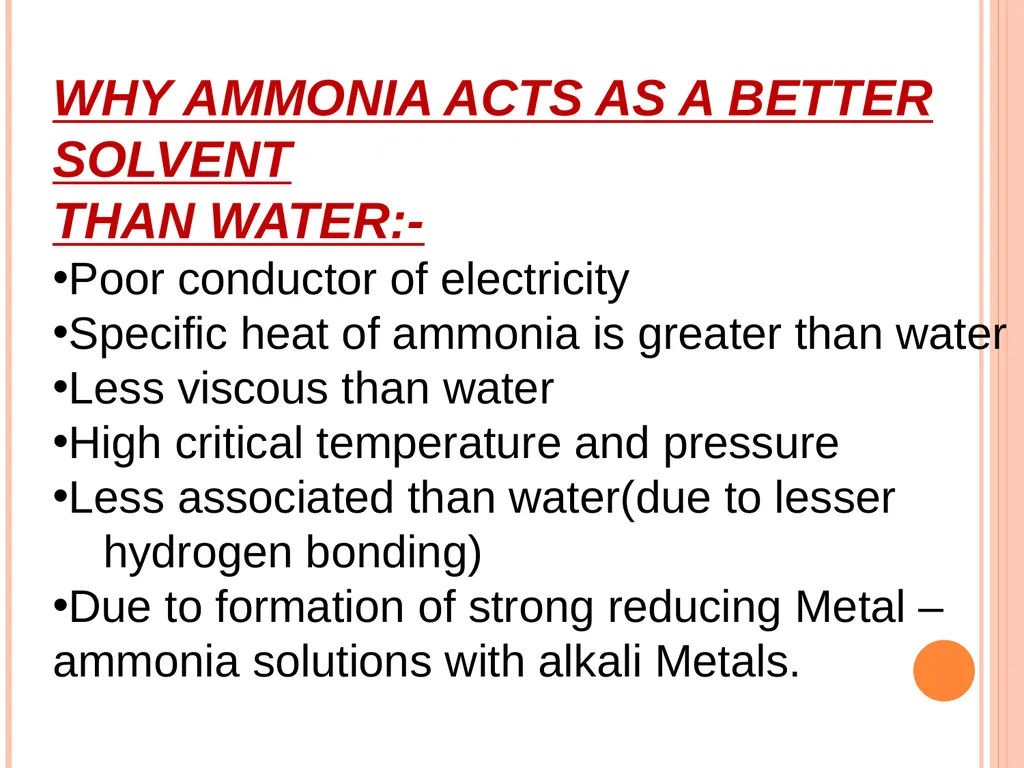
WHY AMMONIA ACTS AS A BETTER SOLVENT
THAN WATER:-
Poor conductor of electricity
Specific heat of ammonia is greater than water
Less viscous than water
High critical temperature and pressure
Less associated than water(due to lesser
hydrogen bonding)
Due to formation of strong reducing Metal –ammonia solutions with alkali Metals.<br>
THAN WATER:-
Poor conductor of electricity
Specific heat of ammonia is greater than water
Less viscous than water
High critical temperature and pressure
Less associated than water(due to lesser
hydrogen bonding)
Due to formation of strong reducing Metal –ammonia solutions with alkali Metals.<br>
12
CHEMICAL REACTION Acid base reaction.
Precipitation reaction.
Redox reaction.
Solvation reaction.<br>
Precipitation reaction.
Redox reaction.
Solvation reaction.<br>
13
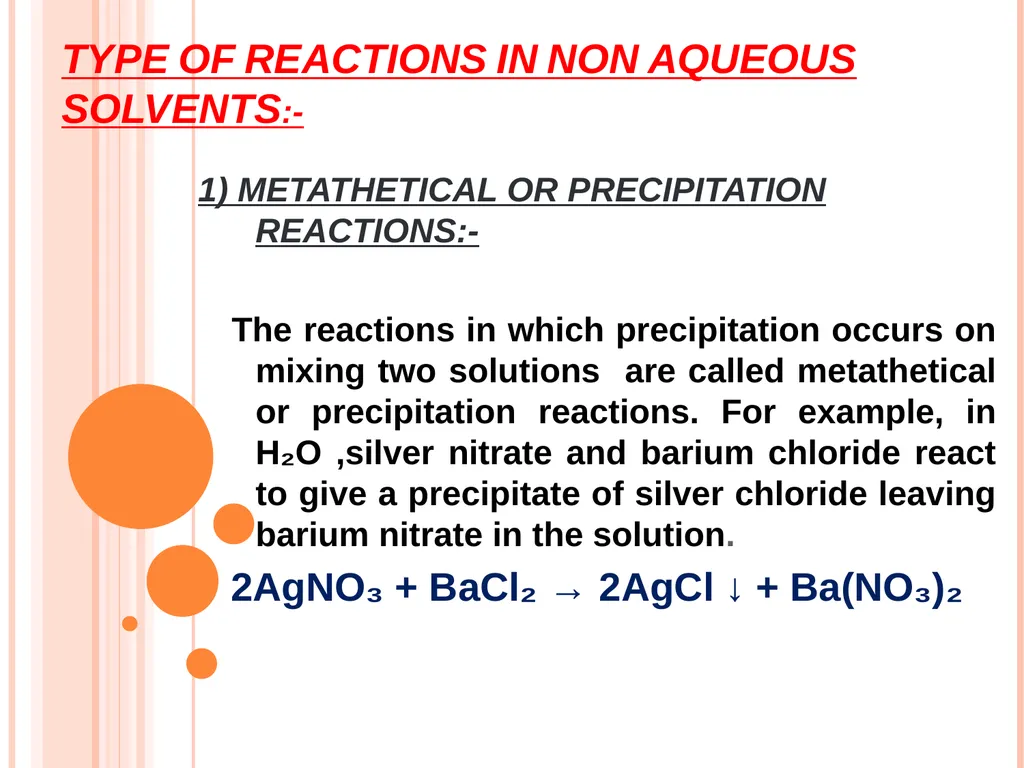
TYPE OF REACTIONS IN NON AQUEOUS SOLVENTS:- 1) METATHETICAL OR PRECIPITATION REACTIONS:-
The reactions in which precipitation occurs on mixing two solutions are called metathetical or precipitation reactions. For example, in H₂O ,silver nitrate and barium chloride react to give a precipitate of silver chloride leaving barium nitrate in the solution.
2AgNO₃ + BaCl₂ → 2AgCl ↓ + Ba(NO₃)₂<br>
The reactions in which precipitation occurs on mixing two solutions are called metathetical or precipitation reactions. For example, in H₂O ,silver nitrate and barium chloride react to give a precipitate of silver chloride leaving barium nitrate in the solution.
2AgNO₃ + BaCl₂ → 2AgCl ↓ + Ba(NO₃)₂<br>
14
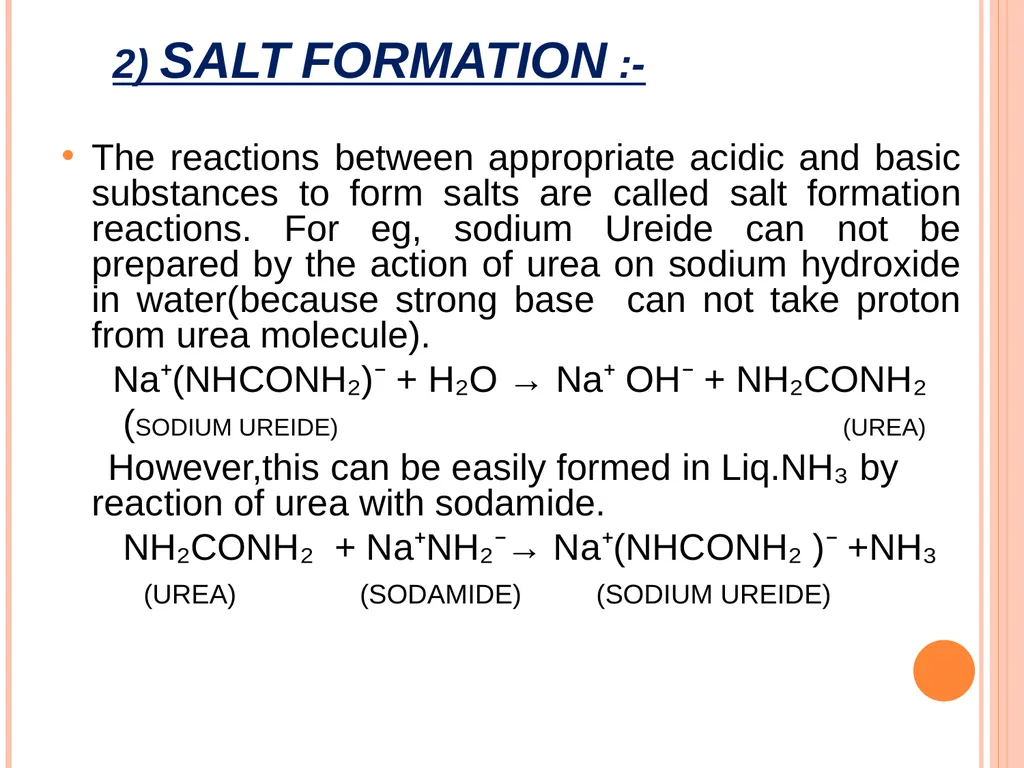
2) SALT FORMATION :- The reactions between appropriate acidic and basic substances to form salts are called salt formation reactions. For eg, sodium Ureide can not be prepared by the action of urea on sodium hydroxide in water(because strong base can not take proton from urea molecule).
Na⁺(NHCONH₂)⁻ + H₂O → Na⁺ OH⁻ + NH₂CONH₂
(SODIUM UREIDE) (UREA)
However,this can be easily formed in Liq.NH₃ by reaction of urea with sodamide.
NH₂CONH₂ + Na⁺NH₂⁻→ Na⁺(NHCONH₂ )⁻ +NH₃
(UREA) (SODAMIDE) (SODIUM UREIDE)<br>
Na⁺(NHCONH₂)⁻ + H₂O → Na⁺ OH⁻ + NH₂CONH₂
(SODIUM UREIDE) (UREA)
However,this can be easily formed in Liq.NH₃ by reaction of urea with sodamide.
NH₂CONH₂ + Na⁺NH₂⁻→ Na⁺(NHCONH₂ )⁻ +NH₃
(UREA) (SODAMIDE) (SODIUM UREIDE)<br>
15
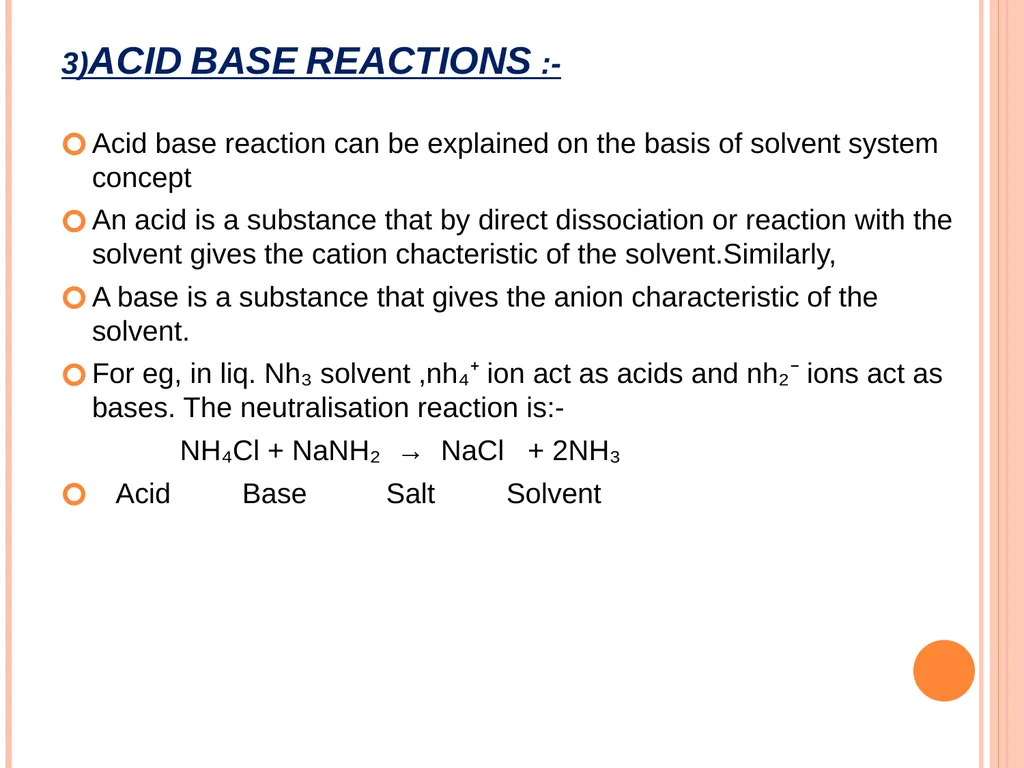
3)ACID BASE REACTIONS :- Acid base reaction can be explained on the basis of solvent system concept
An acid is a substance that by direct dissociation or reaction with the solvent gives the cation chacteristic of the solvent.Similarly,
A base is a substance that gives the anion characteristic of the solvent.
For eg, in liq. Nh₃ solvent ,nh₄⁺ ion act as acids and nh₂⁻ ions act as bases. The neutralisation reaction is:-
NH₄Cl + NaNH₂ → NaCl + 2NH₃
Acid Base Salt Solvent<br>
An acid is a substance that by direct dissociation or reaction with the solvent gives the cation chacteristic of the solvent.Similarly,
A base is a substance that gives the anion characteristic of the solvent.
For eg, in liq. Nh₃ solvent ,nh₄⁺ ion act as acids and nh₂⁻ ions act as bases. The neutralisation reaction is:-
NH₄Cl + NaNH₂ → NaCl + 2NH₃
Acid Base Salt Solvent<br>
16
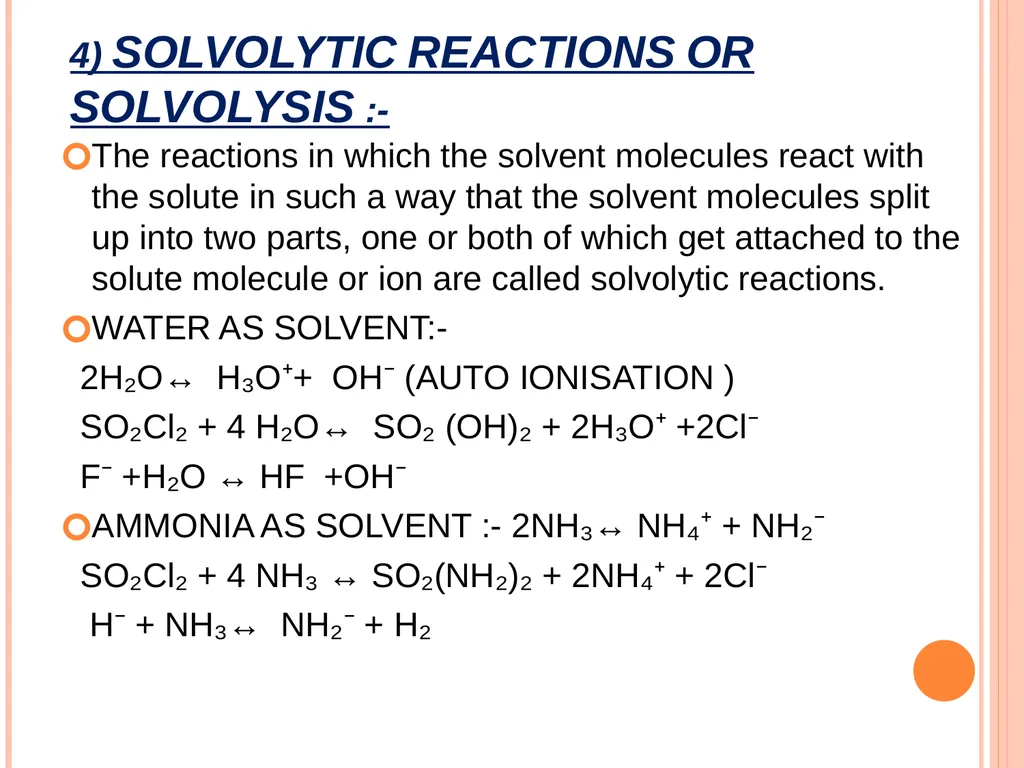
4) SOLVOLYTIC REACTIONS OR SOLVOLYSIS :- The reactions in which the solvent molecules react with the solute in such a way that the solvent molecules split up into two parts, one or both of which get attached to the solute molecule or ion are called solvolytic reactions.
WATER AS SOLVENT:-
2H₂O↔ H₃O⁺+ OH⁻ (AUTO IONISATION )
SO₂Cl₂ + 4 H₂O↔ SO₂ (OH)₂ + 2H₃O⁺ +2Cl⁻
F⁻ +H₂O ↔ HF +OH⁻
AMMONIA AS SOLVENT :- 2NH₃↔ NH₄⁺ + NH₂⁻
SO₂Cl₂ + 4 NH₃ ↔ SO₂(NH₂)₂ + 2NH₄⁺ + 2Cl⁻
H⁻ + NH₃↔ NH₂⁻ + H₂<br>
WATER AS SOLVENT:-
2H₂O↔ H₃O⁺+ OH⁻ (AUTO IONISATION )
SO₂Cl₂ + 4 H₂O↔ SO₂ (OH)₂ + 2H₃O⁺ +2Cl⁻
F⁻ +H₂O ↔ HF +OH⁻
AMMONIA AS SOLVENT :- 2NH₃↔ NH₄⁺ + NH₂⁻
SO₂Cl₂ + 4 NH₃ ↔ SO₂(NH₂)₂ + 2NH₄⁺ + 2Cl⁻
H⁻ + NH₃↔ NH₂⁻ + H₂<br>
17
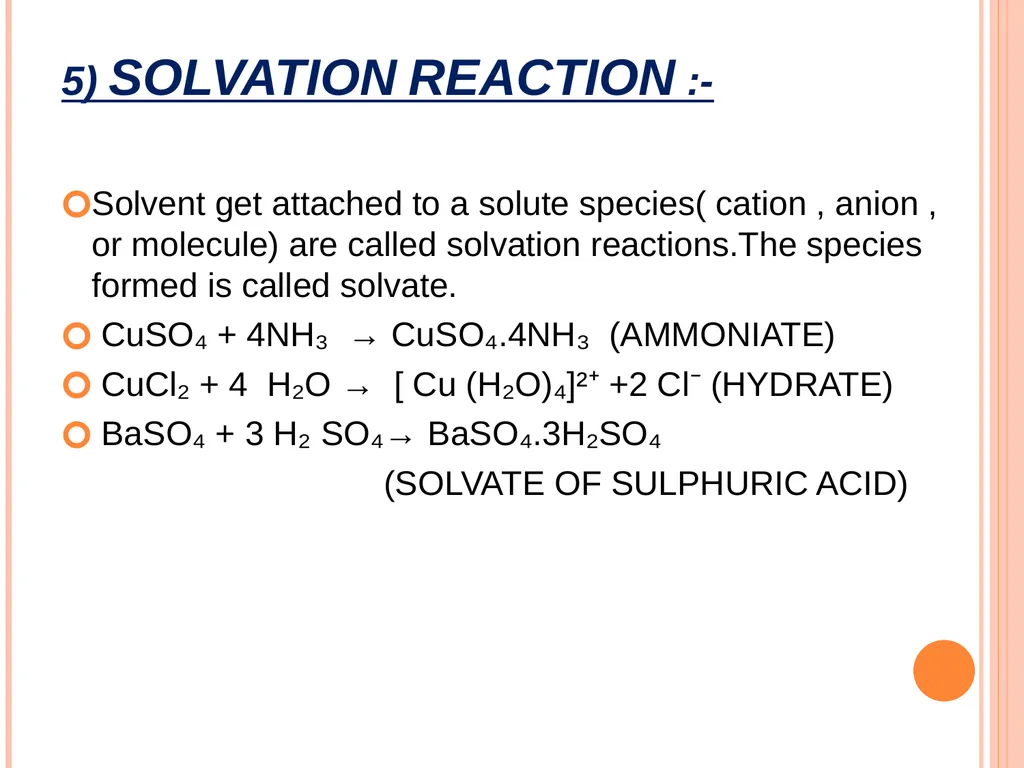
5) SOLVATION REACTION :- Solvent get attached to a solute species( cation , anion , or molecule) are called solvation reactions.The species formed is called solvate.
CuSO₄ + 4NH₃ → CuSO₄.4NH₃ (AMMONIATE)
CuCl₂ + 4 H₂O → [ Cu (H₂O)₄]²⁺ +2 Cl⁻ (HYDRATE)
BaSO₄ + 3 H₂ SO₄→ BaSO₄.3H₂SO₄
(SOLVATE OF SULPHURIC ACID)<br>
CuSO₄ + 4NH₃ → CuSO₄.4NH₃ (AMMONIATE)
CuCl₂ + 4 H₂O → [ Cu (H₂O)₄]²⁺ +2 Cl⁻ (HYDRATE)
BaSO₄ + 3 H₂ SO₄→ BaSO₄.3H₂SO₄
(SOLVATE OF SULPHURIC ACID)<br>
18
REACTIONS IN LIQUID AMMONIA
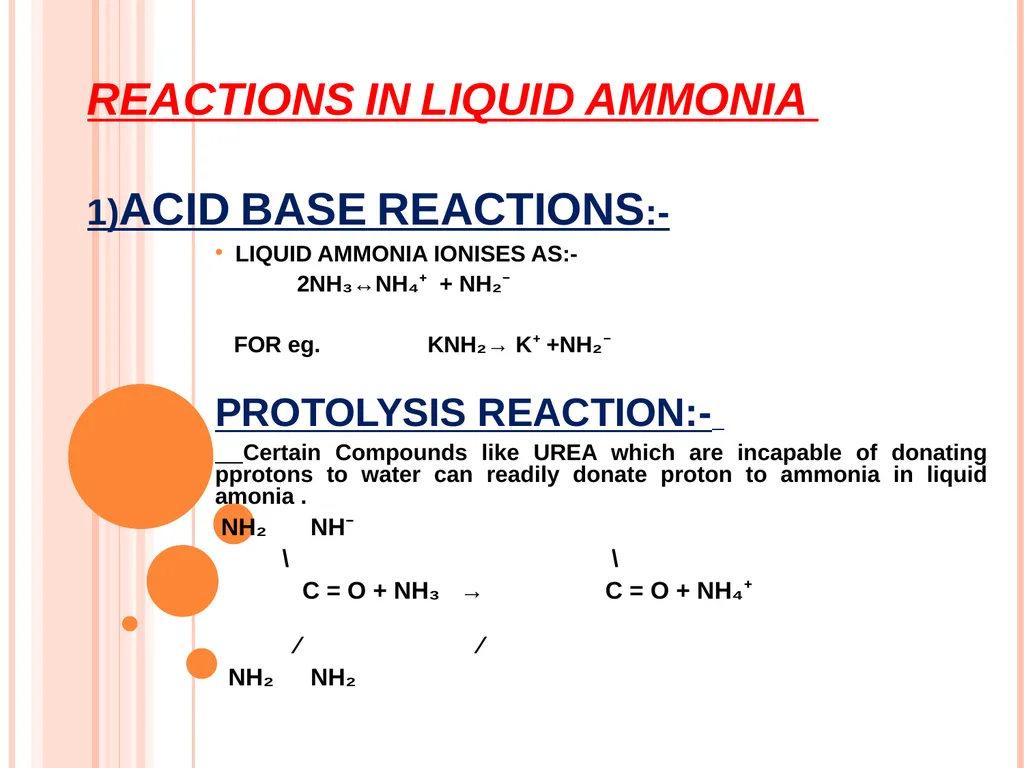
1)ACID BASE REACTIONS:- LIQUID AMMONIA IONISES AS:-
2NH₃↔NH₄⁺ + NH₂⁻
FOR eg. KNH₂→ K⁺ +NH₂⁻
PROTOLYSIS REACTION:-
Certain Compounds like UREA which are incapable of donating pprotons to water can readily donate proton to ammonia in liquid amonia .
NH₂ NH⁻
\ \
C = O + NH₃ → C = O + NH₄⁺
⁄ ⁄
NH₂ NH₂<br>
2NH₃↔NH₄⁺ + NH₂⁻
FOR eg. KNH₂→ K⁺ +NH₂⁻
PROTOLYSIS REACTION:-
Certain Compounds like UREA which are incapable of donating pprotons to water can readily donate proton to ammonia in liquid amonia .
NH₂ NH⁻
\ \
C = O + NH₃ → C = O + NH₄⁺
⁄ ⁄
NH₂ NH₂<br>
19
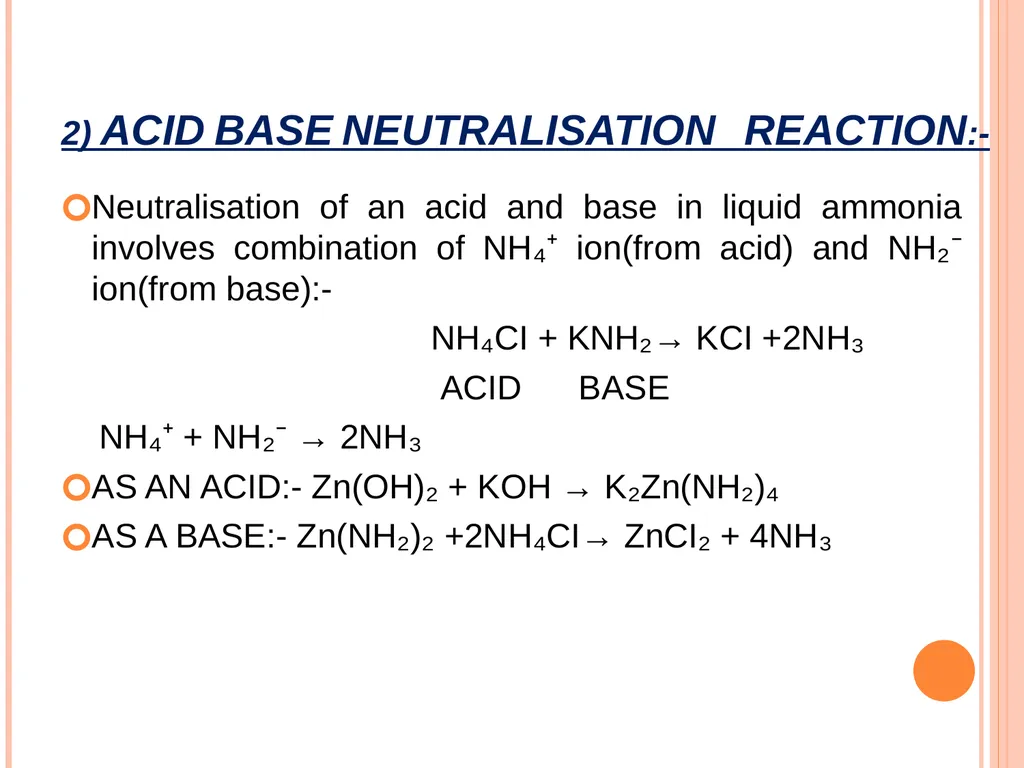
2) ACID BASE NEUTRALISATION REACTION:- Neutralisation of an acid and base in liquid ammonia involves combination of NH₄⁺ ion(from acid) and NH₂⁻ ion(from base):-
NH₄CI + KNH₂→ KCI +2NH₃
ACID BASE
NH₄⁺ + NH₂⁻ → 2NH₃
AS AN ACID:- Zn(OH)₂ + KOH → K₂Zn(NH₂)₄
AS A BASE:- Zn(NH₂)₂ +2NH₄CI→ ZnCI₂ + 4NH₃<br>
NH₄CI + KNH₂→ KCI +2NH₃
ACID BASE
NH₄⁺ + NH₂⁻ → 2NH₃
AS AN ACID:- Zn(OH)₂ + KOH → K₂Zn(NH₂)₄
AS A BASE:- Zn(NH₂)₂ +2NH₄CI→ ZnCI₂ + 4NH₃<br>
20
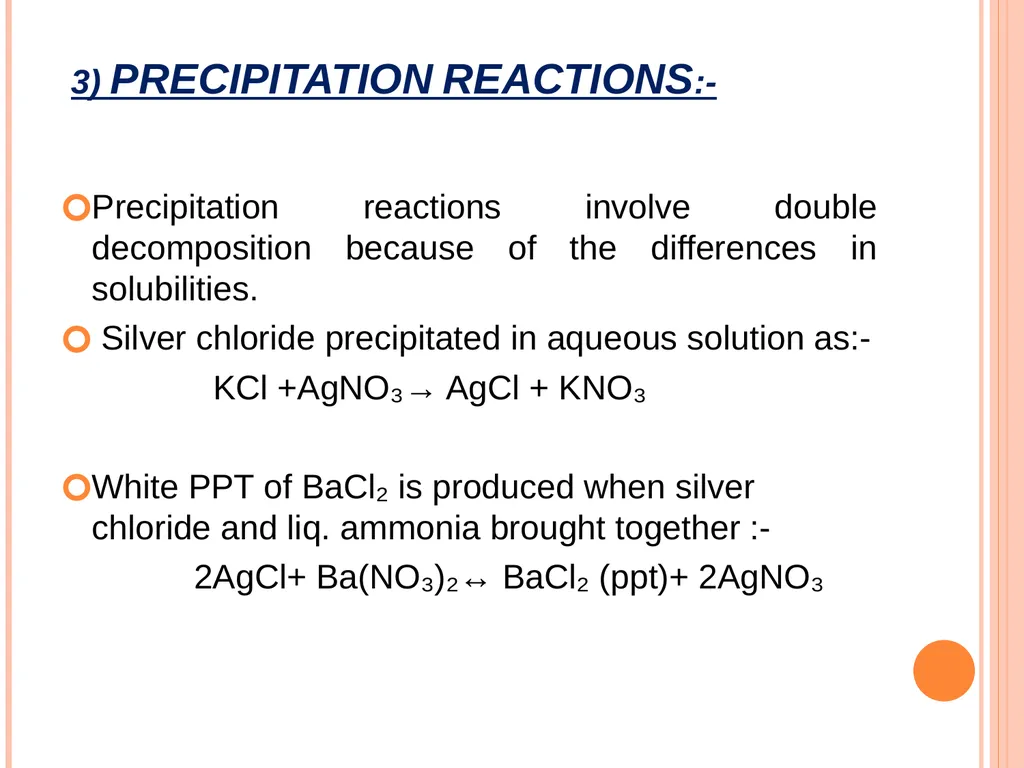
3) PRECIPITATION REACTIONS:- Precipitation reactions involve double decomposition because of the differences in solubilities.
Silver chloride precipitated in aqueous solution as:-
KCl +AgNO₃→ AgCl + KNO₃
White PPT of BaCl₂ is produced when silver chloride and liq. ammonia brought together :-
2AgCl+ Ba(NO₃)₂↔ BaCl₂ (ppt)+ 2AgNO₃<br>
Silver chloride precipitated in aqueous solution as:-
KCl +AgNO₃→ AgCl + KNO₃
White PPT of BaCl₂ is produced when silver chloride and liq. ammonia brought together :-
2AgCl+ Ba(NO₃)₂↔ BaCl₂ (ppt)+ 2AgNO₃<br>
21
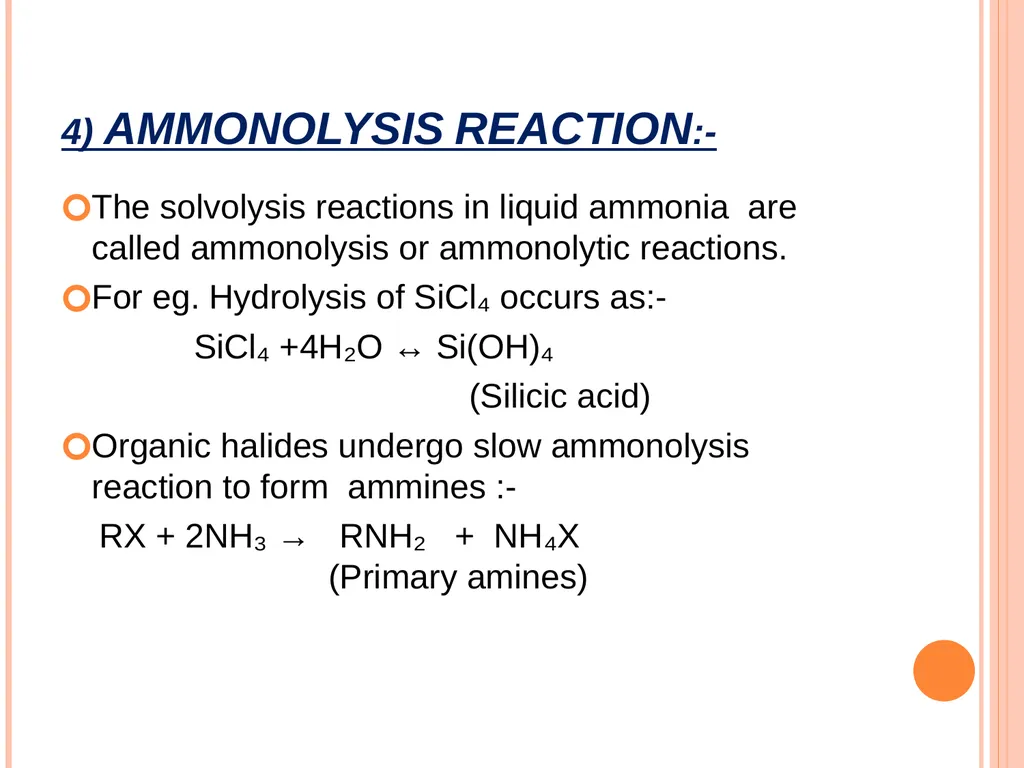
4) AMMONOLYSIS REACTION:- The solvolysis reactions in liquid ammonia are called ammonolysis or ammonolytic reactions.
For eg. Hydrolysis of SiCl₄ occurs as:-
SiCl₄ +4H₂O ↔ Si(OH)₄
(Silicic acid)
Organic halides undergo slow ammonolysis reaction to form ammines :-
RX + 2NH₃ → RNH₂ + NH₄X (Primary amines)<br>
For eg. Hydrolysis of SiCl₄ occurs as:-
SiCl₄ +4H₂O ↔ Si(OH)₄
(Silicic acid)
Organic halides undergo slow ammonolysis reaction to form ammines :-
RX + 2NH₃ → RNH₂ + NH₄X (Primary amines)<br>
22
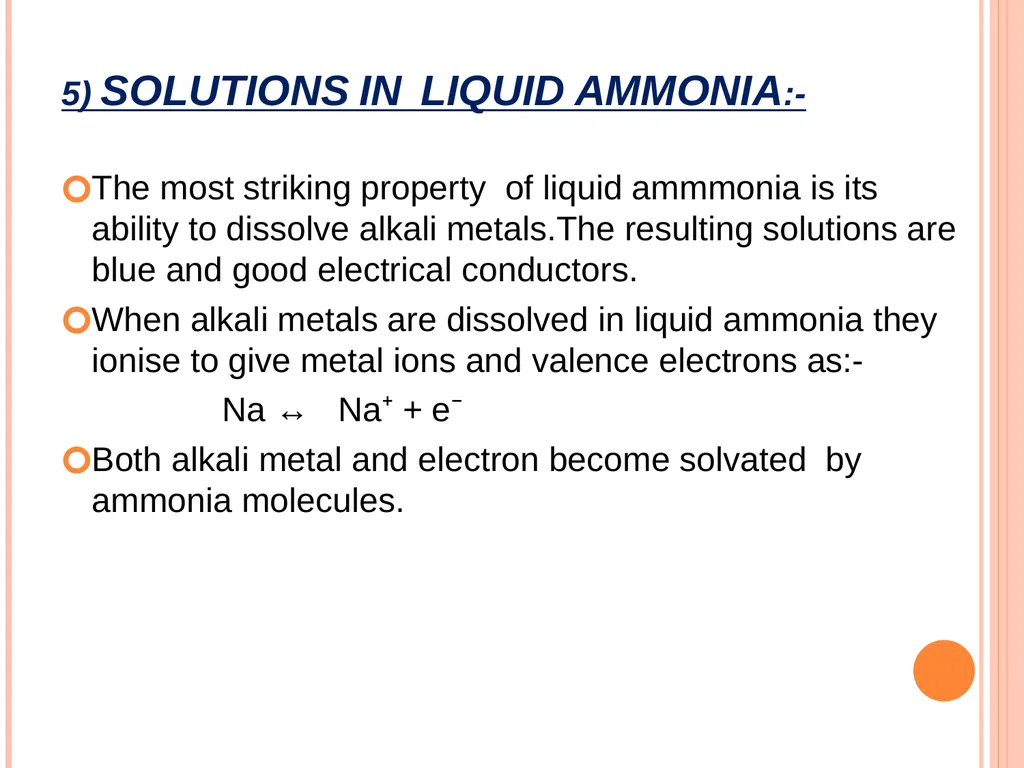
5) SOLUTIONS IN LIQUID AMMONIA:- The most striking property of liquid ammmonia is its ability to dissolve alkali metals.The resulting solutions are blue and good electrical conductors.
When alkali metals are dissolved in liquid ammonia they ionise to give metal ions and valence electrons as:-
Na ↔ Na⁺ + e⁻
Both alkali metal and electron become solvated by ammonia molecules.<br>
When alkali metals are dissolved in liquid ammonia they ionise to give metal ions and valence electrons as:-
Na ↔ Na⁺ + e⁻
Both alkali metal and electron become solvated by ammonia molecules.<br>
23
Na⁺ + xNH₃→ [ Na(NH₃)x]⁺
(ammoniated cation)
e⁻ + yNH₃ → [ e(NH₃)y]⁻
(amnoniated electron )
The complete reaction may be written as:-
Na → [ Na⁺ (NH₃)x]⁺ + [ e (NH₃)y]⁻
The ammoniated electrons are responsible for blue colour of solution.<br>
(ammoniated cation)
e⁻ + yNH₃ → [ e(NH₃)y]⁻
(amnoniated electron )
The complete reaction may be written as:-
Na → [ Na⁺ (NH₃)x]⁺ + [ e (NH₃)y]⁻
The ammoniated electrons are responsible for blue colour of solution.<br>
24
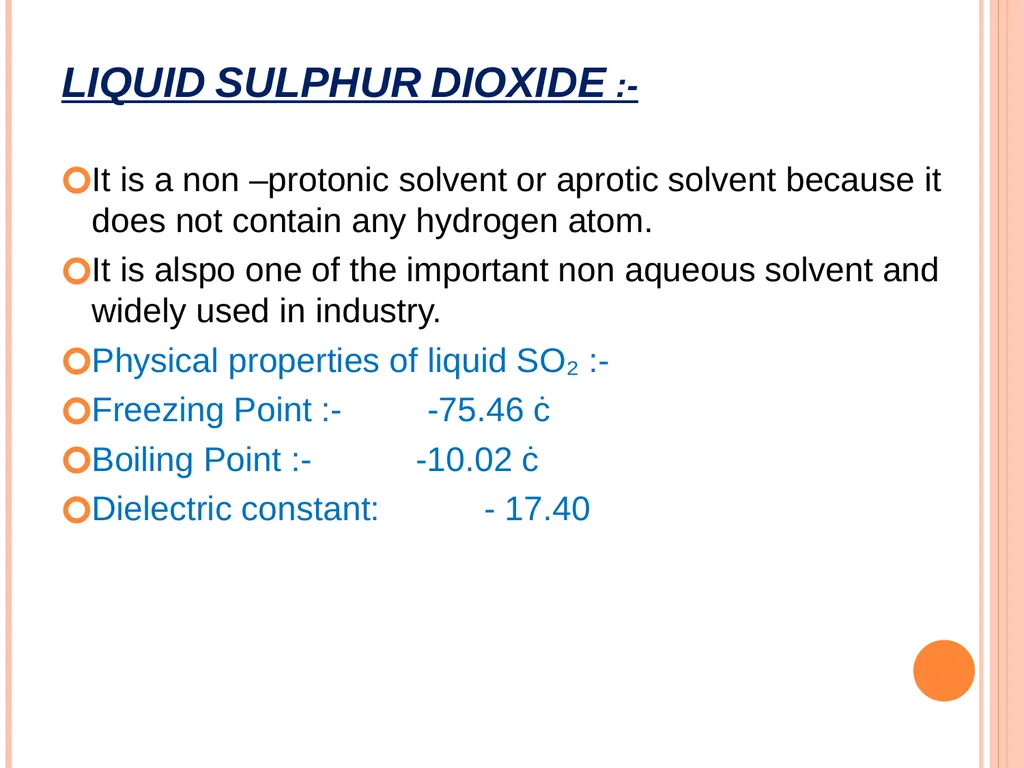
LIQUID SULPHUR DIOXIDE :- It is a non –protonic solvent or aprotic solvent because it does not contain any hydrogen atom.
It is alspo one of the important non aqueous solvent and widely used in industry.
Physical properties of liquid SO₂ :-
Freezing Point :- -75.46 ċ
Boiling Point :- -10.02 ċ
Dielectric constant: - 17.40<br>
It is alspo one of the important non aqueous solvent and widely used in industry.
Physical properties of liquid SO₂ :-
Freezing Point :- -75.46 ċ
Boiling Point :- -10.02 ċ
Dielectric constant: - 17.40<br>
25
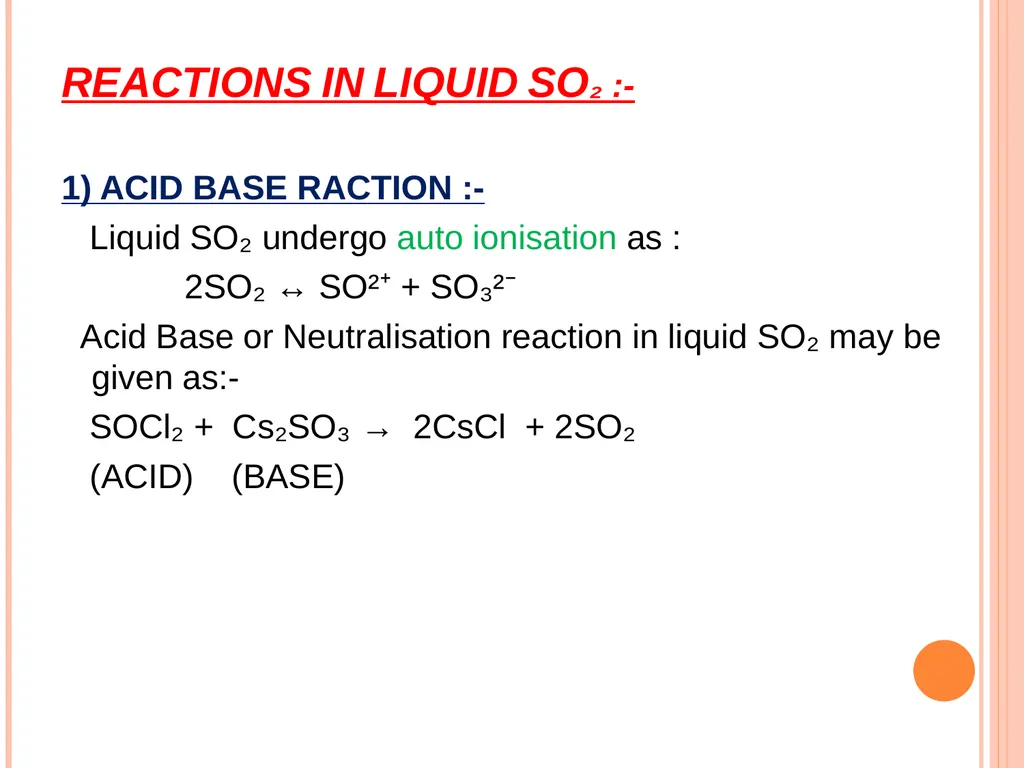
REACTIONS IN LIQUID SO₂ :- 1) ACID BASE RACTION :-
Liquid SO₂ undergo auto ionisation as :
2SO₂ ↔ SO²⁺ + SO₃²⁻
Acid Base or Neutralisation reaction in liquid SO₂ may be given as:-
SOCl₂ + Cs₂SO₃ → 2CsCl + 2SO₂
(ACID) (BASE)<br>
Liquid SO₂ undergo auto ionisation as :
2SO₂ ↔ SO²⁺ + SO₃²⁻
Acid Base or Neutralisation reaction in liquid SO₂ may be given as:-
SOCl₂ + Cs₂SO₃ → 2CsCl + 2SO₂
(ACID) (BASE)<br>
26
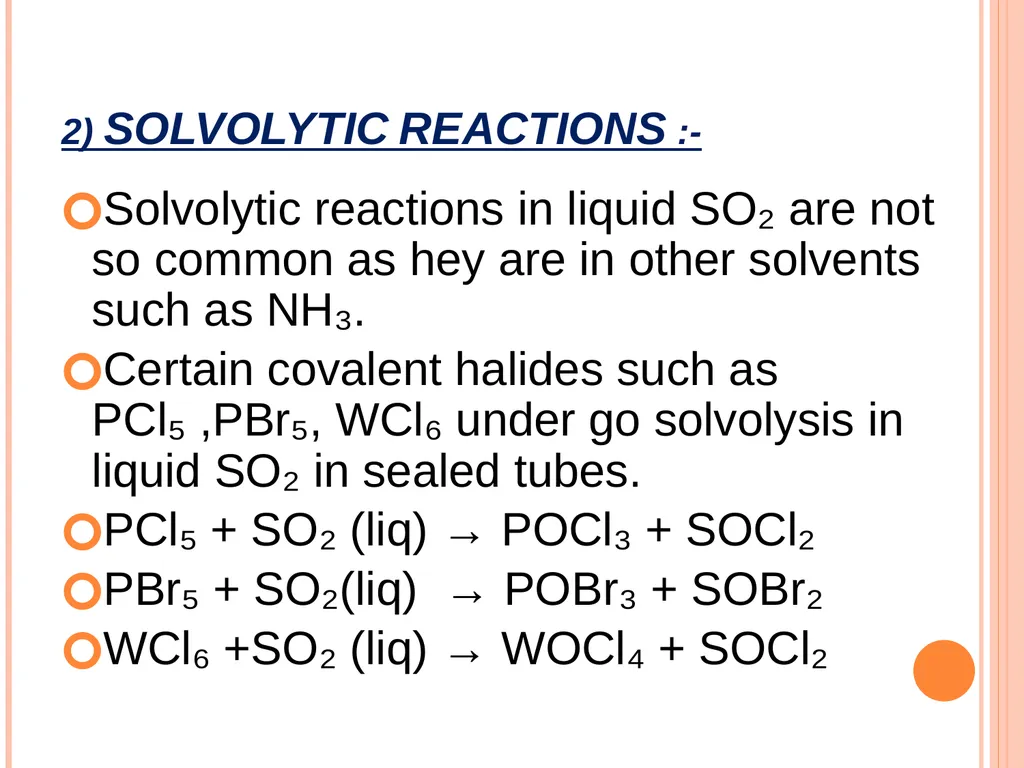
2) SOLVOLYTIC REACTIONS :- Solvolytic reactions in liquid SO₂ are not so common as hey are in other solvents such as NH₃.
Certain covalent halides such as PCl₅ ,PBr₅, WCl₆ under go solvolysis in liquid SO₂ in sealed tubes.
PCl₅ + SO₂ (liq) → POCl₃ + SOCl₂
PBr₅ + SO₂(liq) → POBr₃ + SOBr₂
WCl₆ +SO₂ (liq) → WOCl₄ + SOCl₂<br>
Certain covalent halides such as PCl₅ ,PBr₅, WCl₆ under go solvolysis in liquid SO₂ in sealed tubes.
PCl₅ + SO₂ (liq) → POCl₃ + SOCl₂
PBr₅ + SO₂(liq) → POBr₃ + SOBr₂
WCl₆ +SO₂ (liq) → WOCl₄ + SOCl₂<br>
27
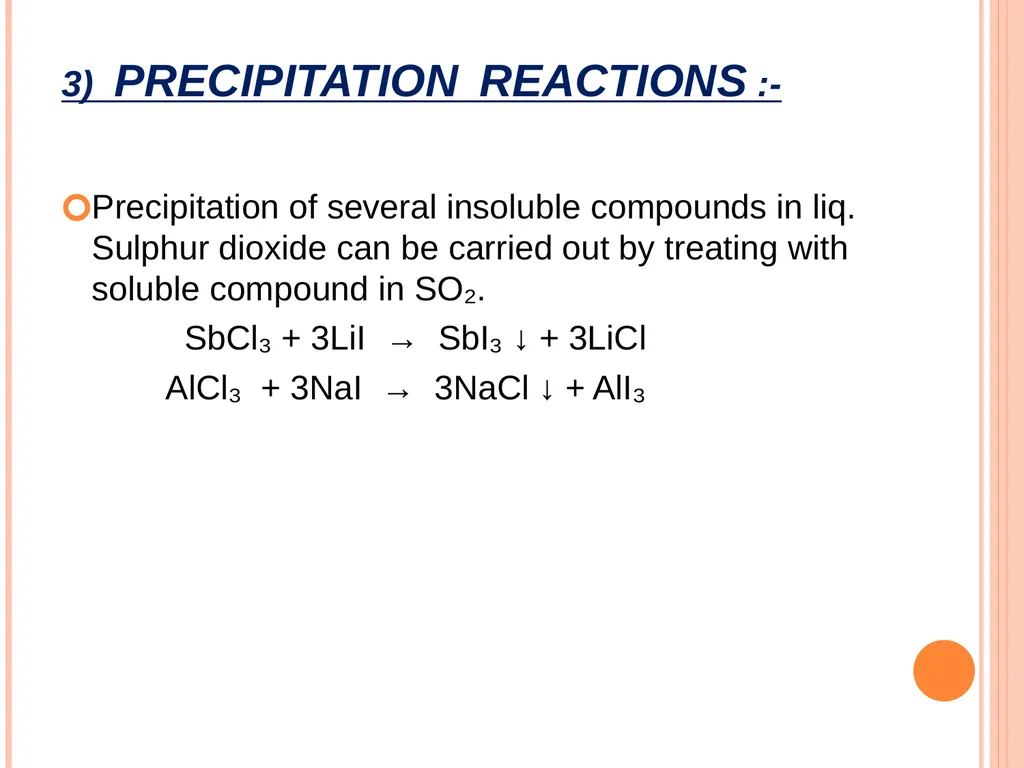
3) PRECIPITATION REACTIONS :- Precipitation of several insoluble compounds in liq. Sulphur dioxide can be carried out by treating with soluble compound in SO₂.
SbCl₃ + 3LiI → SbI₃ ↓ + 3LiCl
AlCl₃ + 3NaI → 3NaCl ↓ + AlI₃<br>
SbCl₃ + 3LiI → SbI₃ ↓ + 3LiCl
AlCl₃ + 3NaI → 3NaCl ↓ + AlI₃<br>
28
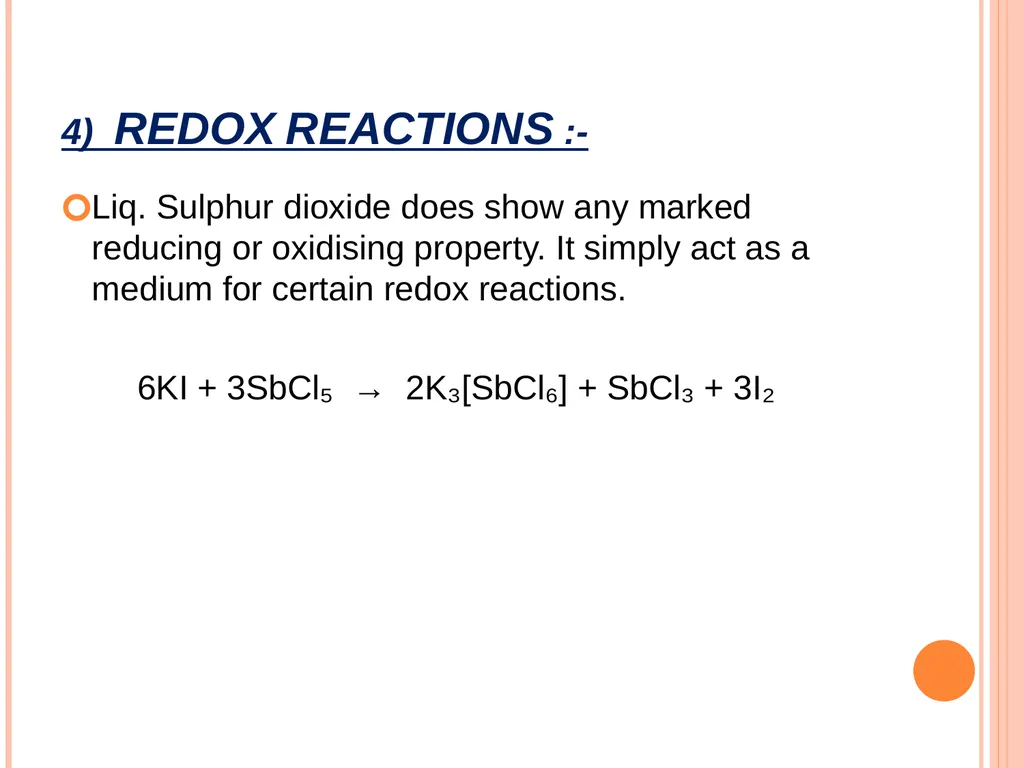
4) REDOX REACTIONS :- Liq. Sulphur dioxide does show any marked reducing or oxidising property. It simply act as a medium for certain redox reactions.
6KI + 3SbCl₅ → 2K₃[SbCl₆] + SbCl₃ + 3I₂<br>
6KI + 3SbCl₅ → 2K₃[SbCl₆] + SbCl₃ + 3I₂<br>
29
THANKS<br>