Non Linear Hebbian Learning Techniques and Fuzzy
Description: Non Linear Hebbian Learning Techniques and Fuzzy Cognitive Maps in Modeling the Parkinsons Disease PhD Student Antigoni P. Anninou Professor Peter P. Groumpos Laboratory for Automation and Robotics Department of Electrical and Computer
Related Topics
Download Presentation
"Non Linear Hebbian Learning Techniques and Fuzzy" is the property of its rightful owner. Permission is granted to download and print the materials on this website for personal, non-commercial use only, and to display it on your personal computer provided you do not modify the materials and that you retain all copyright notices contained in the materials. By downloading content from our website, you accept the terms of this agreement.
Presentation Transcript
slide1. Non Linear Hebbian Learning Techniques and Fuzzy Cognitive Maps in Modeling the Parkinson’s Disease PhD Student Antigoni P. Anninou
Professor Peter P. Groumpos
Laboratory for Automation and Robotics
Department of Electrical and Computer Engineering 21st Mediterranean Conference on Control and Automation
MED’13 27/6/2013 1<br>
slide2. Outline Problem Formulation
Fuzzy Cognitive Maps
Non-Linear Hebbian Learning
Decision Support System in Parkinson’s Disease
Simulation Results
Conclusions 27/6/2013 2<br>
slide3. Aim Construction and training of a Fuzzy Cognitive Map (FCM) in modeling a Decision Support System, to help in diagnosis concerning the disease of Parkinson 27/6/2013 3<br>
slide4. Fuzzy Cognitive Maps (FCM) (1/5) Modeling method for describing particular domains
Fyzzy-graph structures for representing causal reasoning 27/6/2013 4<br>
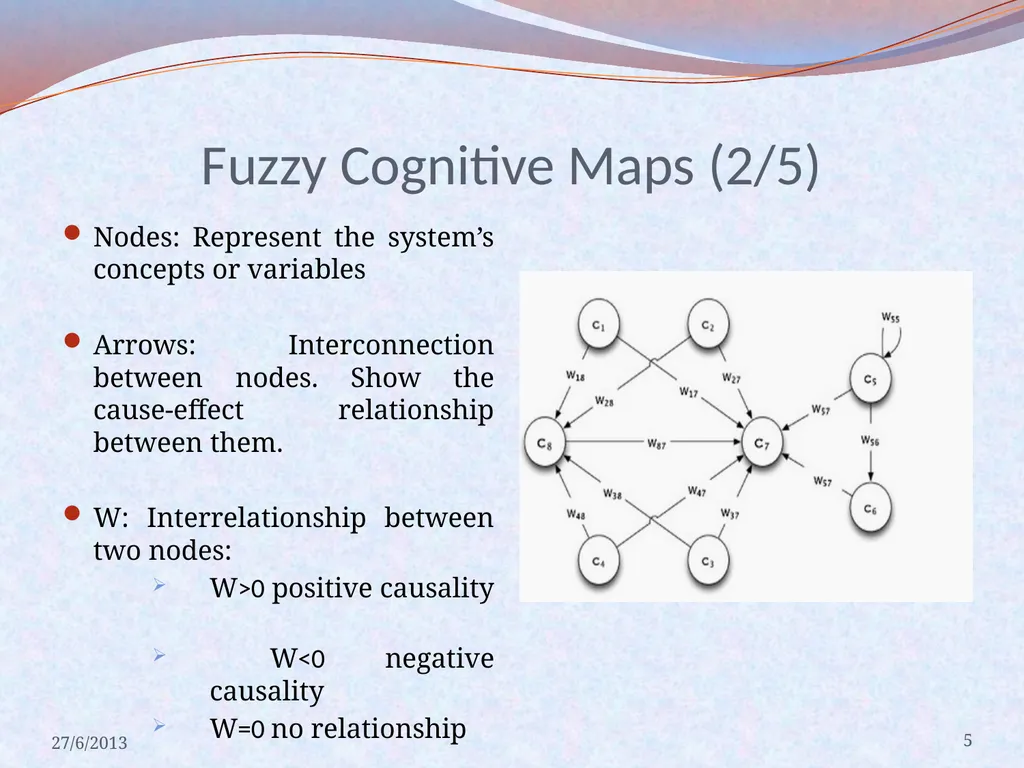
slide5. Fuzzy Cognitive Maps (2/5) Nodes: Represent the system’s concepts or variables
Arrows: Interconnection between nodes. Show the cause-effect relationship between them.
W: Interrelationship between two nodes:
W>0 positive causality
W<0 negative causality
W=0 no relationship 27/6/2013 5<br>
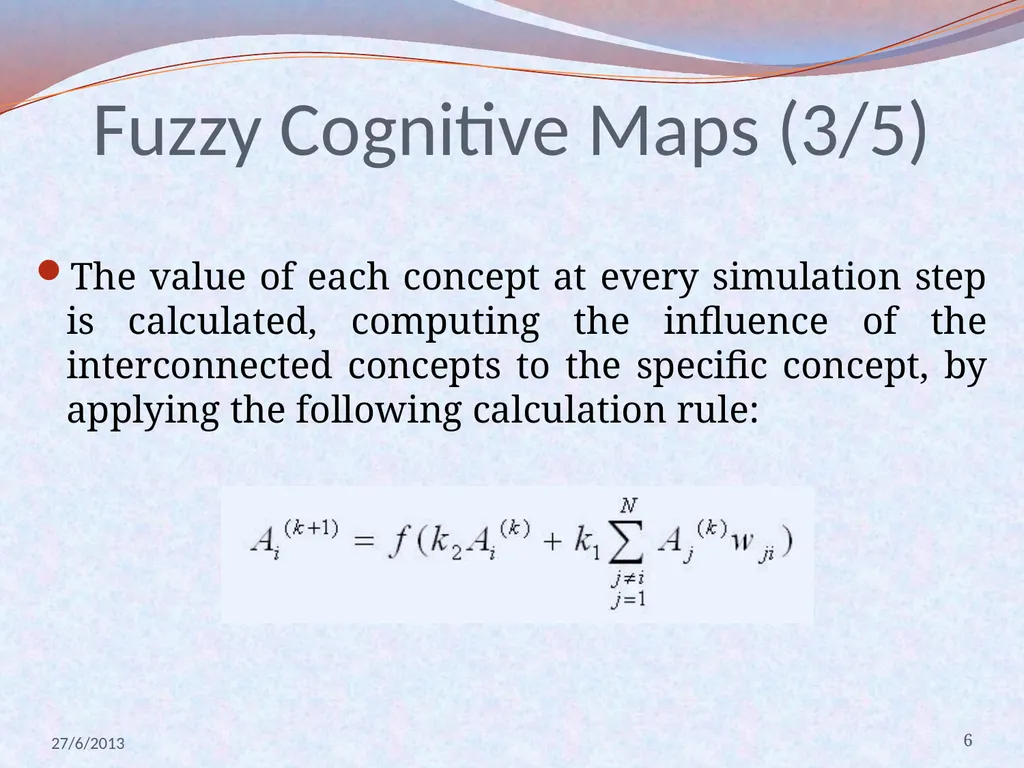
slide6. Fuzzy Cognitive Maps (3/5) The value of each concept at every simulation step is calculated, computing the influence of the interconnected concepts to the specific concept, by applying the following calculation rule: 27/6/2013 6<br>
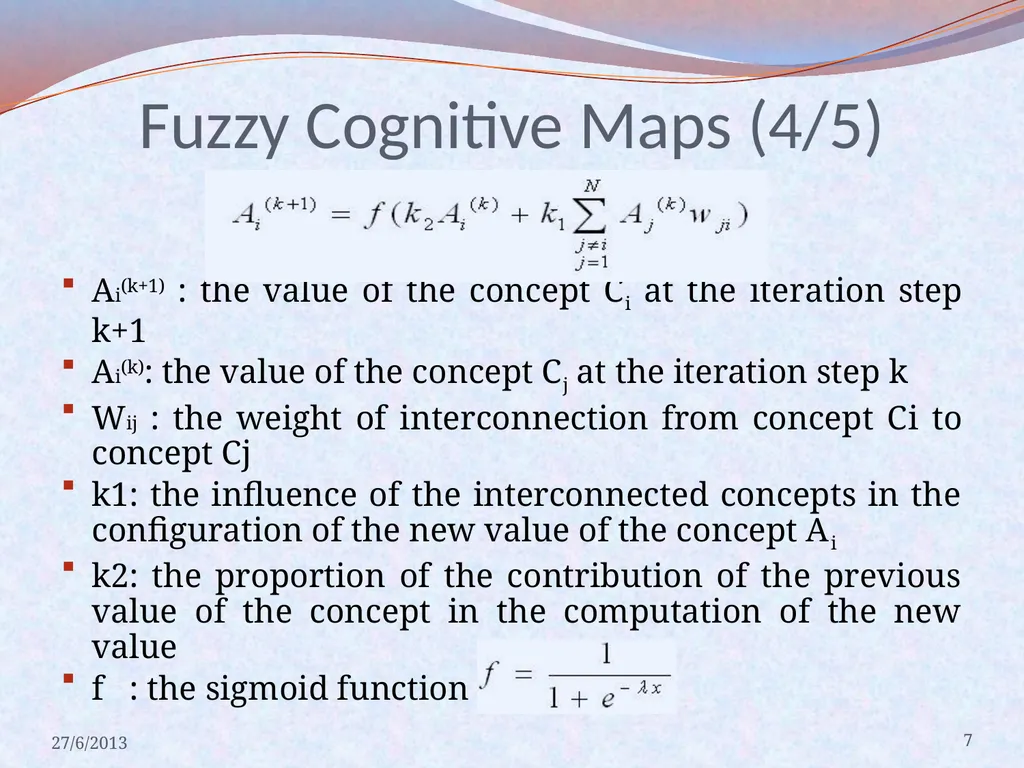
slide7. Fuzzy Cognitive Maps (4/5) Ai(k+1) : the value of the concept Ci at the iteration step k+1
Ai(k): the value of the concept Cj at the iteration step k
Wij : the weight of interconnection from concept Ci to concept Cj
k1: the influence of the interconnected concepts in the configuration of the new value of the concept Ai
k2: the proportion of the contribution of the previous value of the concept in the computation of the new value
f : the sigmoid function 27/6/2013 7<br>
slide8. Fuzzy Cognitive Maps (5/5) Weaknesses
Direct dependence of the initial knowledge of experts
Convergence to undesirable situations
Solution
Training the FCM 27/6/2013 8<br>
slide9. Non-Linear Hebbian Learning (NHL) (1/2) Increase the effectiveness of FCMs and their implementation in real problems
Update weights associated only with edges that are initially suggested by experts
All concepts in FCM model are triggered at each iteration step and change their values
Output concepts → Desired Output Concepts (DOCs) 27/6/2013 9<br>
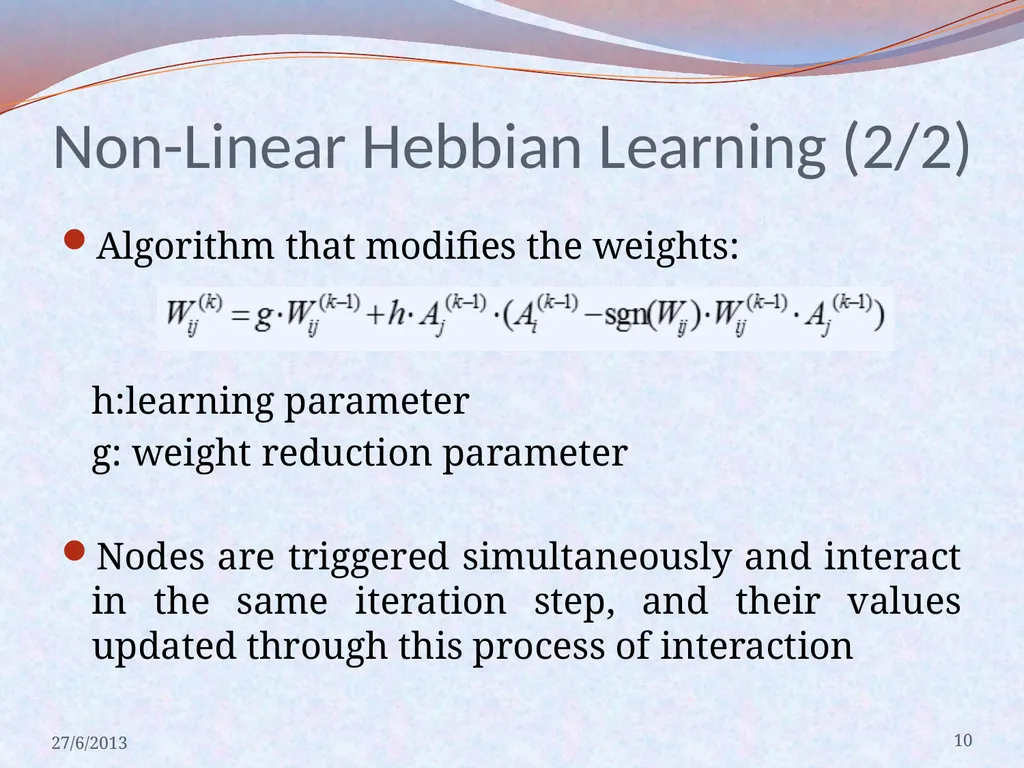
slide10. Non-Linear Hebbian Learning (2/2) Algorithm that modifies the weights:
h:learning parameter
g: weight reduction parameter
Nodes are triggered simultaneously and interact in the same iteration step, and their values updated through this process of interaction 27/6/2013 10<br>
slide11. Criteria 1st : Minimization of the objective function F
DOCi: the value of the output concept i as indicated in each iteration
Ti: the mean target value of the concept DOCi
m: the number of the desired output nodes
2nd : Minimization of the variation of two subsequent values of DOCs
F2 = | DOCi (k+1)- DOCi (k) | 27/6/2013 11<br>
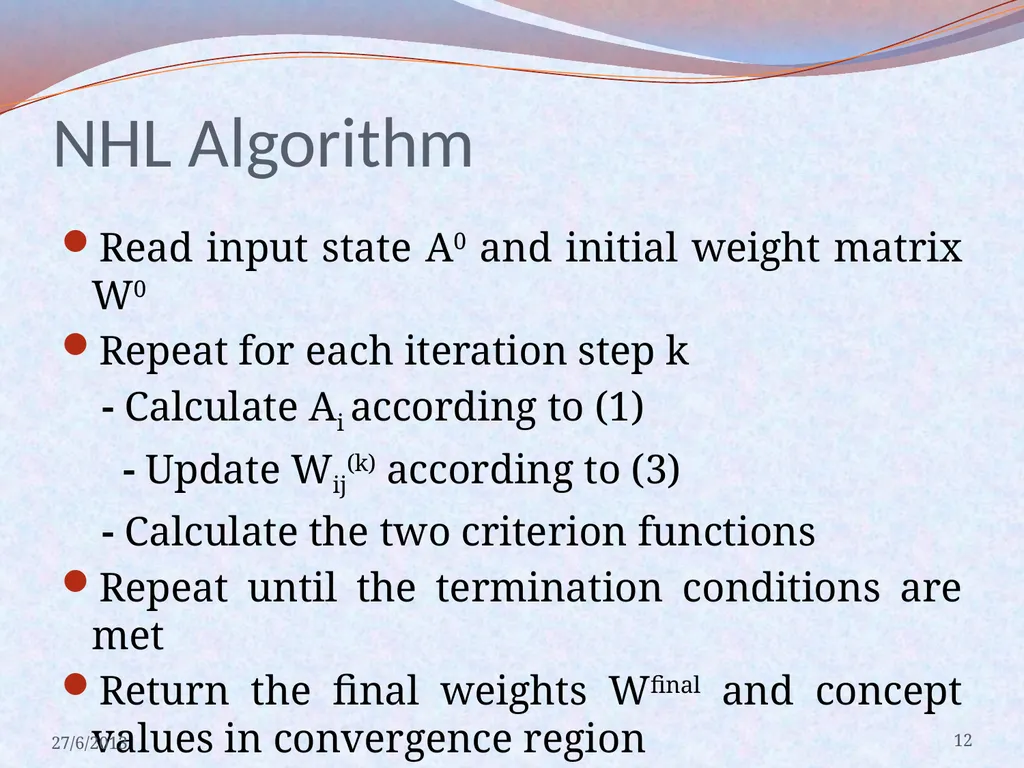
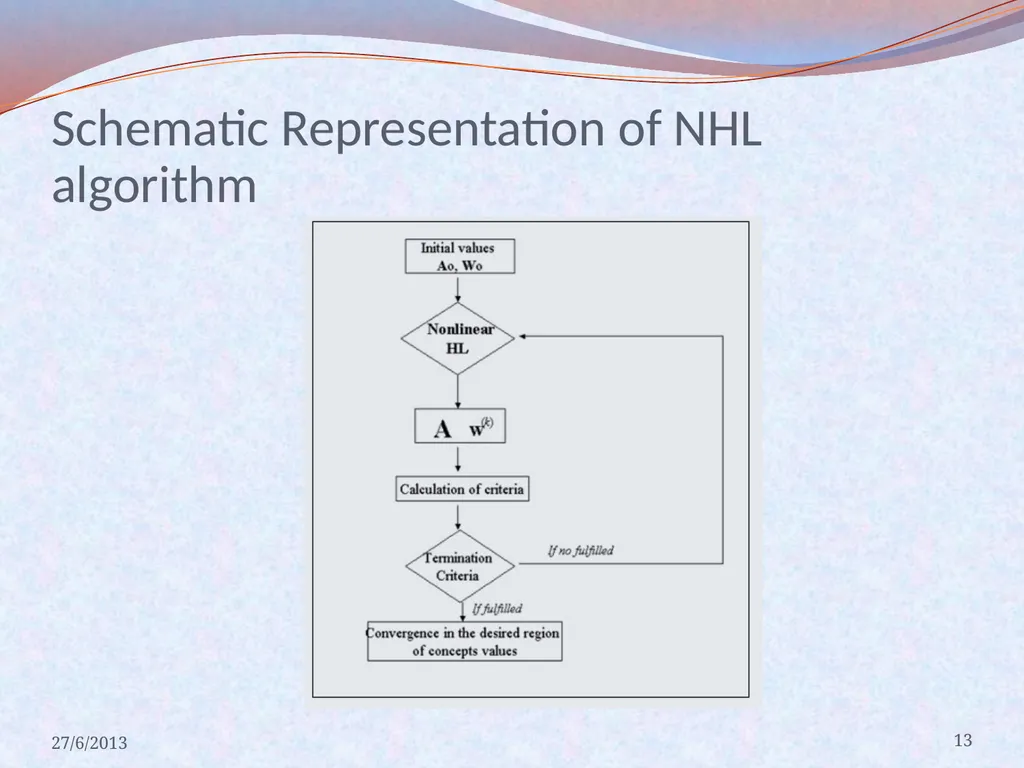
slide12. NHL Algorithm Read input state A0 and initial weight matrix W0
Repeat for each iteration step k
- Calculate Ai according to (1)
- Update Wij(k) according to (3)
- Calculate the two criterion functions
Repeat until the termination conditions are met
Return the final weights Wfinal and concept values in convergence region 27/6/2013 12<br>
slide13. Schematic Representation of NHL algorithm 27/6/2013 13<br>
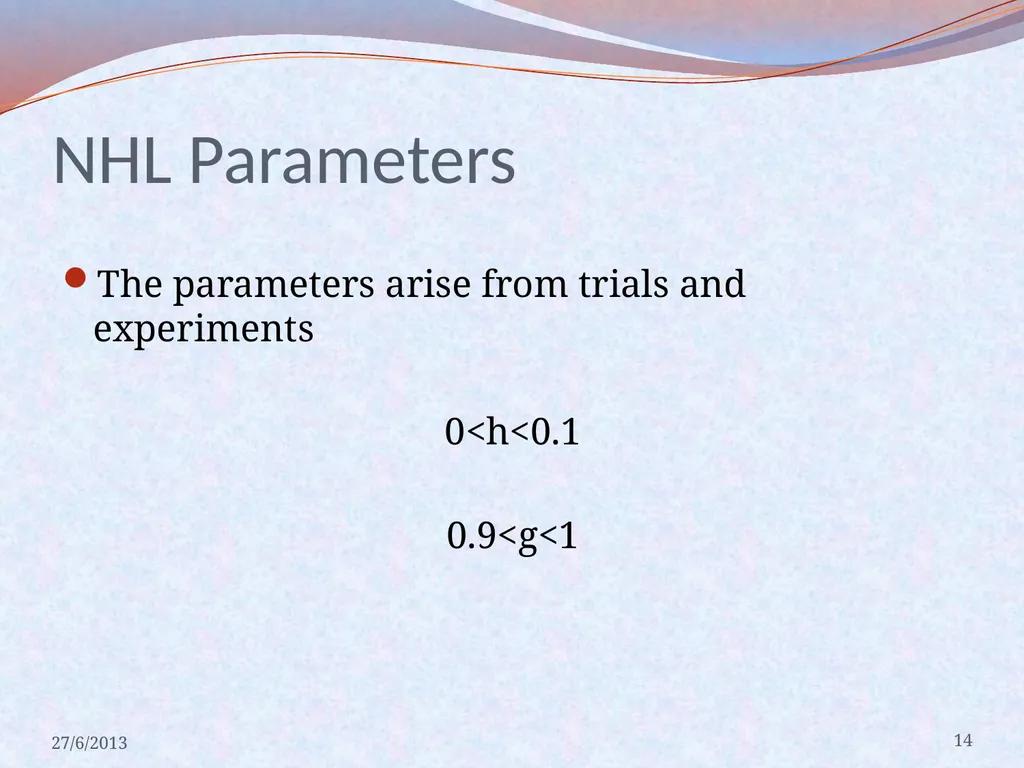
slide14. NHL Parameters The parameters arise from trials and experiments
0<h<0.1
0.9<g<1 27/6/2013 14<br>
slide15. Decision Support System Definition: Interactive computer – based support system for making decisions in any complex system, when individuals or a team of people are trying to solve unstructured problems on an uncertain environment
Aim: Reach acceptable and realistic decisions
Methodology: Exploitation of experts’ experience 27/6/2013 15<br>
slide16. Why to model Decision Support Systems with FCMs High amount of data and information from interdisciplinary sources
Information may be vague or missing
Procedure is complex
Many factors may be complementary, contradictory or competitive 27/6/2013 16<br>
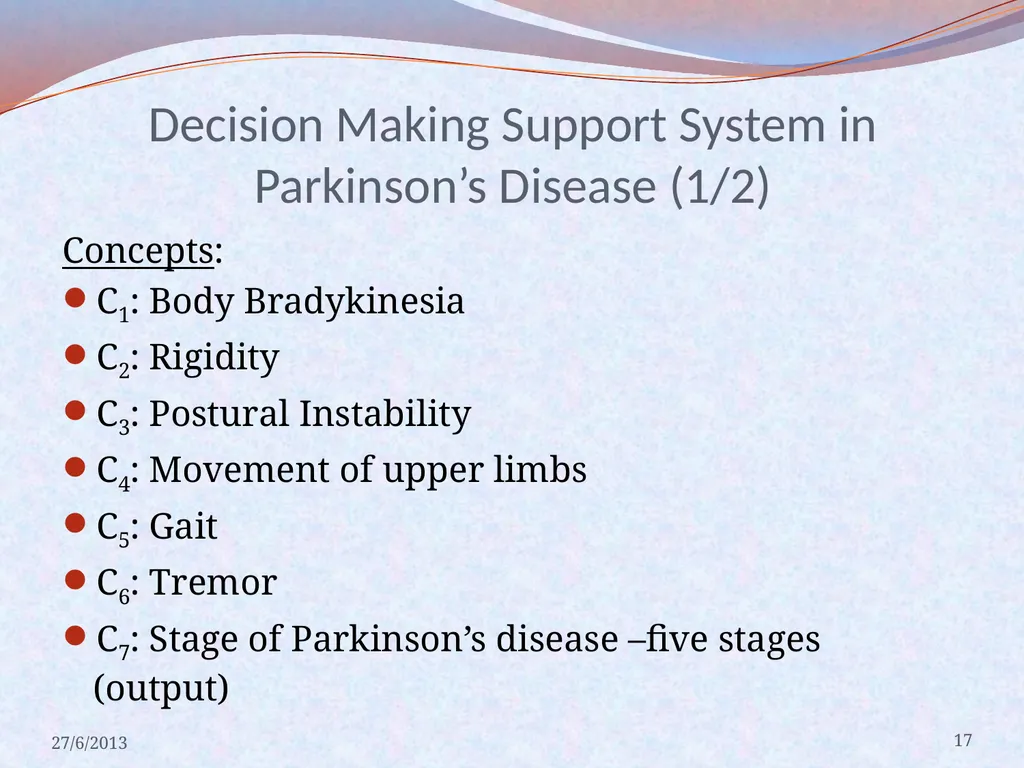
slide17. Decision Making Support System in Parkinson’s Disease (1/2) Concepts:
C1: Body Bradykinesia
C2: Rigidity
C3: Postural Instability
C4: Movement of upper limbs
C5: Gait
C6: Tremor
C7: Stage of Parkinson’s disease –five stages (output) 27/6/2013 17<br>
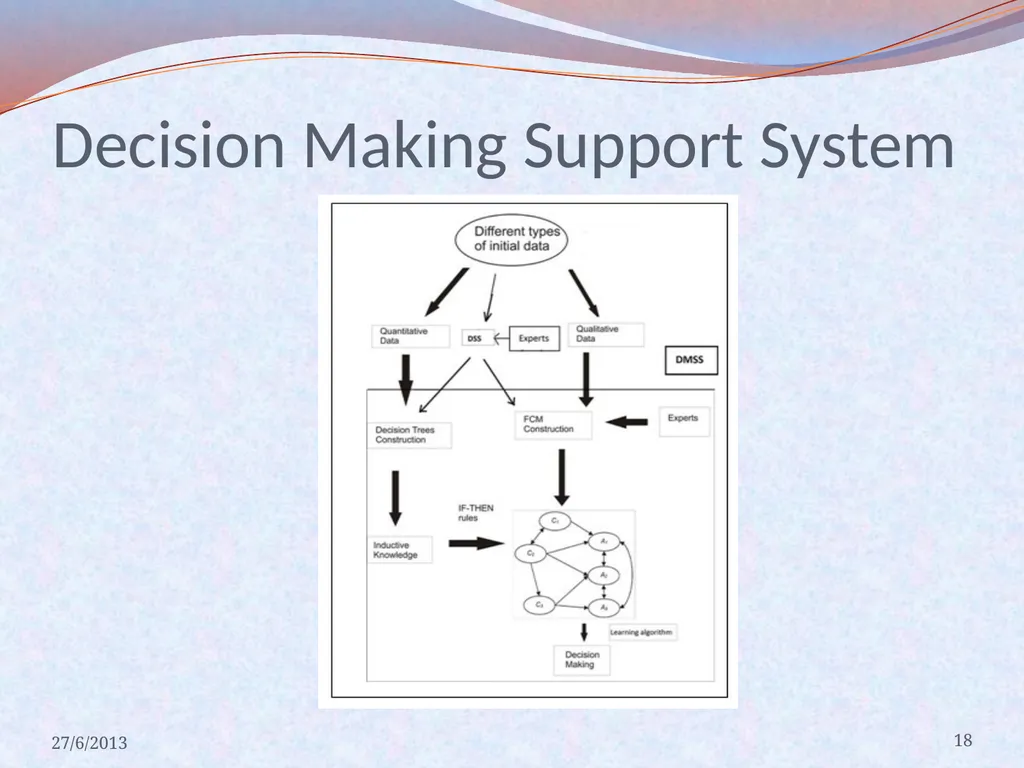
slide18. Decision Making Support System 27/6/2013 18<br>
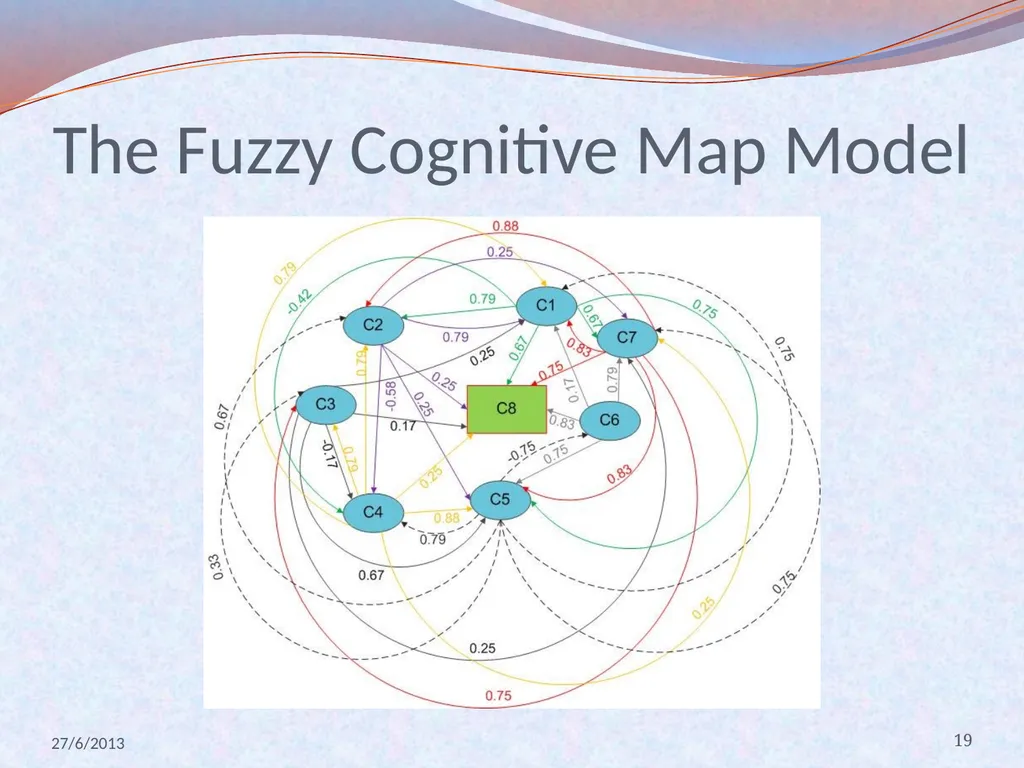
slide19. The Fuzzy Cognitive Map Model 27/6/2013 19<br>
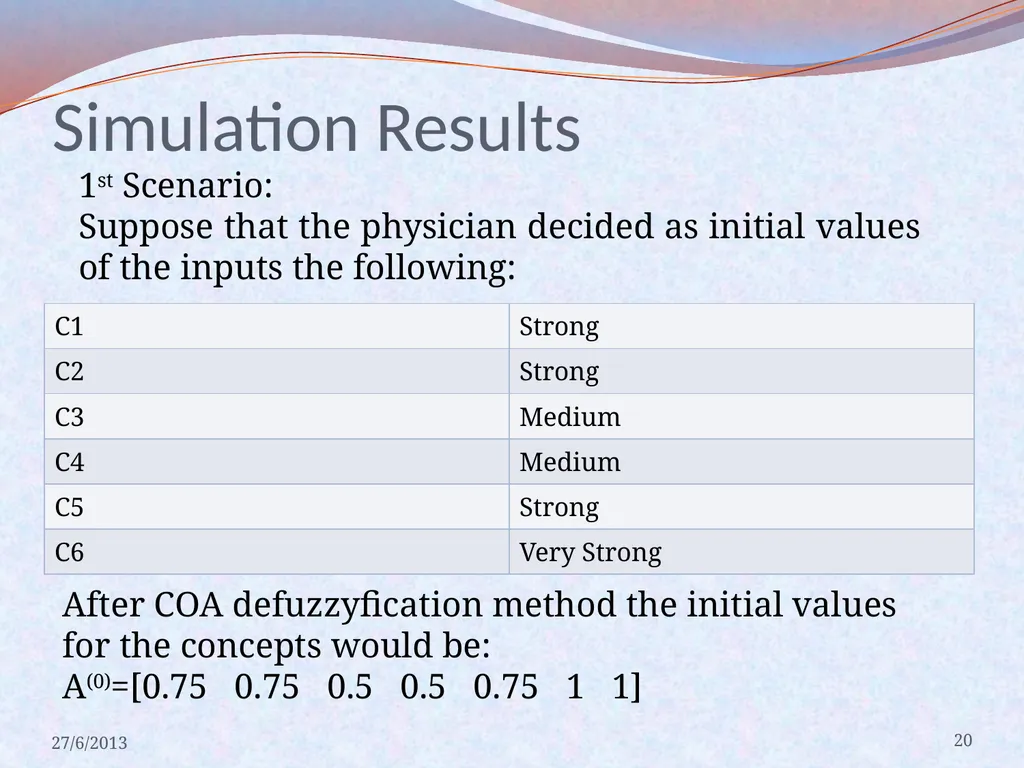
slide20. Simulation Results 1st Scenario:
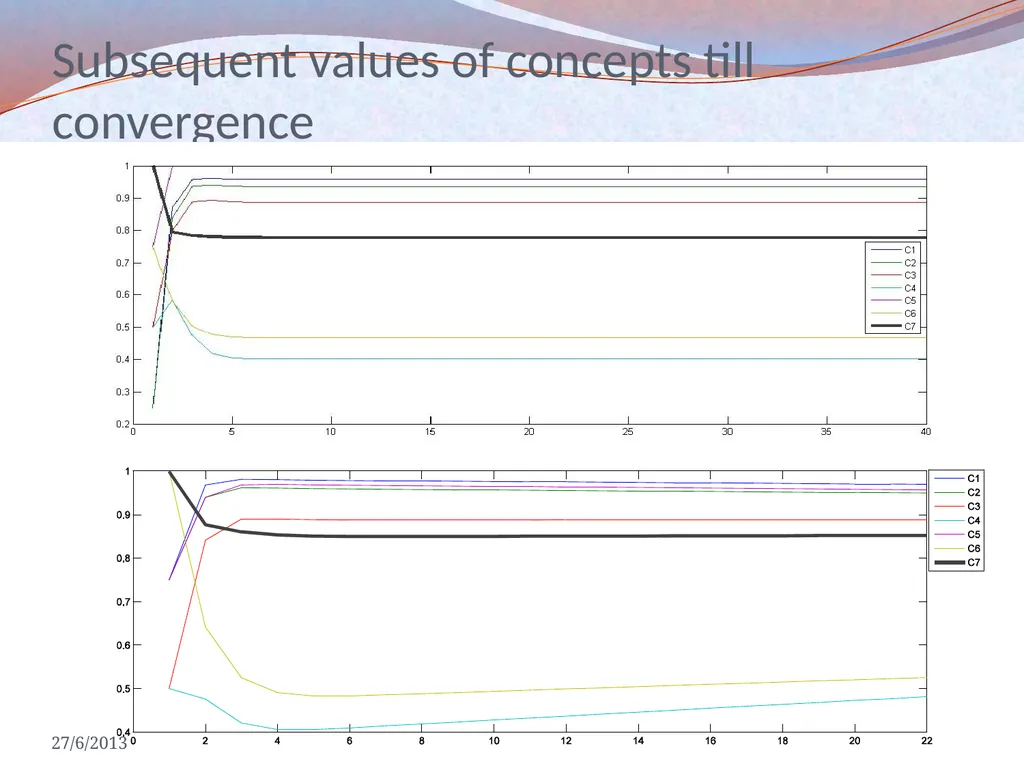
Suppose that the physician decided as initial values of the inputs the following: After COA defuzzyfication method the initial values for the concepts would be:
A(0)=[0.75 0.75 0.5 0.5 0.75 1 1] 27/6/2013 20<br>
slide21. Subsequent values of concepts till convergence 27/6/2013 21<br>
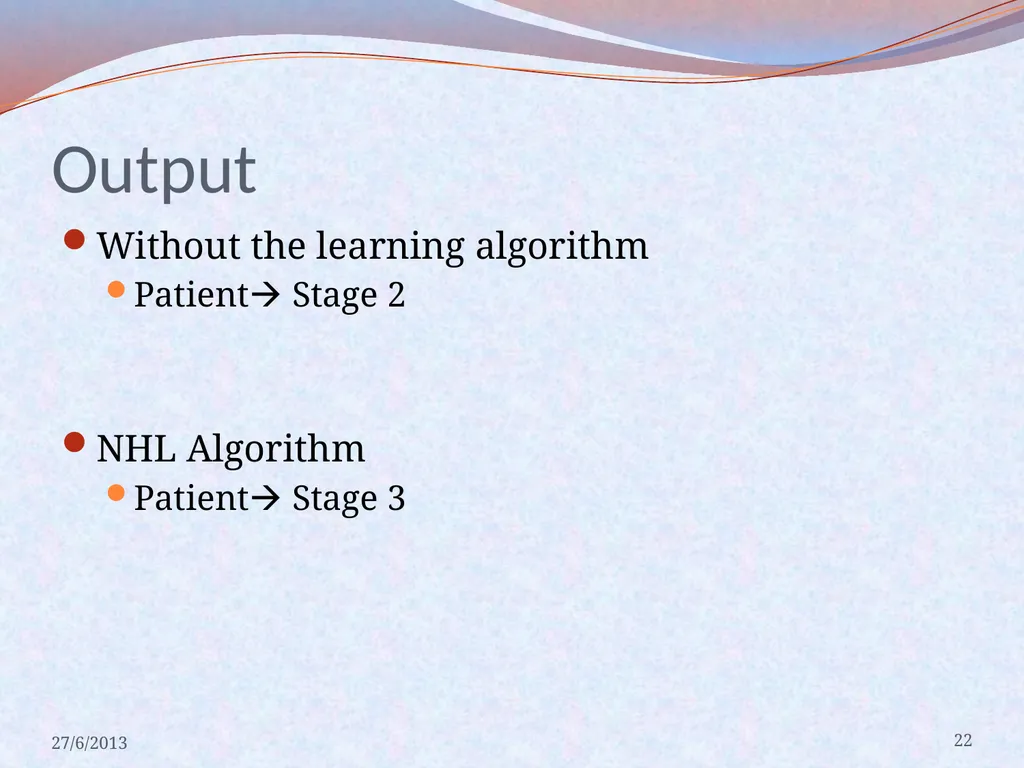
slide22. Output Without the learning algorithm
Patient Stage 2
NHL Algorithm
Patient Stage 3 27/6/2013 22<br>
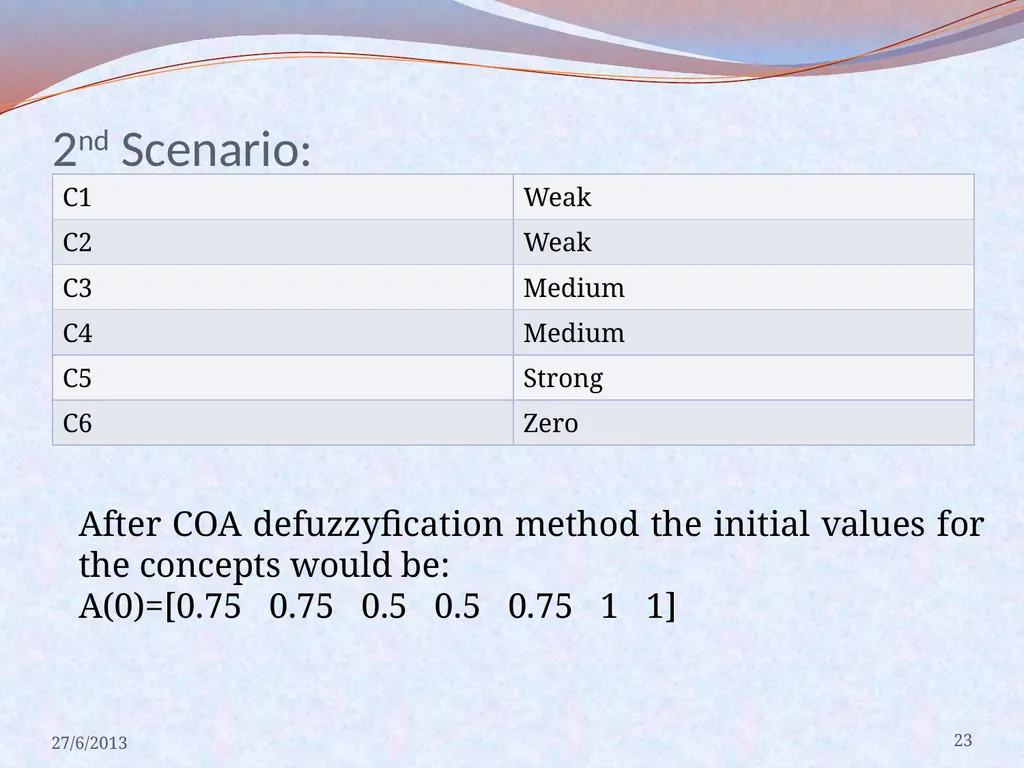
slide23. 2nd Scenario: After COA defuzzyfication method the initial values for the concepts would be:
A(0)=[0.75 0.75 0.5 0.5 0.75 1 1] 27/6/2013 23<br>
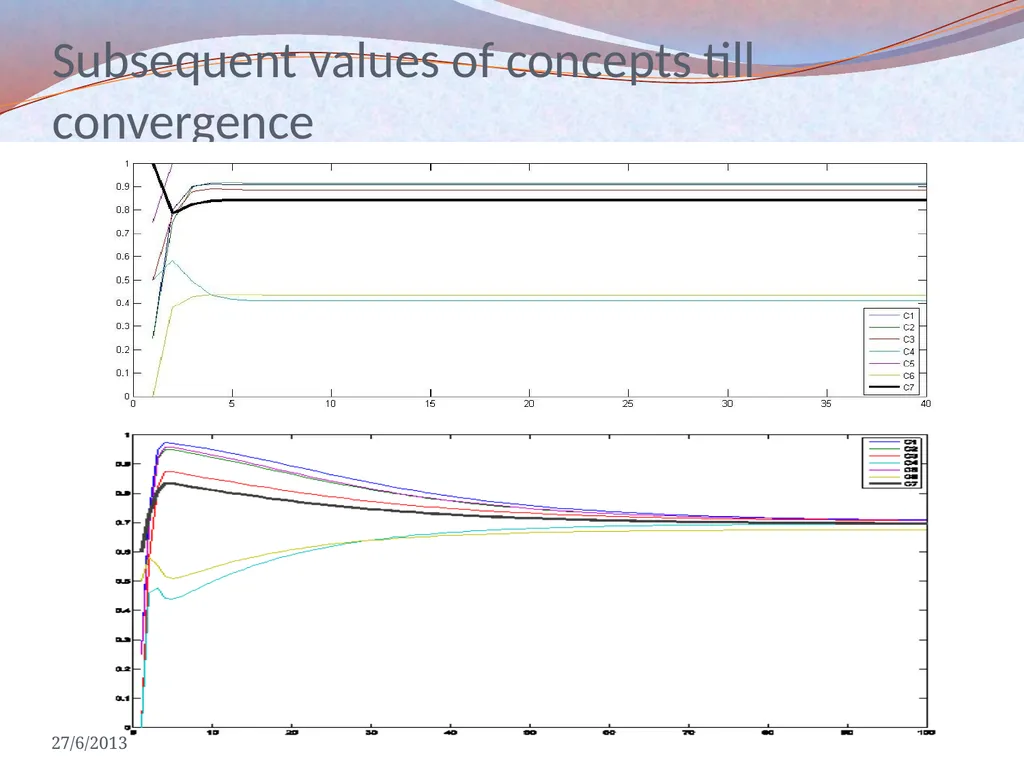
slide24. Subsequent values of concepts till convergence 27/6/2013 24<br>
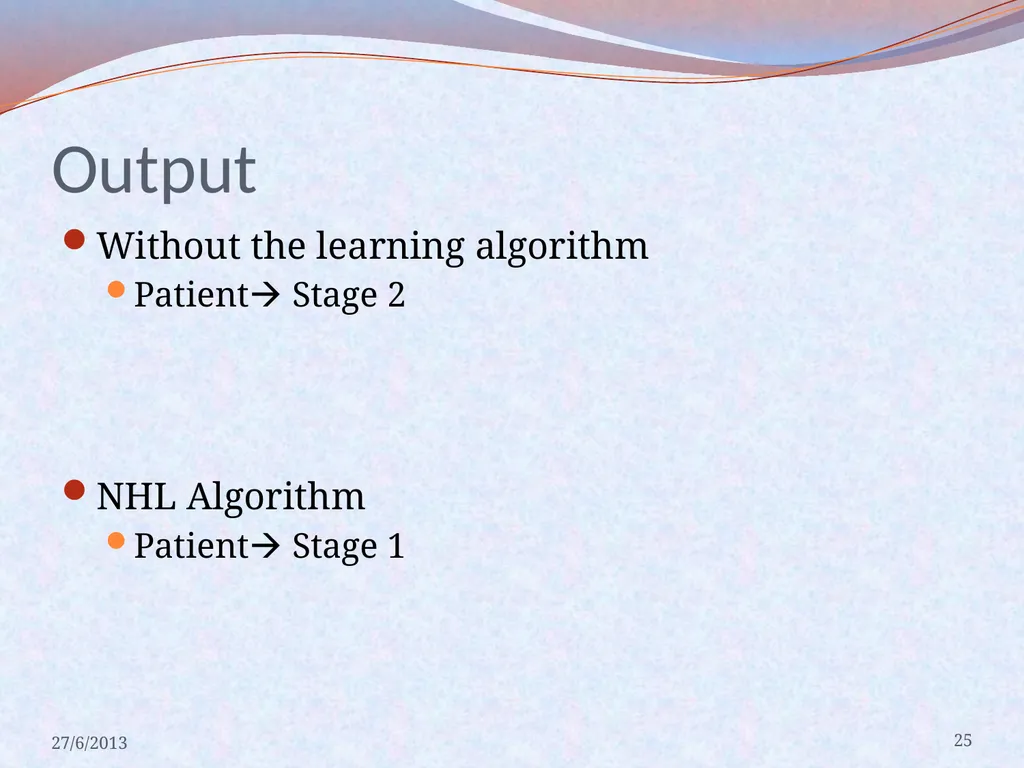
slide25. Output Without the learning algorithm
Patient Stage 2
NHL Algorithm
Patient Stage 1 27/6/2013 25<br>
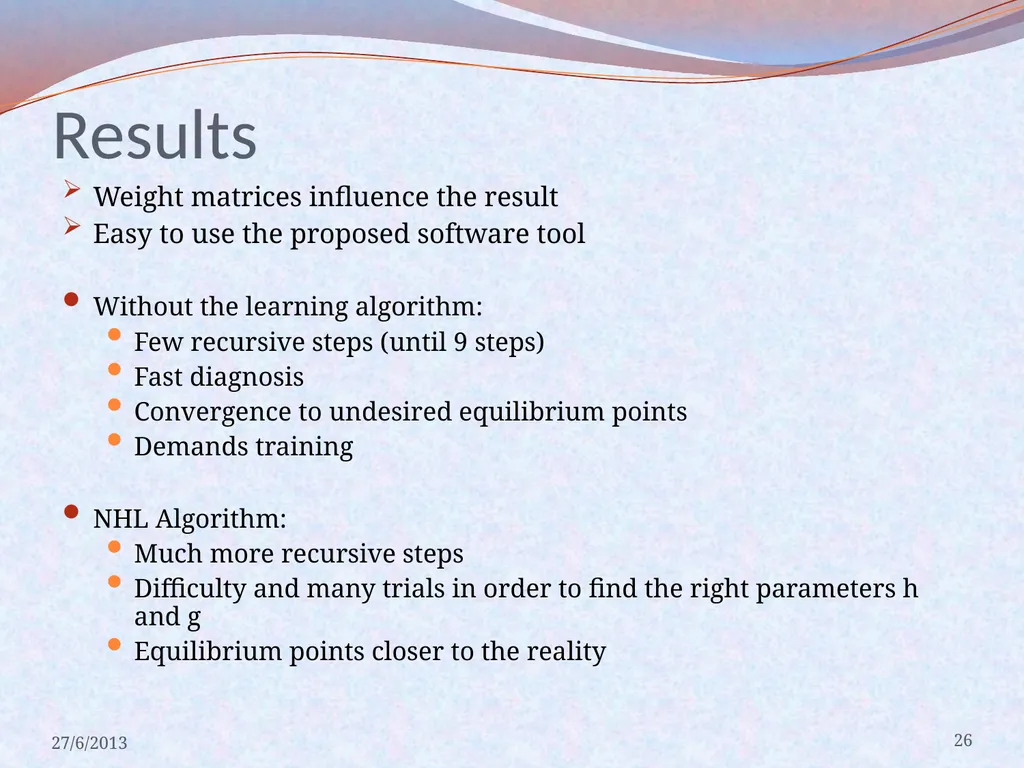
slide26. Results Weight matrices influence the result
Easy to use the proposed software tool
Without the learning algorithm:
Few recursive steps (until 9 steps)
Fast diagnosis
Convergence to undesired equilibrium points
Demands training
NHL Algorithm:
Much more recursive steps
Difficulty and many trials in order to find the right parameters h and g
Equilibrium points closer to the reality 27/6/2013 26<br>
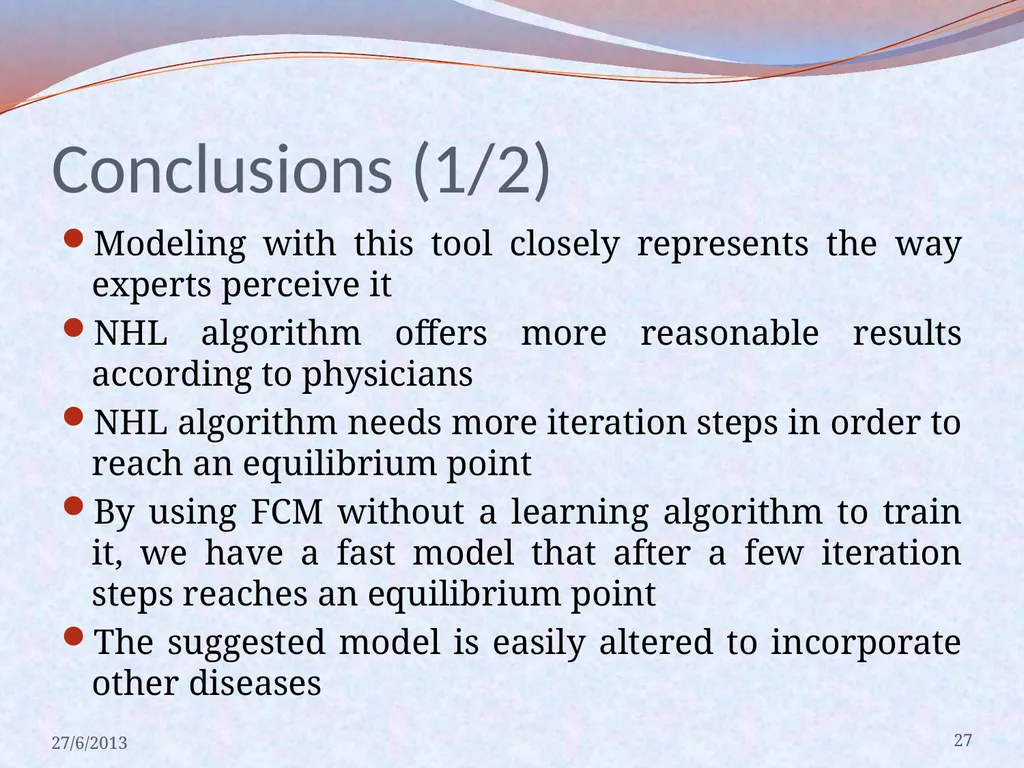
slide27. Conclusions (1/2) Modeling with this tool closely represents the way experts perceive it
NHL algorithm offers more reasonable results according to physicians
NHL algorithm needs more iteration steps in order to reach an equilibrium point
By using FCM without a learning algorithm to train it, we have a fast model that after a few iteration steps reaches an equilibrium point
The suggested model is easily altered to incorporate other diseases 27/6/2013 27<br>
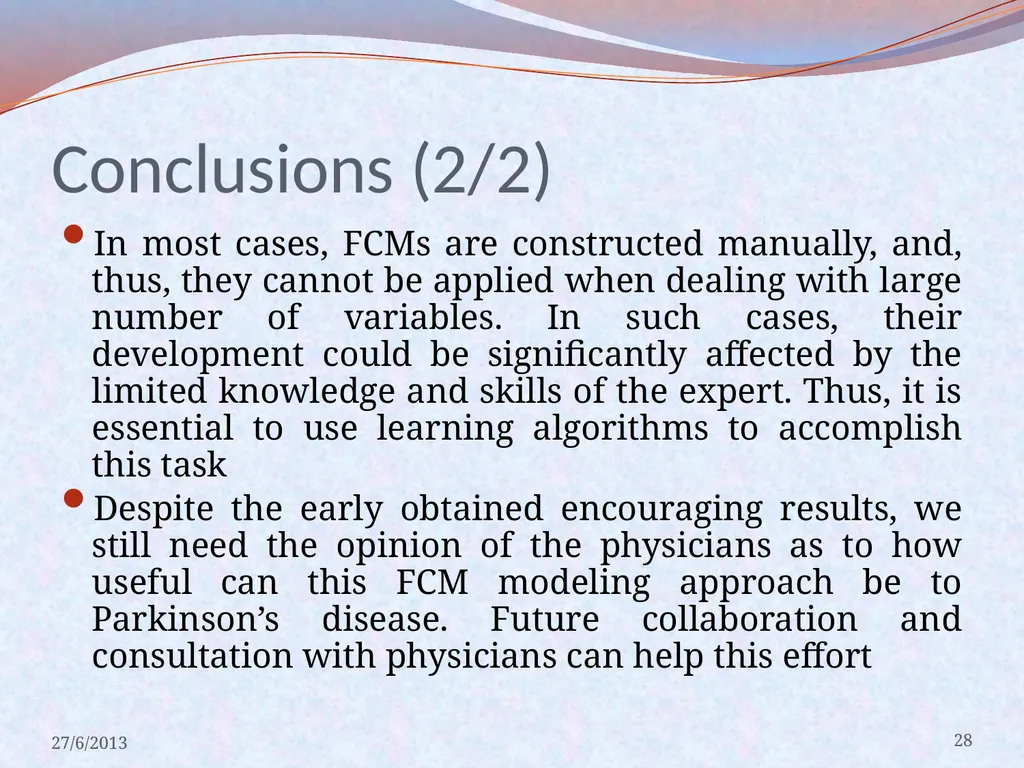
slide28. Conclusions (2/2) In most cases, FCMs are constructed manually, and, thus, they cannot be applied when dealing with large number of variables. In such cases, their development could be significantly affected by the limited knowledge and skills of the expert. Thus, it is essential to use learning algorithms to accomplish this task
Despite the early obtained encouraging results, we still need the opinion of the physicians as to how useful can this FCM modeling approach be to Parkinson’s disease. Future collaboration and consultation with physicians can help this effort 27/6/2013 28<br>
slide29. Thank you for your attention Professor Peter P. Groumpos
Email: groumpos@ece.upatras.gr PhD Student Antigoni P. Anninou
Email: anninou@ece.upatras.gr 27/6/2013 29<br>

Professor Peter P. Groumpos
Laboratory for Automation and Robotics
Department of Electrical and Computer Engineering 21st Mediterranean Conference on Control and Automation
MED’13 27/6/2013 1<br>
slide2. Outline Problem Formulation
Fuzzy Cognitive Maps
Non-Linear Hebbian Learning
Decision Support System in Parkinson’s Disease
Simulation Results
Conclusions 27/6/2013 2<br>
slide3. Aim Construction and training of a Fuzzy Cognitive Map (FCM) in modeling a Decision Support System, to help in diagnosis concerning the disease of Parkinson 27/6/2013 3<br>
slide4. Fuzzy Cognitive Maps (FCM) (1/5) Modeling method for describing particular domains
Fyzzy-graph structures for representing causal reasoning 27/6/2013 4<br>
slide5. Fuzzy Cognitive Maps (2/5) Nodes: Represent the system’s concepts or variables
Arrows: Interconnection between nodes. Show the cause-effect relationship between them.
W: Interrelationship between two nodes:
W>0 positive causality
W<0 negative causality
W=0 no relationship 27/6/2013 5<br>
slide6. Fuzzy Cognitive Maps (3/5) The value of each concept at every simulation step is calculated, computing the influence of the interconnected concepts to the specific concept, by applying the following calculation rule: 27/6/2013 6<br>
slide7. Fuzzy Cognitive Maps (4/5) Ai(k+1) : the value of the concept Ci at the iteration step k+1
Ai(k): the value of the concept Cj at the iteration step k
Wij : the weight of interconnection from concept Ci to concept Cj
k1: the influence of the interconnected concepts in the configuration of the new value of the concept Ai
k2: the proportion of the contribution of the previous value of the concept in the computation of the new value
f : the sigmoid function 27/6/2013 7<br>
slide8. Fuzzy Cognitive Maps (5/5) Weaknesses
Direct dependence of the initial knowledge of experts
Convergence to undesirable situations
Solution
Training the FCM 27/6/2013 8<br>
slide9. Non-Linear Hebbian Learning (NHL) (1/2) Increase the effectiveness of FCMs and their implementation in real problems
Update weights associated only with edges that are initially suggested by experts
All concepts in FCM model are triggered at each iteration step and change their values
Output concepts → Desired Output Concepts (DOCs) 27/6/2013 9<br>
slide10. Non-Linear Hebbian Learning (2/2) Algorithm that modifies the weights:
h:learning parameter
g: weight reduction parameter
Nodes are triggered simultaneously and interact in the same iteration step, and their values updated through this process of interaction 27/6/2013 10<br>
slide11. Criteria 1st : Minimization of the objective function F
DOCi: the value of the output concept i as indicated in each iteration
Ti: the mean target value of the concept DOCi
m: the number of the desired output nodes
2nd : Minimization of the variation of two subsequent values of DOCs
F2 = | DOCi (k+1)- DOCi (k) | 27/6/2013 11<br>
slide12. NHL Algorithm Read input state A0 and initial weight matrix W0
Repeat for each iteration step k
- Calculate Ai according to (1)
- Update Wij(k) according to (3)
- Calculate the two criterion functions
Repeat until the termination conditions are met
Return the final weights Wfinal and concept values in convergence region 27/6/2013 12<br>
slide13. Schematic Representation of NHL algorithm 27/6/2013 13<br>
slide14. NHL Parameters The parameters arise from trials and experiments
0<h<0.1
0.9<g<1 27/6/2013 14<br>
slide15. Decision Support System Definition: Interactive computer – based support system for making decisions in any complex system, when individuals or a team of people are trying to solve unstructured problems on an uncertain environment
Aim: Reach acceptable and realistic decisions
Methodology: Exploitation of experts’ experience 27/6/2013 15<br>
slide16. Why to model Decision Support Systems with FCMs High amount of data and information from interdisciplinary sources
Information may be vague or missing
Procedure is complex
Many factors may be complementary, contradictory or competitive 27/6/2013 16<br>
slide17. Decision Making Support System in Parkinson’s Disease (1/2) Concepts:
C1: Body Bradykinesia
C2: Rigidity
C3: Postural Instability
C4: Movement of upper limbs
C5: Gait
C6: Tremor
C7: Stage of Parkinson’s disease –five stages (output) 27/6/2013 17<br>
slide18. Decision Making Support System 27/6/2013 18<br>
slide19. The Fuzzy Cognitive Map Model 27/6/2013 19<br>
slide20. Simulation Results 1st Scenario:
Suppose that the physician decided as initial values of the inputs the following: After COA defuzzyfication method the initial values for the concepts would be:
A(0)=[0.75 0.75 0.5 0.5 0.75 1 1] 27/6/2013 20<br>
slide21. Subsequent values of concepts till convergence 27/6/2013 21<br>
slide22. Output Without the learning algorithm
Patient Stage 2
NHL Algorithm
Patient Stage 3 27/6/2013 22<br>
slide23. 2nd Scenario: After COA defuzzyfication method the initial values for the concepts would be:
A(0)=[0.75 0.75 0.5 0.5 0.75 1 1] 27/6/2013 23<br>
slide24. Subsequent values of concepts till convergence 27/6/2013 24<br>
slide25. Output Without the learning algorithm
Patient Stage 2
NHL Algorithm
Patient Stage 1 27/6/2013 25<br>
slide26. Results Weight matrices influence the result
Easy to use the proposed software tool
Without the learning algorithm:
Few recursive steps (until 9 steps)
Fast diagnosis
Convergence to undesired equilibrium points
Demands training
NHL Algorithm:
Much more recursive steps
Difficulty and many trials in order to find the right parameters h and g
Equilibrium points closer to the reality 27/6/2013 26<br>
slide27. Conclusions (1/2) Modeling with this tool closely represents the way experts perceive it
NHL algorithm offers more reasonable results according to physicians
NHL algorithm needs more iteration steps in order to reach an equilibrium point
By using FCM without a learning algorithm to train it, we have a fast model that after a few iteration steps reaches an equilibrium point
The suggested model is easily altered to incorporate other diseases 27/6/2013 27<br>
slide28. Conclusions (2/2) In most cases, FCMs are constructed manually, and, thus, they cannot be applied when dealing with large number of variables. In such cases, their development could be significantly affected by the limited knowledge and skills of the expert. Thus, it is essential to use learning algorithms to accomplish this task
Despite the early obtained encouraging results, we still need the opinion of the physicians as to how useful can this FCM modeling approach be to Parkinson’s disease. Future collaboration and consultation with physicians can help this effort 27/6/2013 28<br>
slide29. Thank you for your attention Professor Peter P. Groumpos
Email: groumpos@ece.upatras.gr PhD Student Antigoni P. Anninou
Email: anninou@ece.upatras.gr 27/6/2013 29<br>