Nonelectrolytes Assistant Prof Dr. Fouad Alsaady Physical Properties of Substances The physical properties of substances can be classified as colligative, additive, and constitutive. Colligative properties depend mainly on the number of
"Nonelectrolytes Assistant Prof Dr. Fouad Alsaady" is the property of its rightful owner. Permission is granted to
download and print the materials on this website for personal, non-commercial use only, and to display it
on your personal computer provided you do not modify the materials and that you retain all copyright
notices contained in the materials. By downloading content from our website, you accept the terms of this
agreement.
Presentation Transcript
01
Nonelectrolytes Assistant Prof Dr. Fouad Alsaady<br>
02
Physical Properties of Substances The physical properties of substances can be classified as colligative, additive, and constitutive.
Colligative properties depend mainly on the number of particles in a solution.
The colligative properties of solutions are osmotic pressure, vapor pressure lowering, freezing point depression, and boiling point elevation.
The values of the colligative properties are approximately the same for equal concentrations of different nonelectrolytes in solution regardless of the species or chemical nature of the constituents.<br>
03
In considering the colligative properties of solid-in-liquid solutions, it is assumed that the solute is nonvolatile and that the pressure of the vapor above the solution is provided entirely by the solvent.
Additive properties depend on the total contribution of the atoms in the molecule or on the sum of the properties of the constituents in a solution. An example of an additive property of a compound is the molecular weight, that is, the sum of the masses of the constituent atoms.<br>
04
Constitutive properties depend on the arrangement and to a lesser extent on the number and kind of atoms within a molecule.
Many physical properties may be partly additive and partly constitutive.
The refraction of light, in part constitutive and in part additive properties;<br>
05
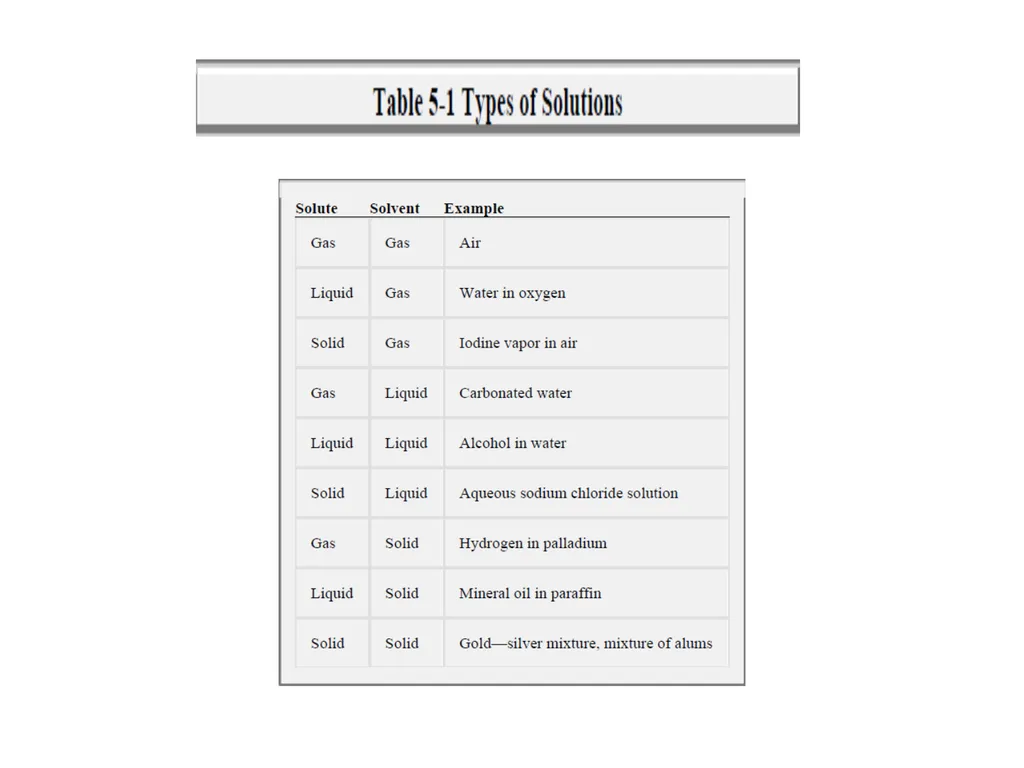
Types of Solutions A solution can be classified according to the states in which the solute and solvent occur, and because three states of matter (gas, liquid, and crystalline solid) exist, nine types of homogeneous mixtures of solute and solvent are possible.<br>
06
The solutes (whether gases, liquids, or solids) are divided into two main classes: nonelectrolytes and electrolytes.
Nonelectrolytes are substances that do not ionize when dissolved in water and therefore do not conduct an electric current through the solution.
Examples of nonelectrolytes are sucrose, glycerin, naphthalene, and urea.
Electrolytes are substances that form ions in solution, conduct electric current,
Examples of electrolytes are hydrochloric acid, sodium sulfate, ephedrine, and phenobarbital.<br>
07
Electrolytes may be subdivided further into strong electrolytes and weak electrolytes depending on whether the substance is completely or only partly ionized in water. Hydrochloric acid and sodium sulfate are strong electrolytes, whereas ephedrine and phenobarbital are weak electrolytes.<br>
08
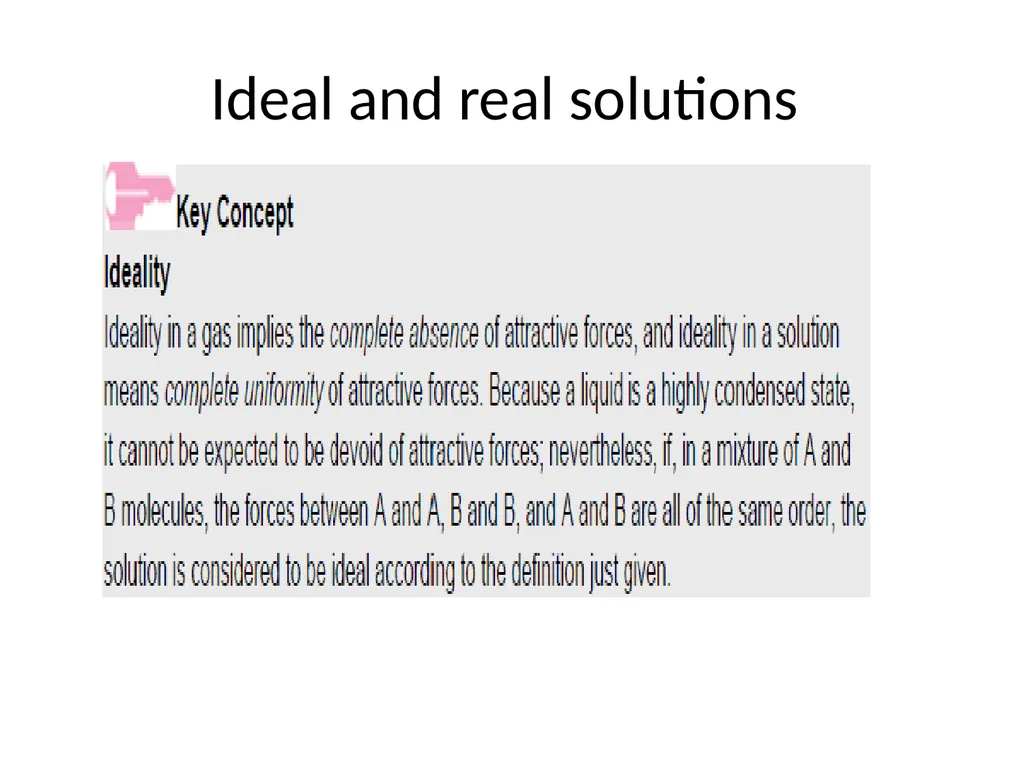
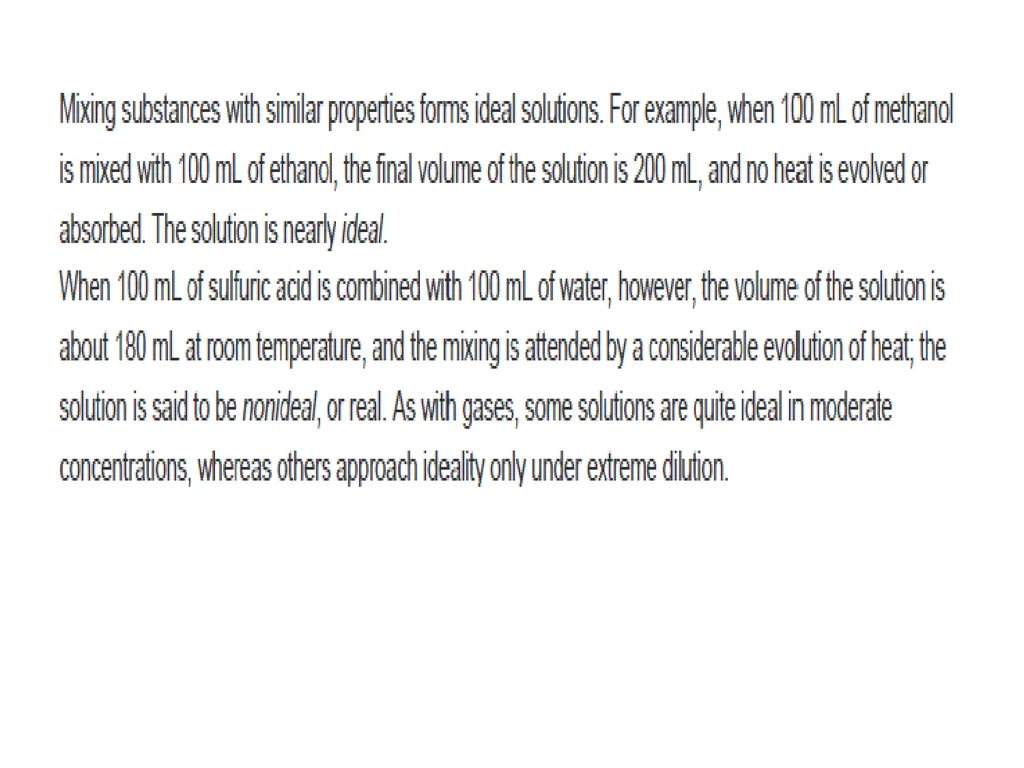
Ideal and real solutions<br>
09
No heat evolved or absorbed during mixing process.
The final volume represents additive property of the individual components.<br>