
nOPV2 Introduction Crisis Communications Planning
OM
Published · 36 slides · 0 views

1 / 1



Description
nOPV2 Introduction Crisis Communications Planning Toolkit This document is designed as a practical planning tool to help communications teams in nOPV2 rollout countries anticipate, assess, and respond to crises that could arise as part of
Related Topics
Share
Embed code
Download this presentation From Below
"nOPV2 Introduction Crisis Communications Planning" is the property of its rightful owner. Permission is granted to download and print the materials on this website for personal, non-commercial use only, and to display it on your personal computer provided you do not modify the materials and that you retain all copyright notices contained in the materials. By downloading content from our website, you accept the terms of this agreement.
Presentation Transcript
01
nOPV2 Introduction
Crisis Communications Planning Toolkit<br>
Crisis Communications Planning Toolkit<br>
02
This document is designed as a practical planning tool to help communications teams in nOPV2 rollout countries anticipate, assess, and respond to crises that could arise as part of rollout of the vaccine.
Contents:
nOPV2 Crisis Communications: Getting Started
Crisis Communications Lifecycle
Crisis Communications Planning and Preparation
Crisis Communications Assessment and Response
Evaluation Assessment Introduction: Before You Begin<br>
Contents:
nOPV2 Crisis Communications: Getting Started
Crisis Communications Lifecycle
Crisis Communications Planning and Preparation
Crisis Communications Assessment and Response
Evaluation Assessment Introduction: Before You Begin<br>
03
nOPV2 Crisis Communications: Getting Started<br>
04
Please refer to the glossary of terms in Appendix (slide 30) as needed. Review the nOPV2 Vaccine Related Event Response Plan The VRE Response plan, required under EUL, contains everything you need to know about vaccine safety monitoring and protocols and should be taken into consideration at each step of crisis planning.
Link: Here Review the nOPV2 Crisis Communication Planning Template The nOPV2 Crisis Communications Planning Template is a checklist of required aspects of an nOPV2 crisis communications plan.
Link: here Use the nOPV2 Introduction Crisis Communications Planning Toolkit to develop your crisis communications plan The nOPV2 Introduction Crisis Communications Planning Toolkit (this document) contains practical planning tools to help you and your team develop an nOPV2 crisis communications plan and fulfill specific elements of the nOPV2 Crisis Communications Planning Template.
You are here! Review your crisis communications plan After completing step 3, revisit the VRE Response Plan and nOPV2 Crisis Communication Planning Template. Make sure you completed all the necessary steps and key elements are reflected in your crisis communications plan. Step 1 Step 2 Step 3 Step 4 Required Crisis Preparation Steps<br>
Link: Here Review the nOPV2 Crisis Communication Planning Template The nOPV2 Crisis Communications Planning Template is a checklist of required aspects of an nOPV2 crisis communications plan.
Link: here Use the nOPV2 Introduction Crisis Communications Planning Toolkit to develop your crisis communications plan The nOPV2 Introduction Crisis Communications Planning Toolkit (this document) contains practical planning tools to help you and your team develop an nOPV2 crisis communications plan and fulfill specific elements of the nOPV2 Crisis Communications Planning Template.
You are here! Review your crisis communications plan After completing step 3, revisit the VRE Response Plan and nOPV2 Crisis Communication Planning Template. Make sure you completed all the necessary steps and key elements are reflected in your crisis communications plan. Step 1 Step 2 Step 3 Step 4 Required Crisis Preparation Steps<br>
05
Crises occur as a culmination of specific, separate issues that when taken together, can limit the ability to achieve the overall objective.
Issues can include unfavorable attributes of a product, landscape factors that could impact how a product or message is received, an audience’s pre-existing understanding of a product or message, and other factors.
When many potential issues are anticipated, it is important to plan for how they could work together to culminate into a crisis. What Is a Crisis?<br>
Issues can include unfavorable attributes of a product, landscape factors that could impact how a product or message is received, an audience’s pre-existing understanding of a product or message, and other factors.
When many potential issues are anticipated, it is important to plan for how they could work together to culminate into a crisis. What Is a Crisis?<br>
06
Vaccinate children with nOPV2 to achieve 95% coverage. nOPV2 Rollout Objective<br>
07
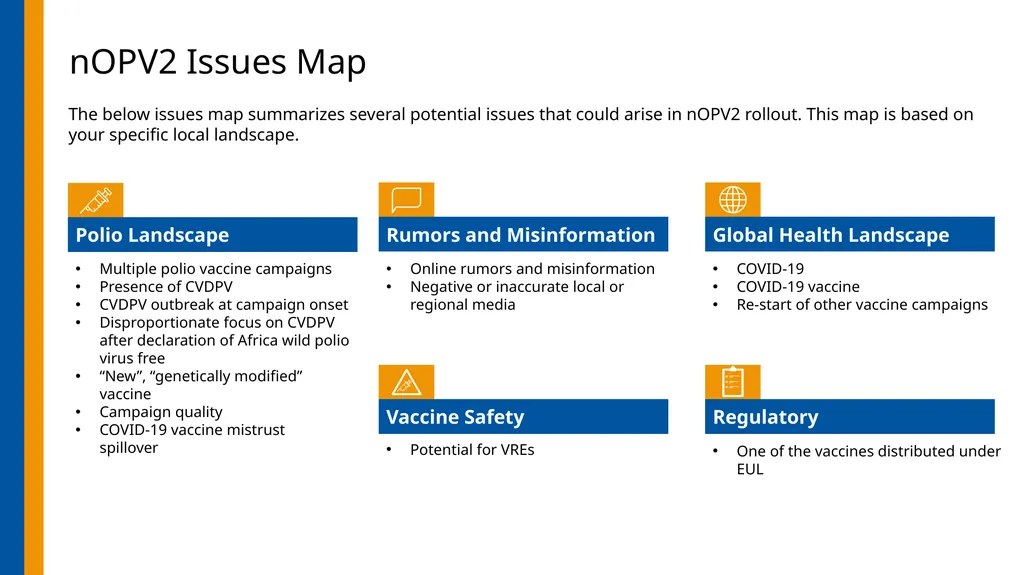
Vaccine Safety Polio Landscape The below issues map summarizes several potential issues that could arise in nOPV2 rollout. This map is based on your specific local landscape. Multiple polio vaccine campaigns
Presence of CVDPV
CVDPV outbreak at campaign onset
Disproportionate focus on CVDPV after declaration of Africa wild polio virus free
“New”, “genetically modified” vaccine
Campaign quality
COVID-19 vaccine mistrust spillover Online rumors and misinformation
Negative or inaccurate local or regional media Rumors and Misinformation Potential for VREs COVID-19
COVID-19 vaccine
Re-start of other vaccine campaigns Global Health Landscape One of the vaccines distributed under EUL Regulatory nOPV2 Issues Map<br>
Presence of CVDPV
CVDPV outbreak at campaign onset
Disproportionate focus on CVDPV after declaration of Africa wild polio virus free
“New”, “genetically modified” vaccine
Campaign quality
COVID-19 vaccine mistrust spillover Online rumors and misinformation
Negative or inaccurate local or regional media Rumors and Misinformation Potential for VREs COVID-19
COVID-19 vaccine
Re-start of other vaccine campaigns Global Health Landscape One of the vaccines distributed under EUL Regulatory nOPV2 Issues Map<br>
08
nOPV2 Potential Issues
Polio landscape
Rumors and misinformation
Vaccine safety
Global health landscape
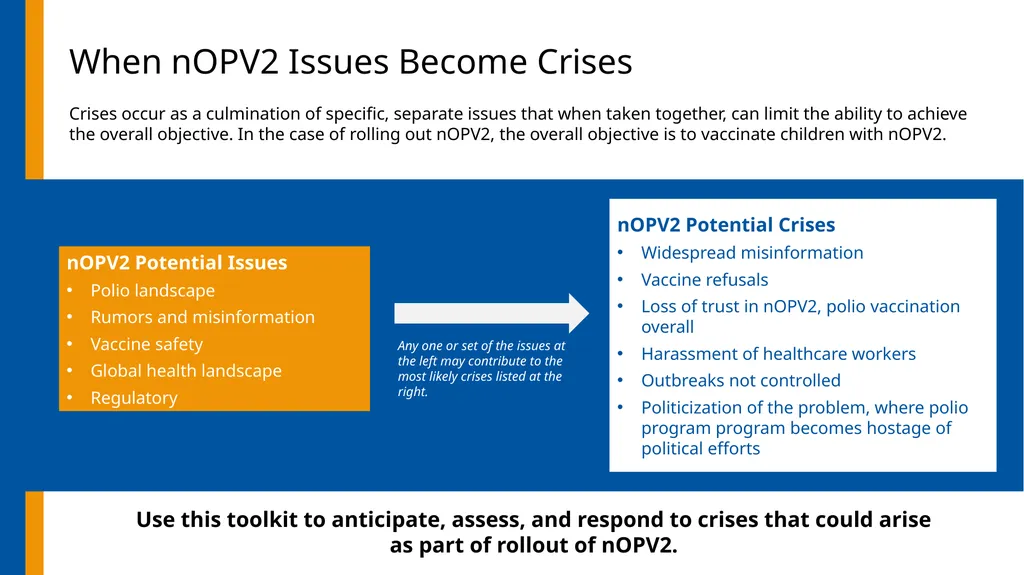
Regulatory Crises occur as a culmination of specific, separate issues that when taken together, can limit the ability to achieve the overall objective. In the case of rolling out nOPV2, the overall objective is to vaccinate children with nOPV2. nOPV2 Potential Crises
Widespread misinformation
Vaccine refusals
Loss of trust in nOPV2, polio vaccination overall
Harassment of healthcare workers
Outbreaks not controlled
Politicization of the problem, where polio program program becomes hostage of political efforts Use this toolkit to anticipate, assess, and respond to crises that could arise as part of rollout of nOPV2. Any one or set of the issues at the left may contribute to the most likely crises listed at the right. When nOPV2 Issues Become Crises<br>
Polio landscape
Rumors and misinformation
Vaccine safety
Global health landscape
Regulatory Crises occur as a culmination of specific, separate issues that when taken together, can limit the ability to achieve the overall objective. In the case of rolling out nOPV2, the overall objective is to vaccinate children with nOPV2. nOPV2 Potential Crises
Widespread misinformation
Vaccine refusals
Loss of trust in nOPV2, polio vaccination overall
Harassment of healthcare workers
Outbreaks not controlled
Politicization of the problem, where polio program program becomes hostage of political efforts Use this toolkit to anticipate, assess, and respond to crises that could arise as part of rollout of nOPV2. Any one or set of the issues at the left may contribute to the most likely crises listed at the right. When nOPV2 Issues Become Crises<br>
09
Crisis Communications Lifecycle<br>
10
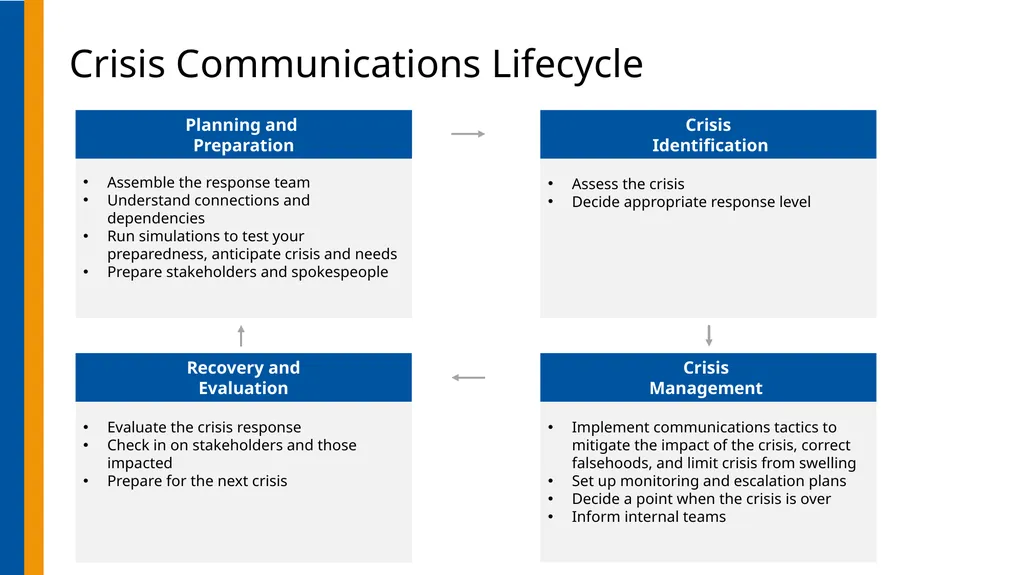
Implement communications tactics to mitigate the impact of the crisis, correct falsehoods, and limit crisis from swelling
Set up monitoring and escalation plans
Decide a point when the crisis is over
Inform internal teams Crisis
Identification Crisis
Management Recovery and
Evaluation Planning and
Preparation Assemble the response team
Understand connections and dependencies
Run simulations to test your preparedness, anticipate crisis and needs
Prepare stakeholders and spokespeople Assess the crisis
Decide appropriate response level Evaluate the crisis response
Check in on stakeholders and those impacted
Prepare for the next crisis Crisis Communications Lifecycle<br>
Set up monitoring and escalation plans
Decide a point when the crisis is over
Inform internal teams Crisis
Identification Crisis
Management Recovery and
Evaluation Planning and
Preparation Assemble the response team
Understand connections and dependencies
Run simulations to test your preparedness, anticipate crisis and needs
Prepare stakeholders and spokespeople Assess the crisis
Decide appropriate response level Evaluate the crisis response
Check in on stakeholders and those impacted
Prepare for the next crisis Crisis Communications Lifecycle<br>
11
Crisis Communications Planning and Preparation<br>
12
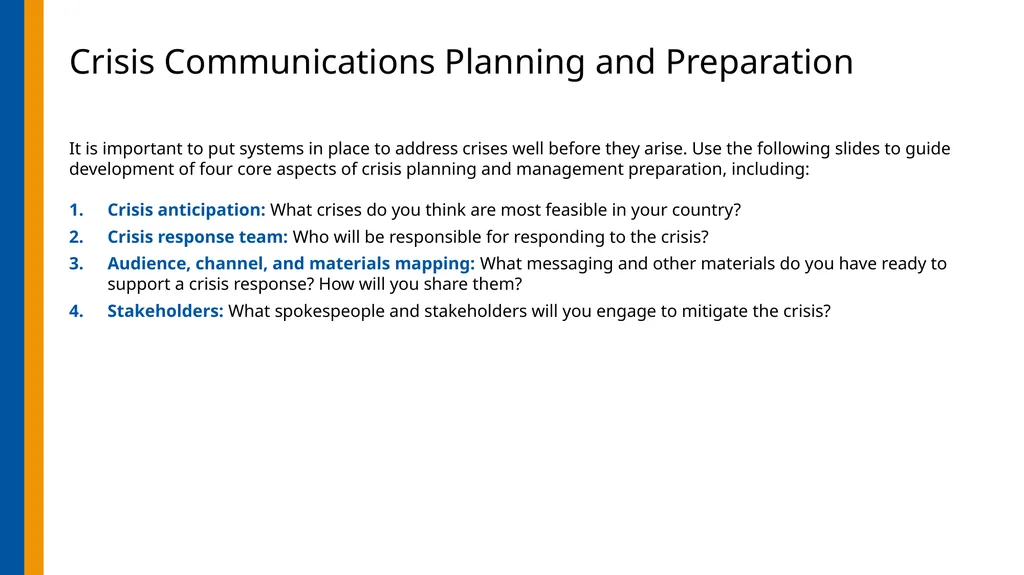
Crisis Communications Planning and Preparation It is important to put systems in place to address crises well before they arise. Use the following slides to guide development of four core aspects of crisis planning and management preparation, including:
Crisis anticipation: What crises do you think are most feasible in your country?
Crisis response team: Who will be responsible for responding to the crisis?
Audience, channel, and materials mapping: What messaging and other materials do you have ready to support a crisis response? How will you share them?
Stakeholders: What spokespeople and stakeholders will you engage to mitigate the crisis?<br>
Crisis anticipation: What crises do you think are most feasible in your country?
Crisis response team: Who will be responsible for responding to the crisis?
Audience, channel, and materials mapping: What messaging and other materials do you have ready to support a crisis response? How will you share them?
Stakeholders: What spokespeople and stakeholders will you engage to mitigate the crisis?<br>
13
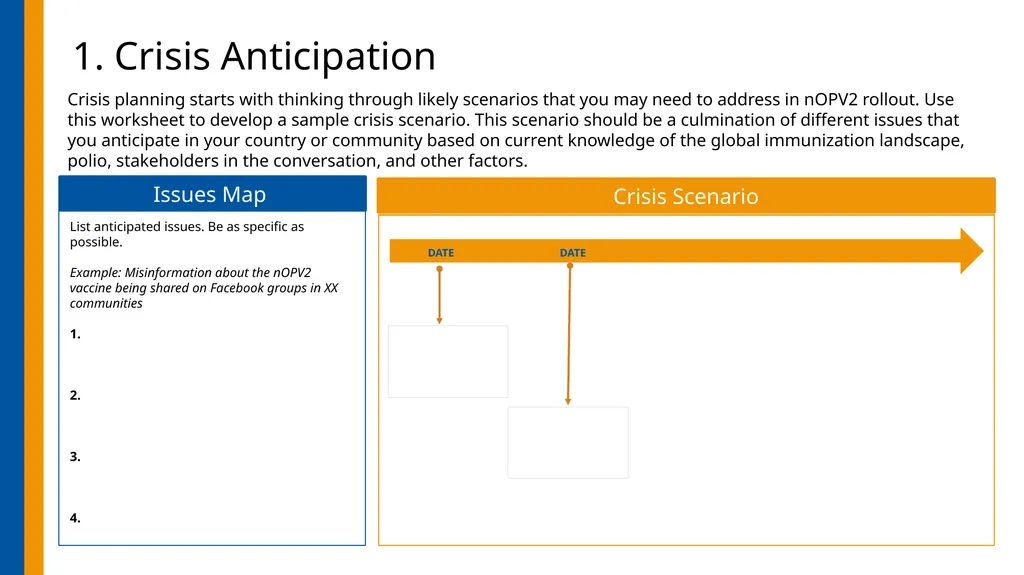
Crisis planning starts with thinking through likely scenarios that you may need to address in nOPV2 rollout. Use this worksheet to develop a sample crisis scenario. This scenario should be a culmination of different issues that you anticipate in your country or community based on current knowledge of the global immunization landscape, polio, stakeholders in the conversation, and other factors. 1. Crisis Anticipation Issues Map Crisis Scenario List anticipated issues. Be as specific as possible.
Example: Misinformation about the nOPV2 vaccine being shared on Facebook groups in XX communities
1.
2.
3.
4. DATE DATE<br>
Example: Misinformation about the nOPV2 vaccine being shared on Facebook groups in XX communities
1.
2.
3.
4. DATE DATE<br>
14
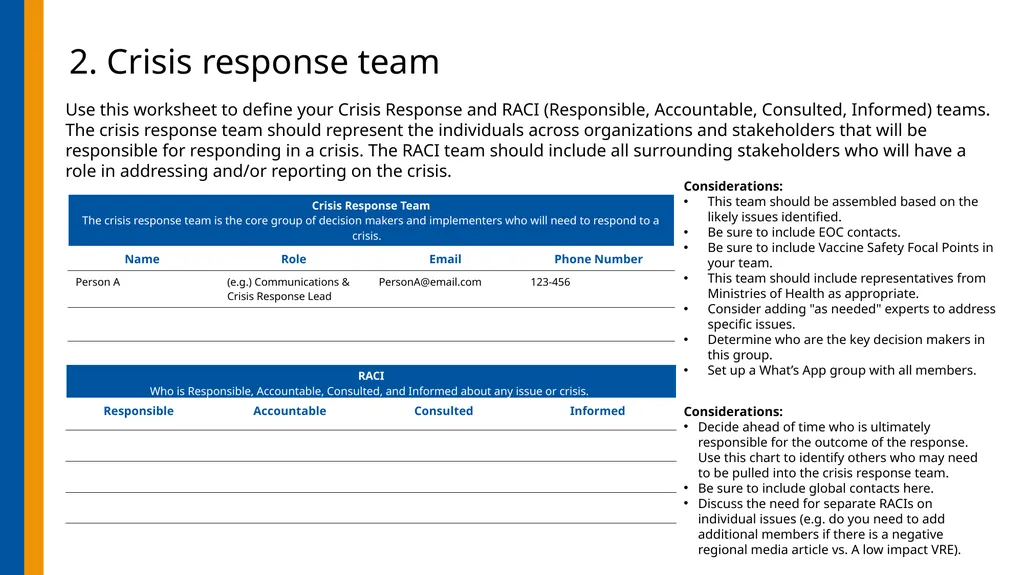
Considerations:
This team should be assembled based on the likely issues identified.
Be sure to include EOC contacts.
Be sure to include Vaccine Safety Focal Points in your team.
This team should include representatives from Ministries of Health as appropriate.
Consider adding "as needed" experts to address specific issues.
Determine who are the key decision makers in this group.
Set up a What’s App group with all members. Considerations:
Decide ahead of time who is ultimately responsible for the outcome of the response. Use this chart to identify others who may need to be pulled into the crisis response team.
Be sure to include global contacts here.
Discuss the need for separate RACIs on individual issues (e.g. do you need to add additional members if there is a negative regional media article vs. A low impact VRE). Use this worksheet to define your Crisis Response and RACI (Responsible, Accountable, Consulted, Informed) teams. The crisis response team should represent the individuals across organizations and stakeholders that will be responsible for responding in a crisis. The RACI team should include all surrounding stakeholders who will have a role in addressing and/or reporting on the crisis. 2. Crisis response team<br>
This team should be assembled based on the likely issues identified.
Be sure to include EOC contacts.
Be sure to include Vaccine Safety Focal Points in your team.
This team should include representatives from Ministries of Health as appropriate.
Consider adding "as needed" experts to address specific issues.
Determine who are the key decision makers in this group.
Set up a What’s App group with all members. Considerations:
Decide ahead of time who is ultimately responsible for the outcome of the response. Use this chart to identify others who may need to be pulled into the crisis response team.
Be sure to include global contacts here.
Discuss the need for separate RACIs on individual issues (e.g. do you need to add additional members if there is a negative regional media article vs. A low impact VRE). Use this worksheet to define your Crisis Response and RACI (Responsible, Accountable, Consulted, Informed) teams. The crisis response team should represent the individuals across organizations and stakeholders that will be responsible for responding in a crisis. The RACI team should include all surrounding stakeholders who will have a role in addressing and/or reporting on the crisis. 2. Crisis response team<br>
15
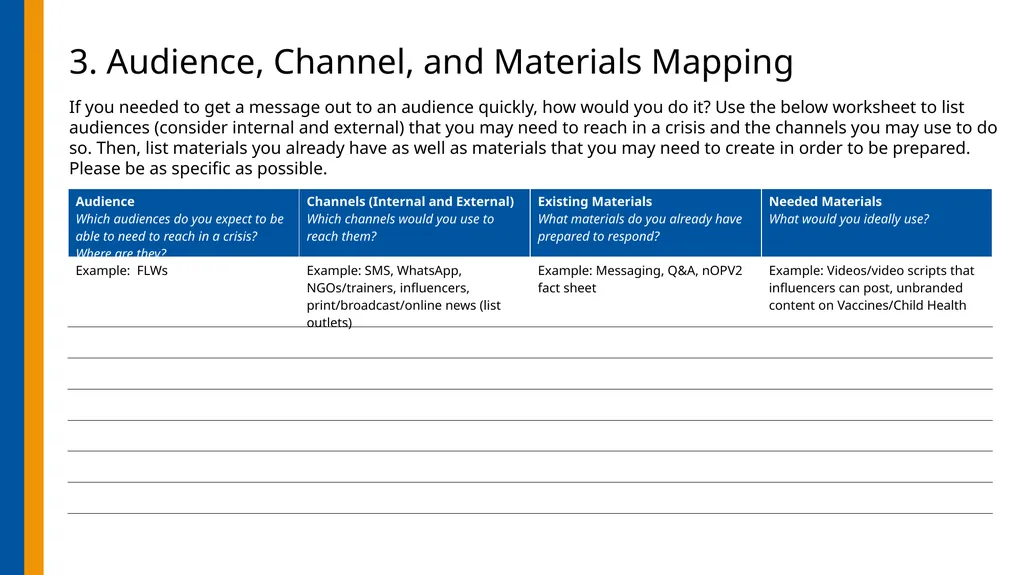
If you needed to get a message out to an audience quickly, how would you do it? Use the below worksheet to list audiences (consider internal and external) that you may need to reach in a crisis and the channels you may use to do so. Then, list materials you already have as well as materials that you may need to create in order to be prepared. Please be as specific as possible. 3. Audience, Channel, and Materials Mapping<br>
16
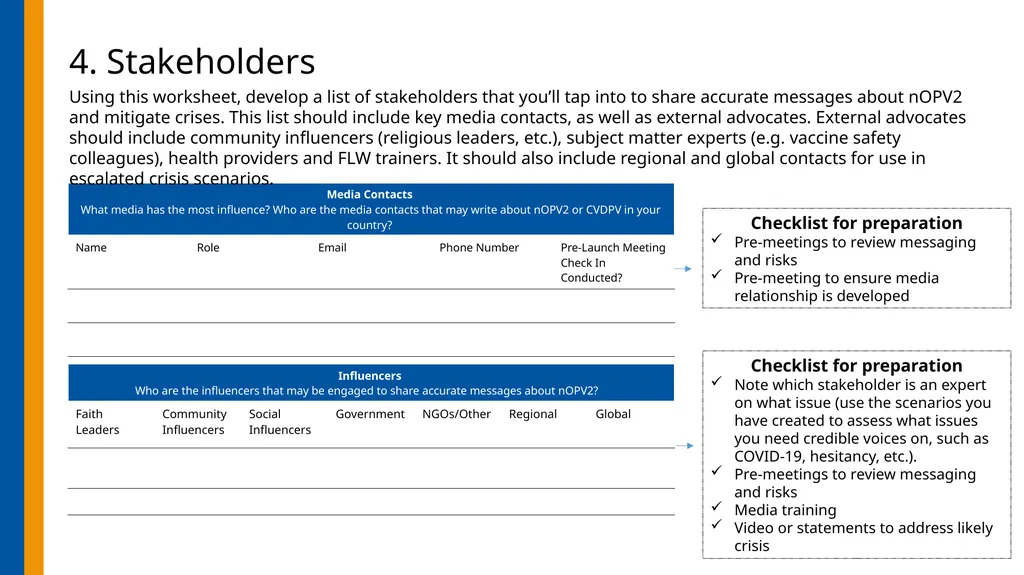
4. Stakeholders Checklist for preparation
Note which stakeholder is an expert on what issue (use the scenarios you have created to assess what issues you need credible voices on, such as COVID-19, hesitancy, etc.).
Pre-meetings to review messaging and risks
Media training
Video or statements to address likely crisis Checklist for preparation
Pre-meetings to review messaging and risks
Pre-meeting to ensure media relationship is developed Using this worksheet, develop a list of stakeholders that you’ll tap into to share accurate messages about nOPV2 and mitigate crises. This list should include key media contacts, as well as external advocates. External advocates should include community influencers (religious leaders, etc.), subject matter experts (e.g. vaccine safety colleagues), health providers and FLW trainers. It should also include regional and global contacts for use in escalated crisis scenarios.<br>
Note which stakeholder is an expert on what issue (use the scenarios you have created to assess what issues you need credible voices on, such as COVID-19, hesitancy, etc.).
Pre-meetings to review messaging and risks
Media training
Video or statements to address likely crisis Checklist for preparation
Pre-meetings to review messaging and risks
Pre-meeting to ensure media relationship is developed Using this worksheet, develop a list of stakeholders that you’ll tap into to share accurate messages about nOPV2 and mitigate crises. This list should include key media contacts, as well as external advocates. External advocates should include community influencers (religious leaders, etc.), subject matter experts (e.g. vaccine safety colleagues), health providers and FLW trainers. It should also include regional and global contacts for use in escalated crisis scenarios.<br>
17
Simulation To test your preparedness, we recommend using the tools you've created using the previous pages to do a simulated crisis response using a likely scenario in your country.
An example scenario that can be tailored to your country is available in the Appendix.<br>
An example scenario that can be tailored to your country is available in the Appendix.<br>
18
Crisis Identification & Response Tools<br>
19
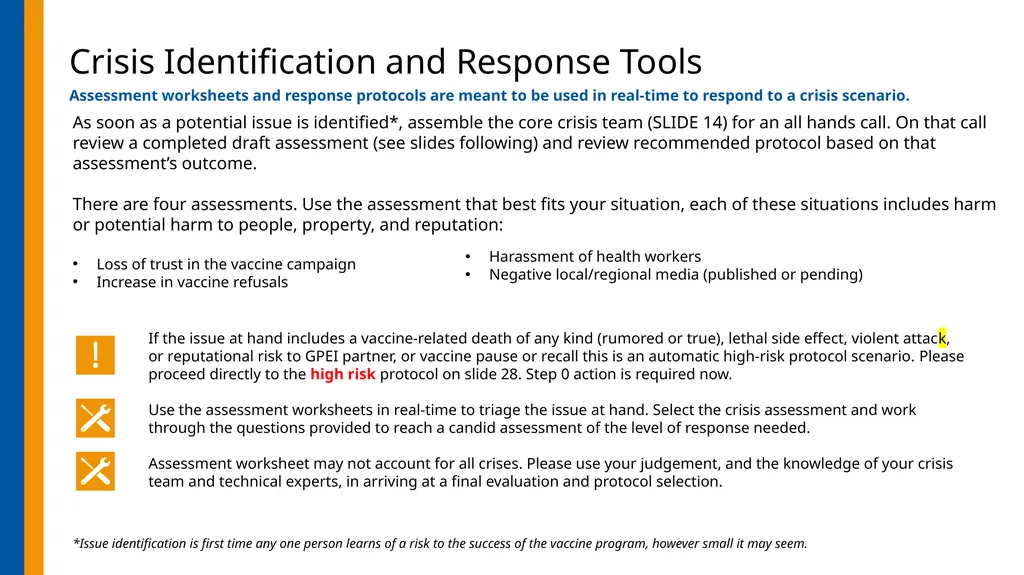
Crisis Identification and Response Tools Assessment worksheets and response protocols are meant to be used in real-time to respond to a crisis scenario. As soon as a potential issue is identified*, assemble the core crisis team (SLIDE 14) for an all hands call. On that call review a completed draft assessment (see slides following) and review recommended protocol based on that assessment’s outcome.
There are four assessments. Use the assessment that best fits your situation, each of these situations includes harm or potential harm to people, property, and reputation:
Loss of trust in the vaccine campaign
Increase in vaccine refusals If the issue at hand includes a vaccine-related death of any kind (rumored or true), lethal side effect, violent attack, or reputational risk to GPEI partner, or vaccine pause or recall this is an automatic high-risk protocol scenario. Please proceed directly to the high risk protocol on slide 28. Step 0 action is required now.
Use the assessment worksheets in real-time to triage the issue at hand. Select the crisis assessment and work through the questions provided to reach a candid assessment of the level of response needed.
Assessment worksheet may not account for all crises. Please use your judgement, and the knowledge of your crisis team and technical experts, in arriving at a final evaluation and protocol selection. *Issue identification is first time any one person learns of a risk to the success of the vaccine program, however small it may seem. Harassment of health workers
Negative local/regional media (published or pending)<br>
There are four assessments. Use the assessment that best fits your situation, each of these situations includes harm or potential harm to people, property, and reputation:
Loss of trust in the vaccine campaign
Increase in vaccine refusals If the issue at hand includes a vaccine-related death of any kind (rumored or true), lethal side effect, violent attack, or reputational risk to GPEI partner, or vaccine pause or recall this is an automatic high-risk protocol scenario. Please proceed directly to the high risk protocol on slide 28. Step 0 action is required now.
Use the assessment worksheets in real-time to triage the issue at hand. Select the crisis assessment and work through the questions provided to reach a candid assessment of the level of response needed.
Assessment worksheet may not account for all crises. Please use your judgement, and the knowledge of your crisis team and technical experts, in arriving at a final evaluation and protocol selection. *Issue identification is first time any one person learns of a risk to the success of the vaccine program, however small it may seem. Harassment of health workers
Negative local/regional media (published or pending)<br>
20
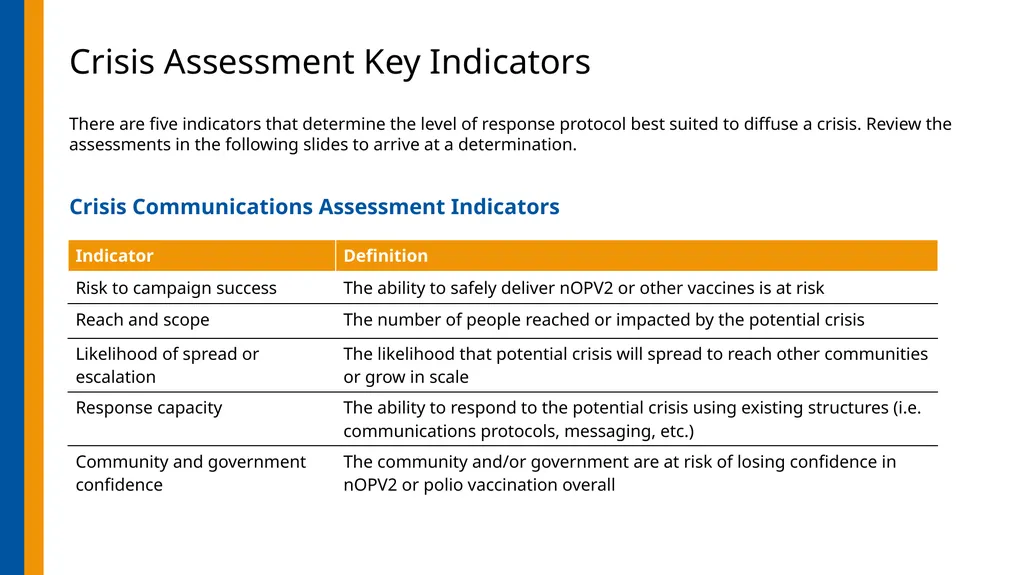
Crisis Communications Assessment Indicators There are five indicators that determine the level of response protocol best suited to diffuse a crisis. Review the assessments in the following slides to arrive at a determination. Crisis Assessment Key Indicators<br>
21
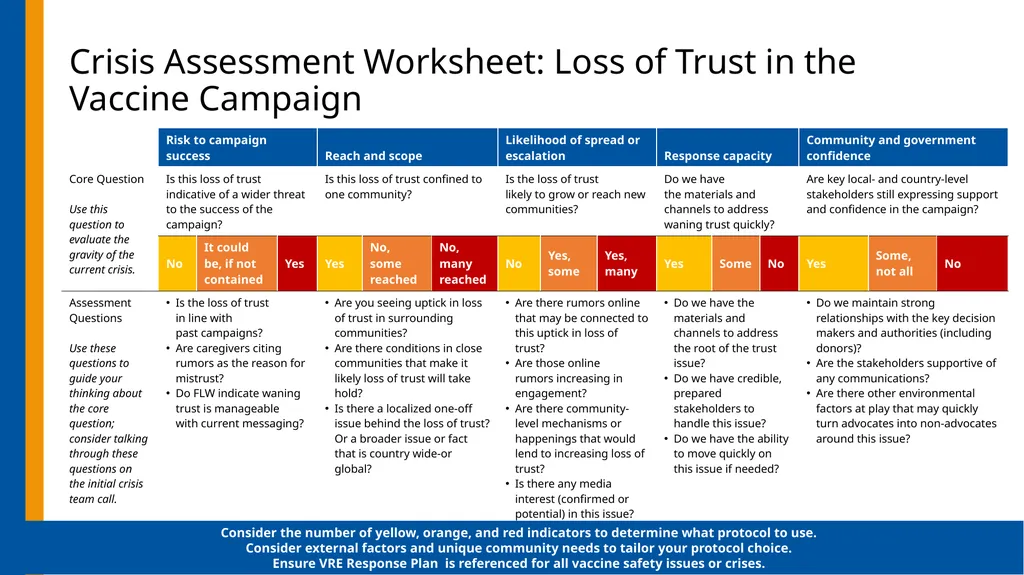
Crisis Assessment Worksheet: Loss of Trust in the Vaccine Campaign Consider the number of yellow, orange, and red indicators to determine what protocol to use.
Consider external factors and unique community needs to tailor your protocol choice.
Ensure VRE Response Plan is referenced for all vaccine safety issues or crises.<br>
Consider external factors and unique community needs to tailor your protocol choice.
Ensure VRE Response Plan is referenced for all vaccine safety issues or crises.<br>
22
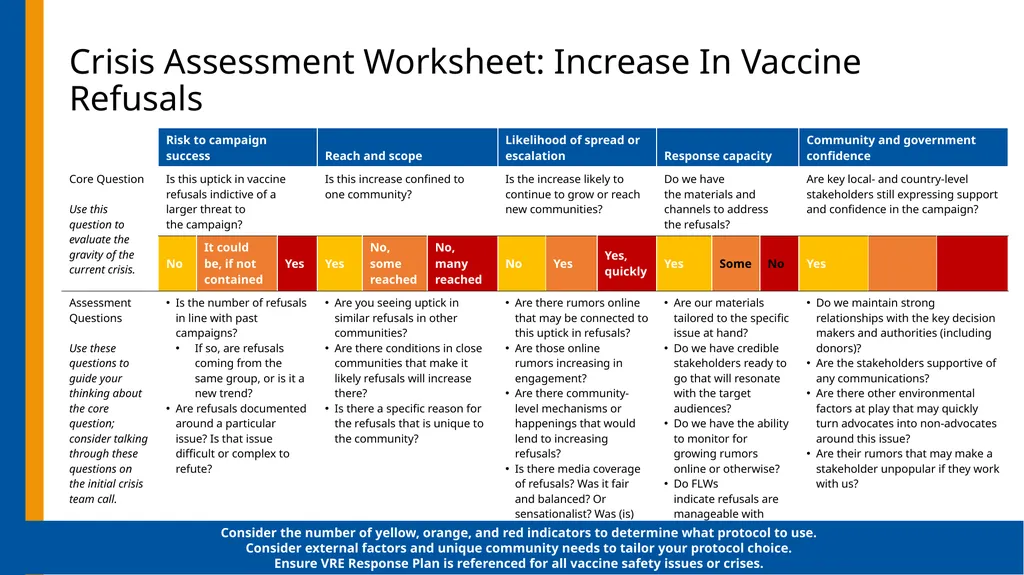
Crisis Assessment Worksheet: Increase In Vaccine Refusals Consider the number of yellow, orange, and red indicators to determine what protocol to use.
Consider external factors and unique community needs to tailor your protocol choice.
Ensure VRE Response Plan is referenced for all vaccine safety issues or crises.<br>
Consider external factors and unique community needs to tailor your protocol choice.
Ensure VRE Response Plan is referenced for all vaccine safety issues or crises.<br>
23
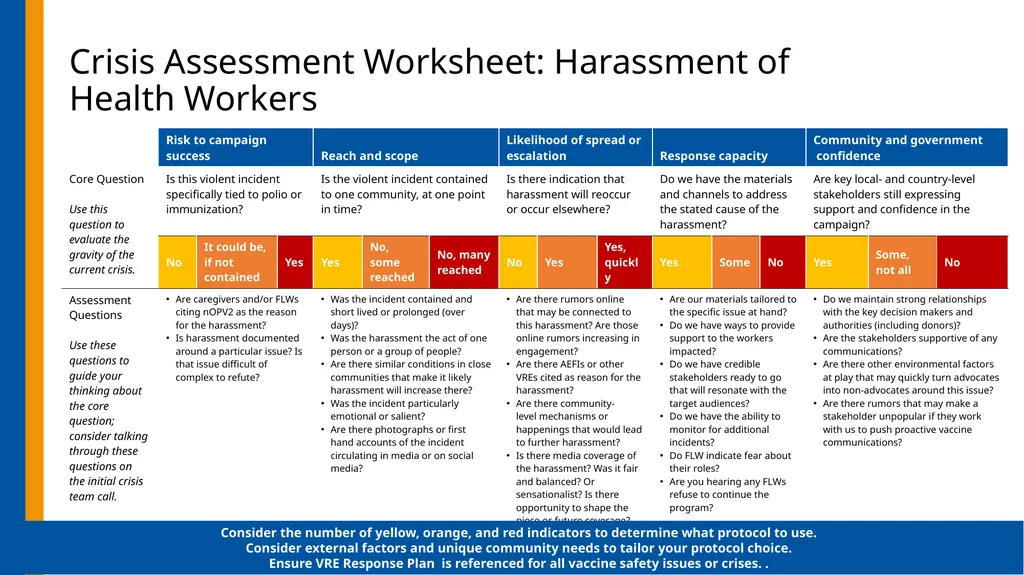
Crisis Assessment Worksheet: Harassment of Health Workers Consider the number of yellow, orange, and red indicators to determine what protocol to use.
Consider external factors and unique community needs to tailor your protocol choice.
Ensure VRE Response Plan is referenced for all vaccine safety issues or crises. .<br>
Consider external factors and unique community needs to tailor your protocol choice.
Ensure VRE Response Plan is referenced for all vaccine safety issues or crises. .<br>
24
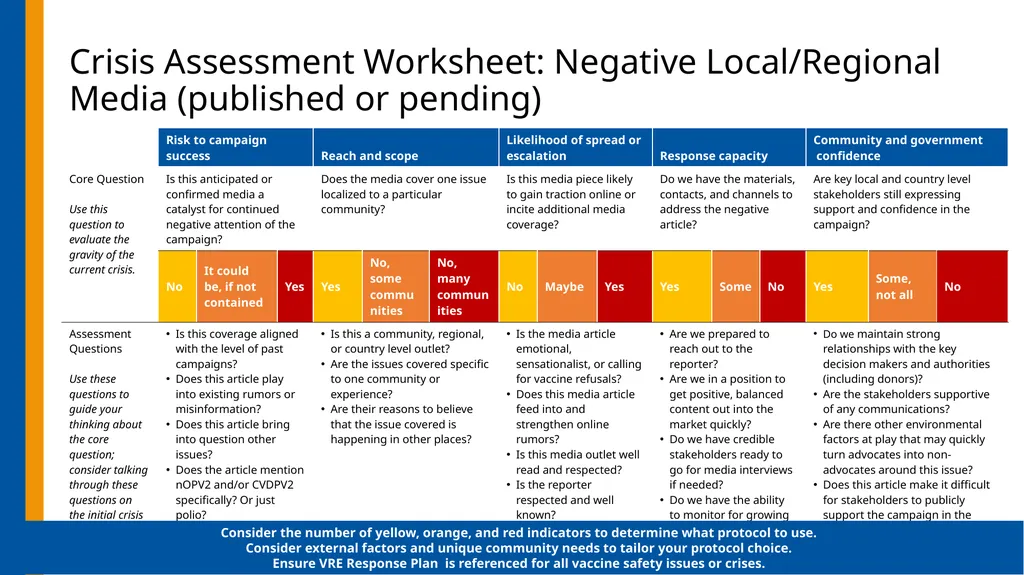
Crisis Assessment Worksheet: Negative Local/Regional Media (published or pending) Consider the number of yellow, orange, and red indicators to determine what protocol to use.
Consider external factors and unique community needs to tailor your protocol choice.
Ensure VRE Response Plan is referenced for all vaccine safety issues or crises.<br>
Consider external factors and unique community needs to tailor your protocol choice.
Ensure VRE Response Plan is referenced for all vaccine safety issues or crises.<br>
25
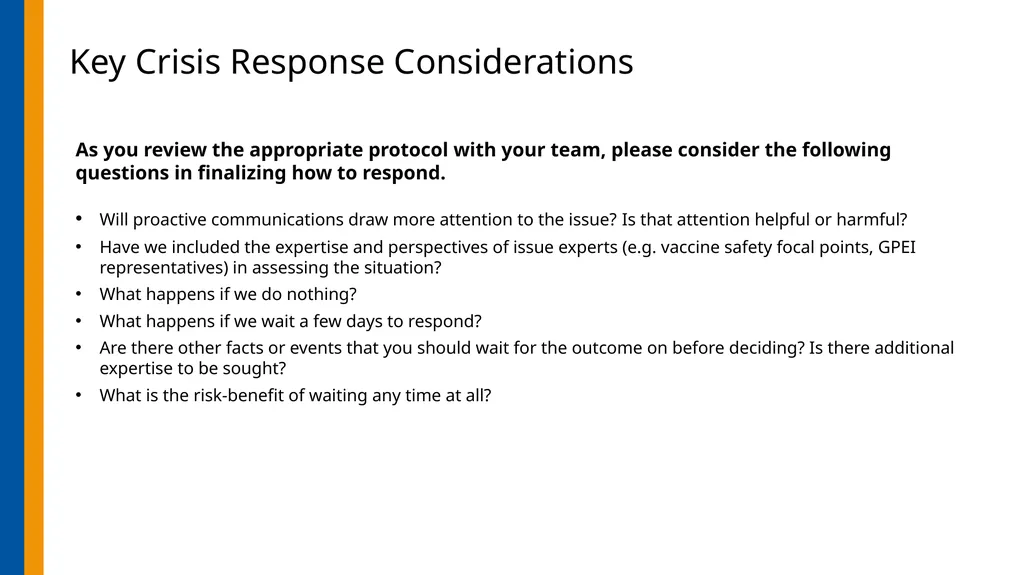
Key Crisis Response Considerations As you review the appropriate protocol with your team, please consider the following questions in finalizing how to respond.
Will proactive communications draw more attention to the issue? Is that attention helpful or harmful?
Have we included the expertise and perspectives of issue experts (e.g. vaccine safety focal points, GPEI representatives) in assessing the situation?
What happens if we do nothing?
What happens if we wait a few days to respond?
Are there other facts or events that you should wait for the outcome on before deciding? Is there additional expertise to be sought?
What is the risk-benefit of waiting any time at all?<br>
Will proactive communications draw more attention to the issue? Is that attention helpful or harmful?
Have we included the expertise and perspectives of issue experts (e.g. vaccine safety focal points, GPEI representatives) in assessing the situation?
What happens if we do nothing?
What happens if we wait a few days to respond?
Are there other facts or events that you should wait for the outcome on before deciding? Is there additional expertise to be sought?
What is the risk-benefit of waiting any time at all?<br>
26
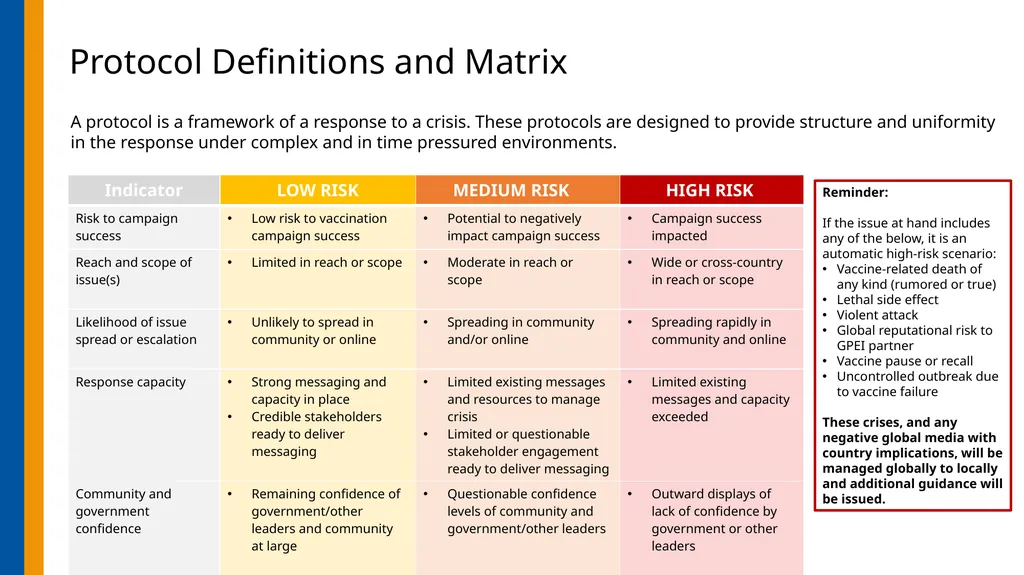
Protocol Definitions and Matrix A protocol is a framework of a response to a crisis. These protocols are designed to provide structure and uniformity in the response under complex and in time pressured environments. Reminder:
If the issue at hand includes any of the below, it is an automatic high-risk scenario:
Vaccine-related death of any kind (rumored or true)
Lethal side effect
Violent attack
Global reputational risk to GPEI partner
Vaccine pause or recall
Uncontrolled outbreak due to vaccine failure
These crises, and any negative global media with country implications, will be managed globally to locally and additional guidance will be issued.<br>
If the issue at hand includes any of the below, it is an automatic high-risk scenario:
Vaccine-related death of any kind (rumored or true)
Lethal side effect
Violent attack
Global reputational risk to GPEI partner
Vaccine pause or recall
Uncontrolled outbreak due to vaccine failure
These crises, and any negative global media with country implications, will be managed globally to locally and additional guidance will be issued.<br>
27
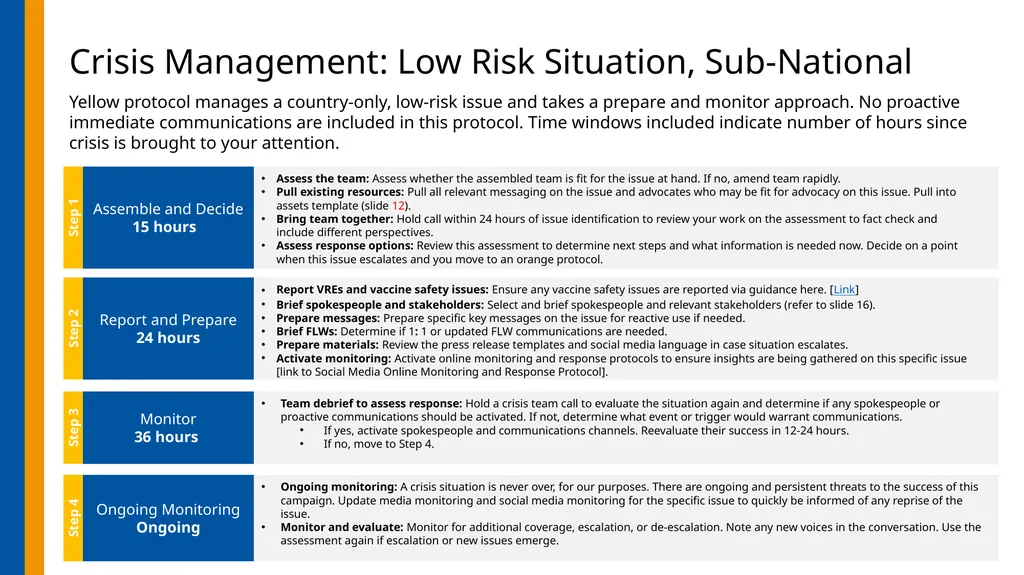
Ongoing monitoring: A crisis situation is never over, for our purposes. There are ongoing and persistent threats to the success of this campaign. Update media monitoring and social media monitoring for the specific issue to quickly be informed of any reprise of the issue.
Monitor and evaluate: Monitor for additional coverage, escalation, or de-escalation. Note any new voices in the conversation. Use the assessment again if escalation or new issues emerge. Team debrief to assess response: Hold a crisis team call to evaluate the situation again and determine if any spokespeople or proactive communications should be activated. If not, determine what event or trigger would warrant communications.
If yes, activate spokespeople and communications channels. Reevaluate their success in 12-24 hours.
If no, move to Step 4. Report VREs and vaccine safety issues: Ensure any vaccine safety issues are reported via guidance here. [Link]
Brief spokespeople and stakeholders: Select and brief spokespeople and relevant stakeholders (refer to slide 16).
Prepare messages: Prepare specific key messages on the issue for reactive use if needed.
Brief FLWs: Determine if 1: 1 or updated FLW communications are needed.
Prepare materials: Review the press release templates and social media language in case situation escalates.
Activate monitoring: Activate online monitoring and response protocols to ensure insights are being gathered on this specific issue [link to Social Media Online Monitoring and Response Protocol]. Yellow protocol manages a country-only, low-risk issue and takes a prepare and monitor approach. No proactive immediate communications are included in this protocol. Time windows included indicate number of hours since crisis is brought to your attention. Assess the team: Assess whether the assembled team is fit for the issue at hand. If no, amend team rapidly.
Pull existing resources: Pull all relevant messaging on the issue and advocates who may be fit for advocacy on this issue. Pull into assets template (slide 12).
Bring team together: Hold call within 24 hours of issue identification to review your work on the assessment to fact check and include different perspectives.
Assess response options: Review this assessment to determine next steps and what information is needed now. Decide on a point when this issue escalates and you move to an orange protocol. Crisis Management: Low Risk Situation, Sub-National Assemble and Decide
15 hours Step 1 Report and Prepare
24 hours Step 2 Monitor
36 hours Step 3 Ongoing Monitoring
Ongoing Step 4<br>
Monitor and evaluate: Monitor for additional coverage, escalation, or de-escalation. Note any new voices in the conversation. Use the assessment again if escalation or new issues emerge. Team debrief to assess response: Hold a crisis team call to evaluate the situation again and determine if any spokespeople or proactive communications should be activated. If not, determine what event or trigger would warrant communications.
If yes, activate spokespeople and communications channels. Reevaluate their success in 12-24 hours.
If no, move to Step 4. Report VREs and vaccine safety issues: Ensure any vaccine safety issues are reported via guidance here. [Link]
Brief spokespeople and stakeholders: Select and brief spokespeople and relevant stakeholders (refer to slide 16).
Prepare messages: Prepare specific key messages on the issue for reactive use if needed.
Brief FLWs: Determine if 1: 1 or updated FLW communications are needed.
Prepare materials: Review the press release templates and social media language in case situation escalates.
Activate monitoring: Activate online monitoring and response protocols to ensure insights are being gathered on this specific issue [link to Social Media Online Monitoring and Response Protocol]. Yellow protocol manages a country-only, low-risk issue and takes a prepare and monitor approach. No proactive immediate communications are included in this protocol. Time windows included indicate number of hours since crisis is brought to your attention. Assess the team: Assess whether the assembled team is fit for the issue at hand. If no, amend team rapidly.
Pull existing resources: Pull all relevant messaging on the issue and advocates who may be fit for advocacy on this issue. Pull into assets template (slide 12).
Bring team together: Hold call within 24 hours of issue identification to review your work on the assessment to fact check and include different perspectives.
Assess response options: Review this assessment to determine next steps and what information is needed now. Decide on a point when this issue escalates and you move to an orange protocol. Crisis Management: Low Risk Situation, Sub-National Assemble and Decide
15 hours Step 1 Report and Prepare
24 hours Step 2 Monitor
36 hours Step 3 Ongoing Monitoring
Ongoing Step 4<br>
28
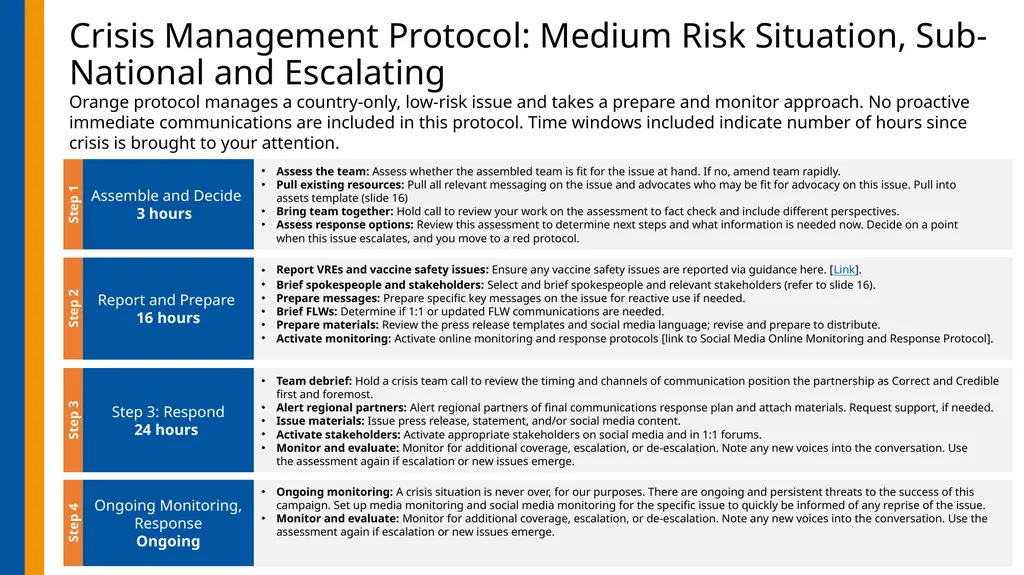
Ongoing monitoring: A crisis situation is never over, for our purposes. There are ongoing and persistent threats to the success of this campaign. Set up media monitoring and social media monitoring for the specific issue to quickly be informed of any reprise of the issue.
Monitor and evaluate: Monitor for additional coverage, escalation, or de-escalation. Note any new voices into the conversation. Use the assessment again if escalation or new issues emerge. Team debrief: Hold a crisis team call to review the timing and channels of communication position the partnership as Correct and Credible first and foremost.
Alert regional partners: Alert regional partners of final communications response plan and attach materials. Request support, if needed.
Issue materials: Issue press release, statement, and/or social media content.
Activate stakeholders: Activate appropriate stakeholders on social media and in 1:1 forums.
Monitor and evaluate: Monitor for additional coverage, escalation, or de-escalation. Note any new voices into the conversation. Use the assessment again if escalation or new issues emerge. Report VREs and vaccine safety issues: Ensure any vaccine safety issues are reported via guidance here. [Link].
Brief spokespeople and stakeholders: Select and brief spokespeople and relevant stakeholders (refer to slide 16).
Prepare messages: Prepare specific key messages on the issue for reactive use if needed.
Brief FLWs: Determine if 1:1 or updated FLW communications are needed.
Prepare materials: Review the press release templates and social media language; revise and prepare to distribute.
Activate monitoring: Activate online monitoring and response protocols [link to Social Media Online Monitoring and Response Protocol]. Assess the team: Assess whether the assembled team is fit for the issue at hand. If no, amend team rapidly.
Pull existing resources: Pull all relevant messaging on the issue and advocates who may be fit for advocacy on this issue. Pull into assets template (slide 16)
Bring team together: Hold call to review your work on the assessment to fact check and include different perspectives.
Assess response options: Review this assessment to determine next steps and what information is needed now. Decide on a point when this issue escalates, and you move to a red protocol. Orange protocol manages a country-only, low-risk issue and takes a prepare and monitor approach. No proactive immediate communications are included in this protocol. Time windows included indicate number of hours since crisis is brought to your attention. Crisis Management Protocol: Medium Risk Situation, Sub-National and Escalating Assemble and Decide
3 hours Step 1 Report and Prepare
16 hours Step 2 Step 3: Respond
24 hours Step 3 Ongoing Monitoring, Response
Ongoing Step 4<br>
Monitor and evaluate: Monitor for additional coverage, escalation, or de-escalation. Note any new voices into the conversation. Use the assessment again if escalation or new issues emerge. Team debrief: Hold a crisis team call to review the timing and channels of communication position the partnership as Correct and Credible first and foremost.
Alert regional partners: Alert regional partners of final communications response plan and attach materials. Request support, if needed.
Issue materials: Issue press release, statement, and/or social media content.
Activate stakeholders: Activate appropriate stakeholders on social media and in 1:1 forums.
Monitor and evaluate: Monitor for additional coverage, escalation, or de-escalation. Note any new voices into the conversation. Use the assessment again if escalation or new issues emerge. Report VREs and vaccine safety issues: Ensure any vaccine safety issues are reported via guidance here. [Link].
Brief spokespeople and stakeholders: Select and brief spokespeople and relevant stakeholders (refer to slide 16).
Prepare messages: Prepare specific key messages on the issue for reactive use if needed.
Brief FLWs: Determine if 1:1 or updated FLW communications are needed.
Prepare materials: Review the press release templates and social media language; revise and prepare to distribute.
Activate monitoring: Activate online monitoring and response protocols [link to Social Media Online Monitoring and Response Protocol]. Assess the team: Assess whether the assembled team is fit for the issue at hand. If no, amend team rapidly.
Pull existing resources: Pull all relevant messaging on the issue and advocates who may be fit for advocacy on this issue. Pull into assets template (slide 16)
Bring team together: Hold call to review your work on the assessment to fact check and include different perspectives.
Assess response options: Review this assessment to determine next steps and what information is needed now. Decide on a point when this issue escalates, and you move to a red protocol. Orange protocol manages a country-only, low-risk issue and takes a prepare and monitor approach. No proactive immediate communications are included in this protocol. Time windows included indicate number of hours since crisis is brought to your attention. Crisis Management Protocol: Medium Risk Situation, Sub-National and Escalating Assemble and Decide
3 hours Step 1 Report and Prepare
16 hours Step 2 Step 3: Respond
24 hours Step 3 Ongoing Monitoring, Response
Ongoing Step 4<br>
29
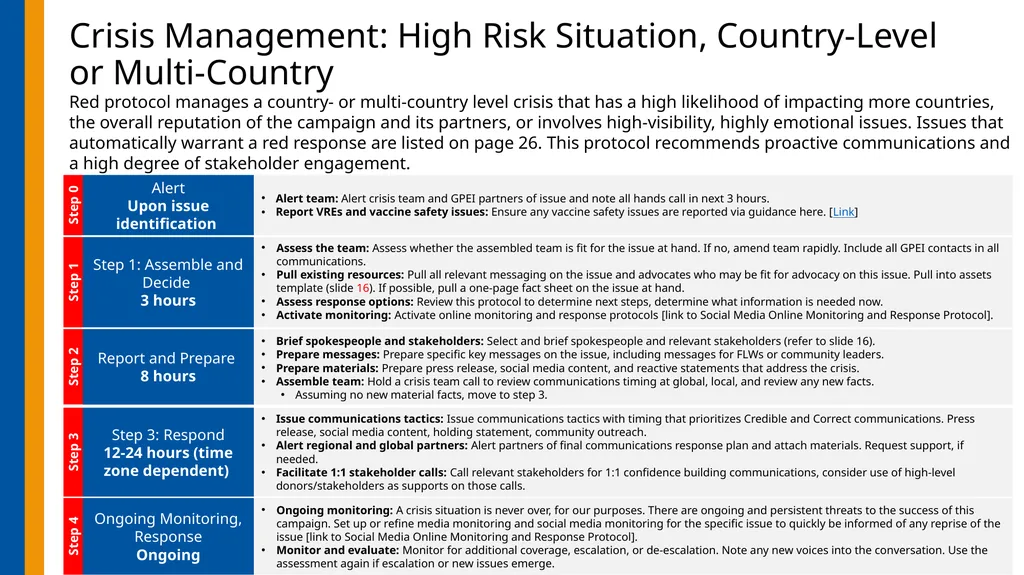
Ongoing monitoring: A crisis situation is never over, for our purposes. There are ongoing and persistent threats to the success of this campaign. Set up or refine media monitoring and social media monitoring for the specific issue to quickly be informed of any reprise of the issue [link to Social Media Online Monitoring and Response Protocol].
Monitor and evaluate: Monitor for additional coverage, escalation, or de-escalation. Note any new voices into the conversation. Use the assessment again if escalation or new issues emerge. Brief spokespeople and stakeholders: Select and brief spokespeople and relevant stakeholders (refer to slide 16).
Prepare messages: Prepare specific key messages on the issue, including messages for FLWs or community leaders.
Prepare materials: Prepare press release, social media content, and reactive statements that address the crisis.
Assemble team: Hold a crisis team call to review communications timing at global, local, and review any new facts.
Assuming no new material facts, move to step 3. Red protocol manages a country- or multi-country level crisis that has a high likelihood of impacting more countries, the overall reputation of the campaign and its partners, or involves high-visibility, highly emotional issues. Issues that automatically warrant a red response are listed on page 26. This protocol recommends proactive communications and a high degree of stakeholder engagement. Alert team: Alert crisis team and GPEI partners of issue and note all hands call in next 3 hours.
Report VREs and vaccine safety issues: Ensure any vaccine safety issues are reported via guidance here. [Link] Crisis Management: High Risk Situation, Country-Level or Multi-Country Alert
Upon issue identification Step 0 Report and Prepare
8 hours Step 2 Step 3: Respond
12-24 hours (time zone dependent) Step 3 Ongoing Monitoring, Response
Ongoing Step 4 Issue communications tactics: Issue communications tactics with timing that prioritizes Credible and Correct communications. Press release, social media content, holding statement, community outreach.
Alert regional and global partners: Alert partners of final communications response plan and attach materials. Request support, if needed.
Facilitate 1:1 stakeholder calls: Call relevant stakeholders for 1:1 confidence building communications, consider use of high-level donors/stakeholders as supports on those calls. Step 1: Assemble and Decide
3 hours Step 1 Assess the team: Assess whether the assembled team is fit for the issue at hand. If no, amend team rapidly. Include all GPEI contacts in all communications.
Pull existing resources: Pull all relevant messaging on the issue and advocates who may be fit for advocacy on this issue. Pull into assets template (slide 16). If possible, pull a one-page fact sheet on the issue at hand.
Assess response options: Review this protocol to determine next steps, determine what information is needed now.
Activate monitoring: Activate online monitoring and response protocols [link to Social Media Online Monitoring and Response Protocol].<br>
Monitor and evaluate: Monitor for additional coverage, escalation, or de-escalation. Note any new voices into the conversation. Use the assessment again if escalation or new issues emerge. Brief spokespeople and stakeholders: Select and brief spokespeople and relevant stakeholders (refer to slide 16).
Prepare messages: Prepare specific key messages on the issue, including messages for FLWs or community leaders.
Prepare materials: Prepare press release, social media content, and reactive statements that address the crisis.
Assemble team: Hold a crisis team call to review communications timing at global, local, and review any new facts.
Assuming no new material facts, move to step 3. Red protocol manages a country- or multi-country level crisis that has a high likelihood of impacting more countries, the overall reputation of the campaign and its partners, or involves high-visibility, highly emotional issues. Issues that automatically warrant a red response are listed on page 26. This protocol recommends proactive communications and a high degree of stakeholder engagement. Alert team: Alert crisis team and GPEI partners of issue and note all hands call in next 3 hours.
Report VREs and vaccine safety issues: Ensure any vaccine safety issues are reported via guidance here. [Link] Crisis Management: High Risk Situation, Country-Level or Multi-Country Alert
Upon issue identification Step 0 Report and Prepare
8 hours Step 2 Step 3: Respond
12-24 hours (time zone dependent) Step 3 Ongoing Monitoring, Response
Ongoing Step 4 Issue communications tactics: Issue communications tactics with timing that prioritizes Credible and Correct communications. Press release, social media content, holding statement, community outreach.
Alert regional and global partners: Alert partners of final communications response plan and attach materials. Request support, if needed.
Facilitate 1:1 stakeholder calls: Call relevant stakeholders for 1:1 confidence building communications, consider use of high-level donors/stakeholders as supports on those calls. Step 1: Assemble and Decide
3 hours Step 1 Assess the team: Assess whether the assembled team is fit for the issue at hand. If no, amend team rapidly. Include all GPEI contacts in all communications.
Pull existing resources: Pull all relevant messaging on the issue and advocates who may be fit for advocacy on this issue. Pull into assets template (slide 16). If possible, pull a one-page fact sheet on the issue at hand.
Assess response options: Review this protocol to determine next steps, determine what information is needed now.
Activate monitoring: Activate online monitoring and response protocols [link to Social Media Online Monitoring and Response Protocol].<br>
30
Recovery Evaluation<br>
31
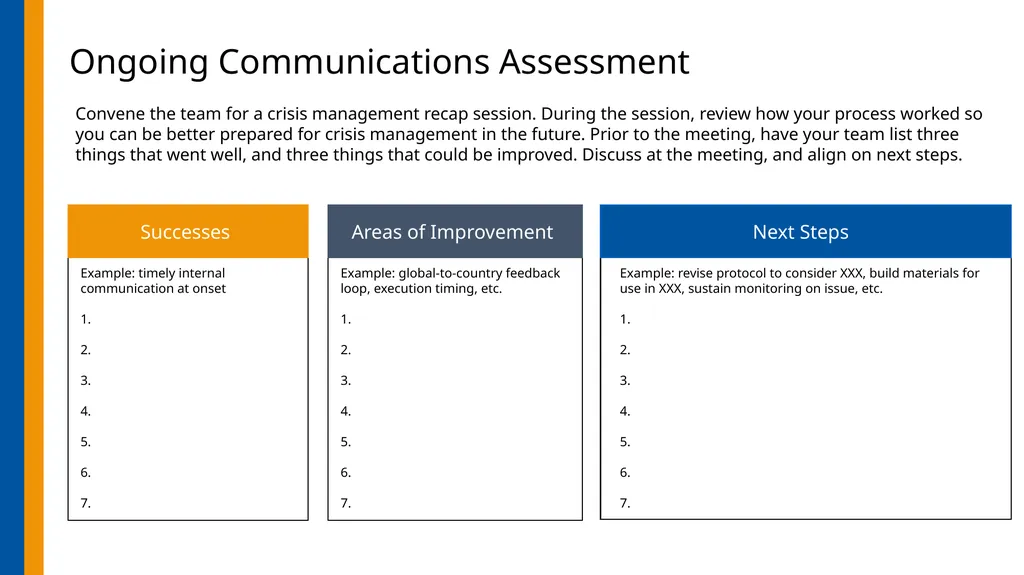
Successes Next Steps Convene the team for a crisis management recap session. During the session, review how your process worked so you can be better prepared for crisis management in the future. Prior to the meeting, have your team list three things that went well, and three things that could be improved. Discuss at the meeting, and align on next steps. Example: timely internal communication at onset
1.
2.
3.
4.
5.
6.
7. Example: global-to-country feedback loop, execution timing, etc.
1.
2.
3.
4.
5.
6.
7. Areas of Improvement Example: revise protocol to consider XXX, build materials for use in XXX, sustain monitoring on issue, etc.
1.
2.
3.
4.
5.
6.
7. Ongoing Communications Assessment<br>
1.
2.
3.
4.
5.
6.
7. Example: global-to-country feedback loop, execution timing, etc.
1.
2.
3.
4.
5.
6.
7. Areas of Improvement Example: revise protocol to consider XXX, build materials for use in XXX, sustain monitoring on issue, etc.
1.
2.
3.
4.
5.
6.
7. Ongoing Communications Assessment<br>
32
Thank You<br>
33
Appendix A
Glossary of Terms<br>
Glossary of Terms<br>
34
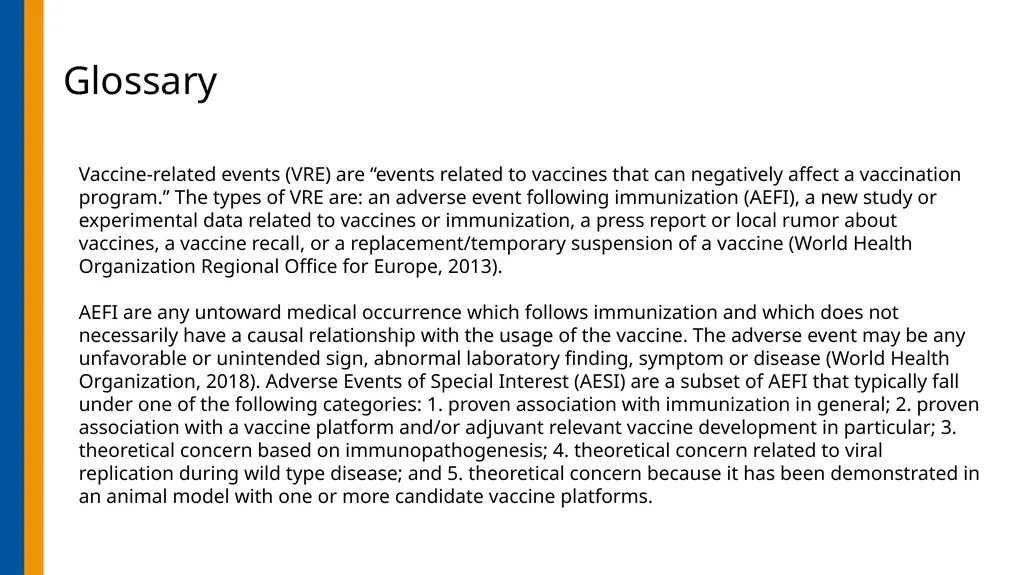
Glossary Vaccine-related events (VRE) are “events related to vaccines that can negatively affect a vaccination program.” The types of VRE are: an adverse event following immunization (AEFI), a new study or experimental data related to vaccines or immunization, a press report or local rumor about vaccines, a vaccine recall, or a replacement/temporary suspension of a vaccine (World Health Organization Regional Office for Europe, 2013).
AEFI are any untoward medical occurrence which follows immunization and which does not necessarily have a causal relationship with the usage of the vaccine. The adverse event may be any unfavorable or unintended sign, abnormal laboratory finding, symptom or disease (World Health Organization, 2018). Adverse Events of Special Interest (AESI) are a subset of AEFI that typically fall under one of the following categories: 1. proven association with immunization in general; 2. proven association with a vaccine platform and/or adjuvant relevant vaccine development in particular; 3. theoretical concern based on immunopathogenesis; 4. theoretical concern related to viral replication during wild type disease; and 5. theoretical concern because it has been demonstrated in an animal model with one or more candidate vaccine platforms.<br>
AEFI are any untoward medical occurrence which follows immunization and which does not necessarily have a causal relationship with the usage of the vaccine. The adverse event may be any unfavorable or unintended sign, abnormal laboratory finding, symptom or disease (World Health Organization, 2018). Adverse Events of Special Interest (AESI) are a subset of AEFI that typically fall under one of the following categories: 1. proven association with immunization in general; 2. proven association with a vaccine platform and/or adjuvant relevant vaccine development in particular; 3. theoretical concern based on immunopathogenesis; 4. theoretical concern related to viral replication during wild type disease; and 5. theoretical concern because it has been demonstrated in an animal model with one or more candidate vaccine platforms.<br>
35
Appendix B
Example Crisis Situation<br>
Example Crisis Situation<br>
36
Rumors online in Country B and those surrounding swell
Conspiracy theories about COVID-19 and nOPV2 vaccines reach approx. 1000 people every day with high engagement in comments and shares. AFRO Certification Widely publicized and promoted globally, regionally, and locally nOPV2 is introduced in Country B
Successful, with minimal vaccine refusals COVID-19 vaccine receives EUL recommendation and FDA authorization
Global, regional, and local media is consumed by this news, nOPV2 is noted as the only other EUL recommended vaccine Influential community leaders in Country B cast doubt on all vaccines
Call for nOPV2 refusals. As rumors swell, so do leaders engagement on these issues. There is a reported 22% increase in vaccine refusals nOPV2 receives EUL recommendation
Light global and country media August 20 September 24 October 22 November 19 December 3 December 17 December 31 Crisis Anticipation Example: Vaccine Refusals*
This is not a real example. Dates and events are purely illustrative. *This simulation is a fictional set of facts that lead up to the fictional scenario of mass vaccine refusals. This simulation is for crisis planning purposes only.<br>
Conspiracy theories about COVID-19 and nOPV2 vaccines reach approx. 1000 people every day with high engagement in comments and shares. AFRO Certification Widely publicized and promoted globally, regionally, and locally nOPV2 is introduced in Country B
Successful, with minimal vaccine refusals COVID-19 vaccine receives EUL recommendation and FDA authorization
Global, regional, and local media is consumed by this news, nOPV2 is noted as the only other EUL recommended vaccine Influential community leaders in Country B cast doubt on all vaccines
Call for nOPV2 refusals. As rumors swell, so do leaders engagement on these issues. There is a reported 22% increase in vaccine refusals nOPV2 receives EUL recommendation
Light global and country media August 20 September 24 October 22 November 19 December 3 December 17 December 31 Crisis Anticipation Example: Vaccine Refusals*
This is not a real example. Dates and events are purely illustrative. *This simulation is a fictional set of facts that lead up to the fictional scenario of mass vaccine refusals. This simulation is for crisis planning purposes only.<br>
37
Communications Materials Reference Table Several materials are being provided to help countries communicate about nOPV2. These materials are designed to be used together to fulfill the Advocacy, Communications and Social Mobilization components of nOPV2 readiness checklist. *Required under EUL<br>