
NSERC Alliance Grants Canada’s research
SB
Published · 47 slides · 0 views

1 / 1








Description
NSERC Alliance Grants Canadas research partnership program Pam Giberson, PhD NSERC Pacific Alliance grants encourage university researchers to collaborate with partner organizations, which can be from the private, public or not-for-profit
Related Topics
Share
Embed code
Download this presentation From Below
"NSERC Alliance Grants Canada’s research" is the property of its rightful owner. Permission is granted to download and print the materials on this website for personal, non-commercial use only, and to display it on your personal computer provided you do not modify the materials and that you retain all copyright notices contained in the materials. By downloading content from our website, you accept the terms of this agreement.
Presentation Transcript
01
NSERC
Alliance Grants Canada’s research partnership program Pam Giberson, PhD
NSERC Pacific<br>
Alliance Grants Canada’s research partnership program Pam Giberson, PhD
NSERC Pacific<br>
02
Alliance grants encourage university researchers to collaborate with partner organizations, which can be from the private, public or not-for-profit sectors. These grants support research projects led by strong, complementary, collaborative teams that will generate new knowledge and accelerate the application of research results for the benefit of all Canadians. 2<br>
03
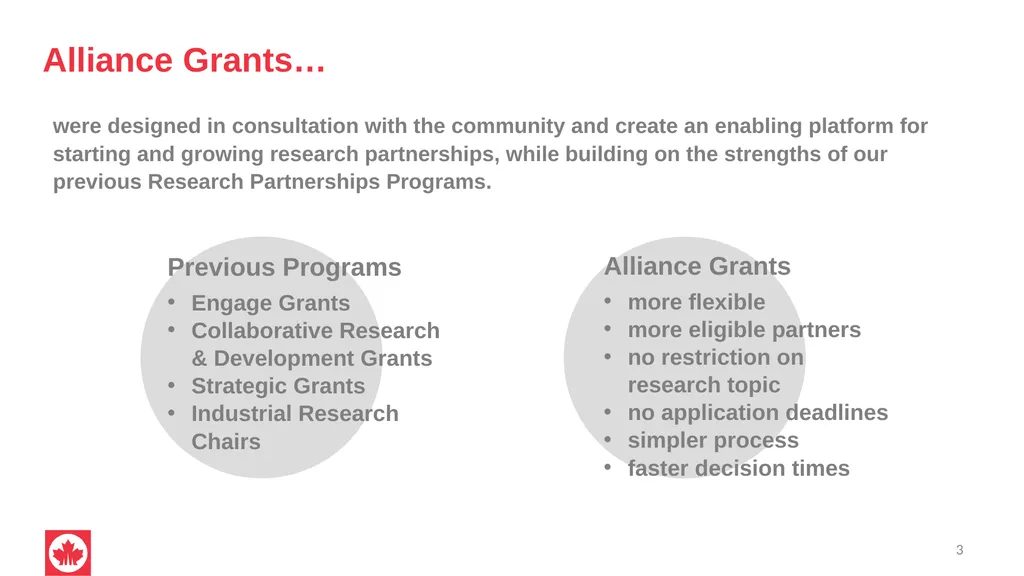
Alliance Grants… were designed in consultation with the community and create an enabling platform for starting and growing research partnerships, while building on the strengths of our previous Research Partnerships Programs. Alliance Grants
more flexible
more eligible partners
no restriction on research topic
no application deadlines
simpler process
faster decision times Previous Programs
Engage Grants
Collaborative Research & Development Grants
Strategic Grants
Industrial Research Chairs 3<br>
more flexible
more eligible partners
no restriction on research topic
no application deadlines
simpler process
faster decision times Previous Programs
Engage Grants
Collaborative Research & Development Grants
Strategic Grants
Industrial Research Chairs 3<br>
04
Alliance Grants support
collaborative projects that will… Generate new knowledge / technology
Create economic / social / environmental benefits
Contribute to Canada’s long-term competitiveness
Support public policy
Train new researchers
Draw on diverse perspectives / skill sets 4<br>
Create economic / social / environmental benefits
Contribute to Canada’s long-term competitiveness
Support public policy
Train new researchers
Draw on diverse perspectives / skill sets 4<br>
05
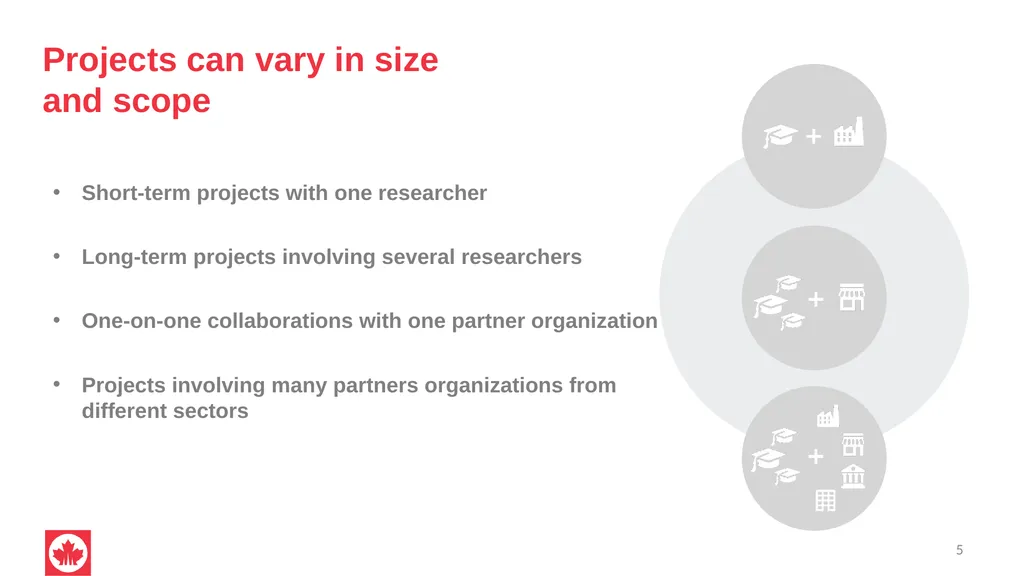
Projects can vary in size and scope Short-term projects with one researcher
Long-term projects involving several researchers
One-on-one collaborations with one partner organization
Projects involving many partners organizations from different sectors 5<br>
Long-term projects involving several researchers
One-on-one collaborations with one partner organization
Projects involving many partners organizations from different sectors 5<br>
06
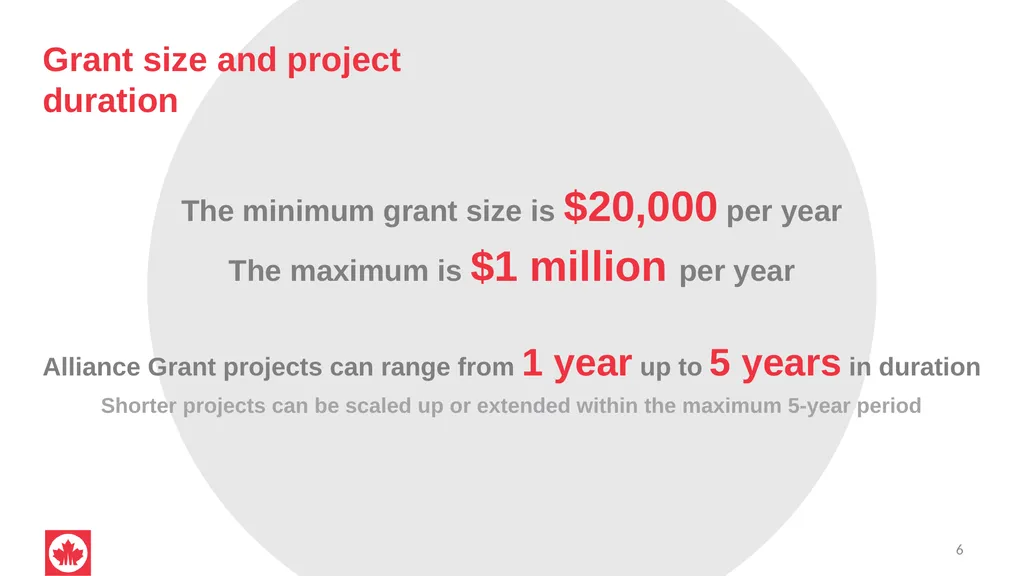
Grant size and project duration The minimum grant size is $20,000 per year
The maximum is $1 million per year
Alliance Grant projects can range from 1 year up to 5 years in duration
Shorter projects can be scaled up or extended within the maximum 5-year period 6<br>
The maximum is $1 million per year
Alliance Grant projects can range from 1 year up to 5 years in duration
Shorter projects can be scaled up or extended within the maximum 5-year period 6<br>
07
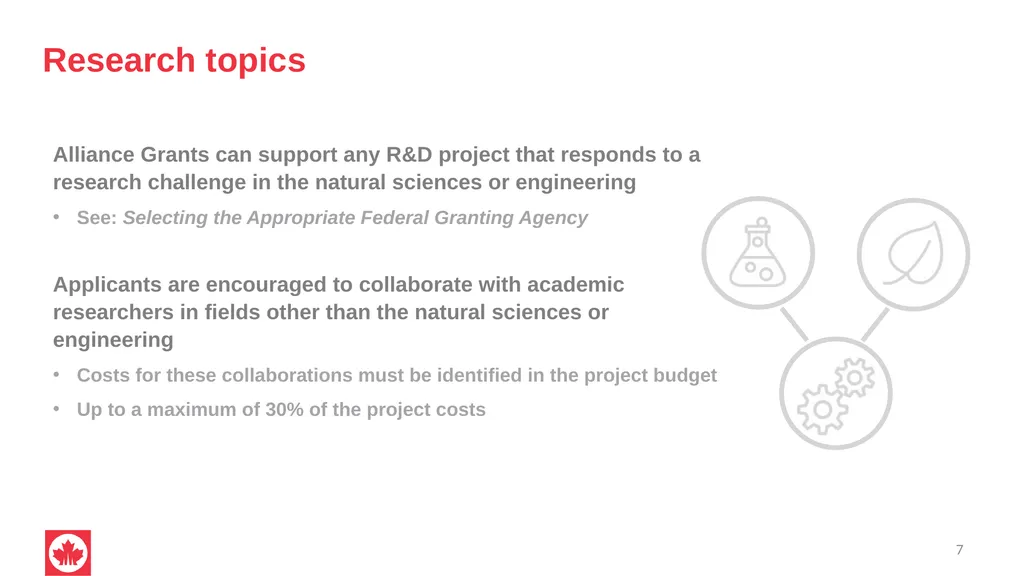
Research topics Alliance Grants can support any R&D project that responds to a research challenge in the natural sciences or engineering
See: Selecting the Appropriate Federal Granting Agency
Applicants are encouraged to collaborate with academic researchers in fields other than the natural sciences or engineering
Costs for these collaborations must be identified in the project budget
Up to a maximum of 30% of the project costs 7<br>
See: Selecting the Appropriate Federal Granting Agency
Applicants are encouraged to collaborate with academic researchers in fields other than the natural sciences or engineering
Costs for these collaborations must be identified in the project budget
Up to a maximum of 30% of the project costs 7<br>
08
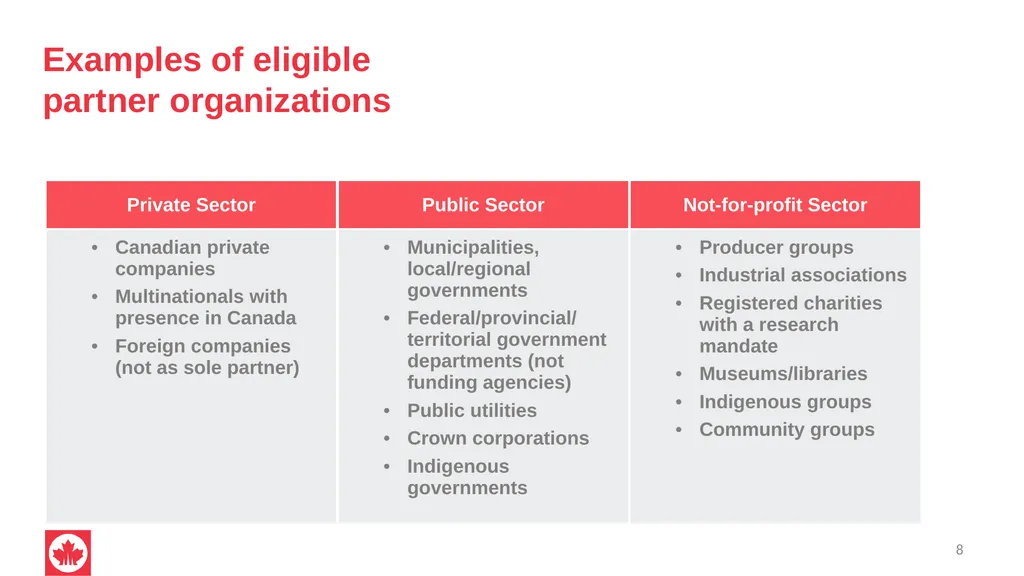
Examples of eligible
partner organizations 8<br>
09
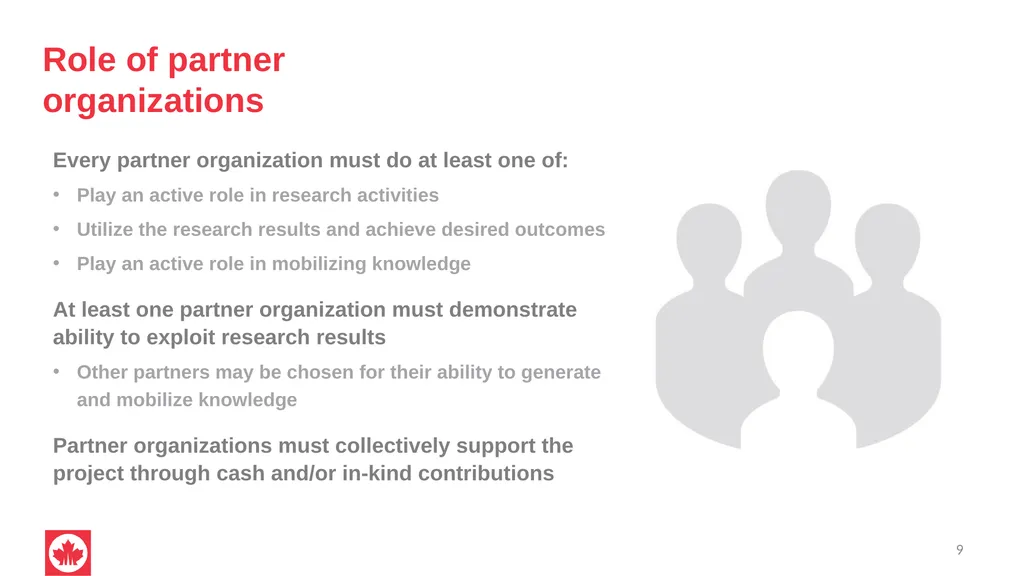
Role of partner organizations Every partner organization must do at least one of:
Play an active role in research activities
Utilize the research results and achieve desired outcomes
Play an active role in mobilizing knowledge
At least one partner organization must demonstrate ability to exploit research results
Other partners may be chosen for their ability to generate and mobilize knowledge
Partner organizations must collectively support the project through cash and/or in-kind contributions 9<br>
Play an active role in research activities
Utilize the research results and achieve desired outcomes
Play an active role in mobilizing knowledge
At least one partner organization must demonstrate ability to exploit research results
Other partners may be chosen for their ability to generate and mobilize knowledge
Partner organizations must collectively support the project through cash and/or in-kind contributions 9<br>
10
Cost-sharing… 10<br>
11
Cost-sharing Alliance Grants are calculated based on cost-sharing with the partner organizations
The portion that can be cost-shared with NSERC includes only the cash contributions from partner organizations recognized for cost sharing
In-kind contributions are important for the success of the project
In-kind contributions are considered as part of the proposal evaluation
In-kind should not be considered when determining NSERC’s contribution to the project costs 11<br>
The portion that can be cost-shared with NSERC includes only the cash contributions from partner organizations recognized for cost sharing
In-kind contributions are important for the success of the project
In-kind contributions are considered as part of the proposal evaluation
In-kind should not be considered when determining NSERC’s contribution to the project costs 11<br>
12
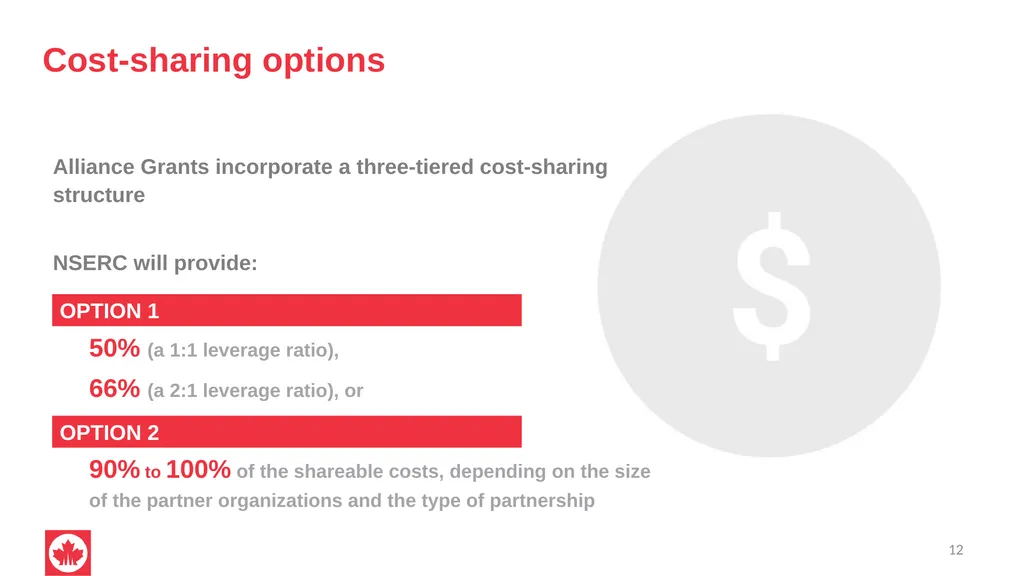
Cost-sharing options Alliance Grants incorporate a three-tiered cost-sharing structure
NSERC will provide:
50% (a 1:1 leverage ratio),
66% (a 2:1 leverage ratio), or
90% to 100% of the shareable costs, depending on the size of the partner organizations and the type of partnership 12 OPTION 1 OPTION 2<br>
NSERC will provide:
50% (a 1:1 leverage ratio),
66% (a 2:1 leverage ratio), or
90% to 100% of the shareable costs, depending on the size of the partner organizations and the type of partnership 12 OPTION 1 OPTION 2<br>
13
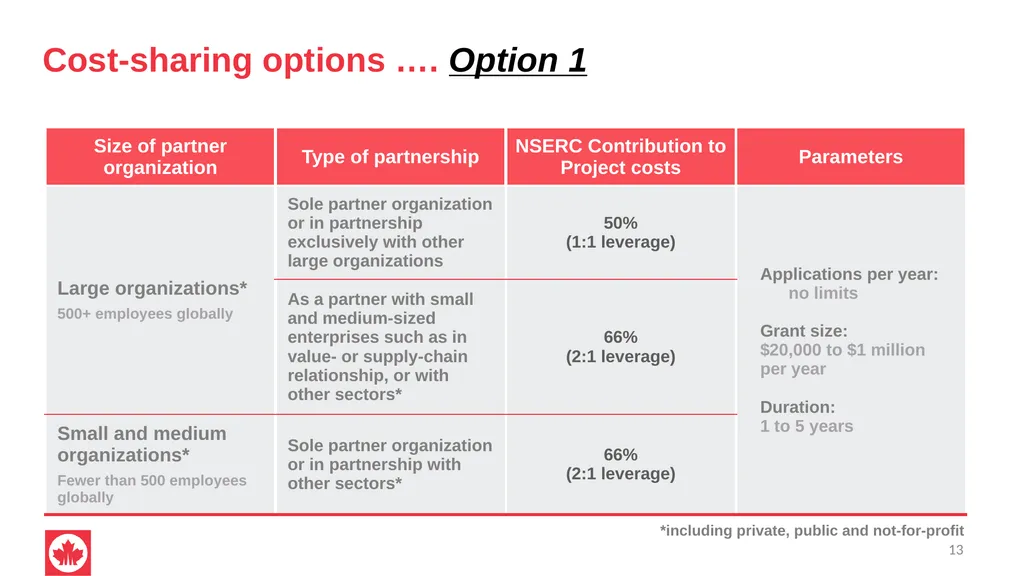
Cost-sharing options …. Option 1 *including private, public and not-for-profit 13<br>
14
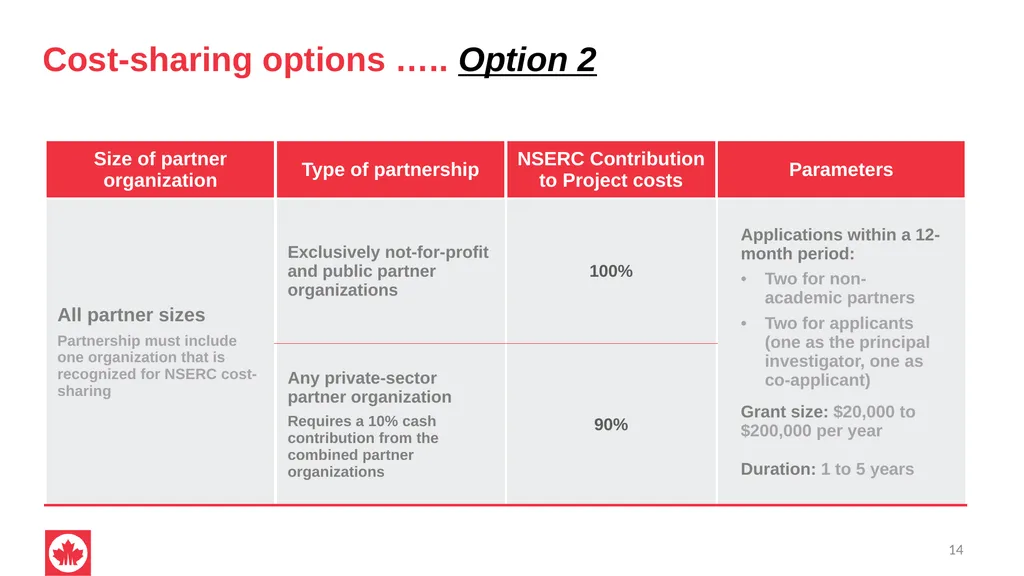
Cost-sharing options ….. Option 2 14<br>
15
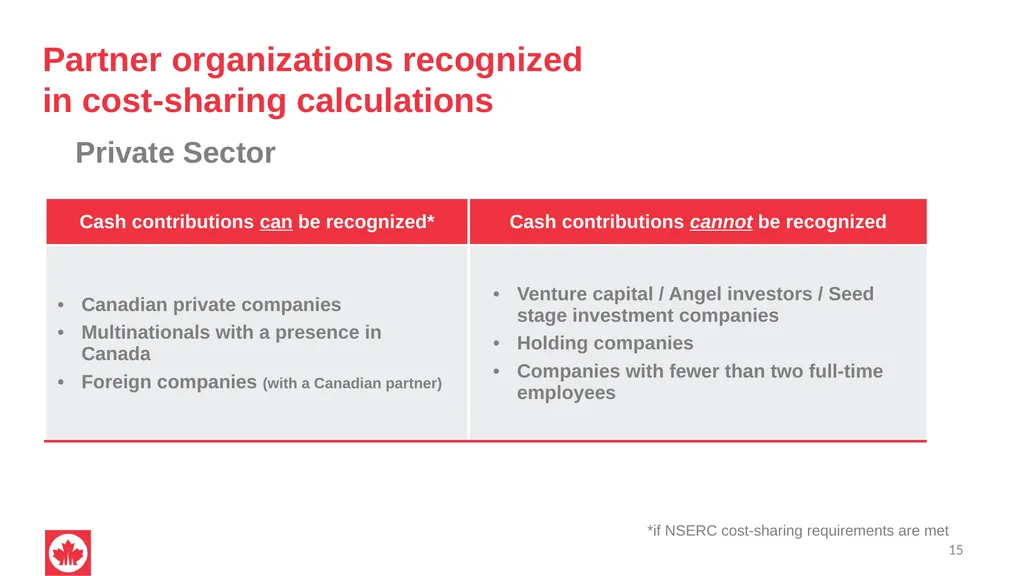
Partner organizations recognized in cost-sharing calculations Private Sector *if NSERC cost-sharing requirements are met 15<br>
16
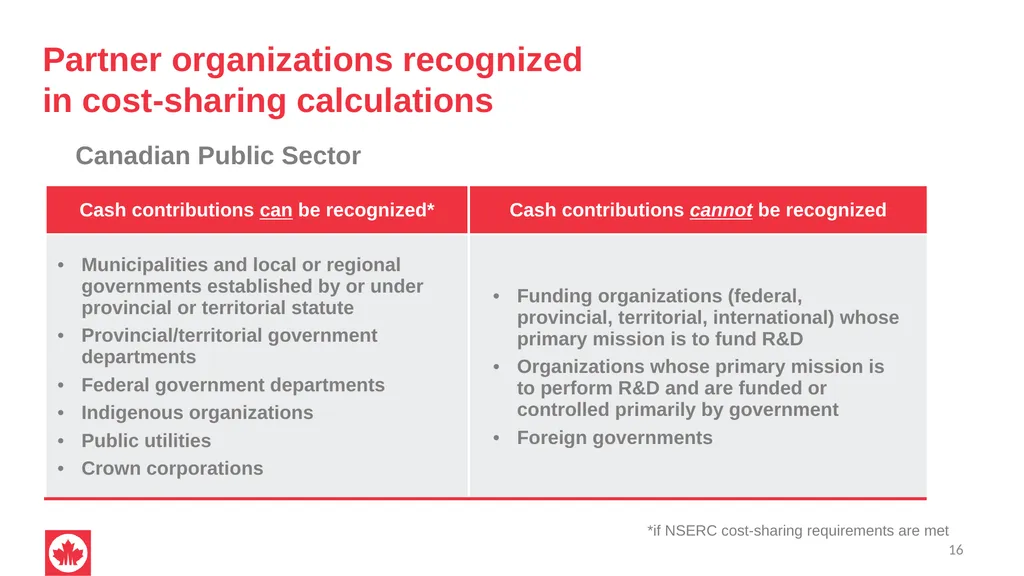
Partner organizations recognized in cost-sharing calculations Canadian Public Sector *if NSERC cost-sharing requirements are met 16<br>
17
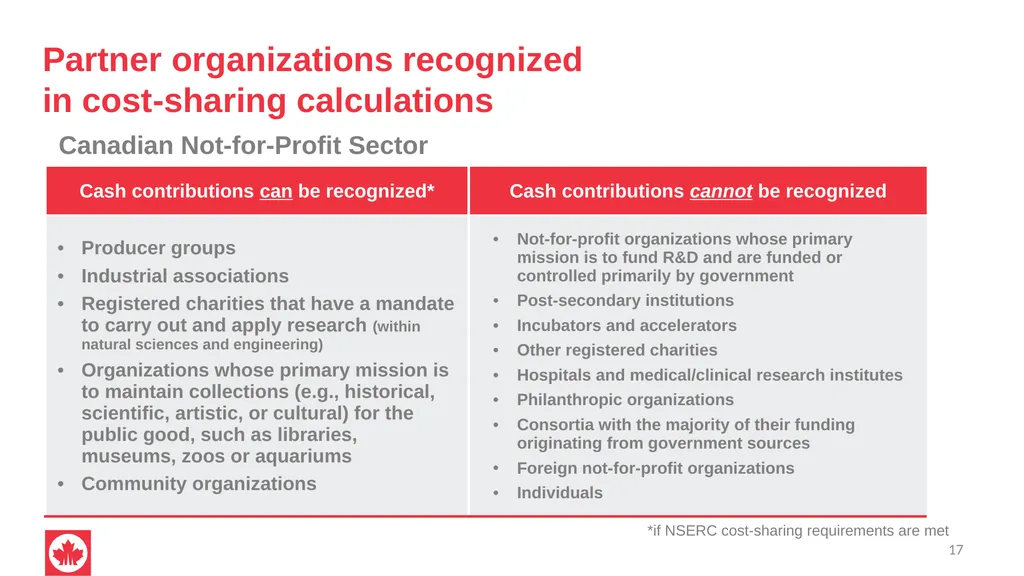
Partner organizations recognized in cost-sharing calculations Canadian Not-for-Profit Sector *if NSERC cost-sharing requirements are met 17<br>
18
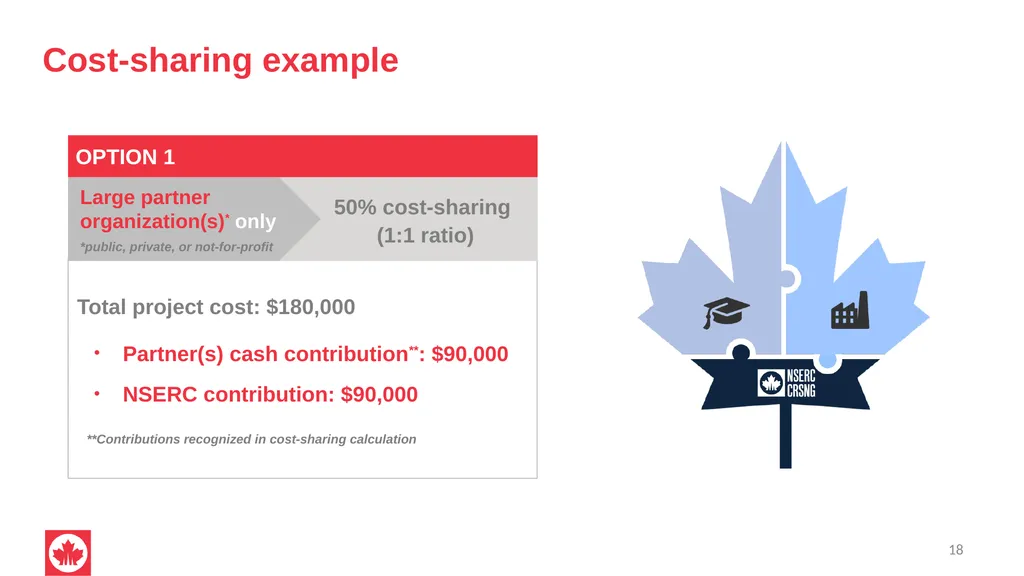
Total project cost: $180,000
Partner(s) cash contribution**: $90,000
NSERC contribution: $90,000
**Contributions recognized in cost-sharing calculation Cost-sharing example 50% cost-sharing
(1:1 ratio) Large partner organization(s)* only
*public, private, or not-for-profit OPTION 1 18<br>
Partner(s) cash contribution**: $90,000
NSERC contribution: $90,000
**Contributions recognized in cost-sharing calculation Cost-sharing example 50% cost-sharing
(1:1 ratio) Large partner organization(s)* only
*public, private, or not-for-profit OPTION 1 18<br>
19
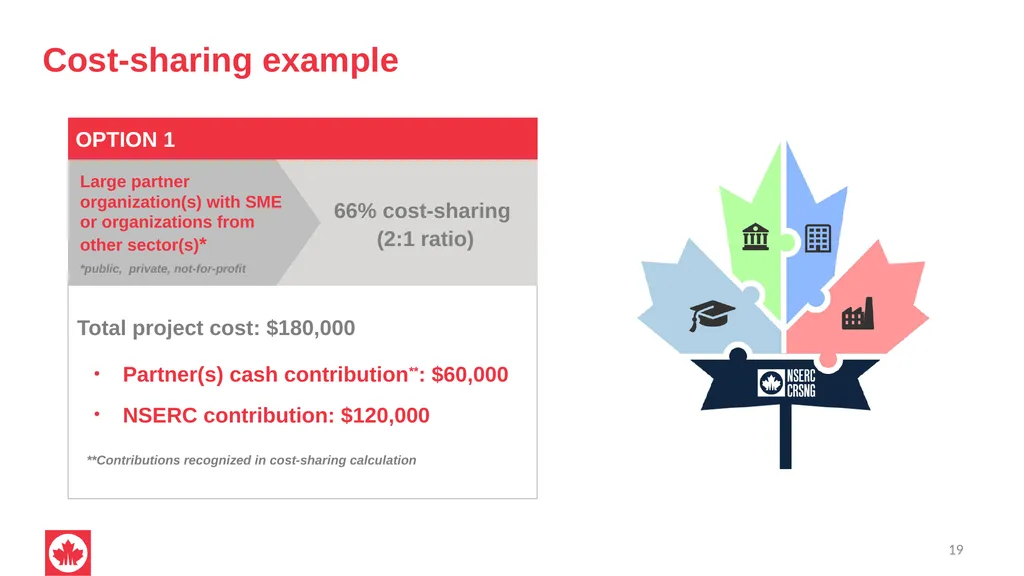
Cost-sharing example Total project cost: $180,000
Partner(s) cash contribution**: $60,000
NSERC contribution: $120,000
**Contributions recognized in cost-sharing calculation 66% cost-sharing
(2:1 ratio) Large partner organization(s) with SME or organizations from other sector(s)*
*public, private, not-for-profit OPTION 1 19<br>
Partner(s) cash contribution**: $60,000
NSERC contribution: $120,000
**Contributions recognized in cost-sharing calculation 66% cost-sharing
(2:1 ratio) Large partner organization(s) with SME or organizations from other sector(s)*
*public, private, not-for-profit OPTION 1 19<br>
20
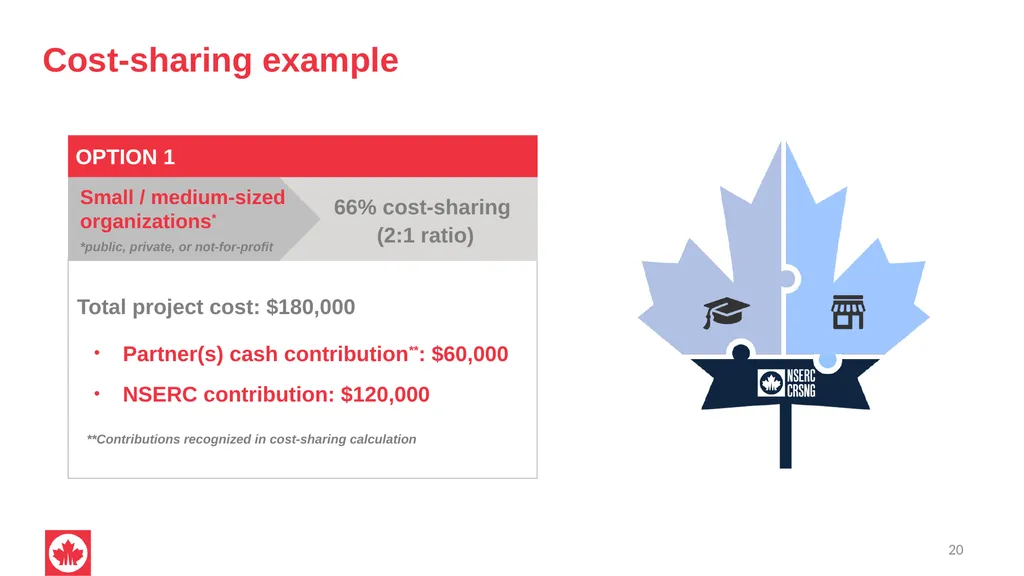
Total project cost: $180,000
Partner(s) cash contribution**: $60,000
NSERC contribution: $120,000
**Contributions recognized in cost-sharing calculation Cost-sharing example 66% cost-sharing
(2:1 ratio) Small / medium-sized organizations*
*public, private, or not-for-profit OPTION 1 20<br>
Partner(s) cash contribution**: $60,000
NSERC contribution: $120,000
**Contributions recognized in cost-sharing calculation Cost-sharing example 66% cost-sharing
(2:1 ratio) Small / medium-sized organizations*
*public, private, or not-for-profit OPTION 1 20<br>
21
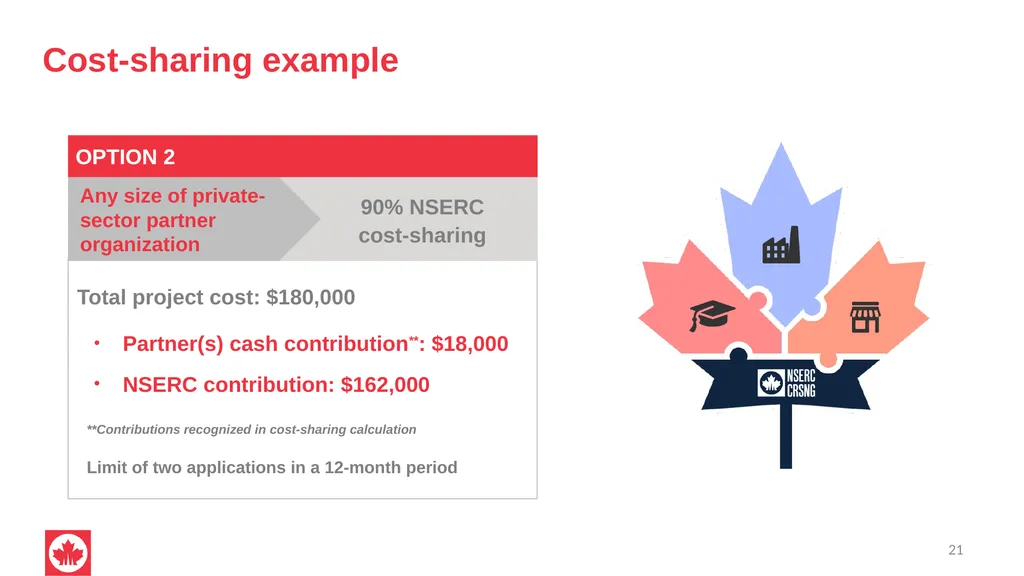
Total project cost: $180,000
Partner(s) cash contribution**: $18,000
NSERC contribution: $162,000
**Contributions recognized in cost-sharing calculation
Limit of two applications in a 12-month period Cost-sharing example 90% NSERC
cost-sharing Any size of private-sector partner organization OPTION 2 21<br>
Partner(s) cash contribution**: $18,000
NSERC contribution: $162,000
**Contributions recognized in cost-sharing calculation
Limit of two applications in a 12-month period Cost-sharing example 90% NSERC
cost-sharing Any size of private-sector partner organization OPTION 2 21<br>
22
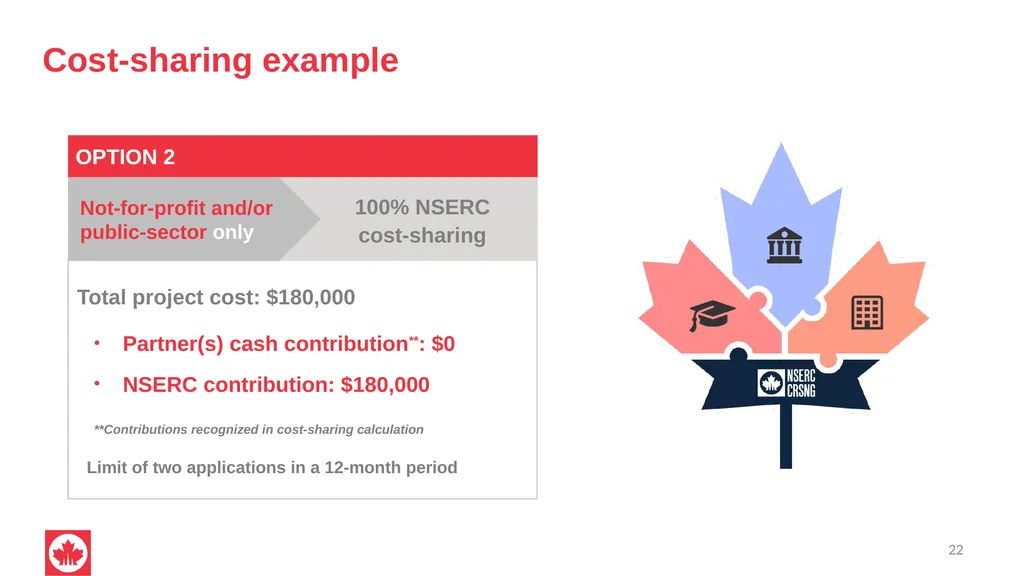
Total project cost: $180,000
Partner(s) cash contribution**: $0
NSERC contribution: $180,000
**Contributions recognized in cost-sharing calculation
Limit of two applications in a 12-month period Cost-sharing example 100% NSERC
cost-sharing Not-for-profit and/or public-sector only OPTION 2 22<br>
Partner(s) cash contribution**: $0
NSERC contribution: $180,000
**Contributions recognized in cost-sharing calculation
Limit of two applications in a 12-month period Cost-sharing example 100% NSERC
cost-sharing Not-for-profit and/or public-sector only OPTION 2 22<br>
23
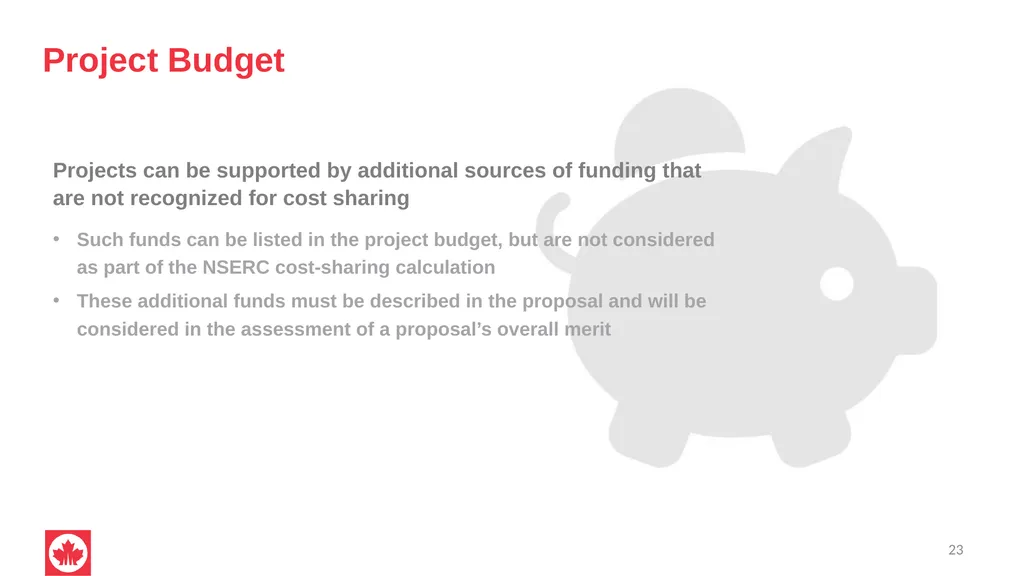
Project Budget Projects can be supported by additional sources of funding that are not recognized for cost sharing
Such funds can be listed in the project budget, but are not considered as part of the NSERC cost-sharing calculation
These additional funds must be described in the proposal and will be considered in the assessment of a proposal’s overall merit 23<br>
Such funds can be listed in the project budget, but are not considered as part of the NSERC cost-sharing calculation
These additional funds must be described in the proposal and will be considered in the assessment of a proposal’s overall merit 23<br>
24
Applying…<br>
25
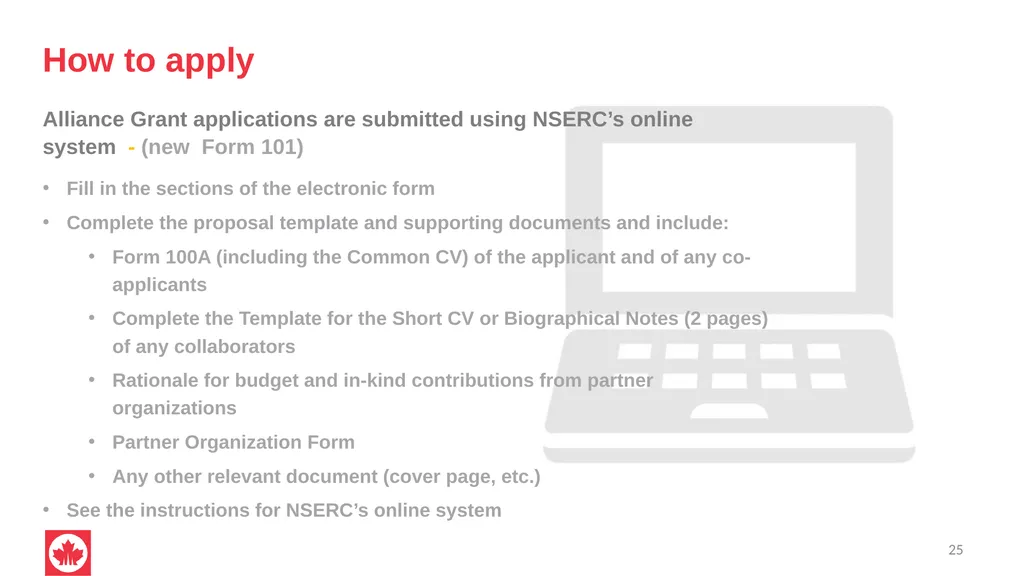
How to apply Alliance Grant applications are submitted using NSERC’s online system - (new Form 101)
Fill in the sections of the electronic form
Complete the proposal template and supporting documents and include:
Form 100A (including the Common CV) of the applicant and of any co-applicants
Complete the Template for the Short CV or Biographical Notes (2 pages) of any collaborators
Rationale for budget and in-kind contributions from partner organizations
Partner Organization Form
Any other relevant document (cover page, etc.)
See the instructions for NSERC’s online system 25<br>
Fill in the sections of the electronic form
Complete the proposal template and supporting documents and include:
Form 100A (including the Common CV) of the applicant and of any co-applicants
Complete the Template for the Short CV or Biographical Notes (2 pages) of any collaborators
Rationale for budget and in-kind contributions from partner organizations
Partner Organization Form
Any other relevant document (cover page, etc.)
See the instructions for NSERC’s online system 25<br>
26
How to complete the proposal…<br>
27
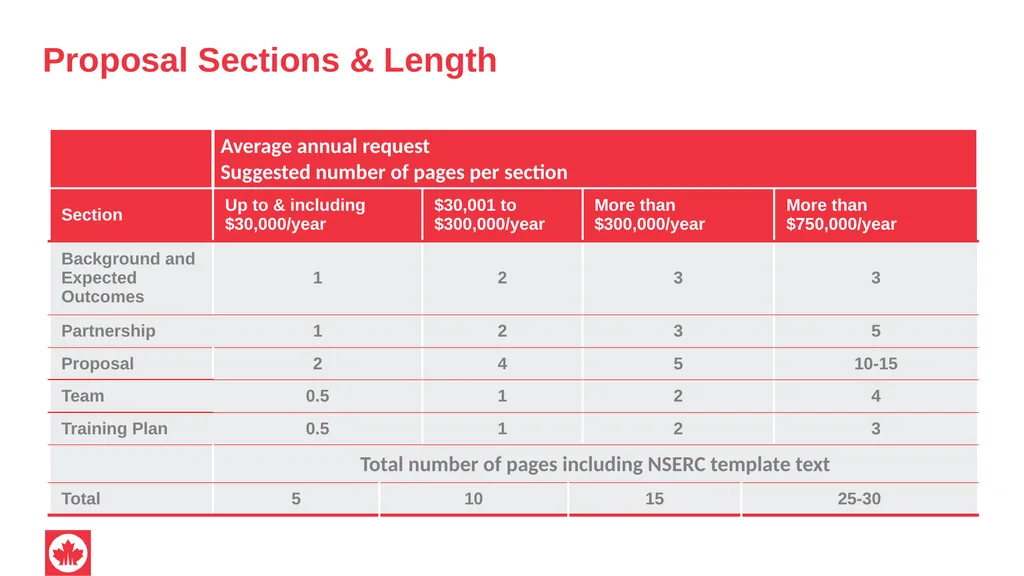
Proposal Sections & Length<br>
28
Assessment of applications…<br>
29
How applications are reviewed NSERC has adopted a financial risk-based approach that includes various assessment tools
Reduces burden and delays
Recognizes risk as a function of project complexity and funds requested 29<br>
Reduces burden and delays
Recognizes risk as a function of project complexity and funds requested 29<br>
30
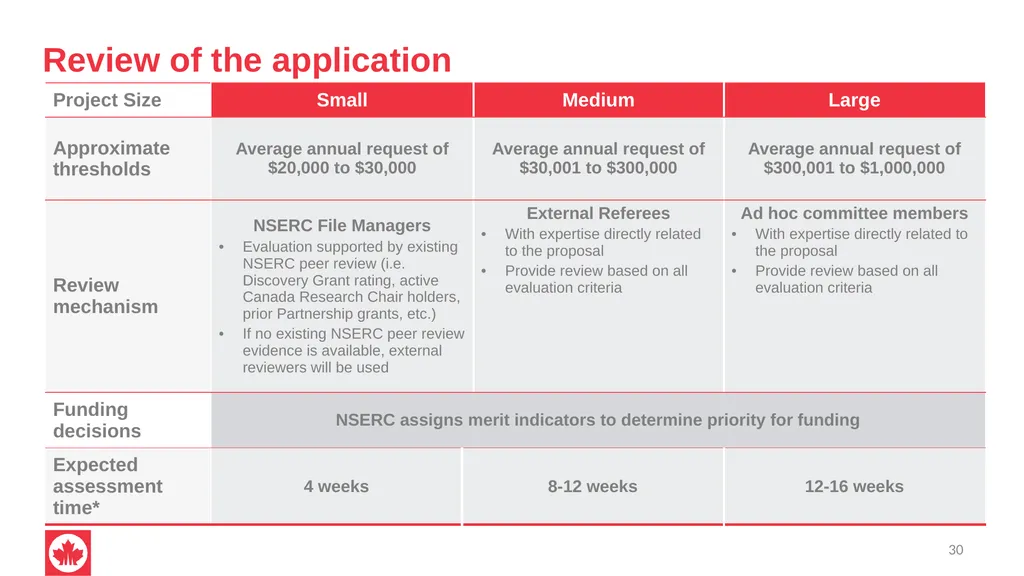
Review of the application 30<br>
31
Evaluation
Criteria…<br>
Criteria…<br>
32
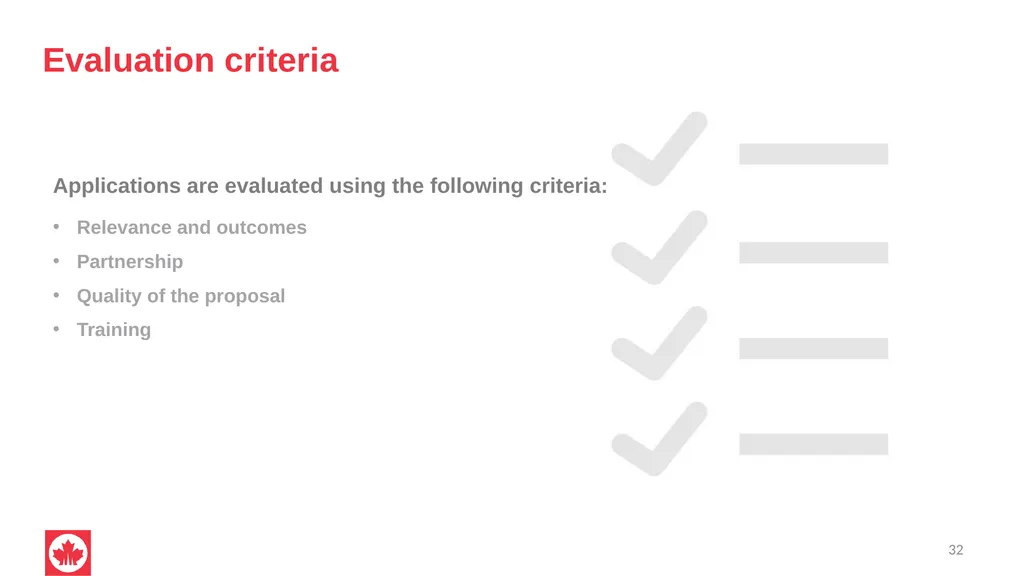
Evaluation criteria Applications are evaluated using the following criteria:
Relevance and outcomes
Partnership
Quality of the proposal
Training 32<br>
Relevance and outcomes
Partnership
Quality of the proposal
Training 32<br>
33
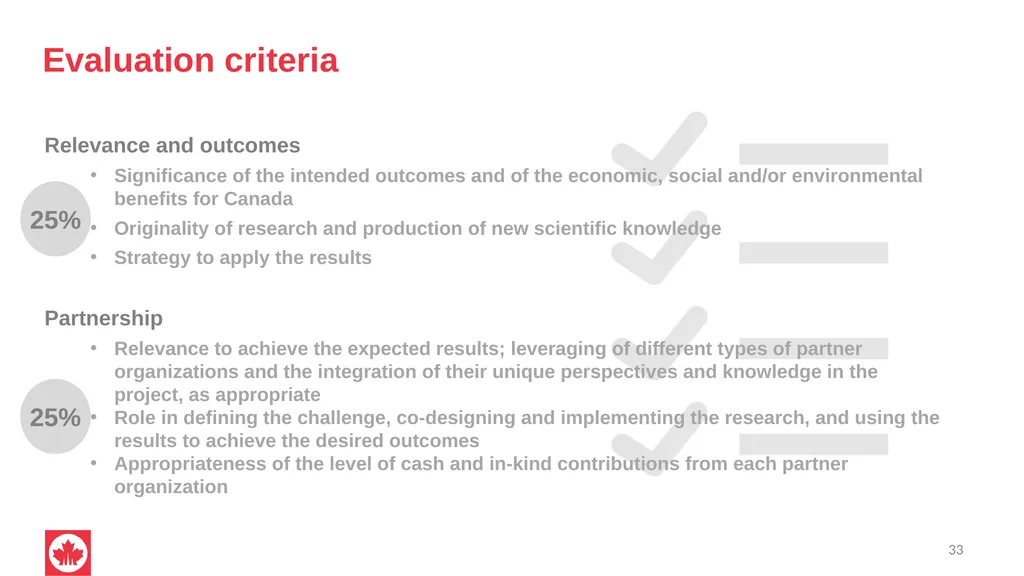
Evaluation criteria 33 Relevance and outcomes
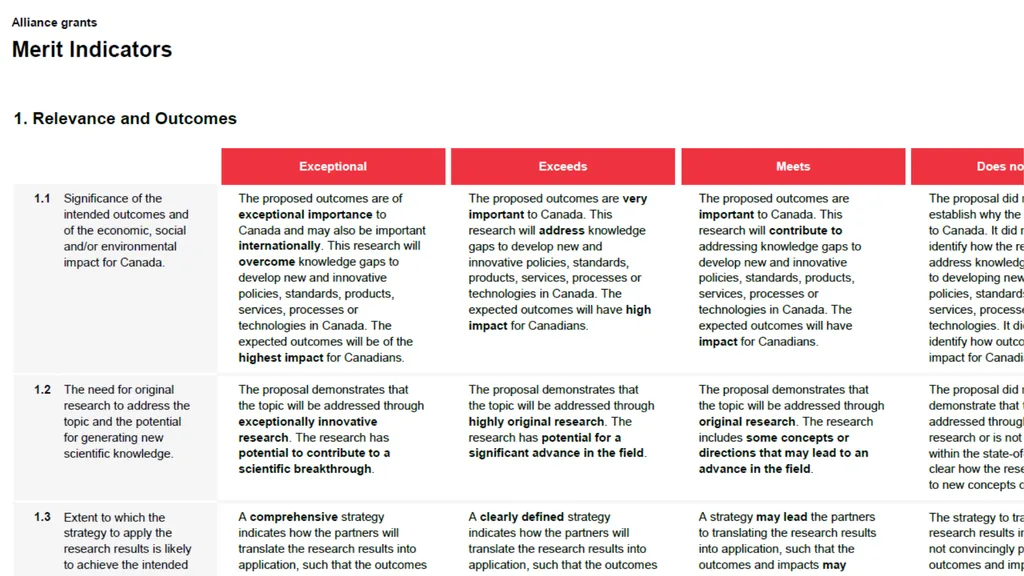
Significance of the intended outcomes and of the economic, social and/or environmental benefits for Canada
Originality of research and production of new scientific knowledge
Strategy to apply the results
Partnership
Relevance to achieve the expected results; leveraging of different types of partner organizations and the integration of their unique perspectives and knowledge in the project, as appropriate
Role in defining the challenge, co-designing and implementing the research, and using the results to achieve the desired outcomes
Appropriateness of the level of cash and in-kind contributions from each partner organization<br>
Significance of the intended outcomes and of the economic, social and/or environmental benefits for Canada
Originality of research and production of new scientific knowledge
Strategy to apply the results
Partnership
Relevance to achieve the expected results; leveraging of different types of partner organizations and the integration of their unique perspectives and knowledge in the project, as appropriate
Role in defining the challenge, co-designing and implementing the research, and using the results to achieve the desired outcomes
Appropriateness of the level of cash and in-kind contributions from each partner organization<br>
34
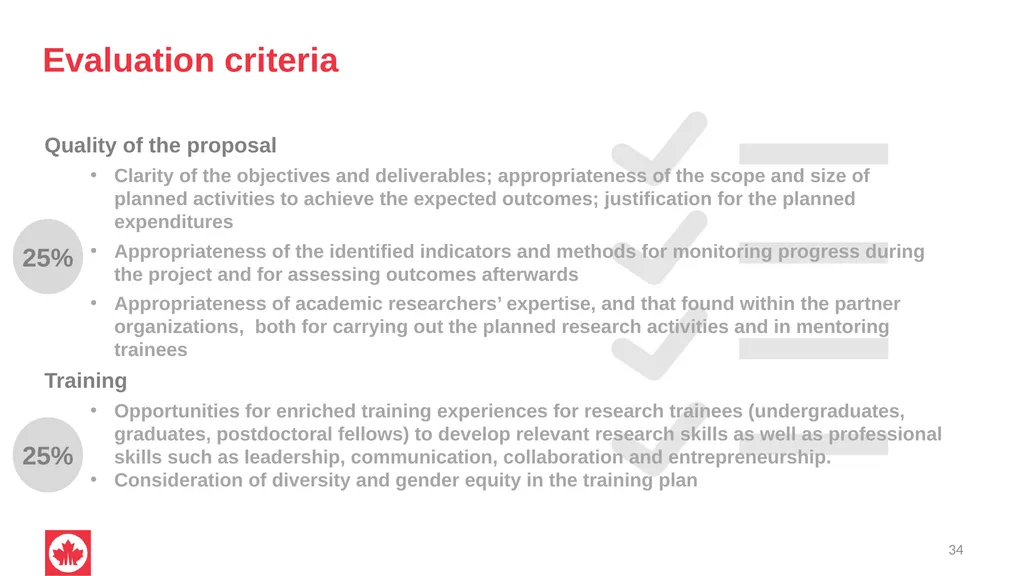
Evaluation criteria 34 Quality of the proposal
Clarity of the objectives and deliverables; appropriateness of the scope and size of planned activities to achieve the expected outcomes; justification for the planned expenditures
Appropriateness of the identified indicators and methods for monitoring progress during the project and for assessing outcomes afterwards
Appropriateness of academic researchers’ expertise, and that found within the partner organizations, both for carrying out the planned research activities and in mentoring trainees
Training
Opportunities for enriched training experiences for research trainees (undergraduates, graduates, postdoctoral fellows) to develop relevant research skills as well as professional skills such as leadership, communication, collaboration and entrepreneurship.
Consideration of diversity and gender equity in the training plan<br>
Clarity of the objectives and deliverables; appropriateness of the scope and size of planned activities to achieve the expected outcomes; justification for the planned expenditures
Appropriateness of the identified indicators and methods for monitoring progress during the project and for assessing outcomes afterwards
Appropriateness of academic researchers’ expertise, and that found within the partner organizations, both for carrying out the planned research activities and in mentoring trainees
Training
Opportunities for enriched training experiences for research trainees (undergraduates, graduates, postdoctoral fellows) to develop relevant research skills as well as professional skills such as leadership, communication, collaboration and entrepreneurship.
Consideration of diversity and gender equity in the training plan<br>
35
Equity, diversity and inclusion NSERC is committed to excellence in research and research training for the benefit of Canadians.
Achieving a more equitable, diverse and inclusive Canadian research enterprise is also essential to creating the excellent, innovative and impactful research necessary to seize opportunities and respond to global challenges. 35<br>
Achieving a more equitable, diverse and inclusive Canadian research enterprise is also essential to creating the excellent, innovative and impactful research necessary to seize opportunities and respond to global challenges. 35<br>
36
Equity, diversity and inclusion You are asked to consider sex, gender and diversity in the project’s research design and to consider how to promote and support a variety of forms of mentoring to ensure trainees’ equitable participation and growth.
In large proposals, you must strive for equity, diversity and inclusion when developing your group of co-applicants, partners and trainees
See Guide for Applicants: Considering equity, diversity, and inclusion in your application 36<br>
In large proposals, you must strive for equity, diversity and inclusion when developing your group of co-applicants, partners and trainees
See Guide for Applicants: Considering equity, diversity, and inclusion in your application 36<br>
37
How are funding decisions made ...<br>
38
Funding Decisions 38 Financing decisions will be made on a competitive basis
Assessment using the evaluation criteria
Merit indicators
Ranking according to overall merit
Applications with the highest merit will be funded until the budget of the period in question is exhausted<br>
Assessment using the evaluation criteria
Merit indicators
Ranking according to overall merit
Applications with the highest merit will be funded until the budget of the period in question is exhausted<br>
39
39<br>
40
Scaling-up successful research collaborations NSERC will support the growth of a project as the partnership progresses by providing options to expand successful projects
Additional funds can be awarded within the original timeframe or during additional years of the project
Maximum project duration (including any time extension) is five years
Procedure for expanding projects will be detailed at a later date 40<br>
Additional funds can be awarded within the original timeframe or during additional years of the project
Maximum project duration (including any time extension) is five years
Procedure for expanding projects will be detailed at a later date 40<br>
41
Alliance Grants
timeline… 41<br>
timeline… 41<br>
42
Alliance Option 2 This component of Alliance is still under development. It is intended for natural science/engineering research proposals that:
aim to address an unmet societal need (may include research affecting public goods, or that will address national or global issues that benefit more than a single or a few organizations)
connect partner organizations willing and able to overcome existing barriers to address these challenges and achieve results that can lead to societal impact beyond economic benefits
More details on the objectives and on the application and evaluation processes will be available soon 42 Visit the
Alliance webpage for updates<br>
aim to address an unmet societal need (may include research affecting public goods, or that will address national or global issues that benefit more than a single or a few organizations)
connect partner organizations willing and able to overcome existing barriers to address these challenges and achieve results that can lead to societal impact beyond economic benefits
More details on the objectives and on the application and evaluation processes will be available soon 42 Visit the
Alliance webpage for updates<br>
43
Points to remember…<br>
44
Alliance Grants… Single point of entry for university research partnerships
Support multi-sectoral partnerships
Various levels of cost sharing
Simplified processes
Flexible
Focus on project outcomes
Competitive<br>
Support multi-sectoral partnerships
Various levels of cost sharing
Simplified processes
Flexible
Focus on project outcomes
Competitive<br>
45
More than research funding:
It’s about collaboration Alliance grants support truly collaborative projects
Partner organizations are involved at all stages, including:
co-designing the project
actively participating in the research
implementing/mobilizing project outcomes for the benefit of Canada and Canadians<br>
It’s about collaboration Alliance grants support truly collaborative projects
Partner organizations are involved at all stages, including:
co-designing the project
actively participating in the research
implementing/mobilizing project outcomes for the benefit of Canada and Canadians<br>
46
Useful Links Alliance Grants Website
Instructions for completing an Alliance Grant application
Role of partner organizations
Evaluation Criteria
Merit Indicators
Use of Grant Funds
FAQ 46<br>
Instructions for completing an Alliance Grant application
Role of partner organizations
Evaluation Criteria
Merit Indicators
Use of Grant Funds
FAQ 46<br>
47
Thank you! NSERC Head Office
613-995-1111
alliance@nserc-crsng.gc.ca NSERC Regional Offices
Toll-free
1-877-767-1767
nserc-atlantic@nserc-crsng.gc.ca
nserc-ontario@nserc-crsng.gc.ca
nserc-pacific@nserc-crsng.gc.ca
nserc-prairies@nserc-crsng.gc.ca
nserc-quebec@nserc-crsng.gc.ca 47<br>
613-995-1111
alliance@nserc-crsng.gc.ca NSERC Regional Offices
Toll-free
1-877-767-1767
nserc-atlantic@nserc-crsng.gc.ca
nserc-ontario@nserc-crsng.gc.ca
nserc-pacific@nserc-crsng.gc.ca
nserc-prairies@nserc-crsng.gc.ca
nserc-quebec@nserc-crsng.gc.ca 47<br>