NUCLEAR REACTION RATES AND CROSS SECTIONS The probability for a particular reaction to occur is expressed in terms of cross section Consider a beam of nuclei a bombarding a target consisting of nuclei B Let N No. of nuclei B per m3 in
"NUCLEAR REACTION RATES AND CROSS SECTIONS The" is the property of its rightful owner. Permission is granted to
download and print the materials on this website for personal, non-commercial use only, and to display it
on your personal computer provided you do not modify the materials and that you retain all copyright
notices contained in the materials. By downloading content from our website, you accept the terms of this
agreement.
Presentation Transcript
01
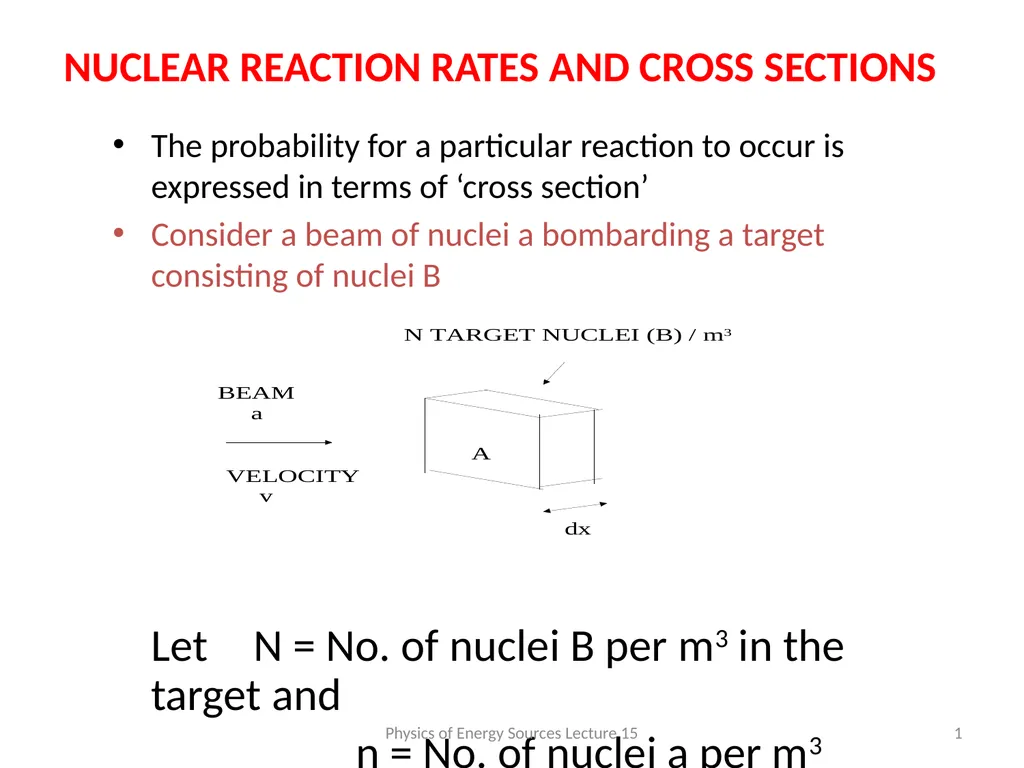
NUCLEAR REACTION RATES AND CROSS SECTIONS The probability for a particular reaction to occur is expressed in terms of ‘cross section’
Consider a beam of nuclei a bombarding a target consisting of nuclei B
Let N = No. of nuclei B per m3 in the target and
n = No. of nuclei a per m3
= density of particles in the beam 1 Physics of Energy Sources Lecture 15<br>
02
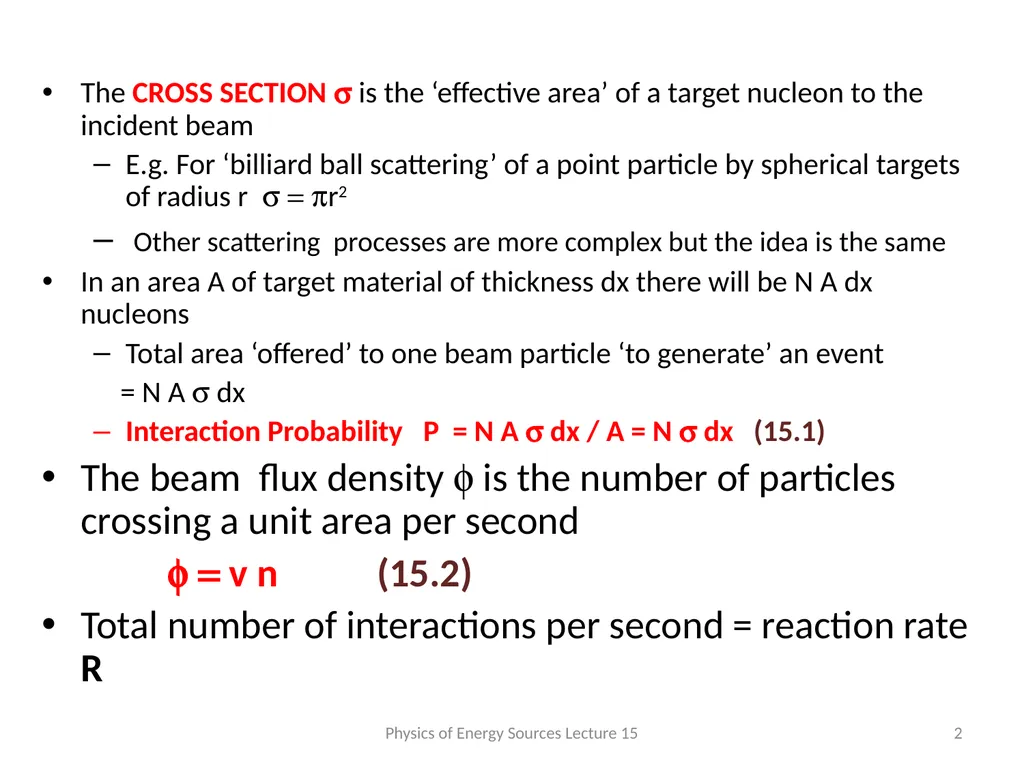
The CROSS SECTION s is the ‘effective area’ of a target nucleon to the incident beam
E.g. For ‘billiard ball scattering’ of a point particle by spherical targets of radius r s = pr2
Other scattering processes are more complex but the idea is the same
In an area A of target material of thickness dx there will be N A dx nucleons
Total area ‘offered’ to one beam particle ‘to generate’ an event
= N A s dx
Interaction Probability P = N A s dx / A = N s dx (15.1)
The beam flux density f is the number of particles crossing a unit area per second
f = v n (15.2)
Total number of interactions per second = reaction rate R 2 Physics of Energy Sources Lecture 15<br>
03
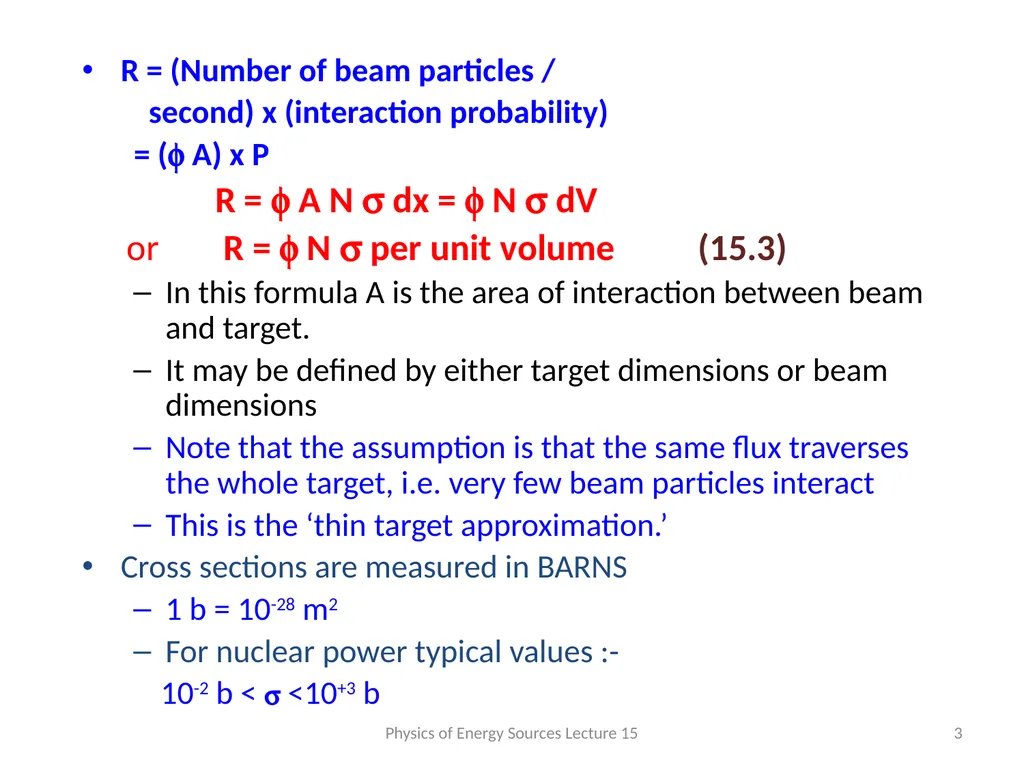
R = (Number of beam particles /
second) x (interaction probability)
= (f A) x P
R = f A N s dx = f N s dV
or R = f N s per unit volume (15.3)
In this formula A is the area of interaction between beam and target.
It may be defined by either target dimensions or beam dimensions
Note that the assumption is that the same flux traverses the whole target, i.e. very few beam particles interact
This is the ‘thin target approximation.’
Cross sections are measured in BARNS
1 b = 10-28 m2
For nuclear power typical values :-
10-2 b < s <10+3 b 3 Physics of Energy Sources Lecture 15<br>
04
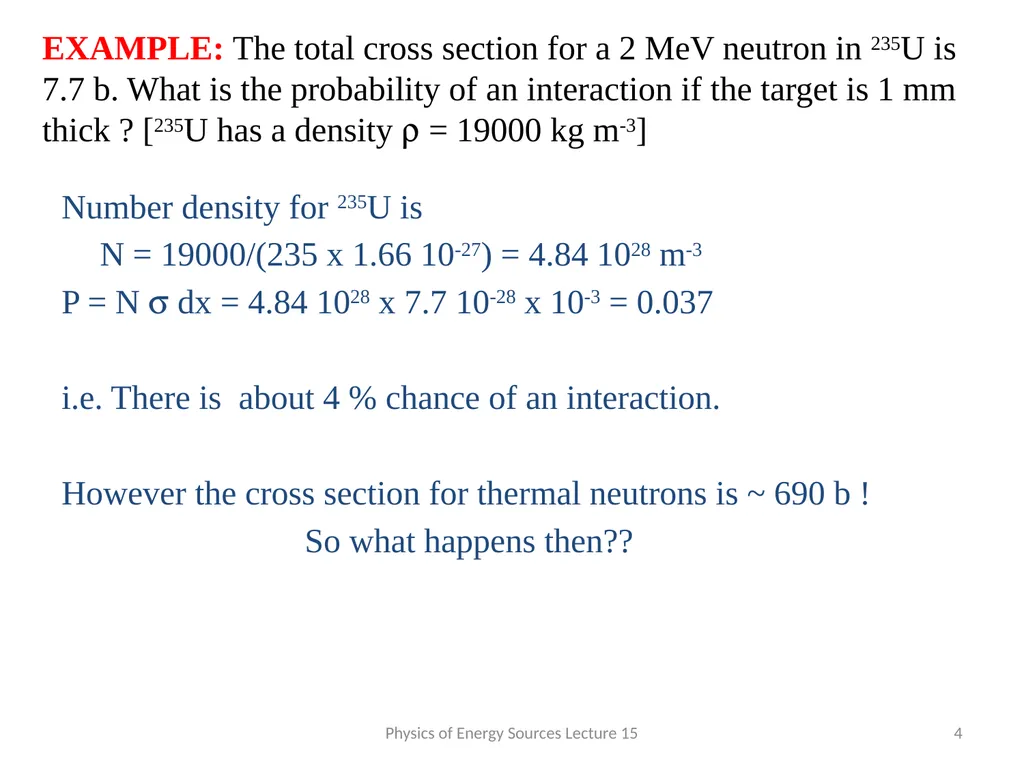
EXAMPLE: The total cross section for a 2 MeV neutron in 235U is 7.7 b. What is the probability of an interaction if the target is 1 mm thick ? [235U has a density r = 19000 kg m-3] Number density for 235U is
N = 19000/(235 x 1.66 10-27) = 4.84 1028 m-3
P = N s dx = 4.84 1028 x 7.7 10-28 x 10-3 = 0.037
i.e. There is about 4 % chance of an interaction.
However the cross section for thermal neutrons is ~ 690 b !
So what happens then?? 4 Physics of Energy Sources Lecture 15<br>
05
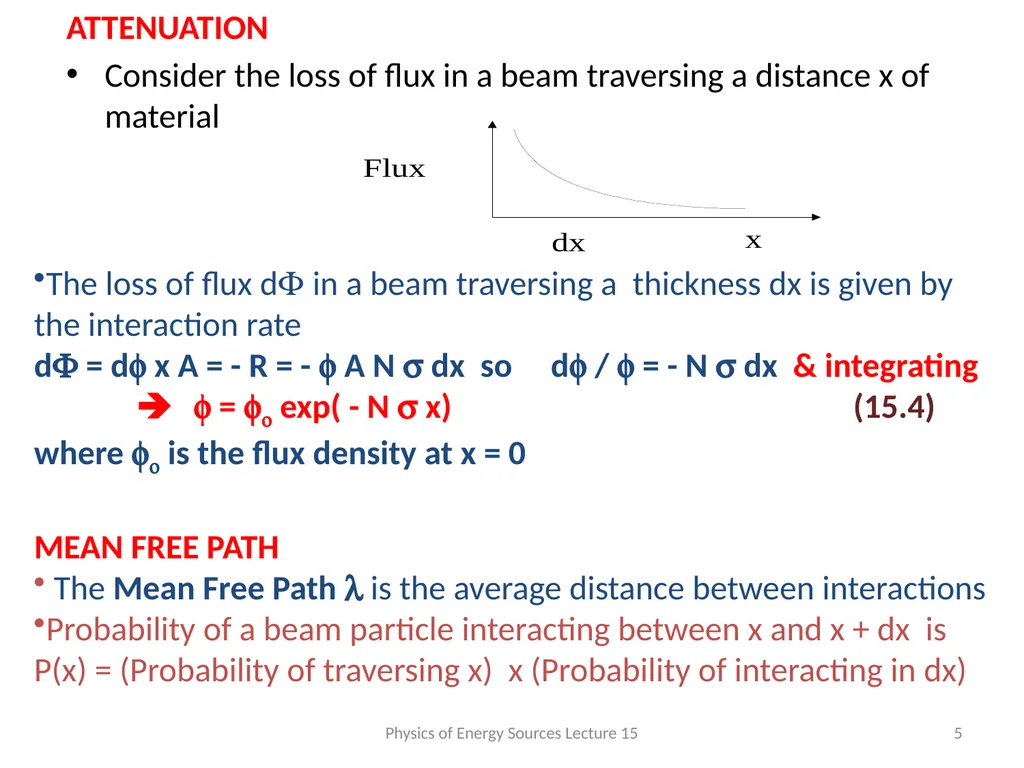
ATTENUATION
Consider the loss of flux in a beam traversing a distance x of material The loss of flux dF in a beam traversing a thickness dx is given by the interaction rate
dF = df x A = - R = - f A N s dx so df / f = - N s dx & integrating
f = fo exp( - N s x) (15.4)
where fo is the flux density at x = 0
MEAN FREE PATH
The Mean Free Path l is the average distance between interactions
Probability of a beam particle interacting between x and x + dx is
P(x) = (Probability of traversing x) x (Probability of interacting in dx) 5 Physics of Energy Sources Lecture 15<br>
06
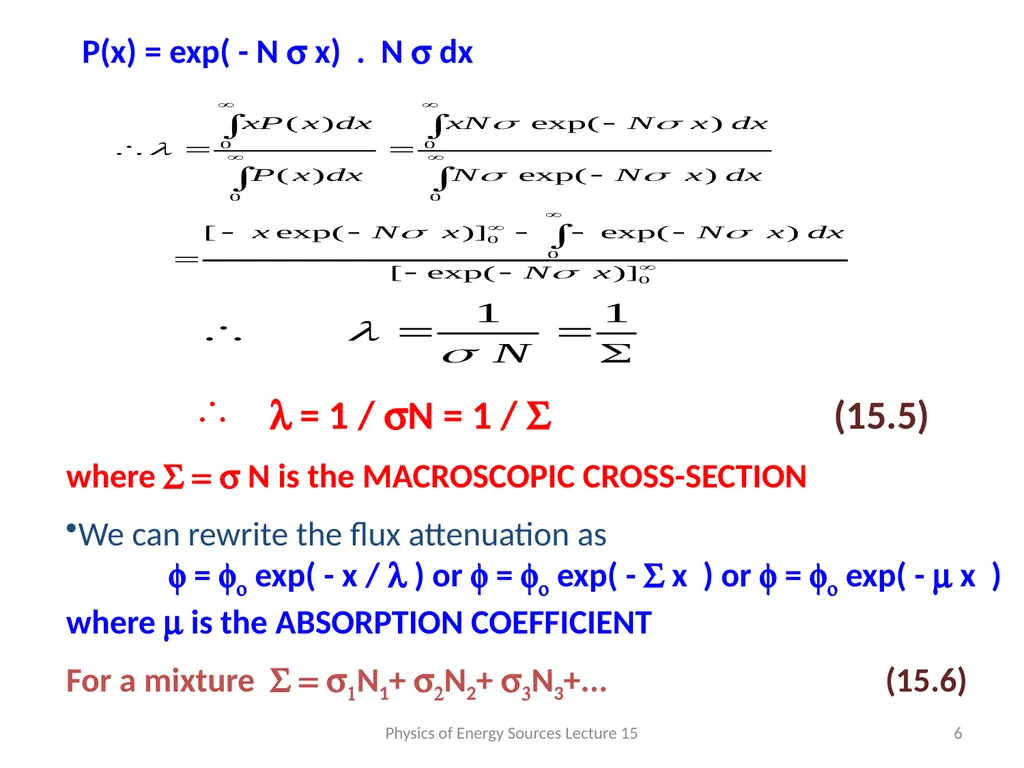
P(x) = exp( - N s x) . N s dx l = 1 / sN = 1 / S (15.5)
where S = s N is the MACROSCOPIC CROSS-SECTION
We can rewrite the flux attenuation as
f = fo exp( - x / l ) or f = fo exp( - S x ) or f = fo exp( - m x ) where m is the ABSORPTION COEFFICIENT
For a mixture S = s1N1+ s2N2+ s3N3+... (15.6) 6 Physics of Energy Sources Lecture 15<br>
07
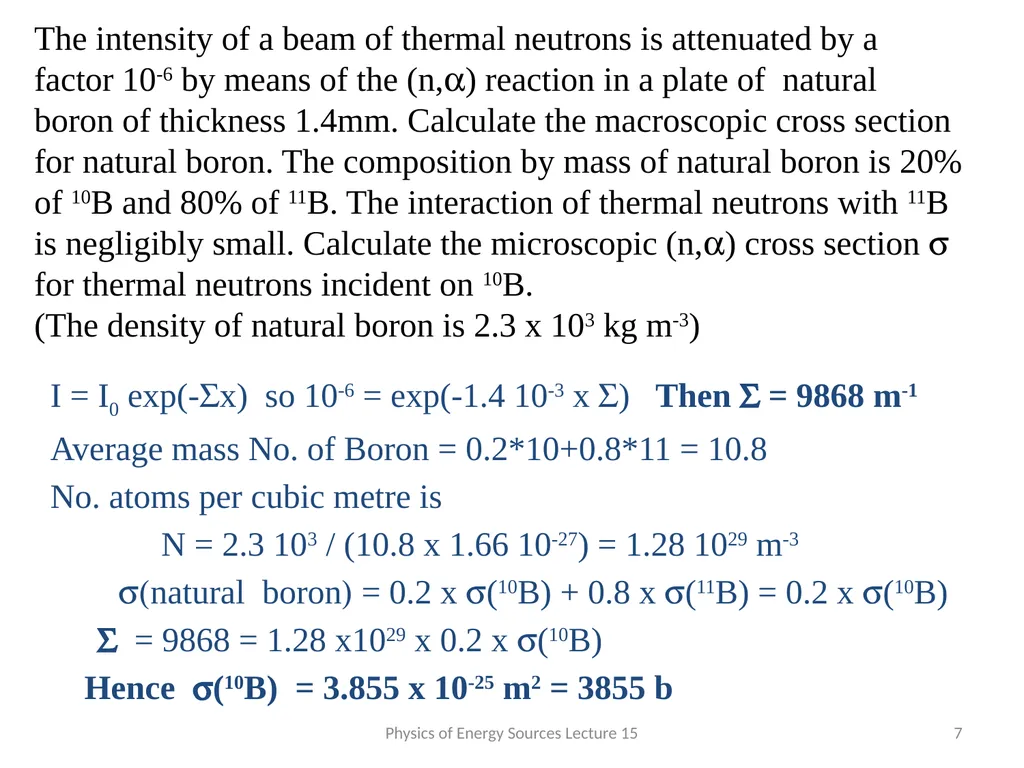
The intensity of a beam of thermal neutrons is attenuated by a factor 10-6 by means of the (n,a) reaction in a plate of natural boron of thickness 1.4mm. Calculate the macroscopic cross section for natural boron. The composition by mass of natural boron is 20% of 10B and 80% of 11B. The interaction of thermal neutrons with 11B is negligibly small. Calculate the microscopic (n,a) cross section s for thermal neutrons incident on 10B. (The density of natural boron is 2.3 x 10³ kg m-3) I = I0 exp(-Sx) so 10-6 = exp(-1.4 10-3 x S) Then S = 9868 m-1
Average mass No. of Boron = 0.2*10+0.8*11 = 10.8
No. atoms per cubic metre is
N = 2.3 103 / (10.8 x 1.66 10-27) = 1.28 1029 m-3
s(natural boron) = 0.2 x s(10B) + 0.8 x s(11B) = 0.2 x s(10B)
S = 9868 = 1.28 x1029 x 0.2 x s(10B)
Hence s(10B) = 3.855 x 10⁻²⁵ m2 = 3855 b 7 Physics of Energy Sources Lecture 15<br>
08
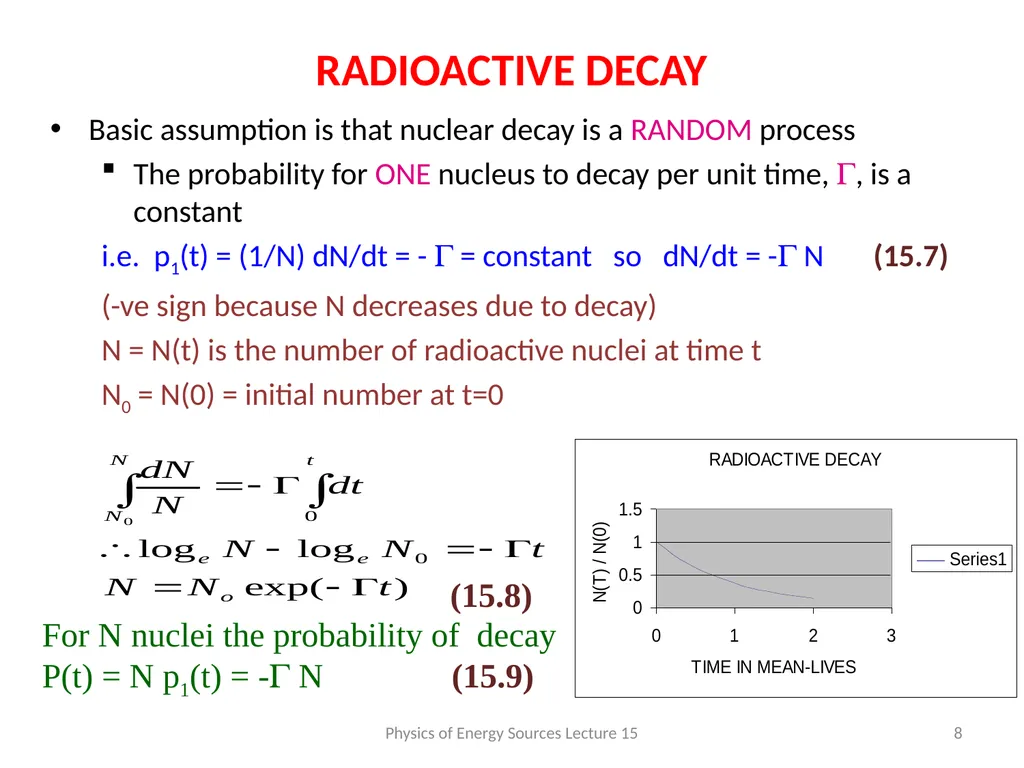
RADIOACTIVE DECAY Basic assumption is that nuclear decay is a RANDOM process
The probability for ONE nucleus to decay per unit time, G, is a constant
i.e. p1(t) = (1/N) dN/dt = - G = constant so dN/dt = -G N (15.7)
(-ve sign because N decreases due to decay)
N = N(t) is the number of radioactive nuclei at time t
N0 = N(0) = initial number at t=0 8 Physics of Energy Sources Lecture 15 For N nuclei the probability of decay
P(t) = N p1(t) = -G N (15.9) (15.8)<br>
09
MEAN LIFETIME t
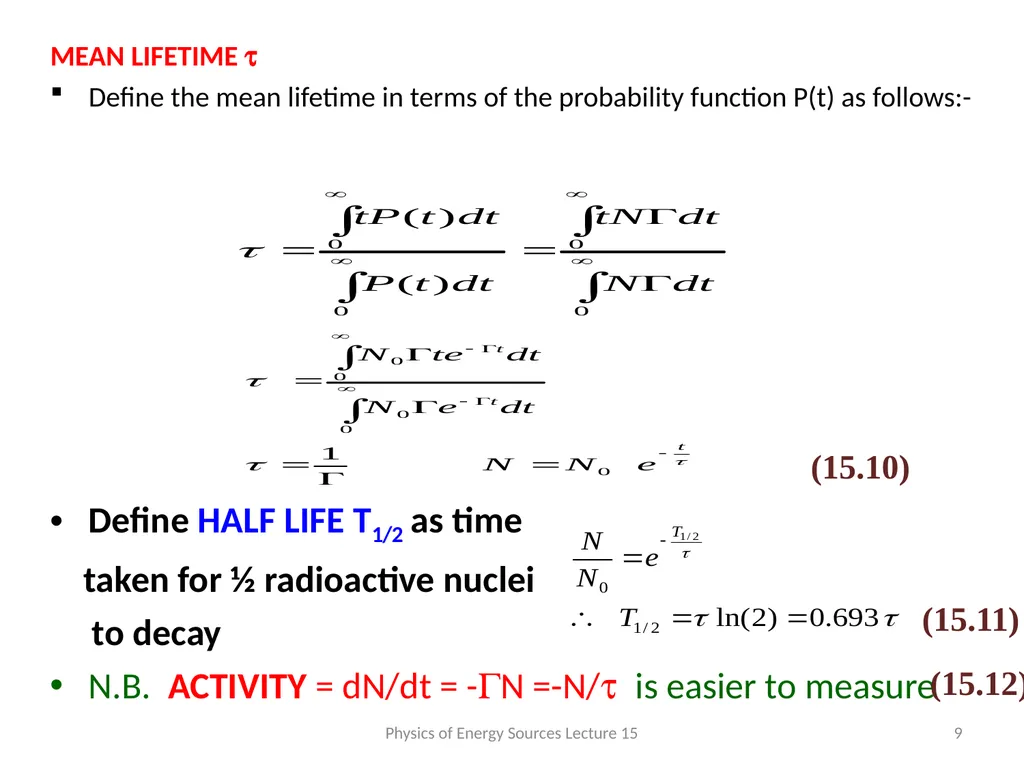
Define the mean lifetime in terms of the probability function P(t) as follows:-
Define HALF LIFE T1/2 as time
taken for ½ radioactive nuclei
to decay
N.B. ACTIVITY = dN/dt = -GN =-N/t is easier to measure 9 Physics of Energy Sources Lecture 15 (15.10) (15.11) (15.12)<br>
10
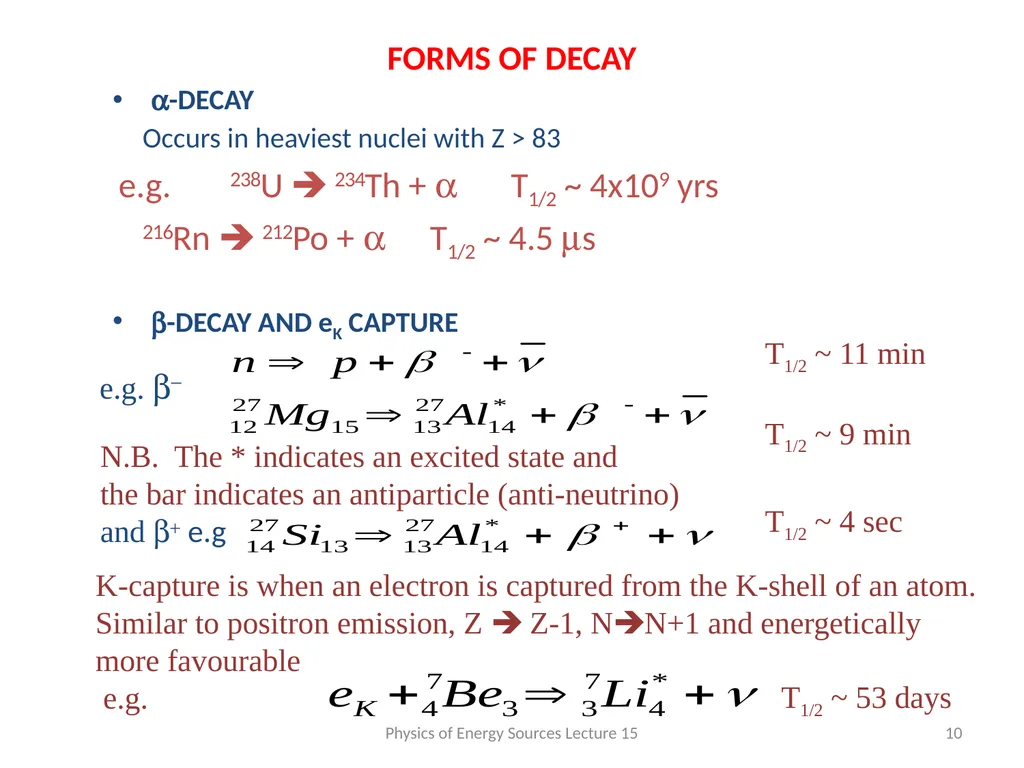
FORMS OF DECAY a-DECAY
Occurs in heaviest nuclei with Z > 83
e.g. 238U 234Th + a T1/2 ~ 4x10⁹ yrs
216Rn 212Po + a T1/2 ~ 4.5 ms
b-DECAY AND eK CAPTURE T1/2 ~ 11 min
T1/2 ~ 9 min N.B. The * indicates an excited state and
the bar indicates an antiparticle (anti-neutrino)
and b+ e.g T1/2 ~ 4 sec K-capture is when an electron is captured from the K-shell of an atom.
Similar to positron emission, Z Z-1, NN+1 and energetically
more favourable
e.g. T1/2 ~ 53 days 10 Physics of Energy Sources Lecture 15 e.g. b-<br>
11
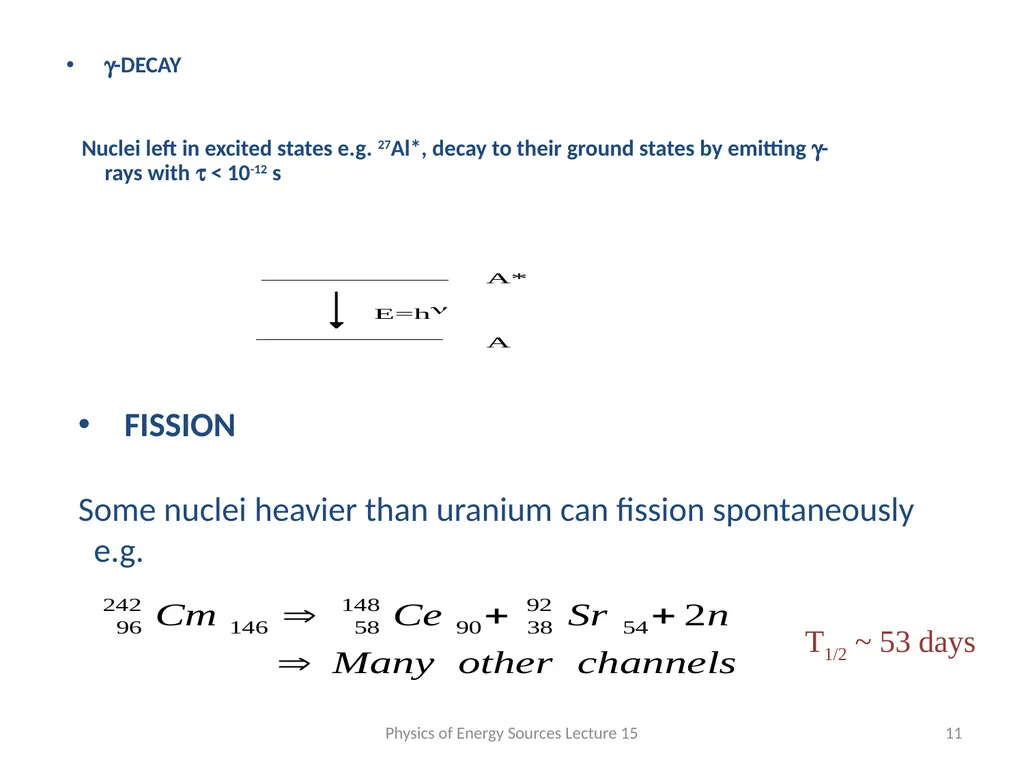
g-DECAY
Nuclei left in excited states e.g. 27Al*, decay to their ground states by emitting g-rays with t < 10-12 s FISSION
Some nuclei heavier than uranium can fission spontaneously e.g. T1/2 ~ 53 days 11 Physics of Energy Sources Lecture 15<br>
12
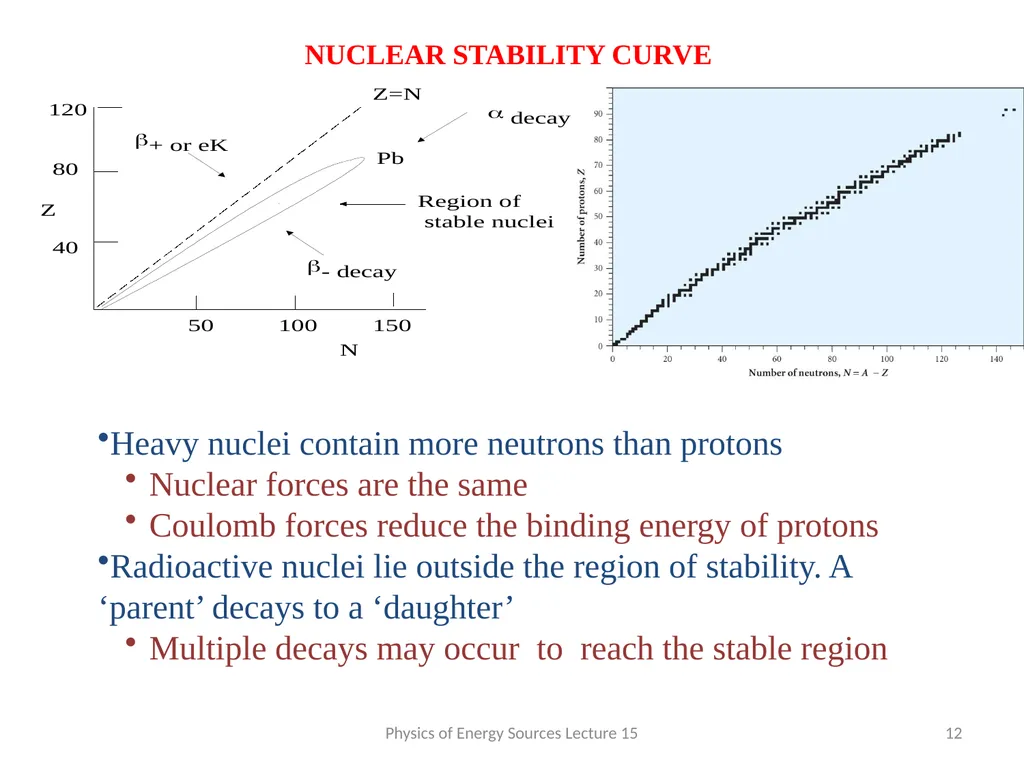
NUCLEAR STABILITY CURVE Heavy nuclei contain more neutrons than protons
Nuclear forces are the same
Coulomb forces reduce the binding energy of protons
Radioactive nuclei lie outside the region of stability. A ‘parent’ decays to a ‘daughter’
Multiple decays may occur to reach the stable region 12 Physics of Energy Sources Lecture 15<br>
13
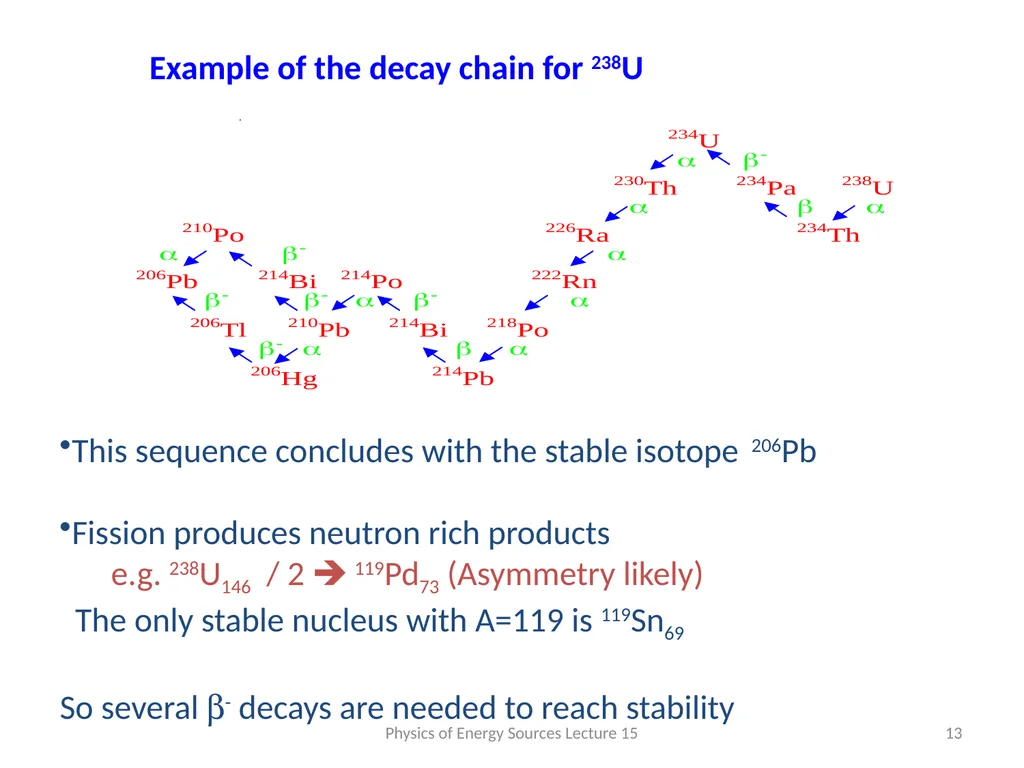
Example of the decay chain for 238U This sequence concludes with the stable isotope 206Pb
Fission produces neutron rich products
e.g. 238U146 / 2 119Pd73 (Asymmetry likely)
The only stable nucleus with A=119 is 119Sn69
So several b- decays are needed to reach stability 13 Physics of Energy Sources Lecture 15<br>