Nucleosynthesis Elements are made in four distinct ways (plus another we didnt go into) Big Bang Nucleosynthesis takes place when the universe is a few minutes old makes 2H, 3He, 4He and 7Li Fusion in stars in stars like the Sun, makes 4He
"Nucleosynthesis Elements are made in four distinct" is the property of its rightful owner. Permission is granted to
download and print the materials on this website for personal, non-commercial use only, and to display it
on your personal computer provided you do not modify the materials and that you retain all copyright
notices contained in the materials. By downloading content from our website, you accept the terms of this
agreement.
Presentation Transcript
01
Nucleosynthesis Elements are made in four distinct ways (plus another we didn’t go into)
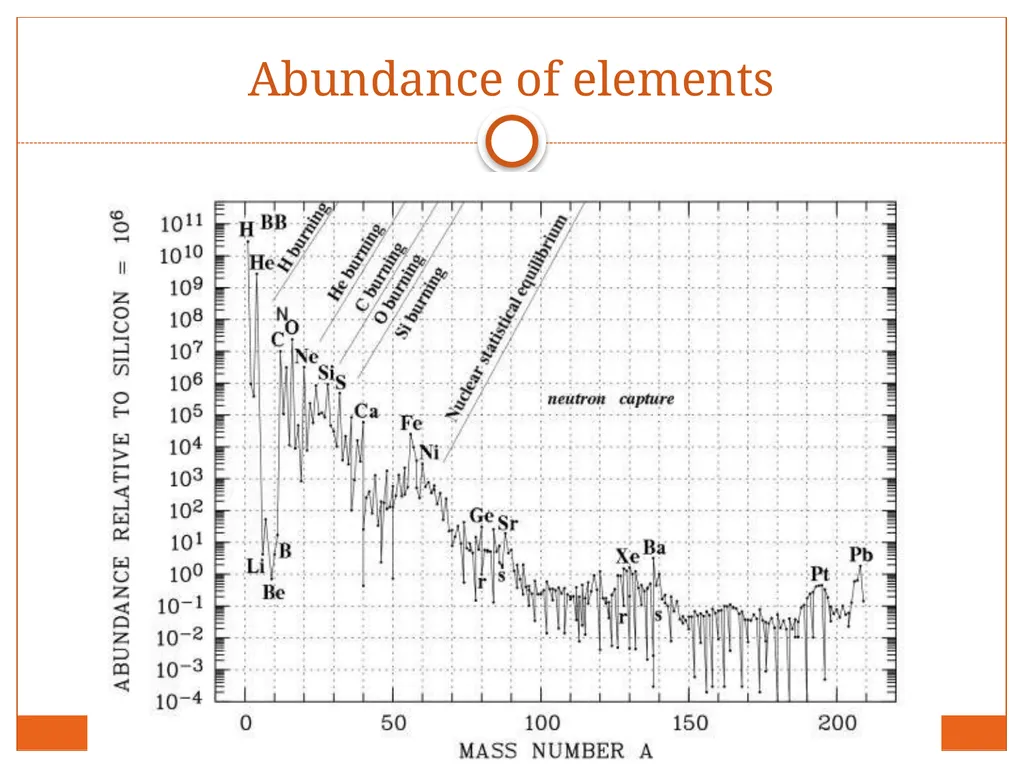
Big Bang Nucleosynthesis
takes place when the universe is a few minutes old
makes 2H, 3He, 4He and 7Li
Fusion in stars
in stars like the Sun, makes 4He and C, N, O
in massive stars, makes elements up to iron-56
Fusion in supernova explosions
primarily makes elements around iron
Neutron capture in He-fusing stars and supernovae
makes elements heavier than iron<br>
02
Abundance of elements<br>
03
Neutron capture processes Three basic types
s-process (slow)
occurs in helium-fusing stars where small quantities of free neutrons are made by processes like 13C + 4He → 16O + n
adds neutrons very slowly, so any unstable nucleus that forms has time to decay
therefore makes only nuclei which can be reached (directly or via decay) from a stable isotope
anything surrounded by unstable isotopes cannot be produced<br>
04
Neutron capture processes Three basic types
r-process (rapid)
occurs in very neutron-rich environment—we think during supernovae
adds neutrons rapidly, so many neutrons are added before the nucleus has time to decay
therefore initially makes highly unstable, very neutron-rich nuclei which subsequently decay to stable isotopes via β decay
each β decay converts one neutron to a proton
therefore cannot make any nucleus which has a stable isobar with the same mass number but smaller atomic number<br>
05
Neutron capture processes Three basic types
p-process
probably occurs in supernovae
creates rare neutron-poor isotopes, either by adding protons or by knocking out neutrons
responsible for making isotopes which are to the left of the s-process path, therefore not accessible by either the s-process itself or the r-process<br>
06
add neutron The s-process path stable isotope stable isotope? yes no decay (probably β decay, maybe electron capture) Repeat until 209Bi, where it ends because 210Po α-decays, forming a loop back to 206Pb<br>
07
The r-process path stable isotope no β decay The initial neutron influx only happens once, followed by many β-decays add many neutrons stable isotope yes stable isotope?<br>
08
The s- and r-process paths r-process makes very unstable nuclei<br>
09
Example s and r process
s process only
r process only
p process only β decay converts neutron to proton e capture converts proton to neutron A, Z A, Z−1 A, Z+1<br>
10
Summary Big Bang nucleosynthesis makes only isotopes with atomic masses 2, 3, 4 and 7
because masses 5 and 8 are not stable
Stellar fusion makes helium, and elements from carbon to iron
Supernova fusion makes the “iron peak”
Neutron capture makes elements heavier than iron
s-process: isotopes from Fe to Bi adjacent to other stable isotopes
r-process: isotopes accessible via repeated β decays
p-process: isotopes to the left of the s-process path<br>