
Numerical Weather Prediction MUSTANSIRIYAH

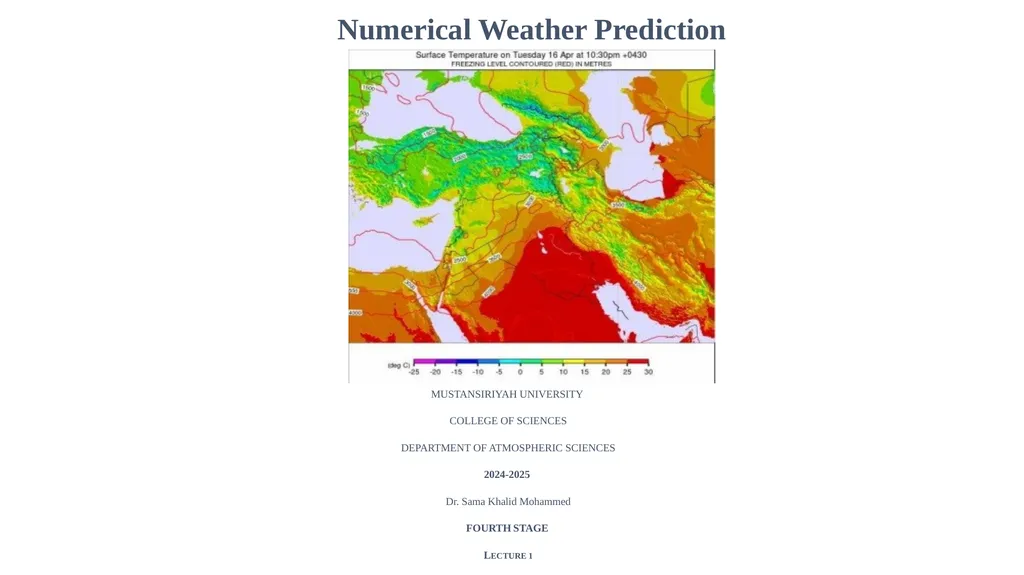
Description: Numerical Weather Prediction MUSTANSIRIYAH UNIVERSITY COLLEGE OF SCIENCES DEPARTMENT OF ATMOSPHERIC SCIENCES 2024-2025 Dr. Sama Khalid Mohammed FOURTH STAGE Lecture 1 Numerical Weather Prediction A method of weather forecasting that
Related Topics
Download Presentation
"Numerical Weather Prediction MUSTANSIRIYAH" is the property of its rightful owner. Permission is granted to download and print the materials on this website for personal, non-commercial use only, and to display it on your personal computer provided you do not modify the materials and that you retain all copyright notices contained in the materials. By downloading content from our website, you accept the terms of this agreement.
Presentation Transcript
slide1. Numerical Weather Prediction MUSTANSIRIYAH UNIVERSITY
COLLEGE OF SCIENCES
DEPARTMENT OF ATMOSPHERIC SCIENCES
2024-2025
Dr. Sama Khalid Mohammed
FOURTH STAGE
Lecture 1<br>
slide2. Numerical Weather Prediction<br>
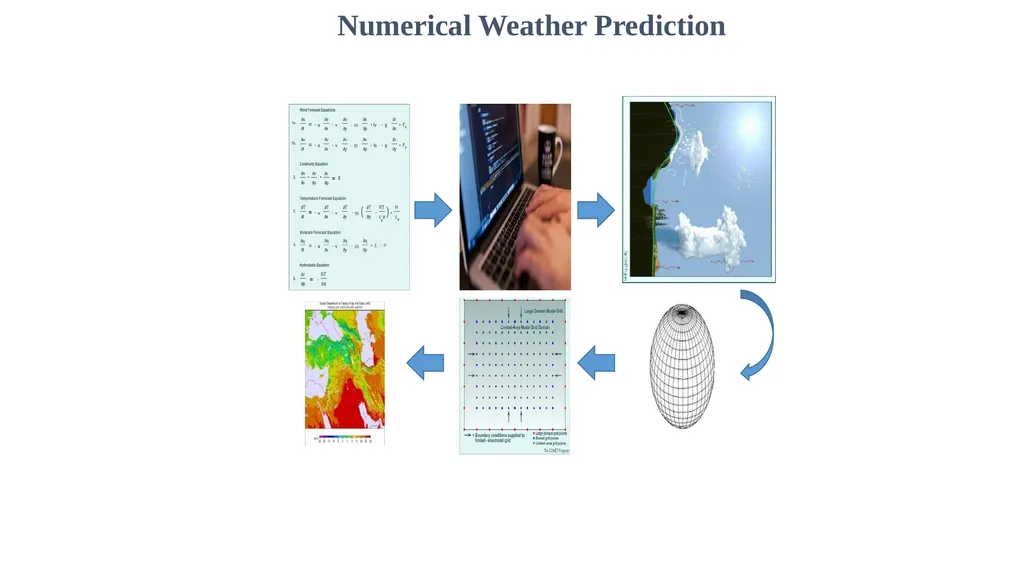
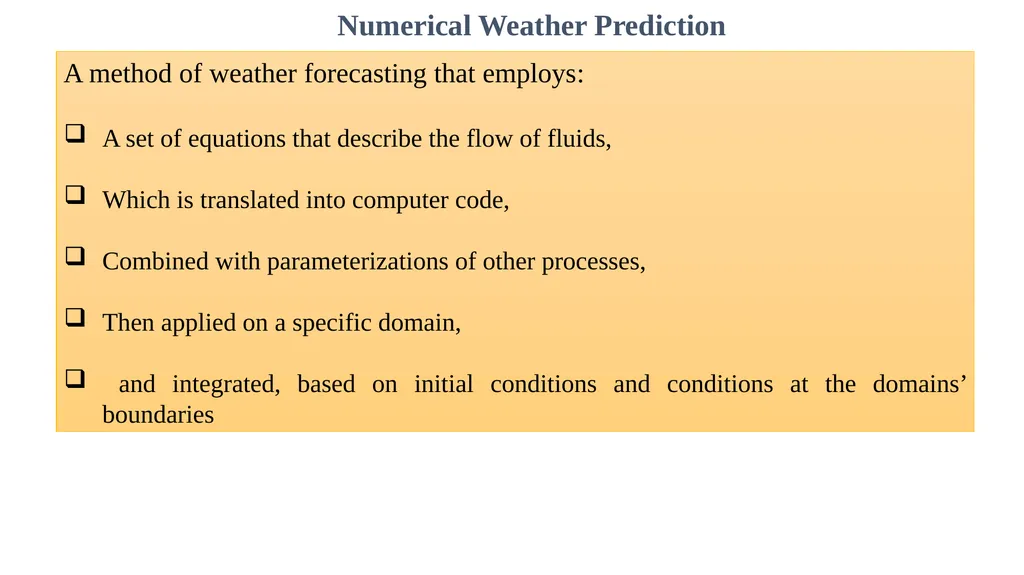
slide3. A method of weather forecasting that employs:
A set of equations that describe the flow of fluids,
Which is translated into computer code,
Combined with parameterizations of other processes,
Then applied on a specific domain,
and integrated, based on initial conditions and conditions at the domains’ boundaries Numerical Weather Prediction<br>
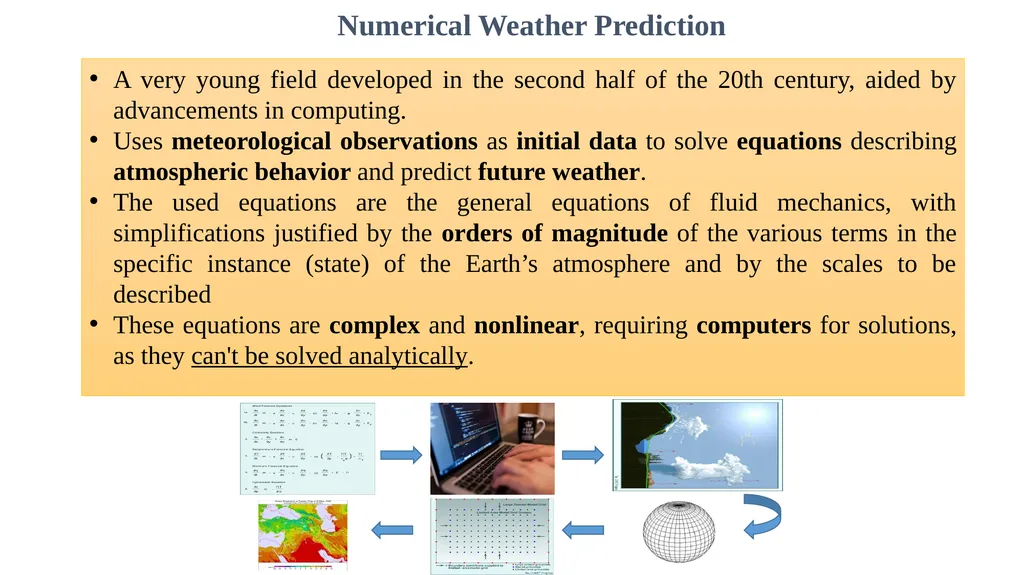
slide4. A very young field developed in the second half of the 20th century, aided by advancements in computing.
Uses meteorological observations as initial data to solve equations describing atmospheric behavior and predict future weather.
The used equations are the general equations of fluid mechanics, with simplifications justified by the orders of magnitude of the various terms in the specific instance (state) of the Earth’s atmosphere and by the scales to be described
These equations are complex and nonlinear, requiring computers for solutions, as they can't be solved analytically. Numerical Weather Prediction<br>
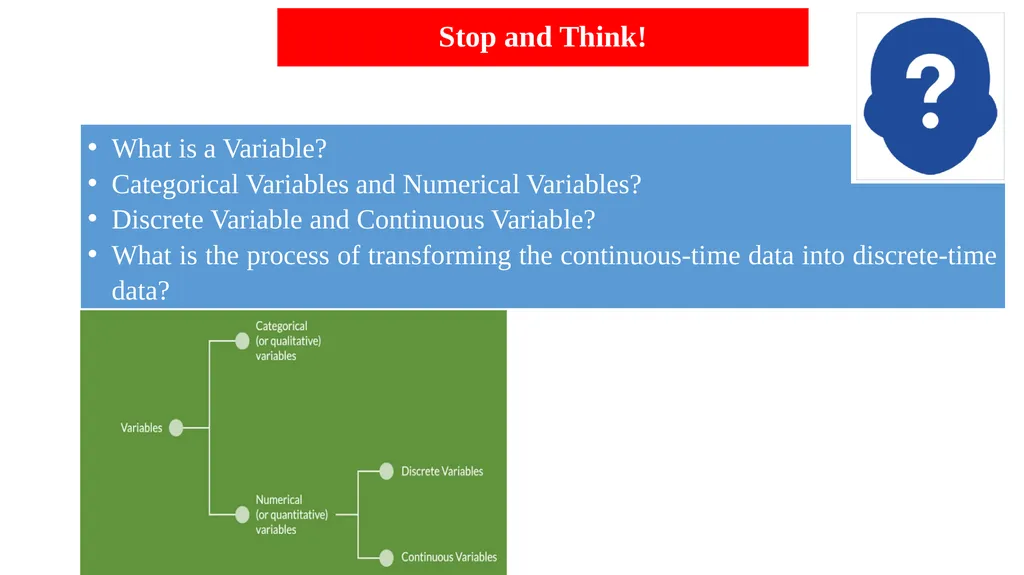
slide5. Stop and Think! What is a Variable?
Categorical Variables and Numerical Variables?
Discrete Variable and Continuous Variable?
What is the process of transforming the continuous-time data into discrete-time data?<br>
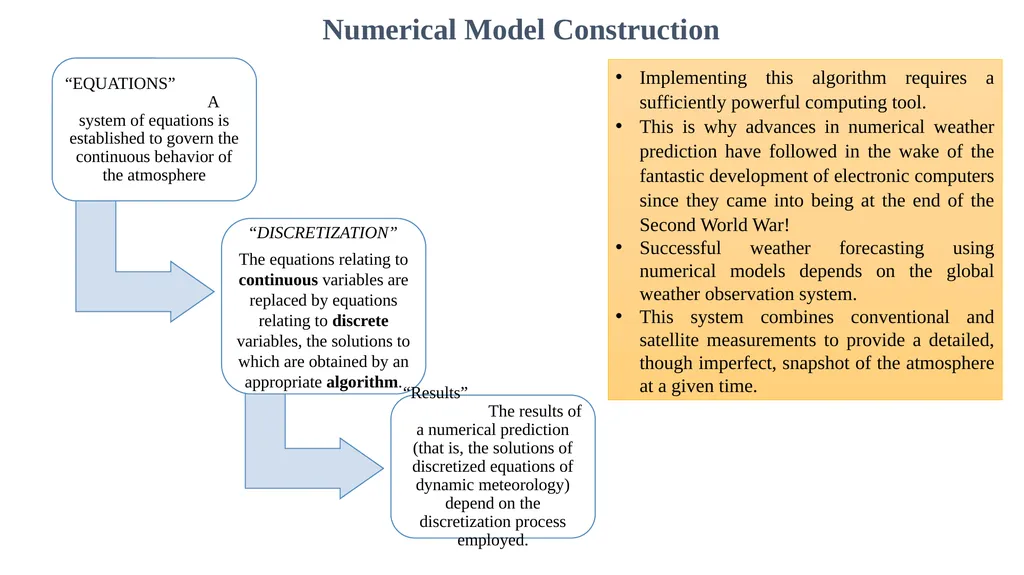
slide6. Numerical Model Construction Implementing this algorithm requires a sufficiently powerful computing tool.
This is why advances in numerical weather prediction have followed in the wake of the fantastic development of electronic computers since they came into being at the end of the Second World War!
Successful weather forecasting using numerical models depends on the global weather observation system.
This system combines conventional and satellite measurements to provide a detailed, though imperfect, snapshot of the atmosphere at a given time.<br>
slide7. Stop and Think! What is deterministic and probabilistic prediction?
What is the absolute vorticity conservation equation?
What is the quasi-geostrophic approximation?
What is the absolute vorticity?<br>
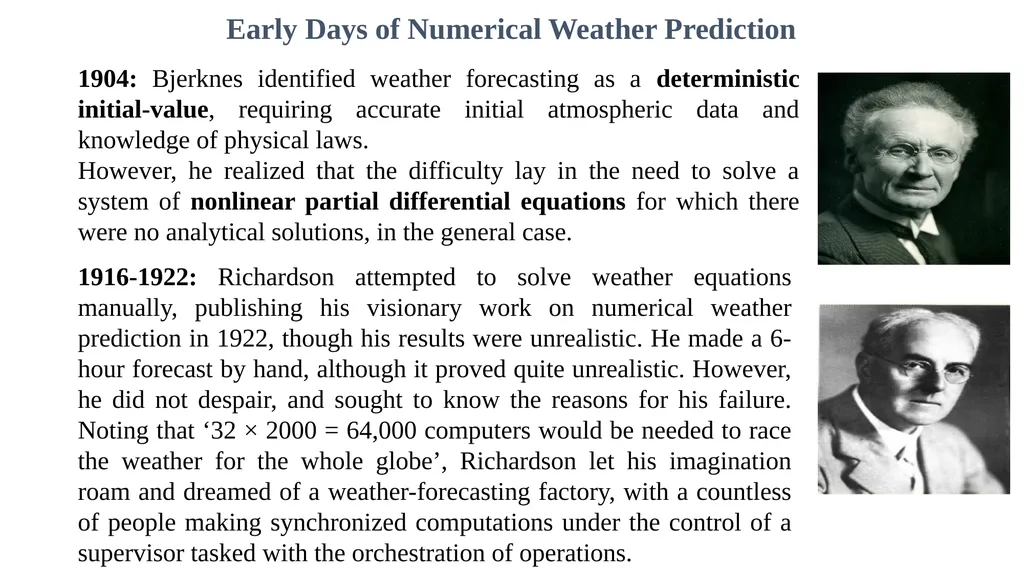
slide8. Early Days of Numerical Weather Prediction 1904: Bjerknes identified weather forecasting as a deterministic initial-value, requiring accurate initial atmospheric data and knowledge of physical laws.
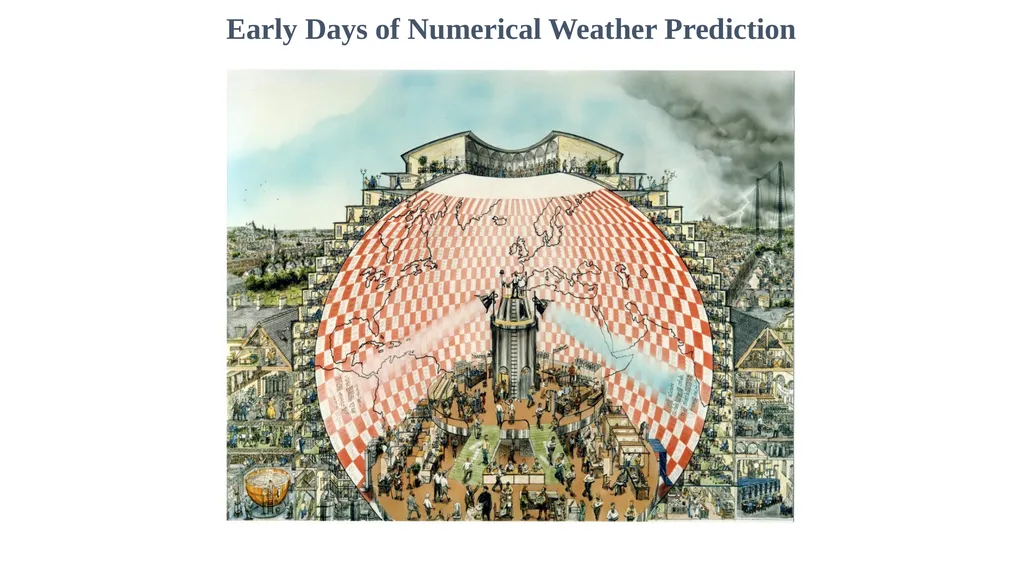
However, he realized that the difficulty lay in the need to solve a system of nonlinear partial differential equations for which there were no analytical solutions, in the general case. 1916-1922: Richardson attempted to solve weather equations manually, publishing his visionary work on numerical weather prediction in 1922, though his results were unrealistic. He made a 6-hour forecast by hand, although it proved quite unrealistic. However, he did not despair, and sought to know the reasons for his failure. Noting that ‘32 × 2000 = 64,000 computers would be needed to race the weather for the whole globe’, Richardson let his imagination roam and dreamed of a weather-forecasting factory, with a countless of people making synchronized computations under the control of a supervisor tasked with the orchestration of operations.<br>
slide9. Early Days of Numerical Weather Prediction<br>
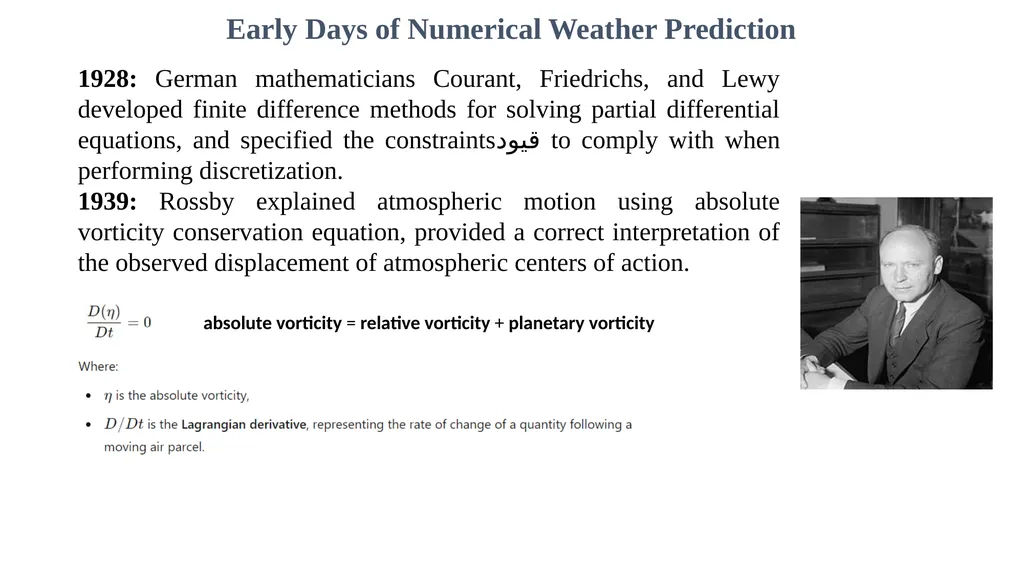
slide10. Early Days of Numerical Weather Prediction 1928: German mathematicians Courant, Friedrichs, and Lewy developed finite difference methods for solving partial differential equations, and specified the constraintsقيود to comply with when performing discretization.
1939: Rossby explained atmospheric motion using absolute vorticity conservation equation, provided a correct interpretation of the observed displacement of atmospheric centers of action. absolute vorticity = relative vorticity + planetary vorticity<br>
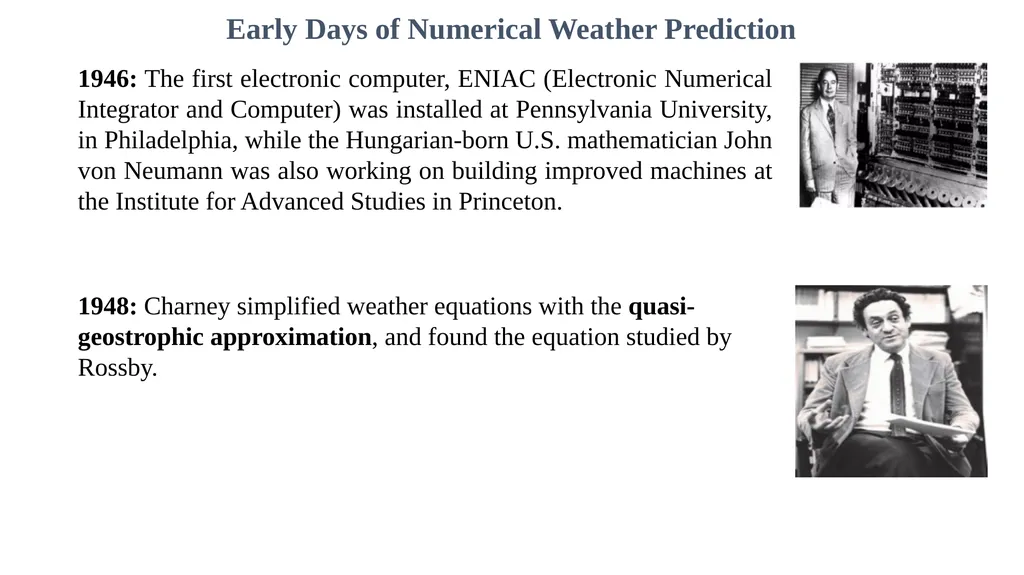
slide11. Early Days of Numerical Weather Prediction 1946: The first electronic computer, ENIAC (Electronic Numerical Integrator and Computer) was installed at Pennsylvania University, in Philadelphia, while the Hungarian-born U.S. mathematician John von Neumann was also working on building improved machines at the Institute for Advanced Studies in Princeton. 1948: Charney simplified weather equations with the quasi-geostrophic approximation, and found the equation studied by Rossby.<br>
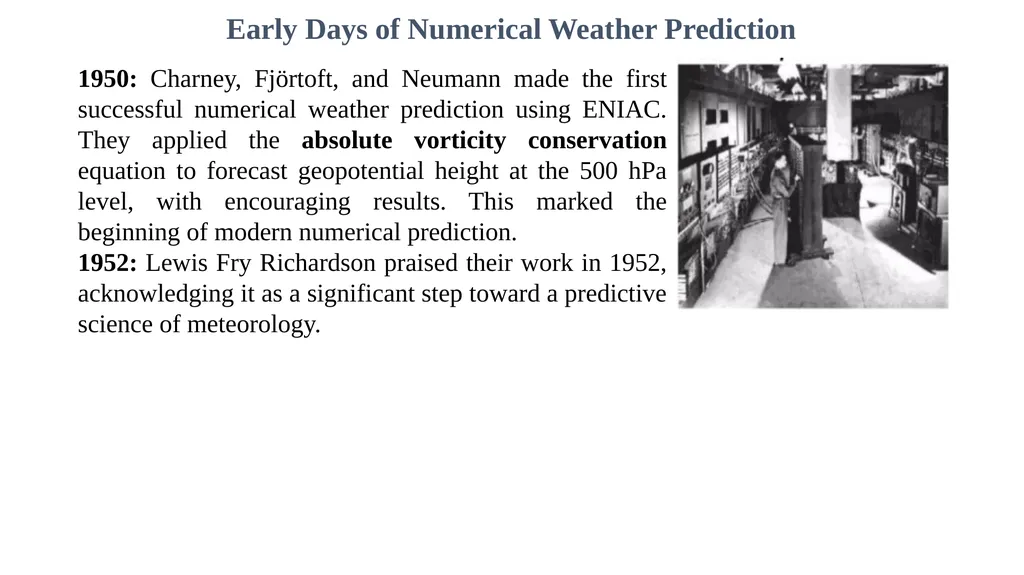
slide12. Early Days of Numerical Weather Prediction 1950: Charney, Fjörtoft, and Neumann made the first successful numerical weather prediction using ENIAC. They applied the absolute vorticity conservation equation to forecast geopotential height at the 500 hPa level, with encouraging results. This marked the beginning of modern numerical prediction.
1952: Lewis Fry Richardson praised their work in 1952, acknowledging it as a significant step toward a predictive science of meteorology.<br>
COLLEGE OF SCIENCES
DEPARTMENT OF ATMOSPHERIC SCIENCES
2024-2025
Dr. Sama Khalid Mohammed
FOURTH STAGE
Lecture 1<br>
slide2. Numerical Weather Prediction<br>
slide3. A method of weather forecasting that employs:
A set of equations that describe the flow of fluids,
Which is translated into computer code,
Combined with parameterizations of other processes,
Then applied on a specific domain,
and integrated, based on initial conditions and conditions at the domains’ boundaries Numerical Weather Prediction<br>
slide4. A very young field developed in the second half of the 20th century, aided by advancements in computing.
Uses meteorological observations as initial data to solve equations describing atmospheric behavior and predict future weather.
The used equations are the general equations of fluid mechanics, with simplifications justified by the orders of magnitude of the various terms in the specific instance (state) of the Earth’s atmosphere and by the scales to be described
These equations are complex and nonlinear, requiring computers for solutions, as they can't be solved analytically. Numerical Weather Prediction<br>
slide5. Stop and Think! What is a Variable?
Categorical Variables and Numerical Variables?
Discrete Variable and Continuous Variable?
What is the process of transforming the continuous-time data into discrete-time data?<br>
slide6. Numerical Model Construction Implementing this algorithm requires a sufficiently powerful computing tool.
This is why advances in numerical weather prediction have followed in the wake of the fantastic development of electronic computers since they came into being at the end of the Second World War!
Successful weather forecasting using numerical models depends on the global weather observation system.
This system combines conventional and satellite measurements to provide a detailed, though imperfect, snapshot of the atmosphere at a given time.<br>
slide7. Stop and Think! What is deterministic and probabilistic prediction?
What is the absolute vorticity conservation equation?
What is the quasi-geostrophic approximation?
What is the absolute vorticity?<br>
slide8. Early Days of Numerical Weather Prediction 1904: Bjerknes identified weather forecasting as a deterministic initial-value, requiring accurate initial atmospheric data and knowledge of physical laws.
However, he realized that the difficulty lay in the need to solve a system of nonlinear partial differential equations for which there were no analytical solutions, in the general case. 1916-1922: Richardson attempted to solve weather equations manually, publishing his visionary work on numerical weather prediction in 1922, though his results were unrealistic. He made a 6-hour forecast by hand, although it proved quite unrealistic. However, he did not despair, and sought to know the reasons for his failure. Noting that ‘32 × 2000 = 64,000 computers would be needed to race the weather for the whole globe’, Richardson let his imagination roam and dreamed of a weather-forecasting factory, with a countless of people making synchronized computations under the control of a supervisor tasked with the orchestration of operations.<br>
slide9. Early Days of Numerical Weather Prediction<br>
slide10. Early Days of Numerical Weather Prediction 1928: German mathematicians Courant, Friedrichs, and Lewy developed finite difference methods for solving partial differential equations, and specified the constraintsقيود to comply with when performing discretization.
1939: Rossby explained atmospheric motion using absolute vorticity conservation equation, provided a correct interpretation of the observed displacement of atmospheric centers of action. absolute vorticity = relative vorticity + planetary vorticity<br>
slide11. Early Days of Numerical Weather Prediction 1946: The first electronic computer, ENIAC (Electronic Numerical Integrator and Computer) was installed at Pennsylvania University, in Philadelphia, while the Hungarian-born U.S. mathematician John von Neumann was also working on building improved machines at the Institute for Advanced Studies in Princeton. 1948: Charney simplified weather equations with the quasi-geostrophic approximation, and found the equation studied by Rossby.<br>
slide12. Early Days of Numerical Weather Prediction 1950: Charney, Fjörtoft, and Neumann made the first successful numerical weather prediction using ENIAC. They applied the absolute vorticity conservation equation to forecast geopotential height at the 500 hPa level, with encouraging results. This marked the beginning of modern numerical prediction.
1952: Lewis Fry Richardson praised their work in 1952, acknowledging it as a significant step toward a predictive science of meteorology.<br>