
Nursing Leadership through Informatics Shauna
TD
Published · 22 slides · 0 views

1 / 1

Description
Nursing Leadership through Informatics Shauna Davies Creative commons attribution 4.0 international license June 2018 Authors Title Open License The PowerPoint slide deck created by Joan Wagner, and designed by JVDW Designs, for the open
Related Topics
Share
Embed code
Download this presentation From Below
"Nursing Leadership through Informatics Shauna" is the property of its rightful owner. Permission is granted to download and print the materials on this website for personal, non-commercial use only, and to display it on your personal computer provided you do not modify the materials and that you retain all copyright notices contained in the materials. By downloading content from our website, you accept the terms of this agreement.
Presentation Transcript
01
Nursing Leadership through Informatics Shauna Davies Creative commons attribution 4.0 international license June 2018 Author’s Title<br>
02
Open License The PowerPoint slide deck created by Joan Wagner, and designed by JVDW Designs, for the open textbook Leadership and Influencing Change in Nursing is licensed under a Creative Commons Attribution 4.0 International License, except where otherwise noted. The University of Regina logo is a registered trademark.
Under the terms of the Creative Commons Attribution 4.0 International License, you are free to retain, reuse, copy, redistribute, and revise this PowerPoint – in whole or in part – as long as you provide attribution to Joan Wagner. Download the PowerPoint slide deck for Leadership and Influencing Change in Nursing by Joan Wagner for free at www.uregina.ca/open-access/open-textbooks.
For questions about University of Regina’s Open Textbook Publishing Program, contact: open.textbooks@uregina.ca. CC BY 4.0 International License 2<br>
Under the terms of the Creative Commons Attribution 4.0 International License, you are free to retain, reuse, copy, redistribute, and revise this PowerPoint – in whole or in part – as long as you provide attribution to Joan Wagner. Download the PowerPoint slide deck for Leadership and Influencing Change in Nursing by Joan Wagner for free at www.uregina.ca/open-access/open-textbooks.
For questions about University of Regina’s Open Textbook Publishing Program, contact: open.textbooks@uregina.ca. CC BY 4.0 International License 2<br>
03
Learning Objectives Define the terms nursing informatics, e–Health, and m–Health.
Develop an understanding of the risks and benefits of using electronic health records.
Develop an appreciation for standardized terminologies.
Develop an understanding of telehealth and telehomecare.
Differentiate between telehealth and telehomecare.
Develop an understanding of various web 2.0 tools used in health care.
Discuss the role of nurses in developing clients’ health literacy.
Describe the necessary steps to ensure privacy and security of personal health information. CC BY 4.0 International License 3<br>
Develop an understanding of the risks and benefits of using electronic health records.
Develop an appreciation for standardized terminologies.
Develop an understanding of telehealth and telehomecare.
Differentiate between telehealth and telehomecare.
Develop an understanding of various web 2.0 tools used in health care.
Discuss the role of nurses in developing clients’ health literacy.
Describe the necessary steps to ensure privacy and security of personal health information. CC BY 4.0 International License 3<br>
04
Health Informatics Health information systems specialize in storing, managing, capturing, and transmitting information about the health of individuals, along with all activities within the health care organization (CASN, 2012).
Nursing informatics is a specialty that combines nursing care with the use of computers and information science to provide information about nursing care delivery. CC BY 4.0 International License 4<br>
Nursing informatics is a specialty that combines nursing care with the use of computers and information science to provide information about nursing care delivery. CC BY 4.0 International License 4<br>
05
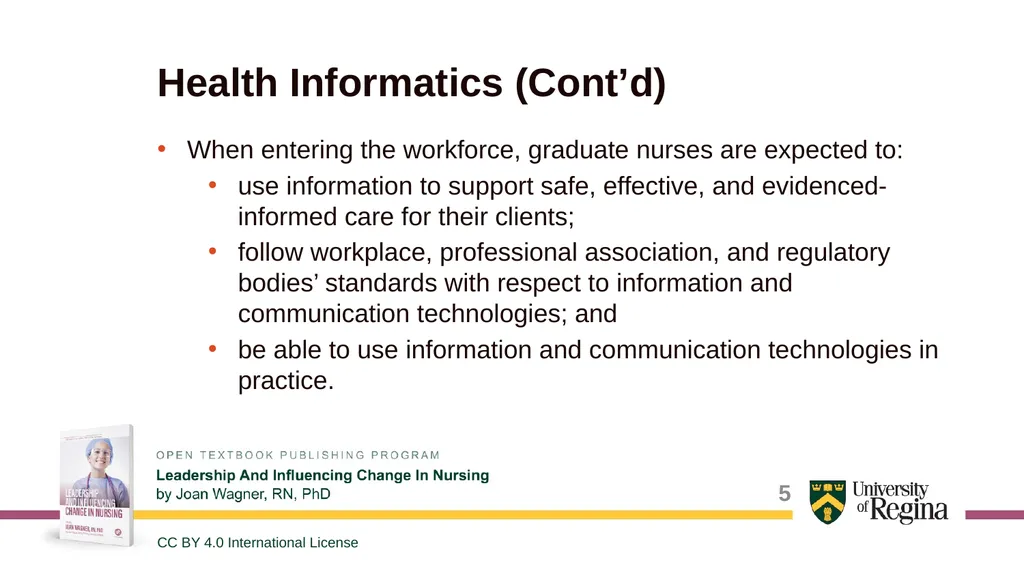
Health Informatics (Cont’d) When entering the workforce, graduate nurses are expected to:
use information to support safe, effective, and evidenced-informed care for their clients;
follow workplace, professional association, and regulatory bodies’ standards with respect to information and communication technologies; and
be able to use information and communication technologies in practice. CC BY 4.0 International License 5<br>
use information to support safe, effective, and evidenced-informed care for their clients;
follow workplace, professional association, and regulatory bodies’ standards with respect to information and communication technologies; and
be able to use information and communication technologies in practice. CC BY 4.0 International License 5<br>
06
Health Informatics: e-Health e-Health is the information and communication technologies used in health care, which includes a range of services such as:
electronic patient administration systems,
lab and diagnostic tests, information services; and
telehealth and telehomecare monitoring devices (including remote vital sign monitoring). CC BY 4.0 International License 6<br>
electronic patient administration systems,
lab and diagnostic tests, information services; and
telehealth and telehomecare monitoring devices (including remote vital sign monitoring). CC BY 4.0 International License 6<br>
07
Health Informatics: m-Health Any mobile device with smartphone capabilities allows for the downloading of apps, which are self-contained computer programs that run directly on the device’s home screen.
m-Health technology includes many different types of medical- and health-related apps.
Health care providers must follow HIPA (Health Information Protection Act) when using apps with multiple clients so that any personal information is de-identified. CC BY 4.0 International License 7<br>
m-Health technology includes many different types of medical- and health-related apps.
Health care providers must follow HIPA (Health Information Protection Act) when using apps with multiple clients so that any personal information is de-identified. CC BY 4.0 International License 7<br>
08
Risks and Benefits of Electronic Health Records Electronic health records systems are used in various hospitals, community health settings, and doctor’s offices to enter and view client information.
A benefit of using electronic health records is that health care providers have quick access to medical information.
Clients benefit as they receive improved management of chronic diseases.
A risk of electronic health records is that people not within the circle of care may access confidential information. CC BY 4.0 International License 8<br>
A benefit of using electronic health records is that health care providers have quick access to medical information.
Clients benefit as they receive improved management of chronic diseases.
A risk of electronic health records is that people not within the circle of care may access confidential information. CC BY 4.0 International License 8<br>
09
Essential Learning Activity 14.1.1 For more information on nursing informatics, see CASN’s report titled Nursing Informatics: Entry-to-Practice Competencies for Registered Nurses, then answer the following questions:
What three entry-to-practice informatics competencies does CASN set out?
Select one of these competencies and list the indicators.
Health Insurance Portability and Accountability Act for Professionals US Department of Health and Human Services:
Can health information be shared in a severe disaster?
Who has the right to consent with respect to whether a covered entity may electronically exchange a minor’s protected health information to or through a health information organization? CC BY 4.0 International License 9<br>
What three entry-to-practice informatics competencies does CASN set out?
Select one of these competencies and list the indicators.
Health Insurance Portability and Accountability Act for Professionals US Department of Health and Human Services:
Can health information be shared in a severe disaster?
Who has the right to consent with respect to whether a covered entity may electronically exchange a minor’s protected health information to or through a health information organization? CC BY 4.0 International License 9<br>
10
Essential Learning Activity 14.1.1 (Cont’d) Your Personal Health Information and Privacy (Government of Saskatchewan):
Who are the trustees under the Health Information Protection Act?
What rights do you have with respect to your personal information?
How do I get access to information? (Office of the Saskatchewan Information and Privacy Commissioner)
How do you access the type of information you need from the Office of the Saskatchewan Information and Privacy Commissioner? CC BY 4.0 International License 10<br>
Who are the trustees under the Health Information Protection Act?
What rights do you have with respect to your personal information?
How do I get access to information? (Office of the Saskatchewan Information and Privacy Commissioner)
How do you access the type of information you need from the Office of the Saskatchewan Information and Privacy Commissioner? CC BY 4.0 International License 10<br>
11
Standardized Terminologies Electronic health systems use standardized clinical terminologies so that all health care providers can communicate findings and share client information within their specific practice settings.
Common terminologies:
Systematized Nomenclature of Medicine—Clinical Terms (SNOMED CT)
Canadian Health Outcomes for Better Information and Care (C-HOBIC) CC BY 4.0 International License 11<br>
Common terminologies:
Systematized Nomenclature of Medicine—Clinical Terms (SNOMED CT)
Canadian Health Outcomes for Better Information and Care (C-HOBIC) CC BY 4.0 International License 11<br>
12
Standardized Terminologies (Cont’d) By using a common terminology and following a specific plan of action, researchers will be more effective in using the information and comparing results with other information globally.
These nursing interventions can then be described and understood by other health care providers as the client transitions from the hospital to community or home setting. CC BY 4.0 International License 12<br>
These nursing interventions can then be described and understood by other health care providers as the client transitions from the hospital to community or home setting. CC BY 4.0 International License 12<br>
13
Essential Learning Activity 14.2.1 Read Canada Health Infoway’s webpage about Electronic Health Records then answer the following questions:
Explain why digital records need to be available to all authorized health care providers.
What are the challenges to and solutions for providing a comprehensive framework for sharing health information across the country?
The 2016 Digital Health Blueprint identified ten computing environments. What are they?
When determining how to implement a particular digital health solution, designers have many decisions to make. List three of these decisions. CC BY 4.0 International License 13<br>
Explain why digital records need to be available to all authorized health care providers.
What are the challenges to and solutions for providing a comprehensive framework for sharing health information across the country?
The 2016 Digital Health Blueprint identified ten computing environments. What are they?
When determining how to implement a particular digital health solution, designers have many decisions to make. List three of these decisions. CC BY 4.0 International License 13<br>
14
Telehealth and Telehomecare Telehealth is an information and communication technology that allows for health services to be delivered over a distance using electronic or telecommunication devices.
The benefit of using telehealth technology is that health care is accessible to all persons no matter where they reside.
Telehomecare refers to services provided to clients in their own homes.
The main benefit of telehomecare is that clients and caregivers are provided with additional supports. CC BY 4.0 International License 14<br>
The benefit of using telehealth technology is that health care is accessible to all persons no matter where they reside.
Telehomecare refers to services provided to clients in their own homes.
The main benefit of telehomecare is that clients and caregivers are provided with additional supports. CC BY 4.0 International License 14<br>
15
Essential Learning Activity 13.5.1 How can telehomecare help you care for your patients?
How can telehomecare assist family caregivers in caring for family with COPD or heart failure? CC BY 4.0 International License 15<br>
How can telehomecare assist family caregivers in caring for family with COPD or heart failure? CC BY 4.0 International License 15<br>
16
Social Networking Social networking refers to any web-based or mobile platform that allows users to create and share conversations or content with other users or the public.
Some examples: Twitter, Facebook, LinkedIn, YouTube, etc.
Each of these tools is presently being used in health care to:
connect clients with other clients dealing with the same health condition;
connect health care providers with other health care providers; or
connect health care providers with clients and families. CC BY 4.0 International License 16<br>
Some examples: Twitter, Facebook, LinkedIn, YouTube, etc.
Each of these tools is presently being used in health care to:
connect clients with other clients dealing with the same health condition;
connect health care providers with other health care providers; or
connect health care providers with clients and families. CC BY 4.0 International License 16<br>
17
Social Networking: Privacy Concerns Registered nurses must reflect on the CNA’s Code of Ethics for Registered Nurses (2017), which states that registered nurses must “safeguard the privacy and confidentiality of persons and other colleagues” (p. 21).
In Saskatchewan, the Health Information Protection Act (HIPA) discusses the protection of electronic health information (Government of Saskatchewan, 2003). CC BY 4.0 International License 17<br>
In Saskatchewan, the Health Information Protection Act (HIPA) discusses the protection of electronic health information (Government of Saskatchewan, 2003). CC BY 4.0 International License 17<br>
18
Research Note Davies, S. (2016). Online Social Support in the Saskatchewan Heart Failure Network: An Interpretative Description Approach (Doctoral dissertation). University of Saskatchewan.
Abstract: Web-based tools are used by many health care professionals and health care organizations to communicate with patients, to collaborate with other health professionals, and to provide health information. This interpretive descriptive research study explored the factors that have influenced and will continue to influence or contribute to caregivers’ use of social networking as a form of social support when a family member is learning to live well with heart failure.
The results of this research study have implications for regional health authorities, health care professionals, and caregivers of patients living with heart failure. Health care professionals are encouraged to provide caregivers and patients with a variety of teaching materials both in print and electronically. CC BY 4.0 International License 18<br>
Abstract: Web-based tools are used by many health care professionals and health care organizations to communicate with patients, to collaborate with other health professionals, and to provide health information. This interpretive descriptive research study explored the factors that have influenced and will continue to influence or contribute to caregivers’ use of social networking as a form of social support when a family member is learning to live well with heart failure.
The results of this research study have implications for regional health authorities, health care professionals, and caregivers of patients living with heart failure. Health care professionals are encouraged to provide caregivers and patients with a variety of teaching materials both in print and electronically. CC BY 4.0 International License 18<br>
19
Exercises for Review Review your current social media presence then describe the risks and benefits of using social media in a professional setting. Reflect on what you found. Now consider any risks and benefits related to your nursing image and professionalism.
Review the Health on the Net (HON) code principles or medical and health websites. Find three websites that relate to your area of clinical interest. Would you recommend these websites to your clients? Why or why not?
Reflect on a situation where a member of a health care team was reprimanded for posting information on social media. How will you ensure that you are maintaining confidentiality using social media? CC BY 4.0 International License 19<br>
Review the Health on the Net (HON) code principles or medical and health websites. Find three websites that relate to your area of clinical interest. Would you recommend these websites to your clients? Why or why not?
Reflect on a situation where a member of a health care team was reprimanded for posting information on social media. How will you ensure that you are maintaining confidentiality using social media? CC BY 4.0 International License 19<br>
20
Exercises for Review (Cont’d) Review HIPA, HIPAA, and FOIP guidelines. How do you ensure that you are maintaining health information confidentiality in the clinical setting? What steps are taken by a health care organization to ensure confidentiality of health information? What information can a client request to see before, during, or after receiving medical care? What steps must be taken by the client to receive their personal health information? CC BY 4.0 International License 20<br>
21
References Canadian Association of Schools of Nursing [CASN]. (2012). Nursing informatics: Entry-to-practice competencies for registered nurses. Retrieved from: http://www.casn.ca/wp-content/uploads/2014/12/Nursing-Informatics-Entry-to-Practice-Competencies-for-RNs_updated-June-4-2015.pdf
Canadian Nurses Association [CNA]. (2017). Code of ethics for registered nurses [2017 edition]. Retrieved from: https://www.cna-aiic.ca/html/en/Code-of-Ethics-2017-Edition/index.html#1/z
Government of Saskatchewan. (2003). The Health Information Protection Act quick reference sheet. Retrieved from http://www.health.gov.sk.ca/hipa-quick-reference CC BY 4.0 International License 21<br>
Canadian Nurses Association [CNA]. (2017). Code of ethics for registered nurses [2017 edition]. Retrieved from: https://www.cna-aiic.ca/html/en/Code-of-Ethics-2017-Edition/index.html#1/z
Government of Saskatchewan. (2003). The Health Information Protection Act quick reference sheet. Retrieved from http://www.health.gov.sk.ca/hipa-quick-reference CC BY 4.0 International License 21<br>
22
Presenters Presented by Thank you! Creative commons attribution 4.0 International license June 2018<br>