
Nursing research or research nursing? Two separate






Description: Nursing research or research nursing? Two separate terms, two separate careers Nurse Researcher 17.3 (2010) Johnson S and Stevenson K ICN Code of ethics, 2012 The nurse assumes the major role in determining and implementing acceptable
Related Topics
Download Presentation
"Nursing research or research nursing? Two separate" is the property of its rightful owner. Permission is granted to download and print the materials on this website for personal, non-commercial use only, and to display it on your personal computer provided you do not modify the materials and that you retain all copyright notices contained in the materials. By downloading content from our website, you accept the terms of this agreement.
Presentation Transcript
slide1. Nursing research or research nursing?
Two separate terms, two separate careers
Nurse Researcher 17.3 (2010) Johnson S and Stevenson K<br>
slide2. ICN Code of ethics, 2012 The nurse assumes the major role in determining and implementing acceptable standards of clinical nursing practice http://www.icn.ch/images/stories/documents/publications/free_publications/Code%20of%20Ethics%202012%20for%20web.pdf International Council
of Nurses<br>
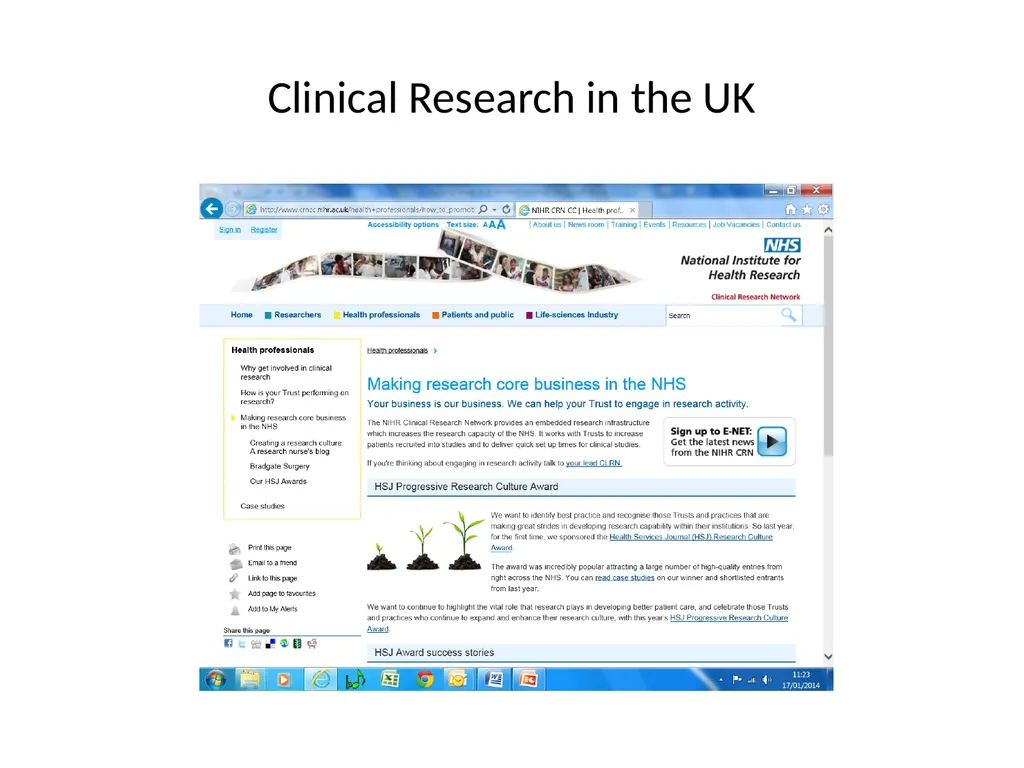
slide3. Clinical Research in the UK<br>
slide4. Set up in 2006 to promote research in the NHS.
The mission of the National Institute for Health Research
(NIHR)is to maintain a health research system in which the
NHS supports outstanding individuals, working in world class
facilities, conducting leading edge research focused on the
needs of patients and the public.<br>
slide5. Clinical Research Nursing in UK Recommendations for nursing research careers published
by the UKCRC Subcommittee for Nurses in Clinical Research
A report was published recommending that a training and support structure should be put in place to enable nurses to work as researchers at different stages of their career. 1st August 2007<br>
slide6. COMPETENCY FRAMEWORK FOR CLINICAL RESEARCH NURSES NHS Competency Framework 2006, reviewed 2011<br>
slide7. Royal College of Nursing, UK The RCN Research & Development Governance Group have sponsored an RCN Research Society project:
‘Capitalising on the contribution of nurses in clinical research’<br>
slide8. Capitalising on the contribution of nurses in clinical research Project vision
Embed clinical research nurses in the RCN
Create an active network offering mentorship, supervision and development of others as part of practice
Identify ‘added value’ of clinical research nurses to clinical research and recruitment to trials
Identify and showcase best practice in Uk NHS research
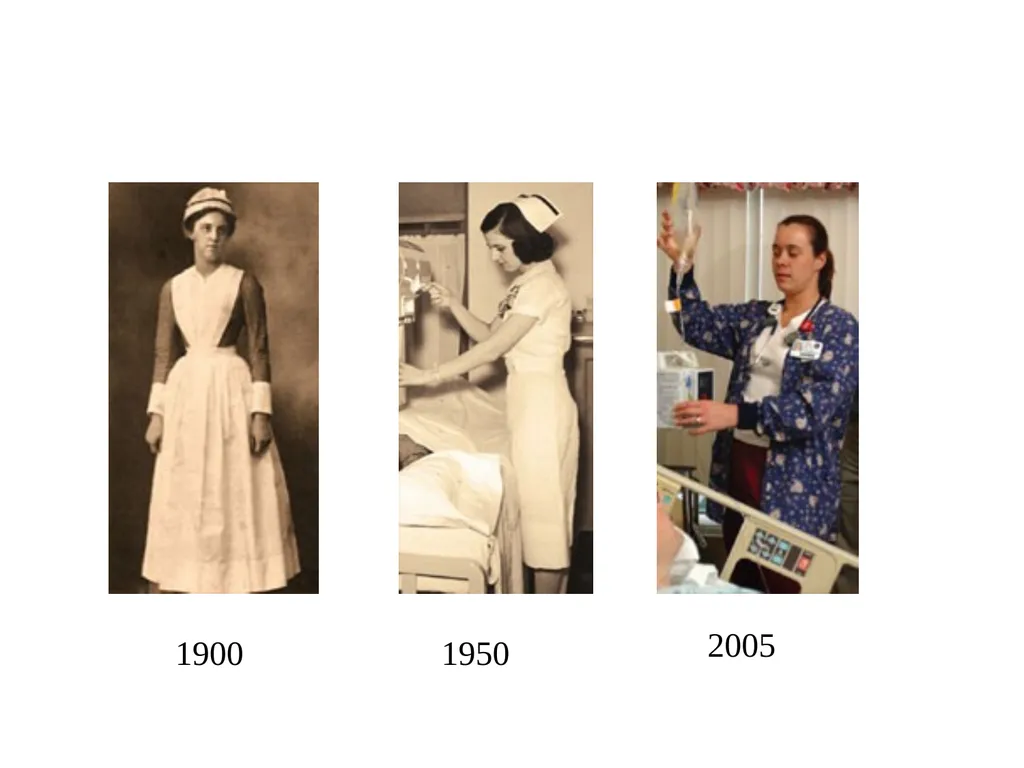
Network with Association of nursing students and Education forum to use Clinical research facilities for student placements.<br>
slide9. The role of the research nurse. Hill G, MacArthur J (2006) Professional issues associated with the role of the research nurse. Nursing Standard. 20, 39, 41-47.
Role of research nurse:
Advocate
Educator
Caregiver
Coordinator – care/ research
http://nursingstandard.rcnpublishing.co.uk/archive/article-professional-issues-associated-with-the-role-of-the-research-nurse<br>
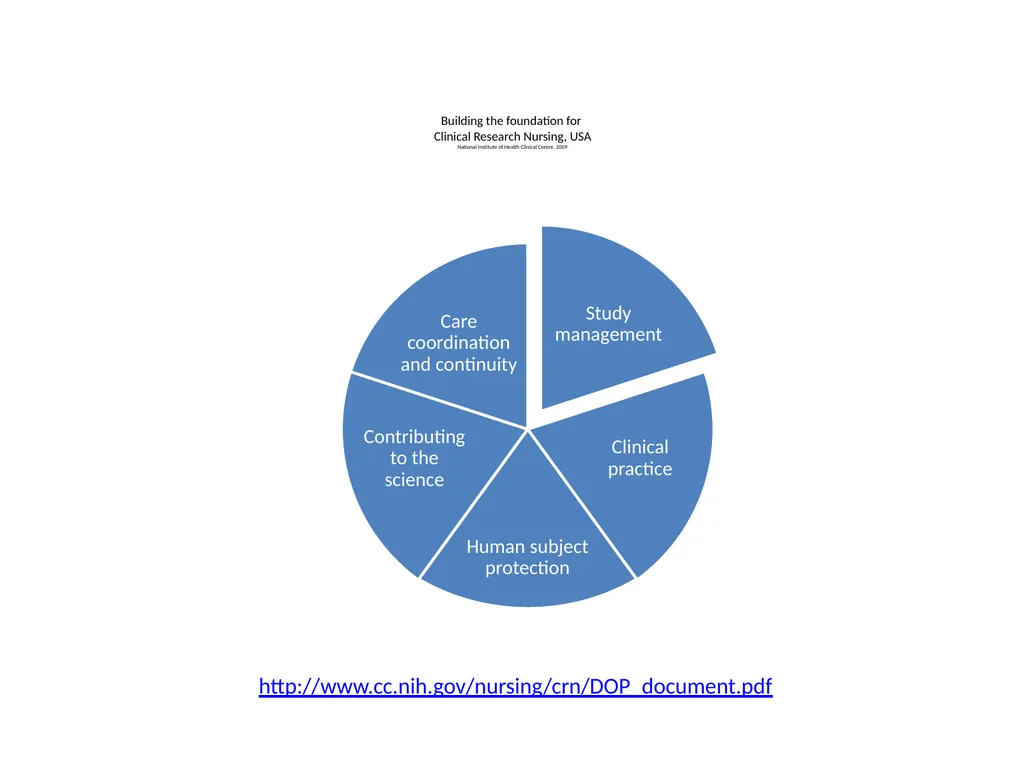
slide10. Building the foundation for Clinical Research Nursing, USA National Institute of Health Clinical Centre, 2009 http://www.cc.nih.gov/nursing/crn/DOP_document.pdf<br>
slide11. Problems associated with the role: Hill G, MacArthur J (2006) Professional issues associated with the role of the research nurse. Nursing Standard. 20, 39, 41-47.
Professional isolation – lack of peer support or understanding of the role by the nursing community
Lack of job specific training
Short term contracts
Unpredictable workload
http://nursingstandard.rcnpublishing.co.uk/archive/article-professional-issues-associated-with-the-role-of-the-research-nurse<br>
slide12. Recommendations: Hill G, MacArthur J (2006) Professional issues associated with the role of the research nurse. Nursing Standard. 20, 39, 41-47.
Research Nurses need to
Encourage peer support
Disseminate information about the role
Access educational opportunities
http://nursingstandard.rcnpublishing.co.uk/archive/article-professional-issues-associated-with-the-role-of-the-research-nurse<br>
slide13. CLINICAL RESEARCH NURSE - SUMMARY A DEVELOPING ROLE
AN OPPORTUNITY FOR NURSES
DEMANDS CLINICAL AND ACADEMIC SKILLS
HELPS TO DEVELOP HEALTH CARE FOR NOW AND THE FUTURE<br>
slide14. Nursing Research = RESEARCH BY AND FOR NURSES<br>
slide15. ICN Code of ethics, 2012 The nurse assumes the major role in determining and implementing acceptable standards of clinical nursing practice http://www.icn.ch/images/stories/documents/publications/free_publications/Code%20of%20Ethics%202012%20for%20web.pdf International Council
of Nurses<br>
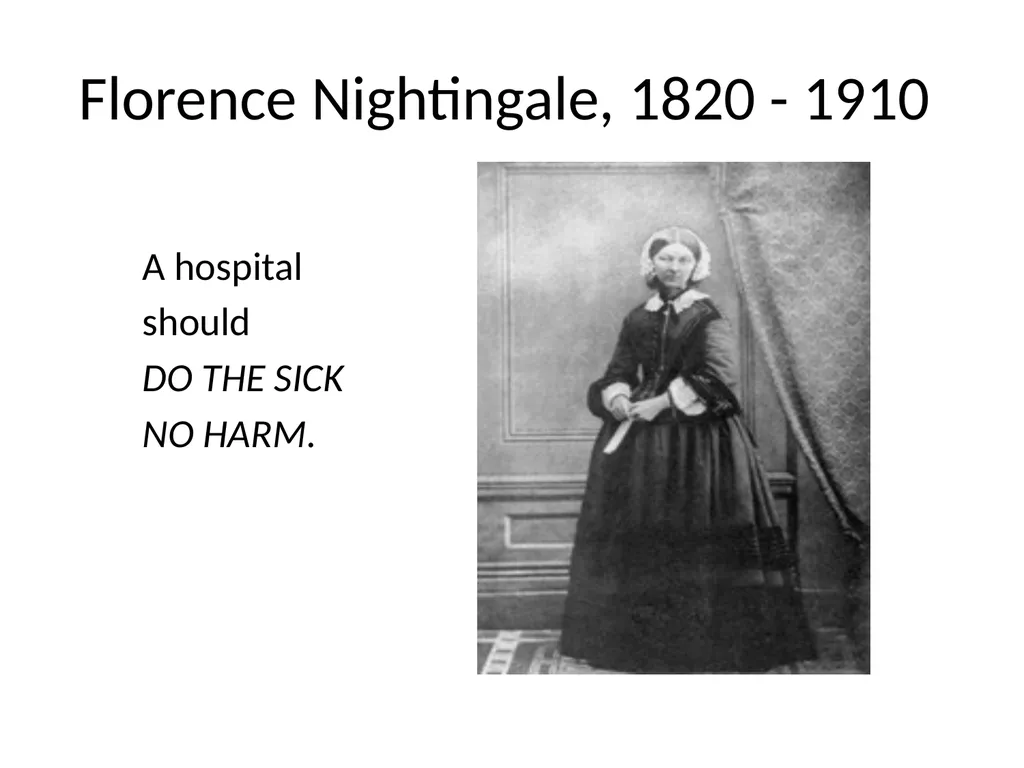
slide16. Florence Nightingale, 1820 - 1910 A hospital
should
DO THE SICK
NO HARM.<br>
slide17. What do nurses need to know? Clinical information about health and disease, treatment and care
Psycho-social information – how is the individual responding to changes in health status?
Organisational information – how does communication flow in the Multi-disciplinary team? Where do resources come from and who is responsible for ordering and storage? Who makes patient appointments/ referrals?<br>
slide18. Nursing Research = PRACTICE CHANGES ...<br>
slide19. INFLUENCES ON CHANGING NURSING PRACTICE: scientific and medical advance
pharmaceutical development
social change
changes to management of healthcare
changed expectations
changed attitudes
role of women<br>
slide20. To respond to change, research must provide
information about:
Direct care – clinical practice
Indirect care – organisation of care
Influence on care – policy initiatives,
strategic healthcare planning
Frasure, J. (2008) Analysis of instruments measuring nurses’ attitudes towards research utilisation: a systematic review. JAN Volume 61 (1) January 2008 pp. 5 - 18<br>
slide21. National Institute of Nursing Research, US department of Health and Human Services, 20th anniversary, 2006 Changing Practice, Changing Lives: 10 Landmark Nursing Research Studies.<br>
slide23. Nursing Research = PRACTICE CHANGES,
WHAT CHANGES HAVE YOU SEEN DURING YOUR CAREER?<br>
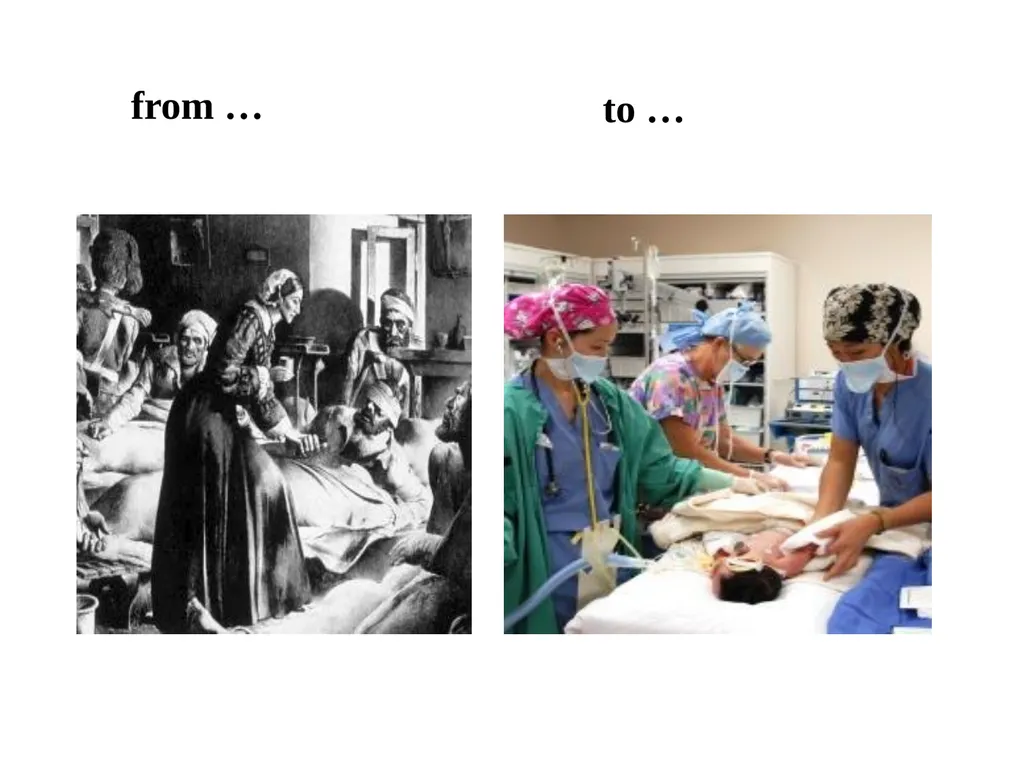
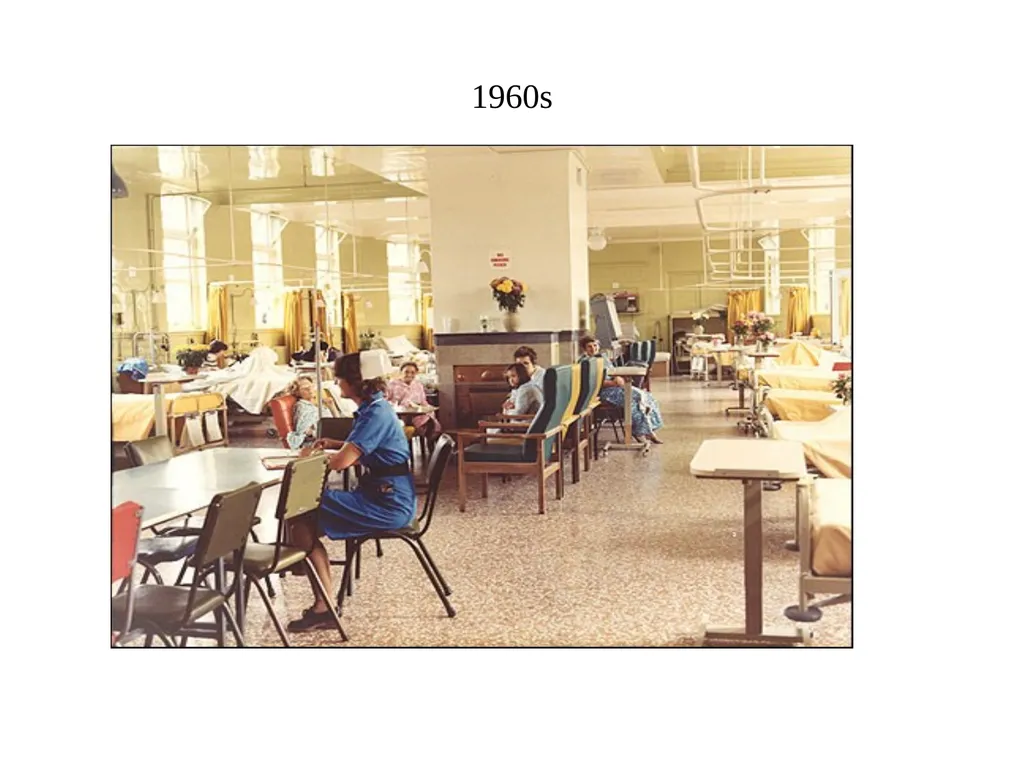
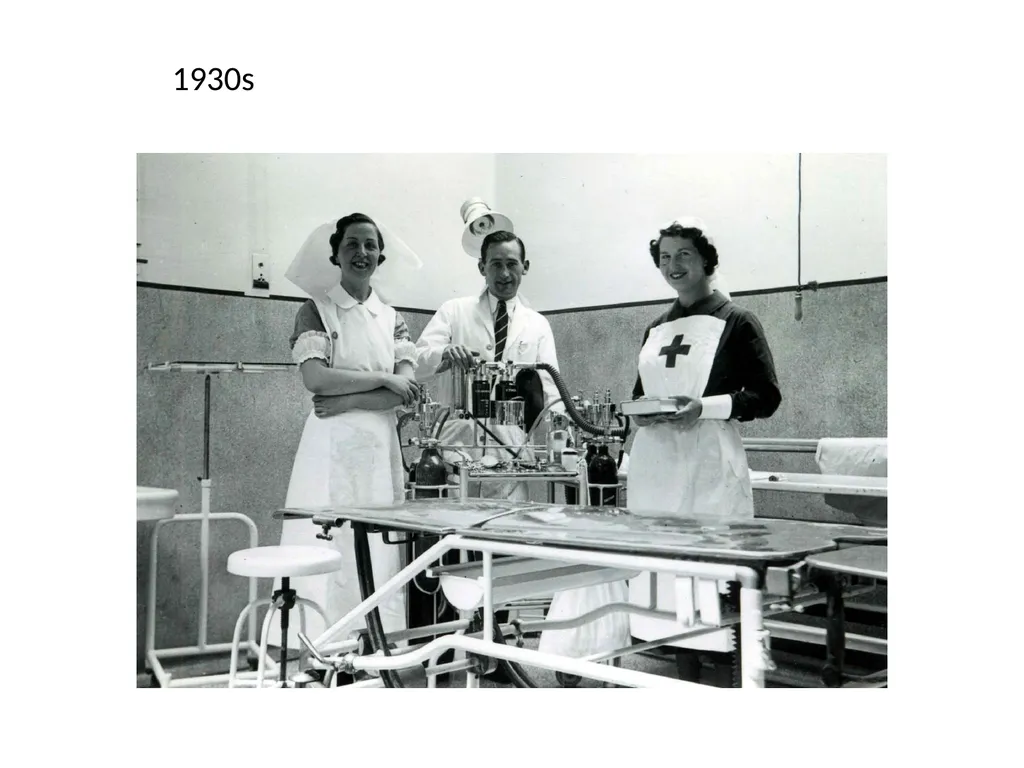
slide24. from … to …<br>
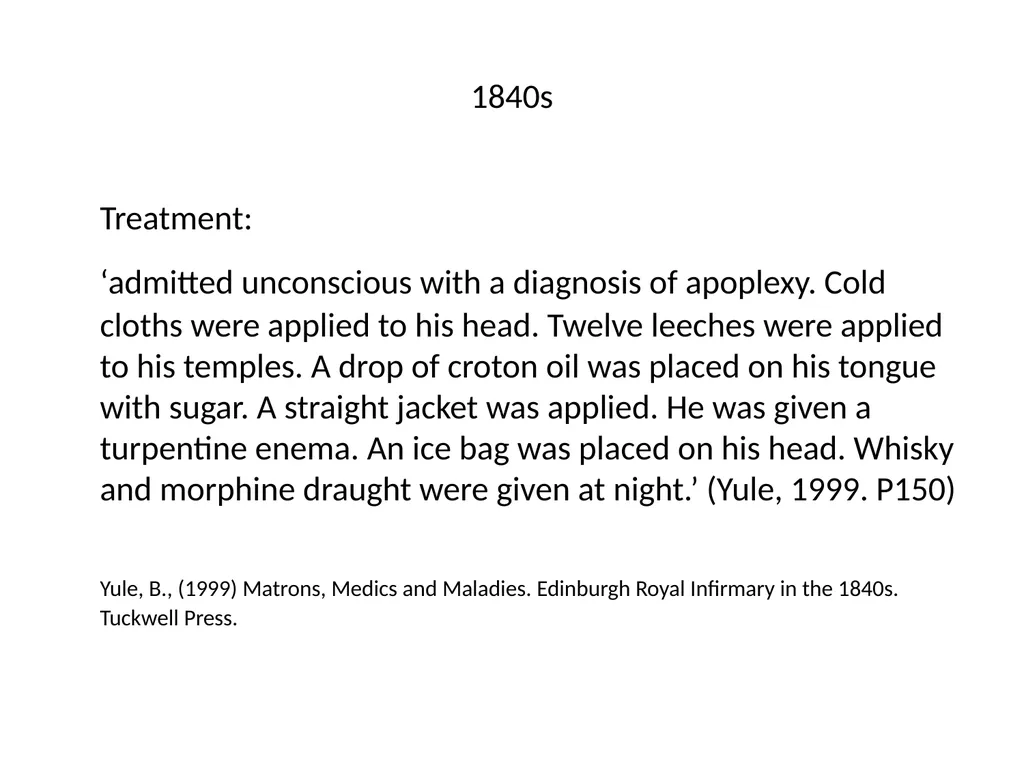
slide25. 1840s Treatment:
‘admitted unconscious with a diagnosis of apoplexy. Cold cloths were applied to his head. Twelve leeches were applied to his temples. A drop of croton oil was placed on his tongue with sugar. A straight jacket was applied. He was given a turpentine enema. An ice bag was placed on his head. Whisky and morphine draught were given at night.’ (Yule, 1999. P150)
Yule, B., (1999) Matrons, Medics and Maladies. Edinburgh Royal Infirmary in the 1840s. Tuckwell Press.<br>
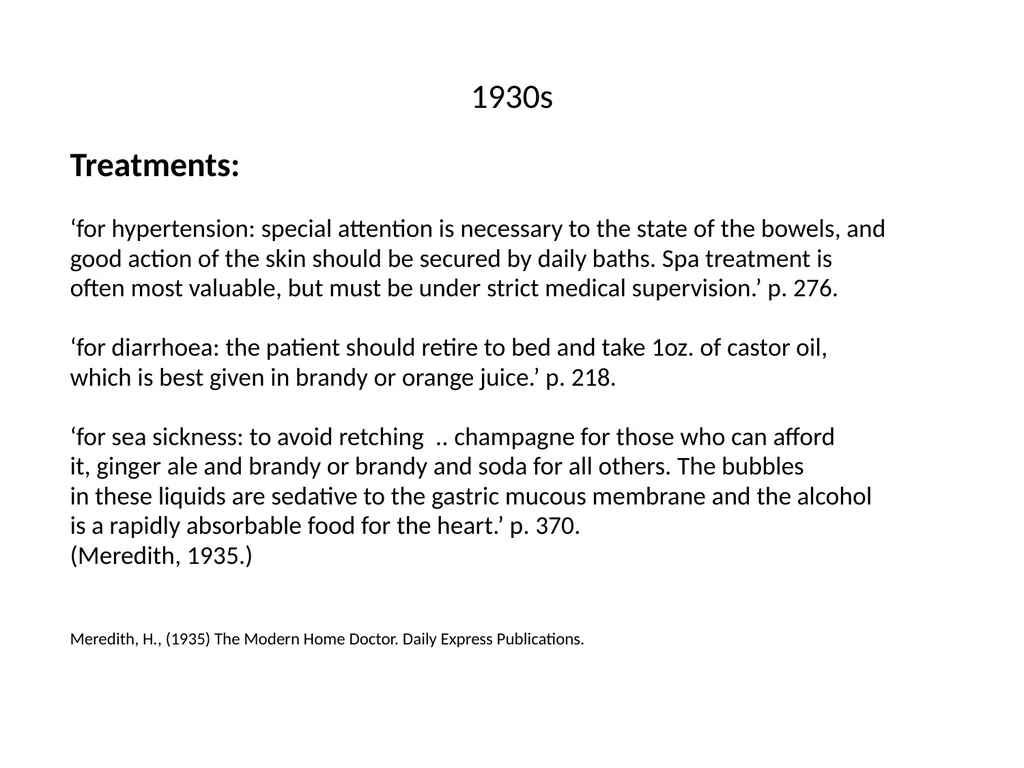
slide26. 1930s Treatments:
‘for hypertension: special attention is necessary to the state of the bowels, and
good action of the skin should be secured by daily baths. Spa treatment is
often most valuable, but must be under strict medical supervision.’ p. 276.
‘for diarrhoea: the patient should retire to bed and take 1oz. of castor oil,
which is best given in brandy or orange juice.’ p. 218.
‘for sea sickness: to avoid retching .. champagne for those who can afford
it, ginger ale and brandy or brandy and soda for all others. The bubbles
in these liquids are sedative to the gastric mucous membrane and the alcohol
is a rapidly absorbable food for the heart.’ p. 370.
(Meredith, 1935.)
Meredith, H., (1935) The Modern Home Doctor. Daily Express Publications.<br>
slide27. 1960s<br>
slide28. 1930s<br>
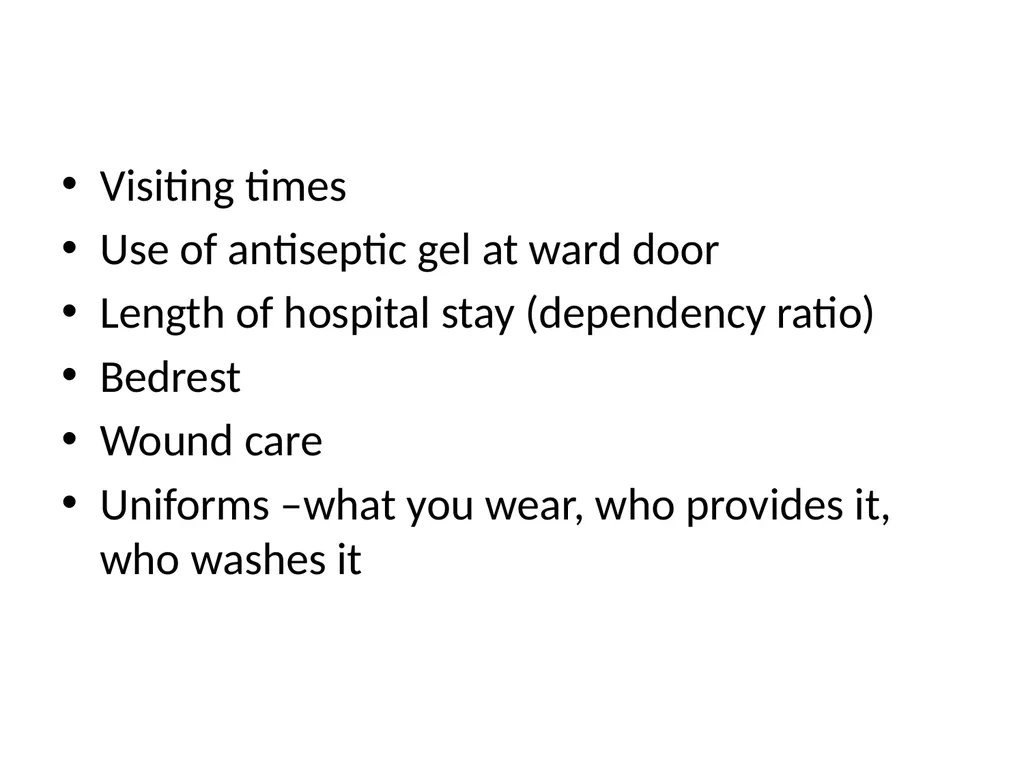
slide29. Visiting times
Use of antiseptic gel at ward door
Length of hospital stay (dependency ratio)
Bedrest
Wound care
Uniforms –what you wear, who provides it, who washes it<br>
slide30. 1900 1950 2005<br>
slide31. change to practice must be based on evidence to ensure that quality is maintained...
maintaining quality therefore requires the nurse to be aware of, to understand and to implement research findings<br>
slide32. Barriers to accessing research information: time
availability of information
information hard to understand
confidence in judging quality of information
Gerrish & Clayton, J. (2004) Promoting evidence based practice; an organisational approach, Journal of Nursing Management, 12, pp 114 - 123.<br>
slide33. Understanding -
Skills needed to evaluate research –
to assess quality/ feasibility/ whether appropriate for YOUR practice<br>
slide34. Research is a tool for quality improvements in nursing<br>
slide35. Nursing Research Nursing now part of the academic world
Nurses learn about research as students
Post graduate opportunities are increasing
Nurses are undertaking research
Nurses publish<br>
slide36. Developing the Role of the Clinical Academic Researcher in the Nursing, Midwifery and Allied Health Professions, UK, DoH 2012 http://www.dh.gov.uk/prod_consum_dh/groups/dh_digitalassets/@dh/@en/documents/
digitalasset/dh_133094.pdf
‘developing the best clinical academics requires national oversight, strategic vision and political commitment, underpinned by focused local implementation’<br>
slide37. Building capacity for nurse-led research International Nursing Review; Vol 56., 1, pp 88–94, March 2009 N. Edwards RN, PhD1, J. Webber RN, PhD3, J. Mill RN, PhD4, E. Kahwa RN, PhD5, S. Roelofs MA 2 Aim: To discuss factors that have influenced the development of research capacity among nurses in lower and middle-income countries (LMICs)
Findings: Factors limiting nurses' involvement in research include hierarchies of power among disciplines, scarce resources, a lack of graduate and post-graduate education opportunities, few senior mentors, and prolonged underfunding of nursing research.<br>
slide38. South Africa Nurses’ Council Nursing Strategy 2008. ‘Research into the relevance of theory to practice should be commissioned at regular intervals in order to guide nursing practice. Research activity in the nursing profession and among nursing educators and professionals will need special attention, as it is critical to the sustainability of the profession.’ Page 13.
Strategic focus area;
Improve research capacity of nurses
Conduct extensive training in research methodology
Facilitate nursing research amongst academic institutions and health facilities
Attract young nurses to nursing academia
Develop nurse academics/ teachers<br>
slide39. Research in clinical practice ...
Research in academic world of nurses ...<br>
slide40. Reflection Network http://www.reflection-network.eu/index.php REFLECTION is a network of researchers working in Europe to improve the evidence which underpins nursing interventions.<br>
slide41. 2013 – Systematic Review of European Nursing Research, conducted by the Reflection network A systematic review of research reports in (European) nursing aiming to provide REFLECTION with a baseline against which to judge its success in transforming nursing research<br>
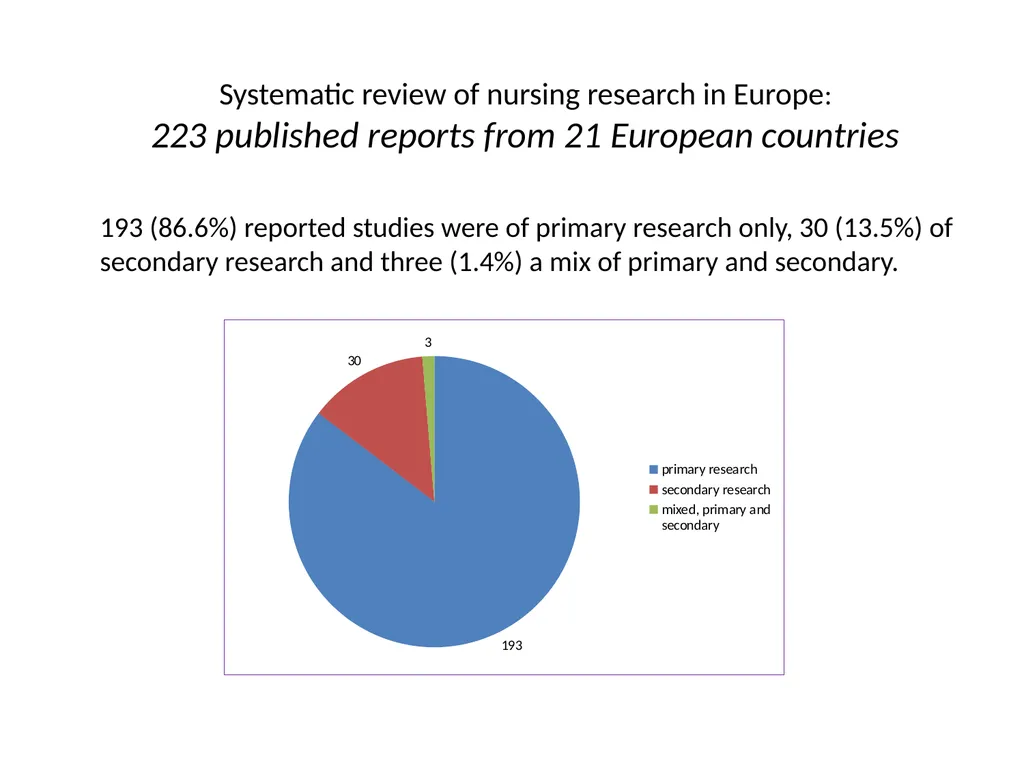
slide42. Systematic review of nursing research in Europe: 223 published reports from 21 European countries 193 (86.6%) reported studies were of primary research only, 30 (13.5%) of secondary research and three (1.4%) a mix of primary and secondary.<br>
slide43. Systematic review of nursing research in Europe: 223 published reports from 21 European countries Methodological description was often poor, misleading or even absent.<br>
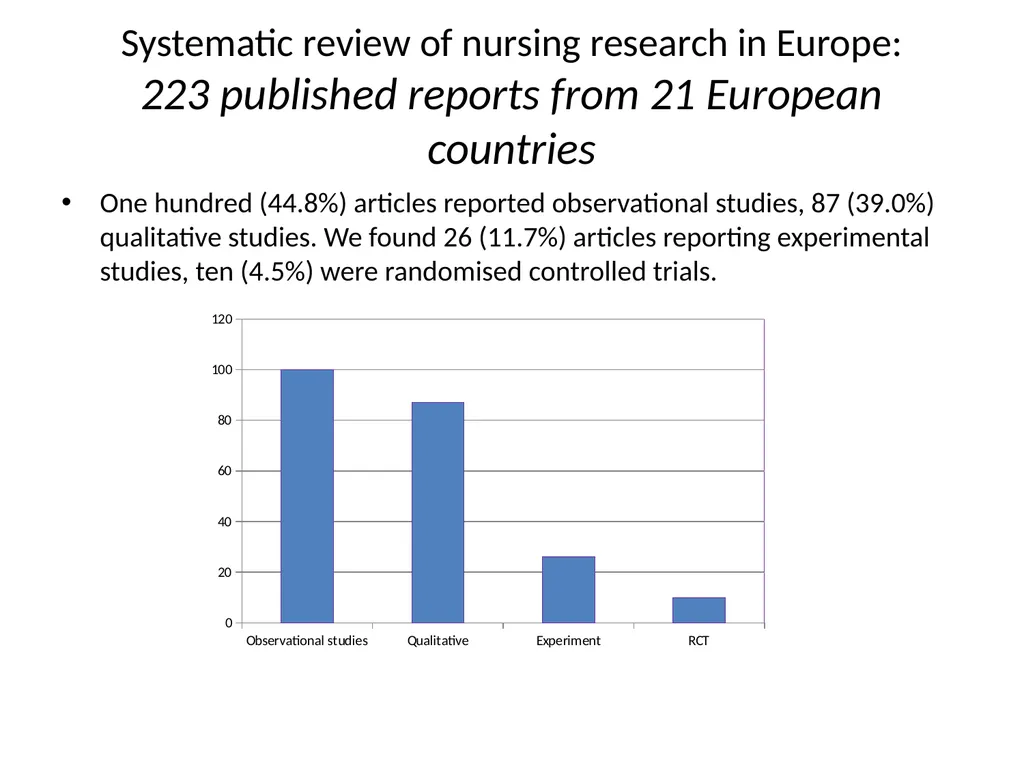
slide44. Systematic review of nursing research in Europe: 223 published reports from 21 European countries One hundred (44.8%) articles reported observational studies, 87 (39.0%) qualitative studies. We found 26 (11.7%) articles reporting experimental studies, ten (4.5%) were randomised controlled trials.<br>
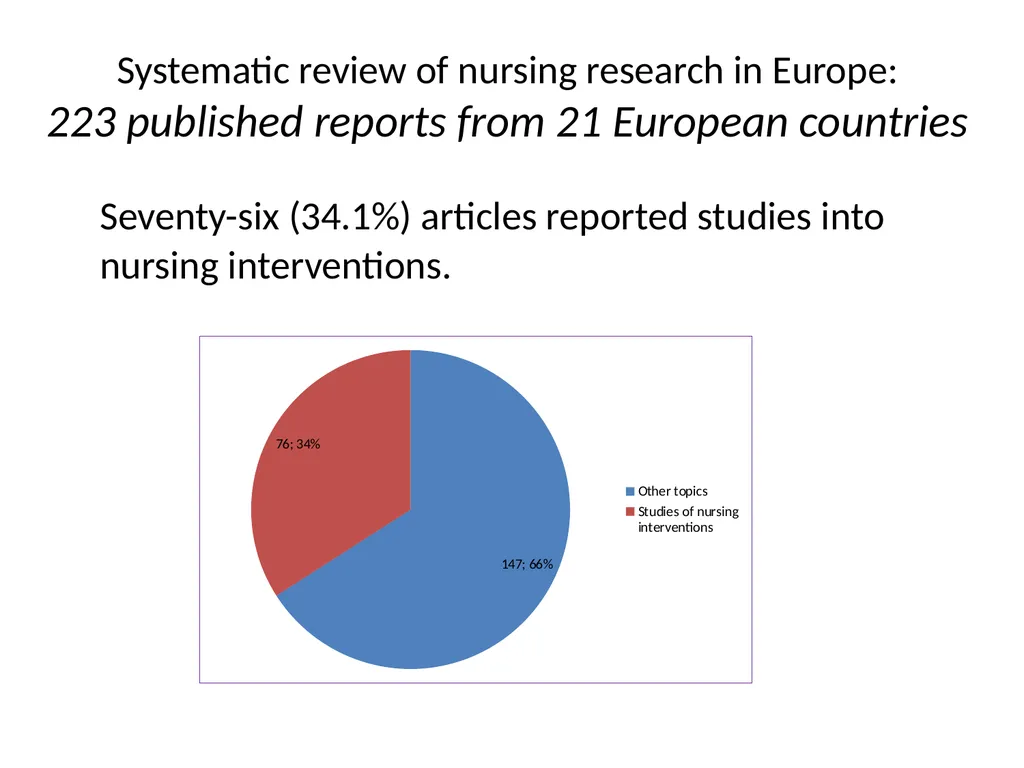
slide45. Systematic review of nursing research in Europe: 223 published reports from 21 European countries Seventy-six (34.1%) articles reported studies into nursing interventions.<br>
slide46. Presented in Oslo at the European Academy of Nursing Science winter scientific summit, January 2014. Publication to follow.<br>
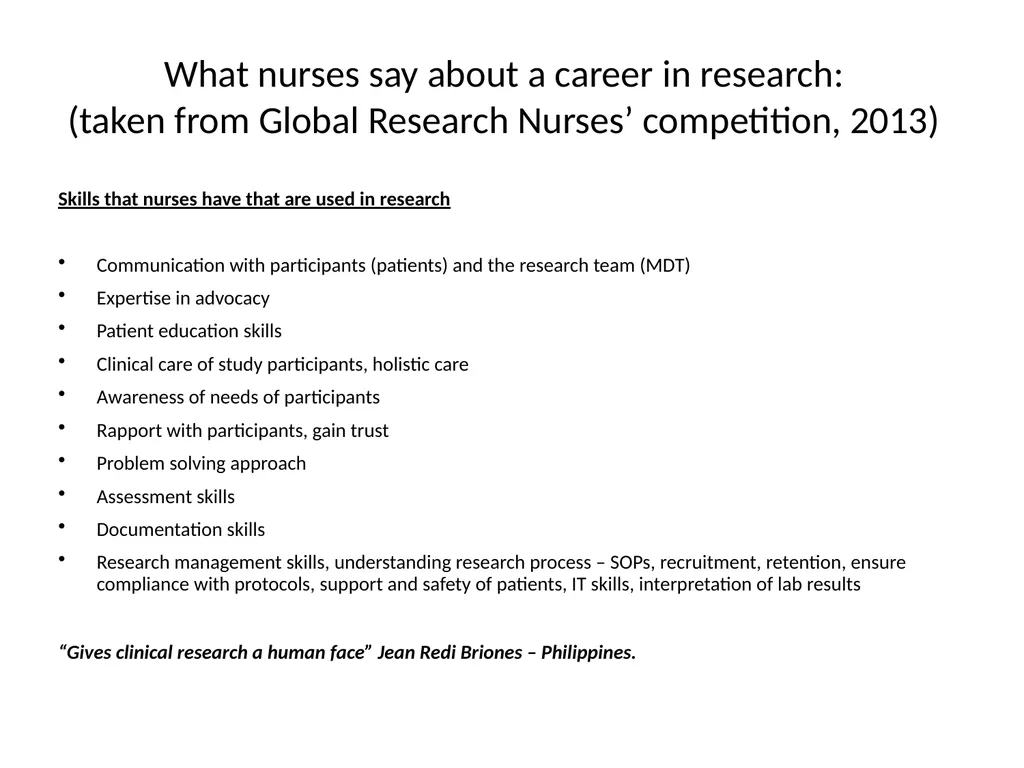
slide47. What nurses say about a career in research: (taken from Global Research Nurses’ competition, 2013) Skills that nurses have that are used in research
Communication with participants (patients) and the research team (MDT)
Expertise in advocacy
Patient education skills
Clinical care of study participants, holistic care
Awareness of needs of participants
Rapport with participants, gain trust
Problem solving approach
Assessment skills
Documentation skills
Research management skills, understanding research process – SOPs, recruitment, retention, ensure compliance with protocols, support and safety of patients, IT skills, interpretation of lab results
“Gives clinical research a human face” Jean Redi Briones – Philippines.<br>
slide48. What nurses say about a career in research: (taken from Global Research Nurses’ competition, 2013) Barriers faced by nurses doing research
Lack of motivation – research not seen as relevant
Lack of research skills
Lack of recognition of role
Role conflict
Lack of time – demands of workload
Lack of confidence
Gap between clinical and academic spheres within the profession<br>
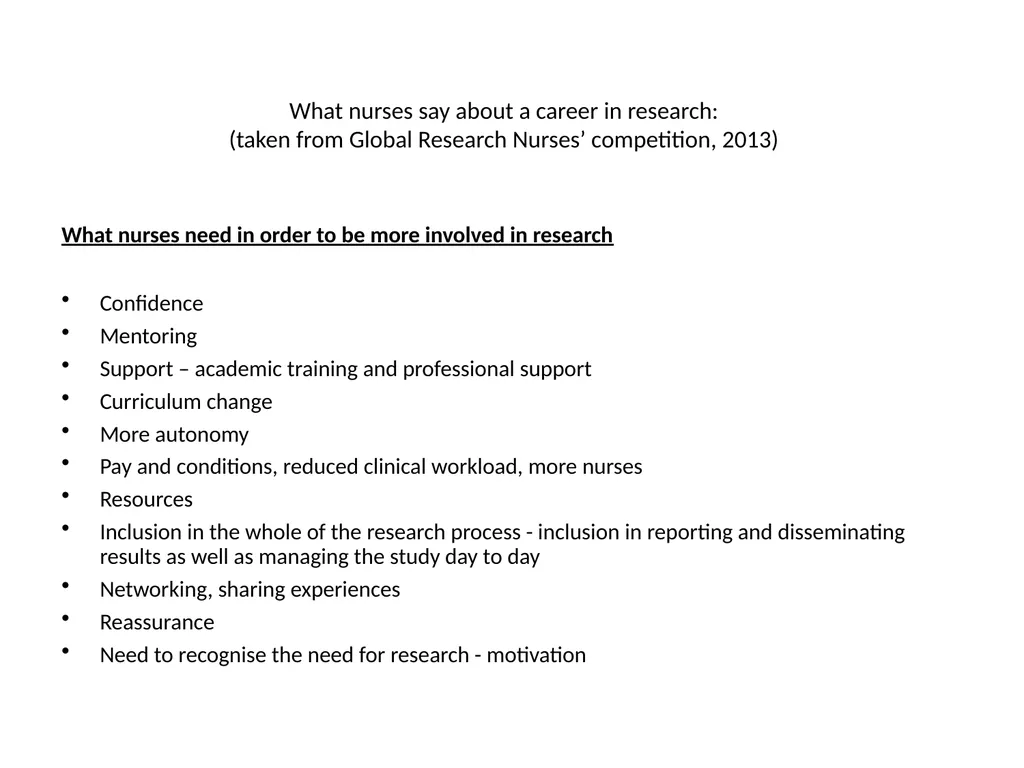
slide49. What nurses say about a career in research: (taken from Global Research Nurses’ competition, 2013) What nurses need in order to be more involved in research
Confidence
Mentoring
Support – academic training and professional support
Curriculum change
More autonomy
Pay and conditions, reduced clinical workload, more nurses
Resources
Inclusion in the whole of the research process - inclusion in reporting and disseminating results as well as managing the study day to day
Networking, sharing experiences
Reassurance
Need to recognise the need for research - motivation<br>
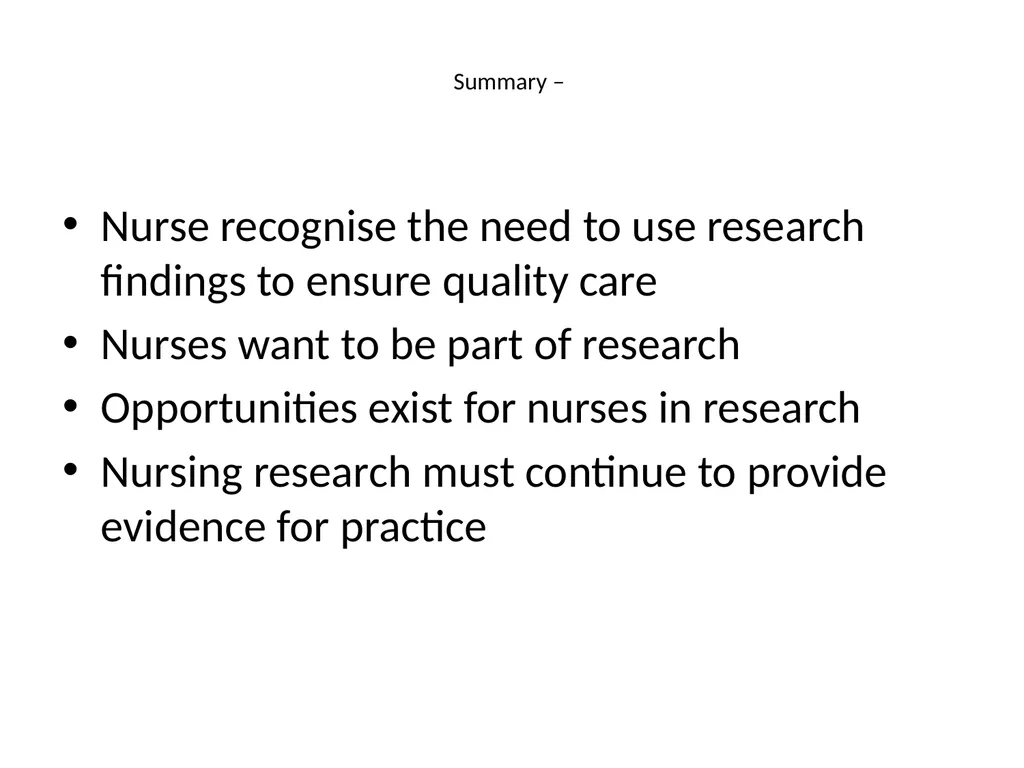
slide50. Summary – Nurse recognise the need to use research findings to ensure quality care
Nurses want to be part of research
Opportunities exist for nurses in research
Nursing research must continue to provide evidence for practice<br>
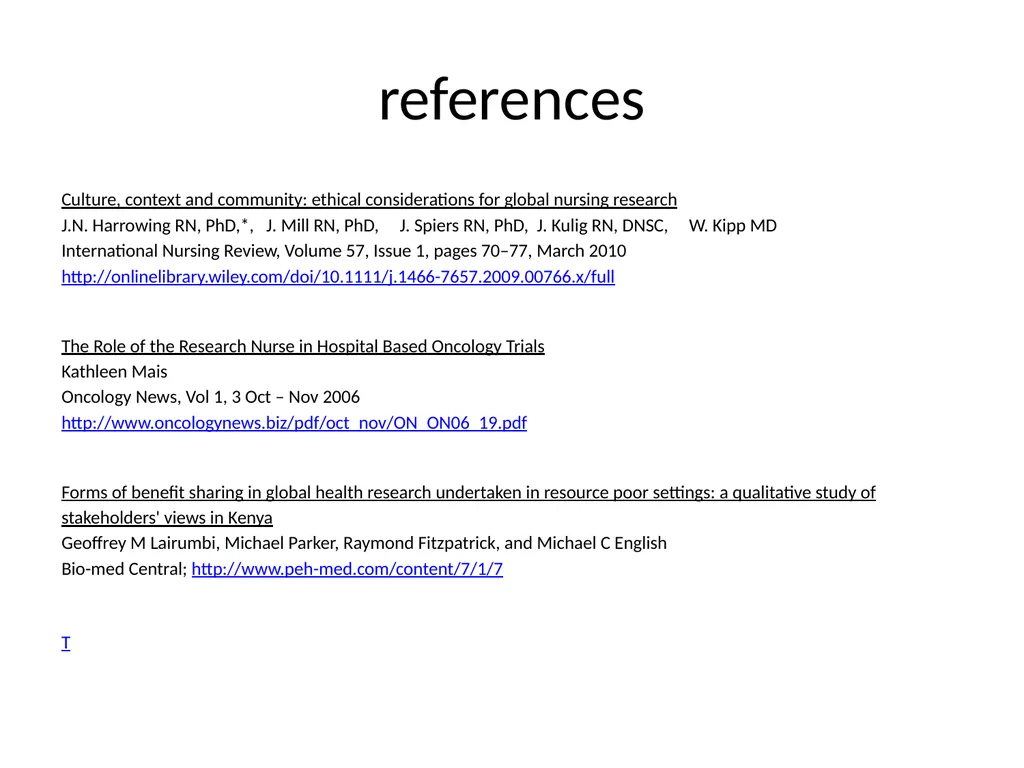
slide51. references Culture, context and community: ethical considerations for global nursing research
J.N. Harrowing RN, PhD,*, J. Mill RN, PhD, J. Spiers RN, PhD, J. Kulig RN, DNSC, W. Kipp MD
International Nursing Review, Volume 57, Issue 1, pages 70–77, March 2010
http://onlinelibrary.wiley.com/doi/10.1111/j.1466-7657.2009.00766.x/full
The Role of the Research Nurse in Hospital Based Oncology Trials
Kathleen Mais
Oncology News, Vol 1, 3 Oct – Nov 2006
http://www.oncologynews.biz/pdf/oct_nov/ON_ON06_19.pdf
Forms of benefit sharing in global health research undertaken in resource poor settings: a qualitative study of stakeholders' views in Kenya
Geoffrey M Lairumbi, Michael Parker, Raymond Fitzpatrick, and Michael C English
Bio-med Central; http://www.peh-med.com/content/7/1/7
T<br>
slide2. ICN Code of ethics, 2012 The nurse assumes the major role in determining and implementing acceptable standards of clinical nursing practice http://www.icn.ch/images/stories/documents/publications/free_publications/Code%20of%20Ethics%202012%20for%20web.pdf International Council
of Nurses<br>
slide3. Clinical Research in the UK<br>
slide4. Set up in 2006 to promote research in the NHS.
The mission of the National Institute for Health Research
(NIHR)is to maintain a health research system in which the
NHS supports outstanding individuals, working in world class
facilities, conducting leading edge research focused on the
needs of patients and the public.<br>
slide5. Clinical Research Nursing in UK Recommendations for nursing research careers published
by the UKCRC Subcommittee for Nurses in Clinical Research
A report was published recommending that a training and support structure should be put in place to enable nurses to work as researchers at different stages of their career. 1st August 2007<br>
slide6. COMPETENCY FRAMEWORK FOR CLINICAL RESEARCH NURSES NHS Competency Framework 2006, reviewed 2011<br>
slide7. Royal College of Nursing, UK The RCN Research & Development Governance Group have sponsored an RCN Research Society project:
‘Capitalising on the contribution of nurses in clinical research’<br>
slide8. Capitalising on the contribution of nurses in clinical research Project vision
Embed clinical research nurses in the RCN
Create an active network offering mentorship, supervision and development of others as part of practice
Identify ‘added value’ of clinical research nurses to clinical research and recruitment to trials
Identify and showcase best practice in Uk NHS research
Network with Association of nursing students and Education forum to use Clinical research facilities for student placements.<br>
slide9. The role of the research nurse. Hill G, MacArthur J (2006) Professional issues associated with the role of the research nurse. Nursing Standard. 20, 39, 41-47.
Role of research nurse:
Advocate
Educator
Caregiver
Coordinator – care/ research
http://nursingstandard.rcnpublishing.co.uk/archive/article-professional-issues-associated-with-the-role-of-the-research-nurse<br>
slide10. Building the foundation for Clinical Research Nursing, USA National Institute of Health Clinical Centre, 2009 http://www.cc.nih.gov/nursing/crn/DOP_document.pdf<br>
slide11. Problems associated with the role: Hill G, MacArthur J (2006) Professional issues associated with the role of the research nurse. Nursing Standard. 20, 39, 41-47.
Professional isolation – lack of peer support or understanding of the role by the nursing community
Lack of job specific training
Short term contracts
Unpredictable workload
http://nursingstandard.rcnpublishing.co.uk/archive/article-professional-issues-associated-with-the-role-of-the-research-nurse<br>
slide12. Recommendations: Hill G, MacArthur J (2006) Professional issues associated with the role of the research nurse. Nursing Standard. 20, 39, 41-47.
Research Nurses need to
Encourage peer support
Disseminate information about the role
Access educational opportunities
http://nursingstandard.rcnpublishing.co.uk/archive/article-professional-issues-associated-with-the-role-of-the-research-nurse<br>
slide13. CLINICAL RESEARCH NURSE - SUMMARY A DEVELOPING ROLE
AN OPPORTUNITY FOR NURSES
DEMANDS CLINICAL AND ACADEMIC SKILLS
HELPS TO DEVELOP HEALTH CARE FOR NOW AND THE FUTURE<br>
slide14. Nursing Research = RESEARCH BY AND FOR NURSES<br>
slide15. ICN Code of ethics, 2012 The nurse assumes the major role in determining and implementing acceptable standards of clinical nursing practice http://www.icn.ch/images/stories/documents/publications/free_publications/Code%20of%20Ethics%202012%20for%20web.pdf International Council
of Nurses<br>
slide16. Florence Nightingale, 1820 - 1910 A hospital
should
DO THE SICK
NO HARM.<br>
slide17. What do nurses need to know? Clinical information about health and disease, treatment and care
Psycho-social information – how is the individual responding to changes in health status?
Organisational information – how does communication flow in the Multi-disciplinary team? Where do resources come from and who is responsible for ordering and storage? Who makes patient appointments/ referrals?<br>
slide18. Nursing Research = PRACTICE CHANGES ...<br>
slide19. INFLUENCES ON CHANGING NURSING PRACTICE: scientific and medical advance
pharmaceutical development
social change
changes to management of healthcare
changed expectations
changed attitudes
role of women<br>
slide20. To respond to change, research must provide
information about:
Direct care – clinical practice
Indirect care – organisation of care
Influence on care – policy initiatives,
strategic healthcare planning
Frasure, J. (2008) Analysis of instruments measuring nurses’ attitudes towards research utilisation: a systematic review. JAN Volume 61 (1) January 2008 pp. 5 - 18<br>
slide21. National Institute of Nursing Research, US department of Health and Human Services, 20th anniversary, 2006 Changing Practice, Changing Lives: 10 Landmark Nursing Research Studies.<br>
slide23. Nursing Research = PRACTICE CHANGES,
WHAT CHANGES HAVE YOU SEEN DURING YOUR CAREER?<br>
slide24. from … to …<br>
slide25. 1840s Treatment:
‘admitted unconscious with a diagnosis of apoplexy. Cold cloths were applied to his head. Twelve leeches were applied to his temples. A drop of croton oil was placed on his tongue with sugar. A straight jacket was applied. He was given a turpentine enema. An ice bag was placed on his head. Whisky and morphine draught were given at night.’ (Yule, 1999. P150)
Yule, B., (1999) Matrons, Medics and Maladies. Edinburgh Royal Infirmary in the 1840s. Tuckwell Press.<br>
slide26. 1930s Treatments:
‘for hypertension: special attention is necessary to the state of the bowels, and
good action of the skin should be secured by daily baths. Spa treatment is
often most valuable, but must be under strict medical supervision.’ p. 276.
‘for diarrhoea: the patient should retire to bed and take 1oz. of castor oil,
which is best given in brandy or orange juice.’ p. 218.
‘for sea sickness: to avoid retching .. champagne for those who can afford
it, ginger ale and brandy or brandy and soda for all others. The bubbles
in these liquids are sedative to the gastric mucous membrane and the alcohol
is a rapidly absorbable food for the heart.’ p. 370.
(Meredith, 1935.)
Meredith, H., (1935) The Modern Home Doctor. Daily Express Publications.<br>
slide27. 1960s<br>
slide28. 1930s<br>
slide29. Visiting times
Use of antiseptic gel at ward door
Length of hospital stay (dependency ratio)
Bedrest
Wound care
Uniforms –what you wear, who provides it, who washes it<br>
slide30. 1900 1950 2005<br>
slide31. change to practice must be based on evidence to ensure that quality is maintained...
maintaining quality therefore requires the nurse to be aware of, to understand and to implement research findings<br>
slide32. Barriers to accessing research information: time
availability of information
information hard to understand
confidence in judging quality of information
Gerrish & Clayton, J. (2004) Promoting evidence based practice; an organisational approach, Journal of Nursing Management, 12, pp 114 - 123.<br>
slide33. Understanding -
Skills needed to evaluate research –
to assess quality/ feasibility/ whether appropriate for YOUR practice<br>
slide34. Research is a tool for quality improvements in nursing<br>
slide35. Nursing Research Nursing now part of the academic world
Nurses learn about research as students
Post graduate opportunities are increasing
Nurses are undertaking research
Nurses publish<br>
slide36. Developing the Role of the Clinical Academic Researcher in the Nursing, Midwifery and Allied Health Professions, UK, DoH 2012 http://www.dh.gov.uk/prod_consum_dh/groups/dh_digitalassets/@dh/@en/documents/
digitalasset/dh_133094.pdf
‘developing the best clinical academics requires national oversight, strategic vision and political commitment, underpinned by focused local implementation’<br>
slide37. Building capacity for nurse-led research International Nursing Review; Vol 56., 1, pp 88–94, March 2009 N. Edwards RN, PhD1, J. Webber RN, PhD3, J. Mill RN, PhD4, E. Kahwa RN, PhD5, S. Roelofs MA 2 Aim: To discuss factors that have influenced the development of research capacity among nurses in lower and middle-income countries (LMICs)
Findings: Factors limiting nurses' involvement in research include hierarchies of power among disciplines, scarce resources, a lack of graduate and post-graduate education opportunities, few senior mentors, and prolonged underfunding of nursing research.<br>
slide38. South Africa Nurses’ Council Nursing Strategy 2008. ‘Research into the relevance of theory to practice should be commissioned at regular intervals in order to guide nursing practice. Research activity in the nursing profession and among nursing educators and professionals will need special attention, as it is critical to the sustainability of the profession.’ Page 13.
Strategic focus area;
Improve research capacity of nurses
Conduct extensive training in research methodology
Facilitate nursing research amongst academic institutions and health facilities
Attract young nurses to nursing academia
Develop nurse academics/ teachers<br>
slide39. Research in clinical practice ...
Research in academic world of nurses ...<br>
slide40. Reflection Network http://www.reflection-network.eu/index.php REFLECTION is a network of researchers working in Europe to improve the evidence which underpins nursing interventions.<br>
slide41. 2013 – Systematic Review of European Nursing Research, conducted by the Reflection network A systematic review of research reports in (European) nursing aiming to provide REFLECTION with a baseline against which to judge its success in transforming nursing research<br>
slide42. Systematic review of nursing research in Europe: 223 published reports from 21 European countries 193 (86.6%) reported studies were of primary research only, 30 (13.5%) of secondary research and three (1.4%) a mix of primary and secondary.<br>
slide43. Systematic review of nursing research in Europe: 223 published reports from 21 European countries Methodological description was often poor, misleading or even absent.<br>
slide44. Systematic review of nursing research in Europe: 223 published reports from 21 European countries One hundred (44.8%) articles reported observational studies, 87 (39.0%) qualitative studies. We found 26 (11.7%) articles reporting experimental studies, ten (4.5%) were randomised controlled trials.<br>
slide45. Systematic review of nursing research in Europe: 223 published reports from 21 European countries Seventy-six (34.1%) articles reported studies into nursing interventions.<br>
slide46. Presented in Oslo at the European Academy of Nursing Science winter scientific summit, January 2014. Publication to follow.<br>
slide47. What nurses say about a career in research: (taken from Global Research Nurses’ competition, 2013) Skills that nurses have that are used in research
Communication with participants (patients) and the research team (MDT)
Expertise in advocacy
Patient education skills
Clinical care of study participants, holistic care
Awareness of needs of participants
Rapport with participants, gain trust
Problem solving approach
Assessment skills
Documentation skills
Research management skills, understanding research process – SOPs, recruitment, retention, ensure compliance with protocols, support and safety of patients, IT skills, interpretation of lab results
“Gives clinical research a human face” Jean Redi Briones – Philippines.<br>
slide48. What nurses say about a career in research: (taken from Global Research Nurses’ competition, 2013) Barriers faced by nurses doing research
Lack of motivation – research not seen as relevant
Lack of research skills
Lack of recognition of role
Role conflict
Lack of time – demands of workload
Lack of confidence
Gap between clinical and academic spheres within the profession<br>
slide49. What nurses say about a career in research: (taken from Global Research Nurses’ competition, 2013) What nurses need in order to be more involved in research
Confidence
Mentoring
Support – academic training and professional support
Curriculum change
More autonomy
Pay and conditions, reduced clinical workload, more nurses
Resources
Inclusion in the whole of the research process - inclusion in reporting and disseminating results as well as managing the study day to day
Networking, sharing experiences
Reassurance
Need to recognise the need for research - motivation<br>
slide50. Summary – Nurse recognise the need to use research findings to ensure quality care
Nurses want to be part of research
Opportunities exist for nurses in research
Nursing research must continue to provide evidence for practice<br>
slide51. references Culture, context and community: ethical considerations for global nursing research
J.N. Harrowing RN, PhD,*, J. Mill RN, PhD, J. Spiers RN, PhD, J. Kulig RN, DNSC, W. Kipp MD
International Nursing Review, Volume 57, Issue 1, pages 70–77, March 2010
http://onlinelibrary.wiley.com/doi/10.1111/j.1466-7657.2009.00766.x/full
The Role of the Research Nurse in Hospital Based Oncology Trials
Kathleen Mais
Oncology News, Vol 1, 3 Oct – Nov 2006
http://www.oncologynews.biz/pdf/oct_nov/ON_ON06_19.pdf
Forms of benefit sharing in global health research undertaken in resource poor settings: a qualitative study of stakeholders' views in Kenya
Geoffrey M Lairumbi, Michael Parker, Raymond Fitzpatrick, and Michael C English
Bio-med Central; http://www.peh-med.com/content/7/1/7
T<br>