
Nutrition COMMUNITY NUTRITION PROGRAMME
MY
Published · 79 slides · 0 views
1 / 1

Description
Nutrition COMMUNITY NUTRITION PROGRAMME Under-nutrition most important single cause of illness and death globally. 12 of all deaths and 16 DALY (disability-adjusted life years) lost. Even mild to moderate under-nutrition in the womb
Related Topics
Share
Embed code
Download this presentation From Below
"Nutrition COMMUNITY NUTRITION PROGRAMME" is the property of its rightful owner. Permission is granted to download and print the materials on this website for personal, non-commercial use only, and to display it on your personal computer provided you do not modify the materials and that you retain all copyright notices contained in the materials. By downloading content from our website, you accept the terms of this agreement.
Presentation Transcript
01
Nutrition<br>
02
COMMUNITY NUTRITION PROGRAMME Under-nutrition most important single cause of illness and death globally.
12% of all deaths and 16% DALY (disability-adjusted life years) lost.
Even mild to moderate under-nutrition in the womb reduces cognitive development.
Number of people suffering from food insecurity and hunger is growing-even though food production doubled in last 40 years<br>
12% of all deaths and 16% DALY (disability-adjusted life years) lost.
Even mild to moderate under-nutrition in the womb reduces cognitive development.
Number of people suffering from food insecurity and hunger is growing-even though food production doubled in last 40 years<br>
03
18% of world population- hungry.
In S.E. Asia 1out of 4 persons-hungry.
In Sub-Saharan Africa 1 out of 3 persons- hungry.
1/3rd preschool children stunted.
16% babies born are LBW.<br>
In S.E. Asia 1out of 4 persons-hungry.
In Sub-Saharan Africa 1 out of 3 persons- hungry.
1/3rd preschool children stunted.
16% babies born are LBW.<br>
04
CAUSES OF MALNUTRITION-
Strongly linked with poverty.
Environment – safe water or sanitation.
Indoor air pollution- wood or animal dung used for cooking and heating along with poor ventilation.<br>
Strongly linked with poverty.
Environment – safe water or sanitation.
Indoor air pollution- wood or animal dung used for cooking and heating along with poor ventilation.<br>
05
GOI initiated several large scale supplementary feeding programmes.
Programmes aiming at overcoming specific deficiency diseases through various ministries to combat malnutrition.<br>
Programmes aiming at overcoming specific deficiency diseases through various ministries to combat malnutrition.<br>
06
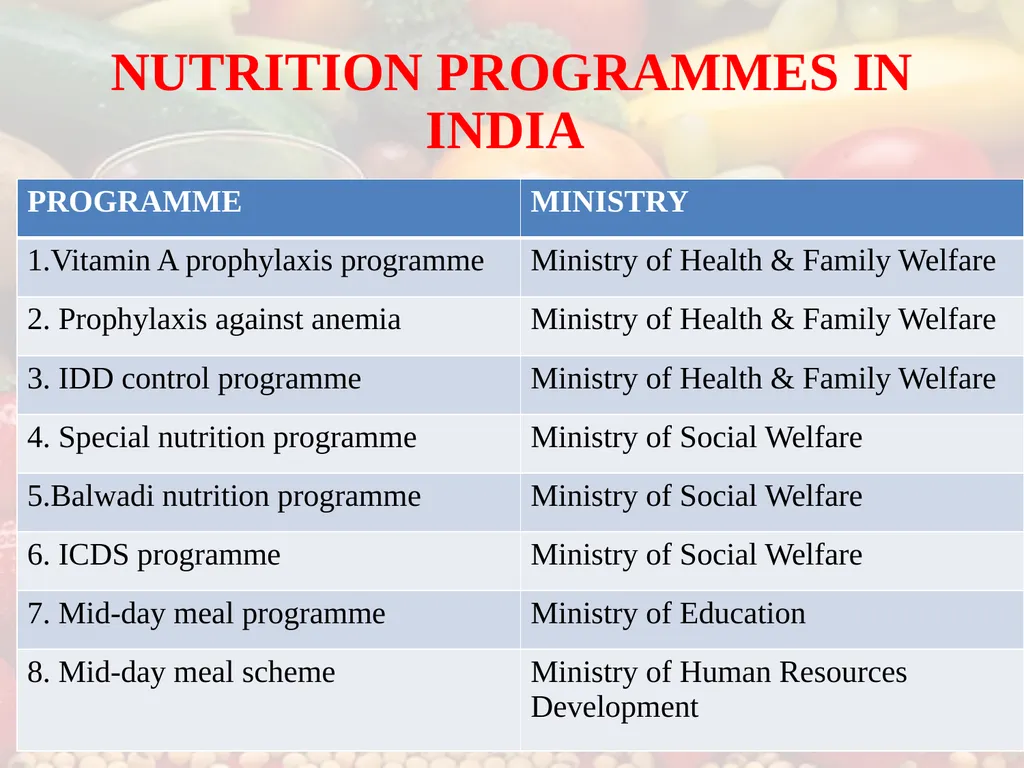
NUTRITION PROGRAMMES IN INDIA<br>
07
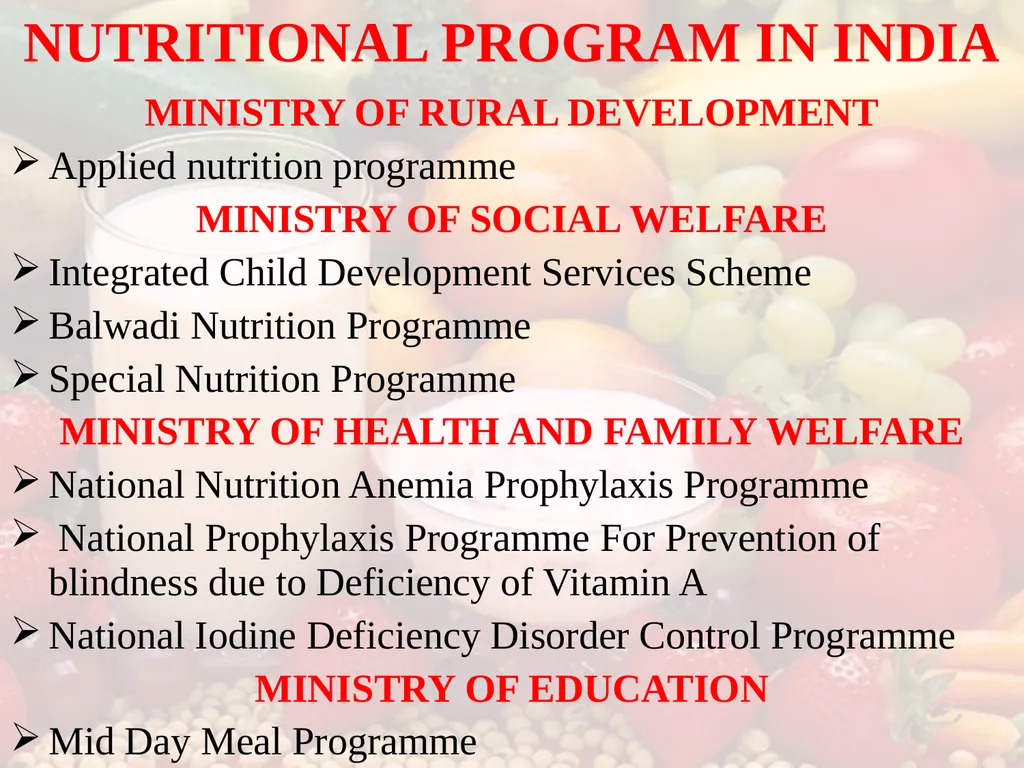
NUTRITIONAL PROGRAM IN INDIA MINISTRY OF RURAL DEVELOPMENT
Applied nutrition programme
MINISTRY OF SOCIAL WELFARE
Integrated Child Development Services Scheme
Balwadi Nutrition Programme
Special Nutrition Programme
MINISTRY OF HEALTH AND FAMILY WELFARE
National Nutrition Anemia Prophylaxis Programme
National Prophylaxis Programme For Prevention of blindness due to Deficiency of Vitamin A
National Iodine Deficiency Disorder Control Programme
MINISTRY OF EDUCATION
Mid Day Meal Programme<br>
08
VITAMIN AND MINERAL DEFICIENCY Iodine deficiency-lowered intellectual capacity-10-15%
Iron deficiency in 6-24 months-impairing mental development, 40-60% of developing world children.
Severe iron deficiency anemia-deaths of 50,000 young pregnant women/year in pregnancy and childbirth.
Iron deficiency in adults-losses of 2% GDP.<br>
Iron deficiency in 6-24 months-impairing mental development, 40-60% of developing world children.
Severe iron deficiency anemia-deaths of 50,000 young pregnant women/year in pregnancy and childbirth.
Iron deficiency in adults-losses of 2% GDP.<br>
09
5. Vitamin A deficiency-compromising immune systems-40% of developing world’s under-fives-1 million deaths of young children/year.
6. Iodine deficiency in pregnancy-20 million mentally impaired babies/year.
7. Folate deficiency-200,000 severe birth defects/year and associated 1 in every 10 adults deaths from heart disease.
8. Half children with Vitamin Mineral Deficiency-immeasurable burden on individuals, health services, education systems.<br>
10
SOLUTION Fortification
Supplementation
Education
Disease control<br>
Supplementation
Education
Disease control<br>
11
PILOT PROJECT AGAINST MICRONUTRIENT MALNUTRITION OBJECTIVES
Assess magnitude of fluorosis and dental carries, iron and vitamin A deficiency.
Assess and improve vitamin A status in school going children, adolescent boys and girls, non-pregnant women, adult male and geriatrics.
Launch IEC
Zinc level in food products and soil
Coordinate with similar programme.<br>
12
NUTRITIONAL REHABITILATION CENTER Unit in District Health Facility, children with severe acute malnutrition (SAM) enrolled, admission and provided medical and nutritional therapeutic care, curative care-timely, adequate and appropriate feeding
Gujarat Govt.”Mission Balam Sukham” in 2012.
Mobile Nutritional Rehabilitation Center (NRC)<br>
Gujarat Govt.”Mission Balam Sukham” in 2012.
Mobile Nutritional Rehabilitation Center (NRC)<br>
13
1.Vitamin A prophylaxis programme Under the National Program for Prophylaxis against Blindness in Children caused due to Vitamin A deficiency.
Every child given a dose of 1,00,000 I.U. of vitamin A at age of 9 months than at 16 months and every 6th monthly up to age of 5 years through peripheral health worker.
Program was launched by MOH&FW in 1970 on the basis oh technology developed by National Institute of nutrition, Hyderabad.<br>
Every child given a dose of 1,00,000 I.U. of vitamin A at age of 9 months than at 16 months and every 6th monthly up to age of 5 years through peripheral health worker.
Program was launched by MOH&FW in 1970 on the basis oh technology developed by National Institute of nutrition, Hyderabad.<br>
14
Evaluation of program revealed a reduction in vitamin A deficiency in children.<br>
15
2. PROPHYLAXIS AGAINST ANEMIA Programme was launched by GOI in 1970, during 4th five year plan to prevent nutritional anemia in mothers and children.
The expected and nursing mothers as well as acceptors of F.P.- one tablet of IFA 60 mg elementary iron raised to 100 mg elemental iron and 0.5 mg of folic acid and children in age group 1-5 years one tablet of IFA containing 20 mg elemental iron and 0.1 mg folic acid daily for a period of 100 days.<br>
The expected and nursing mothers as well as acceptors of F.P.- one tablet of IFA 60 mg elementary iron raised to 100 mg elemental iron and 0.5 mg of folic acid and children in age group 1-5 years one tablet of IFA containing 20 mg elemental iron and 0.1 mg folic acid daily for a period of 100 days.<br>
16
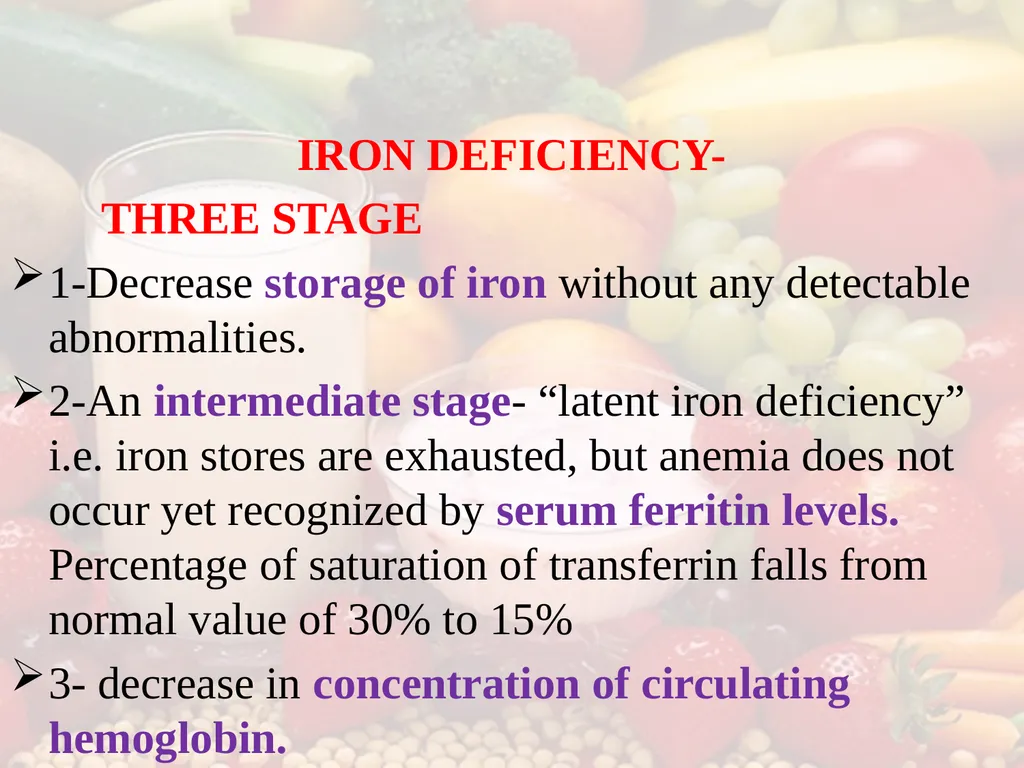
IRON DEFICIENCY-
THREE STAGE
1-Decrease storage of iron without any detectable abnormalities.
2-An intermediate stage- “latent iron deficiency” i.e. iron stores are exhausted, but anemia does not occur yet recognized by serum ferritin levels. Percentage of saturation of transferrin falls from normal value of 30% to 15%
3- decrease in concentration of circulating hemoglobin.<br>
17
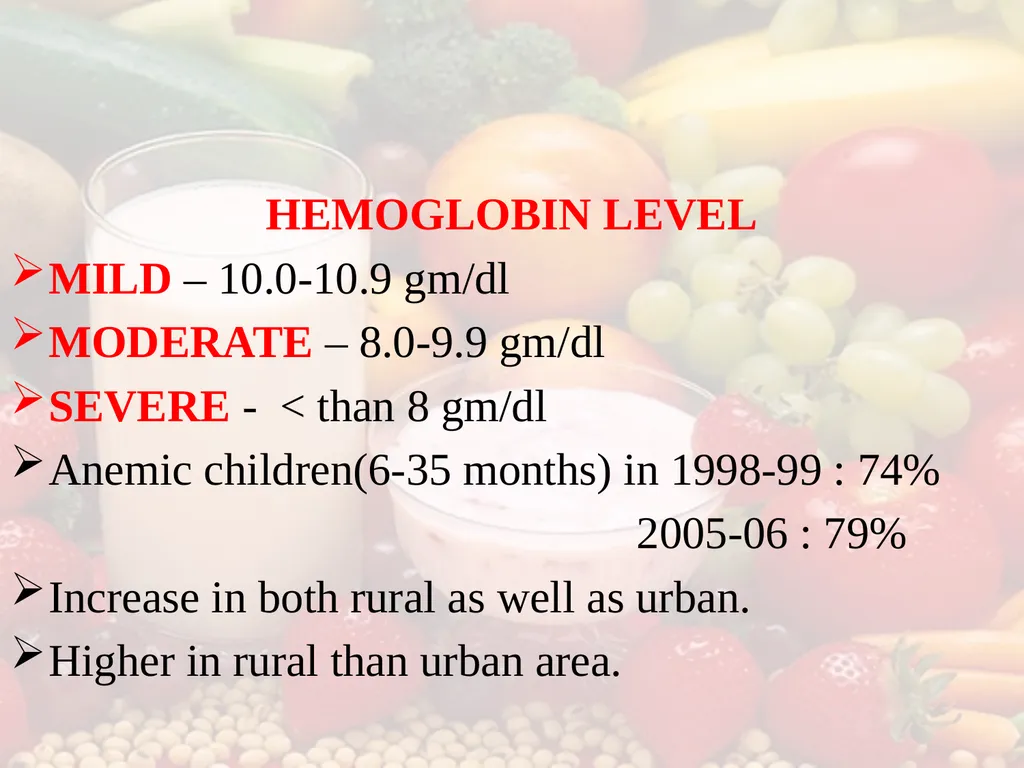
HEMOGLOBIN LEVEL
MILD – 10.0-10.9 gm/dl
MODERATE – 8.0-9.9 gm/dl
SEVERE - < than 8 gm/dl
Anemic children(6-35 months) in 1998-99 : 74%
2005-06 : 79%
Increase in both rural as well as urban.
Higher in rural than urban area.<br>
MILD – 10.0-10.9 gm/dl
MODERATE – 8.0-9.9 gm/dl
SEVERE - < than 8 gm/dl
Anemic children(6-35 months) in 1998-99 : 74%
2005-06 : 79%
Increase in both rural as well as urban.
Higher in rural than urban area.<br>
18
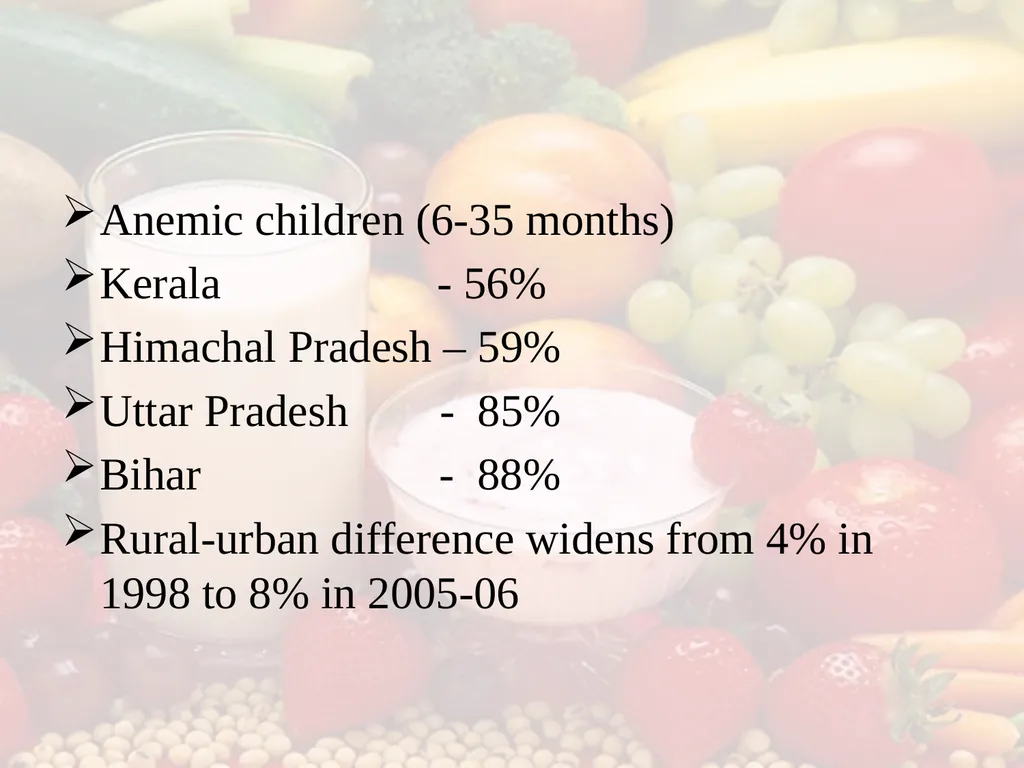
Anemic children (6-35 months)
Kerala - 56%
Himachal Pradesh – 59%
Uttar Pradesh - 85%
Bihar - 88%
Rural-urban difference widens from 4% in 1998 to 8% in 2005-06<br>
Kerala - 56%
Himachal Pradesh – 59%
Uttar Pradesh - 85%
Bihar - 88%
Rural-urban difference widens from 4% in 1998 to 8% in 2005-06<br>
19
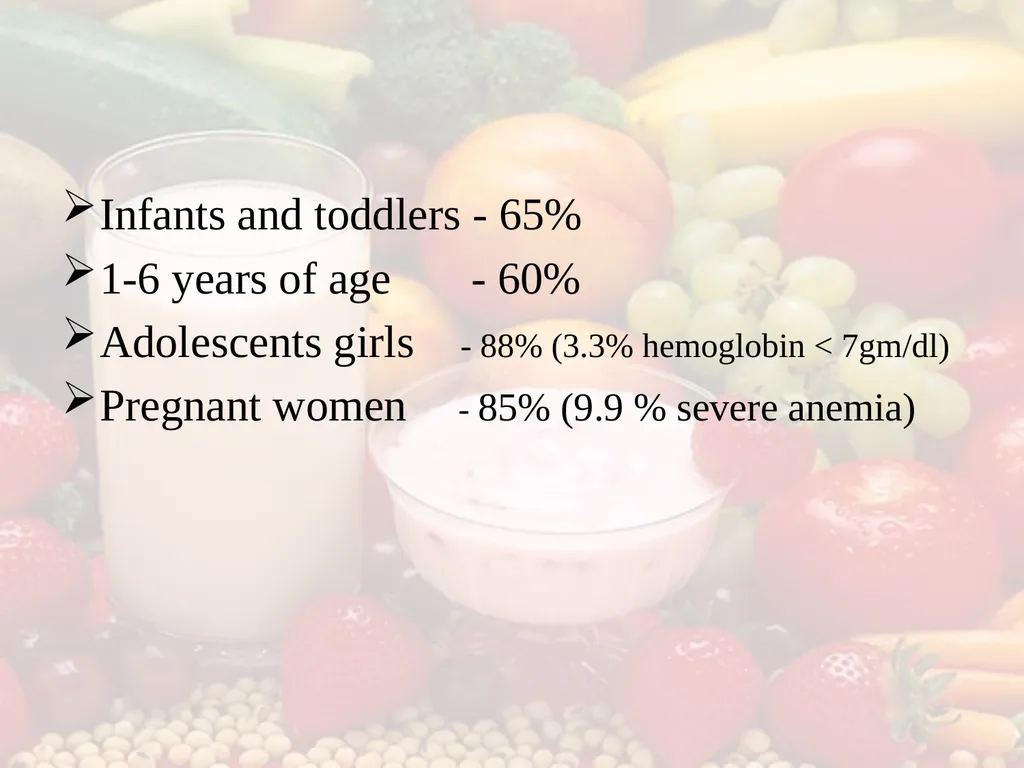
Infants and toddlers - 65%
1-6 years of age - 60%
Adolescents girls - 88% (3.3% hemoglobin < 7gm/dl)
Pregnant women - 85% (9.9 % severe anemia)<br>
1-6 years of age - 60%
Adolescents girls - 88% (3.3% hemoglobin < 7gm/dl)
Pregnant women - 85% (9.9 % severe anemia)<br>
20
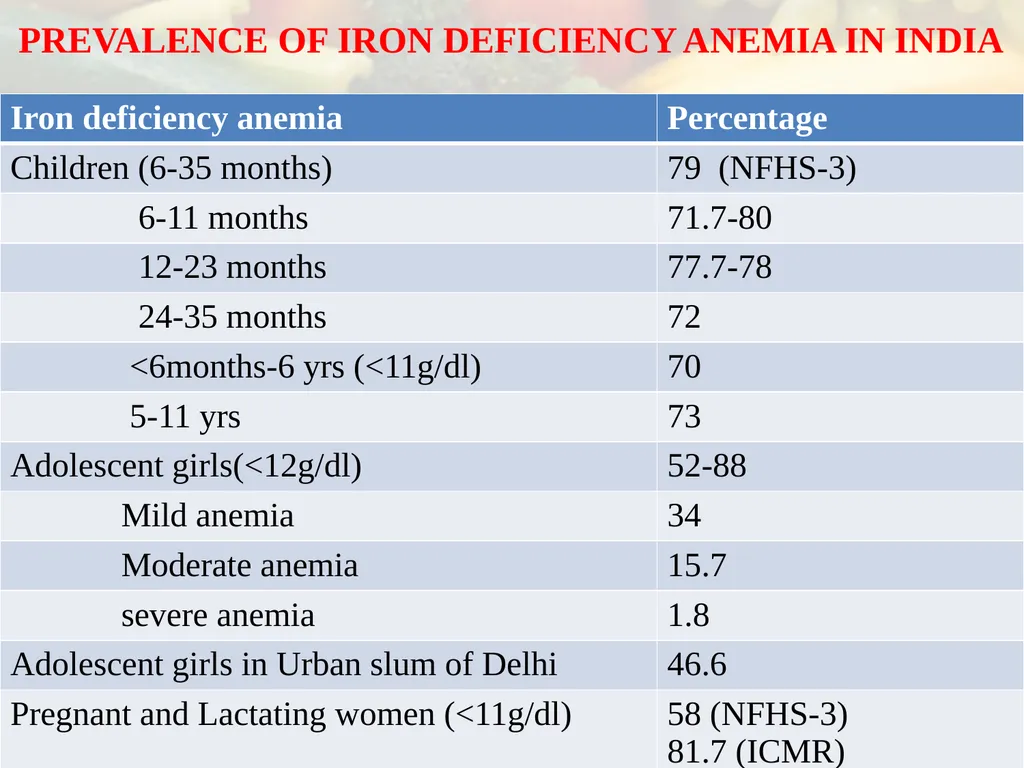
PREVALENCE OF IRON DEFICIENCY ANEMIA IN INDIA<br>
21
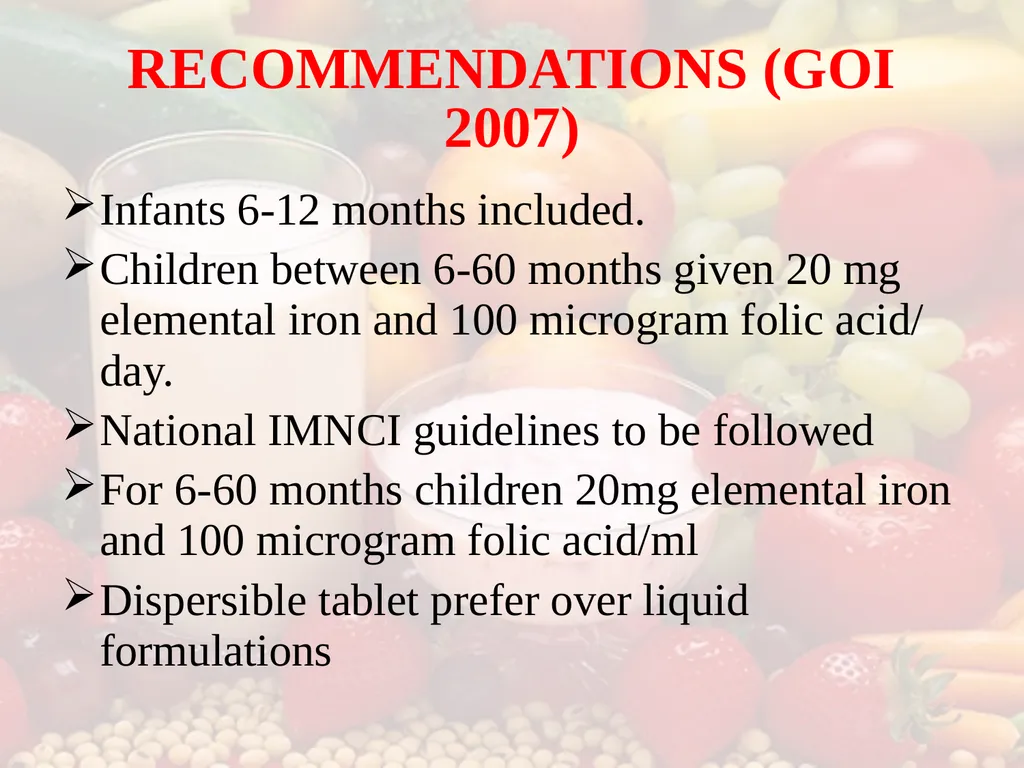
RECOMMENDATIONS (GOI 2007) Infants 6-12 months included.
Children between 6-60 months given 20 mg elemental iron and 100 microgram folic acid/ day.
National IMNCI guidelines to be followed
For 6-60 months children 20mg elemental iron and 100 microgram folic acid/ml
Dispersible tablet prefer over liquid formulations<br>
Children between 6-60 months given 20 mg elemental iron and 100 microgram folic acid/ day.
National IMNCI guidelines to be followed
For 6-60 months children 20mg elemental iron and 100 microgram folic acid/ml
Dispersible tablet prefer over liquid formulations<br>
22
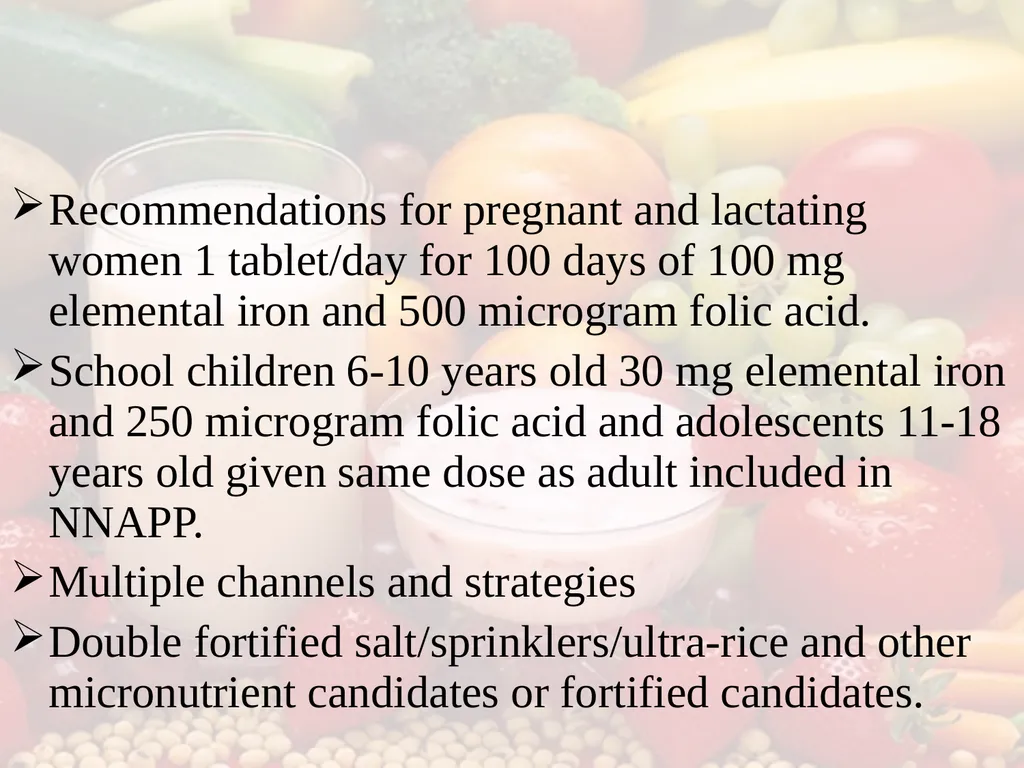
Recommendations for pregnant and lactating women 1 tablet/day for 100 days of 100 mg elemental iron and 500 microgram folic acid.
School children 6-10 years old 30 mg elemental iron and 250 microgram folic acid and adolescents 11-18 years old given same dose as adult included in NNAPP.
Multiple channels and strategies
Double fortified salt/sprinklers/ultra-rice and other micronutrient candidates or fortified candidates.<br>
School children 6-10 years old 30 mg elemental iron and 250 microgram folic acid and adolescents 11-18 years old given same dose as adult included in NNAPP.
Multiple channels and strategies
Double fortified salt/sprinklers/ultra-rice and other micronutrient candidates or fortified candidates.<br>
23
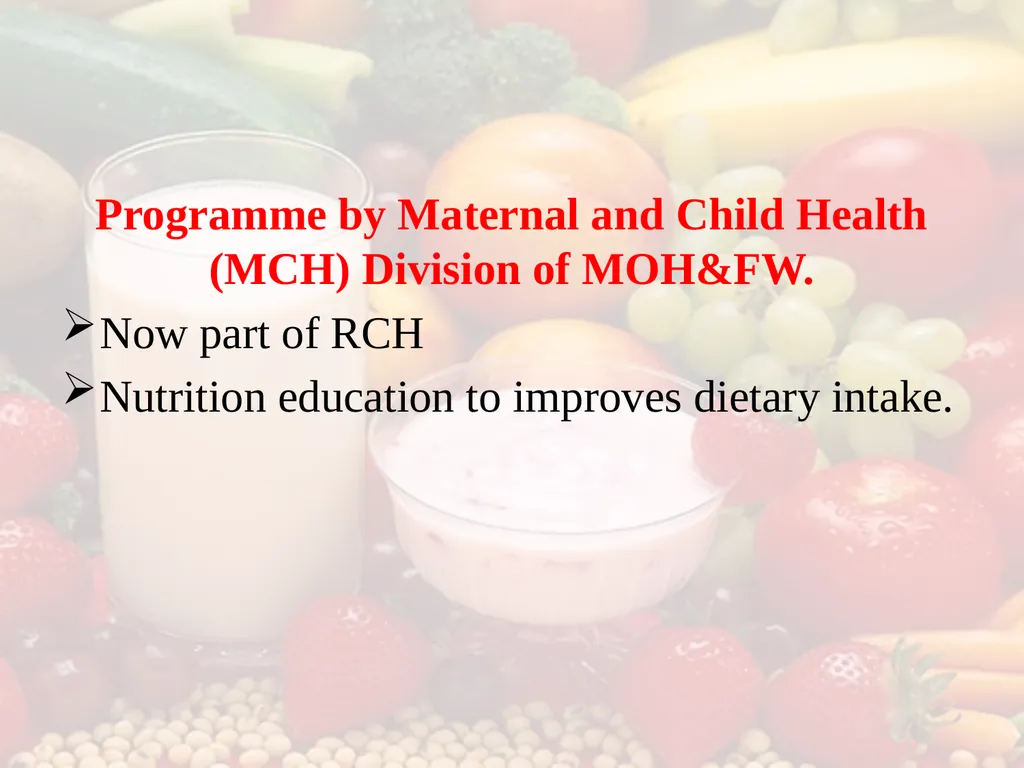
Programme by Maternal and Child Health (MCH) Division of MOH&FW.
Now part of RCH
Nutrition education to improves dietary intake.<br>
Now part of RCH
Nutrition education to improves dietary intake.<br>
24
STATEGIES
Use traditional food processing techniques to increase bioavailability of iron.
Dietary behavior through nutrition education.
Consume iron-fortified processed complementary foods.
Supplement infants and young children.
Combinations of above strategies.<br>
Use traditional food processing techniques to increase bioavailability of iron.
Dietary behavior through nutrition education.
Consume iron-fortified processed complementary foods.
Supplement infants and young children.
Combinations of above strategies.<br>
25
12-by-12 INITIATIVE FOR ANEMIA CONTROL Launched at AIIMS on April 24,2007 with a view to ensure that every child should have hemoglobin 12gm by age of 12
By jointly MOH&FW, GOI, WHO, FOGSI (The Federation of Obstetrics and Gynecology Societies of India) and UNICEF along with other partners.
Controlling adolescent anemia is an effective and sustainable nation building exercise.<br>
By jointly MOH&FW, GOI, WHO, FOGSI (The Federation of Obstetrics and Gynecology Societies of India) and UNICEF along with other partners.
Controlling adolescent anemia is an effective and sustainable nation building exercise.<br>
26
All partners agencies work in their areas like adoption of few schools and creating public awareness by giving advise on dietary pattern.
Workshops in rural and slum areas.
Children 10-14 years screened and if hemoglobin <12 gm., iron supplements given.
In adopted schools, in Iron Day-students educated about issue and dietary pattern corrected.<br>
Workshops in rural and slum areas.
Children 10-14 years screened and if hemoglobin <12 gm., iron supplements given.
In adopted schools, in Iron Day-students educated about issue and dietary pattern corrected.<br>
27
12 by 12 focuses on increasing iron intake of children, controlling worm infestations and other infections and improving overall nutrition by changing dietary pattern to make iron more bio-available.<br>
28
3. IDD CONTROL PROGRAMME Programme launched by GOI in 1962 National Goiter Control Program (NGCP) in conventional goiter belt in Himalayan region with objective of identification of goiter endemic areas to supply iodized salt in place of common salt and to assess impact of goiter control measures over a period of time.
In 1992 renamed as National Iodine Deficiency Control Program (NIDDCP)
IDD affects all ages, both sexes and different SE Status<br>
In 1992 renamed as National Iodine Deficiency Control Program (NIDDCP)
IDD affects all ages, both sexes and different SE Status<br>
29
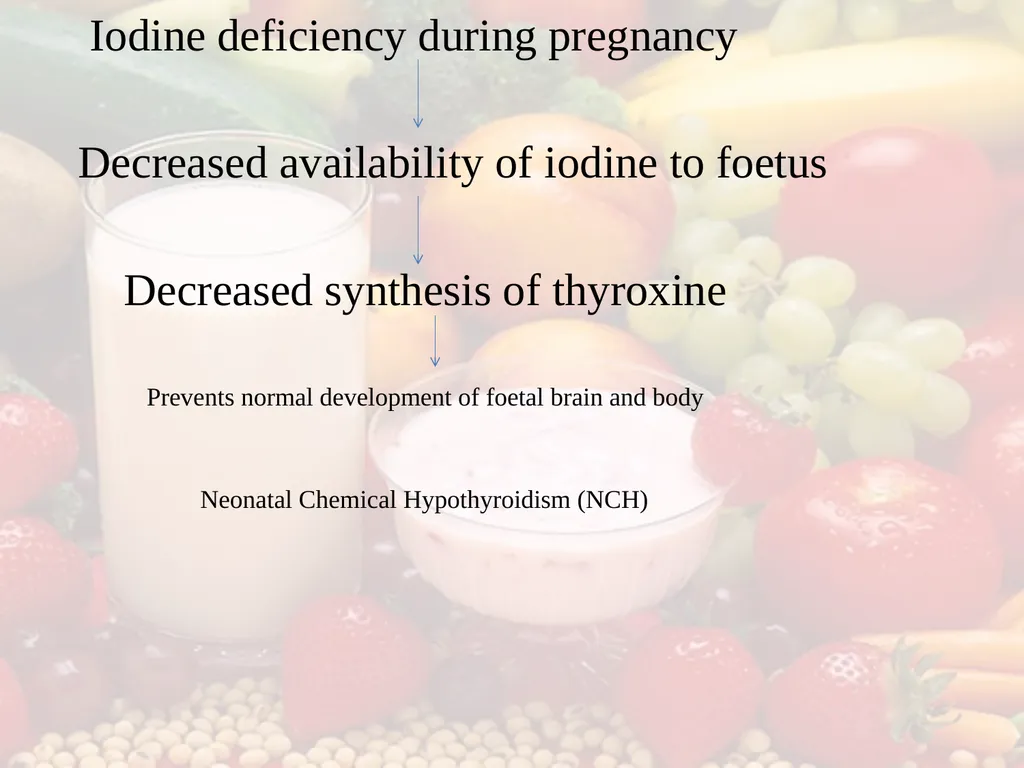
Iodine deficiency during pregnancy
Decreased availability of iodine to foetus
Decreased synthesis of thyroxine Prevents normal development of foetal brain and body Neonatal Chemical Hypothyroidism (NCH)<br>
Decreased availability of iodine to foetus
Decreased synthesis of thyroxine Prevents normal development of foetal brain and body Neonatal Chemical Hypothyroidism (NCH)<br>
30
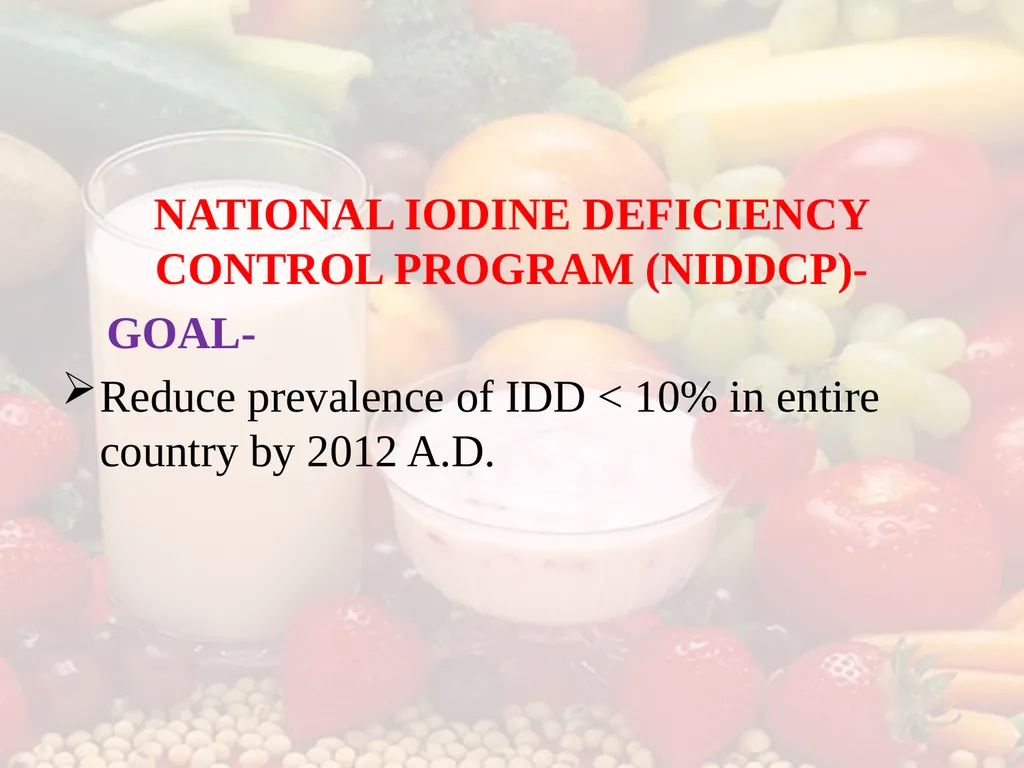
NATIONAL IODINE DEFICIENCY CONTROL PROGRAM (NIDDCP)-
GOAL-
Reduce prevalence of IDD < 10% in entire country by 2012 A.D.<br>
GOAL-
Reduce prevalence of IDD < 10% in entire country by 2012 A.D.<br>
31
OBJECTIVES
1. Surveys to assess magnitude of IDD
2. Supply of iodized salt
3. Resurvey after every 5 years to assess the extent of IDD and impact of iodized salt.
4. Laboratory monitoring of iodated salt and urinary iodine excretion.
5. Health education & Publicity.<br>
1. Surveys to assess magnitude of IDD
2. Supply of iodized salt
3. Resurvey after every 5 years to assess the extent of IDD and impact of iodized salt.
4. Laboratory monitoring of iodated salt and urinary iodine excretion.
5. Health education & Publicity.<br>
32
POLICY-
Consumption of iodized salt best and simplest way to control IDD.
On recommendation of Central Council of Health 1984, GOI decide to iodate the entire edible salt in the country by 1992.
Program commenced in phrased manner in April 1986.
GOI banned sale of non-iodized salt from 17th May,2006 under Prevention of Food Adulteration Act 1954.<br>
33
NODAL MINISTRY-
MOH&HW.
STANDARD FOR IODATED SALT-
At production and consumption levels at least 30 and 15 ppm respectively.<br>
MOH&HW.
STANDARD FOR IODATED SALT-
At production and consumption levels at least 30 and 15 ppm respectively.<br>
34
4. SPECIAL NUTRITION PROGRAMME Stared in 1970 for children below 6 years , pregnant & nursing mothers and in urban slums, tribal areas and backward rural areas.
Supplementary food supply 300 kcal and 10-12 gr. Protein/children/day and for mothers 500 kcal and 25 gm. Protein/mother/day for 300 days/year.
Originally launched as central program and transferred to state in Vth five year program part of minimum needs program.<br>
Supplementary food supply 300 kcal and 10-12 gr. Protein/children/day and for mothers 500 kcal and 25 gm. Protein/mother/day for 300 days/year.
Originally launched as central program and transferred to state in Vth five year program part of minimum needs program.<br>
35
MAIN AIM OF PROGRAM-
improve nutritional status of target group.
Merged into ICDS programme.<br>
improve nutritional status of target group.
Merged into ICDS programme.<br>
36
5.BALWADI NUTRITION PROGRAMME Stared in 1970 for children aged 3-6 years in rural areas by ministry of Social Welfare.
Funds given to voluntary organizations.
Through BALWADIS which also provide pre-primary education to these children.
Provide 300 kcal and 10 gm. Protein/child/day.
Phased out in ICDS.<br>
Funds given to voluntary organizations.
Through BALWADIS which also provide pre-primary education to these children.
Provide 300 kcal and 10 gm. Protein/child/day.
Phased out in ICDS.<br>
37
6. ICDS PROGRAMME Launched on Oct. 2nd 1975 (5th five year plan) in pursuance of National Policy for children in 33 experimental blocks.
Network consists of 5659 projects in rural and urban pockets.
Goal is universalization throughout the country.
Through Women and Child Development, Ministry of Human Resources development and nodal Department of State-Social Welfare, Rural Development, Tribal Welfare, Health and Family Welfare or Woman & Child Development.<br>
38
BENICIERIES-
Children below 6 years.
Pregnant and lactating women.
Women in age group of 15-45 years.
Adolescents girls in selected blocks.<br>
Children below 6 years.
Pregnant and lactating women.
Women in age group of 15-45 years.
Adolescents girls in selected blocks.<br>
39
OBJECTIVES of ICDS-
To improve nutritional and health status of preschool children in age group 0-6 years.
To lay the foundation of proper psychological development of the child.
To reduce the incidence of mortality, morbidity, malnutrition and school dropout.<br>
To improve nutritional and health status of preschool children in age group 0-6 years.
To lay the foundation of proper psychological development of the child.
To reduce the incidence of mortality, morbidity, malnutrition and school dropout.<br>
40
To achieve effective coordination of policy and implementation amongst various departments to promote child development.
To enhance capacity of mother to look after the normal health and nutritional needs of the child through nutrition and health education.<br>
To enhance capacity of mother to look after the normal health and nutritional needs of the child through nutrition and health education.<br>
41
ORGANIZATION THE ANGANWADI-
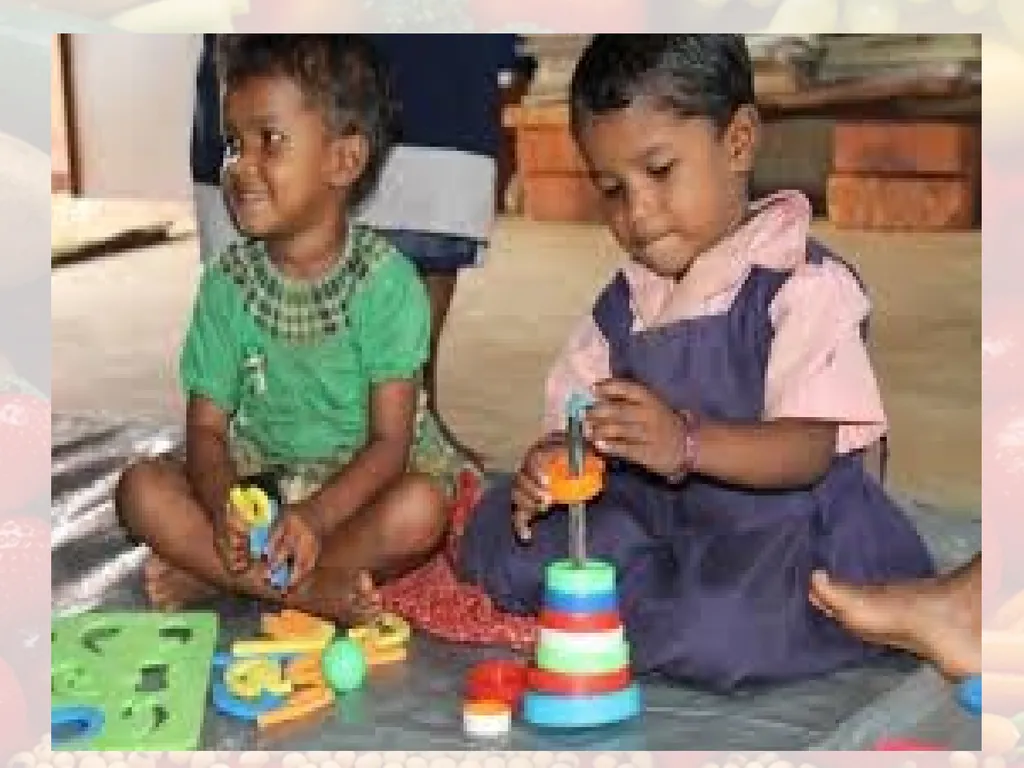
Located within village or slum area.
Focal point for delivery of services at community levels to children below 6 years, pregnant women, lactating mother and adolescent girls.
Meeting ground for women, mothers and other social health workers for discussion, awareness program, joint action for child development and women empowerment.<br>
42
Run by anganwari worker (AWW) supported by helper.
Each anganwari covers 1000 population in rural and urban area.
Mini-Anganwari covers remote and low populated hamlets/villages in tribal blocks.
Cover 150-500 population in rural area, 500-1500 population in urban area and 150-300 population in tribal area<br>
Each anganwari covers 1000 population in rural and urban area.
Mini-Anganwari covers remote and low populated hamlets/villages in tribal blocks.
Cover 150-500 population in rural area, 500-1500 population in urban area and 150-300 population in tribal area<br>
43
Free nutritional food (2009)
Rs. 4/child/day, 500 kcal, protein 12-15 gm.
Rs, 6/child/day for severely malnourished, 800 kcal, protein 20-25 gm.
Rs. 5 /pregnant/lactating mothers/day, 500kcal, protein 18-20 gm.<br>
Rs. 4/child/day, 500 kcal, protein 12-15 gm.
Rs, 6/child/day for severely malnourished, 800 kcal, protein 20-25 gm.
Rs. 5 /pregnant/lactating mothers/day, 500kcal, protein 18-20 gm.<br>
44
SERVICES –
HEALTH-
Immunization
Health checkup
Referral services
Treatment of minor illness.
NUTRITION-
Supplementary Nutrition
Growth monitoring and promotion
Nutrition and health education<br>
HEALTH-
Immunization
Health checkup
Referral services
Treatment of minor illness.
NUTRITION-
Supplementary Nutrition
Growth monitoring and promotion
Nutrition and health education<br>
45
Early childhood care and Pre-School Education to children of 3-6 years
CONVERGENCE-
Of other supportive services-safe drinking water, environmental sanitation, women’s empowerment programs, non-formal education and adult literacy.<br>
CONVERGENCE-
Of other supportive services-safe drinking water, environmental sanitation, women’s empowerment programs, non-formal education and adult literacy.<br>
46
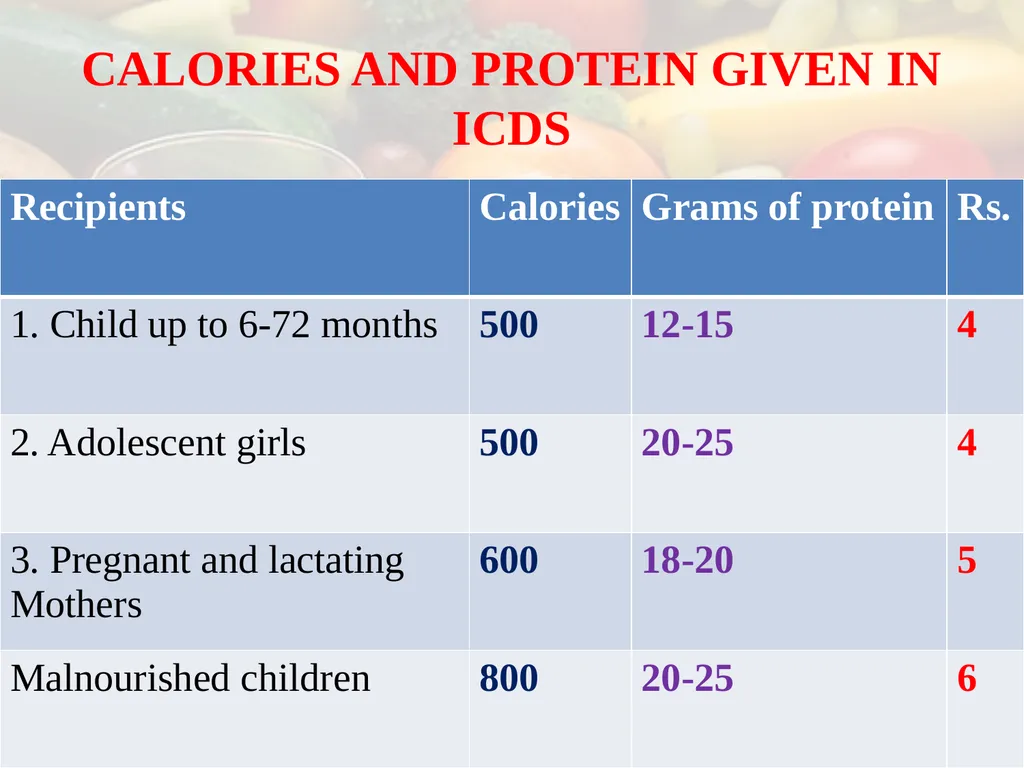
CALORIES AND PROTEIN GIVEN IN ICDS<br>
47
ANGANWARI WORKER-
Part time trained voluntary worker.
Receives honorarium of Rs. 3000/month.
Assisted by helper paid honorarium of 1500/month
Maintain growth chart of every child and weigh each child every month.
Children above 3 years assessed by UMAC .
If child’s UMAC < than 13.5 than weigh every month.<br>
Part time trained voluntary worker.
Receives honorarium of Rs. 3000/month.
Assisted by helper paid honorarium of 1500/month
Maintain growth chart of every child and weigh each child every month.
Children above 3 years assessed by UMAC .
If child’s UMAC < than 13.5 than weigh every month.<br>
48
Non-formal education for children of 3-6 years.
Educate mother on health and nutrition.
Coordinate with PHC staff for health check-up.
Immunization and referral of suffering child.
Treatment of minor illness.
Maintain all files and records of services provided and growth of the children and submit report monthly to MUKHYA SEVIKA.
Supplementary nutrition feeding for children (0-6 years) and expectant and lactating mothers.
Sample survey to find out total beneficiaries.<br>
49
MUKHYA SEVIKA (MS)-
Full time worker supervises work of 20,25 and 17 AWWs in urban, rural and tribal projects respectively.
Visit anganwari once a month.
Coordinate with LHV in nutritional and health activities.<br>
Full time worker supervises work of 20,25 and 17 AWWs in urban, rural and tribal projects respectively.
Visit anganwari once a month.
Coordinate with LHV in nutritional and health activities.<br>
50
CHILD DEVELOPMENT PROJECT OFFICER (CDPO)-
For each project one CDPO.
Covers community development block having a population 80,000-120,000.
S(h)e supervises, coordinate and guides the work of entire ICDS project as an in-charge and supervises 4-5 MS.
Assisted by assistant CDPO.<br>
For each project one CDPO.
Covers community development block having a population 80,000-120,000.
S(h)e supervises, coordinate and guides the work of entire ICDS project as an in-charge and supervises 4-5 MS.
Assisted by assistant CDPO.<br>
51
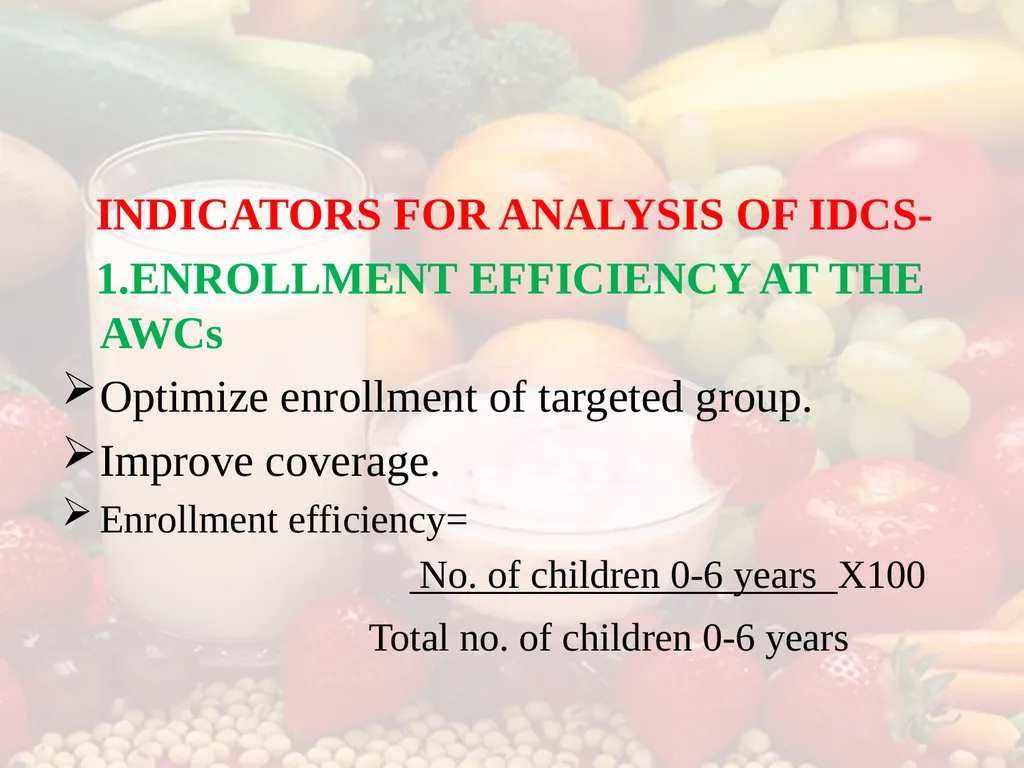
INDICATORS FOR ANALYSIS OF IDCS-
1.ENROLLMENT EFFICIENCY AT THE AWCs
Optimize enrollment of targeted group.
Improve coverage.
Enrollment efficiency=
No. of children 0-6 years X100
Total no. of children 0-6 years<br>
1.ENROLLMENT EFFICIENCY AT THE AWCs
Optimize enrollment of targeted group.
Improve coverage.
Enrollment efficiency=
No. of children 0-6 years X100
Total no. of children 0-6 years<br>
52
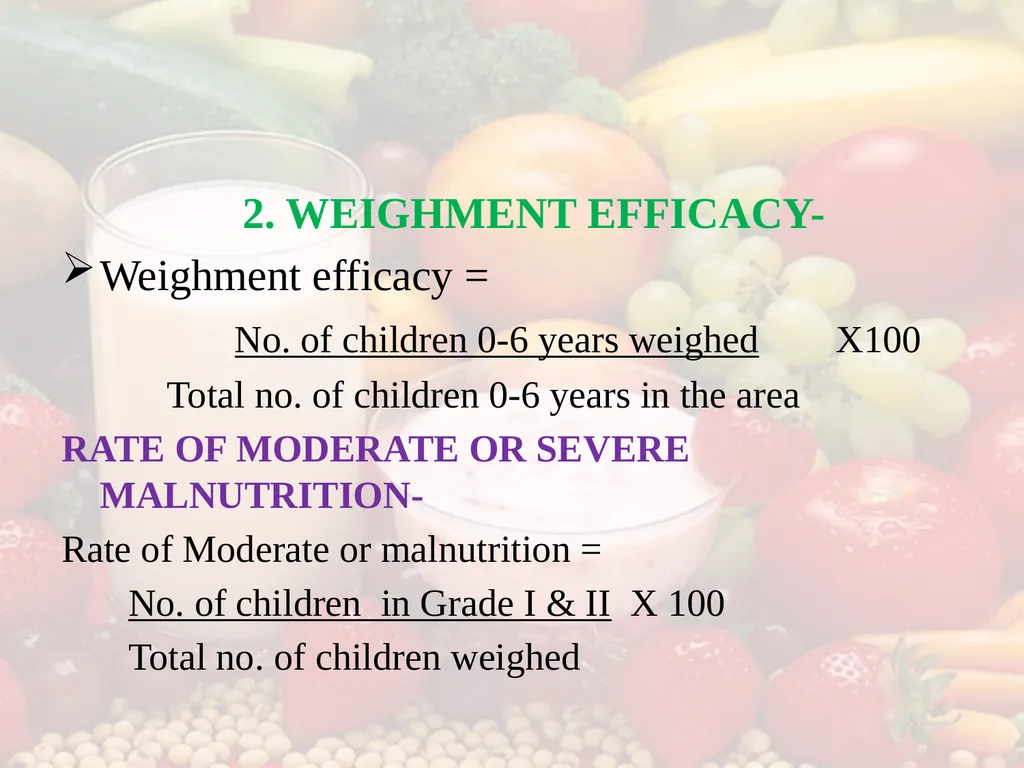
2. WEIGHMENT EFFICACY-
Weighment efficacy =
No. of children 0-6 years weighed X100
Total no. of children 0-6 years in the area
RATE OF MODERATE OR SEVERE MALNUTRITION-
Rate of Moderate or malnutrition =
No. of children in Grade I & II X 100
Total no. of children weighed<br>
Weighment efficacy =
No. of children 0-6 years weighed X100
Total no. of children 0-6 years in the area
RATE OF MODERATE OR SEVERE MALNUTRITION-
Rate of Moderate or malnutrition =
No. of children in Grade I & II X 100
Total no. of children weighed<br>
53
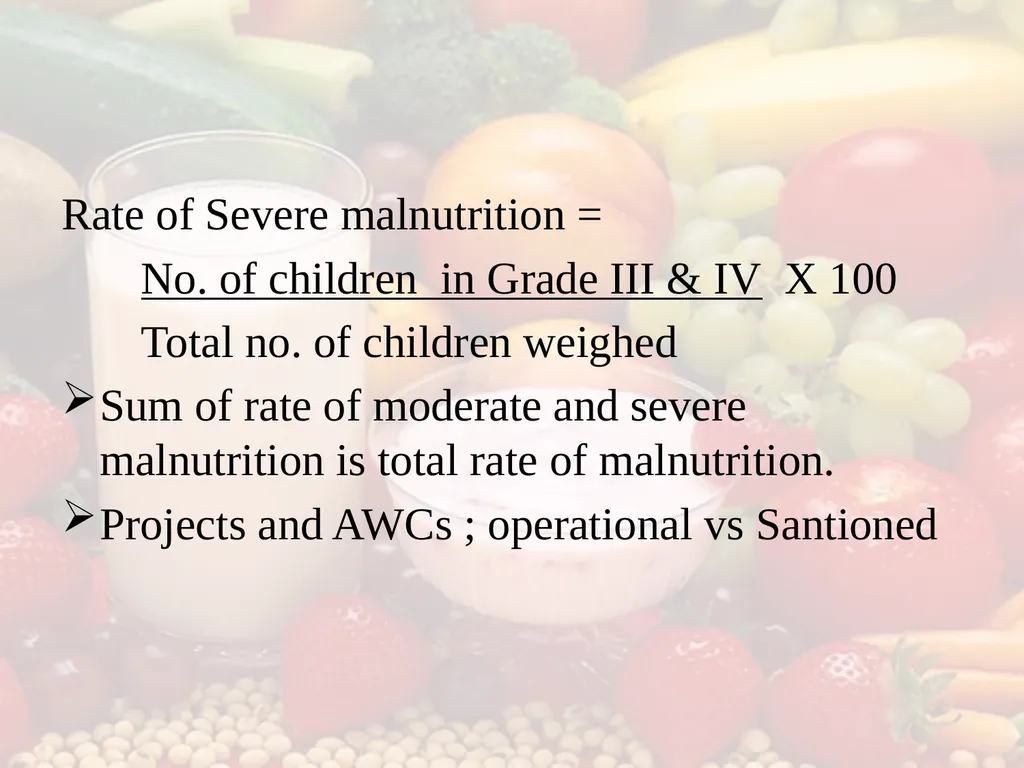
Rate of Severe malnutrition =
No. of children in Grade III & IV X 100
Total no. of children weighed
Sum of rate of moderate and severe malnutrition is total rate of malnutrition.
Projects and AWCs ; operational vs Santioned<br>
No. of children in Grade III & IV X 100
Total no. of children weighed
Sum of rate of moderate and severe malnutrition is total rate of malnutrition.
Projects and AWCs ; operational vs Santioned<br>
54
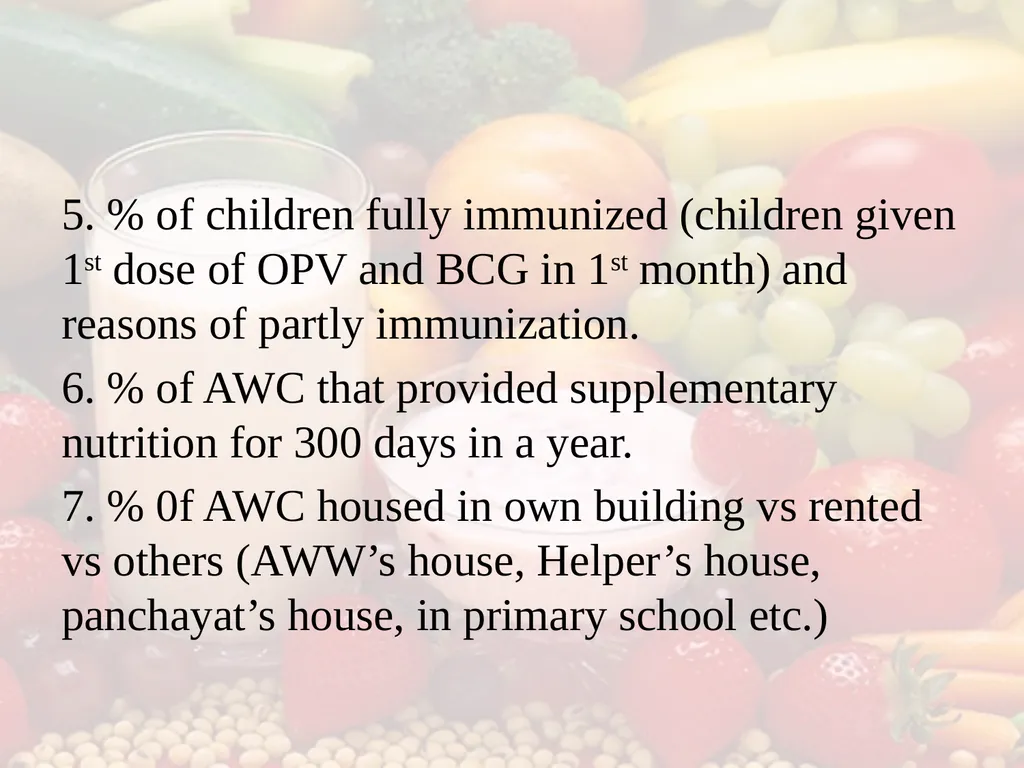
5. % of children fully immunized (children given 1st dose of OPV and BCG in 1st month) and reasons of partly immunization.
6. % of AWC that provided supplementary nutrition for 300 days in a year.
7. % 0f AWC housed in own building vs rented vs others (AWW’s house, Helper’s house, panchayat’s house, in primary school etc.)<br>
6. % of AWC that provided supplementary nutrition for 300 days in a year.
7. % 0f AWC housed in own building vs rented vs others (AWW’s house, Helper’s house, panchayat’s house, in primary school etc.)<br>
55
8. % operational AWC vs AWC with toilet facility and/or drinking water facility.
9. % of children who left AWC and enrolled at primary school i.e. enrollment efficiency.
10. % of children under various degrees of malnutrition.
11. Trend analysis of normal, moderate to severe malnourished children and vice versa.<br>
9. % of children who left AWC and enrolled at primary school i.e. enrollment efficiency.
10. % of children under various degrees of malnutrition.
11. Trend analysis of normal, moderate to severe malnourished children and vice versa.<br>
56
12. % children with LBW.
13. % children with breastfed with colostrum and % children (<0-6 m0nths) exclusively breastfed for first 6 months.
14. average number of AWCs visited by supervisor in a year/month.<br>
13. % children with breastfed with colostrum and % children (<0-6 m0nths) exclusively breastfed for first 6 months.
14. average number of AWCs visited by supervisor in a year/month.<br>
57
ACHIEVEMENTS Expenditure on program
3,103.08 crores-2007-08
4,306.82 crores- 2009-10
5659 ICDS in community development blocks and major urban slums.
2.27 crores beneficiaries in 1997 children <6 years.
7.95 crores beneficiaries in 2011 children <6 years.
1.84 crores beneficiaries in 2011 pregnant and lactating mothers<br>
3,103.08 crores-2007-08
4,306.82 crores- 2009-10
5659 ICDS in community development blocks and major urban slums.
2.27 crores beneficiaries in 1997 children <6 years.
7.95 crores beneficiaries in 2011 children <6 years.
1.84 crores beneficiaries in 2011 pregnant and lactating mothers<br>
58
12.86 lakhs AWCs operational and up to 1.2 lakhs AWCs more being set up.
Implementations closely monitored at regular intervals.<br>
Implementations closely monitored at regular intervals.<br>
59
REASONS FOR LACK OF NUTRITION-
1.Inadequate coverage of children below 3 years. Pregnant and lactating mothers hardly benefited.
2. Irregularity of food deliveries to anganwadis and hence irregular feeding and inadequate rations.
3.Poor nutrition education to improve feeding practices at home.<br>
1.Inadequate coverage of children below 3 years. Pregnant and lactating mothers hardly benefited.
2. Irregularity of food deliveries to anganwadis and hence irregular feeding and inadequate rations.
3.Poor nutrition education to improve feeding practices at home.<br>
60
4. Inadequate training of workers in nutrition, growth monitoring and communication.
5. Poor supervision.
6. poor coordination and linkage with health workers.
7. Lack of community ownership.
8. poor quality of feed which is not accepted by majority of children.<br>
5. Poor supervision.
6. poor coordination and linkage with health workers.
7. Lack of community ownership.
8. poor quality of feed which is not accepted by majority of children.<br>
61
7. MID-DAY MEAL PROGRAMME Also known as school lunch programme.
Madras presidency provide cooked meals to children in corporation schools in the Madras city in 1923.
Introduced in large scale in 1961 OBJECTIVES –
1. School attendance
2. Reduced dropouts
3. A beneficial impact on children’s nutrition<br>
Madras presidency provide cooked meals to children in corporation schools in the Madras city in 1923.
Introduced in large scale in 1961 OBJECTIVES –
1. School attendance
2. Reduced dropouts
3. A beneficial impact on children’s nutrition<br>
62
PRINCIPALS IN FORMULATING MDM-
1- Should be supplement and not a substitute to home diet.
2. Should supply at least 1/3rd of energy requirement and 1/2nd of protein need.
3. Cost should be reasonably low.
4. Should be easily prepared in school.
5. Locally available food used.
6. Menu changed to avoid monotony.<br>
1- Should be supplement and not a substitute to home diet.
2. Should supply at least 1/3rd of energy requirement and 1/2nd of protein need.
3. Cost should be reasonably low.
4. Should be easily prepared in school.
5. Locally available food used.
6. Menu changed to avoid monotony.<br>
63
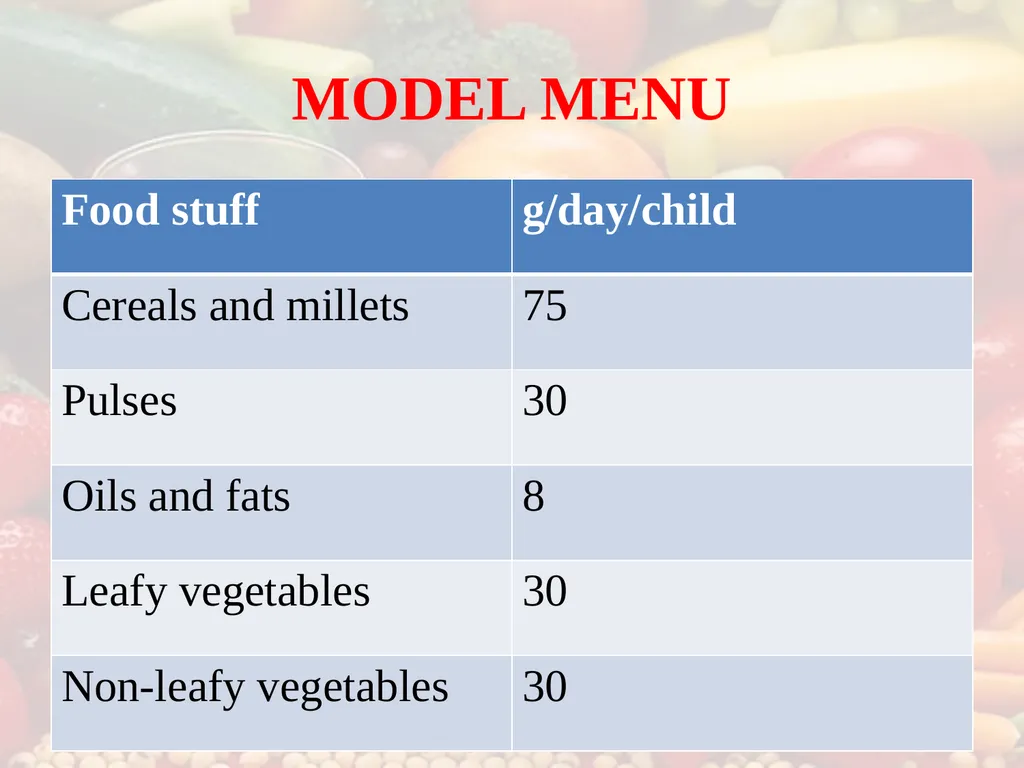
MODEL MENU<br>
64
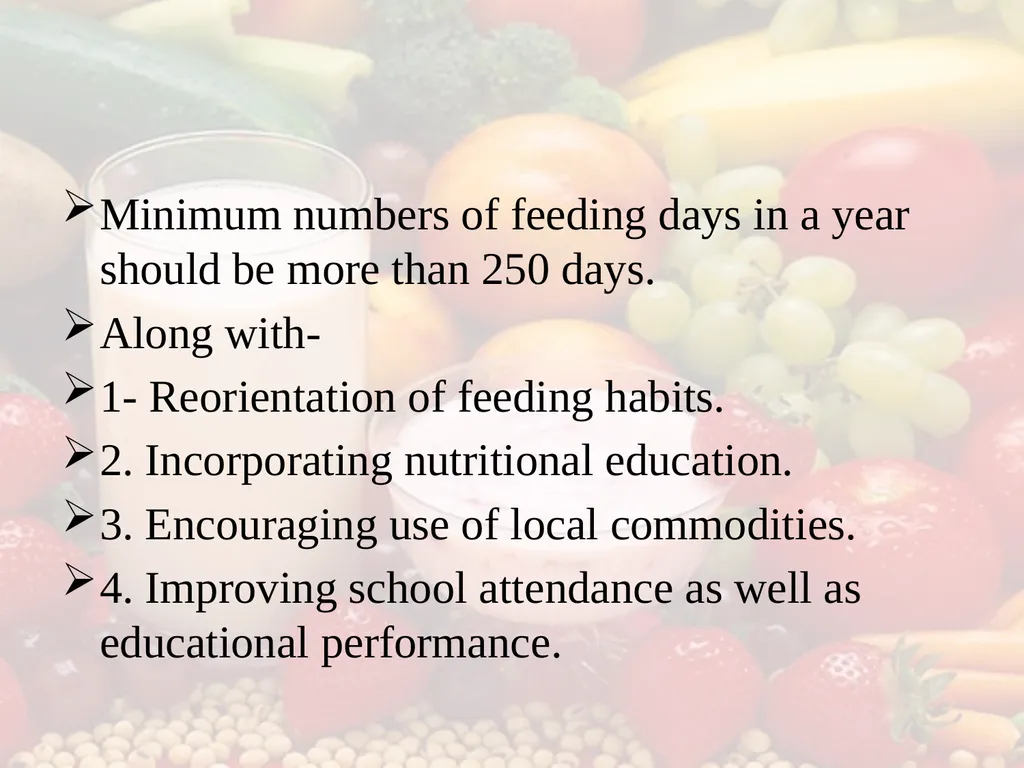
Minimum numbers of feeding days in a year should be more than 250 days.
Along with-
1- Reorientation of feeding habits.
2. Incorporating nutritional education.
3. Encouraging use of local commodities.
4. Improving school attendance as well as educational performance.<br>
Along with-
1- Reorientation of feeding habits.
2. Incorporating nutritional education.
3. Encouraging use of local commodities.
4. Improving school attendance as well as educational performance.<br>
65
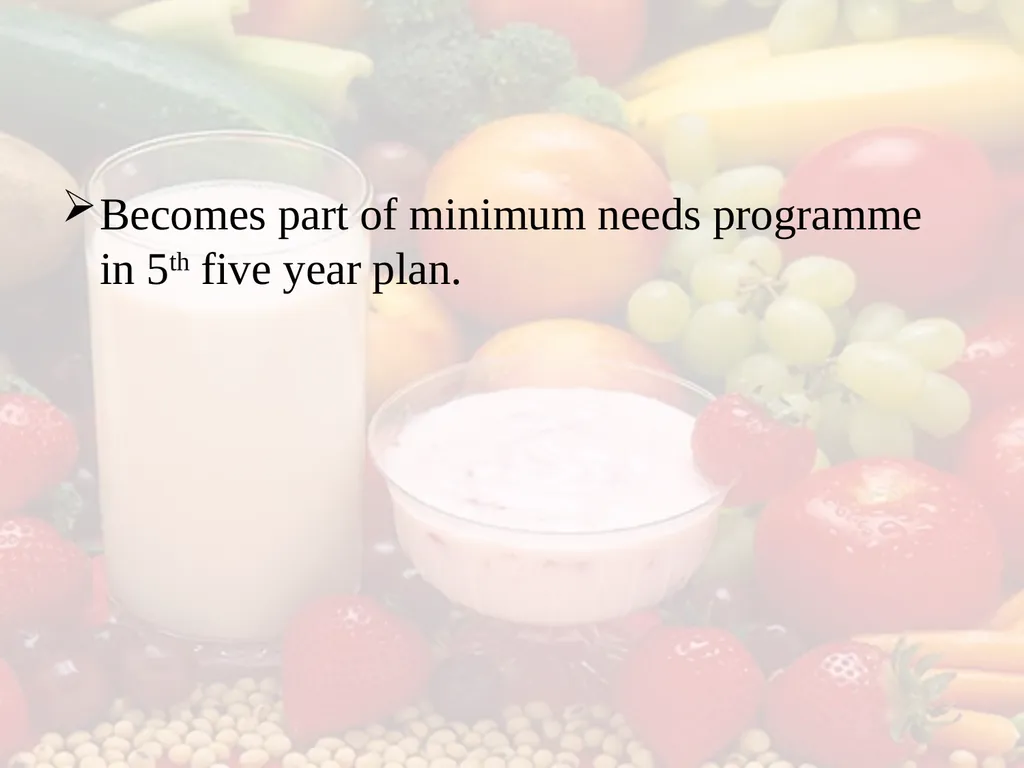
Becomes part of minimum needs programme in 5th five year plan.<br>
66
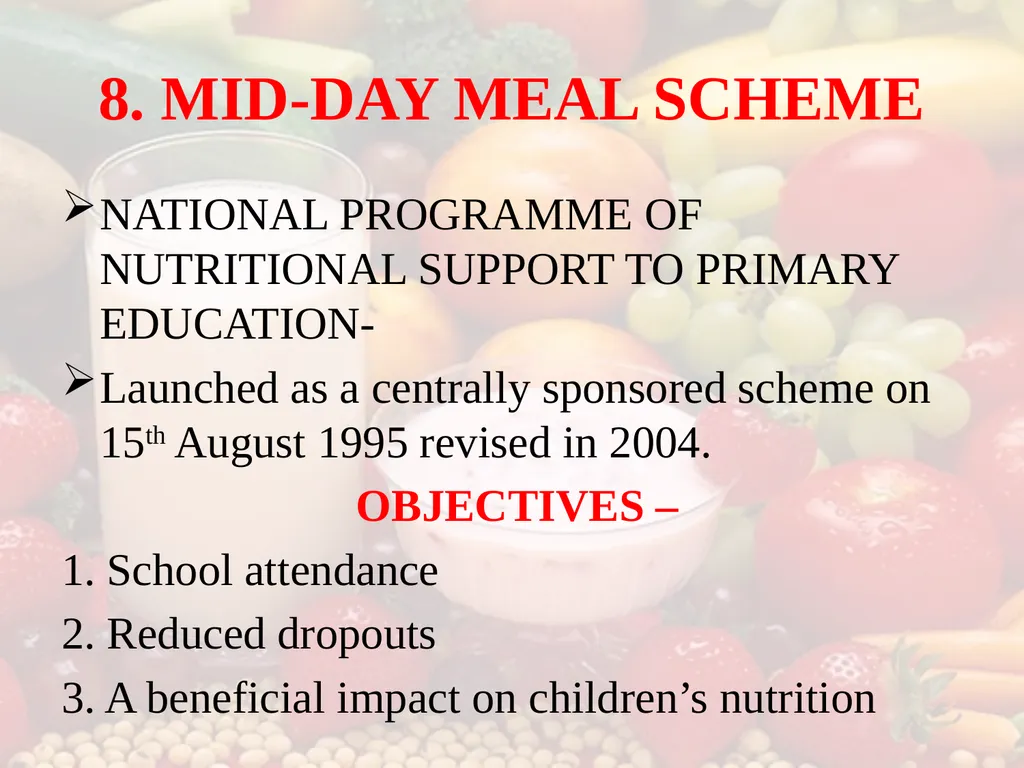
8. MID-DAY MEAL SCHEME NATIONAL PROGRAMME OF NUTRITIONAL SUPPORT TO PRIMARY EDUCATION-
Launched as a centrally sponsored scheme on 15th August 1995 revised in 2004.
OBJECTIVES –
1. School attendance
2. Reduced dropouts
3. A beneficial impact on children’s nutrition<br>
Launched as a centrally sponsored scheme on 15th August 1995 revised in 2004.
OBJECTIVES –
1. School attendance
2. Reduced dropouts
3. A beneficial impact on children’s nutrition<br>
67
Initially in 2,408 blocks covered whole country in phased manner by 1997-98.
Originally covered children of primary stage (classes I-V) in government, local body and government aided schools.
Extended in Oct. 2002 to cover children in Education Guarantee Scheme and Alternative and Innovative Education Cenres also.<br>
Originally covered children of primary stage (classes I-V) in government, local body and government aided schools.
Extended in Oct. 2002 to cover children in Education Guarantee Scheme and Alternative and Innovative Education Cenres also.<br>
68
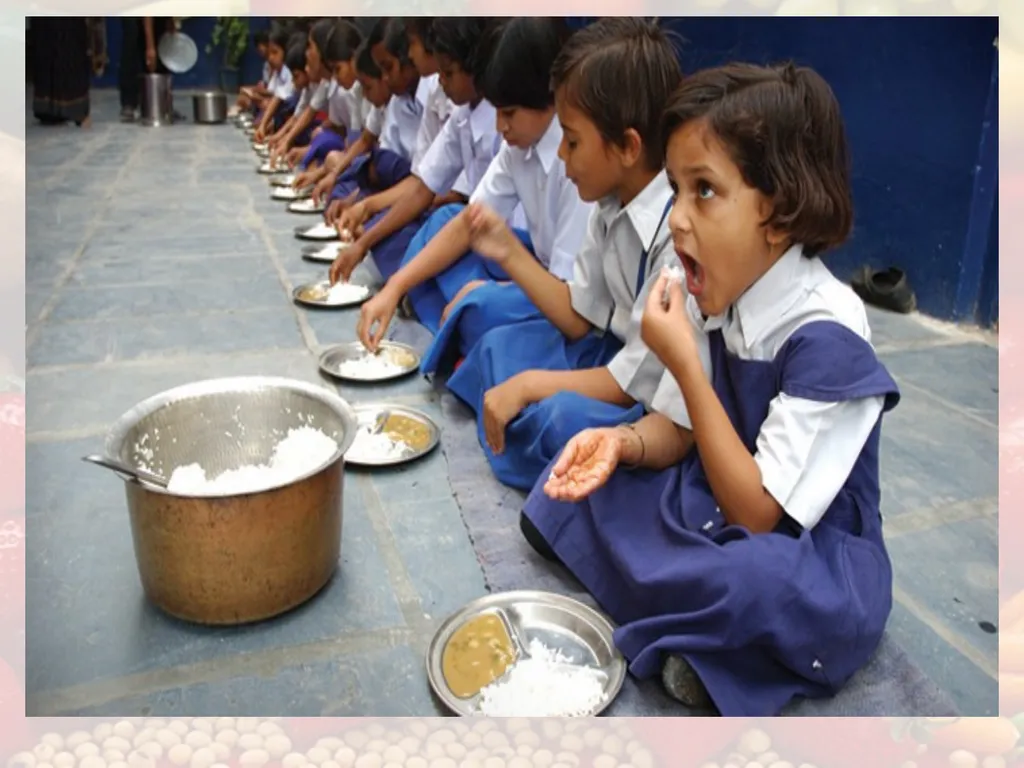
Center assistance to State-
Supply of food grain from nearest FCI godown 100 g/children/day with subsidiary for transport.
To achieve objectives-
Cooked mid day meal with minimum 300 calories and 8-12 g protein to all children of class I-V.<br>
Supply of food grain from nearest FCI godown 100 g/children/day with subsidiary for transport.
To achieve objectives-
Cooked mid day meal with minimum 300 calories and 8-12 g protein to all children of class I-V.<br>
69
SUGGESTIONS FOR PREPARATION 1. Food grains stored away from moisture, in air tight container/bins.
2. Use whole wheat or broken wheat (Dalia).
3. Rice parboiled or unpolished.
4. “A single dish meal” using broken wheat or rice incorporating some pulse or soyabean, a seasonal vegetable/green leafy vegetable, some oil.<br>
2. Use whole wheat or broken wheat (Dalia).
3. Rice parboiled or unpolished.
4. “A single dish meal” using broken wheat or rice incorporating some pulse or soyabean, a seasonal vegetable/green leafy vegetable, some oil.<br>
70
5. Cereal pulse combination to have good quality protein. Ratio range from 3:1-5:1.
6. Sprouted pulses
7. Leafy vegetables thoroughly washed before cutting.
8. Soaking of rice, dal, etc. reduces cooking time.
9. Rice water if left after cooking mixed with dal.<br>
6. Sprouted pulses
7. Leafy vegetables thoroughly washed before cutting.
8. Soaking of rice, dal, etc. reduces cooking time.
9. Rice water if left after cooking mixed with dal.<br>
71
10. Fermentation improves nutritive value.
11. Cooking must be done with lid on to avoid loss of nutrients.
12. Over cooking should be avoided.
13. Reheating of oil not done.
14. Leafy tops of carrots, radish, turnips etc. should not be thrown out but utilized.
15. Only “iodized salt” used.<br>
11. Cooking must be done with lid on to avoid loss of nutrients.
12. Over cooking should be avoided.
13. Reheating of oil not done.
14. Leafy tops of carrots, radish, turnips etc. should not be thrown out but utilized.
15. Only “iodized salt” used.<br>
72
MONITORING AND EVALUATION OF NUTRITION PROGRAMME Unethical to launched without built-in monitoring, evaluation and feed-back.
Improvement of family diet will improve nutrition of child.
How long 100 million children without any socio-economic improvement?<br>
Improvement of family diet will improve nutrition of child.
How long 100 million children without any socio-economic improvement?<br>
73
WORLD FOOD PROGRAMME (WFP) Largest international food aid organization-serving 80 countries
GOAL:
“A world in which every man, women and child has access at all times to the food needed for an active and healthy life, without food there can be no sustainable peace, no democracy and no development”
1963-food aid arm in UN, after Rome declaration on World Food Safety 1996<br>
GOAL:
“A world in which every man, women and child has access at all times to the food needed for an active and healthy life, without food there can be no sustainable peace, no democracy and no development”
1963-food aid arm in UN, after Rome declaration on World Food Safety 1996<br>
74
WFP IN INDIA Food delivery phased out in 2012 under new Country Strategic Plan 2015-18, WFP supporting Government in strengthening the efficacy and effectiveness under National Food Security Act (NFSA).
Targeted Public Distribution System(TPDS), ICDS and Mid Day Meal (MDM)<br>
Targeted Public Distribution System(TPDS), ICDS and Mid Day Meal (MDM)<br>
75
Fortification of foods-served to children via MDM-rice fortified with iron<br>
76
Thank You<br>