Nyaya philosophy perception According to Nyaya prama is divided into four kinds-Prayaksa, Anumiti, Upamiti and Savda. Naiyayikas define perception as a definite cognition which is produced by sense-object contact and is true. The perception
"Nyaya philosophy perception According to Nyaya" is the property of its rightful owner. Permission is granted to
download and print the materials on this website for personal, non-commercial use only, and to display it
on your personal computer provided you do not modify the materials and that you retain all copyright
notices contained in the materials. By downloading content from our website, you accept the terms of this
agreement.
Presentation Transcript
01
Nyaya philosophy perception According to Nyaya prama is divided into four kinds-Prayaksa, Anumiti, Upamiti and Savda. Naiyayikas define perception as a definite cognition which is produced by sense-object contact and is true. The perception of the table before me is due to the contact of my eyes with the table and I am definite that the object is a table. The perception of a snake in a piece of rope is definite but false. So it is different from valid perception.<br>
02
Definition “Indriyarthasannikarsotpannam jnanam avyapadeshyam avyabhichari vyabasayatmakam pratyaksam”
Perception is a valid cognition which is produced by sense-object contact. It is true and indubitable know ledge and it is non verbal(asavda).Here maharsi Goutam mentioned nirvikalpaka pratyaksa.<br>
03
“Jnakaranakam jnanam pratyaksm” Biswanath , the writer of Bhasaparicceda ,said that jnakaranakam jnanam pratyaksa. God ,we are told, percives all things but has no sense. So the definition of perception is too narrow.
It is necessary to remove this fallacy.
We are said to perceive an object, if and when we know it directly, i. e.without taking the help of previous experience (jnana).In this way it is possible to overcome that fallacy.<br>
04
Nirvikalpak and Savikalpaka Nirvikalpaka perception is the cognition of an object as just an existent thing without an explicit recognition and characterization of it as this or that kind of things. Immediately after the first glance, or after the first moment of contact between your eyes and the object, you apprehend something.
Savikalpaka perception is the cognition of an object as possessed of some character. For example,looking at the orange, I judge with myself,”this is an orange” I do not only cognige the existence of the orange as such, but also explicitly recognize or mentally assert of what sort of existence it is.<br>
05
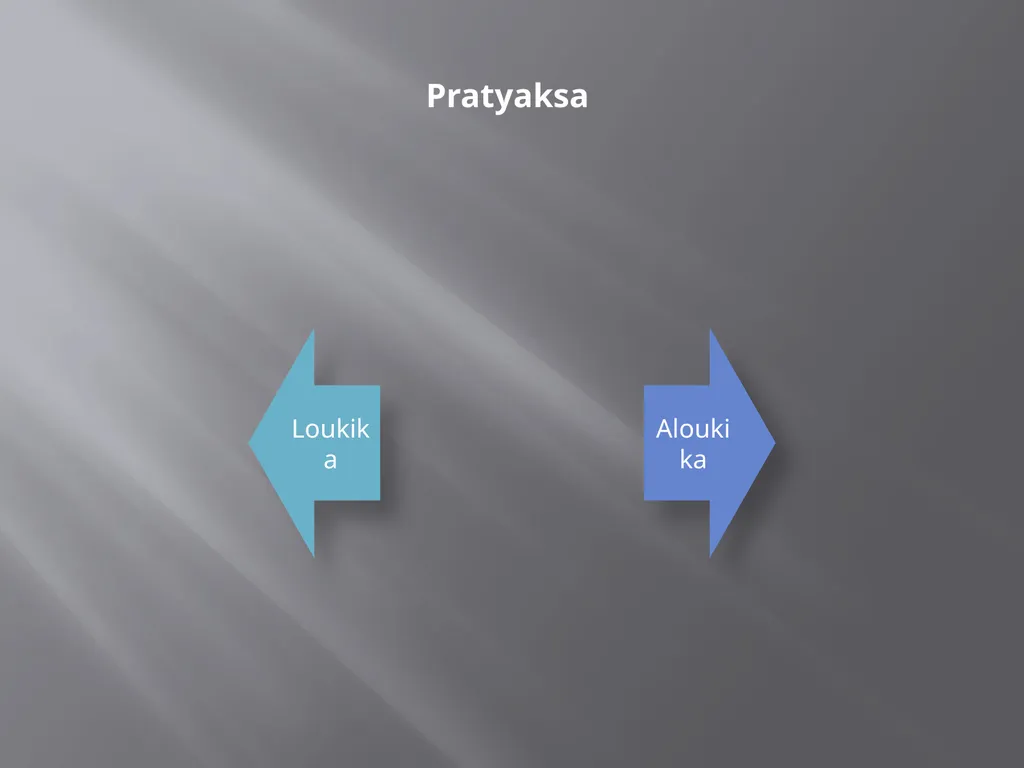
Pratyaksa<br>
06
Loukika pratyaksa<br>
07
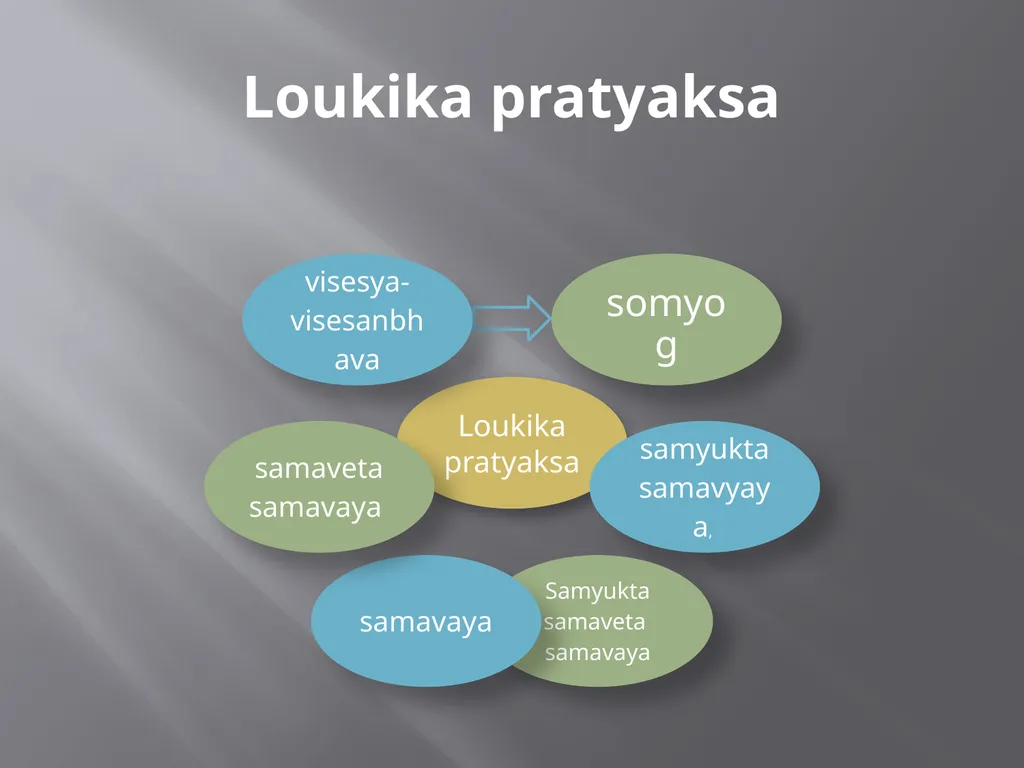
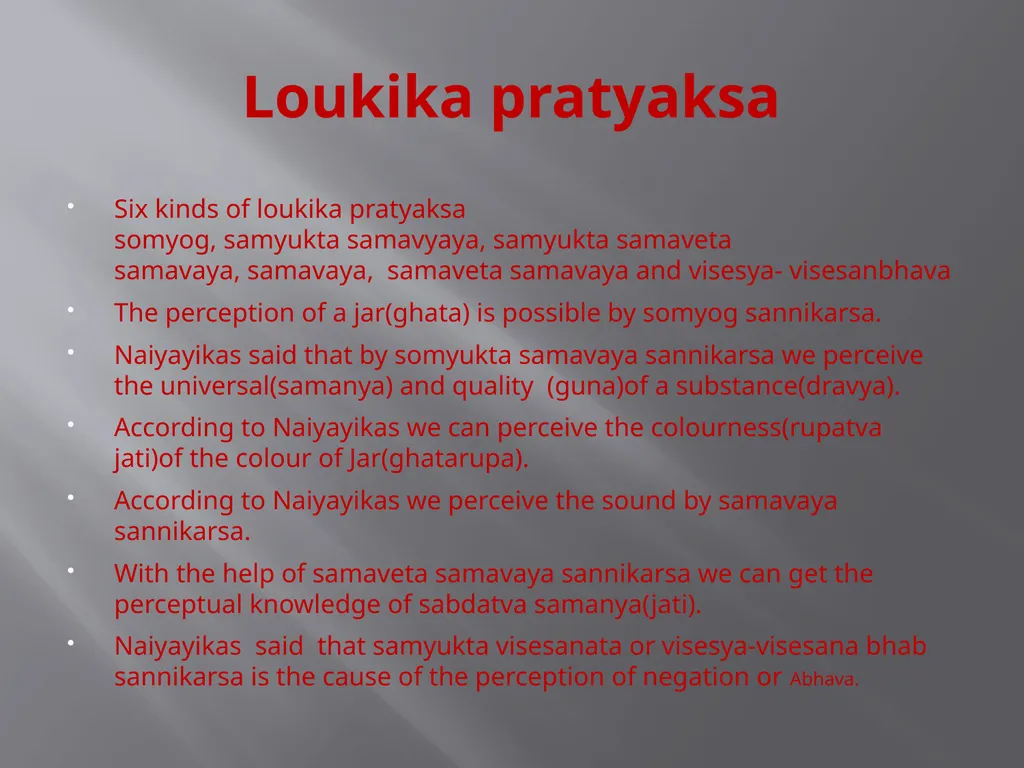
Loukika pratyaksa Six kinds of loukika pratyaksa somyog, samyukta samavyaya, samyukta samaveta samavaya, samavaya, samaveta samavaya and visesya- visesanbhava
The perception of a jar(ghata) is possible by somyog sannikarsa.
Naiyayikas said that by somyukta samavaya sannikarsa we perceive the universal(samanya) and quality (guna)of a substance(dravya).
According to Naiyayikas we can perceive the colourness(rupatva jati)of the colour of Jar(ghatarupa).
According to Naiyayikas we perceive the sound by samavaya sannikarsa.
With the help of samaveta samavaya sannikarsa we can get the perceptual knowledge of sabdatva samanya(jati).
Naiyayikas said that samyukta visesanata or visesya-visesana bhab sannikarsa is the cause of the perception of negation or Abhava.<br>