OBE briefing for students How much can you learn about OBE? Prepared by: OBEC, LKC FES 1 Lee Kong Chian Faculty of Engineering Science What is OBE? 2 Lee Kong Chian Faculty of Engineering Science OBE is Outcome-Based Education. OBE is
"OBE briefing for students How much can you learn" is the property of its rightful owner. Permission is granted to
download and print the materials on this website for personal, non-commercial use only, and to display it
on your personal computer provided you do not modify the materials and that you retain all copyright
notices contained in the materials. By downloading content from our website, you accept the terms of this
agreement.
Presentation Transcript
01
OBE briefing for students How much can you learn about OBE?
Prepared by:
OBEC, LKC FES 1 Lee Kong Chian Faculty of Engineering & Science<br>
02
What is OBE? 2 Lee Kong Chian Faculty of Engineering & Science<br>
03
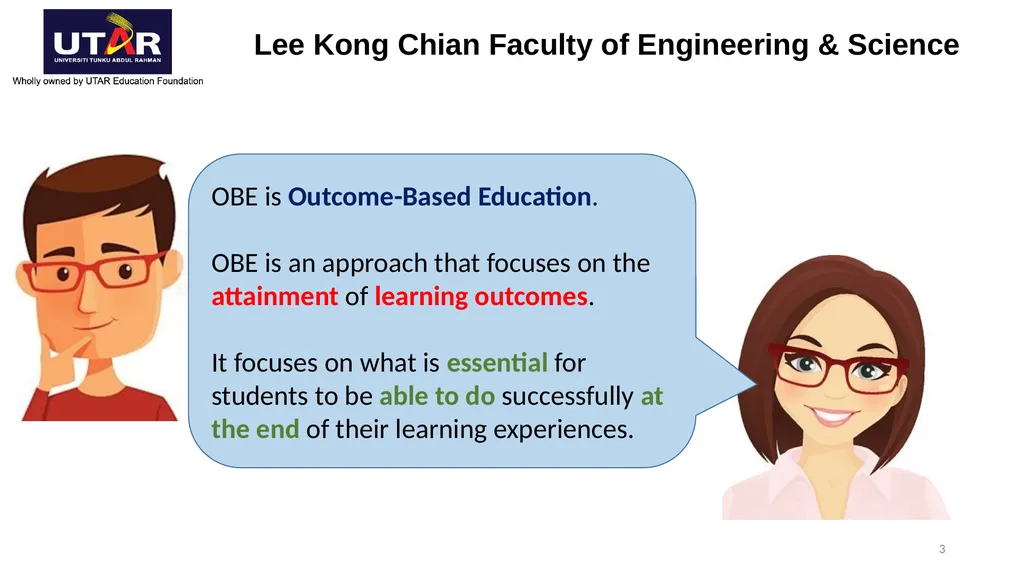
OBE is Outcome-Based Education.
OBE is an approach that focuses on the attainment of learning outcomes.
It focuses on what is essential for students to be able to do successfully at the end of their learning experiences. 3 Lee Kong Chian Faculty of Engineering & Science<br>
04
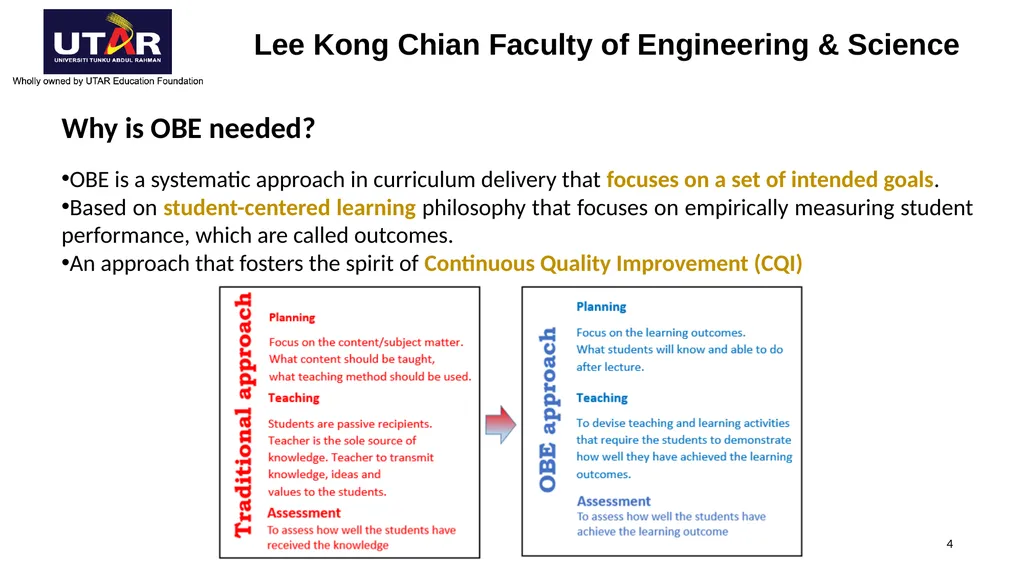
Why is OBE needed? OBE is a systematic approach in curriculum delivery that focuses on a set of intended goals.
Based on student-centered learning philosophy that focuses on empirically measuring student performance, which are called outcomes.
An approach that fosters the spirit of Continuous Quality Improvement (CQI) 4 Lee Kong Chian Faculty of Engineering & Science<br>
05
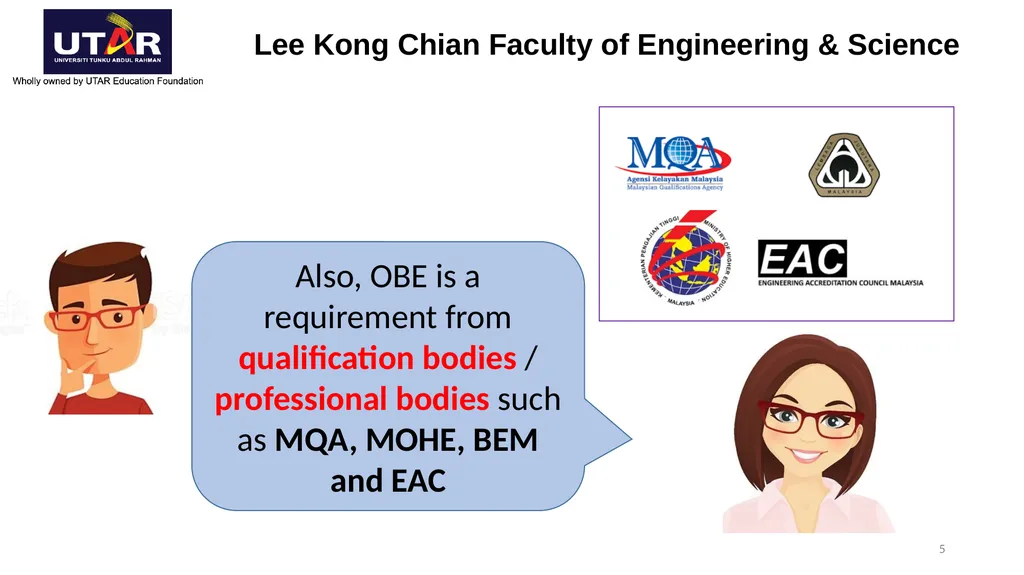
Also, OBE is a requirement from qualification bodies / professional bodies such as MQA, MOHE, BEM and EAC 5 Lee Kong Chian Faculty of Engineering & Science<br>
06
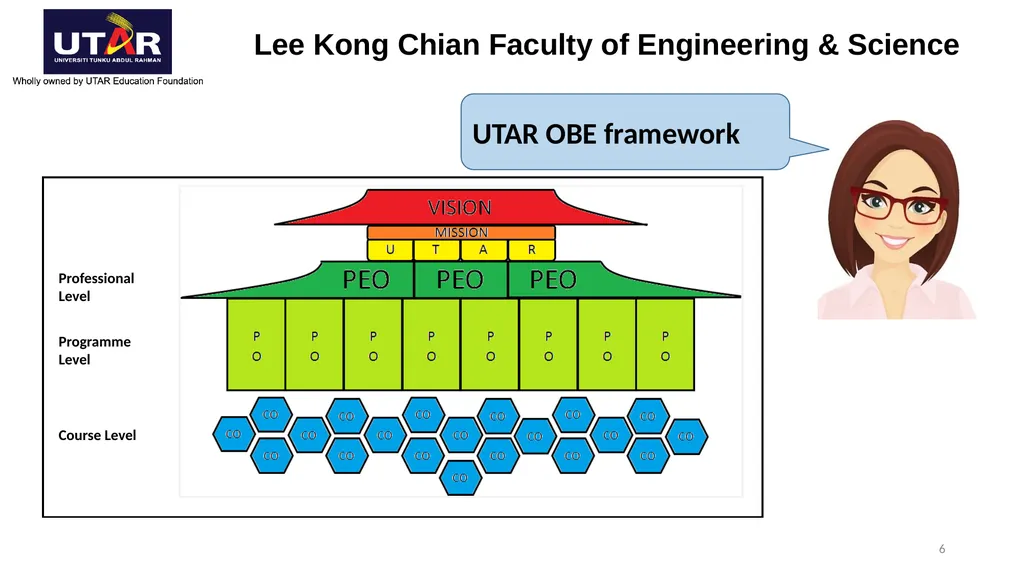
UTAR OBE framework 6 Lee Kong Chian Faculty of Engineering & Science<br>
07
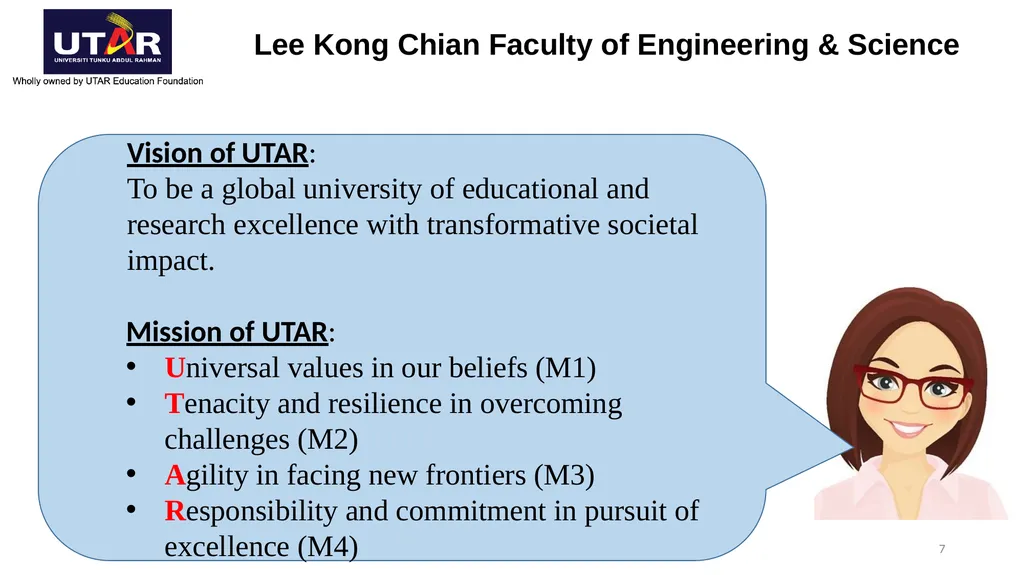
Vision of UTAR:
To be a global university of educational and research excellence with transformative societal impact.
Mission of UTAR:
Universal values in our beliefs (M1)
Tenacity and resilience in overcoming challenges (M2)
Agility in facing new frontiers (M3)
Responsibility and commitment in pursuit of excellence (M4) 7 Lee Kong Chian Faculty of Engineering & Science<br>
08
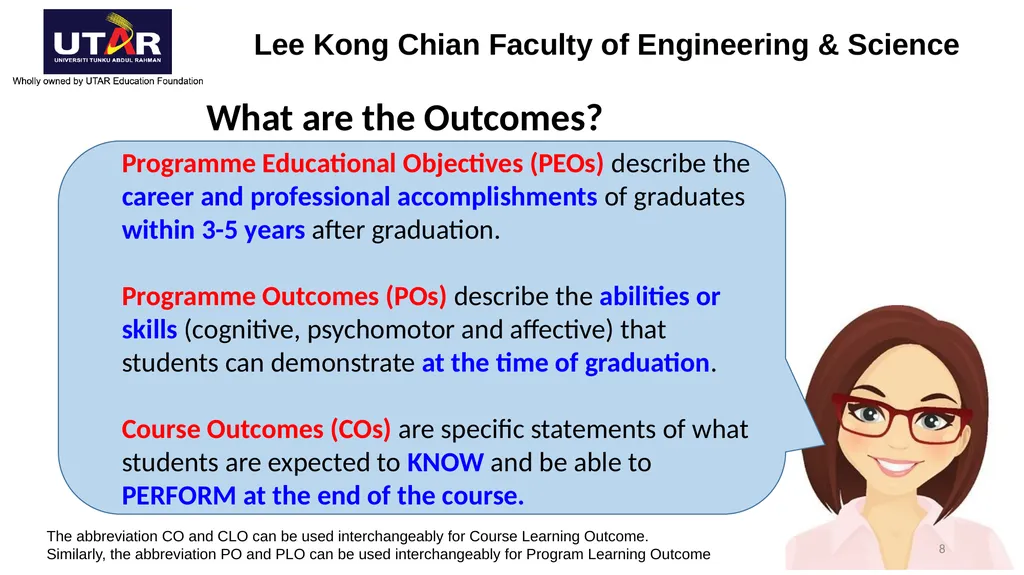
Programme Educational Objectives (PEOs) describe the career and professional accomplishments of graduates within 3-5 years after graduation.
Programme Outcomes (POs) describe the abilities or skills (cognitive, psychomotor and affective) that students can demonstrate at the time of graduation.
Course Outcomes (COs) are specific statements of what students are expected to KNOW and be able to PERFORM at the end of the course. 8 What are the Outcomes? Lee Kong Chian Faculty of Engineering & Science The abbreviation CO and CLO can be used interchangeably for Course Learning Outcome. Similarly, the abbreviation PO and PLO can be used interchangeably for Program Learning Outcome<br>
09
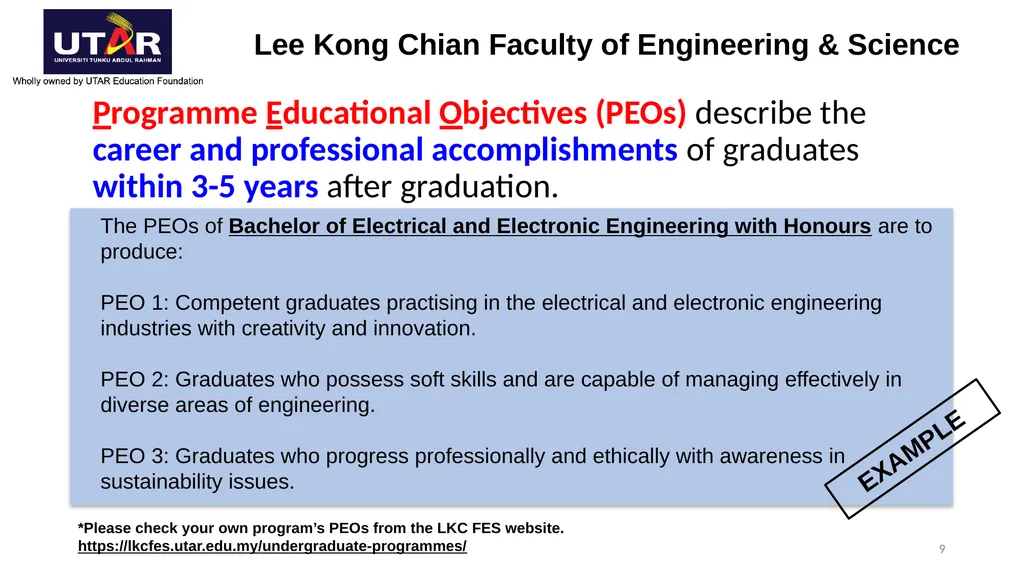
Programme Educational Objectives (PEOs) describe the career and professional accomplishments of graduates within 3-5 years after graduation. The PEOs of Bachelor of Electrical and Electronic Engineering with Honours are to produce:
PEO 1: Competent graduates practising in the electrical and electronic engineering industries with creativity and innovation.
PEO 2: Graduates who possess soft skills and are capable of managing effectively in diverse areas of engineering.
PEO 3: Graduates who progress professionally and ethically with awareness in sustainability issues. 9 *Please check your own program’s PEOs from the LKC FES website.
https://lkcfes.utar.edu.my/undergraduate-programmes/ Lee Kong Chian Faculty of Engineering & Science<br>
10
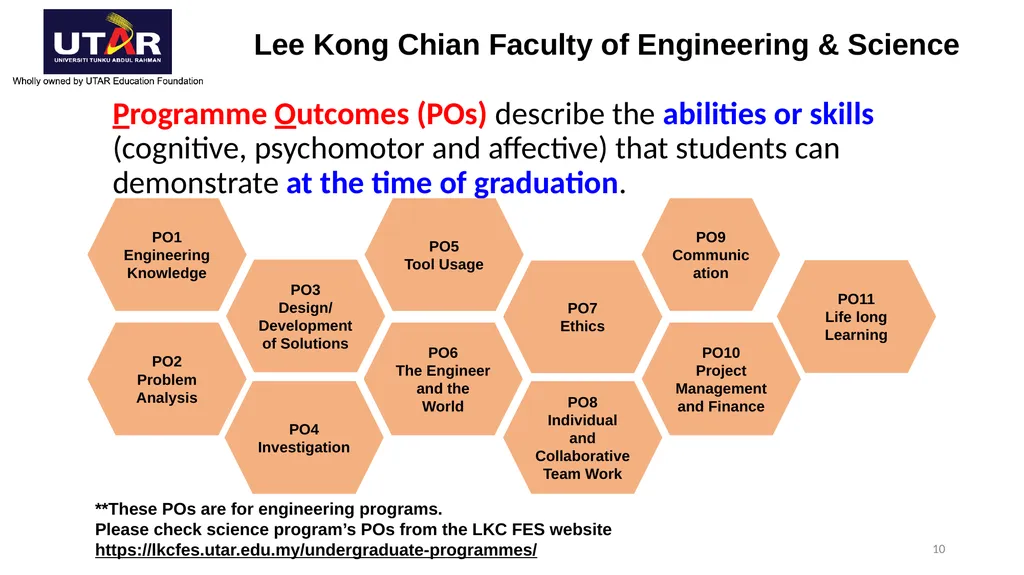
Programme Outcomes (POs) describe the abilities or skills (cognitive, psychomotor and affective) that students can demonstrate at the time of graduation. 10 **These POs are for engineering programs.
Please check science program’s POs from the LKC FES website
https://lkcfes.utar.edu.my/undergraduate-programmes/ Lee Kong Chian Faculty of Engineering & Science<br>
11
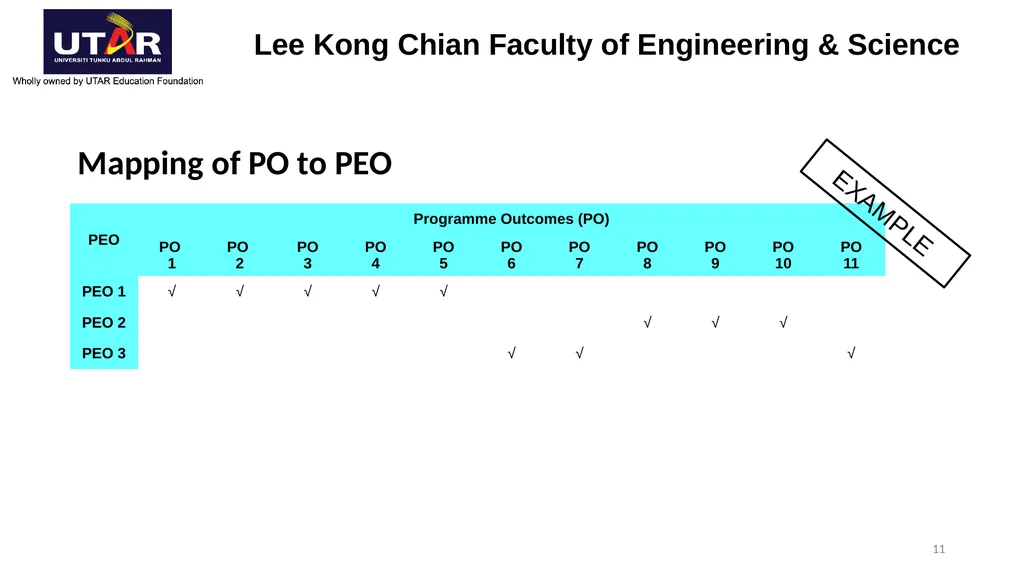
Mapping of PO to PEO 11 Lee Kong Chian Faculty of Engineering & Science<br>
12
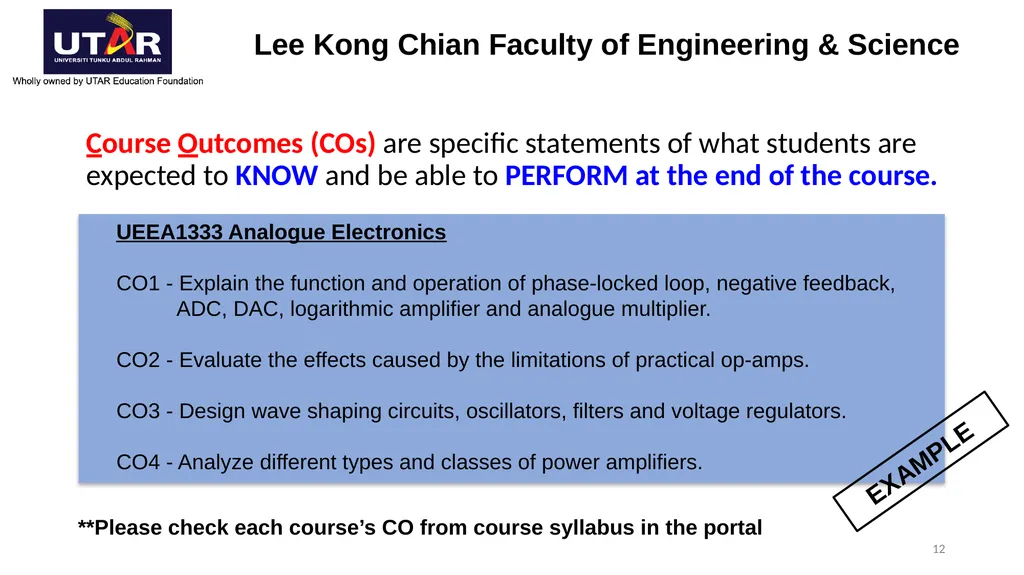
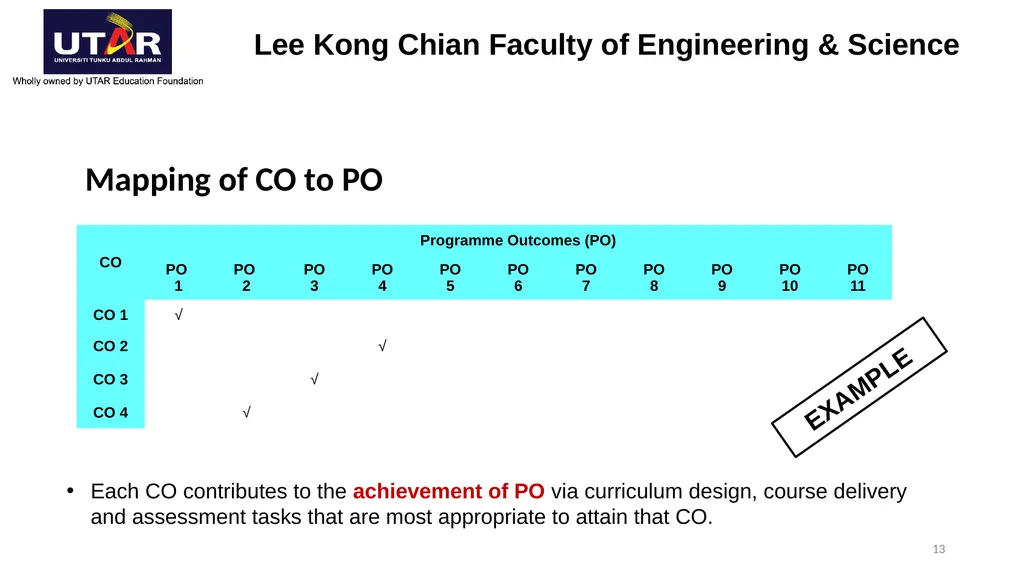
Course Outcomes (COs) are specific statements of what students are expected to KNOW and be able to PERFORM at the end of the course. UEEA1333 Analogue Electronics
CO1 - Explain the function and operation of phase-locked loop, negative feedback, ADC, DAC, logarithmic amplifier and analogue multiplier.
CO2 - Evaluate the effects caused by the limitations of practical op-amps.
CO3 - Design wave shaping circuits, oscillators, filters and voltage regulators.
CO4 - Analyze different types and classes of power amplifiers. 12 **Please check each course’s CO from course syllabus in the portal Lee Kong Chian Faculty of Engineering & Science<br>
13
Mapping of CO to PO Each CO contributes to the achievement of PO via curriculum design, course delivery and assessment tasks that are most appropriate to attain that CO. 13 Lee Kong Chian Faculty of Engineering & Science<br>
14
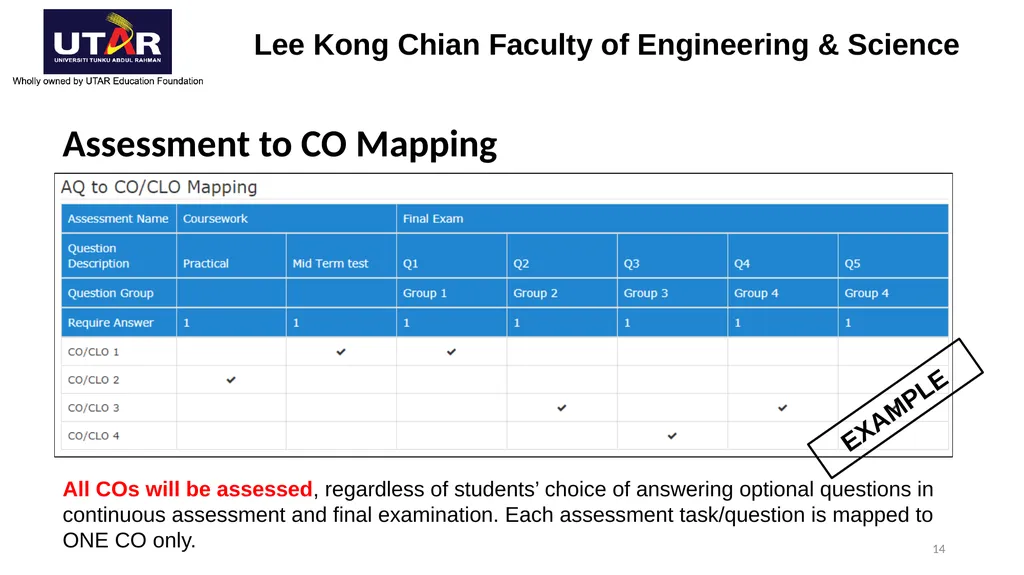
Assessment to CO Mapping 14 All COs will be assessed, regardless of students’ choice of answering optional questions in continuous assessment and final examination. Each assessment task/question is mapped to ONE CO only. Lee Kong Chian Faculty of Engineering & Science<br>
15
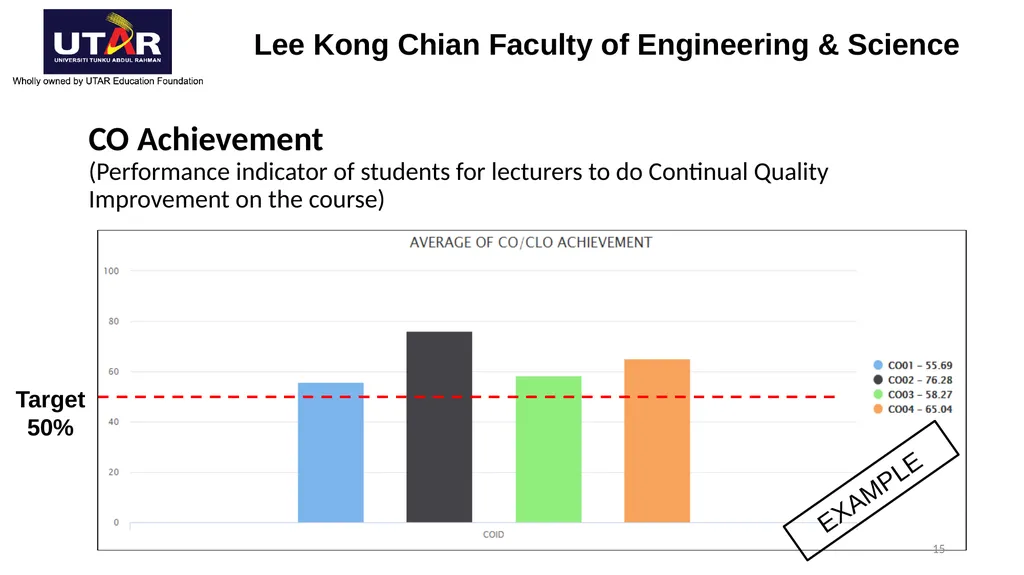
CO Achievement (Performance indicator of students for lecturers to do Continual Quality Improvement on the course) 15 Target
50% Lee Kong Chian Faculty of Engineering & Science<br>
16
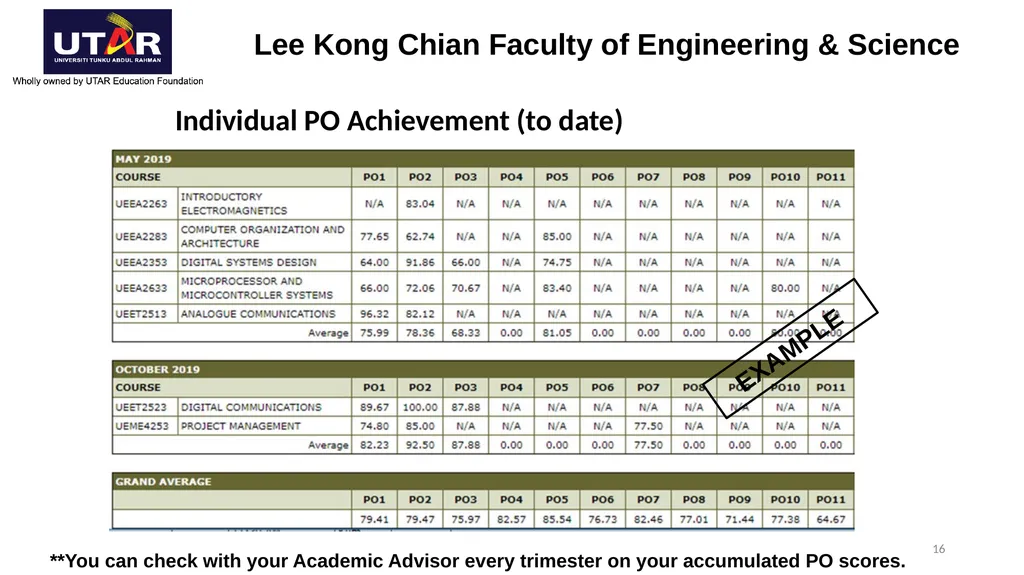
Individual PO Achievement (to date) **You can check with your Academic Advisor every trimester on your accumulated PO scores. 16 Lee Kong Chian Faculty of Engineering & Science<br>
17
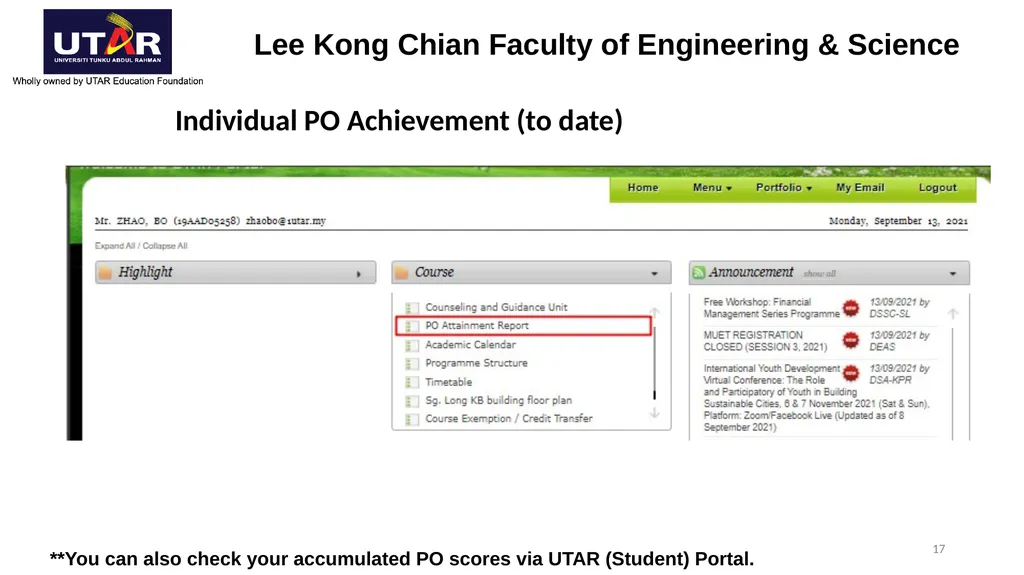
Individual PO Achievement (to date) **You can also check your accumulated PO scores via UTAR (Student) Portal. 17 Lee Kong Chian Faculty of Engineering & Science<br>
18
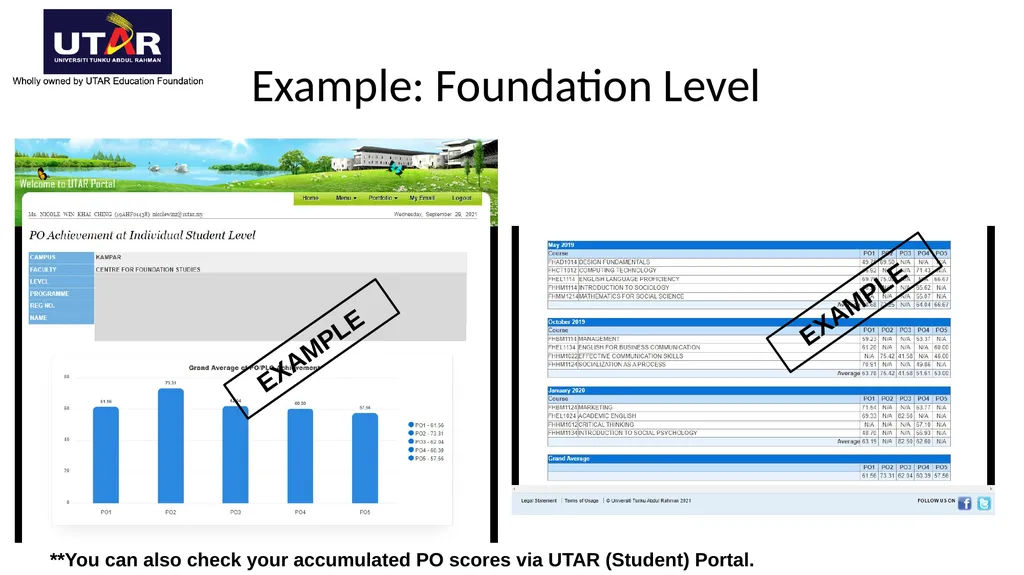
Example: Foundation Level **You can also check your accumulated PO scores via UTAR (Student) Portal.<br>
19
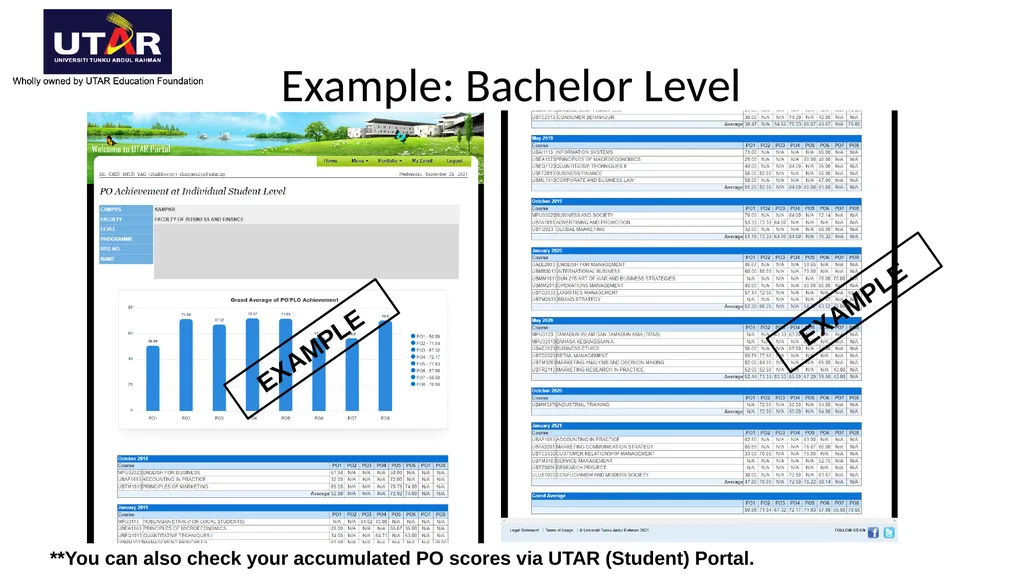
Example: Bachelor Level **You can also check your accumulated PO scores via UTAR (Student) Portal.<br>
20
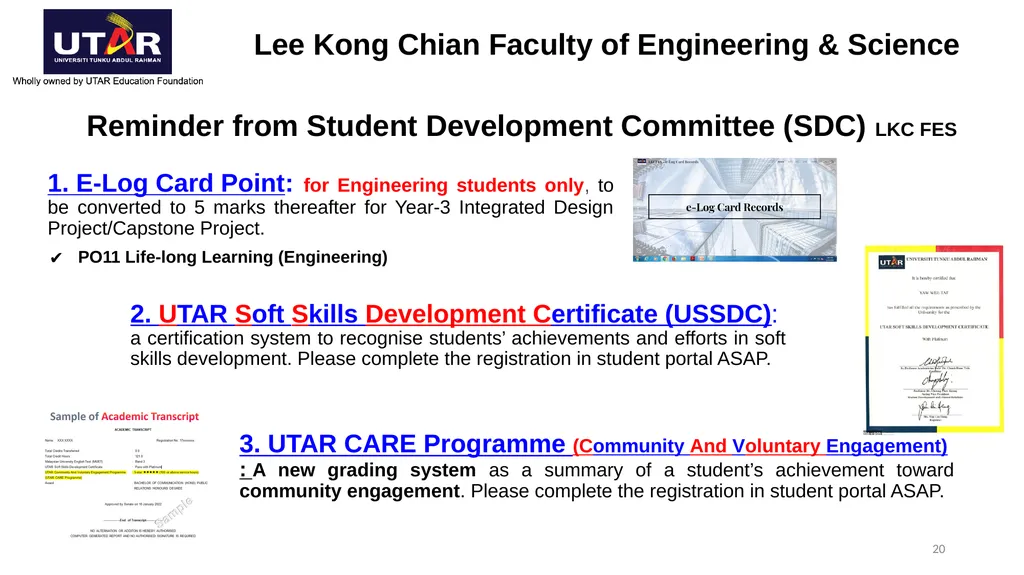
Reminder from Student Development Committee (SDC) LKC FES 2. UTAR Soft Skills Development Certificate (USSDC): a certification system to recognise students’ achievements and efforts in soft skills development. Please complete the registration in student portal ASAP. 1. E-Log Card Point: for Engineering students only, to be converted to 5 marks thereafter for Year-3 Integrated Design Project/Capstone Project. 3. UTAR CARE Programme (Community And Voluntary Engagement): A new grading system as a summary of a student’s achievement toward community engagement. Please complete the registration in student portal ASAP. PO11 Life-long Learning (Engineering) 20 Lee Kong Chian Faculty of Engineering & Science<br>
21
For more details, please click the icon to visit the specific website 21 Lee Kong Chian Faculty of Engineering & Science<br>
22
END! 22 Lee Kong Chian Faculty of Engineering & Science<br>