Object Oriented PHP CS380 1 Why use classes and objects? PHP is a primarily procedural language small programs are easily written without adding any classes or objects larger programs, however, become cluttered with so many disorganized
"Object Oriented PHP CS380 1 Why use classes and" is the property of its rightful owner. Permission is granted to
download and print the materials on this website for personal, non-commercial use only, and to display it
on your personal computer provided you do not modify the materials and that you retain all copyright
notices contained in the materials. By downloading content from our website, you accept the terms of this
agreement.
Presentation Transcript
01
Object Oriented PHP CS380 1<br>
02
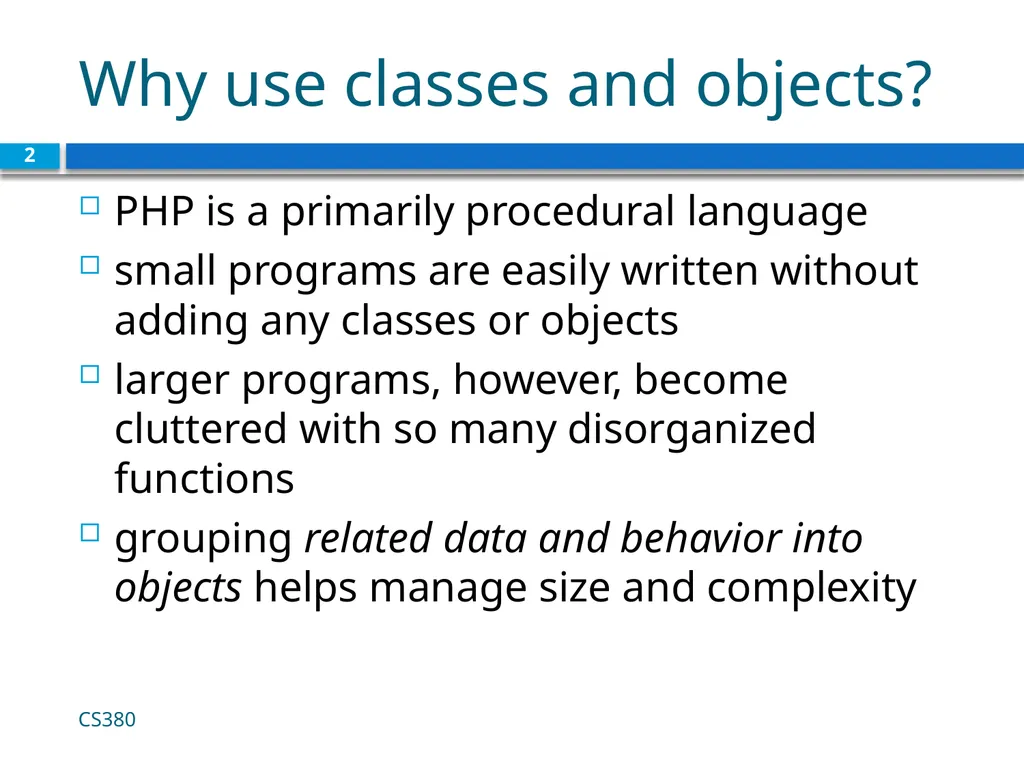
Why use classes and objects? PHP is a primarily procedural language
small programs are easily written without adding any classes or objects
larger programs, however, become cluttered with so many disorganized functions
grouping related data and behavior into objects helps manage size and complexity CS380 2<br>
03
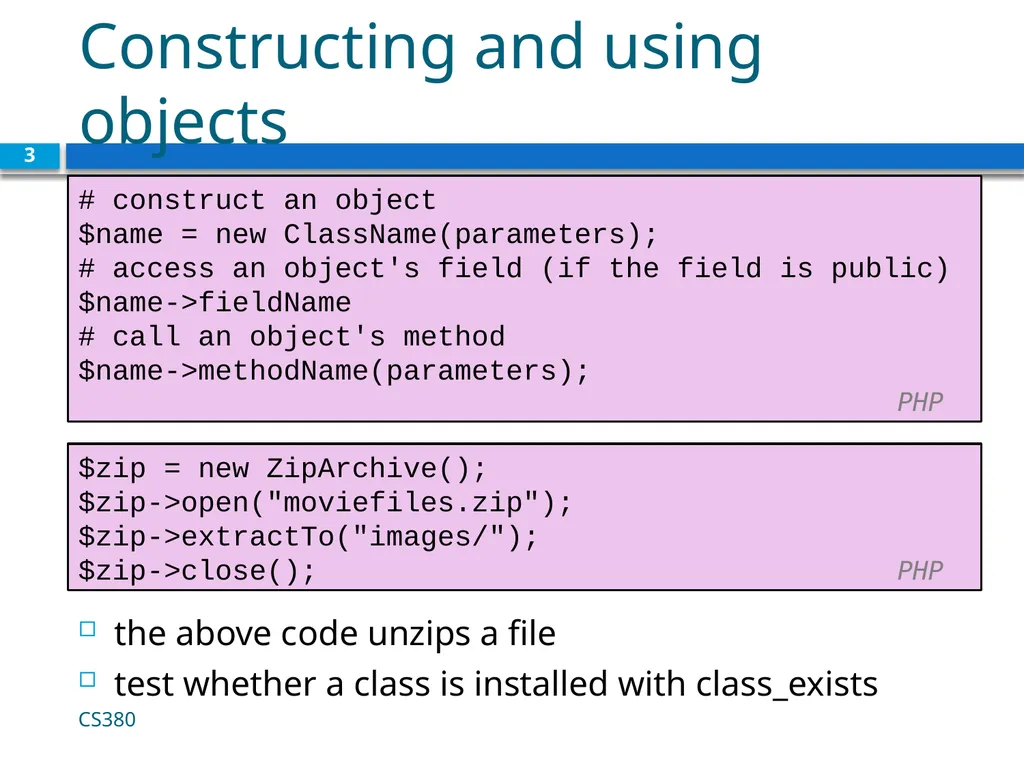
Constructing and using objects 3 # construct an object
$name = new ClassName(parameters);
# access an object's field (if the field is public)
$name->fieldName
# call an object's method
$name->methodName(parameters); PHP the above code unzips a file
test whether a class is installed with class_exists CS380 $zip = new ZipArchive();
$zip->open("moviefiles.zip");
$zip->extractTo("images/");
$zip->close(); PHP<br>
04
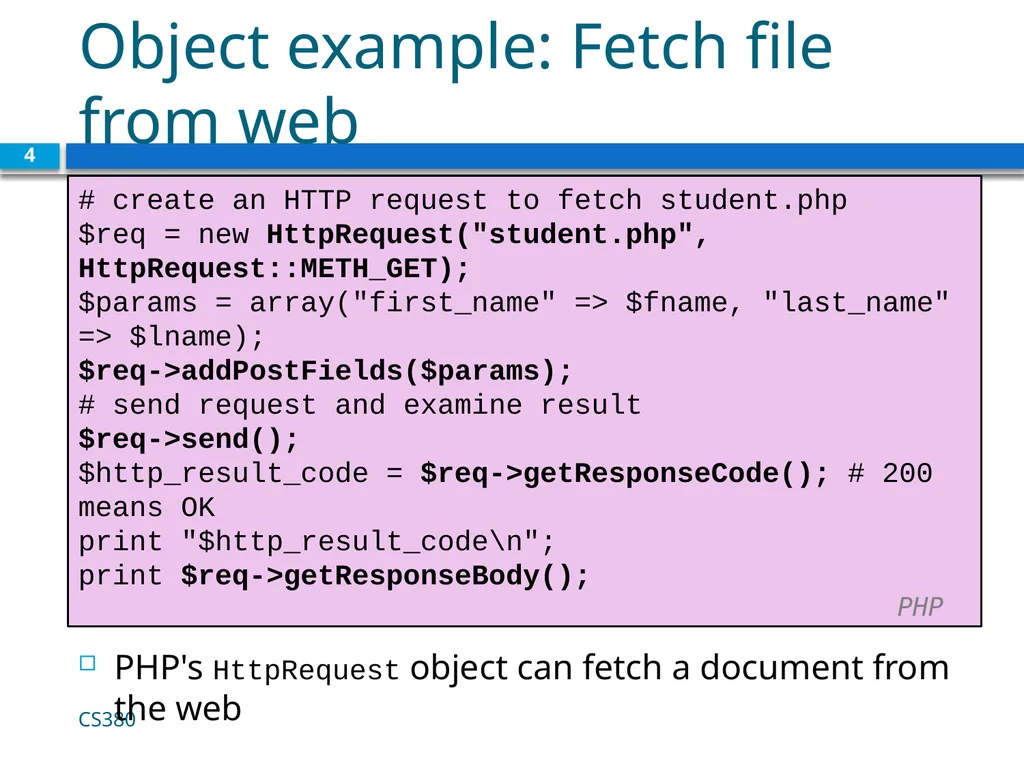
Object example: Fetch file from web 4 # create an HTTP request to fetch student.php
$req = new HttpRequest("student.php", HttpRequest::METH_GET);
$params = array("first_name" => $fname, "last_name" => $lname);
$req->addPostFields($params);
# send request and examine result
$req->send();
$http_result_code = $req->getResponseCode(); # 200 means OK
print "$http_result_code\n";
print $req->getResponseBody(); PHP PHP's HttpRequest object can fetch a document from the web CS380<br>
05
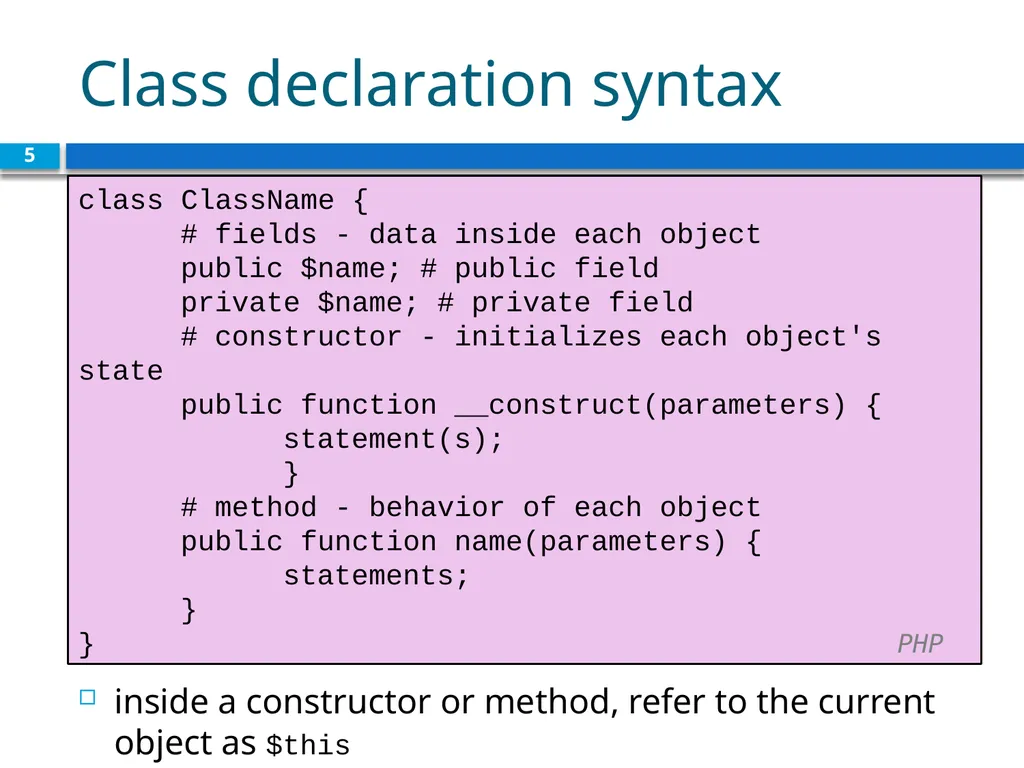
Class declaration syntax 5 class ClassName {
# fields - data inside each object
public $name; # public field
private $name; # private field
# constructor - initializes each object's state
public function __construct(parameters) {
statement(s);
}
# method - behavior of each object
public function name(parameters) {
statements;
}
} PHP inside a constructor or method, refer to the current object as $this<br>
06
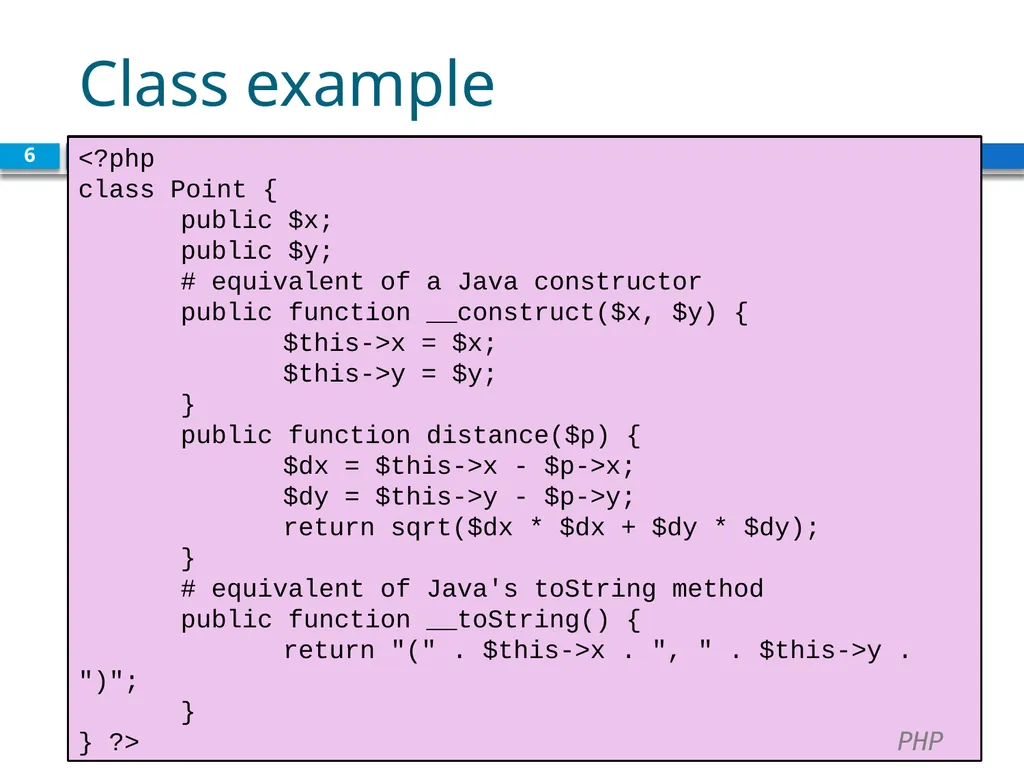
Class example 6 <?php
class Point {
public $x;
public $y;
# equivalent of a Java constructor
public function __construct($x, $y) {
$this->x = $x;
$this->y = $y;
}
public function distance($p) {
$dx = $this->x - $p->x;
$dy = $this->y - $p->y;
return sqrt($dx * $dx + $dy * $dy);
}
# equivalent of Java's toString method
public function __toString() {
return "(" . $this->x . ", " . $this->y . ")";
}
} ?> PHP<br>
07
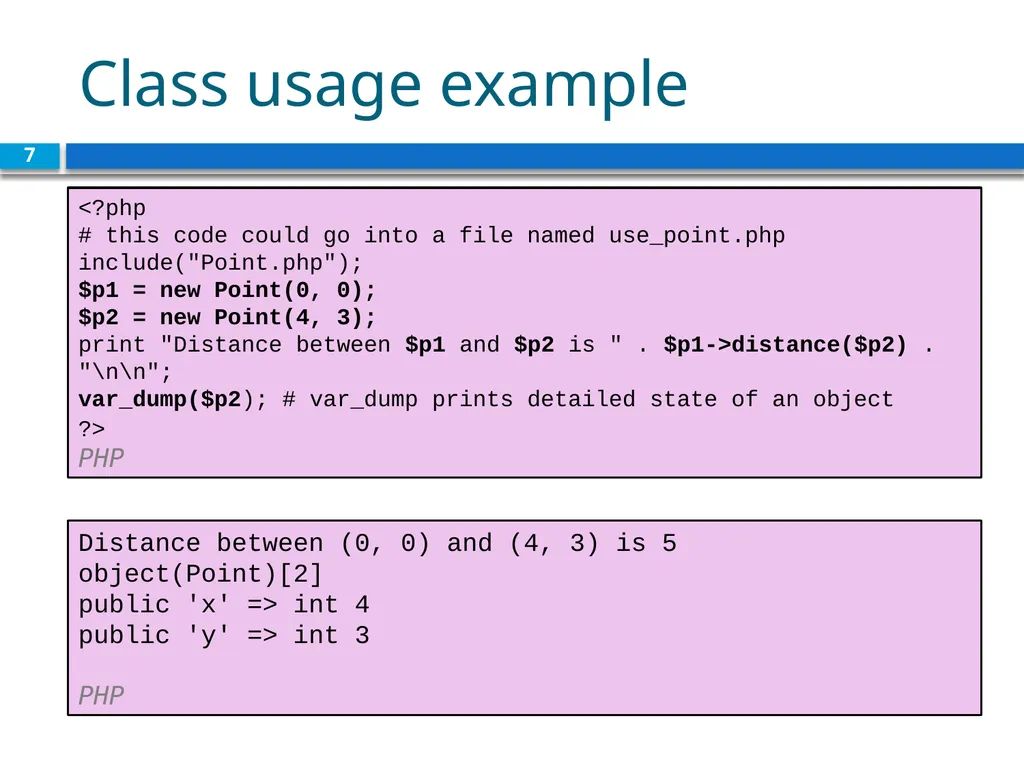
Class usage example 7 <?php
# this code could go into a file named use_point.php
include("Point.php");
$p1 = new Point(0, 0);
$p2 = new Point(4, 3);
print "Distance between $p1 and $p2 is " . $p1->distance($p2) . "\n\n";
var_dump($p2); # var_dump prints detailed state of an object
?> PHP Distance between (0, 0) and (4, 3) is 5
object(Point)[2]
public 'x' => int 4
public 'y' => int 3 PHP<br>
08
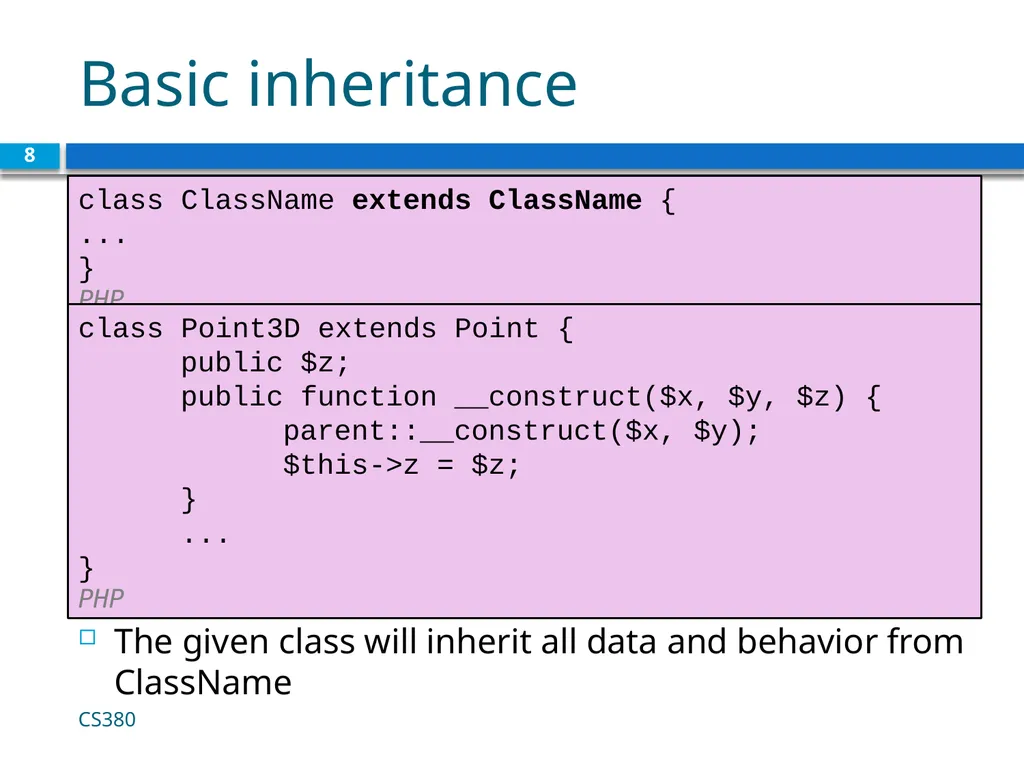
Basic inheritance 8 class ClassName extends ClassName {
...
} PHP The given class will inherit all data and behavior from ClassName class Point3D extends Point {
public $z;
public function __construct($x, $y, $z) {
parent::__construct($x, $y);
$this->z = $z;
}
...
} PHP CS380<br>
09
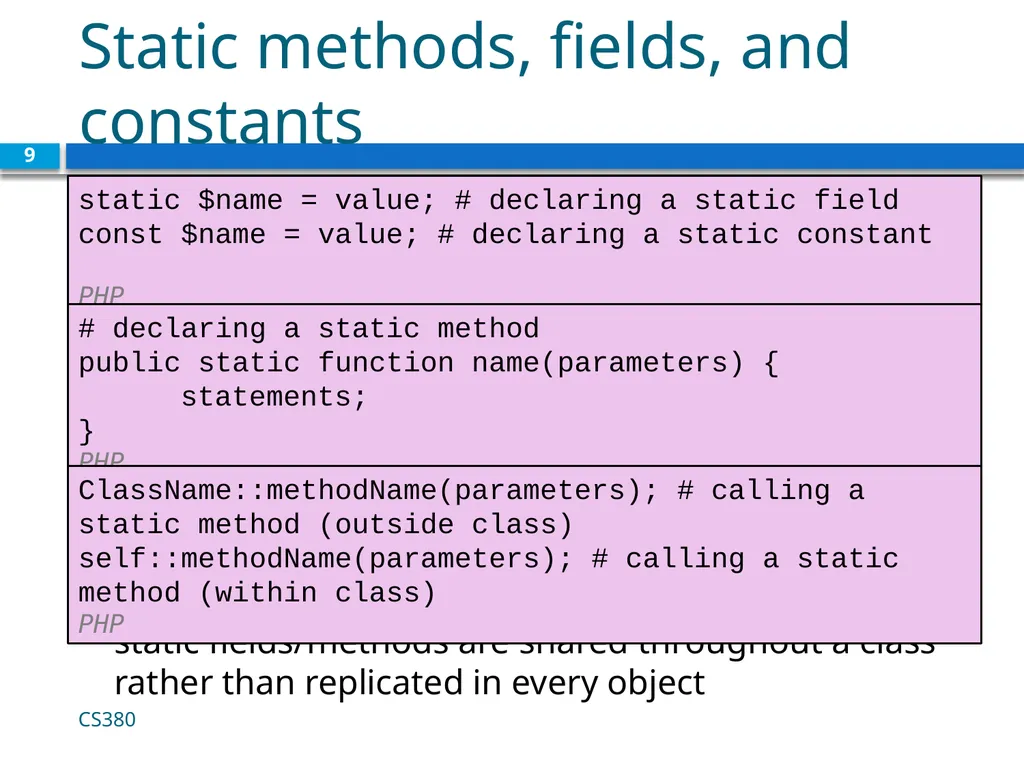
Static methods, fields, and constants 9 static $name = value; # declaring a static field
const $name = value; # declaring a static constant PHP static fields/methods are shared throughout a class rather than replicated in every object # declaring a static method
public static function name(parameters) {
statements;
} PHP CS380 ClassName::methodName(parameters); # calling a static method (outside class)
self::methodName(parameters); # calling a static method (within class) PHP<br>
10
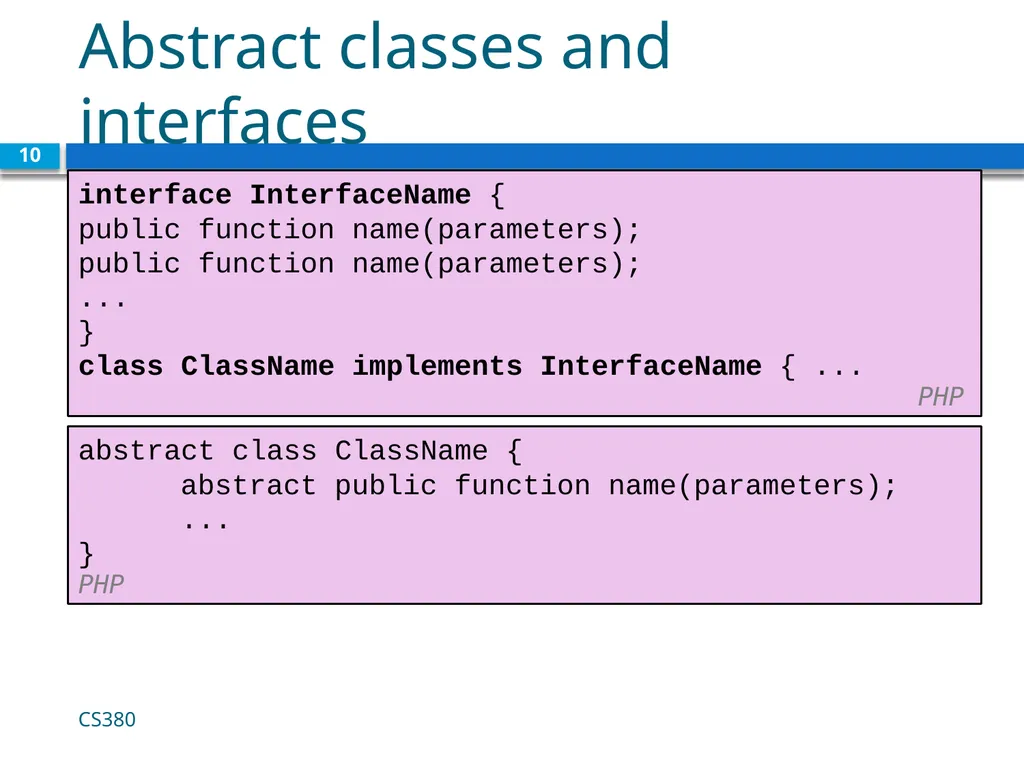
Abstract classes and interfaces 10 interface InterfaceName {
public function name(parameters);
public function name(parameters);
...
}
class ClassName implements InterfaceName { ... PHP CS380 abstract class ClassName {
abstract public function name(parameters);
...
} PHP<br>
11
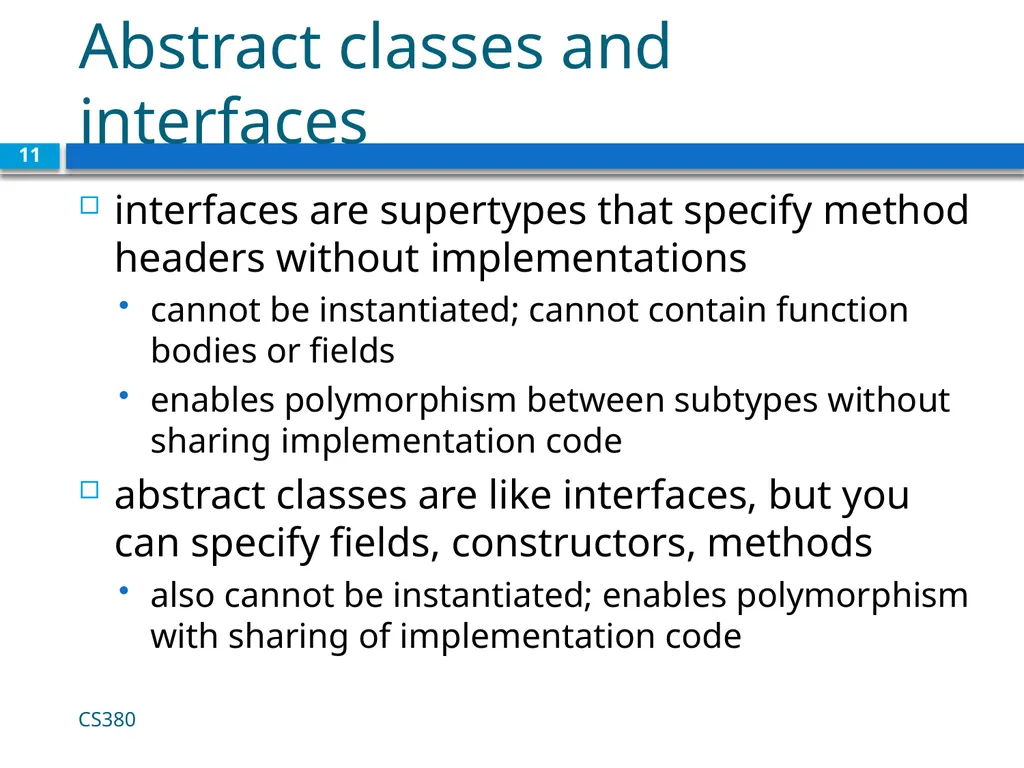
Abstract classes and interfaces CS380 11 interfaces are supertypes that specify method headers without implementations
cannot be instantiated; cannot contain function bodies or fields
enables polymorphism between subtypes without sharing implementation code
abstract classes are like interfaces, but you can specify fields, constructors, methods
also cannot be instantiated; enables polymorphism with sharing of implementation code<br>