
Object-Oriented Software Engineering Practical
CS
Published · 23 slides · 0 views
1 / 1
Description
Object-Oriented Software Engineering Practical Software Development using UML and Java Chapter 6: Using Design Patterns 1 2 6.1 Introduction to Patterns The recurring aspects of designs are called design patterns. A pattern is the outline
Related Topics
Share
Embed code
Download this presentation From Below
"Object-Oriented Software Engineering Practical" is the property of its rightful owner. Permission is granted to download and print the materials on this website for personal, non-commercial use only, and to display it on your personal computer provided you do not modify the materials and that you retain all copyright notices contained in the materials. By downloading content from our website, you accept the terms of this agreement.
Presentation Transcript
01
Object-Oriented Software Engineering
Practical Software Development using UML and Java Chapter 6:
Using Design Patterns 1<br>
Using Design Patterns 1<br>
02
2 6.1 Introduction to Patterns The recurring aspects of designs are called design patterns.
A pattern is the outline of a reusable solution to a general problem encountered in a particular context
Many of them have been systematically documented for all software developers to use
A good pattern should
Be as general as possible
Contain a solution that has been proven to effectively solve the problem in the indicated context.
Studying patterns is an effective way to learn from the experience of others<br>
A pattern is the outline of a reusable solution to a general problem encountered in a particular context
Many of them have been systematically documented for all software developers to use
A good pattern should
Be as general as possible
Contain a solution that has been proven to effectively solve the problem in the indicated context.
Studying patterns is an effective way to learn from the experience of others<br>
03
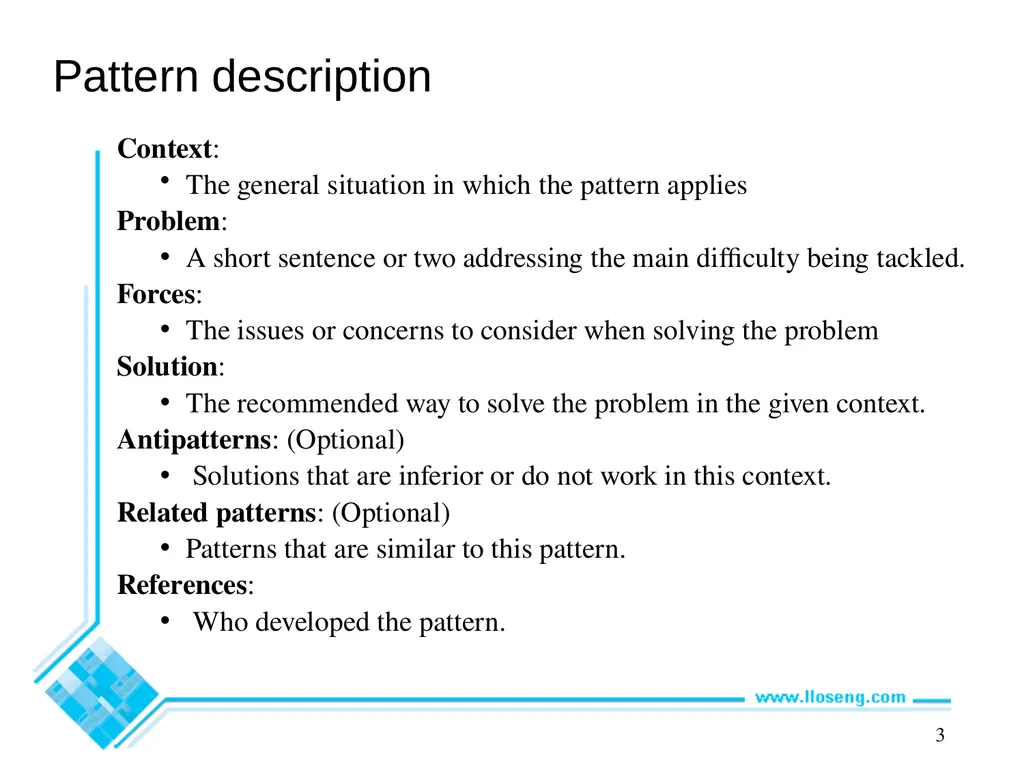
3 Pattern description Context:
The general situation in which the pattern applies
Problem:
A short sentence or two addressing the main difficulty being tackled.
Forces:
The issues or concerns to consider when solving the problem
Solution:
The recommended way to solve the problem in the given context.
Antipatterns: (Optional)
Solutions that are inferior or do not work in this context.
Related patterns: (Optional)
Patterns that are similar to this pattern.
References:
Who developed the pattern.<br>
The general situation in which the pattern applies
Problem:
A short sentence or two addressing the main difficulty being tackled.
Forces:
The issues or concerns to consider when solving the problem
Solution:
The recommended way to solve the problem in the given context.
Antipatterns: (Optional)
Solutions that are inferior or do not work in this context.
Related patterns: (Optional)
Patterns that are similar to this pattern.
References:
Who developed the pattern.<br>
04
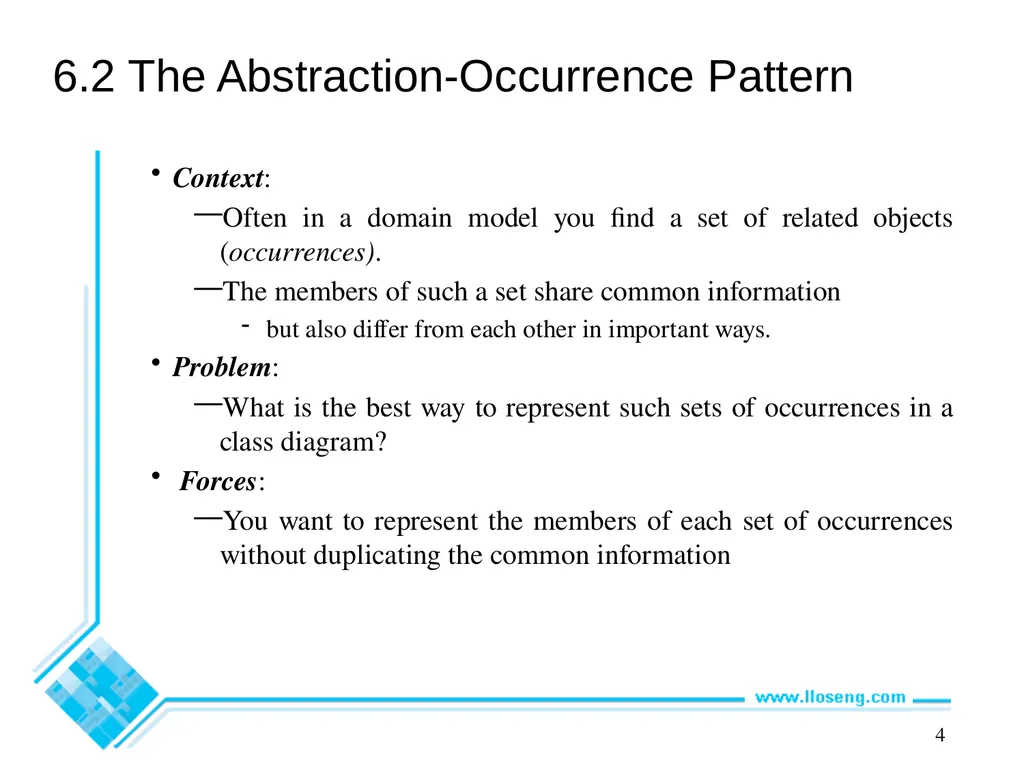
4 6.2 The Abstraction-Occurrence Pattern Context:
Often in a domain model you find a set of related objects (occurrences).
The members of such a set share common information
but also differ from each other in important ways.
Problem:
What is the best way to represent such sets of occurrences in a class diagram?
Forces:
You want to represent the members of each set of occurrences without duplicating the common information<br>
Often in a domain model you find a set of related objects (occurrences).
The members of such a set share common information
but also differ from each other in important ways.
Problem:
What is the best way to represent such sets of occurrences in a class diagram?
Forces:
You want to represent the members of each set of occurrences without duplicating the common information<br>
05
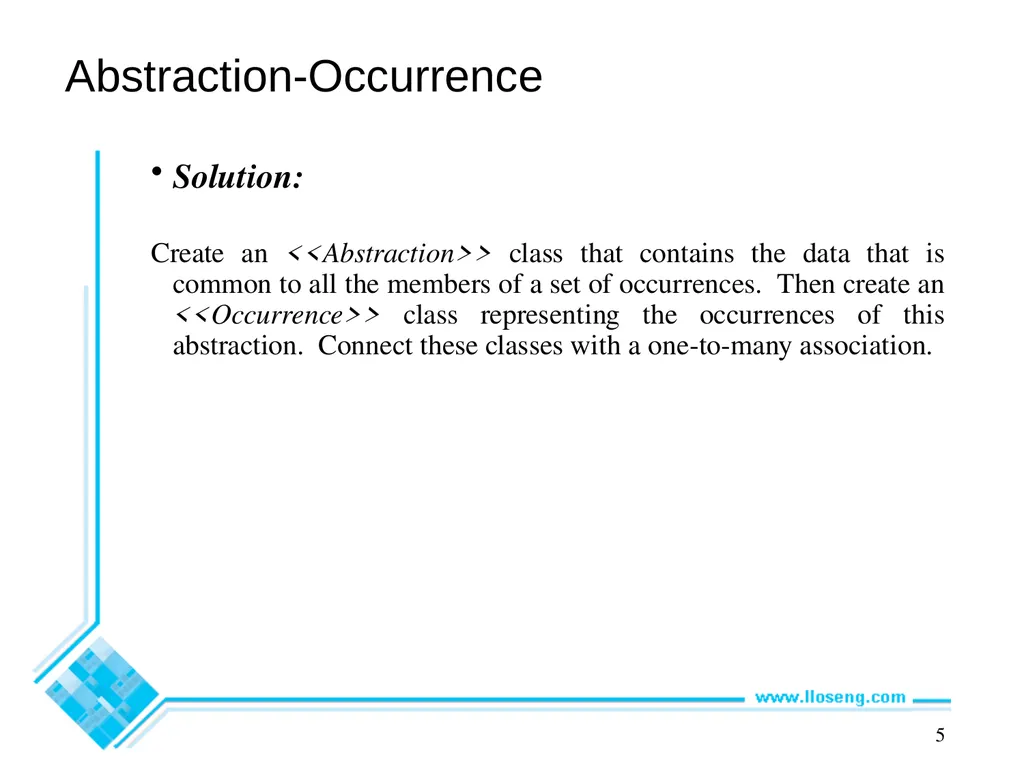
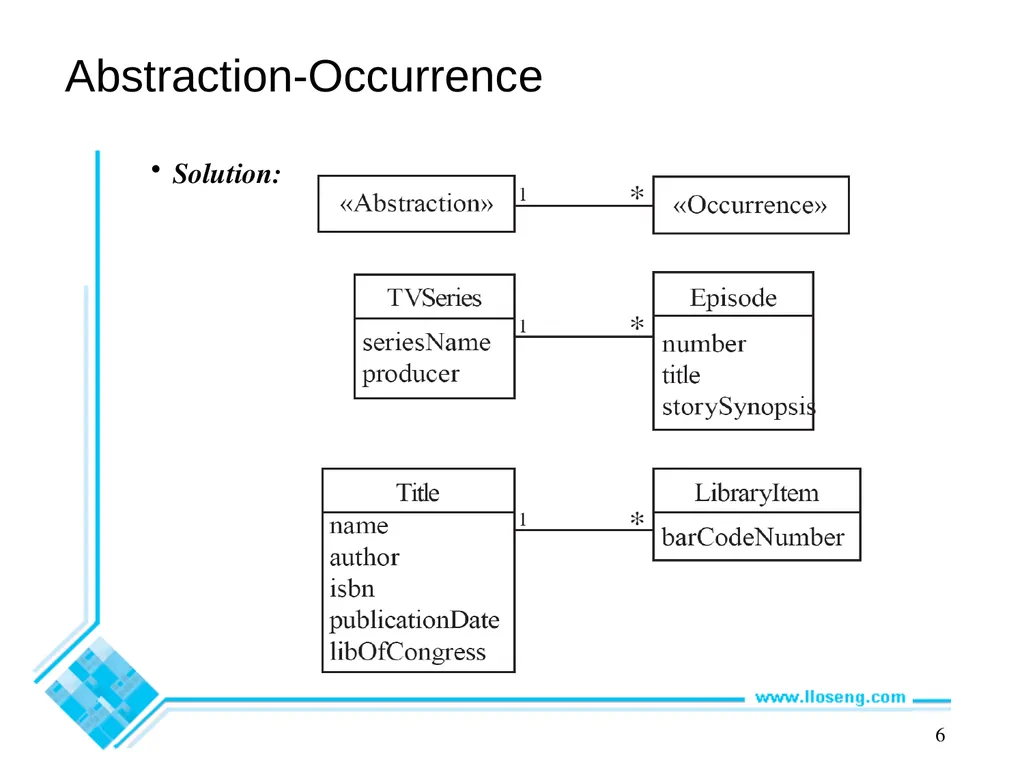
5 Abstraction-Occurrence Solution:
Create an <<Abstraction>> class that contains the data that is common to all the members of a set of occurrences. Then create an <<Occurrence>> class representing the occurrences of this abstraction. Connect these classes with a one-to-many association.<br>
Create an <<Abstraction>> class that contains the data that is common to all the members of a set of occurrences. Then create an <<Occurrence>> class representing the occurrences of this abstraction. Connect these classes with a one-to-many association.<br>
06
6 Abstraction-Occurrence Solution:<br>
07
7 Abstraction-Occurrence Antipatterns:<br>
08
8 Abstraction-Occurrence Square variant<br>
09
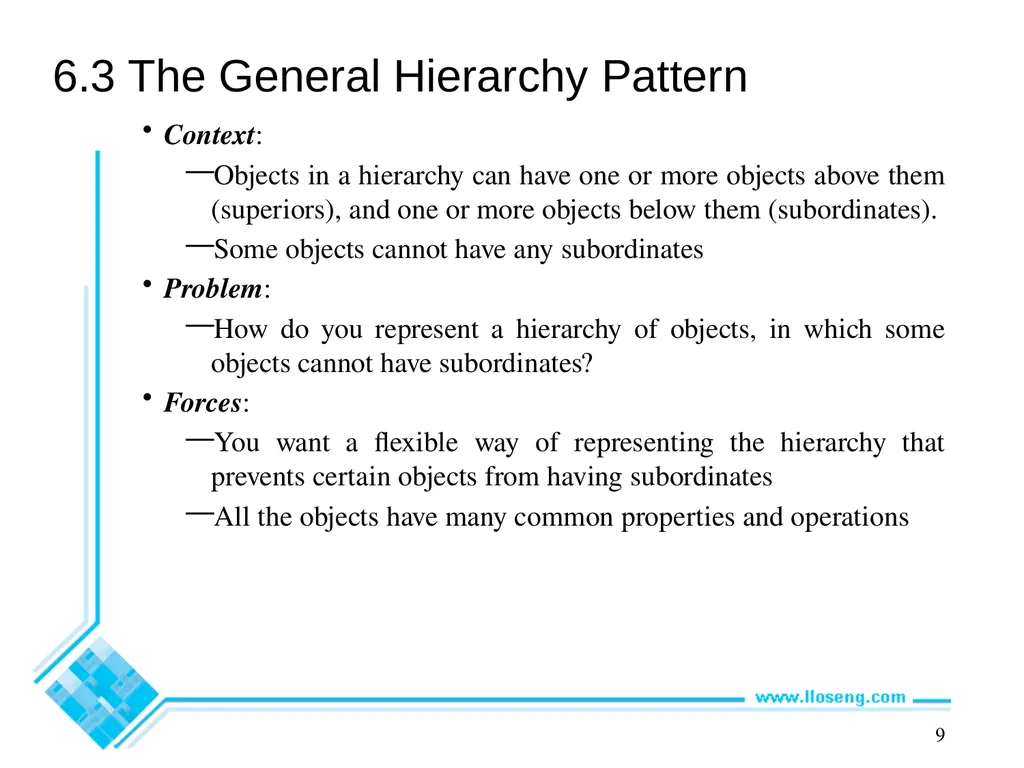
9 6.3 The General Hierarchy Pattern Context:
Objects in a hierarchy can have one or more objects above them (superiors), and one or more objects below them (subordinates).
Some objects cannot have any subordinates
Problem:
How do you represent a hierarchy of objects, in which some objects cannot have subordinates?
Forces:
You want a flexible way of representing the hierarchy that prevents certain objects from having subordinates
All the objects have many common properties and operations<br>
Objects in a hierarchy can have one or more objects above them (superiors), and one or more objects below them (subordinates).
Some objects cannot have any subordinates
Problem:
How do you represent a hierarchy of objects, in which some objects cannot have subordinates?
Forces:
You want a flexible way of representing the hierarchy that prevents certain objects from having subordinates
All the objects have many common properties and operations<br>
10
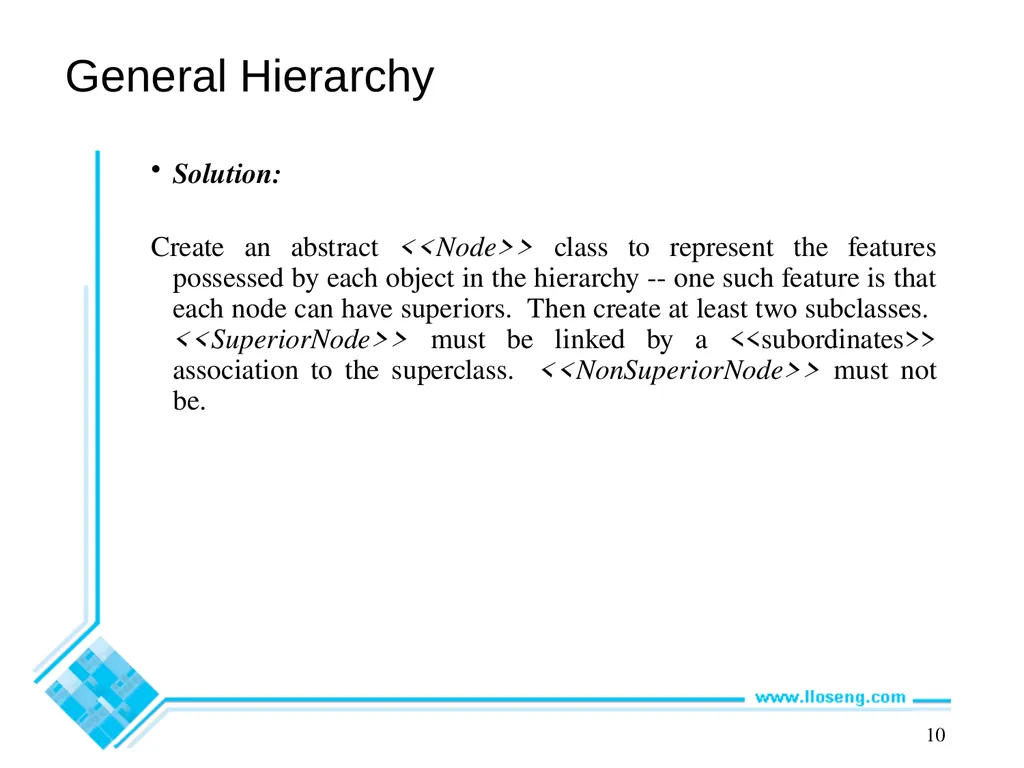
10 General Hierarchy Solution:
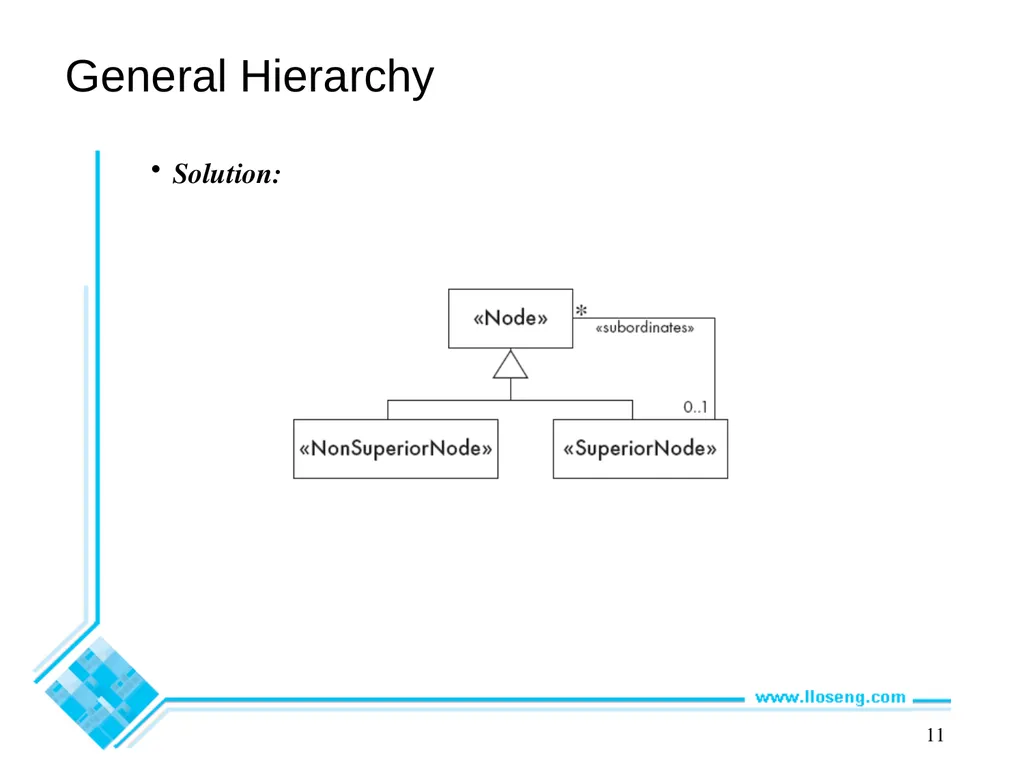
Create an abstract <<Node>> class to represent the features possessed by each object in the hierarchy -- one such feature is that each node can have superiors. Then create at least two subclasses. <<SuperiorNode>> must be linked by a <<subordinates>> association to the superclass. <<NonSuperiorNode>> must not be.<br>
Create an abstract <<Node>> class to represent the features possessed by each object in the hierarchy -- one such feature is that each node can have superiors. Then create at least two subclasses. <<SuperiorNode>> must be linked by a <<subordinates>> association to the superclass. <<NonSuperiorNode>> must not be.<br>
11
11 General Hierarchy Solution:<br>
12
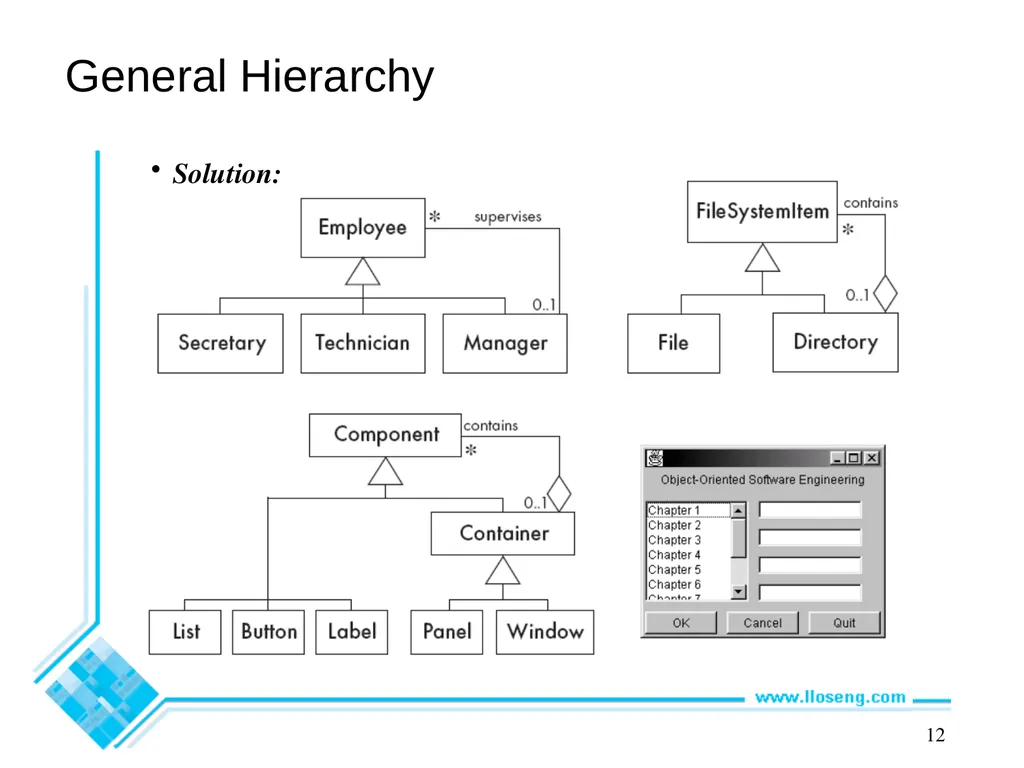
12 Solution: General Hierarchy<br>
13
13 General Hierarchy Antipattern:<br>
14
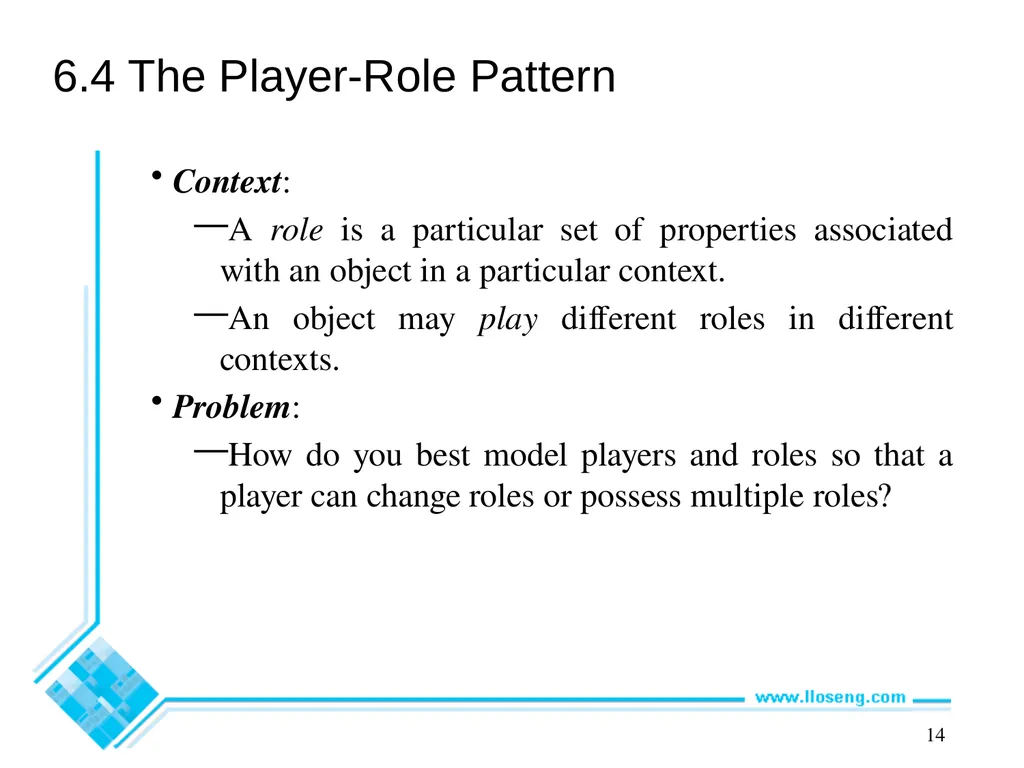
14 6.4 The Player-Role Pattern Context:
A role is a particular set of properties associated with an object in a particular context.
An object may play different roles in different contexts.
Problem:
How do you best model players and roles so that a player can change roles or possess multiple roles?<br>
A role is a particular set of properties associated with an object in a particular context.
An object may play different roles in different contexts.
Problem:
How do you best model players and roles so that a player can change roles or possess multiple roles?<br>
15
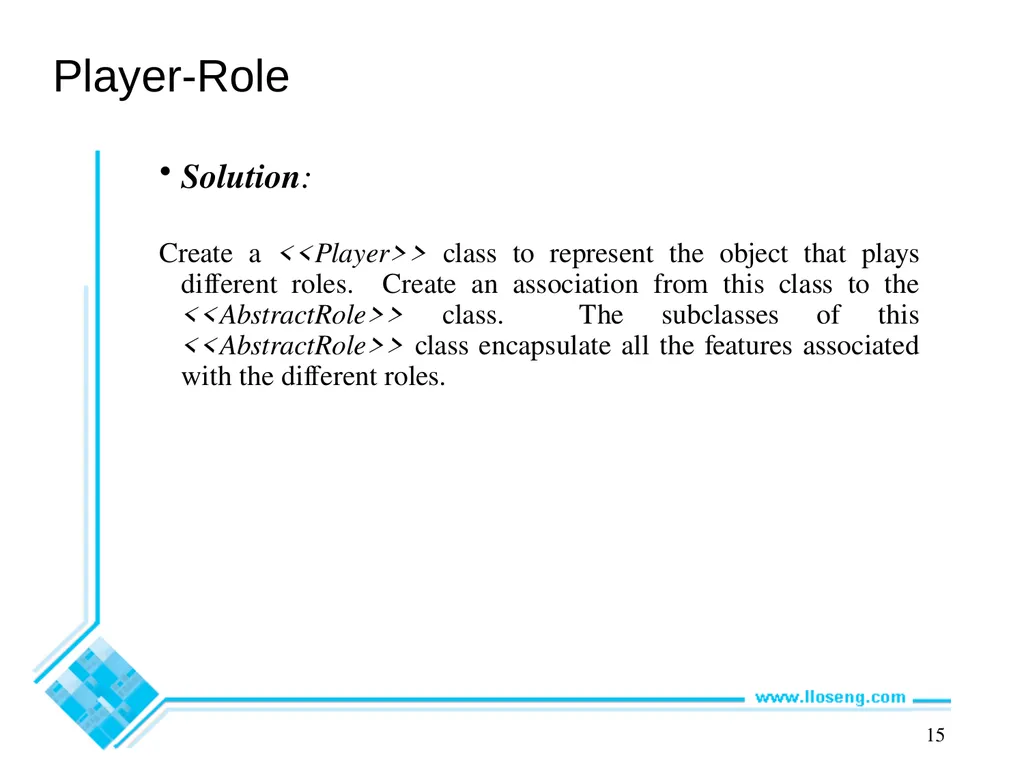
15 Player-Role Solution:
Create a <<Player>> class to represent the object that plays different roles. Create an association from this class to the <<AbstractRole>> class. The subclasses of this <<AbstractRole>> class encapsulate all the features associated with the different roles.<br>
Create a <<Player>> class to represent the object that plays different roles. Create an association from this class to the <<AbstractRole>> class. The subclasses of this <<AbstractRole>> class encapsulate all the features associated with the different roles.<br>
16
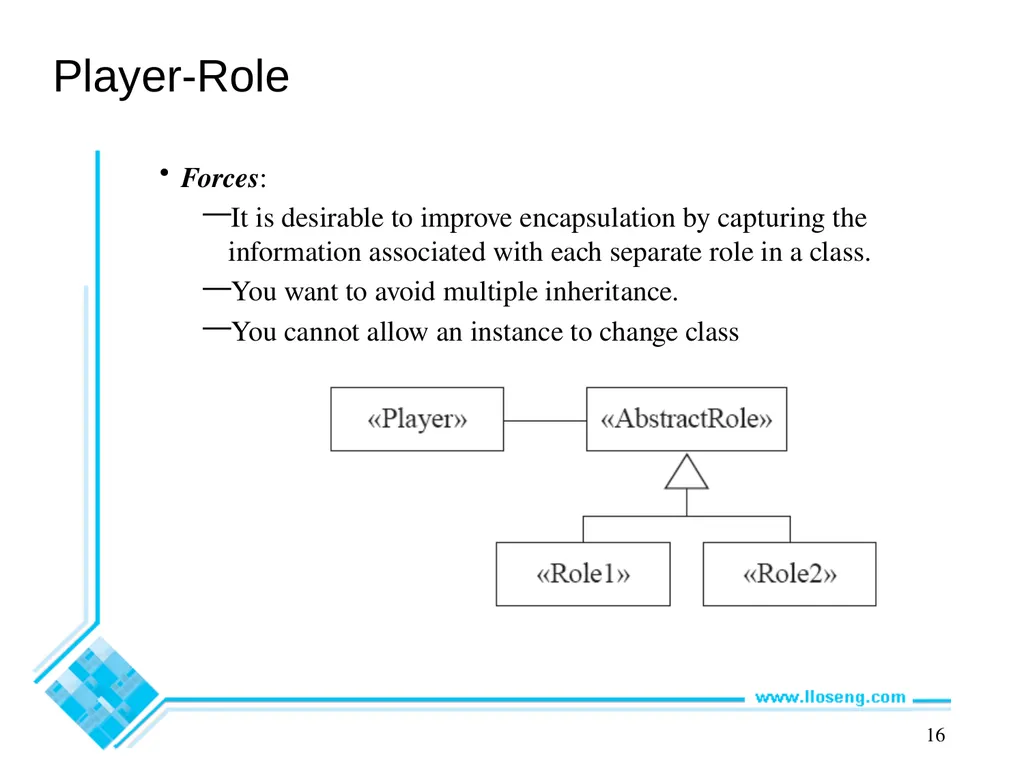
16 Player-Role Forces:
It is desirable to improve encapsulation by capturing the information associated with each separate role in a class.
You want to avoid multiple inheritance.
You cannot allow an instance to change class<br>
It is desirable to improve encapsulation by capturing the information associated with each separate role in a class.
You want to avoid multiple inheritance.
You cannot allow an instance to change class<br>
17
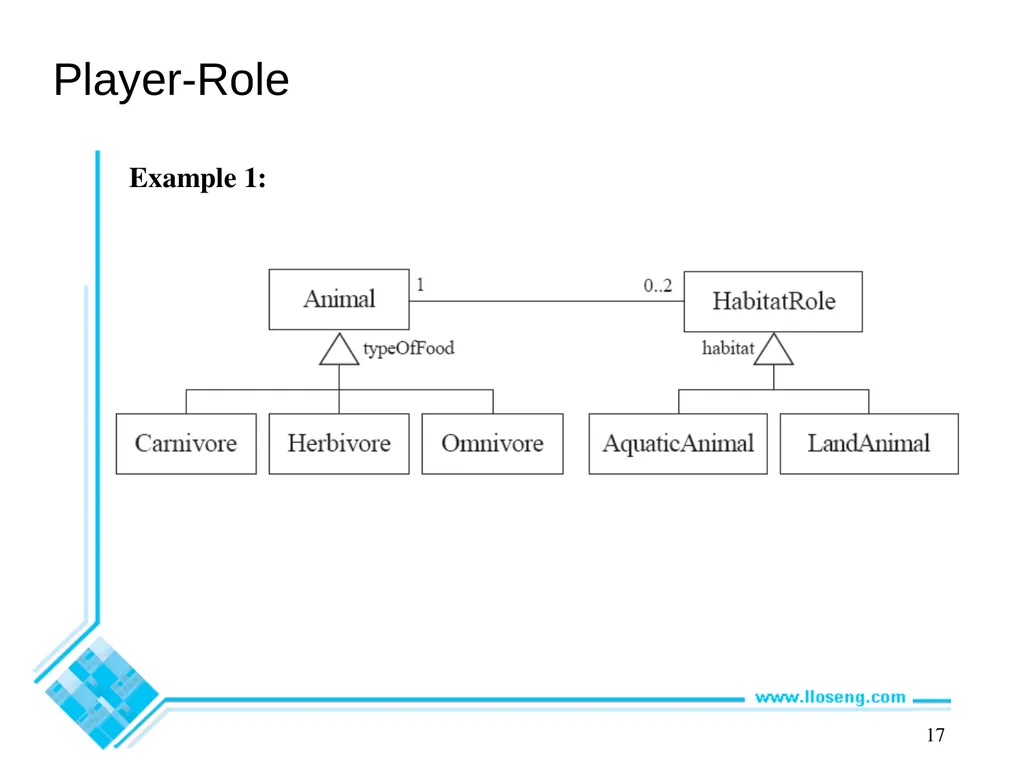
17 Player-Role Example 1:<br>
18
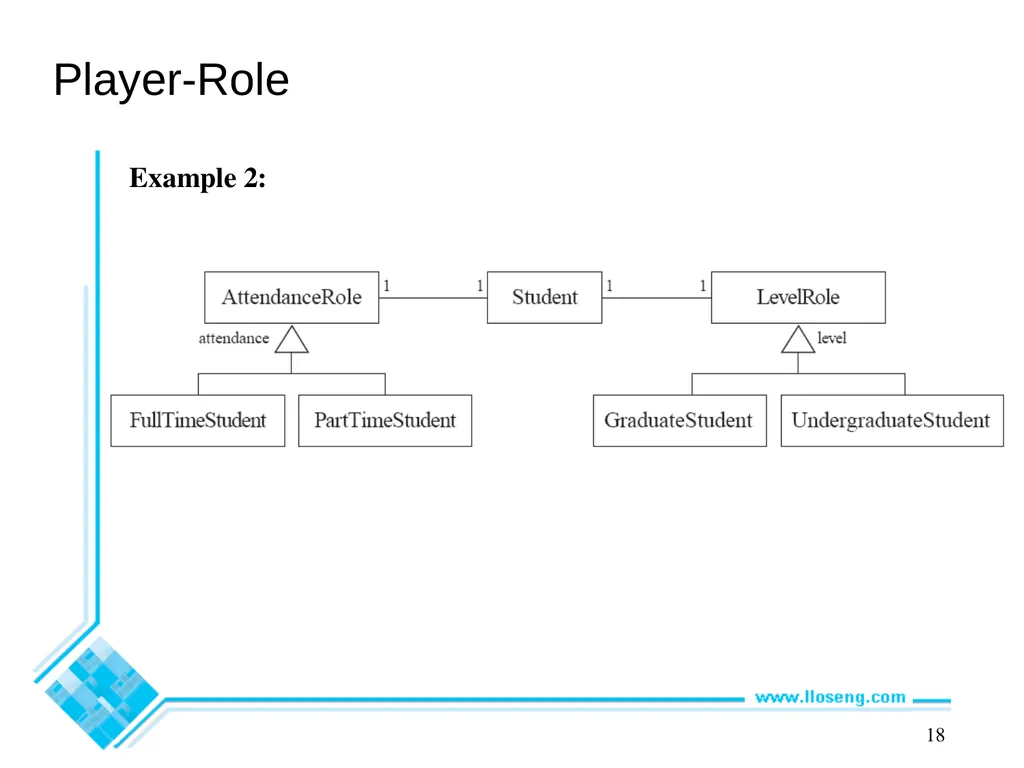
18 Player-Role Example 2:<br>
19
19 Player-Role Antipatterns:
Merge all the properties and behaviours into a single «Player» class and not have «Role» classes at all.
Create roles as subclasses of the «Player» class.<br>
Merge all the properties and behaviours into a single «Player» class and not have «Role» classes at all.
Create roles as subclasses of the «Player» class.<br>
20
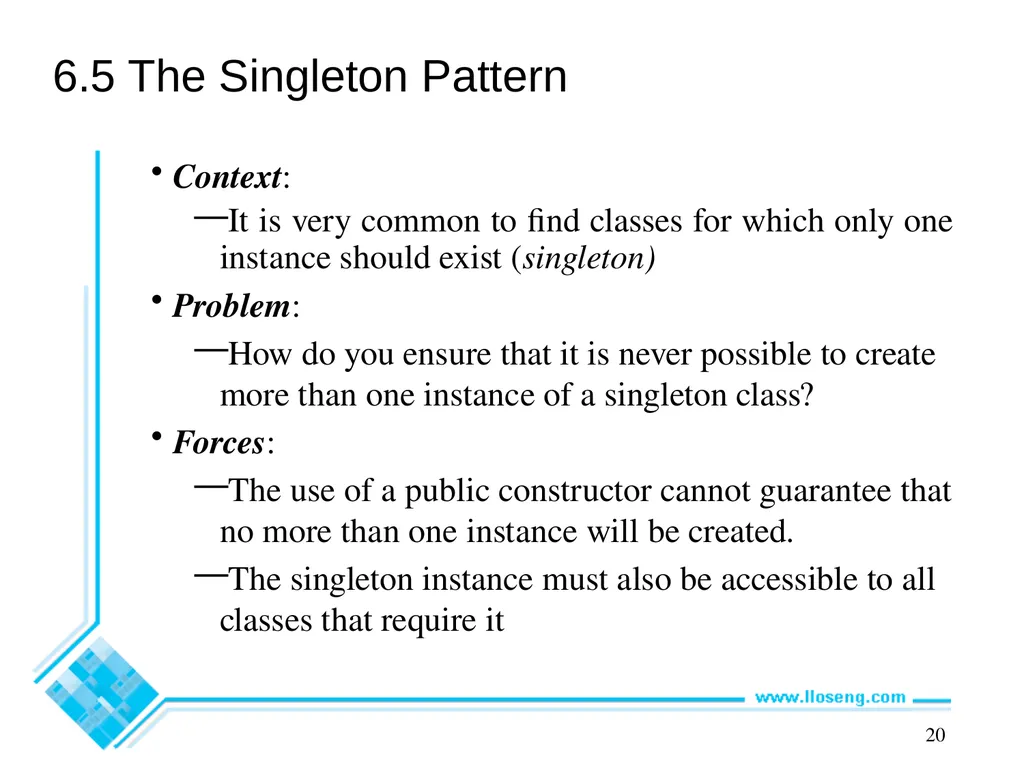
20 6.5 The Singleton Pattern Context:
It is very common to find classes for which only one instance should exist (singleton)
Problem:
How do you ensure that it is never possible to create more than one instance of a singleton class?
Forces:
The use of a public constructor cannot guarantee that no more than one instance will be created.
The singleton instance must also be accessible to all classes that require it<br>
It is very common to find classes for which only one instance should exist (singleton)
Problem:
How do you ensure that it is never possible to create more than one instance of a singleton class?
Forces:
The use of a public constructor cannot guarantee that no more than one instance will be created.
The singleton instance must also be accessible to all classes that require it<br>
21
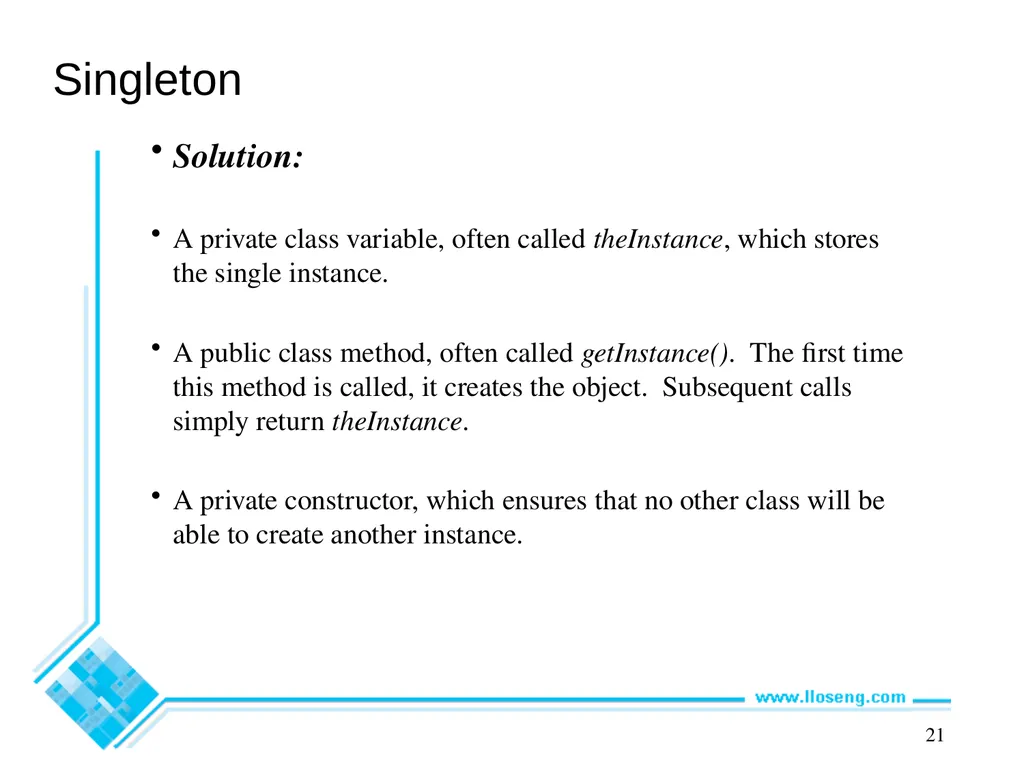
21 Singleton Solution:
A private class variable, often called theInstance, which stores the single instance.
A public class method, often called getInstance(). The first time this method is called, it creates the object. Subsequent calls simply return theInstance.
A private constructor, which ensures that no other class will be able to create another instance.<br>
A private class variable, often called theInstance, which stores the single instance.
A public class method, often called getInstance(). The first time this method is called, it creates the object. Subsequent calls simply return theInstance.
A private constructor, which ensures that no other class will be able to create another instance.<br>
22
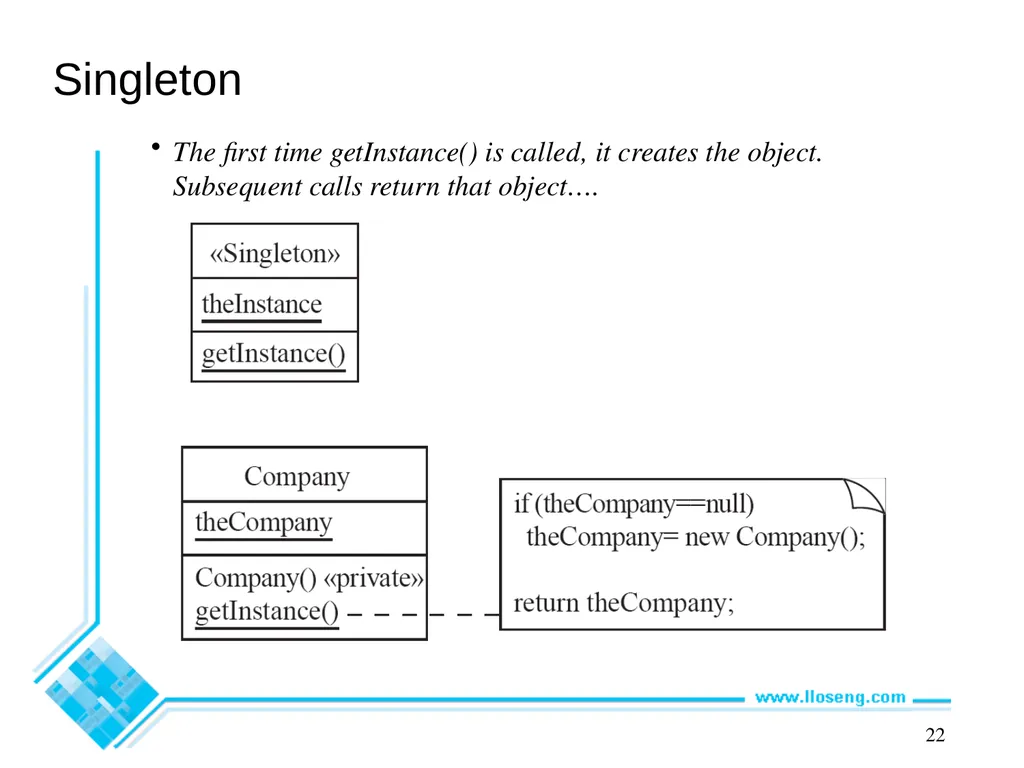
22 Singleton The first time getInstance() is called, it creates the object. Subsequent calls return that object….<br>
23
23 6.6 The Observer Pattern Context:
When an association is created between two classes, the code for the classes becomes inseparable.
If you want to reuse one class, then you also have to reuse the other.
Problem:
How do you reduce the interconnection between classes, especially between classes that belong to different modules or subsystems?
Forces:
You want to maximize the flexibility of the system to the greatest extent possible<br>
When an association is created between two classes, the code for the classes becomes inseparable.
If you want to reuse one class, then you also have to reuse the other.
Problem:
How do you reduce the interconnection between classes, especially between classes that belong to different modules or subsystems?
Forces:
You want to maximize the flexibility of the system to the greatest extent possible<br>
24
24 Observer Create an abstract class <<Observable>> that maintains a collection of <<Observer>> instances.
<<Observable>> can add and remove observers and has a method notifyObservers() that sends an update to each <<Observer>> .<br>
<<Observable>> can add and remove observers and has a method notifyObservers() that sends an update to each <<Observer>> .<br>
25
25 Observer Solution:<br>
26
26 Observer Antipatterns:
Connect an observer directly to an observable so that they both have references to each other.
Make the observers subclasses of the observable.<br>
Connect an observer directly to an observable so that they both have references to each other.
Make the observers subclasses of the observable.<br>
27
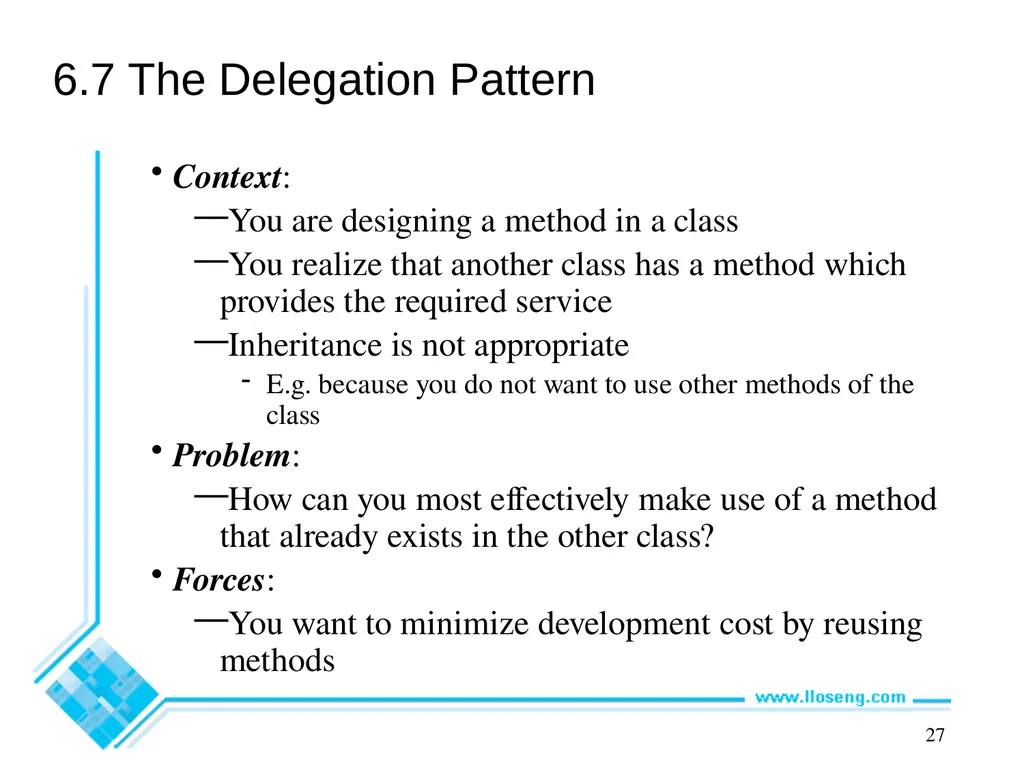
27 6.7 The Delegation Pattern Context:
You are designing a method in a class
You realize that another class has a method which provides the required service
Inheritance is not appropriate
E.g. because you do not want to use other methods of the class
Problem:
How can you most effectively make use of a method that already exists in the other class?
Forces:
You want to minimize development cost by reusing methods<br>
You are designing a method in a class
You realize that another class has a method which provides the required service
Inheritance is not appropriate
E.g. because you do not want to use other methods of the class
Problem:
How can you most effectively make use of a method that already exists in the other class?
Forces:
You want to minimize development cost by reusing methods<br>
28
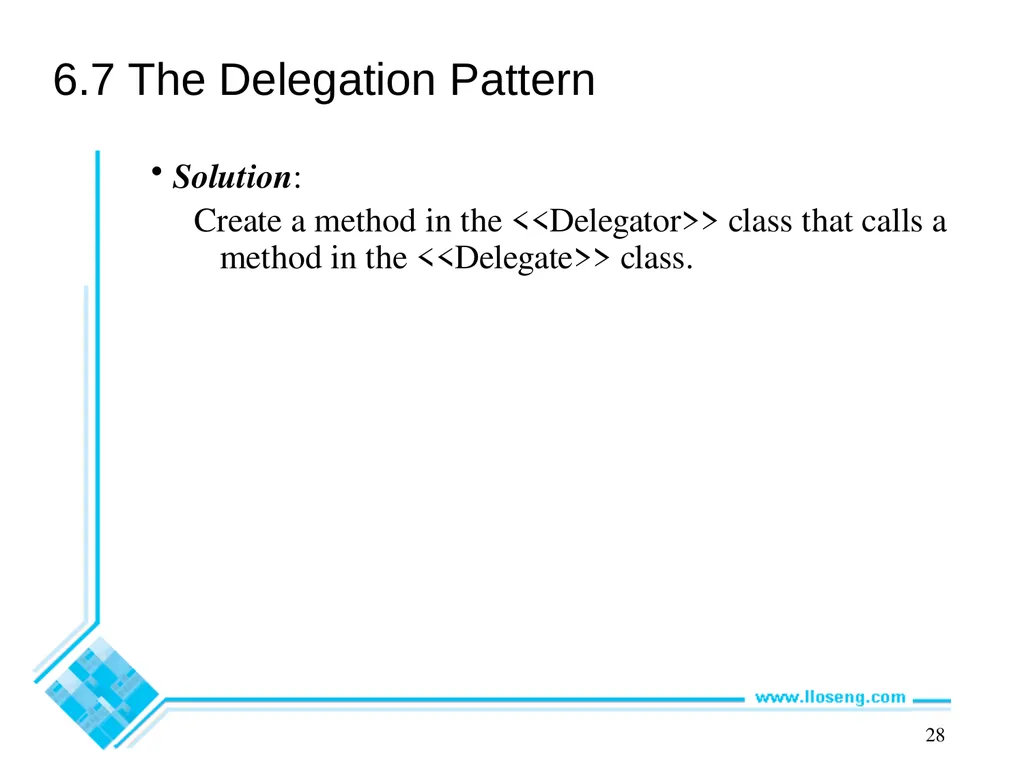
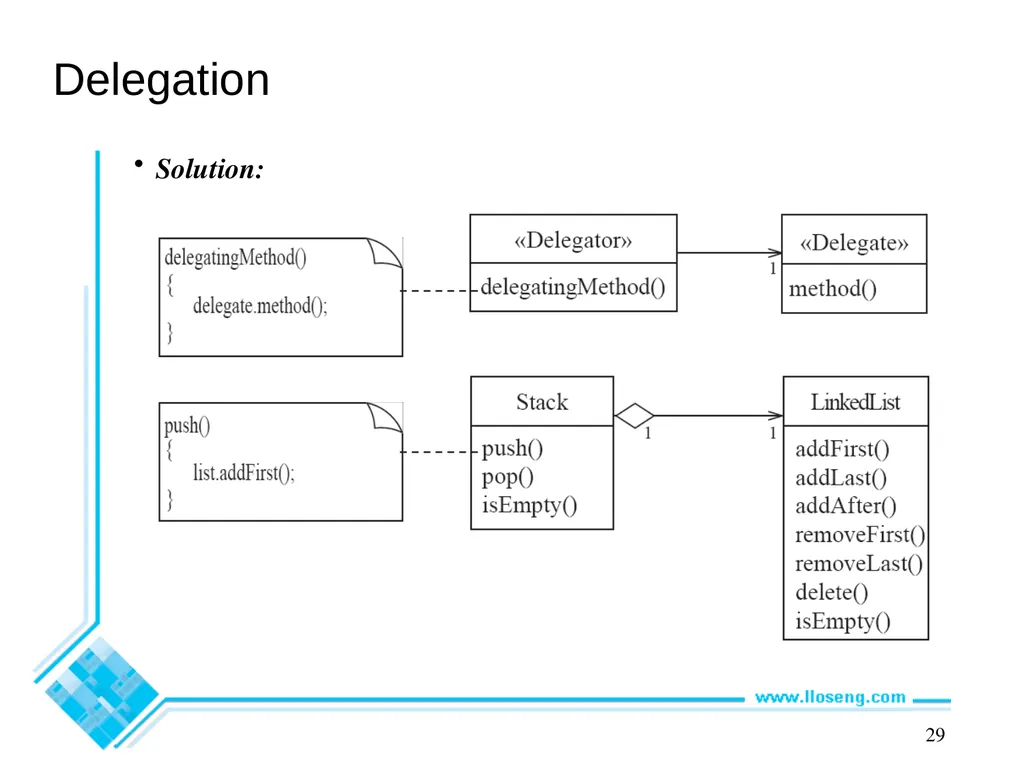
28 6.7 The Delegation Pattern Solution:
Create a method in the <<Delegator>> class that calls a method in the <<Delegate>> class.<br>
Create a method in the <<Delegator>> class that calls a method in the <<Delegate>> class.<br>
29
29 Delegation Solution:<br>
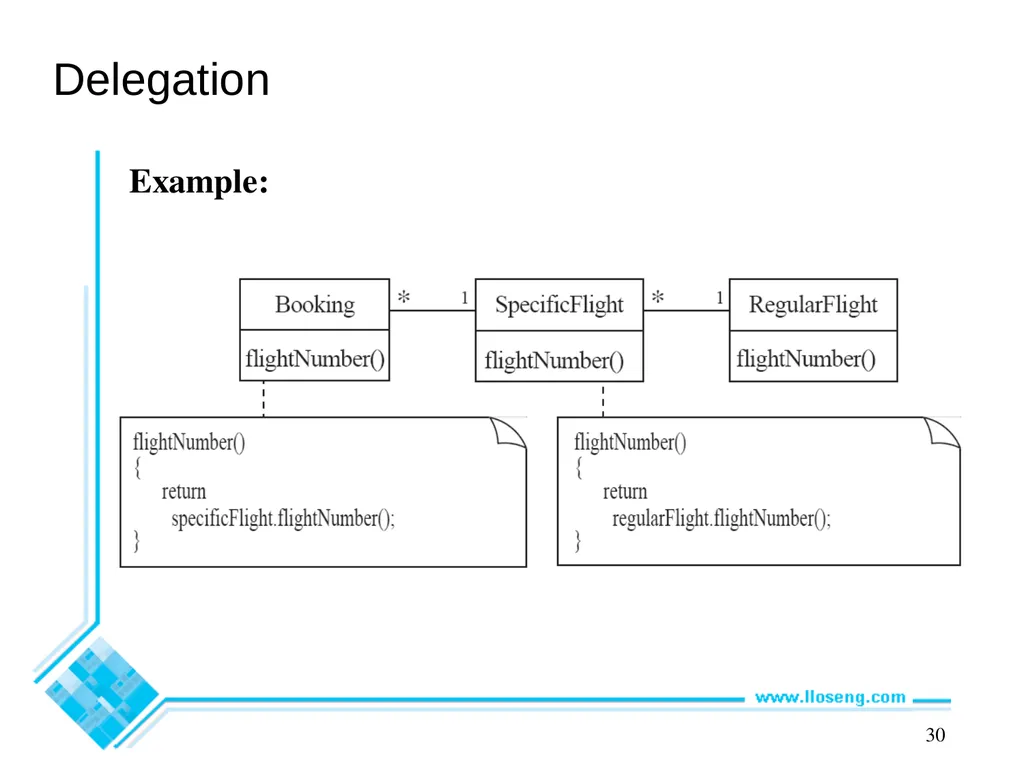
30
30 Delegation Example:<br>
31
31 Delegation Antipatterns
Overuse generalization and inherit the method that is to be reused
Instead of creating a single method in the «Delegator» that does nothing other than call a method in the «Delegate
consider having many different methods in the «Delegator» call the delegate’s method
Access non-neighboring classes return specificFlight.regularFlight.flightNumber();
return getRegularFlight().flightNumber();<br>
Overuse generalization and inherit the method that is to be reused
Instead of creating a single method in the «Delegator» that does nothing other than call a method in the «Delegate
consider having many different methods in the «Delegator» call the delegate’s method
Access non-neighboring classes return specificFlight.regularFlight.flightNumber();
return getRegularFlight().flightNumber();<br>
32
32 6.8 The Adapter Pattern Context:
You are building an inheritance hierarchy and want to incorporate into it an existing class.
The reused class is also often already part of its own inheritance hierarchy.
Problem:
How to obtain the power of polymorphism when reusing a class whose methods
have the same function
but not the same signature
as the other methods in the hierarchy?
Forces:
You do not have access to multiple inheritance or you do not want to use it.<br>
You are building an inheritance hierarchy and want to incorporate into it an existing class.
The reused class is also often already part of its own inheritance hierarchy.
Problem:
How to obtain the power of polymorphism when reusing a class whose methods
have the same function
but not the same signature
as the other methods in the hierarchy?
Forces:
You do not have access to multiple inheritance or you do not want to use it.<br>
33
33 Adapter Solution:<br>
34
34 Adapter Example:<br>
35
35 6.9 The Façade Pattern Context:
Often, an application contains several complex packages.
A programmer working with such packages has to manipulate many different classes
Problem:
How do you simplify the view that programmers have of a complex package?
Forces:
It is hard for a programmer to understand and use an entire subsystem
If several different application classes call methods of the complex package, then any modifications made to the package will necessitate a complete review of all these classes.<br>
Often, an application contains several complex packages.
A programmer working with such packages has to manipulate many different classes
Problem:
How do you simplify the view that programmers have of a complex package?
Forces:
It is hard for a programmer to understand and use an entire subsystem
If several different application classes call methods of the complex package, then any modifications made to the package will necessitate a complete review of all these classes.<br>
36
36 Façade Solution: Create a special class called a <<Façade>>.
The <<Façade>> will contain a simplified set of public methods.<br>
The <<Façade>> will contain a simplified set of public methods.<br>
37
37 Façade Solution:<br>
38
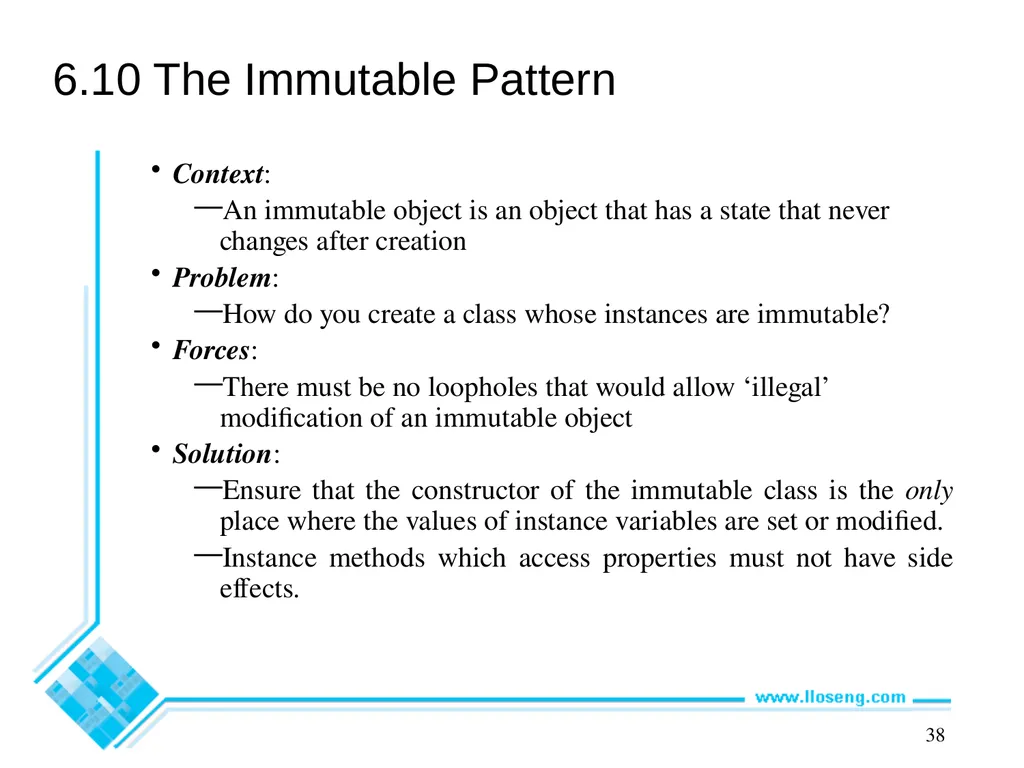
38 6.10 The Immutable Pattern Context:
An immutable object is an object that has a state that never changes after creation
Problem:
How do you create a class whose instances are immutable?
Forces:
There must be no loopholes that would allow ‘illegal’ modification of an immutable object
Solution:
Ensure that the constructor of the immutable class is the only place where the values of instance variables are set or modified.
Instance methods which access properties must not have side effects.<br>
An immutable object is an object that has a state that never changes after creation
Problem:
How do you create a class whose instances are immutable?
Forces:
There must be no loopholes that would allow ‘illegal’ modification of an immutable object
Solution:
Ensure that the constructor of the immutable class is the only place where the values of instance variables are set or modified.
Instance methods which access properties must not have side effects.<br>
39
39 6.11 The Read-only Interface Pattern Context:
You sometimes want certain privileged classes to be able to modify attributes of objects that are otherwise immutable
Problem:
How do you create a situation where some classes see a class as read-only whereas others are able to make modifications?
Forces:
Restricting access by using the public, protected, and private keywords is not adequately selective.
Making access public makes it public for both reading and writing<br>
You sometimes want certain privileged classes to be able to modify attributes of objects that are otherwise immutable
Problem:
How do you create a situation where some classes see a class as read-only whereas others are able to make modifications?
Forces:
Restricting access by using the public, protected, and private keywords is not adequately selective.
Making access public makes it public for both reading and writing<br>
40
40 Read-only Interface Solution:<br>
41
41 Read-only Interface Example:<br>
42
42 Read-only Interface Antipatterns:
Make the read-only class a subclass of the «Mutable» class
Override all methods that modify properties
such that they throw an exception<br>
Make the read-only class a subclass of the «Mutable» class
Override all methods that modify properties
such that they throw an exception<br>
43
43 6.12 The Proxy Pattern Context:
Often, it is time-consuming and complicated to create instances of a class.
There may be a time delay and a complex mechanism involved in creating the object in memory
Problem:
How to reduce the need to create instances of such a heavyweight class?
Forces:
We want all the objects in a domain model to be available for programs to use when they execute a system’s various responsibilities.
It is also important for many objects to persist from run to run of the same program<br>
Often, it is time-consuming and complicated to create instances of a class.
There may be a time delay and a complex mechanism involved in creating the object in memory
Problem:
How to reduce the need to create instances of such a heavyweight class?
Forces:
We want all the objects in a domain model to be available for programs to use when they execute a system’s various responsibilities.
It is also important for many objects to persist from run to run of the same program<br>
44
44 Proxy Solution:<br>
45
45 Proxy Examples:<br>
46
46 6.13 The Factory Pattern Context:
A reusable framework needs to create objects; however the class of the created objects depends on the application.
Problem:
How do you enable a programmer to add a new application-specific class into a system built on such a framework?
Forces:
We want to have the framework create and work with application-specific classes that the framework does not yet know about.
Solution:
The framework delegates the creation of application-specific classes to a specialized class, the Factory.
The Factory is a generic interface defined in the framework.
The factory interface declares a method whose purpose is to create some subclass of a generic class.<br>
A reusable framework needs to create objects; however the class of the created objects depends on the application.
Problem:
How do you enable a programmer to add a new application-specific class into a system built on such a framework?
Forces:
We want to have the framework create and work with application-specific classes that the framework does not yet know about.
Solution:
The framework delegates the creation of application-specific classes to a specialized class, the Factory.
The Factory is a generic interface defined in the framework.
The factory interface declares a method whose purpose is to create some subclass of a generic class.<br>
47
47 The Factory Pattern Solution<br>
48
48 The Factory Pattern Example<br>
49
49 6.14 Detailed Example: enhancing OCSF with some design patterns<br>
50
50 The Observable layer of OCSF (continued)<br>
51
51 Using the observable layer 1. Create a class that implements the Observer interface.
2. Register it as an observer of the Observable:
public MessageHandler(Observable client)
{
client.addObserver(this);
...
}
3. Define the update method in the new class:
public void update(Observable obs, Object message)
{
if (message instanceOf SomeClass)
{
// process the message
}
}<br>
2. Register it as an observer of the Observable:
public MessageHandler(Observable client)
{
client.addObserver(this);
...
}
3. Define the update method in the new class:
public void update(Observable obs, Object message)
{
if (message instanceOf SomeClass)
{
// process the message
}
}<br>
52
52 6.15 Difficulties and Risks When Creating Class Diagrams Patterns are not a panacea:
Whenever you see an indication that a pattern should be applied, you might be tempted to blindly apply the pattern.
This can lead to unwise design decisions .
Resolution:
Always understand in depth the forces that need to be balanced, and when other patterns better balance the forces.
Make sure you justify each design decision carefully.<br>
Whenever you see an indication that a pattern should be applied, you might be tempted to blindly apply the pattern.
This can lead to unwise design decisions .
Resolution:
Always understand in depth the forces that need to be balanced, and when other patterns better balance the forces.
Make sure you justify each design decision carefully.<br>
53
53 Difficulties and Risks When Creating Class Diagrams Developing patterns is hard
Writing a good pattern takes considerable work.
A poor pattern can be hard to apply correctly
Resolution:
Do not write patterns for others to use until you have considerable experience both in software design and in the use of patterns.
Take an in-depth course on patterns.
Iteratively refine your patterns, and have them peer reviewed at each iteration.<br>
Writing a good pattern takes considerable work.
A poor pattern can be hard to apply correctly
Resolution:
Do not write patterns for others to use until you have considerable experience both in software design and in the use of patterns.
Take an in-depth course on patterns.
Iteratively refine your patterns, and have them peer reviewed at each iteration.<br>