Objective: Explore Interior Angles of Polygons Interior Angles An interior angle is an angle formed by two sides of a polygon with a common vertex. A triangle has three interior angles Triangle Explore Activity Draw a large-ish triangle on
"Objective: Explore Interior Angles of Polygons" is the property of its rightful owner. Permission is granted to
download and print the materials on this website for personal, non-commercial use only, and to display it
on your personal computer provided you do not modify the materials and that you retain all copyright
notices contained in the materials. By downloading content from our website, you accept the terms of this
agreement.
Share
Embed code
Presentation Transcript
01
Objective: Explore Interior Angles of Polygons<br>
02
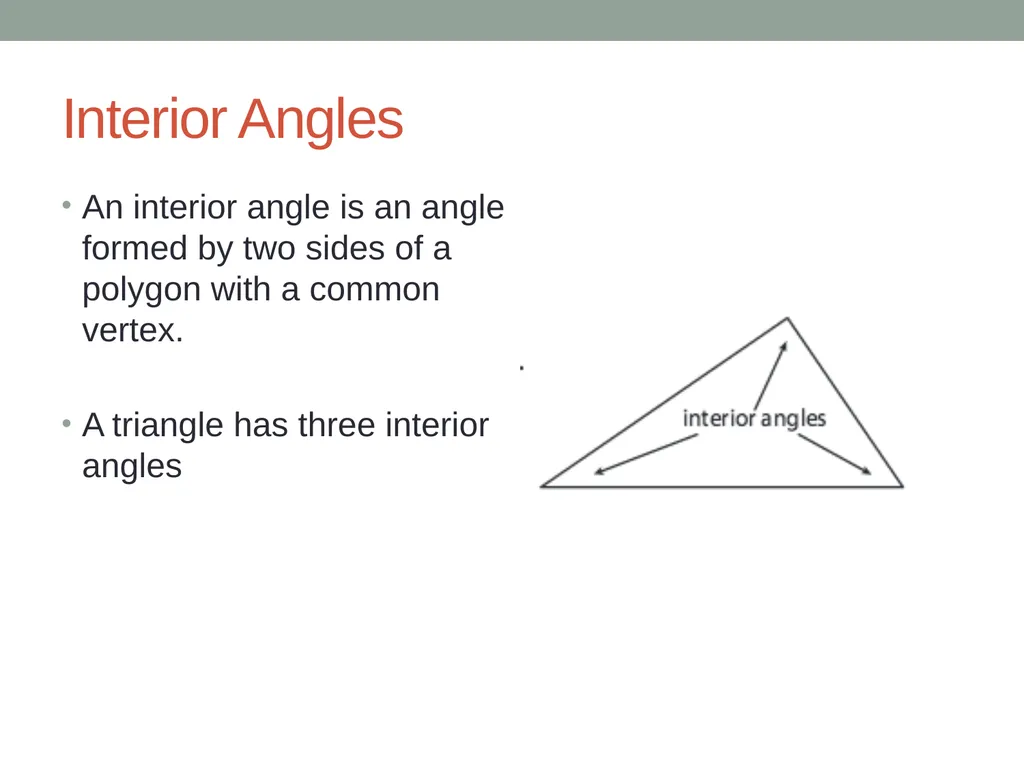
Interior Angles An interior angle is an angle formed by two sides of a polygon with a common vertex.
A triangle has three interior angles<br>
03
Triangle Explore Activity Draw a large-ish triangle on one of your half sheets using a ruler.
Cut your triangle out.
Tear off the three corners of the triangle.
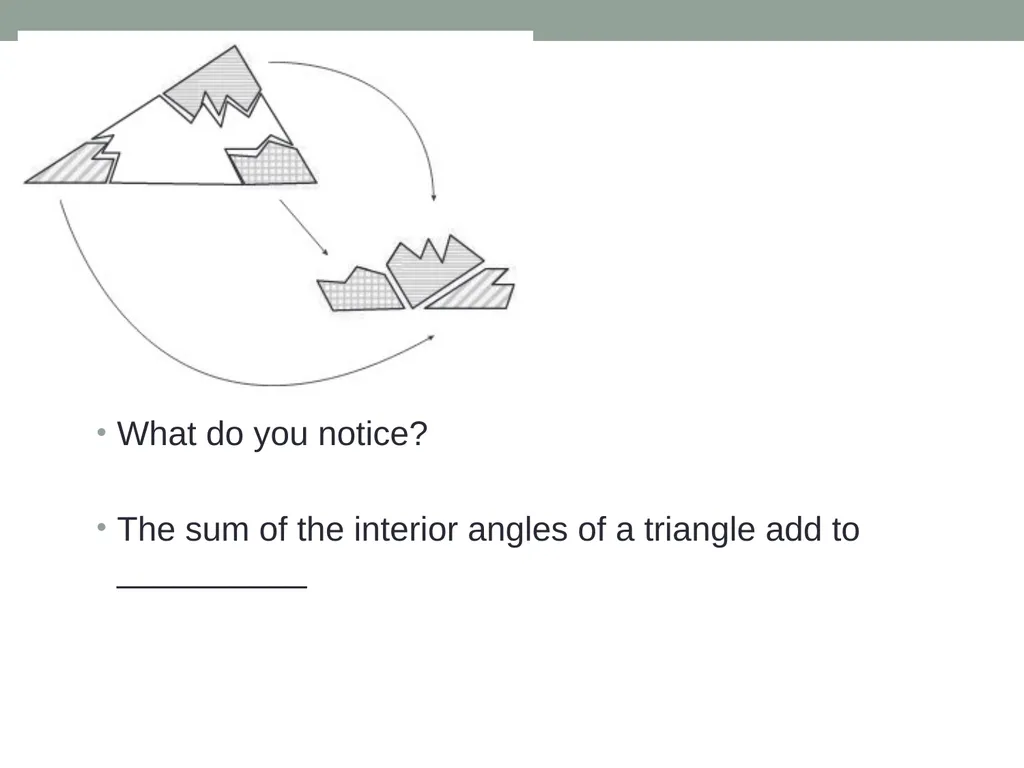
Rearrange the angles so their sides are adjacent and their vertices meet at a point<br>
04
What do you notice?
The sum of the interior angles of a triangle add to __________<br>
05
Explore Angles in a Quadrilateral Draw a large-ish quadrilateral on one of your half sheets using a ruler.
Cut your quadrilateral out.
Tear off the four corners of the quadrilateral.
Rearrange the angles so their sides are adjacent and their vertices meet at a point<br>
06
What do you notice?
The sum of the interior angles of a quadrilateral add to __________<br>
07
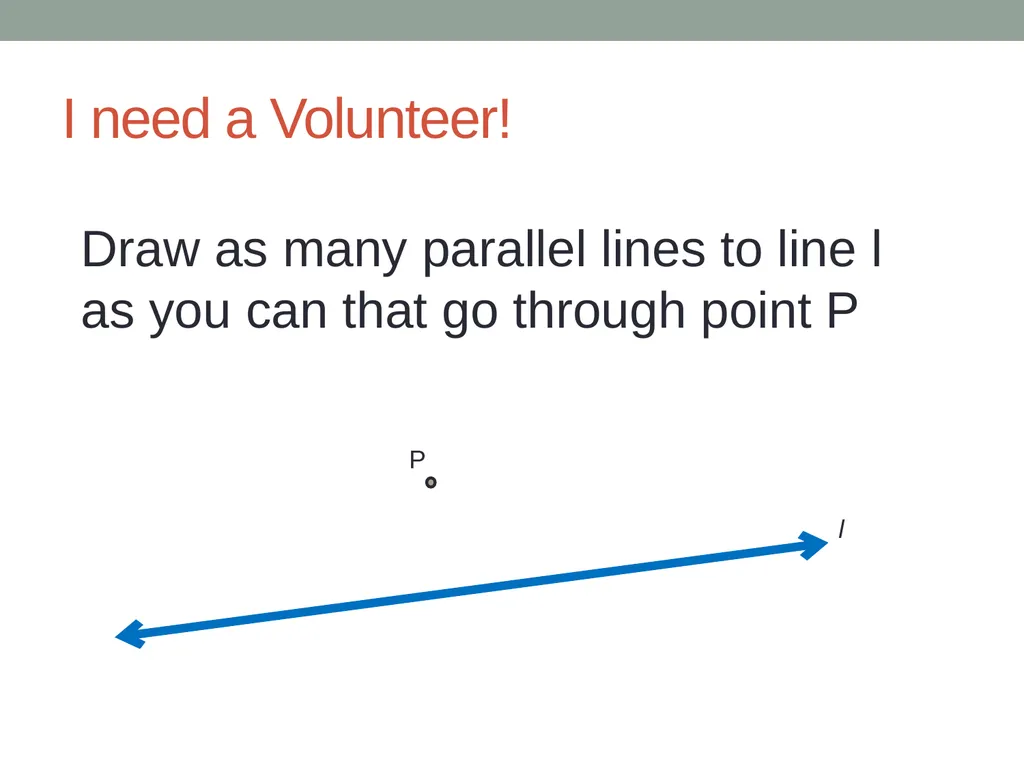
I need a Volunteer! Draw as many parallel lines to line l as you can that go through point P l P<br>
08
Parallel Postulate Through a point P not on line l, there is exactly one line parallel to l.<br>
09
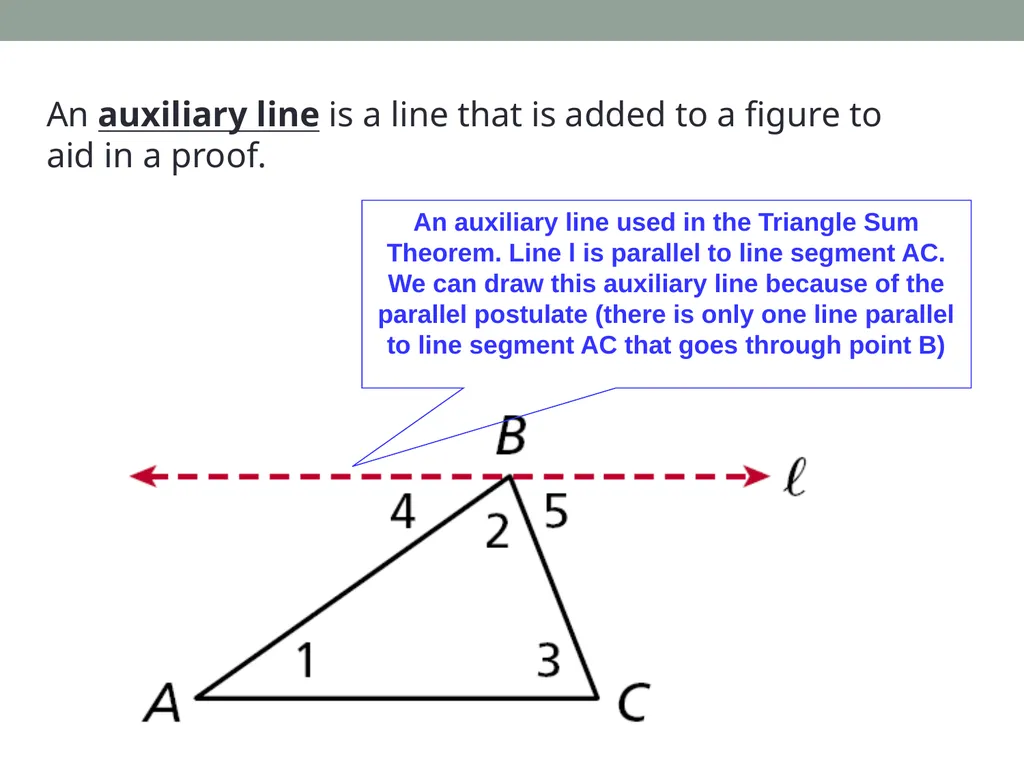
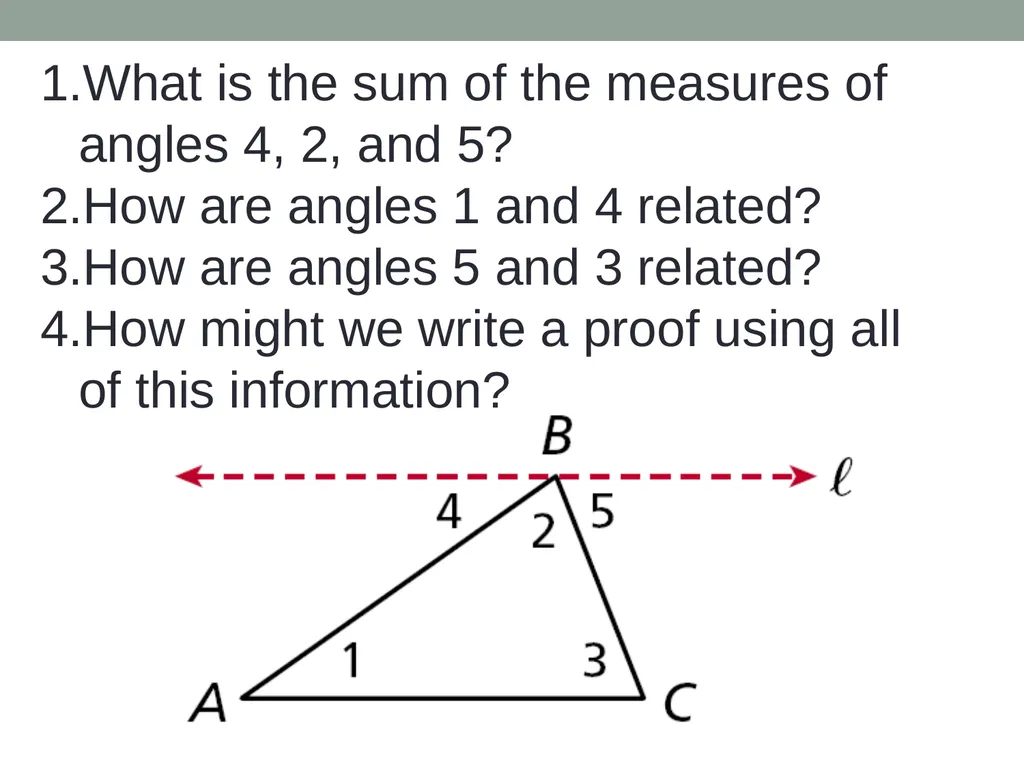
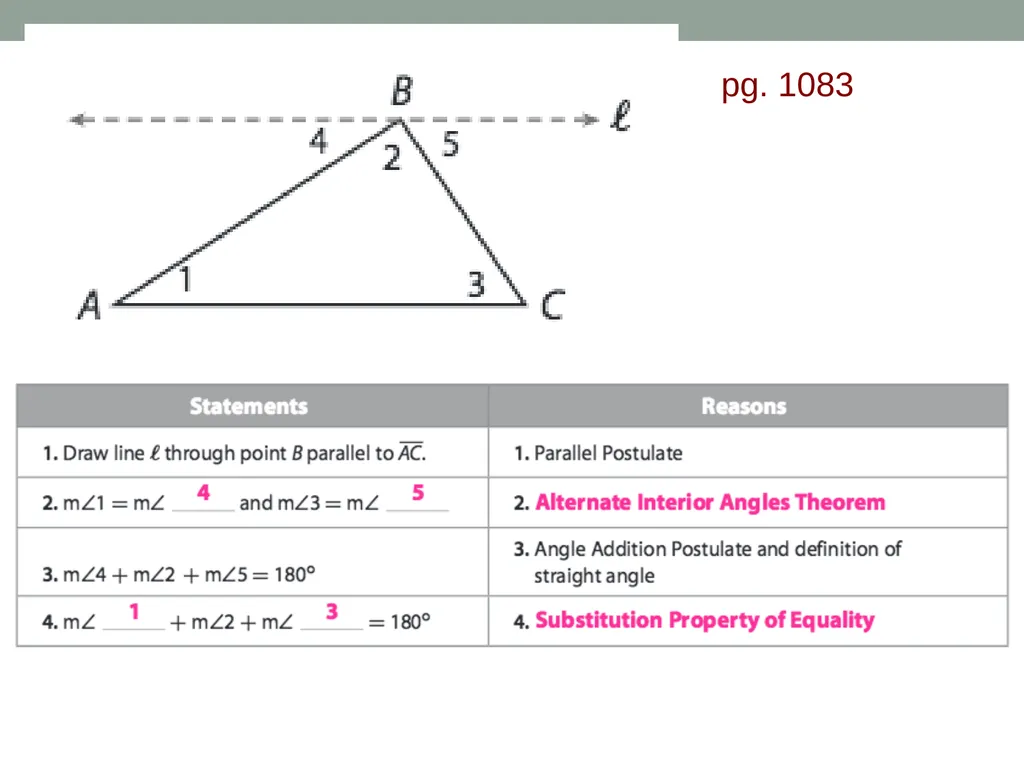
An auxiliary line is a line that is added to a figure to aid in a proof. An auxiliary line used in the Triangle Sum Theorem. Line l is parallel to line segment AC. We can draw this auxiliary line because of the parallel postulate (there is only one line parallel to line segment AC that goes through point B)<br>
10
What is the sum of the measures of angles 4, 2, and 5?
How are angles 1 and 4 related?
How are angles 5 and 3 related?
How might we write a proof using all of this information?<br>
11
pg. 1083<br>
12
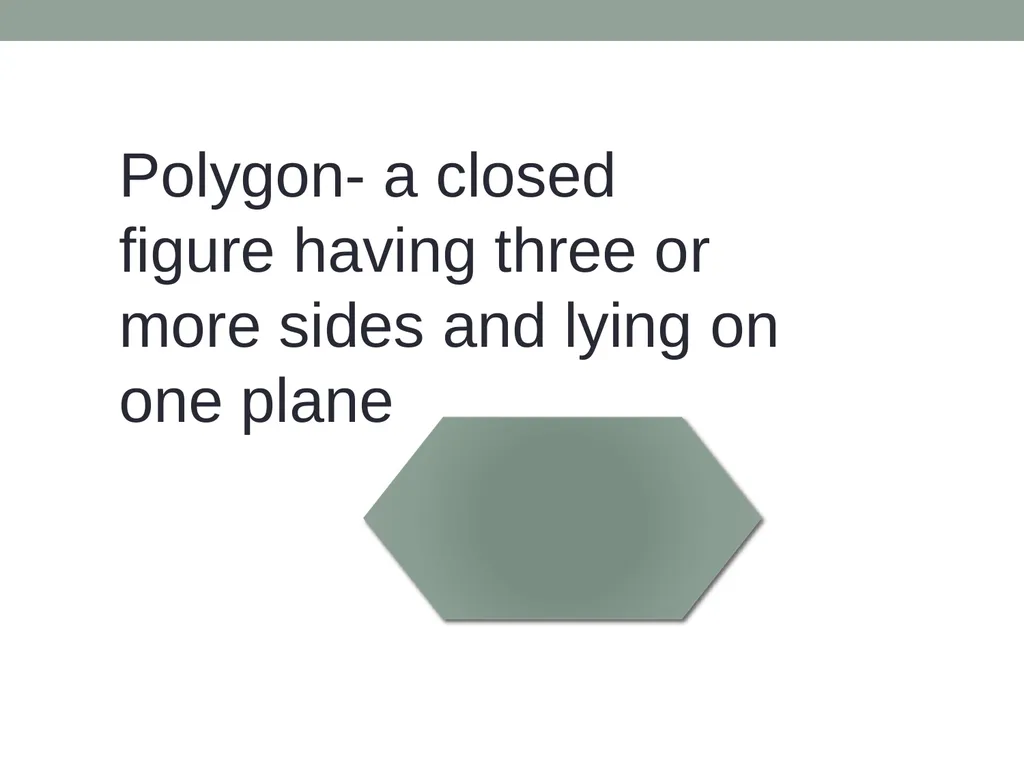
Polygon- a closed figure having three or more sides and lying on one plane<br>
13
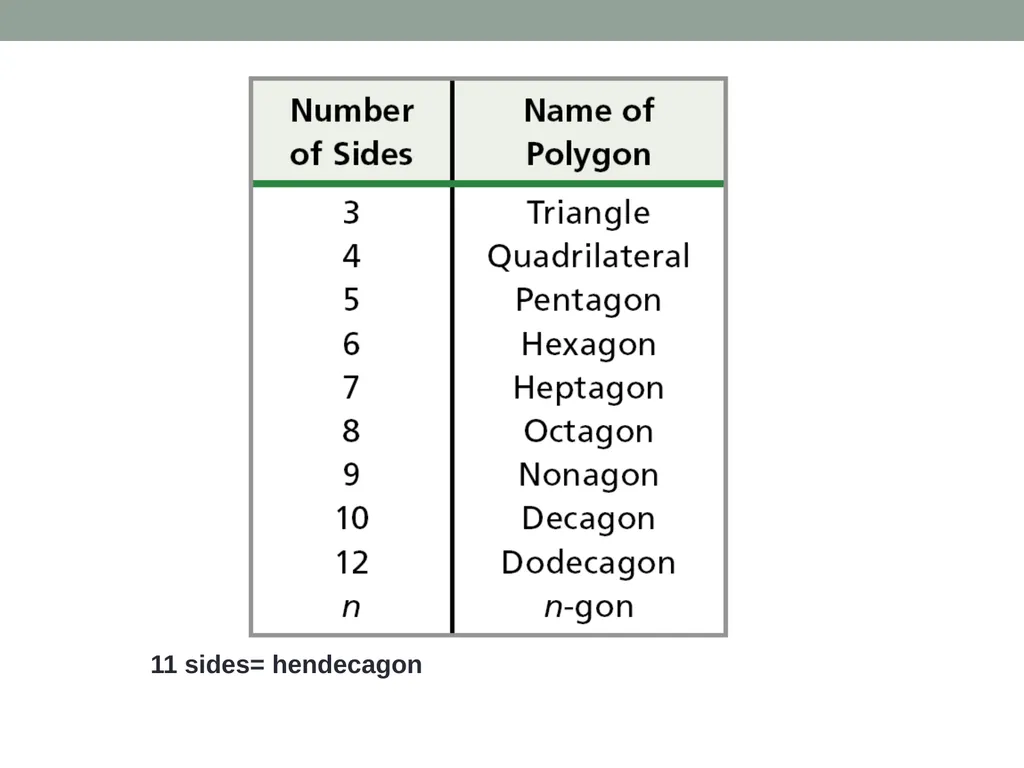
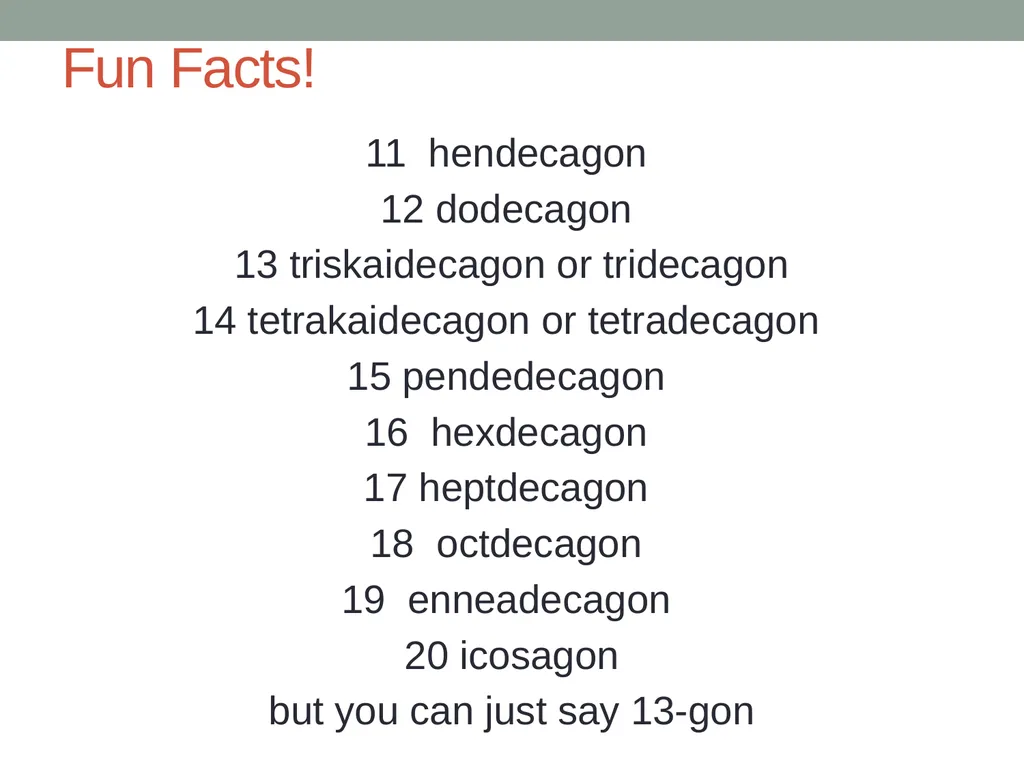
11 sides= hendecagon<br>
14
Fun Facts! 11 hendecagon
12 dodecagon
13 triskaidecagon or tridecagon
14 tetrakaidecagon or tetradecagon
15 pendedecagon
16 hexdecagon
17 heptdecagon
18 octdecagon
19 enneadecagon
20 icosagon
but you can just say 13-gon<br>
15
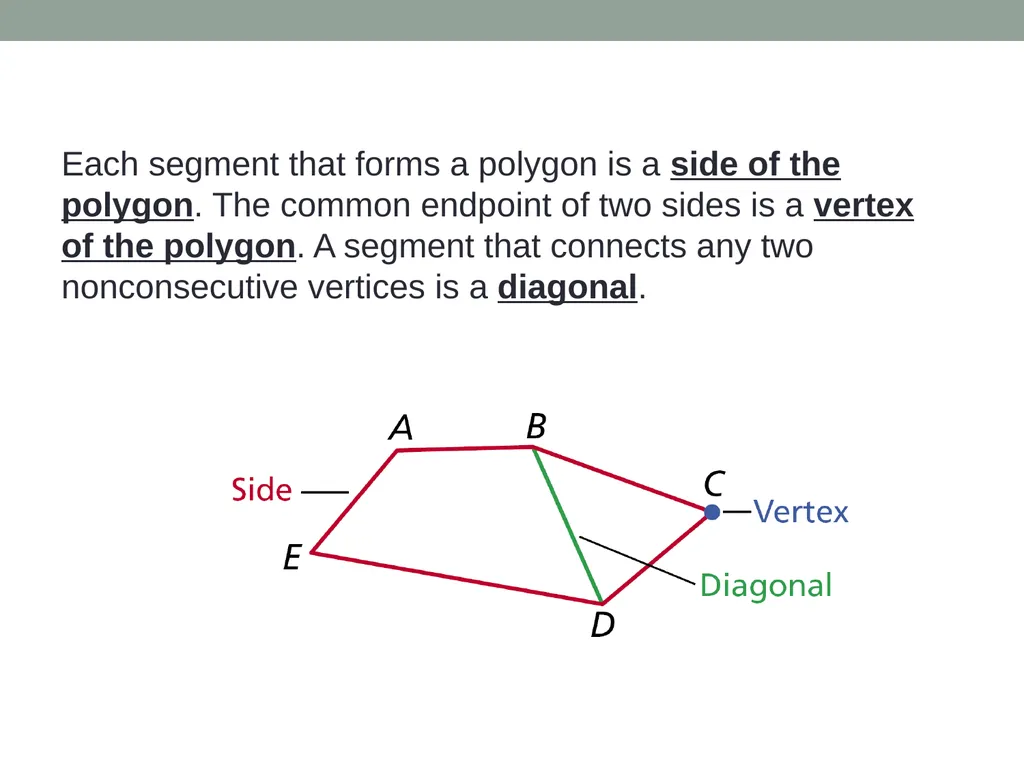
Each segment that forms a polygon is a side of the polygon. The common endpoint of two sides is a vertex of the polygon. A segment that connects any two nonconsecutive vertices is a diagonal.<br>
16
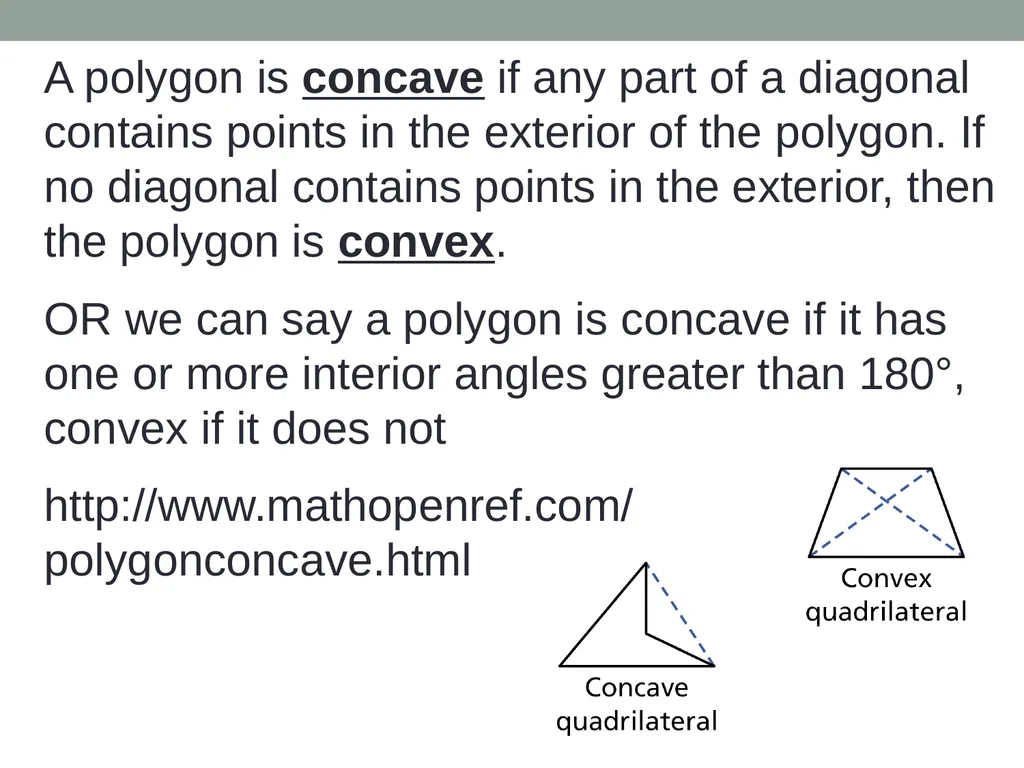
A polygon is concave if any part of a diagonal contains points in the exterior of the polygon. If no diagonal contains points in the exterior, then the polygon is convex.
OR we can say a polygon is concave if it has one or more interior angles greater than 180°, convex if it does not
http://www.mathopenref.com/polygonconcave.html<br>
17
All the sides are congruent in an equilateral polygon. All the angles are congruent in an equiangular polygon. A regular polygon is one that is both equilateral and equiangular. If a polygon is not regular, it is called irregular.<br>
18
From now on we will only be talking about convex polygons!<br>
19
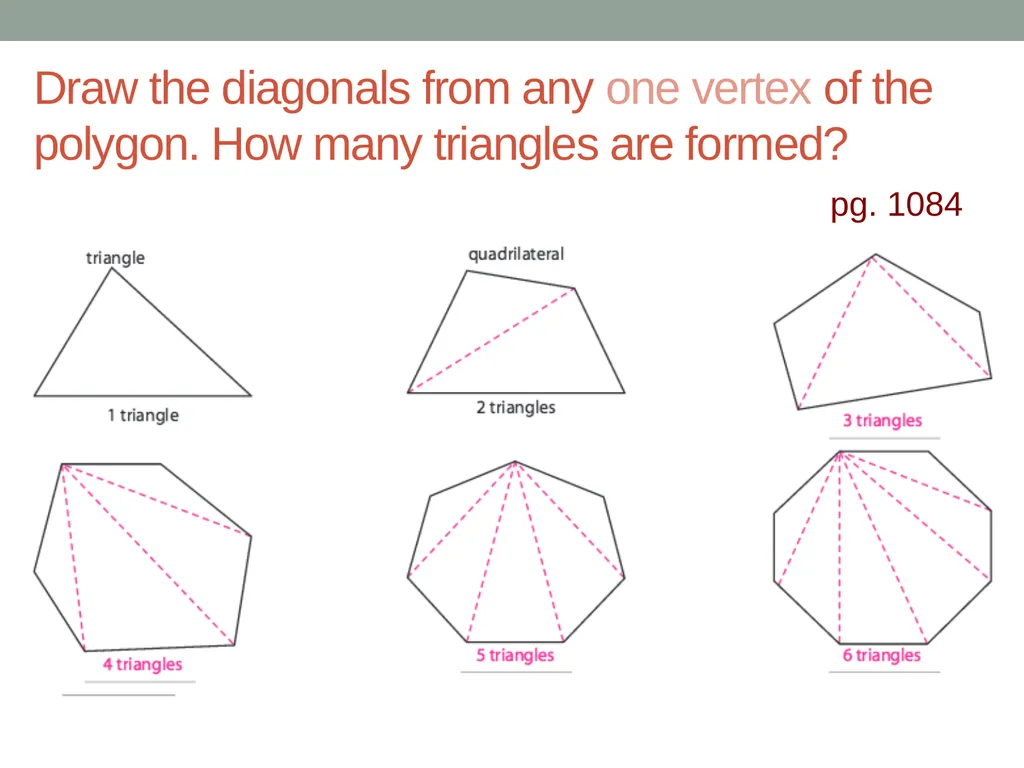
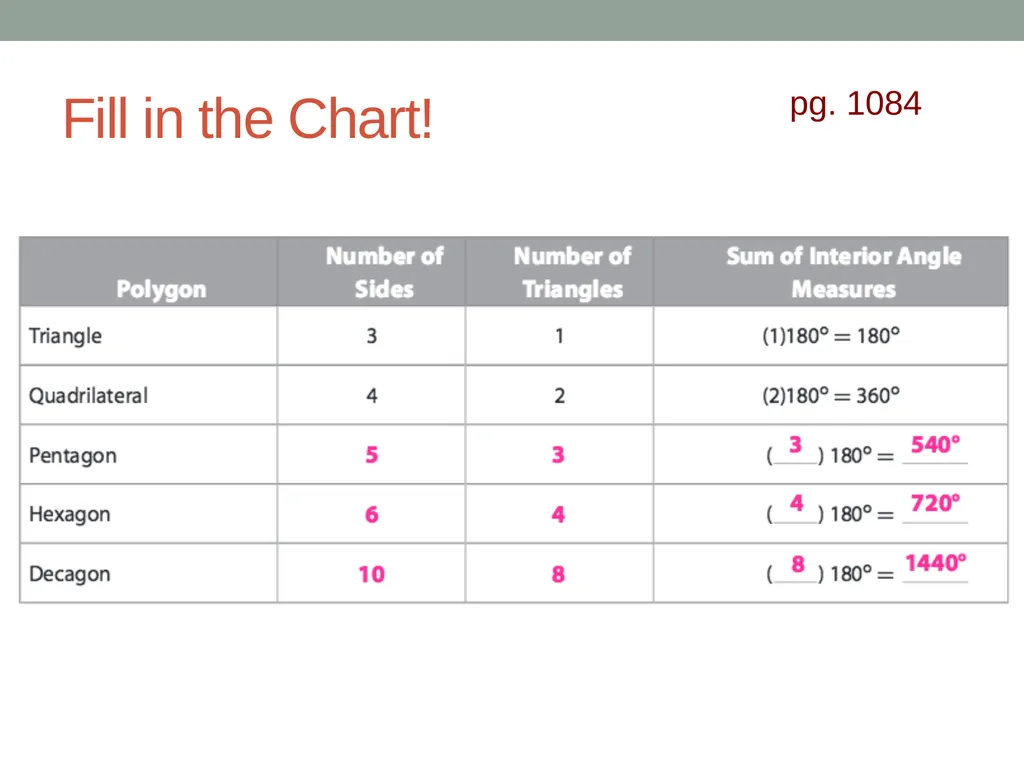
Draw the diagonals from any one vertex of the polygon. How many triangles are formed? pg. 1084<br>
20
Fill in the Chart! pg. 1084<br>
21
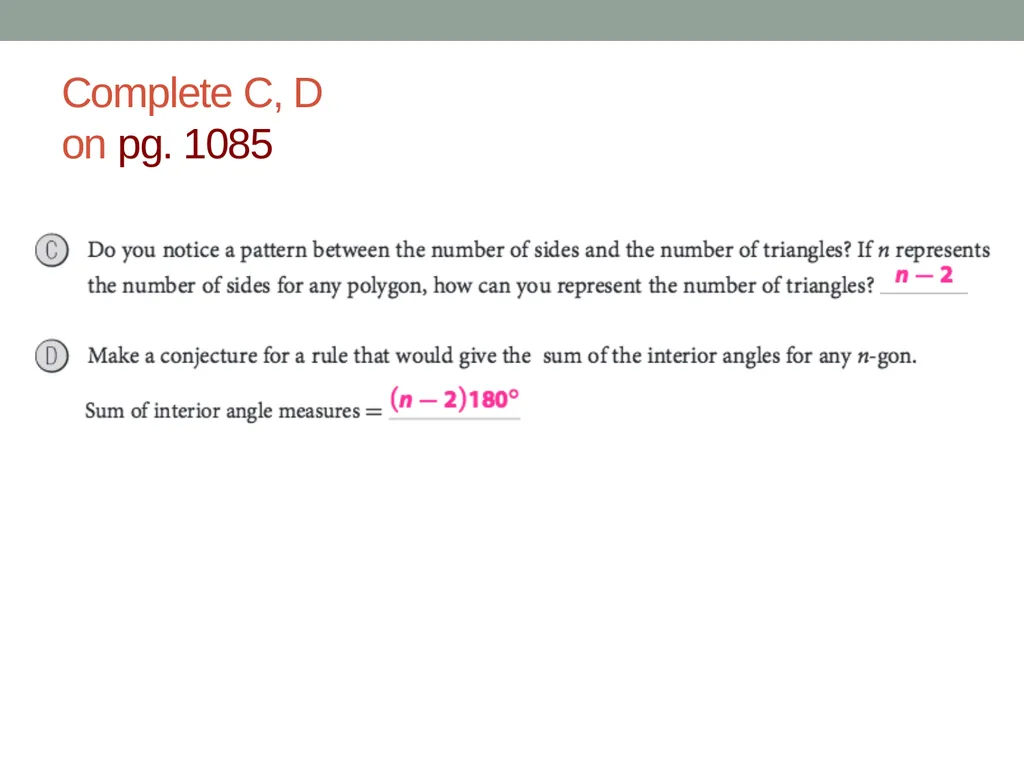
Complete C, D on pg. 1085<br>
22
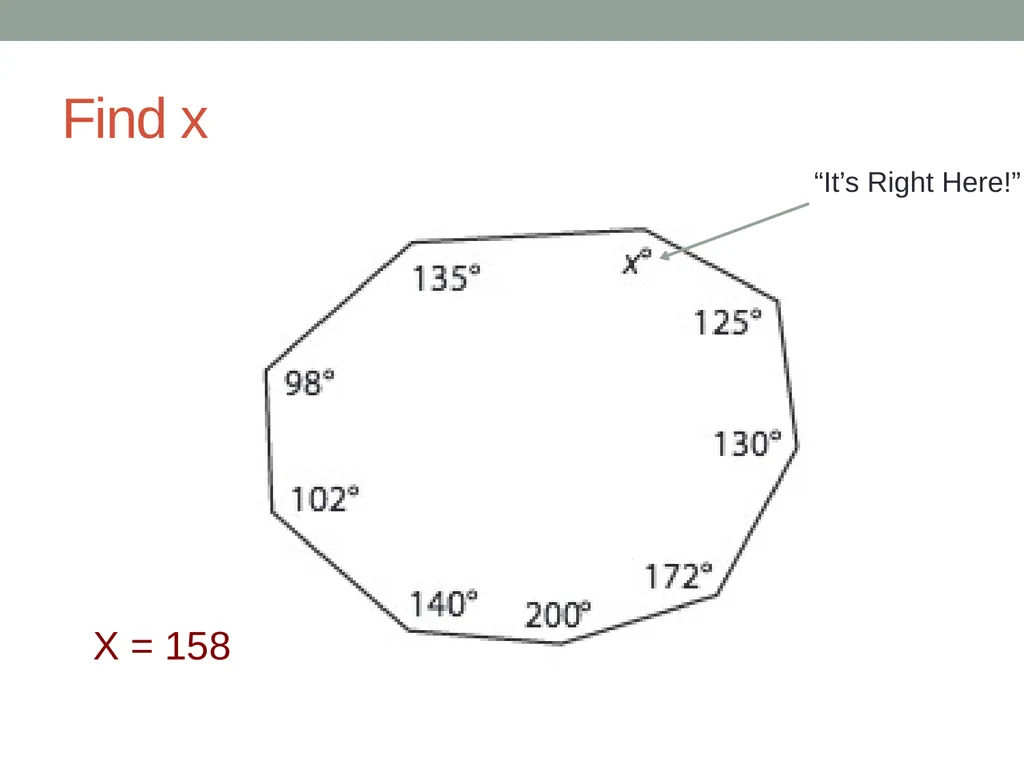
Find x “It’s Right Here!” X = 158<br>
23
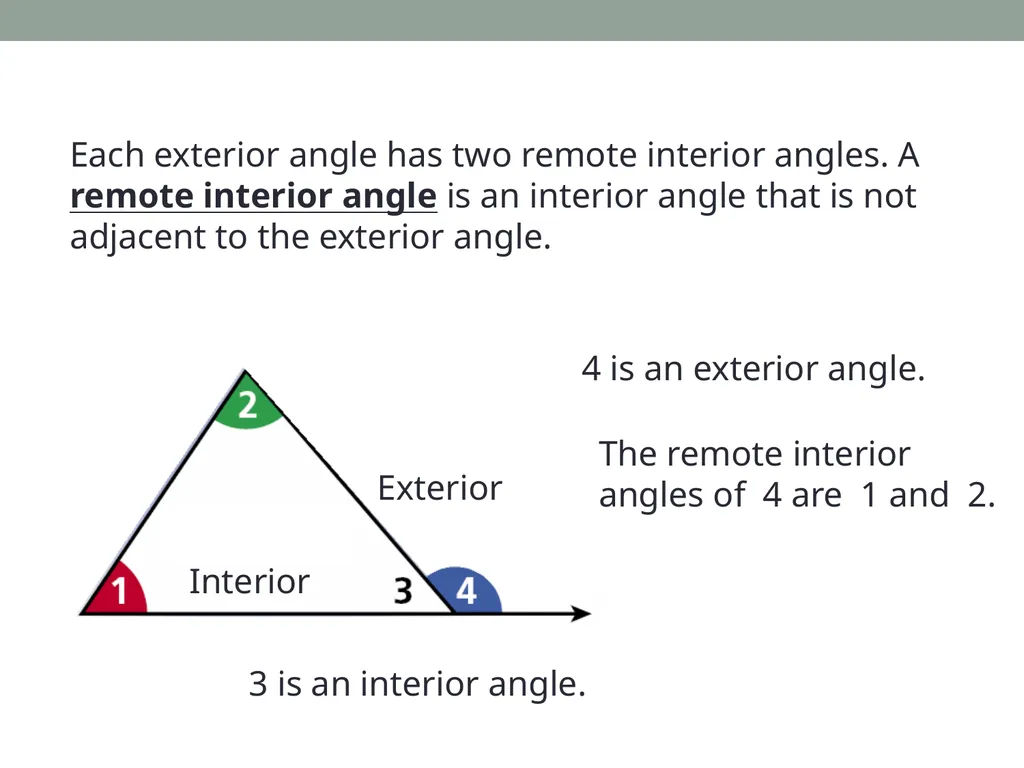
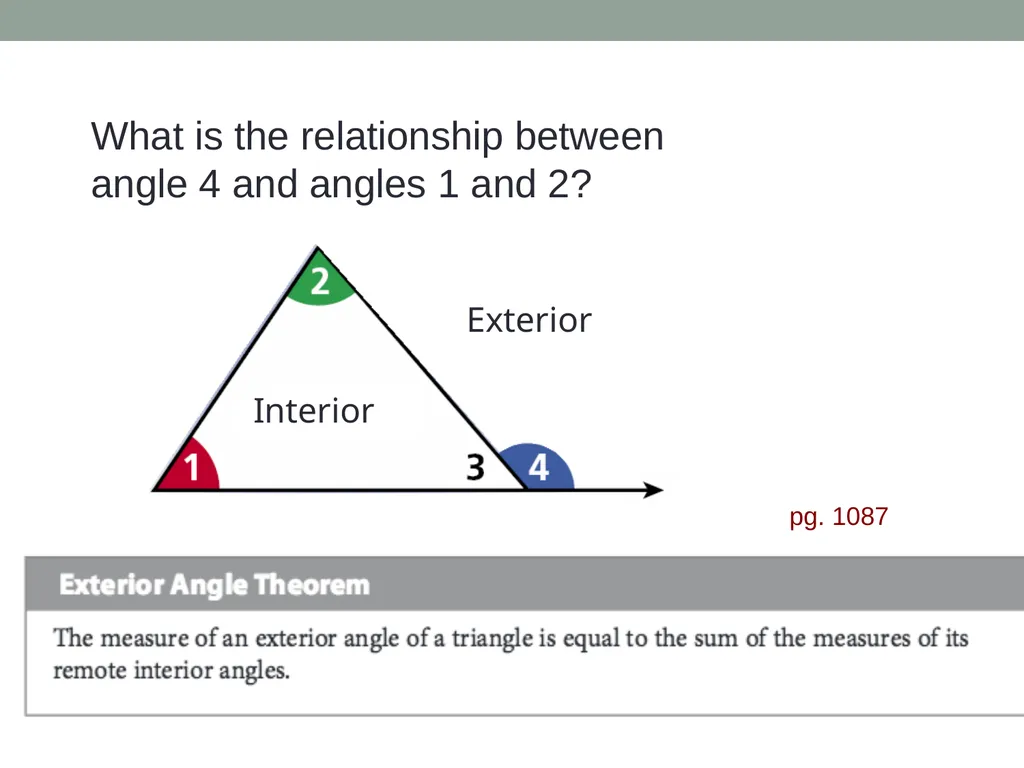
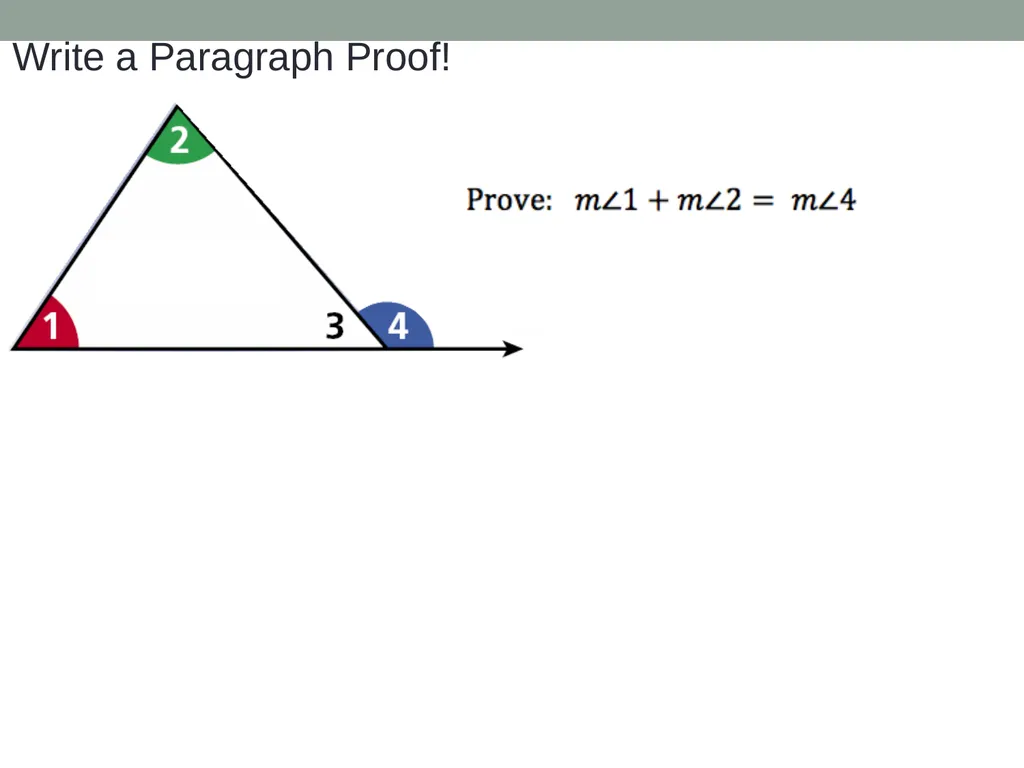
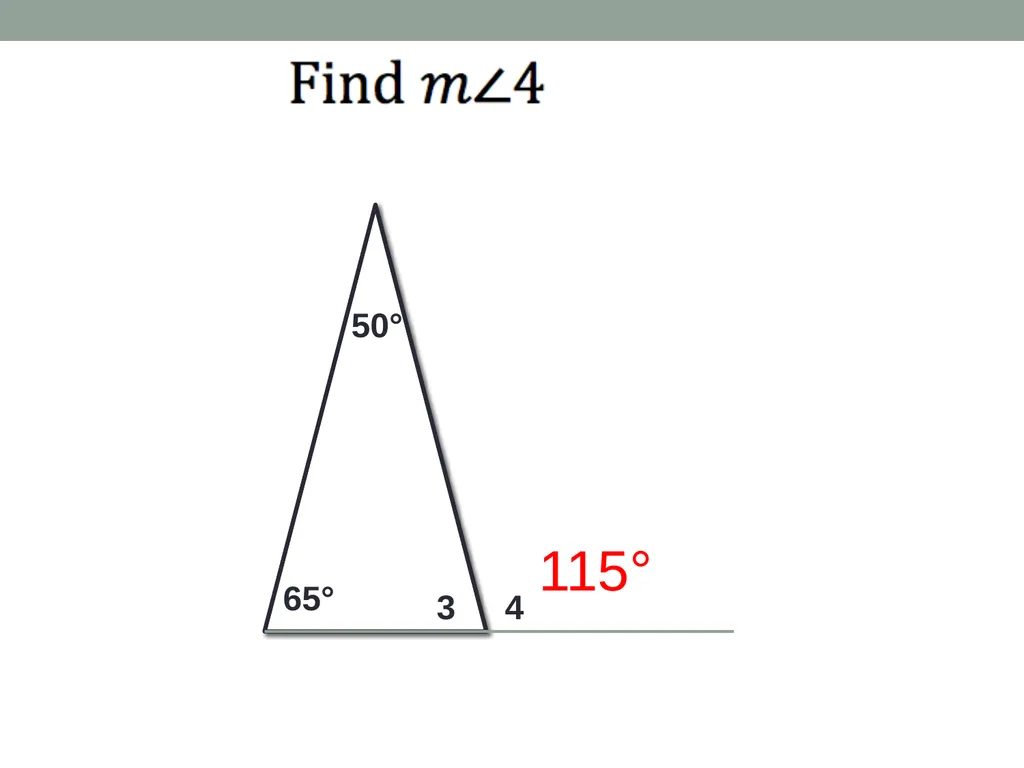
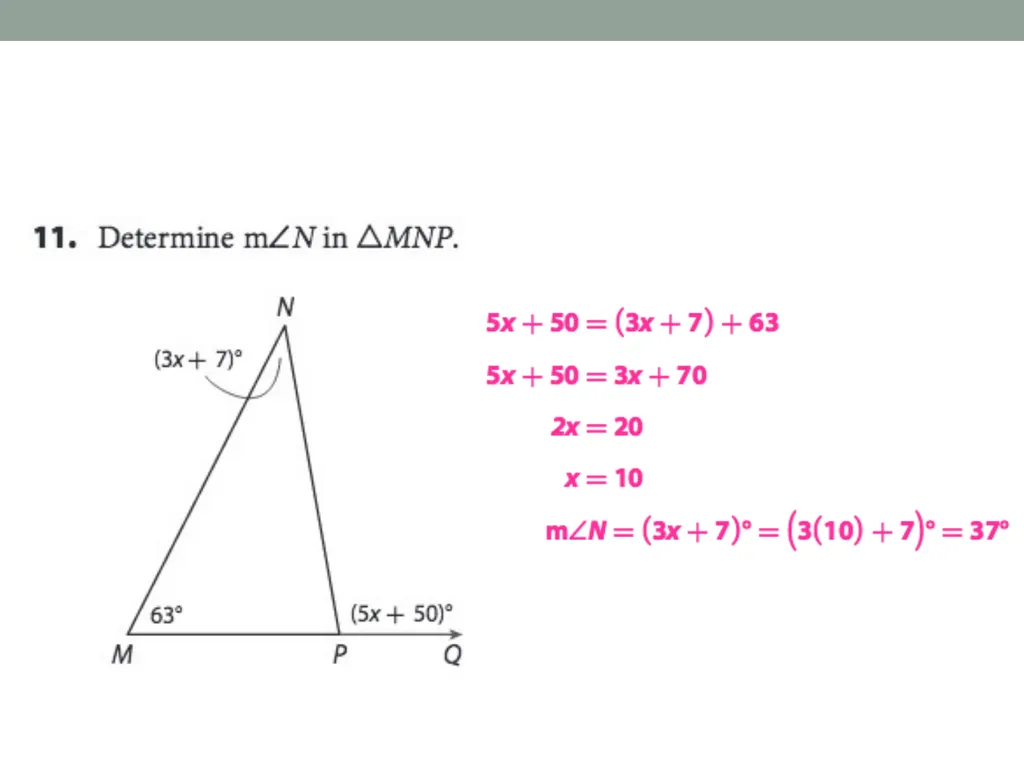
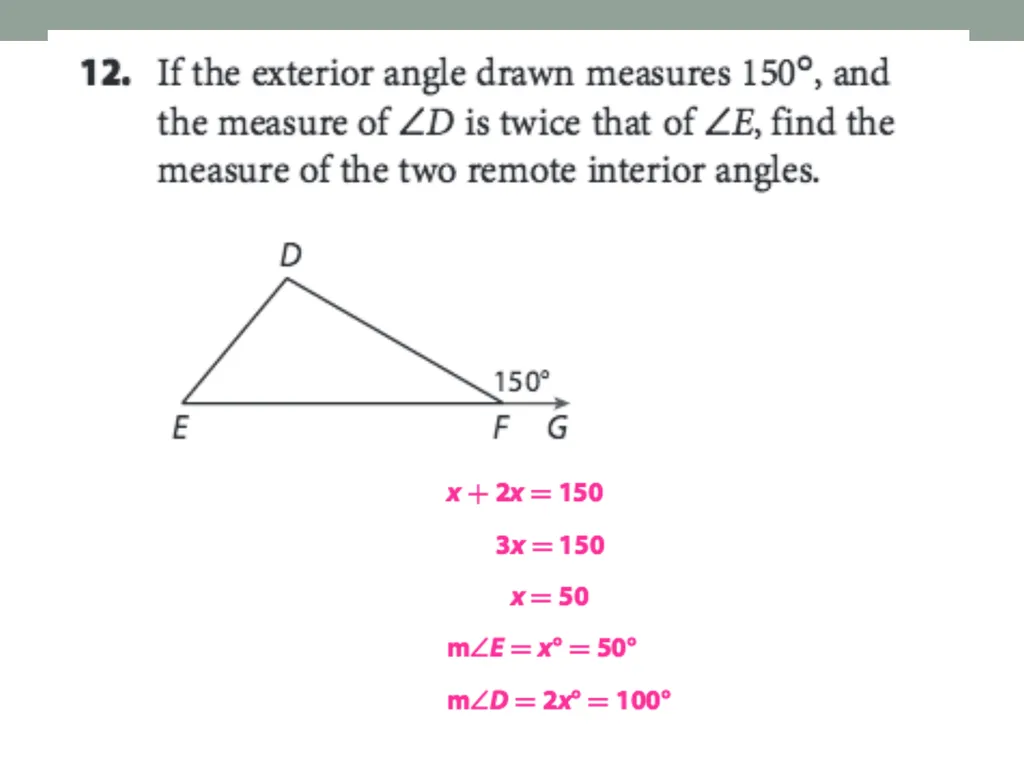
Each exterior angle has two remote interior angles. A remote interior angle is an interior angle that is not adjacent to the exterior angle. Interior Exterior 3 is an interior angle. 4 is an exterior angle. The remote interior angles of 4 are 1 and 2.<br>
24
Interior Exterior What is the relationship between
angle 4 and angles 1 and 2? pg. 1087<br>
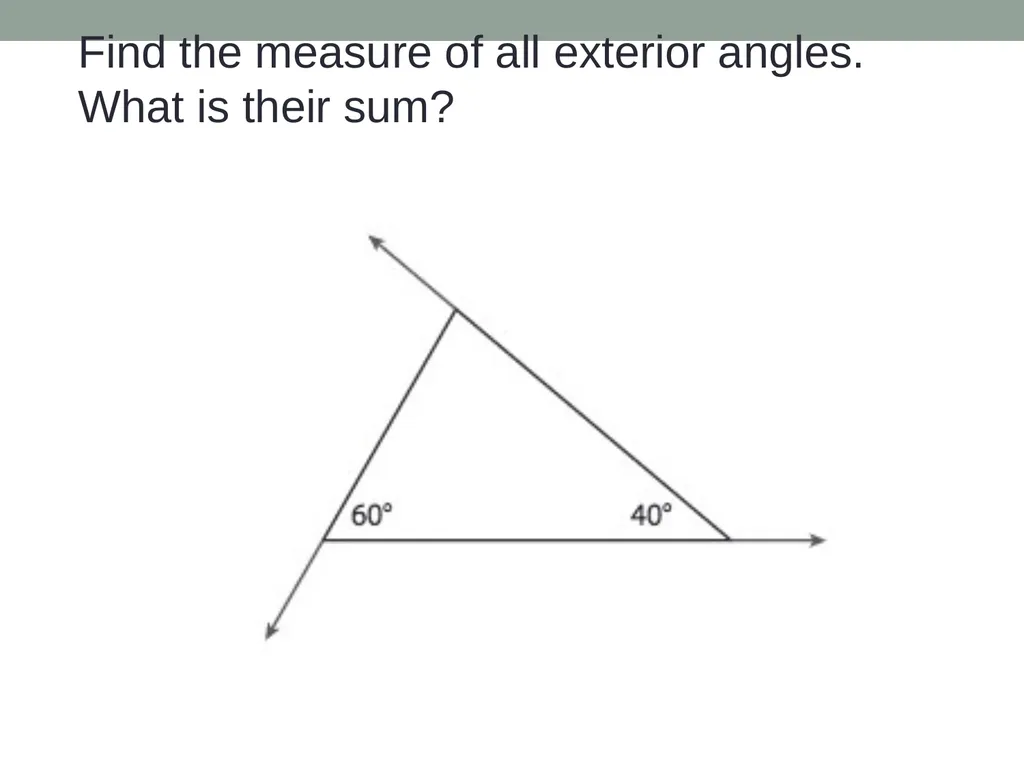
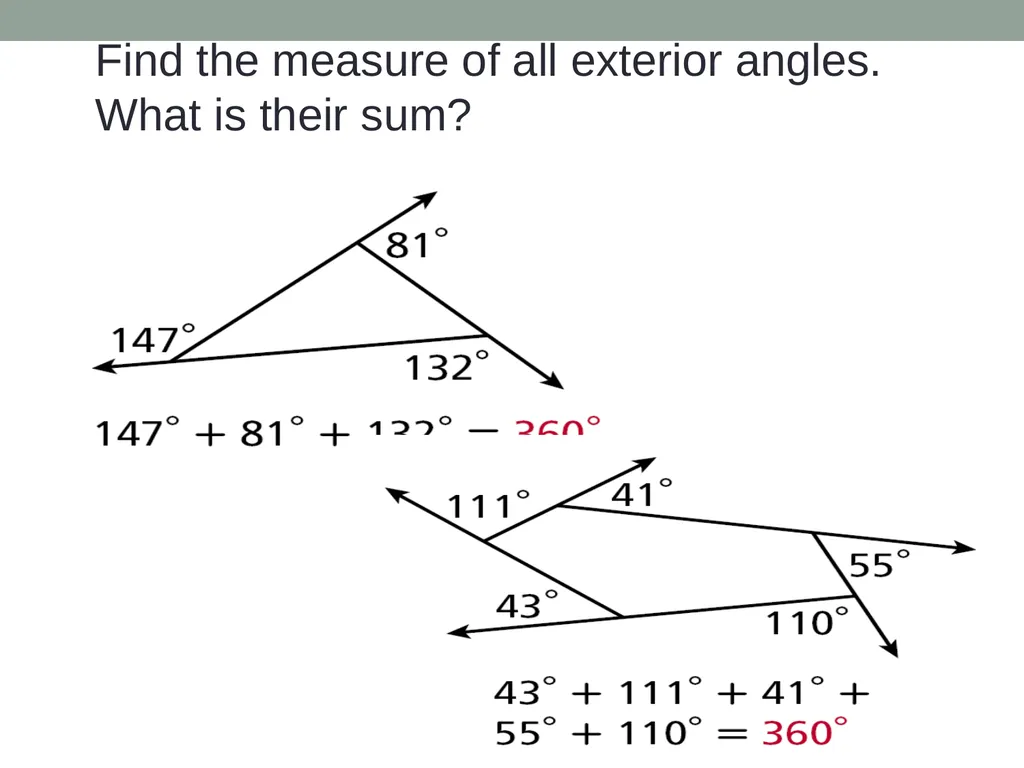
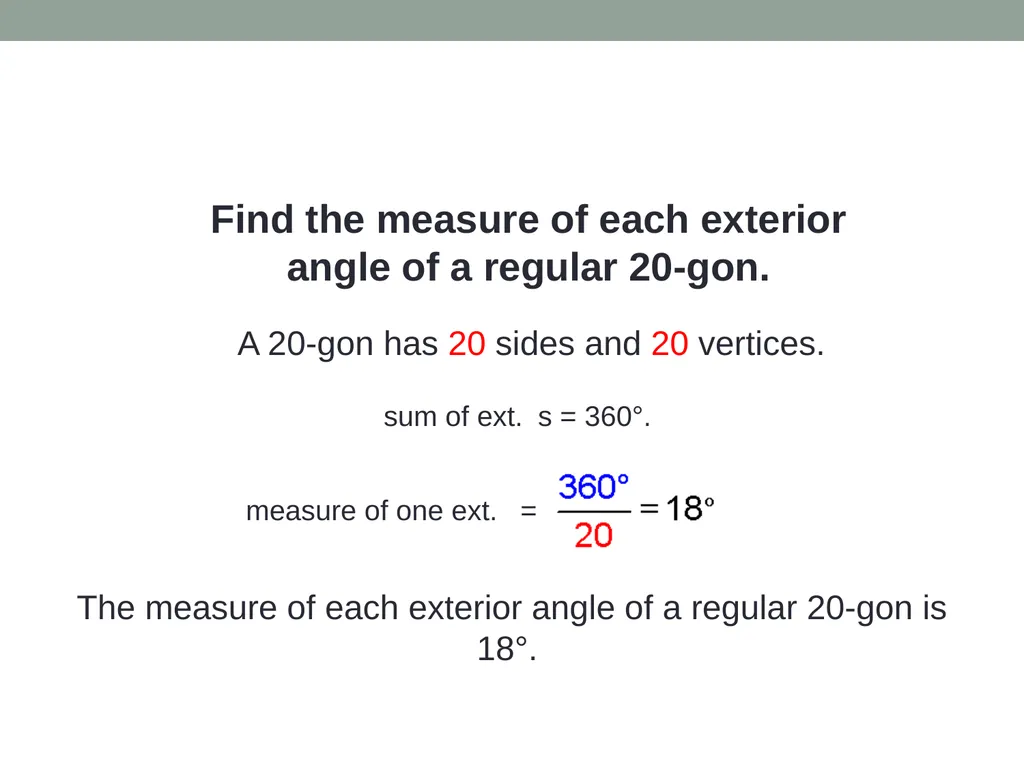
Find the measure of each exterior angle of a regular 20-gon. A 20-gon has 20 sides and 20 vertices. sum of ext. s = 360°. The measure of each exterior angle of a regular 20-gon is 18°.<br>
33
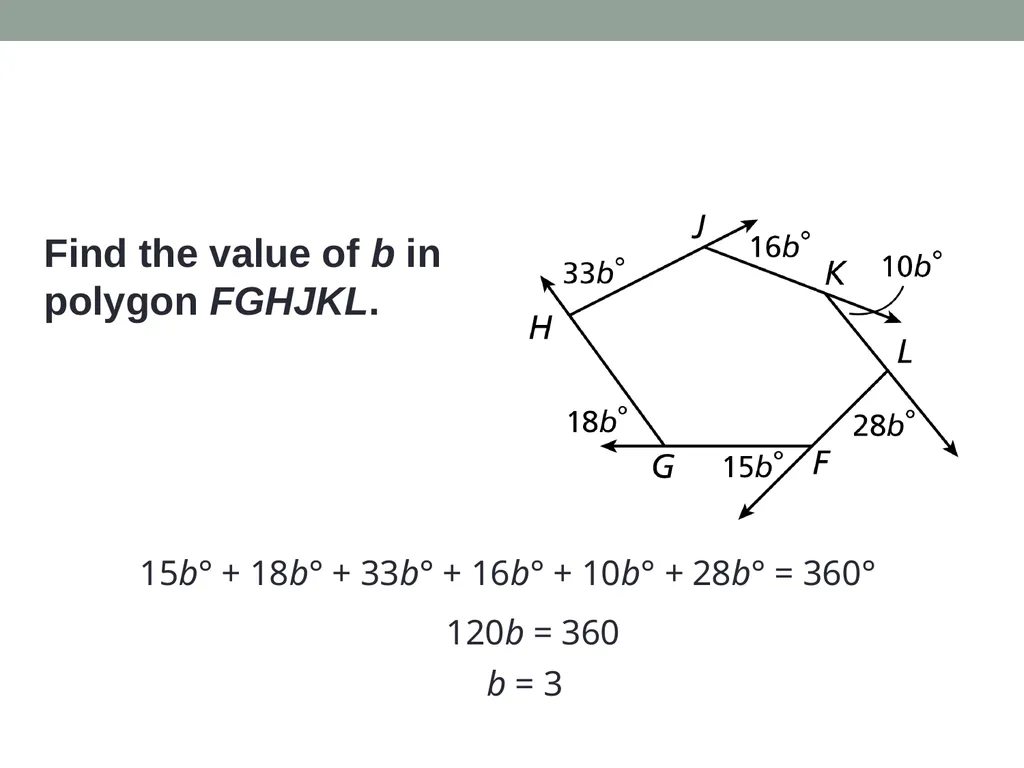
Find the value of b in
polygon FGHJKL. 15b° + 18b° + 33b° + 16b° + 10b° + 28b° = 360° 120b = 360 b = 3<br>