
Objective: interpret and apply theories of
TG
Published · 32 slides · 0 views
1 / 1






Description
Objective: interpret and apply theories of population growth and decline, understand how the DTM is used to explain population change over time space. identify stages of the DTM through the movement of CBR, CDR, and NIRtotal pop.
Related Topics
Share
Embed code
Download this presentation From Below
"Objective: interpret and apply theories of" is the property of its rightful owner. Permission is granted to download and print the materials on this website for personal, non-commercial use only, and to display it on your personal computer provided you do not modify the materials and that you retain all copyright notices contained in the materials. By downloading content from our website, you accept the terms of this agreement.
Presentation Transcript
01
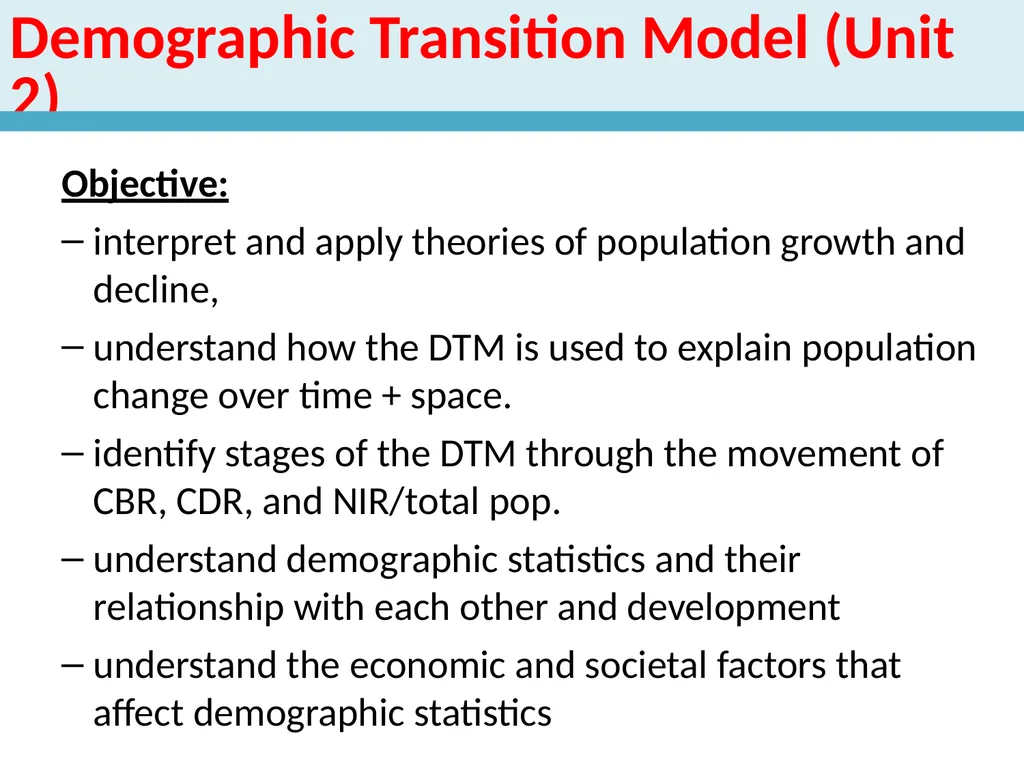
Objective:
interpret and apply theories of population growth and decline,
understand how the DTM is used to explain population change over time + space.
identify stages of the DTM through the movement of CBR, CDR, and NIR/total pop.
understand demographic statistics and their relationship with each other and development
understand the economic and societal factors that affect demographic statistics Demographic Transition Model (Unit 2)<br>
interpret and apply theories of population growth and decline,
understand how the DTM is used to explain population change over time + space.
identify stages of the DTM through the movement of CBR, CDR, and NIR/total pop.
understand demographic statistics and their relationship with each other and development
understand the economic and societal factors that affect demographic statistics Demographic Transition Model (Unit 2)<br>
02
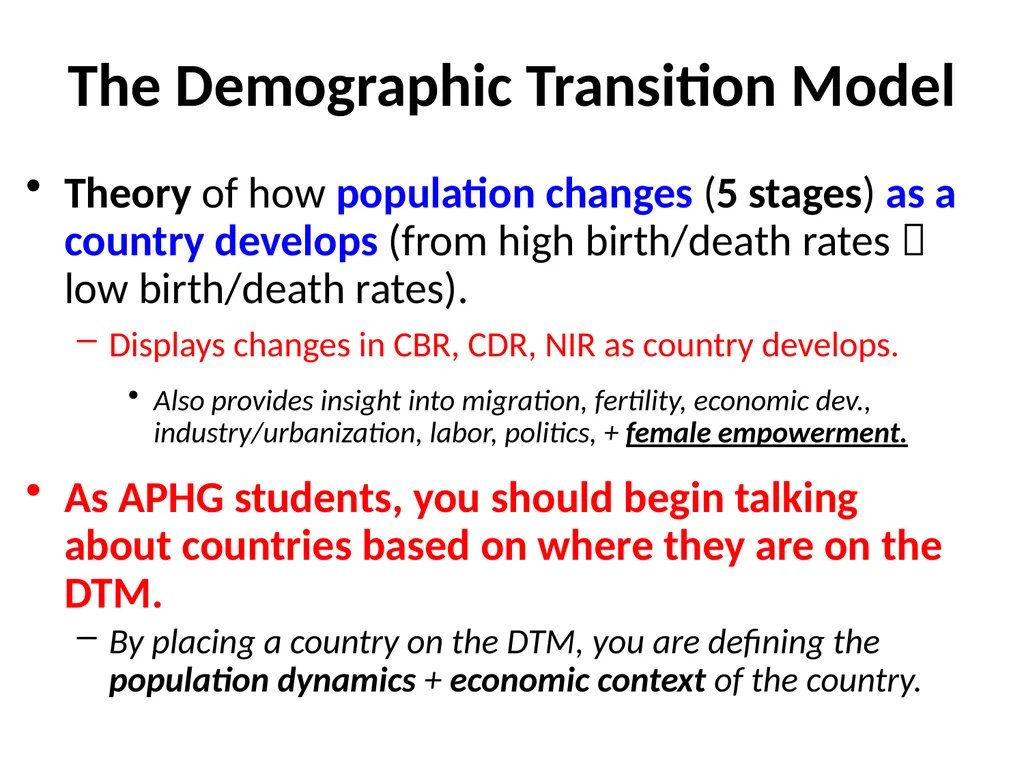
The Demographic Transition Model Theory of how population changes (5 stages) as a country develops (from high birth/death rates low birth/death rates).
Displays changes in CBR, CDR, NIR as country develops.
Also provides insight into migration, fertility, economic dev., industry/urbanization, labor, politics, + female empowerment.
As APHG students, you should begin talking about countries based on where they are on the DTM.
By placing a country on the DTM, you are defining the population dynamics + economic context of the country.<br>
Displays changes in CBR, CDR, NIR as country develops.
Also provides insight into migration, fertility, economic dev., industry/urbanization, labor, politics, + female empowerment.
As APHG students, you should begin talking about countries based on where they are on the DTM.
By placing a country on the DTM, you are defining the population dynamics + economic context of the country.<br>
03
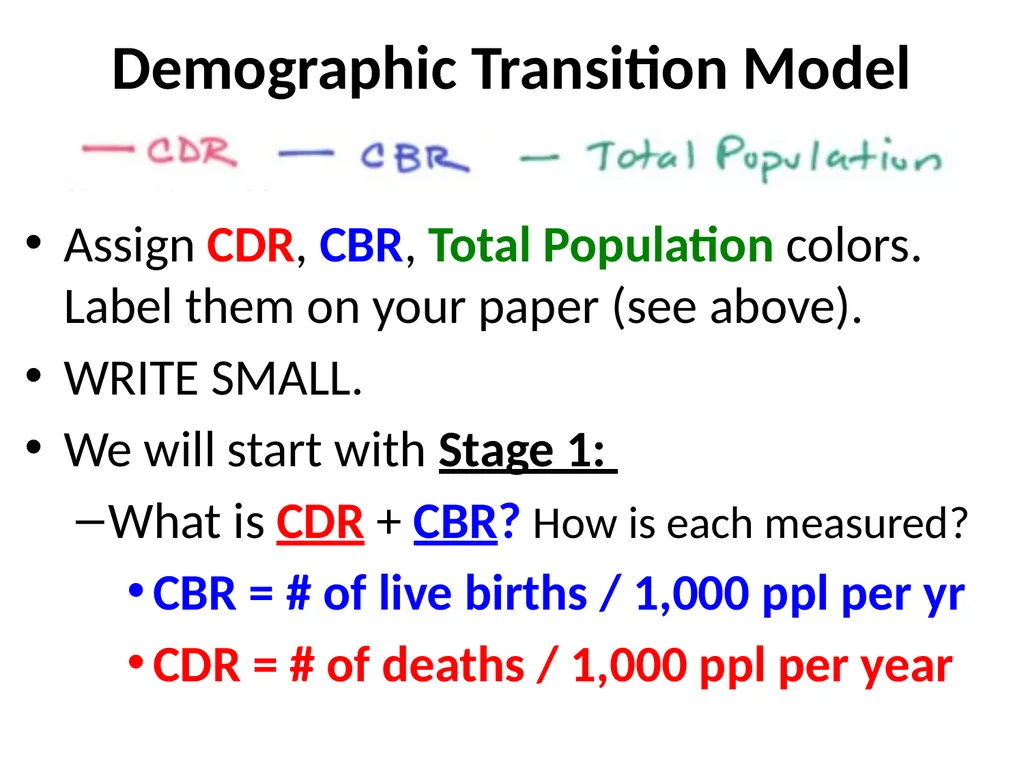
Demographic Transition Model Assign CDR, CBR, Total Population colors. Label them on your paper (see above).
WRITE SMALL.
We will start with Stage 1:
What is CDR + CBR? How is each measured?
CBR = # of live births / 1,000 ppl per yr
CDR = # of deaths / 1,000 ppl per year<br>
WRITE SMALL.
We will start with Stage 1:
What is CDR + CBR? How is each measured?
CBR = # of live births / 1,000 ppl per yr
CDR = # of deaths / 1,000 ppl per year<br>
04
Stage One<br>
05
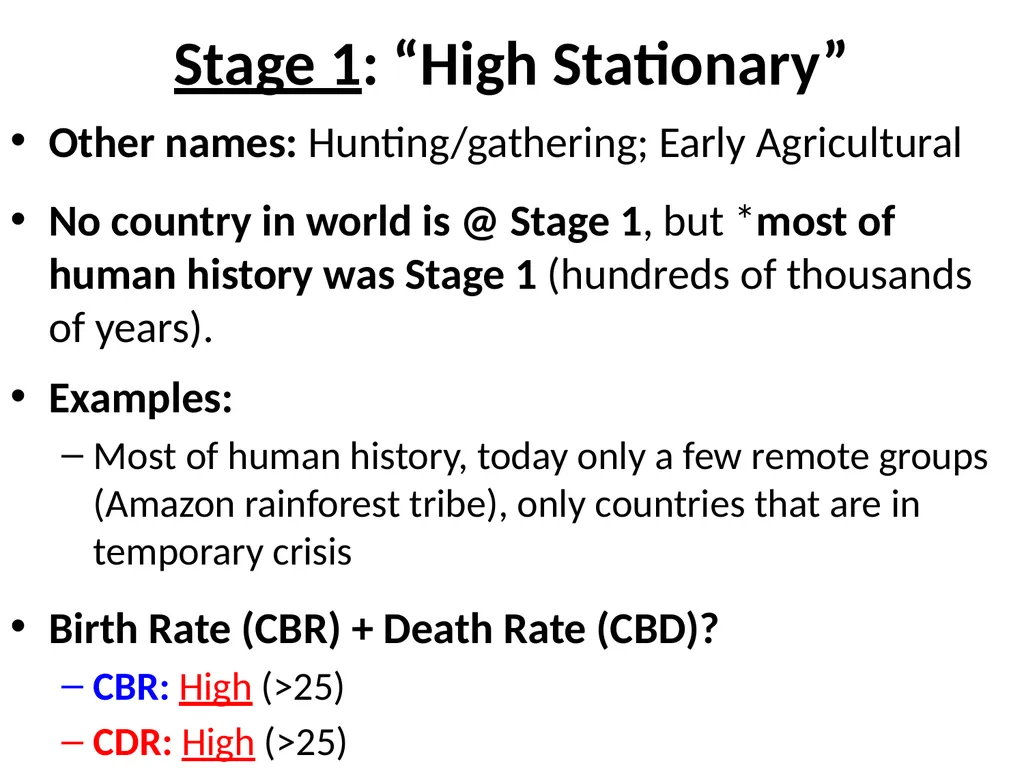
Stage 1: “High Stationary” Other names: Hunting/gathering; Early Agricultural
No country in world is @ Stage 1, but *most of human history was Stage 1 (hundreds of thousands of years).
Examples:
Most of human history, today only a few remote groups (Amazon rainforest tribe), only countries that are in temporary crisis
Birth Rate (CBR) + Death Rate (CBD)?
CBR: High (>25)
CDR: High (>25)<br>
No country in world is @ Stage 1, but *most of human history was Stage 1 (hundreds of thousands of years).
Examples:
Most of human history, today only a few remote groups (Amazon rainforest tribe), only countries that are in temporary crisis
Birth Rate (CBR) + Death Rate (CBD)?
CBR: High (>25)
CDR: High (>25)<br>
06
Stage 1: Reasons for CBR + CDR?
Reasons for birth rate:
Children = $ economic assets (source of labor; more children = more crops.)
High IMR
High CBR, parents compensate for expected deaths among children by having more children
Religious or social traditions; lack of *female empowerment
Reasons for death rate:
“Age of pestilence and famine”
“Lives short, brutal, hungry”
Disease (pandemics, plague, famine/hunger, drought, constant war, childbirth dangerous – MMR/IMR high)
No modern medicine.
If both rates are high, what your Natural Increase (NIR)?
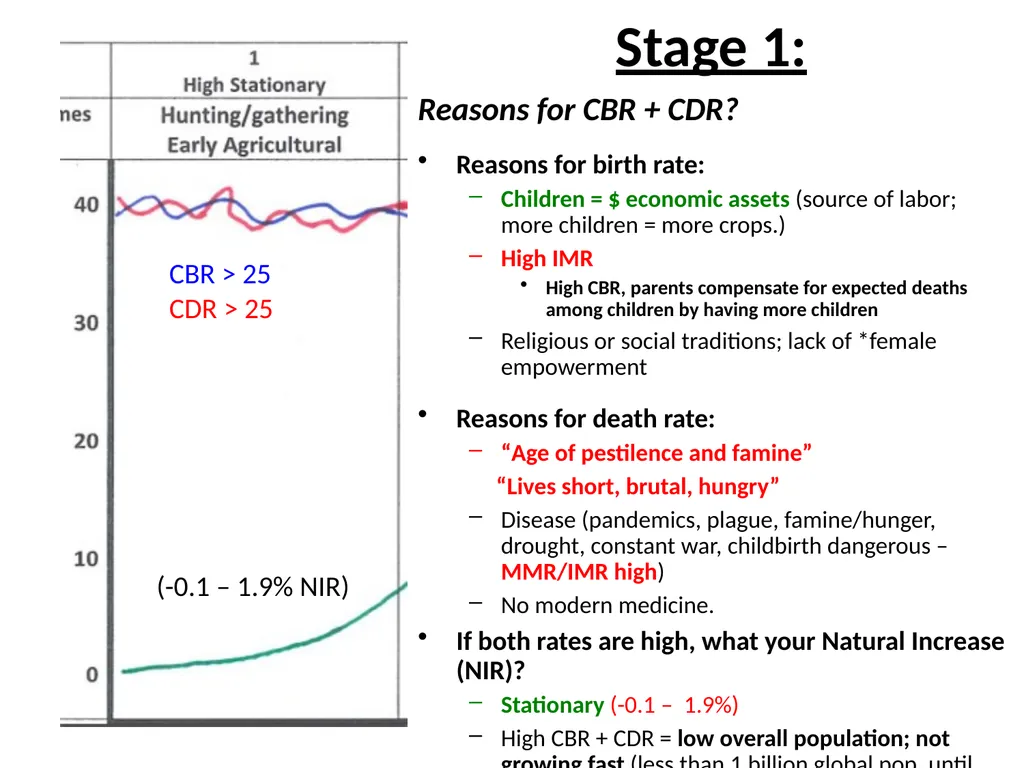
Stationary (-0.1 – 1.9%)
High CBR + CDR = low overall population; not growing fast (less than 1 billion global pop. until early 1800s) CBR > 25
CDR > 25 (-0.1 – 1.9% NIR)<br>
Reasons for birth rate:
Children = $ economic assets (source of labor; more children = more crops.)
High IMR
High CBR, parents compensate for expected deaths among children by having more children
Religious or social traditions; lack of *female empowerment
Reasons for death rate:
“Age of pestilence and famine”
“Lives short, brutal, hungry”
Disease (pandemics, plague, famine/hunger, drought, constant war, childbirth dangerous – MMR/IMR high)
No modern medicine.
If both rates are high, what your Natural Increase (NIR)?
Stationary (-0.1 – 1.9%)
High CBR + CDR = low overall population; not growing fast (less than 1 billion global pop. until early 1800s) CBR > 25
CDR > 25 (-0.1 – 1.9% NIR)<br>
07
Stage Two<br>
08
Stage 2: “Early Expansion” Predict:
What will be the big change in Stage 2?
What causes this change in human history?
What happens to CDR? CBR? Total population?
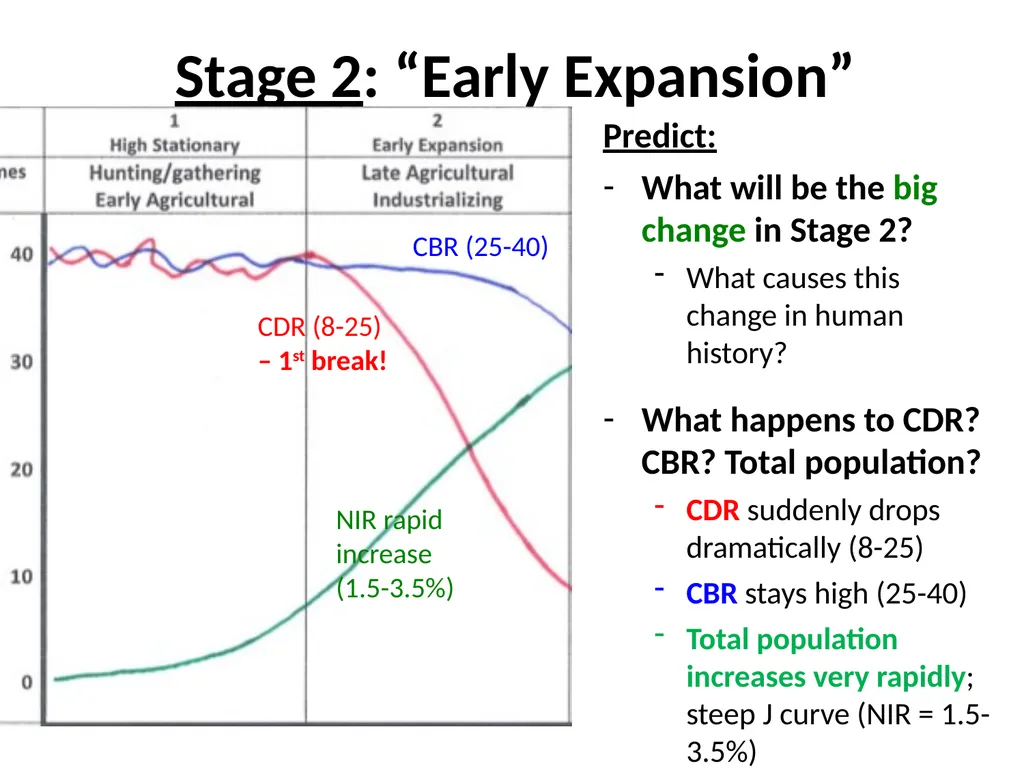
CDR suddenly drops dramatically (8-25)
CBR stays high (25-40)
Total population increases very rapidly; steep J curve (NIR = 1.5-3.5%) CDR (8-25) – 1st break! NIR rapid increase (1.5-3.5%) CBR (25-40)<br>
What will be the big change in Stage 2?
What causes this change in human history?
What happens to CDR? CBR? Total population?
CDR suddenly drops dramatically (8-25)
CBR stays high (25-40)
Total population increases very rapidly; steep J curve (NIR = 1.5-3.5%) CDR (8-25) – 1st break! NIR rapid increase (1.5-3.5%) CBR (25-40)<br>
09
Stage 2: “Early Expansion” Other names: Late Agricultural/ Industrializing
Birth Rate (CBR)? Death Rate (CBD)? NIR?
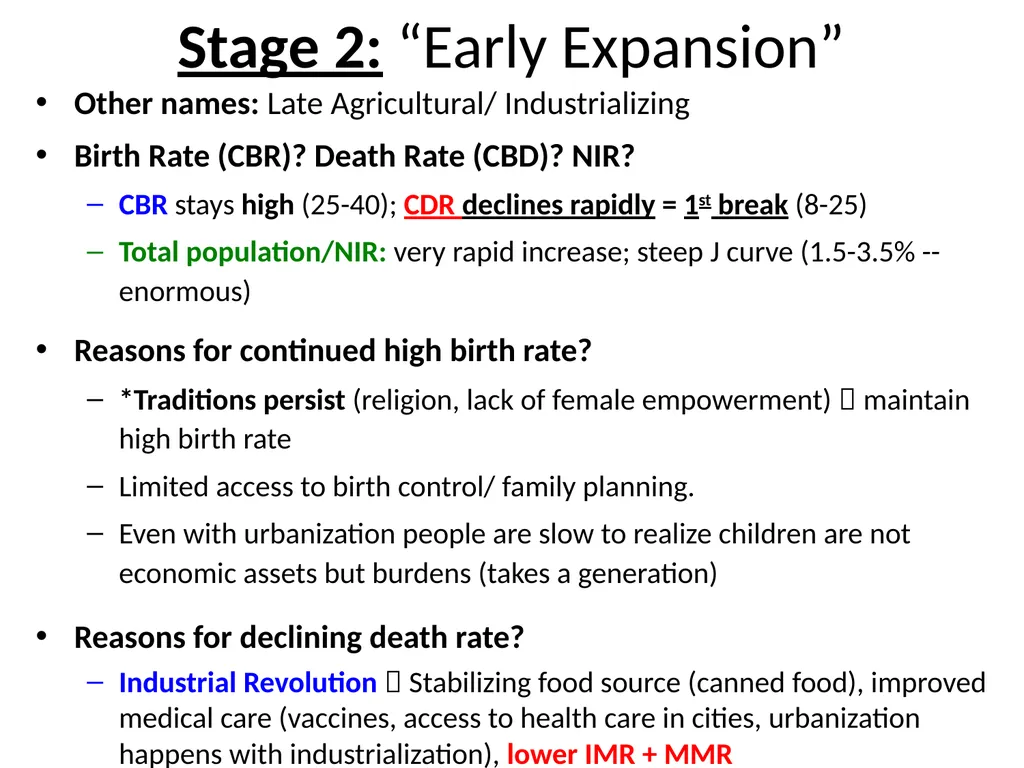
CBR stays high (25-40); CDR declines rapidly = 1st break (8-25)
Total population/NIR: very rapid increase; steep J curve (1.5-3.5% -- enormous)
Reasons for continued high birth rate?
*Traditions persist (religion, lack of female empowerment) maintain high birth rate
Limited access to birth control/ family planning.
Even with urbanization people are slow to realize children are not economic assets but burdens (takes a generation)
Reasons for declining death rate?
Industrial Revolution Stabilizing food source (canned food), improved medical care (vaccines, access to health care in cities, urbanization happens with industrialization), lower IMR + MMR<br>
Birth Rate (CBR)? Death Rate (CBD)? NIR?
CBR stays high (25-40); CDR declines rapidly = 1st break (8-25)
Total population/NIR: very rapid increase; steep J curve (1.5-3.5% -- enormous)
Reasons for continued high birth rate?
*Traditions persist (religion, lack of female empowerment) maintain high birth rate
Limited access to birth control/ family planning.
Even with urbanization people are slow to realize children are not economic assets but burdens (takes a generation)
Reasons for declining death rate?
Industrial Revolution Stabilizing food source (canned food), improved medical care (vaccines, access to health care in cities, urbanization happens with industrialization), lower IMR + MMR<br>
10
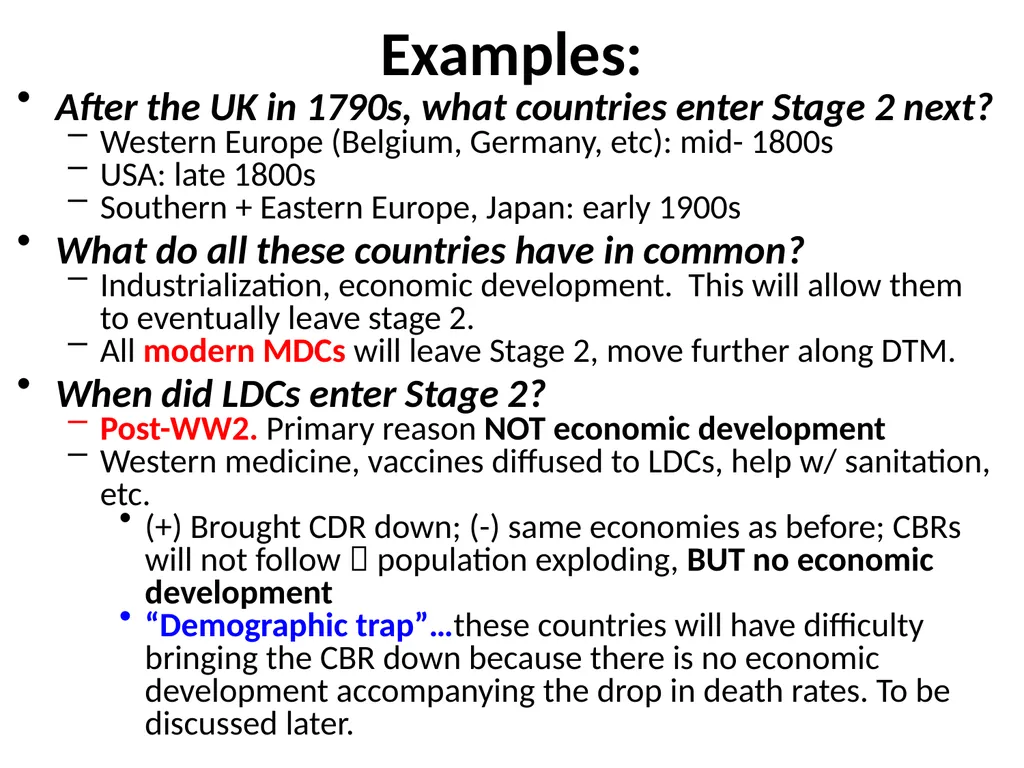
Examples: After the UK in 1790s, what countries enter Stage 2 next?
Western Europe (Belgium, Germany, etc): mid- 1800s
USA: late 1800s
Southern + Eastern Europe, Japan: early 1900s
What do all these countries have in common?
Industrialization, economic development. This will allow them to eventually leave stage 2.
All modern MDCs will leave Stage 2, move further along DTM.
When did LDCs enter Stage 2?
Post-WW2. Primary reason NOT economic development
Western medicine, vaccines diffused to LDCs, help w/ sanitation, etc.
(+) Brought CDR down; (-) same economies as before; CBRs will not follow population exploding, BUT no economic development
“Demographic trap”…these countries will have difficulty bringing the CBR down because there is no economic development accompanying the drop in death rates. To be discussed later.<br>
Western Europe (Belgium, Germany, etc): mid- 1800s
USA: late 1800s
Southern + Eastern Europe, Japan: early 1900s
What do all these countries have in common?
Industrialization, economic development. This will allow them to eventually leave stage 2.
All modern MDCs will leave Stage 2, move further along DTM.
When did LDCs enter Stage 2?
Post-WW2. Primary reason NOT economic development
Western medicine, vaccines diffused to LDCs, help w/ sanitation, etc.
(+) Brought CDR down; (-) same economies as before; CBRs will not follow population exploding, BUT no economic development
“Demographic trap”…these countries will have difficulty bringing the CBR down because there is no economic development accompanying the drop in death rates. To be discussed later.<br>
11
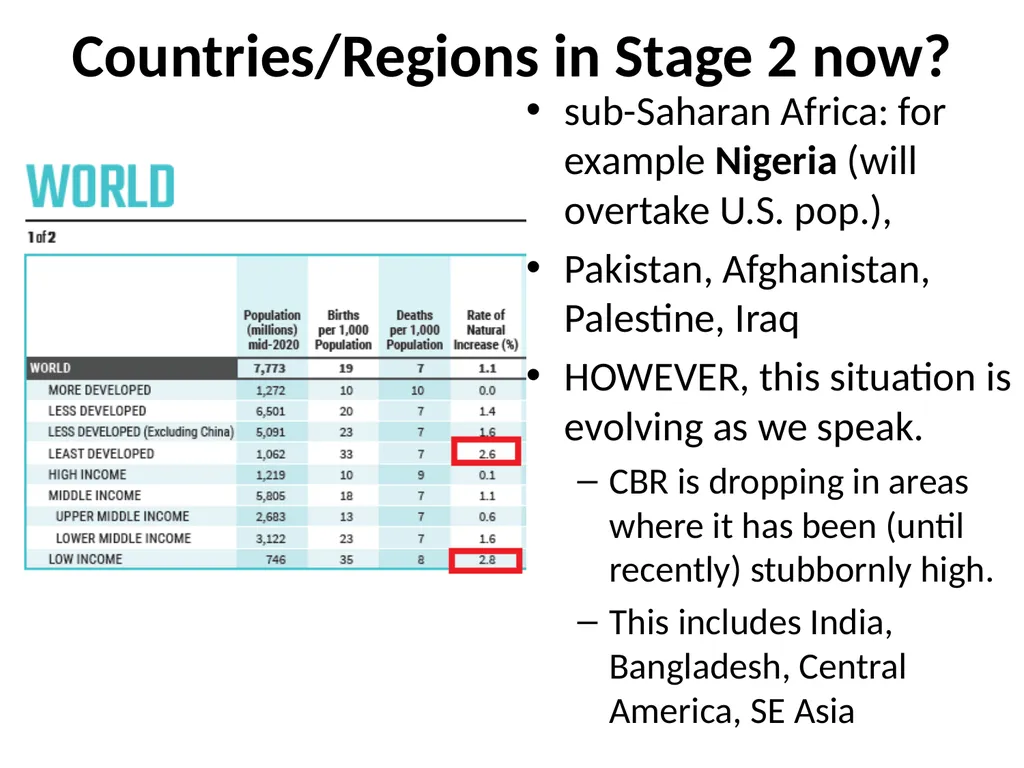
Countries/Regions in Stage 2 now? sub-Saharan Africa: for example Nigeria (will overtake U.S. pop.),
Pakistan, Afghanistan, Palestine, Iraq
HOWEVER, this situation is evolving as we speak.
CBR is dropping in areas where it has been (until recently) stubbornly high.
This includes India, Bangladesh, Central America, SE Asia<br>
Pakistan, Afghanistan, Palestine, Iraq
HOWEVER, this situation is evolving as we speak.
CBR is dropping in areas where it has been (until recently) stubbornly high.
This includes India, Bangladesh, Central America, SE Asia<br>
12
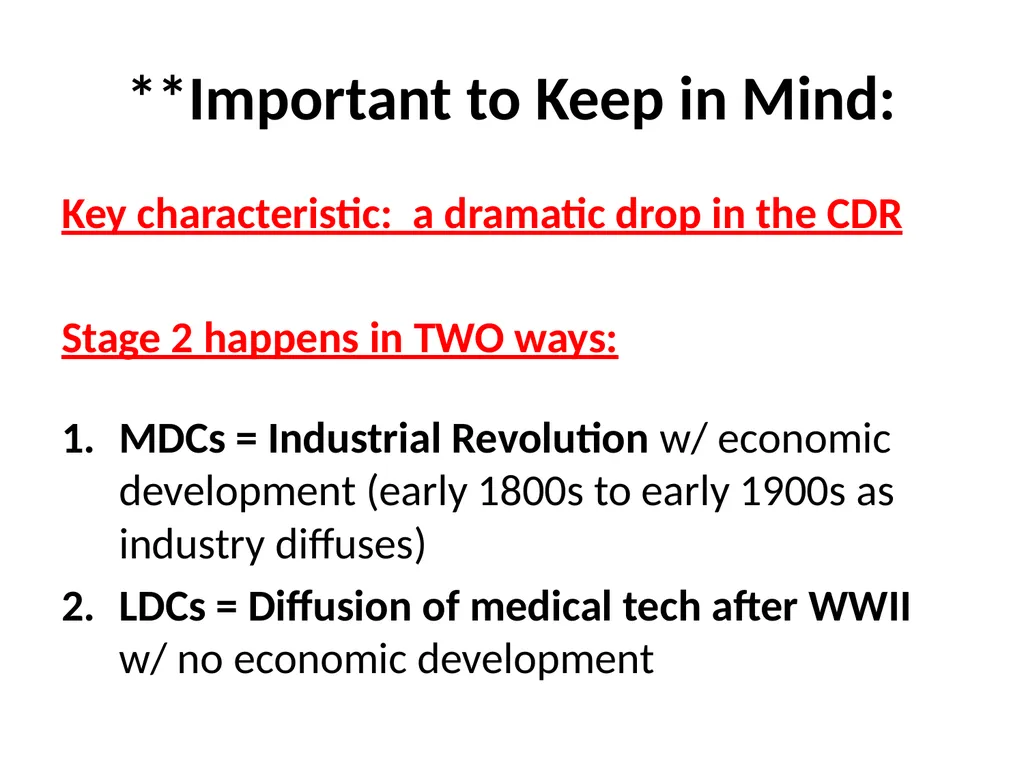
**Important to Keep in Mind: Key characteristic: a dramatic drop in the CDR
Stage 2 happens in TWO ways:
MDCs = Industrial Revolution w/ economic development (early 1800s to early 1900s as industry diffuses)
LDCs = Diffusion of medical tech after WWII w/ no economic development<br>
Stage 2 happens in TWO ways:
MDCs = Industrial Revolution w/ economic development (early 1800s to early 1900s as industry diffuses)
LDCs = Diffusion of medical tech after WWII w/ no economic development<br>
13
Stage Three<br>
14
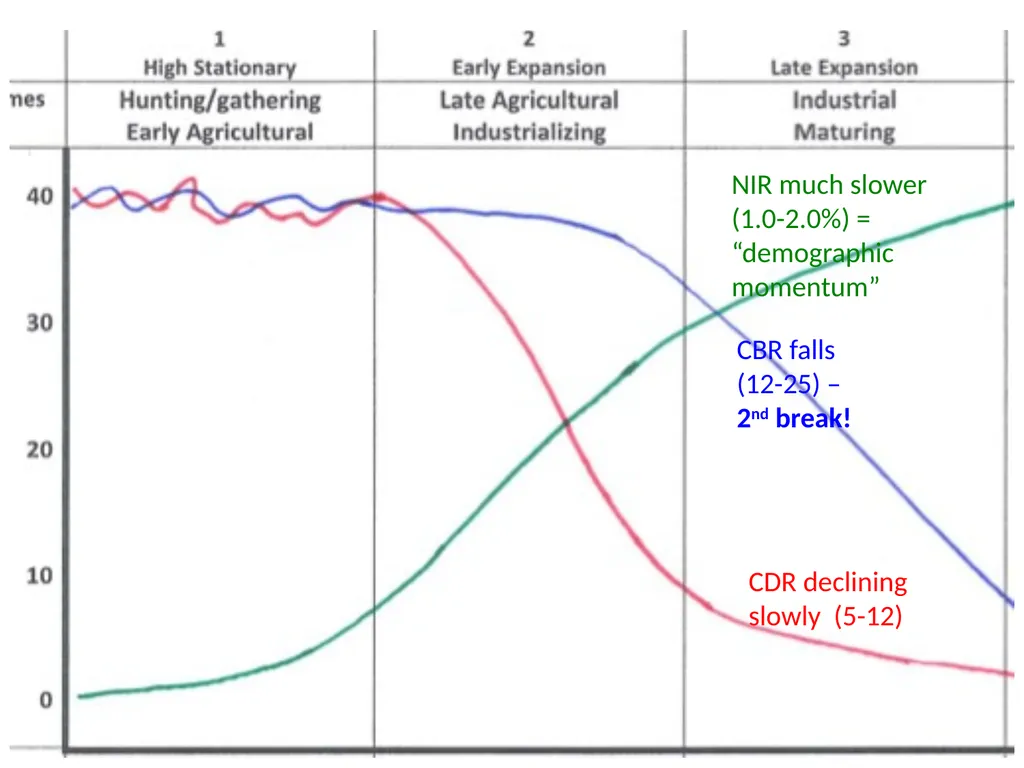
Stage 3: “Late Expansion” Predict: What happens to the lines in Stage 3? (CDR, CBR, NIR/Total Population) CBR falls (12-25) – 2nd break! CDR declining slowly (5-12) NIR much slower (1.0-2.0%) = “demographic momentum”<br>
15
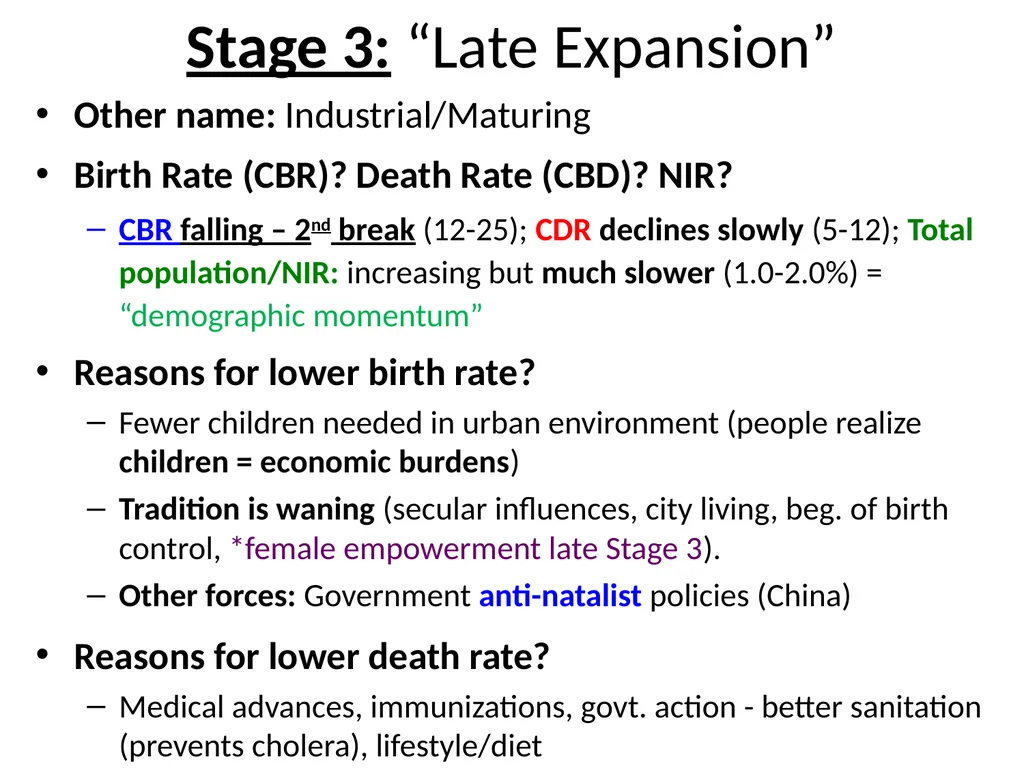
Stage 3: “Late Expansion” Other name: Industrial/Maturing
Birth Rate (CBR)? Death Rate (CBD)? NIR?
CBR falling – 2nd break (12-25); CDR declines slowly (5-12); Total population/NIR: increasing but much slower (1.0-2.0%) = “demographic momentum”
Reasons for lower birth rate?
Fewer children needed in urban environment (people realize children = economic burdens)
Tradition is waning (secular influences, city living, beg. of birth control, *female empowerment late Stage 3).
Other forces: Government anti-natalist policies (China)
Reasons for lower death rate?
Medical advances, immunizations, govt. action - better sanitation (prevents cholera), lifestyle/diet<br>
Birth Rate (CBR)? Death Rate (CBD)? NIR?
CBR falling – 2nd break (12-25); CDR declines slowly (5-12); Total population/NIR: increasing but much slower (1.0-2.0%) = “demographic momentum”
Reasons for lower birth rate?
Fewer children needed in urban environment (people realize children = economic burdens)
Tradition is waning (secular influences, city living, beg. of birth control, *female empowerment late Stage 3).
Other forces: Government anti-natalist policies (China)
Reasons for lower death rate?
Medical advances, immunizations, govt. action - better sanitation (prevents cholera), lifestyle/diet<br>
16
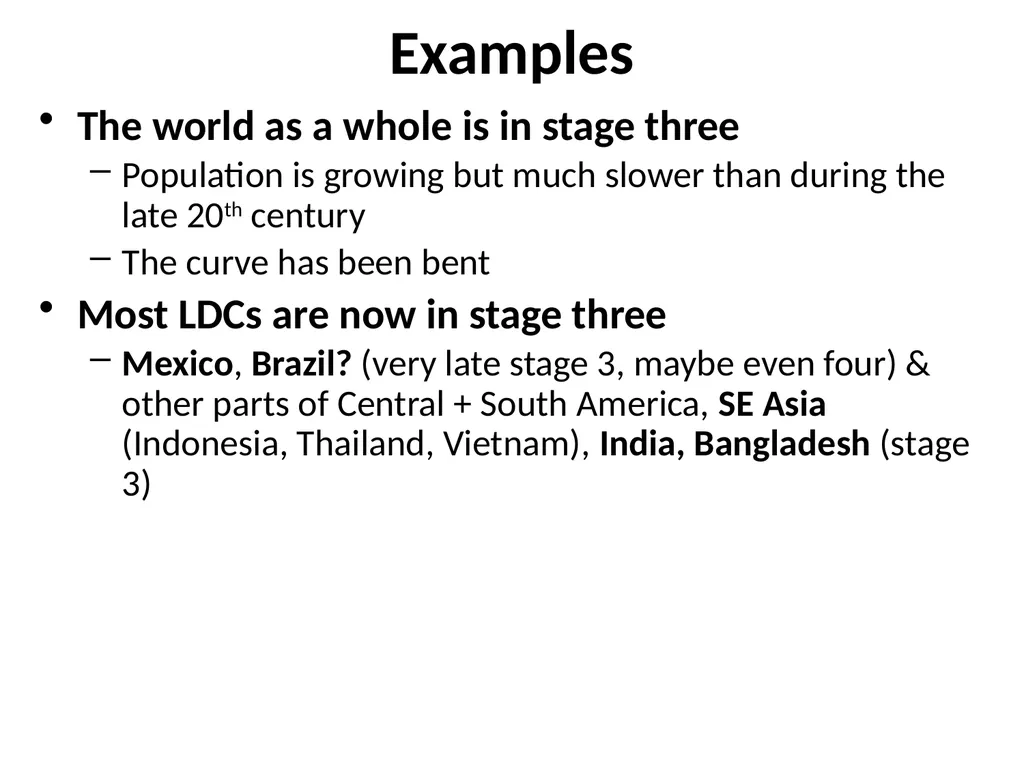
Examples The world as a whole is in stage three
Population is growing but much slower than during the late 20th century
The curve has been bent
Most LDCs are now in stage three
Mexico, Brazil? (very late stage 3, maybe even four) & other parts of Central + South America, SE Asia (Indonesia, Thailand, Vietnam), India, Bangladesh (stage 3)<br>
Population is growing but much slower than during the late 20th century
The curve has been bent
Most LDCs are now in stage three
Mexico, Brazil? (very late stage 3, maybe even four) & other parts of Central + South America, SE Asia (Indonesia, Thailand, Vietnam), India, Bangladesh (stage 3)<br>
17
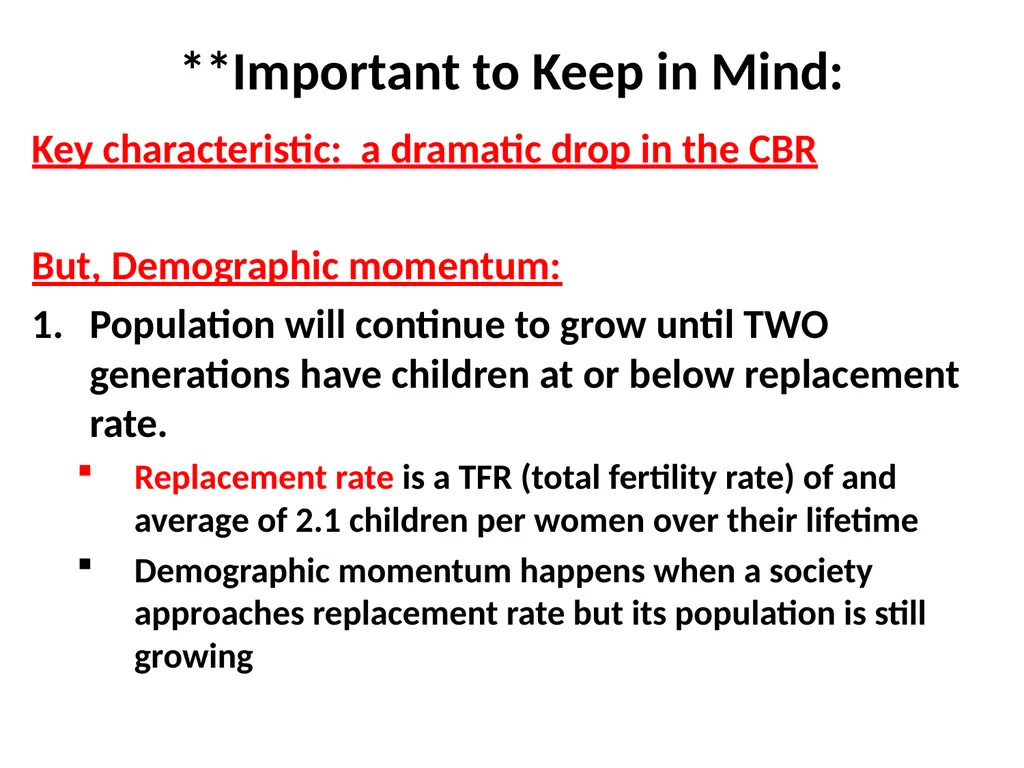
**Important to Keep in Mind: Key characteristic: a dramatic drop in the CBR
But, Demographic momentum:
Population will continue to grow until TWO generations have children at or below replacement rate.
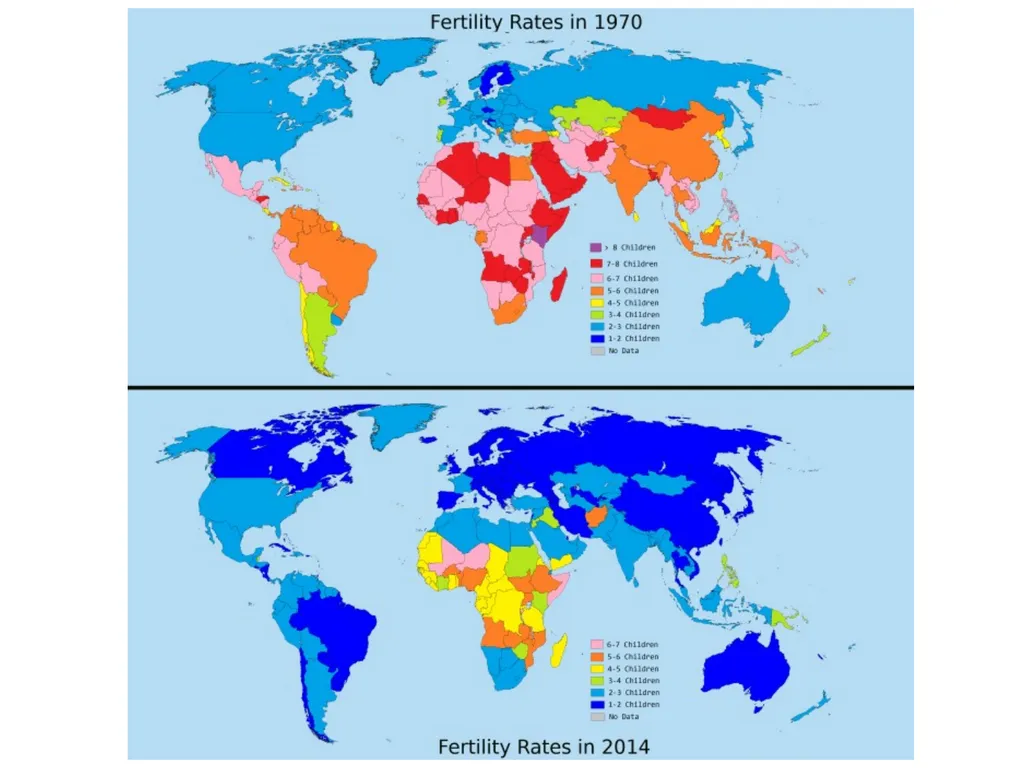
Replacement rate is a TFR (total fertility rate) of and average of 2.1 children per women over their lifetime
Demographic momentum happens when a society approaches replacement rate but its population is still growing<br>
But, Demographic momentum:
Population will continue to grow until TWO generations have children at or below replacement rate.
Replacement rate is a TFR (total fertility rate) of and average of 2.1 children per women over their lifetime
Demographic momentum happens when a society approaches replacement rate but its population is still growing<br>
18
Stage Four<br>
19
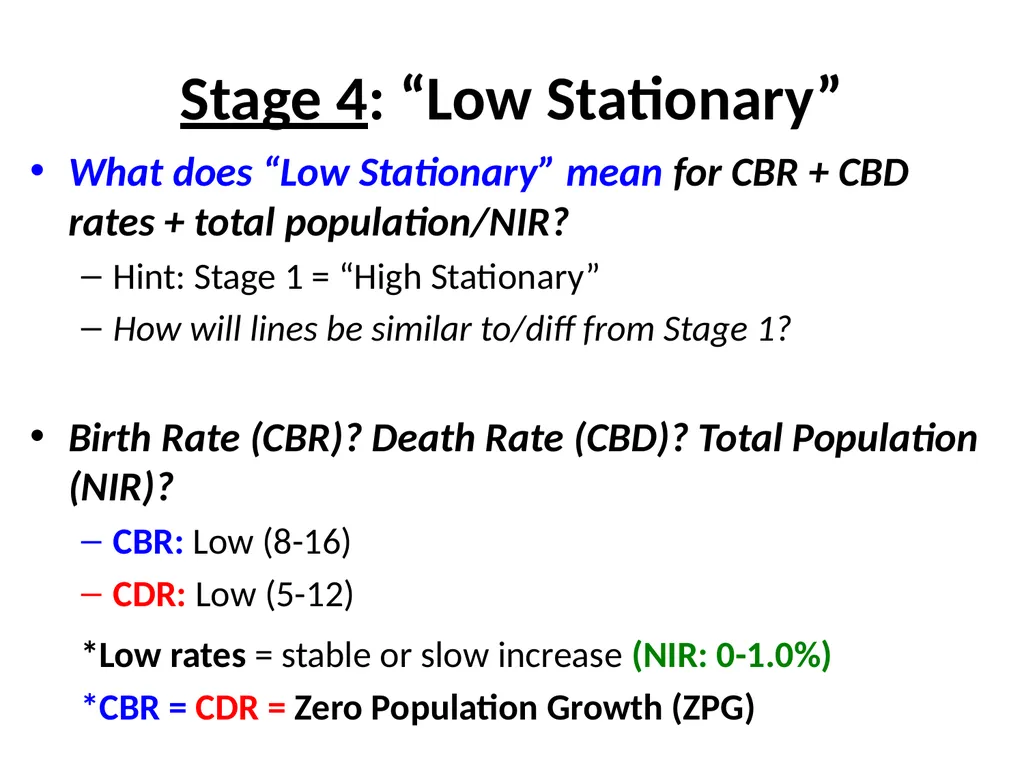
Stage 4: “Low Stationary” What does “Low Stationary” mean for CBR + CBD rates + total population/NIR?
Hint: Stage 1 = “High Stationary”
How will lines be similar to/diff from Stage 1?
Birth Rate (CBR)? Death Rate (CBD)? Total Population (NIR)?
CBR: Low (8-16)
CDR: Low (5-12)
*Low rates = stable or slow increase (NIR: 0-1.0%)
*CBR = CDR = Zero Population Growth (ZPG)<br>
Hint: Stage 1 = “High Stationary”
How will lines be similar to/diff from Stage 1?
Birth Rate (CBR)? Death Rate (CBD)? Total Population (NIR)?
CBR: Low (8-16)
CDR: Low (5-12)
*Low rates = stable or slow increase (NIR: 0-1.0%)
*CBR = CDR = Zero Population Growth (ZPG)<br>
20
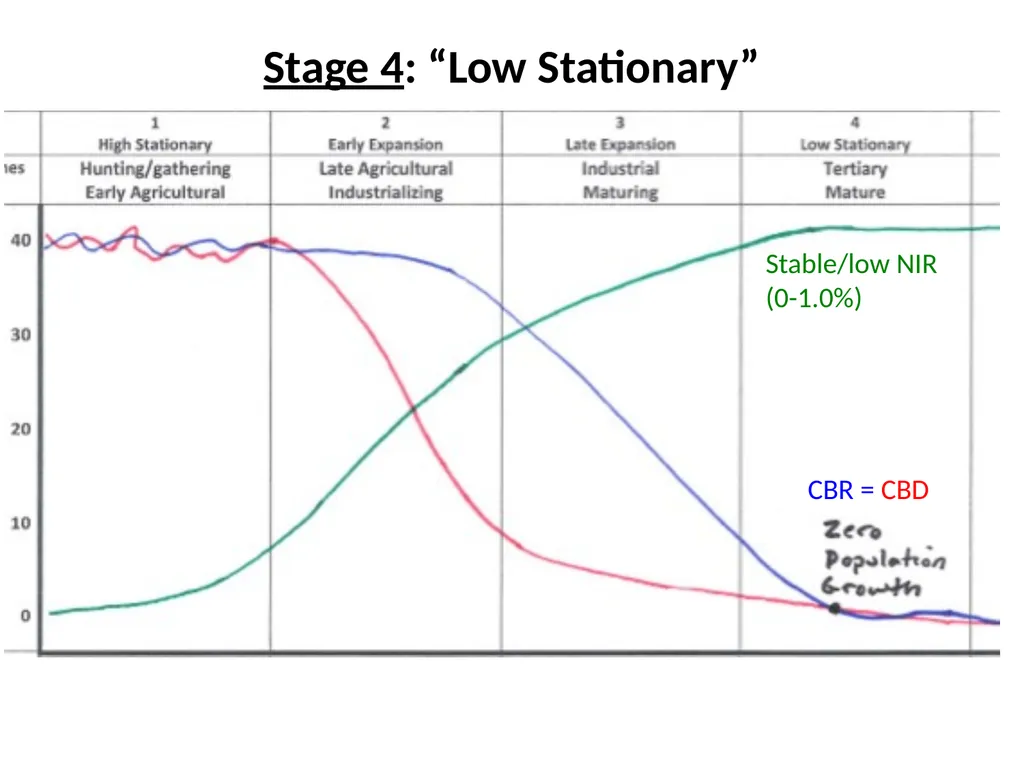
Stage 4: “Low Stationary” What does “Low Stable/low NIR (0-1.0%) CBR = CBD<br>
21
Stage 4: “Low Stationary” Other name: Tertiary/Mature/Post-Industrial
Birth Rate (CBR)? Death Rate (CBD)? NIR?
CBR low(8-16), CDR low (5-12)
CBR = CDR = Zero Population Growth (ZPG)**
Dying grandparents are replaced by children, demographic momentum has run its course, second generation to be at replacement rate fertility
Total population/NIR: stable/low (0-1.0%)
Reasons for low birth rate?
*Gender empowerment, family planning, later marriages, less traditional values (secular, urban influences), govt. encourages population control (anti-natalist policies)
Reasons for low death rate?
Lifestyle changes (diet, exercise), good healthcare - improved treatment for chronic diseases extends life expectancy (Lipitor for high cholesterol lowers risk of strokes)<br>
Birth Rate (CBR)? Death Rate (CBD)? NIR?
CBR low(8-16), CDR low (5-12)
CBR = CDR = Zero Population Growth (ZPG)**
Dying grandparents are replaced by children, demographic momentum has run its course, second generation to be at replacement rate fertility
Total population/NIR: stable/low (0-1.0%)
Reasons for low birth rate?
*Gender empowerment, family planning, later marriages, less traditional values (secular, urban influences), govt. encourages population control (anti-natalist policies)
Reasons for low death rate?
Lifestyle changes (diet, exercise), good healthcare - improved treatment for chronic diseases extends life expectancy (Lipitor for high cholesterol lowers risk of strokes)<br>
22
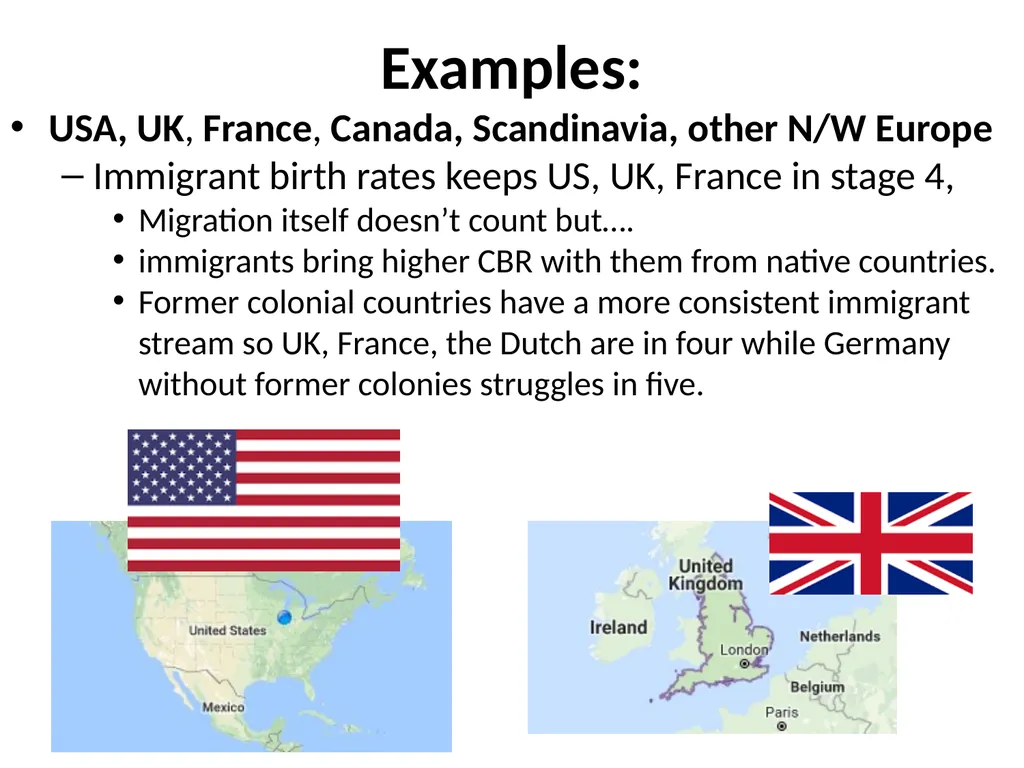
Examples: USA, UK, France, Canada, Scandinavia, other N/W Europe
Immigrant birth rates keeps US, UK, France in stage 4,
Migration itself doesn’t count but….
immigrants bring higher CBR with them from native countries.
Former colonial countries have a more consistent immigrant stream so UK, France, the Dutch are in four while Germany without former colonies struggles in five.<br>
Immigrant birth rates keeps US, UK, France in stage 4,
Migration itself doesn’t count but….
immigrants bring higher CBR with them from native countries.
Former colonial countries have a more consistent immigrant stream so UK, France, the Dutch are in four while Germany without former colonies struggles in five.<br>
23
Stage Five<br>
24
Stage 5: Declining/Theoretical? All countries in Stage 5 trying to fight it.
Why might Stage 5 be a bad place to be?
What is so bad about having a declining population?
*Can mean economic decline. Less customers, workers, lower GNI!
Birth rates? Death rates? Total Pop/NIR?
CBR = VERY low
CDR = Low, possibly going up/ increasing.
NIR = declining/ negative NIR (< 0%)<br>
Why might Stage 5 be a bad place to be?
What is so bad about having a declining population?
*Can mean economic decline. Less customers, workers, lower GNI!
Birth rates? Death rates? Total Pop/NIR?
CBR = VERY low
CDR = Low, possibly going up/ increasing.
NIR = declining/ negative NIR (< 0%)<br>
25
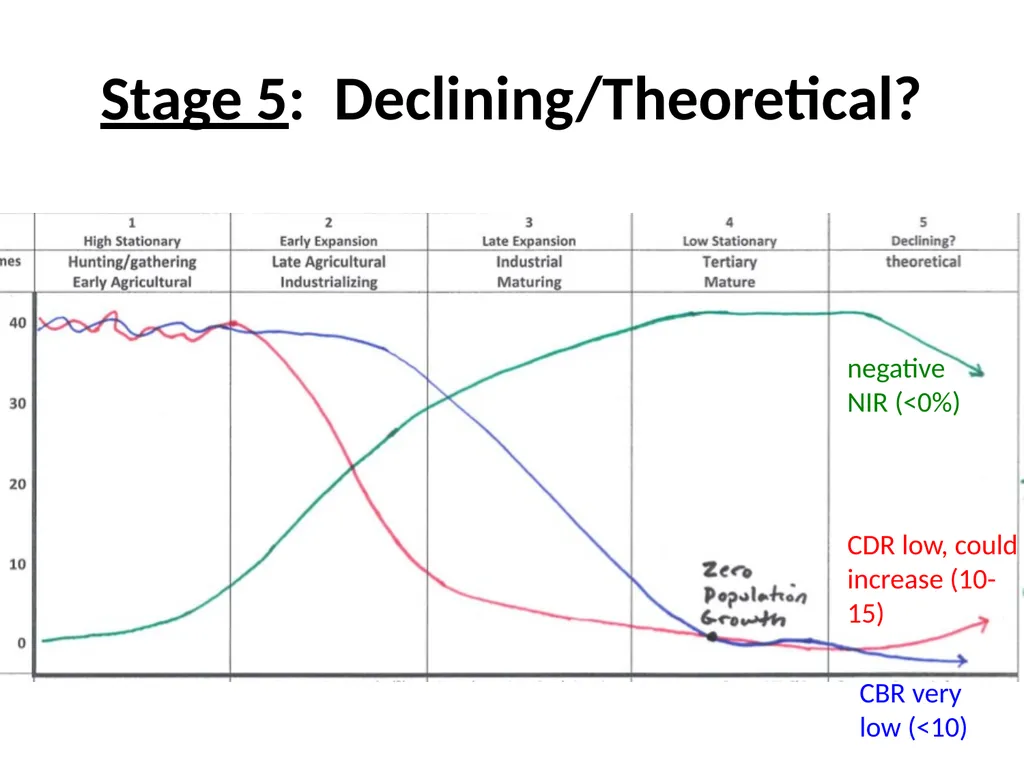
Stage 5: Declining/Theoretical? negative
NIR (<0%) CDR low, could increase (10-15) CBR very
low (<10)<br>
NIR (<0%) CDR low, could increase (10-15) CBR very
low (<10)<br>
26
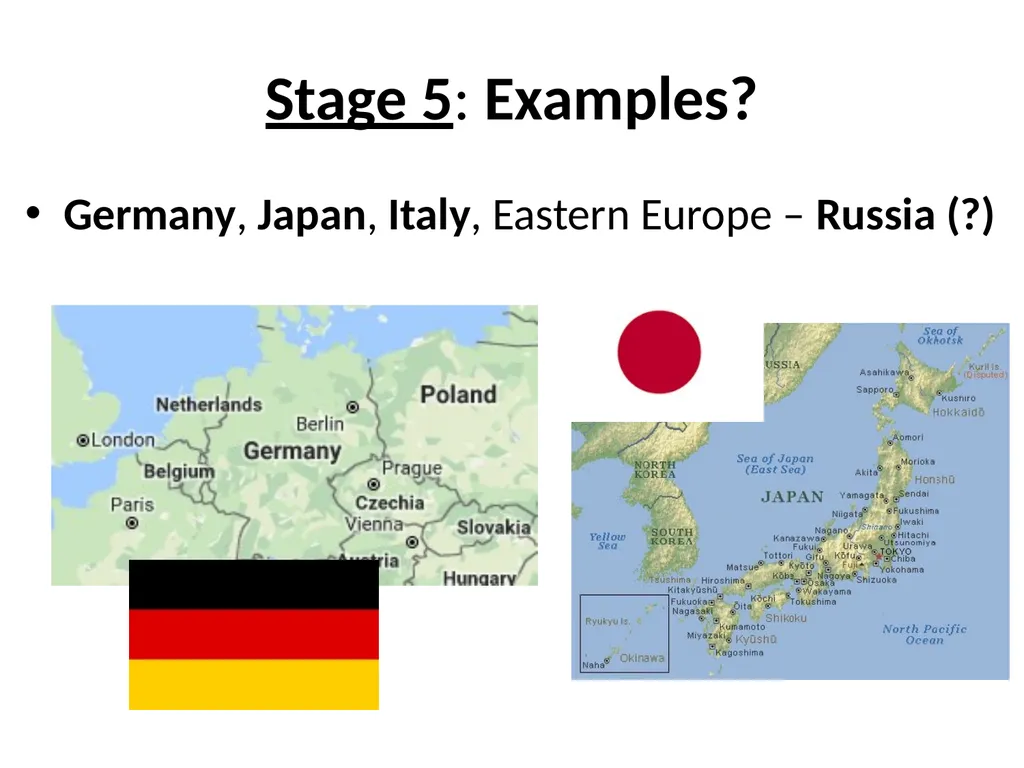
Stage 5: Examples? Germany, Japan, Italy, Eastern Europe – Russia (?)<br>
27
Stage 5: “Declining” Reasons for very low birth rates (CBR)?
Continuation of stage 4 trends
Female empowerment, economic cost of children
*Pessimism over bleak future (Russia, Eastern Europe – see similar pattern in “Rustbelt” states of US). No kids b/c why would you bring kids into declining future?
Reasons for death rates (CDR)?
Large elderly population increases death rate<br>
Continuation of stage 4 trends
Female empowerment, economic cost of children
*Pessimism over bleak future (Russia, Eastern Europe – see similar pattern in “Rustbelt” states of US). No kids b/c why would you bring kids into declining future?
Reasons for death rates (CDR)?
Large elderly population increases death rate<br>
28
Ways to face stage 5? Allow immigrants to come (Germany).
Immigration itself is not included on the DTM? But….
Immigration can offset declining birthrates, bolsters workforce, increases # of taxpayers
Immigrants often bring birthrate from their country of origin
keeps US, UK, France in stage 4;
Pro-natalist policies – encouraging childbirth as a positive thing
“Do it for Denmark”
Russia has increased its birth rates in the last decade.
Automation, vending machines (Japan)
Japan has liberalized immigration laws but
Immigration remains unpopular with people
Japanese believe in homogeneity; sameness of population.
Naturalization (citizenship) and other laws are more strict.<br>
Immigration itself is not included on the DTM? But….
Immigration can offset declining birthrates, bolsters workforce, increases # of taxpayers
Immigrants often bring birthrate from their country of origin
keeps US, UK, France in stage 4;
Pro-natalist policies – encouraging childbirth as a positive thing
“Do it for Denmark”
Russia has increased its birth rates in the last decade.
Automation, vending machines (Japan)
Japan has liberalized immigration laws but
Immigration remains unpopular with people
Japanese believe in homogeneity; sameness of population.
Naturalization (citizenship) and other laws are more strict.<br>
29
Solutions?<br>