Objectivity, Value Judgement, and Theory Choice by Thomas Kuhn Presented by Brett Park Two Theses Overview The Structure of Scientific Revolutions Science alternates between periods of normal and revolutionary science Normal science is
"Objectivity, Value Judgement, and Theory Choice by" is the property of its rightful owner. Permission is granted to
download and print the materials on this website for personal, non-commercial use only, and to display it
on your personal computer provided you do not modify the materials and that you retain all copyright
notices contained in the materials. By downloading content from our website, you accept the terms of this
agreement.
Presentation Transcript
01
Objectivity, Value Judgement, and Theory Choice by Thomas Kuhn Presented by Brett Park<br>
02
Two Theses<br>
03
Overview<br>
04
The Structure of Scientific Revolutions Science alternates between periods of normal and revolutionary science
Normal science is highly dogmatic by operating within a paradigm, and its primary operation is “puzzle solving”
Eventually, enough unsolved puzzles, or anomalies accumulate, and a period of revolutionary science begins
Revolutionary science is undogmatic as new paradigms are considered
However, Kuhn does not think that choosing a new paradigm is entirely rational
Justification is circular
Paradigms are incommensurable<br>
05
Criticisms of Kuhn Leads to “relativism” – Dudley Shapere, p. 393
Makes theory choice “a matter of mob psychology ” – Imre Lakatos, p. 178
Acceptance by social scientists as evidence of the Strong Programme<br>
06
First Thesis Thesis 1: there is always subjective elements to theory choice, or, there is no single objective and rational algorithm for theory choice<br>
07
Five (non-exhaustive) Criteria for Theory Choice Accurate: agreement between consequences of a theory and observation
Consistent: not to contradict itself or other accepted theories
Broad in Scope: extends beyond what it was initially designed for
Simple: unifying disparate phenomena with few posits
Fruitful: disclose new phenomena, opens new areas of research<br>
08
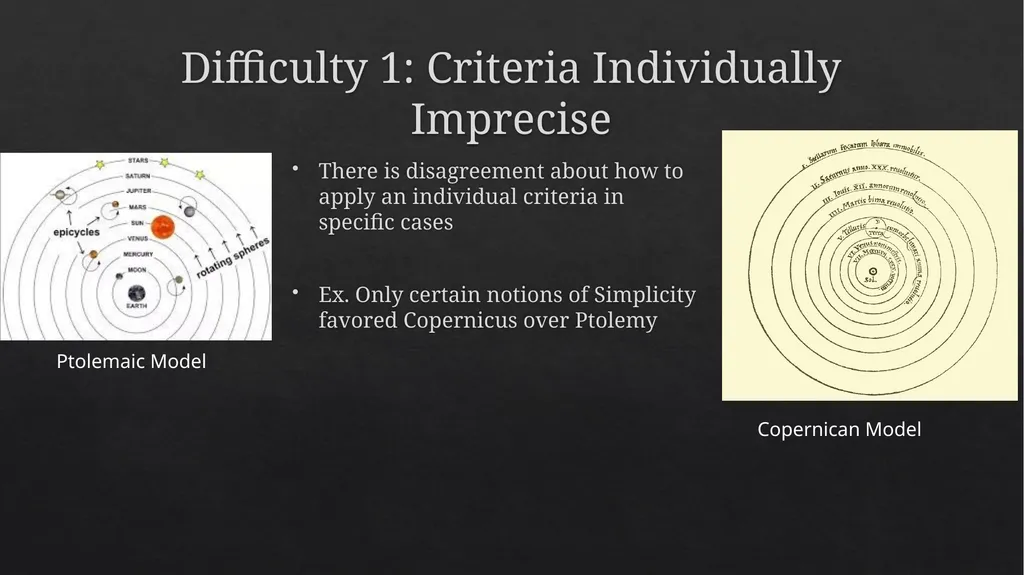
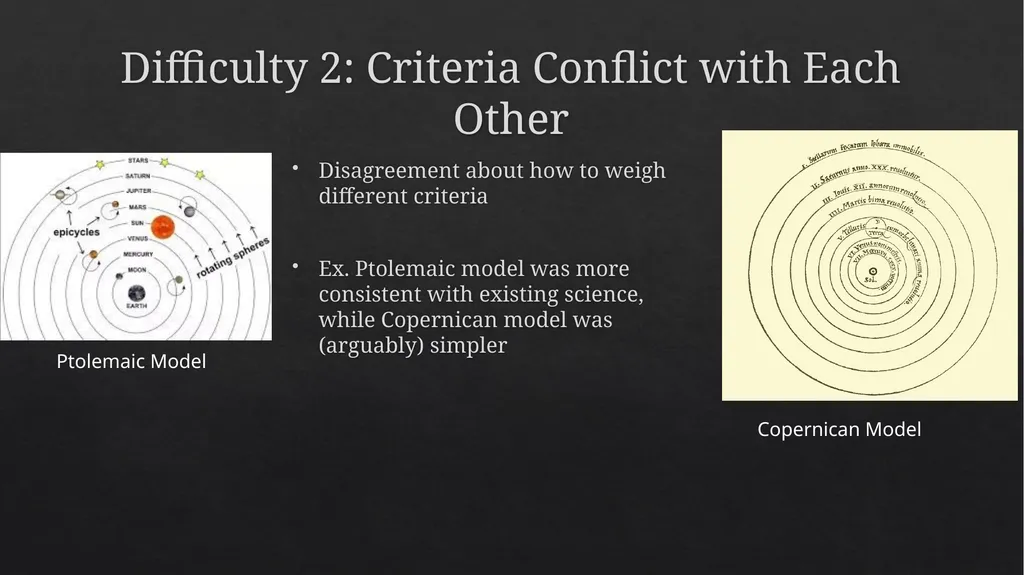
Difficulty 1: Criteria Individually Imprecise There is disagreement about how to apply an individual criteria in specific cases
Ex. Only certain notions of Simplicity favored Copernicus over Ptolemy Ptolemaic Model Copernican Model<br>
09
Difficulty 2: Criteria Conflict with Each Other Disagreement about how to weigh different criteria
Ex. Ptolemaic model was more consistent with existing science, while Copernican model was (arguably) simpler Ptolemaic Model Copernican Model<br>
10
Focus on Historical Details on Individual Scientists In order to understand why scientists choose one theory over another, historical details of individual scientists need to be examined
How entrenched was a scientists in the old theory?
Had they seen success advancing the old theory?
Did that success depend on concepts and techniques challenged by the new theory?
How did other philosophical/non-scientific commitments affect their readiness to accept the new theory?
Ex. Kepler’s adoption of Copernican model<br>
11
No Decision Algorithm Kuhn’s point is merely that there are both objective and subjective factors in theory choice
Alternatively, there is no single decision algorithm which would rationally constrain theory choice to a single answer in every situation
No unambiguous and exhaustive criteria
No single correct weights for those criteria<br>
12
Contexts of Discovery/Justification Distinction between the creation of new ideas and the justification of those ideas
Critic: Contexts of discovery have Kuhn’s subjective elements, but the context of justification is objective
Kuhn: Reject this distinction as a good idealization
We cannot trust scientific pedagogy, or “textbook science”, to give us an accurate account of the context of justification better than the context of discovery<br>
13
Second Thesis Thesis 2: Subjectivity in theory choice is an essential part of science<br>
14
Value Theory Values and norms often conflict, and rational people committed to the same values can disagree
No decision algorithm ex. William David Ross
Not a cause for abandonment of values
Criteria of choice are just another set of values<br>
15
If We Had a Decision Algorithm... All scientists would arrive at the same conclusion
Set the bar for new theories too low, and we have constant revolutions
Set the bar too high, and new theories are never attempted
The heterogeneity of criteria application encourages a healthy amount of novelty<br>
16
Epilogue Clarifications on:
Value Invariance
Partial Communication<br>
17
Value Invariance Assumed that values/criteria of choice remains fixed over time
Rather, those values gradually evolve as science progresses
Adding new values
Different application of values
Weights associated with them<br>
18
Partial Communication Assumed that communication between holders of different theories is unproblematic
In Structure, he calls them ‘conversions’ rather than choices
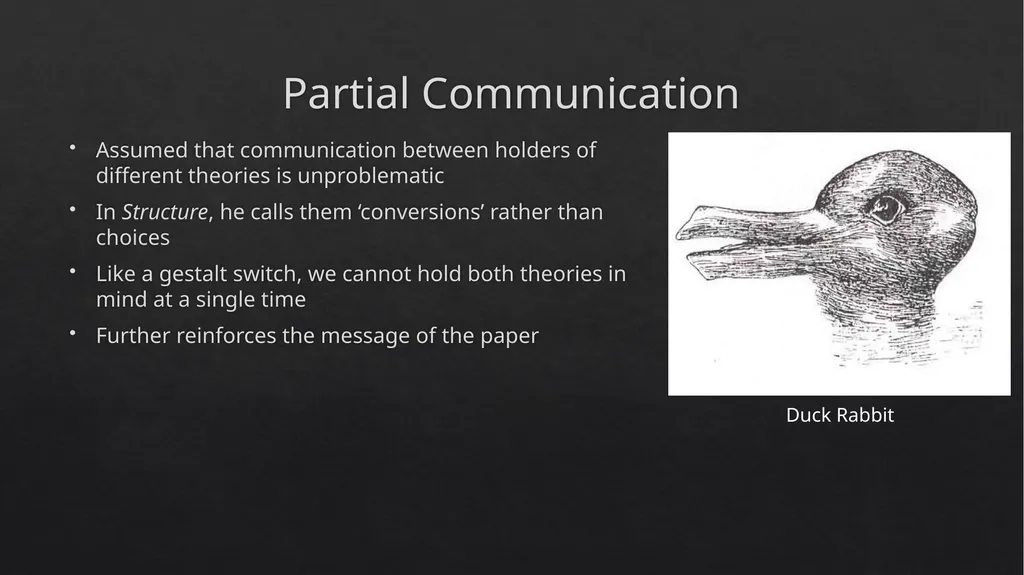
Like a gestalt switch, we cannot hold both theories in mind at a single time
Further reinforces the message of the paper Duck Rabbit<br>
19
Gems Illustrates a specific purpose for history/philosophy of science
Uses historical examples
Interesting paper structure – assume opponents’ framing, then reinterpret<br>