
Obstetrics CHAPTER 42 Introduction Pregnancy is
LD
Published · 182 slides · 0 views

1 / 1









Description
Obstetrics CHAPTER 42 Introduction Pregnancy is not a disease needing treatment. Have a calm demeanor and confident approach. Modern medicine has significantly reduced maternal and infant mortality rates. Anatomy and Physiology Review
Related Topics
Share
Embed code
Download this presentation From Below
"Obstetrics CHAPTER 42 Introduction Pregnancy is" is the property of its rightful owner. Permission is granted to download and print the materials on this website for personal, non-commercial use only, and to display it on your personal computer provided you do not modify the materials and that you retain all copyright notices contained in the materials. By downloading content from our website, you accept the terms of this agreement.
Presentation Transcript
01
Obstetrics CHAPTER 42<br>
02
Introduction Pregnancy is not a disease needing treatment.
Have a calm demeanor and confident approach.
Modern medicine has significantly reduced maternal and infant mortality rates.<br>
Have a calm demeanor and confident approach.
Modern medicine has significantly reduced maternal and infant mortality rates.<br>
03
Anatomy and Physiology Review<br>
04
Anatomy and Physiology Review (1 of 10) Female reproductive organs include:
Two ovaries
Two fallopian tubes
Uterus
Cervix
Vagina
Mammary glands
External genitalia<br>
Two ovaries
Two fallopian tubes
Uterus
Cervix
Vagina
Mammary glands
External genitalia<br>
05
Anatomy and Physiology Review (2 of 10) Ovaries
Each ovary contains about 200,000 follicles, with each one containing an egg.
Each month, several follicles begin the maturation process.
Only a single follicle releases an ovum.<br>
Each ovary contains about 200,000 follicles, with each one containing an egg.
Each month, several follicles begin the maturation process.
Only a single follicle releases an ovum.<br>
06
Anatomy and Physiology Review (3 of 10) The cycle continues with the release of hormones throughout various stages.
The anterior pituitary gland releases:
Follicle-stimulating hormone
Luteinizing hormone
At the end of pregnancy, prostaglandins and oxytocin signal uterine contractions and labor.<br>
The anterior pituitary gland releases:
Follicle-stimulating hormone
Luteinizing hormone
At the end of pregnancy, prostaglandins and oxytocin signal uterine contractions and labor.<br>
07
Anatomy and Physiology Review (4 of 10) The ovum travels from the ovaries into the uterus through the fallopian tubes.
Ciliary motion sweeps the egg into the fallopian tube.
Smooth muscle contractions and inner mucosa move the ovum through the tube to the uterus.<br>
Ciliary motion sweeps the egg into the fallopian tube.
Smooth muscle contractions and inner mucosa move the ovum through the tube to the uterus.<br>
08
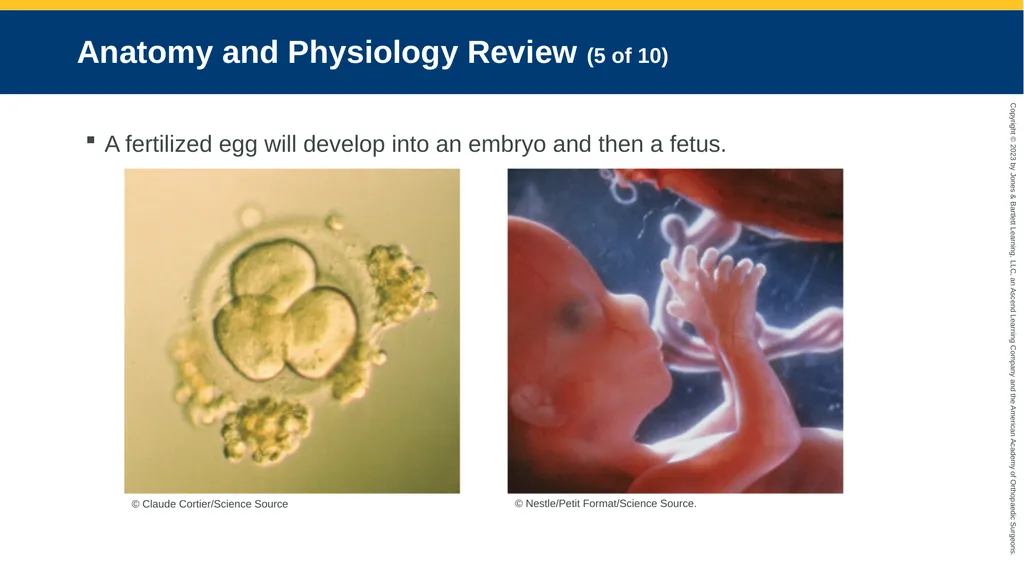
Anatomy and Physiology Review (5 of 10) A fertilized egg will develop into an embryo and then a fetus. © Claude Cortier/Science Source © Nestle/Petit Format/Science Source.<br>
09
Anatomy and Physiology Review (6 of 10) Uterus: organ that lies between the urinary bladder and the rectum
The uterus is where:
The fertilized ovum implants.
The fetus develops.
Labor takes place.<br>
The uterus is where:
The fertilized ovum implants.
The fetus develops.
Labor takes place.<br>
10
Anatomy and Physiology Review (7 of 10) Three layers of tissues in the uterus:
Perimetrium
Myometrium
Endometrium
Cervix
Opens into the vagina<br>
Perimetrium
Myometrium
Endometrium
Cervix
Opens into the vagina<br>
11
Anatomy and Physiology Review (8 of 10) Functions of the vagina include:
Receptacle for penis during sexual intercourse
Passage for exit of menstrual flow
Passage for childbirth<br>
Receptacle for penis during sexual intercourse
Passage for exit of menstrual flow
Passage for childbirth<br>
12
Anatomy and Physiology Review (9 of 10) Stretches to accommodate fetus delivery
If it doesn’t stretch enough:
Tissues in and around the perineum can tear.
Significant pain and bleeding may occur.<br>
If it doesn’t stretch enough:
Tissues in and around the perineum can tear.
Significant pain and bleeding may occur.<br>
13
Anatomy and Physiology Review (10 of 10) Primary purpose of mammary glands: lactation
Signs that a woman is most likely pregnant:
Breast enlargement
Tenderness
Milk excretion<br>
Signs that a woman is most likely pregnant:
Breast enlargement
Tenderness
Milk excretion<br>
14
Conception and Fetal Development<br>
15
Conception and Fetal Development (1 of 6) Once the egg has been fertilized and implanted, major changes occur.
Cells multiply on the outside of the egg surface, forming layers that will generate:
Fetal membrane
Placenta
Embryo<br>
Cells multiply on the outside of the egg surface, forming layers that will generate:
Fetal membrane
Placenta
Embryo<br>
16
Conception and Fetal Development (2 of 6) The blastocyst migrates to the endometrial wall and becomes implanted a week after conception.
Implantation triggers the development of placental tissues.
The corpus luteum produces hormones to support pregnancy until the placenta develops.<br>
Implantation triggers the development of placental tissues.
The corpus luteum produces hormones to support pregnancy until the placenta develops.<br>
17
Conception and Fetal Development (3 of 6) Two weeks after conception:
The blastocyst evolves into an embryonic disc.
The embryo begins to draw on maternal circulation.
Three weeks after conception:
The blastocyst becomes an embryo.
Body systems form.
The heart beats.
Blood cells circulate.<br>
The blastocyst evolves into an embryonic disc.
The embryo begins to draw on maternal circulation.
Three weeks after conception:
The blastocyst becomes an embryo.
Body systems form.
The heart beats.
Blood cells circulate.<br>
18
Conception and Fetal Development (4 of 6) In the fourth week of pregnancy, the placenta develops.
Serves as an early liver
Produces antibodies
Functions as fetal lungs
Transports nutrients and excretes wastes
Transfers heat from the mother to the fetus
Forms a barrier against harmful substances<br>
Serves as an early liver
Produces antibodies
Functions as fetal lungs
Transports nutrients and excretes wastes
Transfers heat from the mother to the fetus
Forms a barrier against harmful substances<br>
19
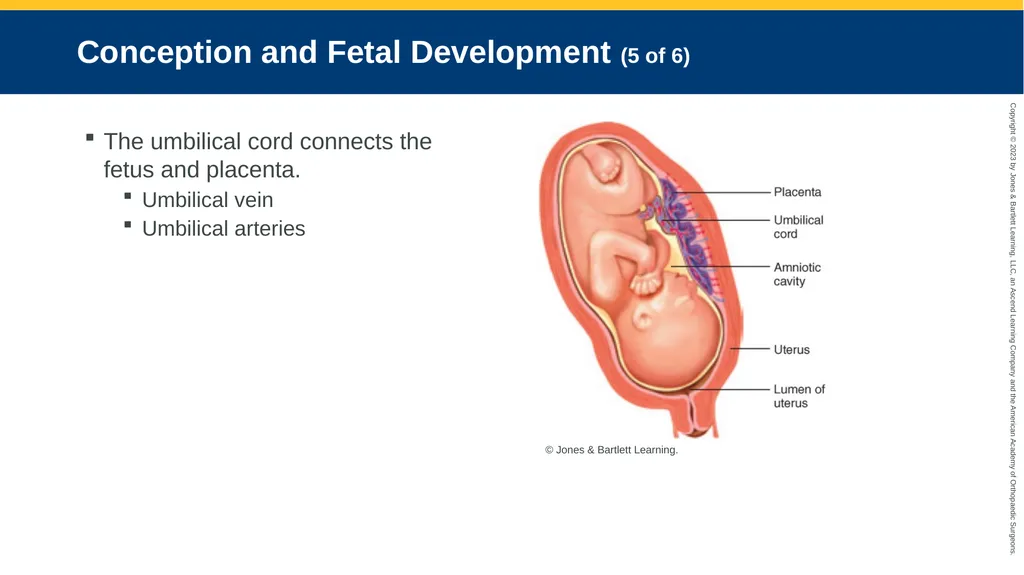
Conception and Fetal Development (5 of 6) The umbilical cord connects the fetus and placenta.
Umbilical vein
Umbilical arteries © Jones & Bartlett Learning.<br>
Umbilical vein
Umbilical arteries © Jones & Bartlett Learning.<br>
20
Conception and Fetal Development (6 of 6) The amniotic sac encloses the fetus in amniotic fluid.
Major organs and other body systems are formed in the fourth through eighth week of embryonic development.
The gestational period is normally 38 weeks.
Calculated from the first day of the pregnant woman’s last menstrual period<br>
Major organs and other body systems are formed in the fourth through eighth week of embryonic development.
The gestational period is normally 38 weeks.
Calculated from the first day of the pregnant woman’s last menstrual period<br>
21
Physiologic Maternal Changes During Pregnancy<br>
22
Physiologic Maternal Changes During Pregnancy (1 of 13) Physiologic changes occurring throughout pregnancy can:
Alter normal response to trauma
Exacerbate or create medical conditions<br>
Alter normal response to trauma
Exacerbate or create medical conditions<br>
23
Physiologic Maternal Changes During Pregnancy (2 of 13) Significant changes occur in the uterus.
Before pregnancy, the uterus:
Weighs about 70 g (2.5 oz)
Has a fluid capacity of about 10 mL
At the end of the pregnancy, the uterus:
Weighs as much as 1100 to 1200 g (2.24 to 2.6 lb)
Has the capacity to hold about 5,000 mL<br>
Before pregnancy, the uterus:
Weighs about 70 g (2.5 oz)
Has a fluid capacity of about 10 mL
At the end of the pregnancy, the uterus:
Weighs as much as 1100 to 1200 g (2.24 to 2.6 lb)
Has the capacity to hold about 5,000 mL<br>
24
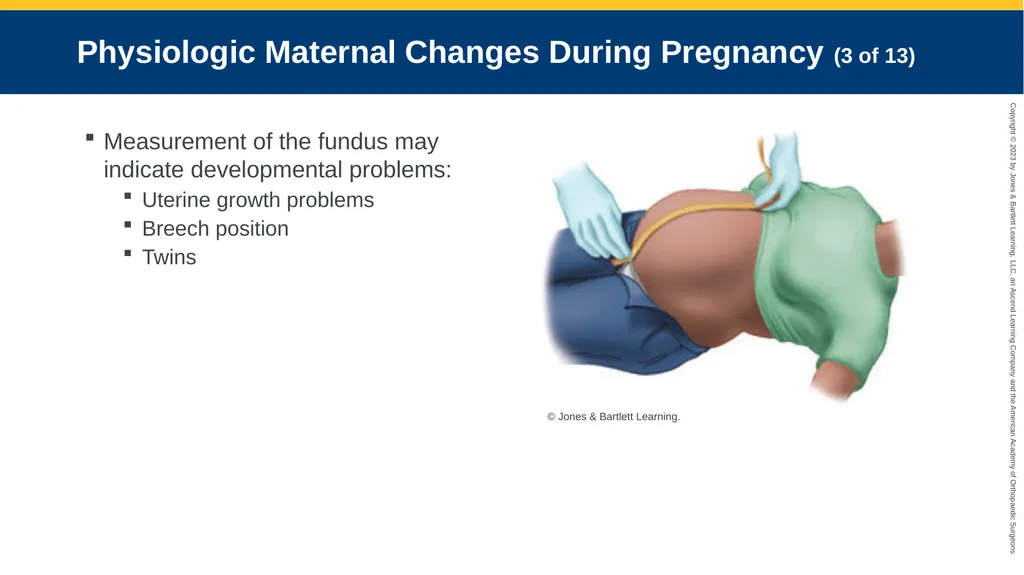
Physiologic Maternal Changes During Pregnancy (3 of 13) Measurement of the fundus may indicate developmental problems:
Uterine growth problems
Breech position
Twins © Jones & Bartlett Learning.<br>
Uterine growth problems
Breech position
Twins © Jones & Bartlett Learning.<br>
25
Physiologic Maternal Changes During Pregnancy (4 of 13) Pressure occurs on intestine and rectum.
Smooth muscle in the GI tract relaxes.
Stomach is not emptied as quickly.
Kidneys increase in size and volume.
Ureters increase in diameter.
Hormones cause changes to the skin, hair, and eyes.<br>
Smooth muscle in the GI tract relaxes.
Stomach is not emptied as quickly.
Kidneys increase in size and volume.
Ureters increase in diameter.
Hormones cause changes to the skin, hair, and eyes.<br>
26
Physiologic Maternal Changes During Pregnancy (5 of 13) Circulatory changes
Blood volume increases up to 50% more to:
Meet fetal metabolic needs
Adequately perfuse maternal organs
Help compensate for blood loss in delivery<br>
Blood volume increases up to 50% more to:
Meet fetal metabolic needs
Adequately perfuse maternal organs
Help compensate for blood loss in delivery<br>
27
Physiologic Maternal Changes During Pregnancy (6 of 13) Circulatory changes (cont’d)
The number of red and white blood cells increases.
Clotting factors and concentrations of fibrinogen increase.
The size of the heart and blood volume increases.<br>
The number of red and white blood cells increases.
Clotting factors and concentrations of fibrinogen increase.
The size of the heart and blood volume increases.<br>
28
Physiologic Maternal Changes During Pregnancy (7 of 13) The heart rate gradually increases by an average of 15 to 20 beats/min by term.
ECG changes may include:
Ectopic beats
Supraventricular tachycardia
Slight left axis deviation
Lead III changes<br>
ECG changes may include:
Ectopic beats
Supraventricular tachycardia
Slight left axis deviation
Lead III changes<br>
29
Physiologic Maternal Changes During Pregnancy (8 of 13) Sensitivity to body position increases as gestation increases.
Lying supine can cause compression of the inferior vena cava.
If pressure is not relieved, cardiac output is decreased.<br>
Lying supine can cause compression of the inferior vena cava.
If pressure is not relieved, cardiac output is decreased.<br>
30
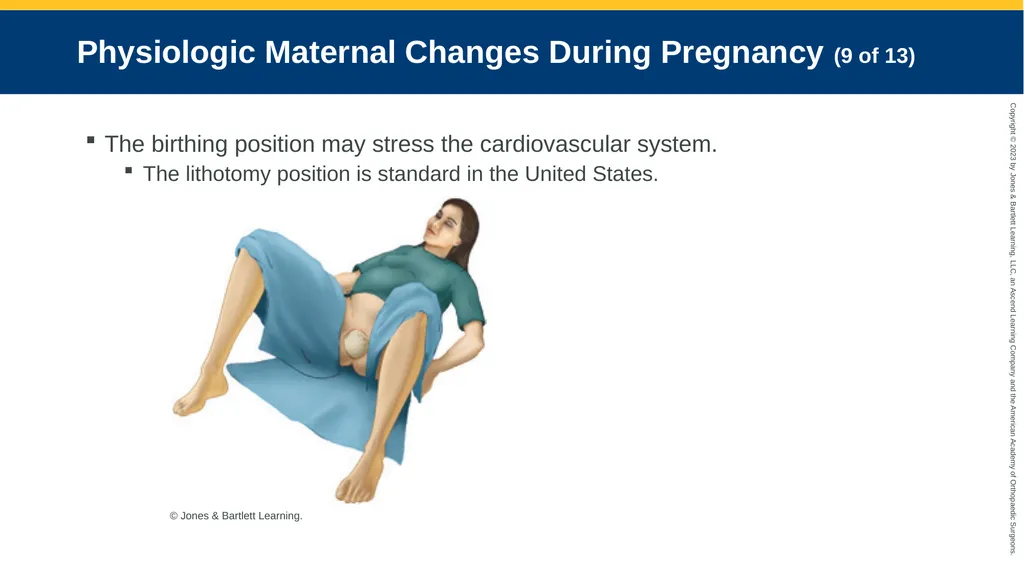
Physiologic Maternal Changes During Pregnancy (9 of 13) The birthing position may stress the cardiovascular system.
The lithotomy position is standard in the United States. © Jones & Bartlett Learning.<br>
The lithotomy position is standard in the United States. © Jones & Bartlett Learning.<br>
31
Physiologic Maternal Changes During Pregnancy (10 of 13) Respiratory changes
The diaphragm is pushed up by the uterus.
Maternal oxygen demand increases.
Progesterone does the following:
Decreases threshold to carbon dioxide
Causes the bronchi to dilate
Regulates mucus production<br>
The diaphragm is pushed up by the uterus.
Maternal oxygen demand increases.
Progesterone does the following:
Decreases threshold to carbon dioxide
Causes the bronchi to dilate
Regulates mucus production<br>
32
Physiologic Maternal Changes During Pregnancy (11 of 13) Respiratory changes (cont’d)
A decrease in:
Expiratory reserve volume
Functional residual capacity
Residual volume
An increase in:
Tidal volume
Inspiratory reserve volume
Structural changes with the respiratory mucous membranes result in:
Increased vascularity
Edema<br>
A decrease in:
Expiratory reserve volume
Functional residual capacity
Residual volume
An increase in:
Tidal volume
Inspiratory reserve volume
Structural changes with the respiratory mucous membranes result in:
Increased vascularity
Edema<br>
33
Physiologic Maternal Changes During Pregnancy (12 of 13) Maternal metabolism
Weight gain averages 27 lb (12.3 kg).
Increased blood volume and intracellular and extracellular fluid
Uterine growth
Placental and fetal growth
Increased breast tissue
Increased proteins and fat deposits<br>
Weight gain averages 27 lb (12.3 kg).
Increased blood volume and intracellular and extracellular fluid
Uterine growth
Placental and fetal growth
Increased breast tissue
Increased proteins and fat deposits<br>
34
Physiologic Maternal Changes During Pregnancy (13 of 13) Maternal metabolism
Relaxin softens collagenous tissues and relaxes the ligamentous system.
Increased demand for carbohydrates<br>
Relaxin softens collagenous tissues and relaxes the ligamentous system.
Increased demand for carbohydrates<br>
35
Cultural Value Considerations<br>
36
Cultural Value Considerations Some cultures have a value system that affects their pregnancy.
Some do not permit a male health care provider to examine a pregnant patient.
Different cultures view pregnancy differently.<br>
Some do not permit a male health care provider to examine a pregnant patient.
Different cultures view pregnancy differently.<br>
37
Adolescent Pregnancy The United States has one of the highest teenage pregnancy rates among developed countries.
Pregnancy is a possibility when assessing all female teenagers.
Respect privacy and independence.<br>
Pregnancy is a possibility when assessing all female teenagers.
Respect privacy and independence.<br>
38
Patient Assessment<br>
39
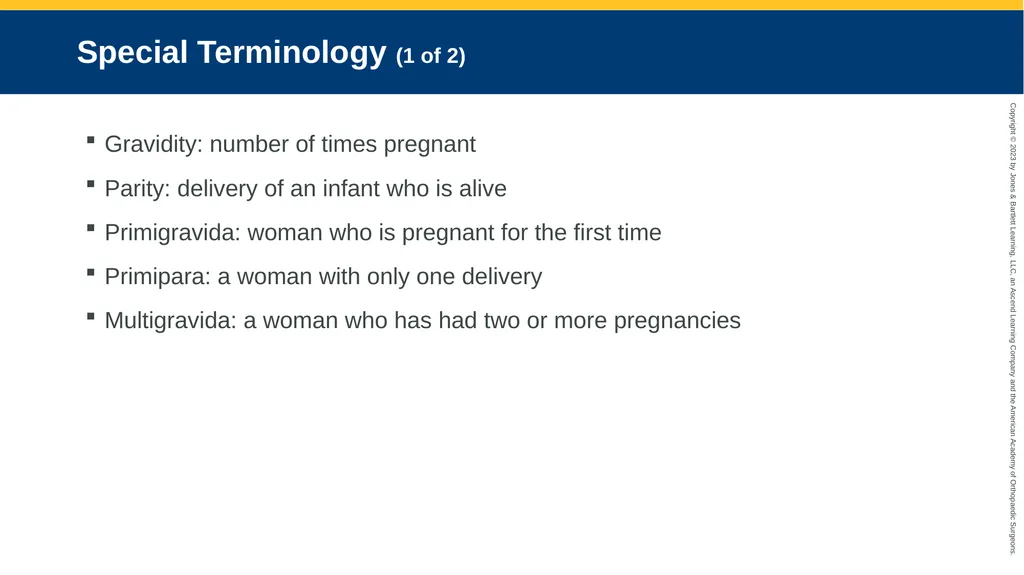
Special Terminology (1 of 2) Gravidity: number of times pregnant
Parity: delivery of an infant who is alive
Primigravida: woman who is pregnant for the first time
Primipara: a woman with only one delivery
Multigravida: a woman who has had two or more pregnancies<br>
Parity: delivery of an infant who is alive
Primigravida: woman who is pregnant for the first time
Primipara: a woman with only one delivery
Multigravida: a woman who has had two or more pregnancies<br>
40
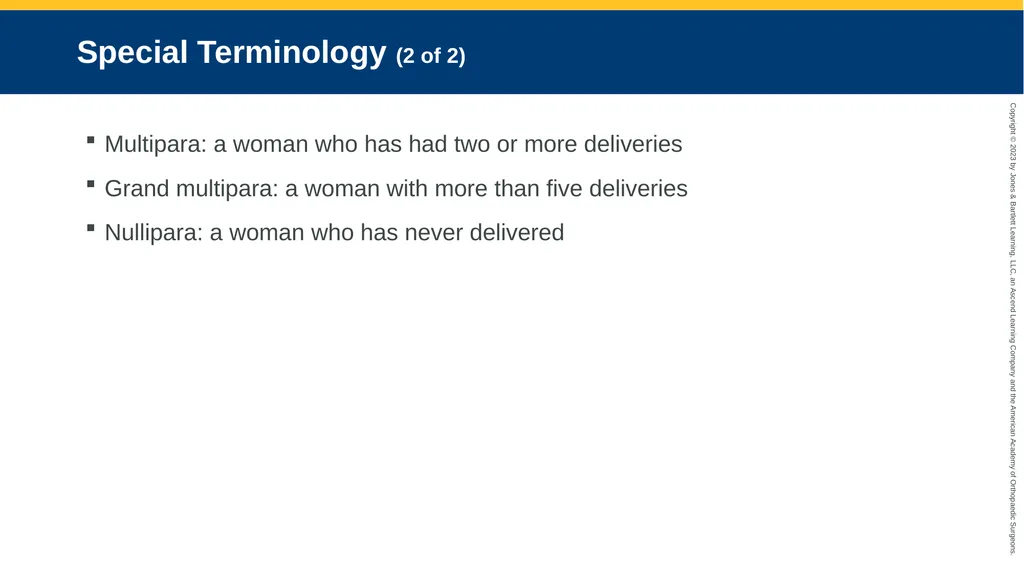
Special Terminology (2 of 2) Multipara: a woman who has had two or more deliveries
Grand multipara: a woman with more than five deliveries
Nullipara: a woman who has never delivered<br>
Grand multipara: a woman with more than five deliveries
Nullipara: a woman who has never delivered<br>
41
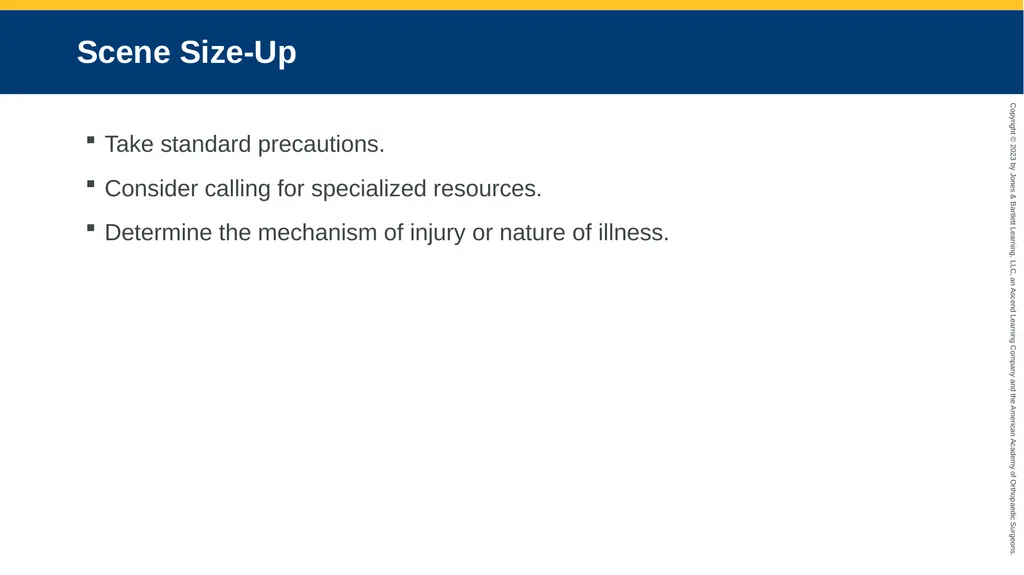
Scene Size-Up Take standard precautions.
Consider calling for specialized resources.
Determine the mechanism of injury or nature of illness.<br>
Consider calling for specialized resources.
Determine the mechanism of injury or nature of illness.<br>
42
Primary Assessment (1 of 4) Form a general impression.
Determine if there is time for further evaluation.
Evaluate trauma or other medical problems first.
Use the AVPU scale to determine the level of consciousness.<br>
Determine if there is time for further evaluation.
Evaluate trauma or other medical problems first.
Use the AVPU scale to determine the level of consciousness.<br>
43
Primary Assessment (2 of 4) Airway and breathing
Danger is generally not an issue in an uncomplicated birth.
If there is trauma, assess for airway and breathing.
Circulation
Assess early for life-threatening bleeding.
Assess the skin CTC and check the pulse.
Establish a minimum of one IV line.<br>
Danger is generally not an issue in an uncomplicated birth.
If there is trauma, assess for airway and breathing.
Circulation
Assess early for life-threatening bleeding.
Assess the skin CTC and check the pulse.
Establish a minimum of one IV line.<br>
44
Primary Assessment (3 of 4) Transport decision
If delivery is imminent, prepare to deliver at the scene.
If delivery is not imminent, transport the woman lying on the left side when possible.<br>
If delivery is imminent, prepare to deliver at the scene.
If delivery is not imminent, transport the woman lying on the left side when possible.<br>
45
Primary Assessment (4 of 4) Transport decision (cont’d)
Provide rapid transport for patients:
With significant bleeding and pain
Who are hypertensive
Who are having a seizure
Who have an altered mental status<br>
Provide rapid transport for patients:
With significant bleeding and pain
Who are hypertensive
Who are having a seizure
Who have an altered mental status<br>
46
History Taking (1 of 3) Determine chief complaint using OPQRST.
Obtain the SAMPLE history.
Determine previous complications or gynecologic problems.<br>
Obtain the SAMPLE history.
Determine previous complications or gynecologic problems.<br>
47
History Taking (2 of 3) Was an ultrasound done recently, and what were the findings?
Determine the general impression of the patient’s health.
Determine if there is any vaginal bleeding.<br>
Determine the general impression of the patient’s health.
Determine if there is any vaginal bleeding.<br>
48
History Taking (3 of 3) Determine if the woman’s water has broken.
Does she need to move her bowels or push?
If so, delivery is imminent.
What are the contractions like, and how frequent are they?
Inspect the woman for crowning.<br>
Does she need to move her bowels or push?
If so, delivery is imminent.
What are the contractions like, and how frequent are they?
Inspect the woman for crowning.<br>
49
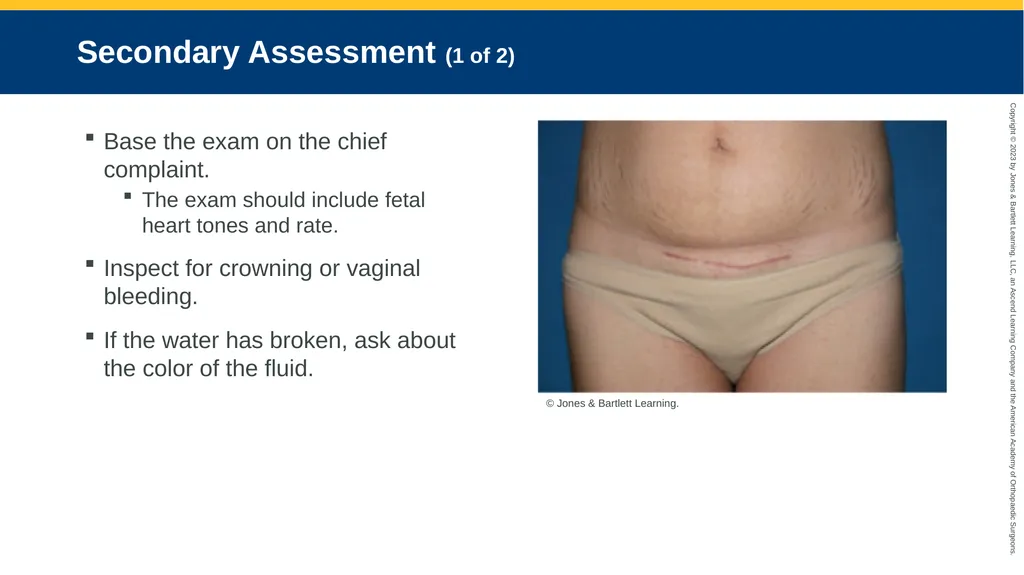
Secondary Assessment (1 of 2) Base the exam on the chief complaint.
The exam should include fetal heart tones and rate.
Inspect for crowning or vaginal bleeding.
If the water has broken, ask about the color of the fluid. © Jones & Bartlett Learning.<br>
The exam should include fetal heart tones and rate.
Inspect for crowning or vaginal bleeding.
If the water has broken, ask about the color of the fluid. © Jones & Bartlett Learning.<br>
50
Secondary Assessment (2 of 2) Braxton-Hicks contractions
Occur every 10–20 minutes
Third trimester
False labor<br>
Occur every 10–20 minutes
Third trimester
False labor<br>
51
Imminent Delivery (1 of 2) Imminent delivery
Assess the woman’s vital signs.
Estimate the gestational age.
Listen for fetal heart tones.<br>
Assess the woman’s vital signs.
Estimate the gestational age.
Listen for fetal heart tones.<br>
52
Imminent Delivery (2 of 2) If there is time to reach the hospital:
Place the patient in the left lateral recumbent position.
Remove clothing that might obstruct delivery.
Begin transport.
If there is not time:
Try to find a private and clean area.
Allow any support persons to be present.
Dismiss any nonessential people.
Be calm and reassuring.<br>
Place the patient in the left lateral recumbent position.
Remove clothing that might obstruct delivery.
Begin transport.
If there is not time:
Try to find a private and clean area.
Allow any support persons to be present.
Dismiss any nonessential people.
Be calm and reassuring.<br>
53
Reassessment (1 of 2) Perform ongoing examination, including:
Vital signs
Fetal heart rate
Time contractions and perform exam.
Check interventions and transport.<br>
Vital signs
Fetal heart rate
Time contractions and perform exam.
Check interventions and transport.<br>
54
Reassessment (2 of 2) If delivery is imminent:
Notify staff at hospital.
Provide an update on the status after delivery.
If delivery does not occur within 30 minutes or a complication occurs:
Notify staff.
Provide rapid transport.<br>
Notify staff at hospital.
Provide an update on the status after delivery.
If delivery does not occur within 30 minutes or a complication occurs:
Notify staff.
Provide rapid transport.<br>
55
Pathophysiology, Assessment, and Management of Complications Related to Pregnancy<br>
56
Substance Use Disorders in Pregnancy Illicit drugs pass through the placenta barrier and enter fetal circulation.
Birth defects
Addiction
Withdrawal signs
Treatment should concentrate on cardiorespiratory support.
Use reversal agents when appropriate.<br>
Birth defects
Addiction
Withdrawal signs
Treatment should concentrate on cardiorespiratory support.
Use reversal agents when appropriate.<br>
57
Supine Hypotensive Syndrome (1 of 2) Uterus may compress the inferior vena cava.
May diminish venous blood return to the heart
Can result in significant hypotension and fetal distress<br>
May diminish venous blood return to the heart
Can result in significant hypotension and fetal distress<br>
58
Supine Hypotensive Syndrome (2 of 2) Management includes:
Placing the patient in the left lateral recumbent position
Treating underlying causes
Monitoring blood pressure and other vital signs
Obtaining an ECG<br>
Placing the patient in the left lateral recumbent position
Treating underlying causes
Monitoring blood pressure and other vital signs
Obtaining an ECG<br>
59
Cardiac Conditions Determine the nature and treatment of any heart condition.
Cardiac medications
Dysrhythmia or heart murmur diagnosis
History of rheumatic fever
Born with congenital heart defect
Episodes of dizziness, light-headedness, or syncope<br>
Cardiac medications
Dysrhythmia or heart murmur diagnosis
History of rheumatic fever
Born with congenital heart defect
Episodes of dizziness, light-headedness, or syncope<br>
60
Peripartum Cardiomyopathy An uncommon form of heart failure
Occurs during the last month of pregnancy or up to 5 months after giving birth
Can easily be confused with preeclampsia<br>
Occurs during the last month of pregnancy or up to 5 months after giving birth
Can easily be confused with preeclampsia<br>
61
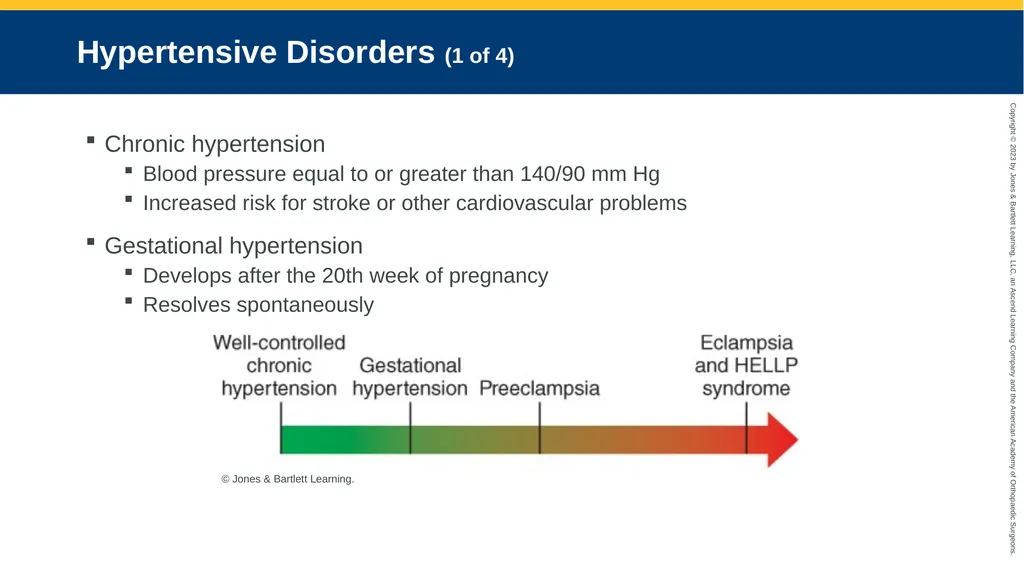
Hypertensive Disorders (1 of 4) Chronic hypertension
Blood pressure equal to or greater than 140/90 mm Hg
Increased risk for stroke or other cardiovascular problems
Gestational hypertension
Develops after the 20th week of pregnancy
Resolves spontaneously © Jones & Bartlett Learning.<br>
Blood pressure equal to or greater than 140/90 mm Hg
Increased risk for stroke or other cardiovascular problems
Gestational hypertension
Develops after the 20th week of pregnancy
Resolves spontaneously © Jones & Bartlett Learning.<br>
62
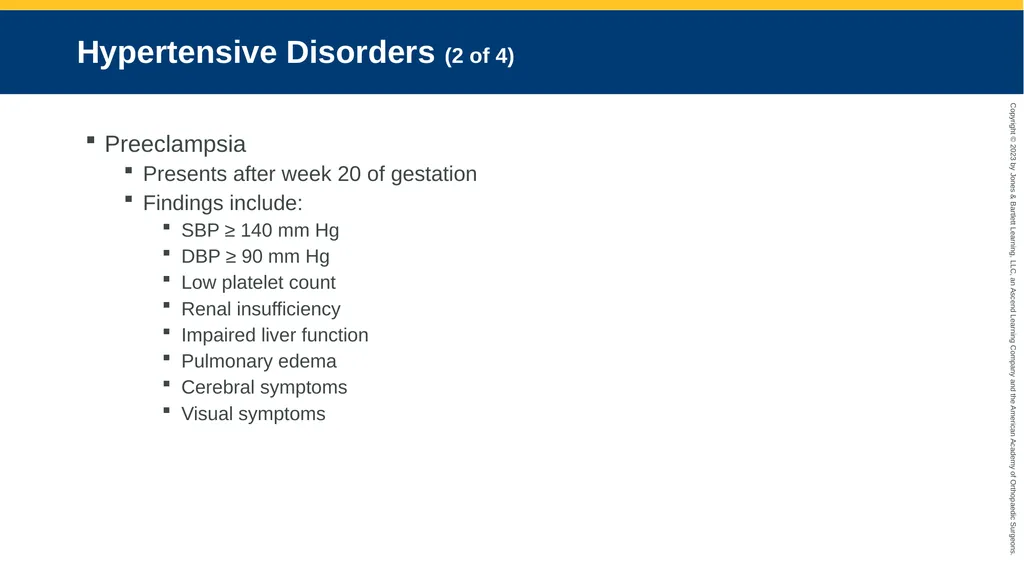
Hypertensive Disorders (2 of 4) Preeclampsia
Presents after week 20 of gestation
Findings include:
SBP ≥ 140 mm Hg
DBP ≥ 90 mm Hg
Low platelet count
Renal insufficiency
Impaired liver function
Pulmonary edema
Cerebral symptoms
Visual symptoms<br>
Presents after week 20 of gestation
Findings include:
SBP ≥ 140 mm Hg
DBP ≥ 90 mm Hg
Low platelet count
Renal insufficiency
Impaired liver function
Pulmonary edema
Cerebral symptoms
Visual symptoms<br>
63
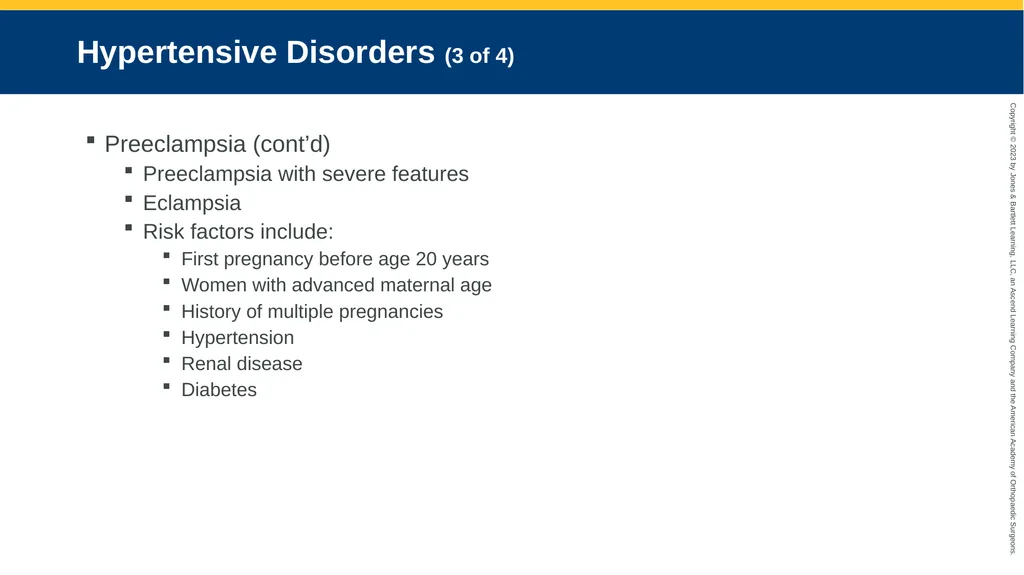
Hypertensive Disorders (3 of 4) Preeclampsia (cont’d)
Preeclampsia with severe features
Eclampsia
Risk factors include:
First pregnancy before age 20 years
Women with advanced maternal age
History of multiple pregnancies
Hypertension
Renal disease
Diabetes<br>
Preeclampsia with severe features
Eclampsia
Risk factors include:
First pregnancy before age 20 years
Women with advanced maternal age
History of multiple pregnancies
Hypertension
Renal disease
Diabetes<br>
64
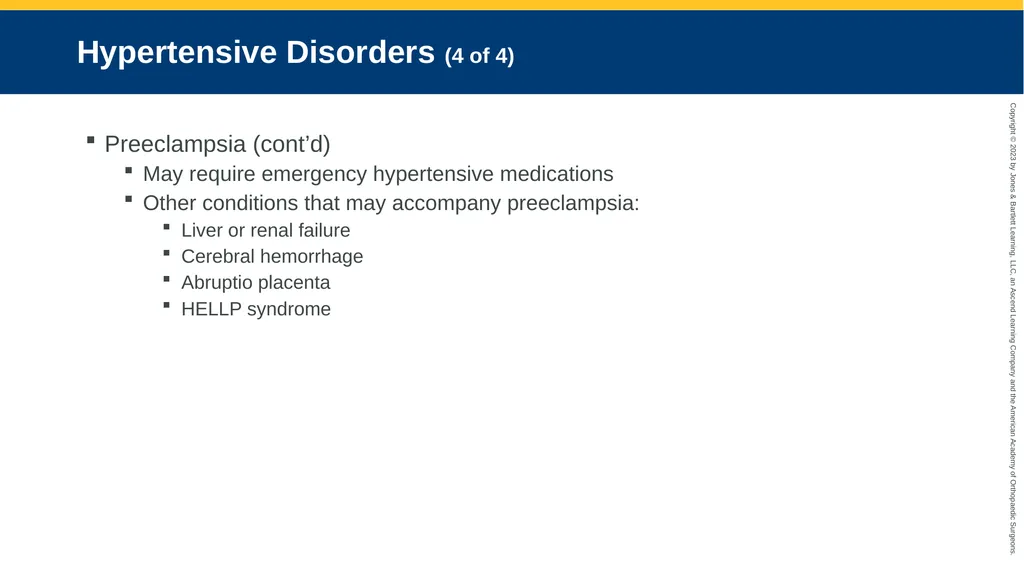
Hypertensive Disorders (4 of 4) Preeclampsia (cont’d)
May require emergency hypertensive medications
Other conditions that may accompany preeclampsia:
Liver or renal failure
Cerebral hemorrhage
Abruptio placenta
HELLP syndrome<br>
May require emergency hypertensive medications
Other conditions that may accompany preeclampsia:
Liver or renal failure
Cerebral hemorrhage
Abruptio placenta
HELLP syndrome<br>
65
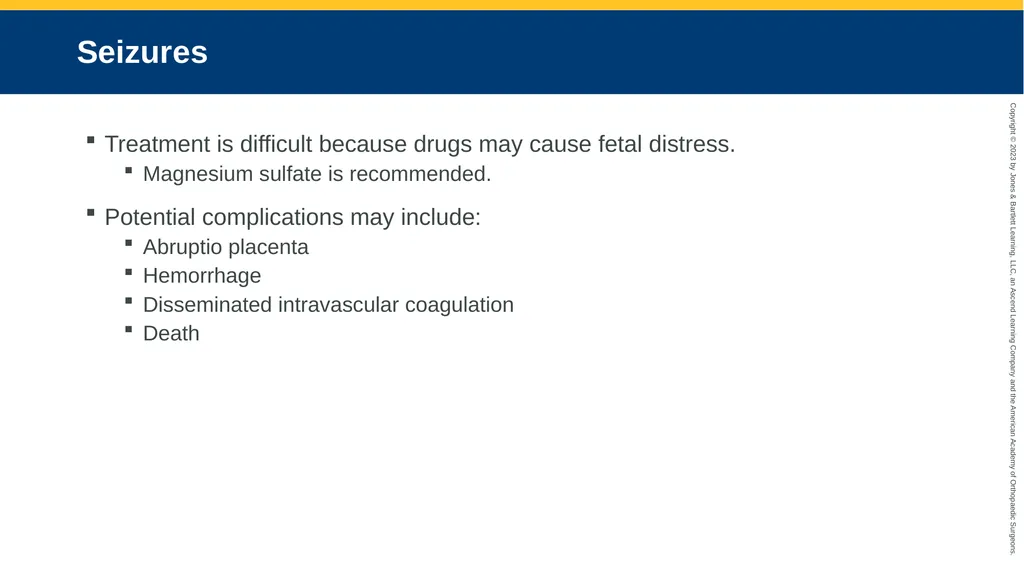
Seizures Treatment is difficult because drugs may cause fetal distress.
Magnesium sulfate is recommended.
Potential complications may include:
Abruptio placenta
Hemorrhage
Disseminated intravascular coagulation
Death<br>
Magnesium sulfate is recommended.
Potential complications may include:
Abruptio placenta
Hemorrhage
Disseminated intravascular coagulation
Death<br>
66
Diabetes (1 of 2) Gestational diabetes mellitus
Inability to process carbohydrates during pregnancy
Treatment consists of:
Diet control
Oral hypoglycemic medications<br>
Inability to process carbohydrates during pregnancy
Treatment consists of:
Diet control
Oral hypoglycemic medications<br>
67
Diabetes (2 of 2) Diabetes may be affected by pregnancy.
Patients with a history of diabetes should have a blood glucose level test.<br>
Patients with a history of diabetes should have a blood glucose level test.<br>
68
Respiratory Disorders (1 of 2) Shortness of breath or general dyspnea is one of the most common complaints.
Often caused by hormone-related changes
Asthma is a common condition that complicates pregnancy.<br>
Often caused by hormone-related changes
Asthma is a common condition that complicates pregnancy.<br>
69
Respiratory Disorders (2 of 2) Maternal asthma complications:
Premature labor
Preeclampsia
Respiratory failure
Vaginal hemorrhage
Eclampsia
Fetal asthma complications:
Premature birth
Low birth rate
Growth retardation
Fetal death<br>
Premature labor
Preeclampsia
Respiratory failure
Vaginal hemorrhage
Eclampsia
Fetal asthma complications:
Premature birth
Low birth rate
Growth retardation
Fetal death<br>
70
Hyperemesis Gravidarum (1 of 2) Persistent nausea and vomiting
Leads to dehydration, malnutrition, and weight loss
Exact cause unknown
Symptoms:
Severe and persistent vomiting
Projectile vomiting
Severe nausea
Pallor, jaundice<br>
Leads to dehydration, malnutrition, and weight loss
Exact cause unknown
Symptoms:
Severe and persistent vomiting
Projectile vomiting
Severe nausea
Pallor, jaundice<br>
71
Hyperemesis Gravidarum (2 of 2) Prehospital treatment includes:
Checking blood glucose levels
Starting IV line of normal saline
Administering diphenhydramine IV or deep IM if protocols allow
Administering ondansetron IV or PO per protocols
Checking orthostatic vital signs and obtaining an ECG
Transporting to a hospital<br>
Checking blood glucose levels
Starting IV line of normal saline
Administering diphenhydramine IV or deep IM if protocols allow
Administering ondansetron IV or PO per protocols
Checking orthostatic vital signs and obtaining an ECG
Transporting to a hospital<br>
72
Renal Disorders Kidneys increase in length, and the ureters get longer.
Changes can lead to urinary stasis and urinary tract infections.
The uterus puts pressure on the bladder, causing increased urinary frequency.<br>
Changes can lead to urinary stasis and urinary tract infections.
The uterus puts pressure on the bladder, causing increased urinary frequency.<br>
73
Rh Sensitization If the mother is Rh negative and the father is Rh positive, the fetus may inherit Rh factor.
The fetal blood produces a maternal antibody when in the woman’s circulation.
In subsequent pregnancies the antibodies will attack the fetal RBCs.
Medications can prevent sensitization.
Must be administered at specific intervals<br>
The fetal blood produces a maternal antibody when in the woman’s circulation.
In subsequent pregnancies the antibodies will attack the fetal RBCs.
Medications can prevent sensitization.
Must be administered at specific intervals<br>
74
Infections (1 of 8) Urinary tract infections
If Streptococcus agalactiae is passed to the newborn, it can cause:
Respiratory problems
Pneumonia
Septic shock
Meningitis<br>
If Streptococcus agalactiae is passed to the newborn, it can cause:
Respiratory problems
Pneumonia
Septic shock
Meningitis<br>
75
Infections (2 of 8) Human immunodeficiency virus (HIV)
Pregnant women may infect the infant during labor and delivery.
Medication can control the infection.<br>
Pregnant women may infect the infant during labor and delivery.
Medication can control the infection.<br>
76
Infections (3 of 8) Cholestasis
If the bile cannot flow normally, it builds up in the liver and spills into the bloodstream.
Symptoms include:
Profuse, painful itching
Right upper quadrant pain
Color changes in waste elimination<br>
If the bile cannot flow normally, it builds up in the liver and spills into the bloodstream.
Symptoms include:
Profuse, painful itching
Right upper quadrant pain
Color changes in waste elimination<br>
77
Infections (4 of 8) Cholestasis (cont’d)
High risks include:
Carrying multiple fetuses
A familial history of cholestasis
Previous liver damage
Relatively benign and transitory for the woman
Can be serious for the fetus<br>
High risks include:
Carrying multiple fetuses
A familial history of cholestasis
Previous liver damage
Relatively benign and transitory for the woman
Can be serious for the fetus<br>
78
Infections (5 of 8) TORCH syndrome
TORCH
Toxoplasmosis
Other agents
Rubella
Cytomegalovirus
Herpes simplex
Refers to infections that pass through the placenta to the fetus<br>
TORCH
Toxoplasmosis
Other agents
Rubella
Cytomegalovirus
Herpes simplex
Refers to infections that pass through the placenta to the fetus<br>
79
Infections (6 of 8) Toxoplasmosis
Caused from handling or eating contaminated food or from handling cat litter
Early in the pregnancy, there is a lower chance of passing it on to the fetus.<br>
Caused from handling or eating contaminated food or from handling cat litter
Early in the pregnancy, there is a lower chance of passing it on to the fetus.<br>
80
Infections (7 of 8) Cytomegalovirus (CMV)
Member of the herpes virus family
Can remain dormant in the body for years
Pregnant women have an increased risk for active infection and more serious complications.<br>
Member of the herpes virus family
Can remain dormant in the body for years
Pregnant women have an increased risk for active infection and more serious complications.<br>
81
Infections (8 of 8) Cytomegalovirus (cont’d)
Newborns with CMV are susceptible to:
Lung problems
Blood problems
Liver problems
Swollen glands
Rash
Poor weight gain<br>
Newborns with CMV are susceptible to:
Lung problems
Blood problems
Liver problems
Swollen glands
Rash
Poor weight gain<br>
82
Pathophysiology, Assessment, and Management of Bleeding Related to Pregnancy<br>
83
Pathophysiology (1 of 16) Abortion
Expulsion of the fetus before the 20th week of gestation
Classified as:
Spontaneous abortion (miscarriage)
Elective (intentional) abortion<br>
Expulsion of the fetus before the 20th week of gestation
Classified as:
Spontaneous abortion (miscarriage)
Elective (intentional) abortion<br>
84
Pathophysiology (2 of 16) Habitual abortions: three or more consecutive miscarriages
Causes include:
Ovarian issues
Uterine malformations
Cervical conditions
Infections<br>
Causes include:
Ovarian issues
Uterine malformations
Cervical conditions
Infections<br>
85
Pathophysiology (3 of 16) Threatened abortion: abortion attempting to take place
It is characterized by vaginal bleeding in the first half of pregnancy.
Patients may present with abdominal discomfort or report menstrual cramps.
It can progress, or it may subside.
The prehospital role is transport and support.<br>
It is characterized by vaginal bleeding in the first half of pregnancy.
Patients may present with abdominal discomfort or report menstrual cramps.
It can progress, or it may subside.
The prehospital role is transport and support.<br>
86
Pathophysiology (4 of 16) Imminent abortion: spontaneous abortion that cannot be prevented
Signs and symptoms include:
Severe abdominal pain
Vaginal bleeding
Cervical dilation
Maintain blood pressure and prevent hypovolemia.<br>
Signs and symptoms include:
Severe abdominal pain
Vaginal bleeding
Cervical dilation
Maintain blood pressure and prevent hypovolemia.<br>
87
Pathophysiology (5 of 16) Imminent abortion (cont’d)
Treatment includes:
Establishing an IV line of normal saline
Administering 100% supplemental oxygen
Obtaining an ECG
Providing emotional support with rapid transport
Watching for signs of shock<br>
Treatment includes:
Establishing an IV line of normal saline
Administering 100% supplemental oxygen
Obtaining an ECG
Providing emotional support with rapid transport
Watching for signs of shock<br>
88
Pathophysiology (6 of 16) Incomplete abortion: part of the products of conception remains in the uterus
Vaginal bleeding will be continuous.
Watch for signs and symptoms of shock.
Start an IV line of normal saline.
Consult medical control.
Collect all products of conception.
A complete abortion has occurred when all products of conception are expelled.<br>
Vaginal bleeding will be continuous.
Watch for signs and symptoms of shock.
Start an IV line of normal saline.
Consult medical control.
Collect all products of conception.
A complete abortion has occurred when all products of conception are expelled.<br>
89
Pathophysiology (7 of 16) Missed abortion: The fetus dies during the first 20 weeks of gestation but remains in utero.
Provide emotional support and transport.
On examination:
The uterus feels like a hard mass.
The fetal heartbeat cannot be heard.<br>
Provide emotional support and transport.
On examination:
The uterus feels like a hard mass.
The fetal heartbeat cannot be heard.<br>
90
Pathophysiology (8 of 16) Septic abortion: The uterus becomes infected following abortion.
History includes fever and foul-smelling vaginal discharge after abortion.
Physical examination shows fever and abdominal tenderness.<br>
History includes fever and foul-smelling vaginal discharge after abortion.
Physical examination shows fever and abdominal tenderness.<br>
91
Pathophysiology (9 of 16) Septic abortion (cont’d)
Prehospital management includes:
Establishing an IV line of normal saline
Administering 100% supplemental oxygen
ECG monitoring
Rapid transport
Fluid administration<br>
Prehospital management includes:
Establishing an IV line of normal saline
Administering 100% supplemental oxygen
ECG monitoring
Rapid transport
Fluid administration<br>
92
Pathophysiology (10 of 16) Third-trimester bleeding
Greatest danger of hemorrhage
A large volume of blood is present.
Compensatory mechanisms function as a result of pregnancy.<br>
Greatest danger of hemorrhage
A large volume of blood is present.
Compensatory mechanisms function as a result of pregnancy.<br>
93
Pathophysiology (11 of 16) Ectopic pregnancy
The ovum implants somewhere besides uterus.
The patient usually presents with:
Severe abdominal pain
Hypovolemic shock
Should be considered for all female patients of child-bearing age with severe lower abdominal pain.
Treat for shock and provide rapid transport.<br>
The ovum implants somewhere besides uterus.
The patient usually presents with:
Severe abdominal pain
Hypovolemic shock
Should be considered for all female patients of child-bearing age with severe lower abdominal pain.
Treat for shock and provide rapid transport.<br>
94
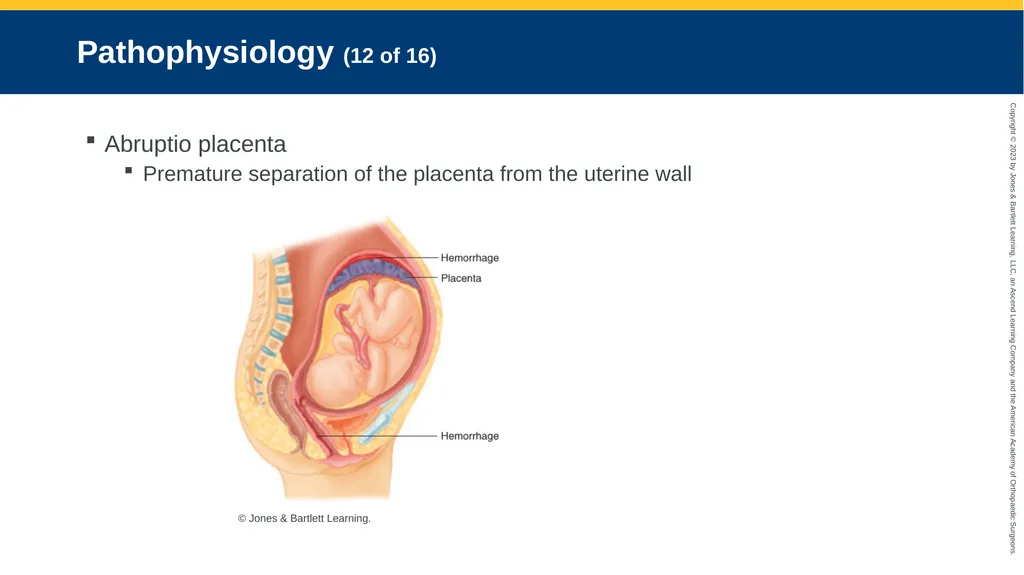
Pathophysiology (12 of 16) Abruptio placenta
Premature separation of the placenta from the uterine wall © Jones & Bartlett Learning.<br>
Premature separation of the placenta from the uterine wall © Jones & Bartlett Learning.<br>
95
Pathophysiology (13 of 16) Abruptio placenta (cont’d)
Patient will report:
Sudden onset of severe abdominal pain
Decreased fetal movement
Vaginal bleeding with dark red blood<br>
Patient will report:
Sudden onset of severe abdominal pain
Decreased fetal movement
Vaginal bleeding with dark red blood<br>
96
Pathophysiology (14 of 16) Abruptio placenta (cont’d)
Physical examination may reveal:
Signs of shock
Tender abdomen and rigid uterus
Absent fetal heart sounds<br>
Physical examination may reveal:
Signs of shock
Tender abdomen and rigid uterus
Absent fetal heart sounds<br>
97
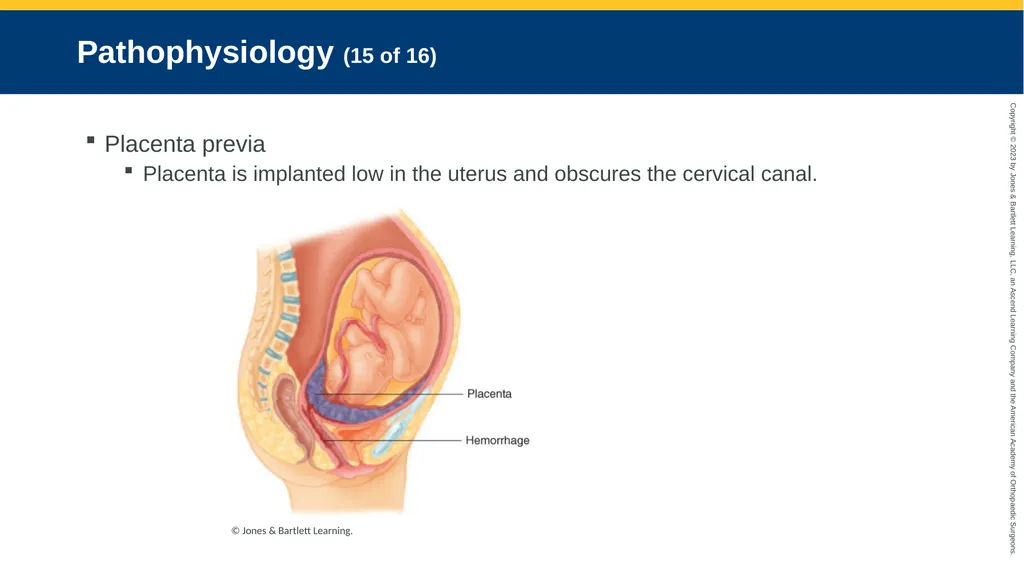
Pathophysiology (15 of 16) Placenta previa
Placenta is implanted low in the uterus and obscures the cervical canal. © Jones & Bartlett Learning.<br>
Placenta is implanted low in the uterus and obscures the cervical canal. © Jones & Bartlett Learning.<br>
98
Pathophysiology (16 of 16) Placenta previa (cont’d)
Painless vaginal bleeding with bright red blood.
Uterus is soft and nontender.<br>
Painless vaginal bleeding with bright red blood.
Uterus is soft and nontender.<br>
99
Assessment and Management (1 of 2) Try to determine the nature of the bleeding.
Use OPQRST to elaborate on the chief complaint of labor pain.
Identify changes in orthostatic vital signs.
Look for positive Grey Turner or Cullen sign.<br>
Use OPQRST to elaborate on the chief complaint of labor pain.
Identify changes in orthostatic vital signs.
Look for positive Grey Turner or Cullen sign.<br>
100
Assessment and Management (2 of 2) Keep the patient in a left lateral recumbent position.
Administer 100% supplemental oxygen.
Provide rapid transport.
Start an IV line of normal saline.
Obtain an ECG and baseline vital signs.
Loosely place trauma pads over the vagina.<br>
Administer 100% supplemental oxygen.
Provide rapid transport.
Start an IV line of normal saline.
Obtain an ECG and baseline vital signs.
Loosely place trauma pads over the vagina.<br>
101
Normal Childbirth<br>
102
Stages of Labor (1 of 3) First stage
Begins with onset of labor pains
Lasts until the cervix is fully dilated
Rupture of the amniotic sac near the end of the stage<br>
Begins with onset of labor pains
Lasts until the cervix is fully dilated
Rupture of the amniotic sac near the end of the stage<br>
103
Stages of Labor (2 of 3) Second stage
Begins as the head descends to enter the birth canal
Fetus will undergo several position changes.
Contractions are more intense and frequent.
The cervix becomes fully dilated.
Concludes when the newborn is fully delivered.<br>
Begins as the head descends to enter the birth canal
Fetus will undergo several position changes.
Contractions are more intense and frequent.
The cervix becomes fully dilated.
Concludes when the newborn is fully delivered.<br>
104
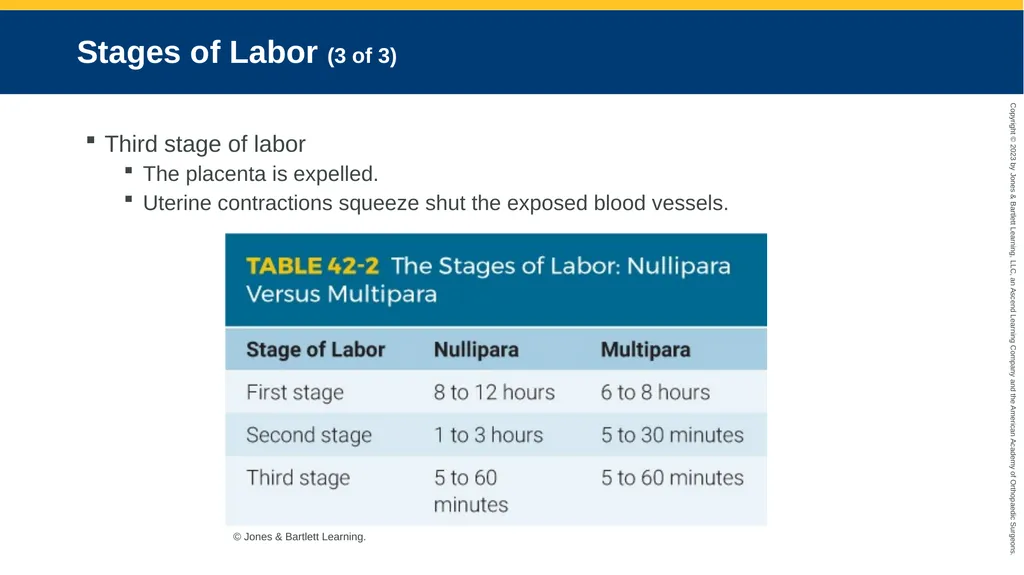
Stages of Labor (3 of 3) Third stage of labor
The placenta is expelled.
Uterine contractions squeeze shut the exposed blood vessels. © Jones & Bartlett Learning.<br>
The placenta is expelled.
Uterine contractions squeeze shut the exposed blood vessels. © Jones & Bartlett Learning.<br>
105
Maternal and Fetal Response to Labor (1 of 2) Maternal response
Increase in:
Workload of the heart
Blood pressure, pulse, and cardiac output
Respiratory rate
WBC production
Protein breakdown<br>
Increase in:
Workload of the heart
Blood pressure, pulse, and cardiac output
Respiratory rate
WBC production
Protein breakdown<br>
106
Maternal and Fetal Response to Labor (2 of 2) Fetal response
Decrease in the amount of oxygen and nutrients
Insufficient removal of waste
Decreased fetal heart rate
Fetal acidosis<br>
Decrease in the amount of oxygen and nutrients
Insufficient removal of waste
Decreased fetal heart rate
Fetal acidosis<br>
107
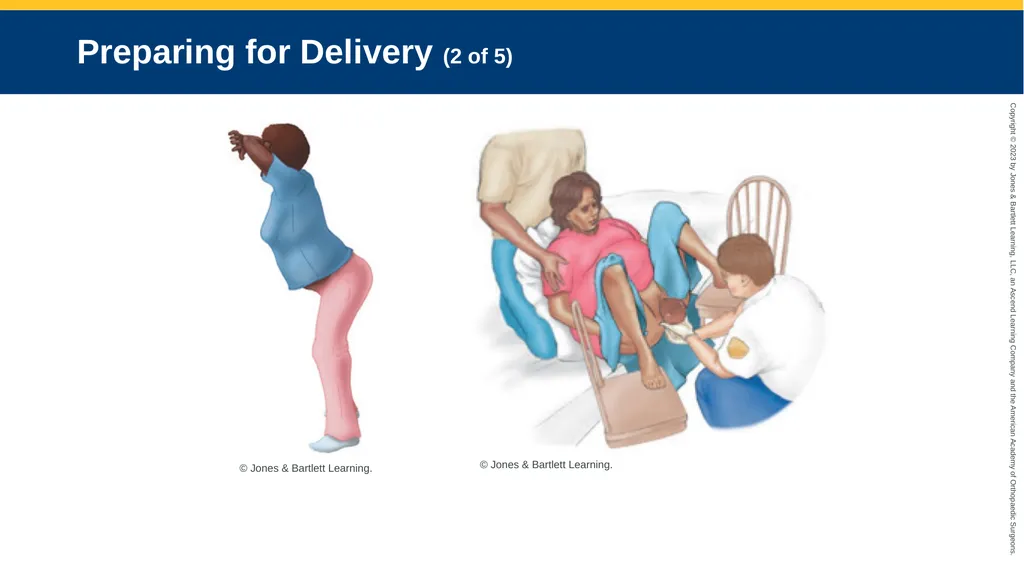
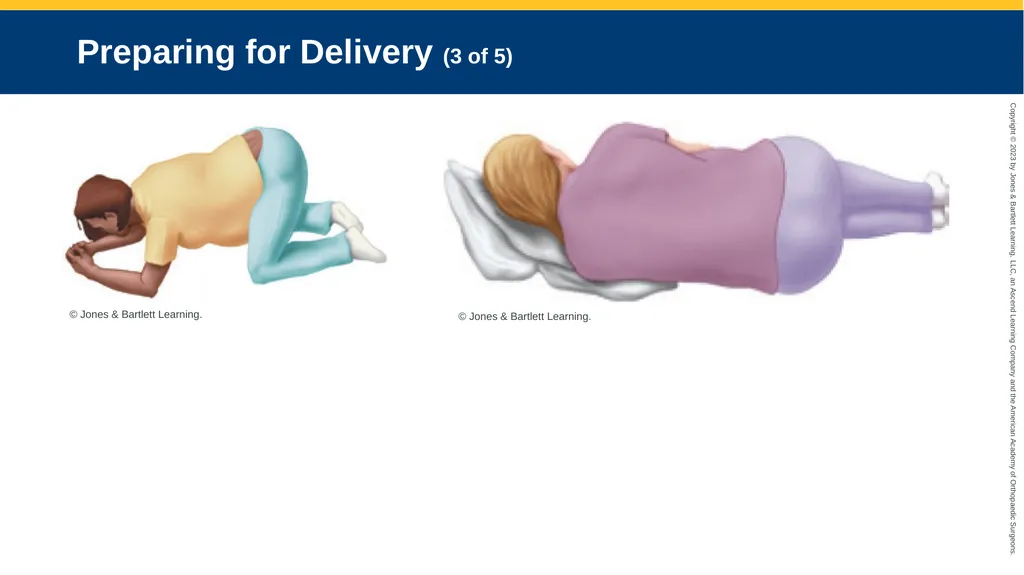
Preparing for Delivery (1 of 5) Birthing positions
Lying supine
Standing birth
Semi-Fowler position
Kneeling birth
Side-lying position<br>
Lying supine
Standing birth
Semi-Fowler position
Kneeling birth
Side-lying position<br>
108
Preparing for Delivery (2 of 5) © Jones & Bartlett Learning. © Jones & Bartlett Learning.<br>
109
Preparing for Delivery (3 of 5) © Jones & Bartlett Learning. © Jones & Bartlett Learning.<br>
110
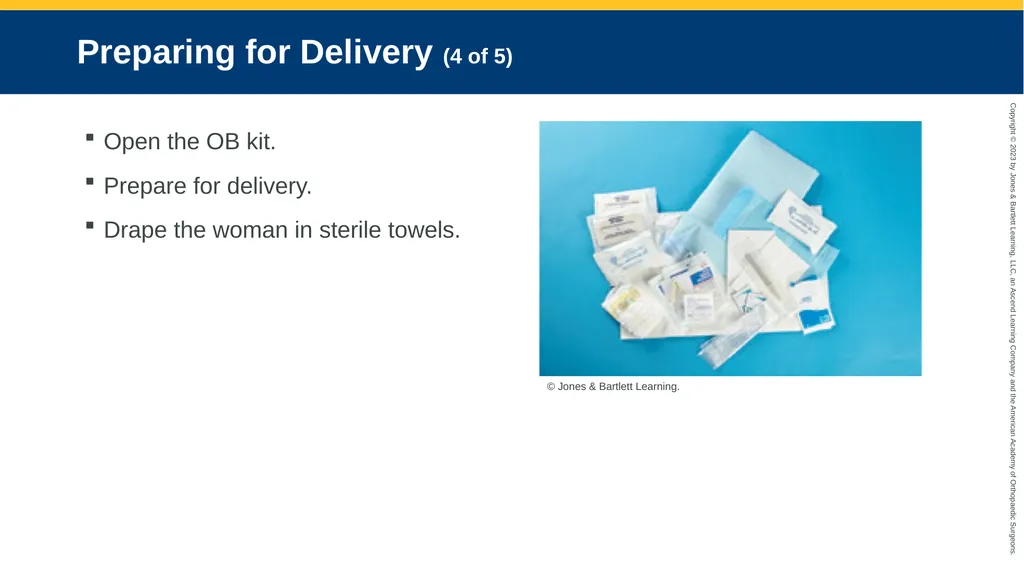
Preparing for Delivery (4 of 5) Open the OB kit.
Prepare for delivery.
Drape the woman in sterile towels. © Jones & Bartlett Learning.<br>
Prepare for delivery.
Drape the woman in sterile towels. © Jones & Bartlett Learning.<br>
111
Preparing for Delivery (5 of 5) A safe and controlled delivery takes precedence over the draping.
Have your partner at the woman’s head to help keep her calm and administer oxygen.
Encourage the woman to rest between contractions and to resist bearing down.<br>
Have your partner at the woman’s head to help keep her calm and administer oxygen.
Encourage the woman to rest between contractions and to resist bearing down.<br>
112
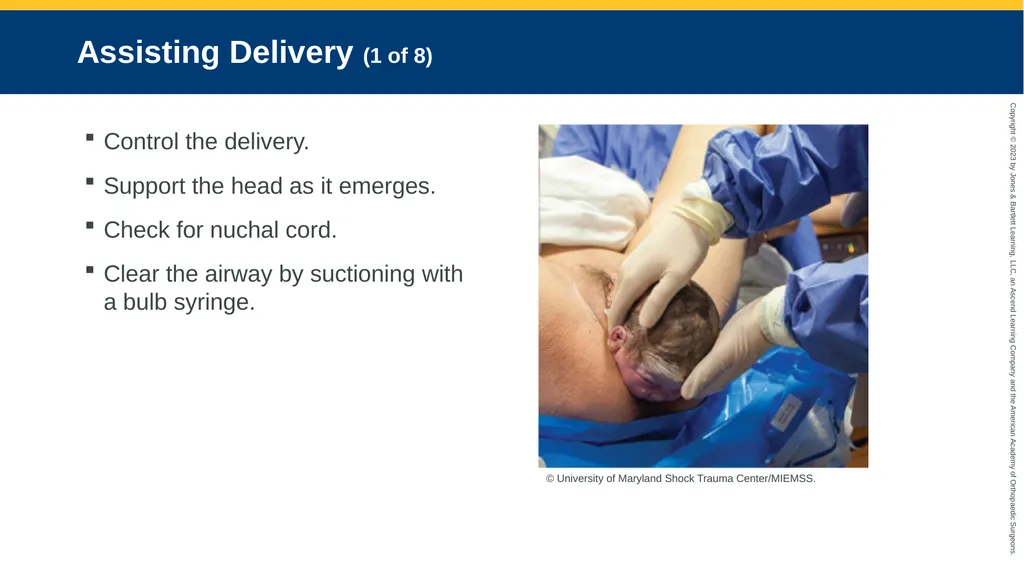
Assisting Delivery (1 of 8) Control the delivery.
Support the head as it emerges.
Check for nuchal cord.
Clear the airway by suctioning with a bulb syringe. © University of Maryland Shock Trauma Center/MIEMSS.<br>
Support the head as it emerges.
Check for nuchal cord.
Clear the airway by suctioning with a bulb syringe. © University of Maryland Shock Trauma Center/MIEMSS.<br>
113
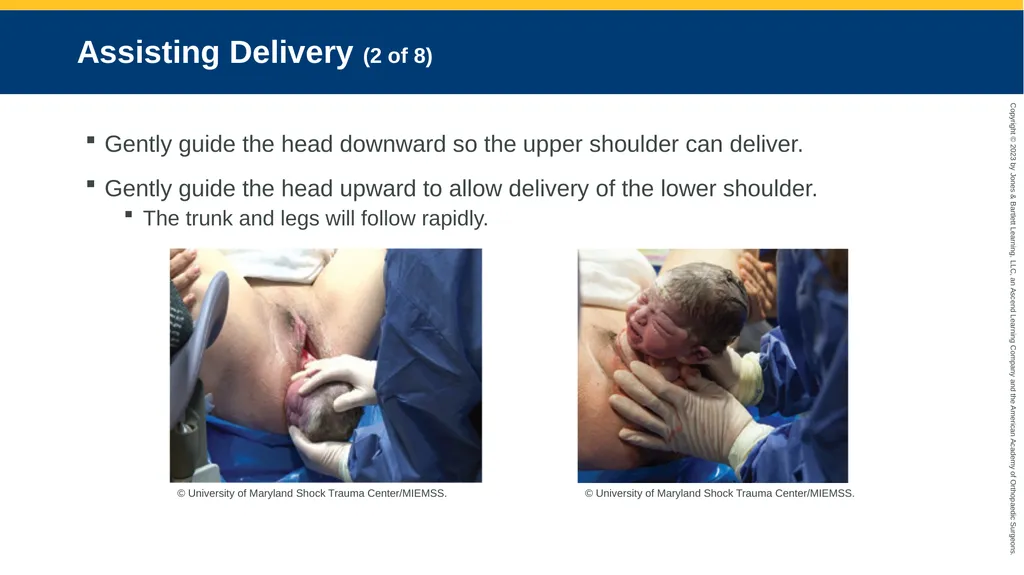
Assisting Delivery (2 of 8) Gently guide the head downward so the upper shoulder can deliver.
Gently guide the head upward to allow delivery of the lower shoulder.
The trunk and legs will follow rapidly. © University of Maryland Shock Trauma Center/MIEMSS. © University of Maryland Shock Trauma Center/MIEMSS.<br>
Gently guide the head upward to allow delivery of the lower shoulder.
The trunk and legs will follow rapidly. © University of Maryland Shock Trauma Center/MIEMSS. © University of Maryland Shock Trauma Center/MIEMSS.<br>
114
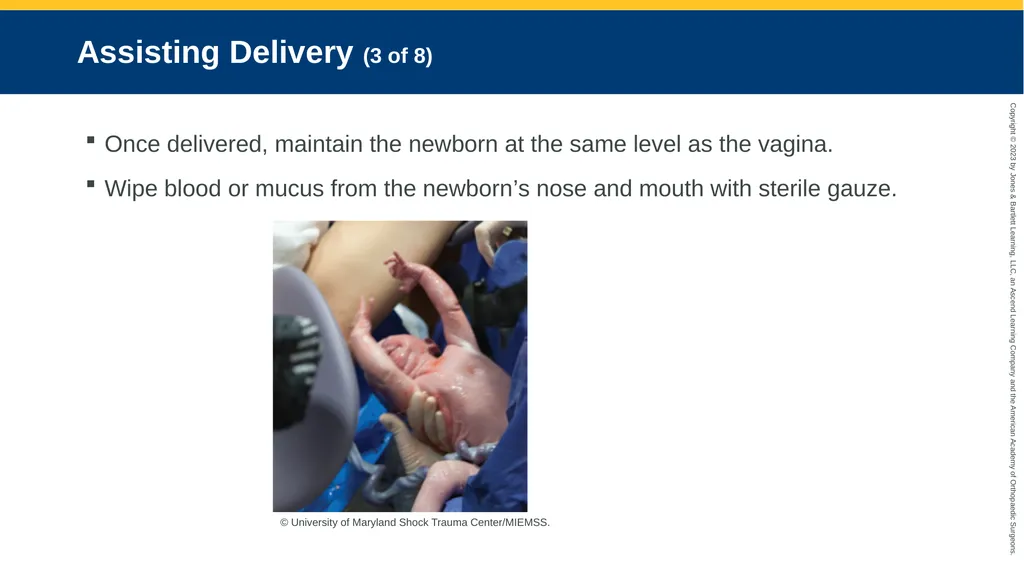
Assisting Delivery (3 of 8) Once delivered, maintain the newborn at the same level as the vagina.
Wipe blood or mucus from the newborn’s nose and mouth with sterile gauze. © University of Maryland Shock Trauma Center/MIEMSS.<br>
Wipe blood or mucus from the newborn’s nose and mouth with sterile gauze. © University of Maryland Shock Trauma Center/MIEMSS.<br>
115
Assisting Delivery (4 of 8) Dry the newborn with sterile towels and wrap in a dry blanket.
Usually breathing on their own
Usually turning from blue to normal baseline color in the head and chest area
Record the time of birth for the patient care report.<br>
Usually breathing on their own
Usually turning from blue to normal baseline color in the head and chest area
Record the time of birth for the patient care report.<br>
116
Assisting Delivery (5 of 8) Apgar scoring
Evaluates the newborn’s vital functions
Cutting the umbilical cord
Tie or clamp the cord with clamps 2 inches apart, and then cut the cord between them.
Examine the ends to ensure there is no bleeding.
Once the cord is cut, wrap the newborn in a dry blanket.<br>
Evaluates the newborn’s vital functions
Cutting the umbilical cord
Tie or clamp the cord with clamps 2 inches apart, and then cut the cord between them.
Examine the ends to ensure there is no bleeding.
Once the cord is cut, wrap the newborn in a dry blanket.<br>
117
Assisting Delivery (6 of 8) Delivery of the placenta
The placenta usually delivers within 30 minutes after delivery of the baby.
Do not pull on the umbilical cord to speed up placental delivery.
Instruct the patient to bear down.<br>
The placenta usually delivers within 30 minutes after delivery of the baby.
Do not pull on the umbilical cord to speed up placental delivery.
Instruct the patient to bear down.<br>
118
Assisting Delivery (7 of 8) Delivery of the placenta (cont’d)
The fetal side should be gray, shiny, and smooth.
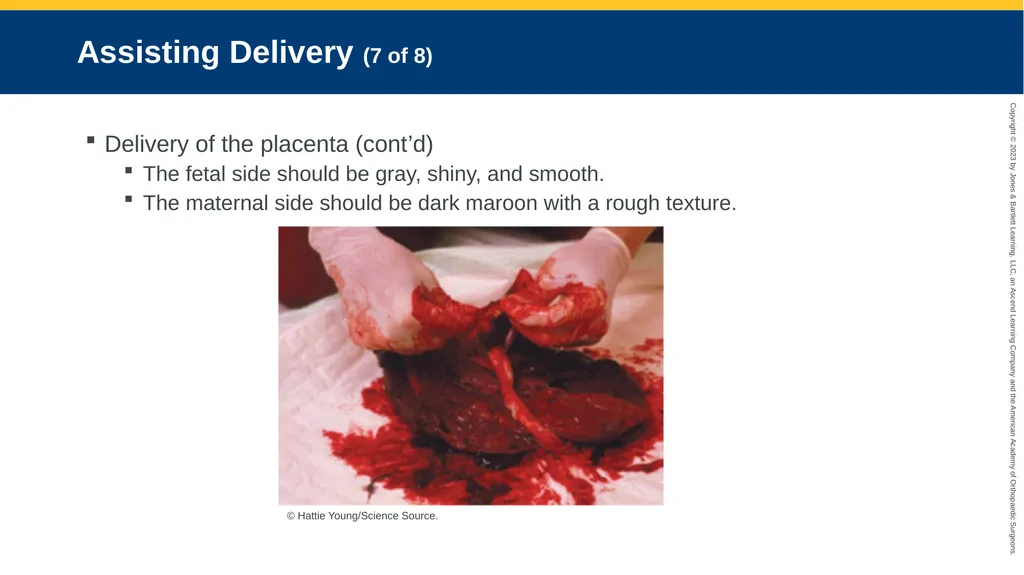
The maternal side should be dark maroon with a rough texture. © Hattie Young/Science Source.<br>
The fetal side should be gray, shiny, and smooth.
The maternal side should be dark maroon with a rough texture. © Hattie Young/Science Source.<br>
119
Assisting Delivery (8 of 8) Delivery of the placenta (cont’d)
Place the placenta in a plastic bag.
Examine the perineum for lacerations.
Prepare for transport.
Do not wait for the placenta to deliver.<br>
Place the placenta in a plastic bag.
Examine the perineum for lacerations.
Prepare for transport.
Do not wait for the placenta to deliver.<br>
120
Postpartum Care Obtain the mother’s vital signs.
Monitor the mother’s condition closely.
Assess the fundus.
Note the lochia.
Cover the mother with blankets.<br>
Monitor the mother’s condition closely.
Assess the fundus.
Note the lochia.
Cover the mother with blankets.<br>
121
Emergency Pharmacology in Pregnancy<br>
122
Emergency Pharmacology in Pregnancy Maternal physiology changes may have an impact on pharmacologic therapies.
IV medications may pass quickly through the maternal system.
Higher doses may be needed.
Oral drugs may take longer to work.<br>
IV medications may pass quickly through the maternal system.
Higher doses may be needed.
Oral drugs may take longer to work.<br>
123
Magnesium Sulfate In pregnancy, used to manage eclampsia
Can cause:
Drowsiness
Respiratory depression
Hypotension
Bradycardia with rapid administration
Always spell out name to avoid confusion with other medication.<br>
Can cause:
Drowsiness
Respiratory depression
Hypotension
Bradycardia with rapid administration
Always spell out name to avoid confusion with other medication.<br>
124
Calcium Chloride Antidote for magnesium sulfate overdose
Side effects:
Nausea and vomiting
Syncope
Bradycardia
Dysrhythmias<br>
Side effects:
Nausea and vomiting
Syncope
Bradycardia
Dysrhythmias<br>
125
Valium Indicated in eclampsia when seizures do not respond to magnesium sulfate
Principal side effects:
Nausea and vomiting
Respiratory depression
Hypotension<br>
Principal side effects:
Nausea and vomiting
Respiratory depression
Hypotension<br>
126
Diphenhydramine Antihistamine used to treat hyperemesis gravidarum
Side effects:
Drowsiness
Headache
Tachycardia
Hypotension<br>
Side effects:
Drowsiness
Headache
Tachycardia
Hypotension<br>
127
Ondansetron Antiemetic used to treat nausea and vomiting
Side effects include potential QT prolongation.
Monitor ECG during administration.<br>
Side effects include potential QT prolongation.
Monitor ECG during administration.<br>
128
Oxytocin (Pitocin) (1 of 2) Naturally occurring hormone that triggers uterine contractions
Used to:
Induce labor
Control postpartum hemorrhage<br>
Used to:
Induce labor
Control postpartum hemorrhage<br>
129
Oxytocin (Pitocin) (2 of 2) Side effects include:
Nausea and vomiting
Seizures
Cardiac dysrhythmias
Anaphylaxis<br>
Nausea and vomiting
Seizures
Cardiac dysrhythmias
Anaphylaxis<br>
130
Pathophysiology, Assessment, and Management of Complications of Labor<br>
131
Premature Rupture of Membranes The amniotic sac ruptures, or opens, more than an hour before labor.
The sac may self-seal and heal itself.
Often, labor will begin within 48 hours.
If the pregnancy is not near term, a risk of infection exists.<br>
The sac may self-seal and heal itself.
Often, labor will begin within 48 hours.
If the pregnancy is not near term, a risk of infection exists.<br>
132
Preterm Labor Labor that begins after the 20th week but before the 37th week
The patient may be admitted to the hospital for medication, bed rest, and monitoring.<br>
The patient may be admitted to the hospital for medication, bed rest, and monitoring.<br>
133
Fetal Distress Caused by many conditions
Difficult to assess in the field
Rely on information provided by the woman.
Provide support and rapid transport.<br>
Difficult to assess in the field
Rely on information provided by the woman.
Provide support and rapid transport.<br>
134
Uterine Rupture Occurs during labor
Signs and symptoms include:
Weakness, dizziness, and thirst
Initial strong contractions that have lessened
Replaced by sharp, tearing pain
Signs of shock
Treat for shock and provide rapid transport.<br>
Signs and symptoms include:
Weakness, dizziness, and thirst
Initial strong contractions that have lessened
Replaced by sharp, tearing pain
Signs of shock
Treat for shock and provide rapid transport.<br>
135
Pathophysiology, Assessment, and Management of High-Risk Pregnancy Considerations<br>
136
Precipitous Labor and Birth The entire labor time and birth time usually total less than 3 hours.
Chances increase the more children the woman has had.
Contractions are usually more intense.
Assess the woman postdelivery for tears and bleeding.<br>
Chances increase the more children the woman has had.
Contractions are usually more intense.
Assess the woman postdelivery for tears and bleeding.<br>
137
Post-Term Pregnancy The fetus has not been born after 42 weeks.
The cause is unknown.
This situation is high risk because:
The fetus may become malnourished.
There is increased chance of meconium aspiration.
Risk of longer labor and complicated delivery
Usually delivered by cesarean section<br>
The cause is unknown.
This situation is high risk because:
The fetus may become malnourished.
There is increased chance of meconium aspiration.
Risk of longer labor and complicated delivery
Usually delivered by cesarean section<br>
138
Meconium Staining Meconium: first stool the fetus passes
Odorless, greenish-black, with a tar-like consistency
May be voided into the amniotic fluid and cause chemical pneumonia in the newborn<br>
Odorless, greenish-black, with a tar-like consistency
May be voided into the amniotic fluid and cause chemical pneumonia in the newborn<br>
139
Fetal Macrosomia The fetus weighs more than 4,500 grams (almost 9 lb).
Treatment should focus on:
Support and rapid transport
If field delivery:
Encourage breastfeeding.
Check newborn’s blood glucose level.<br>
Treatment should focus on:
Support and rapid transport
If field delivery:
Encourage breastfeeding.
Check newborn’s blood glucose level.<br>
140
Multiple Gestation (1 of 2) Prepare for more than one resuscitation.
Consider the possibility of multiples if:
The first newborn is small.
The abdomen is still fairly large after the birth.
The second newborn is usually born within 45 minutes.<br>
Consider the possibility of multiples if:
The first newborn is small.
The abdomen is still fairly large after the birth.
The second newborn is usually born within 45 minutes.<br>
141
Multiple Gestation (2 of 2) The procedure is the same as for a single birth.
Check if there are one or two cords coming out of the placenta when it delivers.
Two cords: identical twins
One cord: fraternal twins with two placentas
Record the time of birth for each newborn.
Identify the first newborn delivered as “Baby A.”<br>
Check if there are one or two cords coming out of the placenta when it delivers.
Two cords: identical twins
One cord: fraternal twins with two placentas
Record the time of birth for each newborn.
Identify the first newborn delivered as “Baby A.”<br>
142
Intrauterine Fetal Death The fetus died in the uterus before labor.
Care will focus on the woman.
The actual cause is usually difficult to determine.
Labor can occur up to 2 weeks or longer after the fetal death.
Do not attempt resuscitation.<br>
Care will focus on the woman.
The actual cause is usually difficult to determine.
Labor can occur up to 2 weeks or longer after the fetal death.
Do not attempt resuscitation.<br>
143
Amniotic Fluid Embolism (1 of 2) Amniotic fluid enters the woman’s pulmonary and circulatory system through the placenta.
Results in an allergic reaction response
Signs and symptoms include:
Respiratory distress and hypotension
Cyanosis
Possible seizures
Cardiogenic shock and unresponsiveness
Possible cardiac arrest<br>
Results in an allergic reaction response
Signs and symptoms include:
Respiratory distress and hypotension
Cyanosis
Possible seizures
Cardiogenic shock and unresponsiveness
Possible cardiac arrest<br>
144
Amniotic Fluid Embolism (2 of 2) If the patient survives the initial reaction, they will likely develop coagulopathies.
Treatment includes:
Supporting respiratory and circulatory systems
Providing rapid transport<br>
Treatment includes:
Supporting respiratory and circulatory systems
Providing rapid transport<br>
145
Amniotic Fluid Volume Problems (1 of 2) Polyhydramnios
Too much amniotic fluid
Usually detected early by ultrasound
Patients are at risk for:
Prolapsed cord and abruptio placenta
Postpartum hemorrhage<br>
Too much amniotic fluid
Usually detected early by ultrasound
Patients are at risk for:
Prolapsed cord and abruptio placenta
Postpartum hemorrhage<br>
146
Amniotic Fluid Volume Problems (2 of 2) Oligohydramnios
Too little amniotic fluid
No way to diagnose in the field
Transport the patient if she has a history with the condition.<br>
Too little amniotic fluid
No way to diagnose in the field
Transport the patient if she has a history with the condition.<br>
147
Cephalopelvic Disproportion The head of the fetus is larger than the pelvis.
A cesarean section is usually required.
May cause postpartum complications<br>
A cesarean section is usually required.
May cause postpartum complications<br>
148
Pathophysiology, Assessment, and Management of Complications of Delivery<br>
149
Cephalic Presentation (1 of 2) The newborn’s head is overly extended, creating a face presentation at birth.
Brow presentation
Occiput-posterior presentation
Military presentation<br>
Brow presentation
Occiput-posterior presentation
Military presentation<br>
150
Cephalic Presentation (2 of 2) If the newborn’s head cannot be externally rotated or the delivery cannot be completed:
Support the woman and fetus.
Provide rapid transport.<br>
Support the woman and fetus.
Provide rapid transport.<br>
151
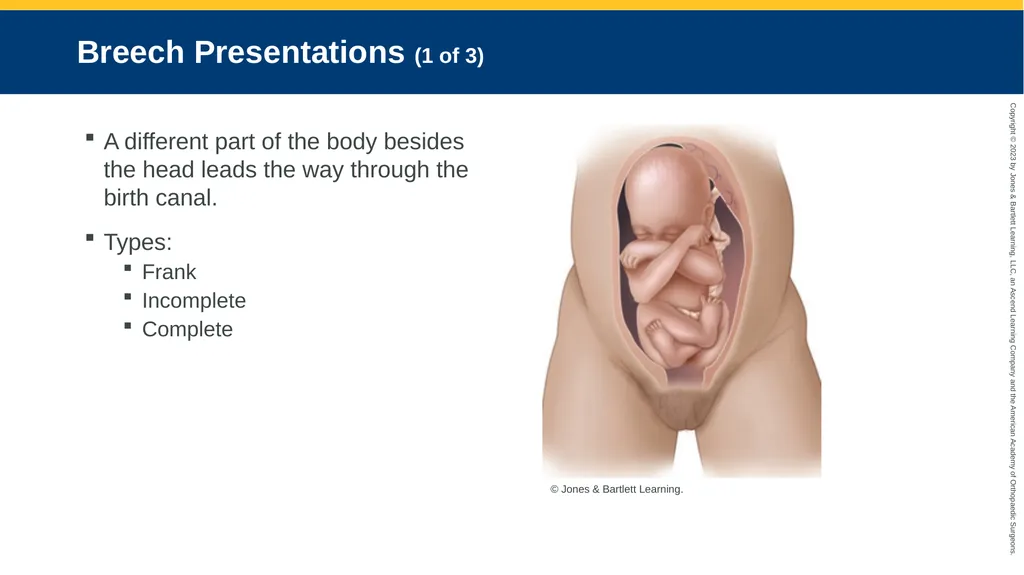
Breech Presentations (1 of 3) A different part of the body besides the head leads the way through the birth canal.
Types:
Frank
Incomplete
Complete © Jones & Bartlett Learning.<br>
Types:
Frank
Incomplete
Complete © Jones & Bartlett Learning.<br>
152
Breech Presentations (2 of 3) If buttocks are presenting and delivery is imminent:
Position the woman with buttocks at edge of bed or stretcher, legs flexed.
Allow newborn’s buttocks and trunk to deliver spontaneously.
Once the legs are clear, support the body.
Lower the newborn slightly.
Once the hairline is spotted, grasp the newborn’s ankles and lift upward.
If the head does not deliver within 3 minutes, the newborn may suffocate.
Do not try to forcibly pull the newborn out.<br>
Position the woman with buttocks at edge of bed or stretcher, legs flexed.
Allow newborn’s buttocks and trunk to deliver spontaneously.
Once the legs are clear, support the body.
Lower the newborn slightly.
Once the hairline is spotted, grasp the newborn’s ankles and lift upward.
If the head does not deliver within 3 minutes, the newborn may suffocate.
Do not try to forcibly pull the newborn out.<br>
153
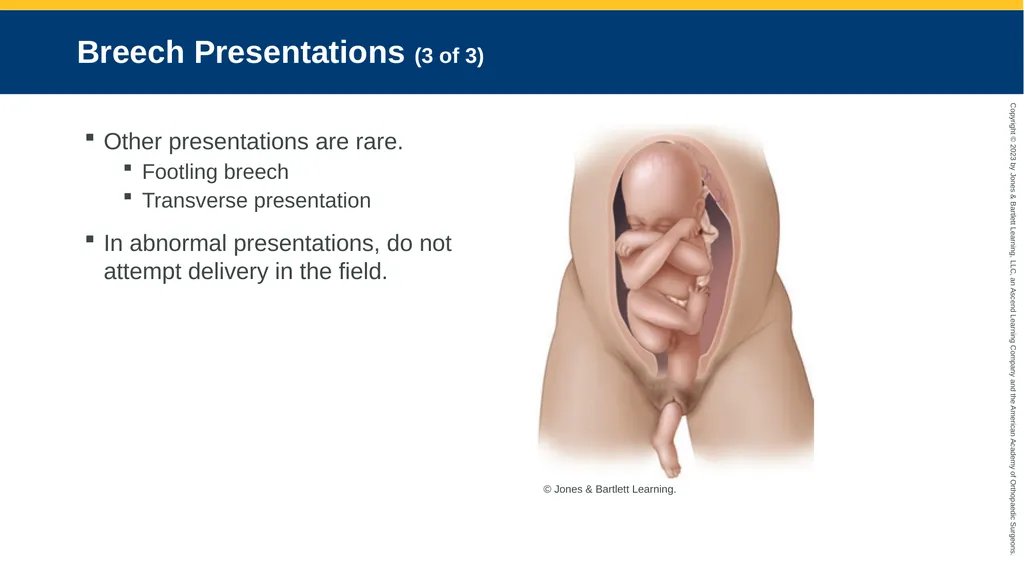
Breech Presentations (3 of 3) Other presentations are rare.
Footling breech
Transverse presentation
In abnormal presentations, do not attempt delivery in the field. © Jones & Bartlett Learning.<br>
Footling breech
Transverse presentation
In abnormal presentations, do not attempt delivery in the field. © Jones & Bartlett Learning.<br>
154
Shoulder Dystocia (1 of 2) Difficulty in delivering the shoulders
If the shoulders cannot clear the birth canal, the fetus cannot breathe.
A major concern for the newborn is brachial nerve plexus damage.<br>
If the shoulders cannot clear the birth canal, the fetus cannot breathe.
A major concern for the newborn is brachial nerve plexus damage.<br>
155
Shoulder Dystocia (2 of 2) McRoberts maneuver
Hyperflex the woman’s legs tightly to the abdomen
May be necessary to apply pressure to the lower abdomen and gently pull on the fetus’s head<br>
Hyperflex the woman’s legs tightly to the abdomen
May be necessary to apply pressure to the lower abdomen and gently pull on the fetus’s head<br>
156
Nuchal Cord The umbilical cord becomes wrapped around the newborn’s neck during delivery.
Slip a finger under the cord and gently attempt to slip it over the shoulder and head.
If unsuccessful, cut the cord.<br>
Slip a finger under the cord and gently attempt to slip it over the shoulder and head.
If unsuccessful, cut the cord.<br>
157
Prolapsed Umbilical Cord (1 of 3) The cord emerges before the fetus.
Shuts off the oxygenated blood supply from the placenta
Leads to fetal asphyxia © Jones & Bartlett Learning.<br>
Shuts off the oxygenated blood supply from the placenta
Leads to fetal asphyxia © Jones & Bartlett Learning.<br>
158
Prolapsed Umbilical Cord (2 of 3) Keep the woman supine with hips elevated.
Administer 100% supplemental oxygen.
Have the woman pant with each contraction.
Gently push the presenting part back up the vagina until it no longer presses on the cord.<br>
Administer 100% supplemental oxygen.
Have the woman pant with each contraction.
Gently push the presenting part back up the vagina until it no longer presses on the cord.<br>
159
Prolapsed Umbilical Cord (3 of 3) Maintain pressure while another paramedic covers the exposed cord with dressings.
Maintain that position throughout urgent transport.<br>
Maintain that position throughout urgent transport.<br>
160
Pathophysiology, Assessment, and Management of Postpartum Complications<br>
161
Uterine Inversion (1 of 3) The placenta fails to detach properly from the uterine wall when it is expelled.
The uterus turns inside out as a result.
Severity is graded by how much the uterus has reversed itself.
Very painful and may rapidly cause shock<br>
The uterus turns inside out as a result.
Severity is graded by how much the uterus has reversed itself.
Very painful and may rapidly cause shock<br>
162
Uterine Inversion (2 of 3) Keep the patient recumbent.
Administer 100% supplemental oxygen.
Start two IV lines with normal saline.
Do not attempt to remove the placenta if it is still attached to the uterus.<br>
Administer 100% supplemental oxygen.
Start two IV lines with normal saline.
Do not attempt to remove the placenta if it is still attached to the uterus.<br>
163
Uterine Inversion (3 of 3) Carefully monitor vital signs.
Consider oxytocin to control hemorrhage.
Make one attempt to replace the uterus.<br>
Consider oxytocin to control hemorrhage.
Make one attempt to replace the uterus.<br>
164
Postpartum Hemorrhage (1 of 3) Average blood loss during delivery: 0.3 pint (150 mL)
Blood loss with postpartum hemorrhage exceeds 1 pint (500 mL)
During first 24 hours after birth
Can be either early or late hemorrhage
Early: bleeding within 24 hours of delivery
Late: bleeding occurring from 24 hours to 6 weeks after delivery<br>
Blood loss with postpartum hemorrhage exceeds 1 pint (500 mL)
During first 24 hours after birth
Can be either early or late hemorrhage
Early: bleeding within 24 hours of delivery
Late: bleeding occurring from 24 hours to 6 weeks after delivery<br>
165
Postpartum Hemorrhage (2 of 3) Causes of postpartum hemorrhage include:
Lacerations
Prolonged labor or multiple baby delivery
Retained products of conception
Uterine atony
Grand multiparity
Multiple pregnancy
Placenta previa
Full bladder<br>
Lacerations
Prolonged labor or multiple baby delivery
Retained products of conception
Uterine atony
Grand multiparity
Multiple pregnancy
Placenta previa
Full bladder<br>
166
Postpartum Hemorrhage (3 of 3) Continue uterine massage.
Encourage the woman to breastfeed.
Notify the receiving facility of status.
Transport immediately.
Add a large-bore IV line en route.
Do not pack dressings into the vagina.<br>
Encourage the woman to breastfeed.
Notify the receiving facility of status.
Transport immediately.
Add a large-bore IV line en route.
Do not pack dressings into the vagina.<br>
167
Pulmonary Embolism (1 of 2) Frequently caused by a clot arising in pelvic circulation from:
Amniotic embolism
Pregnancy-related venous thromboembolism
Water embolism<br>
Amniotic embolism
Pregnancy-related venous thromboembolism
Water embolism<br>
168
Pulmonary Embolism (2 of 2) Suspect if a woman in the postpartum state experiences:
Sudden dyspnea
Tachycardia
Atrial fibrillation
Hypotension
Sharp, sudden chest or abdominal pain
Syncope<br>
Sudden dyspnea
Tachycardia
Atrial fibrillation
Hypotension
Sharp, sudden chest or abdominal pain
Syncope<br>
169
Postpartum Depression Experienced by one in nine women
It may appear up to 1 year after birth.
Signs and symptoms include:
Signs similar to others with depression
Anger directed toward the infant
Little or no interest in the infant
Thoughts of harming herself or her infant<br>
It may appear up to 1 year after birth.
Signs and symptoms include:
Signs similar to others with depression
Anger directed toward the infant
Little or no interest in the infant
Thoughts of harming herself or her infant<br>
170
Trauma and Pregnancy<br>
171
Trauma Leading cause of maternal death in the United States
Abdominal trauma occurs from the same mechanisms in pregnant women as nonpregnant women.<br>
Abdominal trauma occurs from the same mechanisms in pregnant women as nonpregnant women.<br>
172
Pathophysiology and Assessment Considerations (1 of 3) Anatomic changes are important in trauma.
Abdominal contents compress into the upper abdomen.
The diaphragm elevates by about 1.5 inches.
The peritoneum maximally stretches.<br>
Abdominal contents compress into the upper abdomen.
The diaphragm elevates by about 1.5 inches.
The peritoneum maximally stretches.<br>
173
Pathophysiology and Assessment Considerations (2 of 3) First trimester
The uterus is well protected and rarely damaged from trauma.
Second and third trimesters
The uterus extends into the abdomen and becomes more vulnerable to trauma.<br>
The uterus is well protected and rarely damaged from trauma.
Second and third trimesters
The uterus extends into the abdomen and becomes more vulnerable to trauma.<br>
174
Pathophysiology and Assessment Considerations (3 of 3) Pregnant patients will have different signs or responses to trauma.
It may be more difficult to interpret tachycardia.
Signs of hypovolemia may be hidden.
Higher chance of bleeding to death in the case of pelvic fractures
Inadequate respiratory rate of less than 20 breaths/min
Increased chance of aspiration<br>
It may be more difficult to interpret tachycardia.
Signs of hypovolemia may be hidden.
Higher chance of bleeding to death in the case of pelvic fractures
Inadequate respiratory rate of less than 20 breaths/min
Increased chance of aspiration<br>
175
Considerations for the Fetus and Trauma (1 of 2) Fetal injury can occur from:
Rapid deceleration
Impaired fetal circulation
If a pregnant woman has massive bleeding, maternal circulation will shunt blood away from the fetus.<br>
Rapid deceleration
Impaired fetal circulation
If a pregnant woman has massive bleeding, maternal circulation will shunt blood away from the fetus.<br>
176
Considerations for the Fetus and Trauma (2 of 2) The fetal heart rate is the best indication of fetal status after trauma.
Fetal heart rate between 120 and 160 beats/min: normal
A rate slower than 120 beats/min: fetal distress and dire emergency<br>
Fetal heart rate between 120 and 160 beats/min: normal
A rate slower than 120 beats/min: fetal distress and dire emergency<br>
177
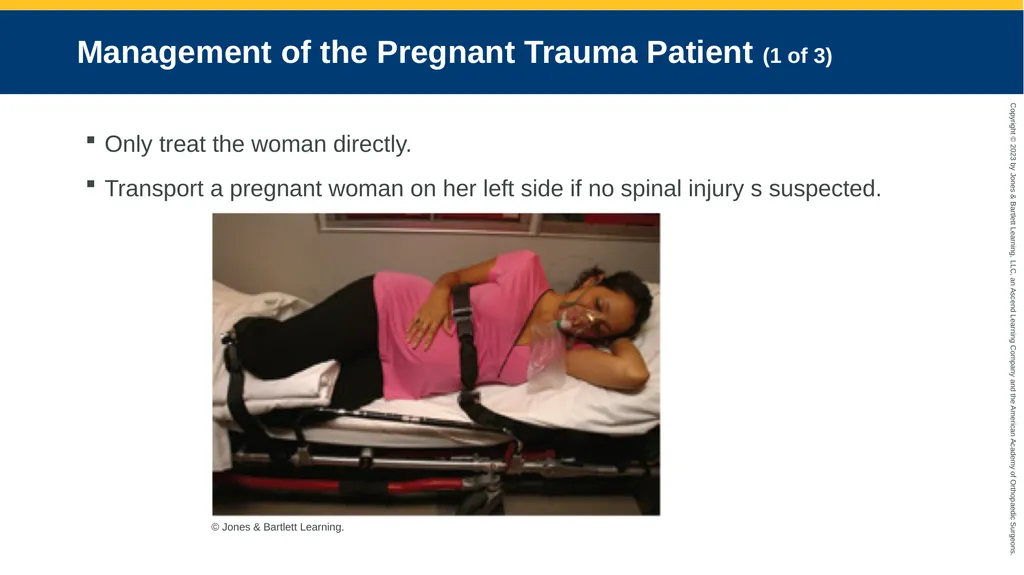
Management of the Pregnant Trauma Patient (1 of 3) Only treat the woman directly.
Transport a pregnant woman on her left side if no spinal injury s suspected. © Jones & Bartlett Learning.<br>
Transport a pregnant woman on her left side if no spinal injury s suspected. © Jones & Bartlett Learning.<br>
178
Management of the Pregnant Trauma Patient (2 of 3) Ensure an adequate airway.
Administer oxygen.
Assist ventilations when needed and provide a higher-than-usual minute volume.
Control external bleeding and splint fractures.<br>
Administer oxygen.
Assist ventilations when needed and provide a higher-than-usual minute volume.
Control external bleeding and splint fractures.<br>
179
Management of the Pregnant Trauma Patient (3 of 3) Start one or two IV lines of normal saline.
Notify the hospital of the patient’s status and estimated time of arrival.
Transport the patient in the lateral recumbent position.<br>
Notify the hospital of the patient’s status and estimated time of arrival.
Transport the patient in the lateral recumbent position.<br>
180
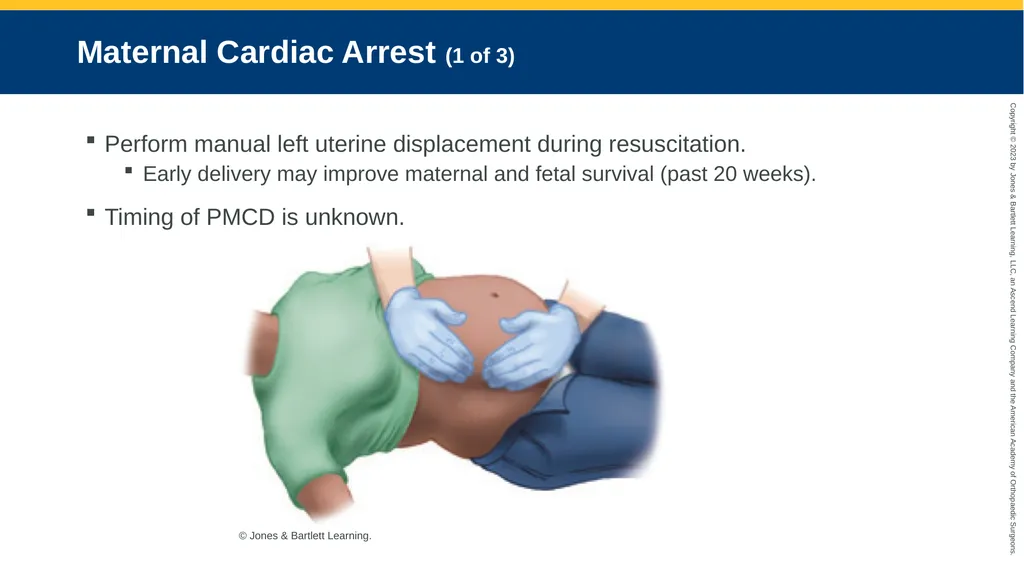
Maternal Cardiac Arrest (1 of 3) Perform manual left uterine displacement during resuscitation.
Early delivery may improve maternal and fetal survival (past 20 weeks).
Timing of PMCD is unknown. © Jones & Bartlett Learning.<br>
Early delivery may improve maternal and fetal survival (past 20 weeks).
Timing of PMCD is unknown. © Jones & Bartlett Learning.<br>
181
Maternal Cardiac Arrest (2 of 3) Paramedics ensure the best chance of survival by:
Rapidly transporting patient
Activating high-risk obstetrics, anesthesia, and neonatal resuscitation teams
Providing high-quality BS and ACLS<br>
Rapidly transporting patient
Activating high-risk obstetrics, anesthesia, and neonatal resuscitation teams
Providing high-quality BS and ACLS<br>
182
Maternal Cardiac Arrest (3 of 3) Normal landmarks for chest compressions may be difficult to find in the third trimester.
Use the sternal notch as a guidelines for hand placement.
Pregnant women are more susceptible to vomiting and aspiration during resuscitation.
Use ABCDEFGH mnemonic.<br>
Use the sternal notch as a guidelines for hand placement.
Pregnant women are more susceptible to vomiting and aspiration during resuscitation.
Use ABCDEFGH mnemonic.<br>