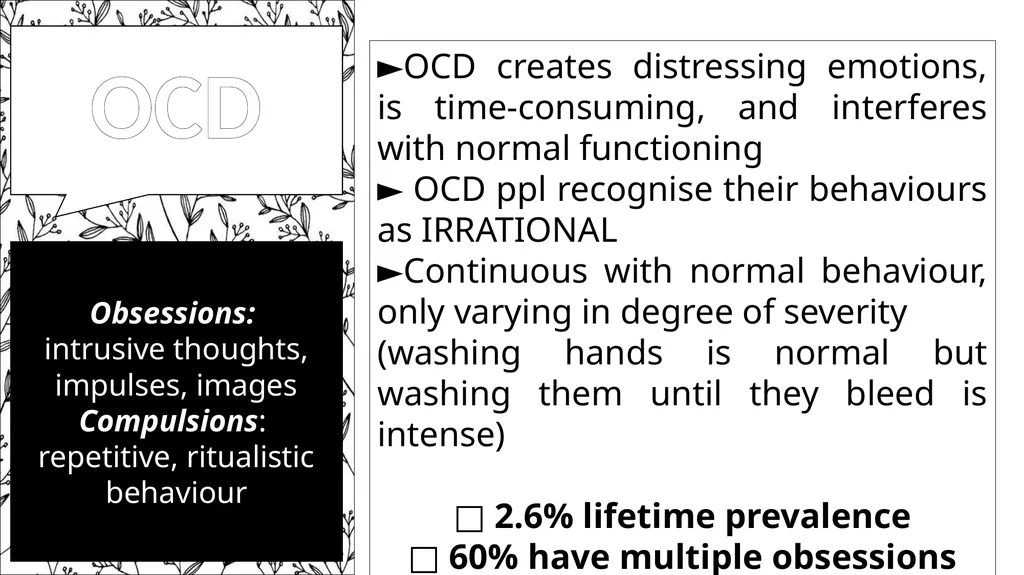
OCD Obsessions: intrusive thoughts, impulses, images Compulsions: repetitive, ritualistic behaviour OCD creates distressing emotions, is time-consuming, and interferes with normal functioning OCD ppl recognise their behaviours as
"OCD Obsessions: intrusive thoughts, impulses," is the property of its rightful owner. Permission is granted to
download and print the materials on this website for personal, non-commercial use only, and to display it
on your personal computer provided you do not modify the materials and that you retain all copyright
notices contained in the materials. By downloading content from our website, you accept the terms of this
agreement.
Presentation Transcript
01
OCD Obsessions:
intrusive thoughts, impulses, images
Compulsions:
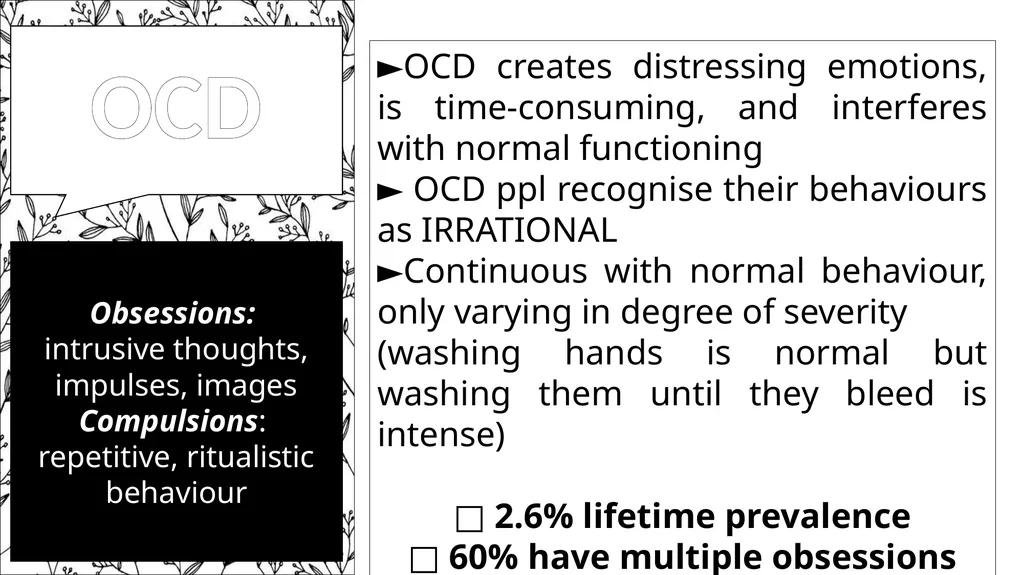
repetitive, ritualistic behaviour ►OCD creates distressing emotions, is time-consuming, and interferes with normal functioning
► OCD ppl recognise their behaviours as IRRATIONAL
►Continuous with normal behaviour, only varying in degree of severity
(washing hands is normal but washing them until they bleed is intense)
□ 2.6% lifetime prevalence
□ 60% have multiple obsessions<br>
02
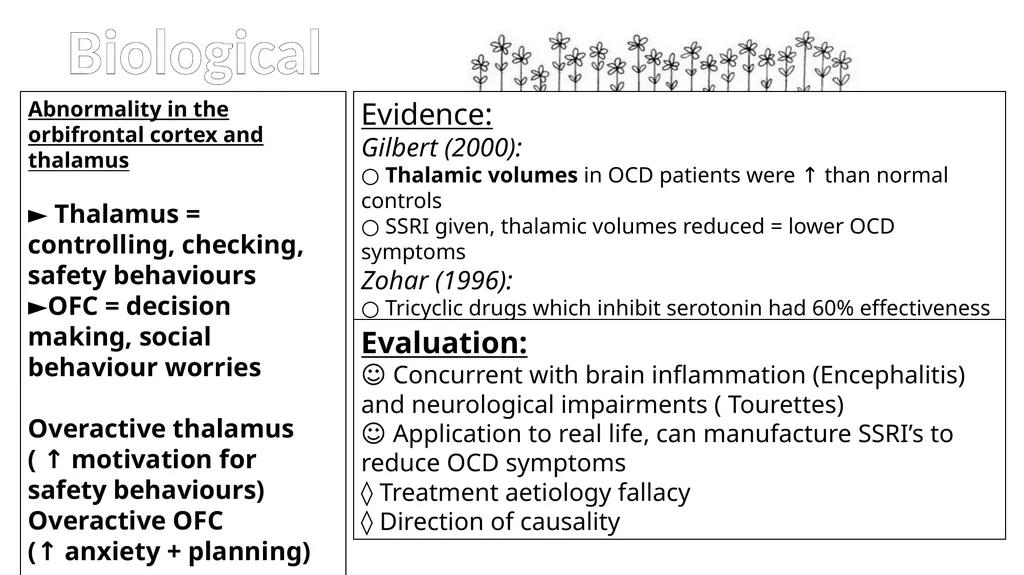
Biological Abnormality in the orbifrontal cortex and thalamus
Overactive thalamus
( ↑ motivation for safety behaviours) Overactive OFC
(↑ anxiety + planning) Evidence:
Gilbert (2000):
○ Thalamic volumes in OCD patients were ↑ than normal controls
○ SSRI given, thalamic volumes reduced = lower OCD symptoms
Zohar (1996):
○ Tricyclic drugs which inhibit serotonin had 60% effectiveness Evaluation:
☺ Concurrent with brain inflammation (Encephalitis) and neurological impairments ( Tourettes)
☺ Application to real life, can manufacture SSRI’s to reduce OCD symptoms
◊ Treatment aetiology fallacy
◊ Direction of causality<br>
03
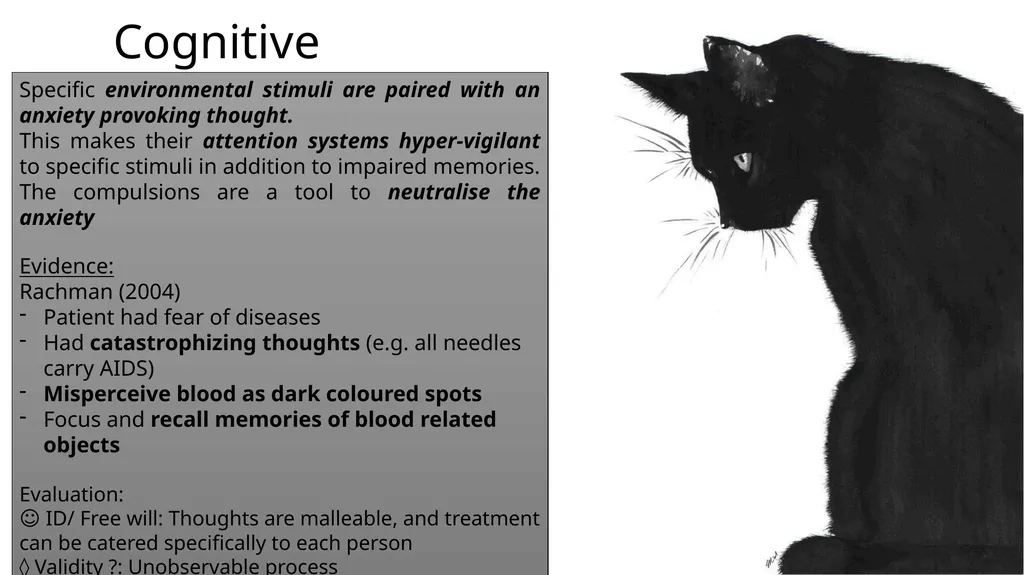
Cognitive Specific environmental stimuli are paired with an anxiety provoking thought.
This makes their attention systems hyper-vigilant to specific stimuli in addition to impaired memories.
The compulsions are a tool to neutralise the anxiety
Evidence:
Rachman (2004)
Patient had fear of diseases
Had catastrophizing thoughts (e.g. all needles carry AIDS)
Misperceive blood as dark coloured spots
Focus and recall memories of blood related objects
Evaluation:
☺ ID/ Free will: Thoughts are malleable, and treatment can be catered specifically to each person
◊ Validity ?: Unobservable process
◊ Direction of causality<br>
04
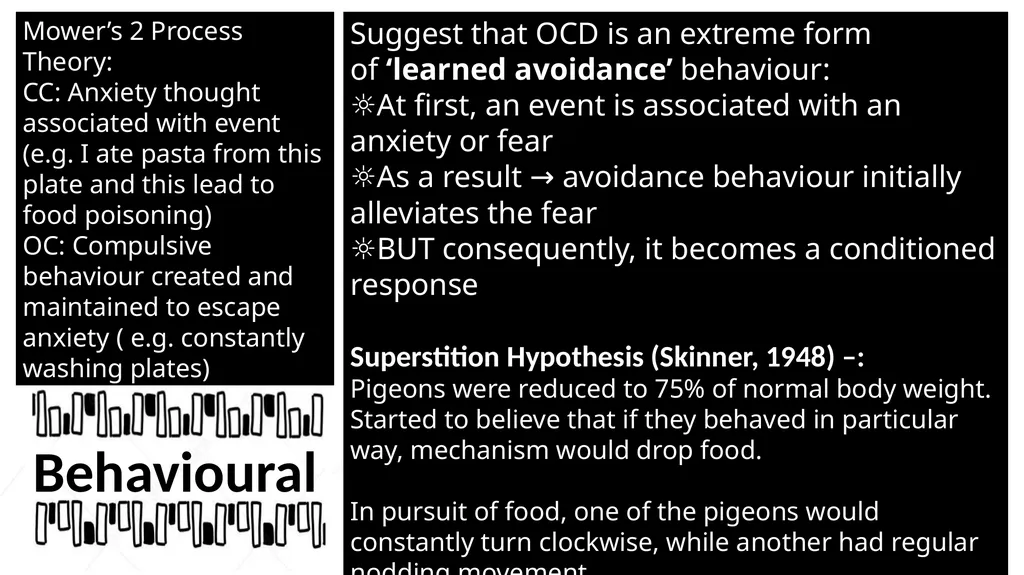
Behavioural Mower’s 2 Process Theory:
CC: Anxiety thought associated with event
(e.g. I ate pasta from this plate and this lead to food poisoning)
OC: Compulsive behaviour created and maintained to escape anxiety ( e.g. constantly washing plates) Suggest that OCD is an extreme form of ‘learned avoidance’ behaviour:
☼At first, an event is associated with an anxiety or fear
☼As a result → avoidance behaviour initially alleviates the fear
☼BUT consequently, it becomes a conditioned response
Superstition Hypothesis (Skinner, 1948) –:
Pigeons were reduced to 75% of normal body weight. Started to believe that if they behaved in particular way, mechanism would drop food.
In pursuit of food, one of the pigeons would constantly turn clockwise, while another had regular nodding movement<br>
05
Psychodynamic Freud → fixation in the anal stage
Fixation at psychosexual stage: Anal retentive
Concerned with maintaining hygiene, avoid anxiety from strict parents
Become excessively neat and tidy
Obsessions can be defence mechanisms which occupy the mind so as to displace more disturbing thoughts. Ratman (Freud 1907)
Obsession: thought of father’s death by rats boring through his anus
Compulsion: irrational actions
(e.g. urge to repay lieutenant for his bifocals even though he declined payment)
DISPLACEMENT: fear of punishment displaced on father
Childhood history where he indulged in sexual foreplay with his governess, stimulating fear of punishment from father<br>
06
Rappaport 1991 ►Charles took 3+ hours to shower and 2 hours to get dressed. This interfered with his daily functioning, to the point that he had to leave school.
Obsession: “something sticky”
“I have to”
“sickness”
“bad luck”
Compulsion:
Continuously washing hands, cleansing self in shower
►Had (+) reinforcement because mum encourages OCD by cleaning with rubbing alcohol, scouring room and keep people away from the house which reduces his anxiety
►Used Anafranil (SSRI), but only effective for 1 year<br>
07
“I don’t worry unduly about contamination if I touch an animal”
“I am more concerned than most people about honesty”
“I have a very strict conscience” MOCI (Maudsley Obsessional Compulsive Inventory) Evaluation:
(+) 30 questions (T/F) = easy to carry out and more objective since it is quantitative data for statistical analysis
(+) Sensitive to change so can measure pre/post treatment responses, also no need for trained psychologist
(-) Reductionist categories limited to washing, checking, slowness doubting, excludes other categories like hoarding or covert rituals
(-) Some answers may be common among the clinically normal public so not valid<br>
08
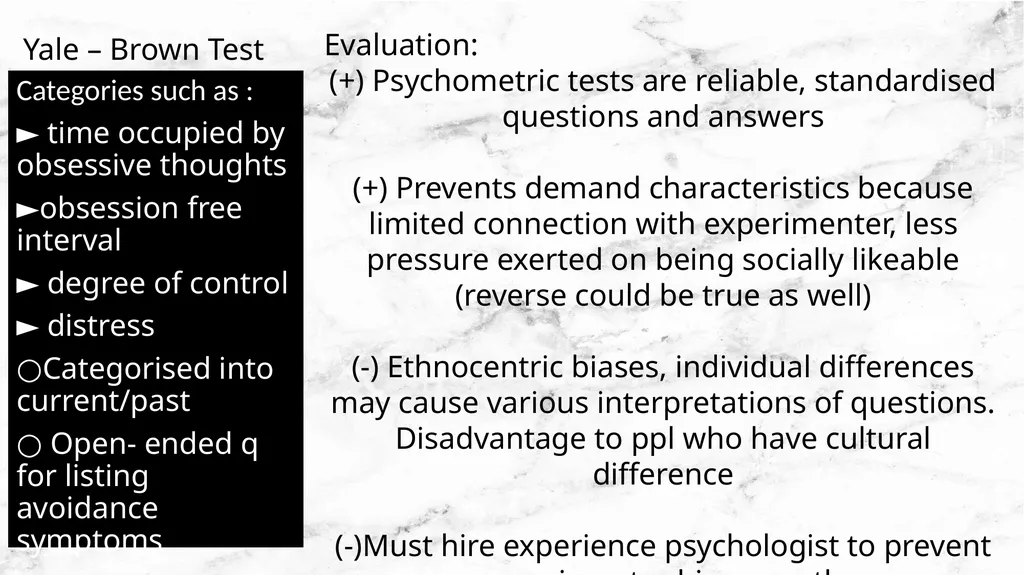
Yale – Brown Test Categories such as :
► time occupied by obsessive thoughts
►obsession free interval
► degree of control
► distress
○Categorised into current/past
○ Open- ended q for listing avoidance symptoms Evaluation:
(+) Psychometric tests are reliable, standardised questions and answers
(+) Prevents demand characteristics because limited connection with experimenter, less pressure exerted on being socially likeable (reverse could be true as well)
(-) Ethnocentric biases, individual differences may cause various interpretations of questions. Disadvantage to ppl who have cultural difference
(-)Must hire experience psychologist to prevent experimenter bias = costly<br>
09
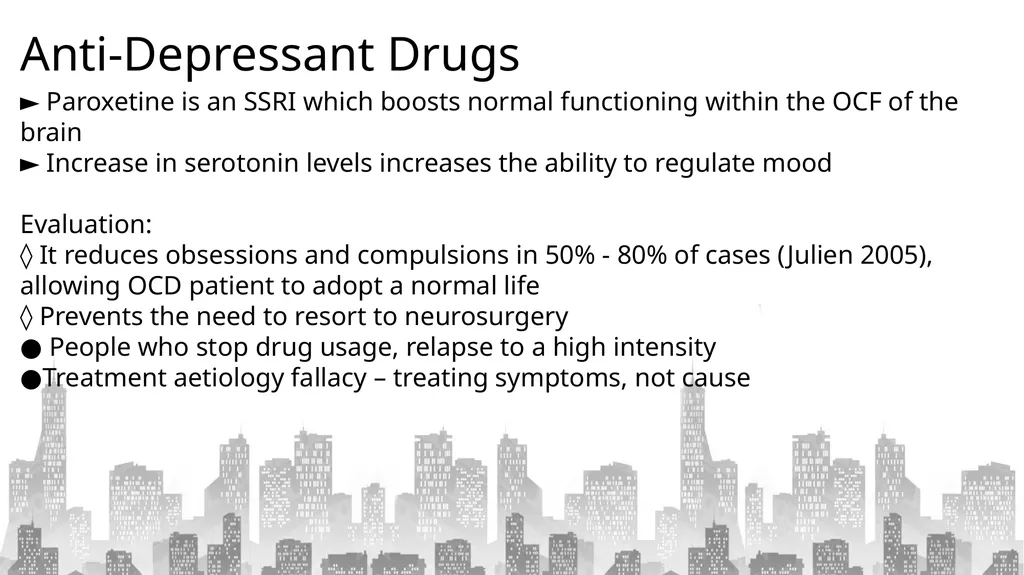
Anti-Depressant Drugs ► Paroxetine is an SSRI which boosts normal functioning within the OCF of the brain
► Increase in serotonin levels increases the ability to regulate mood
Evaluation:
◊ It reduces obsessions and compulsions in 50% - 80% of cases (Julien 2005), allowing OCD patient to adopt a normal life
◊ Prevents the need to resort to neurosurgery
● People who stop drug usage, relapse to a high intensity
●Treatment aetiology fallacy – treating symptoms, not cause<br>
10
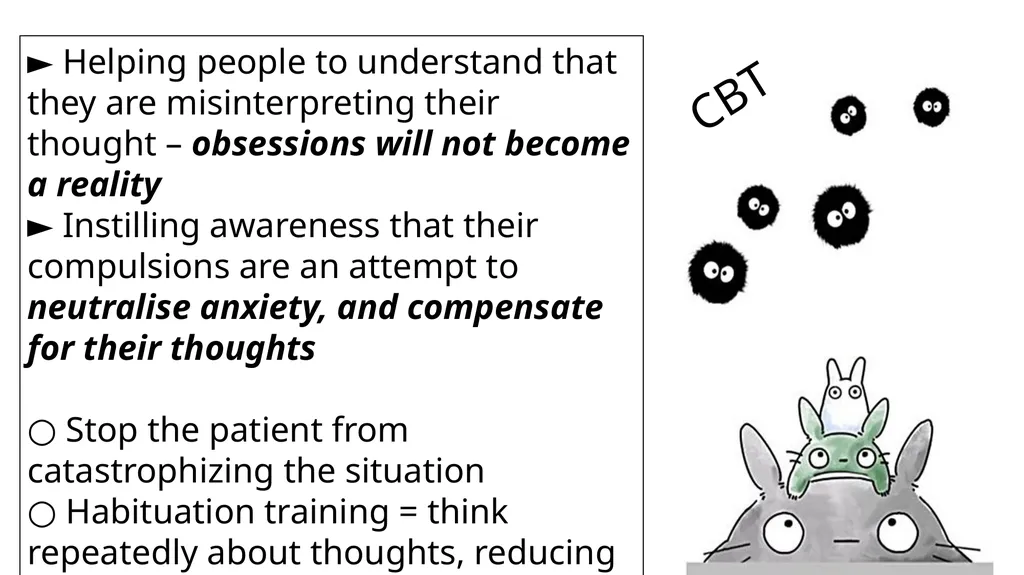
CBT ► Helping people to understand that they are misinterpreting their thought – obsessions will not become a reality
► Instilling awareness that their compulsions are an attempt to neutralise anxiety, and compensate for their thoughts
○ Stop the patient from catastrophizing the situation
○ Habituation training = think repeatedly about thoughts, reducing anxiety<br>
11
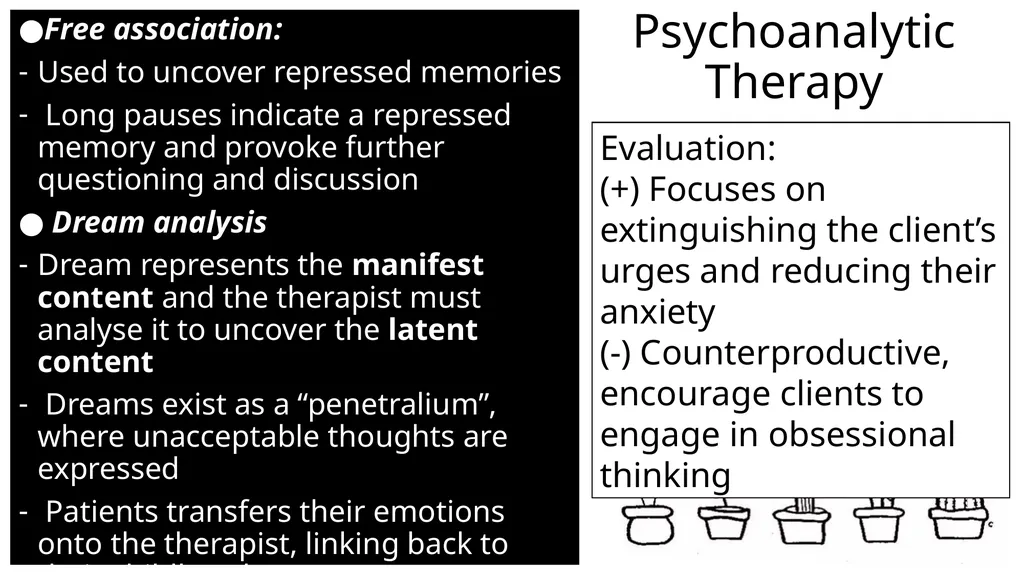
Psychoanalytic Therapy ●Free association:
Used to uncover repressed memories
Long pauses indicate a repressed memory and provoke further questioning and discussion
● Dream analysis
Dream represents the manifest content and the therapist must analyse it to uncover the latent content
Dreams exist as a “penetralium”, where unacceptable thoughts are expressed
Patients transfers their emotions onto the therapist, linking back to their childhood trauma Evaluation:
(+) Focuses on extinguishing the client’s urges and reducing their anxiety
(-) Counterproductive, encourage clients to engage in obsessional thinking<br>