
OECD data collection activities UNCEEA meeting New
MT
Published · 22 slides · 0 views

1 / 1

Description
OECD data collection activities UNCEEA meeting New York, 24-26 June 2015 Myriam Linster, OECD Environment Directorate Environment Environmental data and indicators Database on policy instruments Green growth: indicators and database
Related Topics
Download this presentation From Below
"OECD data collection activities UNCEEA meeting New" is the property of its rightful owner. Permission is granted to download and print the materials on this website for personal, non-commercial use only, and to display it on your personal computer provided you do not modify the materials and that you retain all copyright notices contained in the materials. By downloading content from our website, you accept the terms of this agreement.
Share
Embed code
Presentation Transcript
01
OECD data collection activities UNCEEA meeting
New York, 24-26 June 2015 Myriam Linster, OECD
Environment Directorate<br>
02
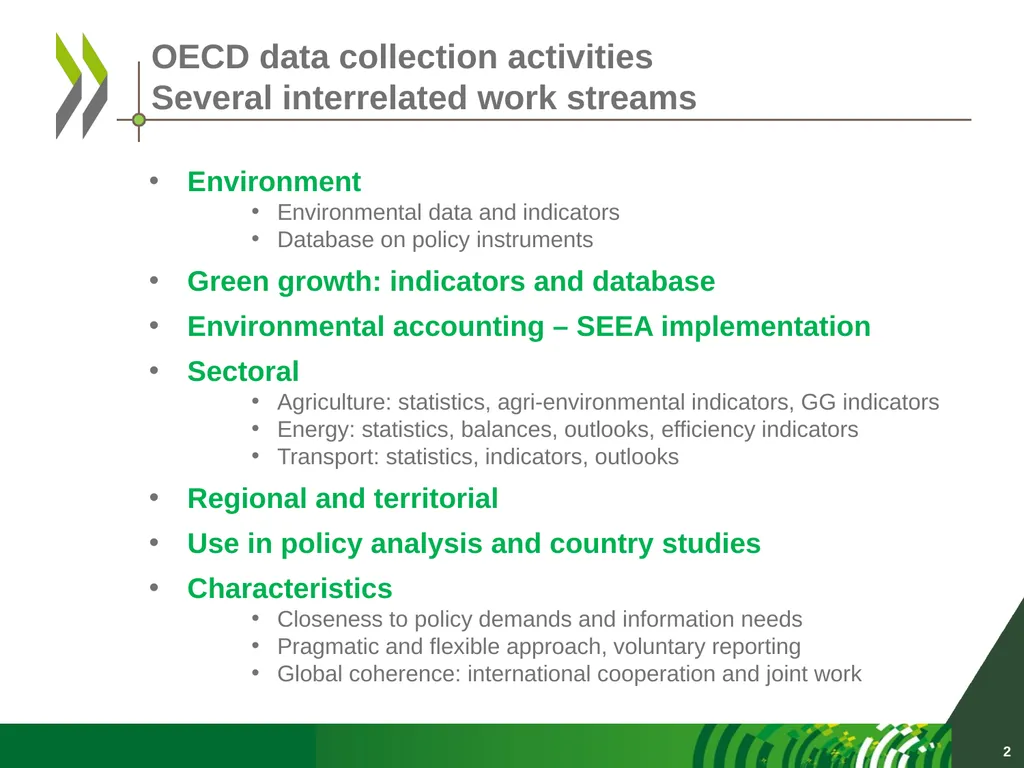
Environment
Environmental data and indicators
Database on policy instruments
Green growth: indicators and database
Environmental accounting – SEEA implementation
Sectoral
Agriculture: statistics, agri-environmental indicators, GG indicators
Energy: statistics, balances, outlooks, efficiency indicators
Transport: statistics, indicators, outlooks
Regional and territorial
Use in policy analysis and country studies
Characteristics
Closeness to policy demands and information needs
Pragmatic and flexible approach, voluntary reporting
Global coherence: international cooperation and joint work 2 OECD data collection activities Several interrelated work streams<br>
Environmental data and indicators
Database on policy instruments
Green growth: indicators and database
Environmental accounting – SEEA implementation
Sectoral
Agriculture: statistics, agri-environmental indicators, GG indicators
Energy: statistics, balances, outlooks, efficiency indicators
Transport: statistics, indicators, outlooks
Regional and territorial
Use in policy analysis and country studies
Characteristics
Closeness to policy demands and information needs
Pragmatic and flexible approach, voluntary reporting
Global coherence: international cooperation and joint work 2 OECD data collection activities Several interrelated work streams<br>
03
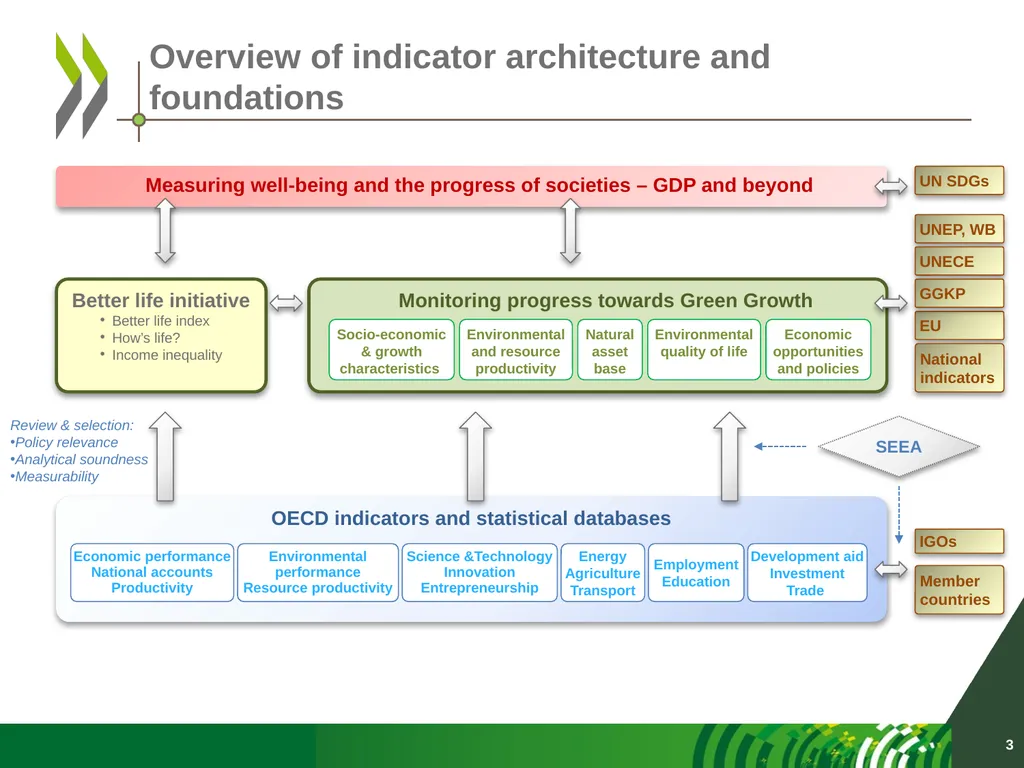
3 Overview of indicator architecture and foundations UNEP, WB SEEA Review & selection:
Policy relevance
Analytical soundness
Measurability EU Measuring well-being and the progress of societies – GDP and beyond Member countries IGOs National indicators UN SDGs Better life initiative
Better life index
How’s life?
Income inequality UNECE GGKP<br>
Policy relevance
Analytical soundness
Measurability EU Measuring well-being and the progress of societies – GDP and beyond Member countries IGOs National indicators UN SDGs Better life initiative
Better life index
How’s life?
Income inequality UNECE GGKP<br>
04
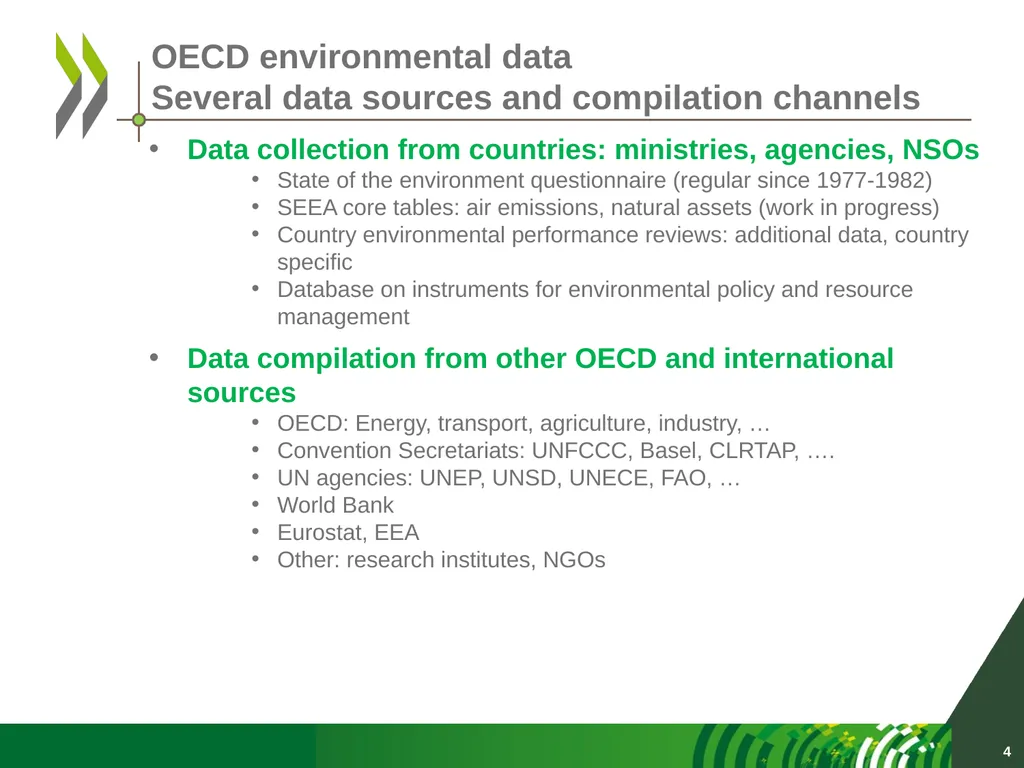
Data collection from countries: ministries, agencies, NSOs
State of the environment questionnaire (regular since 1977-1982)
SEEA core tables: air emissions, natural assets (work in progress)
Country environmental performance reviews: additional data, country specific
Database on instruments for environmental policy and resource management
Data compilation from other OECD and international sources
OECD: Energy, transport, agriculture, industry, …
Convention Secretariats: UNFCCC, Basel, CLRTAP, ….
UN agencies: UNEP, UNSD, UNECE, FAO, …
World Bank
Eurostat, EEA
Other: research institutes, NGOs 4 OECD environmental data Several data sources and compilation channels<br>
State of the environment questionnaire (regular since 1977-1982)
SEEA core tables: air emissions, natural assets (work in progress)
Country environmental performance reviews: additional data, country specific
Database on instruments for environmental policy and resource management
Data compilation from other OECD and international sources
OECD: Energy, transport, agriculture, industry, …
Convention Secretariats: UNFCCC, Basel, CLRTAP, ….
UN agencies: UNEP, UNSD, UNECE, FAO, …
World Bank
Eurostat, EEA
Other: research institutes, NGOs 4 OECD environmental data Several data sources and compilation channels<br>
05
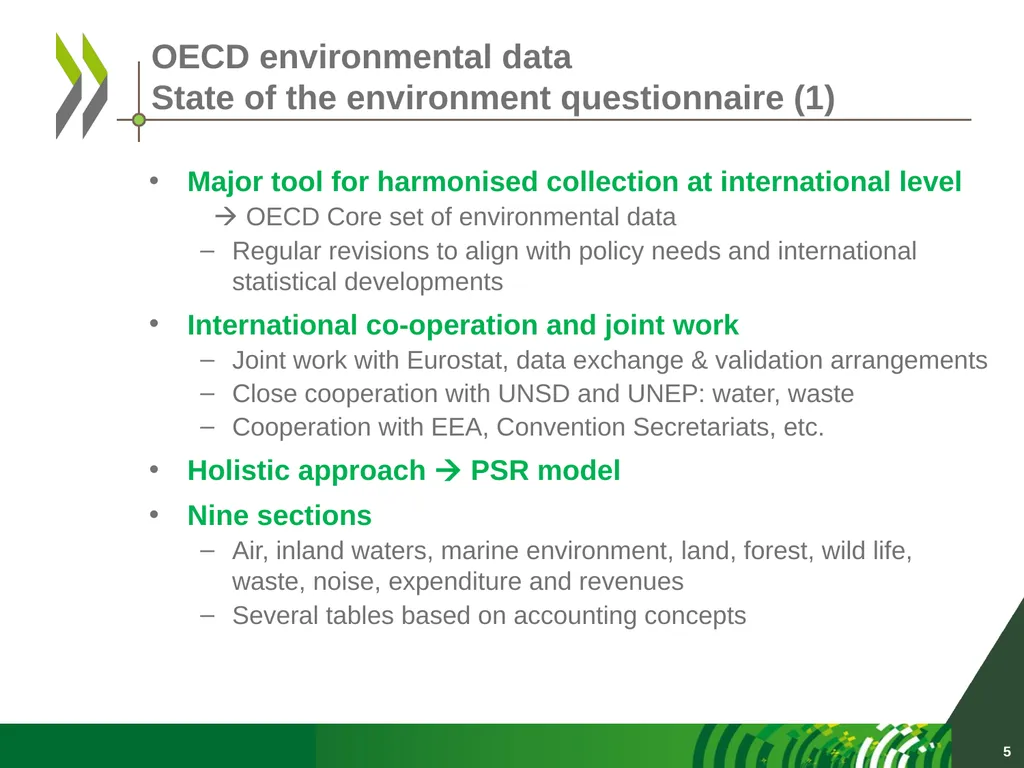
Major tool for harmonised collection at international level
OECD Core set of environmental data
Regular revisions to align with policy needs and international statistical developments
International co-operation and joint work
Joint work with Eurostat, data exchange & validation arrangements
Close cooperation with UNSD and UNEP: water, waste
Cooperation with EEA, Convention Secretariats, etc.
Holistic approach PSR model
Nine sections
Air, inland waters, marine environment, land, forest, wild life, waste, noise, expenditure and revenues
Several tables based on accounting concepts 5 OECD environmental data State of the environment questionnaire (1)<br>
OECD Core set of environmental data
Regular revisions to align with policy needs and international statistical developments
International co-operation and joint work
Joint work with Eurostat, data exchange & validation arrangements
Close cooperation with UNSD and UNEP: water, waste
Cooperation with EEA, Convention Secretariats, etc.
Holistic approach PSR model
Nine sections
Air, inland waters, marine environment, land, forest, wild life, waste, noise, expenditure and revenues
Several tables based on accounting concepts 5 OECD environmental data State of the environment questionnaire (1)<br>
06
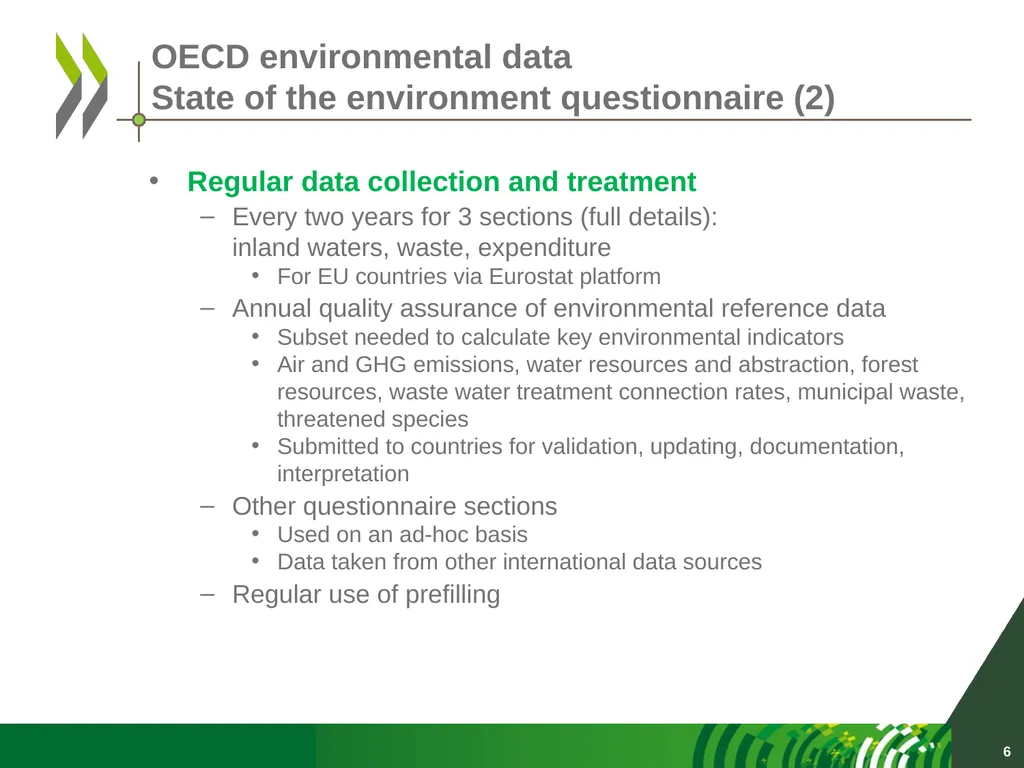
Regular data collection and treatment
Every two years for 3 sections (full details): inland waters, waste, expenditure
For EU countries via Eurostat platform
Annual quality assurance of environmental reference data
Subset needed to calculate key environmental indicators
Air and GHG emissions, water resources and abstraction, forest resources, waste water treatment connection rates, municipal waste, threatened species
Submitted to countries for validation, updating, documentation, interpretation
Other questionnaire sections
Used on an ad-hoc basis
Data taken from other international data sources
Regular use of prefilling 6 OECD environmental data State of the environment questionnaire (2)<br>
Every two years for 3 sections (full details): inland waters, waste, expenditure
For EU countries via Eurostat platform
Annual quality assurance of environmental reference data
Subset needed to calculate key environmental indicators
Air and GHG emissions, water resources and abstraction, forest resources, waste water treatment connection rates, municipal waste, threatened species
Submitted to countries for validation, updating, documentation, interpretation
Other questionnaire sections
Used on an ad-hoc basis
Data taken from other international data sources
Regular use of prefilling 6 OECD environmental data State of the environment questionnaire (2)<br>
07
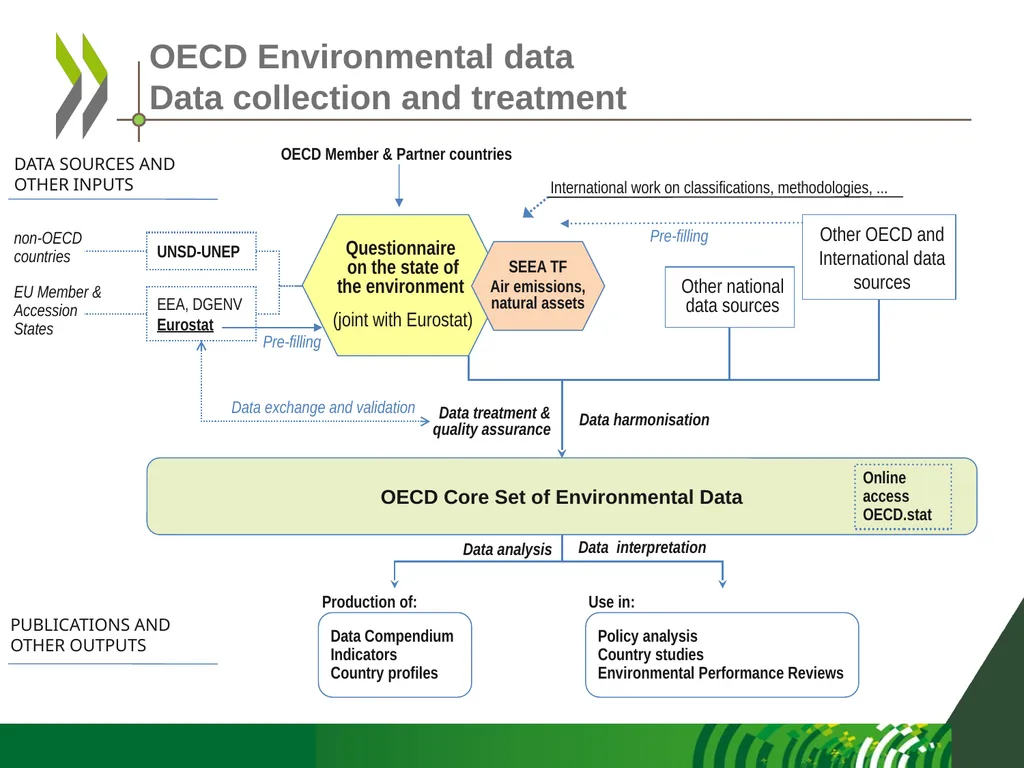
OECD Core Set of Environmental Data Policy analysis
Country studies
Environmental Performance Reviews Use in: Data Compendium
Indicators
Country profiles Production of: Other OECD and International data sources Other national data sources Online access
OECD.stat Data analysis Data exchange and validation Data harmonisation EEA, DGENV
Eurostat EU Member & Accession States non-OECD countries Data treatment & quality assurance Data interpretation UNSD-UNEP Pre-filling OECD Environmental data Data collection and treatment Pre-filling Questionnaire on the state of the environment
(joint with Eurostat) SEEA TF
Air emissions, natural assets<br>
Country studies
Environmental Performance Reviews Use in: Data Compendium
Indicators
Country profiles Production of: Other OECD and International data sources Other national data sources Online access
OECD.stat Data analysis Data exchange and validation Data harmonisation EEA, DGENV
Eurostat EU Member & Accession States non-OECD countries Data treatment & quality assurance Data interpretation UNSD-UNEP Pre-filling OECD Environmental data Data collection and treatment Pre-filling Questionnaire on the state of the environment
(joint with Eurostat) SEEA TF
Air emissions, natural assets<br>
08
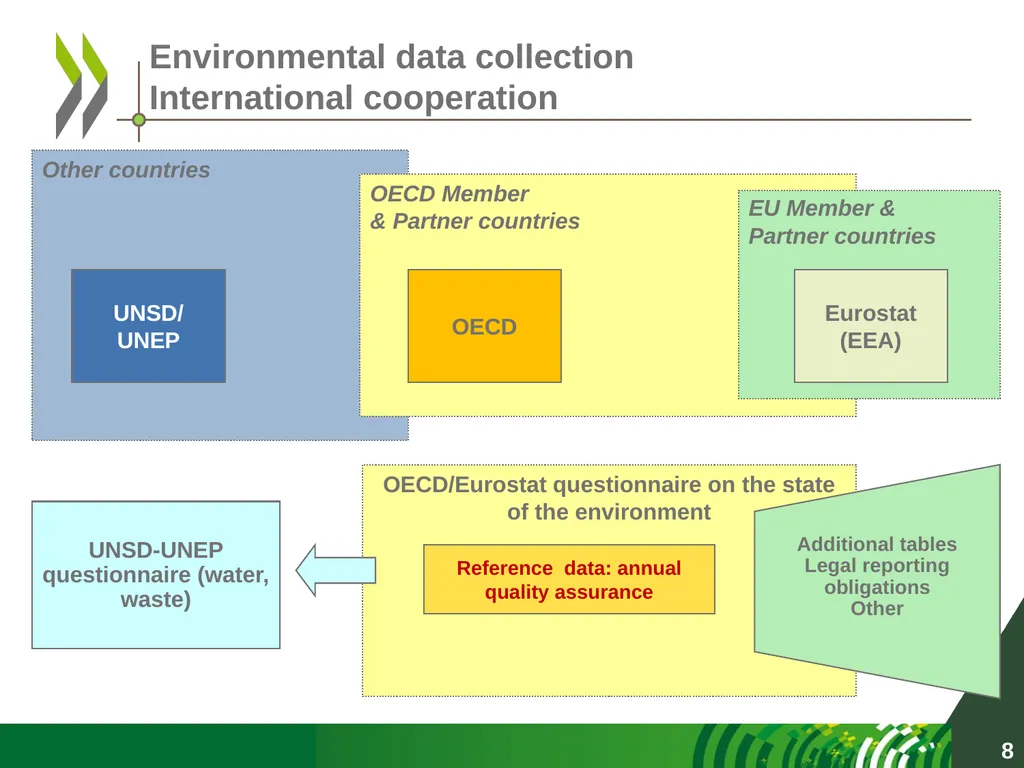
8 Environmental data collection
International cooperation Other countries OECD Member
& Partner countries EU Member &
Partner countries OECD Eurostat
(EEA) UNSD/ UNEP OECD/Eurostat questionnaire on the state of the environment UNSD-UNEP questionnaire (water, waste) Reference data: annual quality assurance<br>
Partner countries OECD Eurostat
(EEA) UNSD/ UNEP OECD/Eurostat questionnaire on the state of the environment UNSD-UNEP questionnaire (water, waste) Reference data: annual quality assurance<br>
09
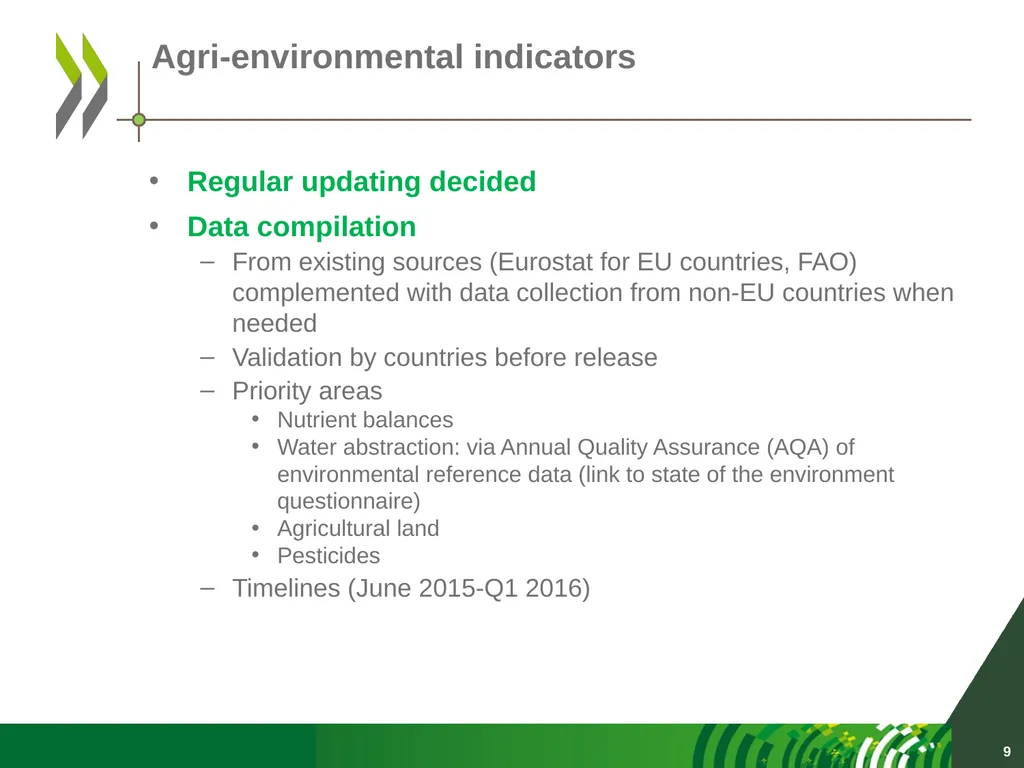
Regular updating decided
Data compilation
From existing sources (Eurostat for EU countries, FAO) complemented with data collection from non-EU countries when needed
Validation by countries before release
Priority areas
Nutrient balances
Water abstraction: via Annual Quality Assurance (AQA) of environmental reference data (link to state of the environment questionnaire)
Agricultural land
Pesticides
Timelines (June 2015-Q1 2016) 9 Agri-environmental indicators<br>
Data compilation
From existing sources (Eurostat for EU countries, FAO) complemented with data collection from non-EU countries when needed
Validation by countries before release
Priority areas
Nutrient balances
Water abstraction: via Annual Quality Assurance (AQA) of environmental reference data (link to state of the environment questionnaire)
Agricultural land
Pesticides
Timelines (June 2015-Q1 2016) 9 Agri-environmental indicators<br>
10
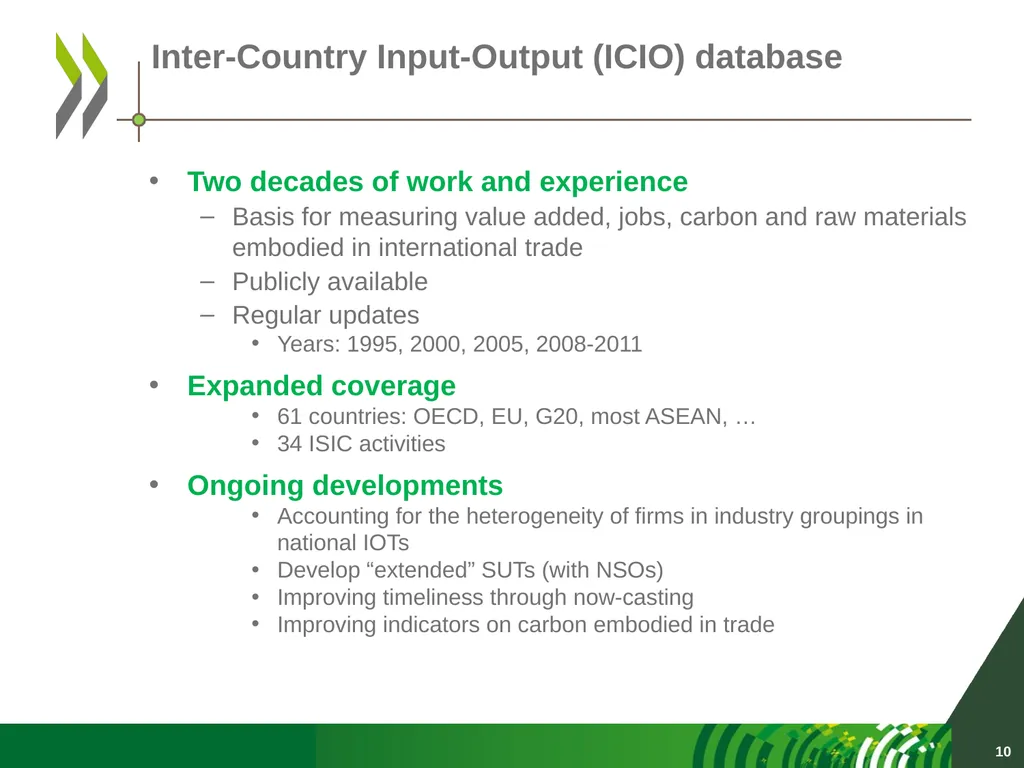
Two decades of work and experience
Basis for measuring value added, jobs, carbon and raw materials embodied in international trade
Publicly available
Regular updates
Years: 1995, 2000, 2005, 2008-2011
Expanded coverage
61 countries: OECD, EU, G20, most ASEAN, …
34 ISIC activities
Ongoing developments
Accounting for the heterogeneity of firms in industry groupings in national IOTs
Develop “extended” SUTs (with NSOs)
Improving timeliness through now-casting
Improving indicators on carbon embodied in trade 10 Inter-Country Input-Output (ICIO) database<br>
Basis for measuring value added, jobs, carbon and raw materials embodied in international trade
Publicly available
Regular updates
Years: 1995, 2000, 2005, 2008-2011
Expanded coverage
61 countries: OECD, EU, G20, most ASEAN, …
34 ISIC activities
Ongoing developments
Accounting for the heterogeneity of firms in industry groupings in national IOTs
Develop “extended” SUTs (with NSOs)
Improving timeliness through now-casting
Improving indicators on carbon embodied in trade 10 Inter-Country Input-Output (ICIO) database<br>
11
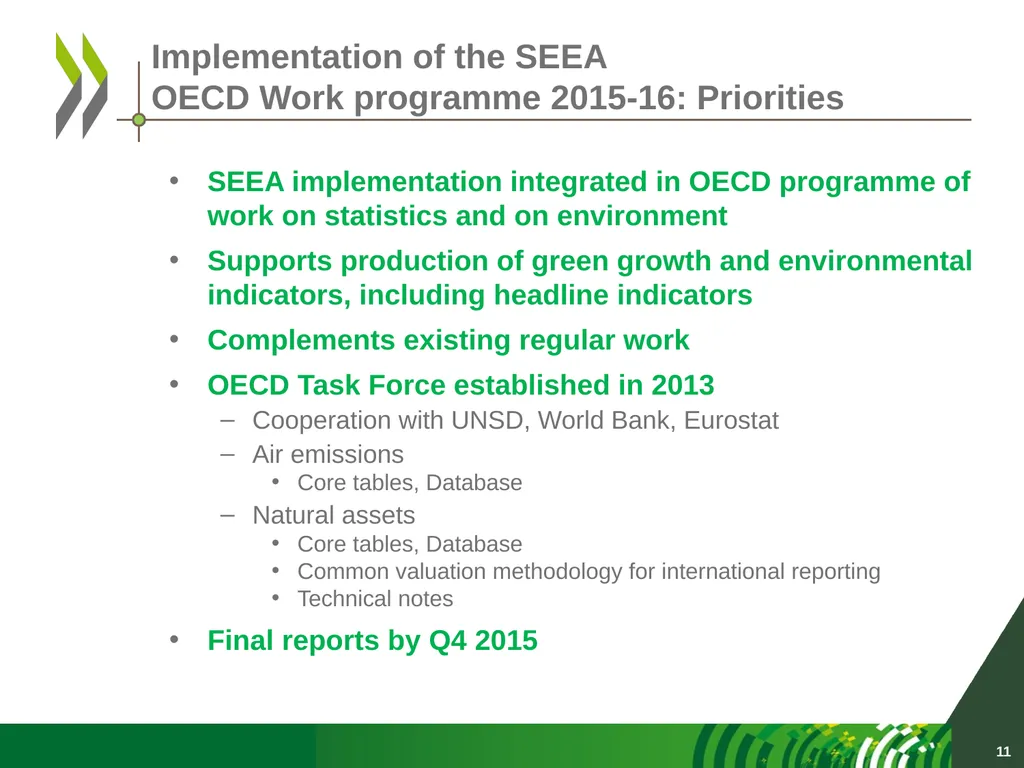
SEEA implementation integrated in OECD programme of work on statistics and on environment
Supports production of green growth and environmental indicators, including headline indicators
Complements existing regular work
OECD Task Force established in 2013
Cooperation with UNSD, World Bank, Eurostat
Air emissions
Core tables, Database
Natural assets
Core tables, Database
Common valuation methodology for international reporting
Technical notes
Final reports by Q4 2015 11 Implementation of the SEEA OECD Work programme 2015-16: Priorities<br>
Supports production of green growth and environmental indicators, including headline indicators
Complements existing regular work
OECD Task Force established in 2013
Cooperation with UNSD, World Bank, Eurostat
Air emissions
Core tables, Database
Natural assets
Core tables, Database
Common valuation methodology for international reporting
Technical notes
Final reports by Q4 2015 11 Implementation of the SEEA OECD Work programme 2015-16: Priorities<br>
12
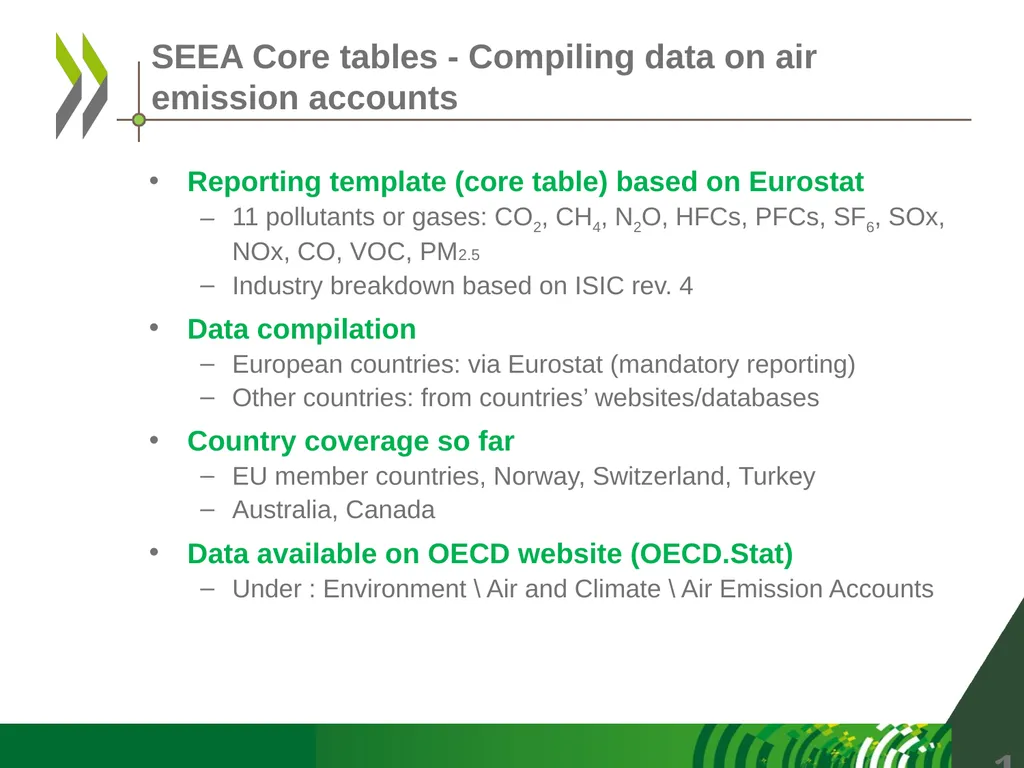
Reporting template (core table) based on Eurostat
11 pollutants or gases: CO2, CH4, N2O, HFCs, PFCs, SF6, SOx, NOx, CO, VOC, PM2.5
Industry breakdown based on ISIC rev. 4
Data compilation
European countries: via Eurostat (mandatory reporting)
Other countries: from countries’ websites/databases
Country coverage so far
EU member countries, Norway, Switzerland, Turkey
Australia, Canada
Data available on OECD website (OECD.Stat)
Under : Environment \ Air and Climate \ Air Emission Accounts 12 SEEA Core tables - Compiling data on air emission accounts<br>
11 pollutants or gases: CO2, CH4, N2O, HFCs, PFCs, SF6, SOx, NOx, CO, VOC, PM2.5
Industry breakdown based on ISIC rev. 4
Data compilation
European countries: via Eurostat (mandatory reporting)
Other countries: from countries’ websites/databases
Country coverage so far
EU member countries, Norway, Switzerland, Turkey
Australia, Canada
Data available on OECD website (OECD.Stat)
Under : Environment \ Air and Climate \ Air Emission Accounts 12 SEEA Core tables - Compiling data on air emission accounts<br>
13
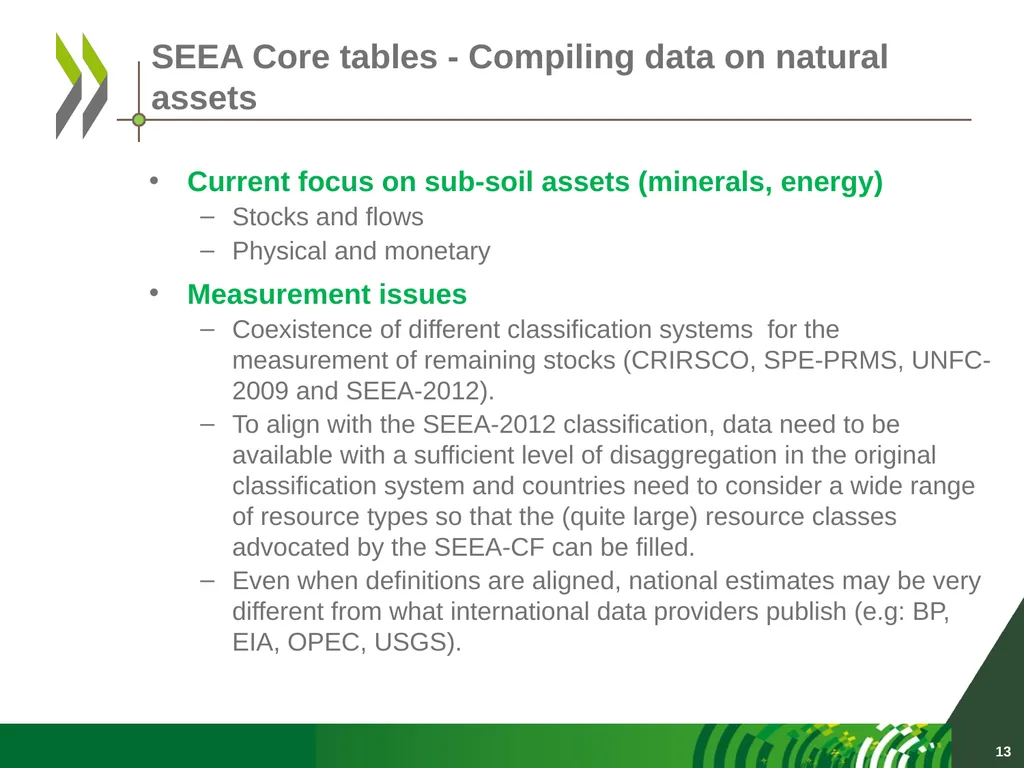
Current focus on sub-soil assets (minerals, energy)
Stocks and flows
Physical and monetary
Measurement issues
Coexistence of different classification systems for the measurement of remaining stocks (CRIRSCO, SPE-PRMS, UNFC-2009 and SEEA-2012).
To align with the SEEA-2012 classification, data need to be available with a sufficient level of disaggregation in the original classification system and countries need to consider a wide range of resource types so that the (quite large) resource classes advocated by the SEEA-CF can be filled.
Even when definitions are aligned, national estimates may be very different from what international data providers publish (e.g: BP, EIA, OPEC, USGS). 13 SEEA Core tables - Compiling data on natural assets<br>
Stocks and flows
Physical and monetary
Measurement issues
Coexistence of different classification systems for the measurement of remaining stocks (CRIRSCO, SPE-PRMS, UNFC-2009 and SEEA-2012).
To align with the SEEA-2012 classification, data need to be available with a sufficient level of disaggregation in the original classification system and countries need to consider a wide range of resource types so that the (quite large) resource classes advocated by the SEEA-CF can be filled.
Even when definitions are aligned, national estimates may be very different from what international data providers publish (e.g: BP, EIA, OPEC, USGS). 13 SEEA Core tables - Compiling data on natural assets<br>
14
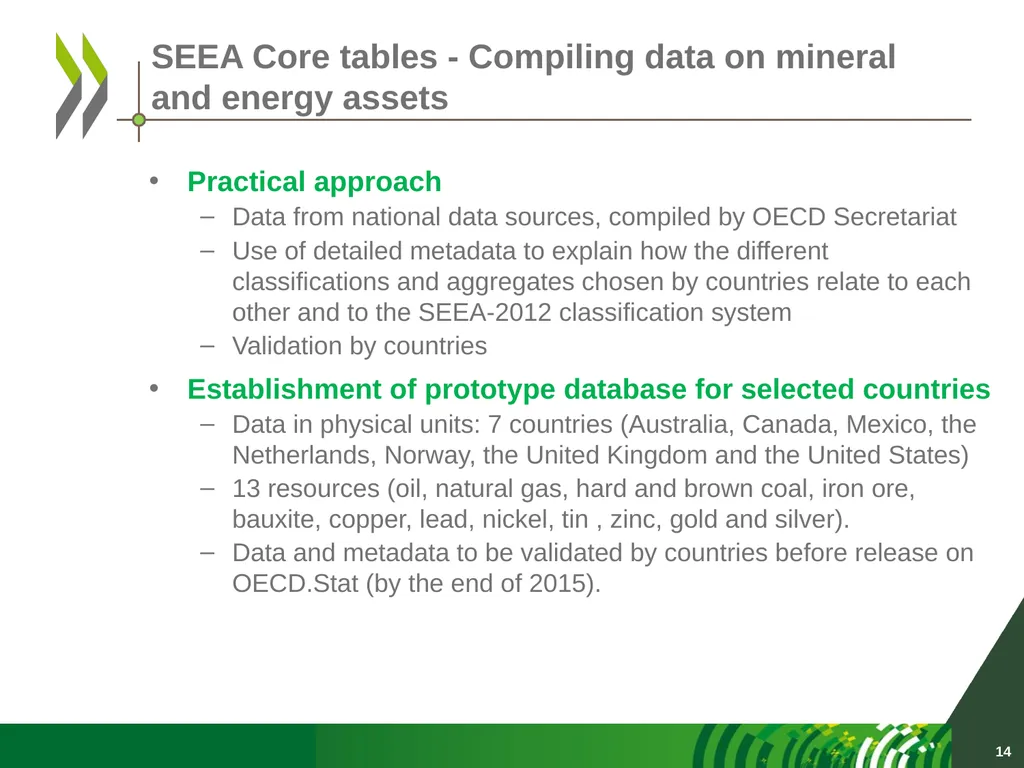
Practical approach
Data from national data sources, compiled by OECD Secretariat
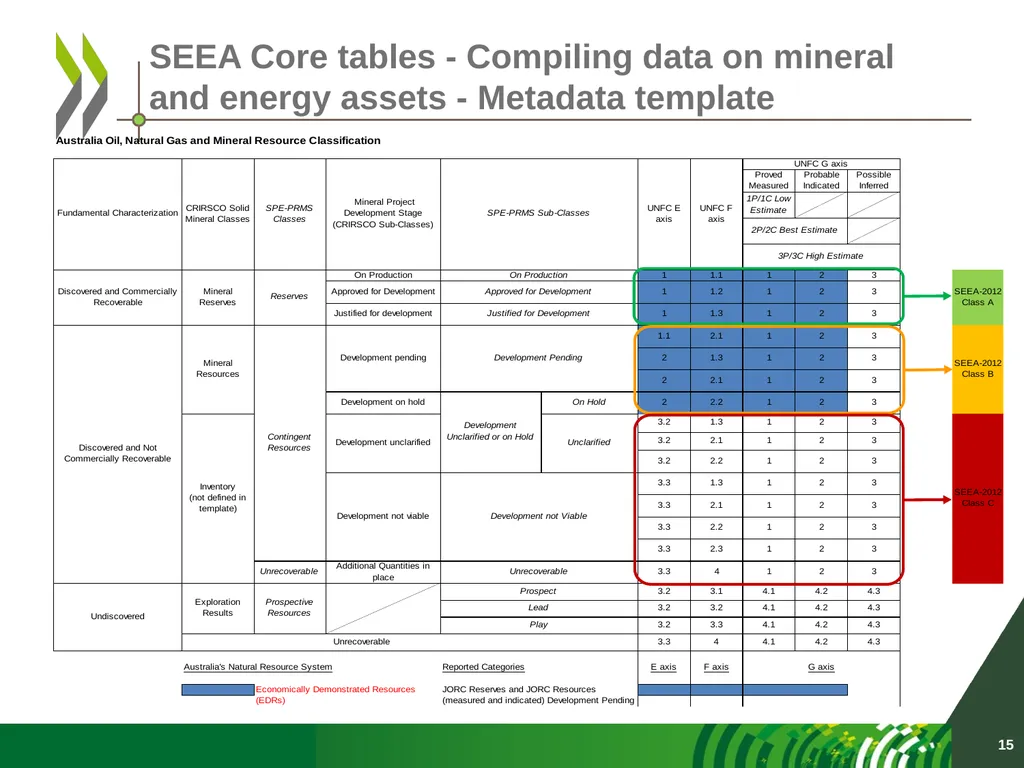
Use of detailed metadata to explain how the different classifications and aggregates chosen by countries relate to each other and to the SEEA-2012 classification system
Validation by countries
Establishment of prototype database for selected countries
Data in physical units: 7 countries (Australia, Canada, Mexico, the Netherlands, Norway, the United Kingdom and the United States)
13 resources (oil, natural gas, hard and brown coal, iron ore, bauxite, copper, lead, nickel, tin , zinc, gold and silver).
Data and metadata to be validated by countries before release on OECD.Stat (by the end of 2015). 14 SEEA Core tables - Compiling data on mineral and energy assets<br>
Data from national data sources, compiled by OECD Secretariat
Use of detailed metadata to explain how the different classifications and aggregates chosen by countries relate to each other and to the SEEA-2012 classification system
Validation by countries
Establishment of prototype database for selected countries
Data in physical units: 7 countries (Australia, Canada, Mexico, the Netherlands, Norway, the United Kingdom and the United States)
13 resources (oil, natural gas, hard and brown coal, iron ore, bauxite, copper, lead, nickel, tin , zinc, gold and silver).
Data and metadata to be validated by countries before release on OECD.Stat (by the end of 2015). 14 SEEA Core tables - Compiling data on mineral and energy assets<br>
15
15 SEEA Core tables - Compiling data on mineral and energy assets - Metadata template<br>
16
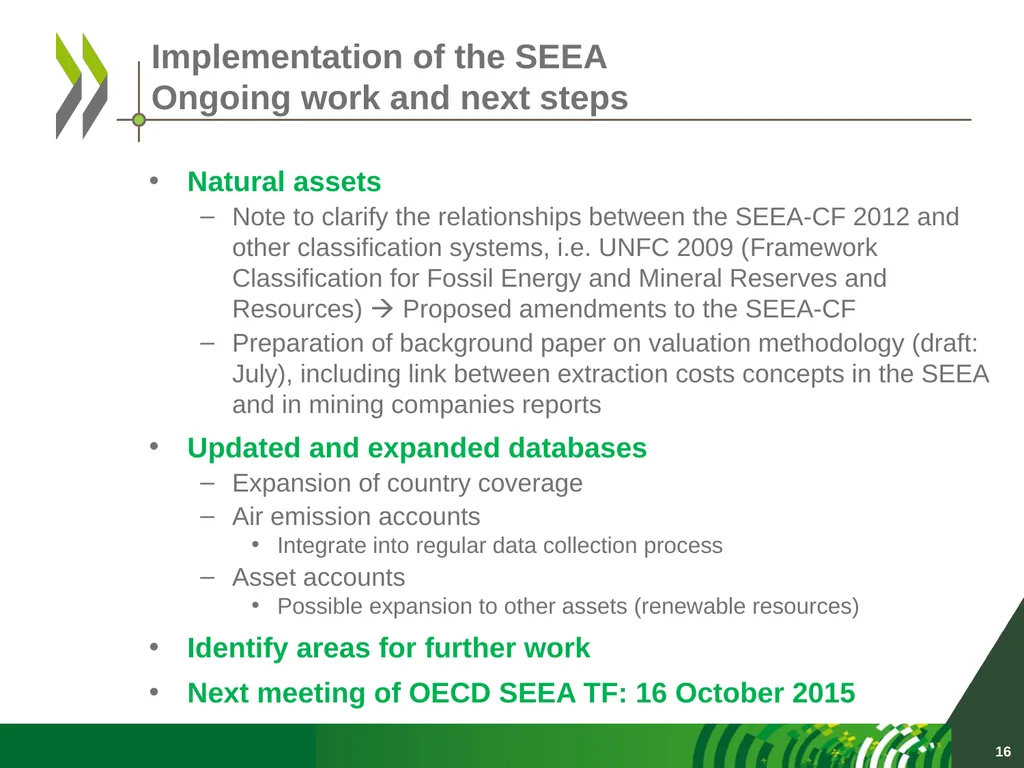
Natural assets
Note to clarify the relationships between the SEEA-CF 2012 and other classification systems, i.e. UNFC 2009 (Framework Classification for Fossil Energy and Mineral Reserves and Resources) Proposed amendments to the SEEA-CF
Preparation of background paper on valuation methodology (draft: July), including link between extraction costs concepts in the SEEA and in mining companies reports
Updated and expanded databases
Expansion of country coverage
Air emission accounts
Integrate into regular data collection process
Asset accounts
Possible expansion to other assets (renewable resources)
Identify areas for further work
Next meeting of OECD SEEA TF: 16 October 2015 16 Implementation of the SEEA Ongoing work and next steps<br>
Note to clarify the relationships between the SEEA-CF 2012 and other classification systems, i.e. UNFC 2009 (Framework Classification for Fossil Energy and Mineral Reserves and Resources) Proposed amendments to the SEEA-CF
Preparation of background paper on valuation methodology (draft: July), including link between extraction costs concepts in the SEEA and in mining companies reports
Updated and expanded databases
Expansion of country coverage
Air emission accounts
Integrate into regular data collection process
Asset accounts
Possible expansion to other assets (renewable resources)
Identify areas for further work
Next meeting of OECD SEEA TF: 16 October 2015 16 Implementation of the SEEA Ongoing work and next steps<br>
17
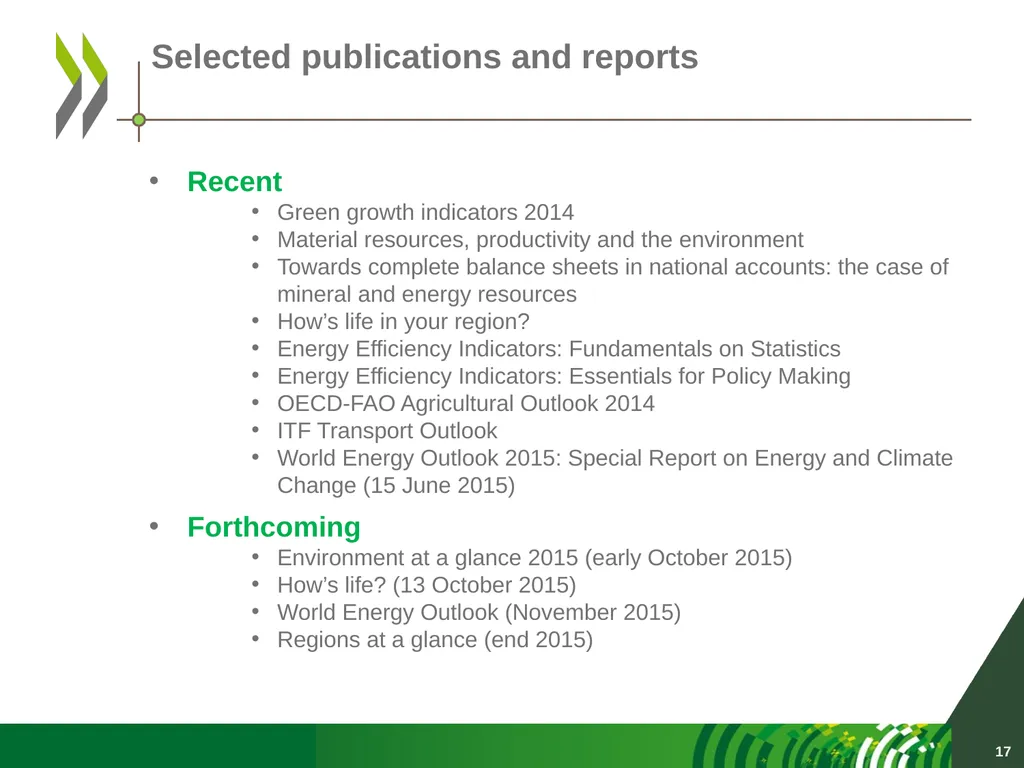
Recent
Green growth indicators 2014
Material resources, productivity and the environment
Towards complete balance sheets in national accounts: the case of mineral and energy resources
How’s life in your region?
Energy Efficiency Indicators: Fundamentals on Statistics
Energy Efficiency Indicators: Essentials for Policy Making
OECD-FAO Agricultural Outlook 2014
ITF Transport Outlook
World Energy Outlook 2015: Special Report on Energy and Climate Change (15 June 2015)
Forthcoming
Environment at a glance 2015 (early October 2015)
How’s life? (13 October 2015)
World Energy Outlook (November 2015)
Regions at a glance (end 2015) 17 Selected publications and reports<br>
Green growth indicators 2014
Material resources, productivity and the environment
Towards complete balance sheets in national accounts: the case of mineral and energy resources
How’s life in your region?
Energy Efficiency Indicators: Fundamentals on Statistics
Energy Efficiency Indicators: Essentials for Policy Making
OECD-FAO Agricultural Outlook 2014
ITF Transport Outlook
World Energy Outlook 2015: Special Report on Energy and Climate Change (15 June 2015)
Forthcoming
Environment at a glance 2015 (early October 2015)
How’s life? (13 October 2015)
World Energy Outlook (November 2015)
Regions at a glance (end 2015) 17 Selected publications and reports<br>
18
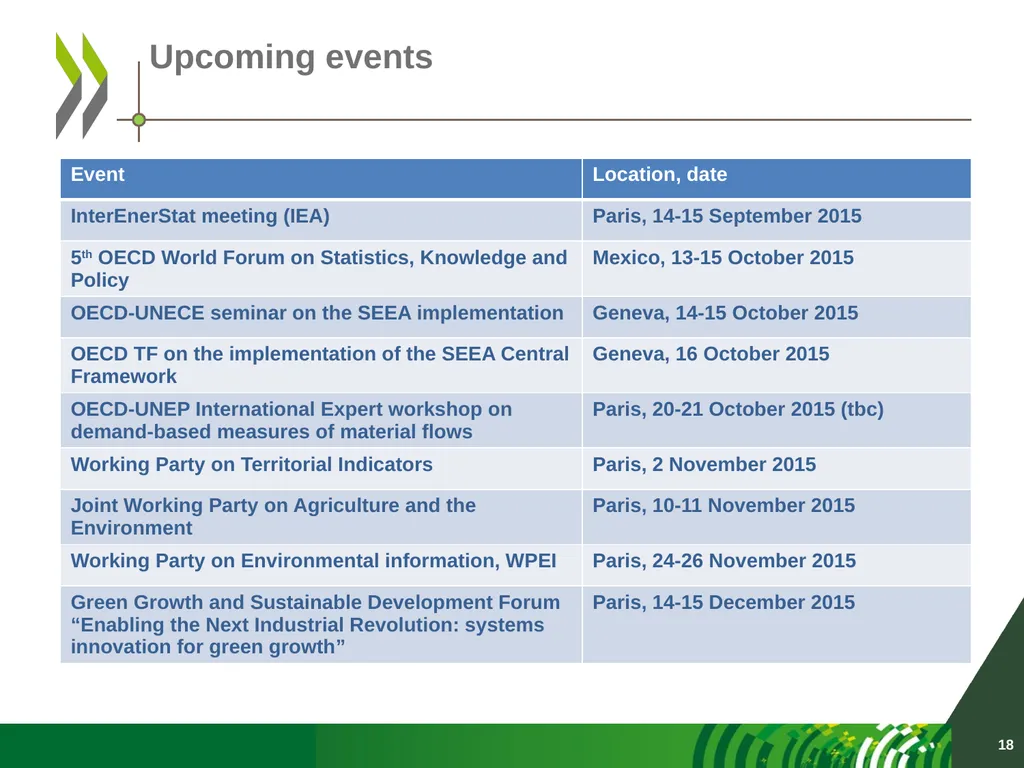
18 Upcoming events<br>
19
Towards a global data collection programme on environmental-economic accounts 19<br>
20
Success criteria
Closeness to policy demands: national, international
Continuity and flexibility, institutional arrangements
Cost-effectiveness: use synergies, minimise duplication, focus on priority areas
Global coherence: cooperation, coordination, joint work
Existing international work covers already many SEEA-related topics
Energy, Water, Air emissions, Material flows, Environmental protection expenditure, Environmental taxes, Land, EGGS, …
Agriculture, forestry, food, protected areas, …
Could be used as a foundation
By identify commonalities
By applying the subsidiarity principle layered approach as for environmental data or for national accounts (IWGs), 20 Lessons from OECD work and discussion items<br>
Closeness to policy demands: national, international
Continuity and flexibility, institutional arrangements
Cost-effectiveness: use synergies, minimise duplication, focus on priority areas
Global coherence: cooperation, coordination, joint work
Existing international work covers already many SEEA-related topics
Energy, Water, Air emissions, Material flows, Environmental protection expenditure, Environmental taxes, Land, EGGS, …
Agriculture, forestry, food, protected areas, …
Could be used as a foundation
By identify commonalities
By applying the subsidiarity principle layered approach as for environmental data or for national accounts (IWGs), 20 Lessons from OECD work and discussion items<br>
21
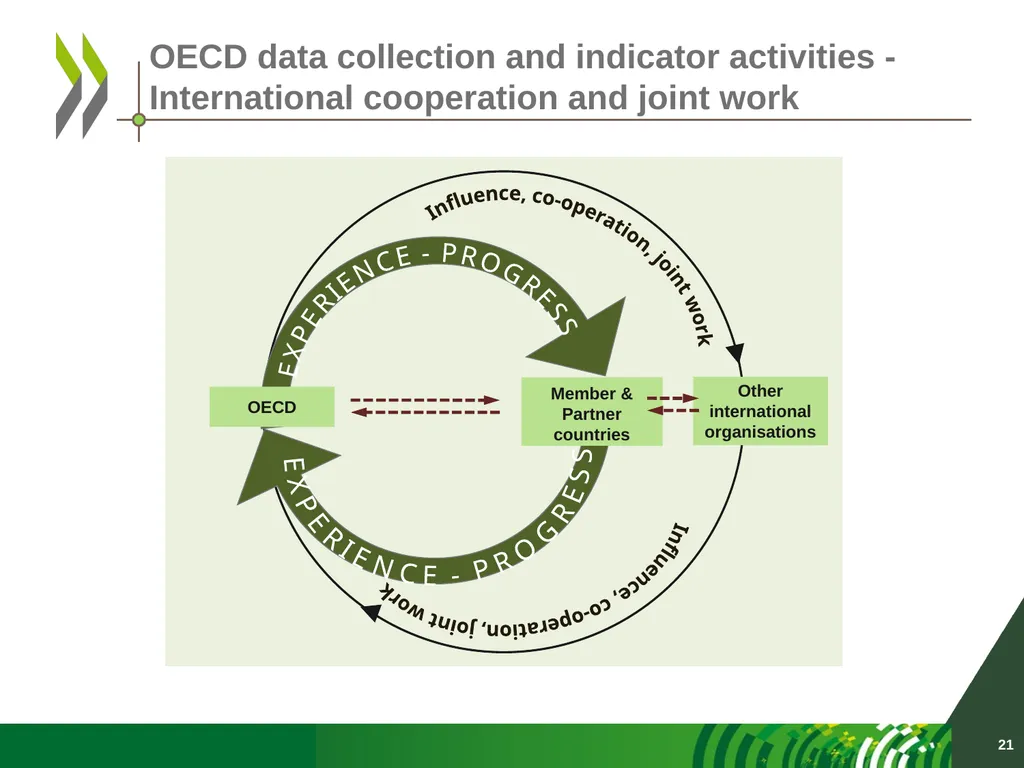
21 OECD data collection and indicator activities - International cooperation and joint work<br>
22
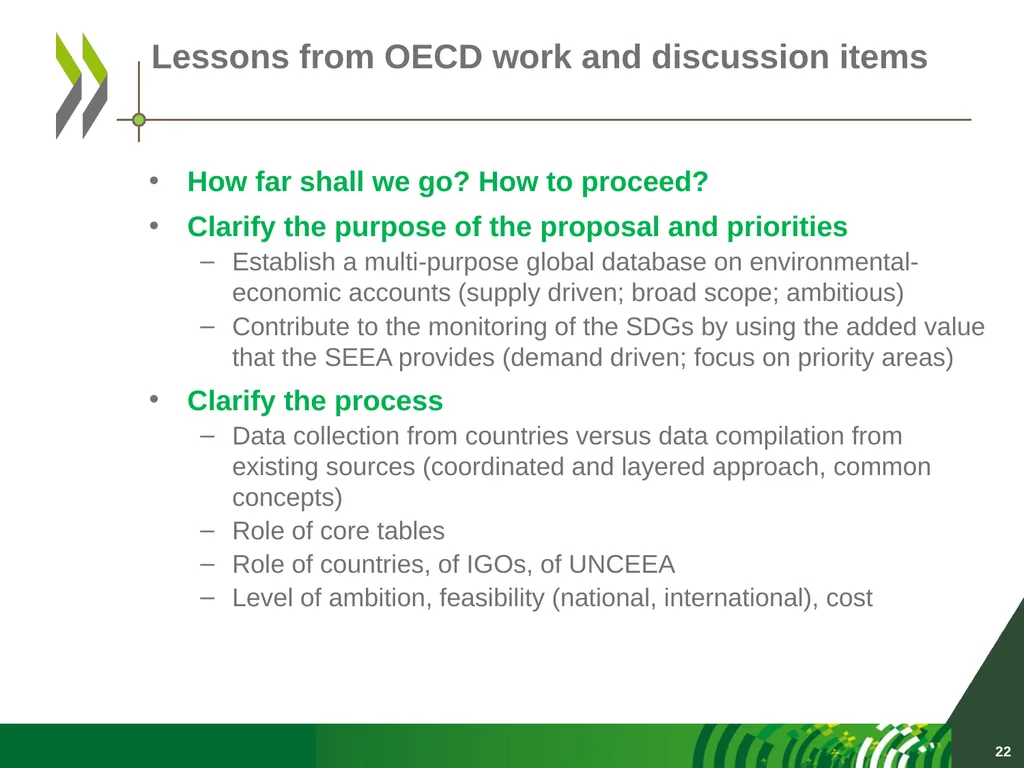
How far shall we go? How to proceed?
Clarify the purpose of the proposal and priorities
Establish a multi-purpose global database on environmental-economic accounts (supply driven; broad scope; ambitious)
Contribute to the monitoring of the SDGs by using the added value that the SEEA provides (demand driven; focus on priority areas)
Clarify the process
Data collection from countries versus data compilation from existing sources (coordinated and layered approach, common concepts)
Role of core tables
Role of countries, of IGOs, of UNCEEA
Level of ambition, feasibility (national, international), cost 22 Lessons from OECD work and discussion items<br>
Clarify the purpose of the proposal and priorities
Establish a multi-purpose global database on environmental-economic accounts (supply driven; broad scope; ambitious)
Contribute to the monitoring of the SDGs by using the added value that the SEEA provides (demand driven; focus on priority areas)
Clarify the process
Data collection from countries versus data compilation from existing sources (coordinated and layered approach, common concepts)
Role of core tables
Role of countries, of IGOs, of UNCEEA
Level of ambition, feasibility (national, international), cost 22 Lessons from OECD work and discussion items<br>