Ohio Collaborative Law Enforcement Accreditation Program (OCLEAP) 6.01 State of Ohio Standard for Use of Force Objectives Review and understand the State of Ohio Standard for Use of Force Obtain applicable knowledge of the policy components
"Ohio Collaborative Law Enforcement Accreditation" is the property of its rightful owner. Permission is granted to
download and print the materials on this website for personal, non-commercial use only, and to display it
on your personal computer provided you do not modify the materials and that you retain all copyright
notices contained in the materials. By downloading content from our website, you accept the terms of this
agreement.
Presentation Transcript
01
Ohio Collaborative Law Enforcement Accreditation Program (OCLEAP)
6.01 State of Ohio Standard for Use of Force<br>
02
Objectives Review and understand the State of Ohio Standard for Use of Force
Obtain applicable knowledge of the policy components and standard compliance for the State of Ohio Standard for Use of Force
Identify and understand how to demonstrate compliance with standard requirements and best practices on Use of Force 2<br>
03
Overview Purpose
Standard
Commentary
Compliance Verification Strategies
Sample Policy
Additional Information
OCJS Contact Information 3<br>
04
Purpose This policy recognizes that the use of force by law enforcement requires constant evaluation.
Even at its lowest level, the use of force is a serious responsibility.
The purpose of this policy is to provide law enforcement with guidelines on the reasonable use of force.
While there is no way to specify the exact amount or type of reasonable force to be applied in any situation, each officer is expected to use these guidelines to make such decisions in a professional, impartial, and reasonable manner. 4<br>
05
Standard Law enforcement agencies shall establish written policies governing how sworn personnel respond to resistance, which includes the following provisions:
Sworn personnel may only use the force which is objectively reasonable to effect lawful objectives including: effecting a lawful arrest or overcoming resistance to a lawful arrest, preventing the escape of an offender, or protecting or defending others or themselves from physical harm. Sworn personnel should employ de-escalation techniques when possible.
Sworn personnel have the affirmative duty to intervene, i.e., to prevent or stop, as appropriate, any officer from engaging in excessive force or any other use of force that violates the Constitution, other laws, or agency policy on the reasonable use of force.
Establish the affirmative duty to request and/or render medical aid, as appropriate, where needed.
Policy language indicating when a use of force report shall be completed.
Conduct investigation/report review for use of force policy compliance.
Sworn personnel will receive in-service training, at least annually, on the agency’s use of force policies. This training will include:
Legal updates, de-escalation techniques, deadly force, the affirmative duty to intervene and the affirmative duty to request and/or render medical aid.
Reading and acknowledgement of policies.
Testing of policies. 5<br>
06
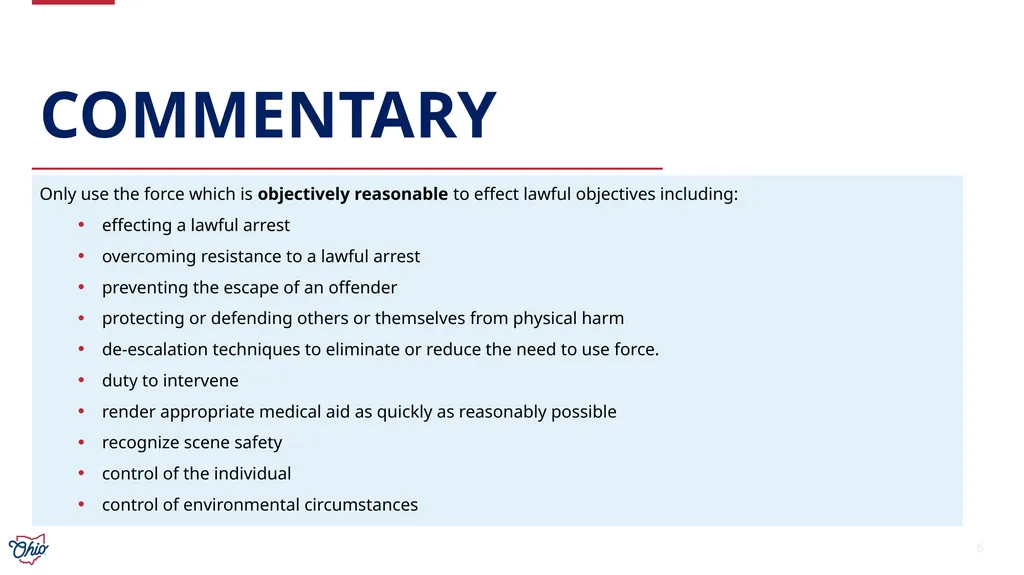
Commentary Only use the force which is objectively reasonable to effect lawful objectives including:
effecting a lawful arrest
overcoming resistance to a lawful arrest
preventing the escape of an offender
protecting or defending others or themselves from physical harm
de-escalation techniques to eliminate or reduce the need to use force.
duty to intervene
render appropriate medical aid as quickly as reasonably possible
recognize scene safety
control of the individual
control of environmental circumstances 6<br>
07
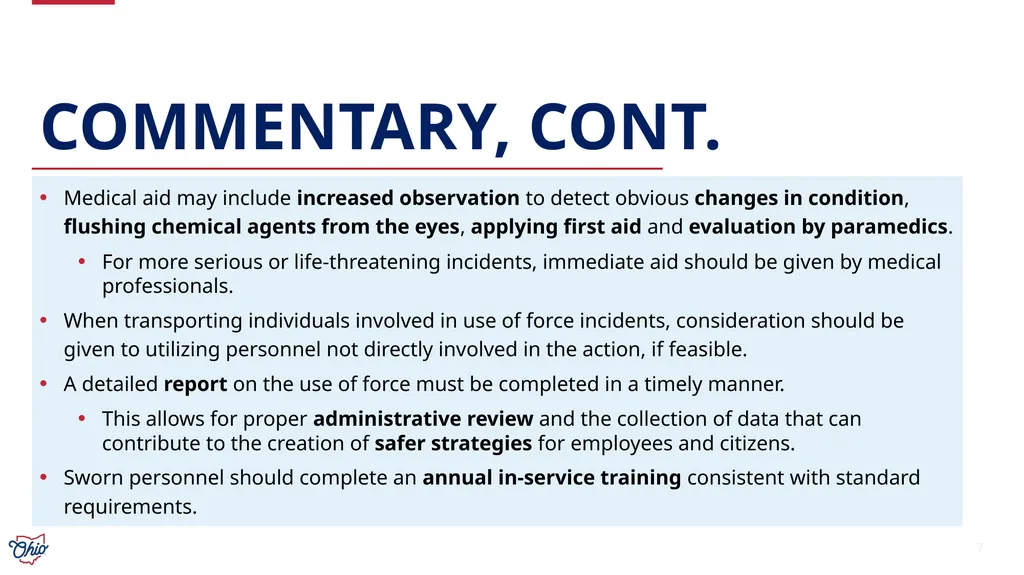
Commentary, Cont. Medical aid may include increased observation to detect obvious changes in condition, flushing chemical agents from the eyes, applying first aid and evaluation by paramedics.
For more serious or life-threatening incidents, immediate aid should be given by medical professionals.
When transporting individuals involved in use of force incidents, consideration should be given to utilizing personnel not directly involved in the action, if feasible.
A detailed report on the use of force must be completed in a timely manner.
This allows for proper administrative review and the collection of data that can contribute to the creation of safer strategies for employees and citizens.
Sworn personnel should complete an annual in-service training consistent with standard requirements. 7<br>
08
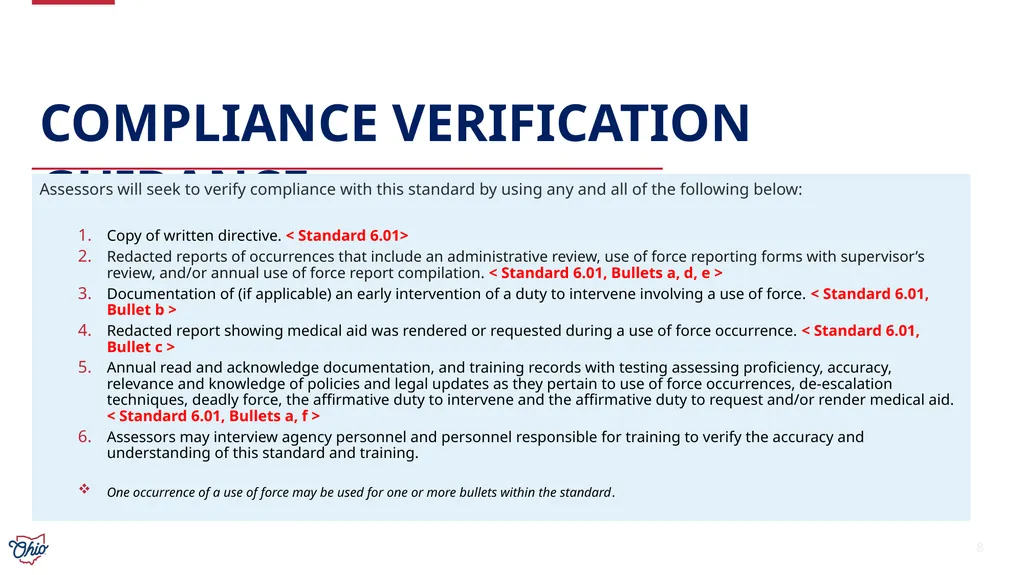
Compliance Verification Guidance Assessors will seek to verify compliance with this standard by using any and all of the following below:
Copy of written directive. < Standard 6.01>
Redacted reports of occurrences that include an administrative review, use of force reporting forms with supervisor’s review, and/or annual use of force report compilation. < Standard 6.01, Bullets a, d, e >
Documentation of (if applicable) an early intervention of a duty to intervene involving a use of force. < Standard 6.01, Bullet b >
Redacted report showing medical aid was rendered or requested during a use of force occurrence. < Standard 6.01, Bullet c >
Annual read and acknowledge documentation, and training records with testing assessing proficiency, accuracy, relevance and knowledge of policies and legal updates as they pertain to use of force occurrences, de-escalation techniques, deadly force, the affirmative duty to intervene and the affirmative duty to request and/or render medical aid. < Standard 6.01, Bullets a, f >
Assessors may interview agency personnel and personnel responsible for training to verify the accuracy and understanding of this standard and training.
One occurrence of a use of force may be used for one or more bullets within the standard. 8<br>
09
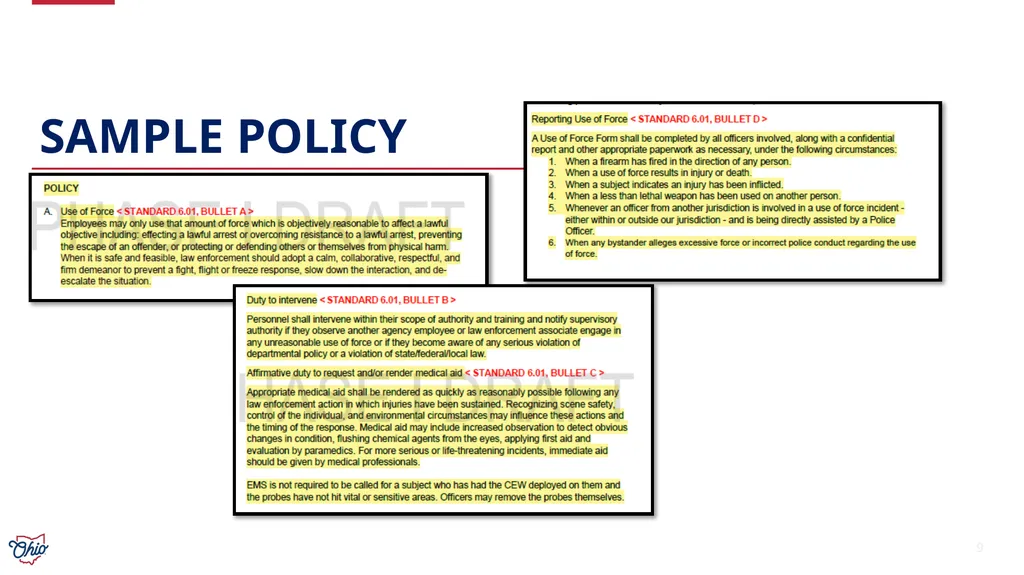
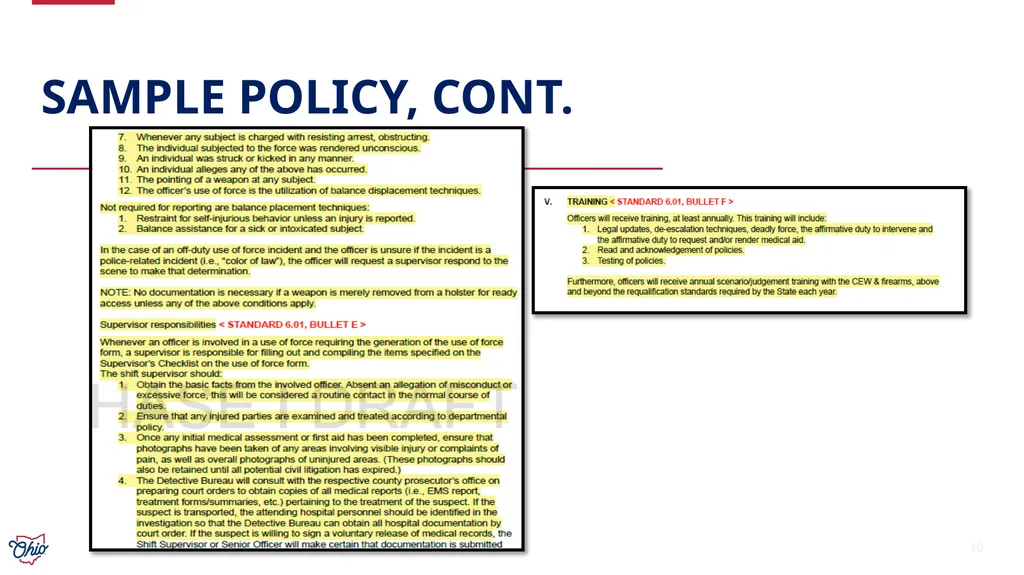
Sample Policy 9<br>
10
Sample Policy, Cont. 10<br>
11
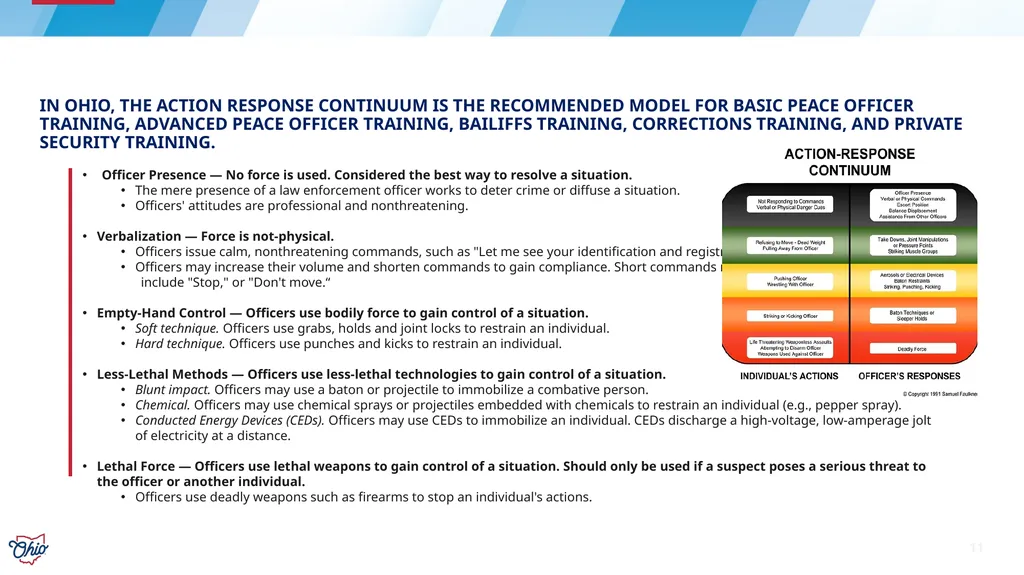
In Ohio, the Action Response Continuum is the recommended model for Basic Peace Officer Training, Advanced Peace Officer Training, Bailiffs Training, Corrections Training, and Private Security Training. Officer Presence — No force is used. Considered the best way to resolve a situation.
The mere presence of a law enforcement officer works to deter crime or diffuse a situation.
Officers' attitudes are professional and nonthreatening.
Verbalization — Force is not-physical.
Officers issue calm, nonthreatening commands, such as "Let me see your identification and registration."
Officers may increase their volume and shorten commands to gain compliance. Short commands might
include "Stop," or "Don't move.“
Empty-Hand Control — Officers use bodily force to gain control of a situation.
Soft technique. Officers use grabs, holds and joint locks to restrain an individual.
Hard technique. Officers use punches and kicks to restrain an individual.
Less-Lethal Methods — Officers use less-lethal technologies to gain control of a situation.
Blunt impact. Officers may use a baton or projectile to immobilize a combative person.
Chemical. Officers may use chemical sprays or projectiles embedded with chemicals to restrain an individual (e.g., pepper spray).
Conducted Energy Devices (CEDs). Officers may use CEDs to immobilize an individual. CEDs discharge a high-voltage, low-amperage jolt of electricity at a distance.
Lethal Force — Officers use lethal weapons to gain control of a situation. Should only be used if a suspect poses a serious threat to the officer or another individual.
Officers use deadly weapons such as firearms to stop an individual's actions. 11<br>
12
Contact Us Office of Criminal Justice Services
1970 W. Broad St.
Columbus, OH 43223
Ohio Collaborative: (888)448-4842
ohiocollaborative@dps.ohio.gov
Complete our form online if you have questions. 12<br>