OL2 Mission Support Functions Mission Support: Leadership Through Service Learning Outcomes Explain the importance of mission support functions in ensuring mission success. Identify key staff roles and responsibilities involved. Develop
"OL2 – Mission Support Functions Mission Support:" is the property of its rightful owner. Permission is granted to
download and print the materials on this website for personal, non-commercial use only, and to display it
on your personal computer provided you do not modify the materials and that you retain all copyright
notices contained in the materials. By downloading content from our website, you accept the terms of this
agreement.
Presentation Transcript
01
OL2 – Mission Support Functions Mission Support: Leadership Through Service<br>
02
Learning Outcomes Explain the importance of mission support functions in ensuring mission success.
Identify key staff roles and responsibilities involved.
Develop basic support plans and timelines aligned with operational goals.
Navigate CAP administrative processes, including forms, approvals, and coordination.
Understand how effective support operations reflect leadership through service.<br>
03
Why Support Functions Matter "[Commanders] are authorized a staff to assist in the accomplishment of the various assigned tasks" – CAPR 30-1 “Administrative, logistical, and financial support functions are essential to mission success.” – CAPP 30-1
Support is the foundation of mission readiness.
Every CAP activity or mission relies on support to function.
Behind-the-scenes coordination makes mission success possible.<br>
04
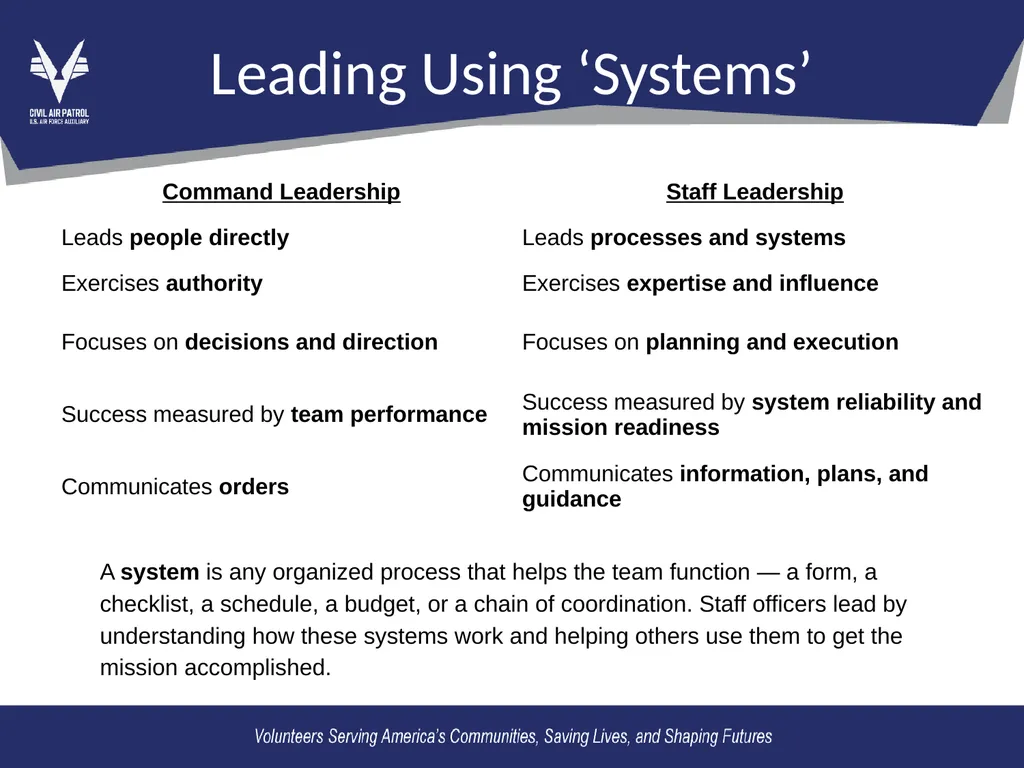
Leading Using ‘Systems’ A system is any organized process that helps the team function — a form, a checklist, a schedule, a budget, or a chain of coordination. Staff officers lead by understanding how these systems work and helping others use them to get the mission accomplished.<br>
05
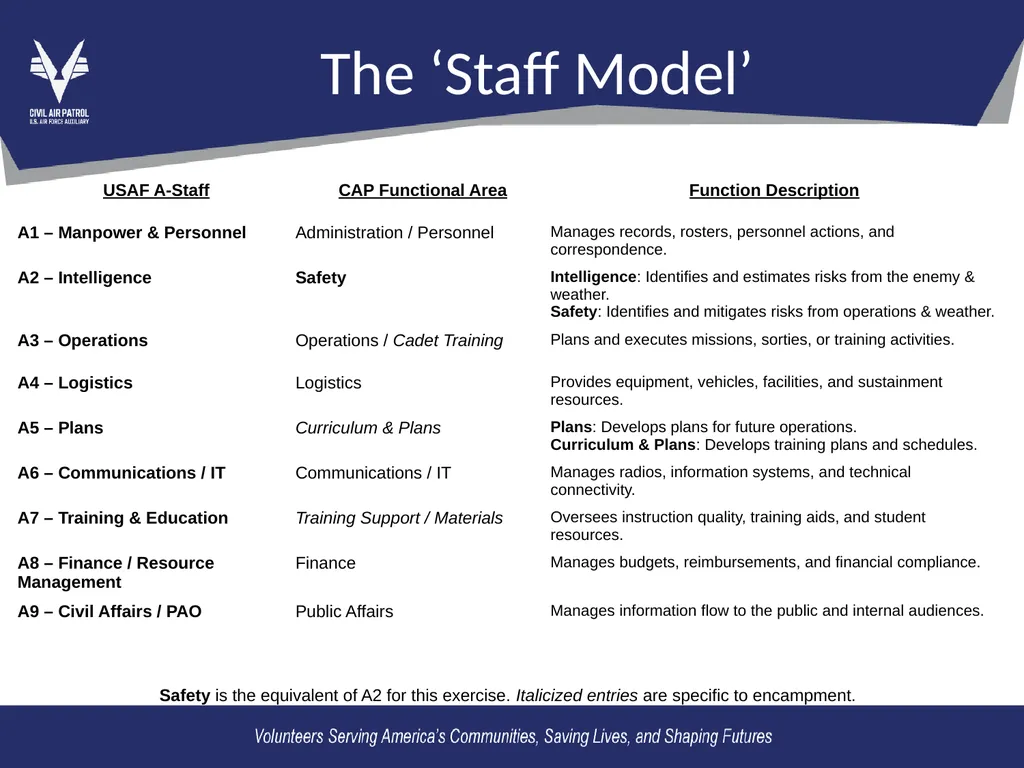
The ‘Staff Model’ Safety is the equivalent of A2 for this exercise. Italicized entries are specific to encampment.<br>
06
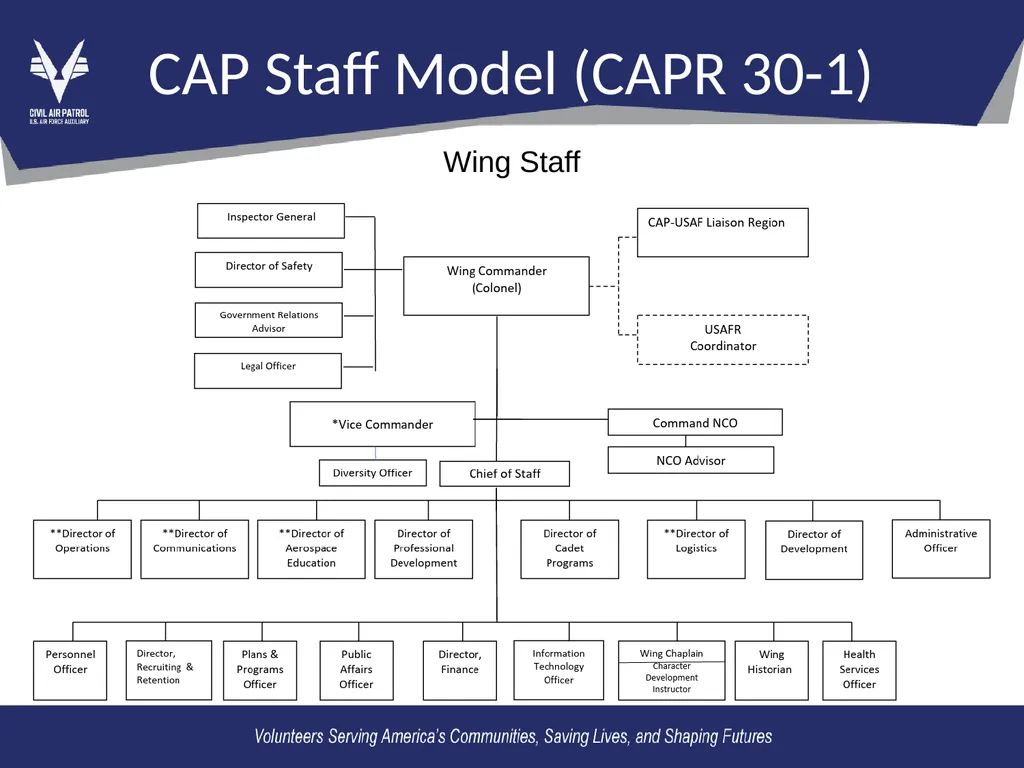
CAP Staff Model (CAPR 30-1) Wing Staff<br>
07
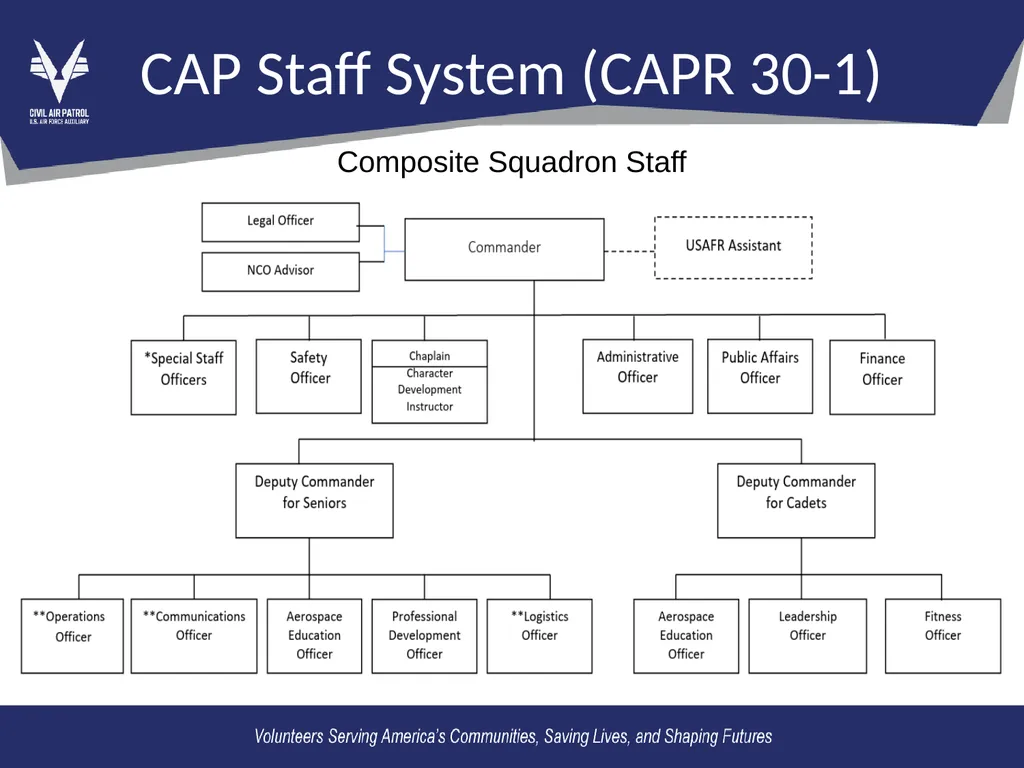
CAP Staff System (CAPR 30-1) Composite Squadron Staff<br>
08
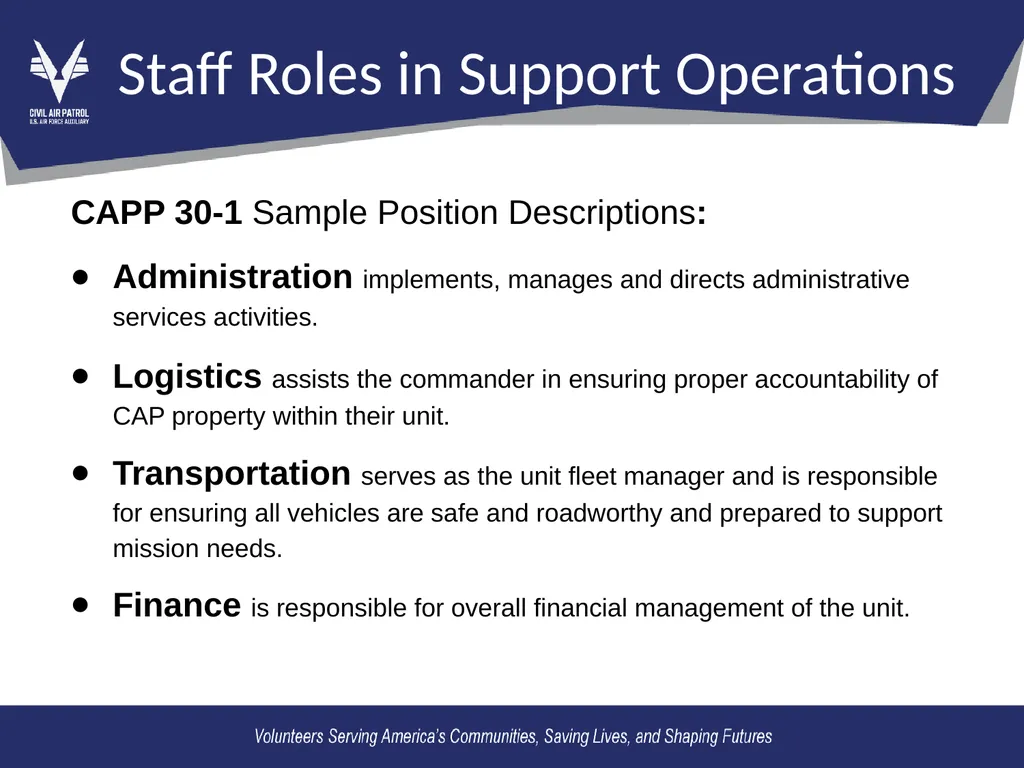
Staff Roles in Support Operations CAPP 30-1 Sample Position Descriptions:
Administration implements, manages and directs administrative services activities.
Logistics assists the commander in ensuring proper accountability of CAP property within their unit.
Transportation serves as the unit fleet manager and is responsible for ensuring all vehicles are safe and roadworthy and prepared to support mission needs.
Finance is responsible for overall financial management of the unit.<br>
09
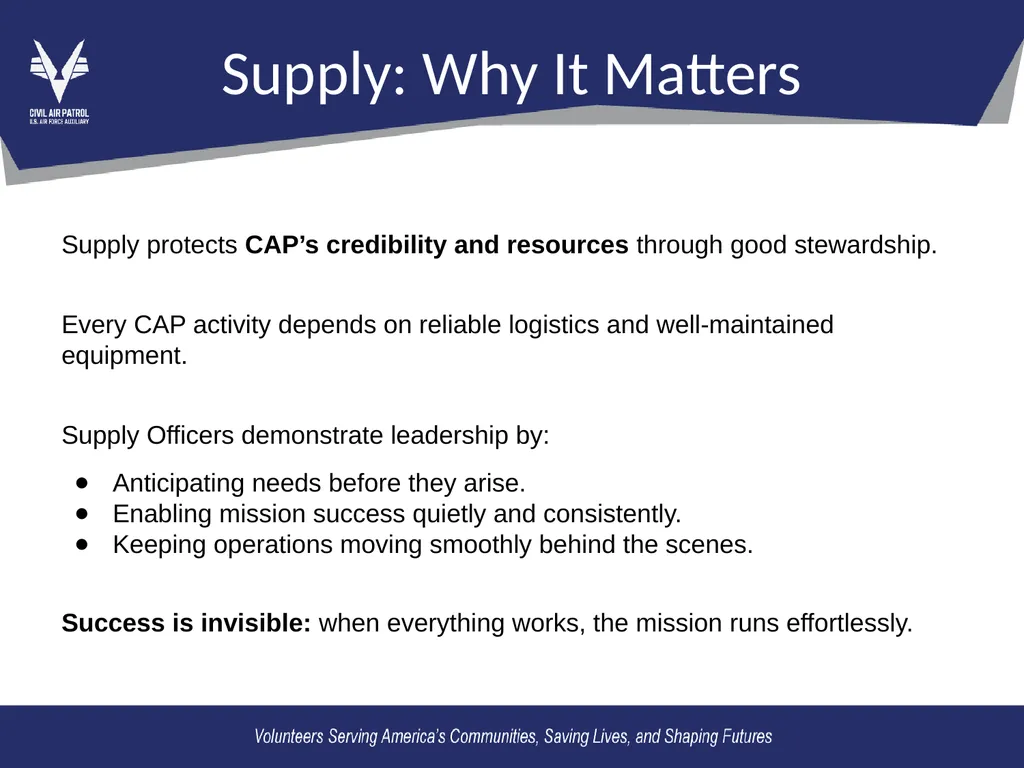
Supply: Why It Matters Supply protects CAP’s credibility and resources through good stewardship.
Every CAP activity depends on reliable logistics and well-maintained equipment.
Supply Officers demonstrate leadership by:
Anticipating needs before they arise.
Enabling mission success quietly and consistently.
Keeping operations moving smoothly behind the scenes.
Success is invisible: when everything works, the mission runs effortlessly.<br>
10
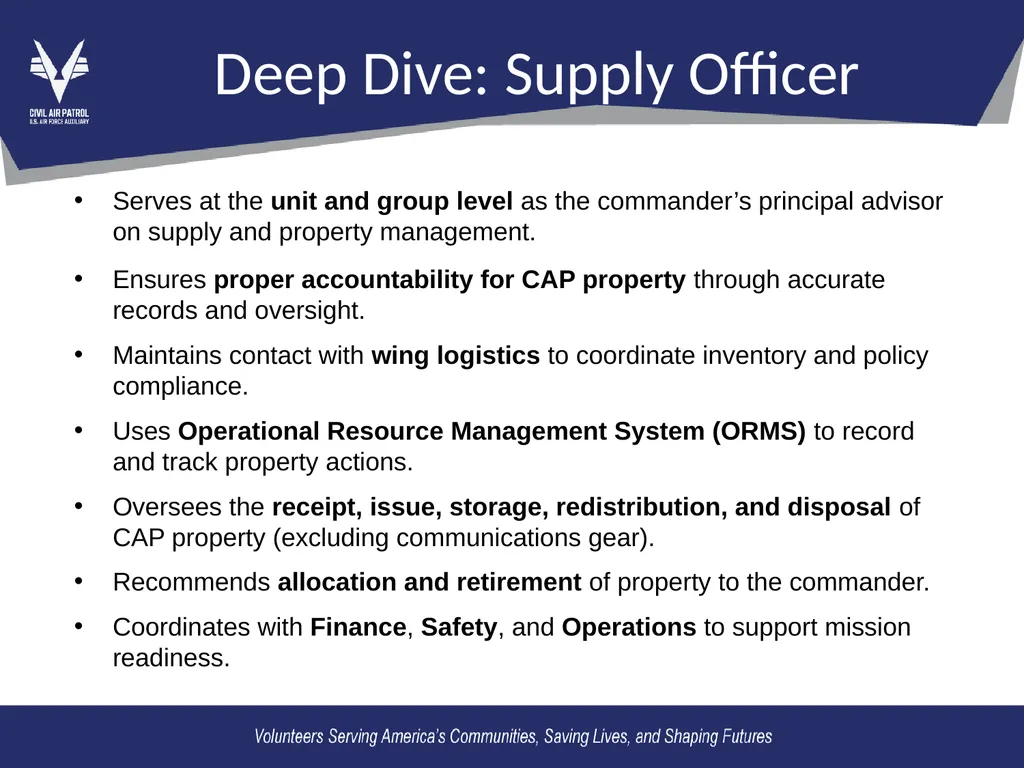
Deep Dive: Supply Officer Serves at the unit and group level as the commander’s principal advisor on supply and property management.
Ensures proper accountability for CAP property through accurate records and oversight.
Maintains contact with wing logistics to coordinate inventory and policy compliance.
Uses Operational Resource Management System (ORMS) to record and track property actions.
Oversees the receipt, issue, storage, redistribution, and disposal of CAP property (excluding communications gear).
Recommends allocation and retirement of property to the commander.
Coordinates with Finance, Safety, and Operations to support mission readiness.<br>
11
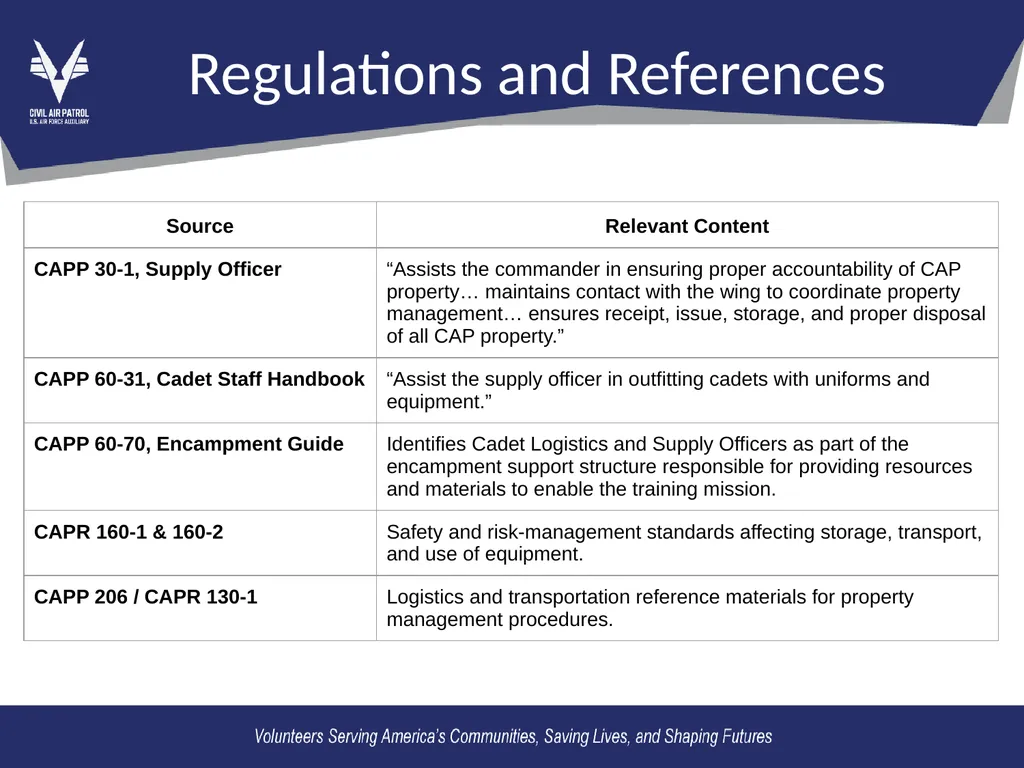
Regulations and References<br>
12
Coordination & Higher Headquarters Logistics operates at the crossroads of multiple staff sections:
Works with Finance for purchases, reimbursements, and inventory validation.
Works with Safety for storage, risk mitigation, and transportation checks.
Works with Operations to ensure mission equipment and vehicles are ready.
Works with Administration for documentation and records retention.
Maintains regular contact with Wing Logistics for ORMS updates, redistribution, and compliance.
Ensures unit accountability data are accurate and transmitted to higher headquarters.
Demonstrates professionalism through clear, timely, and complete coordination.<br>
13
Whiteboard Exercise: Supply Purpose: Work through supply needs to see how a need turns into a plan.
Scenarios:
Billeting for cadets
Meals for participants
Classroom supplies
Transportation
Specialized equipment
Facility support
Your task:
Define the requirement.
Find the guidance or regulation.
Identify coordination and approvals.
Outline key events and milestones.
Build a timeline that ensures mission success.<br>
14
Servant Leadership in Action Servant leadership is the practice of leading by serving others — putting the team’s needs before your own, helping them grow, and ensuring the mission succeeds by helping them succeed.
Mission support is the purest form of servant leadership: invisible, vital, and focused on enabling others to succeed.
A good staff officer must show:
Humility – Recognizing that leadership is about enabling others’ success, not seeking personal credit for mission results.
Resilience – Working exhaustively and persistently to get things done, even when tasks are hard or the hours are long—because others are counting on your work to succeed.
Reliability – Consistently doing what you said you would do, so others can plan and act with confidence in your support.
Foresight – Anticipating needs and challenges before they arise, ensuring the mission stays on track through preparation and planning.
Service – Using your time, skills, and effort to make the mission and those around you better, even when the work goes unnoticed.<br>
15
Preparing for the Workshop Mission support enables mission success. Every CAP operation depends on strong admin, logistics, finance, and safety functions.
Staff officers lead through service. Leadership is shown in coordination, reliability, and support for others.
Each role matters. Every staff function contributes to readiness and execution.
Effective support = effective leadership. Quiet, disciplined systems work reflects servant leadership in action.
Now it’s your turn. Apply these principles in the Mission Support Workshop—plan, coordinate, and lead through service.<br>
16
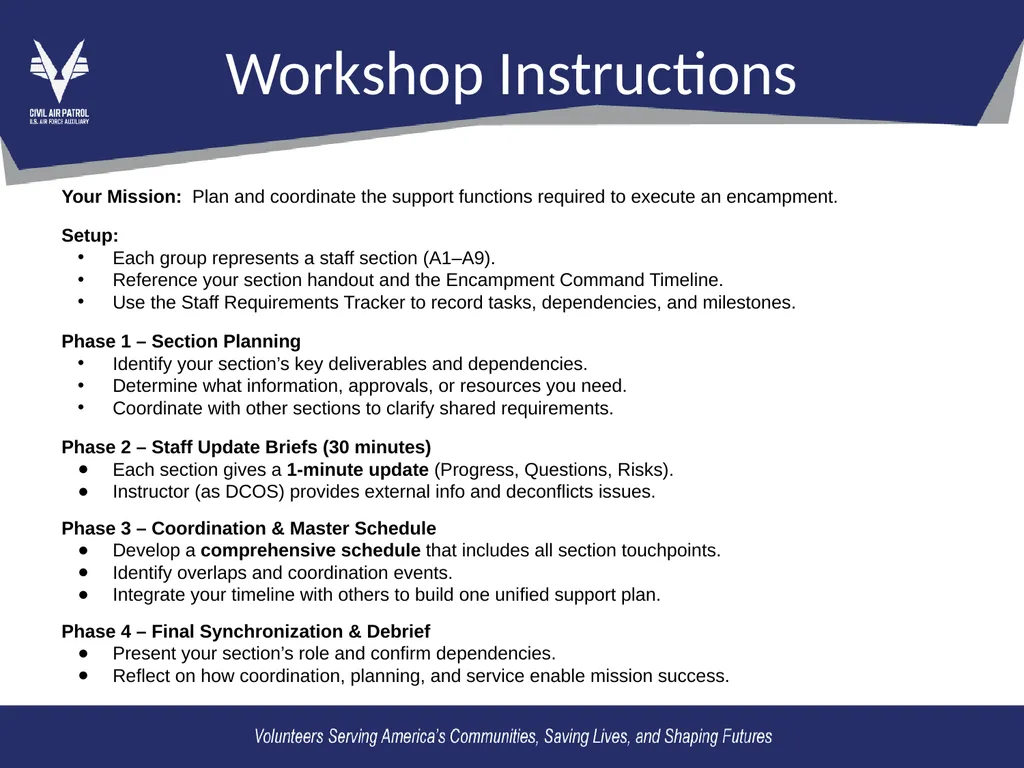
Workshop Instructions Your Mission: Plan and coordinate the support functions required to execute an encampment.
Setup:
Each group represents a staff section (A1–A9).
Reference your section handout and the Encampment Command Timeline.
Use the Staff Requirements Tracker to record tasks, dependencies, and milestones.
Phase 1 – Section Planning
Identify your section’s key deliverables and dependencies.
Determine what information, approvals, or resources you need.
Coordinate with other sections to clarify shared requirements.
Phase 2 – Staff Update Briefs (30 minutes)
Each section gives a 1-minute update (Progress, Questions, Risks).
Instructor (as DCOS) provides external info and deconflicts issues.
Phase 3 – Coordination & Master Schedule
Develop a comprehensive schedule that includes all section touchpoints.
Identify overlaps and coordination events.
Integrate your timeline with others to build one unified support plan.
Phase 4 – Final Synchronization & Debrief
Present your section’s role and confirm dependencies.
Reflect on how coordination, planning, and service enable mission success.<br>