
Olmstead Planning – Where do we stand? Kevin
CB
Published · 37 slides · 0 views
1 / 1



Description
Olmstead Planning Where do we stand? Kevin Martone, Executive Director Technical Assistance Collaborative, Inc. (TAC) And Harvey Rosenthal, CEO NY Association of Psychiatric Rehabilitation Services (NYAPRS) This webinar was developed in
Related Topics
Share
Embed code
Download this presentation From Below
"Olmstead Planning – Where do we stand? Kevin" is the property of its rightful owner. Permission is granted to download and print the materials on this website for personal, non-commercial use only, and to display it on your personal computer provided you do not modify the materials and that you retain all copyright notices contained in the materials. By downloading content from our website, you accept the terms of this agreement.
Presentation Transcript
01
Olmstead Planning – Where do we stand? Kevin Martone, Executive Director
Technical Assistance Collaborative, Inc. (TAC)
And
Harvey Rosenthal, CEO
NY Association of Psychiatric Rehabilitation Services (NYAPRS)<br>
Technical Assistance Collaborative, Inc. (TAC)
And
Harvey Rosenthal, CEO
NY Association of Psychiatric Rehabilitation Services (NYAPRS)<br>
02
This webinar was developed [in part] under contract number HHSS283201200021I/HHS28342003T from the Substance Abuse and Mental Health Services Administration (SAMHSA), U.S. Department of Health and Human Services (HHS). The views, policies and opinions expressed are those of the authors and do not necessarily reflect those of SAMHSA or HHS. 2 Disclaimer<br>
03
Kevin Martone, Executive Director
The Technical Assistance Collaborative (TAC) 3 Olmstead Planning and Implementation<br>
The Technical Assistance Collaborative (TAC) 3 Olmstead Planning and Implementation<br>
04
What is Olmstead?
What does community integration mean?
What did the U.S. Supreme Court say regarding Olmstead Plans?
What should an effective Olmstead Plan include?
How have states approached Olmstead planning?
What are examples of activities in Olmstead Plans?
What are some lessons learned in working with states on Olmstead planning? 4 Topics to be Discussed<br>
What does community integration mean?
What did the U.S. Supreme Court say regarding Olmstead Plans?
What should an effective Olmstead Plan include?
How have states approached Olmstead planning?
What are examples of activities in Olmstead Plans?
What are some lessons learned in working with states on Olmstead planning? 4 Topics to be Discussed<br>
05
In the landmark Olmstead v. L.C. decision (1999), the U.S. Supreme Court held that states have an affirmative obligation to ensure that individuals with disabilities live in the most integrated settings possible.
The regulations implementing Title II of the Americans with Disabilities Act (ADA) define an integrated setting as one that “enables individuals with disabilities to interact with nondisabled persons to the fullest extent possible.”
28 C.F.R. § 35.130(d)
28 C.F.R. § Pt. 35, App. A (2010) (addressing § 35.130) 5 The Mandate for Community Integration<br>
The regulations implementing Title II of the Americans with Disabilities Act (ADA) define an integrated setting as one that “enables individuals with disabilities to interact with nondisabled persons to the fullest extent possible.”
28 C.F.R. § 35.130(d)
28 C.F.R. § Pt. 35, App. A (2010) (addressing § 35.130) 5 The Mandate for Community Integration<br>
06
“Integrated settings are located in mainstream society; offer access to community activities and opportunities at times, frequencies and with persons of an individual’s choosing; afford individuals choice in their daily life activities; and, provide individuals with disabilities the opportunity to interact with non-disabled persons to the fullest extent possible. Evidence-based practices that provide scattered-site housing with supportive services are examples of integrated settings.” 6 Community Integration Defined U.S. Department of Justice. Statement of the Department of Justice on Enforcement of the Integration Mandate of Title II of the Americans with Disabilities Act and Olmstead v. L.C.<br>
07
“By contrast, segregated settings often have qualities of an institutional nature. Segregated settings include, but are not limited to: (1) congregate settings populated exclusively or primarily with individuals with disabilities; (2) congregate settings characterized by regimentation in daily activities, lack of privacy or autonomy, policies limiting visitors, or limits on individuals’ ability to engage freely in community activities and to manage their own activities of daily living; or (3) settings that provide for daytime activities primarily with other individuals with disabilities.” 7 Community Integration Defined U.S. Department of Justice. Statement of the Department of Justice on Enforcement of the Integration Mandate of Title II of the Americans with Disabilities Act and Olmstead v. L.C.<br>
08
In its decision, the Supreme Court stated that if a state had a, “….comprehensive, effectively working plan for placing qualified persons with mental disabilities in less restrictive settings, and a waiting list that moved at a reasonable pace not controlled by the state’s endeavors to keep its institutions fully populated, the reasonable modification standard [of the ADA] would be met.”
For an Olmstead Plan to serve as a reasonable defense against legal action it must include, “…concrete and reliable commitments to expand integrated opportunities….and there must be funding to support the plan.” 8 What is an Olmstead Plan? U.S. Department of Justice. Statement of the Department of Justice on Enforcement of the Integration Mandate of Title II of the Americans with Disabilities Act and Olmstead v. L.C.<br>
For an Olmstead Plan to serve as a reasonable defense against legal action it must include, “…concrete and reliable commitments to expand integrated opportunities….and there must be funding to support the plan.” 8 What is an Olmstead Plan? U.S. Department of Justice. Statement of the Department of Justice on Enforcement of the Integration Mandate of Title II of the Americans with Disabilities Act and Olmstead v. L.C.<br>
09
A description of the state’s current system of providing community-based services and supports to people with disabilities;
An assessment of the strengths and weaknesses of that system; and
A description of the state’s plan and goals for expanding opportunities for providing community-based services and supports to people with disabilities. 9 Olmstead Plan should generally include:<br>
An assessment of the strengths and weaknesses of that system; and
A description of the state’s plan and goals for expanding opportunities for providing community-based services and supports to people with disabilities. 9 Olmstead Plan should generally include:<br>
10
Institutional or segregated in nature
- State hospitals and Developmental Centers
- Nursing Facilities
- Board and Care (e.g. Adult Homes, Assisted Living, Residential Care)
- Congregate living programs
- Incarceration
- Sheltered employment workshops or day programs
At-Risk of Institutionalization
- Homelessness
- At home with aging parents
- Other substandard living conditions 10 Settings often addressed in Olmstead Plans<br>
- State hospitals and Developmental Centers
- Nursing Facilities
- Board and Care (e.g. Adult Homes, Assisted Living, Residential Care)
- Congregate living programs
- Incarceration
- Sheltered employment workshops or day programs
At-Risk of Institutionalization
- Homelessness
- At home with aging parents
- Other substandard living conditions 10 Settings often addressed in Olmstead Plans<br>
11
Populations to be addressed
Data analysis
Housing
Employment
Wellness and integrated healthcare
Transportation
Supports and services
Funding
Policies, rules and regulations
Outcomes
Training and workforce development, including use of peer workforce 11 Examples of Key Olmstead Plan Ingredients<br>
Data analysis
Housing
Employment
Wellness and integrated healthcare
Transportation
Supports and services
Funding
Policies, rules and regulations
Outcomes
Training and workforce development, including use of peer workforce 11 Examples of Key Olmstead Plan Ingredients<br>
12
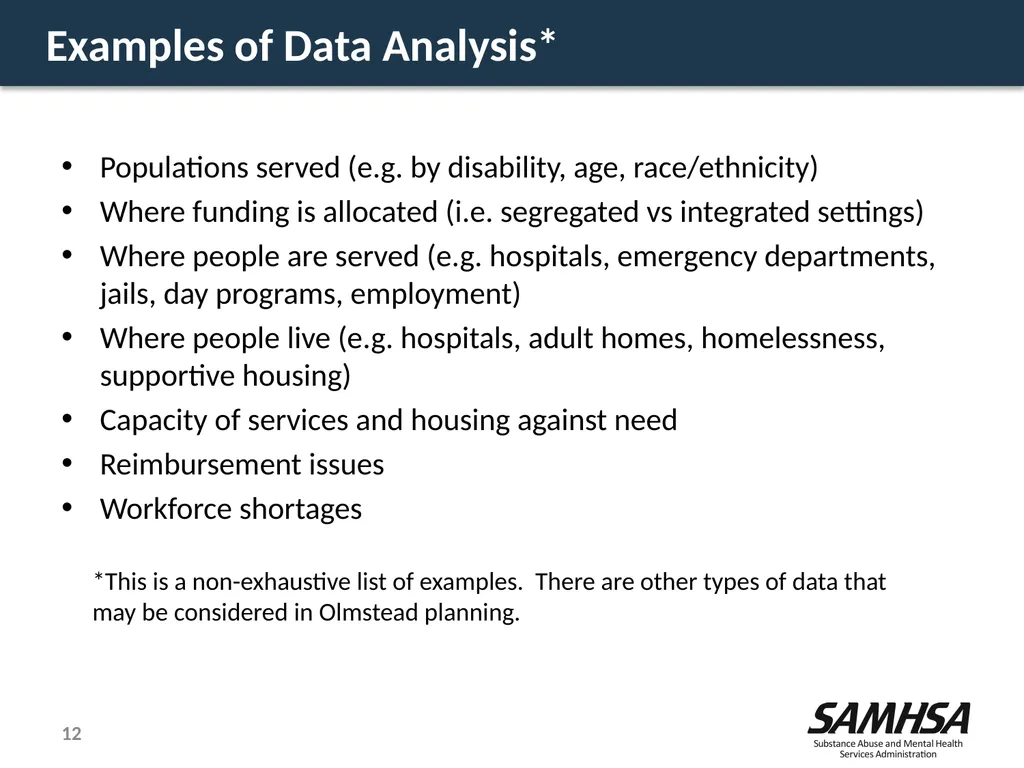
Populations served (e.g. by disability, age, race/ethnicity)
Where funding is allocated (i.e. segregated vs integrated settings)
Where people are served (e.g. hospitals, emergency departments, jails, day programs, employment)
Where people live (e.g. hospitals, adult homes, homelessness, supportive housing)
Capacity of services and housing against need
Reimbursement issues
Workforce shortages 12 Examples of Data Analysis* *This is a non-exhaustive list of examples. There are other types of data that may be considered in Olmstead planning.<br>
Where funding is allocated (i.e. segregated vs integrated settings)
Where people are served (e.g. hospitals, emergency departments, jails, day programs, employment)
Where people live (e.g. hospitals, adult homes, homelessness, supportive housing)
Capacity of services and housing against need
Reimbursement issues
Workforce shortages 12 Examples of Data Analysis* *This is a non-exhaustive list of examples. There are other types of data that may be considered in Olmstead planning.<br>
13
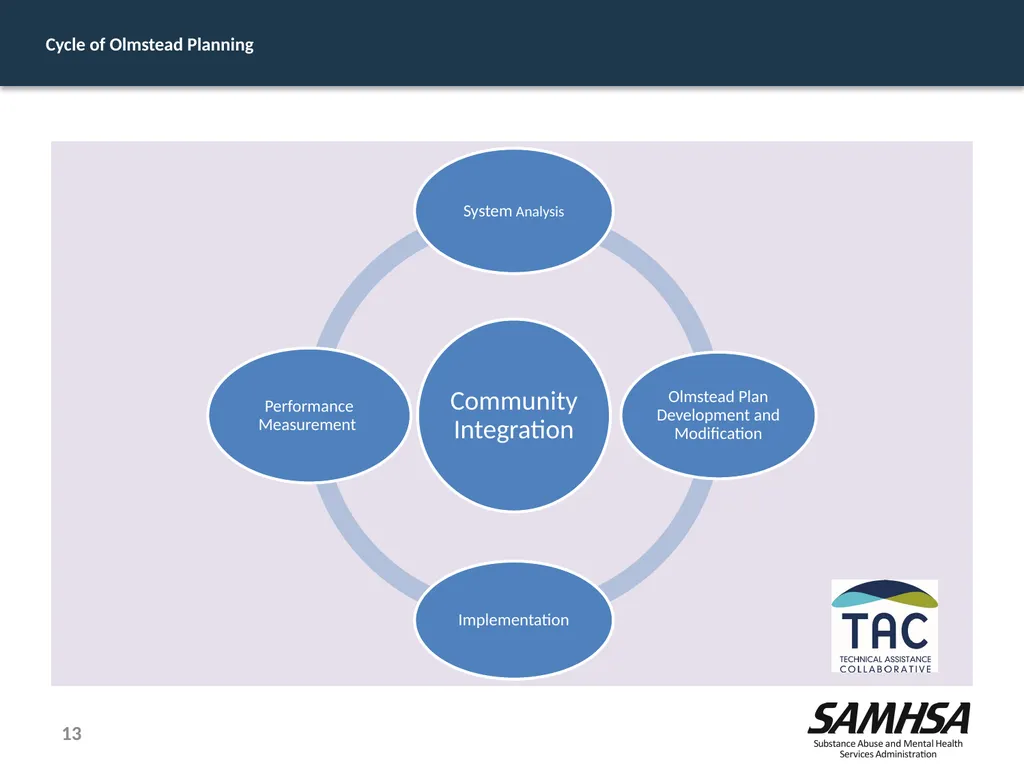
13 Cycle of Olmstead Planning<br>
14
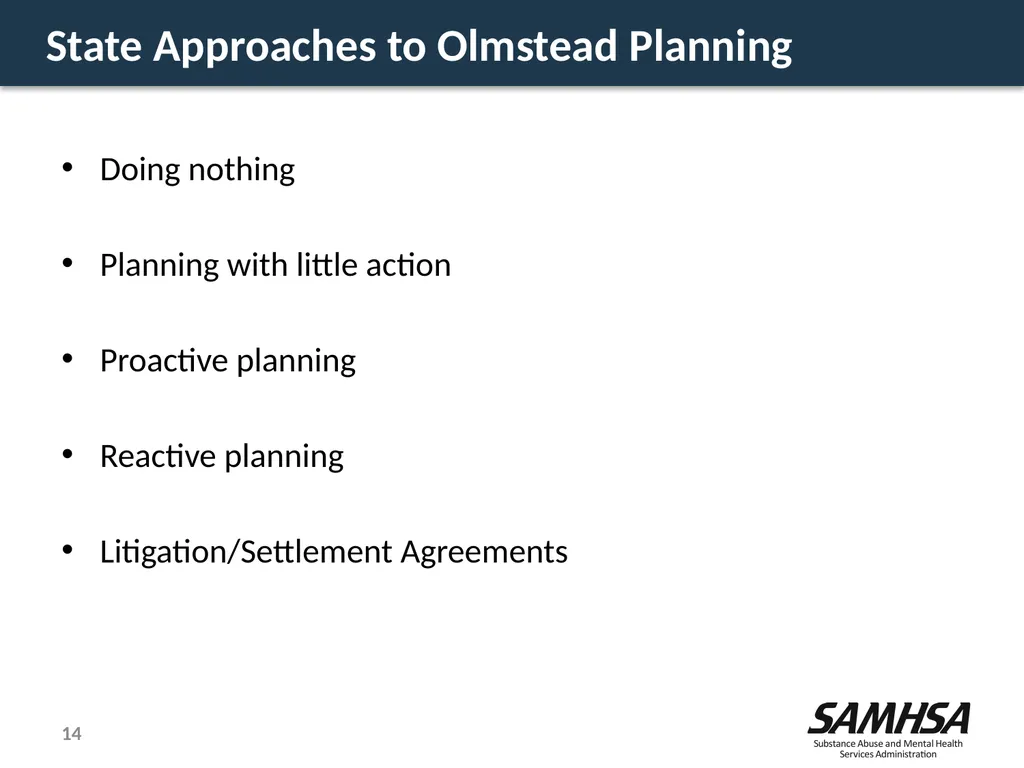
Doing nothing
Planning with little action
Proactive planning
Reactive planning
Litigation/Settlement Agreements 14 State Approaches to Olmstead Planning<br>
Planning with little action
Proactive planning
Reactive planning
Litigation/Settlement Agreements 14 State Approaches to Olmstead Planning<br>
15
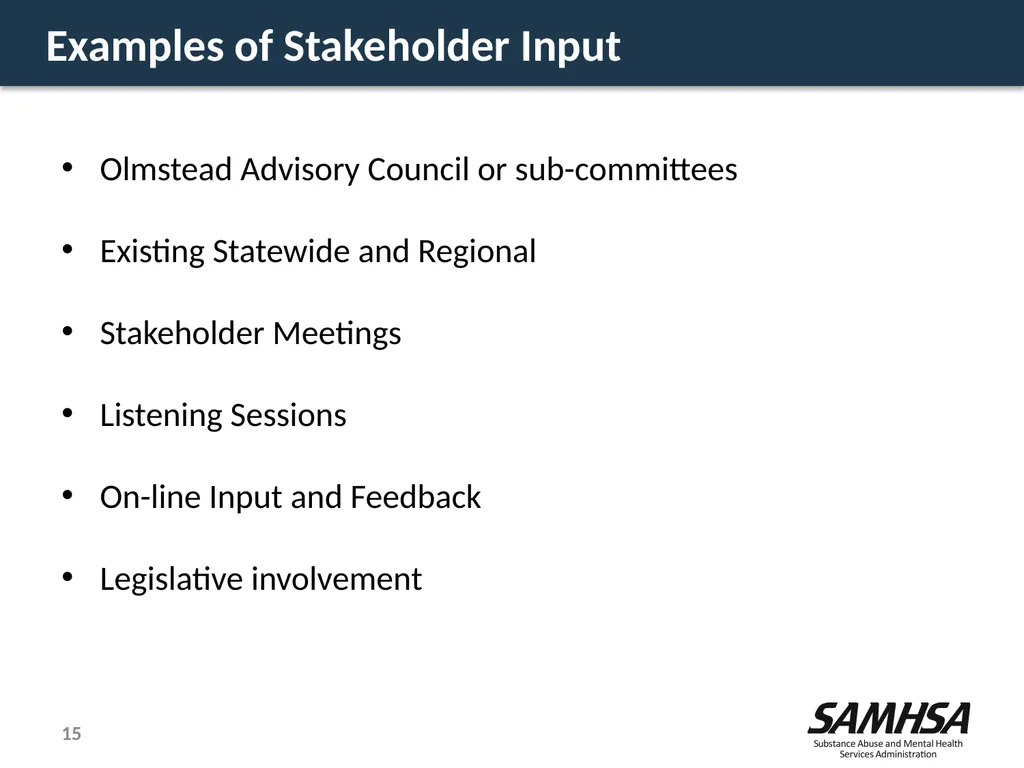
Olmstead Advisory Council or sub-committees
Existing Statewide and Regional
Stakeholder Meetings
Listening Sessions
On-line Input and Feedback
Legislative involvement 15 Examples of Stakeholder Input<br>
Existing Statewide and Regional
Stakeholder Meetings
Listening Sessions
On-line Input and Feedback
Legislative involvement 15 Examples of Stakeholder Input<br>
16
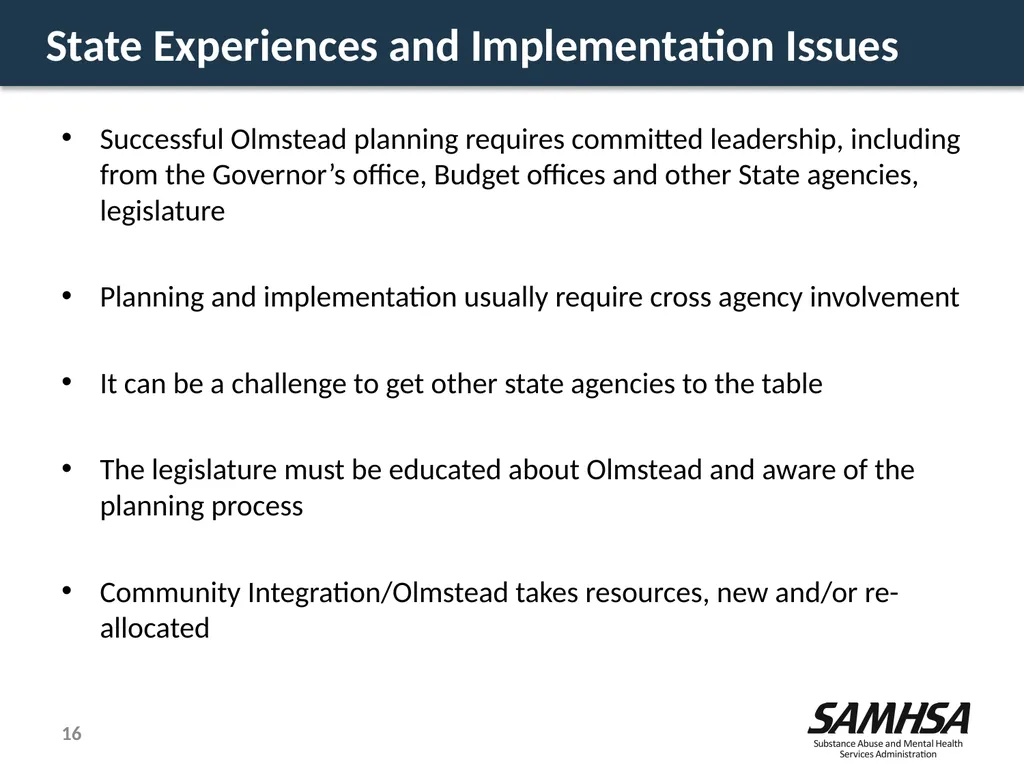
Successful Olmstead planning requires committed leadership, including from the Governor’s office, Budget offices and other State agencies, legislature
Planning and implementation usually require cross agency involvement
It can be a challenge to get other state agencies to the table
The legislature must be educated about Olmstead and aware of the planning process
Community Integration/Olmstead takes resources, new and/or re-allocated 16 State Experiences and Implementation Issues<br>
Planning and implementation usually require cross agency involvement
It can be a challenge to get other state agencies to the table
The legislature must be educated about Olmstead and aware of the planning process
Community Integration/Olmstead takes resources, new and/or re-allocated 16 State Experiences and Implementation Issues<br>
17
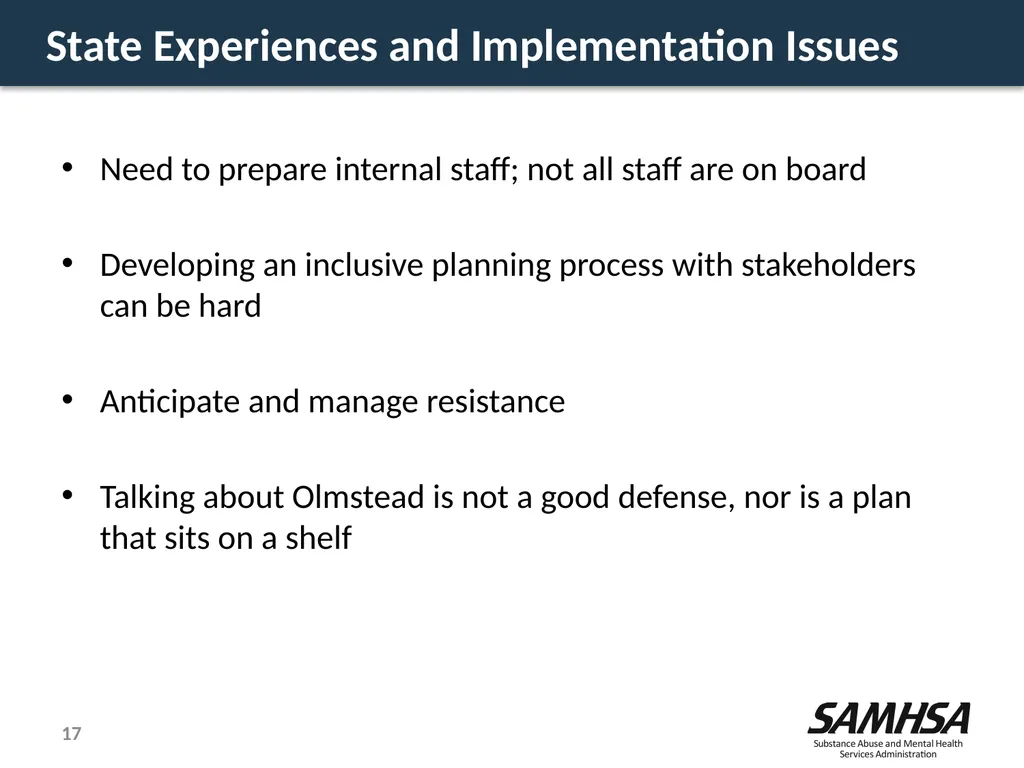
Need to prepare internal staff; not all staff are on board
Developing an inclusive planning process with stakeholders can be hard
Anticipate and manage resistance
Talking about Olmstead is not a good defense, nor is a plan that sits on a shelf 17 State Experiences and Implementation Issues<br>
Developing an inclusive planning process with stakeholders can be hard
Anticipate and manage resistance
Talking about Olmstead is not a good defense, nor is a plan that sits on a shelf 17 State Experiences and Implementation Issues<br>
18
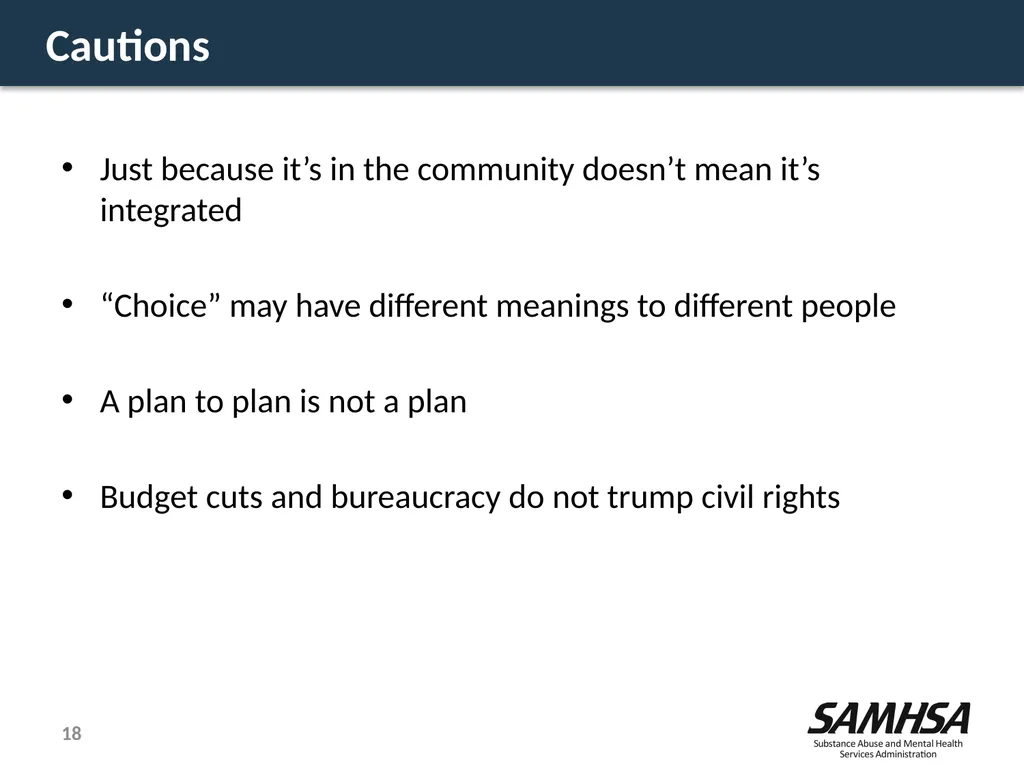
Just because it’s in the community doesn’t mean it’s integrated
“Choice” may have different meanings to different people
A plan to plan is not a plan
Budget cuts and bureaucracy do not trump civil rights 18 Cautions<br>
“Choice” may have different meanings to different people
A plan to plan is not a plan
Budget cuts and bureaucracy do not trump civil rights 18 Cautions<br>
19
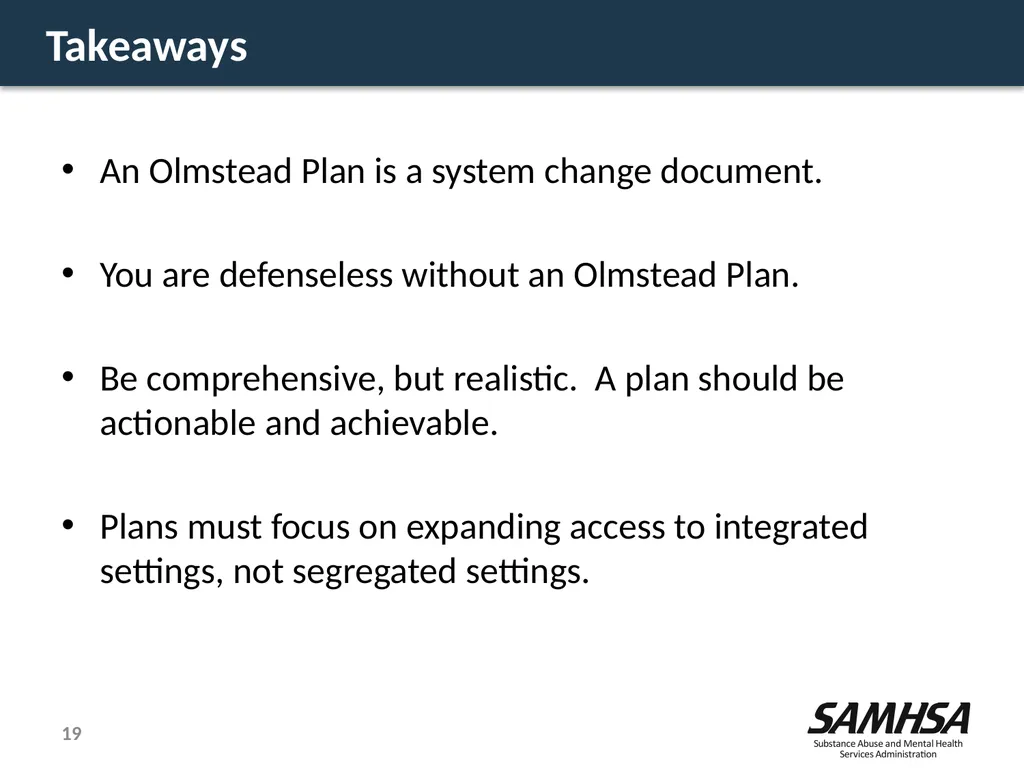
An Olmstead Plan is a system change document.
You are defenseless without an Olmstead Plan.
Be comprehensive, but realistic. A plan should be actionable and achievable.
Plans must focus on expanding access to integrated settings, not segregated settings. 19 Takeaways<br>
You are defenseless without an Olmstead Plan.
Be comprehensive, but realistic. A plan should be actionable and achievable.
Plans must focus on expanding access to integrated settings, not segregated settings. 19 Takeaways<br>
20
Better to have a short, actionable plan than a ZZZ page document that just identifies the issues and barriers to why progress can’t be made.
The Plan should be developed with stakeholder involvement.
Have short and long term goals.
Track and report on progress. 20 Takeaways<br>
The Plan should be developed with stakeholder involvement.
Have short and long term goals.
Track and report on progress. 20 Takeaways<br>
21
Harvey Rosenthal, CEO
New York Association of Psychiatric Rehabilitation Services (NYAPRS) 21 New York Olmstead Planning and Implementation<br>
New York Association of Psychiatric Rehabilitation Services (NYAPRS) 21 New York Olmstead Planning and Implementation<br>
22
New York’s Most Integrated Setting Coordinating Council (MISCC) was established in 2002 following strong advocacy from physical and psychiatric disability groups
Comprised of state agency representatives and 9 public members
Intended to meet quarterly and promoted increased access to increased housing, employment and transportation 22 New York’s Olmstead related Policies<br>
Comprised of state agency representatives and 9 public members
Intended to meet quarterly and promoted increased access to increased housing, employment and transportation 22 New York’s Olmstead related Policies<br>
23
Office of People with Developmental Disabilities
New York State Office of Mental Health
Department of Health,
Office for the Aging
Education Department
Adult Continuing Education Services – Vocational Rehabilitation
Office of Alcohol and Substance Abuse Services
Division of Housing and Community Renewal
Department of Transportation
Office of Children and Family Services
Commission for the Blind
Office of Temporary and Disability Assistance
Justice Center for the Protection of People with Special Needs 23 Statutorily Defined MISSC Members: State Agencies<br>
New York State Office of Mental Health
Department of Health,
Office for the Aging
Education Department
Adult Continuing Education Services – Vocational Rehabilitation
Office of Alcohol and Substance Abuse Services
Division of Housing and Community Renewal
Department of Transportation
Office of Children and Family Services
Commission for the Blind
Office of Temporary and Disability Assistance
Justice Center for the Protection of People with Special Needs 23 Statutorily Defined MISSC Members: State Agencies<br>
24
9 Appointed Public Members
3 consumers of services for individuals with disabilities
3 individuals with expertise in the field of community services for people of all ages with disabilities
3 individuals with expertise in or recipients of services available to senior citizens with disabilities 24 Statutorily Defined MISSC Members: Public Members<br>
3 consumers of services for individuals with disabilities
3 individuals with expertise in the field of community services for people of all ages with disabilities
3 individuals with expertise in or recipients of services available to senior citizens with disabilities 24 Statutorily Defined MISSC Members: Public Members<br>
25
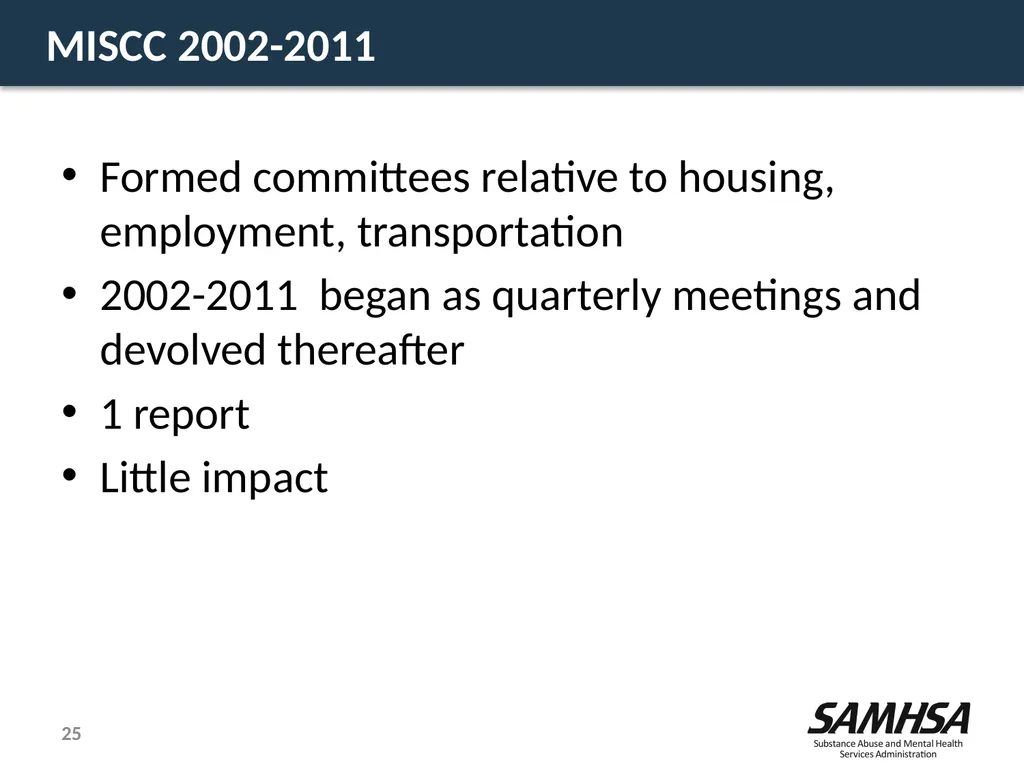
Formed committees relative to housing, employment, transportation
2002-2011 began as quarterly meetings and devolved thereafter
1 report
Little impact 25 MISCC 2002-2011<br>
2002-2011 began as quarterly meetings and devolved thereafter
1 report
Little impact 25 MISCC 2002-2011<br>
26
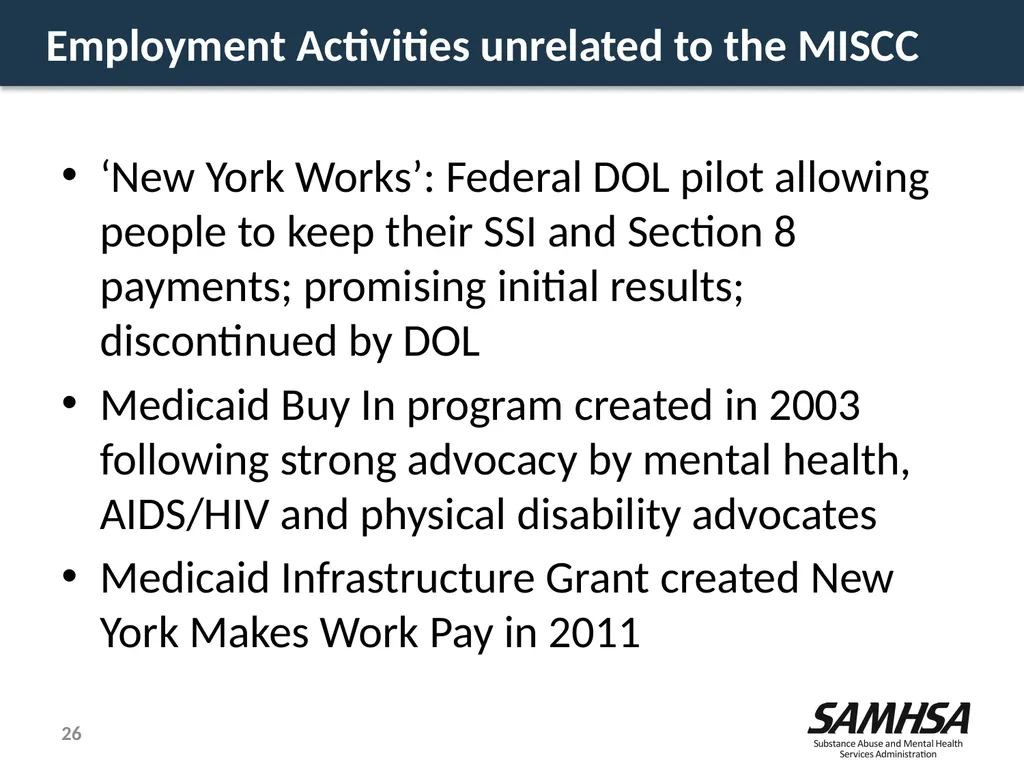
‘New York Works’: Federal DOL pilot allowing people to keep their SSI and Section 8 payments; promising initial results; discontinued by DOL
Medicaid Buy In program created in 2003 following strong advocacy by mental health, AIDS/HIV and physical disability advocates
Medicaid Infrastructure Grant created New York Makes Work Pay in 2011 26 Employment Activities unrelated to the MISCC<br>
Medicaid Buy In program created in 2003 following strong advocacy by mental health, AIDS/HIV and physical disability advocates
Medicaid Infrastructure Grant created New York Makes Work Pay in 2011 26 Employment Activities unrelated to the MISCC<br>
27
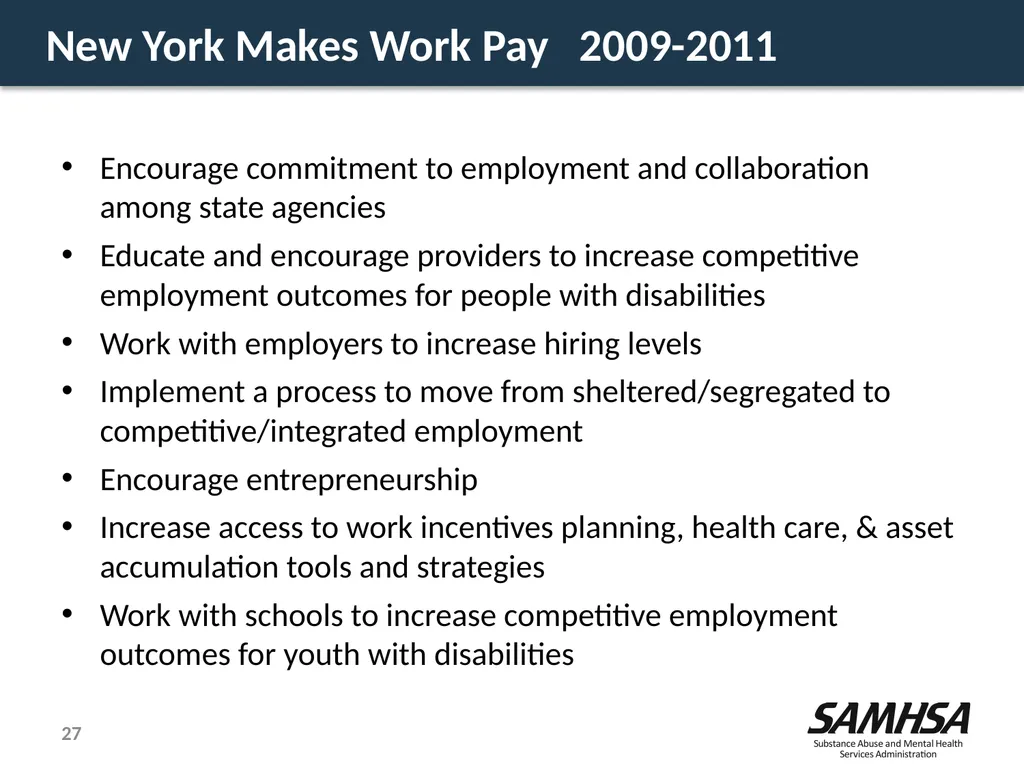
Encourage commitment to employment and collaboration among state agencies
Educate and encourage providers to increase competitive employment outcomes for people with disabilities
Work with employers to increase hiring levels
Implement a process to move from sheltered/segregated to competitive/integrated employment
Encourage entrepreneurship
Increase access to work incentives planning, health care, & asset accumulation tools and strategies
Work with schools to increase competitive employment outcomes for youth with disabilities 27 New York Makes Work Pay 2009-2011<br>
Educate and encourage providers to increase competitive employment outcomes for people with disabilities
Work with employers to increase hiring levels
Implement a process to move from sheltered/segregated to competitive/integrated employment
Encourage entrepreneurship
Increase access to work incentives planning, health care, & asset accumulation tools and strategies
Work with schools to increase competitive employment outcomes for youth with disabilities 27 New York Makes Work Pay 2009-2011<br>
28
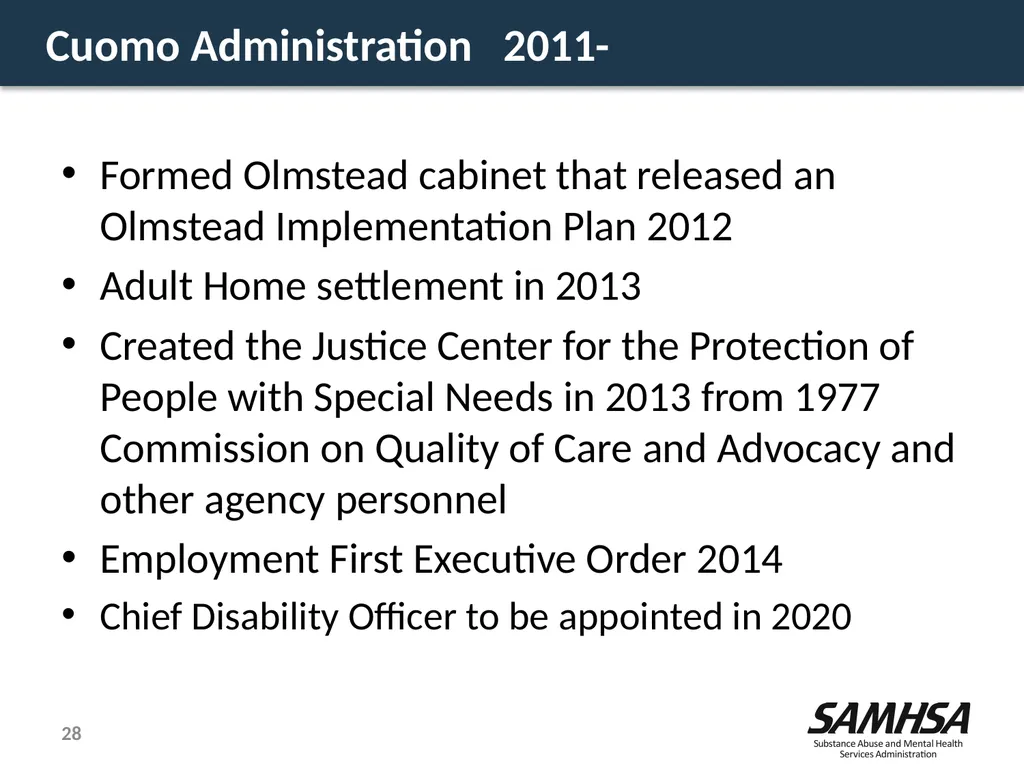
Formed Olmstead cabinet that released an Olmstead Implementation Plan 2012
Adult Home settlement in 2013
Created the Justice Center for the Protection of People with Special Needs in 2013 from 1977 Commission on Quality of Care and Advocacy and other agency personnel
Employment First Executive Order 2014
Chief Disability Officer to be appointed in 2020 28 Cuomo Administration 2011-<br>
Adult Home settlement in 2013
Created the Justice Center for the Protection of People with Special Needs in 2013 from 1977 Commission on Quality of Care and Advocacy and other agency personnel
Employment First Executive Order 2014
Chief Disability Officer to be appointed in 2020 28 Cuomo Administration 2011-<br>
29
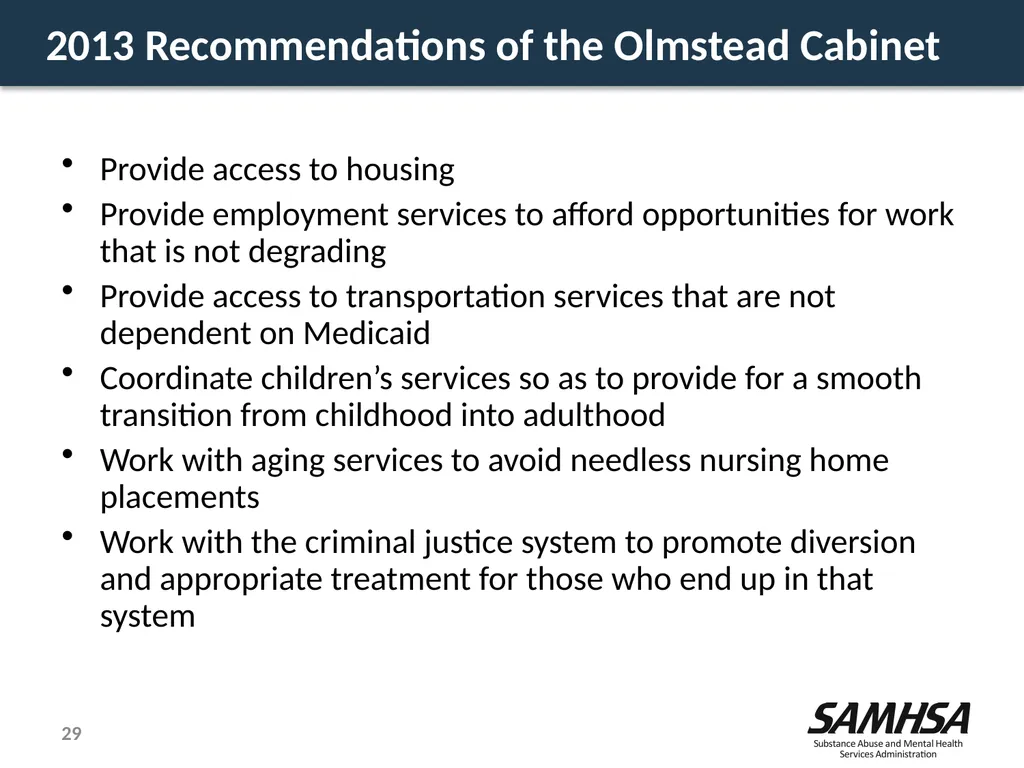
Provide access to housing
Provide employment services to afford opportunities for work that is not degrading
Provide access to transportation services that are not dependent on Medicaid
Coordinate children’s services so as to provide for a smooth transition from childhood into adulthood
Work with aging services to avoid needless nursing home placements
Work with the criminal justice system to promote diversion and appropriate treatment for those who end up in that system 29 2013 Recommendations of the Olmstead Cabinet<br>
Provide employment services to afford opportunities for work that is not degrading
Provide access to transportation services that are not dependent on Medicaid
Coordinate children’s services so as to provide for a smooth transition from childhood into adulthood
Work with aging services to avoid needless nursing home placements
Work with the criminal justice system to promote diversion and appropriate treatment for those who end up in that system 29 2013 Recommendations of the Olmstead Cabinet<br>
30
Increase the employment rate of individuals with disabilities by 5%.
Decrease the poverty rate of individuals with disabilities by 5%.
Register 100 businesses as having formal policies to hire people with disabilities as part of their workforce strategy. 30 2014 Employment First Executive Order: Goals<br>
Decrease the poverty rate of individuals with disabilities by 5%.
Register 100 businesses as having formal policies to hire people with disabilities as part of their workforce strategy. 30 2014 Employment First Executive Order: Goals<br>
31
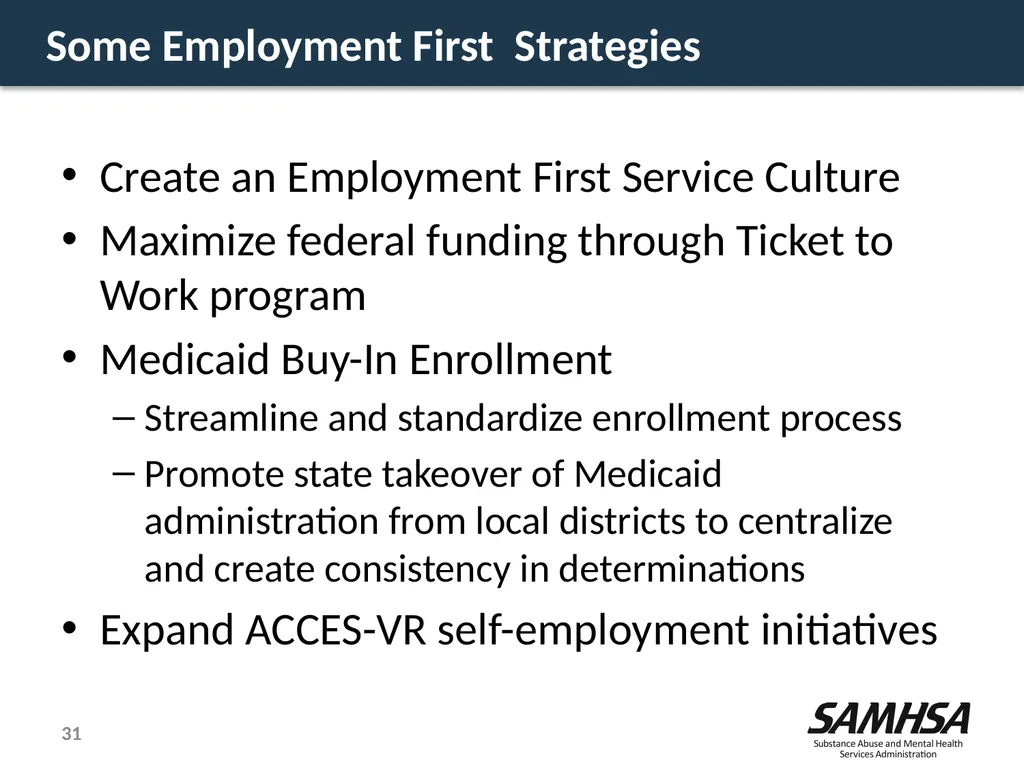
Create an Employment First Service Culture
Maximize federal funding through Ticket to Work program
Medicaid Buy-In Enrollment
Streamline and standardize enrollment process
Promote state takeover of Medicaid administration from local districts to centralize and create consistency in determinations
Expand ACCES-VR self-employment initiatives 31 Some Employment First Strategies<br>
Maximize federal funding through Ticket to Work program
Medicaid Buy-In Enrollment
Streamline and standardize enrollment process
Promote state takeover of Medicaid administration from local districts to centralize and create consistency in determinations
Expand ACCES-VR self-employment initiatives 31 Some Employment First Strategies<br>
32
Adult Home settlement in 2013
Very slow movement of residents into the community due to operator resistance and flawed implementation and complex health home processes
Adult Home Plus Program 1:12 ratio
$5 million to create 2 Adult Home Peer Bridger initiatives 32 Adult Home Settlement Implementation<br>
Very slow movement of residents into the community due to operator resistance and flawed implementation and complex health home processes
Adult Home Plus Program 1:12 ratio
$5 million to create 2 Adult Home Peer Bridger initiatives 32 Adult Home Settlement Implementation<br>
33
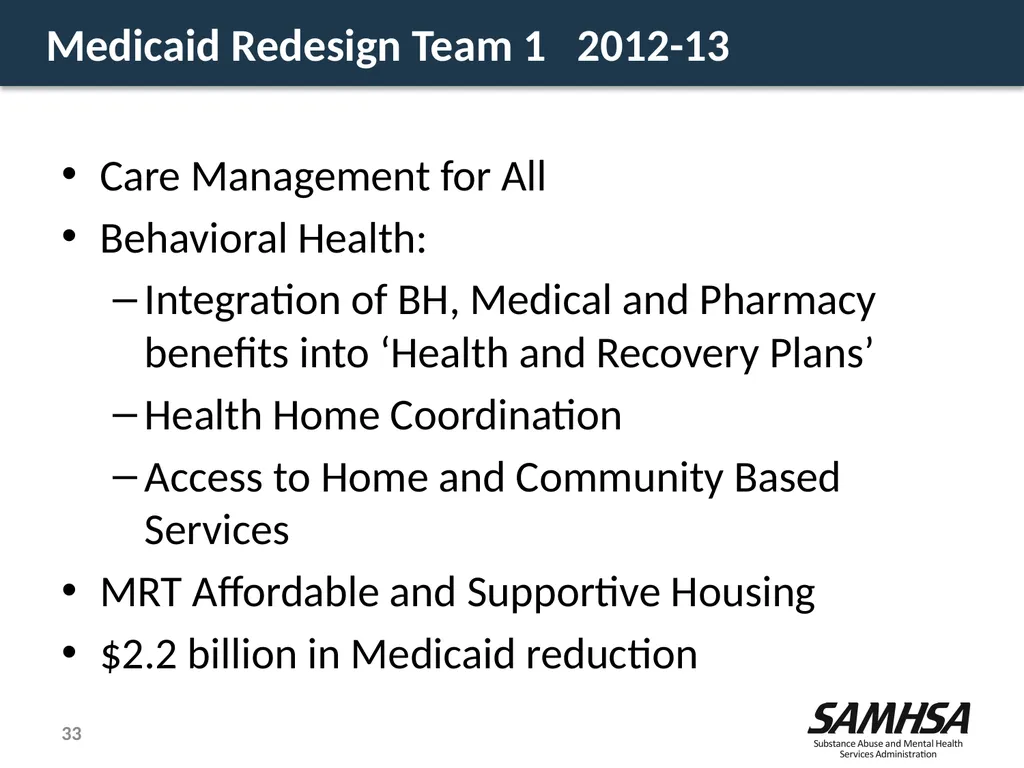
Care Management for All
Behavioral Health:
Integration of BH, Medical and Pharmacy benefits into ‘Health and Recovery Plans’
Health Home Coordination
Access to Home and Community Based Services
MRT Affordable and Supportive Housing
$2.2 billion in Medicaid reduction 33 Medicaid Redesign Team 1 2012-13<br>
Behavioral Health:
Integration of BH, Medical and Pharmacy benefits into ‘Health and Recovery Plans’
Health Home Coordination
Access to Home and Community Based Services
MRT Affordable and Supportive Housing
$2.2 billion in Medicaid reduction 33 Medicaid Redesign Team 1 2012-13<br>
34
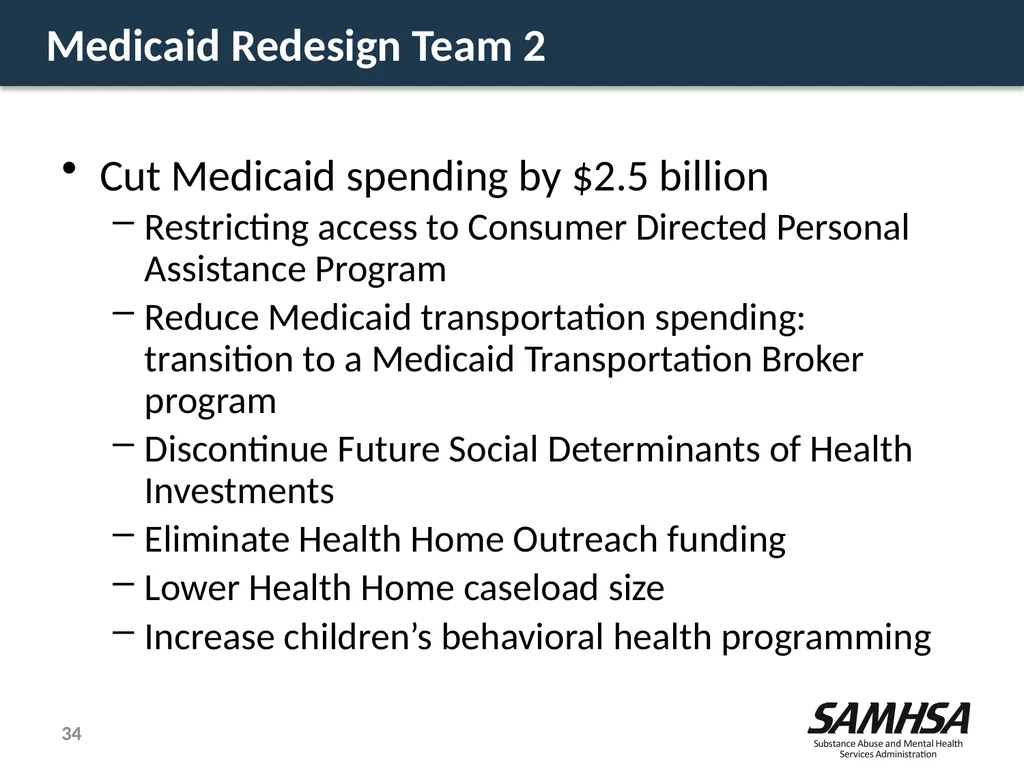
Cut Medicaid spending by $2.5 billion
Restricting access to Consumer Directed Personal Assistance Program
Reduce Medicaid transportation spending: transition to a Medicaid Transportation Broker program
Discontinue Future Social Determinants of Health Investments
Eliminate Health Home Outreach funding
Lower Health Home caseload size
Increase children’s behavioral health programming 34 Medicaid Redesign Team 2<br>
Restricting access to Consumer Directed Personal Assistance Program
Reduce Medicaid transportation spending: transition to a Medicaid Transportation Broker program
Discontinue Future Social Determinants of Health Investments
Eliminate Health Home Outreach funding
Lower Health Home caseload size
Increase children’s behavioral health programming 34 Medicaid Redesign Team 2<br>
35
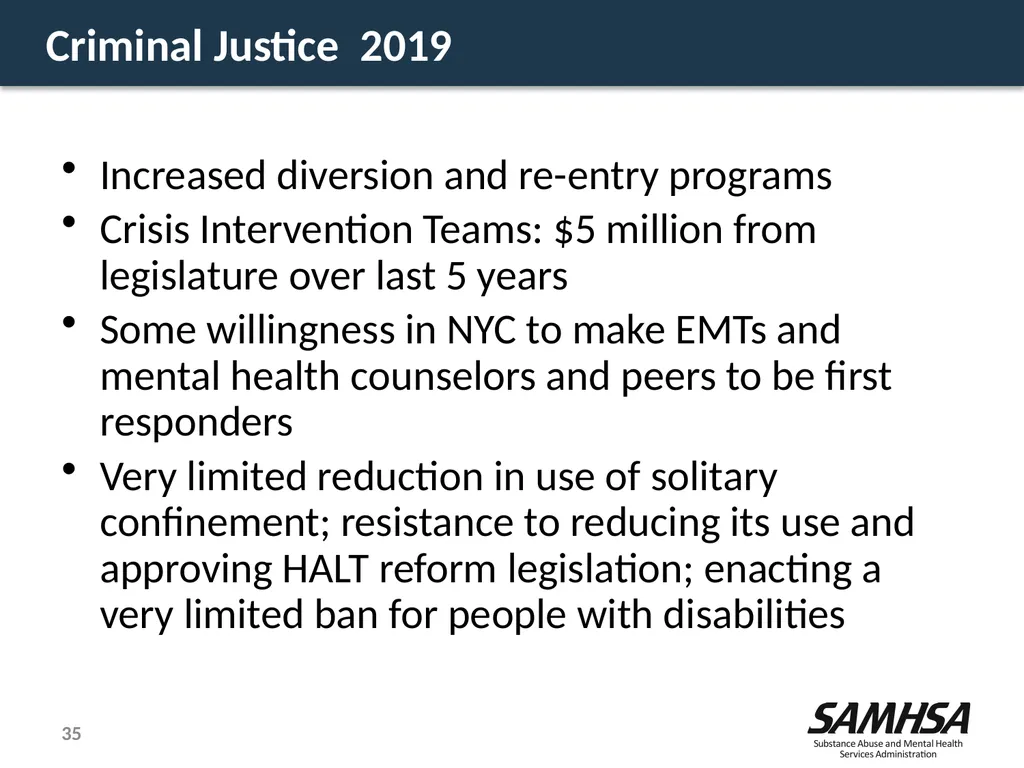
Increased diversion and re-entry programs
Crisis Intervention Teams: $5 million from legislature over last 5 years
Some willingness in NYC to make EMTs and mental health counselors and peers to be first responders
Very limited reduction in use of solitary confinement; resistance to reducing its use and approving HALT reform legislation; enacting a very limited ban for people with disabilities 35 Criminal Justice 2019<br>
Crisis Intervention Teams: $5 million from legislature over last 5 years
Some willingness in NYC to make EMTs and mental health counselors and peers to be first responders
Very limited reduction in use of solitary confinement; resistance to reducing its use and approving HALT reform legislation; enacting a very limited ban for people with disabilities 35 Criminal Justice 2019<br>
36
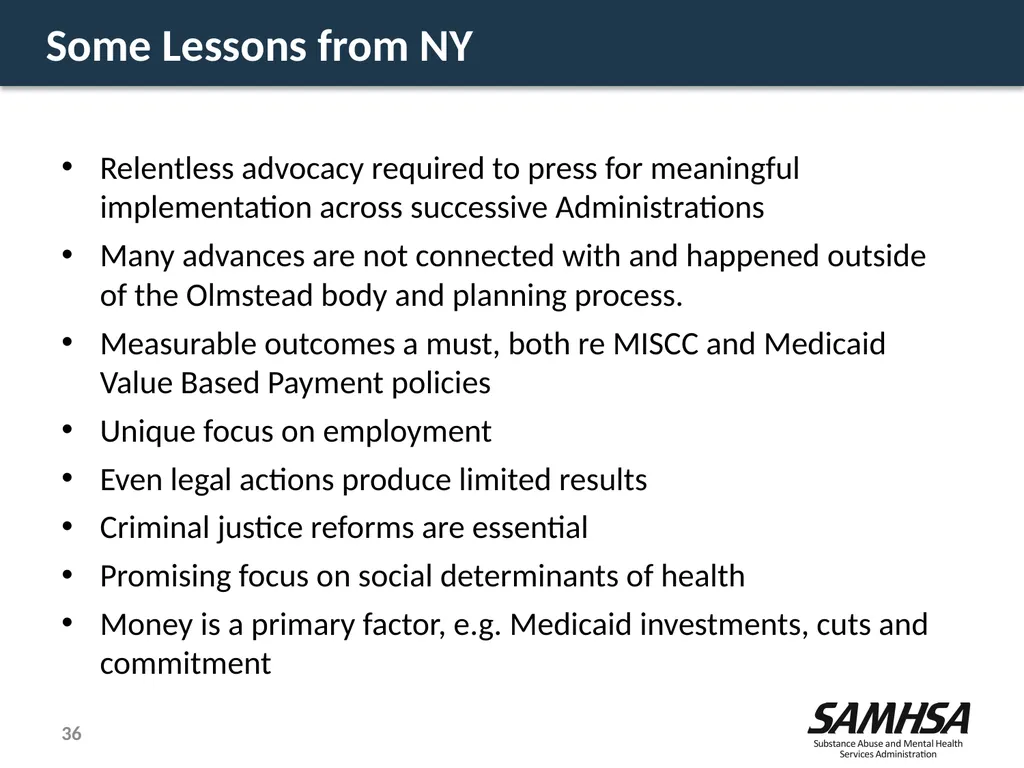
Relentless advocacy required to press for meaningful implementation across successive Administrations
Many advances are not connected with and happened outside of the Olmstead body and planning process.
Measurable outcomes a must, both re MISCC and Medicaid Value Based Payment policies
Unique focus on employment
Even legal actions produce limited results
Criminal justice reforms are essential
Promising focus on social determinants of health
Money is a primary factor, e.g. Medicaid investments, cuts and commitment 36 Some Lessons from NY<br>
Many advances are not connected with and happened outside of the Olmstead body and planning process.
Measurable outcomes a must, both re MISCC and Medicaid Value Based Payment policies
Unique focus on employment
Even legal actions produce limited results
Criminal justice reforms are essential
Promising focus on social determinants of health
Money is a primary factor, e.g. Medicaid investments, cuts and commitment 36 Some Lessons from NY<br>
37
37 Kevin Martone, TAC Harvey Rosenthal, NYAPRS
kmartone@tacinc.org harveyr@nyaprs.org<br>
kmartone@tacinc.org harveyr@nyaprs.org<br>