OMICS Group Contact us at: contact.omicsomicsonline.org OMICS Group International through its Open Access Initiative is committed to make genuine and reliable contributions to the scientific community. OMICS Group hosts over 400
"OMICS Group Contact us at:" is the property of its rightful owner. Permission is granted to
download and print the materials on this website for personal, non-commercial use only, and to display it
on your personal computer provided you do not modify the materials and that you retain all copyright
notices contained in the materials. By downloading content from our website, you accept the terms of this
agreement.
Presentation Transcript
01
OMICS Group Contact us at: contact.omics@omicsonline.org OMICS Group International through its Open Access Initiative is committed to make genuine and reliable contributions to the scientific community. OMICS Group hosts over 400 leading-edge peer reviewed Open Access Journals and organizes over 300 International Conferences annually all over the world. OMICS Publishing Group journals have over 3 million readers and the fame and success of the same can be attributed to the strong editorial board which contains over 30000 eminent personalities that ensure a rapid, quality and quick review process. OMICS Group signed an agreement with more than 1000 International Societies to make healthcare information Open Access.<br>
02
OMICS Group welcomes submissions that are original and technically so as to serve both the developing world and developed countries in the best possible way.
OMICS Journals are poised in excellence by publishing high quality research. OMICS Group follows an Editorial Manager® System peer review process and boasts of a strong and active editorial board.
Editors and reviewers are experts in their field and provide anonymous, unbiased and detailed reviews of all submissions.
The journal gives the options of multiple language translations for all the articles and all archived articles are available in HTML, XML, PDF and audio formats. Also, all the published articles are archived in repositories and indexing services like DOAJ, CAS, Google Scholar, Scientific Commons, Index Copernicus, EBSCO, HINARI and GALE. For more details please visit our website: http://omicsonline.org/Submitmanuscript.php OMICS Journals are welcoming Submissions<br>
03
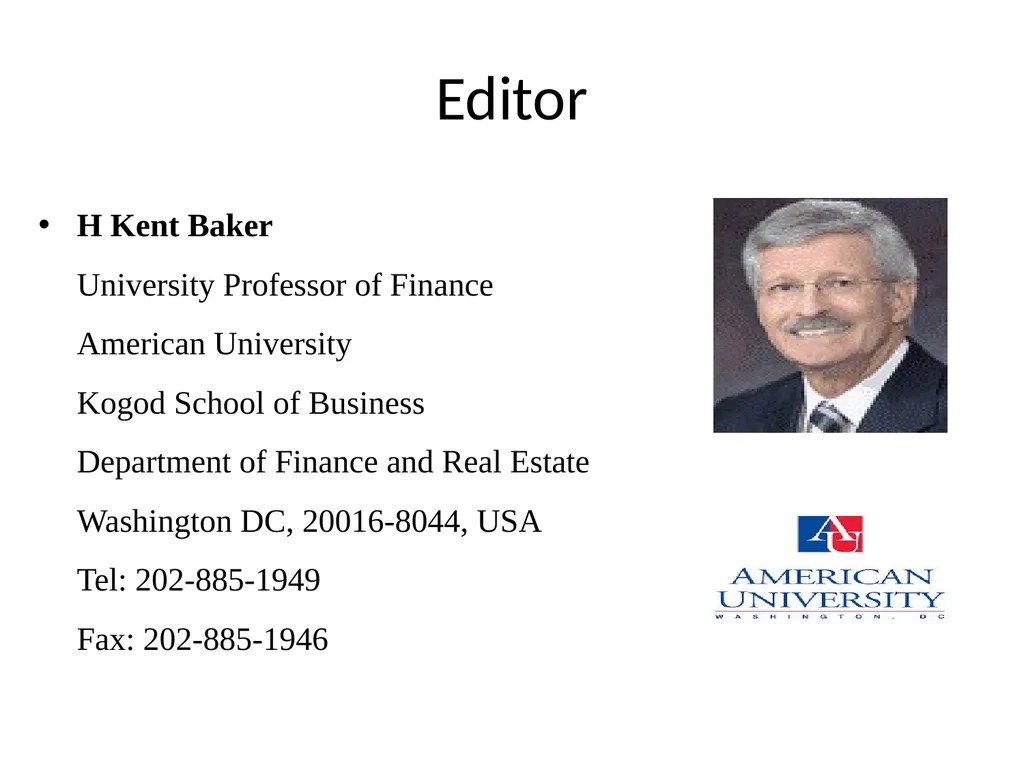
Editor H Kent Baker University Professor of Finance American University Kogod School of Business Department of Finance and Real Estate Washington DC, 20016-8044, USA Tel: 202-885-1949 Fax: 202-885-1946<br>
04
Biography Prof. H. Kent Baker is University Professor of Finance at the Kogod School of Business, American University in Washington, DC.
He is the author/co-editor or editor/co-editor of 24 books including several textbooks.
Professor Baker has also published more than 250 journal articles, monographs, book chapters, and proceedings as well as 350 book reviews and abstracts.
Much of his research is empirical and published in peer-reviewed academic journals<br>
05
Journals include:
Journal of Finance
Journal of Financial and Quantitative Analysis
Financial Management
Financial Analysts Journal
Journal of Portfolio Management
Journal of Financial Research
Financial Review
Harvard Business Review
Journal of Accountancy<br>
06
He has had consulting and training experience with more than 100 organizations.
He currently serves on six advisory or editorial boards.
Professor Baker received a B.S.B.A. from Georgetown University; an M.B.A., M.Ed., and D.B.A. from the University of Maryland, and M.S., M.A., and two PhDs from American University.
He also holds CFA and CMA designations.<br>
07
Research Interest His research interests include:
Survey research
Investor behavior
Financial psychology
Market microstructure
Dividend policy
Mutual funds<br>
08
Market Microstructure Market Microstructure is the process by which securities such as stocks are traded.
For a stock market to function properly, a structure is needed to:
Facilitate the placing of orders.
Speed the execution of the trades ordered.
Provide equal access to information for all investors.
It is the study of the process and outcomes of exchanging assets under explicit trading rules<br>
09
Analysis of how specific trading mechanisms affect the price formation process.
Trading mechanism: set of rules governing the exchange of financial assets (stocks, derivatives) or foreign currencies in a market.
Need for market microstructure
Tries to answer how prices are formed in the economy.
Market microstructure has a profound impact on the real world – on traders, broker/dealers, exchanges, regulators, and policy makers alike.<br>
10
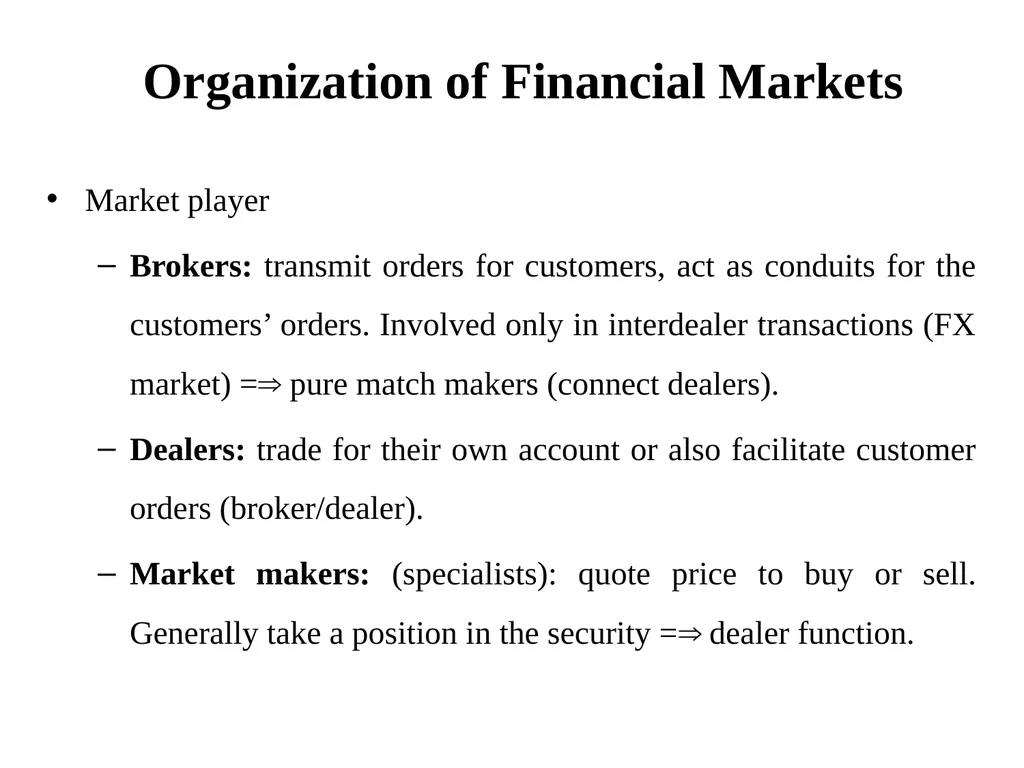
Organization of Financial Markets Market player
Brokers: transmit orders for customers, act as conduits for the customers’ orders. Involved only in interdealer transactions (FX market) =⇒ pure match makers (connect dealers).
Dealers: trade for their own account or also facilitate customer orders (broker/dealer).
Market makers: (specialists): quote price to buy or sell. Generally take a position in the security =⇒ dealer function.<br>
11
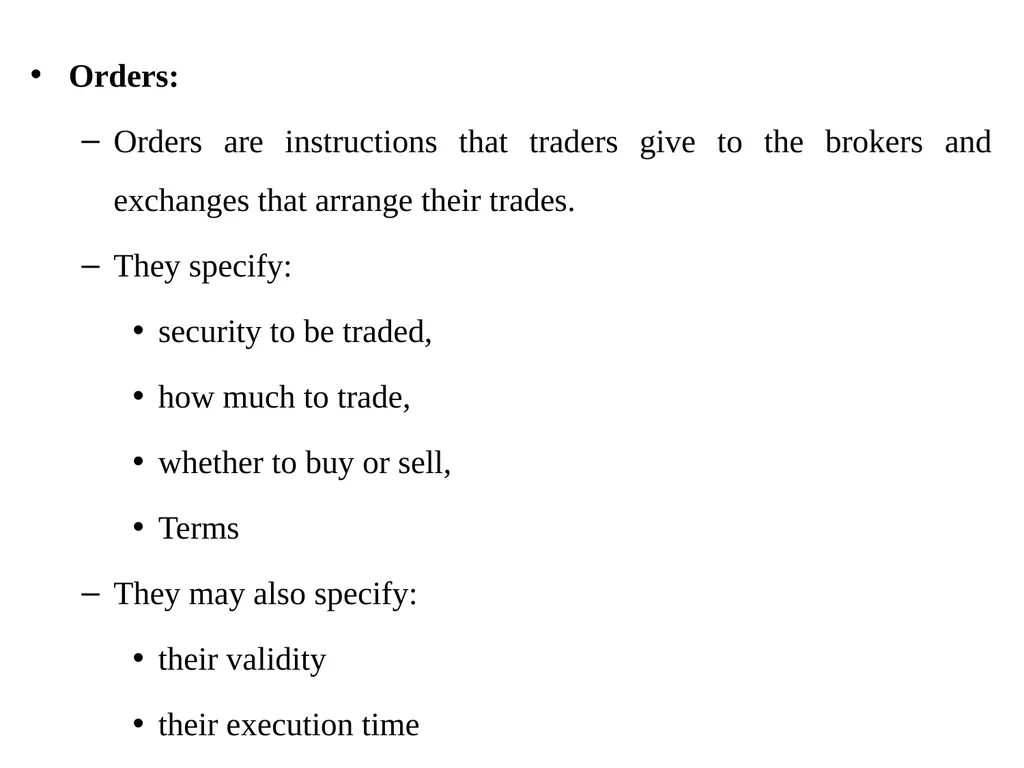
Orders:
Orders are instructions that traders give to the brokers and exchanges that arrange their trades.
They specify:
security to be traded,
how much to trade,
whether to buy or sell,
Terms
They may also specify:
their validity
their execution time<br>
12
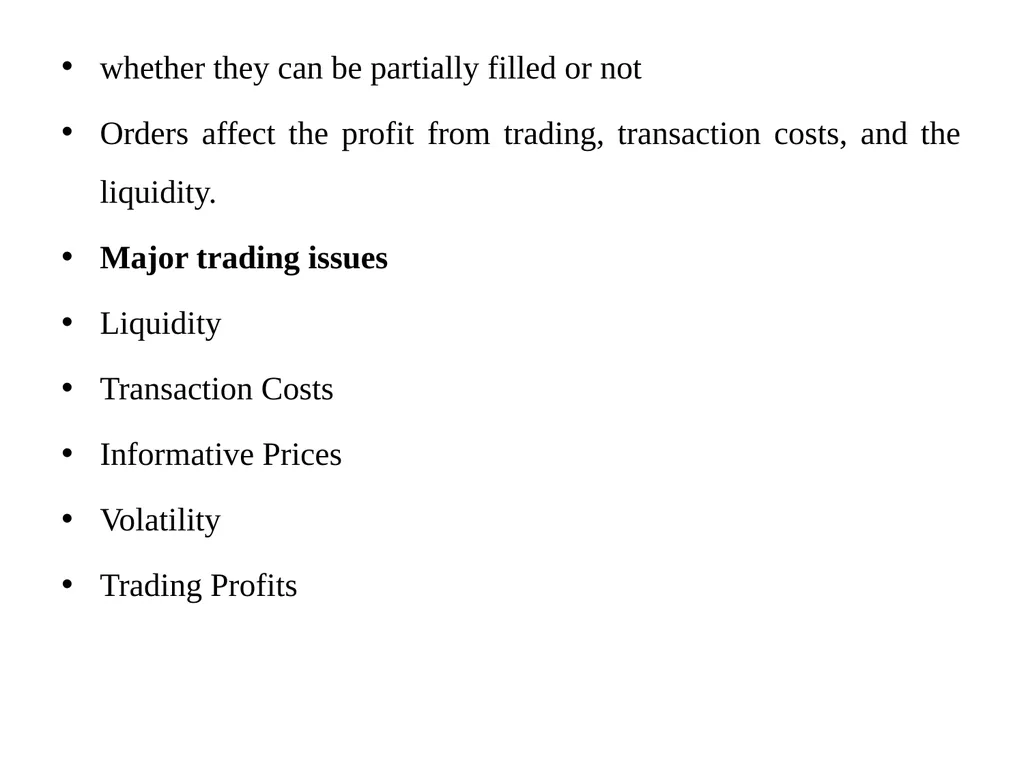
whether they can be partially filled or not
Orders affect the profit from trading, transaction costs, and the liquidity.
Major trading issues
Liquidity
Transaction Costs
Informative Prices
Volatility
Trading Profits<br>
13
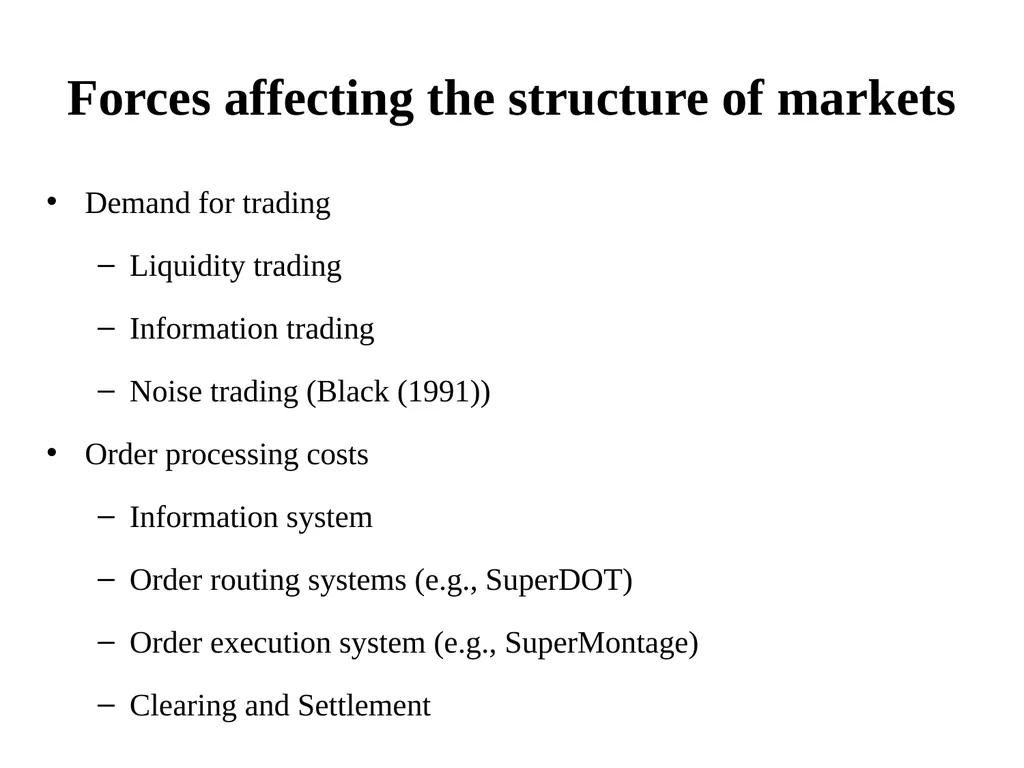
Forces affecting the structure of markets Demand for trading
Liquidity trading
Information trading
Noise trading (Black (1991))
Order processing costs
Information system
Order routing systems (e.g., SuperDOT)
Order execution system (e.g., SuperMontage)
Clearing and Settlement<br>
14
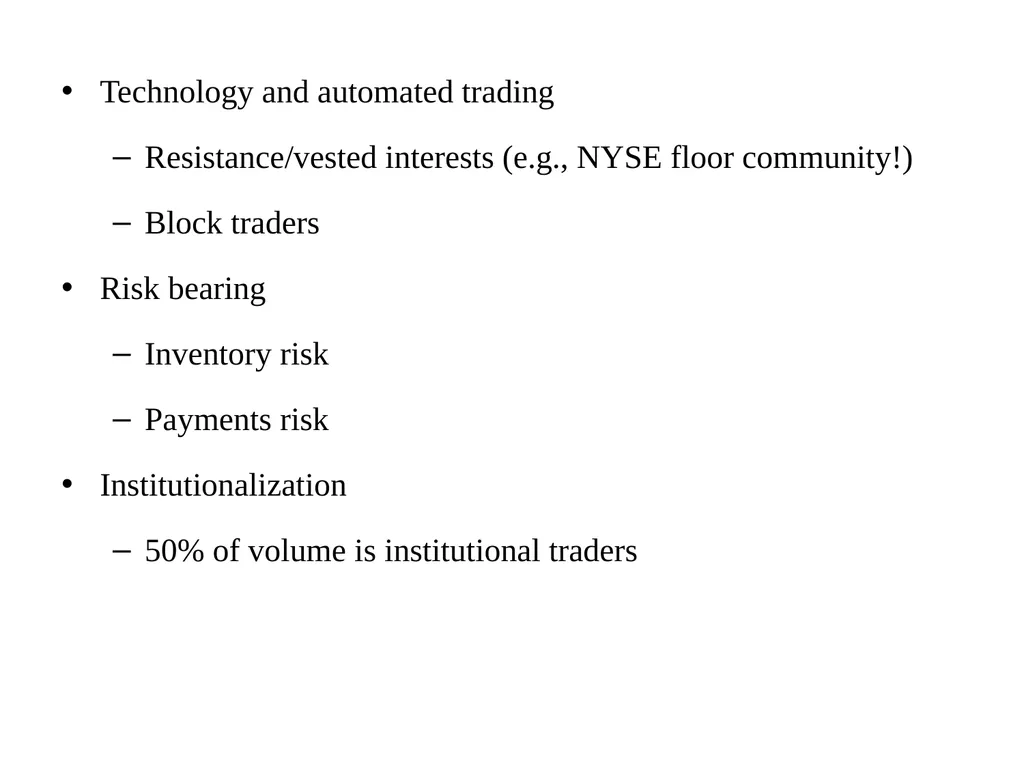
Technology and automated trading
Resistance/vested interests (e.g., NYSE floor community!)
Block traders
Risk bearing
Inventory risk
Payments risk
Institutionalization
50% of volume is institutional traders<br>
15
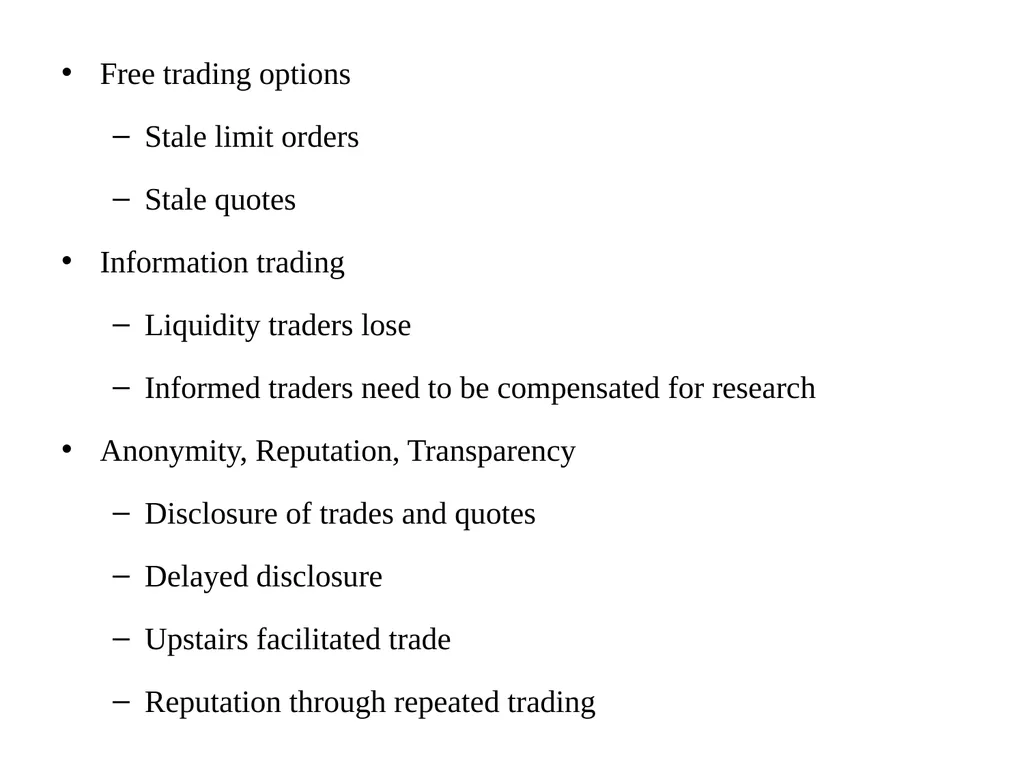
Free trading options
Stale limit orders
Stale quotes
Information trading
Liquidity traders lose
Informed traders need to be compensated for research
Anonymity, Reputation, Transparency
Disclosure of trades and quotes
Delayed disclosure
Upstairs facilitated trade
Reputation through repeated trading<br>
16
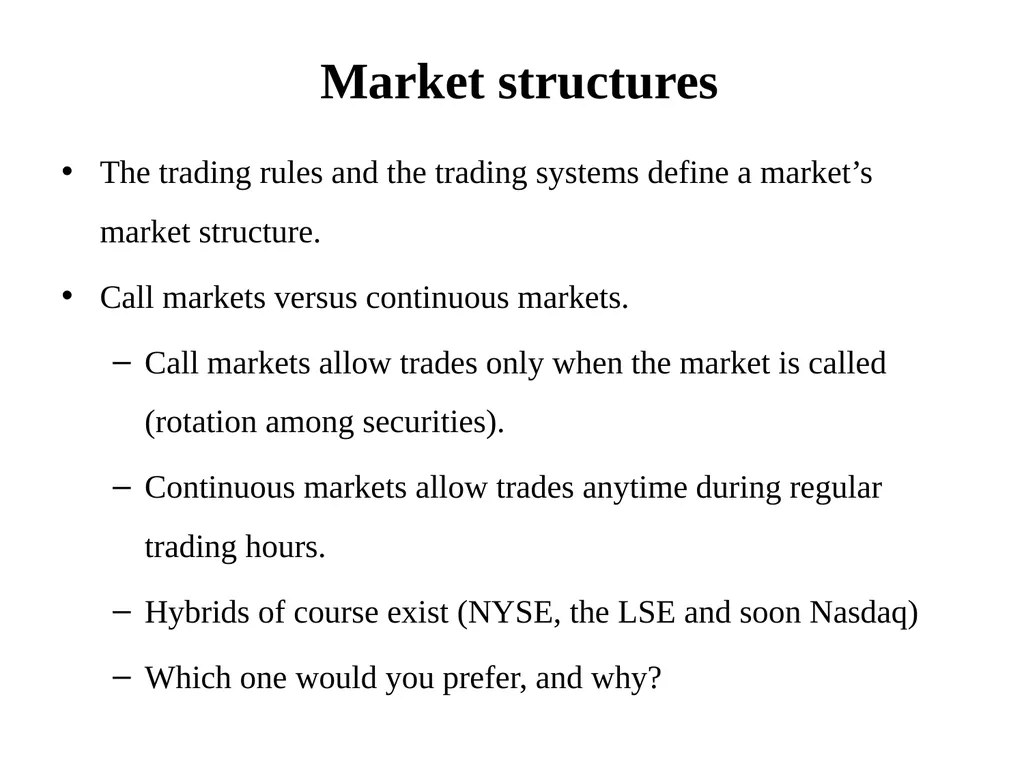
Market structures The trading rules and the trading systems define a market’s market structure.
Call markets versus continuous markets.
Call markets allow trades only when the market is called (rotation among securities).
Continuous markets allow trades anytime during regular trading hours.
Hybrids of course exist (NYSE, the LSE and soon Nasdaq)
Which one would you prefer, and why?<br>
17
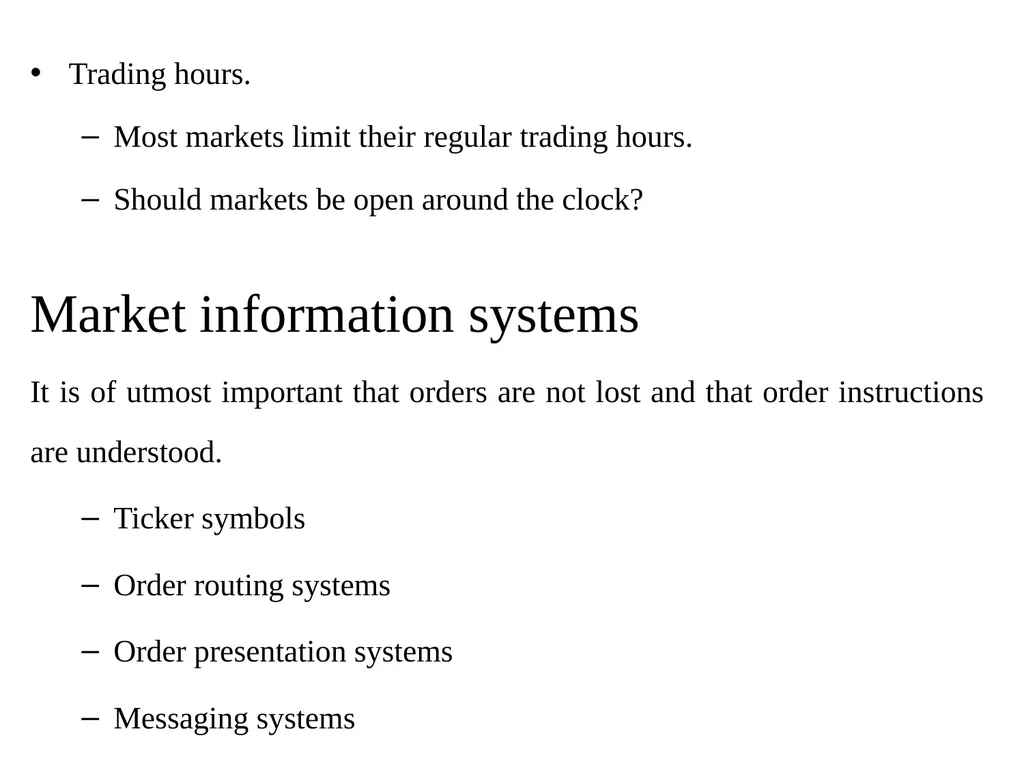
Trading hours.
Most markets limit their regular trading hours.
Should markets be open around the clock?
Market information systems
It is of utmost important that orders are not lost and that order instructions are understood.
Ticker symbols
Order routing systems
Order presentation systems
Messaging systems<br>
18
The information created by trading is valuable.
Market data systems report trades to the public
Broadcast services
Price and sale feeds
Ticker tapes
Quotation feeds
Transparency is a key feature of markets.
Ex ante vs. ex post transparency<br>
19
Market maker obligations Provide quotes during trading hours
Offer “best execution”
Report trades in a timely manner
Fair communication
No churning<br>
20
Thank You..!<br>
21
Journal of Accounting and Marketing
International Journal of Accounting Research Related Journals<br>
22
2nd International Conference on Business Economics and Management<br>
23
OMICS Group Open Access Membership OMICS publishing Group Open Access Membership enables academic and research institutions, funders and corporations to actively encourage open access in scholarly communication and the dissemination of research published by their authors.
For more details and benefits, click on the link below:
http://omicsonline.org/membership.php<br>