
OMM Question Writing Background Bethany Powers, DO
MT
Published · 19 slides · 0 views
1 / 1

Description
OMM Question Writing Background Bethany Powers, DO Discipline Chair of Osteopathic Manipulative Medicine Amber Stroupe, DO, FAAP, FACOP, FACP Assistant Professor of Internal Medicine June 18th, 2019 Faculty Development Objectives Quick
Related Topics
Share
Embed code
Download this presentation From Below
"OMM Question Writing Background Bethany Powers, DO" is the property of its rightful owner. Permission is granted to download and print the materials on this website for personal, non-commercial use only, and to display it on your personal computer provided you do not modify the materials and that you retain all copyright notices contained in the materials. By downloading content from our website, you accept the terms of this agreement.
Presentation Transcript
01
OMM Question Writing
Background Bethany Powers, DO
Discipline Chair of Osteopathic Manipulative Medicine
Amber Stroupe, DO, FAAP, FACOP, FACP
Assistant Professor of Internal Medicine
June 18th, 2019
Faculty Development<br>
Discipline Chair of Osteopathic Manipulative Medicine
Amber Stroupe, DO, FAAP, FACOP, FACP
Assistant Professor of Internal Medicine
June 18th, 2019
Faculty Development<br>
02
Objectives Quick review of history of OMT/Osteopathy
Identify how to define and label somatic dysfunctions
Review evidence behind Osteopathic treatments<br>
Identify how to define and label somatic dysfunctions
Review evidence behind Osteopathic treatments<br>
03
History of Osteopathic Medicine The philosophy was developed in 1874 by Dr. Andrew Taylor Still
Pioneered the concept of "wellness" and recognized the importance of treating illness within the context of the whole body (mind, body, and spirit)
A.T. still was surgeon in the Union Army during the Civil War
After the Civil War and following the death of three of his children from spinal meningitis in 1864, Still concluded that the orthodox medical practices of his day were frequently ineffective, and sometimes harmful (MERCURY)<br>
Pioneered the concept of "wellness" and recognized the importance of treating illness within the context of the whole body (mind, body, and spirit)
A.T. still was surgeon in the Union Army during the Civil War
After the Civil War and following the death of three of his children from spinal meningitis in 1864, Still concluded that the orthodox medical practices of his day were frequently ineffective, and sometimes harmful (MERCURY)<br>
04
History of Osteopathic Medicine Dr. Still opened the first school of osteopathic medicine in Kirksville, Missouri in 1892.
1918 and 1919 influenza outbreak
In US military hospitals, the mortality rate averaged 36%, while the mortality rate in US medical hospitals fell between 30% and 40%, with the exception of 68% in medical hospitals in New York City
D.O.s treated 110,122 patients with influenza, with a resulting mortality of 0.25%
Throughout the first half of the twentieth century, the policy of the American Medical Association labeled osteopathic medicine as a cult and osteopaths were seen as "cultist"
The AMA code of ethics declared it unethical for a medical physician to voluntarily associate with an osteopath<br>
1918 and 1919 influenza outbreak
In US military hospitals, the mortality rate averaged 36%, while the mortality rate in US medical hospitals fell between 30% and 40%, with the exception of 68% in medical hospitals in New York City
D.O.s treated 110,122 patients with influenza, with a resulting mortality of 0.25%
Throughout the first half of the twentieth century, the policy of the American Medical Association labeled osteopathic medicine as a cult and osteopaths were seen as "cultist"
The AMA code of ethics declared it unethical for a medical physician to voluntarily associate with an osteopath<br>
05
History of Osteopathic Medicine In the 1960s in California, the AMA, sensing increased competition from osteopathic medicine, spent nearly $8 million to end the practice of osteopathic medicine in the state.
The California Medical Association issued M.D. degrees to all D.O.s in the state of California for a $65 fee and attending a short seminar
1966 D.O.s were allowed to serve in the military with the same practice rights as M.D.s
Full licensure granted to D.O.s in all 50 states, first was California in 1901 and last was Nebraska in 1989
Ronald Blanck, D.O. served as the Surgeon General from 1996-2000<br>
The California Medical Association issued M.D. degrees to all D.O.s in the state of California for a $65 fee and attending a short seminar
1966 D.O.s were allowed to serve in the military with the same practice rights as M.D.s
Full licensure granted to D.O.s in all 50 states, first was California in 1901 and last was Nebraska in 1989
Ronald Blanck, D.O. served as the Surgeon General from 1996-2000<br>
06
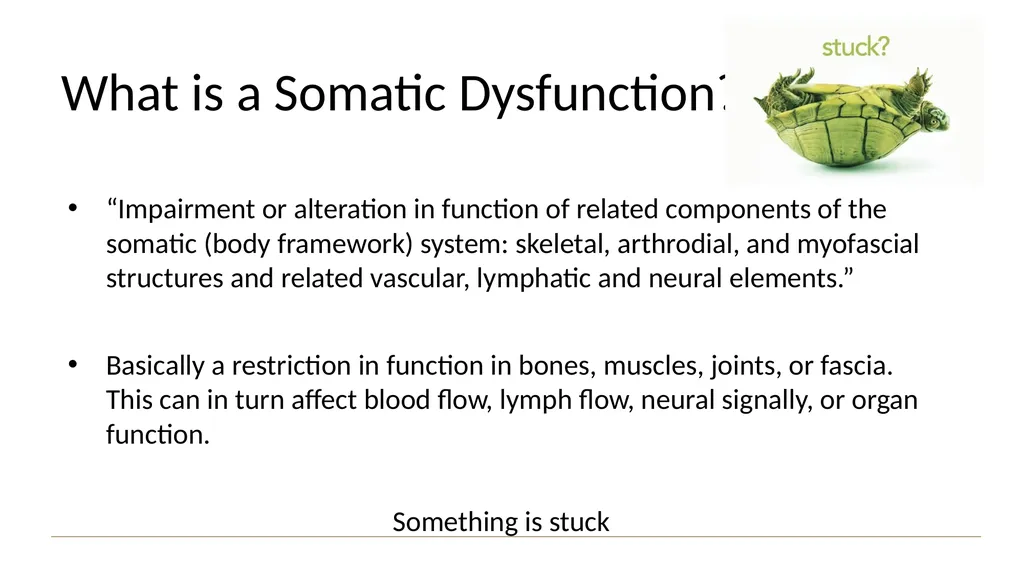
What is a Somatic Dysfunction? “Impairment or alteration in function of related components of the somatic (body framework) system: skeletal, arthrodial, and myofascial structures and related vascular, lymphatic and neural elements.”
Basically a restriction in function in bones, muscles, joints, or fascia. This can in turn affect blood flow, lymph flow, neural signally, or organ function.
Something is stuck<br>
Basically a restriction in function in bones, muscles, joints, or fascia. This can in turn affect blood flow, lymph flow, neural signally, or organ function.
Something is stuck<br>
07
How do you find a somatic dysfunction TART changes on physical exam
Tissue texture changes
Asymmetry
Restriction
Tenderness
Somatic dysfunction is the ONLY indication for OMT.
For example: Sinus infection is NOT. However, facial tenderness would be.
MUST be a TART change<br>
Tissue texture changes
Asymmetry
Restriction
Tenderness
Somatic dysfunction is the ONLY indication for OMT.
For example: Sinus infection is NOT. However, facial tenderness would be.
MUST be a TART change<br>
08
How do we know where to look? Locations of pain or injury reported by the patient
Patterns based on underlying pathology
Viscerosomatic reflexes
Organ (viscera) disorder causing a discreet and specific pattern of MSK/Soft tissue findings.
These patterns are repeatable and recognizable.<br>
Patterns based on underlying pathology
Viscerosomatic reflexes
Organ (viscera) disorder causing a discreet and specific pattern of MSK/Soft tissue findings.
These patterns are repeatable and recognizable.<br>
09
Spinal facilitation patterns
Often cause level specific paraspinal tenderness or muscle hypertonicity
Location based on sympathetic vs. parasympathetic response
Chapman’s points
Fingertip size areas of tenderness/possible palpable ball in very specific locations
To be a true positive finding, both front and back should be present Viscerosomatic Reflexes Dr. Bowers has made a great reference ppt for all of these<br>
Often cause level specific paraspinal tenderness or muscle hypertonicity
Location based on sympathetic vs. parasympathetic response
Chapman’s points
Fingertip size areas of tenderness/possible palpable ball in very specific locations
To be a true positive finding, both front and back should be present Viscerosomatic Reflexes Dr. Bowers has made a great reference ppt for all of these<br>
10
Paravertebral Spinal Facilitation HEENT
T1-4; C2 (CNs III, VII, IX)
Heart
T1-5; C2 (CN X)
Lungs
T2-7; C2 (CN X)
Esophagus
T2-T6
Foregut* (lower esophagus to upper duodenum)
T5-9; C2 (CN X)
Midgut
T10-12; C2 (CN X)
Hindgut
T12-L2; S2-S4 Upper Extremity
T2-T7
Lower Extremity
T10-L3 Adrenals
T8-10
Kidneys
T10-L1; C2 (CN X)
Bladder
T10-L2; S2-S4
Gonads
T9-10; C2 (CN X)
Uterus & cervix
T10-L2
Prostate
T11-L2 Sympathetic-mediated
Parasympathetic-mediated<br>
T1-4; C2 (CNs III, VII, IX)
Heart
T1-5; C2 (CN X)
Lungs
T2-7; C2 (CN X)
Esophagus
T2-T6
Foregut* (lower esophagus to upper duodenum)
T5-9; C2 (CN X)
Midgut
T10-12; C2 (CN X)
Hindgut
T12-L2; S2-S4 Upper Extremity
T2-T7
Lower Extremity
T10-L3 Adrenals
T8-10
Kidneys
T10-L1; C2 (CN X)
Bladder
T10-L2; S2-S4
Gonads
T9-10; C2 (CN X)
Uterus & cervix
T10-L2
Prostate
T11-L2 Sympathetic-mediated
Parasympathetic-mediated<br>
11
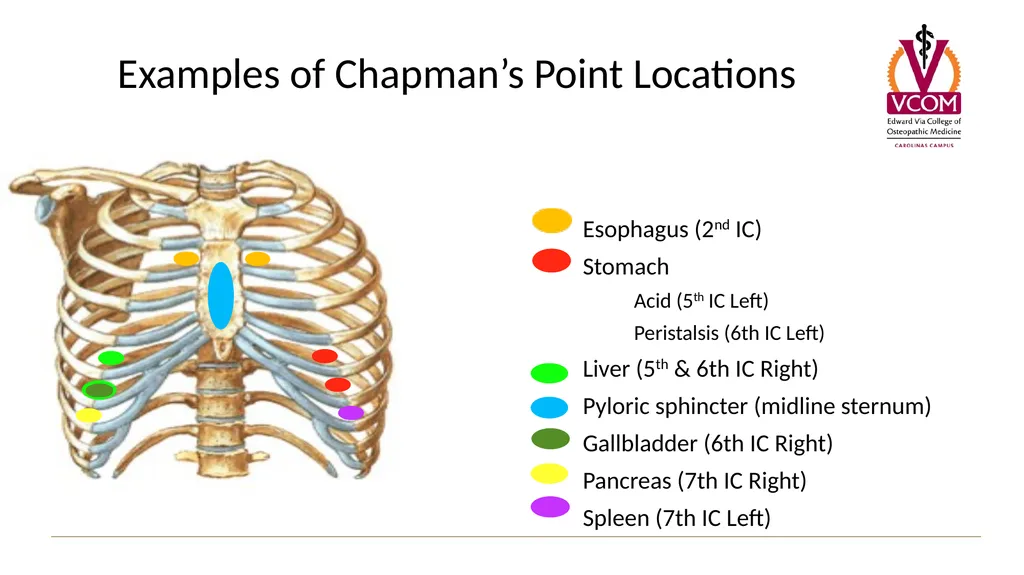
Examples of Chapman’s Point Locations Esophagus (2nd IC)
Stomach
Acid (5th IC Left)
Peristalsis (6th IC Left)
Liver (5th & 6th IC Right)
Pyloric sphincter (midline sternum)
Gallbladder (6th IC Right)
Pancreas (7th IC Right)
Spleen (7th IC Left)<br>
Stomach
Acid (5th IC Left)
Peristalsis (6th IC Left)
Liver (5th & 6th IC Right)
Pyloric sphincter (midline sternum)
Gallbladder (6th IC Right)
Pancreas (7th IC Right)
Spleen (7th IC Left)<br>
12
OMT Evidence Numerous studies have looked at manipulation but often include OMT and chiropractic care together
Difficult to create a double blind studies with OMT
Sham manipulation vs. OMT
Difficult to treat patients with OMT when only following an algorithm as each patient is unique
Not as easy as Drug A or Drug B<br>
Difficult to create a double blind studies with OMT
Sham manipulation vs. OMT
Difficult to treat patients with OMT when only following an algorithm as each patient is unique
Not as easy as Drug A or Drug B<br>
13
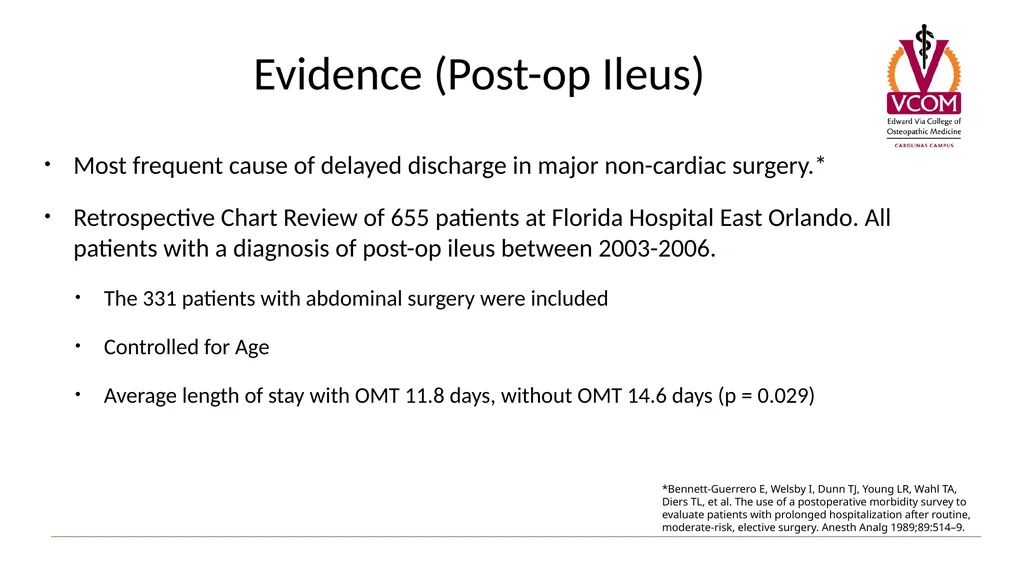
Evidence (Post-op Ileus) Most frequent cause of delayed discharge in major non-cardiac surgery.*
Retrospective Chart Review of 655 patients at Florida Hospital East Orlando. All patients with a diagnosis of post-op ileus between 2003-2006.
The 331 patients with abdominal surgery were included
Controlled for Age
Average length of stay with OMT 11.8 days, without OMT 14.6 days (p = 0.029) *Bennett-Guerrero E, Welsby I, Dunn TJ, Young LR, Wahl TA,
Diers TL, et al. The use of a postoperative morbidity survey to
evaluate patients with prolonged hospitalization after routine,
moderate-risk, elective surgery. Anesth Analg 1989;89:514–9.<br>
Retrospective Chart Review of 655 patients at Florida Hospital East Orlando. All patients with a diagnosis of post-op ileus between 2003-2006.
The 331 patients with abdominal surgery were included
Controlled for Age
Average length of stay with OMT 11.8 days, without OMT 14.6 days (p = 0.029) *Bennett-Guerrero E, Welsby I, Dunn TJ, Young LR, Wahl TA,
Diers TL, et al. The use of a postoperative morbidity survey to
evaluate patients with prolonged hospitalization after routine,
moderate-risk, elective surgery. Anesth Analg 1989;89:514–9.<br>
14
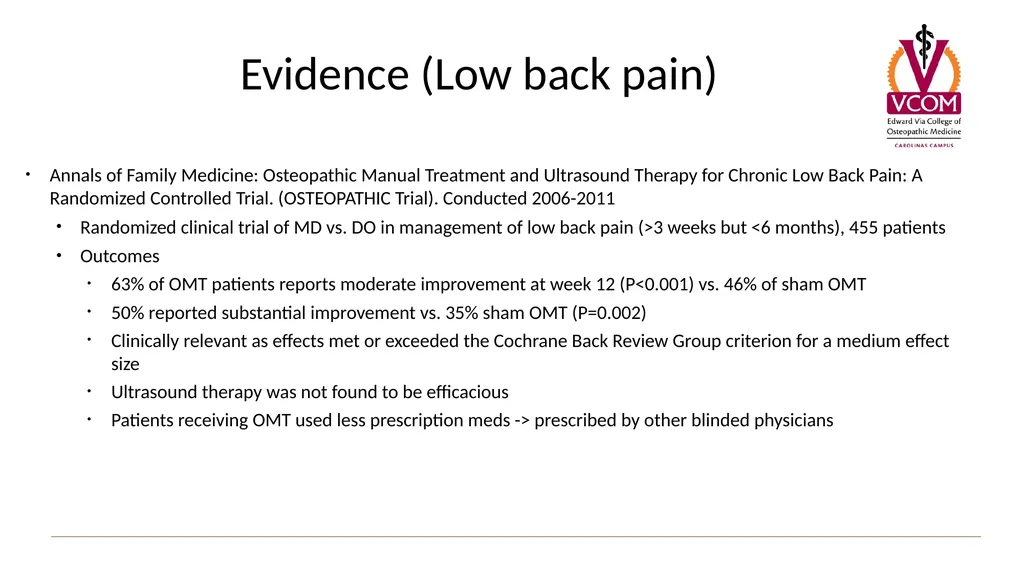
Evidence (Low back pain) Annals of Family Medicine: Osteopathic Manual Treatment and Ultrasound Therapy for Chronic Low Back Pain: A Randomized Controlled Trial. (OSTEOPATHIC Trial). Conducted 2006-2011
Randomized clinical trial of MD vs. DO in management of low back pain (>3 weeks but <6 months), 455 patients
Outcomes
63% of OMT patients reports moderate improvement at week 12 (P<0.001) vs. 46% of sham OMT
50% reported substantial improvement vs. 35% sham OMT (P=0.002)
Clinically relevant as effects met or exceeded the Cochrane Back Review Group criterion for a medium effect size
Ultrasound therapy was not found to be efficacious
Patients receiving OMT used less prescription meds -> prescribed by other blinded physicians<br>
Randomized clinical trial of MD vs. DO in management of low back pain (>3 weeks but <6 months), 455 patients
Outcomes
63% of OMT patients reports moderate improvement at week 12 (P<0.001) vs. 46% of sham OMT
50% reported substantial improvement vs. 35% sham OMT (P=0.002)
Clinically relevant as effects met or exceeded the Cochrane Back Review Group criterion for a medium effect size
Ultrasound therapy was not found to be efficacious
Patients receiving OMT used less prescription meds -> prescribed by other blinded physicians<br>
15
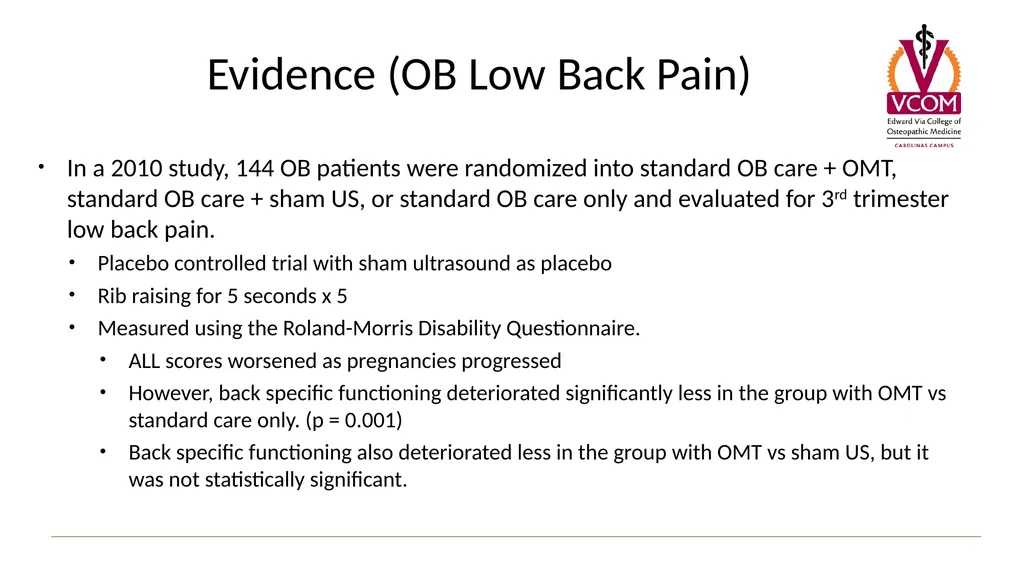
Evidence (OB Low Back Pain) In a 2010 study, 144 OB patients were randomized into standard OB care + OMT, standard OB care + sham US, or standard OB care only and evaluated for 3rd trimester low back pain.
Placebo controlled trial with sham ultrasound as placebo
Rib raising for 5 seconds x 5
Measured using the Roland-Morris Disability Questionnaire.
ALL scores worsened as pregnancies progressed
However, back specific functioning deteriorated significantly less in the group with OMT vs standard care only. (p = 0.001)
Back specific functioning also deteriorated less in the group with OMT vs sham US, but it was not statistically significant.<br>
Placebo controlled trial with sham ultrasound as placebo
Rib raising for 5 seconds x 5
Measured using the Roland-Morris Disability Questionnaire.
ALL scores worsened as pregnancies progressed
However, back specific functioning deteriorated significantly less in the group with OMT vs standard care only. (p = 0.001)
Back specific functioning also deteriorated less in the group with OMT vs sham US, but it was not statistically significant.<br>
16
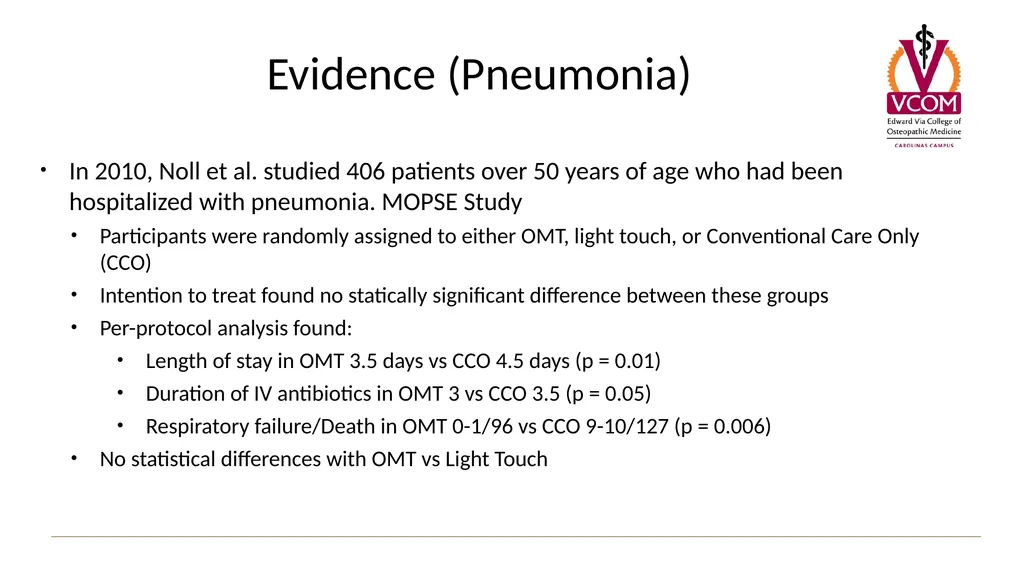
Evidence (Pneumonia) In 2010, Noll et al. studied 406 patients over 50 years of age who had been hospitalized with pneumonia. MOPSE Study
Participants were randomly assigned to either OMT, light touch, or Conventional Care Only (CCO)
Intention to treat found no statically significant difference between these groups
Per-protocol analysis found:
Length of stay in OMT 3.5 days vs CCO 4.5 days (p = 0.01)
Duration of IV antibiotics in OMT 3 vs CCO 3.5 (p = 0.05)
Respiratory failure/Death in OMT 0-1/96 vs CCO 9-10/127 (p = 0.006)
No statistical differences with OMT vs Light Touch<br>
Participants were randomly assigned to either OMT, light touch, or Conventional Care Only (CCO)
Intention to treat found no statically significant difference between these groups
Per-protocol analysis found:
Length of stay in OMT 3.5 days vs CCO 4.5 days (p = 0.01)
Duration of IV antibiotics in OMT 3 vs CCO 3.5 (p = 0.05)
Respiratory failure/Death in OMT 0-1/96 vs CCO 9-10/127 (p = 0.006)
No statistical differences with OMT vs Light Touch<br>
17
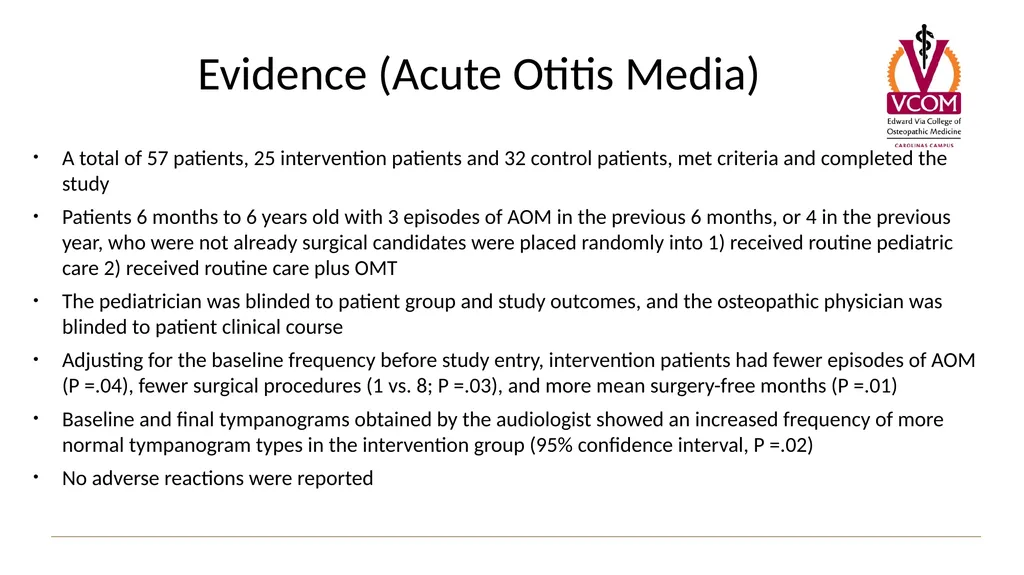
Evidence (Acute Otitis Media) A total of 57 patients, 25 intervention patients and 32 control patients, met criteria and completed the study
Patients 6 months to 6 years old with 3 episodes of AOM in the previous 6 months, or 4 in the previous year, who were not already surgical candidates were placed randomly into 1) received routine pediatric care 2) received routine care plus OMT
The pediatrician was blinded to patient group and study outcomes, and the osteopathic physician was blinded to patient clinical course
Adjusting for the baseline frequency before study entry, intervention patients had fewer episodes of AOM (P =.04), fewer surgical procedures (1 vs. 8; P =.03), and more mean surgery-free months (P =.01)
Baseline and final tympanograms obtained by the audiologist showed an increased frequency of more normal tympanogram types in the intervention group (95% confidence interval, P =.02)
No adverse reactions were reported<br>
Patients 6 months to 6 years old with 3 episodes of AOM in the previous 6 months, or 4 in the previous year, who were not already surgical candidates were placed randomly into 1) received routine pediatric care 2) received routine care plus OMT
The pediatrician was blinded to patient group and study outcomes, and the osteopathic physician was blinded to patient clinical course
Adjusting for the baseline frequency before study entry, intervention patients had fewer episodes of AOM (P =.04), fewer surgical procedures (1 vs. 8; P =.03), and more mean surgery-free months (P =.01)
Baseline and final tympanograms obtained by the audiologist showed an increased frequency of more normal tympanogram types in the intervention group (95% confidence interval, P =.02)
No adverse reactions were reported<br>
18
Questions?<br>
19
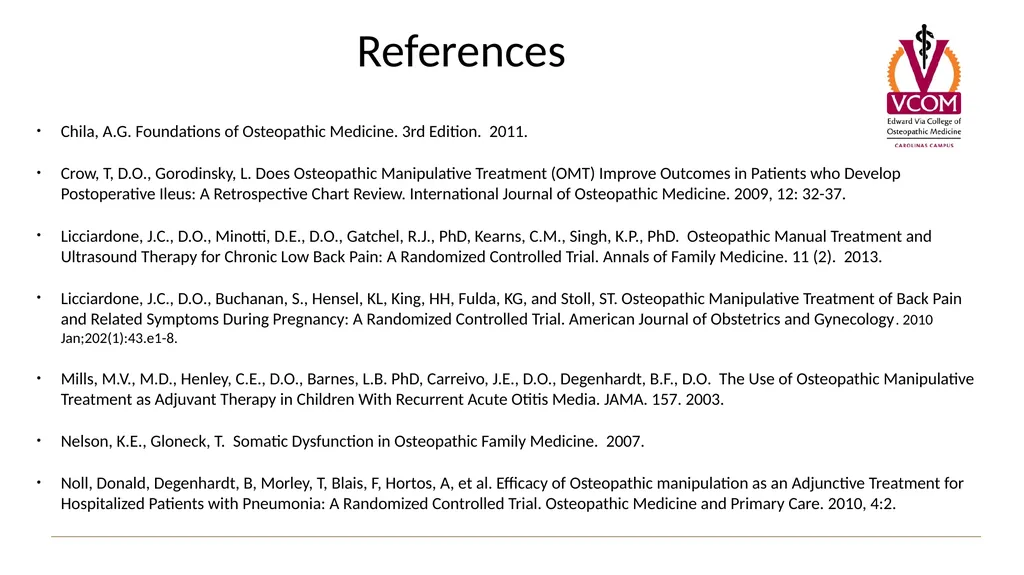
References Chila, A.G. Foundations of Osteopathic Medicine. 3rd Edition. 2011.
Crow, T, D.O., Gorodinsky, L. Does Osteopathic Manipulative Treatment (OMT) Improve Outcomes in Patients who Develop Postoperative Ileus: A Retrospective Chart Review. International Journal of Osteopathic Medicine. 2009, 12: 32-37.
Licciardone, J.C., D.O., Minotti, D.E., D.O., Gatchel, R.J., PhD, Kearns, C.M., Singh, K.P., PhD. Osteopathic Manual Treatment and Ultrasound Therapy for Chronic Low Back Pain: A Randomized Controlled Trial. Annals of Family Medicine. 11 (2). 2013.
Licciardone, J.C., D.O., Buchanan, S., Hensel, KL, King, HH, Fulda, KG, and Stoll, ST. Osteopathic Manipulative Treatment of Back Pain and Related Symptoms During Pregnancy: A Randomized Controlled Trial. American Journal of Obstetrics and Gynecology. 2010 Jan;202(1):43.e1-8.
Mills, M.V., M.D., Henley, C.E., D.O., Barnes, L.B. PhD, Carreivo, J.E., D.O., Degenhardt, B.F., D.O. The Use of Osteopathic Manipulative Treatment as Adjuvant Therapy in Children With Recurrent Acute Otitis Media. JAMA. 157. 2003.
Nelson, K.E., Gloneck, T. Somatic Dysfunction in Osteopathic Family Medicine. 2007.
Noll, Donald, Degenhardt, B, Morley, T, Blais, F, Hortos, A, et al. Efficacy of Osteopathic manipulation as an Adjunctive Treatment for Hospitalized Patients with Pneumonia: A Randomized Controlled Trial. Osteopathic Medicine and Primary Care. 2010, 4:2.<br>
Crow, T, D.O., Gorodinsky, L. Does Osteopathic Manipulative Treatment (OMT) Improve Outcomes in Patients who Develop Postoperative Ileus: A Retrospective Chart Review. International Journal of Osteopathic Medicine. 2009, 12: 32-37.
Licciardone, J.C., D.O., Minotti, D.E., D.O., Gatchel, R.J., PhD, Kearns, C.M., Singh, K.P., PhD. Osteopathic Manual Treatment and Ultrasound Therapy for Chronic Low Back Pain: A Randomized Controlled Trial. Annals of Family Medicine. 11 (2). 2013.
Licciardone, J.C., D.O., Buchanan, S., Hensel, KL, King, HH, Fulda, KG, and Stoll, ST. Osteopathic Manipulative Treatment of Back Pain and Related Symptoms During Pregnancy: A Randomized Controlled Trial. American Journal of Obstetrics and Gynecology. 2010 Jan;202(1):43.e1-8.
Mills, M.V., M.D., Henley, C.E., D.O., Barnes, L.B. PhD, Carreivo, J.E., D.O., Degenhardt, B.F., D.O. The Use of Osteopathic Manipulative Treatment as Adjuvant Therapy in Children With Recurrent Acute Otitis Media. JAMA. 157. 2003.
Nelson, K.E., Gloneck, T. Somatic Dysfunction in Osteopathic Family Medicine. 2007.
Noll, Donald, Degenhardt, B, Morley, T, Blais, F, Hortos, A, et al. Efficacy of Osteopathic manipulation as an Adjunctive Treatment for Hospitalized Patients with Pneumonia: A Randomized Controlled Trial. Osteopathic Medicine and Primary Care. 2010, 4:2.<br>