
On the relation between the psychological and
JO
Published · 28 slides · 0 views
1 / 1
Description
On the relation between the psychological and thermodynamic arrows of time Todd A. Brun and Leonard Mlodinow Time Flies Like An Arrow... (...fruit flies, by contrast, like a banana...) One of the most obvious observations about the world is
Related Topics
Share
Embed code
Download this presentation From Below
"On the relation between the psychological and" is the property of its rightful owner. Permission is granted to download and print the materials on this website for personal, non-commercial use only, and to display it on your personal computer provided you do not modify the materials and that you retain all copyright notices contained in the materials. By downloading content from our website, you accept the terms of this agreement.
Presentation Transcript
01
On the relation between the psychological and thermodynamic arrows of time Todd A. Brun and Leonard Mlodinow<br>
02
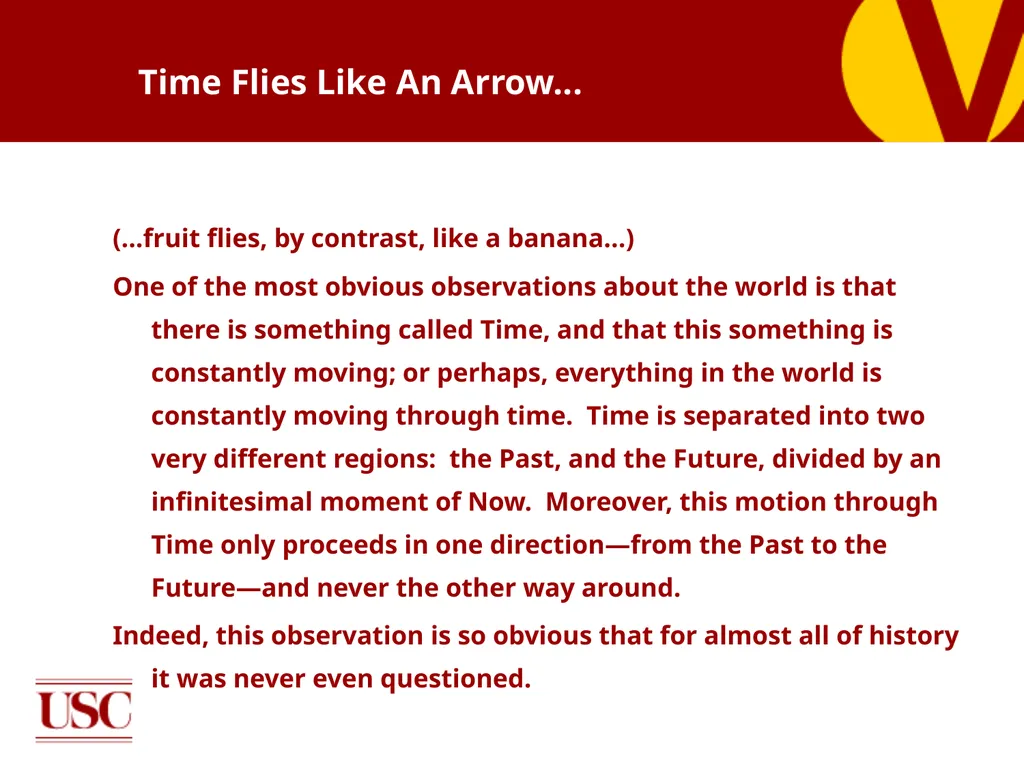
Time Flies Like An Arrow... (...fruit flies, by contrast, like a banana...)
One of the most obvious observations about the world is that there is something called Time, and that this something is constantly moving; or perhaps, everything in the world is constantly moving through time. Time is separated into two very different regions: the Past, and the Future, divided by an infinitesimal moment of Now. Moreover, this motion through Time only proceeds in one direction—from the Past to the Future—and never the other way around.
Indeed, this observation is so obvious that for almost all of history it was never even questioned.<br>
03
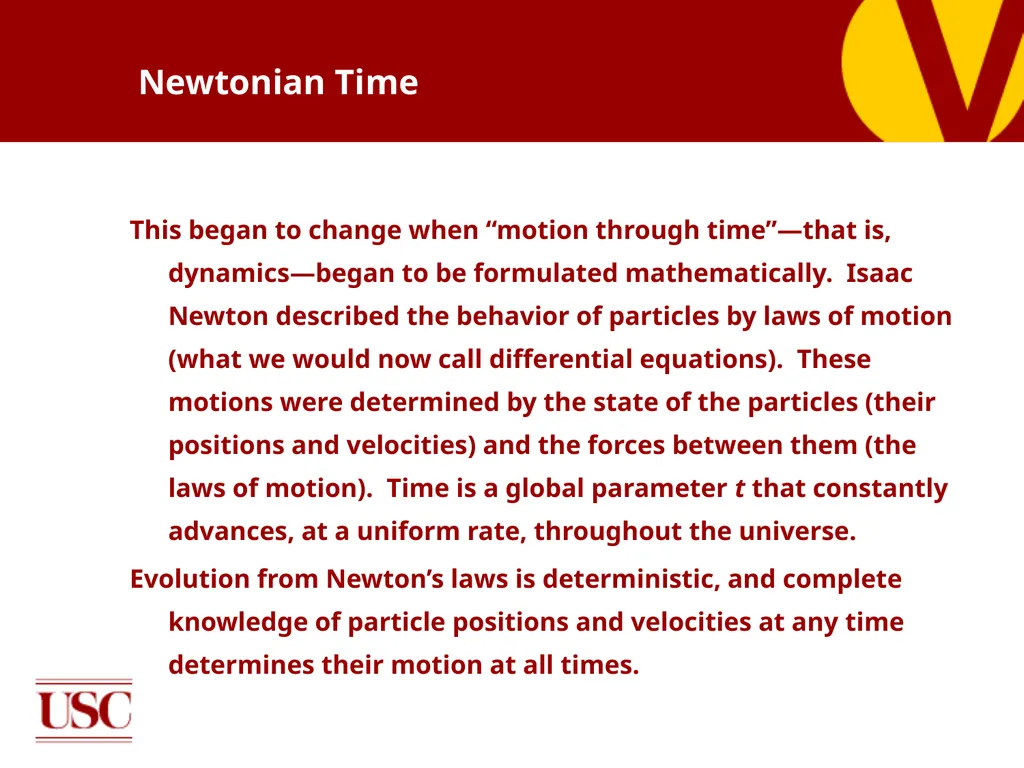
Newtonian Time This began to change when “motion through time”—that is, dynamics—began to be formulated mathematically. Isaac Newton described the behavior of particles by laws of motion (what we would now call differential equations). These motions were determined by the state of the particles (their positions and velocities) and the forces between them (the laws of motion). Time is a global parameter t that constantly advances, at a uniform rate, throughout the universe.
Evolution from Newton’s laws is deterministic, and complete knowledge of particle positions and velocities at any time determines their motion at all times.<br>
Evolution from Newton’s laws is deterministic, and complete knowledge of particle positions and velocities at any time determines their motion at all times.<br>
04
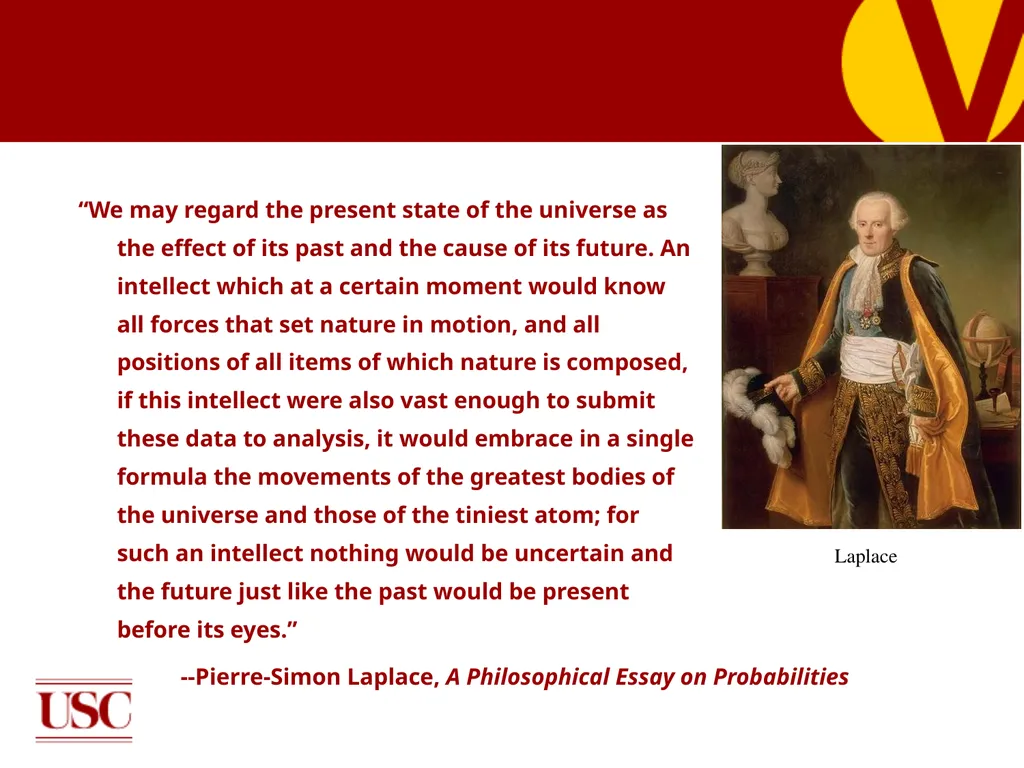
“We may regard the present state of the universe as the effect of its past and the cause of its future. An intellect which at a certain moment would know all forces that set nature in motion, and all positions of all items of which nature is composed, if this intellect were also vast enough to submit these data to analysis, it would embrace in a single formula the movements of the greatest bodies of the universe and those of the tiniest atom; for such an intellect nothing would be uncertain and the future just like the past would be present before its eyes.” --Pierre-Simon Laplace, A Philosophical Essay on Probabilities Laplace<br>
05
This picture seems to put time on a more rigorous footing. But it opens two very puzzling questions.
The mathematical description of time evolution doesn’t single out a moment of ‘Now’: all times are on an equal footing.
Newton’s laws are reversible: if we make a movie of two particles interacting by Newtonian forces, and run the movie backwards, both evolutions obey the laws of motion. Nothing in the laws of motion distinguishes past from future.
But in our experience this is not the case. Eggs break when we drop them, but they rarely fly together again. Moreover, we have a strong perception that the past is fixed but the future is not. How can we reconcile this with reversible laws?<br>
06
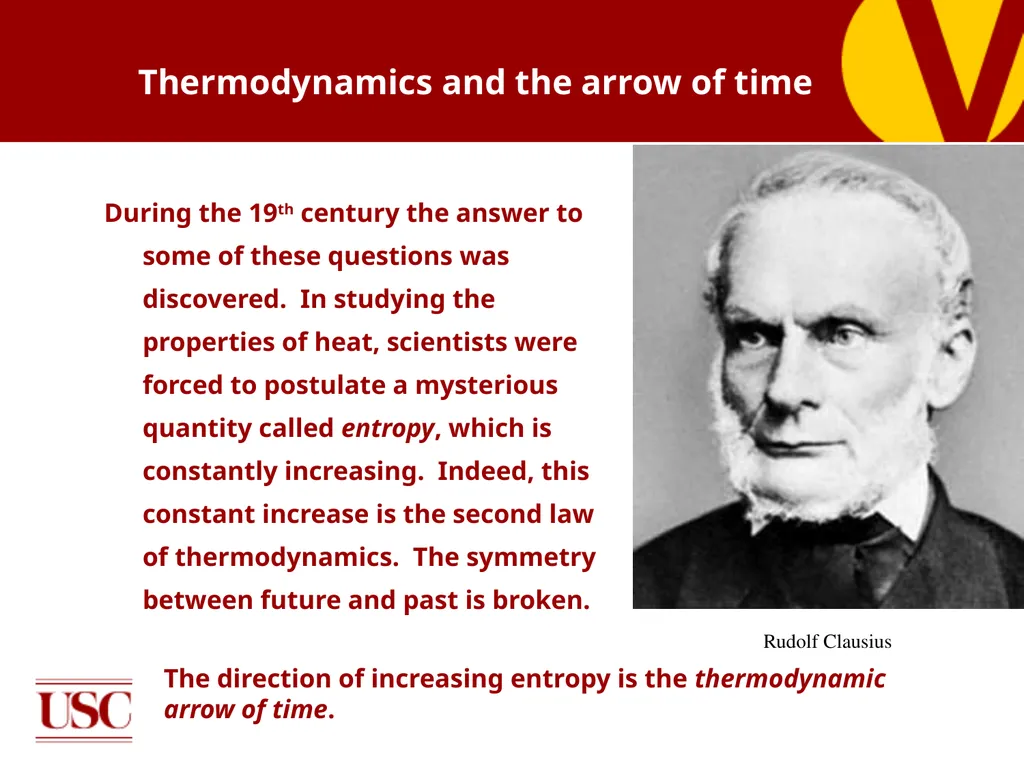
Thermodynamics and the arrow of time During the 19th century the answer to some of these questions was discovered. In studying the properties of heat, scientists were forced to postulate a mysterious quantity called entropy, which is constantly increasing. Indeed, this constant increase is the second law of thermodynamics. The symmetry between future and past is broken. The direction of increasing entropy is the thermodynamic arrow of time. Rudolf Clausius<br>
07
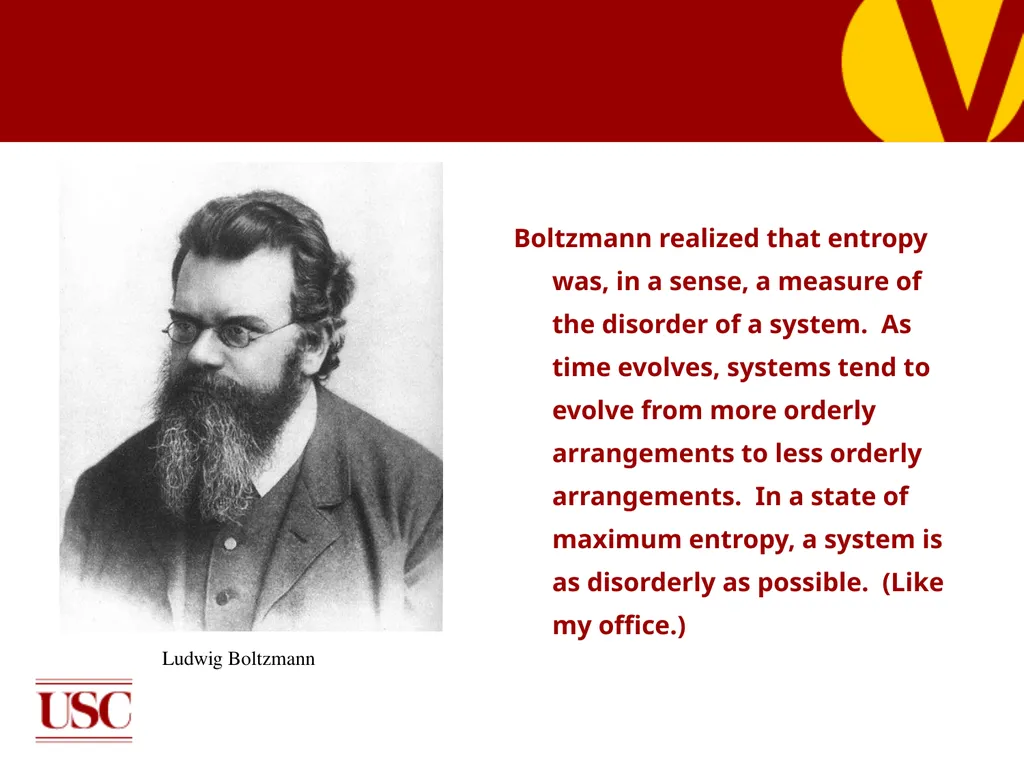
Boltzmann realized that entropy was, in a sense, a measure of the disorder of a system. As time evolves, systems tend to evolve from more orderly arrangements to less orderly arrangements. In a state of maximum entropy, a system is as disorderly as possible. (Like my office.) Ludwig Boltzmann<br>
08
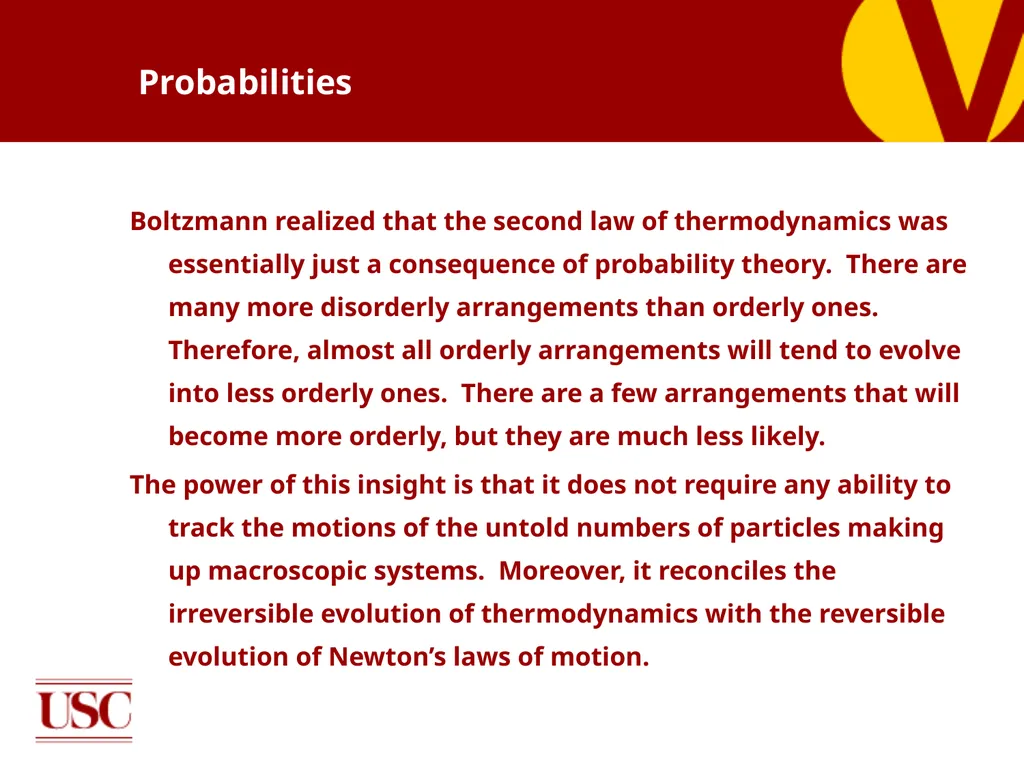
Probabilities Boltzmann realized that the second law of thermodynamics was essentially just a consequence of probability theory. There are many more disorderly arrangements than orderly ones. Therefore, almost all orderly arrangements will tend to evolve into less orderly ones. There are a few arrangements that will become more orderly, but they are much less likely.
The power of this insight is that it does not require any ability to track the motions of the untold numbers of particles making up macroscopic systems. Moreover, it reconciles the irreversible evolution of thermodynamics with the reversible evolution of Newton’s laws of motion.<br>
The power of this insight is that it does not require any ability to track the motions of the untold numbers of particles making up macroscopic systems. Moreover, it reconciles the irreversible evolution of thermodynamics with the reversible evolution of Newton’s laws of motion.<br>
09
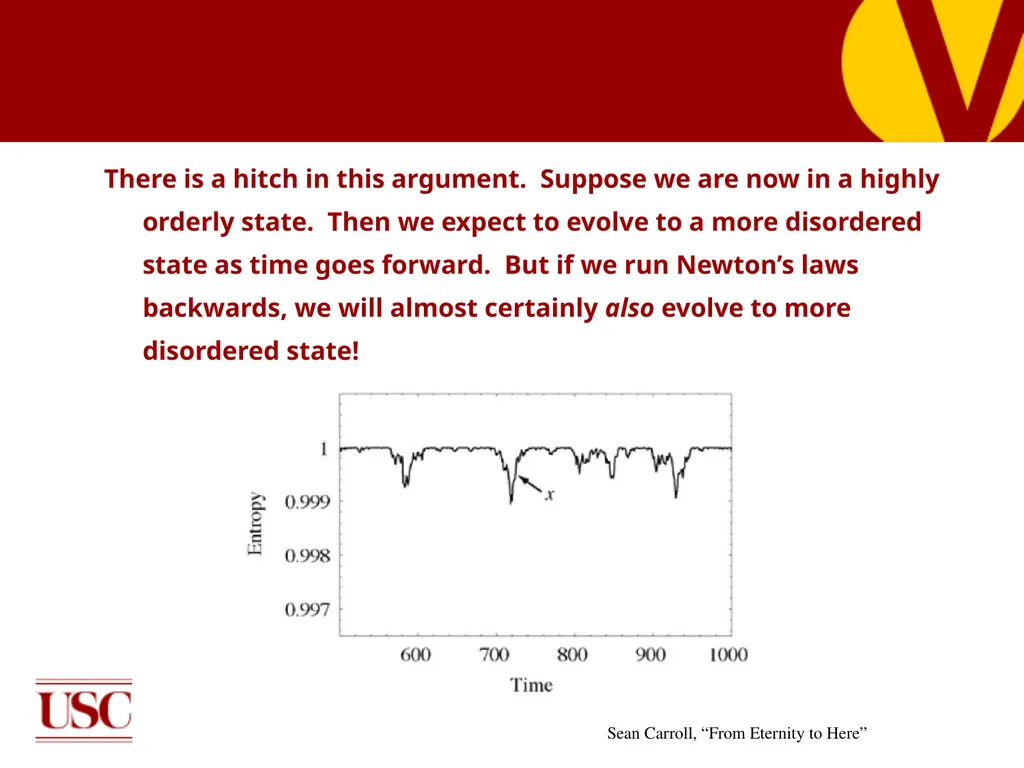
There is a hitch in this argument. Suppose we are now in a highly orderly state. Then we expect to evolve to a more disordered state as time goes forward. But if we run Newton’s laws backwards, we will almost certainly also evolve to more disordered state! Sean Carroll, “From Eternity to Here”<br>
10
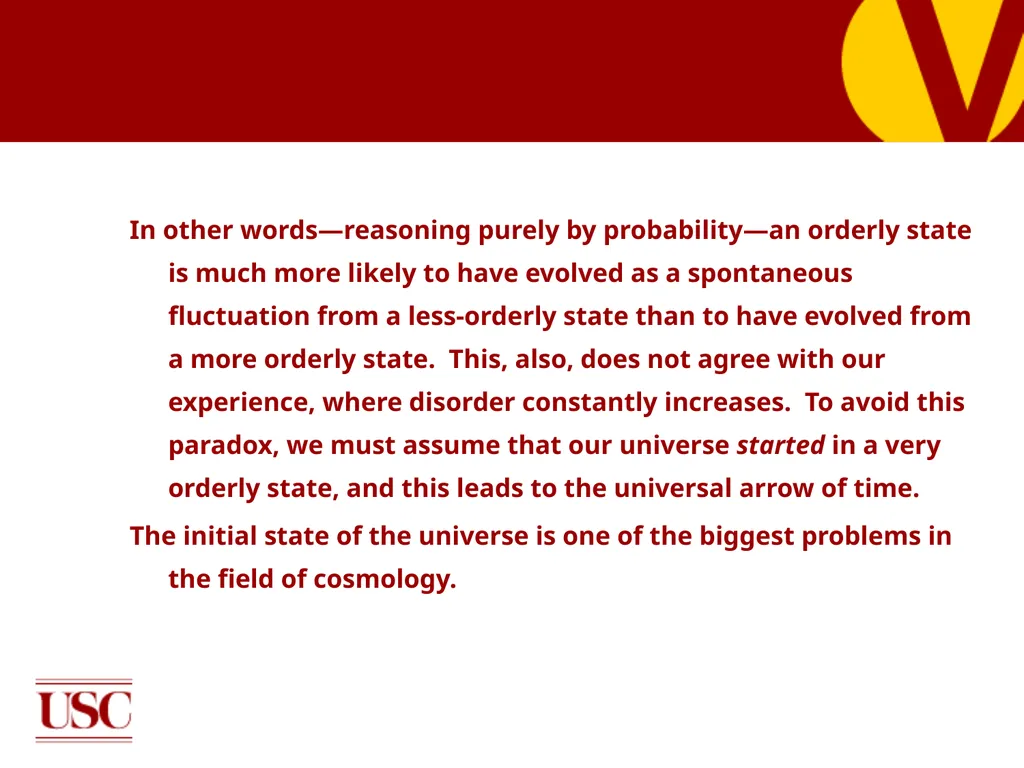
In other words—reasoning purely by probability—an orderly state is much more likely to have evolved as a spontaneous fluctuation from a less-orderly state than to have evolved from a more orderly state. This, also, does not agree with our experience, where disorder constantly increases. To avoid this paradox, we must assume that our universe started in a very orderly state, and this leads to the universal arrow of time.
The initial state of the universe is one of the biggest problems in the field of cosmology.<br>
The initial state of the universe is one of the biggest problems in the field of cosmology.<br>
11
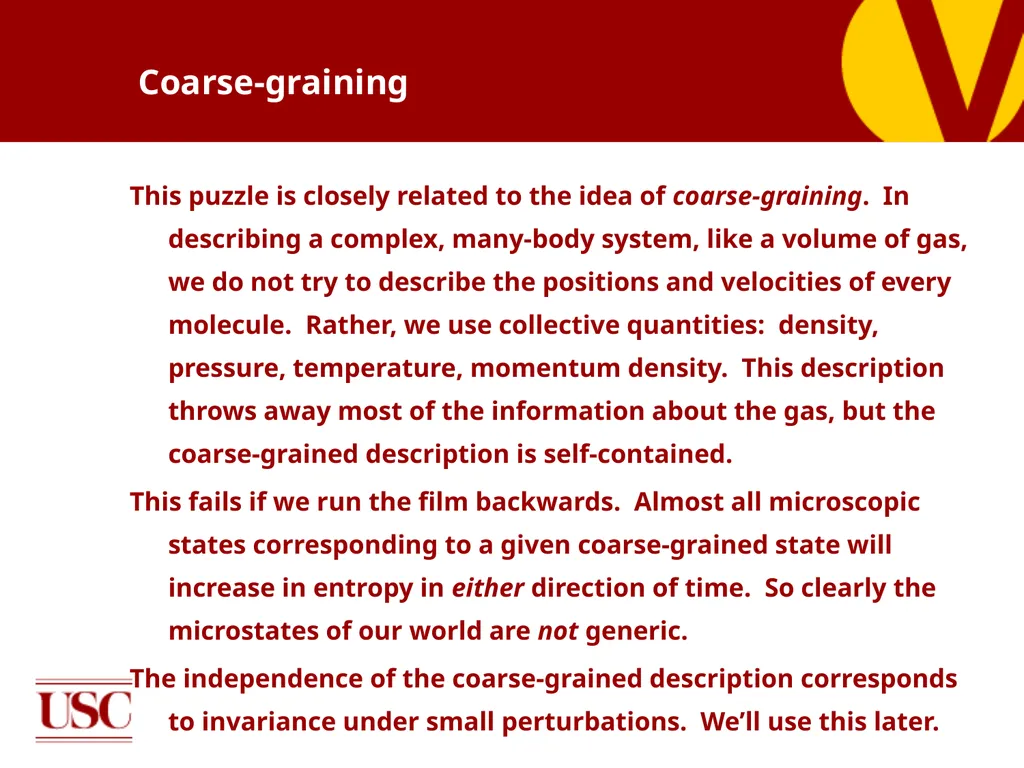
Coarse-graining This puzzle is closely related to the idea of coarse-graining. In describing a complex, many-body system, like a volume of gas, we do not try to describe the positions and velocities of every molecule. Rather, we use collective quantities: density, pressure, temperature, momentum density. This description throws away most of the information about the gas, but the coarse-grained description is self-contained.
This fails if we run the film backwards. Almost all microscopic states corresponding to a given coarse-grained state will increase in entropy in either direction of time. So clearly the microstates of our world are not generic.
The independence of the coarse-grained description corresponds to invariance under small perturbations. We’ll use this later.<br>
12
The psychological arrow of time What about the idea of “Now?” Why do we feel as though we are moving through time from the past to the future? Why are our perceptions of the past—fixed and immutable—so different from our perceptions of the future—unknown and in constant flux? This perception is the psychological arrow of time.
The answer to this question seems to boil down to a simple asymmetry: we remember the past, but we don’t remember the future. At each time t, we have memories of events prior to t, but no memories of future events.
This leads to a new puzzle. Why does the psychological arrow of time line up with the thermodynamic arrow?<br>
13
Thanks for the memories Our intuition may suggest that this question is nonsense. Of course we remember the past and not the future. That’s what “remember” means. But the remarks of Laplace show that this is not quite so straightforward. Given enough knowledge of the world at the present time, we can know its state at any time. So why shouldn’t we be able to remember the future?
The answer seems to be that “enough knowledge” is far more knowledge than any person could conceivably have; and even given the knowledge, the ability to solve the equations of motion is far beyond any conceivable reason. Even in a deterministic universe (which ours is not, in reality), chaos will quickly render any prediction inaccurate.<br>
The answer seems to be that “enough knowledge” is far more knowledge than any person could conceivably have; and even given the knowledge, the ability to solve the equations of motion is far beyond any conceivable reason. Even in a deterministic universe (which ours is not, in reality), chaos will quickly render any prediction inaccurate.<br>
14
In fact, the entire discipline of thermodynamics reflects this inability. Rather than trying to track the myriad degrees of freedom of the world, we construct an effective, highly coarse-grained description, and treat the unknown microscopic state of the system probabilistically.
Given these difficulties, it is kind of remarkable that we can even remember the past, let alone the future.
So, what does it mean for a physical system to act as a memory? And why does the psychological arrow always line up with the thermodynamic arrow?<br>
Given these difficulties, it is kind of remarkable that we can even remember the past, let alone the future.
So, what does it mean for a physical system to act as a memory? And why does the psychological arrow always line up with the thermodynamic arrow?<br>
15
Irreversible memories A natural conjecture is that the asymmetry of memories follows from the thermodynamic arrow of time itself. This is exactly what we expect if memories are irreversible systems.
What does a memory do? Here is a description (Wolpert 1992):
The memory begins in an initial “blank” state.
The memory physically interacts (directly or indirectly) with the system to be recorded. The state of the memory is changed by this interaction, and is correlated with the system.
At a later time, the record can be retrieved by observing the memory and extracting from its state information about the system at the earlier time.<br>
16
Landauer’s principle So, what in this description requires a memory to irreversible? The answer is step 1: initializing the memory must be an irreversible process. This is due to a physical effect called Landauer’s principle.
Landauer’s principle states that processing information can, in principle, be done reversibly, so long as no information is lost; but erasure of information must inevitably produce an increase in entropy. In other words, logical irreversibility implies physical irreversibility.
Erasing one bit of information consumes energy E = kBT ln(2).<br>
17
Initializing a memory—preparing the “blank” state—is clearly an irreversible process, because whatever state the memory had beforehand is erased. (The interactions with the system could also be dissipative, but they need not be.)
Most familiar systems that can serve as memories certainly do operate irreversibly, so this assumption seems natural enough. But is it really necessary?<br>
Most familiar systems that can serve as memories certainly do operate irreversibly, so this assumption seems natural enough. But is it really necessary?<br>
18
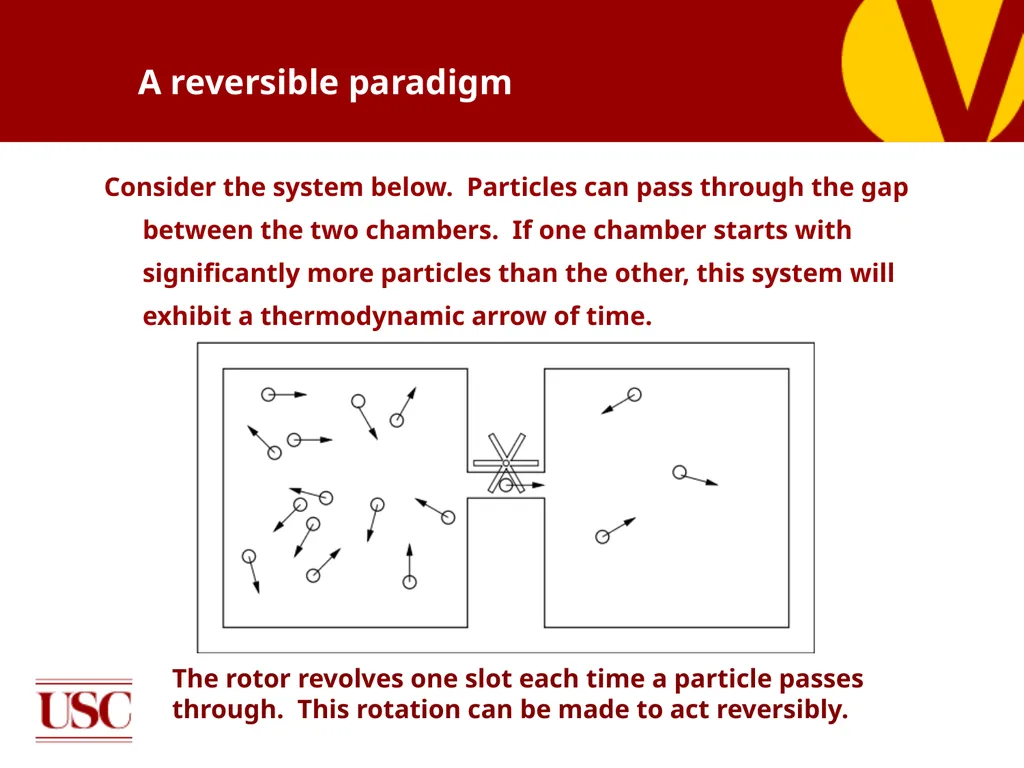
A reversible paradigm Consider the system below. Particles can pass through the gap between the two chambers. If one chamber starts with significantly more particles than the other, this system will exhibit a thermodynamic arrow of time. The rotor revolves one slot each time a particle passes through. This rotation can be made to act reversibly.<br>
19
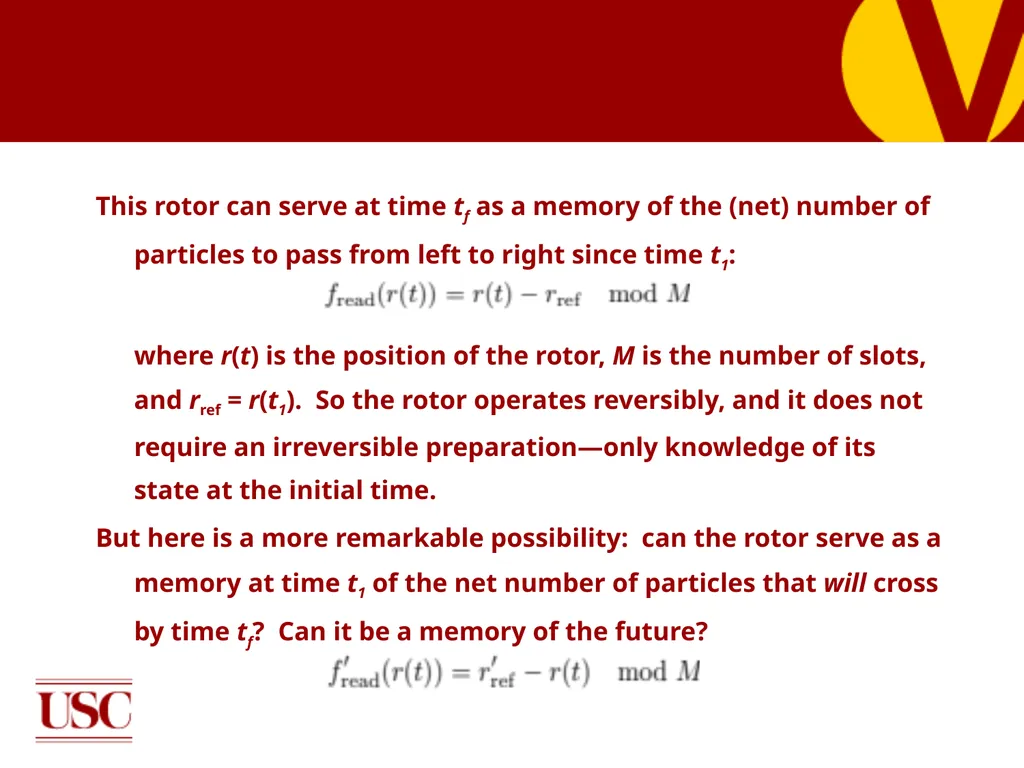
This rotor can serve at time tf as a memory of the (net) number of particles to pass from left to right since time t1:
where r(t) is the position of the rotor, M is the number of slots, and rref = r(t1). So the rotor operates reversibly, and it does not require an irreversible preparation—only knowledge of its state at the initial time.
But here is a more remarkable possibility: can the rotor serve as a memory at time t1 of the net number of particles that will cross by time tf? Can it be a memory of the future?<br>
20
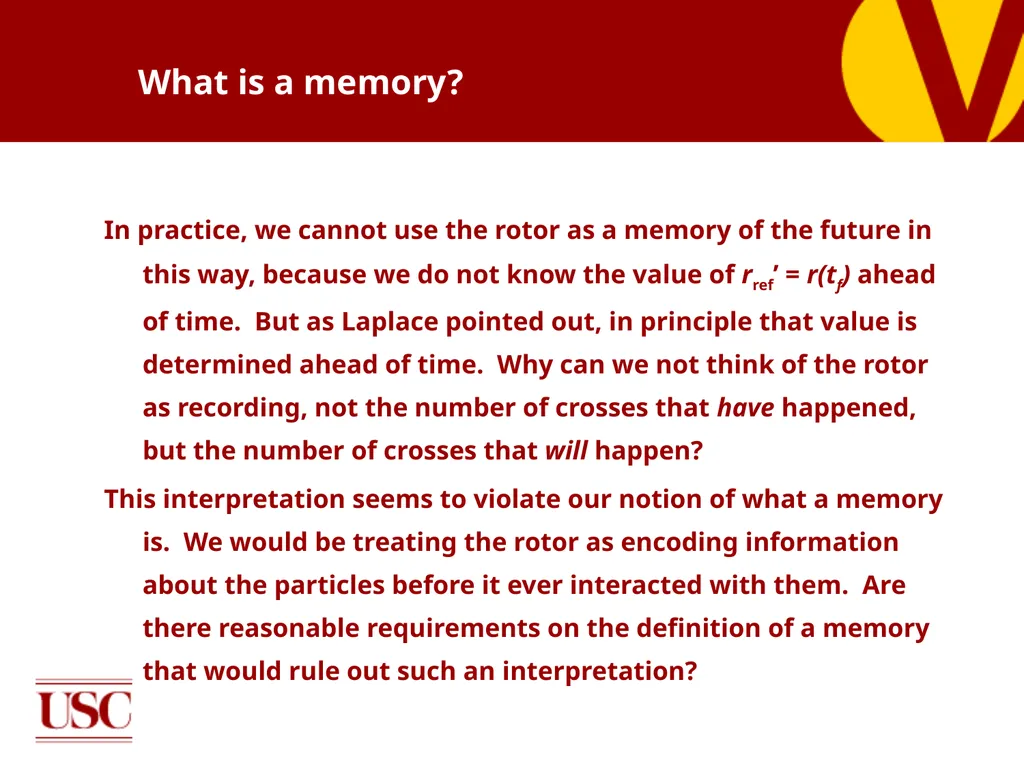
What is a memory? In practice, we cannot use the rotor as a memory of the future in this way, because we do not know the value of rref’ = r(tf) ahead of time. But as Laplace pointed out, in principle that value is determined ahead of time. Why can we not think of the rotor as recording, not the number of crosses that have happened, but the number of crosses that will happen?
This interpretation seems to violate our notion of what a memory is. We would be treating the rotor as encoding information about the particles before it ever interacted with them. Are there reasonable requirements on the definition of a memory that would rule out such an interpretation?<br>
This interpretation seems to violate our notion of what a memory is. We would be treating the rotor as encoding information about the particles before it ever interacted with them. Are there reasonable requirements on the definition of a memory that would rule out such an interpretation?<br>
21
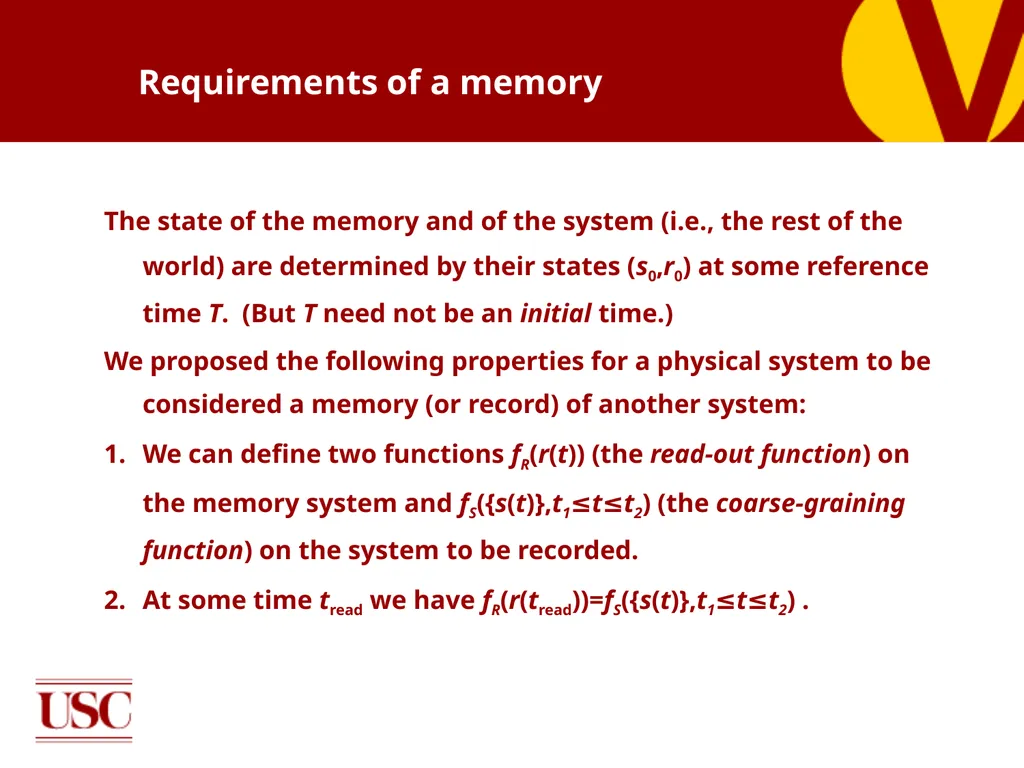
Requirements of a memory The state of the memory and of the system (i.e., the rest of the world) are determined by their states (s0,r0) at some reference time T. (But T need not be an initial time.)
We proposed the following properties for a physical system to be considered a memory (or record) of another system:
We can define two functions fR(r(t)) (the read-out function) on the memory system and fS({s(t)},t1≤t≤t2) (the coarse-graining function) on the system to be recorded.
At some time tread we have fR(r(tread))=fS({s(t)},t1≤t≤t2) .<br>
22
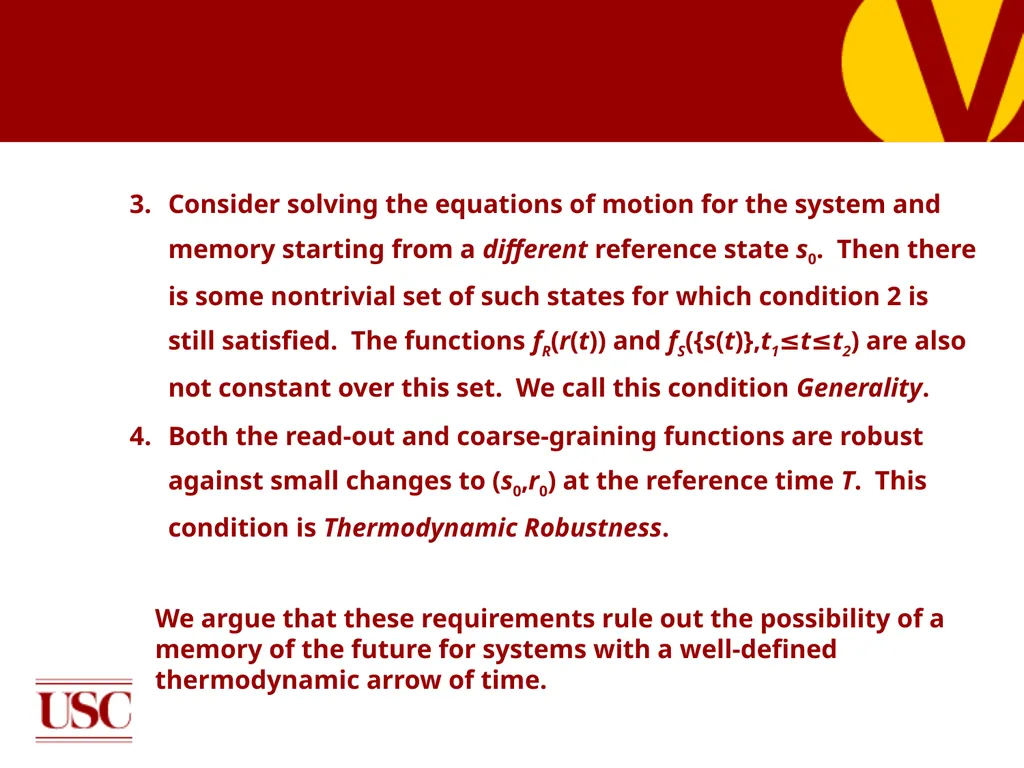
Consider solving the equations of motion for the system and memory starting from a different reference state s0. Then there is some nontrivial set of such states for which condition 2 is still satisfied. The functions fR(r(t)) and fS({s(t)},t1≤t≤t2) are also not constant over this set. We call this condition Generality.
Both the read-out and coarse-graining functions are robust against small changes to (s0,r0) at the reference time T. This condition is Thermodynamic Robustness. We argue that these requirements rule out the possibility of a memory of the future for systems with a well-defined thermodynamic arrow of time.<br>
Both the read-out and coarse-graining functions are robust against small changes to (s0,r0) at the reference time T. This condition is Thermodynamic Robustness. We argue that these requirements rule out the possibility of a memory of the future for systems with a well-defined thermodynamic arrow of time.<br>
23
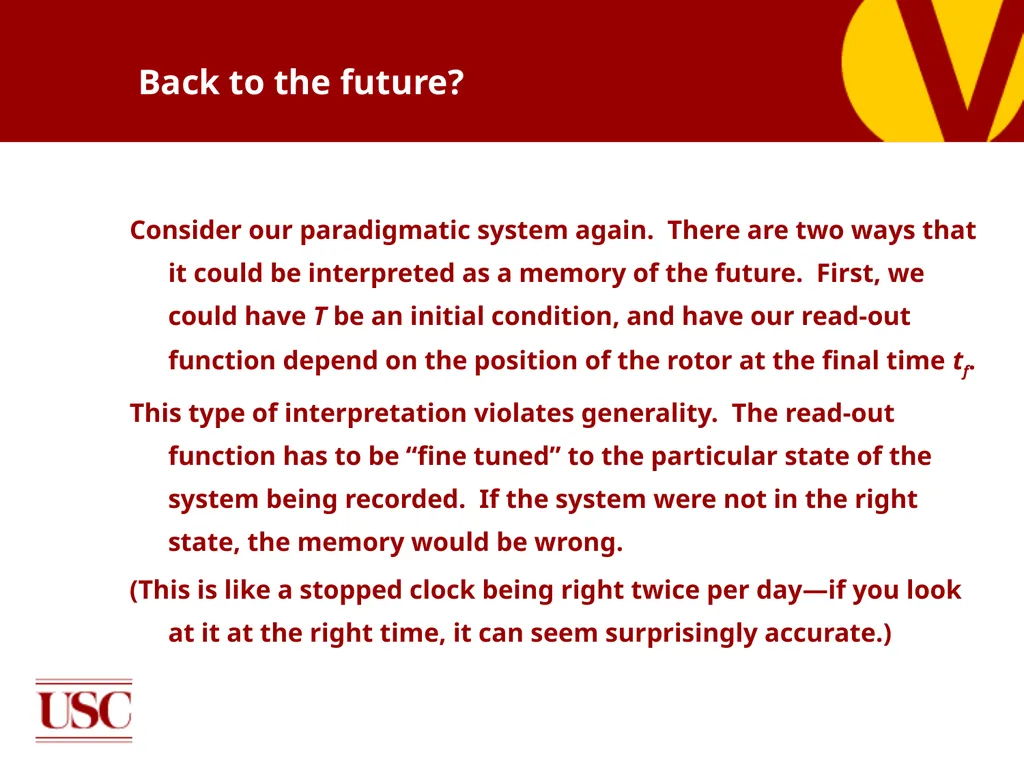
Back to the future? Consider our paradigmatic system again. There are two ways that it could be interpreted as a memory of the future. First, we could have T be an initial condition, and have our read-out function depend on the position of the rotor at the final time tf.
This type of interpretation violates generality. The read-out function has to be “fine tuned” to the particular state of the system being recorded. If the system were not in the right state, the memory would be wrong.
(This is like a stopped clock being right twice per day—if you look at it at the right time, it can seem surprisingly accurate.)<br>
24
The other possibility is that the reference time T could be a future condition, rather than an initial condition. (This would be a strange-looking description, but it’s logically possible.) In this case, the state of a memory at a given time could easily be correlated with the state of a system at a later time.
However! Remember that almost all low-entropy states will increase in disorder in both time directions. The state of the memory would have to be very carefully fine-tuned to avoid disrupting the thermodynamic arrow of time. So in this case, the memory lacks thermodynamic robustness.<br>
However! Remember that almost all low-entropy states will increase in disorder in both time directions. The state of the memory would have to be very carefully fine-tuned to avoid disrupting the thermodynamic arrow of time. So in this case, the memory lacks thermodynamic robustness.<br>
25
The curious thing is that this conclusion does not require the memory itself to be irreversible. But to embed such a memory into a universe with a thermodynamic arrow of time, without either disrupting this arrow or violating our sense of what it means to be a memory, the memory system can only record the past, not the future.<br>
26
What are memories? This definition of a memory are quite broad, and include many systems that (in principle) record information, although (in practice) we may be unable to retrieve it. This would include, e.g., waves emitted by falling stones and tracks left by decay products in mica, as well as human brains, computer memories, written notes, and other such familiar systems.
We call these in-principle-retrievable memories generalized records. In fact, most of the events on earth have left no lasting record here. Charles Bennett of IBM estimates that the overwhelming majority of data about past events on earth have escaped with the soft infrared emissions from the planet. Only rare events have left a more enduring record.<br>
We call these in-principle-retrievable memories generalized records. In fact, most of the events on earth have left no lasting record here. Charles Bennett of IBM estimates that the overwhelming majority of data about past events on earth have escaped with the soft infrared emissions from the planet. Only rare events have left a more enduring record.<br>
27
Memory vs. anticipation It is still possible for one physical system to be correlated with the future state of another. We can think of these as predictions or anticipations of future events. However, such correlations behave quite differently from memories. For one thing, such correlations tend to fall off extremely rapidly. Our ability to accurately predict is extraordinarily limited.
Records of the past, however—while in general very incomplete—can endure for very long times with little degradation. We have detailed knowledge of certain human events from thousands of years ago, and fossils from billions of years ago.<br>
Records of the past, however—while in general very incomplete—can endure for very long times with little degradation. We have detailed knowledge of certain human events from thousands of years ago, and fossils from billions of years ago.<br>
28
Now...and now...and now... So, in a sense, the feeling of moving through time is an illusion. At any given time, we remember the events that have gone before, and can only guess at the events that are to come. And what is more, we remember our past selves, and their ignorance of the events that have since come to pass.
But at any time, we will always have the sense of Now: a unique moment, on the cusp of the past, and poised on the brink of tomorrow. We will never visit this moment again. So I hope it was a good one.
THANK YOU FOR YOUR ATTENTION!<br>
But at any time, we will always have the sense of Now: a unique moment, on the cusp of the past, and poised on the brink of tomorrow. We will never visit this moment again. So I hope it was a good one.
THANK YOU FOR YOUR ATTENTION!<br>