
ONCE A SOCIOLOGIST, ALWAYS A SOCIOLOGIST American
PM
Published · 54 slides · 0 views

1 / 1

Description
ONCE A SOCIOLOGIST, ALWAYS A SOCIOLOGIST American Sociological Association Retirement Network (ASARN) Life in Sociology Lecture August 20, 2023 Kenneth C. Land John Franklin Crowell Professor of Sociology Emeritus and Research Professor,
Related Topics
Share
Embed code
Download this presentation From Below
"ONCE A SOCIOLOGIST, ALWAYS A SOCIOLOGIST American" is the property of its rightful owner. Permission is granted to download and print the materials on this website for personal, non-commercial use only, and to display it on your personal computer provided you do not modify the materials and that you retain all copyright notices contained in the materials. By downloading content from our website, you accept the terms of this agreement.
Presentation Transcript
01
ONCE A SOCIOLOGIST, ALWAYS A SOCIOLOGIST American Sociological Association
Retirement Network (ASARN)
Life in Sociology Lecture
August 20, 2023
Kenneth C. Land
John Franklin Crowell Professor of Sociology Emeritus
and Research Professor, Social Science Research Institute,
Duke University 1<br>
Retirement Network (ASARN)
Life in Sociology Lecture
August 20, 2023
Kenneth C. Land
John Franklin Crowell Professor of Sociology Emeritus
and Research Professor, Social Science Research Institute,
Duke University 1<br>
02
Let me begin with thanks to David J. Ekerdt and the members of the ASARN Advisory Board for the invitation to deliver this Lecture. I consider this lifetime achievement honor to be totally unexpected and appreciated.
In the letter of invitation for this Lecture, David indicated that I could reflect on “… on the arc and many themes of your career in the context of trends in sociology over that same time.”
Accordingly, I begin with Sociology Graduate Studies. 2<br>
In the letter of invitation for this Lecture, David indicated that I could reflect on “… on the arc and many themes of your career in the context of trends in sociology over that same time.”
Accordingly, I begin with Sociology Graduate Studies. 2<br>
03
3 Graduate Studies, The University of Texas at Austin, 1964-1969: Demography, Mathematical Sociology, Social Statistics
During my graduate studies, the classical characterization of Sociology by the UT-Austin faculty members (which will be familiar to ASARN members) was that the discipline consisted of three generic areas of study:
Social Psychology,
Social Organization, and
Demography.<br>
During my graduate studies, the classical characterization of Sociology by the UT-Austin faculty members (which will be familiar to ASARN members) was that the discipline consisted of three generic areas of study:
Social Psychology,
Social Organization, and
Demography.<br>
04
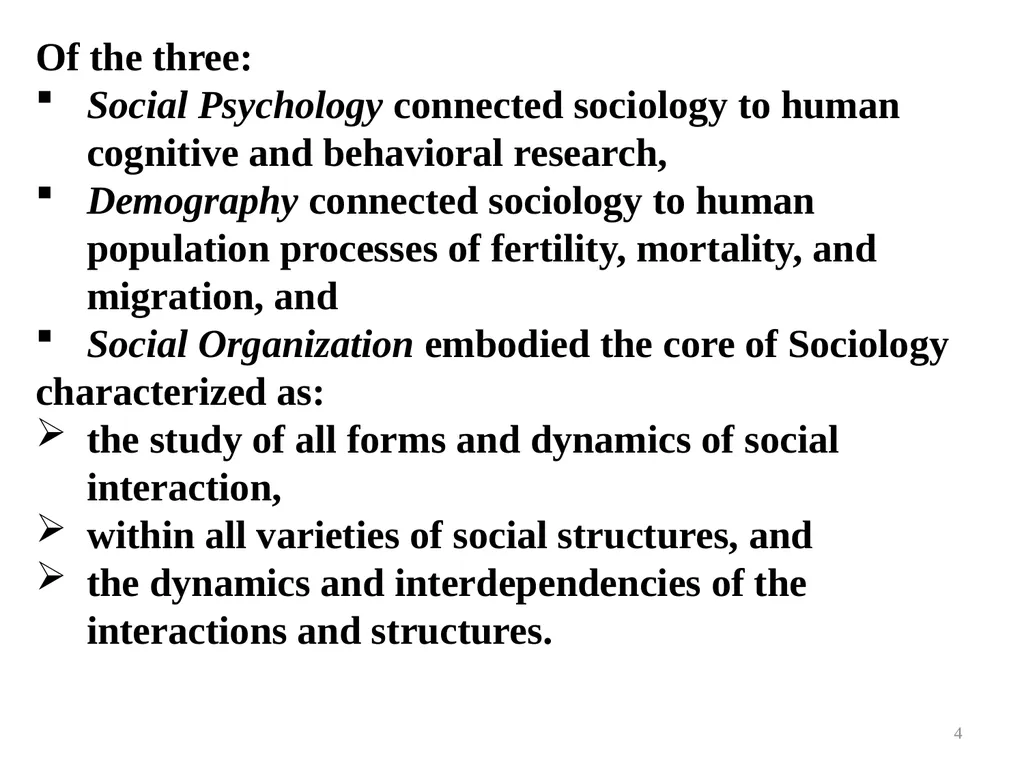
4 Of the three:
Social Psychology connected sociology to human cognitive and behavioral research,
Demography connected sociology to human population processes of fertility, mortality, and migration, and
Social Organization embodied the core of Sociology
characterized as:
the study of all forms and dynamics of social interaction,
within all varieties of social structures, and
the dynamics and interdependencies of the interactions and structures.<br>
05
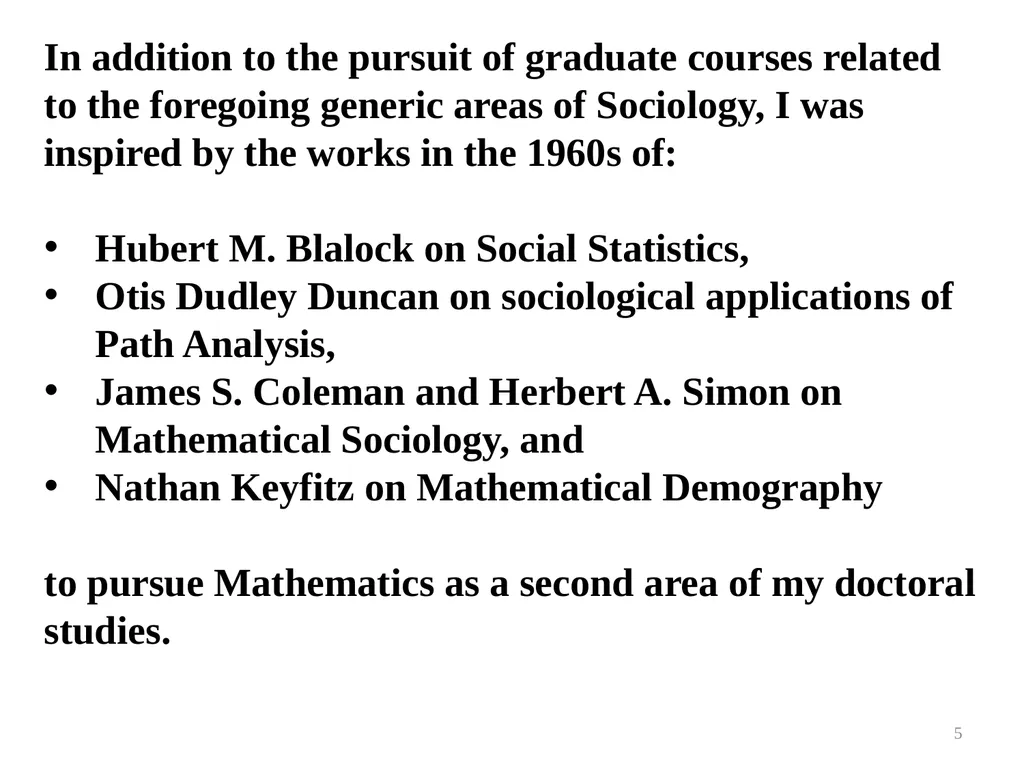
5 In addition to the pursuit of graduate courses related to the foregoing generic areas of Sociology, I was inspired by the works in the 1960s of:
Hubert M. Blalock on Social Statistics,
Otis Dudley Duncan on sociological applications of Path Analysis,
James S. Coleman and Herbert A. Simon on Mathematical Sociology, and
Nathan Keyfitz on Mathematical Demography
to pursue Mathematics as a second area of my doctoral studies.<br>
Hubert M. Blalock on Social Statistics,
Otis Dudley Duncan on sociological applications of Path Analysis,
James S. Coleman and Herbert A. Simon on Mathematical Sociology, and
Nathan Keyfitz on Mathematical Demography
to pursue Mathematics as a second area of my doctoral studies.<br>
06
6 This led to my first peer-reviewed publication in my last year of graduate school:
Kenneth C. Land 1969 “Principles of Path Analysis,” Sociological Methodology: 1-37
an expository essay that has had over 1,000 citations over the years and that still is occasionally cited today -- even with all of the subsequent developments across the past five decades of structural equation model specifications, estimation methods and associated computer software.<br>
07
7 My studies in Sociology and Mathematics also led to my PhD dissertation: Explorations in Mathematical Sociology (1969), the chapters of which resulted in the publications, two of which are:
Kenneth C. Land 1970 “Mathematical Formalization of Durkheim's Theory of Division of Labor,” Sociological Methodology:257-282
Kenneth C. Land 1970 “Path Models of Functional Theories of Social Stratification as Representations of Cultural Beliefs on Stratification,” The Sociological Quarterly, 11 (Fall):474-484<br>
08
8 The members of my dissertation committee were well-known sociologists: Daniel Price (committee chair and social statistician), Norval Glenn, Walter Firey, Ivan Belknap, and Harley Browning (a demographer who had established the UT-Austin Population Research Center and involved me therewith).
I did not know this at the time of my final defense in July 1969, but Dudley Poston told the story for years that he had just joined the UT-Austin Sociology faculty as an assistant professor and was standing in the hallway outside the conference room when my dissertation committee was assembling to go into the room for the final defense, and heard one committee member say to another “Let’s hope that Ken doesn’t ask us any questions we cannot answer”.<br>
I did not know this at the time of my final defense in July 1969, but Dudley Poston told the story for years that he had just joined the UT-Austin Sociology faculty as an assistant professor and was standing in the hallway outside the conference room when my dissertation committee was assembling to go into the room for the final defense, and heard one committee member say to another “Let’s hope that Ken doesn’t ask us any questions we cannot answer”.<br>
09
9 Post-Doctoral Studies and Lectureship Appointment, Columbia University, and Staff Member, Russell Sage Foundation, 1969-1973: Statistics, Mathematical Sociology, and Social Indicators
During my last year of graduate studies, I applied for and was awarded a Social Science Research Council Post-Doctoral Fellowship to study Mathematical Statistics at Columbia University in New York City, 1969-1970. I then was appointed as a Lecturer in Sociology at Columbia to teach a graduate course in mathematical sociology, 1970-1973.
I also was recruited by Dr. Eleanor Sheldon at the Russell Sage Foundation (who subsequently was President of the Social Science Research Council, 1972-1979) to work with her on the Foundation’s Social Indicators project.<br>
10
10 For the post-doctoral studies at Columbia University:
Herbert Robbins (well known in statistics for his work on the development of the empirical Bayes estimation method) was my supervisor in Mathematical Statistics, and
Paul Lazarsfeld (well known for his statistics work on latent class analysis) was my supervisor in Sociology.
In addition, I met and discussed various aspects of sociology with Robert K. Merton.<br>
11
11 The post-doctoral work at Columbia deepened my knowledge of statistics, which has paid off many times over in the subsequent decades and led relatively quickly to the publications:
Kenneth C. Land 1971 “Formal Theory,” Sociological Methodology:175-200
Kenneth C. Land 1971 “Some Exhaustible Poisson Process Models of Divorce by Marriage Cohort,” Journal of Mathematical Sociology, 1 (July): 213-232
Kenneth C. Land 1971 “Significant Others, the Self-Reflexive Act and the Attitude Formation Process: A Reinterpretation,” American Sociological Review, 36 (December):1085-1098<br>
12
12 And Eleanor Sheldon’s Social Indicators Project at the Russell Sage Foundation was at the forefront of what became known as the social indicators movement. It led to conceptual work on social indicators and their relationship to social reporting:
Kenneth C. Land 1971 “On the Definition of Social Indicators,” The American Sociologist, 6 (November):322-325
Eleanor B. Sheldon and Kenneth C. Land 1972 “Social Reporting for the 1970's,” Policy Sciences, 3 (Summer):137-151<br>
Kenneth C. Land 1971 “On the Definition of Social Indicators,” The American Sociologist, 6 (November):322-325
Eleanor B. Sheldon and Kenneth C. Land 1972 “Social Reporting for the 1970's,” Policy Sciences, 3 (Summer):137-151<br>
13
13 At the Russell Sage Foundation, I also met and interacted with Daniel Bell, who was on leave from Sociology at Columbia University before moving to the Department of Social Relations at Harvard University.
At the time, Daniel was working on what became his The Coming of Post-Industrial Society (1973) book. Bell’s thesis was that:
post-industrialism would be information-led and service-oriented, and
the post-industrial society would replace the industrial society as the dominant system.<br>
At the time, Daniel was working on what became his The Coming of Post-Industrial Society (1973) book. Bell’s thesis was that:
post-industrialism would be information-led and service-oriented, and
the post-industrial society would replace the industrial society as the dominant system.<br>
14
14 According to Daniel Bell, the three components of post-industrialism were:
a shift in the economy from manufacturing to services,
the centrality of the new science-based industries, and
the associated rise of the Knowledge Society based on meritocracy, technocracy, technical elites (among the most contemporary well-known of whom are Mark Zuckerberg and Jeff Bezos), and the advent of an associated new principle of stratification.<br>
15
15 Since members of the ASARN in the audience here are sufficiently of age to remember the economy’s up and down cycles of the 1970s-1980s, I am sure they also can agree with me that, even though Bell could not have foreseen all of the electronic and related technological innovations of the past 50-plus years, these insights are amazing and articulate much of the reality of the economic and societal changes that we have experienced and studied over the past three decades.
Suffice it to say that Daniel Bell and his scholarship have had a lasting impact on my academic life and scholarship.<br>
Suffice it to say that Daniel Bell and his scholarship have had a lasting impact on my academic life and scholarship.<br>
16
16 First University Full-Time Faculty Appointment: The University of Illinois at Urbana-Champaign, 1973-1981: Macro-dynamic Social Indicator Models of Social Change, Multistate Life Tables, and Criminology
In 1973, I joined the Sociology faculty at the University of Illinois at Urbana-Champaign (UIUC) as an Associate Professor and was promoted to Full Professor in 1976. Years later, when I was given the 2003 Contributions to Sociology Award by the North Carolina Sociological Association, the presenter asked the audience “Do you realize that Ken never was an assistant professor?” – evidently because that is so rare.<br>
In 1973, I joined the Sociology faculty at the University of Illinois at Urbana-Champaign (UIUC) as an Associate Professor and was promoted to Full Professor in 1976. Years later, when I was given the 2003 Contributions to Sociology Award by the North Carolina Sociological Association, the presenter asked the audience “Do you realize that Ken never was an assistant professor?” – evidently because that is so rare.<br>
17
17 At the UIUC, my research on social indicators continued – with a focus on how such indicators can be used to construct macro-dynamic models of social change. Some related publications are:
Kenneth C. Land 1975 “Theories, Models and Indicators of Social Change,” International Social Science Journal, 27 (January):7-37
Fred C. Pampel*, Kenneth C. Land, and Marcus Felson 1977 “A Social Indicator Model of Changes in the Occupational Structure of the United States: 1947-74,” American Sociological Review, 42 (December):951-964
Kenneth C. Land 1979 “Modeling Macro Social Change,” Sociological Methodology:219-278
*Fred Pampel was my first Ph.D. student at the UIUC and now is Professor Emeritus at the University of Colorado, Boulder.<br>
18
18 At the UIUC, I teamed up with colleagues and graduate students to pursue research in demography and mathematical demography. Some publications are:
Robert Schoen and Kenneth C. Land 1979 “A General Algorithm for Estimating a Markov-Generated Increment-Decrement Life Table with Applications to Marital Status Patterns,” Journal of the American Statistical Association, 74 (December):761-776
Kenneth C. Land and Fred C. Pampel 1980 “Aggregate Male and Female Labor Force Participation Functions: An Analysis of Structural Differences, 1947-77,” Social Science Research, 9 (March):37-54
Kenneth C. Land and Andrei Rogers (eds.) 1982 Multidimensional Mathematical Demography. New York: Academic Press, Studies in Population Series<br>
19
19 At the UIUC, I also collaborated with colleagues on related macro-dynamic analyses of trends in crime rates, which led to the development of routine activities/crime opportunity theory:
Lawrence E. Cohen, Marcus Felson, and Kenneth C. Land 1980 “Property Crime Rates in the United States: A Macro-dynamic Analysis, 1947-77, with Ex Ante Forecasts for the Mid-1980's,” American Journal of Sociology, 85 (July):90-118
Lawrence E. Cohen, James R. Kluegel, and Kenneth C. Land 1981 “Social Inequality and Predatory Criminal Victimization: An Exposition and Test of a Formal Theory,” American Sociological Review, 46 (October):505-524<br>
20
20 Faculty Appointment: The University of Texas at Austin, 1981-1986: New Areas of Research - Chaos Theory and Efficient Frontier Analysis
After being recruited back to UT-Austin as a Sociology Professor in 1981, my research on mathematical demography continued with publications such as:
Kenneth C. Land and David Cantor* 1983 “ARIMA Models of Seasonal Variation in U.S. Birth and Death Rates,” Demography, 20 (November):541-568
Kenneth C. Land 1986 “Methods for National Population Forecasts: A Review,” Journal of the American Statistical Association, 81 (December):888-901
*David Cantor was my Ph.D. student at the UIUC. He currently is Vice President of Westat, Rockville, Maryland; Westat conducts sample surveys and analyses thereof for the US Federal Government.<br>
21
21 The foregoing 1986 article on methods for national population forecasts was a product of work on social indicators and forecasting that had been stimulated by my membership on the Social Science Research Council (SSRC) Committee on Social Indicators, 1978-1985.
One of the other members of the Committee was Stephen Schneider, a climatologist at the National Center for Atmospheric Research (NCAR) in Boulder, Colorado. Following up on Committee discussions, Stephen and I coordinated a conference in 1984 at the NCAR that brought together climate scientists and social scientists on the subject of forecasting in systems of complex dynamics.<br>
One of the other members of the Committee was Stephen Schneider, a climatologist at the National Center for Atmospheric Research (NCAR) in Boulder, Colorado. Following up on Committee discussions, Stephen and I coordinated a conference in 1984 at the NCAR that brought together climate scientists and social scientists on the subject of forecasting in systems of complex dynamics.<br>
22
22 At that time, mathematical modelers had discovered that any complex deterministic system the dynamics of which was governed by three or more nonlinear differential equations could enter into a phase of unpredictability, which became labeled chaos. In such a system, the approximate present, as measured for example by sample averages, does not determine the future.
The NCAR conference resulted in the edited volume:
Kenneth C. Land and Stephen H. Schneider (eds.), 1987 Forecasting in the Social and Natural Sciences. Boston: D. Reidel Publishing Company<br>
The NCAR conference resulted in the edited volume:
Kenneth C. Land and Stephen H. Schneider (eds.), 1987 Forecasting in the Social and Natural Sciences. Boston: D. Reidel Publishing Company<br>
23
23 In this volume, our introductory chapter:
Kenneth C. Land and Stephen H. Schneider 1987 “Forecasting in the Social and Natural Sciences: Some Isomorphisms.” Pp 7-31 in K.C. Land and S.H. Schneider (eds.), Forecasting in the Social and Natural Sciences. Boston: D. Reidel Publishing Company
described societal and climate systems as dynamic complex systems in this sense and pointed out to corresponding limitations on accuracy of weather/climate and socioeconomic forecasts. Specifically, for social systems, even though we can produce insightful statistical analyses from our sample surveys (e.g., the National Opinion Research Center General Social Survey), these analyses are sample averages. In keeping with complex systems theory, however, the approximate present they identify does not determine the future, i.e., chaotic periods can occur and should be expected.<br>
24
24 At UT-Austin, a collaboration with economist Sten Thore also led to a second new area of research – what is known as data frontier analysis.
The impetus for this work came from Sten’s interest in an analytic model know as data envelopment analysis (DEA) that had been developed in economics and management science to estimate the relative efficiency of each member of a set of firms of the same category of production with respect to their combinations of labor and capital inputs to produce outputs.<br>
The impetus for this work came from Sten’s interest in an analytic model know as data envelopment analysis (DEA) that had been developed in economics and management science to estimate the relative efficiency of each member of a set of firms of the same category of production with respect to their combinations of labor and capital inputs to produce outputs.<br>
25
25 The mathematical method that the developers of DEA had previously applied to estimate relative efficiency was linear programming, a mathematical technique for the optimization of a linear objective function subject to linear equality and linear inequality constraints. Accordingly, instead of estimating statistical averages among a set of firms with respect to their combinations of labor and capital inputs to produce outputs, DEA estimates the most efficient firms with respect to such combinations – which economists have termed the efficiency frontier.<br>
26
26 Sten’s concern was that the resulting DEA analyses were deterministic in the sense that they did not take into account the possibility that the labor and capital inputs and the outputs (usually measured in dollar values) had random measurement errors and were stochastically affected by factors external to the firms. Accordingly, since he was aware of my methodological work on various statistical methods, he suggested a collaboration. The resulting work added random elements to the outcome variable of DEA analysis, the measurements of the outputs – that is, we stochastified the efficiency frontier – with the resulting method termed chance-constrained data envelopment analysis (CCDEA).<br>
27
27 In collaboration with economist C. A. Knox Lovell who was interested in similar research, we first published a methodological article:
Kenneth C. Land, C.A. Knox Lovell, and Sten Thore 1993 “Chance-Constrained Data Envelopment Analysis,” Managerial and Decision Economics, 14 (November-December):541-554
and then an empirical application:
Kenneth C. Land, C. A. Knox Lovell, and Sten Thore 1994 “Productive Efficiency Under Capitalism and State Socialism: An Empirical Inquiry Using Chance-Constrained Data Envelopment Analysis,” Technological Forecasting and Social Change, 46 (June):139-152<br>
28
28 This empirical application used national economic statistical data on labor and capital inputs for Eastern and Western European countries before the disintegration of the Soviet Union and found that the Eastern European countries were far less efficient than the Western ones with respect to use of their inputs to produce outputs.
My participation in the development and application of CCDEA later turned out to be relevant to research on composite social indicators of well-being.<br>
My participation in the development and application of CCDEA later turned out to be relevant to research on composite social indicators of well-being.<br>
29
29 Faculty Appointment: Duke University, 1986-2023:
New Developments in Criminology, Social Indicators, Statistical Methods, and Demography
In January 1986, I joined Sociology at Duke University as Department Chair. I served an initial appointment in this position for 5.5 years followed by two 3 year renewal terms. During this 11.5 year period, suffice it to say that the Department established strong undergraduate and graduate programs and recruited outstanding members of the faculty that strengthened its undergraduate and graduate programs and laid the foundation for the department’s excellence in the 21st century.<br>
30
30 My research program continued in conjunction with colleagues and graduate students.
First, in criminology, during with my years at the UIUC, my Ph.D. student David Cantor and I took on a long-standing research question of the effects of increases in unemployment on crime rates in a time series analysis of U.S. unemployment and crime rates that identified countervailing effects of increased unemployment rates on crime motivation and crime opportunity:
David Cantor and Kenneth C. Land 1985 “Unemployment and Crime Rates in the Post-World War II United States: A Theoretical and Empirical Analysis,” American Sociological Review, 50 (June):317-332<br>
31
31 Since the research in the Cantor and Land (1985) article had been based on national-level unemployment and crime rates, the question remained as to the extent to which similar relationship existed at subnational levels of analysis. This was addressed in the more recent article:
Julie Phillips and Kenneth C. Land 2012 “The Link Between Unemployment and Crime Fluctuations: An Analysis at the County, State, and National Levels,” Social Science Research, 41:681-694<br>
Julie Phillips and Kenneth C. Land 2012 “The Link Between Unemployment and Crime Fluctuations: An Analysis at the County, State, and National Levels,” Social Science Research, 41:681-694<br>
32
32 Similarly, Patricia McCall*, Lawrence Cohen, and I examined the existing and often contradictory research on community-level (cities, metropolitan areas, and states) social structural covariates of homicide rates. Applying latent factor analysis to the structural covariates, we formed composite indices that reduced the correlations among the regressors and then found invariances across levels of analysis and post-World War II decades:
Kenneth C. Land, Patricia L. McCall, and Lawrence E. Cohen 1990 “Structural Covariates of Homicide Rates: Are There Any Invariances Across Time and Social Space?” American Journal of Sociology, 95 (January):922-963
In a more recent article, we found that this consistency continued into the 21st century:
Patricia L. McCall, Kenneth C. Land, and Karen F. Parker 2010 “An Empirical Assessment of What We Know About Structural Covariates of Homicide Rates: A Return to a Classic 20 Years Later,” Homicide Studies, 14:219-243
*Patricia McCall was my UT-Austin Ph.D. student in the mid-1980s. She became a North Carolina State University Sociology faculty member in 1987 and now is Professor Emeritus there.<br>
33
33 McCall and I also collaborated with Carnegie Mellon University criminologist Daniel Nagin to developed finite mixture latent trajectory models of criminal careers:
Kenneth C. Land, Patricia L. McCall, and Daniel S. Nagin 1996 “A Comparison of Poisson, Negative Binomial, and Semiparametric Mixed Poisson Regression Models, with Empirical Applications to Criminal Careers Data,” Sociological Methods and Research, 24 (May):387-442
Amy V. D'Unger, Kenneth C. Land, Patricia L. McCall, and Daniel S. Nagin 1998 “How Many Categories of Delinquent/Criminal Careers? Results from Mixed Poisson Regression Analyses of the London, Philadelphia, and Racine Cohort Studies,” American Journal of Sociology, 103, (May): 1593-1630
Since these articles were published, latent trajectory models have become a widely applied method of statistical analysis in life course studies.<br>
34
34 I also picked up on the multilevel/hierarchical regression models literature that was developing in statistics in the 1990s and with my Duke University Ph.D. student Pamela Wilcox* applied it to sample survey data on crime victimization:
Pamela Wilcox Rountree, Kenneth C. Land, and Terance D. Miethe 1994 “Macro-Micro Integration in the Study of Victimization: A Hierarchical Logistic Regression Model Analysis Across Seattle Neighborhoods,” Criminology, 32 (August):387-414
Pamela Wilcox Rountree and Kenneth C. Land 2000 “The Generalizability of Multilevel Models of Burglary Victimization: A Cross-City Comparison,” Social Science Research, 29, (June):284-305
*Pamela Wilcox currently is Professor in Sociology and Criminology at Pennsylvania State University.<br>
35
35 With respect to social indicators/well-being/quality-of-life research, in the late-1990s I was approached by the Foundation for Child Development (FCD) with the question of whether I could develop a social indicators index that provide a good measure of child well-being and its changes over time. The background of this question was the news reports on various individual indicators showed troubling evidence of child and youth behavioral problems in the late-1980s through the mid-1990s.<br>
36
36 This, in turn, led to a long running (1999-2017) FCD-funded project on monitoring and reporting on trends in child well-being statistical indicators and the development of a composite summary U.S. Child and Youth Well-Being Index (CWI):
Kenneth C. Land, Vicki L. Lamb, Sarah O. Meadows, and Ashley Taylor 2007 “Measuring Trends in Child Well-Being: An Evidence-Based Approach,” Social Indicators Research, 80(January):105-132
Kenneth C. Land (ed.) 2012 The Well-Being of America’s Children: Developing and Improving the Child and Youth Well-Being Index. New York: Springer.<br>
37
37 In addition to producing annual reports on the CWI for the FCD, we collaborated with Bill O’Hare of the Annie E. Casey Foundation on use of the Foundation’s Kids Count data for the 50 U.S. states to calculate corresponding state-level CWIs:
William P. O’Hare, Mark Mather, Genevieve Dupuis, Kenneth C. Land, Vicki L. Lamb, and Qiang Fu* 2013 “Analyzing Differences in Child Well-Being Among U.S. States,” Child Indicators Research, 6(June):401-413
We also collaborated with sociologist Ronald Anderson to study the converse side of child well-being, namely, child suffering:
Kenneth C. Land, Vicki L. Lamb, and Qiang Fu 2015 “Child Well-Being and Child Suffering.” Pp. 173-186 in Ronald E. Anderson (ed.), World Suffering and Quality of Life. New York: Springer
*Qiang Fu was my Duke University Ph.D. student and now is Associate Professor of Sociology at The University of British Columbia.<br>
38
38 Since, as is the case of many composite indices, there was no evidence-based method for differentially weighting the seven well-being domains of the CWI, we weighted them equally. This and related questions of domain weighting in the social indicators research literature led to the statistical methods study:
Michael R. Hagerty and Kenneth C. Land 2007 “Constructing Summary Indices of Quality of Life: A Model for the Effect of Heterogeneous Importance Weights,” Sociological Methods and Research, 35(May):455-496
Among other things in this paper, we demonstrated both mathematically and with simulation studies that the equal-weights method of composite index construction is what is termed in statistics a minimax estimator in the sense that equal weights minimize maximum possible disagreements regarding the weights.<br>
39
39 A third topic of research in the past two decades in statistical methods and empirical applications thereof is age-period-cohort analysis (APC). Specifically, beginning in the early-2000s I worked with my Duke University graduate student Yang Claire Yang* on this topic. We initially teamed up with biostatistician Wenjiang Fu on expositions and empirical applications of the intrinsic estimator for APC analysis of tables of empirical estimates of population rates or proportions:
Yang Yang, Wenjiang J. Fu, and Kenneth C. Land 2004 “A Methodological Comparison of Age-Period-Cohort Models: The Intrinsic Estimator and Conventional Generalized Linear Models,” Sociological Methodology, 34:75-110
Yang Yang, Sam Schulhofer-Wohl, Wenjiang J. Fu, and Kenneth C. Land 2008 “The Intrinsic Estimator for Age-Period-Cohort Analysis: What It Is and How To Use It,” American Journal of Sociology, 114(May):1697-1736
*Claire Yang currently is Alan Shapiro Distinguished Professor of Sociology at The University of North Carolina at Chapel Hill.<br>
40
40 This was followed with the application of mixed (fixed and random effects) multilevel regression models to repeated cross-section sample survey data:
Yang Yang and Kenneth C. Land 2006 “A Mixed Models Approach to the Age-Period-Cohort Analysis of Repeated Cross-Section Surveys, With an Application to Data on Trends in Verbal Test Scores.” Sociological Methodology, 36:75-98
and in collaboration with my subsequent Duke University Ph.D. student Hui Zheng*:
Hui Zheng, Yang Yang, and Kenneth C. Land 2011 “Variance Function Regression in Hierarchical Age-Period-Cohort Models: Applications to the Study of Self-Reported Health,” American Sociological Review, 76 (December):955-983
*Hui Zheng currently is Professor of Sociology at the Ohio State University.<br>
41
41 The foregoing APC and related publications were pulled together in our book:
Yang Yang and Kenneth C. Land 2013 Age-Period-Cohort Analysis: New Models, Methods, and Empirical Applications. New York: Chapman & Hall/CRC Interdisciplinary Statistics Series
When Claire Yang and I first began to work on statistical methods and empirical applications of APC models and methods, I remarked to her that I had avoided working on APC methods for over 30 years because the topic was such a vipers den of criticisms and commentaries.<br>
42
42 Suffice it to say that we encountered our share of such interactions; nonetheless, the methods we developed and applied when properly applied and subjected to sensitivity analyses have held up over the past decade and they now are widely applied in APC analyses. Here is a recent contribution to APC statistical methods with colleagues and my Duke University student Emma Zang*:
Qiang Fu, Xin Guo, Sun Jeon, Eric Reither, Emma Zang, and Kenneth C. Land 2021 “The Uses and Abuses of an Age-Period-Cohort Method: On the Linear Algebra and Statistical Properties of Intrinsic and Related Estimators,” Mathematical Foundations of Computing, 4 (Issue 1):45-59
*Emma Zang currently is Assistant Professor of Sociology, Biostatistics, and Global Affairs at Yale University.<br>
43
43 As a fourth area of much of my research over the past two decades, I have continued my work in demography and population analysis. Working with colleagues in the Duke University Aging Center and in the Biodemography of Aging Research Unit (BARU), much of this research has focused on healthy aging, disabilities, healthy life expectancy, and their interrelationships with the human genome. Some publications:
Zeng Yi, Danan Gu, and Kenneth C. Land 2007 “The Association of Childhood Socioeconomic Conditions with Healthy Longevity at the Oldest-Old Ages in China,” Demography, 44(August):497-518
Hui Zheng, Yang Yang, and Kenneth C. Land 2011 “Heterogeneity in the Strehler-Mildvan General Theory of Mortality and Aging,” Demography, 48 (February):267-290.<br>
44
44 Demography and Aging Publications, continued
Alexander M. Kulminski, Svetlana V. Ukraintseva, Irina V. Kulminskaya, Konstantin G. Arbeev, Kenneth C. Land, and Anatoli I. Yashin 2008 “Cumulative Deficits Better Characterize Susceptibility to Death in the Elderly than Phenotypic Frailty: Lessons from the Cardiovascular Health Study,” Journal of the American Geriatrics Society, 56:898-903
Svetlana Ukraintseva, Anatoliy Yashin, Konstantin Arbeev, Alexander Kulminski, Igor Akushevich, Dequin Wu 2016 Gaurang Joshi, Kenneth C. Land, and Eric Stallard, "Puzzling Role of Genetic Risk Factors in Human Longevity: ‘Risk Alleles’ as Pro-Longevity Variants," Biogerontology, 17:109-127
Hui Zheng, Yang Yang, and Kenneth C. Land 2016 “Age-Specific Variation in Adult Mortality Rates in Developed Countries,” Population Research and Policy Review, 35(February):49-71<br>
45
45 Conclusions
In the wake of the foregoing research excursions into various areas of sociology and related disciplines (and there are several others not covered here in order not to talk for hours and hours):
What Are My Takeaways From a Life in Sociology?
There are four that stand out to me.<br>
In the wake of the foregoing research excursions into various areas of sociology and related disciplines (and there are several others not covered here in order not to talk for hours and hours):
What Are My Takeaways From a Life in Sociology?
There are four that stand out to me.<br>
46
46 First, sociologists should embrace the generality of our discipline. Indeed, among the social sciences, it is the most general. As stated in the introduction to this lecture, sociologists:
study of all forms and dynamics of social interaction,
within all varieties of social structures, and
the dynamics and interdependencies of the interactions and structures.
In other words, we are not limited to the study of these processes in one institutional/organizational context or another (e.g., the economy or the polity), nor do we study just one aspect of social interaction and organization (e.g., culture). For us, all of these or aspects thereof are our subject matter.<br>
47
47 Similarly, on the social psychology end of our discipline, we do not study only one form of cognitive functioning such as individual rational choice or collective/crowd behavior. We study them all.
This generality of our discipline increases the importance and centrality of our work. We should embrace it.<br>
This generality of our discipline increases the importance and centrality of our work. We should embrace it.<br>
48
48 Second, we should intensively study, contribute to development of, and utilize the many tools for research that are available today. As summarized in the foregoing materials, for me this was anchored in foundations in mathematics and statistics that has enabled me to bring into sociology, and often develop, many of these tools in the forms of mathematical and statistical models and data analytic methods.<br>
49
49 This recommendation brings to mind the work of statistician John Tukey, who was a highly productive and famous professor of statistics at Princeton University in the post-World War II decades. Tukey is well known for, among other things, his work on exploratory data analysis; he also is famous for the statement that “The nice thing about being a statistician is that you get to play in everyone’s backyard” by which he meant that statisticians get to engage in data analysis after the data have been collected.
My version is: The nice thing about being a sociologist as well as a statistician is that you get to play in everyone’s front yard as well as their backyard, that is, you get to help with the theoretical foundations and design of the research and data collection as well as its analysis.<br>
My version is: The nice thing about being a sociologist as well as a statistician is that you get to play in everyone’s front yard as well as their backyard, that is, you get to help with the theoretical foundations and design of the research and data collection as well as its analysis.<br>
50
50 Also relevant to this takeaway are the many recent and current developments and innovations for research – enabled by modern electronic instruments – not only in statistical analysis and data analysis (e.g., machine learning models) but also in qualitative data collection and analysis.
Sociologists today and especially our students should be studying these developments and using them in research design, data collection, and data analysis. The key point is that the research methods and analytic tools available to us continue to evolve and provide many opportunities for new insights.<br>
Sociologists today and especially our students should be studying these developments and using them in research design, data collection, and data analysis. The key point is that the research methods and analytic tools available to us continue to evolve and provide many opportunities for new insights.<br>
51
51 Third, a takeaway from my decades of research contributions is that sociologists should focus research:
on systematic analyses and solutions of cutting edge research questions and puzzles that have appeared due to contradictions in prior published studies, and/or
on applications of new models and methods of analysis to existing or new sets of data to produce new empirical findings.
These research foci often will lead to important models, methods, and research findings that will be cited for decades.<br>
52
52 Fourth, and related to all of the foregoing takeaways (especially the first) when opportunities for interdisciplinary collaborative research occur,
sociologists should engage them and show the strength of our discipline.
As the most general of the social sciences with a large array of research tools at our disposal, we have much to contribute to such collaborations – and they often can lead to highly innovative and cited research publications.<br>
53
53 To conclude, let me return to the title of this Lecture: Once a Sociologist, Always a Sociologist.
Everyone who is a member of the ASARN likely is fairly senior in the human life age range. And, at this stage of our lives, we likely will have opportunities to engage in new social organizations and structures. Of course, those opportunities might be in the form of movement into a senior living community or long-term care facility… <br>
Everyone who is a member of the ASARN likely is fairly senior in the human life age range. And, at this stage of our lives, we likely will have opportunities to engage in new social organizations and structures. Of course, those opportunities might be in the form of movement into a senior living community or long-term care facility… <br>
54
54 So my question to you is: When these life events and experiences occur, and given your long years of work as sociologists, will it be possible for your mind not to begin analyzing the roles, status structures, interaction patterns, and functioning of those new environments?
I know that the answer for me is a resounding
NO, that is not possible, for I am a sociologist and
Once a Sociologist, Always a Sociologist!
THANKS AGAIN FOR THE INVITATION TO DELIVER THIS LECTURE.<br>
I know that the answer for me is a resounding
NO, that is not possible, for I am a sociologist and
Once a Sociologist, Always a Sociologist!
THANKS AGAIN FOR THE INVITATION TO DELIVER THIS LECTURE.<br>