One Ethical Approach Law and Ethics Red Light Green Light Which approach to journalism ethics makes the most sense? Does it depend on the format used? The Red Light approach would cause a person to hesitate and think of reasons not to
"One Ethical Approach Law and Ethics Red Light –" is the property of its rightful owner. Permission is granted to
download and print the materials on this website for personal, non-commercial use only, and to display it
on your personal computer provided you do not modify the materials and that you retain all copyright
notices contained in the materials. By downloading content from our website, you accept the terms of this
agreement.
Presentation Transcript
01
One Ethical Approach Law and Ethics<br>
02
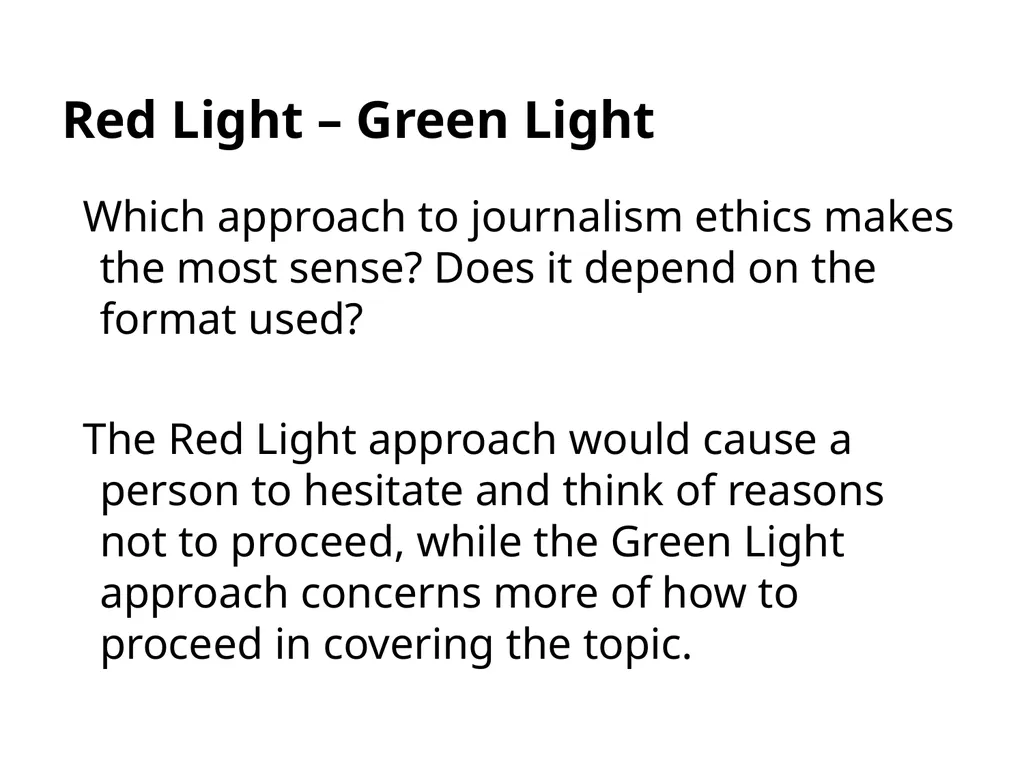
Red Light – Green Light Which approach to journalism ethics makes the most sense? Does it depend on the format used?
The Red Light approach would cause a person to hesitate and think of reasons not to proceed, while the Green Light approach concerns more of how to proceed in covering the topic.<br>
03
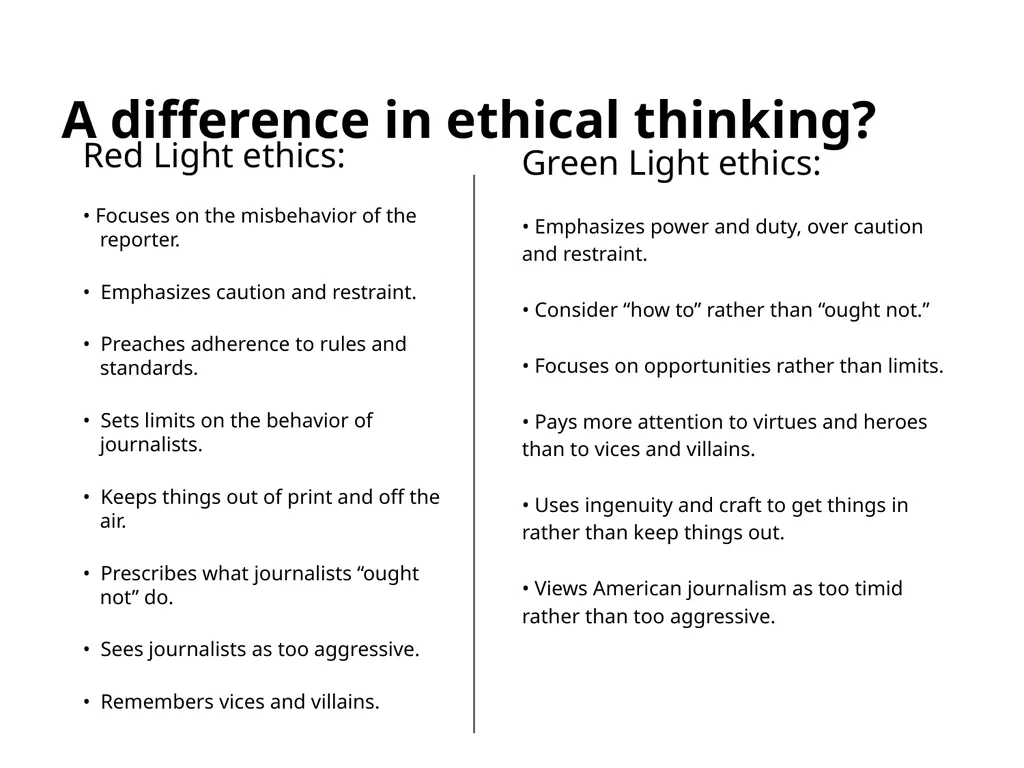
A difference in ethical thinking? Red Light ethics:
• Focuses on the misbehavior of the reporter.
• Emphasizes caution and restraint.
• Preaches adherence to rules and standards.
• Sets limits on the behavior of journalists.
• Keeps things out of print and off the air.
• Prescribes what journalists “ought not” do.
• Sees journalists as too aggressive.
• Remembers vices and villains. Green Light ethics:
• Emphasizes power and duty, over caution and restraint.
• Consider “how to” rather than “ought not.”
• Focuses on opportunities rather than limits.
• Pays more attention to virtues and heroes than to vices and villains.
• Uses ingenuity and craft to get things in rather than keep things out.
• Views American journalism as too timid rather than too aggressive.<br>
04
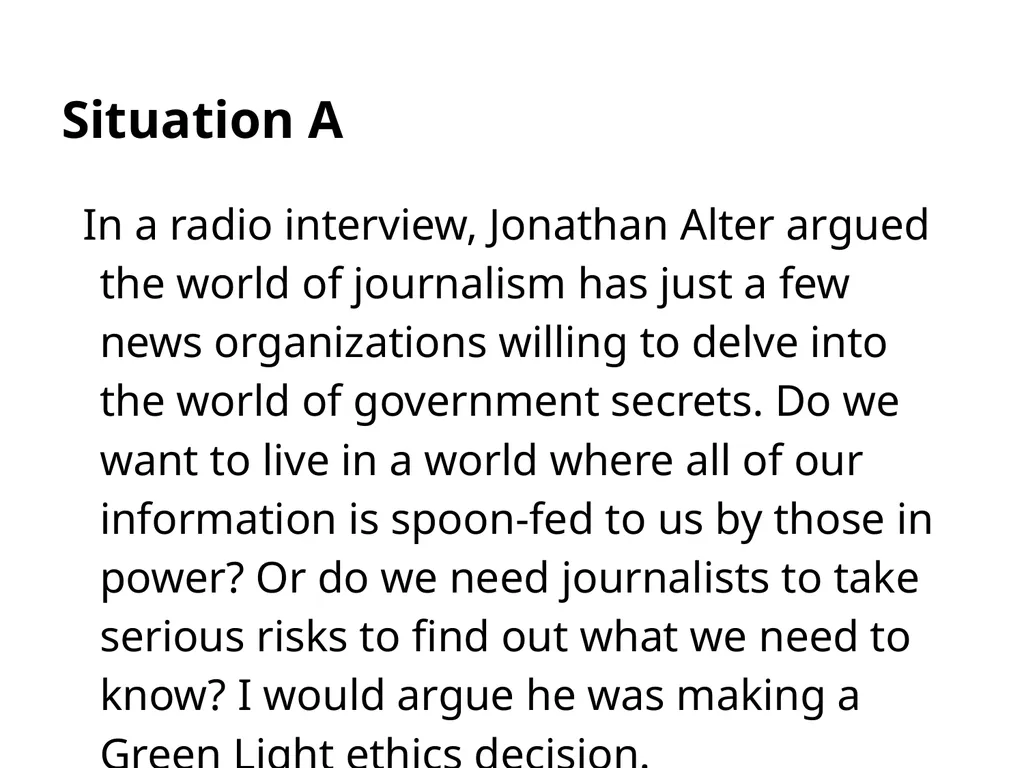
Situation A In a radio interview, Jonathan Alter argued the world of journalism has just a few news organizations willing to delve into the world of government secrets. Do we want to live in a world where all of our information is spoon-fed to us by those in power? Or do we need journalists to take serious risks to find out what we need to know? I would argue he was making a Green Light ethics decision.<br>
05
Situation A Red Light says: Let’s back off. Green Light says: Let’s pin it down.
“These distinctions go beyond semantics although we should not underestimate the effect on students and professionals when we shift from Red Light imperatives to Green Light ones, from negative words to positive ones. Red Light language says: Don’t invade privacy; don’t sensationalize; don’t exploit; don’t lie; don’t re-victimize. Green Light language says: tell the truth; inform the public; reveal social ills; preserve human dignity; be brave.” – Roy Peter Clark, Poynter Institute Senior Scholar<br>
06
Definitions Language, we know, reflects reality, but also helps define it. The words we choose will determine how journalists and the public see the world ethically. If we define media ethics only in terms of scandal, we risk creating a journalism world where there is no risk and no joy. Even in the act of policing ourselves, we run the risk of turning the newsroom into a police state. Every single journalistic scandal we report casts dark clouds over a hundred journalistic achievements, stories of courage and enterprise, stories that change communities for the better. Judging our work in those green terms might just restore our sense of passion and purpose. It might just put some of the fun back into journalism — and brighten the solemnity of media ethics.<br>
07
To report? How? “Should the media cover a little-known pastor’s Koran-burning plan?” has been widely debated. Stephen J.A. Ward asks a larger question: “How is news selected?”<br>
08
How to report this controversy Democracy needs intelligent news selection — They must question a news selection that feeds this media circus. Of course, media should cover pop culture and the merely novel; but the media’s news selection should not be hostage to alleged news events or entertainment values.
Go hard on manipulators — New selection should be guided by who is seeking media attention and why. Jones guessed correctly that a book burning would get attention. He loved appearing before the cameras and toying with reporters. Editors have every right to work against a manipulator’s media strategy. It is not the job of journalists to provide unthinking coverage of events that are gratuitously manufactured to provoke and cause harm.<br>
09
Reporting Practice proportionality; avoid the drama: Reduce the quantity of coverage and reduce the prominence of the story. For example, in the lead up to Sept. 11, the Associated Press announced that it would reduce the number of stories it would do on the Jones affair, and would not distribute images or audio that specifically showed Korans being burned.<br>
10
Reporting Relentlessly provide context: Widen the story by avoiding a narrow focus on the event in question. For example, in the case of Jones, do not follow his every move. Also, explain who Jones is and the size of his church. Note his previous attempts to get media attention and question whether his views are affirmed by many Americans. On a number of days, the New York Times reduced the impact of the Jones story by folding the event into larger explanatory stories of how Americans were approaching the 9/11 anniversary.<br>
11
Red Light or Green Light? Be a catalyst for informed discussion: Deepen a story like the Jones plan by including other voices, such as moderate Muslim leaders and interfaith associations that are rallying against Jones. Use this moment to bring intolerant views about Islam out into the open for rigorous review. Rather than try to pretend that people like Jones don’t exist, use this shabby affair as an opportunity to spark a more reasoned and intelligent discussion of religion. Meet intolerant, uninformed speech with tolerant, informed speech.<br>
12
Prepackaged news? Local television stations are again coming under fire from media watchdogs and the Federal Communications Commission for using so-called video news releases during their newscasts without full disclosure. A video news release, or VNR, is basically a press release in video form. Just as news organizations are inundated every day with press releases from government agencies, consumer groups and corporations, television stations receive the equivalent in video form. While there is nothing inherently wrong with reporting a story based on a press release, many television stations are using the VNRs alone in lieu of original reporting.<br>
13
Ethical approach? "Viewers are accustomed to watching news programs with an uncritical eye and only put their filter on when commercials start. VNRs take full advantage of this tendency and do a direct attack," says Matthew Felling, a director of Center for Media and Public Affairs, a Washington, D.C., media watchdog group.
Your action? Red Light? Green Light? How would you ethically approach using such a VNR or similar situation?<br>