One-Year Outcomes after Amulet or WatchmanFLX Device for Percutaneous Left Atrial Appendage Closure: Pre-Specified Analyses of the SWISS-APERO Randomized Clinical Trial Roberto Galea, MD Department of Cardiology, Bern University Hospital,
"One-Year Outcomes after Amulet or Watchman/FLX" is the property of its rightful owner. Permission is granted to
download and print the materials on this website for personal, non-commercial use only, and to display it
on your personal computer provided you do not modify the materials and that you retain all copyright
notices contained in the materials. By downloading content from our website, you accept the terms of this
agreement.
Presentation Transcript
01
One-Year Outcomes after Amulet or Watchman/FLX Device for Percutaneous Left Atrial Appendage Closure: Pre-Specified Analyses of the SWISS-APERO Randomized Clinical Trial Roberto Galea, MD
Department of Cardiology, Bern University Hospital, Bern, Switzerland
on behalf of the SWISSAPERO Trial Investigators roberto.galea@insel.ch<br>
02
I, Roberto Galea, DO NOT have any relevant financial relationships to disclose.
Background and objectives Residual LAA patency after LAAC has been associated with higher thromboembolic risk, especially when detected remotely after the procedure.
Watchman FLX and Amulet devices are the two most frequently used devices for LAAC worldwide and SwissApero Trial is the first randomized comparison between them. The main findings of the study showed a similar LAA sealing performance of the two devices at 45-day CCTA.
In these pre-specified subanalyses of SwissApero Trial, we compared Watchman FLX and Amulet in terms of LAA patency and DRT at 13-month CCTA, besides clinical outcomes through 13 months.<br>
04
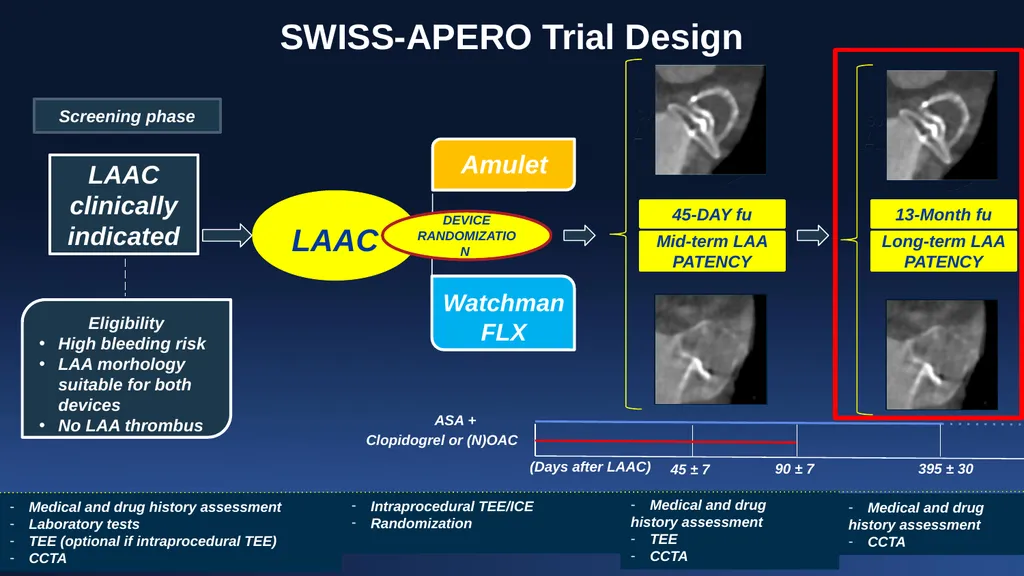
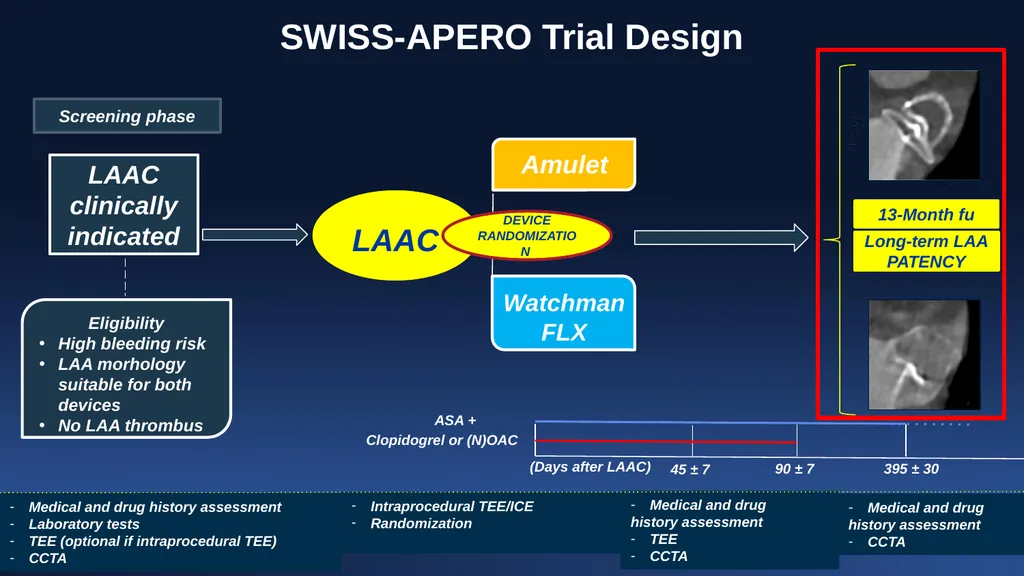
SWISS-APERO Trial Design LAAC clinically indicated Eligibility
High bleeding risk
LAA morhology suitable for both devices
No LAA thrombus LAAC DEVICE RANDOMIZATION Amulet Watchman
FLX O 45 ± 7 (Days after LAAC) ASA + Clopidogrel or (N)OAC Medical and drug history assessment
Laboratory tests
TEE (optional if intraprocedural TEE)
CCTA Intraprocedural TEE/ICE
Randomization Medical and drug
history assessment
TEE
CCTA Screening phase Medical and drug
history assessment
CCTA 395 ± 30 90 ± 7<br>
05
SWISS-APERO Trial Design LAAC clinically indicated Eligibility
High bleeding risk
LAA morhology suitable for both devices
No LAA thrombus LAAC DEVICE RANDOMIZATION Amulet Watchman
FLX O 45 ± 7 (Days after LAAC) ASA + Clopidogrel or (N)OAC Medical and drug history assessment
Laboratory tests
TEE (optional if intraprocedural TEE)
CCTA Intraprocedural TEE/ICE
Randomization Medical and drug
history assessment
TEE
CCTA Screening phase Medical and drug
history assessment
CCTA 395 ± 30 90 ± 7<br>
06
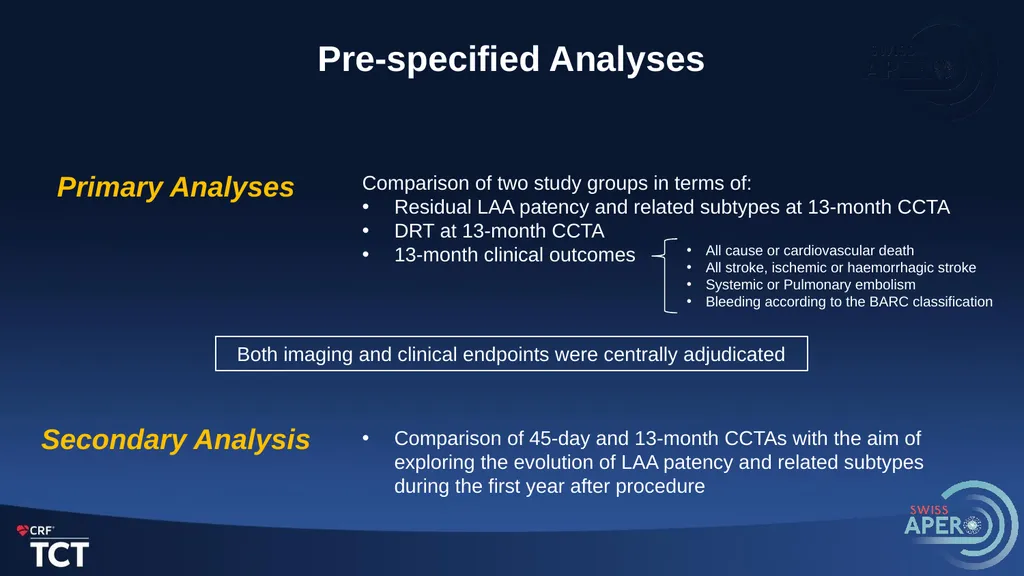
Pre-specified Analyses Primary Analyses Secondary Analysis Comparison of two study groups in terms of:
Residual LAA patency and related subtypes at 13-month CCTA
DRT at 13-month CCTA
13-month clinical outcomes Comparison of 45-day and 13-month CCTAs with the aim of exploring the evolution of LAA patency and related subtypes during the first year after procedure All cause or cardiovascular death
All stroke, ischemic or haemorrhagic stroke
Systemic or Pulmonary embolism
Bleeding according to the BARC classification Both imaging and clinical endpoints were centrally adjudicated<br>
07
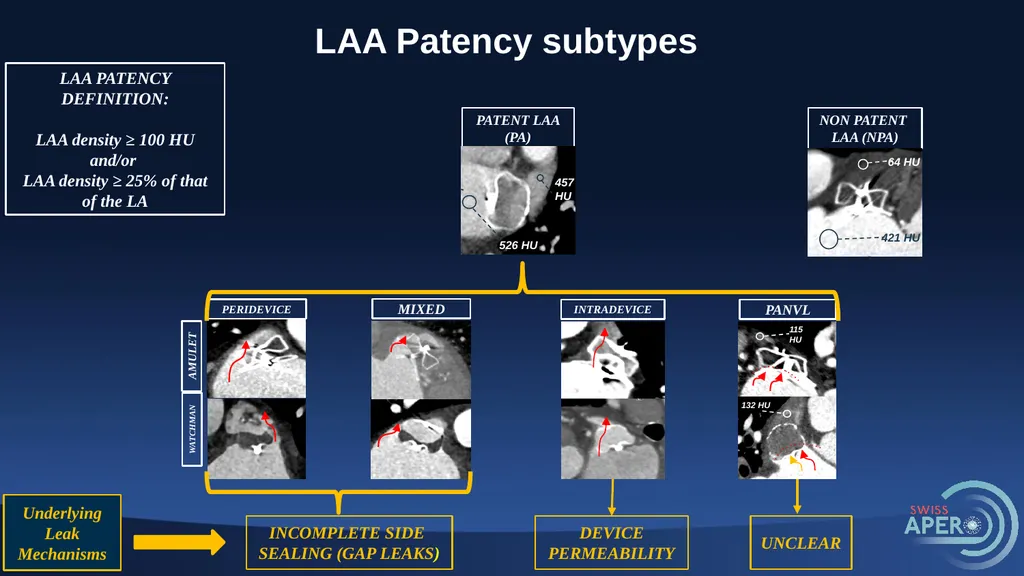
LAA Patency subtypes LAA PATENCY DEFINITION:
LAA density ≥ 100 HU and/or
LAA density ≥ 25% of that of the LA NON PATENT LAA (NPA) 64 HU 421 HU INCOMPLETE SIDE
SEALING (GAP LEAKS) Underlying
Leak Mechanisms DEVICE PERMEABILITY UNCLEAR PERIDEVICE MIXED INTRADEVICE PANVL WATCHMAN AMULET 115
HU 132 HU<br>
08
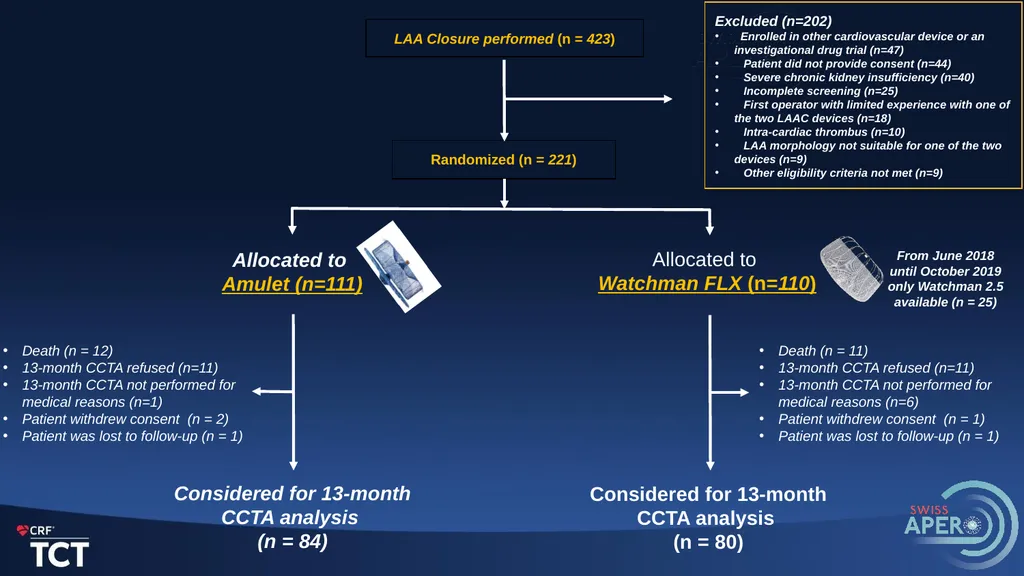
LAA Closure performed (n = 423) Considered for 13-month CCTA analysis
(n = 80) Allocated to
Watchman FLX (n=110) Randomized (n = 221) Excluded (n=202)
Enrolled in other cardiovascular device or an investigational drug trial (n=47)
Patient did not provide consent (n=44)
Severe chronic kidney insufficiency (n=40)
Incomplete screening (n=25)
First operator with limited experience with one of the two LAAC devices (n=18)
Intra-cardiac thrombus (n=10)
LAA morphology not suitable for one of the two devices (n=9)
Other eligibility criteria not met (n=9) Considered for 13-month CCTA analysis
(n = 84) Allocated to
Amulet (n=111) From June 2018 until October 2019 only Watchman 2.5 available (n = 25) Death (n = 12)
13-month CCTA refused (n=11)
13-month CCTA not performed for medical reasons (n=1)
Patient withdrew consent (n = 2)
Patient was lost to follow-up (n = 1) Death (n = 11)
13-month CCTA refused (n=11)
13-month CCTA not performed for medical reasons (n=6)
Patient withdrew consent (n = 1)
Patient was lost to follow-up (n = 1)<br>
09
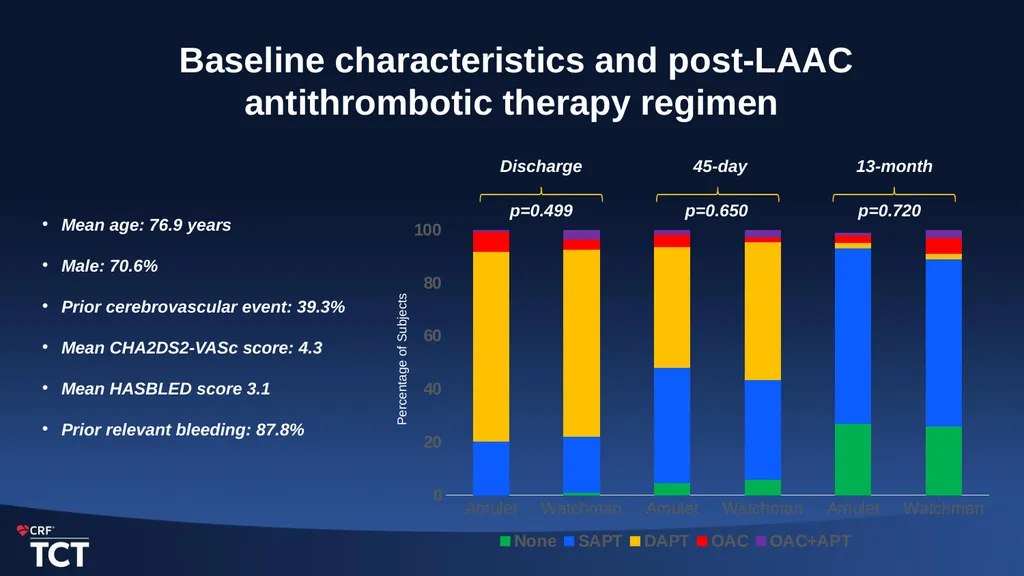
Baseline characteristics and post-LAAC antithrombotic therapy regimen Percentage of Subjects Discharge 45-day 13-month p=0.499 p=0.650 p=0.720 Mean age: 76.9 years
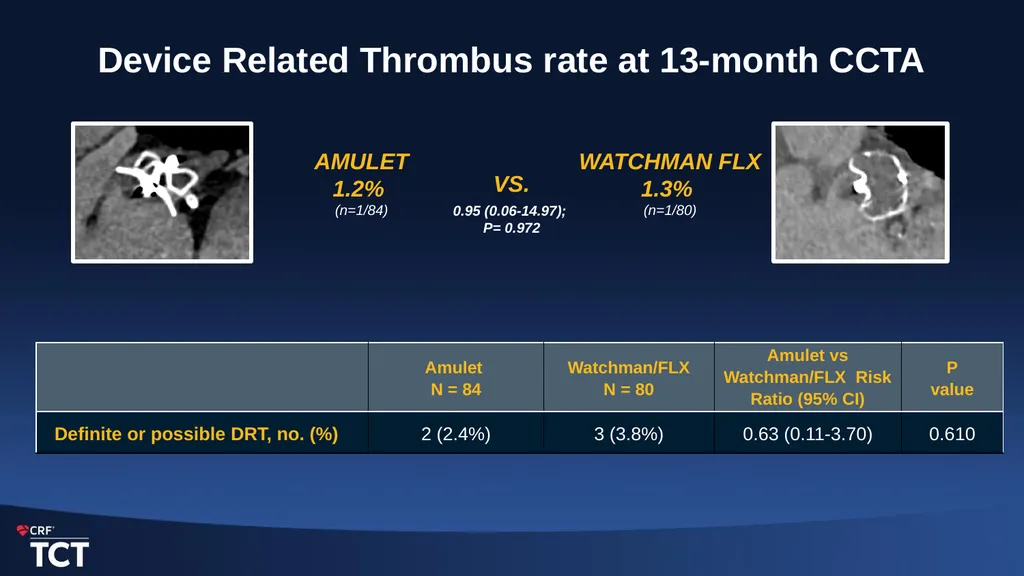
Device Related Thrombus rate at 13-month CCTA 0.95 (0.06-14.97);
P= 0.972 WATCHMAN FLX
1.3%
(n=1/80) AMULET
1.2%
(n=1/84) VS.<br>
12
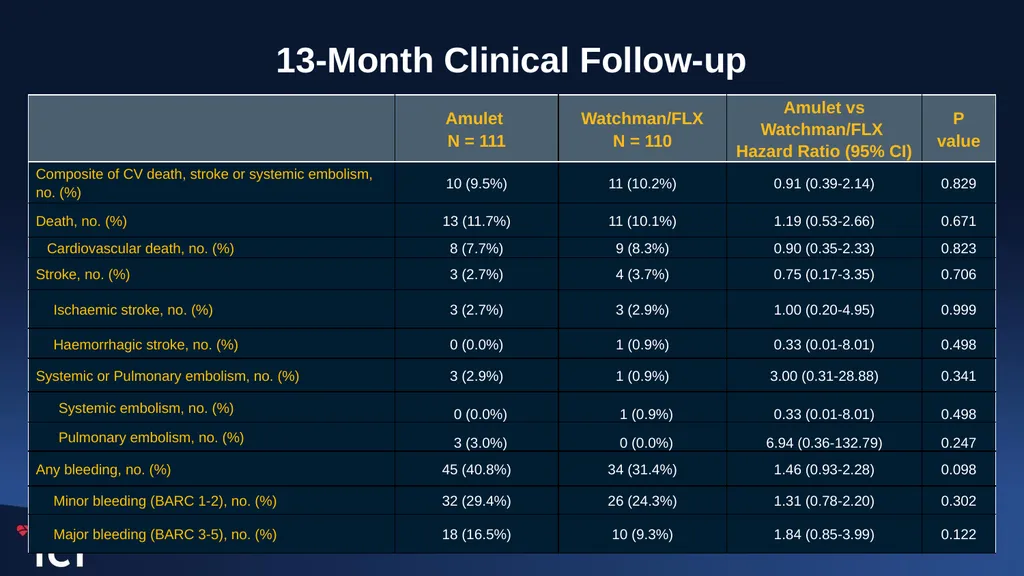
13-Month Clinical Follow-up<br>
13
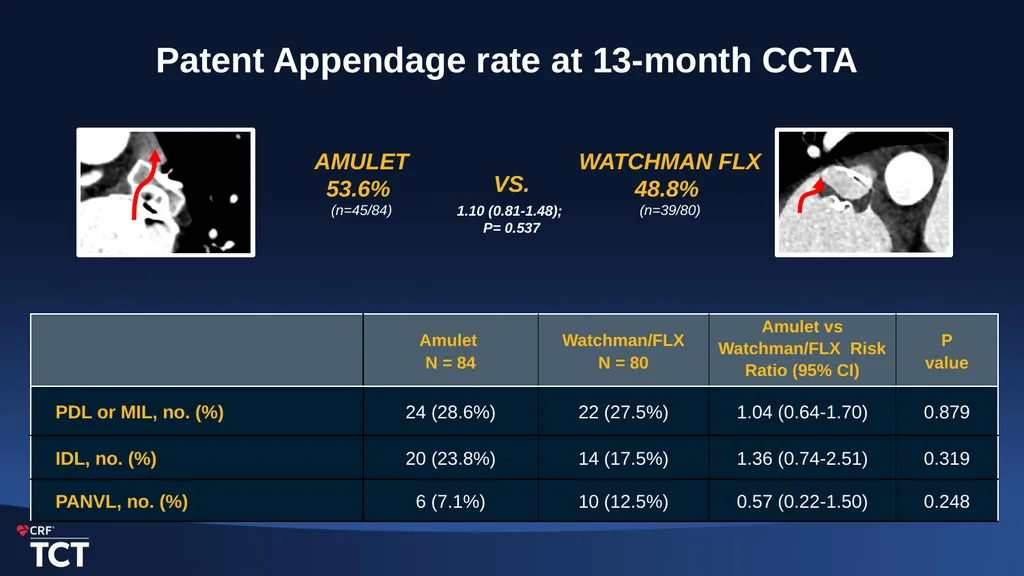
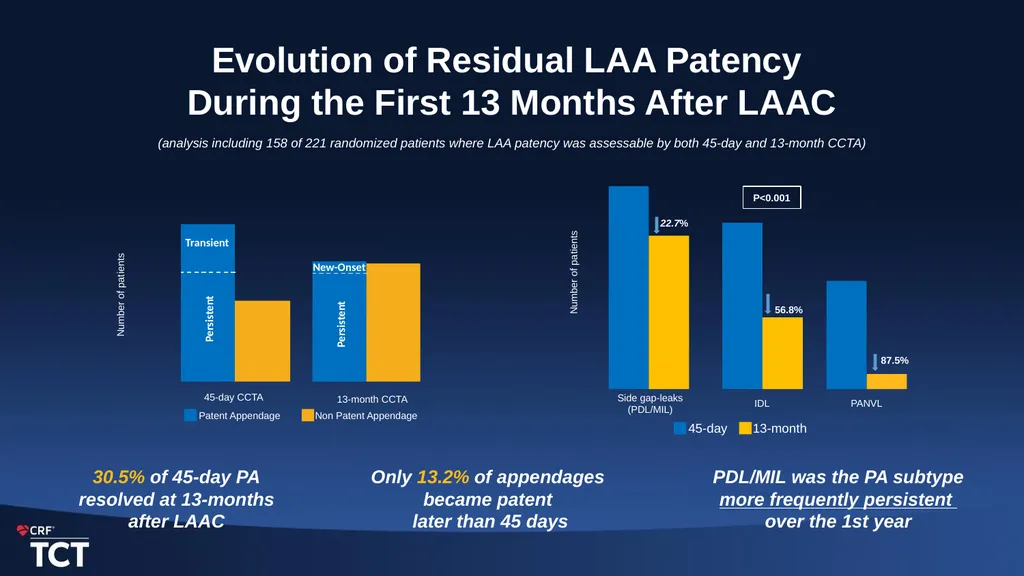
Evolution of Residual LAA Patency During the First 13 Months After LAAC 30.5% of 45-day PA
resolved at 13-months after LAAC Only 13.2% of appendages
became patent
later than 45 days PDL/MIL was the PA subtype more frequently persistent
over the 1st year P<0.001 (analysis including 158 of 221 randomized patients where LAA patency was assessable by both 45-day and 13-month CCTA)<br>
14
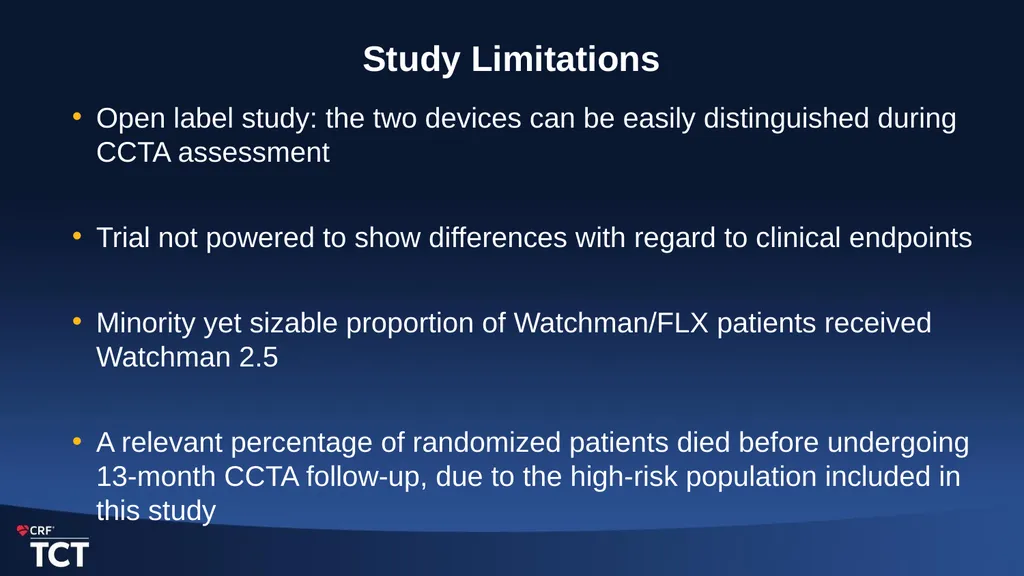
Study Limitations Open label study: the two devices can be easily distinguished during CCTA assessment
Trial not powered to show differences with regard to clinical endpoints
Minority yet sizable proportion of Watchman/FLX patients received Watchman 2.5
A relevant percentage of randomized patients died before undergoing 13-month CCTA follow-up, due to the high-risk population included in this study<br>
15
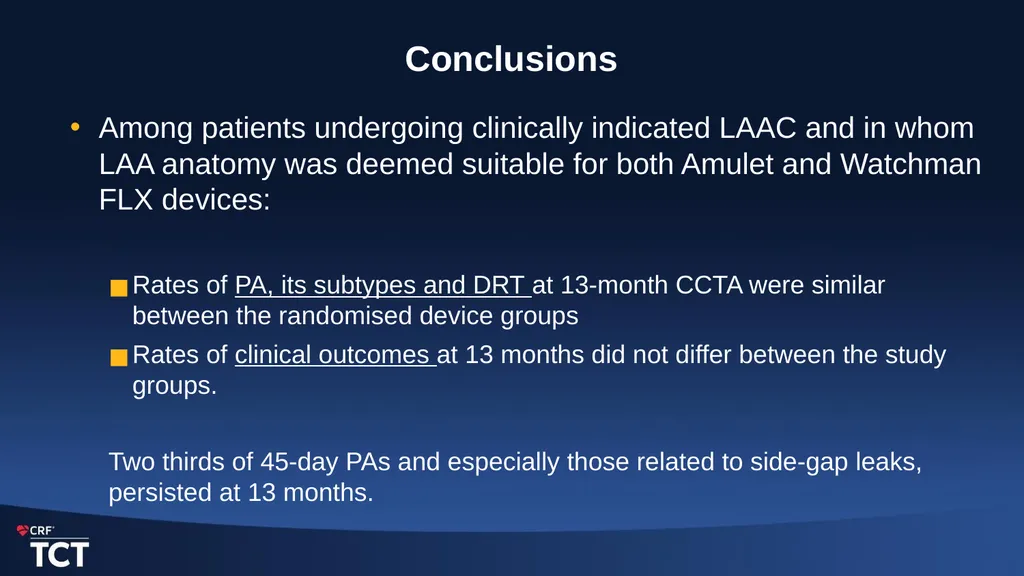
Conclusions Among patients undergoing clinically indicated LAAC and in whom LAA anatomy was deemed suitable for both Amulet and Watchman FLX devices:
Rates of PA, its subtypes and DRT at 13-month CCTA were similar between the randomised device groups
Rates of clinical outcomes at 13 months did not differ between the study groups.
Two thirds of 45-day PAs and especially those related to side-gap leaks, persisted at 13 months.<br>