
Online Controlled Experiments: Lessons from
JO
Published · 44 slides · 0 views
1 / 1


Description
Online Controlled Experiments: Lessons from Running ABn Tests for 12 years Slides at http:bit.lyKDD2015Kohavi, RonnyK Ron Kohavi, Distinguished Engineer, General Manager, Analysis and Experimentation, Microsoft Joint work with many
Related Topics
Share
Embed code
Download this presentation From Below
"Online Controlled Experiments: Lessons from" is the property of its rightful owner. Permission is granted to download and print the materials on this website for personal, non-commercial use only, and to display it on your personal computer provided you do not modify the materials and that you retain all copyright notices contained in the materials. By downloading content from our website, you accept the terms of this agreement.
Presentation Transcript
01
Online Controlled Experiments:
Lessons from Running A/B/n Tests for 12 years
Slides at http://bit.ly/KDD2015Kohavi, @RonnyK Ron Kohavi, Distinguished Engineer, General Manager,
Analysis and Experimentation, Microsoft
Joint work with many members of the A&E/ExP platform team<br>
02
Agenda Introduction to controlled experiments
Four real examples: you’re the decision maker Examples chosen to share lessons
Lessons and pitfalls
Cultural evolution towards a data-driven org Ronny Kohavi 2<br>
Four real examples: you’re the decision maker Examples chosen to share lessons
Lessons and pitfalls
Cultural evolution towards a data-driven org Ronny Kohavi 2<br>
03
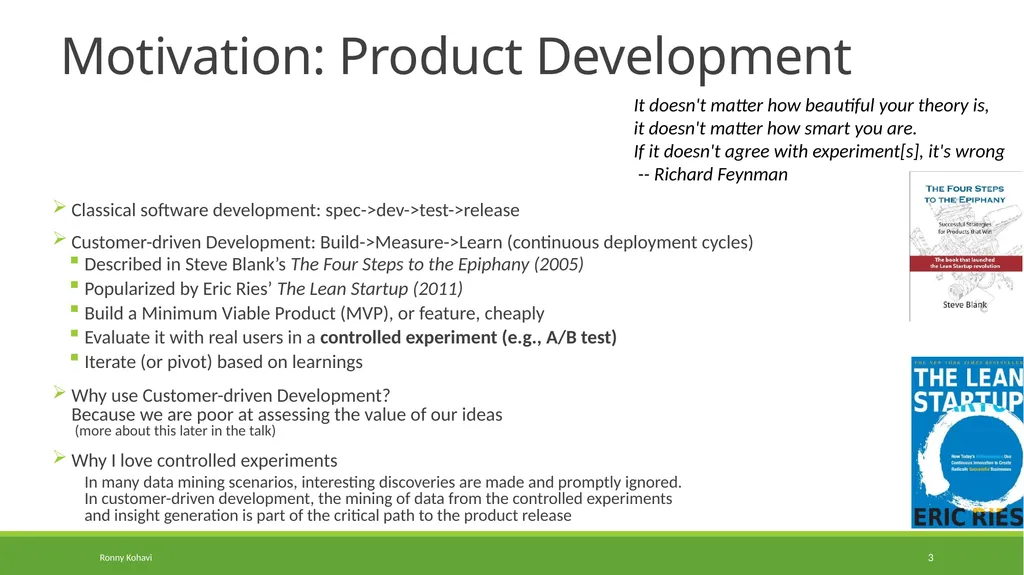
Motivation: Product Development Classical software development: spec->dev->test->release
Customer-driven Development: Build->Measure->Learn (continuous deployment cycles)
Described in Steve Blank’s The Four Steps to the Epiphany (2005)
Popularized by Eric Ries’ The Lean Startup (2011)
Build a Minimum Viable Product (MVP), or feature, cheaply
Evaluate it with real users in a controlled experiment (e.g., A/B test)
Iterate (or pivot) based on learnings
Why use Customer-driven Development? Because we are poor at assessing the value of our ideas (more about this later in the talk)
Why I love controlled experiments
In many data mining scenarios, interesting discoveries are made and promptly ignored. In customer-driven development, the mining of data from the controlled experiments and insight generation is part of the critical path to the product release Ronny Kohavi 3 It doesn't matter how beautiful your theory is, it doesn't matter how smart you are. If it doesn't agree with experiment[s], it's wrong -- Richard Feynman<br>
Customer-driven Development: Build->Measure->Learn (continuous deployment cycles)
Described in Steve Blank’s The Four Steps to the Epiphany (2005)
Popularized by Eric Ries’ The Lean Startup (2011)
Build a Minimum Viable Product (MVP), or feature, cheaply
Evaluate it with real users in a controlled experiment (e.g., A/B test)
Iterate (or pivot) based on learnings
Why use Customer-driven Development? Because we are poor at assessing the value of our ideas (more about this later in the talk)
Why I love controlled experiments
In many data mining scenarios, interesting discoveries are made and promptly ignored. In customer-driven development, the mining of data from the controlled experiments and insight generation is part of the critical path to the product release Ronny Kohavi 3 It doesn't matter how beautiful your theory is, it doesn't matter how smart you are. If it doesn't agree with experiment[s], it's wrong -- Richard Feynman<br>
04
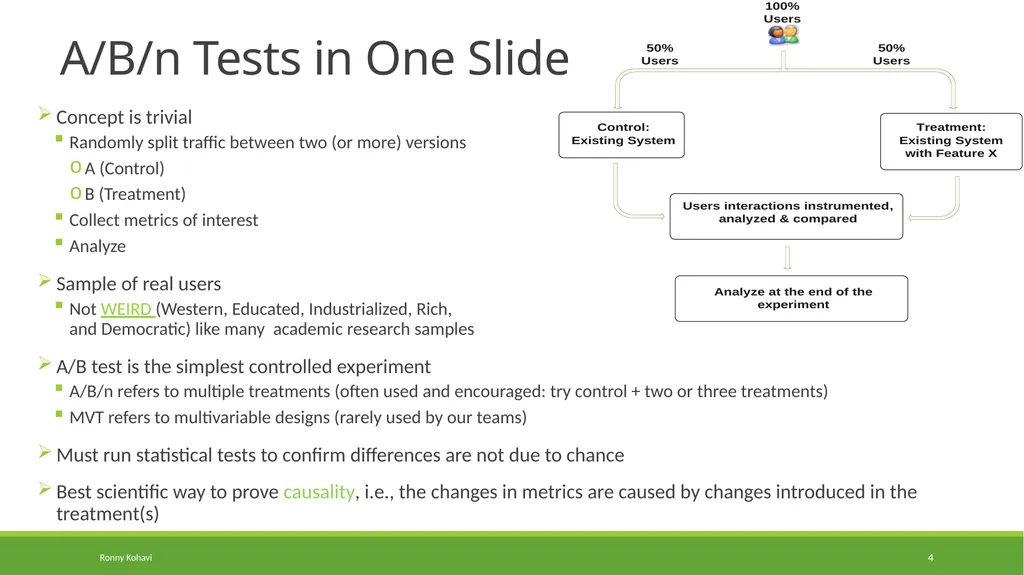
Ronny Kohavi 4 A/B/n Tests in One Slide Concept is trivial
Randomly split traffic between two (or more) versions
A (Control)
B (Treatment)
Collect metrics of interest
Analyze
Sample of real users
Not WEIRD (Western, Educated, Industrialized, Rich, and Democratic) like many academic research samples
A/B test is the simplest controlled experiment
A/B/n refers to multiple treatments (often used and encouraged: try control + two or three treatments)
MVT refers to multivariable designs (rarely used by our teams)
Must run statistical tests to confirm differences are not due to chance
Best scientific way to prove causality, i.e., the changes in metrics are caused by changes introduced in the treatment(s)<br>
Randomly split traffic between two (or more) versions
A (Control)
B (Treatment)
Collect metrics of interest
Analyze
Sample of real users
Not WEIRD (Western, Educated, Industrialized, Rich, and Democratic) like many academic research samples
A/B test is the simplest controlled experiment
A/B/n refers to multiple treatments (often used and encouraged: try control + two or three treatments)
MVT refers to multivariable designs (rarely used by our teams)
Must run statistical tests to confirm differences are not due to chance
Best scientific way to prove causality, i.e., the changes in metrics are caused by changes introduced in the treatment(s)<br>
05
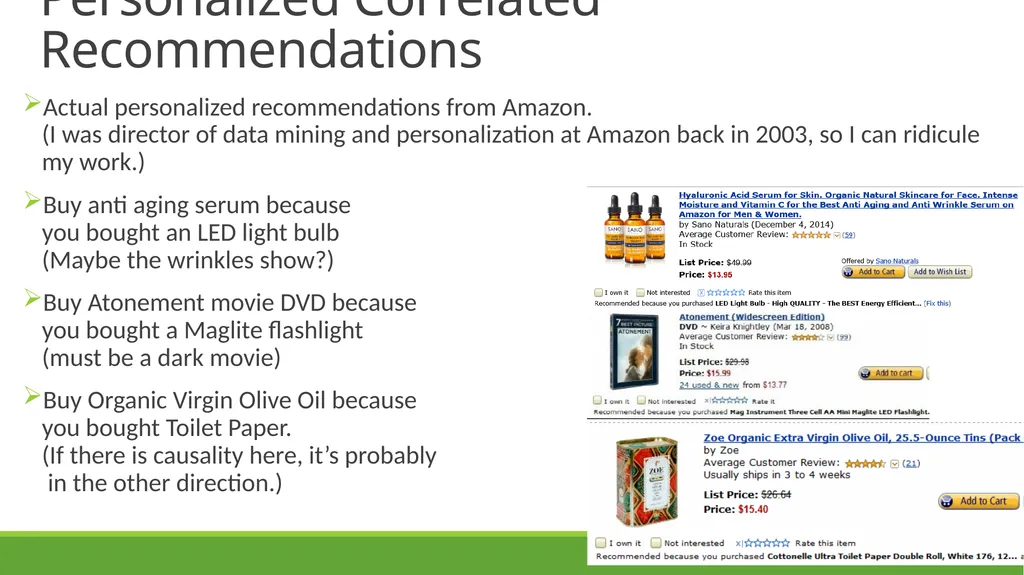
Personalized Correlated Recommendations Actual personalized recommendations from Amazon.
(I was director of data mining and personalization at Amazon back in 2003, so I can ridicule my work.)
Buy anti aging serum because you bought an LED light bulb (Maybe the wrinkles show?)
Buy Atonement movie DVD because you bought a Maglite flashlight (must be a dark movie)
Buy Organic Virgin Olive Oil because you bought Toilet Paper. (If there is causality here, it’s probably in the other direction.)<br>
Buy anti aging serum because you bought an LED light bulb (Maybe the wrinkles show?)
Buy Atonement movie DVD because you bought a Maglite flashlight (must be a dark movie)
Buy Organic Virgin Olive Oil because you bought Toilet Paper. (If there is causality here, it’s probably in the other direction.)<br>
06
Advantage of Controlled Experiments Controlled experiments test for causal relationships, not simply correlations
When the variants run concurrently, only two things could explain a change in metrics:
The “feature(s)” (A vs. B)
Random chance
Everything else happening affects both the variants
For #2, we conduct statistical tests for significance
The gold standard in science and the only way to prove efficacy of drugs in FDA drug tests
Controlled experiments are not the panacea for everything. Issues discussed in the journal survey paper 6<br>
When the variants run concurrently, only two things could explain a change in metrics:
The “feature(s)” (A vs. B)
Random chance
Everything else happening affects both the variants
For #2, we conduct statistical tests for significance
The gold standard in science and the only way to prove efficacy of drugs in FDA drug tests
Controlled experiments are not the panacea for everything. Issues discussed in the journal survey paper 6<br>
07
The First Medical Controlled Experiment The earliest controlled experiment was a test for vegetarianism,
suggested in the Old Testament's Book of Daniel
Test your servants for ten days. Give us nothing but vegetables to eat and water to drink. Then compare our appearance with that of the young men who eat the royal food, and treat your servants in accordance with what you see
First controlled experiment / randomized trial for medical purposes
Scurvy is a disease that results from vitamin C deficiency
It killed over 100,000 people in the 16th-18th centuries, mostly sailors
Lord Anson’s circumnavigation voyage from 1740 to 1744 started with 1,800 sailors and only about 200 returned; most died from scurvy
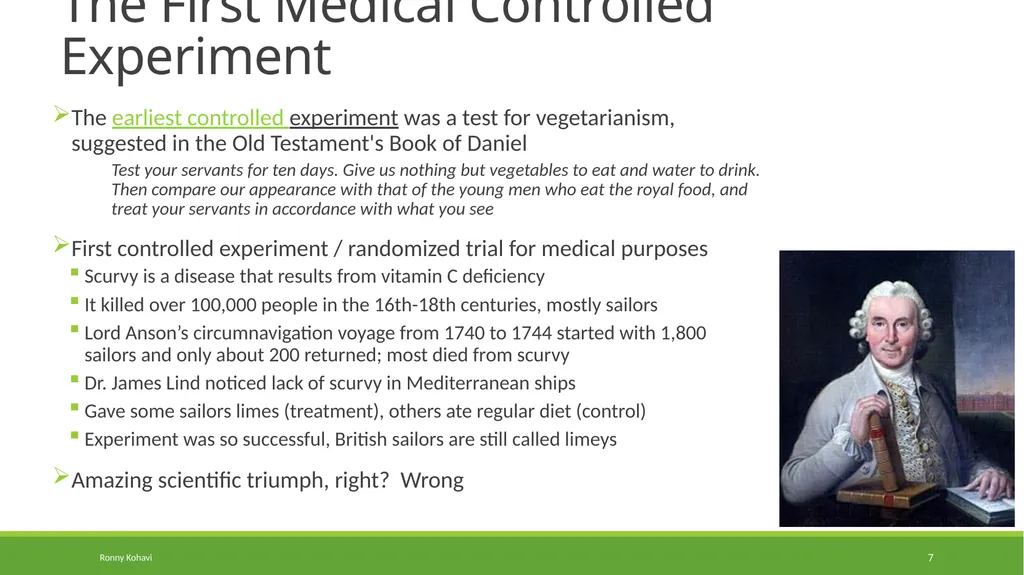
Dr. James Lind noticed lack of scurvy in Mediterranean ships
Gave some sailors limes (treatment), others ate regular diet (control)
Experiment was so successful, British sailors are still called limeys
Amazing scientific triumph, right? Wrong Ronny Kohavi 7<br>
Test your servants for ten days. Give us nothing but vegetables to eat and water to drink. Then compare our appearance with that of the young men who eat the royal food, and treat your servants in accordance with what you see
First controlled experiment / randomized trial for medical purposes
Scurvy is a disease that results from vitamin C deficiency
It killed over 100,000 people in the 16th-18th centuries, mostly sailors
Lord Anson’s circumnavigation voyage from 1740 to 1744 started with 1,800 sailors and only about 200 returned; most died from scurvy
Dr. James Lind noticed lack of scurvy in Mediterranean ships
Gave some sailors limes (treatment), others ate regular diet (control)
Experiment was so successful, British sailors are still called limeys
Amazing scientific triumph, right? Wrong Ronny Kohavi 7<br>
08
The First Medical Controlled Experiment Like most stories, the discovery is highly exaggerated
The experiment was done on 12 sailors split into 6 pairs
Each pair got a different treatment: cider, elixir vitriol, vinegar, sea-water, nutmeg
Two sailors were given two oranges and one lemon per day and recovered
Lind didn’t understand the reason and tried treating Scurvy with concentrated lemon juice called “rob.” The lemon juice was concentrated by heating it, which destroyed the vitamin C.
Working at Haslar hospital, he attended to 300-400 scurvy patients a day for 5 years
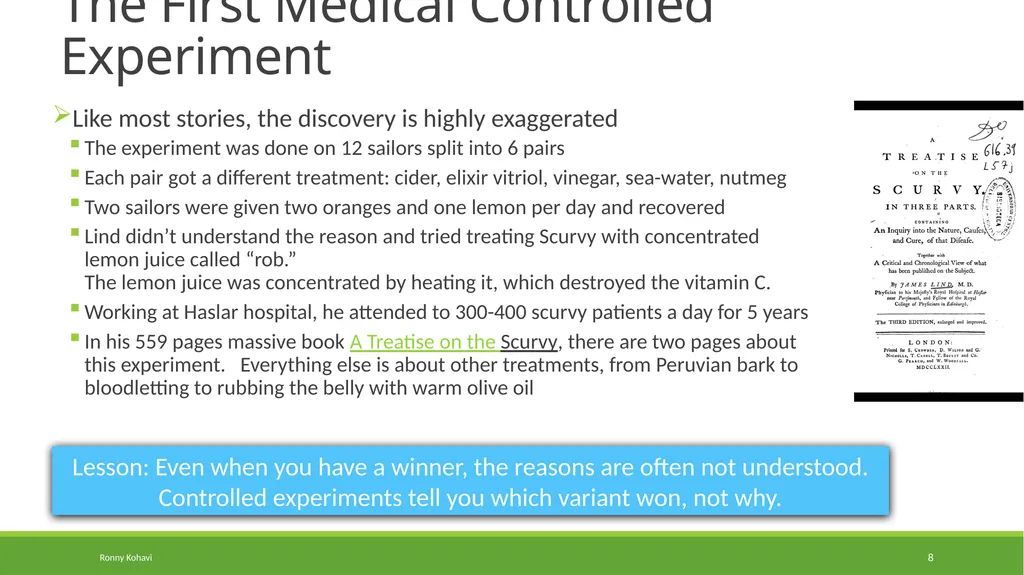
In his 559 pages massive book A Treatise on the Scurvy, there are two pages about this experiment. Everything else is about other treatments, from Peruvian bark to bloodletting to rubbing the belly with warm olive oil Ronny Kohavi 8 Lesson: Even when you have a winner, the reasons are often not understood. Controlled experiments tell you which variant won, not why.<br>
The experiment was done on 12 sailors split into 6 pairs
Each pair got a different treatment: cider, elixir vitriol, vinegar, sea-water, nutmeg
Two sailors were given two oranges and one lemon per day and recovered
Lind didn’t understand the reason and tried treating Scurvy with concentrated lemon juice called “rob.” The lemon juice was concentrated by heating it, which destroyed the vitamin C.
Working at Haslar hospital, he attended to 300-400 scurvy patients a day for 5 years
In his 559 pages massive book A Treatise on the Scurvy, there are two pages about this experiment. Everything else is about other treatments, from Peruvian bark to bloodletting to rubbing the belly with warm olive oil Ronny Kohavi 8 Lesson: Even when you have a winner, the reasons are often not understood. Controlled experiments tell you which variant won, not why.<br>
09
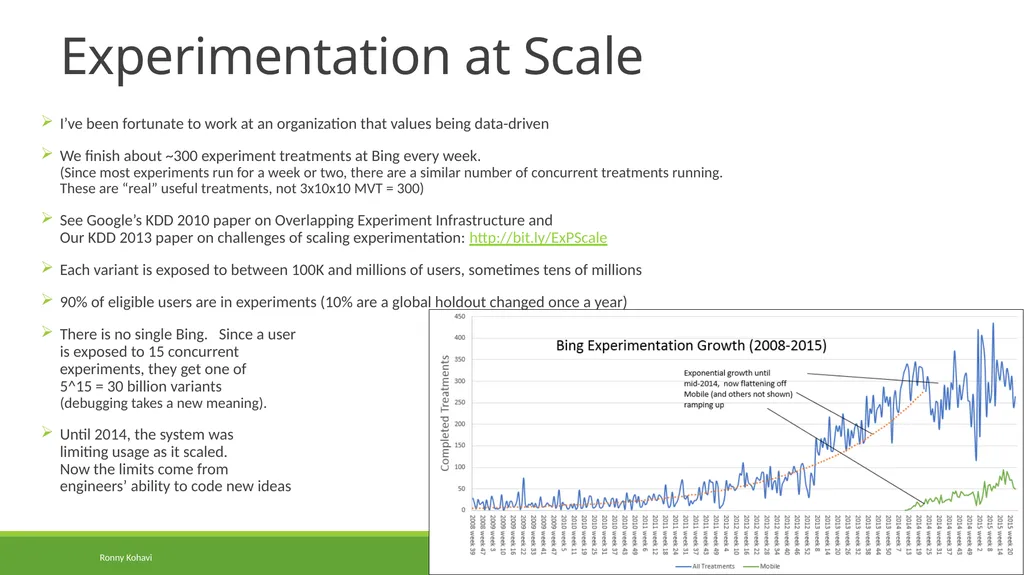
Experimentation at Scale I’ve been fortunate to work at an organization that values being data-driven
We finish about ~300 experiment treatments at Bing every week. (Since most experiments run for a week or two, there are a similar number of concurrent treatments running. These are “real” useful treatments, not 3x10x10 MVT = 300)
See Google’s KDD 2010 paper on Overlapping Experiment Infrastructure and Our KDD 2013 paper on challenges of scaling experimentation: http://bit.ly/ExPScale
Each variant is exposed to between 100K and millions of users, sometimes tens of millions
90% of eligible users are in experiments (10% are a global holdout changed once a year)
There is no single Bing. Since a user is exposed to 15 concurrent experiments, they get one of 5^15 = 30 billion variants (debugging takes a new meaning).
Until 2014, the system was limiting usage as it scaled. Now the limits come from engineers’ ability to code new ideas Ronny Kohavi 9<br>
We finish about ~300 experiment treatments at Bing every week. (Since most experiments run for a week or two, there are a similar number of concurrent treatments running. These are “real” useful treatments, not 3x10x10 MVT = 300)
See Google’s KDD 2010 paper on Overlapping Experiment Infrastructure and Our KDD 2013 paper on challenges of scaling experimentation: http://bit.ly/ExPScale
Each variant is exposed to between 100K and millions of users, sometimes tens of millions
90% of eligible users are in experiments (10% are a global holdout changed once a year)
There is no single Bing. Since a user is exposed to 15 concurrent experiments, they get one of 5^15 = 30 billion variants (debugging takes a new meaning).
Until 2014, the system was limiting usage as it scaled. Now the limits come from engineers’ ability to code new ideas Ronny Kohavi 9<br>
10
Real Examples Four experiments that ran at Microsoft
Each provides interesting lessons
All had enough users for statistical validity
For each experiment, we provide the OEC, the Overall Evaluation Criterion
This is the criterion to determine which variant is the winner
Game: see how many you get right
Everyone please stand up
Three choices are:
A wins (the difference is statistically significant)
A and B are approximately the same (no stat sig diff)
B wins
Since there are 3 choices for each question, random guessing implies 100%/3^4 = 1.2% will get all four questions right. Let’s see how much better than random we can get in this room 10<br>
Each provides interesting lessons
All had enough users for statistical validity
For each experiment, we provide the OEC, the Overall Evaluation Criterion
This is the criterion to determine which variant is the winner
Game: see how many you get right
Everyone please stand up
Three choices are:
A wins (the difference is statistically significant)
A and B are approximately the same (no stat sig diff)
B wins
Since there are 3 choices for each question, random guessing implies 100%/3^4 = 1.2% will get all four questions right. Let’s see how much better than random we can get in this room 10<br>
11
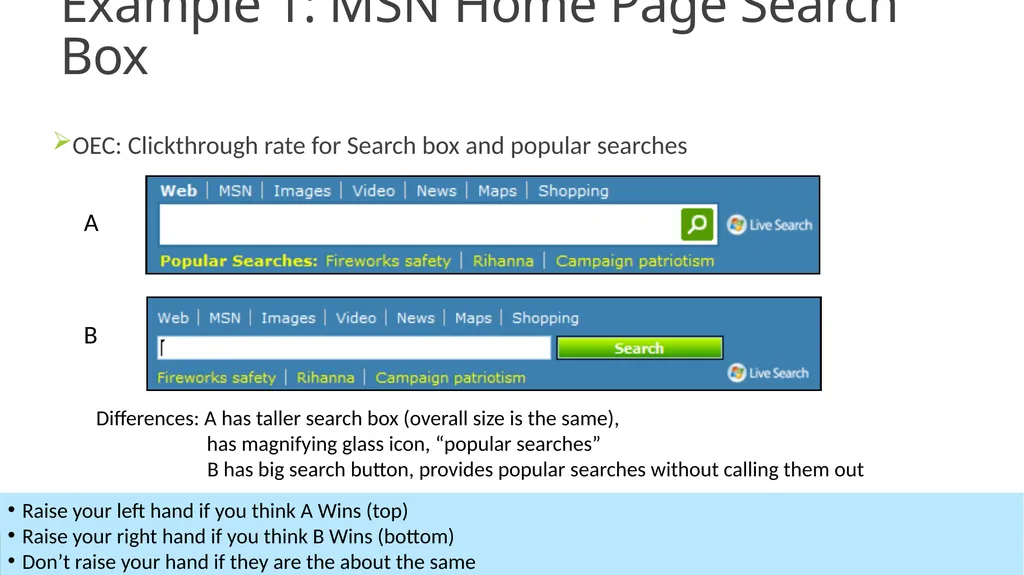
Example 1: MSN Home Page Search Box OEC: Clickthrough rate for Search box and popular searches Ronny Kohavi 11 A Differences: A has taller search box (overall size is the same),
has magnifying glass icon, “popular searches”
B has big search button, provides popular searches without calling them out Raise your left hand if you think A Wins (top)
Raise your right hand if you think B Wins (bottom)
Don’t raise your hand if they are the about the same B<br>
B has big search button, provides popular searches without calling them out Raise your left hand if you think A Wins (top)
Raise your right hand if you think B Wins (bottom)
Don’t raise your hand if they are the about the same B<br>
12
MSN Home Page Search Box [You can’t cheat by looking for the answers here] Ronny Kohavi 12<br>
13
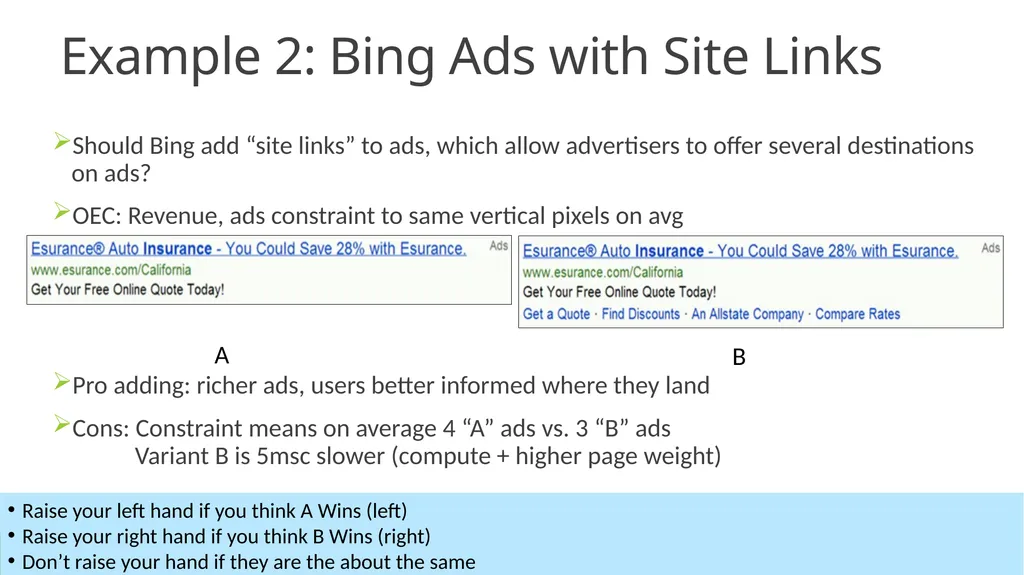
Example 2: Bing Ads with Site Links Should Bing add “site links” to ads, which allow advertisers to offer several destinations on ads?
OEC: Revenue, ads constraint to same vertical pixels on avg
Pro adding: richer ads, users better informed where they land
Cons: Constraint means on average 4 “A” ads vs. 3 “B” ads Variant B is 5msc slower (compute + higher page weight) Ronny Kohavi 13 A B Raise your left hand if you think A Wins (left)
Raise your right hand if you think B Wins (right)
Don’t raise your hand if they are the about the same<br>
OEC: Revenue, ads constraint to same vertical pixels on avg
Pro adding: richer ads, users better informed where they land
Cons: Constraint means on average 4 “A” ads vs. 3 “B” ads Variant B is 5msc slower (compute + higher page weight) Ronny Kohavi 13 A B Raise your left hand if you think A Wins (left)
Raise your right hand if you think B Wins (right)
Don’t raise your hand if they are the about the same<br>
14
Bing Ads with Site Links [You can’t cheat by looking for the answers here] Ronny Kohavi 14<br>
15
Example 3:
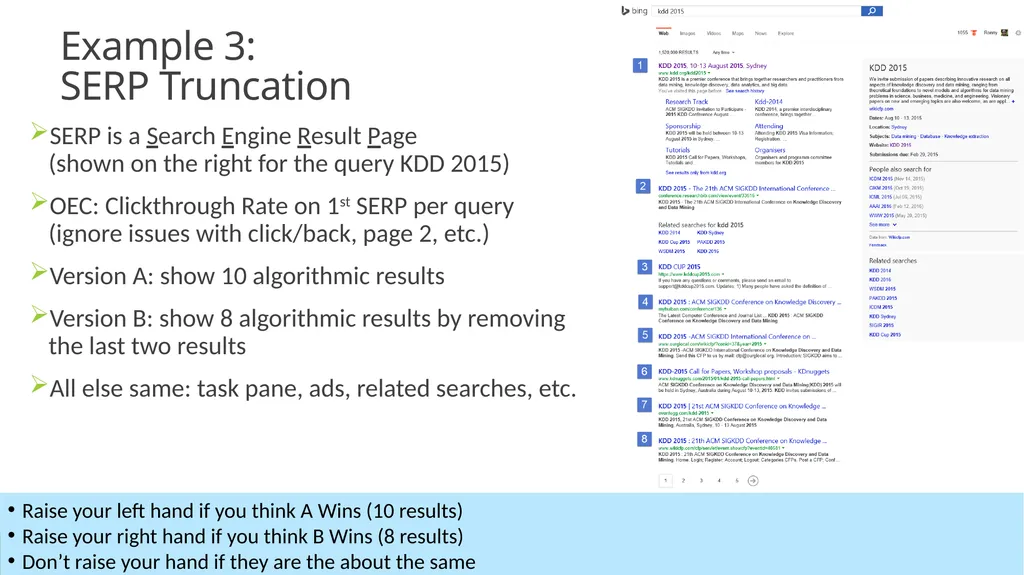
SERP Truncation SERP is a Search Engine Result Page
(shown on the right for the query KDD 2015)
OEC: Clickthrough Rate on 1st SERP per query (ignore issues with click/back, page 2, etc.)
Version A: show 10 algorithmic results
Version B: show 8 algorithmic results by removing the last two results
All else same: task pane, ads, related searches, etc. Ronny Kohavi 15 Raise your left hand if you think A Wins (10 results)
Raise your right hand if you think B Wins (8 results)
Don’t raise your hand if they are the about the same<br>
OEC: Clickthrough Rate on 1st SERP per query (ignore issues with click/back, page 2, etc.)
Version A: show 10 algorithmic results
Version B: show 8 algorithmic results by removing the last two results
All else same: task pane, ads, related searches, etc. Ronny Kohavi 15 Raise your left hand if you think A Wins (10 results)
Raise your right hand if you think B Wins (8 results)
Don’t raise your hand if they are the about the same<br>
16
SERP Truncation [You can’t cheat by looking for the answers here] Ronny Kohavi 16<br>
17
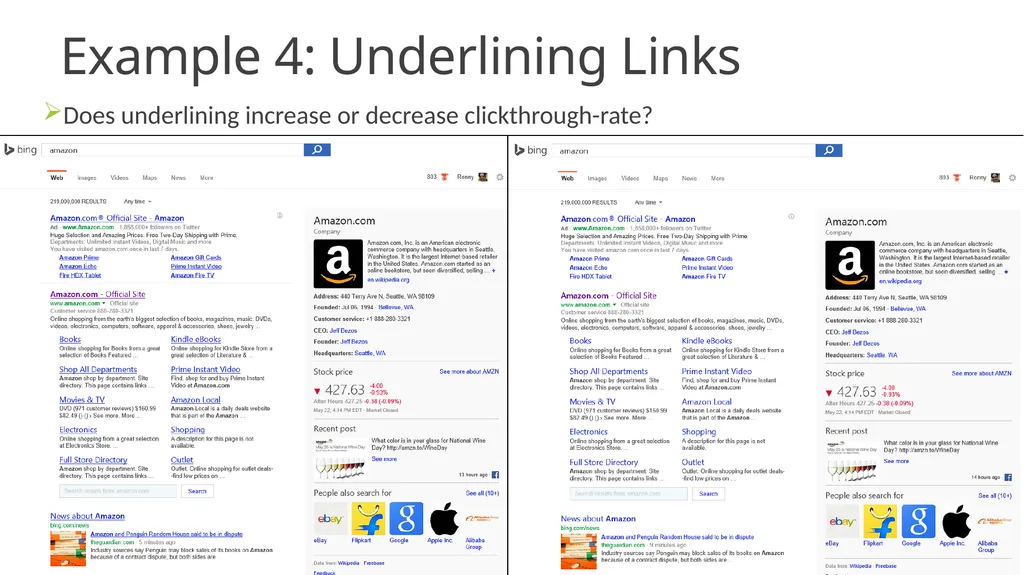
Example 4: Underlining Links Does underlining increase or decrease clickthrough-rate? Ronny Kohavi 17<br>
18
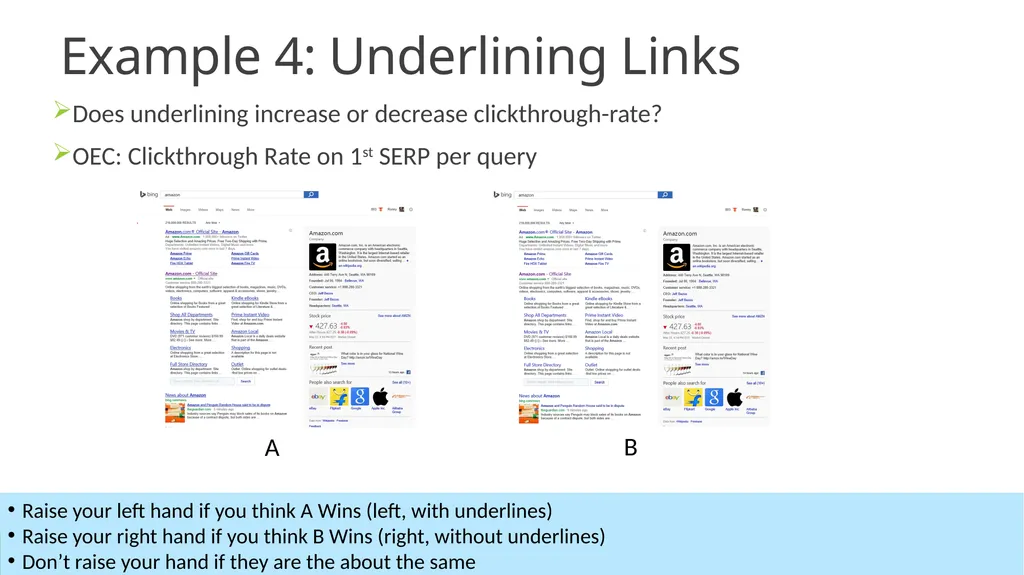
Example 4: Underlining Links Does underlining increase or decrease clickthrough-rate?
OEC: Clickthrough Rate on 1st SERP per query Ronny Kohavi 18 A B Raise your left hand if you think A Wins (left, with underlines)
Raise your right hand if you think B Wins (right, without underlines)
Don’t raise your hand if they are the about the same<br>
OEC: Clickthrough Rate on 1st SERP per query Ronny Kohavi 18 A B Raise your left hand if you think A Wins (left, with underlines)
Raise your right hand if you think B Wins (right, without underlines)
Don’t raise your hand if they are the about the same<br>
19
Underlines Ronny Kohavi 19 [You can’t cheat by looking for the answers here]<br>
20
Agenda Introduction to controlled experiments
Four real examples: you’re the decision maker
Lessons and pitfalls
Cultural evolution towards a data-driven org Ronny Kohavi 20<br>
Four real examples: you’re the decision maker
Lessons and pitfalls
Cultural evolution towards a data-driven org Ronny Kohavi 20<br>
21
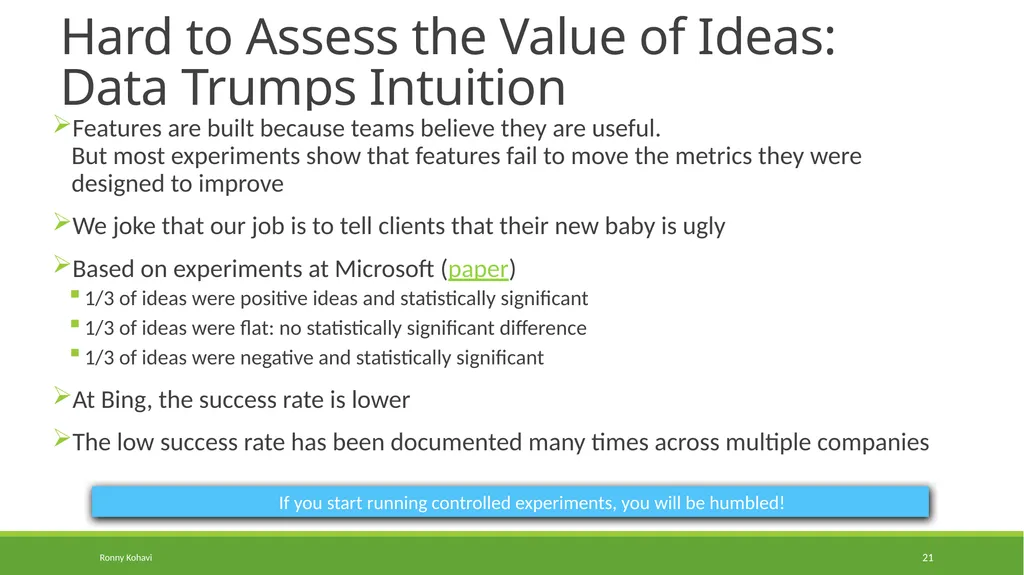
Hard to Assess the Value of Ideas:
Data Trumps Intuition Features are built because teams believe they are useful.
But most experiments show that features fail to move the metrics they were
designed to improve
We joke that our job is to tell clients that their new baby is ugly
Based on experiments at Microsoft (paper)
1/3 of ideas were positive ideas and statistically significant
1/3 of ideas were flat: no statistically significant difference
1/3 of ideas were negative and statistically significant
At Bing, the success rate is lower
The low success rate has been documented many times across multiple companies Ronny Kohavi 21 If you start running controlled experiments, you will be humbled!<br>
We joke that our job is to tell clients that their new baby is ugly
Based on experiments at Microsoft (paper)
1/3 of ideas were positive ideas and statistically significant
1/3 of ideas were flat: no statistically significant difference
1/3 of ideas were negative and statistically significant
At Bing, the success rate is lower
The low success rate has been documented many times across multiple companies Ronny Kohavi 21 If you start running controlled experiments, you will be humbled!<br>
22
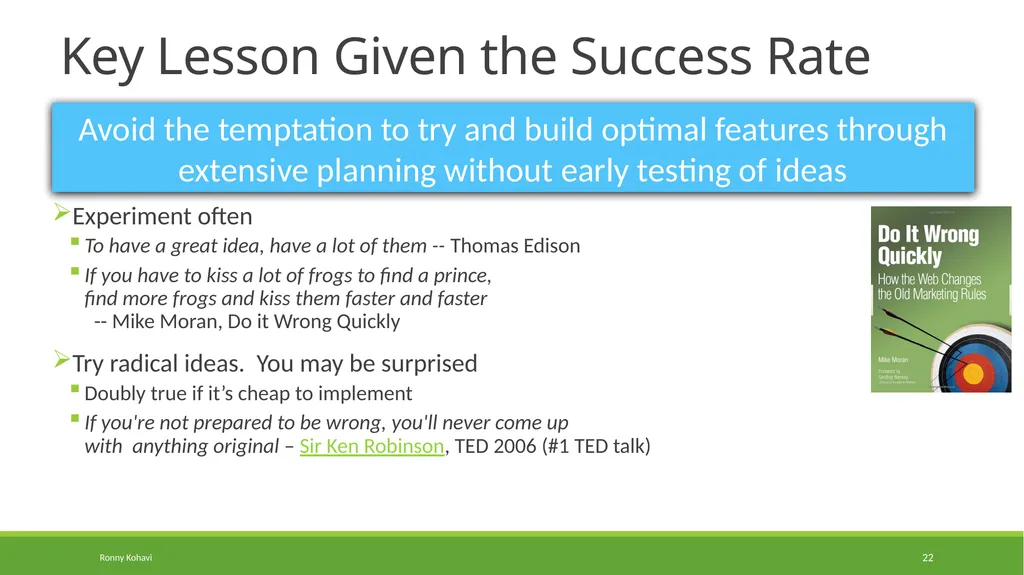
Key Lesson Given the Success Rate Experiment often
To have a great idea, have a lot of them -- Thomas Edison
If you have to kiss a lot of frogs to find a prince, find more frogs and kiss them faster and faster -- Mike Moran, Do it Wrong Quickly
Try radical ideas. You may be surprised
Doubly true if it’s cheap to implement
If you're not prepared to be wrong, you'll never come up with anything original – Sir Ken Robinson, TED 2006 (#1 TED talk) Ronny Kohavi 22 Avoid the temptation to try and build optimal features through extensive planning without early testing of ideas<br>
To have a great idea, have a lot of them -- Thomas Edison
If you have to kiss a lot of frogs to find a prince, find more frogs and kiss them faster and faster -- Mike Moran, Do it Wrong Quickly
Try radical ideas. You may be surprised
Doubly true if it’s cheap to implement
If you're not prepared to be wrong, you'll never come up with anything original – Sir Ken Robinson, TED 2006 (#1 TED talk) Ronny Kohavi 22 Avoid the temptation to try and build optimal features through extensive planning without early testing of ideas<br>
23
Twyman’s Law If something is “amazing,” find the flaw!
Examples
If you have a mandatory birth date field and people think it’s unnecessary, you’ll find lots of 11/11/11 or 01/01/01
If you have an optional drop down, do not default to the first alphabetical entry, or you’ll have lots of: jobs = Astronaut
Traffic to web sites doubled between 1-2AM November 2, 2014 for many sites, relative to the same hour a week prior. Why?
If you see a massive improvement to your OEC, call Twyman’s law and find the flaw. Triple check things before you celebrate. Ronny Kohavi 23 Any figure that looks interesting or different is usually wrong<br>
Examples
If you have a mandatory birth date field and people think it’s unnecessary, you’ll find lots of 11/11/11 or 01/01/01
If you have an optional drop down, do not default to the first alphabetical entry, or you’ll have lots of: jobs = Astronaut
Traffic to web sites doubled between 1-2AM November 2, 2014 for many sites, relative to the same hour a week prior. Why?
If you see a massive improvement to your OEC, call Twyman’s law and find the flaw. Triple check things before you celebrate. Ronny Kohavi 23 Any figure that looks interesting or different is usually wrong<br>
24
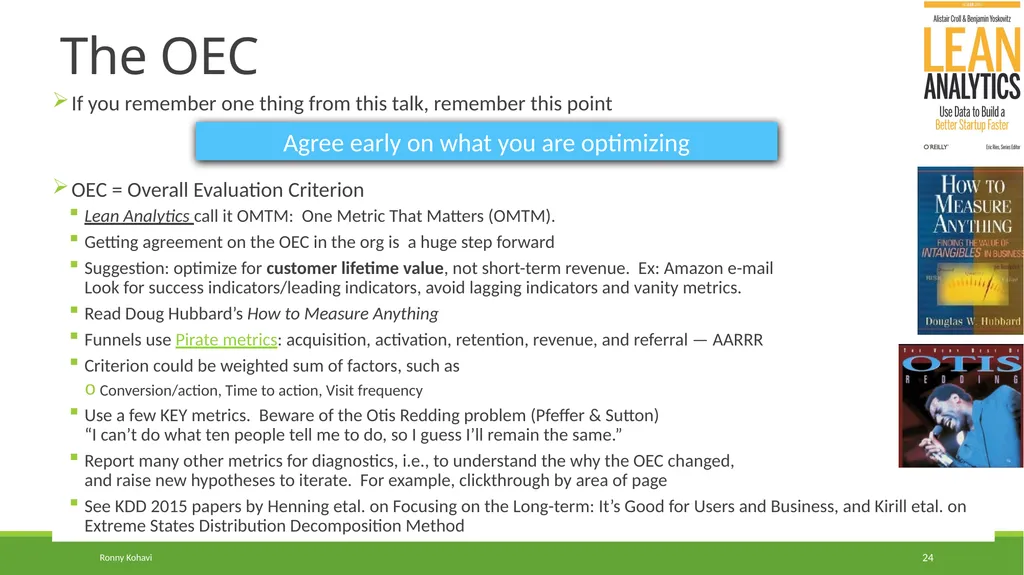
The OEC If you remember one thing from this talk, remember this point
OEC = Overall Evaluation Criterion
Lean Analytics call it OMTM: One Metric That Matters (OMTM).
Getting agreement on the OEC in the org is a huge step forward
Suggestion: optimize for customer lifetime value, not short-term revenue. Ex: Amazon e-mail Look for success indicators/leading indicators, avoid lagging indicators and vanity metrics.
Read Doug Hubbard’s How to Measure Anything
Funnels use Pirate metrics: acquisition, activation, retention, revenue, and referral — AARRR
Criterion could be weighted sum of factors, such as
Conversion/action, Time to action, Visit frequency
Use a few KEY metrics. Beware of the Otis Redding problem (Pfeffer & Sutton) “I can’t do what ten people tell me to do, so I guess I’ll remain the same.”
Report many other metrics for diagnostics, i.e., to understand the why the OEC changed, and raise new hypotheses to iterate. For example, clickthrough by area of page
See KDD 2015 papers by Henning etal. on Focusing on the Long-term: It’s Good for Users and Business, and Kirill etal. on Extreme States Distribution Decomposition Method Ronny Kohavi 24 Agree early on what you are optimizing<br>
OEC = Overall Evaluation Criterion
Lean Analytics call it OMTM: One Metric That Matters (OMTM).
Getting agreement on the OEC in the org is a huge step forward
Suggestion: optimize for customer lifetime value, not short-term revenue. Ex: Amazon e-mail Look for success indicators/leading indicators, avoid lagging indicators and vanity metrics.
Read Doug Hubbard’s How to Measure Anything
Funnels use Pirate metrics: acquisition, activation, retention, revenue, and referral — AARRR
Criterion could be weighted sum of factors, such as
Conversion/action, Time to action, Visit frequency
Use a few KEY metrics. Beware of the Otis Redding problem (Pfeffer & Sutton) “I can’t do what ten people tell me to do, so I guess I’ll remain the same.”
Report many other metrics for diagnostics, i.e., to understand the why the OEC changed, and raise new hypotheses to iterate. For example, clickthrough by area of page
See KDD 2015 papers by Henning etal. on Focusing on the Long-term: It’s Good for Users and Business, and Kirill etal. on Extreme States Distribution Decomposition Method Ronny Kohavi 24 Agree early on what you are optimizing<br>
25
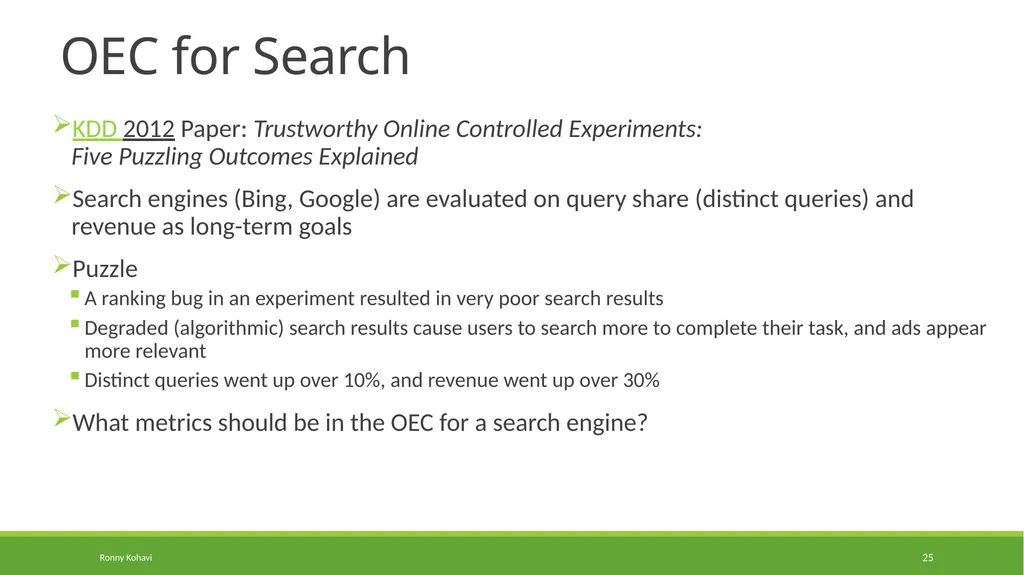
OEC for Search KDD 2012 Paper: Trustworthy Online Controlled Experiments:
Five Puzzling Outcomes Explained
Search engines (Bing, Google) are evaluated on query share (distinct queries) and revenue as long-term goals
Puzzle
A ranking bug in an experiment resulted in very poor search results
Degraded (algorithmic) search results cause users to search more to complete their task, and ads appear more relevant
Distinct queries went up over 10%, and revenue went up over 30%
What metrics should be in the OEC for a search engine? Ronny Kohavi 25<br>
Search engines (Bing, Google) are evaluated on query share (distinct queries) and revenue as long-term goals
Puzzle
A ranking bug in an experiment resulted in very poor search results
Degraded (algorithmic) search results cause users to search more to complete their task, and ads appear more relevant
Distinct queries went up over 10%, and revenue went up over 30%
What metrics should be in the OEC for a search engine? Ronny Kohavi 25<br>
26
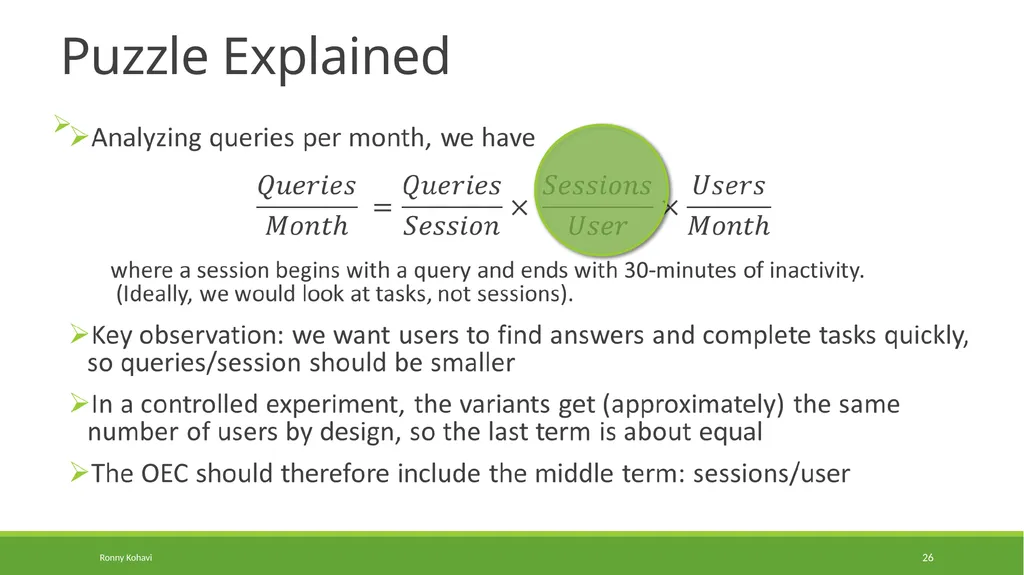
Puzzle Explained Ronny Kohavi 26<br>
27
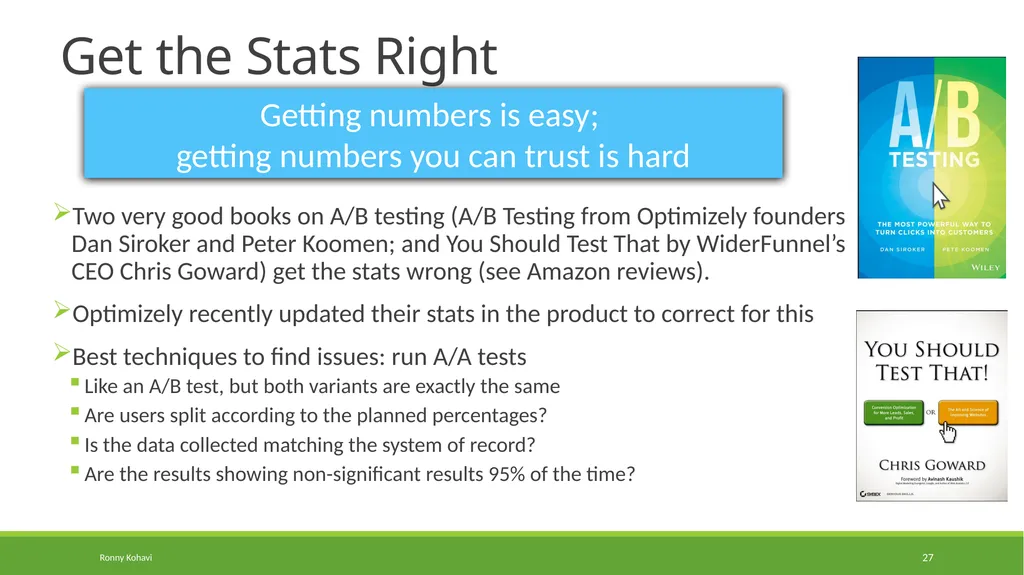
Get the Stats Right Two very good books on A/B testing (A/B Testing from Optimizely founders
Dan Siroker and Peter Koomen; and You Should Test That by WiderFunnel’s
CEO Chris Goward) get the stats wrong (see Amazon reviews).
Optimizely recently updated their stats in the product to correct for this
Best techniques to find issues: run A/A tests
Like an A/B test, but both variants are exactly the same
Are users split according to the planned percentages?
Is the data collected matching the system of record?
Are the results showing non-significant results 95% of the time? Ronny Kohavi 27 Getting numbers is easy; getting numbers you can trust is hard<br>
Optimizely recently updated their stats in the product to correct for this
Best techniques to find issues: run A/A tests
Like an A/B test, but both variants are exactly the same
Are users split according to the planned percentages?
Is the data collected matching the system of record?
Are the results showing non-significant results 95% of the time? Ronny Kohavi 27 Getting numbers is easy; getting numbers you can trust is hard<br>
28
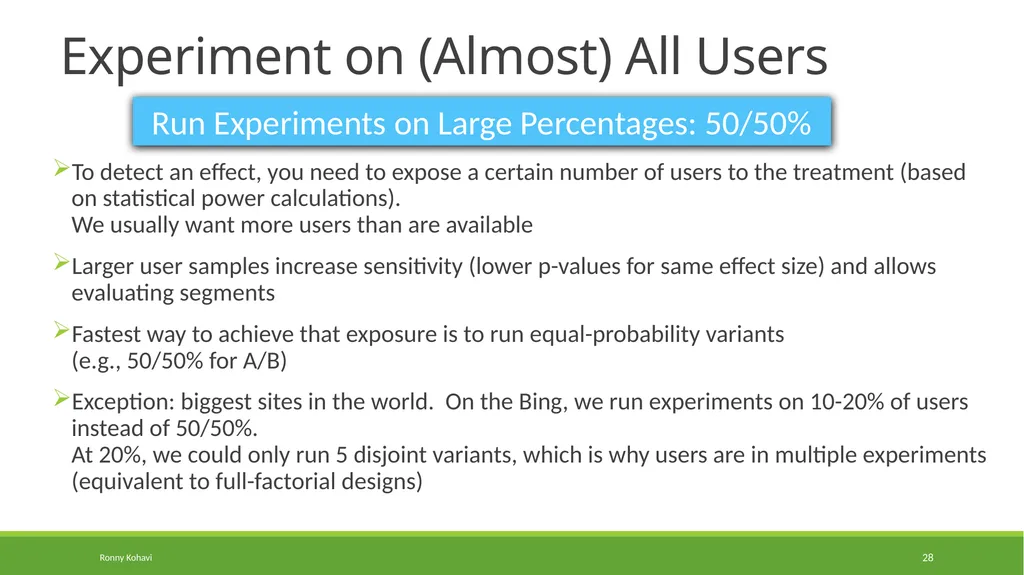
Experiment on (Almost) All Users To detect an effect, you need to expose a certain number of users to the treatment (based on statistical power calculations).
We usually want more users than are available
Larger user samples increase sensitivity (lower p-values for same effect size) and allows evaluating segments
Fastest way to achieve that exposure is to run equal-probability variants (e.g., 50/50% for A/B)
Exception: biggest sites in the world. On the Bing, we run experiments on 10-20% of users instead of 50/50%. At 20%, we could only run 5 disjoint variants, which is why users are in multiple experiments (equivalent to full-factorial designs) Ronny Kohavi 28 Run Experiments on Large Percentages: 50/50%<br>
Larger user samples increase sensitivity (lower p-values for same effect size) and allows evaluating segments
Fastest way to achieve that exposure is to run equal-probability variants (e.g., 50/50% for A/B)
Exception: biggest sites in the world. On the Bing, we run experiments on 10-20% of users instead of 50/50%. At 20%, we could only run 5 disjoint variants, which is why users are in multiple experiments (equivalent to full-factorial designs) Ronny Kohavi 28 Run Experiments on Large Percentages: 50/50%<br>
29
Reduce the Variance of Metrics At Bing, 1% change in the revenue/user in an experiment = tens of millions/year
If we run an experiment that can only detect 1% change, we might lose tens of millions without realizing it! Before shipping a feature, a sufficiently large experiment must run
To improve sensitivity of experiments, you can either get more users or reduce the variance of metrics
Good techniques for reducing the variance of metrics
Triggering: analyze only users who were actually exposed to change. Important sanity check: the complement users should look like an A/A experiment
Use lower-variance metrics (e.g., trim revenue, or look at Boolean metrics like conversion rate vs. revenue; see paper Section 3.2.1)
Use pre-experiment period: before the experiment started, there was no difference between the control and treatment. We can use the deltas in the pre-experiment period to reduce the variance. Nice trick called CUPED
Rejecting randomizations that fail the pre-experiment A/A test (see paper Section 3.5). When you start an experiment, you generate a random hash function to distribute users to variants. If you look back in time (before the experiment started), does the pre-experiment split look like an A/A? In the Mastering ‘Metrics book, they call it “checking for balance.” We automated it and try multiple “seeds” to optimize the balance in the randomization Ronny Kohavi 29<br>
To improve sensitivity of experiments, you can either get more users or reduce the variance of metrics
Good techniques for reducing the variance of metrics
Triggering: analyze only users who were actually exposed to change. Important sanity check: the complement users should look like an A/A experiment
Use lower-variance metrics (e.g., trim revenue, or look at Boolean metrics like conversion rate vs. revenue; see paper Section 3.2.1)
Use pre-experiment period: before the experiment started, there was no difference between the control and treatment. We can use the deltas in the pre-experiment period to reduce the variance. Nice trick called CUPED
Rejecting randomizations that fail the pre-experiment A/A test (see paper Section 3.5). When you start an experiment, you generate a random hash function to distribute users to variants. If you look back in time (before the experiment started), does the pre-experiment split look like an A/A? In the Mastering ‘Metrics book, they call it “checking for balance.” We automated it and try multiple “seeds” to optimize the balance in the randomization Ronny Kohavi 29<br>
30
Online is Different than Offline The theory of controlled experiments was formalized by Sir Ronald A. Fisher’s in the 1920s, but as the saying goes
The difference between theory and practice is larger in practice than the difference between theory and practice in theory
Key differences from Offline to Online
Ramp-up: tens of experiments start every day at Bing, but initial code tends to be buggy.
Experiments start small, the system looks for egregious effects, and if there’s a problem, it shuts down the experiment automatically;
Conversely, if there are no alerts, it ramps up automatically to a large percentage
Massive data logged: tens of terabytes per day, thousands of attributes for every page shown
Data quality challenges, big data challenges
New metrics created every week (although OEC stays stable)
False positives issues and multiple testing (scale paper). Replication is key. Credit is assigned by running a reverse/holdback experiment (ship, test in reverse) Ronny Kohavi 30<br>
The difference between theory and practice is larger in practice than the difference between theory and practice in theory
Key differences from Offline to Online
Ramp-up: tens of experiments start every day at Bing, but initial code tends to be buggy.
Experiments start small, the system looks for egregious effects, and if there’s a problem, it shuts down the experiment automatically;
Conversely, if there are no alerts, it ramps up automatically to a large percentage
Massive data logged: tens of terabytes per day, thousands of attributes for every page shown
Data quality challenges, big data challenges
New metrics created every week (although OEC stays stable)
False positives issues and multiple testing (scale paper). Replication is key. Credit is assigned by running a reverse/holdback experiment (ship, test in reverse) Ronny Kohavi 30<br>
31
Online is Different than Offline (2) Key differences from Offline to Online (cont)
Click instrumentation is either reliable or fast (but not both; see paper)
Bots can cause significant skews. At Bing over 50% of traffic is bot generated!
Beware of carryover effects: segments of users exposed to a bad experience will carry over to the next experiment. Shuffle users all the time (easy for backend experiments; harder in UX)
Performance matters a lot! We run “slowdown” experiments.
A Bing engineer that improves server performance by 10msec (that’s 1/30 of the speed that our eyes blink) more than pays for his fully-loaded annual costs.
Every millisecond counts Ronny Kohavi 31<br>
Click instrumentation is either reliable or fast (but not both; see paper)
Bots can cause significant skews. At Bing over 50% of traffic is bot generated!
Beware of carryover effects: segments of users exposed to a bad experience will carry over to the next experiment. Shuffle users all the time (easy for backend experiments; harder in UX)
Performance matters a lot! We run “slowdown” experiments.
A Bing engineer that improves server performance by 10msec (that’s 1/30 of the speed that our eyes blink) more than pays for his fully-loaded annual costs.
Every millisecond counts Ronny Kohavi 31<br>
32
The Cultural Challenge Why people/orgs avoid controlled experiments
Some believe it threatens their job as decision makers
At Microsoft, program managers select the next set of features to develop. Proposing several alternatives and admitting you don’t know which is best is hard
Editors and designers get paid to select a great design
Failures of ideas may hurt image and professional standing. It’s easier to declare success when the feature launches
We’ve heard: “we know what to do. It’s in our DNA,” and “why don’t we just do the right thing?”
The next few slides show a four-step cultural progression towards becoming data-driven Ronny Kohavi 32 It is difficult to get a man to understand something when his salary depends upon his not understanding it. -- Upton Sinclair<br>
Some believe it threatens their job as decision makers
At Microsoft, program managers select the next set of features to develop. Proposing several alternatives and admitting you don’t know which is best is hard
Editors and designers get paid to select a great design
Failures of ideas may hurt image and professional standing. It’s easier to declare success when the feature launches
We’ve heard: “we know what to do. It’s in our DNA,” and “why don’t we just do the right thing?”
The next few slides show a four-step cultural progression towards becoming data-driven Ronny Kohavi 32 It is difficult to get a man to understand something when his salary depends upon his not understanding it. -- Upton Sinclair<br>
33
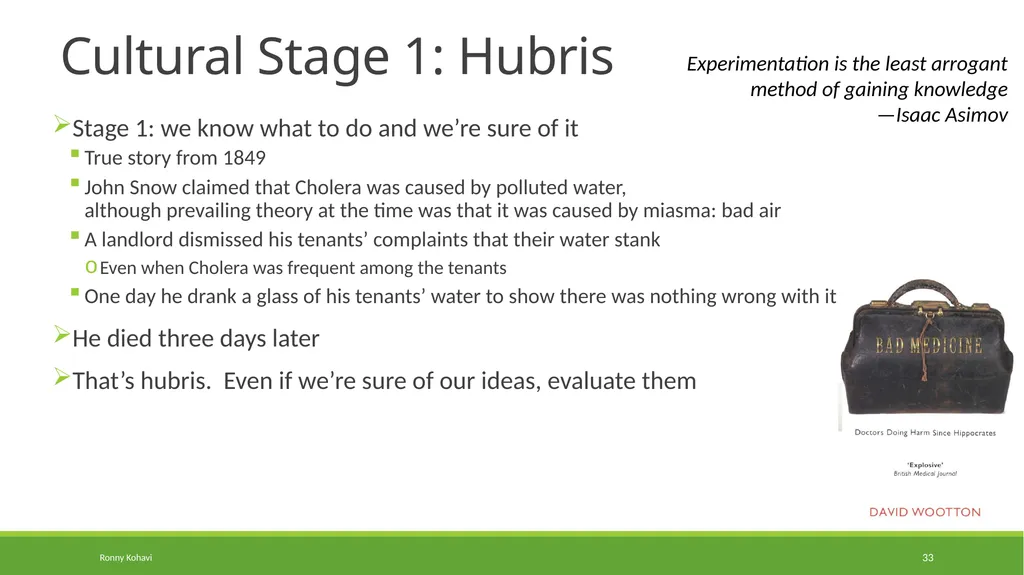
Cultural Stage 1: Hubris Stage 1: we know what to do and we’re sure of it
True story from 1849
John Snow claimed that Cholera was caused by polluted water, although prevailing theory at the time was that it was caused by miasma: bad air
A landlord dismissed his tenants’ complaints that their water stank
Even when Cholera was frequent among the tenants
One day he drank a glass of his tenants’ water to show there was nothing wrong with it
He died three days later
That’s hubris. Even if we’re sure of our ideas, evaluate them Ronny Kohavi 33 Experimentation is the least arrogant method of gaining knowledge
—Isaac Asimov<br>
True story from 1849
John Snow claimed that Cholera was caused by polluted water, although prevailing theory at the time was that it was caused by miasma: bad air
A landlord dismissed his tenants’ complaints that their water stank
Even when Cholera was frequent among the tenants
One day he drank a glass of his tenants’ water to show there was nothing wrong with it
He died three days later
That’s hubris. Even if we’re sure of our ideas, evaluate them Ronny Kohavi 33 Experimentation is the least arrogant method of gaining knowledge
—Isaac Asimov<br>
34
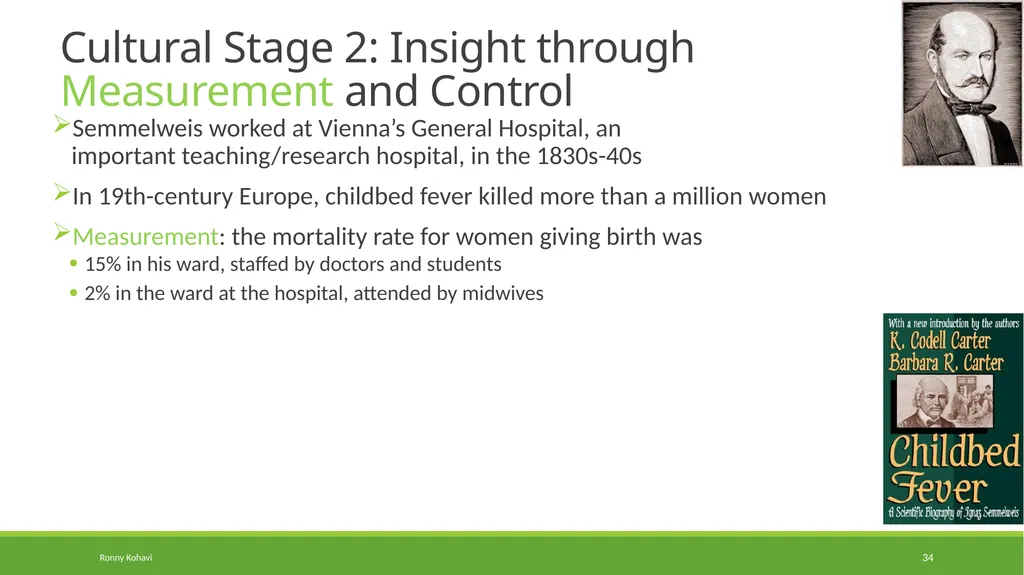
Cultural Stage 2: Insight through
Measurement and Control Semmelweis worked at Vienna’s General Hospital, an
important teaching/research hospital, in the 1830s-40s
In 19th-century Europe, childbed fever killed more than a million women
Measurement: the mortality rate for women giving birth was
15% in his ward, staffed by doctors and students
2% in the ward at the hospital, attended by midwives Ronny Kohavi 34<br>
In 19th-century Europe, childbed fever killed more than a million women
Measurement: the mortality rate for women giving birth was
15% in his ward, staffed by doctors and students
2% in the ward at the hospital, attended by midwives Ronny Kohavi 34<br>
35
Cultural Stage 2: Insight through
Measurement and Control He tries to control all differences
Birthing positions, ventilation, diet, even the way laundry was done
He was away for 4 months and death rate fell significantly when he was away. Could it be related to him?
Insight:
Doctors were performing autopsies each morning on cadavers
Conjecture: particles (called germs today) were being transmitted to healthy patients on the hands of the physicians
He experiments with cleansing agents
Chlorine and lime was effective: death rate fell from 18% to 1% Ronny Kohavi 35<br>
Birthing positions, ventilation, diet, even the way laundry was done
He was away for 4 months and death rate fell significantly when he was away. Could it be related to him?
Insight:
Doctors were performing autopsies each morning on cadavers
Conjecture: particles (called germs today) were being transmitted to healthy patients on the hands of the physicians
He experiments with cleansing agents
Chlorine and lime was effective: death rate fell from 18% to 1% Ronny Kohavi 35<br>
36
Cultural Stage 3: Semmelweis Reflex Success? No! Disbelief. Where/what are these particles?
Semmelweis was dropped from his post at the hospital
He goes to Hungary and reduced mortality rate in obstetrics to 0.85%
His student published a paper about the success. The editor wrote
We believe that this chlorine-washing theory has long outlived its usefulness… It is time we are no longer to be deceived by this theory
In 1865, he suffered a nervous breakdown and was beaten at a mental hospital, where he died
Semmelweis Reflex is a reflex-like rejection of new knowledge because it contradicts entrenched norms, beliefs or paradigms
Only in 1800s? No! A 2005 study: inadequate hand washing is one of the prime contributors to the 2 million health-care-associated infections and 90,000 related deaths annually in the United States Ronny Kohavi 36<br>
Semmelweis was dropped from his post at the hospital
He goes to Hungary and reduced mortality rate in obstetrics to 0.85%
His student published a paper about the success. The editor wrote
We believe that this chlorine-washing theory has long outlived its usefulness… It is time we are no longer to be deceived by this theory
In 1865, he suffered a nervous breakdown and was beaten at a mental hospital, where he died
Semmelweis Reflex is a reflex-like rejection of new knowledge because it contradicts entrenched norms, beliefs or paradigms
Only in 1800s? No! A 2005 study: inadequate hand washing is one of the prime contributors to the 2 million health-care-associated infections and 90,000 related deaths annually in the United States Ronny Kohavi 36<br>
37
Cultural Stage 4: Fundamental Understanding In 1879, Louis Pasteur showed the presence of Streptococcus in the blood of women with child fever
2008, 143 years after he died, a 50 Euro coin commemorating Semmelweis was issued Ronny Kohavi 37<br>
2008, 143 years after he died, a 50 Euro coin commemorating Semmelweis was issued Ronny Kohavi 37<br>
38
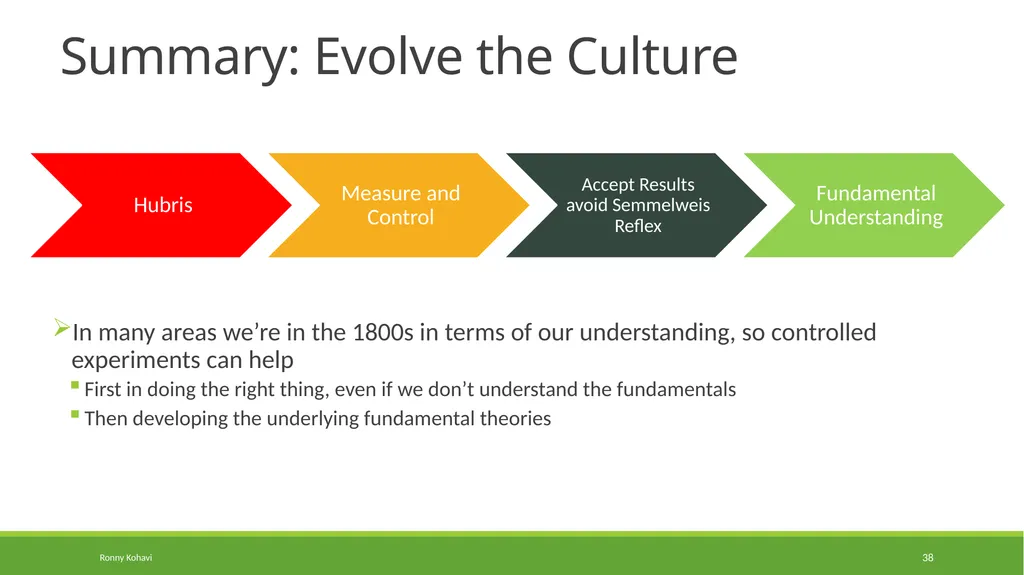
Summary: Evolve the Culture In many areas we’re in the 1800s in terms of our understanding, so controlled experiments can help
First in doing the right thing, even if we don’t understand the fundamentals
Then developing the underlying fundamental theories Ronny Kohavi 38 Hippos kill more humans than any other (non-human) mammal (really)<br>
First in doing the right thing, even if we don’t understand the fundamentals
Then developing the underlying fundamental theories Ronny Kohavi 38 Hippos kill more humans than any other (non-human) mammal (really)<br>
39
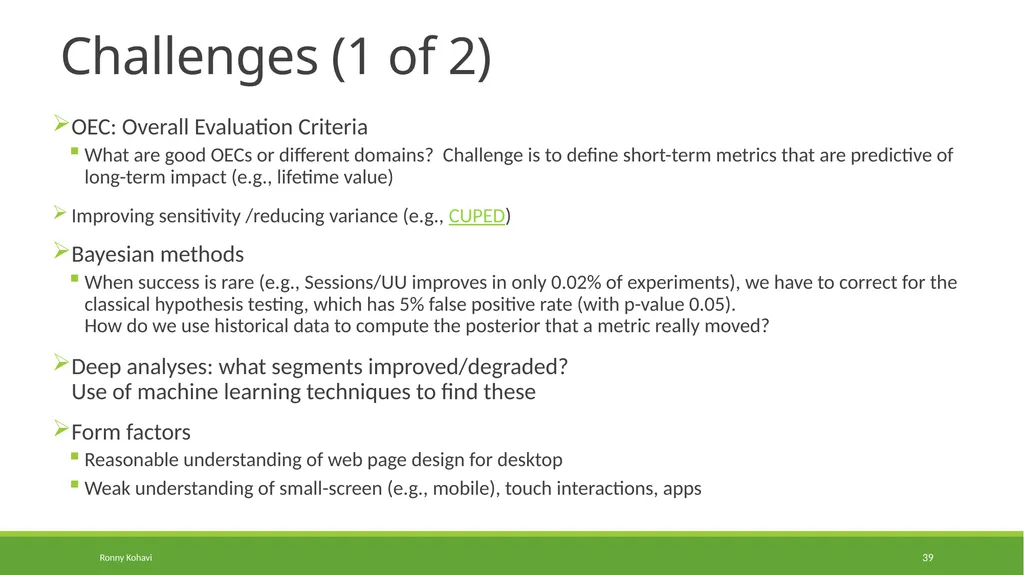
Challenges (1 of 2) OEC: Overall Evaluation Criteria
What are good OECs or different domains? Challenge is to define short-term metrics that are predictive of long-term impact (e.g., lifetime value)
Improving sensitivity /reducing variance (e.g., CUPED)
Bayesian methods
When success is rare (e.g., Sessions/UU improves in only 0.02% of experiments), we have to correct for the classical hypothesis testing, which has 5% false positive rate (with p-value 0.05). How do we use historical data to compute the posterior that a metric really moved?
Deep analyses: what segments improved/degraded? Use of machine learning techniques to find these
Form factors
Reasonable understanding of web page design for desktop
Weak understanding of small-screen (e.g., mobile), touch interactions, apps Ronny Kohavi 39<br>
What are good OECs or different domains? Challenge is to define short-term metrics that are predictive of long-term impact (e.g., lifetime value)
Improving sensitivity /reducing variance (e.g., CUPED)
Bayesian methods
When success is rare (e.g., Sessions/UU improves in only 0.02% of experiments), we have to correct for the classical hypothesis testing, which has 5% false positive rate (with p-value 0.05). How do we use historical data to compute the posterior that a metric really moved?
Deep analyses: what segments improved/degraded? Use of machine learning techniques to find these
Form factors
Reasonable understanding of web page design for desktop
Weak understanding of small-screen (e.g., mobile), touch interactions, apps Ronny Kohavi 39<br>
40
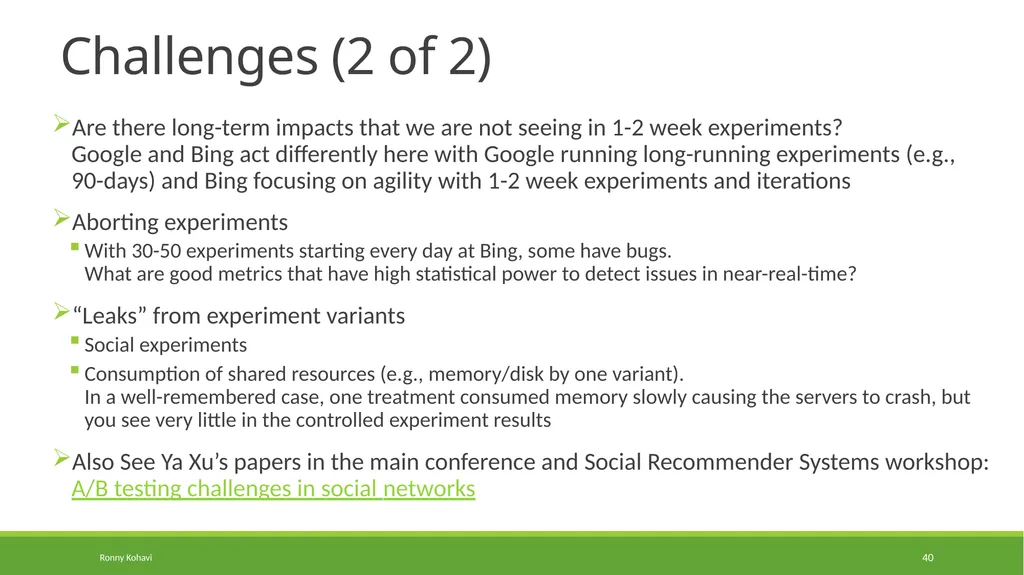
Challenges (2 of 2) Are there long-term impacts that we are not seeing in 1-2 week experiments?
Google and Bing act differently here with Google running long-running experiments (e.g., 90-days) and Bing focusing on agility with 1-2 week experiments and iterations
Aborting experiments
With 30-50 experiments starting every day at Bing, some have bugs. What are good metrics that have high statistical power to detect issues in near-real-time?
“Leaks” from experiment variants
Social experiments
Consumption of shared resources (e.g., memory/disk by one variant). In a well-remembered case, one treatment consumed memory slowly causing the servers to crash, but you see very little in the controlled experiment results
Also See Ya Xu’s papers in the main conference and Social Recommender Systems workshop: A/B testing challenges in social networks Ronny Kohavi 40<br>
Aborting experiments
With 30-50 experiments starting every day at Bing, some have bugs. What are good metrics that have high statistical power to detect issues in near-real-time?
“Leaks” from experiment variants
Social experiments
Consumption of shared resources (e.g., memory/disk by one variant). In a well-remembered case, one treatment consumed memory slowly causing the servers to crash, but you see very little in the controlled experiment results
Also See Ya Xu’s papers in the main conference and Social Recommender Systems workshop: A/B testing challenges in social networks Ronny Kohavi 40<br>
41
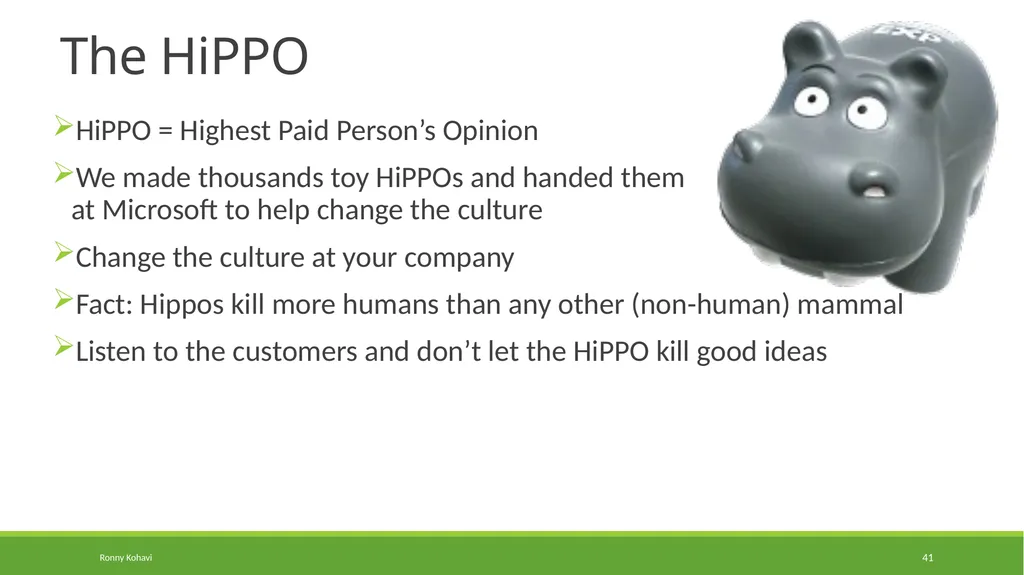
The HiPPO HiPPO = Highest Paid Person’s Opinion
We made thousands toy HiPPOs and handed them at Microsoft to help change the culture
Change the culture at your company
Fact: Hippos kill more humans than any other (non-human) mammal
Listen to the customers and don’t let the HiPPO kill good ideas Ronny Kohavi 41<br>
We made thousands toy HiPPOs and handed them at Microsoft to help change the culture
Change the culture at your company
Fact: Hippos kill more humans than any other (non-human) mammal
Listen to the customers and don’t let the HiPPO kill good ideas Ronny Kohavi 41<br>
42
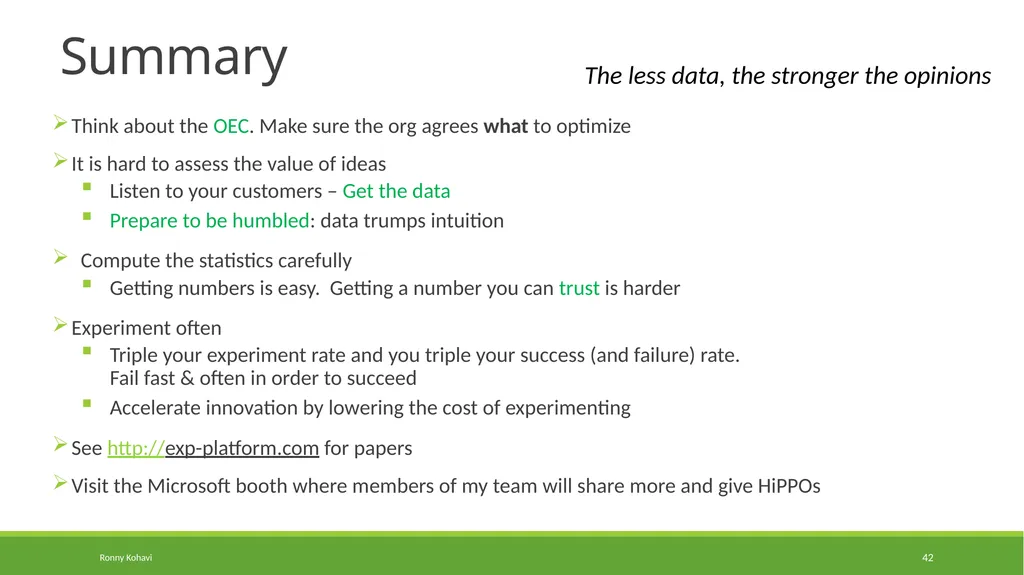
Summary Think about the OEC. Make sure the org agrees what to optimize
It is hard to assess the value of ideas
Listen to your customers – Get the data
Prepare to be humbled: data trumps intuition
Compute the statistics carefully
Getting numbers is easy. Getting a number you can trust is harder
Experiment often
Triple your experiment rate and you triple your success (and failure) rate. Fail fast & often in order to succeed
Accelerate innovation by lowering the cost of experimenting
See http://exp-platform.com for papers
Visit the Microsoft booth where members of my team will share more and give HiPPOs Ronny Kohavi 42 The less data, the stronger the opinions<br>
It is hard to assess the value of ideas
Listen to your customers – Get the data
Prepare to be humbled: data trumps intuition
Compute the statistics carefully
Getting numbers is easy. Getting a number you can trust is harder
Experiment often
Triple your experiment rate and you triple your success (and failure) rate. Fail fast & often in order to succeed
Accelerate innovation by lowering the cost of experimenting
See http://exp-platform.com for papers
Visit the Microsoft booth where members of my team will share more and give HiPPOs Ronny Kohavi 42 The less data, the stronger the opinions<br>
43
Extra Slides Ronny Kohavi 43<br>
44
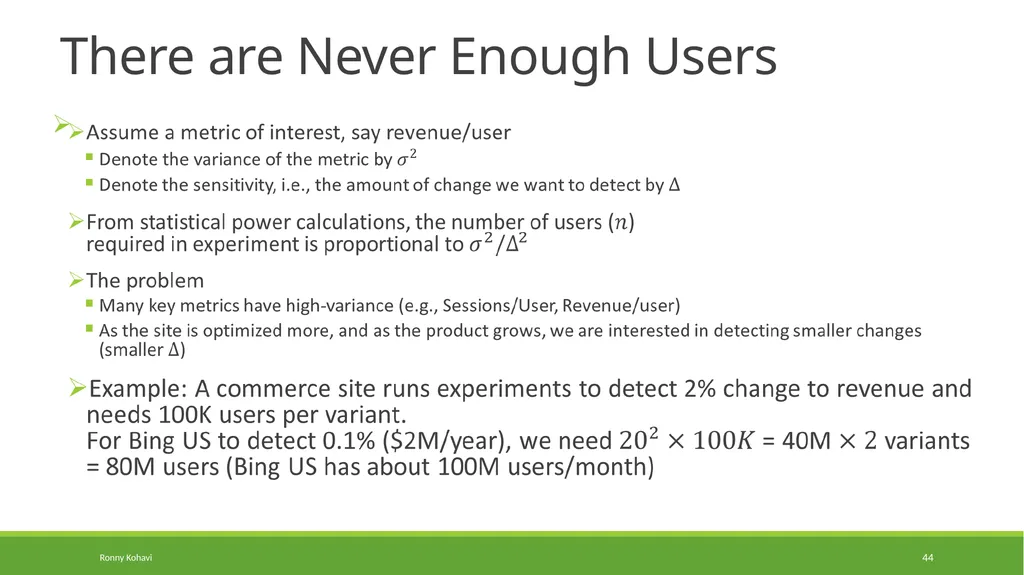
There are Never Enough Users Ronny Kohavi 44<br>