
Open Science the new “modus operandi” for research
LO
Published · 14 slides · 0 views
1 / 1

Description
Open Science the new modus operandi for research ESFRI Science Clusters Long Term Commitments to Open Science 11 June 2021 Kostas GLINOS Head of Open Science RTD.G4 Directorate-General for Research and Innovation European Commission To
Related Topics
Share
Embed code
Download this presentation From Below
"Open Science the new “modus operandi” for research" is the property of its rightful owner. Permission is granted to download and print the materials on this website for personal, non-commercial use only, and to display it on your personal computer provided you do not modify the materials and that you retain all copyright notices contained in the materials. By downloading content from our website, you accept the terms of this agreement.
Presentation Transcript
01
Open Science
the new “modus operandi” for research ESFRI Science Clusters' Long Term Commitments to Open Science
11 June 2021 Kostas GLINOS
Head of Open Science RTD.G4
Directorate-General for Research and Innovation
European Commission<br>
Head of Open Science RTD.G4
Directorate-General for Research and Innovation
European Commission<br>
02
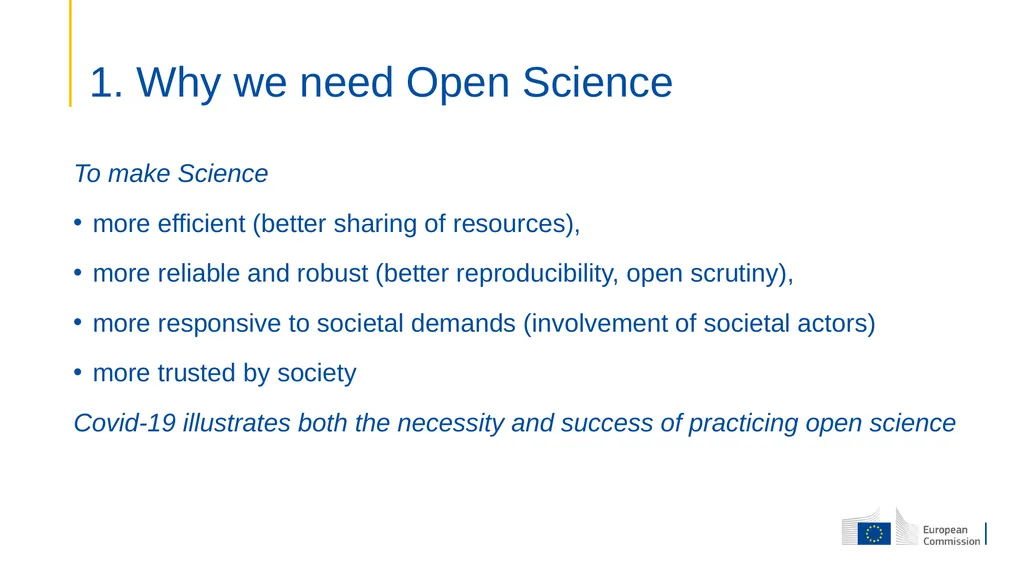
To make Science
more efficient (better sharing of resources),
more reliable and robust (better reproducibility, open scrutiny),
more responsive to societal demands (involvement of societal actors)
more trusted by society
Covid-19 illustrates both the necessity and success of practicing open science 1. Why we need Open Science<br>
more efficient (better sharing of resources),
more reliable and robust (better reproducibility, open scrutiny),
more responsive to societal demands (involvement of societal actors)
more trusted by society
Covid-19 illustrates both the necessity and success of practicing open science 1. Why we need Open Science<br>
03
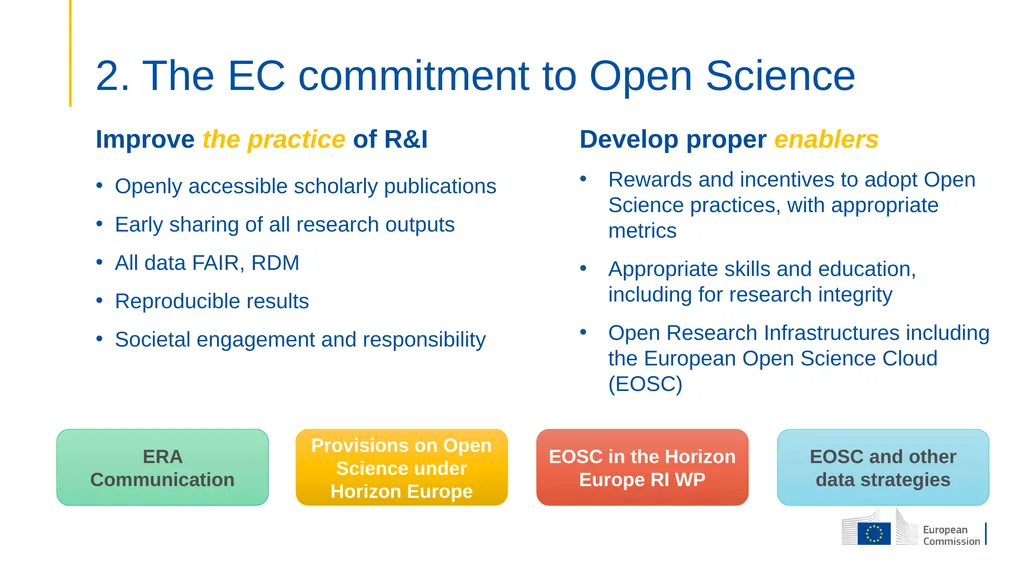
2. The EC commitment to Open Science Improve the practice of R&I
Openly accessible scholarly publications
Early sharing of all research outputs
All data FAIR, RDM
Reproducible results
Societal engagement and responsibility Develop proper enablers
Rewards and incentives to adopt Open Science practices, with appropriate metrics
Appropriate skills and education, including for research integrity
Open Research Infrastructures including the European Open Science Cloud (EOSC) ERA Communication Provisions on Open Science under Horizon Europe EOSC in the Horizon Europe RI WP EOSC and other data strategies<br>
Openly accessible scholarly publications
Early sharing of all research outputs
All data FAIR, RDM
Reproducible results
Societal engagement and responsibility Develop proper enablers
Rewards and incentives to adopt Open Science practices, with appropriate metrics
Appropriate skills and education, including for research integrity
Open Research Infrastructures including the European Open Science Cloud (EOSC) ERA Communication Provisions on Open Science under Horizon Europe EOSC in the Horizon Europe RI WP EOSC and other data strategies<br>
04
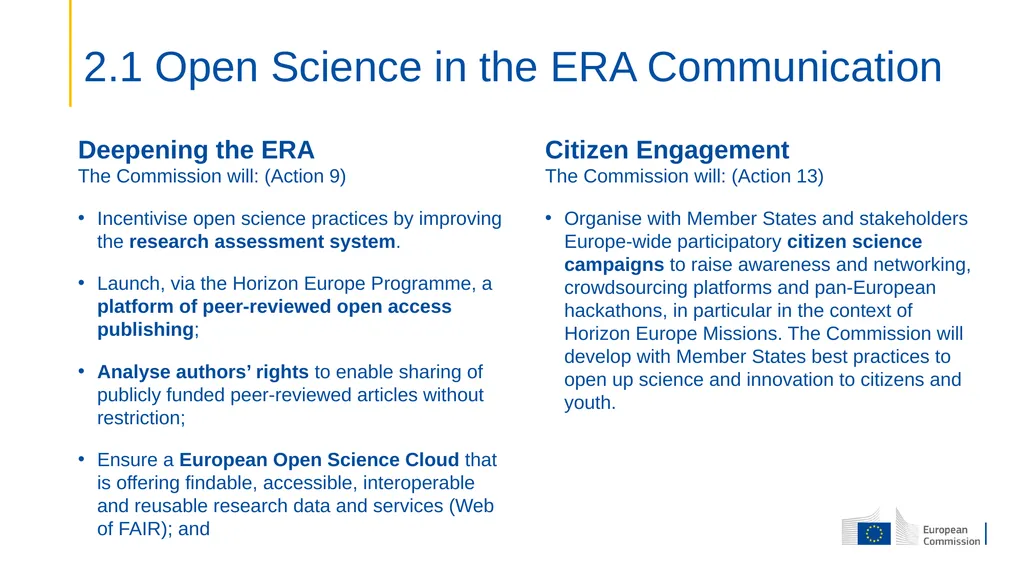
Deepening the ERA
The Commission will: (Action 9)
Incentivise open science practices by improving the research assessment system.
Launch, via the Horizon Europe Programme, a platform of peer-reviewed open access publishing;
Analyse authors’ rights to enable sharing of publicly funded peer-reviewed articles without restriction;
Ensure a European Open Science Cloud that is offering findable, accessible, interoperable and reusable research data and services (Web of FAIR); and Citizen Engagement The Commission will: (Action 13)
Organise with Member States and stakeholders Europe-wide participatory citizen science campaigns to raise awareness and networking, crowdsourcing platforms and pan-European hackathons, in particular in the context of Horizon Europe Missions. The Commission will develop with Member States best practices to open up science and innovation to citizens and youth. 2.1 Open Science in the ERA Communication<br>
Incentivise open science practices by improving the research assessment system.
Launch, via the Horizon Europe Programme, a platform of peer-reviewed open access publishing;
Analyse authors’ rights to enable sharing of publicly funded peer-reviewed articles without restriction;
Ensure a European Open Science Cloud that is offering findable, accessible, interoperable and reusable research data and services (Web of FAIR); and Citizen Engagement The Commission will: (Action 13)
Organise with Member States and stakeholders Europe-wide participatory citizen science campaigns to raise awareness and networking, crowdsourcing platforms and pan-European hackathons, in particular in the context of Horizon Europe Missions. The Commission will develop with Member States best practices to open up science and innovation to citizens and youth. 2.1 Open Science in the ERA Communication<br>
05
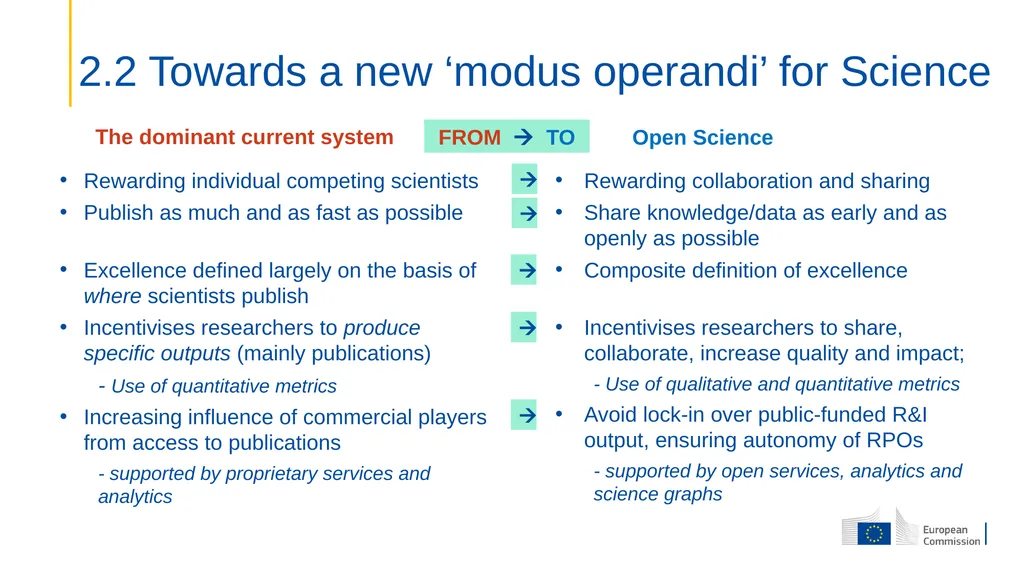
2.2 Towards a new ‘modus operandi’ for Science The dominant current system
Rewarding individual competing scientists
Publish as much and as fast as possible
Excellence defined largely on the basis of where scientists publish
Incentivises researchers to produce specific outputs (mainly publications)
- Use of quantitative metrics
Increasing influence of commercial players from access to publications
- supported by proprietary services and analytics Open Science
Rewarding collaboration and sharing
Share knowledge/data as early and as openly as possible
Composite definition of excellence
Incentivises researchers to share, collaborate, increase quality and impact;
- Use of qualitative and quantitative metrics
Avoid lock-in over public-funded R&I output, ensuring autonomy of RPOs
- supported by open services, analytics and science graphs FROM TO <br>
Rewarding individual competing scientists
Publish as much and as fast as possible
Excellence defined largely on the basis of where scientists publish
Incentivises researchers to produce specific outputs (mainly publications)
- Use of quantitative metrics
Increasing influence of commercial players from access to publications
- supported by proprietary services and analytics Open Science
Rewarding collaboration and sharing
Share knowledge/data as early and as openly as possible
Composite definition of excellence
Incentivises researchers to share, collaborate, increase quality and impact;
- Use of qualitative and quantitative metrics
Avoid lock-in over public-funded R&I output, ensuring autonomy of RPOs
- supported by open services, analytics and science graphs FROM TO <br>
06
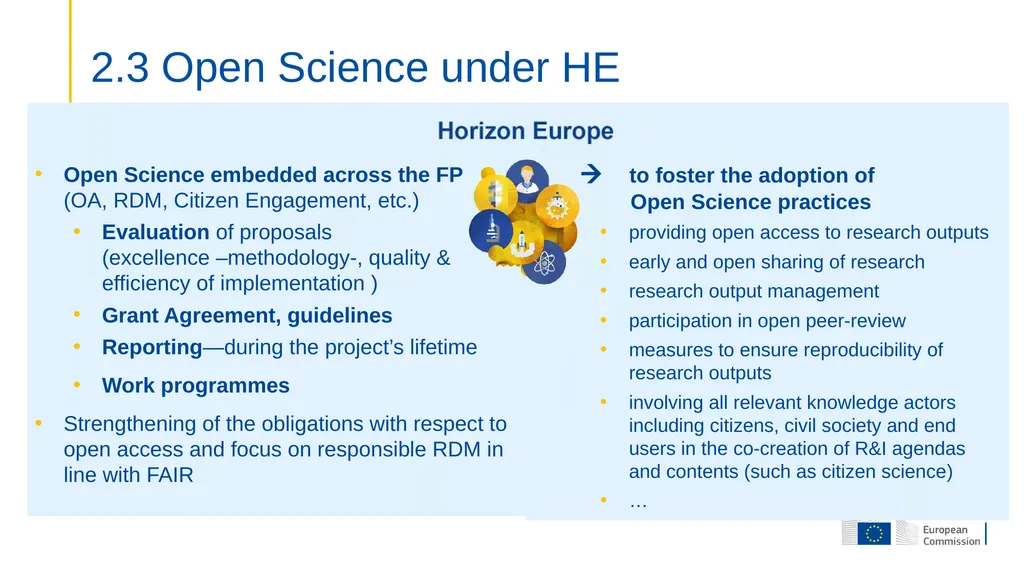
2.3 Open Science under HE Open Science embedded across the FP
(OA, RDM, Citizen Engagement, etc.)
Evaluation of proposals (excellence –methodology-, quality & efficiency of implementation )
Grant Agreement, guidelines
Reporting—during the project’s lifetime
Work programmes
Strengthening of the obligations with respect to open access and focus on responsible RDM in line with FAIR to foster the adoption of Open Science practices
providing open access to research outputs
early and open sharing of research
research output management
participation in open peer-review
measures to ensure reproducibility of research outputs
involving all relevant knowledge actors including citizens, civil society and end users in the co-creation of R&I agendas and contents (such as citizen science)
…<br>
Evaluation of proposals (excellence –methodology-, quality & efficiency of implementation )
Grant Agreement, guidelines
Reporting—during the project’s lifetime
Work programmes
Strengthening of the obligations with respect to open access and focus on responsible RDM in line with FAIR to foster the adoption of Open Science practices
providing open access to research outputs
early and open sharing of research
research output management
participation in open peer-review
measures to ensure reproducibility of research outputs
involving all relevant knowledge actors including citizens, civil society and end users in the co-creation of R&I agendas and contents (such as citizen science)
…<br>
07
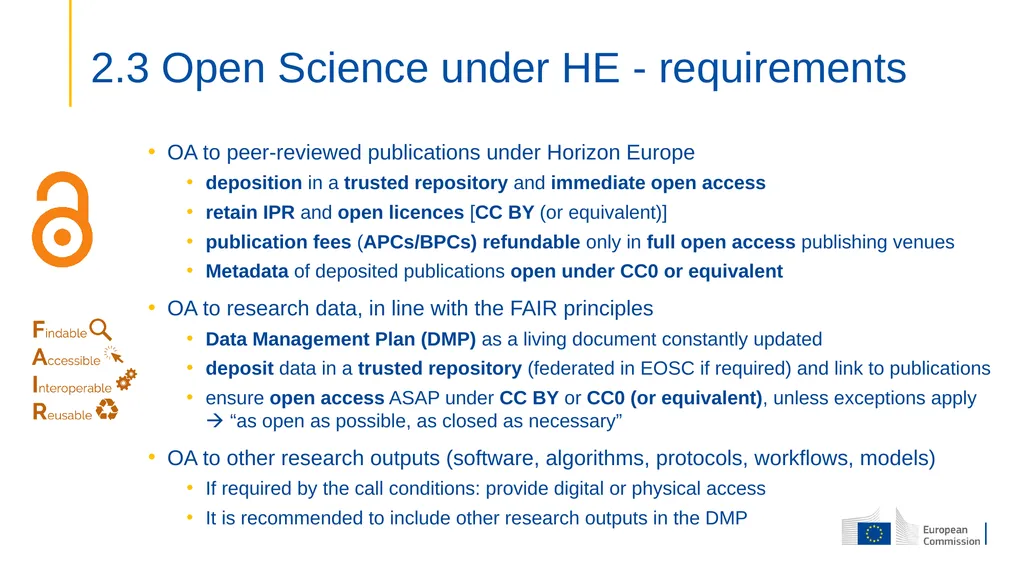
OA to peer-reviewed publications under Horizon Europe
deposition in a trusted repository and immediate open access
retain IPR and open licences [CC BY (or equivalent)]
publication fees (APCs/BPCs) refundable only in full open access publishing venues
Metadata of deposited publications open under CC0 or equivalent
OA to research data, in line with the FAIR principles
Data Management Plan (DMP) as a living document constantly updated
deposit data in a trusted repository (federated in EOSC if required) and link to publications
ensure open access ASAP under CC BY or CC0 (or equivalent), unless exceptions apply “as open as possible, as closed as necessary”
OA to other research outputs (software, algorithms, protocols, workflows, models)
If required by the call conditions: provide digital or physical access
It is recommended to include other research outputs in the DMP 2.3 Open Science under HE - requirements<br>
deposition in a trusted repository and immediate open access
retain IPR and open licences [CC BY (or equivalent)]
publication fees (APCs/BPCs) refundable only in full open access publishing venues
Metadata of deposited publications open under CC0 or equivalent
OA to research data, in line with the FAIR principles
Data Management Plan (DMP) as a living document constantly updated
deposit data in a trusted repository (federated in EOSC if required) and link to publications
ensure open access ASAP under CC BY or CC0 (or equivalent), unless exceptions apply “as open as possible, as closed as necessary”
OA to other research outputs (software, algorithms, protocols, workflows, models)
If required by the call conditions: provide digital or physical access
It is recommended to include other research outputs in the DMP 2.3 Open Science under HE - requirements<br>
08
through the EOSC European
Co-Programmed partnership European Open Science Could
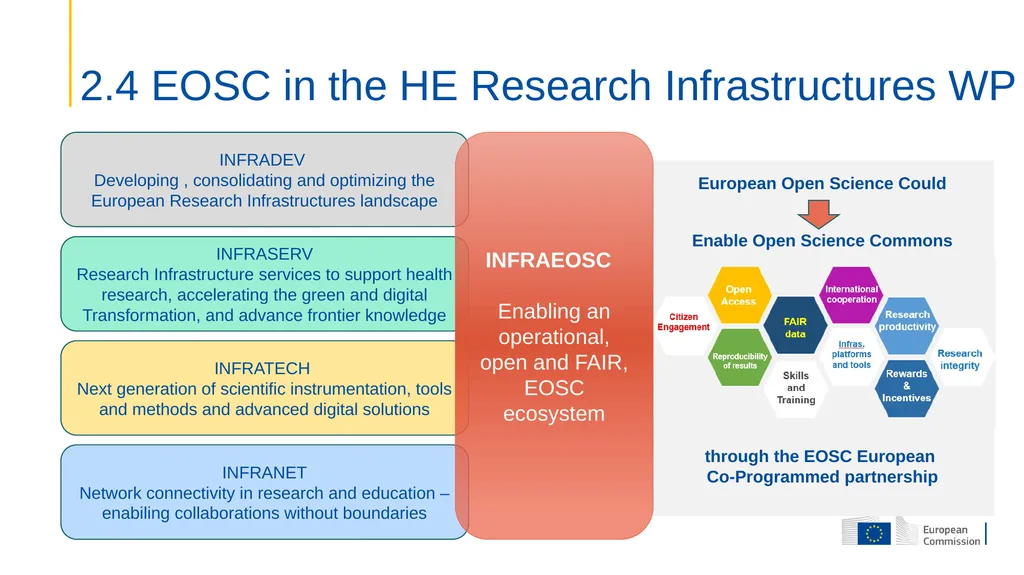
Enable Open Science Commons 2.4 EOSC in the HE Research Infrastructures WP INFRADEV Developing , consolidating and optimizing the European Research Infrastructures landscape INFRASERV Research Infrastructure services to support health research, accelerating the green and digital Transformation, and advance frontier knowledge INFRATECH Next generation of scientific instrumentation, tools and methods and advanced digital solutions INFRANET Network connectivity in research and education – enabiling collaborations without boundaries INFRAEOSC Enabling an operational, open and FAIR, EOSC ecosystem<br>
Enable Open Science Commons 2.4 EOSC in the HE Research Infrastructures WP INFRADEV Developing , consolidating and optimizing the European Research Infrastructures landscape INFRASERV Research Infrastructure services to support health research, accelerating the green and digital Transformation, and advance frontier knowledge INFRATECH Next generation of scientific instrumentation, tools and methods and advanced digital solutions INFRANET Network connectivity in research and education – enabiling collaborations without boundaries INFRAEOSC Enabling an operational, open and FAIR, EOSC ecosystem<br>
09
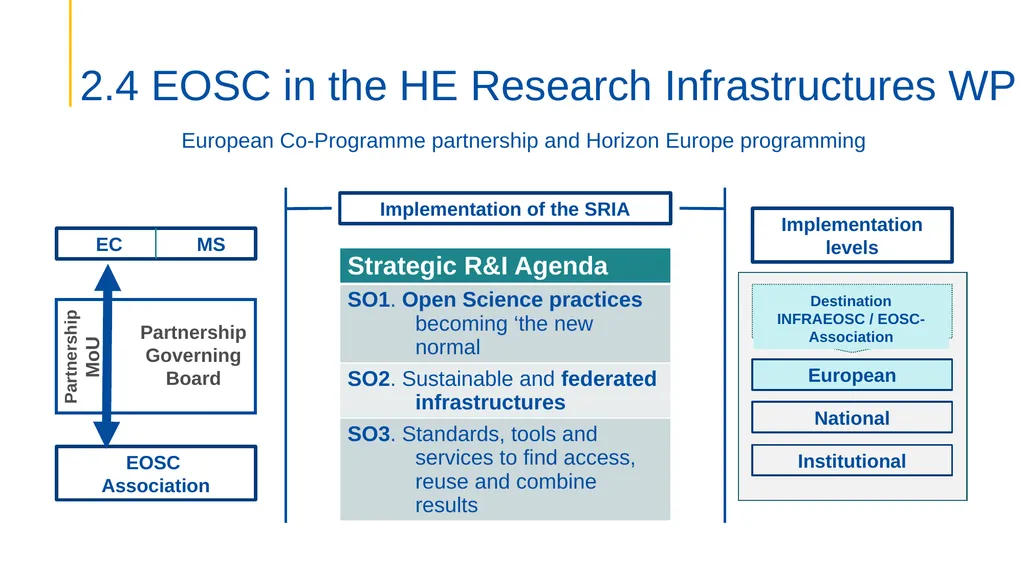
2.4 EOSC in the HE Research Infrastructures WP EC MS EOSC
Association Partnership MoU Partnership
Governing Board Implementation of the SRIA Implementation levels European National Institutional Destination INFRAEOSC / EOSC-Association European Co-Programme partnership and Horizon Europe programming<br>
Governing Board Implementation of the SRIA Implementation levels European National Institutional Destination INFRAEOSC / EOSC-Association European Co-Programme partnership and Horizon Europe programming<br>
10
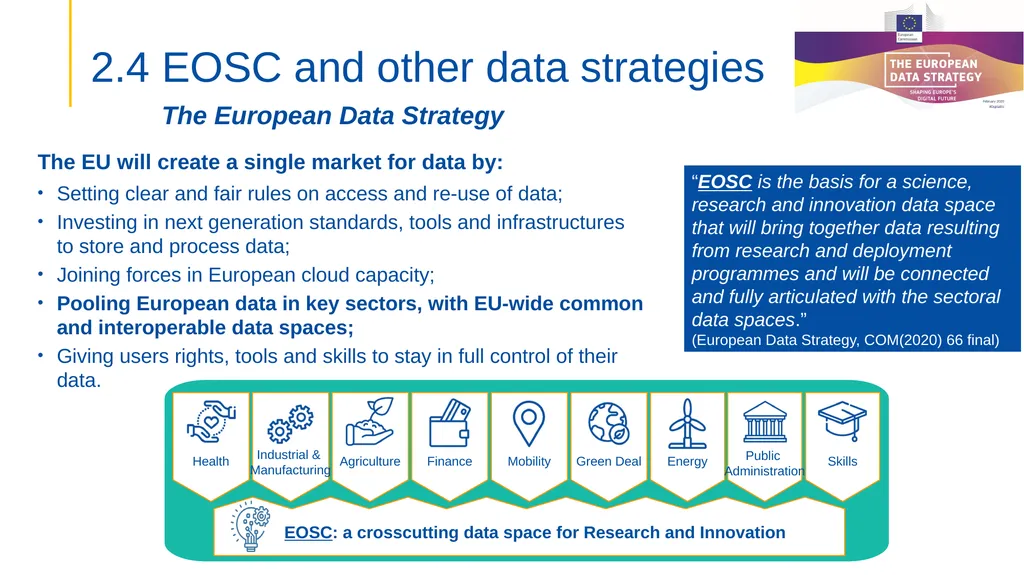
“EOSC is the basis for a science, research and innovation data space that will bring together data resulting from research and deployment programmes and will be connected and fully articulated with the sectoral data spaces.”
(European Data Strategy, COM(2020) 66 final) The EU will create a single market for data by:
Setting clear and fair rules on access and re-use of data;
Investing in next generation standards, tools and infrastructures to store and process data;
Joining forces in European cloud capacity;
Pooling European data in key sectors, with EU-wide common and interoperable data spaces;
Giving users rights, tools and skills to stay in full control of their data. The European Data Strategy 2.4 EOSC and other data strategies<br>
Setting clear and fair rules on access and re-use of data;
Investing in next generation standards, tools and infrastructures to store and process data;
Joining forces in European cloud capacity;
Pooling European data in key sectors, with EU-wide common and interoperable data spaces;
Giving users rights, tools and skills to stay in full control of their data. The European Data Strategy 2.4 EOSC and other data strategies<br>
11
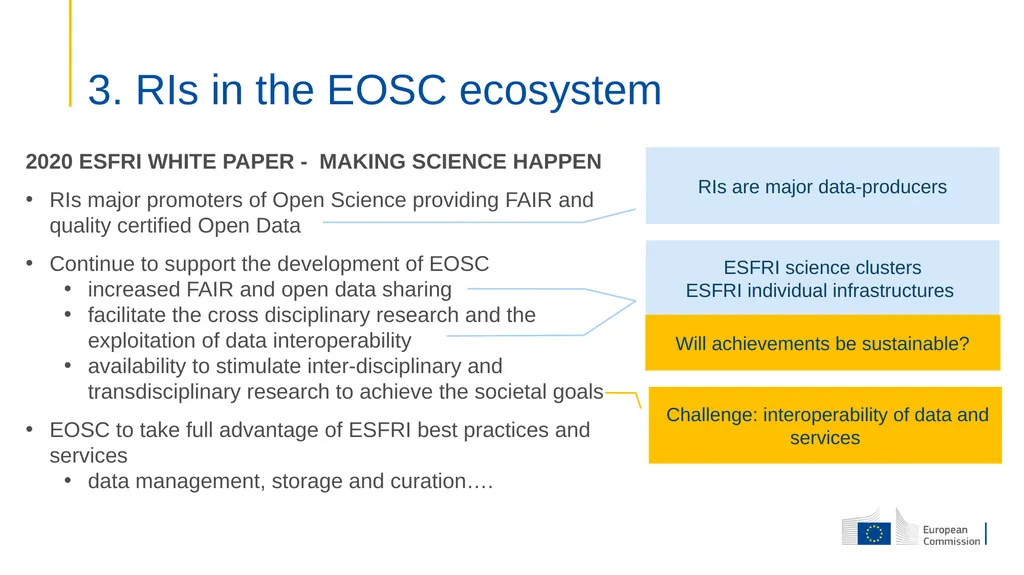
3. RIs in the EOSC ecosystem 2020 ESFRI WHITE PAPER - MAKING SCIENCE HAPPEN
RIs major promoters of Open Science providing FAIR and quality certified Open Data
Continue to support the development of EOSC
increased FAIR and open data sharing
facilitate the cross disciplinary research and the exploitation of data interoperability
availability to stimulate inter-disciplinary and transdisciplinary research to achieve the societal goals
EOSC to take full advantage of ESFRI best practices and services
data management, storage and curation…. RIs are major data-producers Challenge: interoperability of data and services Will achievements be sustainable?<br>
RIs major promoters of Open Science providing FAIR and quality certified Open Data
Continue to support the development of EOSC
increased FAIR and open data sharing
facilitate the cross disciplinary research and the exploitation of data interoperability
availability to stimulate inter-disciplinary and transdisciplinary research to achieve the societal goals
EOSC to take full advantage of ESFRI best practices and services
data management, storage and curation…. RIs are major data-producers Challenge: interoperability of data and services Will achievements be sustainable?<br>
12
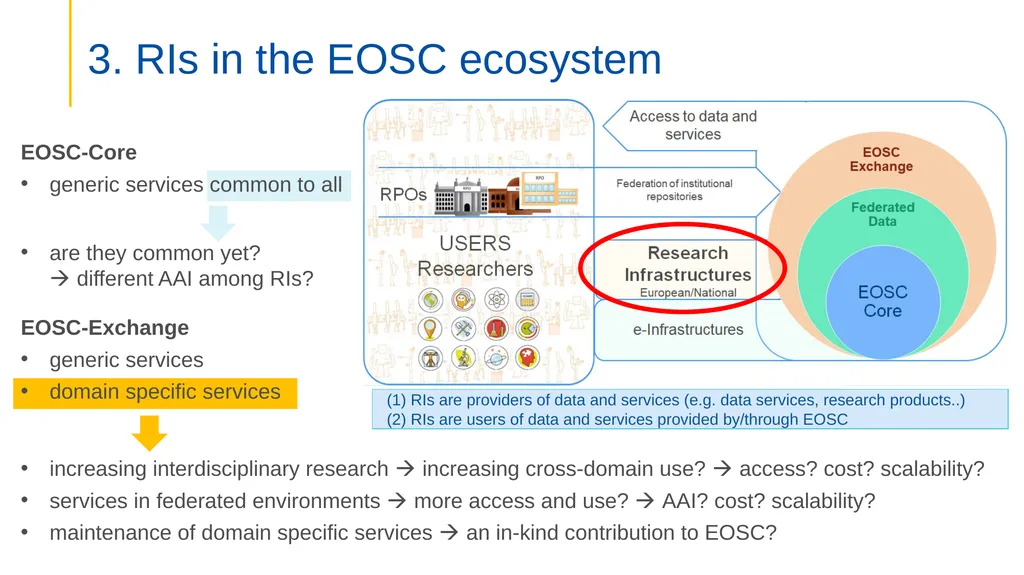
3. RIs in the EOSC ecosystem EOSC-Core
generic services common to all EOSC-Exchange
generic services
domain specific services increasing interdisciplinary research increasing cross-domain use? access? cost? scalability?
services in federated environments more access and use? AAI? cost? scalability?
maintenance of domain specific services an in-kind contribution to EOSC? are they common yet? different AAI among RIs? (1) RIs are providers of data and services (e.g. data services, research products..)
(2) RIs are users of data and services provided by/through EOSC<br>
generic services common to all EOSC-Exchange
generic services
domain specific services increasing interdisciplinary research increasing cross-domain use? access? cost? scalability?
services in federated environments more access and use? AAI? cost? scalability?
maintenance of domain specific services an in-kind contribution to EOSC? are they common yet? different AAI among RIs? (1) RIs are providers of data and services (e.g. data services, research products..)
(2) RIs are users of data and services provided by/through EOSC<br>
13
Thank you © European Union 2020
Unless otherwise noted the reuse of this presentation is authorised under the CC BY 4.0 license. For any use or reproduction of elements that are not owned by the EU, permission may need to be sought directly from the respective right holders.<br>
Unless otherwise noted the reuse of this presentation is authorised under the CC BY 4.0 license. For any use or reproduction of elements that are not owned by the EU, permission may need to be sought directly from the respective right holders.<br>
14
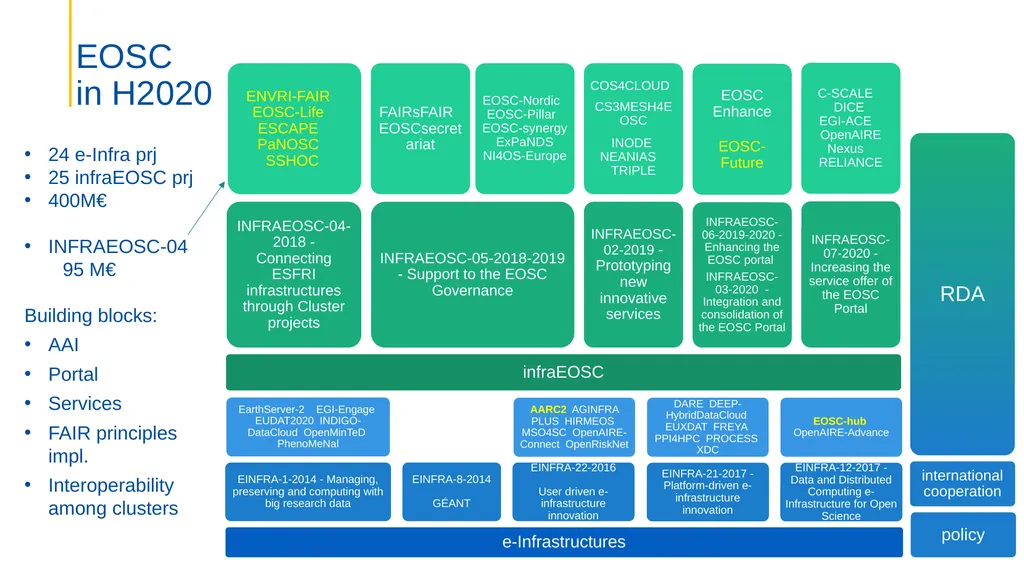
EOSC
in H2020 24 e-Infra prj
25 infraEOSC prj
400M€
INFRAEOSC-04
95 M€
Building blocks:
AAI
Portal
Services
FAIR principles impl.
Interoperability among clusters<br>
25 infraEOSC prj
400M€
INFRAEOSC-04
95 M€
Building blocks:
AAI
Portal
Services
FAIR principles impl.
Interoperability among clusters<br>