
Opening USPTO logo slide USPTO Hour: Updates on
T
Published · 35 slides · 0 views

1 / 1





Description
Opening USPTO logo slide USPTO Hour: Updates on Petitions in Patents Tashiana R. Adams, Director (Acting), Office of Petitions Katie Zalasky McDonald, Petitions Examiner, Office of Petitions August 19, 2026 Todays topics Overview of OPET
Related Topics
Share
Embed code
Download this presentation From Below
"Opening USPTO logo slide USPTO Hour: Updates on" is the property of its rightful owner. Permission is granted to download and print the materials on this website for personal, non-commercial use only, and to display it on your personal computer provided you do not modify the materials and that you retain all copyright notices contained in the materials. By downloading content from our website, you accept the terms of this agreement.
Presentation Transcript
01
Opening USPTO logo slide<br>
02
USPTO Hour:
Updates on Petitions in Patents Tashiana R. Adams, Director (Acting), Office of Petitions
Katie Zalasky McDonald, Petitions Examiner, Office of Petitions
August 19, 2026<br>
Katie Zalasky McDonald, Petitions Examiner, Office of Petitions
August 19, 2026<br>
03
Today’s topics Overview of OPET and recent filing trends
Petition basics
Best practices when filing petitions
Current initiatives and updates 3<br>
Petition basics
Best practices when filing petitions
Current initiatives and updates 3<br>
04
Office of Petitions (OPET) Centralized office for deciding most patent petitions
Reviews and decides:
Over 45 types of petitions (see MPEP § 1002.02(b))
Approximately 60,000 petitions per year
Offers a Petitions Help Desk to field calls from internal and external stakeholders on petitions-related inquiries
(571) 272-3282
Monday through Friday, 8:30 a.m. to 5:00 p.m. ET 4<br>
Reviews and decides:
Over 45 types of petitions (see MPEP § 1002.02(b))
Approximately 60,000 petitions per year
Offers a Petitions Help Desk to field calls from internal and external stakeholders on petitions-related inquiries
(571) 272-3282
Monday through Friday, 8:30 a.m. to 5:00 p.m. ET 4<br>
05
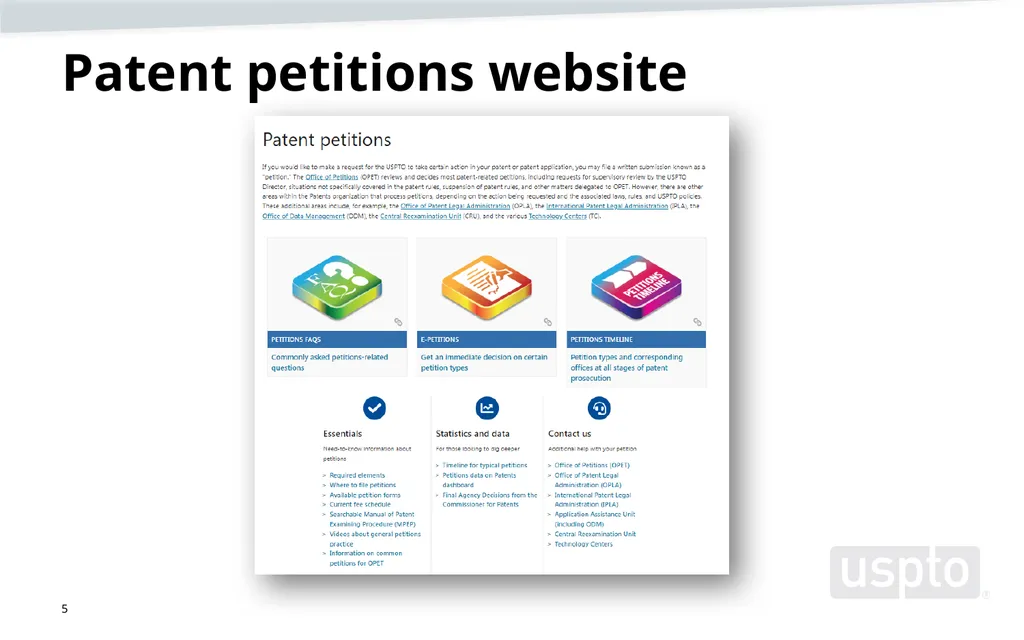
Patent petitions website 5<br>
06
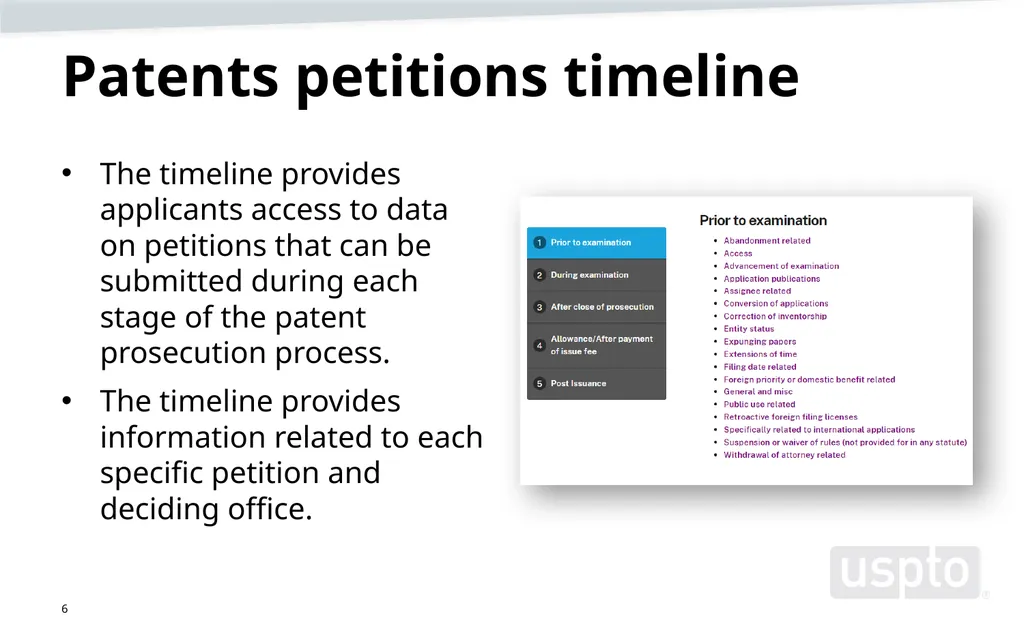
Patents petitions timeline The timeline provides applicants access to data on petitions that can be submitted during each stage of the patent prosecution process.
The timeline provides information related to each specific petition and deciding office. 6<br>
The timeline provides information related to each specific petition and deciding office. 6<br>
07
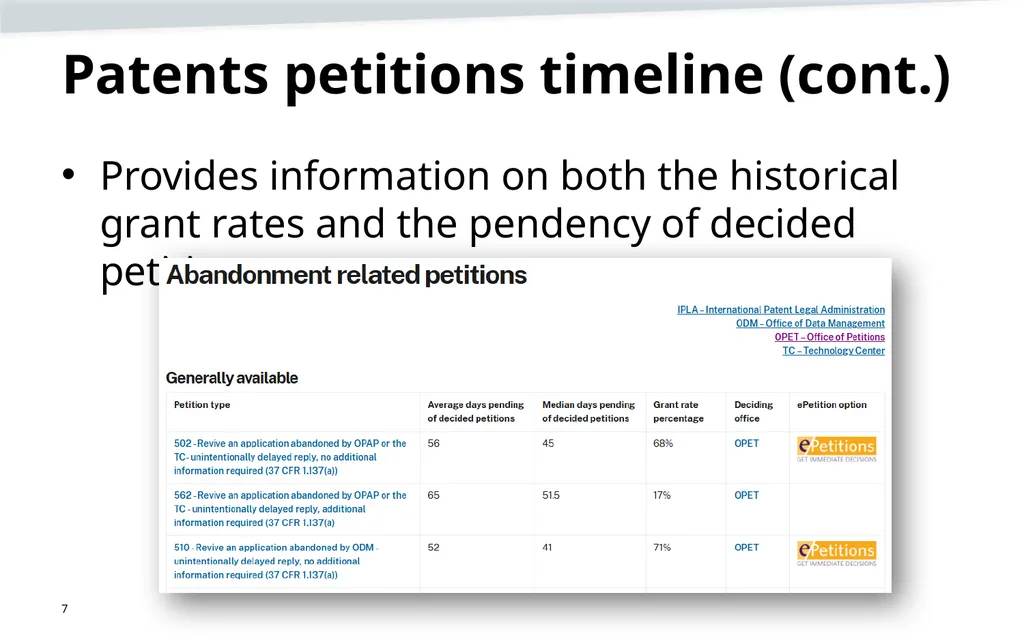
Patents petitions timeline (cont.) Provides information on both the historical grant rates and the pendency of decided petitions. 7<br>
08
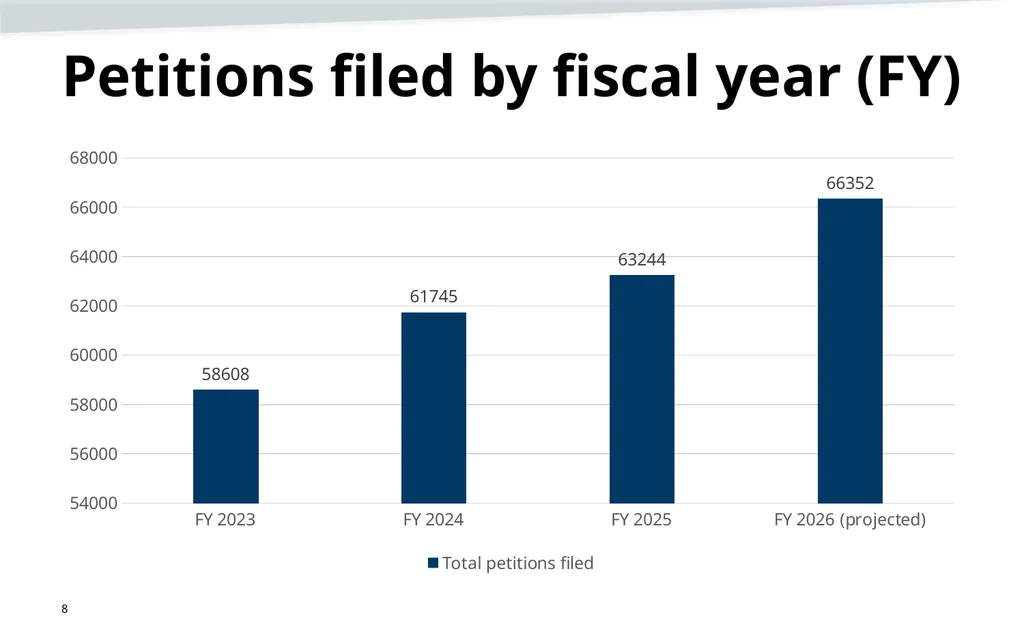
Petitions filed by fiscal year (FY) 8<br>
09
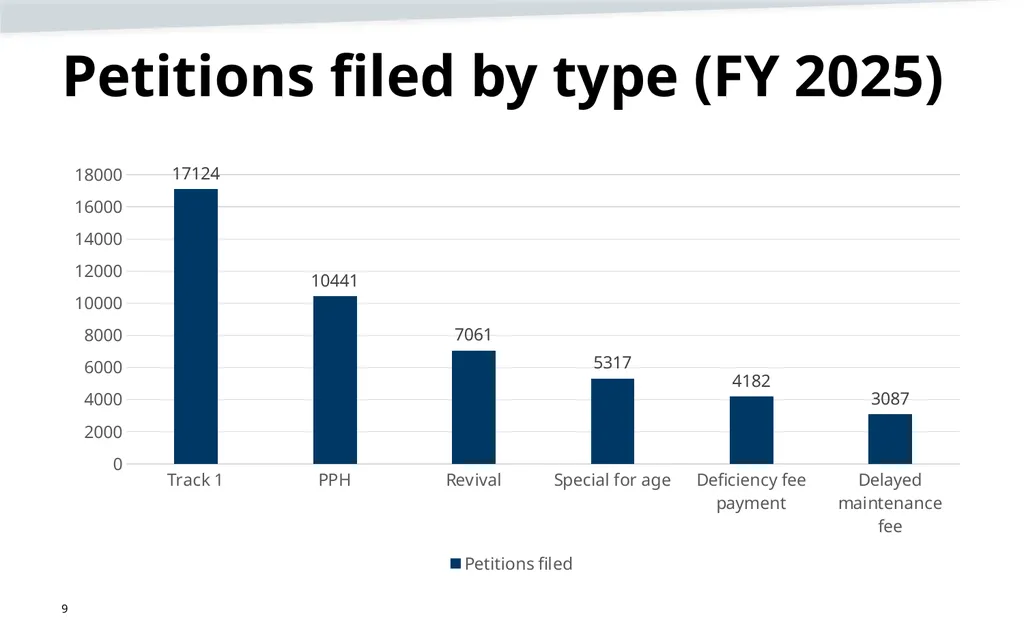
Petitions filed by type (FY 2025) 9<br>
10
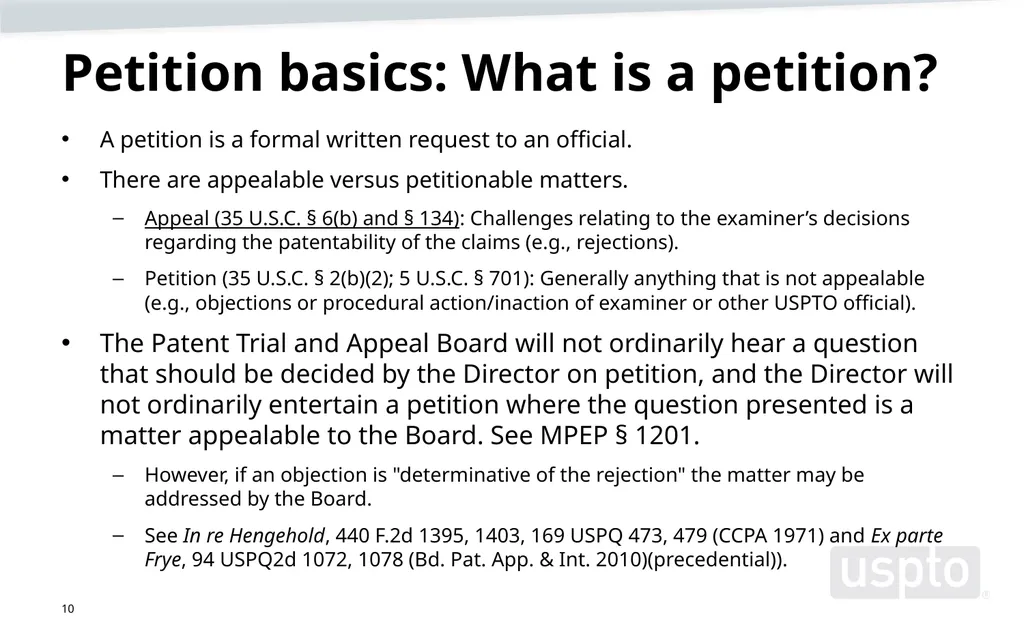
Petition basics: What is a petition? A petition is a formal written request to an official.
There are appealable versus petitionable matters.
Appeal (35 U.S.C. § 6(b) and § 134): Challenges relating to the examiner’s decisions regarding the patentability of the claims (e.g., rejections).
Petition (35 U.S.C. § 2(b)(2); 5 U.S.C. § 701): Generally anything that is not appealable (e.g., objections or procedural action/inaction of examiner or other USPTO official).
The Patent Trial and Appeal Board will not ordinarily hear a question that should be decided by the Director on petition, and the Director will not ordinarily entertain a petition where the question presented is a matter appealable to the Board. See MPEP § 1201.
However, if an objection is "determinative of the rejection" the matter may be addressed by the Board.
See In re Hengehold, 440 F.2d 1395, 1403, 169 USPQ 473, 479 (CCPA 1971) and Ex parte Frye, 94 USPQ2d 1072, 1078 (Bd. Pat. App. & Int. 2010)(precedential)). 10<br>
There are appealable versus petitionable matters.
Appeal (35 U.S.C. § 6(b) and § 134): Challenges relating to the examiner’s decisions regarding the patentability of the claims (e.g., rejections).
Petition (35 U.S.C. § 2(b)(2); 5 U.S.C. § 701): Generally anything that is not appealable (e.g., objections or procedural action/inaction of examiner or other USPTO official).
The Patent Trial and Appeal Board will not ordinarily hear a question that should be decided by the Director on petition, and the Director will not ordinarily entertain a petition where the question presented is a matter appealable to the Board. See MPEP § 1201.
However, if an objection is "determinative of the rejection" the matter may be addressed by the Board.
See In re Hengehold, 440 F.2d 1395, 1403, 169 USPQ 473, 479 (CCPA 1971) and Ex parte Frye, 94 USPQ2d 1072, 1078 (Bd. Pat. App. & Int. 2010)(precedential)). 10<br>
11
Petition basics: Delegation of authority The authority to decide petitions to the Director of the United States Patent and Trademark Office (USPTO) has been delegated to various Office officials such as:
Deputy Commissioner for Patents who oversees OPET
Technology Centers Directors
Director of Office of Patent Application Processing
Director of International Patent Legal Administration (IPLA)
See MPEP § 1002.02. 11<br>
Deputy Commissioner for Patents who oversees OPET
Technology Centers Directors
Director of Office of Patent Application Processing
Director of International Patent Legal Administration (IPLA)
See MPEP § 1002.02. 11<br>
12
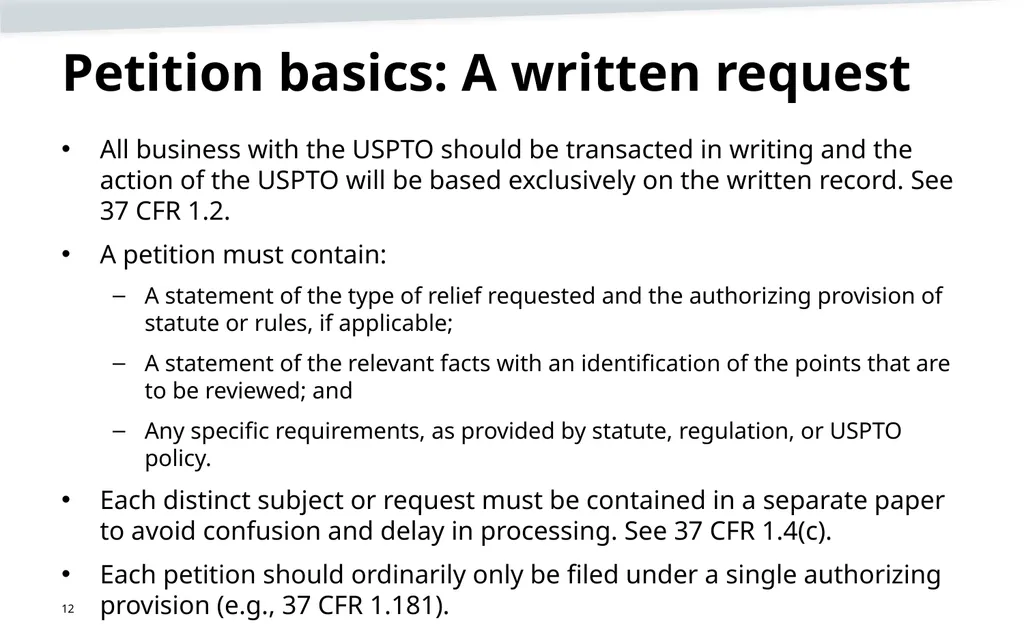
Petition basics: A written request All business with the USPTO should be transacted in writing and the action of the USPTO will be based exclusively on the written record. See 37 CFR 1.2.
A petition must contain:
A statement of the type of relief requested and the authorizing provision of statute or rules, if applicable;
A statement of the relevant facts with an identification of the points that are to be reviewed; and
Any specific requirements, as provided by statute, regulation, or USPTO policy.
Each distinct subject or request must be contained in a separate paper to avoid confusion and delay in processing. See 37 CFR 1.4(c).
Each petition should ordinarily only be filed under a single authorizing provision (e.g., 37 CFR 1.181). 12<br>
A petition must contain:
A statement of the type of relief requested and the authorizing provision of statute or rules, if applicable;
A statement of the relevant facts with an identification of the points that are to be reviewed; and
Any specific requirements, as provided by statute, regulation, or USPTO policy.
Each distinct subject or request must be contained in a separate paper to avoid confusion and delay in processing. See 37 CFR 1.4(c).
Each petition should ordinarily only be filed under a single authorizing provision (e.g., 37 CFR 1.181). 12<br>
13
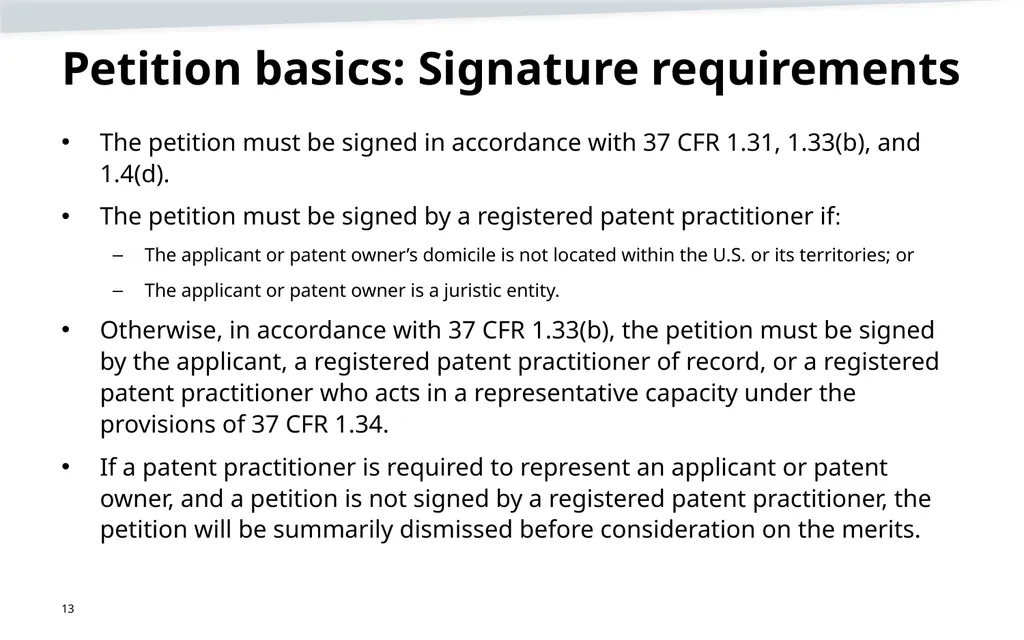
Petition basics: Signature requirements The petition must be signed in accordance with 37 CFR 1.31, 1.33(b), and 1.4(d).
The petition must be signed by a registered patent practitioner if:
The applicant or patent owner’s domicile is not located within the U.S. or its territories; or
The applicant or patent owner is a juristic entity.
Otherwise, in accordance with 37 CFR 1.33(b), the petition must be signed by the applicant, a registered patent practitioner of record, or a registered patent practitioner who acts in a representative capacity under the provisions of 37 CFR 1.34.
If a patent practitioner is required to represent an applicant or patent owner, and a petition is not signed by a registered patent practitioner, the petition will be summarily dismissed before consideration on the merits. 13<br>
The petition must be signed by a registered patent practitioner if:
The applicant or patent owner’s domicile is not located within the U.S. or its territories; or
The applicant or patent owner is a juristic entity.
Otherwise, in accordance with 37 CFR 1.33(b), the petition must be signed by the applicant, a registered patent practitioner of record, or a registered patent practitioner who acts in a representative capacity under the provisions of 37 CFR 1.34.
If a patent practitioner is required to represent an applicant or patent owner, and a petition is not signed by a registered patent practitioner, the petition will be summarily dismissed before consideration on the merits. 13<br>
14
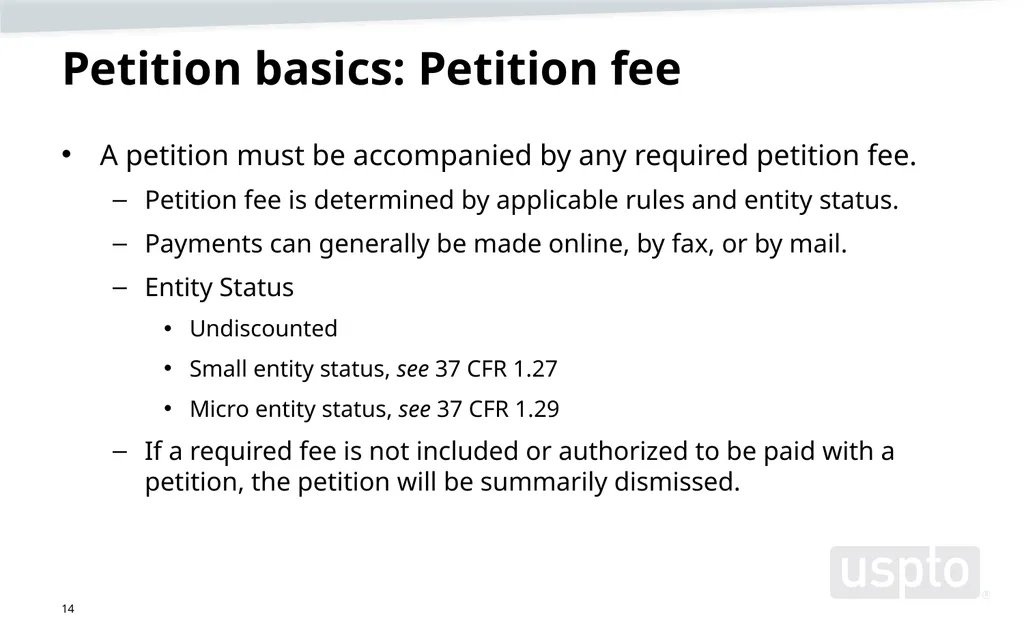
Petition basics: Petition fee A petition must be accompanied by any required petition fee.
Petition fee is determined by applicable rules and entity status.
Payments can generally be made online, by fax, or by mail.
Entity Status
Undiscounted
Small entity status, see 37 CFR 1.27
Micro entity status, see 37 CFR 1.29
If a required fee is not included or authorized to be paid with a petition, the petition will be summarily dismissed. 14<br>
Petition fee is determined by applicable rules and entity status.
Payments can generally be made online, by fax, or by mail.
Entity Status
Undiscounted
Small entity status, see 37 CFR 1.27
Micro entity status, see 37 CFR 1.29
If a required fee is not included or authorized to be paid with a petition, the petition will be summarily dismissed. 14<br>
15
Petition basics: Time period to file A petition must be timely filed per regulation or statute.
37 CFR 1.181(f) provides that any petition under that part which is not filed "within two months of the mailing date of the action or notice from which relief is requested may be dismissed as untimely, except as otherwise provided.”
The mere filing of a petition generally does not stay the period for reply or other proceedings. 15<br>
37 CFR 1.181(f) provides that any petition under that part which is not filed "within two months of the mailing date of the action or notice from which relief is requested may be dismissed as untimely, except as otherwise provided.”
The mere filing of a petition generally does not stay the period for reply or other proceedings. 15<br>
16
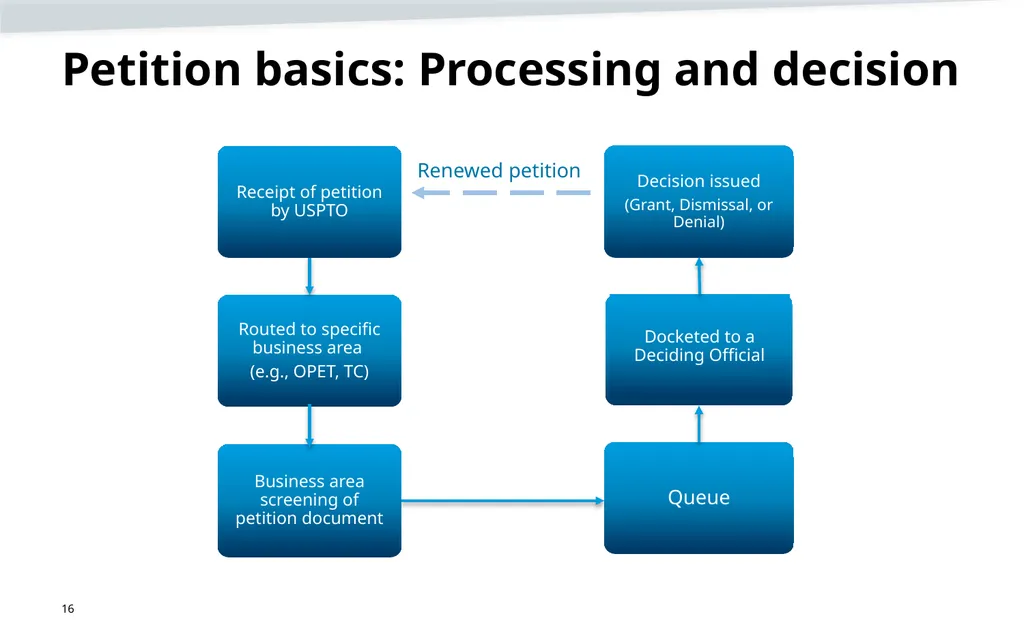
Petition basics: Processing and decision Renewed petition 16<br>
17
Best practices: Payments and sensitive information If no fee code is available to you in Patent Center to electronically submit a necessary payment to accompany your petition (e.g., fee deficiency payment or delayed maintenance fee payment), you may either provide:
A deposit account authorization, if available;
A credit card authorization form that specifies the amount to be charged; or
A check or money order.
A credit card authorization form should not be electronically submitted through Patent Center as this form will be visible in the application file.
Similarly, you should avoid submitting sensitive information in your application files or assignment records. 17<br>
A deposit account authorization, if available;
A credit card authorization form that specifies the amount to be charged; or
A check or money order.
A credit card authorization form should not be electronically submitted through Patent Center as this form will be visible in the application file.
Similarly, you should avoid submitting sensitive information in your application files or assignment records. 17<br>
18
Best practices: Patent Center usage Papers filed through Patent Center must be submitted in accordance with the Legal Framework for the Patent Electronic System, the Patent Center Subscriber Agreement, and the website terms of use.
If you have an inventor account, you must be a named inventor on an application in order to file papers in the application.
If you have a support account or practitioner account, you must be authorized by the applicant or patent owner to file papers in the particular application or patent. 18<br>
If you have an inventor account, you must be a named inventor on an application in order to file papers in the application.
If you have a support account or practitioner account, you must be authorized by the applicant or patent owner to file papers in the particular application or patent. 18<br>
19
Best practices: Form use Many petition types have a form available to assist in the filing of the request.
Other USPTO forms are frequently needed to accompany a petition, such as a terminal disclaimer, oath or declaration, or application data sheet.
No changes to certification statements on the Office forms (e.g., oath or declaration forms, terminal disclaimer forms, petition forms, and nonpublication request form) may be made.
The existing text of a form, other than a certification statement, may be modified, deleted, or added to, if all text identifying the form as an Office form is removed. 19<br>
Other USPTO forms are frequently needed to accompany a petition, such as a terminal disclaimer, oath or declaration, or application data sheet.
No changes to certification statements on the Office forms (e.g., oath or declaration forms, terminal disclaimer forms, petition forms, and nonpublication request form) may be made.
The existing text of a form, other than a certification statement, may be modified, deleted, or added to, if all text identifying the form as an Office form is removed. 19<br>
20
Current initiatives Standards Participation and Representation Kudos (SPARK) Pilot Program
Petitions under the SPARK program will be accepted until the earlier of June 3, 2027, or the date when a total of 200 petitions under the program have been granted.
Streamlined Claim Set Pilot Program
This program is available for noncontinuing, original utility nonprovisional applications filed under 37 CFR 1.111(a) before October 27, 2025.
Petitions under this program will be accepted until the earlier of October 27, 2026, or the date each Technology Center that examines utility applications has been docketed at least approximately 200 applications accepted into the program. 20<br>
Petitions under the SPARK program will be accepted until the earlier of June 3, 2027, or the date when a total of 200 petitions under the program have been granted.
Streamlined Claim Set Pilot Program
This program is available for noncontinuing, original utility nonprovisional applications filed under 37 CFR 1.111(a) before October 27, 2025.
Petitions under this program will be accepted until the earlier of October 27, 2026, or the date each Technology Center that examines utility applications has been docketed at least approximately 200 applications accepted into the program. 20<br>
21
Open Data Portal: Petition Decisions The Final Petition Decisions feature released in the Open Data Portal (ODP) in May 2025.
With this feature, you can search, view, and extract datasets containing final agency petition decisions from the Office of the Commissioner for Patents in patents and patent applications deemed public by 37 CFR 1.11 and 1.14.
Newly issued final petition decisions are added monthly.
Petition decisions can be filtered by petition consideration, statute, and rule.
Expanded feature offerings, such as decision text search and the inclusion of non-final agency petition decisions, are planned for release next month. 21<br>
With this feature, you can search, view, and extract datasets containing final agency petition decisions from the Office of the Commissioner for Patents in patents and patent applications deemed public by 37 CFR 1.11 and 1.14.
Newly issued final petition decisions are added monthly.
Petition decisions can be filtered by petition consideration, statute, and rule.
Expanded feature offerings, such as decision text search and the inclusion of non-final agency petition decisions, are planned for release next month. 21<br>
22
Final Rule involving petitions based on unintentional delay On June 24, 2026, the USPTO published a Final Rule titled, Conditions for Additional Information and Fee in Petitions Filed in Patent Applications and Patents Based on Unintentional Delay, 91 FR 37826 (Jun. 24, 2026).
This rule became effective on August 13, 2026.
There are four circumstances where applicants or patentees may petition to the Director and establish that a delay in taking a required action was unintentional.
Petitions to revive an unintentionally abandoned application (37 CFR 1.137)
Petitions to accept a delayed priority or benefit claim (37 CFR 1.55 and 1.78)
Petitions to accept a delayed maintenance fee and reinstate an expired patent (37 CFR 1.378)
Petitions to excuse a failure to act within prescribed time limits under the Hague Agreement in connection with requirements pertaining to an international design application (37 CFR 1.1051) 22<br>
This rule became effective on August 13, 2026.
There are four circumstances where applicants or patentees may petition to the Director and establish that a delay in taking a required action was unintentional.
Petitions to revive an unintentionally abandoned application (37 CFR 1.137)
Petitions to accept a delayed priority or benefit claim (37 CFR 1.55 and 1.78)
Petitions to accept a delayed maintenance fee and reinstate an expired patent (37 CFR 1.378)
Petitions to excuse a failure to act within prescribed time limits under the Hague Agreement in connection with requirements pertaining to an international design application (37 CFR 1.1051) 22<br>
23
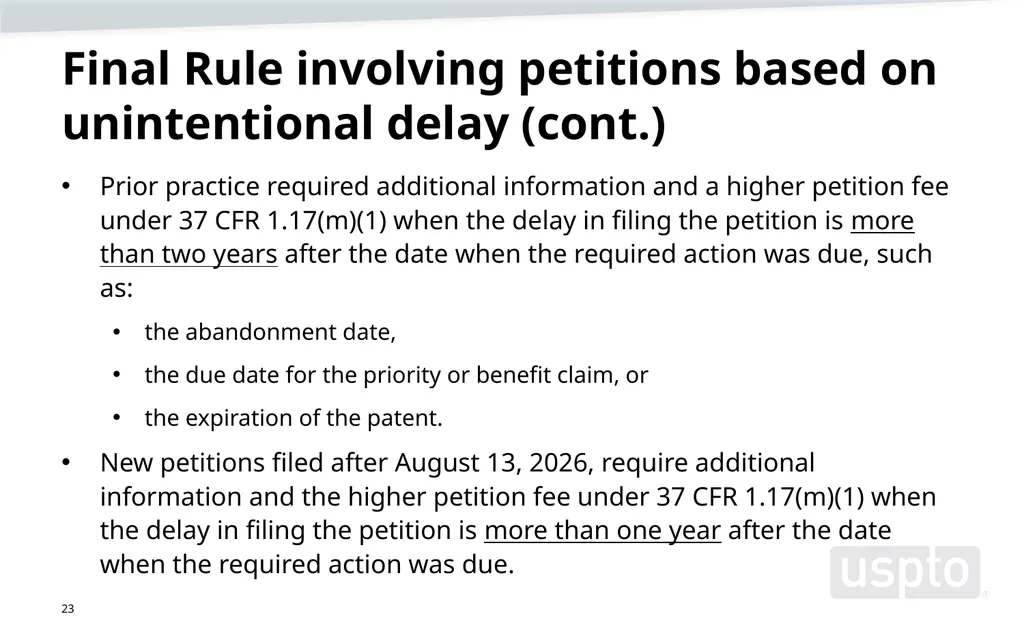
Final Rule involving petitions based on unintentional delay (cont.) Prior practice required additional information and a higher petition fee under 37 CFR 1.17(m)(1) when the delay in filing the petition is more than two years after the date when the required action was due, such as:
the abandonment date,
the due date for the priority or benefit claim, or
the expiration of the patent.
New petitions filed after August 13, 2026, require additional information and the higher petition fee under 37 CFR 1.17(m)(1) when the delay in filing the petition is more than one year after the date when the required action was due. 23<br>
the abandonment date,
the due date for the priority or benefit claim, or
the expiration of the patent.
New petitions filed after August 13, 2026, require additional information and the higher petition fee under 37 CFR 1.17(m)(1) when the delay in filing the petition is more than one year after the date when the required action was due. 23<br>
24
Unintentional delay standard:
Purpose of additional information requirement To increase certainty and predictability of patent rights and encourage the timely filing of grantable petitions
To ensure compliance with the statutory requirement that the USPTO permit the revival of an abandoned application, acceptance of a delayed maintenance fee payment, or acceptance of a delayed priority or benefit claim only when the delay in seeking such action was unintentional 24<br>
To ensure compliance with the statutory requirement that the USPTO permit the revival of an abandoned application, acceptance of a delayed maintenance fee payment, or acceptance of a delayed priority or benefit claim only when the delay in seeking such action was unintentional 24<br>
25
Unintentional delay standard:
Additional information requirements An applicant or patent owner must provide a sufficient explanation of the circumstances surrounding the delay that establishes that the entire delay was unintentional.
Facts as contended must support a conclusion that the entire delay was unintentional.
“Firsthand” knowledge is not required - hearsay evidence may be considered.
A party presenting a paper to the Office is obligated under 37 CFR 11.18 to inquire into the underlying facts and circumstances and must have knowledge, information, and belief that factual contentions have evidentiary support or is likely to have evidentiary support after a reasonable opportunity for further investigation or discovery.
Documentary evidence accepted but not required. 25<br>
Facts as contended must support a conclusion that the entire delay was unintentional.
“Firsthand” knowledge is not required - hearsay evidence may be considered.
A party presenting a paper to the Office is obligated under 37 CFR 11.18 to inquire into the underlying facts and circumstances and must have knowledge, information, and belief that factual contentions have evidentiary support or is likely to have evidentiary support after a reasonable opportunity for further investigation or discovery.
Documentary evidence accepted but not required. 25<br>
26
Unintentional delay standard:
Additional information requirements (cont.) The explanation must be regarding the party whose delay is relevant.
A relevant party is one having the right and/or authority to reply or take action in the patent or patent application.
If delay occurred while prior assignee or applicant was responsible (i.e., ownership of application/patent has been transferred), or while a prior practitioner was handling prosecution of the application, a petitioner is expected to make an inquiry reasonable under the circumstances to determine that the relevant party’s delay was unintentional. 26<br>
A relevant party is one having the right and/or authority to reply or take action in the patent or patent application.
If delay occurred while prior assignee or applicant was responsible (i.e., ownership of application/patent has been transferred), or while a prior practitioner was handling prosecution of the application, a petitioner is expected to make an inquiry reasonable under the circumstances to determine that the relevant party’s delay was unintentional. 26<br>
27
Unintentional delay standard:
Deliberate course of action A delay resulting from a deliberately chosen course of action on the part of the applicant or patent owner does not later become an “unintentional” delay because of a change in circumstance.
For example, delaying the revival of an abandoned application or reinstatement of an expired patent, by a deliberately chosen course of action, until the industry or a competitor shows an interest in the invention is the antithesis of an "unintentional" delay. 27<br>
For example, delaying the revival of an abandoned application or reinstatement of an expired patent, by a deliberately chosen course of action, until the industry or a competitor shows an interest in the invention is the antithesis of an "unintentional" delay. 27<br>
28
Petitions filed in relation to patents involved in judicial proceedings Request for Information
Under 37 CFR 1.105, the USPTO will require certain information from a party who files a petition pertaining to a patent (or reissue application relating to a patent) involved in a judicial proceedings.
The relevant party (e.g., Patentee) is required provide information to substantiate that a decision on the petition will not conflict with matters being considered in the proceeding.
Identification
Federal court action provides notice pursuant to 35 U.S.C. 290 regarding a lawsuit involving the same patent or where the USPTO is aware of a state court action likewise relating to the same patent. 28<br>
Under 37 CFR 1.105, the USPTO will require certain information from a party who files a petition pertaining to a patent (or reissue application relating to a patent) involved in a judicial proceedings.
The relevant party (e.g., Patentee) is required provide information to substantiate that a decision on the petition will not conflict with matters being considered in the proceeding.
Identification
Federal court action provides notice pursuant to 35 U.S.C. 290 regarding a lawsuit involving the same patent or where the USPTO is aware of a state court action likewise relating to the same patent. 28<br>
29
Questions?<br>
30
Patents External Quality Survey: New Opt-In Process A Patents Alert will be sent tomorrow with the same link used in the July 22 and follow-up messages.
The survey is available to all attorneys and agents registered to practice before the USPTO.
Administered semi-annually since 2006.
Seeks feedback on:
Examination quality.
Rejections, rules, and procedures.
Search process and prior art.
Timeliness of examiner communications.
Results will help track quality trends and identify improvement opportunities.<br>
The survey is available to all attorneys and agents registered to practice before the USPTO.
Administered semi-annually since 2006.
Seeks feedback on:
Examination quality.
Rejections, rules, and procedures.
Search process and prior art.
Timeliness of examiner communications.
Results will help track quality trends and identify improvement opportunities.<br>
31
Appendix<br>
32
Call centers Office of Petitions Help Desk
(571) 272-3282
IPLA (PCT Legal) Help Desk
(571) 272-4300
Pro Se Assistance Center
1-866-767-3848
Fee assistance
1-800-786-9199 Inventor Assistance Center (IAC)
1-800-786-9199
(571) 272-1000
Electronic Business Center (EBC)
1-866-217-9197
(571) 272-4100
Other support numbers
www.uspto.gov/patent/contact-patents 32<br>
(571) 272-3282
IPLA (PCT Legal) Help Desk
(571) 272-4300
Pro Se Assistance Center
1-866-767-3848
Fee assistance
1-800-786-9199 Inventor Assistance Center (IAC)
1-800-786-9199
(571) 272-1000
Electronic Business Center (EBC)
1-866-217-9197
(571) 272-4100
Other support numbers
www.uspto.gov/patent/contact-patents 32<br>
33
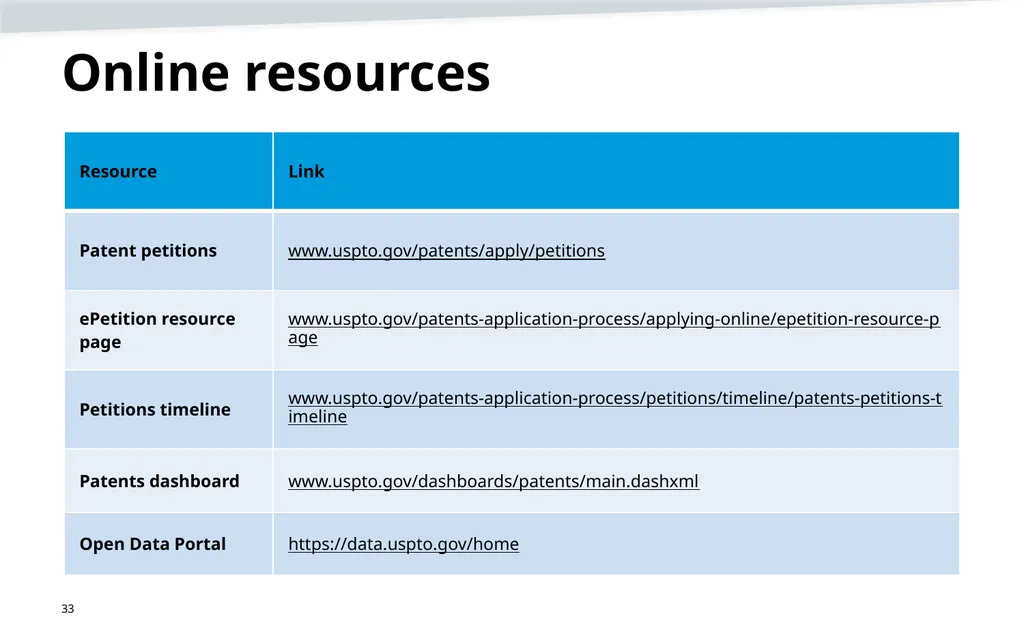
Online resources 33<br>
34
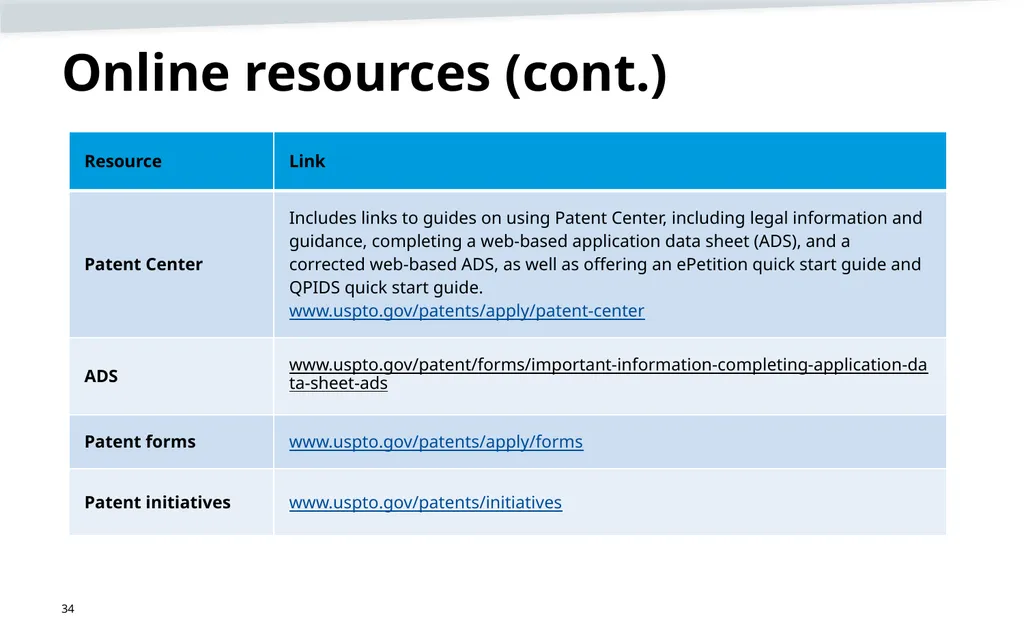
Online resources (cont.) 34<br>
35
Ending slide with USPTO logo<br>