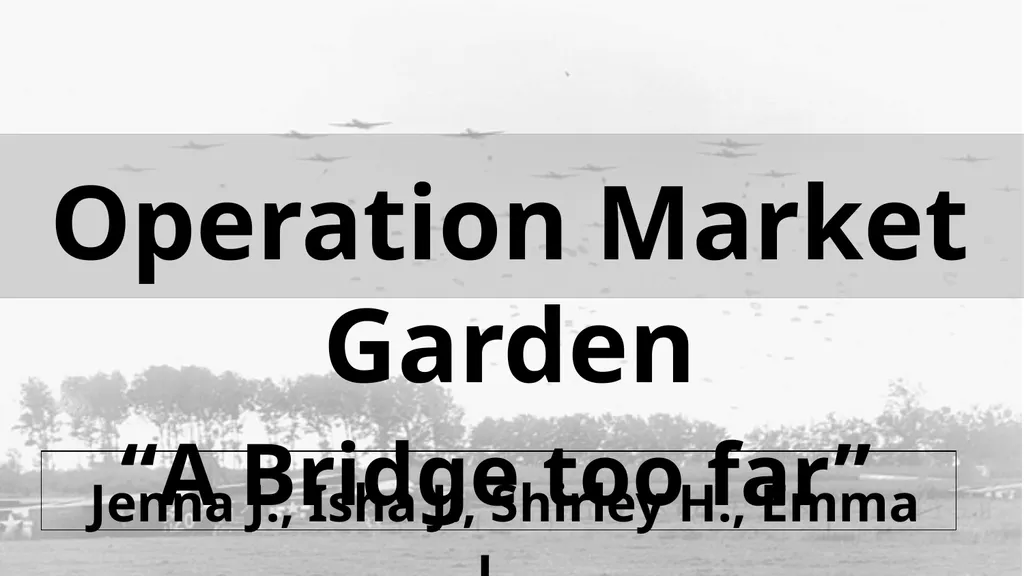
Operation Market Garden “A Bridge too far” Jenna
Description: Operation Market Garden A Bridge too far Jenna J., Isha J., Shirley H., Emma L. Thesis The Allies ambitious goal to end the war by Christmas caused a lack of British and American coordination which ultimately extended world war II,
Related Topics
Download Presentation
"Operation Market Garden “A Bridge too far” Jenna" is the property of its rightful owner. Permission is granted to download and print the materials on this website for personal, non-commercial use only, and to display it on your personal computer provided you do not modify the materials and that you retain all copyright notices contained in the materials. By downloading content from our website, you accept the terms of this agreement.
Presentation Transcript
slide1. Operation Market Garden
“A Bridge too far” Jenna J., Isha J., Shirley H., Emma L.<br>
slide2. Thesis The Allies’ ambitious goal to end the war by Christmas caused a lack of British and American coordination which ultimately extended world war II, costing thousands of soldiers’ Lives and starving countless dutch citizens as a result of the Allied failure.<br>
slide3. Why is it called market garden? Market
Comprised of the airborne divisions, led by British i aIRBORNE corps commanding lieutenant General Frederick Browning Garden
Comprised of the ground divisions, led by Lieutenant General Brian g. Horrocks<br>
slide4. Operation market garden was primarily fought in the netherlands (holland) and germany
The allied powers were attempting to capture german bridges over the lower rhine river
Germany launched counterattack at Arnhem Where<br>
slide5. Who Operation was Devised by British Field Marshal Bernard L. Montgomery
He promised gENERAL eISENHOWER THAT SUCCESS WOULD END THE WAR BEFORE CHRISTMAS 1944
Allied powers vs nazi germany<br>
slide6. When Operation market garden began on september 17th, 1944
Operation market garden ended on september 25th, 1944
Operation market garden lasted for 9 days<br>
slide7. sEPTEMBER 17, 1944 - British troops land in arnhem sEPTEMBER 18, 1944 - Germany counters in arnhem, Eindhoven captured sEPTEMBER 20, 1944 - US 82nd Airborne and British xxx corps capture bridge in Nijmegen sEPTEMBER 21, 1944 - British paratroopers are attacked at north end Timeline of Events<br>
slide8. sEPTEMBER 22, 1944 - British tANKS’ advancement is slowed by attacks sEPTEMBER 23, 1944 - POLISH CROSSING AT ARNHEM FAILS sEPTEMBER 25, 1944 - surviving british troops evacuate<br>
slide9. Goals and leaders Allies
Gain entrance into the Ruhr
Airborne forces were tasked to create a “corridor” to allow the ground troops to pass Axis
Led by General kurt student of the first parachute army
Repel allied attack<br>
slide10. Military Strategy Created by British Field Marshal Bernard Montgomery
The 1st Allied Airborne Army would assist the British Second Army
They would start at Meuse-Escaut Canal and make their way towards the Ruhr<br>
slide11. Military Strategy (cont..) They would then capture the 8 bridges at Eindhoven, Nijmegen, and Arnhem
Airborne troops would be flown behind enemy lines to capture the bridges
British tanks and infantry would then relieve the airborne troops and cross the bridges<br>
slide12. Military Strategy (Cont..X2) The goal was to get across one of the natural barriers blocking the Allies from Germany
This was considered one of the boldest battle plans from World War II<br>
slide13. **Maps Provided By An Animated BBC Map** Operation Market Garden Map/Plan:
Began September 1944
- German army retreating from France
- General Eisenhower (Sup.Com. Of Allied) and British Field Marshall Montgomery quickly decide to for a single thrust across the Rhine River (the last natural barrier before entering Germany!) in order to surprise the retreating Germans<br>
slide14. Overall Plan The two phases of the Operation (market and garden) involves:
- Drop US 101st Air. Division near Eindhoven (Netherlands)
- Drop US 82nd Air. Division near Nijmegen
- Drop British 1st Air. Division near Arnhem
** Air mission = to capture and hold the bridges (leading into Germany) for 3 days while the ground forces arrive to Arnhem
- Ground FOrces: British 30th Corp. spearhead the narrow Eindhoven-Nijmegen-Arnhem road and link up the 3 airborne divisions
- Arrive at Arnhem on day 3
- Us 1st Army will then join British 30th Corp. using a pincer movement from south west<br>
slide15. First Lift (Sept 17-18) *Arnhem was guarded by 2 SS Panzer Divisions and an INfantry Battalion (this was not known by the Allies)
- September 17th pathfinder troops drop in and secure the landing zones
- Later Heavy Bombing proceeds and 1st Air. Division’s 320 gliders and 2,300 paratroopers drop in 8 miles from Arnhem
- BUT… 30th Corp.’s drive to reach Arnhem is halted before they reach Eindhoven<br>
slide16. Attempt To CApture The BRidges (Sept 17) - 1st Airlanding Brigade Squad. Joins 1st Battalion paratroopers To begin an offensive against German 9th SS Panzer resistance
- Battalion 3 is held up in oosterbeek
- Battalion 2 manages to move east along the rhine and find the bridge into arnhem...but they cannot cross due to german units guarding the other side. They have secured the north end of the bridge.<br>
slide17. Battle for the Road Bridge (Sept. 18th) Company B and C of Battalion 2 arrive at the secure north side, and hold off the german battalion trying to cross at dawn.
Meanwhile Battalion 1 and 3 leave oosterbeek for the bridge but end up dispersing. Moving Out from the Drop ZOnes 7 KSOB and Regiment 1 guard the original drop zones until the Germans overran them
South Staffords 2 and Battalion 11 join with Battalion 1 and 3 to plan an Arnhem attack for the Next Morning (they want to Relieve Battalion 2)<br>
slide18. More Attempts to Reach the Bridge (Sept. 19) - South Staffords 2 and other depleted units were captured as they headed north while Battalion 11 is wiped out. Meanwhile, Battalion 2 is struggling to hold out at the bridge. Defending the Drop Zones (Sept. 19) Kosb 7 is left alone to maintain major landing zone ‘L’. Difficulties regarding weather and logistics cause delay and supplies are dropped in a german occupied zone.<br>
slide19. Defending Oosterbeek (Sept. 20) 30th Corps and Battalion 10 form a defensive perimeter around oosterbeek because Battalion 2 cannot be Reached.Battalion 2 desperately holds out and supplies are starting to run out. The Bridgehead Collapses (Sept. 21) After constant fire, Battalion 2 falls in the evening after having held the bridge for 4 nights and 3 days. The Germans attack oosterbeek and the polish drop into Driel for support.<br>
slide20. The Situation Worsens (Sept. 22 -24) The 30th Corps. Finally arrive to aid the poles and try to cross the river...but most groups are captured. Ceasefire on Sept. 24th allows 400 wounded to evacuate. The Withdrawl/ Evac (Sept. 25) THe Germans and the Allies face off at oosterbeek until night arrives. The Allied 30th corps set up a barrage and begin evacuation. 2,000 manage to cross the river to safety. 2,000 out of the starting 10,000 survive.<br>
slide21. Who Won and why Allied powers were unsuccessful in the operation
The allies failed to cross the rhine river and could not advance into germany
The failure of operation market garden ended allied expectations of ending WW2 by christmas 1944<br>
slide22. Effects of Operation Market Garden The Allied Powers were stunned at their defeat and realized the war might not be over as soon as they had previously thought
Operation Market Garden could have potentially ended the war 6 months earlier. However, since it failed thousands more died<br>
slide23. Effects of Operation Market GArden (Cont..) Germans captured 6,000 soldiers
The Allies suffered casualties, leaving them at 25% of their previous strength
10,000 men had gone into the Battle of Arnhem. By the end of the battle, 1,200 were dead and 6,642 were injured or missing<br>
slide24. Effects of Operation Market Garden (Cont..X2) The Parachute Division was decimated
The first and last battle to drop an army behind enemy lines
Led to the dutch winter hunger because the germans cut off supplies<br>
slide25. Operation Market garden in action http://channel.nationalgeographic.com/videos/operation-market-garden/<br>
slide26. Works Cited “BBC - History - World Wars: Animated Map: The Battle of Arnhem.” BBC News. BBC. Web. 23
Apr. 2017
"BBC - History - World Wars: The Battle of Arnhem (Operation Market Garden)." BBC News.
BBC, n.d. Web. 23 Apr. 2017.
Cooke, Tim, Sarah Halliwell, and Jim Harkness. The New Grolier Encyclopedia of World War II.
Danbury, CT: Grolier Educational, 2001. Print.<br>
slide27. Works Cited (cont..) Keegan, John. The Second World War. New York: Penguin, 2005. Print.“
Operation Market Garden, 17-27 September 1944.” Operation Market Garden September 19-27
1944. Web. 23 Apr. 2017<br>
slide28. Works Cited (cont..X2) The Editors of Encyclopædia Britannica. "Bernard Law Montgomery, 1st Viscount
Montgomery."Encyclopædia Britannica. Encyclopædia Britannica, Inc., 02 June 2011. Web. 24 Apr. 2017.
<https://www.britannica.com/biography/Bernard-Law-Montgomery-1st-Viscount-Mo
ntgomery>.
Tucker, Spencer, and Priscilla Mary. Roberts. Encyclopedia of World War II: A Political,
Social, and Military History. Santa Barbara, CA: ABC-CLIO, 2005. Print.<br>
slide29. Watts, Tim. "Battle of Arnhem." World History: The Modern Era, ABC-CLIO, 2017,
worldhistory.abc-clio.com/Search/Display/309464. Accessed 24 Apr. 2017. Works Cited (cont..X3)<br>
slide30. The End Thanks For listening!<br>
“A Bridge too far” Jenna J., Isha J., Shirley H., Emma L.<br>
slide2. Thesis The Allies’ ambitious goal to end the war by Christmas caused a lack of British and American coordination which ultimately extended world war II, costing thousands of soldiers’ Lives and starving countless dutch citizens as a result of the Allied failure.<br>
slide3. Why is it called market garden? Market
Comprised of the airborne divisions, led by British i aIRBORNE corps commanding lieutenant General Frederick Browning Garden
Comprised of the ground divisions, led by Lieutenant General Brian g. Horrocks<br>
slide4. Operation market garden was primarily fought in the netherlands (holland) and germany
The allied powers were attempting to capture german bridges over the lower rhine river
Germany launched counterattack at Arnhem Where<br>
slide5. Who Operation was Devised by British Field Marshal Bernard L. Montgomery
He promised gENERAL eISENHOWER THAT SUCCESS WOULD END THE WAR BEFORE CHRISTMAS 1944
Allied powers vs nazi germany<br>
slide6. When Operation market garden began on september 17th, 1944
Operation market garden ended on september 25th, 1944
Operation market garden lasted for 9 days<br>
slide7. sEPTEMBER 17, 1944 - British troops land in arnhem sEPTEMBER 18, 1944 - Germany counters in arnhem, Eindhoven captured sEPTEMBER 20, 1944 - US 82nd Airborne and British xxx corps capture bridge in Nijmegen sEPTEMBER 21, 1944 - British paratroopers are attacked at north end Timeline of Events<br>
slide8. sEPTEMBER 22, 1944 - British tANKS’ advancement is slowed by attacks sEPTEMBER 23, 1944 - POLISH CROSSING AT ARNHEM FAILS sEPTEMBER 25, 1944 - surviving british troops evacuate<br>
slide9. Goals and leaders Allies
Gain entrance into the Ruhr
Airborne forces were tasked to create a “corridor” to allow the ground troops to pass Axis
Led by General kurt student of the first parachute army
Repel allied attack<br>
slide10. Military Strategy Created by British Field Marshal Bernard Montgomery
The 1st Allied Airborne Army would assist the British Second Army
They would start at Meuse-Escaut Canal and make their way towards the Ruhr<br>
slide11. Military Strategy (cont..) They would then capture the 8 bridges at Eindhoven, Nijmegen, and Arnhem
Airborne troops would be flown behind enemy lines to capture the bridges
British tanks and infantry would then relieve the airborne troops and cross the bridges<br>
slide12. Military Strategy (Cont..X2) The goal was to get across one of the natural barriers blocking the Allies from Germany
This was considered one of the boldest battle plans from World War II<br>
slide13. **Maps Provided By An Animated BBC Map** Operation Market Garden Map/Plan:
Began September 1944
- German army retreating from France
- General Eisenhower (Sup.Com. Of Allied) and British Field Marshall Montgomery quickly decide to for a single thrust across the Rhine River (the last natural barrier before entering Germany!) in order to surprise the retreating Germans<br>
slide14. Overall Plan The two phases of the Operation (market and garden) involves:
- Drop US 101st Air. Division near Eindhoven (Netherlands)
- Drop US 82nd Air. Division near Nijmegen
- Drop British 1st Air. Division near Arnhem
** Air mission = to capture and hold the bridges (leading into Germany) for 3 days while the ground forces arrive to Arnhem
- Ground FOrces: British 30th Corp. spearhead the narrow Eindhoven-Nijmegen-Arnhem road and link up the 3 airborne divisions
- Arrive at Arnhem on day 3
- Us 1st Army will then join British 30th Corp. using a pincer movement from south west<br>
slide15. First Lift (Sept 17-18) *Arnhem was guarded by 2 SS Panzer Divisions and an INfantry Battalion (this was not known by the Allies)
- September 17th pathfinder troops drop in and secure the landing zones
- Later Heavy Bombing proceeds and 1st Air. Division’s 320 gliders and 2,300 paratroopers drop in 8 miles from Arnhem
- BUT… 30th Corp.’s drive to reach Arnhem is halted before they reach Eindhoven<br>
slide16. Attempt To CApture The BRidges (Sept 17) - 1st Airlanding Brigade Squad. Joins 1st Battalion paratroopers To begin an offensive against German 9th SS Panzer resistance
- Battalion 3 is held up in oosterbeek
- Battalion 2 manages to move east along the rhine and find the bridge into arnhem...but they cannot cross due to german units guarding the other side. They have secured the north end of the bridge.<br>
slide17. Battle for the Road Bridge (Sept. 18th) Company B and C of Battalion 2 arrive at the secure north side, and hold off the german battalion trying to cross at dawn.
Meanwhile Battalion 1 and 3 leave oosterbeek for the bridge but end up dispersing. Moving Out from the Drop ZOnes 7 KSOB and Regiment 1 guard the original drop zones until the Germans overran them
South Staffords 2 and Battalion 11 join with Battalion 1 and 3 to plan an Arnhem attack for the Next Morning (they want to Relieve Battalion 2)<br>
slide18. More Attempts to Reach the Bridge (Sept. 19) - South Staffords 2 and other depleted units were captured as they headed north while Battalion 11 is wiped out. Meanwhile, Battalion 2 is struggling to hold out at the bridge. Defending the Drop Zones (Sept. 19) Kosb 7 is left alone to maintain major landing zone ‘L’. Difficulties regarding weather and logistics cause delay and supplies are dropped in a german occupied zone.<br>
slide19. Defending Oosterbeek (Sept. 20) 30th Corps and Battalion 10 form a defensive perimeter around oosterbeek because Battalion 2 cannot be Reached.Battalion 2 desperately holds out and supplies are starting to run out. The Bridgehead Collapses (Sept. 21) After constant fire, Battalion 2 falls in the evening after having held the bridge for 4 nights and 3 days. The Germans attack oosterbeek and the polish drop into Driel for support.<br>
slide20. The Situation Worsens (Sept. 22 -24) The 30th Corps. Finally arrive to aid the poles and try to cross the river...but most groups are captured. Ceasefire on Sept. 24th allows 400 wounded to evacuate. The Withdrawl/ Evac (Sept. 25) THe Germans and the Allies face off at oosterbeek until night arrives. The Allied 30th corps set up a barrage and begin evacuation. 2,000 manage to cross the river to safety. 2,000 out of the starting 10,000 survive.<br>
slide21. Who Won and why Allied powers were unsuccessful in the operation
The allies failed to cross the rhine river and could not advance into germany
The failure of operation market garden ended allied expectations of ending WW2 by christmas 1944<br>
slide22. Effects of Operation Market Garden The Allied Powers were stunned at their defeat and realized the war might not be over as soon as they had previously thought
Operation Market Garden could have potentially ended the war 6 months earlier. However, since it failed thousands more died<br>
slide23. Effects of Operation Market GArden (Cont..) Germans captured 6,000 soldiers
The Allies suffered casualties, leaving them at 25% of their previous strength
10,000 men had gone into the Battle of Arnhem. By the end of the battle, 1,200 were dead and 6,642 were injured or missing<br>
slide24. Effects of Operation Market Garden (Cont..X2) The Parachute Division was decimated
The first and last battle to drop an army behind enemy lines
Led to the dutch winter hunger because the germans cut off supplies<br>
slide25. Operation Market garden in action http://channel.nationalgeographic.com/videos/operation-market-garden/<br>
slide26. Works Cited “BBC - History - World Wars: Animated Map: The Battle of Arnhem.” BBC News. BBC. Web. 23
Apr. 2017
"BBC - History - World Wars: The Battle of Arnhem (Operation Market Garden)." BBC News.
BBC, n.d. Web. 23 Apr. 2017.
Cooke, Tim, Sarah Halliwell, and Jim Harkness. The New Grolier Encyclopedia of World War II.
Danbury, CT: Grolier Educational, 2001. Print.<br>
slide27. Works Cited (cont..) Keegan, John. The Second World War. New York: Penguin, 2005. Print.“
Operation Market Garden, 17-27 September 1944.” Operation Market Garden September 19-27
1944. Web. 23 Apr. 2017<br>
slide28. Works Cited (cont..X2) The Editors of Encyclopædia Britannica. "Bernard Law Montgomery, 1st Viscount
Montgomery."Encyclopædia Britannica. Encyclopædia Britannica, Inc., 02 June 2011. Web. 24 Apr. 2017.
<https://www.britannica.com/biography/Bernard-Law-Montgomery-1st-Viscount-Mo
ntgomery>.
Tucker, Spencer, and Priscilla Mary. Roberts. Encyclopedia of World War II: A Political,
Social, and Military History. Santa Barbara, CA: ABC-CLIO, 2005. Print.<br>
slide29. Watts, Tim. "Battle of Arnhem." World History: The Modern Era, ABC-CLIO, 2017,
worldhistory.abc-clio.com/Search/Display/309464. Accessed 24 Apr. 2017. Works Cited (cont..X3)<br>
slide30. The End Thanks For listening!<br>