
OPERATION RESEARCH Operation Research can be
Description: OPERATION RESEARCH Operation Research can be defined as the use of quantitative methods to assist analysts and decision makers in designing, analysing and improving the performance or operation of system. According to HM Wagner, Operation
Related Topics
Download Presentation
"OPERATION RESEARCH Operation Research can be" is the property of its rightful owner. Permission is granted to download and print the materials on this website for personal, non-commercial use only, and to display it on your personal computer provided you do not modify the materials and that you retain all copyright notices contained in the materials. By downloading content from our website, you accept the terms of this agreement.
Presentation Transcript
slide1. OPERATION RESEARCH Operation Research can be defined as the use of quantitative methods to assist analysts and decision makers in designing, analysing and improving the performance or operation of system.
According to HM Wagner, “ Operation Research is a scientific approach to problem solving for executive management”.<br>
slide2. DECISION MAKING THROUGH OPERATION RESEARCH Operational Research allow people to analyse a greater number of alternatives and constraints than would usually be possible, if they were to use only an initiative approach.
Using Operation Research, It is easier to analyse multiple alternatives, which results in greater confidence in the optimal choice.<br>
slide3. DECISION MAKING THROUGH OPERATION RESEARCH Business managers face an endless list of complex issue everyday. They must make decisions about financing, where to build a plant, how much of a product to manufacture, how many people to hire, and so on, often, the factors that make up business issues are complicated, and they may be difficult to comprehend. Operation Research is a way to deal with these thorny problems.<br>
slide4. NATURE & SIGNIFICANCE OF OPERATION RESEARCH Systematic Orientation
Operation Research tries to identify all possible interaction in the activities of organization & studies their impact.
Interdisciplinary System Approach
OR is performed by a team of scientist drawn from different facilities, statistics, economics, engineering, management, physics etc.<br>
slide5. NATURE & SIGNIFICANCE OF OPERATION RESEARCH Scientific Approach
It is a formalised process of reasoning where the problems are defined & analysed scientifically.
Decision Making
OR is a science which helps management to take better decision.<br>
slide6. NATURE & SIGNIFICANCE OF OPERATION RESEARCH Optimization Objective
It attempts to find the best and optimal solution to a problem using OR techniques.
Bad Answers to a Problem
OR cannot give perfect solution to a problems.<br>
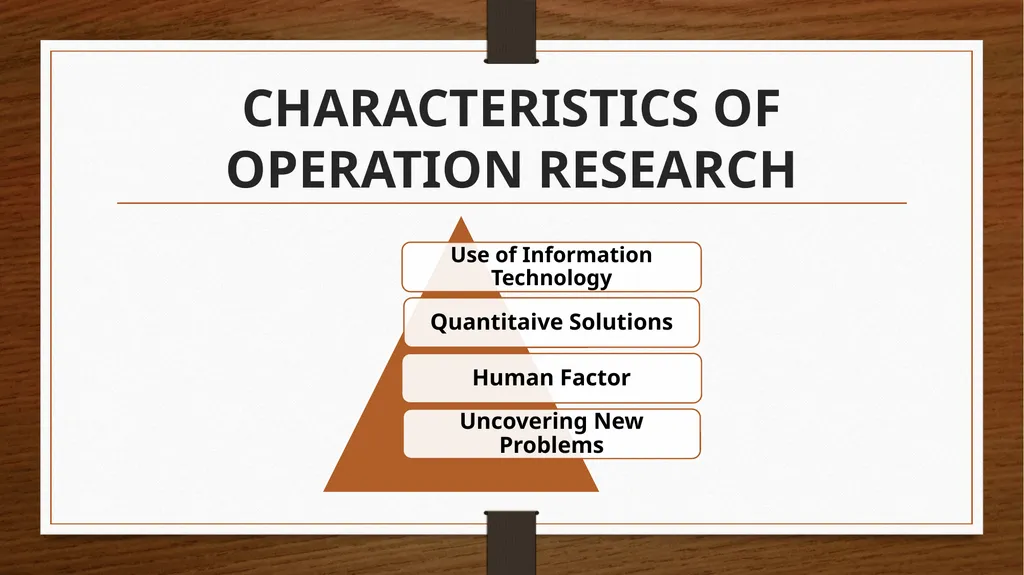
slide7. CHARACTERISTICS OF OPERATION RESEARCH<br>
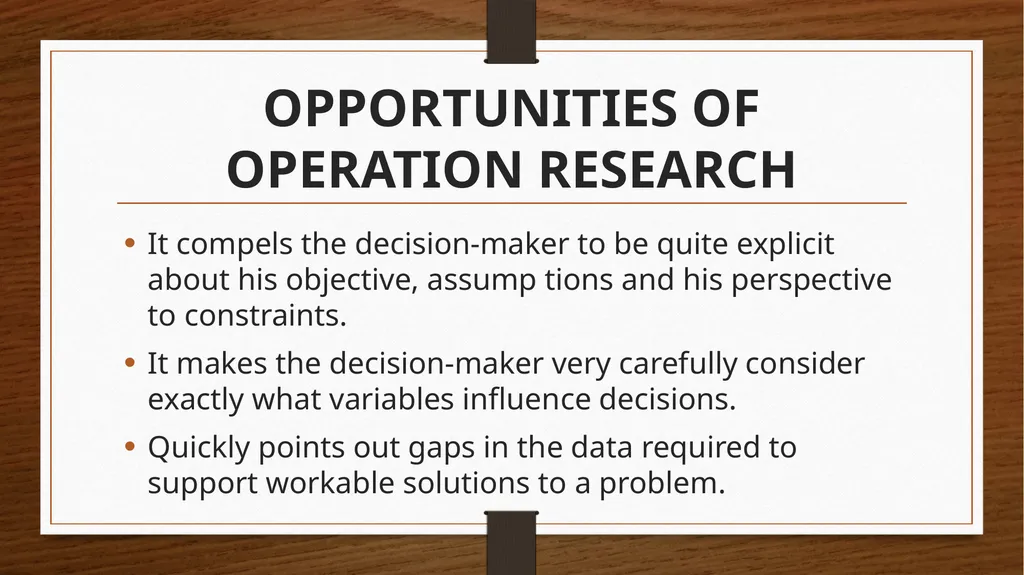
slide8. OPPORTUNITIES OF OPERATION RESEARCH It compels the decision-maker to be quite explicit about his objective, assump tions and his perspective to constraints.
It makes the decision-maker very carefully consider exactly what variables influence decisions.
Quickly points out gaps in the data required to support workable solutions to a problem.<br>
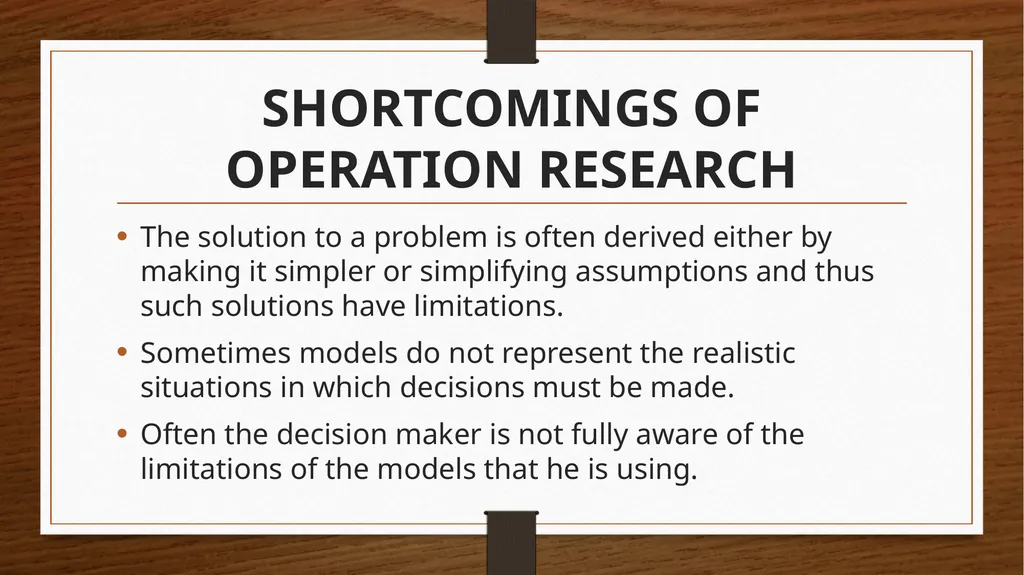
slide9. SHORTCOMINGS OF OPERATION RESEARCH The solution to a problem is often derived either by making it simpler or simplifying assumptions and thus such solutions have limitations.
Sometimes models do not represent the realistic situations in which decisions must be made.
Often the decision maker is not fully aware of the limitations of the models that he is using.<br>
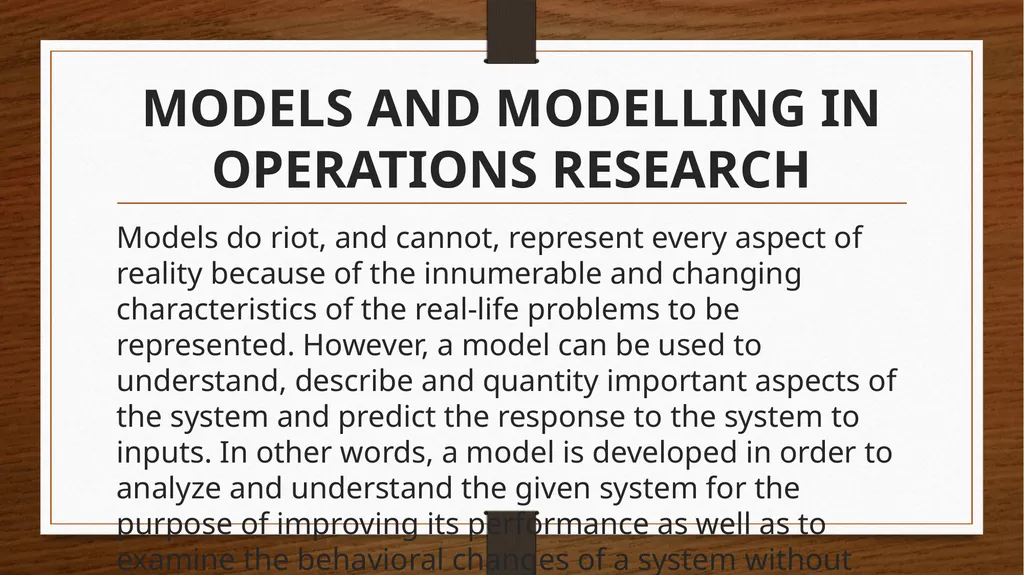
slide10. MODELS AND MODELLING IN OPERATIONS RESEARCH Models do riot, and cannot, represent every aspect of reality because of the innumerable and changing characteristics of the real-life problems to be represented. However, a model can be used to understand, describe and quantity important aspects of the system and predict the response to the system to inputs. In other words, a model is developed in order to analyze and understand the given system for the purpose of improving its performance as well as to examine the behavioral changes of a system without disturbing the ongoing operations.<br>
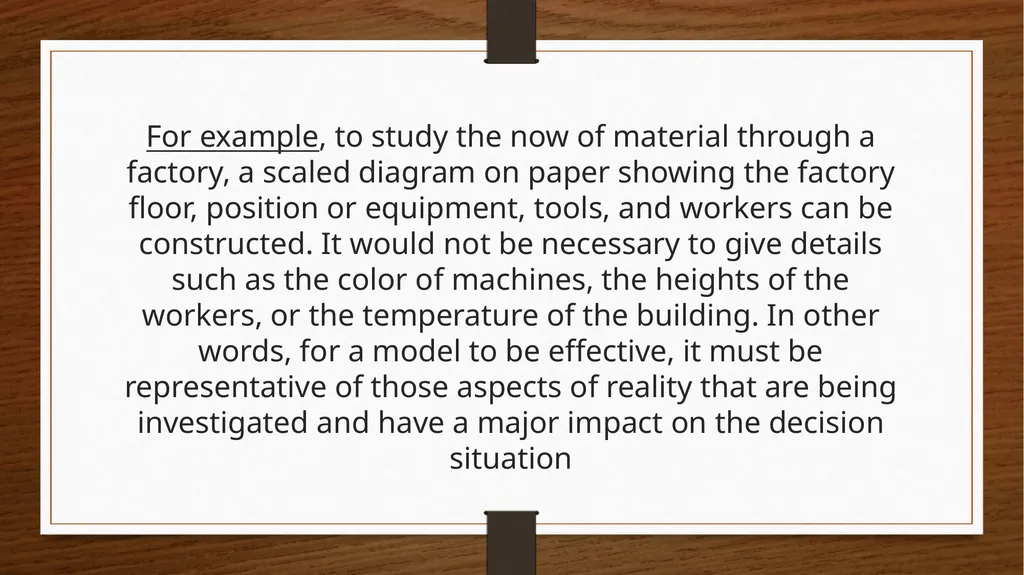
slide11. For example, to study the now of material through a factory, a scaled diagram on paper showing the factory floor, position or equipment, tools, and workers can be constructed. It would not be necessary to give details such as the color of machines, the heights of the workers, or the temperature of the building. In other words, for a model to be effective, it must be representative of those aspects of reality that are being investigated and have a major impact on the decision situation<br>
slide12. The top three qualities of any model are:
The validity of the model, i.e., how the model will represent the critical aspects of the system or problem under study.
The usability of the model, i.e., whether a model can be used for the specific purposes
The value of the model to the user.<br>
slide13. GENERAL METHODS FOR SOLVING OR MODELS Analytical Method
Using all the tools of classical optimaization techniques such as differential calculs and finite differences.
Alternative Method
If classical methods fails because of complexity of the constraint or the number of the variable then we are usually forced to adopt this methods.<br>
slide14. GENERAL METHODS FOR SOLVING OR MODELS Monte – Carlo Method
Method is based on idea of experimenting of the mathematical model by inserting into the model specific value of decision variable for a selected period of time.<br>
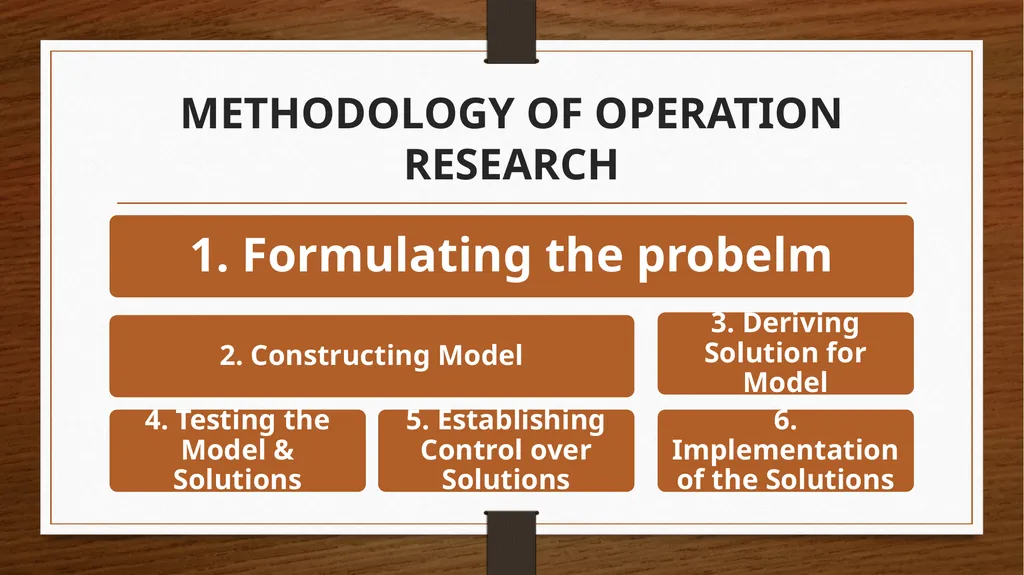
slide15. METHODOLOGY OF OPERATION RESEARCH<br>
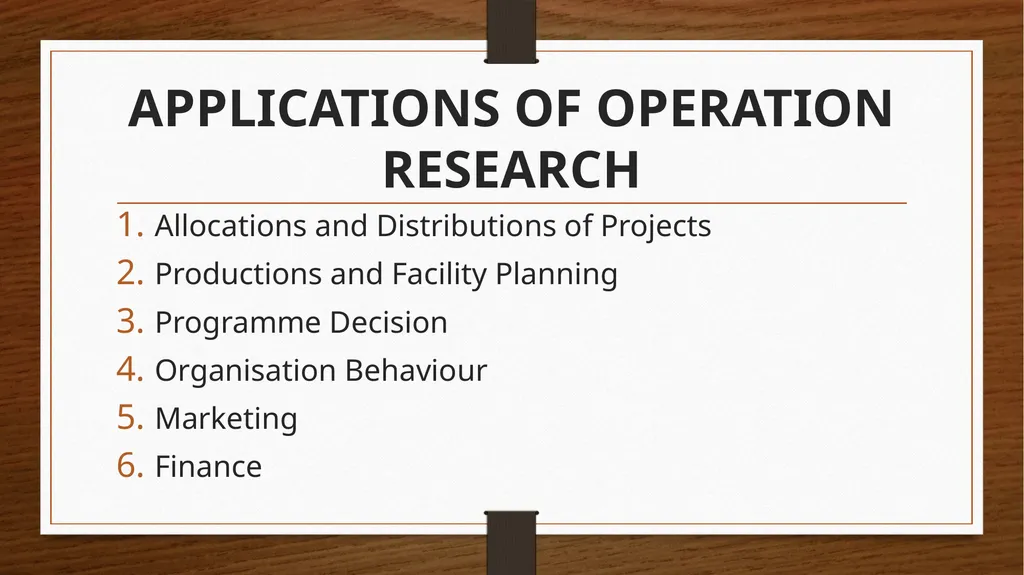
slide16. APPLICATIONS OF OPERATION RESEARCH Allocations and Distributions of Projects
Productions and Facility Planning
Programme Decision
Organisation Behaviour
Marketing
Finance<br>
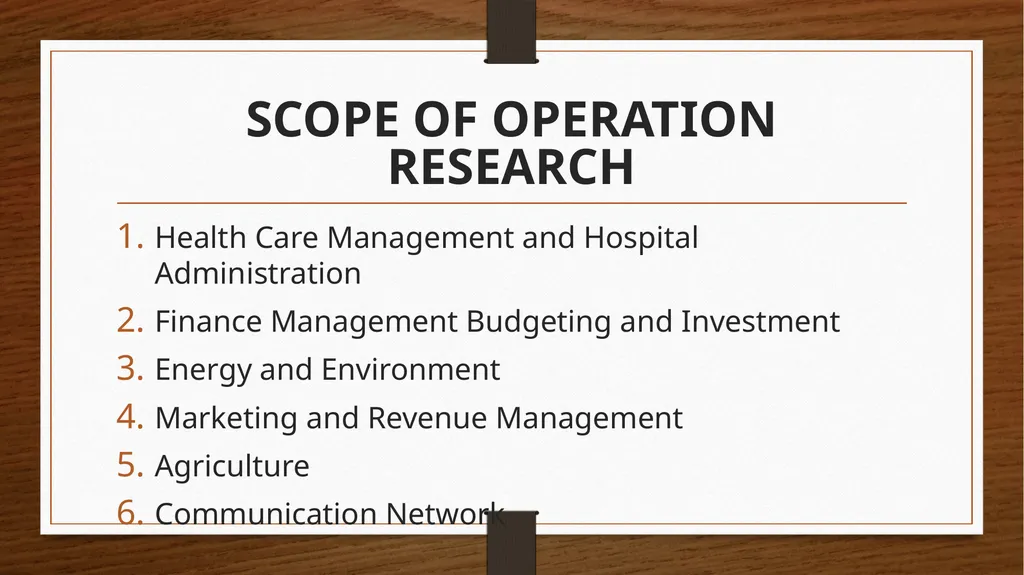
slide17. SCOPE OF OPERATION RESEARCH Health Care Management and Hospital Administration
Finance Management Budgeting and Investment
Energy and Environment
Marketing and Revenue Management
Agriculture
Communication Network<br>
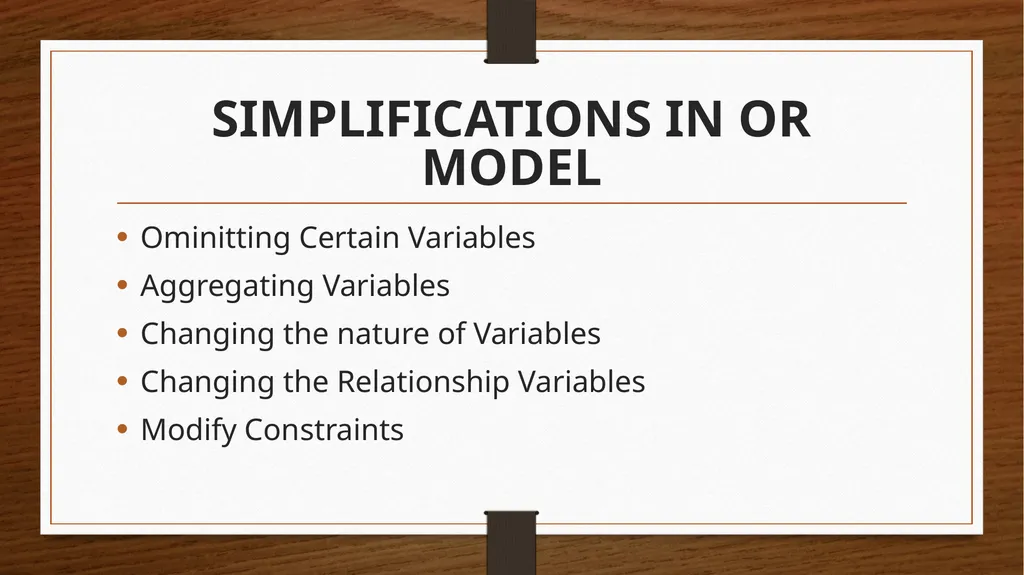
slide18. SIMPLIFICATIONS IN OR MODEL Ominitting Certain Variables
Aggregating Variables
Changing the nature of Variables
Changing the Relationship Variables
Modify Constraints<br>
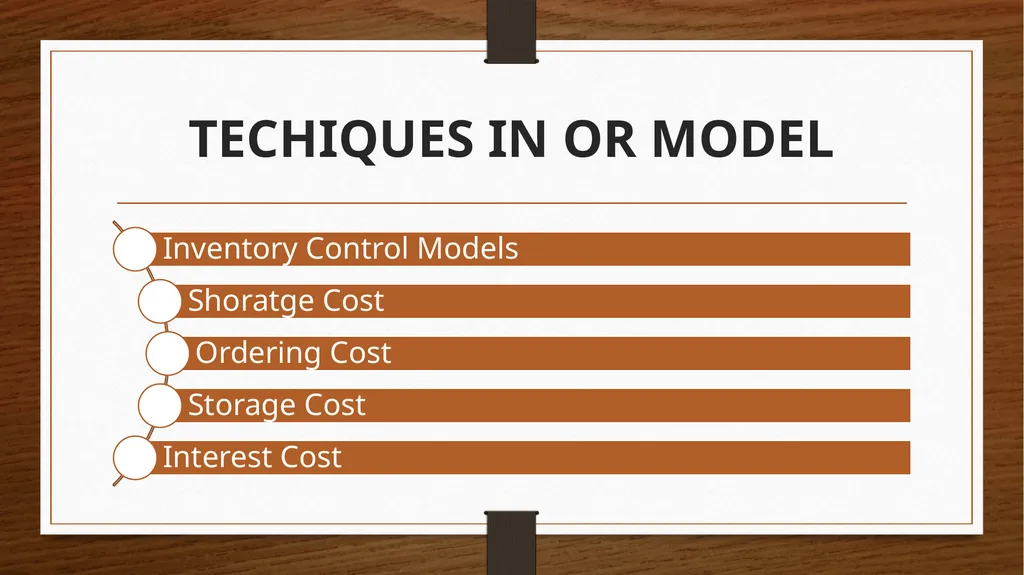
slide19. TECHIQUES IN OR MODEL<br>
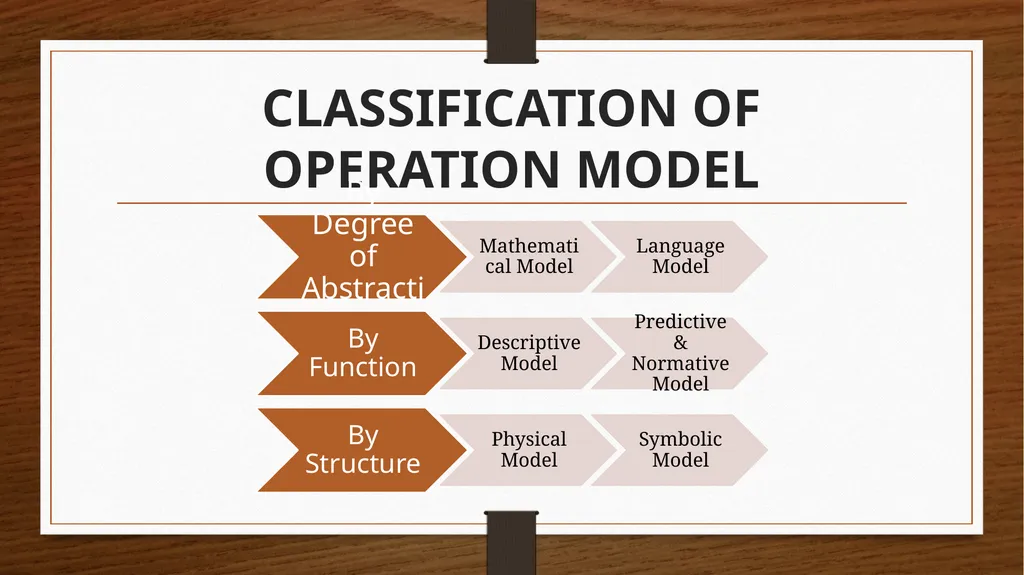
slide20. CLASSIFICATION OF OPERATION MODEL<br>
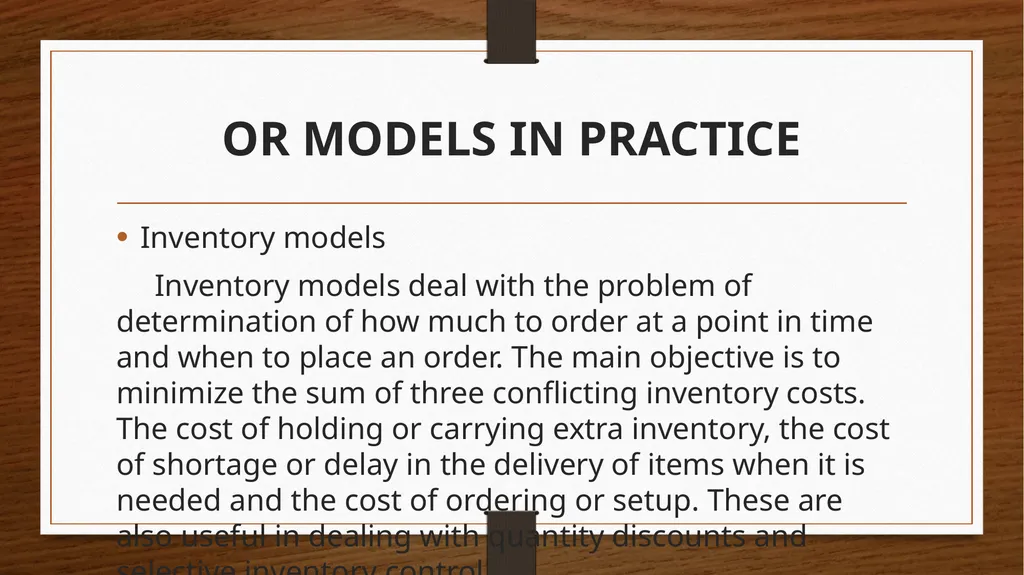
slide21. OR MODELS IN PRACTICE Inventory models
Inventory models deal with the problem of determination of how much to order at a point in time and when to place an order. The main objective is to minimize the sum of three conflicting inventory costs. The cost of holding or carrying extra inventory, the cost of shortage or delay in the delivery of items when it is needed and the cost of ordering or setup. These are also useful in dealing with quantity discounts and selective inventory control.<br>
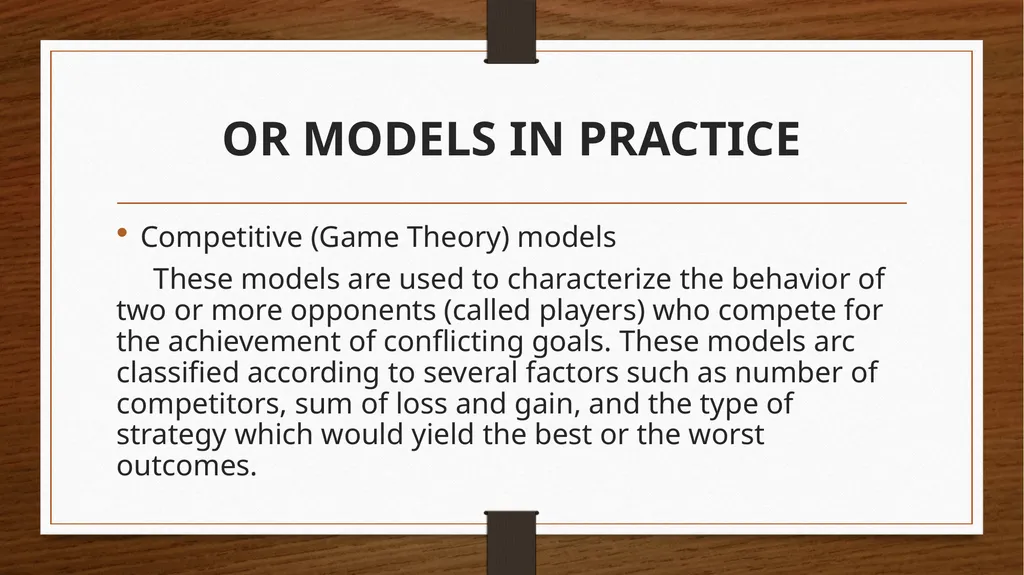
slide22. OR MODELS IN PRACTICE Competitive (Game Theory) models
These models are used to characterize the behavior of two or more opponents (called players) who compete for the achievement of conflicting goals. These models arc classified according to several factors such as number of competitors, sum of loss and gain, and the type of strategy which would yield the best or the worst outcomes.<br>
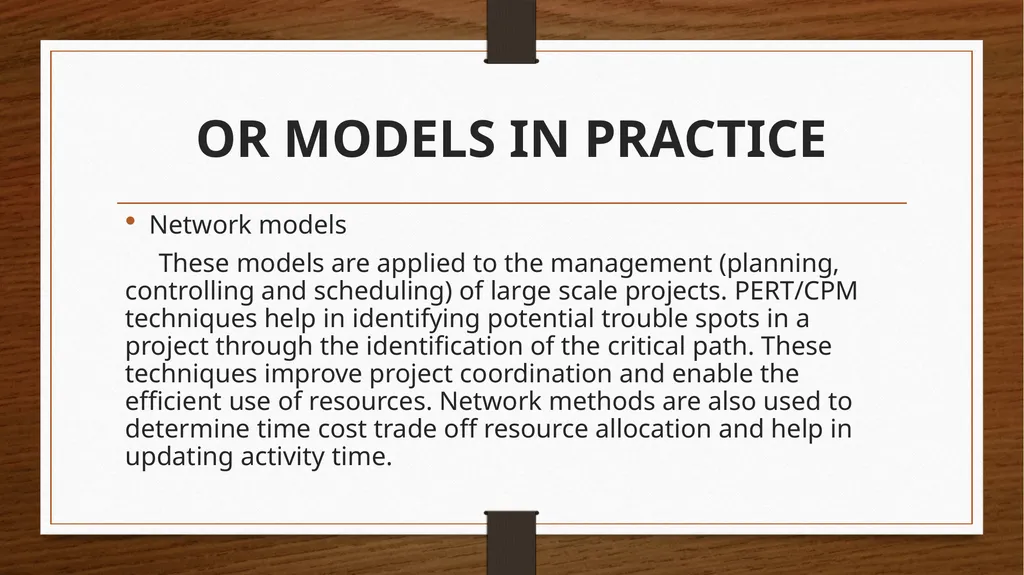
slide23. OR MODELS IN PRACTICE Network models
These models are applied to the management (planning, controlling and scheduling) of large scale projects. PERT/CPM techniques help in identifying potential trouble spots in a project through the identification of the critical path. These techniques improve project coordination and enable the efficient use of resources. Network methods are also used to determine time cost trade off resource allocation and help in updating activity time.<br>
According to HM Wagner, “ Operation Research is a scientific approach to problem solving for executive management”.<br>
slide2. DECISION MAKING THROUGH OPERATION RESEARCH Operational Research allow people to analyse a greater number of alternatives and constraints than would usually be possible, if they were to use only an initiative approach.
Using Operation Research, It is easier to analyse multiple alternatives, which results in greater confidence in the optimal choice.<br>
slide3. DECISION MAKING THROUGH OPERATION RESEARCH Business managers face an endless list of complex issue everyday. They must make decisions about financing, where to build a plant, how much of a product to manufacture, how many people to hire, and so on, often, the factors that make up business issues are complicated, and they may be difficult to comprehend. Operation Research is a way to deal with these thorny problems.<br>
slide4. NATURE & SIGNIFICANCE OF OPERATION RESEARCH Systematic Orientation
Operation Research tries to identify all possible interaction in the activities of organization & studies their impact.
Interdisciplinary System Approach
OR is performed by a team of scientist drawn from different facilities, statistics, economics, engineering, management, physics etc.<br>
slide5. NATURE & SIGNIFICANCE OF OPERATION RESEARCH Scientific Approach
It is a formalised process of reasoning where the problems are defined & analysed scientifically.
Decision Making
OR is a science which helps management to take better decision.<br>
slide6. NATURE & SIGNIFICANCE OF OPERATION RESEARCH Optimization Objective
It attempts to find the best and optimal solution to a problem using OR techniques.
Bad Answers to a Problem
OR cannot give perfect solution to a problems.<br>
slide7. CHARACTERISTICS OF OPERATION RESEARCH<br>
slide8. OPPORTUNITIES OF OPERATION RESEARCH It compels the decision-maker to be quite explicit about his objective, assump tions and his perspective to constraints.
It makes the decision-maker very carefully consider exactly what variables influence decisions.
Quickly points out gaps in the data required to support workable solutions to a problem.<br>
slide9. SHORTCOMINGS OF OPERATION RESEARCH The solution to a problem is often derived either by making it simpler or simplifying assumptions and thus such solutions have limitations.
Sometimes models do not represent the realistic situations in which decisions must be made.
Often the decision maker is not fully aware of the limitations of the models that he is using.<br>
slide10. MODELS AND MODELLING IN OPERATIONS RESEARCH Models do riot, and cannot, represent every aspect of reality because of the innumerable and changing characteristics of the real-life problems to be represented. However, a model can be used to understand, describe and quantity important aspects of the system and predict the response to the system to inputs. In other words, a model is developed in order to analyze and understand the given system for the purpose of improving its performance as well as to examine the behavioral changes of a system without disturbing the ongoing operations.<br>
slide11. For example, to study the now of material through a factory, a scaled diagram on paper showing the factory floor, position or equipment, tools, and workers can be constructed. It would not be necessary to give details such as the color of machines, the heights of the workers, or the temperature of the building. In other words, for a model to be effective, it must be representative of those aspects of reality that are being investigated and have a major impact on the decision situation<br>
slide12. The top three qualities of any model are:
The validity of the model, i.e., how the model will represent the critical aspects of the system or problem under study.
The usability of the model, i.e., whether a model can be used for the specific purposes
The value of the model to the user.<br>
slide13. GENERAL METHODS FOR SOLVING OR MODELS Analytical Method
Using all the tools of classical optimaization techniques such as differential calculs and finite differences.
Alternative Method
If classical methods fails because of complexity of the constraint or the number of the variable then we are usually forced to adopt this methods.<br>
slide14. GENERAL METHODS FOR SOLVING OR MODELS Monte – Carlo Method
Method is based on idea of experimenting of the mathematical model by inserting into the model specific value of decision variable for a selected period of time.<br>
slide15. METHODOLOGY OF OPERATION RESEARCH<br>
slide16. APPLICATIONS OF OPERATION RESEARCH Allocations and Distributions of Projects
Productions and Facility Planning
Programme Decision
Organisation Behaviour
Marketing
Finance<br>
slide17. SCOPE OF OPERATION RESEARCH Health Care Management and Hospital Administration
Finance Management Budgeting and Investment
Energy and Environment
Marketing and Revenue Management
Agriculture
Communication Network<br>
slide18. SIMPLIFICATIONS IN OR MODEL Ominitting Certain Variables
Aggregating Variables
Changing the nature of Variables
Changing the Relationship Variables
Modify Constraints<br>
slide19. TECHIQUES IN OR MODEL<br>
slide20. CLASSIFICATION OF OPERATION MODEL<br>
slide21. OR MODELS IN PRACTICE Inventory models
Inventory models deal with the problem of determination of how much to order at a point in time and when to place an order. The main objective is to minimize the sum of three conflicting inventory costs. The cost of holding or carrying extra inventory, the cost of shortage or delay in the delivery of items when it is needed and the cost of ordering or setup. These are also useful in dealing with quantity discounts and selective inventory control.<br>
slide22. OR MODELS IN PRACTICE Competitive (Game Theory) models
These models are used to characterize the behavior of two or more opponents (called players) who compete for the achievement of conflicting goals. These models arc classified according to several factors such as number of competitors, sum of loss and gain, and the type of strategy which would yield the best or the worst outcomes.<br>
slide23. OR MODELS IN PRACTICE Network models
These models are applied to the management (planning, controlling and scheduling) of large scale projects. PERT/CPM techniques help in identifying potential trouble spots in a project through the identification of the critical path. These techniques improve project coordination and enable the efficient use of resources. Network methods are also used to determine time cost trade off resource allocation and help in updating activity time.<br>