Operations Management Week 01 Adapted from Operations Management by William J. Stevenson Outline Operations Operations Management (OM) Process Management Scope of OM OM Decision Making Adapted from Operations Management by William J.
"Operations Management Week 01 Adapted from" is the property of its rightful owner. Permission is granted to
download and print the materials on this website for personal, non-commercial use only, and to display it
on your personal computer provided you do not modify the materials and that you retain all copyright
notices contained in the materials. By downloading content from our website, you accept the terms of this
agreement.
Presentation Transcript
01
Operations Management Week 01 Adapted from Operations Management by William J. Stevenson<br>
02
Outline Operations & Operations Management (OM)
Process Management
Scope of OM
OM & Decision Making Adapted from Operations Management by William J. Stevenson<br>
03
Learning Outcomes At the end of this session, the students should be able to;
Define the terms “operations management”
Describe the operations function and the nature of operations manager’s job
Summarize the two major aspects of process management
Explain the key aspects of operations management decision making Adapted from Operations Management by William J. Stevenson<br>
04
Operations & OM Operations is part of a business organization that is responsible for producing goods or services
OM can be defined as the management of systems or processes that create goods and/or provide services
OM and supply chain are intrinsically linked Adapted from Operations Management by William J. Stevenson<br>
05
Supply Chain Supply chain (external as well as internal) is a sequence of activities and/or organizations involved in producing and delivering a good or service which begins with basic suppliers of raw materials and extends all the way to the final customer
The external parts of a supply chain provide raw materials, parts, equipment, supplies, and/or other inputs to the organization, and they deliver outputs that are goods to the organization’s customers
The internal parts of a supply chain are part of the operations function itself, supplying operations with parts and materials, performing work on products and/or services, and passing the work on to the next step in the process Adapted from Operations Management by William J. Stevenson<br>
06
Adapted from Operations Management by William J. Stevenson Product Supply Chain<br>
07
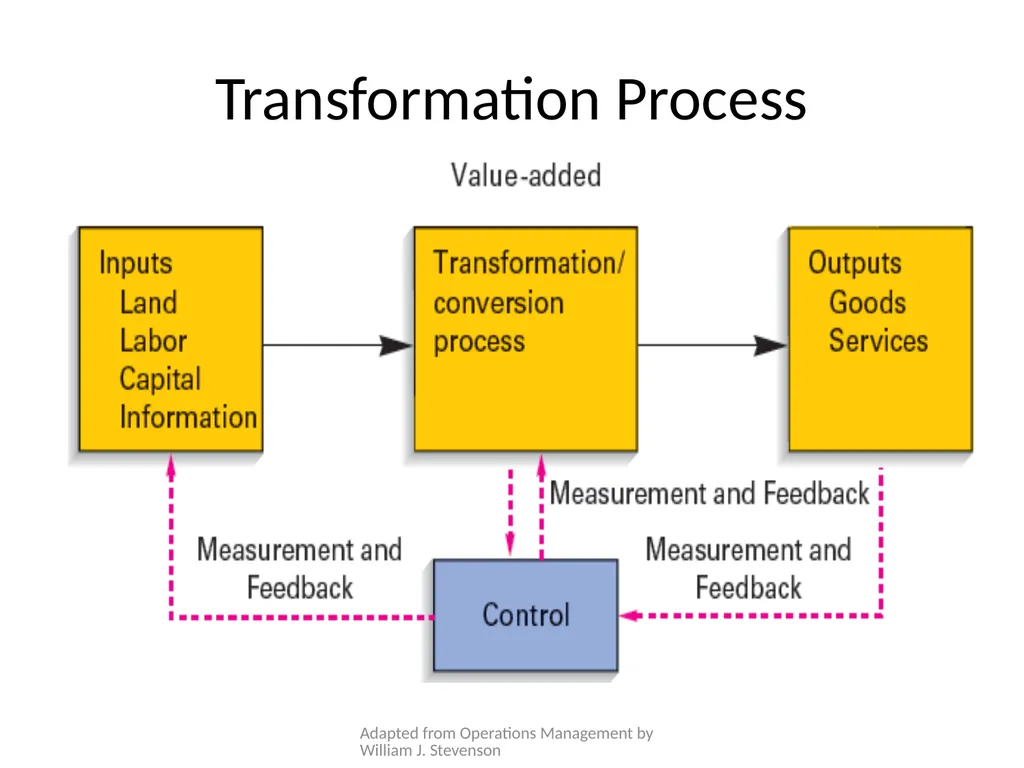
Transformation Process The creation of goods or services involves transforming or converting inputs into outputs
Various inputs such as capital, labor, and information are used to create goods or services using one or more transformation processes (e.g., storing, transporting, repairing)
To ensure that the desired outputs are obtained, an organization takes measurements at various points in the transformation process ( feedback ) and then compares them with previously established standards to determine whether corrective action is needed ( control ) Adapted from Operations Management by William J. Stevenson<br>
08
Transformation Process Adapted from Operations Management by William J. Stevenson<br>
09
Transformation Process; Examples Adapted from Operations Management by William J. Stevenson<br>
10
Adapted from Operations Management by William J. Stevenson Transformation Process; Examples<br>
11
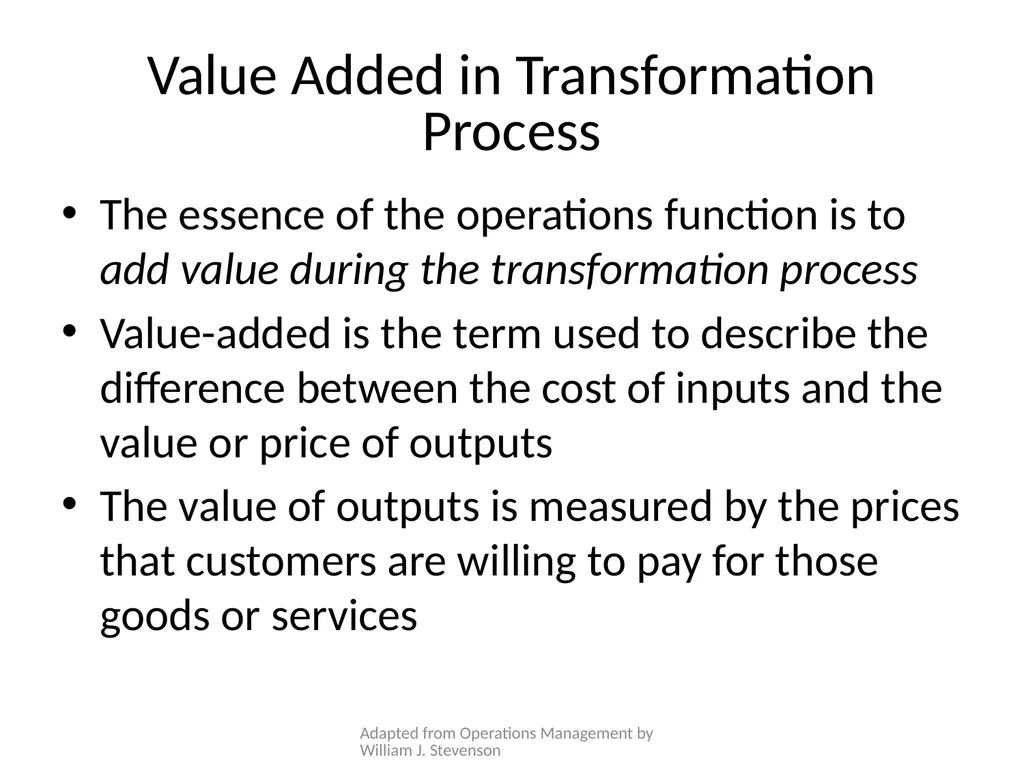
Value Added in Transformation Process The essence of the operations function is to add value during the transformation process
Value-added is the term used to describe the difference between the cost of inputs and the value or price of outputs
The value of outputs is measured by the prices that customers are willing to pay for those goods or services Adapted from Operations Management by William J. Stevenson<br>
12
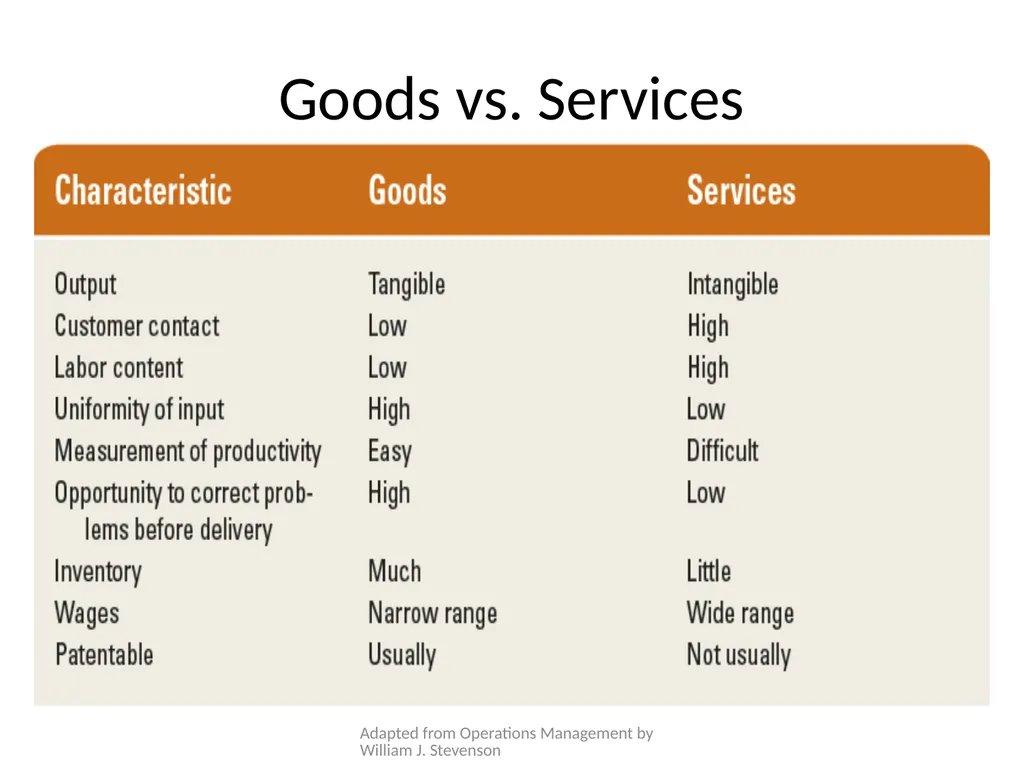
Goods vs. Services Adapted from Operations Management by William J. Stevenson<br>
13
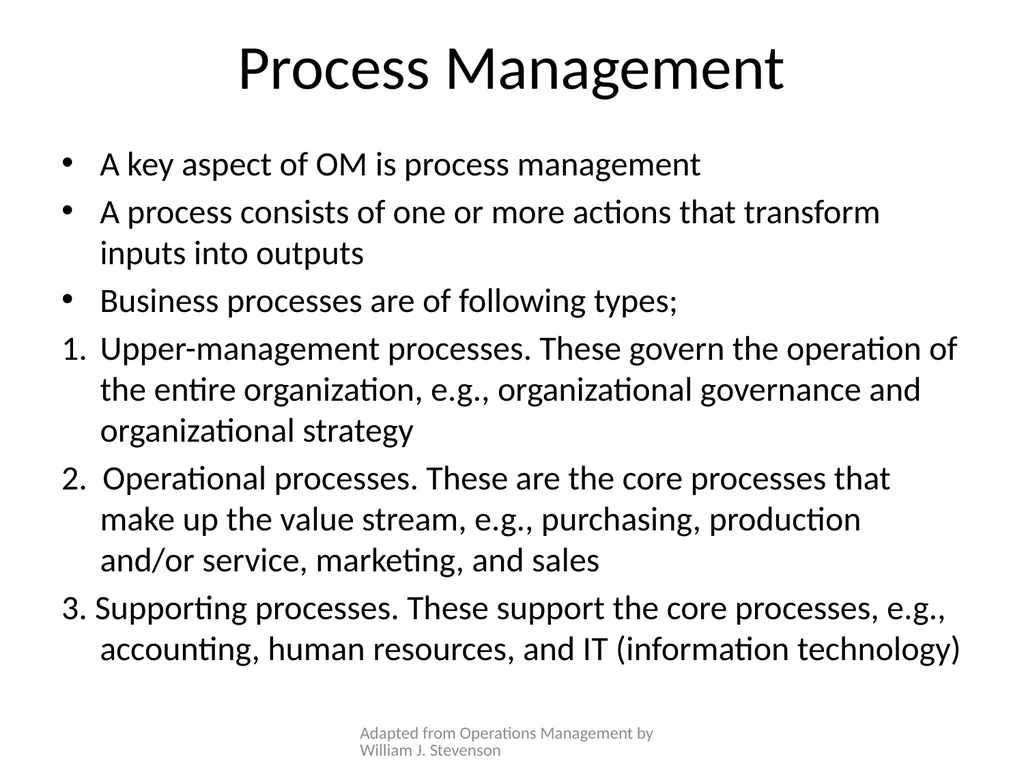
Process Management A key aspect of OM is process management
A process consists of one or more actions that transform inputs into outputs
Business processes are of following types;
Upper-management processes. These govern the operation of the entire organization, e.g., organizational governance and organizational strategy
2. Operational processes. These are the core processes that make up the value stream, e.g., purchasing, production and/or service, marketing, and sales
3. Supporting processes. These support the core processes, e.g., accounting, human resources, and IT (information technology) Adapted from Operations Management by William J. Stevenson<br>
14
A major process can consist of many sub-processes, each having its own goals that contribute to the goals of the overall process
Business process management (BPM) activities include process design, process execution, and process monitoring
Two basic aspects of process management are;
Managing a process to meet demand
Process variation Adapted from Operations Management by William J. Stevenson Process Management<br>
15
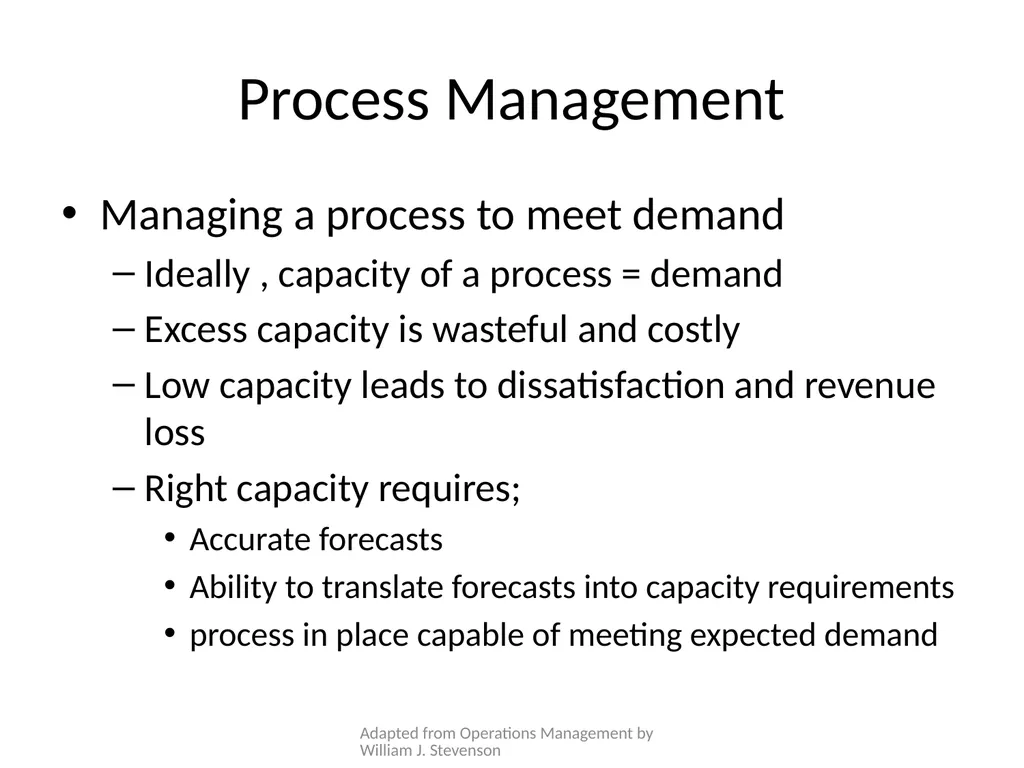
Process Management Managing a process to meet demand
Ideally , capacity of a process = demand
Excess capacity is wasteful and costly
Low capacity leads to dissatisfaction and revenue loss
Right capacity requires;
Accurate forecasts
Ability to translate forecasts into capacity requirements
process in place capable of meeting expected demand Adapted from Operations Management by William J. Stevenson<br>
16
Process variation: Variation occurs in all business processes and the four basic sources are;
1. The variety of goods or services being offered. The greater the variety of goods and services, the greater the variation in production or service requirements.
2. Structural variation in demand. These variations, which include trends and seasonal variations, are generally predictable. They are particularly important for capacity planning.
3. Random variation. This natural variability is present to some extent in all processes, as well as in demand for services and products, and it cannot generally be influenced by managers.
4. Assignable variation. These variations are caused by defective inputs, incorrect work methods, out-of-adjustment equipment, and so on. This type of variation can be reduced or eliminated by analysis and corrective action. Adapted from Operations Management by William J. Stevenson Process Management<br>
17
Scope of OM Reading; Operations Management by William J. Stevenson pp 11 – 14
What is your view of the ‘Scope of OM’
Write in your own (500) words and submit via turnitin.com
Class Name: BBA 2010-14 OM
Class ID: 6424702
Enrollment Password:
Assignment Title: Scope of OM Adapted from Operations Management by William J. Stevenson<br>
18
OM & Decision Making It is important for OM personnel to make informed decisions answering what, when, where, how and who for a decision state
Following tools help in decision making;
Models; An abstraction of reality; a simplified representation of something
Quantitative approaches; For example, linear programming, PERT, CPM
Performance metrics
Analysis of trade-offs
Degree of customization
Systems approach Adapted from Operations Management by William J. Stevenson<br>
19
Systems approach to decision making;
System is a set of interrelated parts that must work together
The whole is greater than the sum of its individual parts
Efficiency of sub-systems contributes to overall efficiency
Establishing priorities; A few factors account for a high percentage of the occurrence of some event(s) (known as Pareto phenomenon) Adapted from Operations Management by William J. Stevenson OM & Decision Making<br>