
Operator Licensing October 2020 SCHMELZER
SB
Published · 119 slides · 0 views

1 / 1














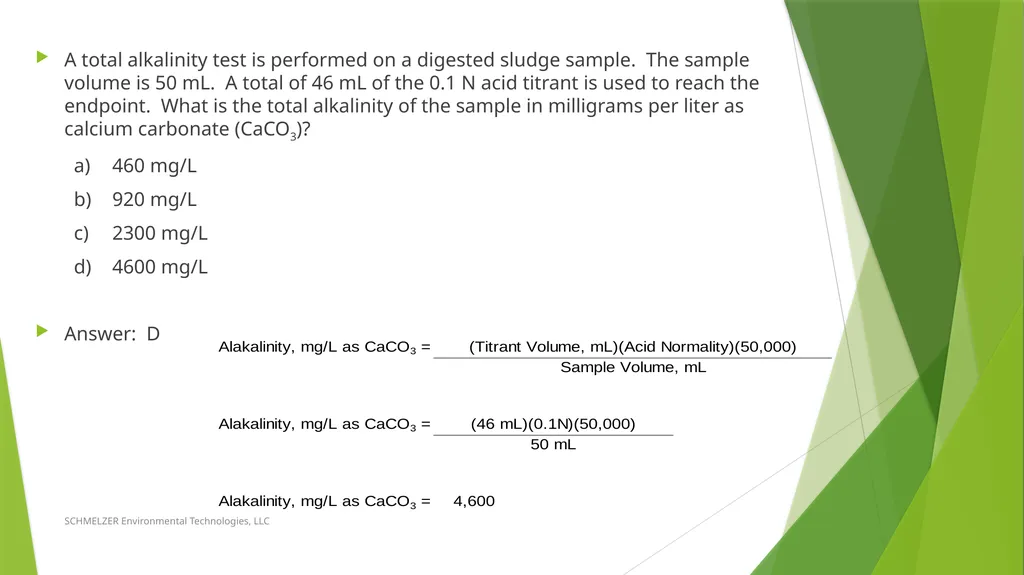
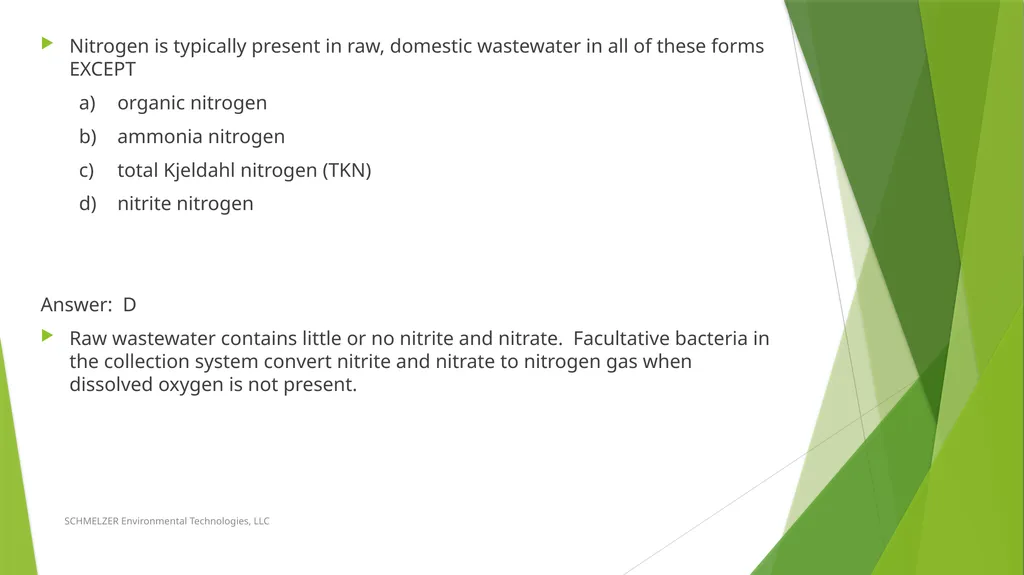
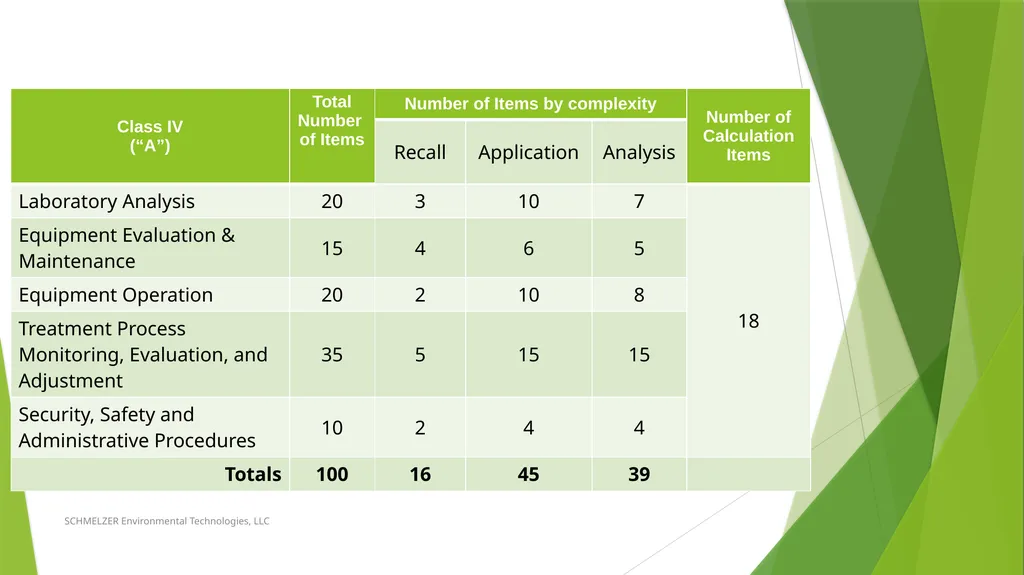
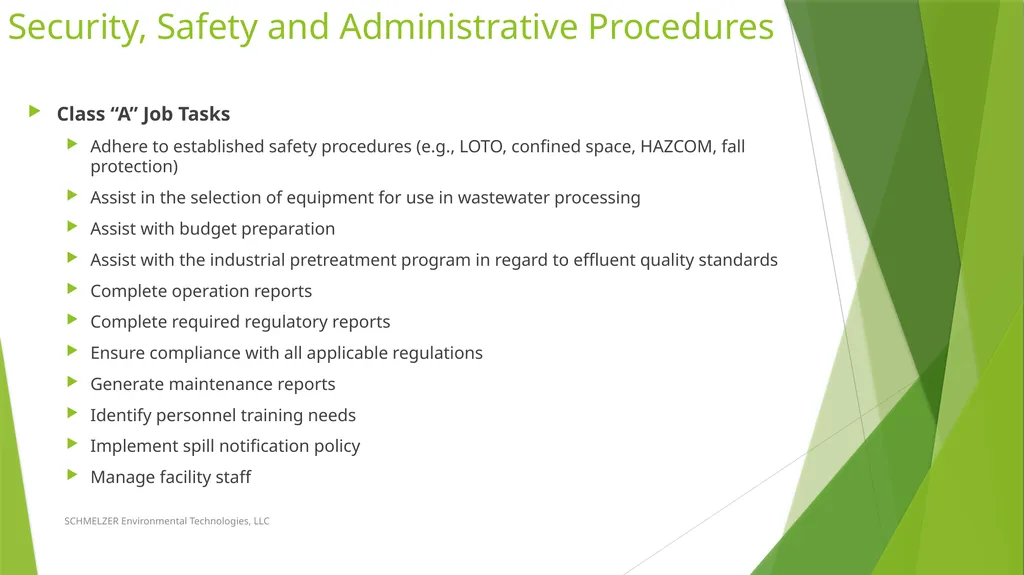



Description
Operator Licensing October 2020 SCHMELZER Environmental Technologies, LLC Agenda Licensing Requirements License Upgrade(s) Exams What to Expect on Exams Example Exam Questions SCHMELZER Environmental Technologies, LLC How to apply for
Related Topics
Share
Embed code
Download this presentation From Below
"Operator Licensing October 2020 SCHMELZER" is the property of its rightful owner. Permission is granted to download and print the materials on this website for personal, non-commercial use only, and to display it on your personal computer provided you do not modify the materials and that you retain all copyright notices contained in the materials. By downloading content from our website, you accept the terms of this agreement.
Presentation Transcript
01
Operator Licensing October 2020
SCHMELZER Environmental Technologies, LLC<br>
SCHMELZER Environmental Technologies, LLC<br>
02
Agenda Licensing Requirements
License Upgrade(s)
Exams
What to Expect on Exams
Example Exam Questions SCHMELZER Environmental Technologies, LLC<br>
License Upgrade(s)
Exams
What to Expect on Exams
Example Exam Questions SCHMELZER Environmental Technologies, LLC<br>
03
How to apply for licensure by examination or reinstatement:
Complete application;
Submit with check or money order for $50;
Applications can be submitted online or via mail;
Completed applications must include a copy of your social security card and a valid driver’s license, state issued ID, or passport. Licensing Requirements SCHMELZER Environmental Technologies, LLC 3<br>
Complete application;
Submit with check or money order for $50;
Applications can be submitted online or via mail;
Completed applications must include a copy of your social security card and a valid driver’s license, state issued ID, or passport. Licensing Requirements SCHMELZER Environmental Technologies, LLC 3<br>
04
How to apply for licensure by Reciprocity:
Complete application;
Submit with check or money order for $50;
Applications can be submitted online or via mail;
Completed applications must include a copy of your social security card and a valid driver’s license, state issued ID, or passport.
Board staff will request appropriate information your current state in order to determine eligibility.
Licenses in other states must be active; inactive licenses cannot be used in determining reciprocity. SCHMELZER Environmental Technologies, LLC<br>
Complete application;
Submit with check or money order for $50;
Applications can be submitted online or via mail;
Completed applications must include a copy of your social security card and a valid driver’s license, state issued ID, or passport.
Board staff will request appropriate information your current state in order to determine eligibility.
Licenses in other states must be active; inactive licenses cannot be used in determining reciprocity. SCHMELZER Environmental Technologies, LLC<br>
05
Upon receipt of a completed application, a trainee license will be issued. Trainees must pay the annual renewal fee ($30) each year by June 30th. Failure to do so will result in a $200 penalty for late renewals.
Trainee license holders will have two (2) years in which to pass the ‘D’ level examination. Failure to pass the exam within the two-year window will result in the license being rendered inactive and the applicant will be required to re-apply. If re-application is necessary, the operator forfeits the work experience time acquired under the expired license. Work experience time will begin again starting with the new application date.
There is no minimum education requirement for certification as a trainee. However, proof of high school completion or the equivalent must be submitted prior to being promoted to the “D” level of certification. After the trainee has obtained one year of actual operating experience and has passed the “D” exam, the trainee will be eligible for a license upgrade. SCHMELZER Environmental Technologies, LLC What happens next?<br>
Trainee license holders will have two (2) years in which to pass the ‘D’ level examination. Failure to pass the exam within the two-year window will result in the license being rendered inactive and the applicant will be required to re-apply. If re-application is necessary, the operator forfeits the work experience time acquired under the expired license. Work experience time will begin again starting with the new application date.
There is no minimum education requirement for certification as a trainee. However, proof of high school completion or the equivalent must be submitted prior to being promoted to the “D” level of certification. After the trainee has obtained one year of actual operating experience and has passed the “D” exam, the trainee will be eligible for a license upgrade. SCHMELZER Environmental Technologies, LLC What happens next?<br>
06
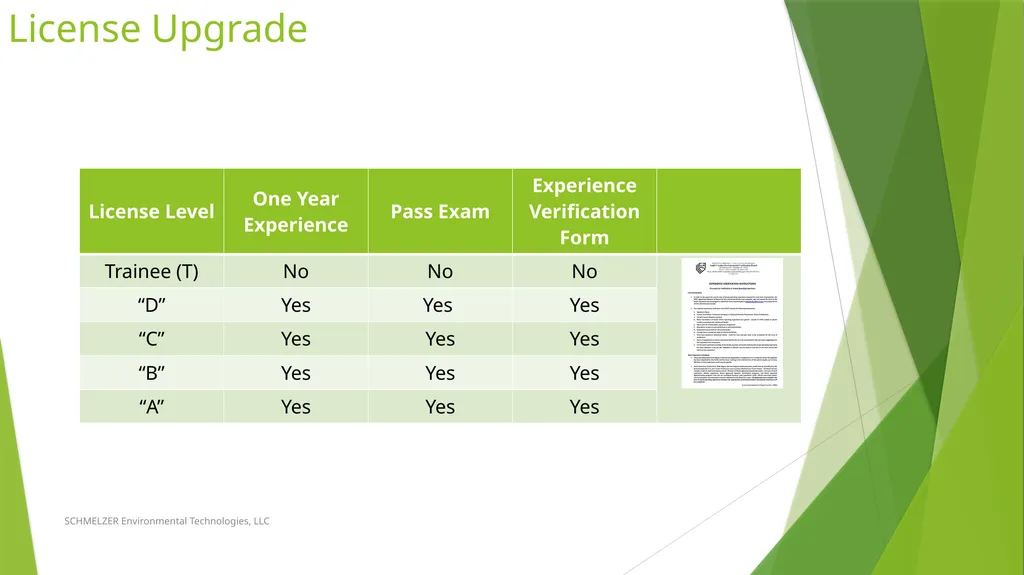
License Upgrade SCHMELZER Environmental Technologies, LLC<br>
07
Upgrade FAQ Do I have to pay a fee to be upgraded to a level of certification?
No. However, you will need for the "Operator of Record", to submit an Experience Verification for the level of certification you are requesting:
Can I get work credit for my college degree? If so, how?
A college degree or college credit may be used toward the C, B or A levels of your license once you have obtained your D-level license. You must submit your college transcript(s) with an experience verification form and pass each exam level. The Board may allow credit for math and sciences, 30 hours of credit = one year of service credit. SCHMELZER Environmental Technologies, LLC<br>
No. However, you will need for the "Operator of Record", to submit an Experience Verification for the level of certification you are requesting:
Can I get work credit for my college degree? If so, how?
A college degree or college credit may be used toward the C, B or A levels of your license once you have obtained your D-level license. You must submit your college transcript(s) with an experience verification form and pass each exam level. The Board may allow credit for math and sciences, 30 hours of credit = one year of service credit. SCHMELZER Environmental Technologies, LLC<br>
08
I took and passed the exam. How long till I get my license upgrade?
In order to receive a license upgrade, an Experience Verification Form must be submitted. Taking and passing the exam alone will not initiate the upgrade process. The Board receives exam scores twice a week from AMP and will not process an EVF until a passing score has been received.
My upgrade was approved. When can I operate at the new level?
Once an upgrade is processed, a letter will be sent verifying Board approval. Licensees may operate at the Board-approved license level once they have received the letter. The official certificates will be mailed after the subsequent Board Meeting. SCHMELZER Environmental Technologies, LLC<br>
In order to receive a license upgrade, an Experience Verification Form must be submitted. Taking and passing the exam alone will not initiate the upgrade process. The Board receives exam scores twice a week from AMP and will not process an EVF until a passing score has been received.
My upgrade was approved. When can I operate at the new level?
Once an upgrade is processed, a letter will be sent verifying Board approval. Licensees may operate at the Board-approved license level once they have received the letter. The official certificates will be mailed after the subsequent Board Meeting. SCHMELZER Environmental Technologies, LLC<br>
09
Exams Do I have to wait a year to take the next exam?
No. If you are in good standing with the Board, you only have to wait a period of 7 business days to apply for the next exam.
Who do I contact to schedule an exam?
To register for the exam, visit http://www.goamp.com?Pages/default.aspx or call 1-800-345-6559. To register by mail, complete the AMP Registration Form located at http://online.goamp.com/CandidateHome/candidateInformation.aspx.
How much does the exam cost and who do I pay? SCHMELZER Environmental Technologies, LLC<br>
No. If you are in good standing with the Board, you only have to wait a period of 7 business days to apply for the next exam.
Who do I contact to schedule an exam?
To register for the exam, visit http://www.goamp.com?Pages/default.aspx or call 1-800-345-6559. To register by mail, complete the AMP Registration Form located at http://online.goamp.com/CandidateHome/candidateInformation.aspx.
How much does the exam cost and who do I pay? SCHMELZER Environmental Technologies, LLC<br>
10
Where can I find study materials for exams?
http://abccert.org/testing_services/certification_study_resources.asp
On – Line Environmental Inc. (Jim Matthews)
http://www.oleinc.com/index.htm
Central Carolina Technical College
https://www.cctech.edu/training-continuing-ed/sc-environmental-training-center/ SCHMELZER Environmental Technologies, LLC<br>
http://abccert.org/testing_services/certification_study_resources.asp
On – Line Environmental Inc. (Jim Matthews)
http://www.oleinc.com/index.htm
Central Carolina Technical College
https://www.cctech.edu/training-continuing-ed/sc-environmental-training-center/ SCHMELZER Environmental Technologies, LLC<br>
11
What to Expect Length of Exam
D, C, & B exams you are allotted 3 hours
A exams you are allotted 4 hours
Testing Environment
Computer based exams
Exams are 100 questions
Multiple choice
What can I have during the exam
Non – Programmable calculator
Scratch paper & pencil (issued by testing center)
Formula sheet (issued by testing center) SCHMELZER Environmental Technologies, LLC<br>
D, C, & B exams you are allotted 3 hours
A exams you are allotted 4 hours
Testing Environment
Computer based exams
Exams are 100 questions
Multiple choice
What can I have during the exam
Non – Programmable calculator
Scratch paper & pencil (issued by testing center)
Formula sheet (issued by testing center) SCHMELZER Environmental Technologies, LLC<br>
12
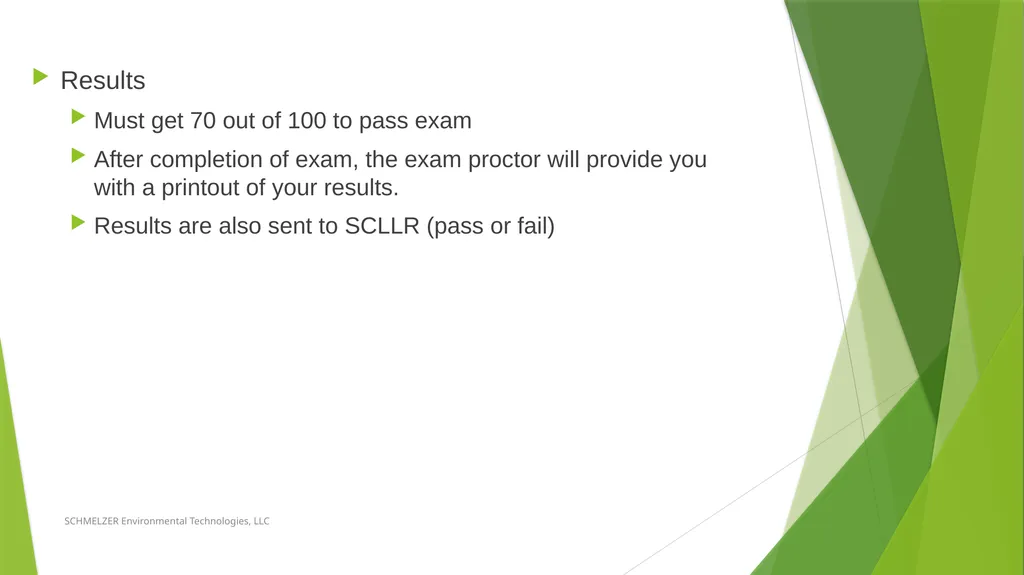
Results
Must get 70 out of 100 to pass exam
After completion of exam, the exam proctor will provide you with a printout of your results.
Results are also sent to SCLLR (pass or fail) SCHMELZER Environmental Technologies, LLC<br>
Must get 70 out of 100 to pass exam
After completion of exam, the exam proctor will provide you with a printout of your results.
Results are also sent to SCLLR (pass or fail) SCHMELZER Environmental Technologies, LLC<br>
13
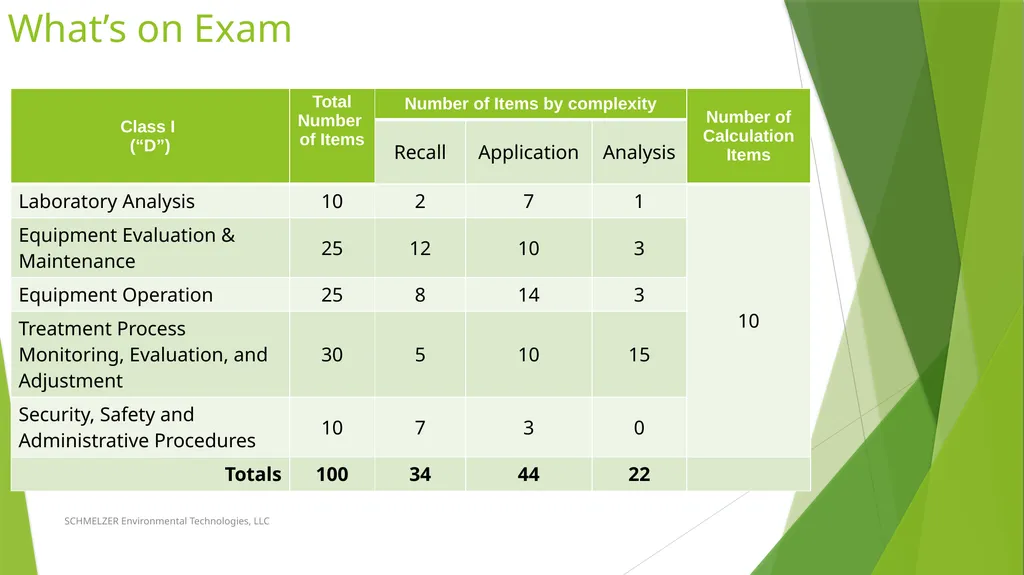
What’s on Exam SCHMELZER Environmental Technologies, LLC<br>
14
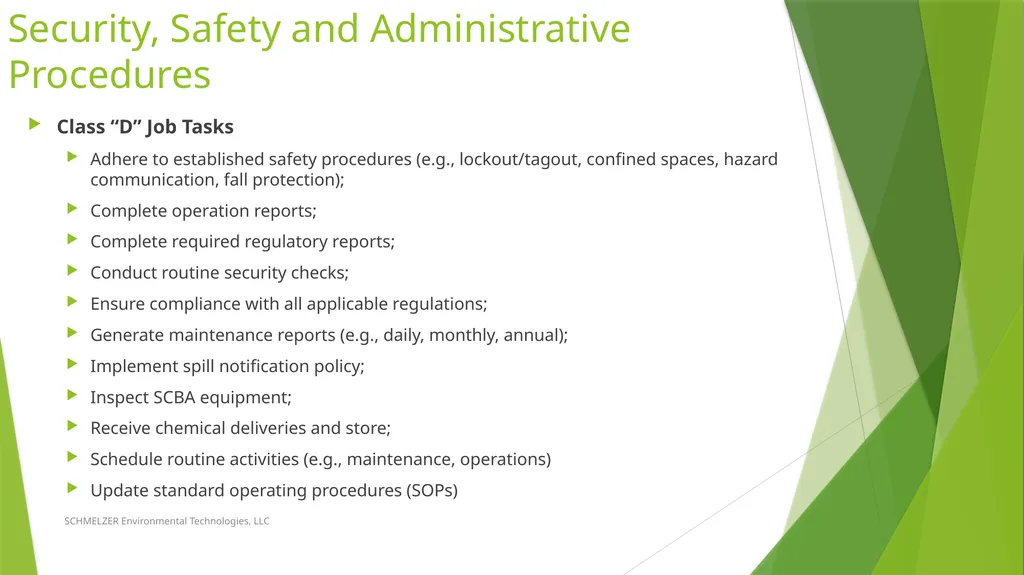
Security, Safety and Administrative Procedures Class “D” Job Tasks
Adhere to established safety procedures (e.g., lockout/tagout, confined spaces, hazard communication, fall protection);
Complete operation reports;
Complete required regulatory reports;
Conduct routine security checks;
Ensure compliance with all applicable regulations;
Generate maintenance reports (e.g., daily, monthly, annual);
Implement spill notification policy;
Inspect SCBA equipment;
Receive chemical deliveries and store;
Schedule routine activities (e.g., maintenance, operations)
Update standard operating procedures (SOPs) SCHMELZER Environmental Technologies, LLC<br>
Adhere to established safety procedures (e.g., lockout/tagout, confined spaces, hazard communication, fall protection);
Complete operation reports;
Complete required regulatory reports;
Conduct routine security checks;
Ensure compliance with all applicable regulations;
Generate maintenance reports (e.g., daily, monthly, annual);
Implement spill notification policy;
Inspect SCBA equipment;
Receive chemical deliveries and store;
Schedule routine activities (e.g., maintenance, operations)
Update standard operating procedures (SOPs) SCHMELZER Environmental Technologies, LLC<br>
15
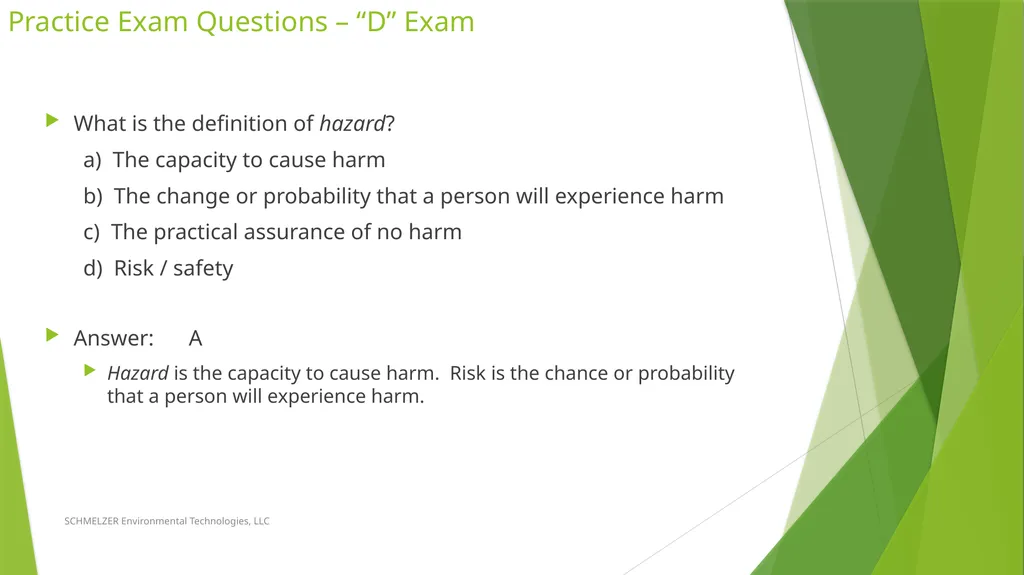
Practice Exam Questions – “D” Exam What is the definition of hazard?
a) The capacity to cause harm
b) The change or probability that a person will experience harm
c) The practical assurance of no harm
d) Risk / safety
Answer: A
Hazard is the capacity to cause harm. Risk is the chance or probability that a person will experience harm. SCHMELZER Environmental Technologies, LLC<br>
a) The capacity to cause harm
b) The change or probability that a person will experience harm
c) The practical assurance of no harm
d) Risk / safety
Answer: A
Hazard is the capacity to cause harm. Risk is the chance or probability that a person will experience harm. SCHMELZER Environmental Technologies, LLC<br>
16
What is the primary purpose of a Safety Data Sheet (SDS)?
a) To assist with the maintenance of proper inventories of materials
b) To provide a record of the proper storage of materials
c) to provide health and safety information regarding the use and handling of specific materials
d) To identify when materials have expired and need to be replaced
Answer: C
The safety data sheet provides the properties of each chemical; the physical, health, and environmental health hazards; protective measures; and safety precautions for handling, storing, and transporting the chemical. SCHMELZER Environmental Technologies, LLC<br>
a) To assist with the maintenance of proper inventories of materials
b) To provide a record of the proper storage of materials
c) to provide health and safety information regarding the use and handling of specific materials
d) To identify when materials have expired and need to be replaced
Answer: C
The safety data sheet provides the properties of each chemical; the physical, health, and environmental health hazards; protective measures; and safety precautions for handling, storing, and transporting the chemical. SCHMELZER Environmental Technologies, LLC<br>
17
The exhaust vents for a chlorine or sulfur dioxide cylinder room are located?
a) As close to the chlorine or sulfur dioxide cylinders as possible
b) Near the cylinder bonnets about two-thirds of the way up the wall
c) Near the floor
d) Immediately adjacent to entrances
Answer: C
Chlorine gas and sulfur dioxide gas are heavier than air. If a leak occurs, these gases will tend to accumulate near the floor. For this reason, exhaust vents are placed near the floor. Gas rooms constructed before 1986 may or may not have a chlorine scrubber to treat chlorine before releasing vented air to the atmosphere. After 1986, scrubbers were required under National Fire Protection Association (NFPA) standards. SCHMELZER Environmental Technologies, LLC<br>
a) As close to the chlorine or sulfur dioxide cylinders as possible
b) Near the cylinder bonnets about two-thirds of the way up the wall
c) Near the floor
d) Immediately adjacent to entrances
Answer: C
Chlorine gas and sulfur dioxide gas are heavier than air. If a leak occurs, these gases will tend to accumulate near the floor. For this reason, exhaust vents are placed near the floor. Gas rooms constructed before 1986 may or may not have a chlorine scrubber to treat chlorine before releasing vented air to the atmosphere. After 1986, scrubbers were required under National Fire Protection Association (NFPA) standards. SCHMELZER Environmental Technologies, LLC<br>
18
Which class of extinguisher should be used for electrical fires?
a) Class A
b) Class B
c) Class C
d) Class D
Answer: C
The following are the four classes of fires:
Class A – ordinary combustibles
Class B – combustible liquids and vapors
Class C – electrical fires
Class D – combustible metals SCHMELZER Environmental Technologies, LLC<br>
a) Class A
b) Class B
c) Class C
d) Class D
Answer: C
The following are the four classes of fires:
Class A – ordinary combustibles
Class B – combustible liquids and vapors
Class C – electrical fires
Class D – combustible metals SCHMELZER Environmental Technologies, LLC<br>
19
Equipment Evaluation and Maintenance Class “D” Job Tasks
Calibrate meters (e.g., flow, pressure sensors);
Follow safety rules and guidelines when working with chemical equipment;
Follow safety rules and guidelines when working with mechanical equipment;
Monitor flowmeters;
Monitor telemetry systems;
Perform basic electrical troubleshooting;
Perform preventive maintenance on equipment; SCHMELZER Environmental Technologies, LLC<br>
Calibrate meters (e.g., flow, pressure sensors);
Follow safety rules and guidelines when working with chemical equipment;
Follow safety rules and guidelines when working with mechanical equipment;
Monitor flowmeters;
Monitor telemetry systems;
Perform basic electrical troubleshooting;
Perform preventive maintenance on equipment; SCHMELZER Environmental Technologies, LLC<br>
20
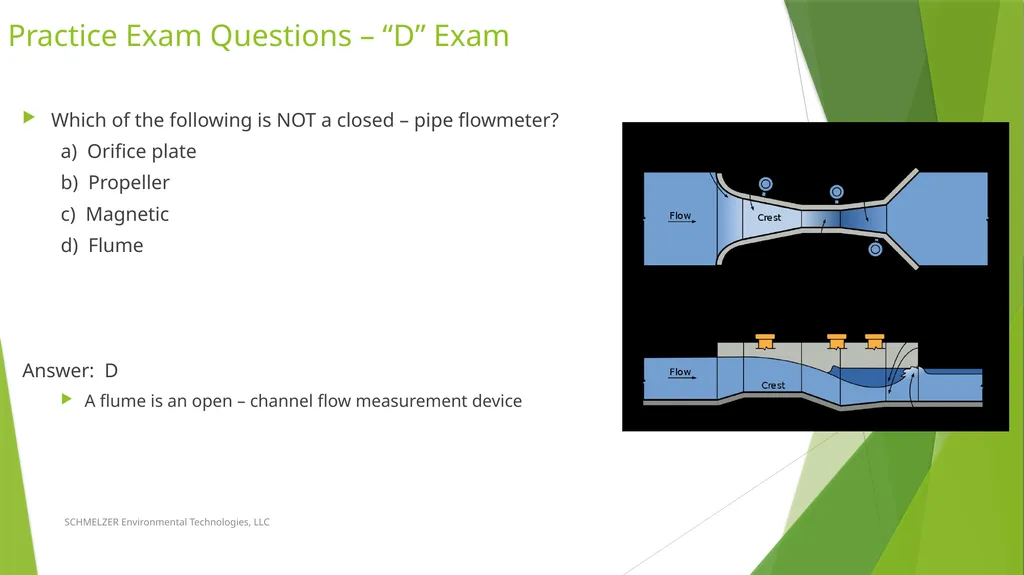
Practice Exam Questions – “D” Exam Which of the following is NOT a closed – pipe flowmeter?
a) Orifice plate
b) Propeller
c) Magnetic
d) Flume
Answer: D
A flume is an open – channel flow measurement device SCHMELZER Environmental Technologies, LLC<br>
a) Orifice plate
b) Propeller
c) Magnetic
d) Flume
Answer: D
A flume is an open – channel flow measurement device SCHMELZER Environmental Technologies, LLC<br>
21
The MAIN reason that electrical distribution networks are grounded is to?
a) prevent short – circuiting
b) provide alternating current (AC) power
c) provide direct current (DC) power
d) prevent the development of unsafe conditions
Answer: D
Safety is the primary purpose for grounding SCHMELZER Environmental Technologies, LLC<br>
a) prevent short – circuiting
b) provide alternating current (AC) power
c) provide direct current (DC) power
d) prevent the development of unsafe conditions
Answer: D
Safety is the primary purpose for grounding SCHMELZER Environmental Technologies, LLC<br>
22
Which component of anaerobic digester gas can form acid in a digester boiler?
a) Carbon dioxide
b) Hydrogen sulfide
c) Methane
d) Siloxanes
Answer: B
Hydrogen sulfide is an extremely reactive compound that, when combined with water, forms an acid solution that is highly corrosive to pipelines. SCHMELZER Environmental Technologies, LLC<br>
a) Carbon dioxide
b) Hydrogen sulfide
c) Methane
d) Siloxanes
Answer: B
Hydrogen sulfide is an extremely reactive compound that, when combined with water, forms an acid solution that is highly corrosive to pipelines. SCHMELZER Environmental Technologies, LLC<br>
23
Misalignment between a motor and a pump could cause?
a) improved motor efficiency
b) shaft damage
c) excess capacity
d) excessive pump speed
Answer: B
Motor and pump misalignment can result in damaged bearings, broken shafts, and excessively worn or ruined gears. SCHMELZER Environmental Technologies, LLC<br>
a) improved motor efficiency
b) shaft damage
c) excess capacity
d) excessive pump speed
Answer: B
Motor and pump misalignment can result in damaged bearings, broken shafts, and excessively worn or ruined gears. SCHMELZER Environmental Technologies, LLC<br>
24
The most common cause of motor malfunction is?
a) bearing failure
b) dust and dirt
c) thermal overload
d) single phasing
Answer: C
Thirty percent (30%) of motor malfunctions are caused by thermal overload. SCHMELZER Environmental Technologies, LLC<br>
a) bearing failure
b) dust and dirt
c) thermal overload
d) single phasing
Answer: C
Thirty percent (30%) of motor malfunctions are caused by thermal overload. SCHMELZER Environmental Technologies, LLC<br>
25
If a magnetic flow meter with a span of 0 to 1,000 gpm (0 to 63 L/s) has a specific accuracy of 2% of the span, the reading would be expected to be within what actual maximum flow?
a) 2 gpm (0.1 L/s)
b) 10 gpm (0.6 L/s)
c) 20 gpm (1.3 L/s)
d) 200 gpm (12.6 L/s)
Answer: C
1,000 gpm [2/100] = 20 gpm
63 L/s [2/100] = 1.26 L/s SCHMELZER Environmental Technologies, LLC<br>
a) 2 gpm (0.1 L/s)
b) 10 gpm (0.6 L/s)
c) 20 gpm (1.3 L/s)
d) 200 gpm (12.6 L/s)
Answer: C
1,000 gpm [2/100] = 20 gpm
63 L/s [2/100] = 1.26 L/s SCHMELZER Environmental Technologies, LLC<br>
26
Equipment Operation Class “D” Job Tasks
Analyze data to evaluate and adjust equipment;
Check filters for proper operation;
Conduct wastewater pipe repairs;
Monitor motor control center;
Operate the following:
Aeration basins;
Aerobic digesters;
Air compressors;
Bar screens;
Chemical feed systems;
Chlorination systems;
Mixers, motors, pumps, etc. SCHMELZER Environmental Technologies, LLC<br>
Analyze data to evaluate and adjust equipment;
Check filters for proper operation;
Conduct wastewater pipe repairs;
Monitor motor control center;
Operate the following:
Aeration basins;
Aerobic digesters;
Air compressors;
Bar screens;
Chemical feed systems;
Chlorination systems;
Mixers, motors, pumps, etc. SCHMELZER Environmental Technologies, LLC<br>
27
Practice Exam Questions – “D” Exam A sudden reduction of pump flow can be caused by?
a) debris
b) a volute
c) a leaking seal
d) a discharge valve stuck open
Answer: A
Pump troubleshooting can be difficult; however, most of the time debris is the culprit. Manufacturer operation and maintenance manuals can also be quite helpful in troubleshooting. SCHMELZER Environmental Technologies, LLC<br>
a) debris
b) a volute
c) a leaking seal
d) a discharge valve stuck open
Answer: A
Pump troubleshooting can be difficult; however, most of the time debris is the culprit. Manufacturer operation and maintenance manuals can also be quite helpful in troubleshooting. SCHMELZER Environmental Technologies, LLC<br>
28
A pump impeller is used to create a
a) seal
b) direct displacement force
c) centrifugal force that moves a liquid
d) strong connection between a pump and its metallic base
Answer: C
A pump impeller creates a pressure drop when it spins. This change in pressure causes water to be taken in and expelled from the pump. SCHMELZER Environmental Technologies, LLC<br>
a) seal
b) direct displacement force
c) centrifugal force that moves a liquid
d) strong connection between a pump and its metallic base
Answer: C
A pump impeller creates a pressure drop when it spins. This change in pressure causes water to be taken in and expelled from the pump. SCHMELZER Environmental Technologies, LLC<br>
29
An air gap backflow preventer is used to
a) prime a pump
b) separate the pump parts from the pumped fluid
c) keep wastewater from entering the potable water system
d) provide oxygen to an aerating basin
Answer: C
Air gaps between equipment and pipes prevent wastewater bacteria from entering the potable water supply. Regular maintenance and inspection are required. SCHMELZER Environmental Technologies, LLC<br>
a) prime a pump
b) separate the pump parts from the pumped fluid
c) keep wastewater from entering the potable water system
d) provide oxygen to an aerating basin
Answer: C
Air gaps between equipment and pipes prevent wastewater bacteria from entering the potable water supply. Regular maintenance and inspection are required. SCHMELZER Environmental Technologies, LLC<br>
30
Electrical transformers are used to
a) change electricity into amps
b) increase or decrease voltage
c) transfer electricity into wastewater
d) protect plant workers from electrocution
Answer: B
Transformers take power from the power company and change it so it can be used to run machinery. Once in the plant, other transformers are used to change the power to operate lights and smaller motors and equipment. The following voltages are found in most treatment plants: 220 V, 480 V, and higher voltages. SCHMELZER Environmental Technologies, LLC<br>
a) change electricity into amps
b) increase or decrease voltage
c) transfer electricity into wastewater
d) protect plant workers from electrocution
Answer: B
Transformers take power from the power company and change it so it can be used to run machinery. Once in the plant, other transformers are used to change the power to operate lights and smaller motors and equipment. The following voltages are found in most treatment plants: 220 V, 480 V, and higher voltages. SCHMELZER Environmental Technologies, LLC<br>
31
When using a positive – displacement pump, what should you never do?
a) Pump fluid uphill
b) Lubricate the pump while it is running
c) Supply the mechanical seal with water
d) Run with the discharge valve closed
Answer: D
Running a positive – displacement pump against a closed valve will severely damage the pump and piping and represents a significant safety hazard. SCHMELZER Environmental Technologies, LLC<br>
a) Pump fluid uphill
b) Lubricate the pump while it is running
c) Supply the mechanical seal with water
d) Run with the discharge valve closed
Answer: D
Running a positive – displacement pump against a closed valve will severely damage the pump and piping and represents a significant safety hazard. SCHMELZER Environmental Technologies, LLC<br>
32
In wastewater, ____________ pumps are most commonly used to pump influent, effluent, return activated sludge, waste activated sludge, and so on.
a) peripheral
b) propeller
c) screw lift
d) centrifugal
Answer: D
All of the pumps may appear in the wastewater process; however, the centrifugal pump is the most common. SCHMELZER Environmental Technologies, LLC<br>
a) peripheral
b) propeller
c) screw lift
d) centrifugal
Answer: D
All of the pumps may appear in the wastewater process; however, the centrifugal pump is the most common. SCHMELZER Environmental Technologies, LLC<br>
33
Treatment Process Monitoring, Evaluation and Adjustment Class “D” Job Tasks
Analyze laboratory data to evaluate and adjust processes;
Follow industry safety rules and guidelines applicable to treatment processes;
Implement changes as indicated by laboratory results;
Operate chemical feed systems
Operate SCADA systems;
Operate the preliminary treatment processes (e.g., screening, grit, flow equalization);
Operate primary clarification / sedimentation processes;
Operate the following secondary treatment processes:
Pond / lagoon systems;
Secondary clarification / sedimentation process, and
Extended aeration processes (e.g., package, SBR, oxidation ditch)
Operate disinfection treatment processes. SCHMELZER Environmental Technologies, LLC<br>
Analyze laboratory data to evaluate and adjust processes;
Follow industry safety rules and guidelines applicable to treatment processes;
Implement changes as indicated by laboratory results;
Operate chemical feed systems
Operate SCADA systems;
Operate the preliminary treatment processes (e.g., screening, grit, flow equalization);
Operate primary clarification / sedimentation processes;
Operate the following secondary treatment processes:
Pond / lagoon systems;
Secondary clarification / sedimentation process, and
Extended aeration processes (e.g., package, SBR, oxidation ditch)
Operate disinfection treatment processes. SCHMELZER Environmental Technologies, LLC<br>
34
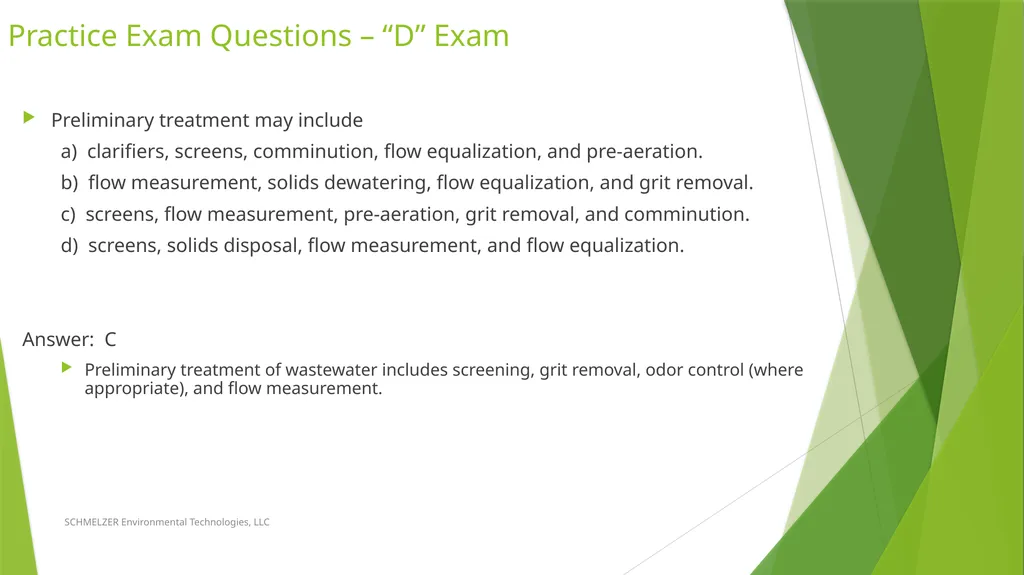
Practice Exam Questions – “D” Exam Preliminary treatment may include
a) clarifiers, screens, comminution, flow equalization, and pre-aeration.
b) flow measurement, solids dewatering, flow equalization, and grit removal.
c) screens, flow measurement, pre-aeration, grit removal, and comminution.
d) screens, solids disposal, flow measurement, and flow equalization.
Answer: C
Preliminary treatment of wastewater includes screening, grit removal, odor control (where appropriate), and flow measurement. SCHMELZER Environmental Technologies, LLC<br>
a) clarifiers, screens, comminution, flow equalization, and pre-aeration.
b) flow measurement, solids dewatering, flow equalization, and grit removal.
c) screens, flow measurement, pre-aeration, grit removal, and comminution.
d) screens, solids disposal, flow measurement, and flow equalization.
Answer: C
Preliminary treatment of wastewater includes screening, grit removal, odor control (where appropriate), and flow measurement. SCHMELZER Environmental Technologies, LLC<br>
35
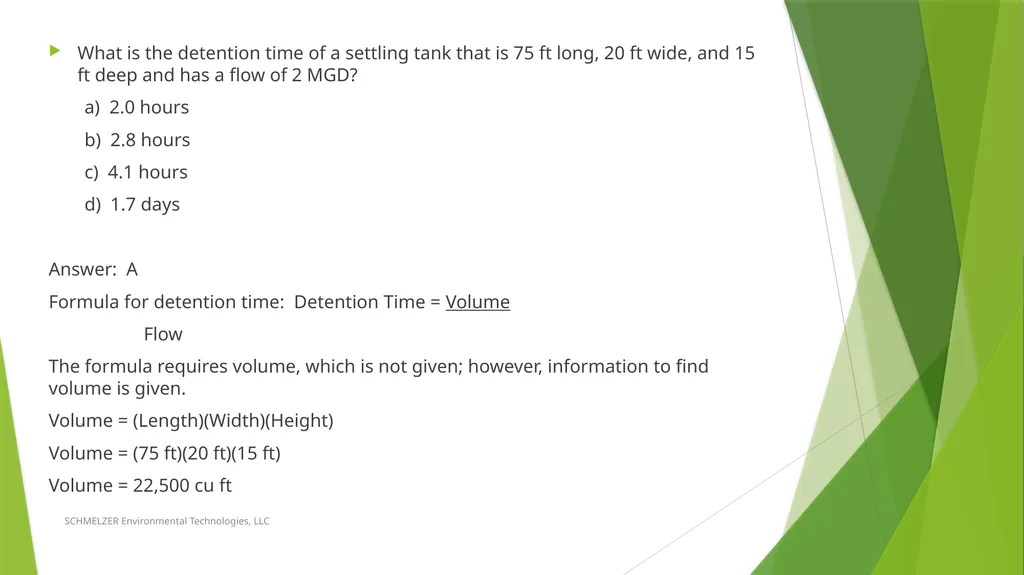
What is the detention time of a settling tank that is 75 ft long, 20 ft wide, and 15 ft deep and has a flow of 2 MGD?
a) 2.0 hours
b) 2.8 hours
c) 4.1 hours
d) 1.7 days
Answer: A
Formula for detention time: Detention Time = Volume
Flow
The formula requires volume, which is not given; however, information to find volume is given.
Volume = (Length)(Width)(Height)
Volume = (75 ft)(20 ft)(15 ft)
Volume = 22,500 cu ft SCHMELZER Environmental Technologies, LLC<br>
a) 2.0 hours
b) 2.8 hours
c) 4.1 hours
d) 1.7 days
Answer: A
Formula for detention time: Detention Time = Volume
Flow
The formula requires volume, which is not given; however, information to find volume is given.
Volume = (Length)(Width)(Height)
Volume = (75 ft)(20 ft)(15 ft)
Volume = 22,500 cu ft SCHMELZER Environmental Technologies, LLC<br>
36
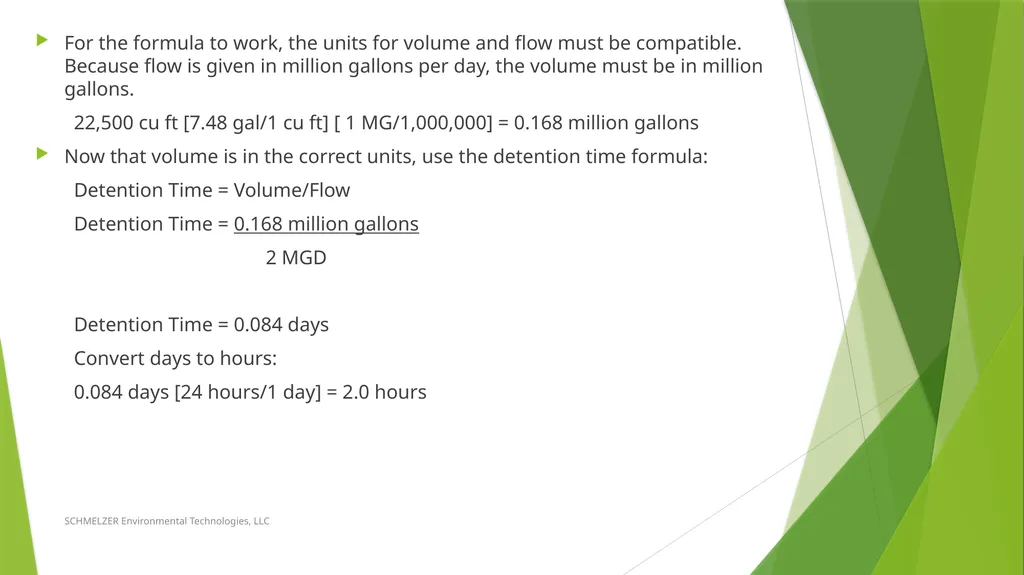
For the formula to work, the units for volume and flow must be compatible. Because flow is given in million gallons per day, the volume must be in million gallons.
22,500 cu ft [7.48 gal/1 cu ft] [ 1 MG/1,000,000] = 0.168 million gallons
Now that volume is in the correct units, use the detention time formula:
Detention Time = Volume/Flow
Detention Time = 0.168 million gallons
2 MGD
Detention Time = 0.084 days
Convert days to hours:
0.084 days [24 hours/1 day] = 2.0 hours SCHMELZER Environmental Technologies, LLC<br>
22,500 cu ft [7.48 gal/1 cu ft] [ 1 MG/1,000,000] = 0.168 million gallons
Now that volume is in the correct units, use the detention time formula:
Detention Time = Volume/Flow
Detention Time = 0.168 million gallons
2 MGD
Detention Time = 0.084 days
Convert days to hours:
0.084 days [24 hours/1 day] = 2.0 hours SCHMELZER Environmental Technologies, LLC<br>
37
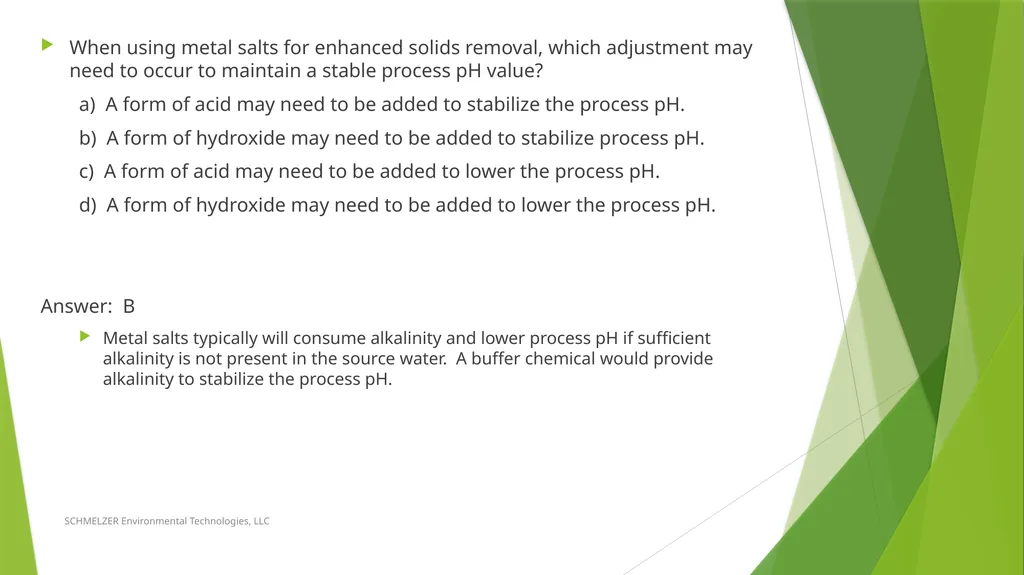
When using metal salts for enhanced solids removal, which adjustment may need to occur to maintain a stable process pH value?
a) A form of acid may need to be added to stabilize the process pH.
b) A form of hydroxide may need to be added to stabilize process pH.
c) A form of acid may need to be added to lower the process pH.
d) A form of hydroxide may need to be added to lower the process pH.
Answer: B
Metal salts typically will consume alkalinity and lower process pH if sufficient alkalinity is not present in the source water. A buffer chemical would provide alkalinity to stabilize the process pH. SCHMELZER Environmental Technologies, LLC<br>
a) A form of acid may need to be added to stabilize the process pH.
b) A form of hydroxide may need to be added to stabilize process pH.
c) A form of acid may need to be added to lower the process pH.
d) A form of hydroxide may need to be added to lower the process pH.
Answer: B
Metal salts typically will consume alkalinity and lower process pH if sufficient alkalinity is not present in the source water. A buffer chemical would provide alkalinity to stabilize the process pH. SCHMELZER Environmental Technologies, LLC<br>
38
Which of the following statements is correct?
a) The coagulation process follows the flocculation process.
b) The flocculation process creates conditions where the collisions of solids are decreased.
c) Coagulation chemicals are traditionally added after flocculation.
d) The flocculation process creates conditions where the collisions of coagulated solids are increased.
Answer: D
Traditionally, the flocculation process is preceded by chemical coagulation. The flocculation process is designed to increase coagulated solids collisions. Coagulation chemicals need to be added before flocculation. SCHMELZER Environmental Technologies, LLC<br>
a) The coagulation process follows the flocculation process.
b) The flocculation process creates conditions where the collisions of solids are decreased.
c) Coagulation chemicals are traditionally added after flocculation.
d) The flocculation process creates conditions where the collisions of coagulated solids are increased.
Answer: D
Traditionally, the flocculation process is preceded by chemical coagulation. The flocculation process is designed to increase coagulated solids collisions. Coagulation chemicals need to be added before flocculation. SCHMELZER Environmental Technologies, LLC<br>
39
In thickening or dewatering processes, one of the most common causes of excessive polymer consumption is?
a) storage of polymer totes at 20° C
b) poor polymer mixing
c) low total dissolved solids in the makeup water
d) use of a non – ionic polymer
Answer: B
The type of polymer preparation and feed system is determined by the type of polymer product used because different mixing systems are required to effectively mix the different types of polymer. The method of mixing the sludge and polymer is important because efficient mixing ensures the most consistent polymer performance. SCHMELZER Environmental Technologies, LLC<br>
a) storage of polymer totes at 20° C
b) poor polymer mixing
c) low total dissolved solids in the makeup water
d) use of a non – ionic polymer
Answer: B
The type of polymer preparation and feed system is determined by the type of polymer product used because different mixing systems are required to effectively mix the different types of polymer. The method of mixing the sludge and polymer is important because efficient mixing ensures the most consistent polymer performance. SCHMELZER Environmental Technologies, LLC<br>
40
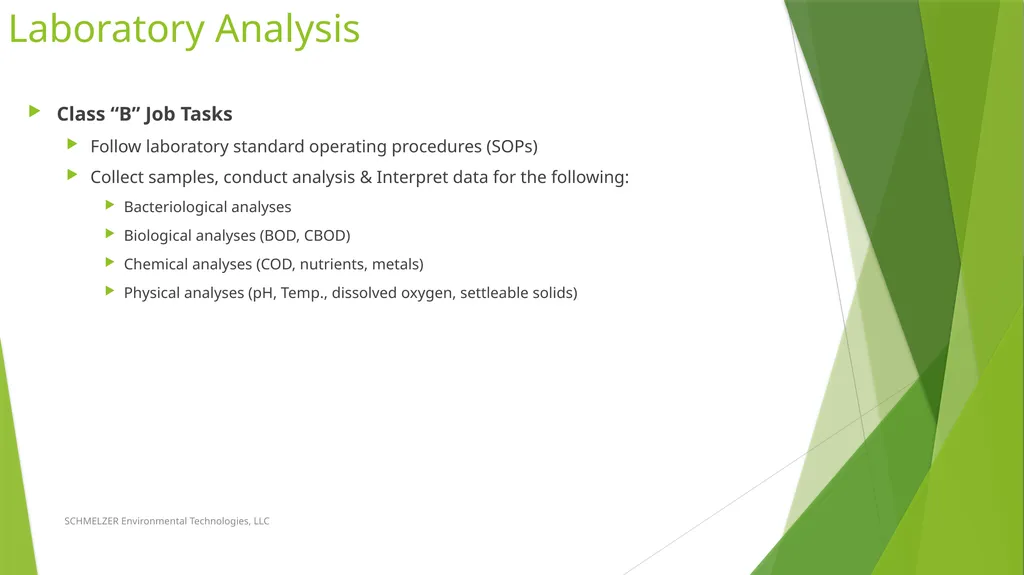
Laboratory Analysis Class “D” Job Tasks
Follow laboratory standard operating procedures (SOPs);
Collect samples for the following:
Bacteriological analyses,
Biological analyses (e.g., BOD, CBOD),
Chemical analyses (e.g., COD, nutrients, metals), and
Physical analyses (e.g., pH, temp., dissolved oxygen, settleable solids);
Conduct the following:
Physical analyses,
Process control laboratory testing;
Interpret data from the following:
Bacteriological analyses,
Biological analyses,
Chemical analyses,
Physical analyses. SCHMELZER Environmental Technologies, LLC<br>
Follow laboratory standard operating procedures (SOPs);
Collect samples for the following:
Bacteriological analyses,
Biological analyses (e.g., BOD, CBOD),
Chemical analyses (e.g., COD, nutrients, metals), and
Physical analyses (e.g., pH, temp., dissolved oxygen, settleable solids);
Conduct the following:
Physical analyses,
Process control laboratory testing;
Interpret data from the following:
Bacteriological analyses,
Biological analyses,
Chemical analyses,
Physical analyses. SCHMELZER Environmental Technologies, LLC<br>
41
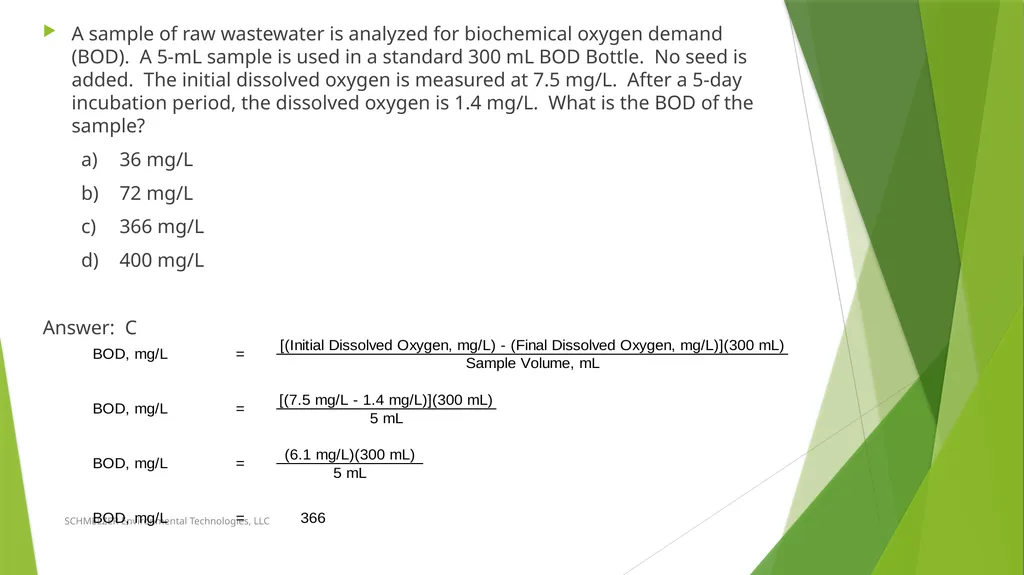
Practice Exam Questions – “D” Exam Which is the standardized condition for biochemical oxygen demand (BOD) analysis?
a) 20° C for 3 days
b) 20° C for 5 days
c) 25° C for 5 days
d) 25° C for 3 days
Answer: B
Because the rate of biological activity depends on temperature and complete stabilization as long as 20 days may be required, the 5 – day BOD test has been standardized to conditions of 20°C for 5 days to ensure consistent results between all laboratories. These conditions will typically provide a value equivalent to the carbonaceous oxygen demand. However, samples that include nitrifiers may need to be treated with an inhibitor to avoid including nitrogenous oxygen demand. Because the rate of biological activity depends on temperature and complete stabilization, as long as 20 days may be required. SCHMELZER Environmental Technologies, LLC<br>
a) 20° C for 3 days
b) 20° C for 5 days
c) 25° C for 5 days
d) 25° C for 3 days
Answer: B
Because the rate of biological activity depends on temperature and complete stabilization as long as 20 days may be required, the 5 – day BOD test has been standardized to conditions of 20°C for 5 days to ensure consistent results between all laboratories. These conditions will typically provide a value equivalent to the carbonaceous oxygen demand. However, samples that include nitrifiers may need to be treated with an inhibitor to avoid including nitrogenous oxygen demand. Because the rate of biological activity depends on temperature and complete stabilization, as long as 20 days may be required. SCHMELZER Environmental Technologies, LLC<br>
42
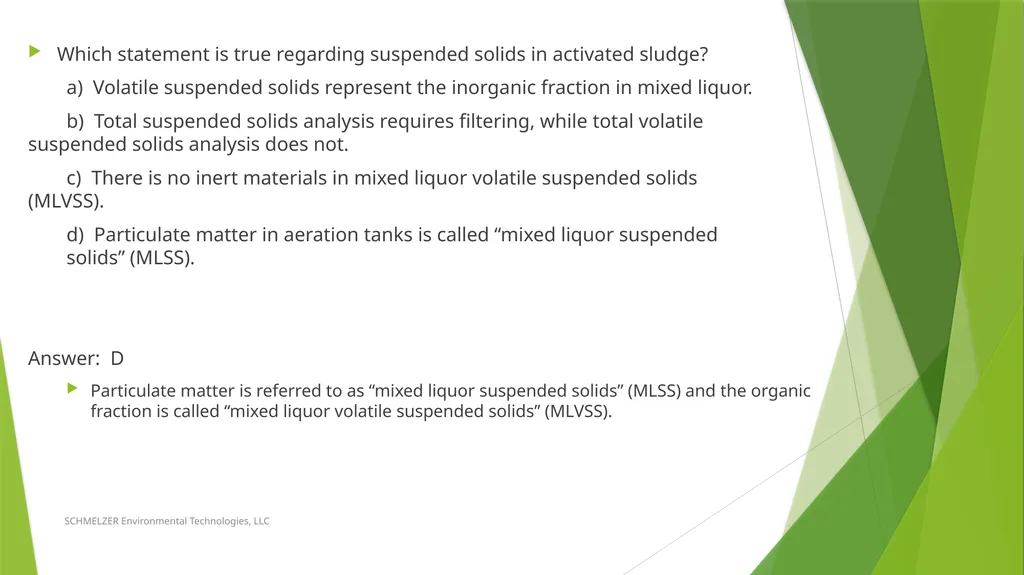
Which statement is true regarding suspended solids in activated sludge?
a) Volatile suspended solids represent the inorganic fraction in mixed liquor.
b) Total suspended solids analysis requires filtering, while total volatile suspended solids analysis does not.
c) There is no inert materials in mixed liquor volatile suspended solids (MLVSS).
d) Particulate matter in aeration tanks is called “mixed liquor suspended solids” (MLSS).
Answer: D
Particulate matter is referred to as “mixed liquor suspended solids” (MLSS) and the organic fraction is called “mixed liquor volatile suspended solids” (MLVSS). SCHMELZER Environmental Technologies, LLC<br>
a) Volatile suspended solids represent the inorganic fraction in mixed liquor.
b) Total suspended solids analysis requires filtering, while total volatile suspended solids analysis does not.
c) There is no inert materials in mixed liquor volatile suspended solids (MLVSS).
d) Particulate matter in aeration tanks is called “mixed liquor suspended solids” (MLSS).
Answer: D
Particulate matter is referred to as “mixed liquor suspended solids” (MLSS) and the organic fraction is called “mixed liquor volatile suspended solids” (MLVSS). SCHMELZER Environmental Technologies, LLC<br>
43
SCHMELZER Environmental Technologies, LLC<br>
44
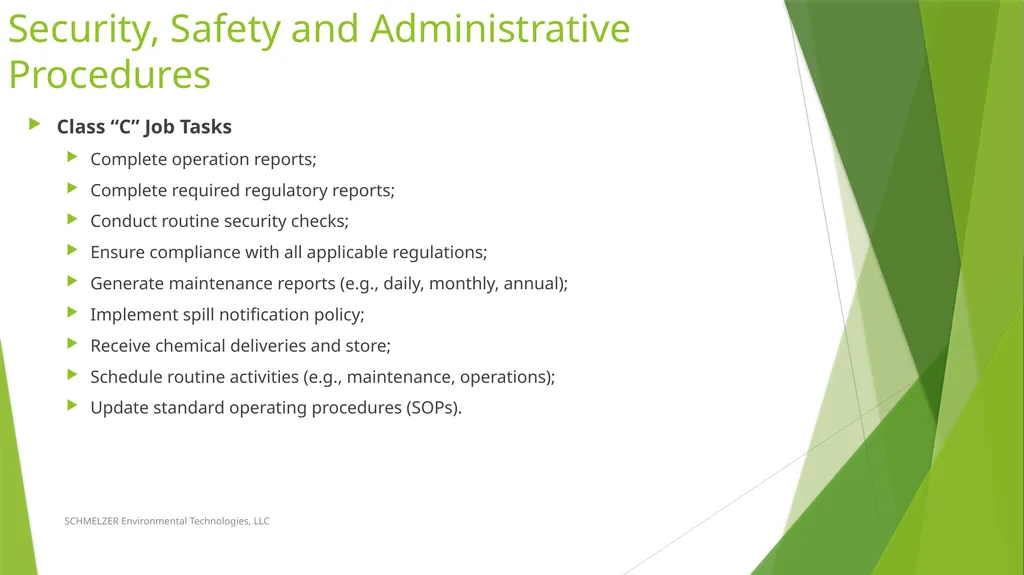
Security, Safety and Administrative Procedures Class “C” Job Tasks
Complete operation reports;
Complete required regulatory reports;
Conduct routine security checks;
Ensure compliance with all applicable regulations;
Generate maintenance reports (e.g., daily, monthly, annual);
Implement spill notification policy;
Receive chemical deliveries and store;
Schedule routine activities (e.g., maintenance, operations);
Update standard operating procedures (SOPs). SCHMELZER Environmental Technologies, LLC<br>
Complete operation reports;
Complete required regulatory reports;
Conduct routine security checks;
Ensure compliance with all applicable regulations;
Generate maintenance reports (e.g., daily, monthly, annual);
Implement spill notification policy;
Receive chemical deliveries and store;
Schedule routine activities (e.g., maintenance, operations);
Update standard operating procedures (SOPs). SCHMELZER Environmental Technologies, LLC<br>
45
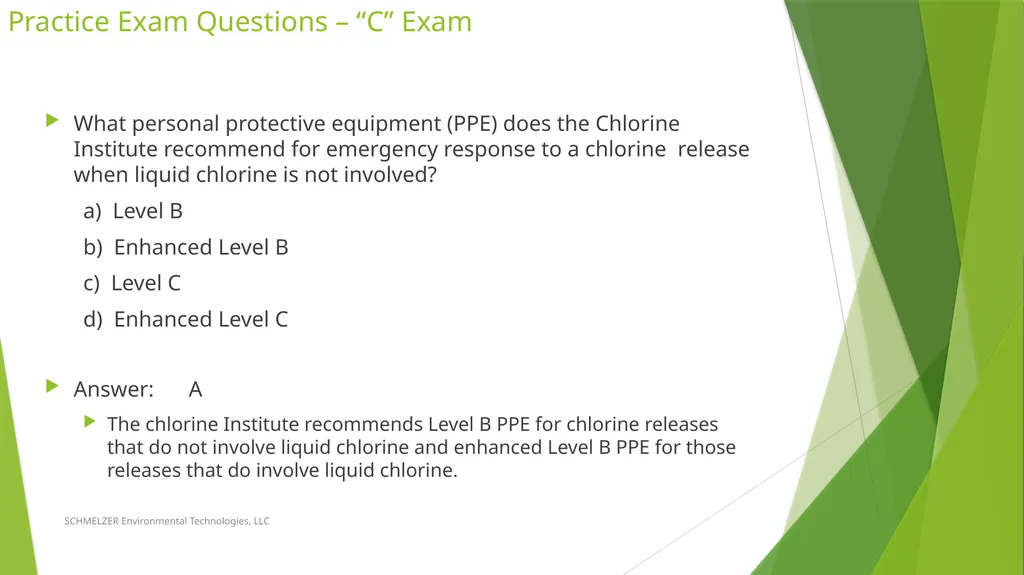
Practice Exam Questions – “C” Exam What personal protective equipment (PPE) does the Chlorine Institute recommend for emergency response to a chlorine release when liquid chlorine is not involved?
a) Level B
b) Enhanced Level B
c) Level C
d) Enhanced Level C
Answer: A
The chlorine Institute recommends Level B PPE for chlorine releases that do not involve liquid chlorine and enhanced Level B PPE for those releases that do involve liquid chlorine. SCHMELZER Environmental Technologies, LLC<br>
a) Level B
b) Enhanced Level B
c) Level C
d) Enhanced Level C
Answer: A
The chlorine Institute recommends Level B PPE for chlorine releases that do not involve liquid chlorine and enhanced Level B PPE for those releases that do involve liquid chlorine. SCHMELZER Environmental Technologies, LLC<br>
46
The Occupational Safety and Health Administration (OSHA) defines a “confined space” using three conditional criteria. Which of the following correctly identifies those three criteria?
a) The space exceeds 25 cu ft in size with a depth of at least 4 ft; the space has fewer than two adequate means of egress; the space has no natural ventilation.
b) The space is deeper than 5 ft and has no side means of access or egress; the space is not adequately ventilated; the space was not designed for human occupancy under any circumstances.
c) The space is deeper than 5 ft and has a volume exceeding 25 cu ft; the space does not contain adequate means of access or egress; the space has no adequate means of providing rescue in case of emergency.
d) The space must be of adequate size and have a configuration where a worker can enter the space; the space has a limited means of access or egress; the space was not designed for continuous human occupancy. SCHMELZER Environmental Technologies, LLC<br>
a) The space exceeds 25 cu ft in size with a depth of at least 4 ft; the space has fewer than two adequate means of egress; the space has no natural ventilation.
b) The space is deeper than 5 ft and has no side means of access or egress; the space is not adequately ventilated; the space was not designed for human occupancy under any circumstances.
c) The space is deeper than 5 ft and has a volume exceeding 25 cu ft; the space does not contain adequate means of access or egress; the space has no adequate means of providing rescue in case of emergency.
d) The space must be of adequate size and have a configuration where a worker can enter the space; the space has a limited means of access or egress; the space was not designed for continuous human occupancy. SCHMELZER Environmental Technologies, LLC<br>
47
Answer: D
The Occupational Safety and Health Administration defines a “confined space” using three conditional criteria.
1) The space must be of adequate size and have a configuration where a worker can enter the space.
2) The space has a limited means of access or egress.
3) The space was not designed for continuous human occupancy. SCHMELZER Environmental Technologies, LLC<br>
The Occupational Safety and Health Administration defines a “confined space” using three conditional criteria.
1) The space must be of adequate size and have a configuration where a worker can enter the space.
2) The space has a limited means of access or egress.
3) The space was not designed for continuous human occupancy. SCHMELZER Environmental Technologies, LLC<br>
48
At what concentration in air is chlorine gas likely to cause toxic pneumonitis and pulmonary edema?
a) Less than 40 ppm
b) More than 40 ppm, but less than 60 ppm
c) More than 60 ppm, but less than 80 ppm
d) More than 80 ppm
Answer: B
Chlorine gas will cause acute respiratory hazards from inhalation. More than 40 ppm but less than 60 ppm of chlorine gas causes toxic pneumonitis and pulmonary edema. At 430 ppm, an exposure is lethal within 30 minutes and at 1000 ppm, it is fatal within minutes. SCHMELZER Environmental Technologies, LLC<br>
a) Less than 40 ppm
b) More than 40 ppm, but less than 60 ppm
c) More than 60 ppm, but less than 80 ppm
d) More than 80 ppm
Answer: B
Chlorine gas will cause acute respiratory hazards from inhalation. More than 40 ppm but less than 60 ppm of chlorine gas causes toxic pneumonitis and pulmonary edema. At 430 ppm, an exposure is lethal within 30 minutes and at 1000 ppm, it is fatal within minutes. SCHMELZER Environmental Technologies, LLC<br>
49
Equipment Evaluation and Maintenance Class “C” Job Tasks
Calibrate meters (e.g., flow, pressure sensors);
Monitor flow meters;
Monitor telemetry systems;
Perform basic electrical troubleshooting;
Perform preventive maintenance on equipment;
Inspect & Maintain the following equipment:
Aeration basins,
Aerations systems (e.g., blowers, surface aerators, diffusers),
Aerobic digesters,
Bar screens,
Chemical feed systems,
Clarifiers / sedimentation basins,
Mechanical dewatering equipment (e.g., presses, centrifuges) SCHMELZER Environmental Technologies, LLC<br>
Calibrate meters (e.g., flow, pressure sensors);
Monitor flow meters;
Monitor telemetry systems;
Perform basic electrical troubleshooting;
Perform preventive maintenance on equipment;
Inspect & Maintain the following equipment:
Aeration basins,
Aerations systems (e.g., blowers, surface aerators, diffusers),
Aerobic digesters,
Bar screens,
Chemical feed systems,
Clarifiers / sedimentation basins,
Mechanical dewatering equipment (e.g., presses, centrifuges) SCHMELZER Environmental Technologies, LLC<br>
50
Practice Exam Questions – “C” Exam A _______ meter is used to measure flow in a pipe by creating a measurable pressure drop across the device.
a) propeller
b) differential head
c) differential suction
d) magnetic
Answer: B
Differential head meter is used to measure flow in a closed pipe. SCHMELZER Environmental Technologies, LLC<br>
a) propeller
b) differential head
c) differential suction
d) magnetic
Answer: B
Differential head meter is used to measure flow in a closed pipe. SCHMELZER Environmental Technologies, LLC<br>
51
During rounds, the operator notices that there is a broken chain in the rectangular primary tank. Which of the following would NOT be a cause of the broken scraper chain?
a) Excessive loading on the sludge collector
b) Debris caught on the primary tank weirs
c) Ice build – up in the tank
d) Improper shear pin sizing and flight alignment
Answer: B
Debris caught on the weirs will not cause the sludge collector to break. SCHMELZER Environmental Technologies, LLC<br>
a) Excessive loading on the sludge collector
b) Debris caught on the primary tank weirs
c) Ice build – up in the tank
d) Improper shear pin sizing and flight alignment
Answer: B
Debris caught on the weirs will not cause the sludge collector to break. SCHMELZER Environmental Technologies, LLC<br>
52
When buildup of deposits is observed in a rotameter, what should you do?
a) Clean the tube and float
b) Increase flow to flush
c) Increase pressure to the flush
d) Nothing as these are normal conditions
Answer: A
Clean the rotameter when deposits are noticed inside the glass rotameter tube or if the float sticks. Be sure that the rotameter and associated equipment are completely dry before reassembling. If moisture is present, chlorine will combine with it to form hypochlorous and hydrochloric acid, which will cause corrosion to occur. SCHMELZER Environmental Technologies, LLC<br>
a) Clean the tube and float
b) Increase flow to flush
c) Increase pressure to the flush
d) Nothing as these are normal conditions
Answer: A
Clean the rotameter when deposits are noticed inside the glass rotameter tube or if the float sticks. Be sure that the rotameter and associated equipment are completely dry before reassembling. If moisture is present, chlorine will combine with it to form hypochlorous and hydrochloric acid, which will cause corrosion to occur. SCHMELZER Environmental Technologies, LLC<br>
53
A sodium hypochlorite system had been operating properly for a while, but suddenly the sodium hypochlorite feed pump stops pumping. What could be the reason?
a) The pump was recently rebuilt and tested by the manufacturer.
b) There is too much chemical entering the pump.
c) The pump is gas locking so the pump needs to be switched to a suction lift pump.
d) The pump is gas locking so the pump suction conditions must be checked to ensure that the pump has a flooded suction.
Answer: D
Sodium hypochlorite can release gas bubbles that accumulate in the suction piping to the feed pumps, which may cause air binding of the feed pumps. Maintain a flooded suction or air – release mechanism to ensure proper operation. SCHMELZER Environmental Technologies, LLC<br>
a) The pump was recently rebuilt and tested by the manufacturer.
b) There is too much chemical entering the pump.
c) The pump is gas locking so the pump needs to be switched to a suction lift pump.
d) The pump is gas locking so the pump suction conditions must be checked to ensure that the pump has a flooded suction.
Answer: D
Sodium hypochlorite can release gas bubbles that accumulate in the suction piping to the feed pumps, which may cause air binding of the feed pumps. Maintain a flooded suction or air – release mechanism to ensure proper operation. SCHMELZER Environmental Technologies, LLC<br>
54
Equipment Operation Class “C” Job Tasks
Analyze data to evaluate and adjust equipment
Check filters for proper operation
Conduct wastewater pipe repairs
Monitor lift stations to ensure equipment is operating properly
Monitor motor control center
Operate the following:
Bar screens
Chemical feed systems
Clarifiers / sedimentation basins
Dechlorination systems
Filtration and exchange units (e.g., sand, membranes)
Flow equalization systems
Mechanical dewatering equipment (e.g., presses, centrifuges) SCHMELZER Environmental Technologies, LLC<br>
Analyze data to evaluate and adjust equipment
Check filters for proper operation
Conduct wastewater pipe repairs
Monitor lift stations to ensure equipment is operating properly
Monitor motor control center
Operate the following:
Bar screens
Chemical feed systems
Clarifiers / sedimentation basins
Dechlorination systems
Filtration and exchange units (e.g., sand, membranes)
Flow equalization systems
Mechanical dewatering equipment (e.g., presses, centrifuges) SCHMELZER Environmental Technologies, LLC<br>
55
Practice Exam Questions – “C” Exam If an aeration tank requires more air, a simple solution is to
a) increase the speed of the blower
b) make larger holes in the piping
c) slightly close the blower suction valve
d) put more water in the tank so the air has more water to mix with.
Answer: A
Increasing the speed of a blower is a practical way to introduce more air to a tank, but it does have its limits. Air piping can be blown apart if you exceed the design pressure of the piping. SCHMELZER Environmental Technologies, LLC<br>
a) increase the speed of the blower
b) make larger holes in the piping
c) slightly close the blower suction valve
d) put more water in the tank so the air has more water to mix with.
Answer: A
Increasing the speed of a blower is a practical way to introduce more air to a tank, but it does have its limits. Air piping can be blown apart if you exceed the design pressure of the piping. SCHMELZER Environmental Technologies, LLC<br>
56
A way to determine the amount of dissolved oxygen in a tank is to
a) use a handheld pH meter
b) look at the size of the bubbles in the tank
c) measure the air gap between the air bubbles and water
d) use a handheld dissolved oxygen meter
Answer: D
Portable handheld dissolved oxygen meters are handy in the field. They are easy to operate and can be carried to a tank to perform measurements. SCHMELZER Environmental Technologies, LLC<br>
a) use a handheld pH meter
b) look at the size of the bubbles in the tank
c) measure the air gap between the air bubbles and water
d) use a handheld dissolved oxygen meter
Answer: D
Portable handheld dissolved oxygen meters are handy in the field. They are easy to operate and can be carried to a tank to perform measurements. SCHMELZER Environmental Technologies, LLC<br>
57
A common way to measure flow in a pipe is to
a) use a magnetic flowmeter
b) measure the speed of ping pong balls in the pipe
c) measure how far the water sprays when it leaves the pipe
d) measure the water level over a V – notch weir
Answer: A
A magnetic flowmeter is the most common form of measurement for flows in a pipe. SCHMELZER Environmental Technologies, LLC<br>
a) use a magnetic flowmeter
b) measure the speed of ping pong balls in the pipe
c) measure how far the water sprays when it leaves the pipe
d) measure the water level over a V – notch weir
Answer: A
A magnetic flowmeter is the most common form of measurement for flows in a pipe. SCHMELZER Environmental Technologies, LLC<br>
58
Diffuser – based sir systems consist of
a) a few small air tanks spread over a large area
b) a blower and a pipe distribution system that are used to bubble air into water
c) different air concentrations in a tank
d) high – speed rotating mixers
Answer: B
The system is made up of a blower, controls, air piping, headers on the tank, and some type of opening in the bottom of the tank. The openings can be coarse, medium, or fine pores. Coarse diffusers can be very large (up to 4 in. by 4 in. openings) and fine pore diffusers can have openings the size of pinholes. SCHMELZER Environmental Technologies, LLC<br>
a) a few small air tanks spread over a large area
b) a blower and a pipe distribution system that are used to bubble air into water
c) different air concentrations in a tank
d) high – speed rotating mixers
Answer: B
The system is made up of a blower, controls, air piping, headers on the tank, and some type of opening in the bottom of the tank. The openings can be coarse, medium, or fine pores. Coarse diffusers can be very large (up to 4 in. by 4 in. openings) and fine pore diffusers can have openings the size of pinholes. SCHMELZER Environmental Technologies, LLC<br>
59
What equipment or actions are typically used to control air flow from centrifugal blowers?
a) throttle the inlet valves or use variable – frequency drives
b) place the blower into surge condition
c) trim the blower impeller
d) throttle the discharge valve and variable – speed drives
Answer: A
Variable – speed drives or inlet valves are the best way to control the output of centrifugal blowers. Any type of control on the discharge side will cause significant damage to equipment. SCHMELZER Environmental Technologies, LLC<br>
a) throttle the inlet valves or use variable – frequency drives
b) place the blower into surge condition
c) trim the blower impeller
d) throttle the discharge valve and variable – speed drives
Answer: A
Variable – speed drives or inlet valves are the best way to control the output of centrifugal blowers. Any type of control on the discharge side will cause significant damage to equipment. SCHMELZER Environmental Technologies, LLC<br>
60
Treatment Process Monitoring, Evaluation, and Adjustment Class “C” Job Tasks
Add chemicals to disinfect and deodorize water and other liquids (e.g., ammonia, chlorine, lime)
Analyze laboratory data to evaluate and adjust processes
Operate chemical feed systems (e.g., polymer, ferric)
Operate SCADA systems
Operate the preliminary treatment processes (e.g., screening, grit, flow equalization)
Operate the following secondary treatment processes:
Secondary clarification / sedimentation processes
Attached growth / fixed film processes (e.g., RBC, trickling filter)
Operate disinfection treatment processes
Operate solids treatment processes SCHMELZER Environmental Technologies, LLC<br>
Add chemicals to disinfect and deodorize water and other liquids (e.g., ammonia, chlorine, lime)
Analyze laboratory data to evaluate and adjust processes
Operate chemical feed systems (e.g., polymer, ferric)
Operate SCADA systems
Operate the preliminary treatment processes (e.g., screening, grit, flow equalization)
Operate the following secondary treatment processes:
Secondary clarification / sedimentation processes
Attached growth / fixed film processes (e.g., RBC, trickling filter)
Operate disinfection treatment processes
Operate solids treatment processes SCHMELZER Environmental Technologies, LLC<br>
61
Practice Exam Questions – “C” Exam The following are interferences to UV transmittance EXCEPT
a) color
b) turbidity
c) organics
d) pH
Answer: D
UV transmittance interferences include color, suspended solids, turbidity, iron, organics, chlorine, and high levels of nitrates. SCHMELZER Environmental Technologies, LLC<br>
a) color
b) turbidity
c) organics
d) pH
Answer: D
UV transmittance interferences include color, suspended solids, turbidity, iron, organics, chlorine, and high levels of nitrates. SCHMELZER Environmental Technologies, LLC<br>
62
During the lime stabilization process, lime is added to
a) maintain a pH of 6.5 to 8.5 for 8 hours
b) prevent the release of ammonia odors
c) maintain a pH of 12 for a minimum of 2 hours
d) turn the biosolids to a greyish white color
Answer: C
Maintaining a pH of 12 for a minimum of 2 hours typically destroys or inhibits pathogens and the microorganisms involved in the decomposition of the sludge. SCHMELZER Environmental Technologies, LLC<br>
a) maintain a pH of 6.5 to 8.5 for 8 hours
b) prevent the release of ammonia odors
c) maintain a pH of 12 for a minimum of 2 hours
d) turn the biosolids to a greyish white color
Answer: C
Maintaining a pH of 12 for a minimum of 2 hours typically destroys or inhibits pathogens and the microorganisms involved in the decomposition of the sludge. SCHMELZER Environmental Technologies, LLC<br>
63
What gas is produced in the anaerobic digester and can be used as fuel?
a) propane
b) methane
c) oxygen
d) carbon dioxide
Answer: B
Digester gas is composed primarily of methane (60 – 65%) and carbon dioxide (35 – 40%). The gas has a lower heating value of 22,400 kJ/m3 (600 BTU/ft3) because it typically contains only 60 to 65% methane. It is a valuable resource that can be used to meet a water resource facility’s energy requirements. SCHMELZER Environmental Technologies, LLC<br>
a) propane
b) methane
c) oxygen
d) carbon dioxide
Answer: B
Digester gas is composed primarily of methane (60 – 65%) and carbon dioxide (35 – 40%). The gas has a lower heating value of 22,400 kJ/m3 (600 BTU/ft3) because it typically contains only 60 to 65% methane. It is a valuable resource that can be used to meet a water resource facility’s energy requirements. SCHMELZER Environmental Technologies, LLC<br>
64
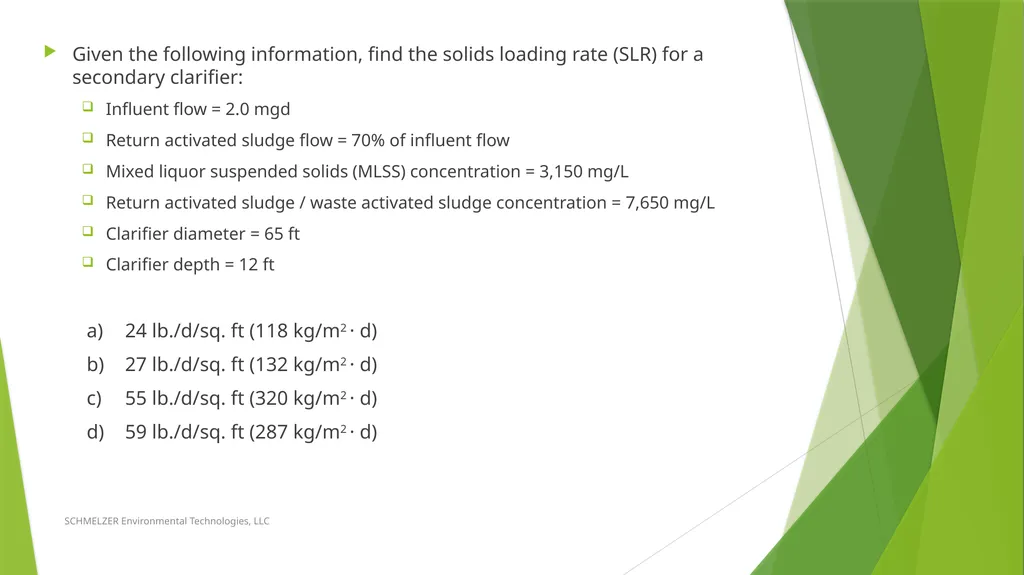
Given the following information, find the solids loading rate (SLR) for a secondary clarifier:
Influent flow = 2.0 mgd
Return activated sludge flow = 70% of influent flow
Mixed liquor suspended solids (MLSS) concentration = 3,150 mg/L
Return activated sludge / waste activated sludge concentration = 7,650 mg/L
Clarifier diameter = 65 ft
Clarifier depth = 12 ft
a) 24 lb./d/sq. ft (118 kg/m2 · d)
b) 27 lb./d/sq. ft (132 kg/m2 · d)
c) 55 lb./d/sq. ft (320 kg/m2 · d)
d) 59 lb./d/sq. ft (287 kg/m2 · d) SCHMELZER Environmental Technologies, LLC<br>
Influent flow = 2.0 mgd
Return activated sludge flow = 70% of influent flow
Mixed liquor suspended solids (MLSS) concentration = 3,150 mg/L
Return activated sludge / waste activated sludge concentration = 7,650 mg/L
Clarifier diameter = 65 ft
Clarifier depth = 12 ft
a) 24 lb./d/sq. ft (118 kg/m2 · d)
b) 27 lb./d/sq. ft (132 kg/m2 · d)
c) 55 lb./d/sq. ft (320 kg/m2 · d)
d) 59 lb./d/sq. ft (287 kg/m2 · d) SCHMELZER Environmental Technologies, LLC<br>
65
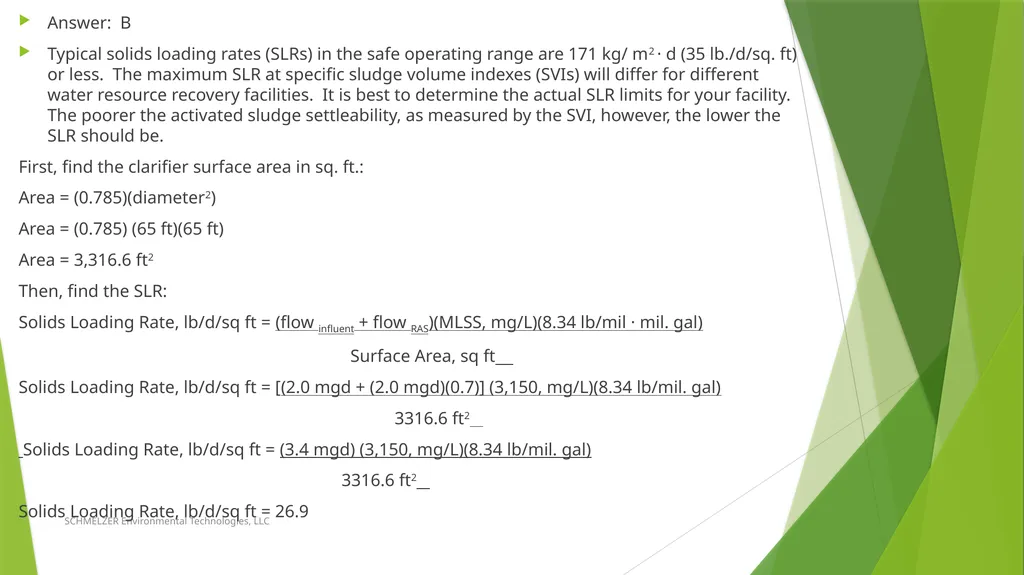
Answer: B
Typical solids loading rates (SLRs) in the safe operating range are 171 kg/ m2 · d (35 lb./d/sq. ft) or less. The maximum SLR at specific sludge volume indexes (SVIs) will differ for different water resource recovery facilities. It is best to determine the actual SLR limits for your facility. The poorer the activated sludge settleability, as measured by the SVI, however, the lower the SLR should be.
First, find the clarifier surface area in sq. ft.:
Area = (0.785)(diameter2)
Area = (0.785) (65 ft)(65 ft)
Area = 3,316.6 ft2
Then, find the SLR:
Solids Loading Rate, lb/d/sq ft = (flow influent + flow RAS)(MLSS, mg/L)(8.34 lb/mil · mil. gal)
Surface Area, sq ft
Solids Loading Rate, lb/d/sq ft = [(2.0 mgd + (2.0 mgd)(0.7)] (3,150, mg/L)(8.34 lb/mil. gal)
3316.6 ft2
Solids Loading Rate, lb/d/sq ft = (3.4 mgd) (3,150, mg/L)(8.34 lb/mil. gal)
3316.6 ft2
Solids Loading Rate, lb/d/sq ft = 26.9 SCHMELZER Environmental Technologies, LLC<br>
Typical solids loading rates (SLRs) in the safe operating range are 171 kg/ m2 · d (35 lb./d/sq. ft) or less. The maximum SLR at specific sludge volume indexes (SVIs) will differ for different water resource recovery facilities. It is best to determine the actual SLR limits for your facility. The poorer the activated sludge settleability, as measured by the SVI, however, the lower the SLR should be.
First, find the clarifier surface area in sq. ft.:
Area = (0.785)(diameter2)
Area = (0.785) (65 ft)(65 ft)
Area = 3,316.6 ft2
Then, find the SLR:
Solids Loading Rate, lb/d/sq ft = (flow influent + flow RAS)(MLSS, mg/L)(8.34 lb/mil · mil. gal)
Surface Area, sq ft
Solids Loading Rate, lb/d/sq ft = [(2.0 mgd + (2.0 mgd)(0.7)] (3,150, mg/L)(8.34 lb/mil. gal)
3316.6 ft2
Solids Loading Rate, lb/d/sq ft = (3.4 mgd) (3,150, mg/L)(8.34 lb/mil. gal)
3316.6 ft2
Solids Loading Rate, lb/d/sq ft = 26.9 SCHMELZER Environmental Technologies, LLC<br>
66
Which of the following in NOT a common effluent discharge reuse application?
a) landscape irrigation
b) boiler makeup
c) drinking water system intake water
d) aquifer recharge
Answer: C SCHMELZER Environmental Technologies, LLC<br>
a) landscape irrigation
b) boiler makeup
c) drinking water system intake water
d) aquifer recharge
Answer: C SCHMELZER Environmental Technologies, LLC<br>
67
Laboratory Analysis Class “C” Job Tasks
Follow laboratory standard operating procedures
Collect samples for the following:
Bacteriological analysis
Biological analyses (BOD, CBOD)
Chemical analyses (COD, nutrients, metals)
Physical analyses
Process control laboratory testing
Required regulatory laboratory testing
Interpret data from the following:
Bacteriological analysis
Biological analyses (BOD, CBOD)
Chemical analyses (COD, nutrients, metals)
Physical analyses (pH, temp., dissolved oxygen, settleable solids) SCHMELZER Environmental Technologies, LLC<br>
Follow laboratory standard operating procedures
Collect samples for the following:
Bacteriological analysis
Biological analyses (BOD, CBOD)
Chemical analyses (COD, nutrients, metals)
Physical analyses
Process control laboratory testing
Required regulatory laboratory testing
Interpret data from the following:
Bacteriological analysis
Biological analyses (BOD, CBOD)
Chemical analyses (COD, nutrients, metals)
Physical analyses (pH, temp., dissolved oxygen, settleable solids) SCHMELZER Environmental Technologies, LLC<br>
68
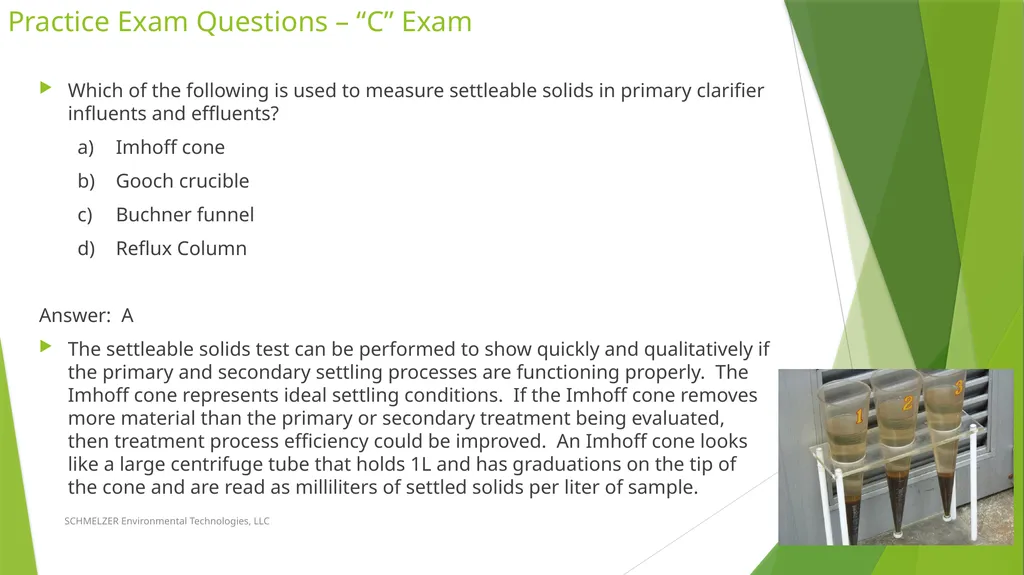
Practice Exam Questions – “C” Exam Which of the following is used to measure settleable solids in primary clarifier influents and effluents?
a) Imhoff cone
b) Gooch crucible
c) Buchner funnel
d) Reflux Column
Answer: A
The settleable solids test can be performed to show quickly and qualitatively if the primary and secondary settling processes are functioning properly. The Imhoff cone represents ideal settling conditions. If the Imhoff cone removes more material than the primary or secondary treatment being evaluated, then treatment process efficiency could be improved. An Imhoff cone looks like a large centrifuge tube that holds 1L and has graduations on the tip of the cone and are read as milliliters of settled solids per liter of sample. SCHMELZER Environmental Technologies, LLC<br>
a) Imhoff cone
b) Gooch crucible
c) Buchner funnel
d) Reflux Column
Answer: A
The settleable solids test can be performed to show quickly and qualitatively if the primary and secondary settling processes are functioning properly. The Imhoff cone represents ideal settling conditions. If the Imhoff cone removes more material than the primary or secondary treatment being evaluated, then treatment process efficiency could be improved. An Imhoff cone looks like a large centrifuge tube that holds 1L and has graduations on the tip of the cone and are read as milliliters of settled solids per liter of sample. SCHMELZER Environmental Technologies, LLC<br>
69
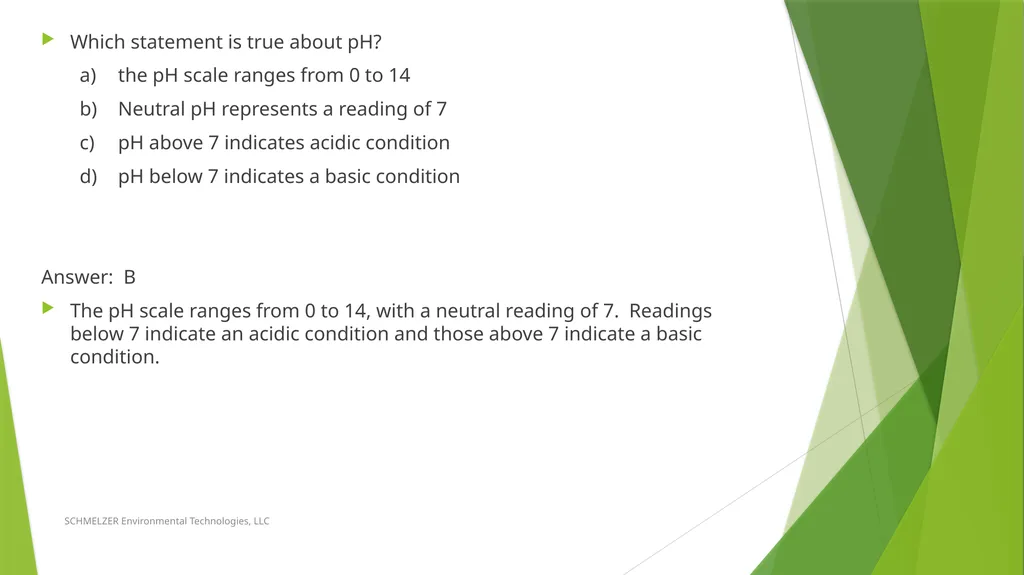
Which statement is true about pH?
a) the pH scale ranges from 0 to 14
b) Neutral pH represents a reading of 7
c) pH above 7 indicates acidic condition
d) pH below 7 indicates a basic condition
Answer: B
The pH scale ranges from 0 to 14, with a neutral reading of 7. Readings below 7 indicate an acidic condition and those above 7 indicate a basic condition. SCHMELZER Environmental Technologies, LLC<br>
a) the pH scale ranges from 0 to 14
b) Neutral pH represents a reading of 7
c) pH above 7 indicates acidic condition
d) pH below 7 indicates a basic condition
Answer: B
The pH scale ranges from 0 to 14, with a neutral reading of 7. Readings below 7 indicate an acidic condition and those above 7 indicate a basic condition. SCHMELZER Environmental Technologies, LLC<br>
70
SCHMELZER Environmental Technologies, LLC<br>
71
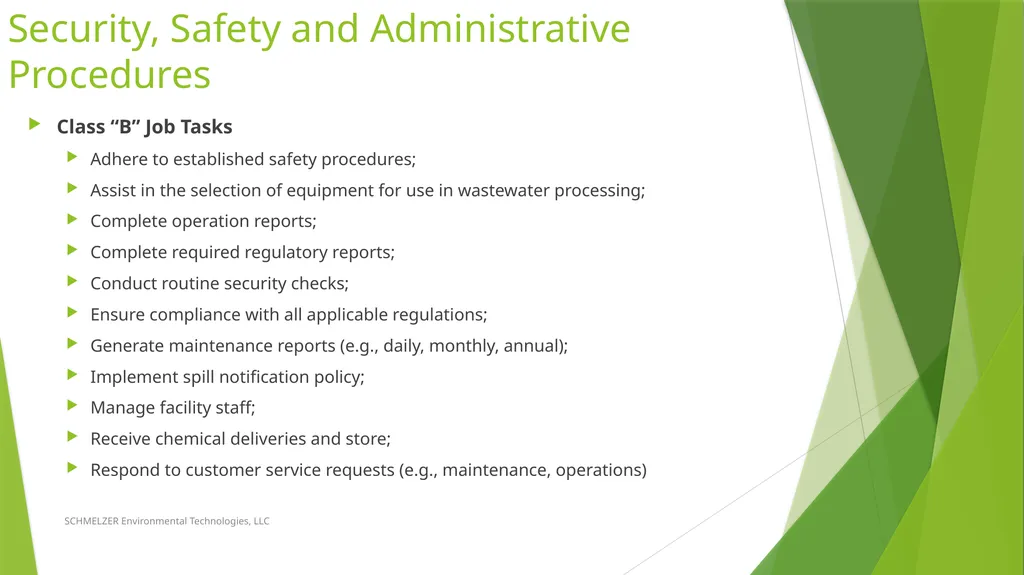
Security, Safety and Administrative Procedures Class “B” Job Tasks
Adhere to established safety procedures;
Assist in the selection of equipment for use in wastewater processing;
Complete operation reports;
Complete required regulatory reports;
Conduct routine security checks;
Ensure compliance with all applicable regulations;
Generate maintenance reports (e.g., daily, monthly, annual);
Implement spill notification policy;
Manage facility staff;
Receive chemical deliveries and store;
Respond to customer service requests (e.g., maintenance, operations) SCHMELZER Environmental Technologies, LLC<br>
Adhere to established safety procedures;
Assist in the selection of equipment for use in wastewater processing;
Complete operation reports;
Complete required regulatory reports;
Conduct routine security checks;
Ensure compliance with all applicable regulations;
Generate maintenance reports (e.g., daily, monthly, annual);
Implement spill notification policy;
Manage facility staff;
Receive chemical deliveries and store;
Respond to customer service requests (e.g., maintenance, operations) SCHMELZER Environmental Technologies, LLC<br>
72
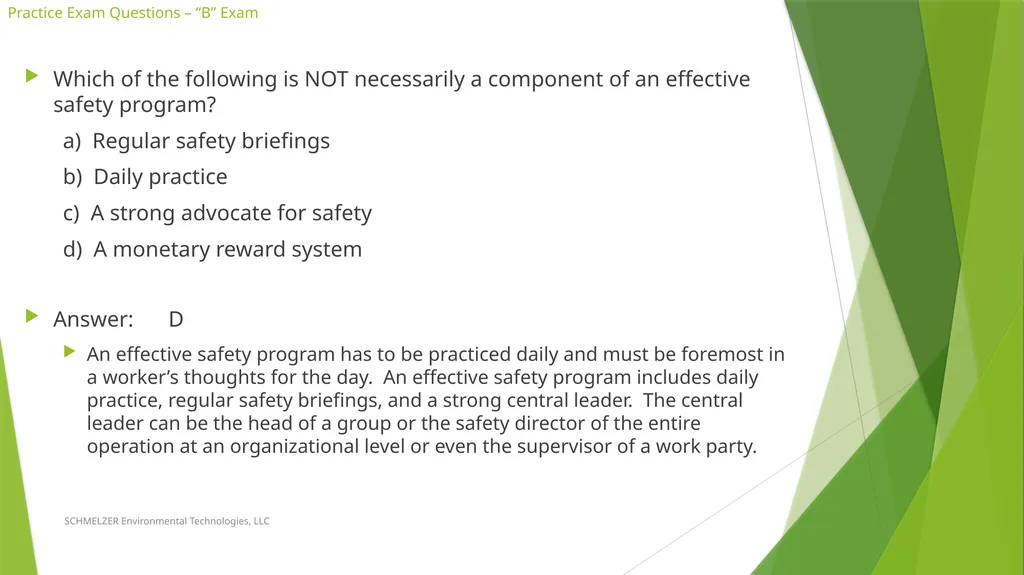
Practice Exam Questions – “B” Exam Which of the following is NOT necessarily a component of an effective safety program?
a) Regular safety briefings
b) Daily practice
c) A strong advocate for safety
d) A monetary reward system
Answer: D
An effective safety program has to be practiced daily and must be foremost in a worker’s thoughts for the day. An effective safety program includes daily practice, regular safety briefings, and a strong central leader. The central leader can be the head of a group or the safety director of the entire operation at an organizational level or even the supervisor of a work party. SCHMELZER Environmental Technologies, LLC<br>
a) Regular safety briefings
b) Daily practice
c) A strong advocate for safety
d) A monetary reward system
Answer: D
An effective safety program has to be practiced daily and must be foremost in a worker’s thoughts for the day. An effective safety program includes daily practice, regular safety briefings, and a strong central leader. The central leader can be the head of a group or the safety director of the entire operation at an organizational level or even the supervisor of a work party. SCHMELZER Environmental Technologies, LLC<br>
73
Which of the following are the most effective sources of information for managers regarding patterns of ergonomic – related injuries and illnesses when evaluating the success of a safety program?
a) employee illness records, employee injury records, and worker’s compensation claims data
b) employee absenteeism records, employee health care costs data, and average worker’s compensation claim costs
c) employee absences, employee discipline records, and accident – free – days data
d) employee complaints data, supervisor complaints data, and worker’s ergonomic equipment request data.
Answer: A
There are several methods used to identify jobs that are most likely to result in ergonomic disorders. Managers and supervisors should monitor injury and illness records and worker’s compensation data to identify patterns of ergonomic – related injuries and illnesses. SCHMELZER Environmental Technologies, LLC<br>
a) employee illness records, employee injury records, and worker’s compensation claims data
b) employee absenteeism records, employee health care costs data, and average worker’s compensation claim costs
c) employee absences, employee discipline records, and accident – free – days data
d) employee complaints data, supervisor complaints data, and worker’s ergonomic equipment request data.
Answer: A
There are several methods used to identify jobs that are most likely to result in ergonomic disorders. Managers and supervisors should monitor injury and illness records and worker’s compensation data to identify patterns of ergonomic – related injuries and illnesses. SCHMELZER Environmental Technologies, LLC<br>
74
Equipment Evaluation and Maintenance Class “B” Job Tasks
Calibrate meters;
Follow safety rules and guidelines when working with chemical equipment;
Follow safety rules and guidelines when working with mechanical equipment;
Monitor flowmeters;
Monitor telemetry systems;
Perform basic electrical troubleshooting;
Perform preventive maintenance on equipment;
Inspect and maintain the following equipment:
Aeration basins,
Aeration systems (blowers, surface aerators, diffusers),
Air compressors,
Bar screens
Chemical feed systems (polymer, ferric),
Flow equalization systems SCHMELZER Environmental Technologies, LLC<br>
Calibrate meters;
Follow safety rules and guidelines when working with chemical equipment;
Follow safety rules and guidelines when working with mechanical equipment;
Monitor flowmeters;
Monitor telemetry systems;
Perform basic electrical troubleshooting;
Perform preventive maintenance on equipment;
Inspect and maintain the following equipment:
Aeration basins,
Aeration systems (blowers, surface aerators, diffusers),
Air compressors,
Bar screens
Chemical feed systems (polymer, ferric),
Flow equalization systems SCHMELZER Environmental Technologies, LLC<br>
75
Practice Exam Questions – “B” Exam If the rake on a mechanically cleaned screen is inoperable and there is no visible problem, the issue is likely a(n)__________.
a) blockage
b) broken chain
c) electrical issue
d) full dumpster
Answer: C
A blockage, a broken chain, and a full dumpster are all visible issues; an electrical issue is not. SCHMELZER Environmental Technologies, LLC<br>
a) blockage
b) broken chain
c) electrical issue
d) full dumpster
Answer: C
A blockage, a broken chain, and a full dumpster are all visible issues; an electrical issue is not. SCHMELZER Environmental Technologies, LLC<br>
76
What can cause a blockage in a chlorinator atmospheric vent line?
a) calcium deposits
b) field mice
c) insects
d) magnesium deposits
Answer: C
Place a screen over the end of the pipe to keep insects from building a nest in the pipe and clogging it. SCHMELZER Environmental Technologies, LLC<br>
a) calcium deposits
b) field mice
c) insects
d) magnesium deposits
Answer: C
Place a screen over the end of the pipe to keep insects from building a nest in the pipe and clogging it. SCHMELZER Environmental Technologies, LLC<br>
77
Given the following:
Aerobic digester dissolved oxygen level is 3.5 mg/L
All blowers are running
pH is 7.2
Temperature is 19°C
Specific oxygen uptake rate (SOUR) is 1.2 mg/L O2/g/h
High surface turbulence
The tank is exhibiting high rates of foaming
What is the first step you should take to reduce the foaming?
a) add an acid
b) add a caustic
c) reduce aeration
d) reduce wasting SCHMELZER Environmental Technologies, LLC<br>
Aerobic digester dissolved oxygen level is 3.5 mg/L
All blowers are running
pH is 7.2
Temperature is 19°C
Specific oxygen uptake rate (SOUR) is 1.2 mg/L O2/g/h
High surface turbulence
The tank is exhibiting high rates of foaming
What is the first step you should take to reduce the foaming?
a) add an acid
b) add a caustic
c) reduce aeration
d) reduce wasting SCHMELZER Environmental Technologies, LLC<br>
78
Answer: C
Excessive turbulence in the presence of either a non – biodegradable detergent or some filamentous bacteria can cause severe foaming. Because the dissolved oxygen concentration is higher than necessary and the digester is functioning well, the first thing to do would be to reduce the aeration rate, which will reduce the turbulence and see if that improves the foaming issue. SCHMELZER Environmental Technologies, LLC<br>
Excessive turbulence in the presence of either a non – biodegradable detergent or some filamentous bacteria can cause severe foaming. Because the dissolved oxygen concentration is higher than necessary and the digester is functioning well, the first thing to do would be to reduce the aeration rate, which will reduce the turbulence and see if that improves the foaming issue. SCHMELZER Environmental Technologies, LLC<br>
79
If a pneumatic bubbler system for flow measurement becomes plugged, you should NOT use the following cleaning method:
a) chemical
b) overpressure
c) wire rodding
d) vacuum suction
Answer: B
Do not attempt to pressurize the system at higher than normal operating pressure for cleaning. Such action will damage internal parts. SCHMELZER Environmental Technologies, LLC<br>
a) chemical
b) overpressure
c) wire rodding
d) vacuum suction
Answer: B
Do not attempt to pressurize the system at higher than normal operating pressure for cleaning. Such action will damage internal parts. SCHMELZER Environmental Technologies, LLC<br>
80
Maintenance is required on a pump at a water resource recovery facility. The parts for the repair cost $6500. Two maintenance personnel work on the pump for 6 hours each. An electrician work on the pump problem for 3 hours. The labor rates for the municipality for these employees are $49/hour for the mechanics and $55/hour for the electrician. How much did it cost for the municipality to repair the pump?
a) $6500
b) 6959
c) $7253
d) $7418 SCHMELZER Environmental Technologies, LLC<br>
a) $6500
b) 6959
c) $7253
d) $7418 SCHMELZER Environmental Technologies, LLC<br>
81
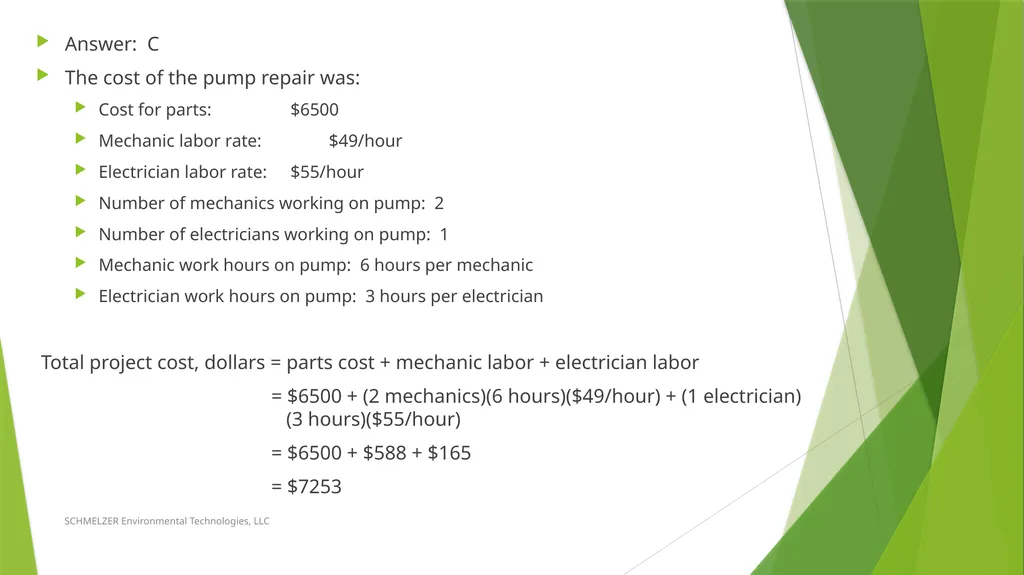
Answer: C
The cost of the pump repair was:
Cost for parts: $6500
Mechanic labor rate: $49/hour
Electrician labor rate: $55/hour
Number of mechanics working on pump: 2
Number of electricians working on pump: 1
Mechanic work hours on pump: 6 hours per mechanic
Electrician work hours on pump: 3 hours per electrician
Total project cost, dollars = parts cost + mechanic labor + electrician labor
= $6500 + (2 mechanics)(6 hours)($49/hour) + (1 electrician) (3 hours)($55/hour)
= $6500 + $588 + $165
= $7253 SCHMELZER Environmental Technologies, LLC<br>
The cost of the pump repair was:
Cost for parts: $6500
Mechanic labor rate: $49/hour
Electrician labor rate: $55/hour
Number of mechanics working on pump: 2
Number of electricians working on pump: 1
Mechanic work hours on pump: 6 hours per mechanic
Electrician work hours on pump: 3 hours per electrician
Total project cost, dollars = parts cost + mechanic labor + electrician labor
= $6500 + (2 mechanics)(6 hours)($49/hour) + (1 electrician) (3 hours)($55/hour)
= $6500 + $588 + $165
= $7253 SCHMELZER Environmental Technologies, LLC<br>
82
Equipment Operation Class “B” Job Tasks
Analyze data to evaluate and adjust equipment
Check filters for proper operation
Conduct wastewater pipe repairs
Monitor lift stations to ensure equipment is operating properly
Monitor motor control center
Transport biosolids offsite for disposal / reuse
Operate the following:
Aeration basins
Aeration systems (blowers, surface aerators, diffusers)
Air compressors
Anaerobic digesters
Analyzers (dissolved oxygen, pH, H2S, ORP)
Bar screens
Chemical feed systems SCHMELZER Environmental Technologies, LLC<br>
Analyze data to evaluate and adjust equipment
Check filters for proper operation
Conduct wastewater pipe repairs
Monitor lift stations to ensure equipment is operating properly
Monitor motor control center
Transport biosolids offsite for disposal / reuse
Operate the following:
Aeration basins
Aeration systems (blowers, surface aerators, diffusers)
Air compressors
Anaerobic digesters
Analyzers (dissolved oxygen, pH, H2S, ORP)
Bar screens
Chemical feed systems SCHMELZER Environmental Technologies, LLC<br>
83
Practice Exam Questions – “B” Exam To safely reduce the flowrate of a centrifugal pump
a) decrease the motor speed
b) decrease the total dynamic head
c) close the discharge valve
d) increase the rotational speed of the impeller
Answer: A
Reducing the motor speed of a pump will safely decrease the pump output as normal mode of operation if the pump is connected to a variable – frequency drive unit. If a constant – speed output needs to be consistently reduced, then the diameter of the impeller can be reduced. Typically, an impeller diameter change is used to improve pump efficiency and is considered a permanent change. Reducing total dynamic head will increase the discharge rate. Closing a discharge valve is extremely inefficient and causes high pressures inside the pump. Increasing the rotational speed will increase discharge rates (affinity laws). SCHMELZER Environmental Technologies, LLC<br>
a) decrease the motor speed
b) decrease the total dynamic head
c) close the discharge valve
d) increase the rotational speed of the impeller
Answer: A
Reducing the motor speed of a pump will safely decrease the pump output as normal mode of operation if the pump is connected to a variable – frequency drive unit. If a constant – speed output needs to be consistently reduced, then the diameter of the impeller can be reduced. Typically, an impeller diameter change is used to improve pump efficiency and is considered a permanent change. Reducing total dynamic head will increase the discharge rate. Closing a discharge valve is extremely inefficient and causes high pressures inside the pump. Increasing the rotational speed will increase discharge rates (affinity laws). SCHMELZER Environmental Technologies, LLC<br>
84
What is typically used as a safety device for machinery that may experience unusually high torque while running?
a) Lockout / Tagout system
b) High – Pressure sensors
c) Air compressors
d) Shear pins
Answer: D
A shear pin is a device that will break under high – torque conditions and separate the motor from the drive unit, effectively shutting the system down before serious damage occurs. Shear pins are effective, simple, and very common, especially with low speed, high – torque devices. The concept is simple: two couplings, face to face, share a common pin. If high torque develops, the pin breaks and the couplings separate before any of the equipment is damaged. It is important to replace the Sher pin with the exact same pin recommended by the manufacturer. SCHMELZER Environmental Technologies, LLC<br>
a) Lockout / Tagout system
b) High – Pressure sensors
c) Air compressors
d) Shear pins
Answer: D
A shear pin is a device that will break under high – torque conditions and separate the motor from the drive unit, effectively shutting the system down before serious damage occurs. Shear pins are effective, simple, and very common, especially with low speed, high – torque devices. The concept is simple: two couplings, face to face, share a common pin. If high torque develops, the pin breaks and the couplings separate before any of the equipment is damaged. It is important to replace the Sher pin with the exact same pin recommended by the manufacturer. SCHMELZER Environmental Technologies, LLC<br>
85
The formation and collapse of gas pockets or bubbles on the blade of a centrifugal pump impeller can cause
a) air binding of the impeller
b) compression of water on the leading edges of the impeller
c) hydraulic overload of the impeller
d) physical damage to the impeller
Answer: D
Cavitation is a phenomenon common in centrifugal pumps that occurs when the pump attempts to discharge more flow than it is pulling in through suction. Reduced internal pressure causes gases to expand and form bubbles around the impeller; when the bubbles implode, it potentially can cause severe damage to the pump. SCHMELZER Environmental Technologies, LLC<br>
a) air binding of the impeller
b) compression of water on the leading edges of the impeller
c) hydraulic overload of the impeller
d) physical damage to the impeller
Answer: D
Cavitation is a phenomenon common in centrifugal pumps that occurs when the pump attempts to discharge more flow than it is pulling in through suction. Reduced internal pressure causes gases to expand and form bubbles around the impeller; when the bubbles implode, it potentially can cause severe damage to the pump. SCHMELZER Environmental Technologies, LLC<br>
86
When a new pure oxygen plant starts up, who is the BEST source for initial safety training and equipment operation and maintenance of the pure oxygen equipment?
a) facility manager
b) lead operator
c) Equipment / oxygen provider
d) facility safety officer
Answer: C
The equipment / oxygen provider is the best source for safety training and equipment operation and maintenance of the pure oxygen equipment. SCHMELZER Environmental Technologies, LLC<br>
a) facility manager
b) lead operator
c) Equipment / oxygen provider
d) facility safety officer
Answer: C
The equipment / oxygen provider is the best source for safety training and equipment operation and maintenance of the pure oxygen equipment. SCHMELZER Environmental Technologies, LLC<br>
87
Treatment Process Monitoring, Evaluation and Adjustment Class “B” Job Tasks
Add chemicals to disinfect and deodorize water and other liquids (ammonia, chlorine, lime)
Analyze laboratory data to evaluate and adjust processes
Implement changes as indicated by laboratory results
Operate SCADA systems
Operate the preliminary treatment processes (i.e., screening, grit, flow equalization)
Operate primary clarification/sedimentation processes
Operate secondary treatment processes
Secondary clarification / sedimentation processes
Extended aeration processes (i.e., package, SBR, oxidation ditch)
Conventional activated sludge processes (i.e., step feed, plug flow, complete mix, MBR)
Operate nutrient removal systems
Operate disinfection treatment processes (i.e., chlorine, dechlorination, UV, ozone) SCHMELZER Environmental Technologies, LLC<br>
Add chemicals to disinfect and deodorize water and other liquids (ammonia, chlorine, lime)
Analyze laboratory data to evaluate and adjust processes
Implement changes as indicated by laboratory results
Operate SCADA systems
Operate the preliminary treatment processes (i.e., screening, grit, flow equalization)
Operate primary clarification/sedimentation processes
Operate secondary treatment processes
Secondary clarification / sedimentation processes
Extended aeration processes (i.e., package, SBR, oxidation ditch)
Conventional activated sludge processes (i.e., step feed, plug flow, complete mix, MBR)
Operate nutrient removal systems
Operate disinfection treatment processes (i.e., chlorine, dechlorination, UV, ozone) SCHMELZER Environmental Technologies, LLC<br>
88
Practice Exam Questions – “B” Exam Denitrification can be achieved in an oxidation ditch using all of the following EXCEPT
a) increasing the recycle rate
b) turning off one or more rotors
c) turning the aerators off at least twice a day
d) creating zones with and without aeration
Answer: A
Denitrification can be achieved by turning off one or more aeration rotors to create an anoxic zone, cycling the aeration by turning the aerators off at least twice a day, or using phased ditch operation. SCHMELZER Environmental Technologies, LLC<br>
a) increasing the recycle rate
b) turning off one or more rotors
c) turning the aerators off at least twice a day
d) creating zones with and without aeration
Answer: A
Denitrification can be achieved by turning off one or more aeration rotors to create an anoxic zone, cycling the aeration by turning the aerators off at least twice a day, or using phased ditch operation. SCHMELZER Environmental Technologies, LLC<br>
89
Determine the volumetric chemical feed rate in milliliters/minute to inject 1,500 lbs./day of sodium hydroxide to a return activated sludge line at a constant rate. Sodium hydroxide is delivered at 50% solution and has a specific gravity of 1.53. solutions are distributed by percent (%) mass and there are 3.785 L/gal.
a) 79 mL/min
b) 160 mL/min
c) 620 mL/min
d) 945 mL/min
Answer: C
It is important to understand that 50% solution equals 50 lbs of chemical (NaOH) per 100 lbs of solution. The per – gallon weight of solution is calculated by multiplying the weight of 1 gal of water by the specific gravity of the solution. Use dimensional analysis, as follows:<br>
a) 79 mL/min
b) 160 mL/min
c) 620 mL/min
d) 945 mL/min
Answer: C
It is important to understand that 50% solution equals 50 lbs of chemical (NaOH) per 100 lbs of solution. The per – gallon weight of solution is calculated by multiplying the weight of 1 gal of water by the specific gravity of the solution. Use dimensional analysis, as follows:<br>
90
Lime coagulation will be most successful in removing which of the following heavy metals?
a) mercury
b) arsenic
c) cadmium
d) selenium
Answer: B
Many of the common heavy metals form insoluble hydroxides at pH 11, so lime coagulation reduces these metal concentrations. Except for mercury, cadmium, and selenium, lime coagulation removes 90% or more of most heavy metals. SCHMELZER Environmental Technologies, LLC<br>
a) mercury
b) arsenic
c) cadmium
d) selenium
Answer: B
Many of the common heavy metals form insoluble hydroxides at pH 11, so lime coagulation reduces these metal concentrations. Except for mercury, cadmium, and selenium, lime coagulation removes 90% or more of most heavy metals. SCHMELZER Environmental Technologies, LLC<br>
91
A water resource recovery facility receives an average daily flow of 12.5 mgd. The influent BOD concentration is 320 mg/L. If the primary clarifier removes 35% of the influent BOD, what is the organic load to the secondary treatment process in pounds per day?
a) 11,676 lb/d
b) 16,446 lb/d
c) 21,684 lb/d
d) 33,360 lb/d SCHMELZER Environmental Technologies, LLC<br>
a) 11,676 lb/d
b) 16,446 lb/d
c) 21,684 lb/d
d) 33,360 lb/d SCHMELZER Environmental Technologies, LLC<br>
92
Answer: C
Mass, lb/d = (flow, mgd)(concentration, mg/L)(8.34 lb/mil. gal)
Mass, lb/d = 12.5 mgd)(320 mg/L)(8.34 lb / mil. gal)
Mass, lb/d = 33,360
If the primary clarifier is removing 35% of the influent BOD, then 100% - 35% = 65% is going on to the secondary treatment process.
(33,360 lb/d)(0.65) = 21,684
In this example, the primary clarifier was able to remove 35% of the influent BOD. Primary clarifiers separate the readily settleable and floatable solids from wastewater. The percent removal that may be achieved at a particular treatment facility will depend on influent wastewater characteristics. SCHMELZER Environmental Technologies, LLC<br>
Mass, lb/d = (flow, mgd)(concentration, mg/L)(8.34 lb/mil. gal)
Mass, lb/d = 12.5 mgd)(320 mg/L)(8.34 lb / mil. gal)
Mass, lb/d = 33,360
If the primary clarifier is removing 35% of the influent BOD, then 100% - 35% = 65% is going on to the secondary treatment process.
(33,360 lb/d)(0.65) = 21,684
In this example, the primary clarifier was able to remove 35% of the influent BOD. Primary clarifiers separate the readily settleable and floatable solids from wastewater. The percent removal that may be achieved at a particular treatment facility will depend on influent wastewater characteristics. SCHMELZER Environmental Technologies, LLC<br>
93
Laboratory Analysis Class “B” Job Tasks
Follow laboratory standard operating procedures (SOPs)
Collect samples, conduct analysis & Interpret data for the following:
Bacteriological analyses
Biological analyses (BOD, CBOD)
Chemical analyses (COD, nutrients, metals)
Physical analyses (pH, Temp., dissolved oxygen, settleable solids) SCHMELZER Environmental Technologies, LLC<br>
Follow laboratory standard operating procedures (SOPs)
Collect samples, conduct analysis & Interpret data for the following:
Bacteriological analyses
Biological analyses (BOD, CBOD)
Chemical analyses (COD, nutrients, metals)
Physical analyses (pH, Temp., dissolved oxygen, settleable solids) SCHMELZER Environmental Technologies, LLC<br>
94
Practice Exam Questions – “B” Exam Which statement is correct regarding total and fecal coliform tests?
a) total and fecal coliform bacteria are pathogens
b) both total and fecal coliform bacteria are reported as colonies per 10 mL
c) total and fecal coliform bacteria analysis must be processed immediately
d) total and fecal coliform bacteria are resistant to disinfection
Answer: D
Total and fecal coliform bacteria are not pathogens themselves; instead, they are used as indicator organisms because they tend to resist the effects of disinfection better than most pathogens. SCHMELZER Environmental Technologies, LLC<br>
a) total and fecal coliform bacteria are pathogens
b) both total and fecal coliform bacteria are reported as colonies per 10 mL
c) total and fecal coliform bacteria analysis must be processed immediately
d) total and fecal coliform bacteria are resistant to disinfection
Answer: D
Total and fecal coliform bacteria are not pathogens themselves; instead, they are used as indicator organisms because they tend to resist the effects of disinfection better than most pathogens. SCHMELZER Environmental Technologies, LLC<br>
95
A total alkalinity test is performed on a digested sludge sample. The sample volume is 50 mL. A total of 46 mL of the 0.1 N acid titrant is used to reach the endpoint. What is the total alkalinity of the sample in milligrams per liter as calcium carbonate (CaCO3)?
a) 460 mg/L
b) 920 mg/L
c) 2300 mg/L
d) 4600 mg/L
Answer: D SCHMELZER Environmental Technologies, LLC<br>
a) 460 mg/L
b) 920 mg/L
c) 2300 mg/L
d) 4600 mg/L
Answer: D SCHMELZER Environmental Technologies, LLC<br>
96
Nitrogen is typically present in raw, domestic wastewater in all of these forms EXCEPT
a) organic nitrogen
b) ammonia nitrogen
c) total Kjeldahl nitrogen (TKN)
d) nitrite nitrogen
Answer: D
Raw wastewater contains little or no nitrite and nitrate. Facultative bacteria in the collection system convert nitrite and nitrate to nitrogen gas when dissolved oxygen is not present. SCHMELZER Environmental Technologies, LLC<br>
a) organic nitrogen
b) ammonia nitrogen
c) total Kjeldahl nitrogen (TKN)
d) nitrite nitrogen
Answer: D
Raw wastewater contains little or no nitrite and nitrate. Facultative bacteria in the collection system convert nitrite and nitrate to nitrogen gas when dissolved oxygen is not present. SCHMELZER Environmental Technologies, LLC<br>
97
SCHMELZER Environmental Technologies, LLC<br>
98
Security, Safety and Administrative Procedures Class “A” Job Tasks
Adhere to established safety procedures (e.g., LOTO, confined space, HAZCOM, fall protection)
Assist in the selection of equipment for use in wastewater processing
Assist with budget preparation
Assist with the industrial pretreatment program in regard to effluent quality standards
Complete operation reports
Complete required regulatory reports
Ensure compliance with all applicable regulations
Generate maintenance reports
Identify personnel training needs
Implement spill notification policy
Manage facility staff SCHMELZER Environmental Technologies, LLC<br>
Adhere to established safety procedures (e.g., LOTO, confined space, HAZCOM, fall protection)
Assist in the selection of equipment for use in wastewater processing
Assist with budget preparation
Assist with the industrial pretreatment program in regard to effluent quality standards
Complete operation reports
Complete required regulatory reports
Ensure compliance with all applicable regulations
Generate maintenance reports
Identify personnel training needs
Implement spill notification policy
Manage facility staff SCHMELZER Environmental Technologies, LLC<br>
99
Practice Exam Questions – “A” Exam SCHMELZER Environmental Technologies, LLC Anaerobic digestion gas handling systems are kept under positive pressure for what reason?
a) to prevent air from entering the system and mixing with digester gas, which could cause an explosion
b) to minimize leakage of greenhouse gases
c) to reduce the potential for worker exposure to methane, which can be fatal in low doses
d) to ensure compliance with the facility’s Clean Air Act Permit
Answer: A
The explosive ratio of air to anaerobic digester gas ranges from approximately 20:1 to 5:1, so avoid mixing digester gas with air at all times. Anaerobic digester gas typically contains approximately 70% methane and 30% carbon dioxide plus nitrogen, hydrogen, hydrogen sulfide and oxygen.<br>
a) to prevent air from entering the system and mixing with digester gas, which could cause an explosion
b) to minimize leakage of greenhouse gases
c) to reduce the potential for worker exposure to methane, which can be fatal in low doses
d) to ensure compliance with the facility’s Clean Air Act Permit
Answer: A
The explosive ratio of air to anaerobic digester gas ranges from approximately 20:1 to 5:1, so avoid mixing digester gas with air at all times. Anaerobic digester gas typically contains approximately 70% methane and 30% carbon dioxide plus nitrogen, hydrogen, hydrogen sulfide and oxygen.<br>
100
In addition to the mechanical hazards of working around machinery, which of the following environmental hazards are also likely to be faced by maintenance workers at a water resource recovery facility?
a) safety device malfunction and heat stress
b) toxic substances and radiation
c) noise, heat illness, and stress
d) temperature extremes and electrical risk
Answer: C
In addition to mechanical hazards of working around machinery, there are other hazards that need to be considered. Maintenance personnel must be trained and properly protected from the following hazards as well: noise, heat insulation (asbestos), and heat illness and stress. SCHMELZER Environmental Technologies, LLC<br>
a) safety device malfunction and heat stress
b) toxic substances and radiation
c) noise, heat illness, and stress
d) temperature extremes and electrical risk
Answer: C
In addition to mechanical hazards of working around machinery, there are other hazards that need to be considered. Maintenance personnel must be trained and properly protected from the following hazards as well: noise, heat insulation (asbestos), and heat illness and stress. SCHMELZER Environmental Technologies, LLC<br>
101
Equipment Evaluation and Maintenance Class “A” Job Tasks
Calibrate meters (flow, pressure sensors)
Follow safety rules and guidelines when working with chemical equipment
Follow safety rules and guideline when working with mechanical equipment
Monitor flowmeters
Monitor telemetry systems
Inspect & maintain the following equipment
Aeration basins & systems (e.g., blowers, surface aerators, diffusers)
Anaerobic digesters
Analyzers (e.g., dissolved oxygen, pH, H2S, ORP)
Chemical feed systems
Clarifiers / sedimentation basins
Mechanical dewatering equipment (e.g., presses, centrifuges)
Solids thickening processes (e.g., DAF, belt, rotary drum)
SCADA Systems SCHMELZER Environmental Technologies, LLC<br>
Calibrate meters (flow, pressure sensors)
Follow safety rules and guidelines when working with chemical equipment
Follow safety rules and guideline when working with mechanical equipment
Monitor flowmeters
Monitor telemetry systems
Inspect & maintain the following equipment
Aeration basins & systems (e.g., blowers, surface aerators, diffusers)
Anaerobic digesters
Analyzers (e.g., dissolved oxygen, pH, H2S, ORP)
Chemical feed systems
Clarifiers / sedimentation basins
Mechanical dewatering equipment (e.g., presses, centrifuges)
Solids thickening processes (e.g., DAF, belt, rotary drum)
SCADA Systems SCHMELZER Environmental Technologies, LLC<br>
102
Practice Exam Questions – “A” Exam SCHMELZER Environmental Technologies, LLC Which of the following is (are) not a component of a magnetic flowmeter?
a) electrode
b) pipe section
c) magnetic coils
d) straightening vanes
Answer: D
Only straightening vanes are not part of a magnetic flowmeter.<br>
a) electrode
b) pipe section
c) magnetic coils
d) straightening vanes
Answer: D
Only straightening vanes are not part of a magnetic flowmeter.<br>
103
When cleaning a sodium hypochlorite pump and effluent water strainer, what type of gloves should be worn?
a) no gloves are necessary
b) leather
c) Kevlar
d) rubber
Answer: D
Water strainers on chlorinators frequently clog and require attention. Water strainers may be cleaned by being flushed with water, or, if they are badly fouled, they may be cleaned with dilute hydrochloric acid followed by a water rinse. Occasionally, pump a 5% solution of hydrochloric acid to prevent carbonate scale from accumulating in the pump. Flush the pump with water before and after using acid. Rubber gloves should be worn to prevent chemical burns during maintenance activities. In addition, protective eyewear should be used. SCHMELZER Environmental Technologies, LLC<br>
a) no gloves are necessary
b) leather
c) Kevlar
d) rubber
Answer: D
Water strainers on chlorinators frequently clog and require attention. Water strainers may be cleaned by being flushed with water, or, if they are badly fouled, they may be cleaned with dilute hydrochloric acid followed by a water rinse. Occasionally, pump a 5% solution of hydrochloric acid to prevent carbonate scale from accumulating in the pump. Flush the pump with water before and after using acid. Rubber gloves should be worn to prevent chemical burns during maintenance activities. In addition, protective eyewear should be used. SCHMELZER Environmental Technologies, LLC<br>
104
Given the following information about a primary clarifier:
Sludge is very thin
Sludge collector motor running
The flow over the weirs appears normal
Sludge collector is moving
What is the most probable problem?
a) broken collector chain
b) broken shear pin
c) excessive sludge pumping
d) inadequate sludge pumping SCHMELZER Environmental Technologies, LLC<br>
Sludge is very thin
Sludge collector motor running
The flow over the weirs appears normal
Sludge collector is moving
What is the most probable problem?
a) broken collector chain
b) broken shear pin
c) excessive sludge pumping
d) inadequate sludge pumping SCHMELZER Environmental Technologies, LLC<br>
105
Answer: C
The blanket thickness and solids concentration in a primary clarifier are inversely proportional to the underflow pumping rate. Higher pumping rates will result in lower blankets and lower solids concentrations. Lower pumping rates will result in deeper blankets and higher solids concentrations. SCHMELZER Environmental Technologies, LLC<br>
The blanket thickness and solids concentration in a primary clarifier are inversely proportional to the underflow pumping rate. Higher pumping rates will result in lower blankets and lower solids concentrations. Lower pumping rates will result in deeper blankets and higher solids concentrations. SCHMELZER Environmental Technologies, LLC<br>
106
Equipment Operation Class “A” Job Tasks
Analyze data to evaluate and adjust equipment
Check filters for proper operation
Monitor lift stations to ensure equipment is operating properly
Monitor motor control center
Operate the following:
Aeration basins & systems (e.g., blowers, surface aerators, diffusers)
Analyzers (e.g., DO, pH, ORP, etc.)
Chemical feed systems
Filtration & exchange units (e.g., sand filters, membranes)
Mechanical dewatering equipment (e.g., presses, centrifuges)
SCADA systems
Solids thickening processes (DAF, belt, rotary drum) SCHMELZER Environmental Technologies, LLC<br>
Analyze data to evaluate and adjust equipment
Check filters for proper operation
Monitor lift stations to ensure equipment is operating properly
Monitor motor control center
Operate the following:
Aeration basins & systems (e.g., blowers, surface aerators, diffusers)
Analyzers (e.g., DO, pH, ORP, etc.)
Chemical feed systems
Filtration & exchange units (e.g., sand filters, membranes)
Mechanical dewatering equipment (e.g., presses, centrifuges)
SCADA systems
Solids thickening processes (DAF, belt, rotary drum) SCHMELZER Environmental Technologies, LLC<br>
107
Practice Exam Questions – “A” Exam SCHMELZER Environmental Technologies, LLC Work has been completed on a motor for a centrifugal pump. The pump is now running, but generating little pressure and flow. What is the most likely cause?
a) the speed of the impeller is too high
b) the pump is overly primed
c) there is a water leak in the seal
d) the impeller is rotating the wrong way
Answer: D
If three-phase power is wired incorrectly, the pump will run backwards at a reduced rate.<br>
a) the speed of the impeller is too high
b) the pump is overly primed
c) there is a water leak in the seal
d) the impeller is rotating the wrong way
Answer: D
If three-phase power is wired incorrectly, the pump will run backwards at a reduced rate.<br>
108
If a variable-speed drive with a maximum speed of 60Hz is running at 35Hz, how fast is the motor (maximum speed of 1200 rpm) spinning in revolutions per minute?
a) 7
b) 70
c) 700
d) 42,000
Answer: C
Solve as a simple ration. SCHMELZER Environmental Technologies, LLC<br>
a) 7
b) 70
c) 700
d) 42,000
Answer: C
Solve as a simple ration. SCHMELZER Environmental Technologies, LLC<br>
109
A centrifuge is fed 70 dry tons of sludge, the centrifuge discharges 65 dry tons of sludge, and the centrate generates 2.4 mil. Gal (9 mL) of 500 – ppm liquid that is returned back to the facility. Calculate the solids capture percent (%) of the centrifuge.
a) 83%
b) 85%
c) 93%
d) 98%
Answer: C
A percent may be defined as the identified piece divided by the total. SCHMELZER Environmental Technologies, LLC<br>
a) 83%
b) 85%
c) 93%
d) 98%
Answer: C
A percent may be defined as the identified piece divided by the total. SCHMELZER Environmental Technologies, LLC<br>
110
Treatment Process Monitoring, Evaluation, and Adjustment Class “A” Job Tasks
Add chemicals to disinfect and deodorize water and other liquids (e.g., ammonia, chlorine, lime)
Operate chemical feed systems
Operate SCADA systems
Operate the preliminary treatment processes (e.g., screening, grit, flow equalization)
Operate the primary clarification / sedimentation processes
Operate the following secondary treatment processes
Secondary clarification/sedimentation processes
Conventional activated sludge processes (e.g., step feed, plug flow, complete mix, MBR)
Operate tertiary treatment processes
Nutrient removal systems
Filtration/ion exchange systems (sand, membranes)
Filtration systems (solids, liquid) SCHMELZER Environmental Technologies, LLC<br>
Add chemicals to disinfect and deodorize water and other liquids (e.g., ammonia, chlorine, lime)
Operate chemical feed systems
Operate SCADA systems
Operate the preliminary treatment processes (e.g., screening, grit, flow equalization)
Operate the primary clarification / sedimentation processes
Operate the following secondary treatment processes
Secondary clarification/sedimentation processes
Conventional activated sludge processes (e.g., step feed, plug flow, complete mix, MBR)
Operate tertiary treatment processes
Nutrient removal systems
Filtration/ion exchange systems (sand, membranes)
Filtration systems (solids, liquid) SCHMELZER Environmental Technologies, LLC<br>
111
Practice Exam Questions – “A” Exam SCHMELZER Environmental Technologies, LLC Calculate the annual power cost to operate the following UV disinfection system (below); assume all lamps are used 365 days per year.
Power cost = $0.10/kWh
Lamp power used = 700 W
Number of lamps = 50
a) $1,278/year
b) $3,500/year
c) $30,660/year
d) $306,600/year
Answer: C
700 W X 0.001 kW/W X 50 lamps X 24 hrs./day X $0.10/kWh X 365 days/year = $30,660/year.<br>
Power cost = $0.10/kWh
Lamp power used = 700 W
Number of lamps = 50
a) $1,278/year
b) $3,500/year
c) $30,660/year
d) $306,600/year
Answer: C
700 W X 0.001 kW/W X 50 lamps X 24 hrs./day X $0.10/kWh X 365 days/year = $30,660/year.<br>
112
The dewatering centrifuge solids capture has been decreasing over the past week. An inspection of the unit shows that the pond depth is too low. What course of action should be taken?
a) conduct jar tests with diluted polymer, try adding post-dilution water to polymer, or thinning out the feed solids
b) increase the bowl speed by 15%
c) check weir setting; raise pond level by 6 mm
d) reduce torque setting to obtain dryer, more viscous cake
Answer: C
Thickening centrifuges react to very small changes in pond height. A fair-sized change in a pond is 1.5 mm (1/16 in). The goal is to set the pond so that good operation occurs with the differential revolution per minute somewhere in its mid-range. Changing the feed rate substantially will require a change in pond setting.
Considering the pond surface (the liquid-air interface within the centrifuge), raising the pond surface reduces pond radius and thus reduces the surface area of the pond where separation takes place. This should give better centrate quality. SCHMELZER Environmental Technologies, LLC<br>
a) conduct jar tests with diluted polymer, try adding post-dilution water to polymer, or thinning out the feed solids
b) increase the bowl speed by 15%
c) check weir setting; raise pond level by 6 mm
d) reduce torque setting to obtain dryer, more viscous cake
Answer: C
Thickening centrifuges react to very small changes in pond height. A fair-sized change in a pond is 1.5 mm (1/16 in). The goal is to set the pond so that good operation occurs with the differential revolution per minute somewhere in its mid-range. Changing the feed rate substantially will require a change in pond setting.
Considering the pond surface (the liquid-air interface within the centrifuge), raising the pond surface reduces pond radius and thus reduces the surface area of the pond where separation takes place. This should give better centrate quality. SCHMELZER Environmental Technologies, LLC<br>
113
Laboratory Analysis Class “A” Job Tasks
Follow laboratory standard operating procedures (SOPs)
Collect samples, conduct analysis & Interpret data for the following:
Bacteriological analyses
Biological analyses (BOD, CBOD)
Chemical analyses (COD, nutrients, metals)
Physical analyses (pH, Temp., dissolved oxygen, settleable solids) SCHMELZER Environmental Technologies, LLC<br>
Follow laboratory standard operating procedures (SOPs)
Collect samples, conduct analysis & Interpret data for the following:
Bacteriological analyses
Biological analyses (BOD, CBOD)
Chemical analyses (COD, nutrients, metals)
Physical analyses (pH, Temp., dissolved oxygen, settleable solids) SCHMELZER Environmental Technologies, LLC<br>
114
Practice Exam Questions – “A” Exam SCHMELZER Environmental Technologies, LLC What is a modified biochemical oxygen demand (BOD) test approved by the U.S. Environmental Protection Agency (USEPA)?
a) A BOD test that gives the result within 3 hours
b) A BOD test that represents the combination of carbonaceous BOD (cBOD) and nitrogenous BOD (NBOD) values
c) A BOD test that adds a nitrification inhibitor for obtaining solely cBOD
d) A BOD test that is done by titration
Answer: C
Because nitrogenous oxidation can sometimes results in substantially higher 5-day BOD (BOD5) test results than those from oxidation of organic substances, USEPA has approved the use of a modified BOD test in which a nitrification inhibitor is used to suppress the nitrification reaction. Use of the CBOD test for permit reporting must be approved by each state regulatory agency.<br>
a) A BOD test that gives the result within 3 hours
b) A BOD test that represents the combination of carbonaceous BOD (cBOD) and nitrogenous BOD (NBOD) values
c) A BOD test that adds a nitrification inhibitor for obtaining solely cBOD
d) A BOD test that is done by titration
Answer: C
Because nitrogenous oxidation can sometimes results in substantially higher 5-day BOD (BOD5) test results than those from oxidation of organic substances, USEPA has approved the use of a modified BOD test in which a nitrification inhibitor is used to suppress the nitrification reaction. Use of the CBOD test for permit reporting must be approved by each state regulatory agency.<br>
115
A 200 – mL/L value on settled sludge volume (SSV) and 2,000 mg/L of mixed liquor suspended solids (MLSS) concentrations of an aeration tank sample are obtained from laboratory experiments. What is the sludge volume index (SVI) of this sample?
a) 10 mL/g
b) 40 mL/g
c) 50 mL/g
d) 100 mL/g SCHMELZER Environmental Technologies, LLC<br>
a) 10 mL/g
b) 40 mL/g
c) 50 mL/g
d) 100 mL/g SCHMELZER Environmental Technologies, LLC<br>
116
Answer: D
The sludge volume index is defined as follows:
The amount of space in mL occupied by 1 g of solids after settling for 30 minutes.
The units are milliliters per gram. 2,000 mg/L of mixed liquor suspended solids = 2,000 mg/1,000 mg/g = 2 g
Therefore 200 mL/2 g = 100 mL/g. SCHMELZER Environmental Technologies, LLC<br>
The sludge volume index is defined as follows:
The amount of space in mL occupied by 1 g of solids after settling for 30 minutes.
The units are milliliters per gram. 2,000 mg/L of mixed liquor suspended solids = 2,000 mg/1,000 mg/g = 2 g
Therefore 200 mL/2 g = 100 mL/g. SCHMELZER Environmental Technologies, LLC<br>
117
A sample of raw wastewater is analyzed for biochemical oxygen demand (BOD). A 5-mL sample is used in a standard 300 mL BOD Bottle. No seed is added. The initial dissolved oxygen is measured at 7.5 mg/L. After a 5-day incubation period, the dissolved oxygen is 1.4 mg/L. What is the BOD of the sample?
a) 36 mg/L
b) 72 mg/L
c) 366 mg/L
d) 400 mg/L
Answer: C SCHMELZER Environmental Technologies, LLC<br>
a) 36 mg/L
b) 72 mg/L
c) 366 mg/L
d) 400 mg/L
Answer: C SCHMELZER Environmental Technologies, LLC<br>
118
Continuing Education Between July 1 and June 30 of each odd numbered year, (i.e., July 1, 2019 to June 30, 2021) every operator and well driller must obtain a total of 12 hours (clock hours) of continuing education or pass the state examination. Operators should keep records of all courses attended.
Continuing education can be obtained from schools, workshops, seminars, conferences, online training, and/or in-house training sessions. As of 2018, operators who participate in the Professional Wastewater Operators Operations Challenge will be granted 12 hours CEU credit upon receipt of certificate of completion. Operations Challenge Judges and Coordinators will be granted 3 hours CEU credit upon receipt of certificate of completion.
After the renewal period, the Board will conduct a random audit for compliance with the CE requirement. If you are selected in the audit, you will be notified by the Board to submit proof of your CE hours. SCHMELZER Environmental Technologies, LLC<br>
Continuing education can be obtained from schools, workshops, seminars, conferences, online training, and/or in-house training sessions. As of 2018, operators who participate in the Professional Wastewater Operators Operations Challenge will be granted 12 hours CEU credit upon receipt of certificate of completion. Operations Challenge Judges and Coordinators will be granted 3 hours CEU credit upon receipt of certificate of completion.
After the renewal period, the Board will conduct a random audit for compliance with the CE requirement. If you are selected in the audit, you will be notified by the Board to submit proof of your CE hours. SCHMELZER Environmental Technologies, LLC<br>
119
Mark Schmelzer
President & CEO
SCHMELZER Environmental Technologies, LLC
mschmelzer@schmelzerenv.com
(843) 501 – 7447 SCHMELZER Environmental Technologies, LLC 119<br>
President & CEO
SCHMELZER Environmental Technologies, LLC
mschmelzer@schmelzerenv.com
(843) 501 – 7447 SCHMELZER Environmental Technologies, LLC 119<br>