
OPPORTUNITIES IN FOOD AND AGRO-PROCESSING IN
SB
Published · 46 slides · 0 views

1 / 1









Description
OPPORTUNITIES IN FOOD AND AGRO-PROCESSING IN NIGERIA OPPORTUNITIES IN FOOD AND AGRO-PROCESSING IN NIGERIA HEAD WOMEN IN AGRICULTURE AND NUTRITION LAGOS STATE AGRICULTURAL DEVELOPMENT AUTHORITY. TEL: 07038590492, 08073718271 EMAIL:
Related Topics
Share
Embed code
Download this presentation From Below
"OPPORTUNITIES IN FOOD AND AGRO-PROCESSING IN" is the property of its rightful owner. Permission is granted to download and print the materials on this website for personal, non-commercial use only, and to display it on your personal computer provided you do not modify the materials and that you retain all copyright notices contained in the materials. By downloading content from our website, you accept the terms of this agreement.
Presentation Transcript
01
OPPORTUNITIES IN FOOD AND AGRO-PROCESSING IN NIGERIA<br>
02
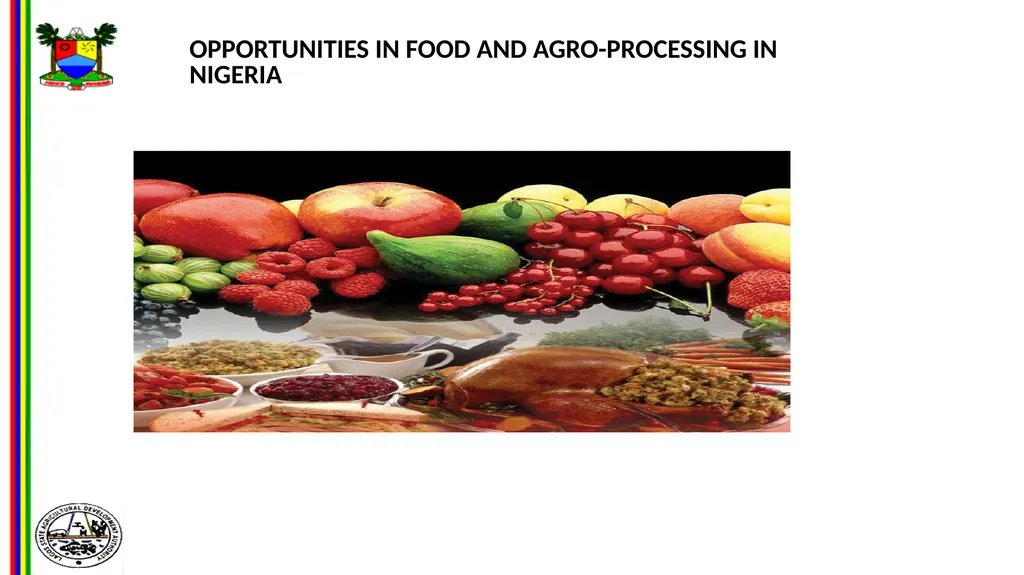
OPPORTUNITIES IN FOOD AND AGRO-PROCESSING IN NIGERIA<br>
03
HEAD WOMEN IN AGRICULTURE AND NUTRITION
LAGOS STATE AGRICULTURAL DEVELOPMENT AUTHORITY.
TEL: 07038590492, 08073718271
EMAIL: jusbalog144@gmail.com PRESENTED BY<br>
LAGOS STATE AGRICULTURAL DEVELOPMENT AUTHORITY.
TEL: 07038590492, 08073718271
EMAIL: jusbalog144@gmail.com PRESENTED BY<br>
04
One of the major objectives of food and Agro processing is to generate passive income at the lowest possible risk and cost.
Develop new value-added products.
GOAL
This webinar will provide significant private sector investment and government collaboration and support. OBJECTIVES<br>
Develop new value-added products.
GOAL
This webinar will provide significant private sector investment and government collaboration and support. OBJECTIVES<br>
05
Adequate food intake and healthy nutritional status are the foundation block of a healthy, active and productive nation.
Agricultural produce are highly perishable in nature.
Value addition through processing is the way out.
Agro-processing has the advantages of stimulating demand for farm produce and products and give consumers additional choice.
Opportunities in food processing.
Strategies for food and dietary diversification. INTRODUCTION<br>
Agricultural produce are highly perishable in nature.
Value addition through processing is the way out.
Agro-processing has the advantages of stimulating demand for farm produce and products and give consumers additional choice.
Opportunities in food processing.
Strategies for food and dietary diversification. INTRODUCTION<br>
06
FOOD AND AGRO PROCESSING
Food processing is any intentional change in food occurring before consumption.
Changing consumer demographics related to lifestyle changes, urbanization, and tourism.
Is a resulting in an increased demand for convenience and processed foods.
Nigerian’s agriculture and agribusiness industry is underperforming,
And thus providing opportunities for investors to benefit from this huge market<br>
Food processing is any intentional change in food occurring before consumption.
Changing consumer demographics related to lifestyle changes, urbanization, and tourism.
Is a resulting in an increased demand for convenience and processed foods.
Nigerian’s agriculture and agribusiness industry is underperforming,
And thus providing opportunities for investors to benefit from this huge market<br>
07
The demand for convenience and processed food is growing in Nigeria
This demand is led by Nigeria’s expanding middle class, with consumer changes in tastes, patterns and style.
Consumers are also becoming more health conscious, adding to the need for nutritious pre-packaged food.
The food processing and packaging market report notes that Nigeria’s packaging and food processing market is one of the largest in Africa,
And estimated at about $545m. Between 2010 and 2012, imports of food<br>
This demand is led by Nigeria’s expanding middle class, with consumer changes in tastes, patterns and style.
Consumers are also becoming more health conscious, adding to the need for nutritious pre-packaged food.
The food processing and packaging market report notes that Nigeria’s packaging and food processing market is one of the largest in Africa,
And estimated at about $545m. Between 2010 and 2012, imports of food<br>
08
Diversification of the economy, in order to reduce present dependence on one export commodity
Reduction of imports and meeting export demands;
Stimulate agricultural production by obtaining marketable products;
Generate both rural and urban employment;
Reduce fresh produce losses;
Improve farmers' nutrition by allowing them to consume their own processed fruit and vegetables during the off-season;
Generate new sources of income for farmers/artisans;
Develop new value-added products. REASONS FOR AGRO- PROCESSING ACTIVITIES<br>
Reduction of imports and meeting export demands;
Stimulate agricultural production by obtaining marketable products;
Generate both rural and urban employment;
Reduce fresh produce losses;
Improve farmers' nutrition by allowing them to consume their own processed fruit and vegetables during the off-season;
Generate new sources of income for farmers/artisans;
Develop new value-added products. REASONS FOR AGRO- PROCESSING ACTIVITIES<br>
09
Despite the challenges.
There is tremendous untapped potential in Nigeria’s agriculture and agribusiness sector.
In the third quarter of 2016, the sector grew 4.88% and has grown by as much as 13% in previous years.
The Nigerian government is prioritising agriculture with growth plans of 6.9% from 2017-2020.
Rice, cashew nuts, groundnuts, cassava and vegetable oil are products the country hopes to export by 2022.
There are plans to make Nigeria self-sufficient in tomato, rice and wheat by 2019, 2020 and 2021/2022 respectively. OPPORTUNITIES<br>
There is tremendous untapped potential in Nigeria’s agriculture and agribusiness sector.
In the third quarter of 2016, the sector grew 4.88% and has grown by as much as 13% in previous years.
The Nigerian government is prioritising agriculture with growth plans of 6.9% from 2017-2020.
Rice, cashew nuts, groundnuts, cassava and vegetable oil are products the country hopes to export by 2022.
There are plans to make Nigeria self-sufficient in tomato, rice and wheat by 2019, 2020 and 2021/2022 respectively. OPPORTUNITIES<br>
10
A broad range of food production and processing opportunities can be gleaned from The Green Alternative, Nigeria’s agriculture promotion policy document.
It is expected to unlock the sectors potentials, reduce dependence on crude oil export and ignite the growth of the Nigerian economy.<br>
It is expected to unlock the sectors potentials, reduce dependence on crude oil export and ignite the growth of the Nigerian economy.<br>
11
Investment opportunities in the agricultural value chain in the country are huge.
The food distribution in Nigeria remains largely inefficient due to the factors such as
crop seasonality,
sub optimal storage technology and facilities,
an inadequate transport and distribution system,
Imperfect market information and behavior. INVESTMENT OPPORTUNITY<br>
The food distribution in Nigeria remains largely inefficient due to the factors such as
crop seasonality,
sub optimal storage technology and facilities,
an inadequate transport and distribution system,
Imperfect market information and behavior. INVESTMENT OPPORTUNITY<br>
12
The poor storage facilities at household level alone results in significant post-harvest losses(cereals 25-30%; root crop 50-70%; fruits and vegetables 70%).
This nexus results in considerable spatial and seasonal variation in food production and availability,
and is responsible for he considerable range in food prices across the country.
Thus one can invest in the following:
Fresh fruits processing,
foodstuff retailing or grocery service,<br>
This nexus results in considerable spatial and seasonal variation in food production and availability,
and is responsible for he considerable range in food prices across the country.
Thus one can invest in the following:
Fresh fruits processing,
foodstuff retailing or grocery service,<br>
13
fish farming, herbs,
flowers framing and gardening,
livestock feed production,
poultry farm,
mushroom farming,
frozen chicken production, and
glasscutter farming<br>
flowers framing and gardening,
livestock feed production,
poultry farm,
mushroom farming,
frozen chicken production, and
glasscutter farming<br>
14
Potential agro entrepreneurs could also make useful investments in other areas, including:
fish production, snail farming,
coconut juice production,
beekeeping and honey production,
plantain chips production, custard manufacturing,
fruit juice or jam production,
groundnut processing, cashew nut processing,
soya beans processing, spices production,
dairy products, vegetable farming e.t.c<br>
fish production, snail farming,
coconut juice production,
beekeeping and honey production,
plantain chips production, custard manufacturing,
fruit juice or jam production,
groundnut processing, cashew nut processing,
soya beans processing, spices production,
dairy products, vegetable farming e.t.c<br>
15
Value Addition, is a Veritable Future for Agro Processing in Nigeria
What is “Value Added?”
“Value added” means adding value to a raw product by taking it to at least the next stage of production.
adding value may be as elaborate as going all the way to the consumer with a “case-ready” food product.
If you are considering a value-added enterprise, there are two key questions to answer: VALUE ADDITION<br>
What is “Value Added?”
“Value added” means adding value to a raw product by taking it to at least the next stage of production.
adding value may be as elaborate as going all the way to the consumer with a “case-ready” food product.
If you are considering a value-added enterprise, there are two key questions to answer: VALUE ADDITION<br>
16
Customer value” reflects the relationship between the benefits customers receive from and the price they pay for a product.
The more benefits relative to the price, the higher the customer value.
This does not necessarily mean that greater value results from a low price.
The price of a particular product may be high, but if the associated benefits are high as well, the customers perceive the product as valuable.
This interaction creates customer value and, thus, the opportunity to add value to your product. WHAT IS CUSTOMER VALUE?<br>
The more benefits relative to the price, the higher the customer value.
This does not necessarily mean that greater value results from a low price.
The price of a particular product may be high, but if the associated benefits are high as well, the customers perceive the product as valuable.
This interaction creates customer value and, thus, the opportunity to add value to your product. WHAT IS CUSTOMER VALUE?<br>
17
Creating customer value is critical in building a profitable and substantial business.
However, one must bear in mind that it is the customers’ perception of value, not the producers’, that is critical.
It is also important to recognize that different customers have different perceptions of added value.
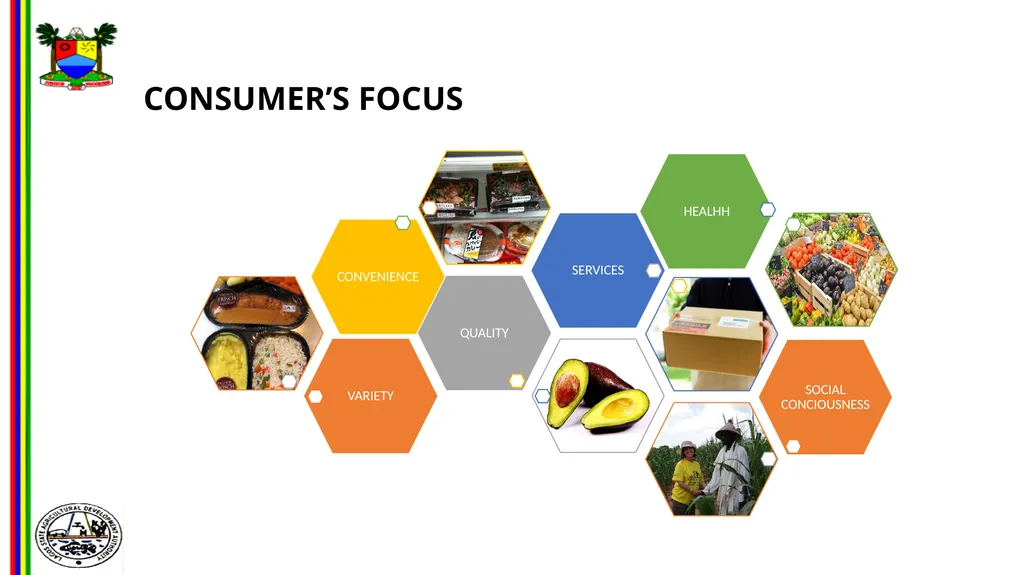
These perceptions correspond to their expectations of quality, service, convenience and selection.<br>
However, one must bear in mind that it is the customers’ perception of value, not the producers’, that is critical.
It is also important to recognize that different customers have different perceptions of added value.
These perceptions correspond to their expectations of quality, service, convenience and selection.<br>
18
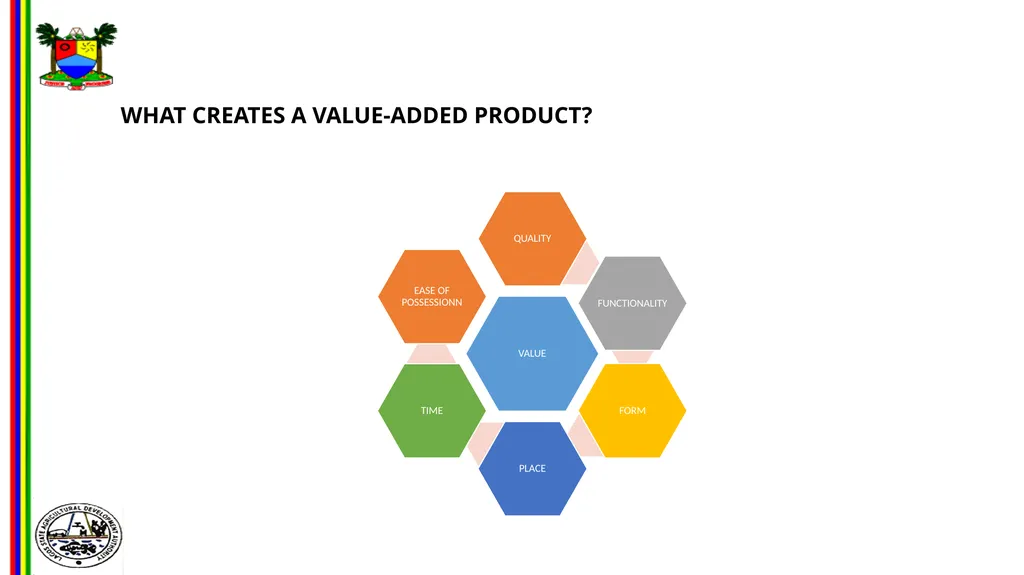
WHAT CREATES A VALUE-ADDED PRODUCT?<br>
19
“Value” is usually created by focusing on the benefits associated with the agribusiness product or service that arise from:
Quality — Does the product or service meet or exceed customer expectations?
Functionality — Does the product or service provide the function needed of it? WHAT CREATES A VALUE-ADDED PRODUCT?<br>
Quality — Does the product or service meet or exceed customer expectations?
Functionality — Does the product or service provide the function needed of it? WHAT CREATES A VALUE-ADDED PRODUCT?<br>
20
Form — Is the product in a useful form?
Place — Is the product in the right place?
Time — Is the product in the right place at the right time?
Ease of possession — Is the product easy for the customer to obtain? WHAT CREATES A VALUE-ADDED PRODUCT?<br>
Place — Is the product in the right place?
Time — Is the product in the right place at the right time?
Ease of possession — Is the product easy for the customer to obtain? WHAT CREATES A VALUE-ADDED PRODUCT?<br>
21
A product must have one or more of these qualities to generate additional value.
Remember that a product is simply.
A bundle of benefits,
And that the more benefits there are the more customers will perceive the product as having value.<br>
Remember that a product is simply.
A bundle of benefits,
And that the more benefits there are the more customers will perceive the product as having value.<br>
22
Agro processing in Nigeria, particularly the food sector, is rapidly consolidating and increasingly responding to the changing tastes and preferences of consumers.
Consumers have higher incomes than ever before.
They are also faced with the increasing value of (and demands on) their time.
In a nutshell, consumers are more value conscious than ever.
Consumers’ rising disposable incomes and the market fragmentation caused by retail consolidation exacerbate competition,
but at the same time leave many niche markets to be exploited. DRIVE OF VALUE ADDITION<br>
Consumers have higher incomes than ever before.
They are also faced with the increasing value of (and demands on) their time.
In a nutshell, consumers are more value conscious than ever.
Consumers’ rising disposable incomes and the market fragmentation caused by retail consolidation exacerbate competition,
but at the same time leave many niche markets to be exploited. DRIVE OF VALUE ADDITION<br>
23
CONSUMER’S FOCUS<br>
24
This creates opportunities for producers to add value to their products.
To take advantage of opportunities in this area, one must know and understand customers.
What consumer segments might want in your product?
What are the benefits desired by these potential customers?
What criteria are they looking for when purchasing? How to Benefit from Agro processing in Nigeria (Creating a Value-Added Product)<br>
To take advantage of opportunities in this area, one must know and understand customers.
What consumer segments might want in your product?
What are the benefits desired by these potential customers?
What criteria are they looking for when purchasing? How to Benefit from Agro processing in Nigeria (Creating a Value-Added Product)<br>
25
Writing these down as part of a business plan is an important first step in beginning a value-added business.
Any business enterprise can be thought of as a value chain.
Each activity that is performed should add value to the product.
To do this, one must meticulously control the activities at each step in the value chain:
Procurement of inputs; converting inputs into products;<br>
Any business enterprise can be thought of as a value chain.
Each activity that is performed should add value to the product.
To do this, one must meticulously control the activities at each step in the value chain:
Procurement of inputs; converting inputs into products;<br>
26
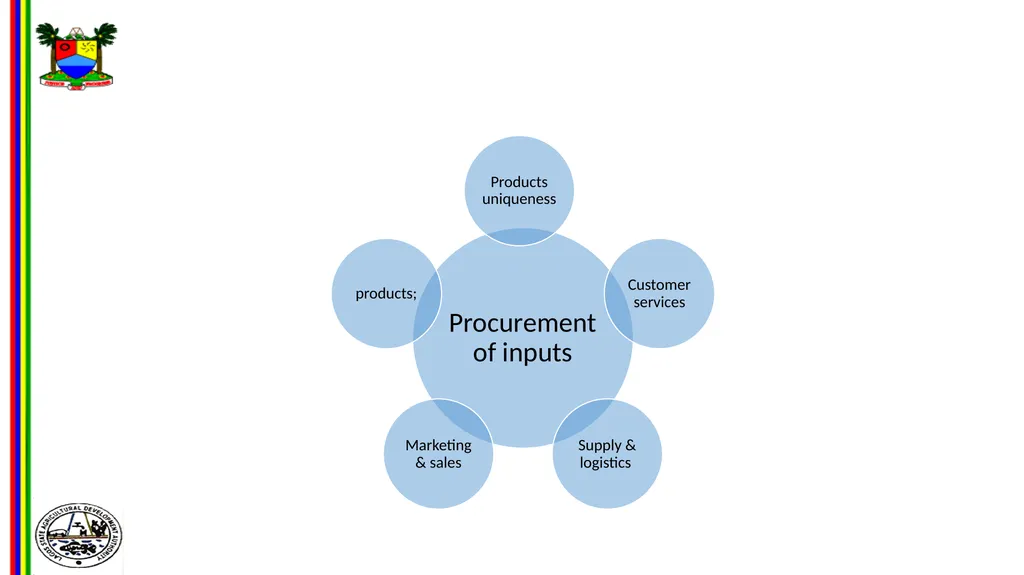
Converting inputs into products;
Marketing and sales;
Supply chain logistics;
Customer service activities.
And product’s uniqueness. Procurement of inputs; Producer’s Point of View<br>
Marketing and sales;
Supply chain logistics;
Customer service activities.
And product’s uniqueness. Procurement of inputs; Producer’s Point of View<br>
27
The uniqueness of your product or service (the value you add) is what ultimately attracts customers.
Obviously, this value-added strategy is very different from the commodity-oriented strategy with which most farmers processors and ranchers are familiar with.<br>
Obviously, this value-added strategy is very different from the commodity-oriented strategy with which most farmers processors and ranchers are familiar with.<br>
28
In a commodity strategy, a producer focuses on the costs of production with the goal of being a low-cost producer.
This is, in essence, a “supply-side” focus. The value-added strategy, in contrast, involves a “demand-side” focus—determining who the customers are and what they want. Then, after assessing your resources and source of uniqueness, you provide a product or service that efficiently curbs production costs while meeting the needs of the potential market.
Unlike a commodity-driven business, a value-added business cannot erode benefits or lower input specifications just to lower costs.<br>
This is, in essence, a “supply-side” focus. The value-added strategy, in contrast, involves a “demand-side” focus—determining who the customers are and what they want. Then, after assessing your resources and source of uniqueness, you provide a product or service that efficiently curbs production costs while meeting the needs of the potential market.
Unlike a commodity-driven business, a value-added business cannot erode benefits or lower input specifications just to lower costs.<br>
29
There are ways to craft a successful value-added business strategy.
The key factors in a detailed business plan are:
Operations plan — flow of the business, quality and cost control
Personnel plan — needs, skills and training
Sales plan — including challenging but realistic goals
Management plan —strengths, weaknesses and resources
Investment and financial plan — cash flow planning Steps to Success in a Value-Added Business<br>
The key factors in a detailed business plan are:
Operations plan — flow of the business, quality and cost control
Personnel plan — needs, skills and training
Sales plan — including challenging but realistic goals
Management plan —strengths, weaknesses and resources
Investment and financial plan — cash flow planning Steps to Success in a Value-Added Business<br>
30
Cassava bread making
Corn starch processing
Cowpea processing
Cashewnut processing into edible cashew kernel
Full fat soya processing
Kunu production and preservation
Smoked catfish/other fish production
Soy-dawadawa processing
Soy milk production
Soy-ogi production Examples of Agro Processing in Nigeria<br>
Corn starch processing
Cowpea processing
Cashewnut processing into edible cashew kernel
Full fat soya processing
Kunu production and preservation
Smoked catfish/other fish production
Soy-dawadawa processing
Soy milk production
Soy-ogi production Examples of Agro Processing in Nigeria<br>
31
Vegetable oil extraction
Tiger nut drink production
Zobo leaves production
Fruit juice processing
Plantain chips processing
Tomato paste processing
Cassava based adhesives processing
Cassava starch processing
Odorless fufu processing Examples of Agro Processing in Nigeria contd.<br>
Tiger nut drink production
Zobo leaves production
Fruit juice processing
Plantain chips processing
Tomato paste processing
Cassava based adhesives processing
Cassava starch processing
Odorless fufu processing Examples of Agro Processing in Nigeria contd.<br>
32
Cassava flour processing
Yam flour processing
Potato flour processing
Cocoyam flour processing
Instant pounded yam flour processing
Palm wine bottling and preservation Examples of Agro Processing in Nigeria contd.<br>
Yam flour processing
Potato flour processing
Cocoyam flour processing
Instant pounded yam flour processing
Palm wine bottling and preservation Examples of Agro Processing in Nigeria contd.<br>
33
Primary (mild processing) food processing is necessary to make most foods edible,
Secondary ( complete conversion to more stable products). turns the ingredients into familiar foods, such as bread.
Tertiary food processing has been criticized for promoting over nutrition and obesity, containing too much sugar and salt, too little fiber, and otherwise being unhealthful in respect to dietary needs of humans and farm animals. AGRO – PROCESSING TYPES<br>
Secondary ( complete conversion to more stable products). turns the ingredients into familiar foods, such as bread.
Tertiary food processing has been criticized for promoting over nutrition and obesity, containing too much sugar and salt, too little fiber, and otherwise being unhealthful in respect to dietary needs of humans and farm animals. AGRO – PROCESSING TYPES<br>
34
1a. Mushroom production, packaging and storage.
(harvesting, weighing , packaging and cool storage for fresh market.)
1b.Drying to obtain extended shelf life products.
2.Leafy vegetables (harvesting, removal of non-edible parts, cutting ready for direct use or drying )
3. Dehydration: Food drying, also called food dehydration, is the process of removing water from food, and stopping the growth of bacteria and fungi by the movement of hot, dry air through the food.
Dehydration of fruit and vegetables is one of the oldest forms of food preservation techniques known to man MILD PROCESSED PRODUCTS<br>
(harvesting, weighing , packaging and cool storage for fresh market.)
1b.Drying to obtain extended shelf life products.
2.Leafy vegetables (harvesting, removal of non-edible parts, cutting ready for direct use or drying )
3. Dehydration: Food drying, also called food dehydration, is the process of removing water from food, and stopping the growth of bacteria and fungi by the movement of hot, dry air through the food.
Dehydration of fruit and vegetables is one of the oldest forms of food preservation techniques known to man MILD PROCESSED PRODUCTS<br>
35
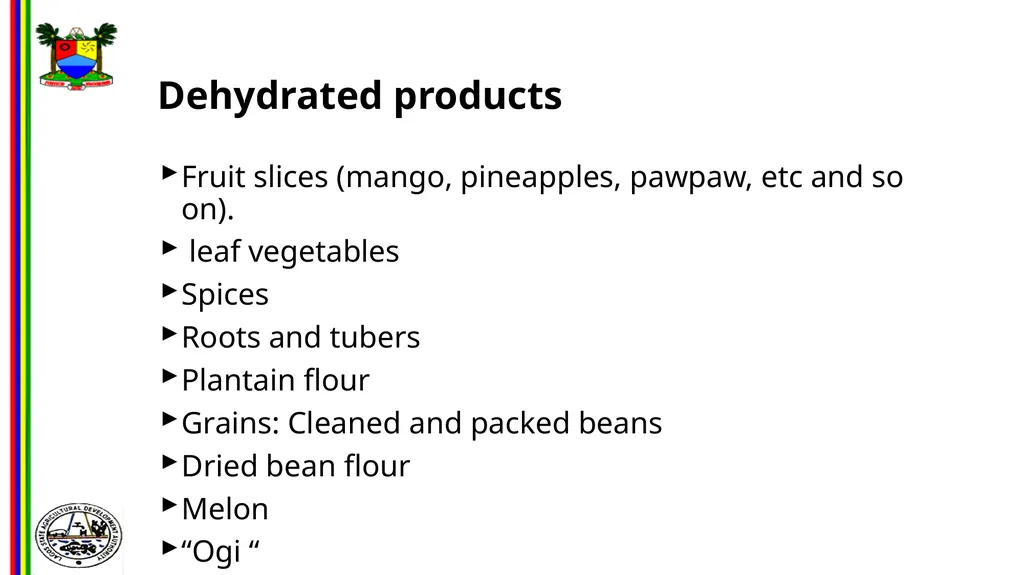
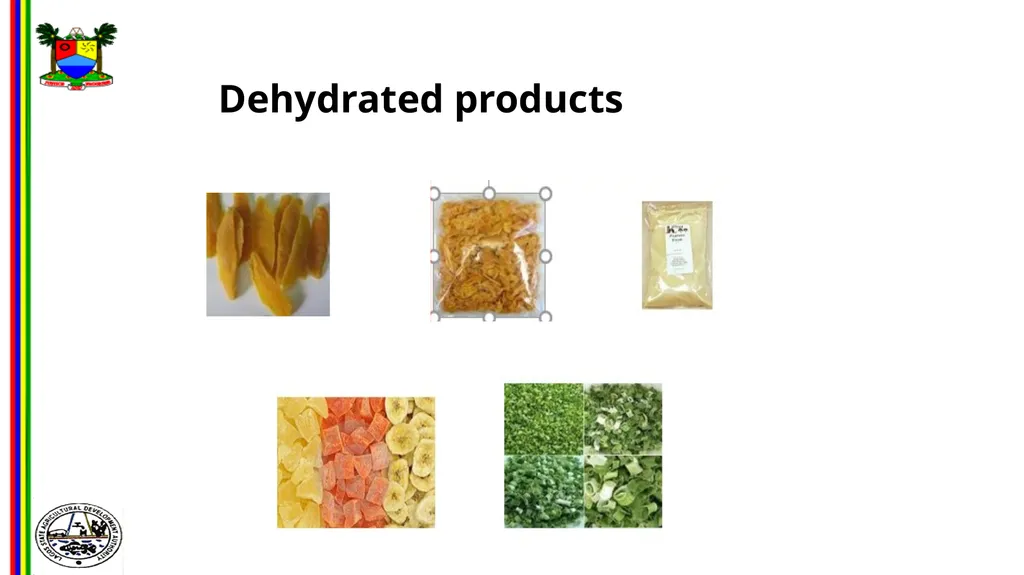
Fruit slices (mango, pineapples, pawpaw, etc and so on).
leaf vegetables
Spices
Roots and tubers
Plantain flour
Grains: Cleaned and packed beans
Dried bean flour
Melon
“Ogi “ Dehydrated products<br>
leaf vegetables
Spices
Roots and tubers
Plantain flour
Grains: Cleaned and packed beans
Dried bean flour
Melon
“Ogi “ Dehydrated products<br>
36
Dehydrated products<br>
37
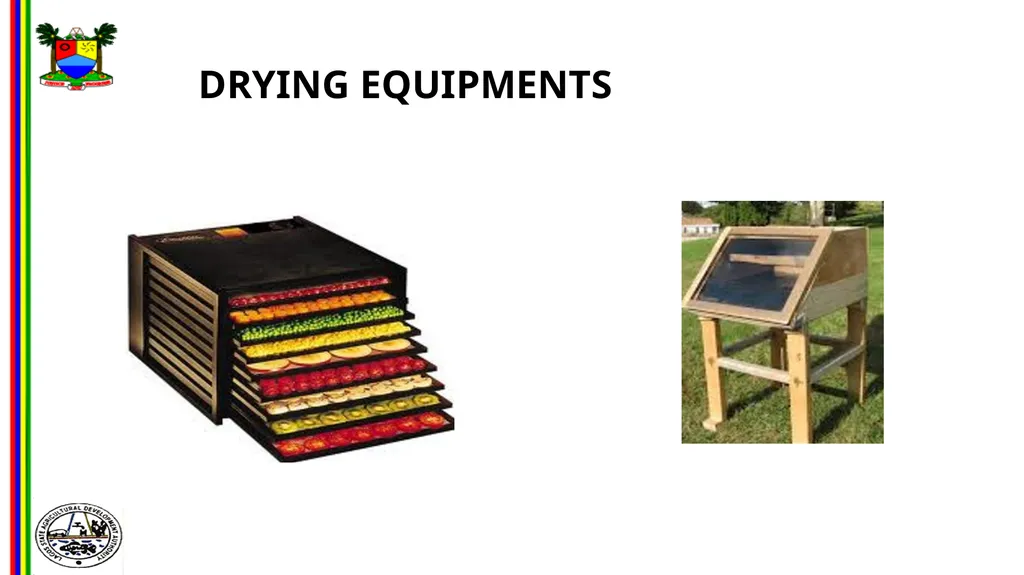
DRYING EQUIPMENTS<br>
38
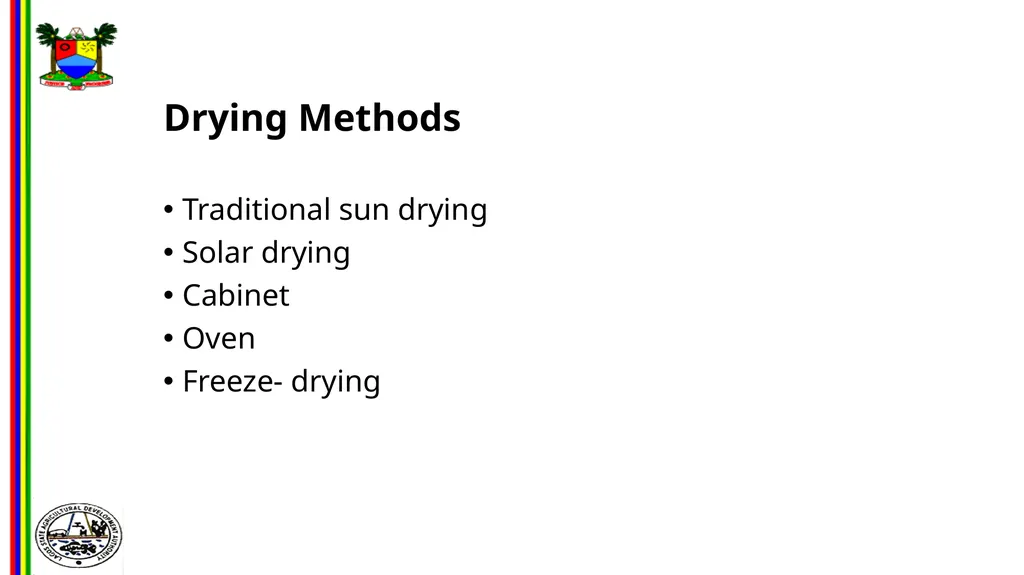
Traditional sun drying
Solar drying
Cabinet
Oven
Freeze- drying Drying Methods<br>
Solar drying
Cabinet
Oven
Freeze- drying Drying Methods<br>
39
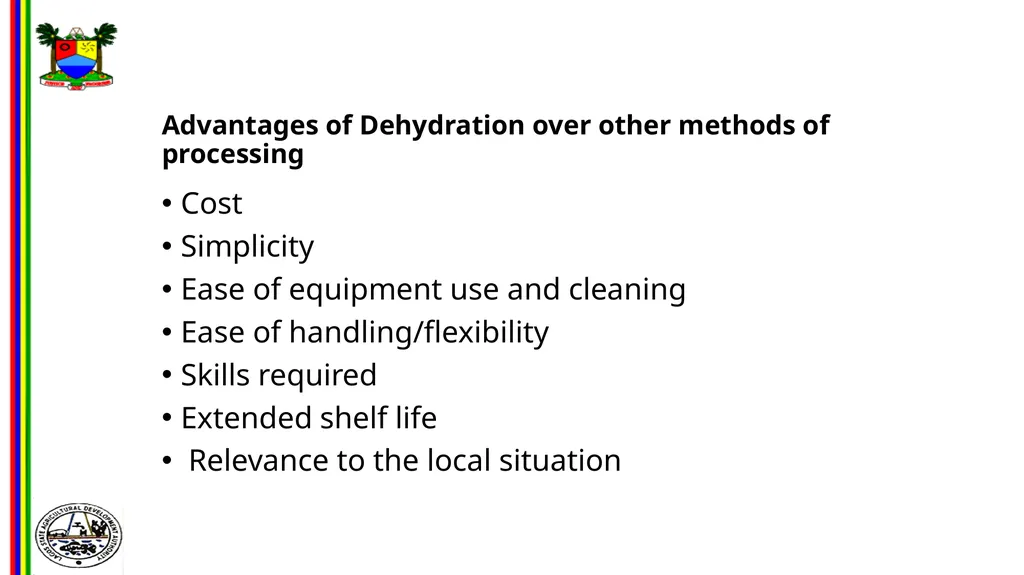
Cost
Simplicity
Ease of equipment use and cleaning
Ease of handling/flexibility
Skills required
Extended shelf life
Relevance to the local situation Advantages of Dehydration over other methods of processing<br>
Simplicity
Ease of equipment use and cleaning
Ease of handling/flexibility
Skills required
Extended shelf life
Relevance to the local situation Advantages of Dehydration over other methods of processing<br>
40
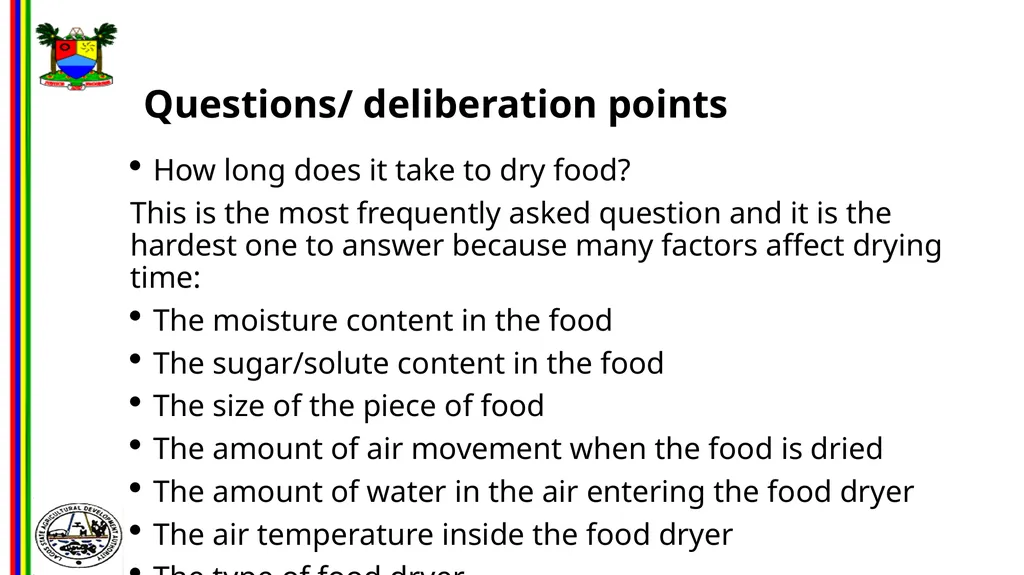
How long does it take to dry food?
This is the most frequently asked question and it is the hardest one to answer because many factors affect drying time:
The moisture content in the food
The sugar/solute content in the food
The size of the piece of food
The amount of air movement when the food is dried
The amount of water in the air entering the food dryer
The air temperature inside the food dryer
The type of food dryer Questions/ deliberation points<br>
This is the most frequently asked question and it is the hardest one to answer because many factors affect drying time:
The moisture content in the food
The sugar/solute content in the food
The size of the piece of food
The amount of air movement when the food is dried
The amount of water in the air entering the food dryer
The air temperature inside the food dryer
The type of food dryer Questions/ deliberation points<br>
41
Generally, greens are best dried at about 40-500C
Fruits at 50-620C for 6-36 hours (indicated by a pliable and leathery feel)
Herbs and other leafy vegetables at temperatures ≤450C for 3-16 hours (brittle and leathery) ANSWERS<br>
Fruits at 50-620C for 6-36 hours (indicated by a pliable and leathery feel)
Herbs and other leafy vegetables at temperatures ≤450C for 3-16 hours (brittle and leathery) ANSWERS<br>
42
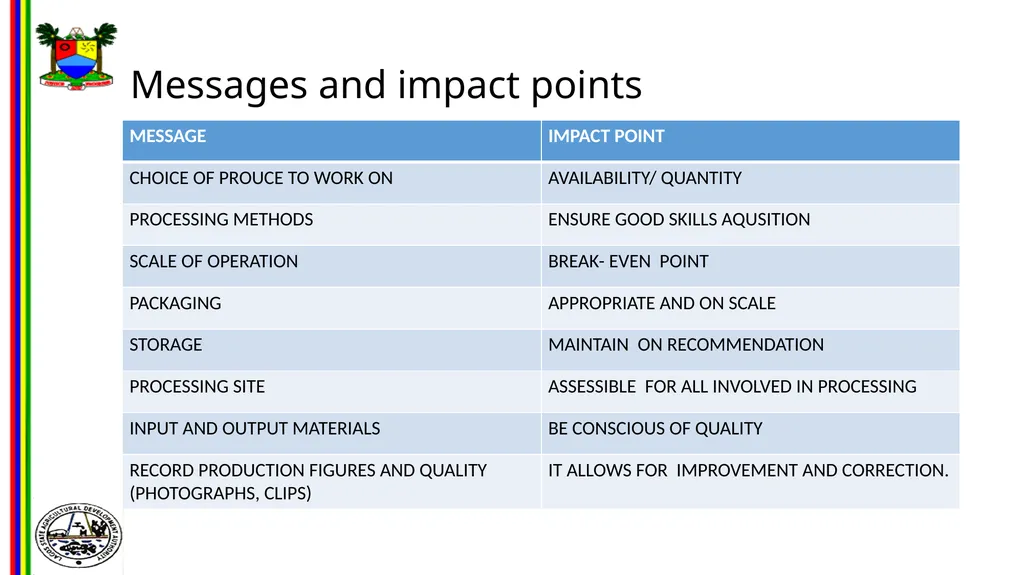
Messages and impact points<br>
43
Adequate training is needed to start a successful agro processing in Nigeria,
I suggest you should consider attending a practical oriented agro processing training to set you on the right path.
You can always contact us if you need assistance on commencing agro processing in Nigeria.
Contact: Justina Balogun Head women in Agriculture & Nutrition; 07038590492, 08073718271
Lagos State Agricultural Development Authority Oko Oba Agege.<br>
I suggest you should consider attending a practical oriented agro processing training to set you on the right path.
You can always contact us if you need assistance on commencing agro processing in Nigeria.
Contact: Justina Balogun Head women in Agriculture & Nutrition; 07038590492, 08073718271
Lagos State Agricultural Development Authority Oko Oba Agege.<br>
44
Food comes first in the hierarchy of human needs:
Think food first and you will always be in business.
IT IS OUR COLLECTIVE EFFORT TO MAKE NIGERIA A GREAT NATION PARTING STATEMENT<br>
Think food first and you will always be in business.
IT IS OUR COLLECTIVE EFFORT TO MAKE NIGERIA A GREAT NATION PARTING STATEMENT<br>