OPPRESSION: THE BACKGROUND AND BIRTH OF MOSES Lesson 1 for July 5, 2025 The children of Israel groaned because of the bondage, and they cried out; and their cry came up to God because of the bondage. So God heard their groaning, and God
"OPPRESSION: THE BACKGROUND AND BIRTH OF MOSES" is the property of its rightful owner. Permission is granted to
download and print the materials on this website for personal, non-commercial use only, and to display it
on your personal computer provided you do not modify the materials and that you retain all copyright
notices contained in the materials. By downloading content from our website, you accept the terms of this
agreement.
Presentation Transcript
01
OPPRESSION: THE BACKGROUND AND BIRTH OF MOSES Lesson 1 for July 5, 2025<br>
02
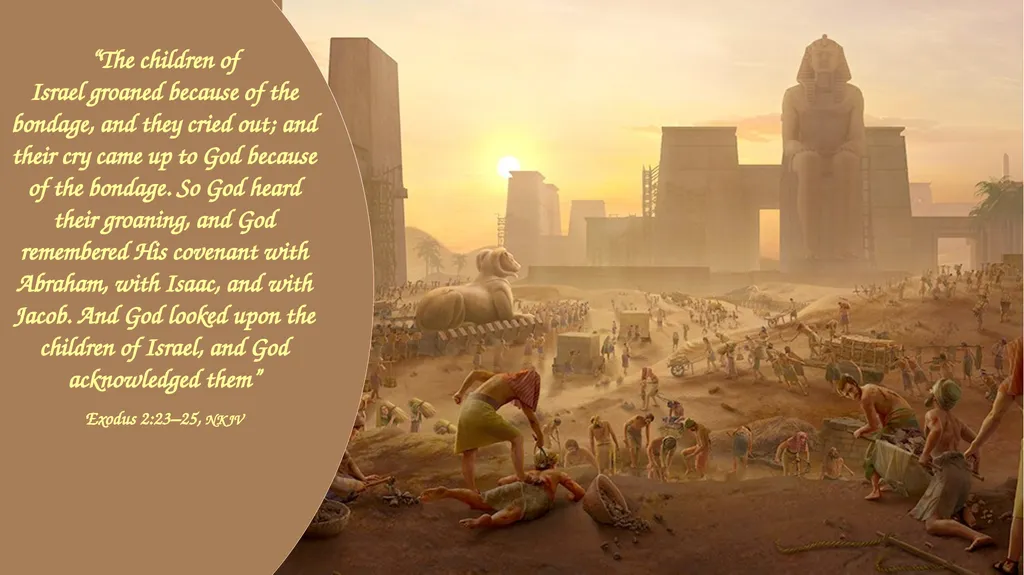
“The children of Israel groaned because of the bondage, and they cried out; and their cry came up to God because of the bondage. So God heard their groaning, and God remembered His covenant with Abraham, with Isaac, and with Jacob. And God looked upon the children of Israel, and God acknowledged them”
Exodus 2:23–25, NKJV<br>
03
God's people in Egypt (Exodus 1:1-14)
From Abraham to Moses (Genesis 15:13; Exodus 1:8)
The Triumph of Faithfulness (Exodus 1:15-22)
The son of the Nile (Exodus 2:1-10)
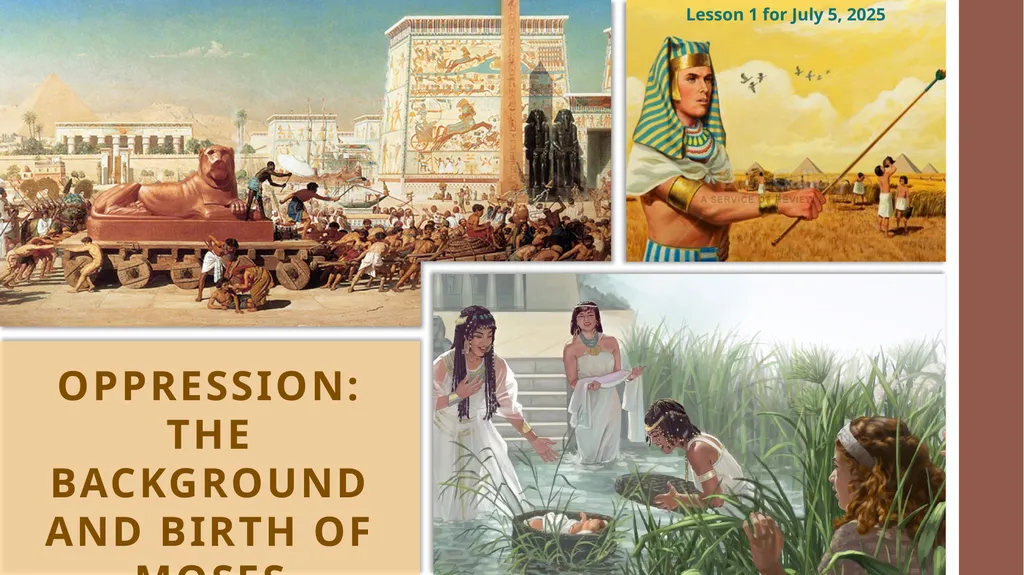
The Failed Deliverer (Exodus 2:11-25) Exodus begins its story with a small family settling in Egypt with the approval of the Pharaoh. The situation is becoming increasingly severe. Amidst the suffering, the faithfulness of two women, Shiphrah and Puah, shines forth, as does the ray of hope with which God greets His people: the beautiful child rescued from the Nile, Moses. Suddenly, the situation changes, becoming slaves forced to work for their Egyptian “masters.”<br>
04
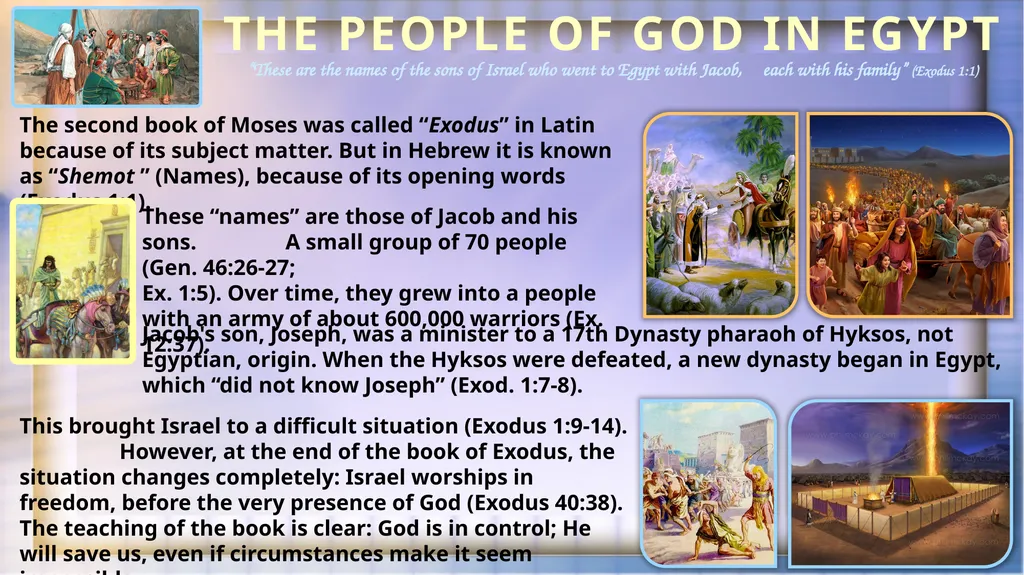
THE PEOPLE OF GOD IN EGYPT “These are the names of the sons of Israel who went to Egypt with Jacob, each with his family” (Exodus 1:1) The second book of Moses was called “Exodus” in Latin because of its subject matter. But in Hebrew it is known as “Shemot ” (Names), because of its opening words (Exodus 1:1). Jacob's son, Joseph, was a minister to a 17th Dynasty pharaoh of Hyksos, not Egyptian, origin. When the Hyksos were defeated, a new dynasty began in Egypt, which “did not know Joseph” (Exod. 1:7-8). This brought Israel to a difficult situation (Exodus 1:9-14). However, at the end of the book of Exodus, the situation changes completely: Israel worships in freedom, before the very presence of God (Exodus 40:38). The teaching of the book is clear: God is in control; He will save us, even if circumstances make it seem impossible. These “names” are those of Jacob and his sons. A small group of 70 people (Gen. 46:26-27; Ex. 1:5). Over time, they grew into a people with an army of about 600,000 warriors (Ex. 12:37).<br>
05
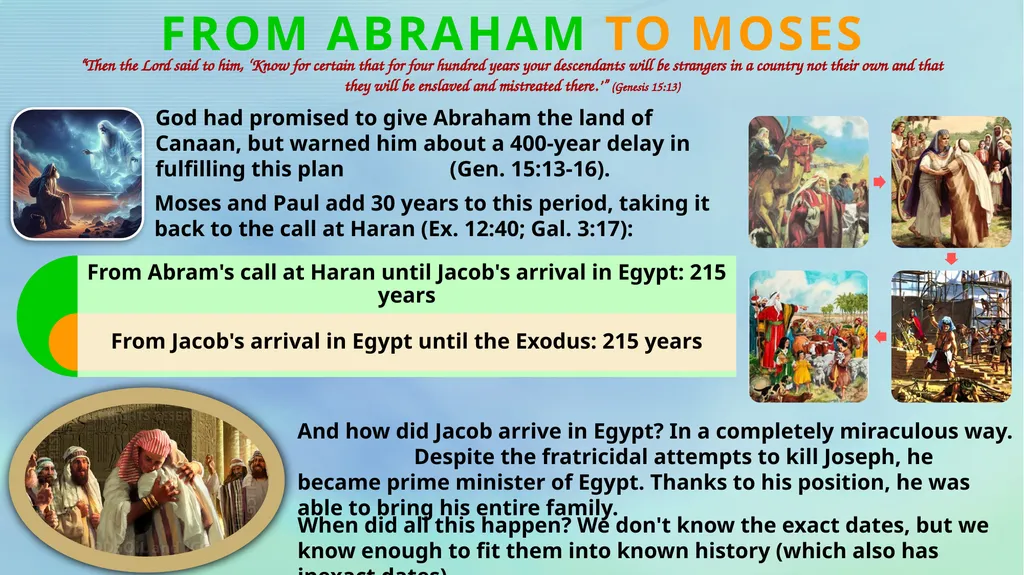
FROM ABRAHAM TO MOSES “Then the Lord said to him, ‘Know for certain that for four hundred years your descendants will be strangers in a country not their own and that they will be enslaved and mistreated there.’” (Genesis 15:13) God had promised to give Abraham the land of Canaan, but warned him about a 400-year delay in fulfilling this plan (Gen. 15:13-16). And how did Jacob arrive in Egypt? In a completely miraculous way. Despite the fratricidal attempts to kill Joseph, he became prime minister of Egypt. Thanks to his position, he was able to bring his entire family. Moses and Paul add 30 years to this period, taking it back to the call at Haran (Ex. 12:40; Gal. 3:17): When did all this happen? We don't know the exact dates, but we know enough to fit them into known history (which also has inexact dates).<br>
06
1 Kings 6:1 says the Exodus occurred 480 years before the 2nd year of Solomon. If this date is accurate and inclusive, it puts us at 1445 BC. If we consider this a “round number,” and take into account the death of Pharaoh, the Exodus took place in 1450 BC. With this data we can determine several moments in Moses’ life. “In the four hundred and eightieth year after the Israelites came out of Egypt, in the fourth year of Solomon’s reign over Israel, in the month of Ziv, the second month, he began to build the temple of the Lord” (1 Kings 6:1) FROM ABRAHAM TO MOSES<br>
07
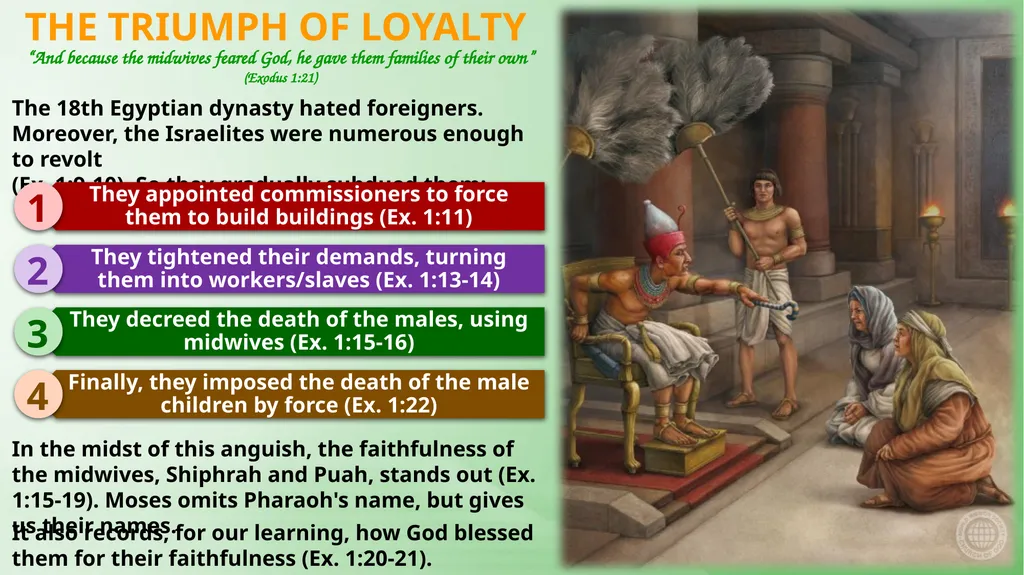
THE TRIUMPH OF LOYALTY “And because the midwives feared God, he gave them families of their own” (Exodus 1:21) The 18th Egyptian dynasty hated foreigners. Moreover, the Israelites were numerous enough to revolt (Ex. 1:9-10). So they gradually subdued them: In the midst of this anguish, the faithfulness of the midwives, Shiphrah and Puah, stands out (Ex. 1:15-19). Moses omits Pharaoh's name, but gives us their names. 1 2 3 4 It also records, for our learning, how God blessed them for their faithfulness (Ex. 1:20-21).<br>
08
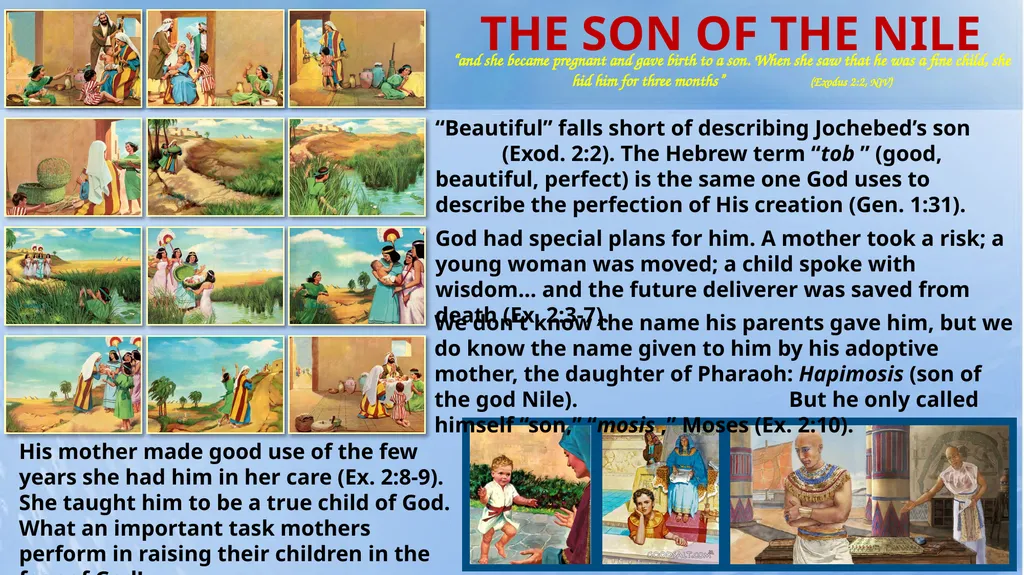
THE SON OF THE NILE “and she became pregnant and gave birth to a son. When she saw that he was a fine child, she hid him for three months” (Exodus 2:2, NIV) “Beautiful” falls short of describing Jochebed’s son (Exod. 2:2). The Hebrew term “tob ” (good, beautiful, perfect) is the same one God uses to describe the perfection of His creation (Gen. 1:31). His mother made good use of the few years she had him in her care (Ex. 2:8-9). She taught him to be a true child of God. What an important task mothers perform in raising their children in the fear of God! We don't know the name his parents gave him, but we do know the name given to him by his adoptive mother, the daughter of Pharaoh: Hapimosis (son of the god Nile). But he only called himself “son,” “mosis ,” Moses (Ex. 2:10). God had special plans for him. A mother took a risk; a young woman was moved; a child spoke with wisdom… and the future deliverer was saved from death (Ex. 2:3-7).<br>
09
“God had heard the mother's prayers; her faith had been rewarded. It was with deep gratitude that she entered upon her now safe and happy task. She faithfully improved her opportunity to educate her child for God. She felt confident that he had been preserved for some great work, and she knew that he must soon be given up to his royal mother, to be surrounded with influences that would tend to lead him away from God. All this rendered her more diligent and careful in his instruction than in that of her other children. She endeavored to imbue his mind with the fear of God and the love of truth and justice, and earnestly prayed [p. 244] that he might be preserved from every corrupting influence. She showed him the folly and sin of idolatry, and early taught him to bow down and pray to the living God, who alone could hear him and help him in every emergency.” EGW (Patriarchs and Prophets, p. 243)<br>
10
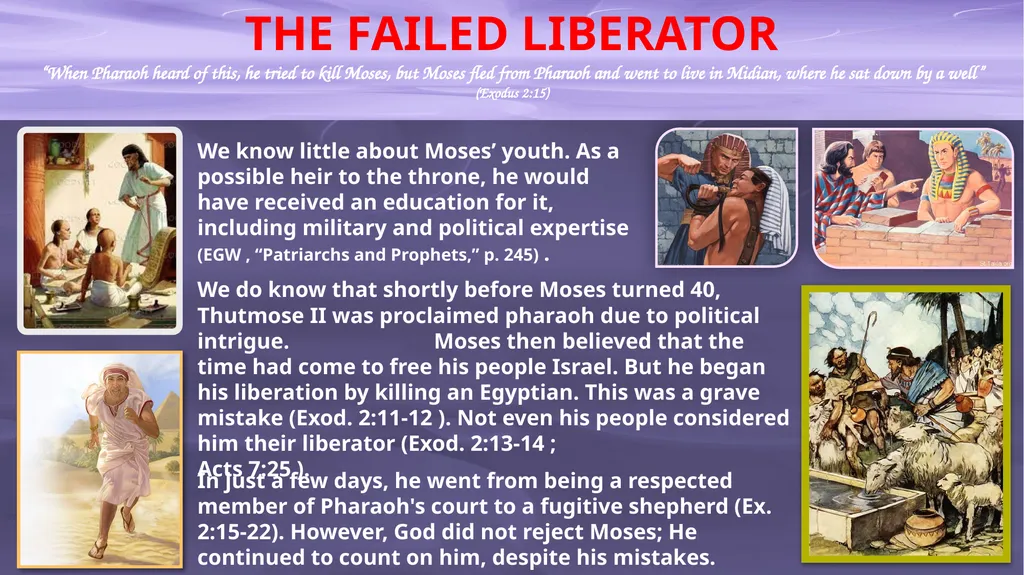
THE FAILED LIBERATOR “When Pharaoh heard of this, he tried to kill Moses, but Moses fled from Pharaoh and went to live in Midian, where he sat down by a well” (Exodus 2:15) We know little about Moses’ youth. As a possible heir to the throne, he would have received an education for it, including military and political expertise (EGW , “Patriarchs and Prophets,” p. 245) . We do know that shortly before Moses turned 40, Thutmose II was proclaimed pharaoh due to political intrigue. Moses then believed that the time had come to free his people Israel. But he began his liberation by killing an Egyptian. This was a grave mistake (Exod. 2:11-12 ). Not even his people considered him their liberator (Exod. 2:13-14 ; Acts 7:25 ). In just a few days, he went from being a respected member of Pharaoh's court to a fugitive shepherd (Ex. 2:15-22). However, God did not reject Moses; He continued to count on him, despite his mistakes.<br>
11
“The magnificent palace of Pharaoh and the monarch's throne were held out as an inducement to Moses; but he knew that the sinful pleasures that make men forget God were in its lordly courts. He looked beyond the gorgeous palace, beyond a monarch's crown, to the high honors that will be bestowed on the saints of the Most High in a kingdom untainted by sin. He saw by faith an imperishable crown that the King of heaven would place on the brow of the overcomer. This faith led him to turn away from the lordly ones of earth and join the humble, poor, despised nation that had chosen to obey God rather than to serve sin.” EGW (Patriarchs and Prophets, p. 246)<br>