
opsi@oecd.org oecd-opsi.org @OPSIgov Blockchain
MY
Published · 26 slides · 0 views

1 / 1
Description
opsioecd.org oecd-opsi.org OPSIgov Blockchain and its Use in the Public Sector June 20, 2018 OPSI is a forum for shared lessons and insights into the practice of innovation in government. Since 2014, it has worked to meet the needs
Related Topics
Share
Embed code
Download this presentation From Below
"opsi@oecd.org oecd-opsi.org @OPSIgov Blockchain" is the property of its rightful owner. Permission is granted to download and print the materials on this website for personal, non-commercial use only, and to display it on your personal computer provided you do not modify the materials and that you retain all copyright notices contained in the materials. By downloading content from our website, you accept the terms of this agreement.
Presentation Transcript
01
opsi@oecd.org oecd-opsi.org @OPSIgov Blockchain and its Use in the Public Sector
June 20, 2018<br>
June 20, 2018<br>
02
OPSI is a forum for shared lessons and insights into the practice of innovation in government. Since 2014, it has worked to meet the needs governments around the world, providing a
collective resource to identify, collect and analyse new ways of designing and delivering public policies and services. UNCOVERING WHAT IS NEXT
Identifying new practices at the leading edge of government, connecting those engaging in new ways of thinking and acting, and considering what these new approaches mean for the public sector. OPSI 1 2 3 TURNING THE NEW INTO NORMAL
Studying innovation in different public sector contexts and investigating potential frameworks and methods to unleash creativity and innovation and ways to connect them with the day-to-day work of public servants. PROVIDING TRUSTED ADVICE TO FOSTER INNOVATION
Sharing guidance and resources about the ways in which governments can support innovation to obtain better outcomes for their people.<br>
collective resource to identify, collect and analyse new ways of designing and delivering public policies and services. UNCOVERING WHAT IS NEXT
Identifying new practices at the leading edge of government, connecting those engaging in new ways of thinking and acting, and considering what these new approaches mean for the public sector. OPSI 1 2 3 TURNING THE NEW INTO NORMAL
Studying innovation in different public sector contexts and investigating potential frameworks and methods to unleash creativity and innovation and ways to connect them with the day-to-day work of public servants. PROVIDING TRUSTED ADVICE TO FOSTER INNOVATION
Sharing guidance and resources about the ways in which governments can support innovation to obtain better outcomes for their people.<br>
03
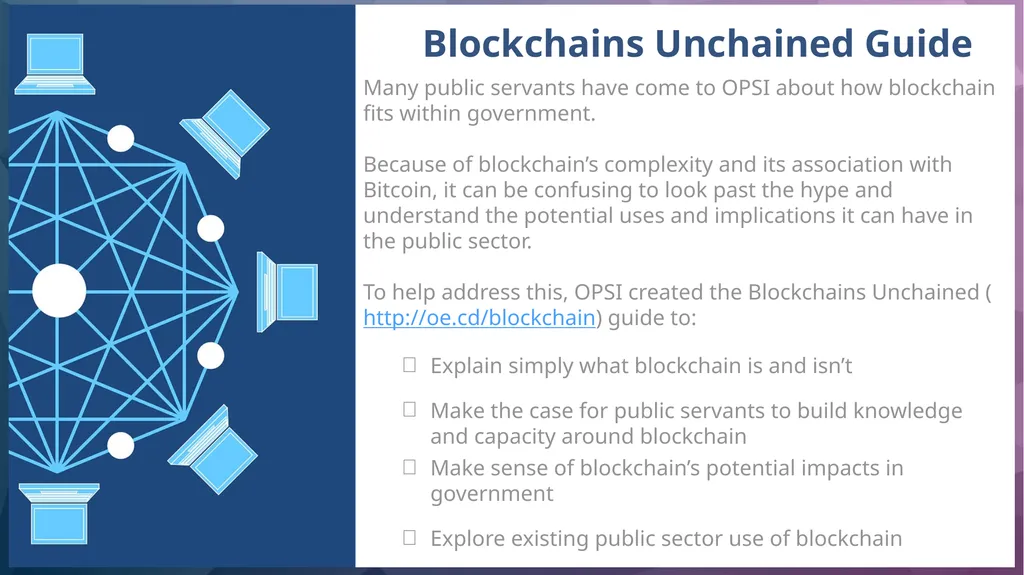
Blockchains Unchained Guide Many public servants have come to OPSI about how blockchain fits within government.
Because of blockchain’s complexity and its association with Bitcoin, it can be confusing to look past the hype and understand the potential uses and implications it can have in the public sector.
To help address this, OPSI created the Blockchains Unchained (http://oe.cd/blockchain) guide to:
Explain simply what blockchain is and isn’t
Make the case for public servants to build knowledge and capacity around blockchain
Make sense of blockchain’s potential impacts in government
Explore existing public sector use of blockchain<br>
Because of blockchain’s complexity and its association with Bitcoin, it can be confusing to look past the hype and understand the potential uses and implications it can have in the public sector.
To help address this, OPSI created the Blockchains Unchained (http://oe.cd/blockchain) guide to:
Explain simply what blockchain is and isn’t
Make the case for public servants to build knowledge and capacity around blockchain
Make sense of blockchain’s potential impacts in government
Explore existing public sector use of blockchain<br>
04
Slide 09 Blockchain Basics<br>
05
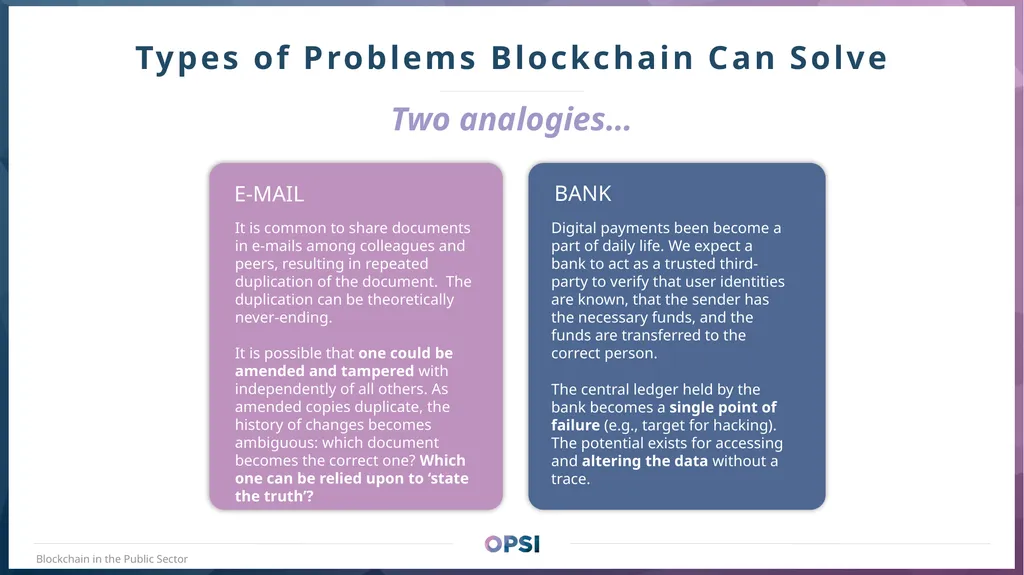
Types of Problems Blockchain Can Solve Two analogies… E-MAIL Digital payments been become a part of daily life. We expect a bank to act as a trusted third-party to verify that user identities are known, that the sender has the necessary funds, and the funds are transferred to the correct person.
The central ledger held by the bank becomes a single point of failure (e.g., target for hacking). The potential exists for accessing and altering the data without a trace.<br>
The central ledger held by the bank becomes a single point of failure (e.g., target for hacking). The potential exists for accessing and altering the data without a trace.<br>
06
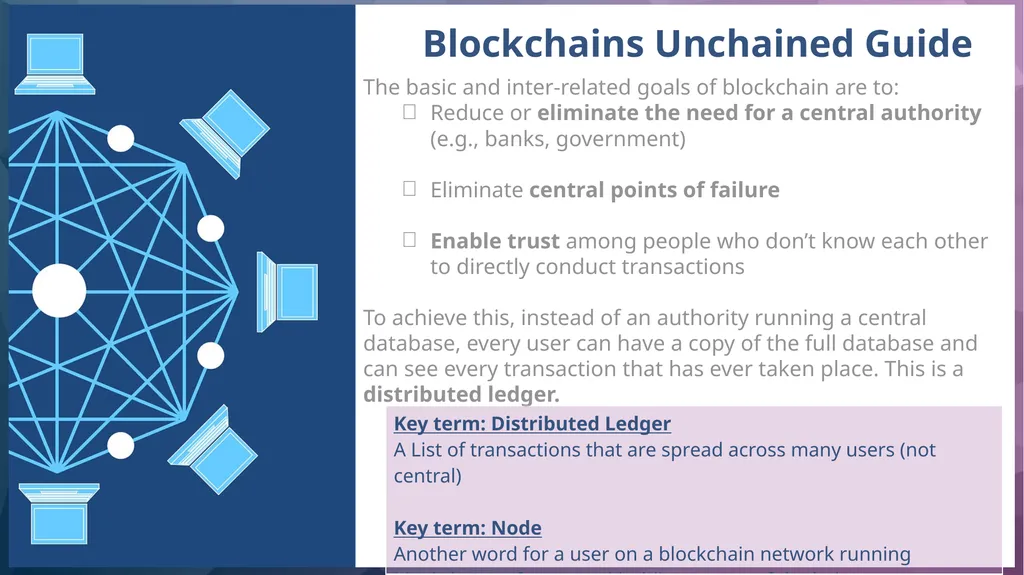
Blockchains Unchained Guide The basic and inter-related goals of blockchain are to:
Reduce or eliminate the need for a central authority (e.g., banks, government)
Eliminate central points of failure
Enable trust among people who don’t know each other to directly conduct transactions
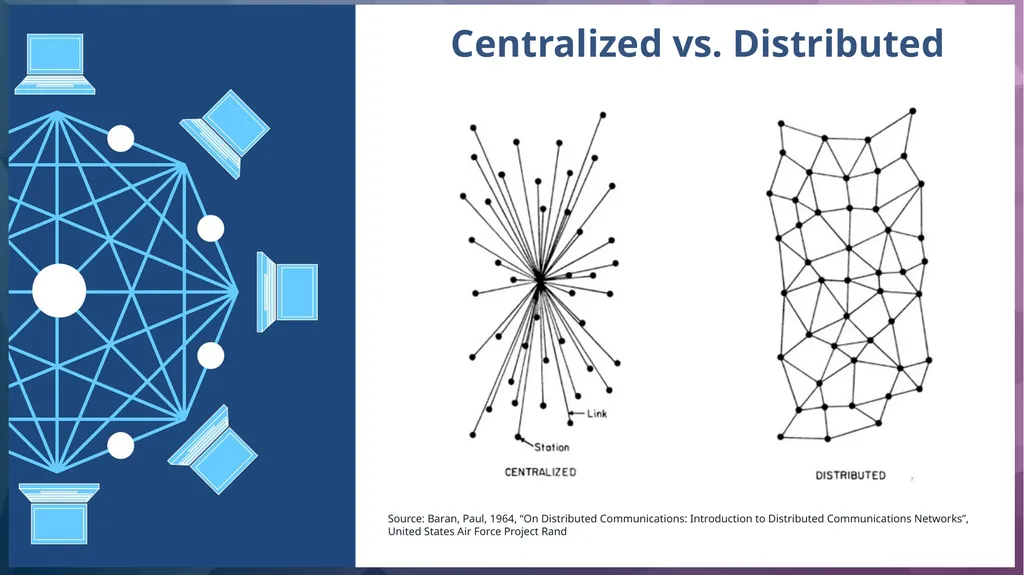
To achieve this, instead of an authority running a central database, every user can have a copy of the full database and can see every transaction that has ever taken place. This is a distributed ledger.<br>
Reduce or eliminate the need for a central authority (e.g., banks, government)
Eliminate central points of failure
Enable trust among people who don’t know each other to directly conduct transactions
To achieve this, instead of an authority running a central database, every user can have a copy of the full database and can see every transaction that has ever taken place. This is a distributed ledger.<br>
07
Centralized vs. Distributed Source: Baran, Paul, 1964, “On Distributed Communications: Introduction to Distributed Communications Networks”, United States Air Force Project Rand<br>
08
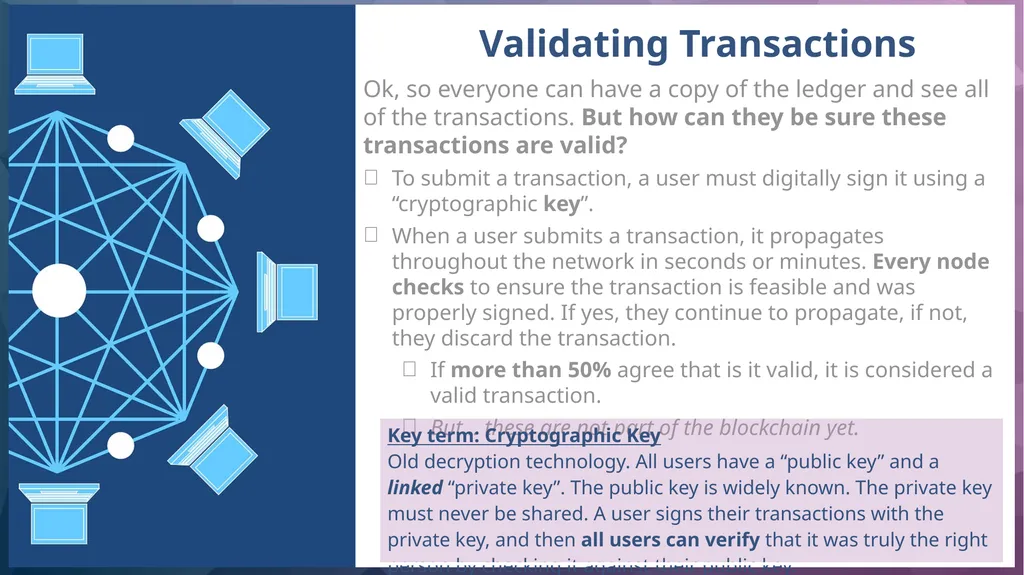
Validating Transactions Ok, so everyone can have a copy of the ledger and see all of the transactions. But how can they be sure these transactions are valid?
To submit a transaction, a user must digitally sign it using a “cryptographic key”.
When a user submits a transaction, it propagates throughout the network in seconds or minutes. Every node checks to ensure the transaction is feasible and was properly signed. If yes, they continue to propagate, if not, they discard the transaction.
If more than 50% agree that is it valid, it is considered a valid transaction.
But… these are not part of the blockchain yet.<br>
To submit a transaction, a user must digitally sign it using a “cryptographic key”.
When a user submits a transaction, it propagates throughout the network in seconds or minutes. Every node checks to ensure the transaction is feasible and was properly signed. If yes, they continue to propagate, if not, they discard the transaction.
If more than 50% agree that is it valid, it is considered a valid transaction.
But… these are not part of the blockchain yet.<br>
09
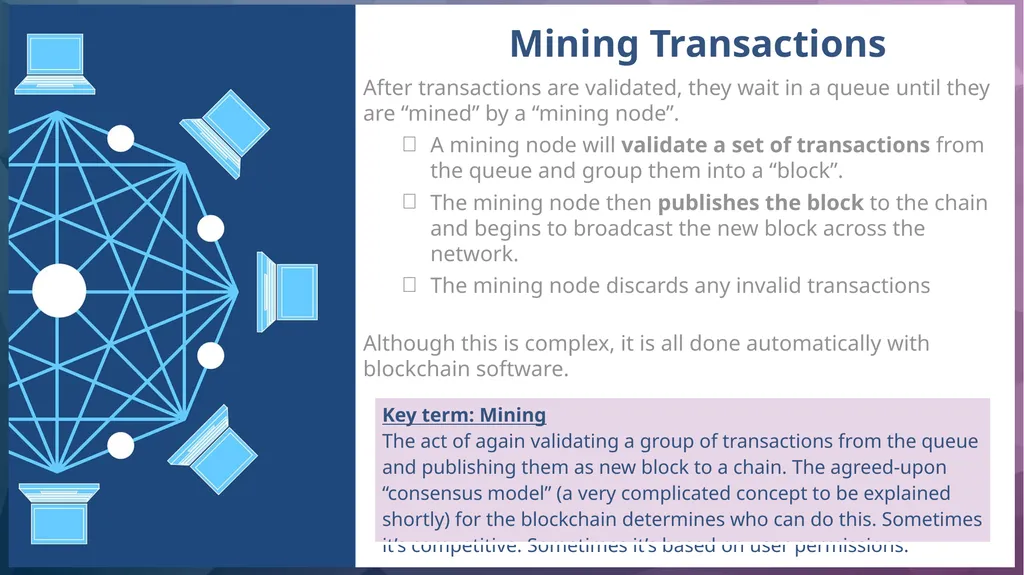
Mining Transactions After transactions are validated, they wait in a queue until they are “mined” by a “mining node”.
A mining node will validate a set of transactions from the queue and group them into a “block”.
The mining node then publishes the block to the chain and begins to broadcast the new block across the network.
The mining node discards any invalid transactions
Although this is complex, it is all done automatically with blockchain software.<br>
A mining node will validate a set of transactions from the queue and group them into a “block”.
The mining node then publishes the block to the chain and begins to broadcast the new block across the network.
The mining node discards any invalid transactions
Although this is complex, it is all done automatically with blockchain software.<br>
10
“Immutability” In addition to they key principles of:
Distributed: everyone holding a copy of the ledger and these copies are automatically synchronised
Shared: all transactions being transparent to everyone
There is a key third principle: Immutability<br>
Distributed: everyone holding a copy of the ledger and these copies are automatically synchronised
Shared: all transactions being transparent to everyone
There is a key third principle: Immutability<br>
11
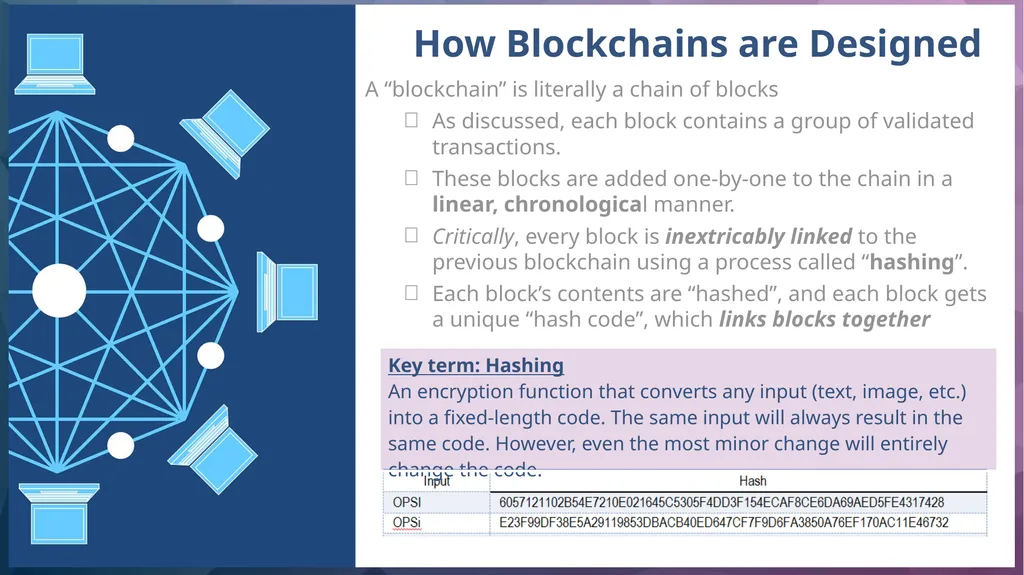
How Blockchains are Designed A “blockchain” is literally a chain of blocks
As discussed, each block contains a group of validated transactions.
These blocks are added one-by-one to the chain in a linear, chronological manner.
Critically, every block is inextricably linked to the previous blockchain using a process called “hashing”.
Each block’s contents are “hashed”, and each block gets a unique “hash code”, which links blocks together<br>
As discussed, each block contains a group of validated transactions.
These blocks are added one-by-one to the chain in a linear, chronological manner.
Critically, every block is inextricably linked to the previous blockchain using a process called “hashing”.
Each block’s contents are “hashed”, and each block gets a unique “hash code”, which links blocks together<br>
12
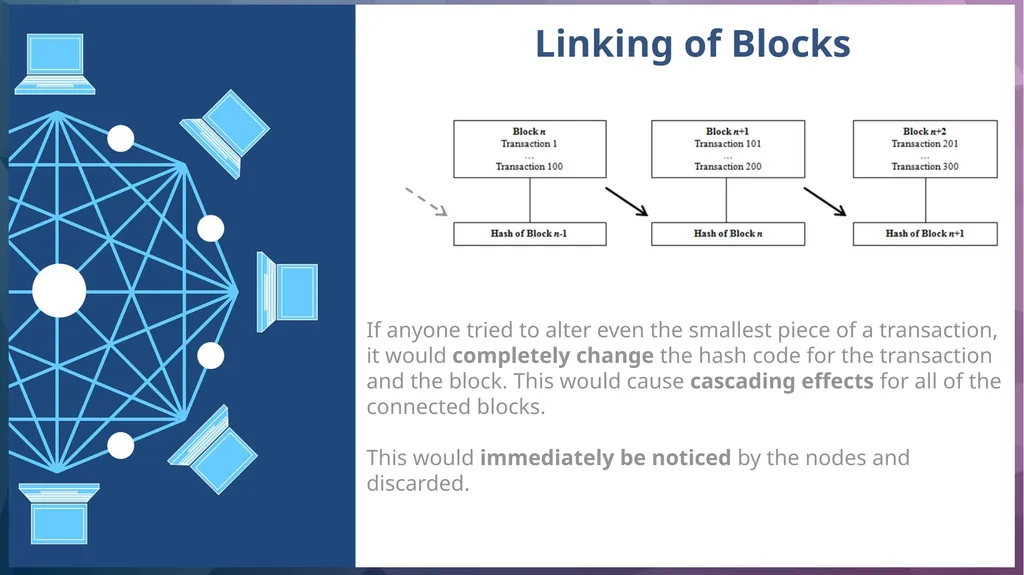
Linking of Blocks If anyone tried to alter even the smallest piece of a transaction, it would completely change the hash code for the transaction and the block. This would cause cascading effects for all of the connected blocks.
This would immediately be noticed by the nodes and discarded.<br>
This would immediately be noticed by the nodes and discarded.<br>
13
Difference Between Blockchain and Bitcoin One of the biggest challenges for blockchain is that it is conflated with Bitcoin.
Blockchain was born with Bitcoin and remains the largest blockchain platform
However, hundreds or thousands of other platforms now exist
The underlying technology has uses and implications that go far beyond Bitcoin or cryptocurrencies in general
Some platforms have developed innovative new features. Most notably, “smart contracts”<br>
Blockchain was born with Bitcoin and remains the largest blockchain platform
However, hundreds or thousands of other platforms now exist
The underlying technology has uses and implications that go far beyond Bitcoin or cryptocurrencies in general
Some platforms have developed innovative new features. Most notably, “smart contracts”<br>
14
Public versus Private Blockchains Blockchain ledgers can be public (“permissionless”), or private (“permissioned”). The distinction between the two is much like the internet versus an intranet.
Permissionless ledgers (e.g., Bitcoin) allow anyone to make transactions and to hold identical copies of the full ledger.
Permissioned ledgers limit contributions to a limited set of users who have been given permission. Access to view records can be restricted or public, depending on the settings of the ledger. In fact, many different aspects of the blockchain can be customized to meet different needs. These are likely to be the most useful for public sector use.
The types of “consensus models”, which are the rules that determine who has the right to publish the next block, vary depending on type of blockchain at hand.<br>
Permissionless ledgers (e.g., Bitcoin) allow anyone to make transactions and to hold identical copies of the full ledger.
Permissioned ledgers limit contributions to a limited set of users who have been given permission. Access to view records can be restricted or public, depending on the settings of the ledger. In fact, many different aspects of the blockchain can be customized to meet different needs. These are likely to be the most useful for public sector use.
The types of “consensus models”, which are the rules that determine who has the right to publish the next block, vary depending on type of blockchain at hand.<br>
15
Consensus Models There are a growing number of consensus models that determine which node has the right to publish the next block. The two below are examples.
Proof of Work – Always for permissionless ledgers (e.g., Bitcoin)
Since no trust exists, in order to keep one or a few users from taking control, a complicated process exists to help even the playing field.
Each user competes to solve a puzzle that is intentionally resource intensive (e.g., processing power, and by extension, electricity) to solve.
The winner publishes the next block and earns financial reward.
Proof of Authority – Usually for permissioned ledgers
User identities must be known and verified.
Ability to publish new blocks is dictated by user permissions (not unlike a traditional database).
No issues related to processing power or electricity.<br>
Proof of Work – Always for permissionless ledgers (e.g., Bitcoin)
Since no trust exists, in order to keep one or a few users from taking control, a complicated process exists to help even the playing field.
Each user competes to solve a puzzle that is intentionally resource intensive (e.g., processing power, and by extension, electricity) to solve.
The winner publishes the next block and earns financial reward.
Proof of Authority – Usually for permissioned ledgers
User identities must be known and verified.
Ability to publish new blocks is dictated by user permissions (not unlike a traditional database).
No issues related to processing power or electricity.<br>
16
Slide 09 Blockchain in the Public Sector<br>
17
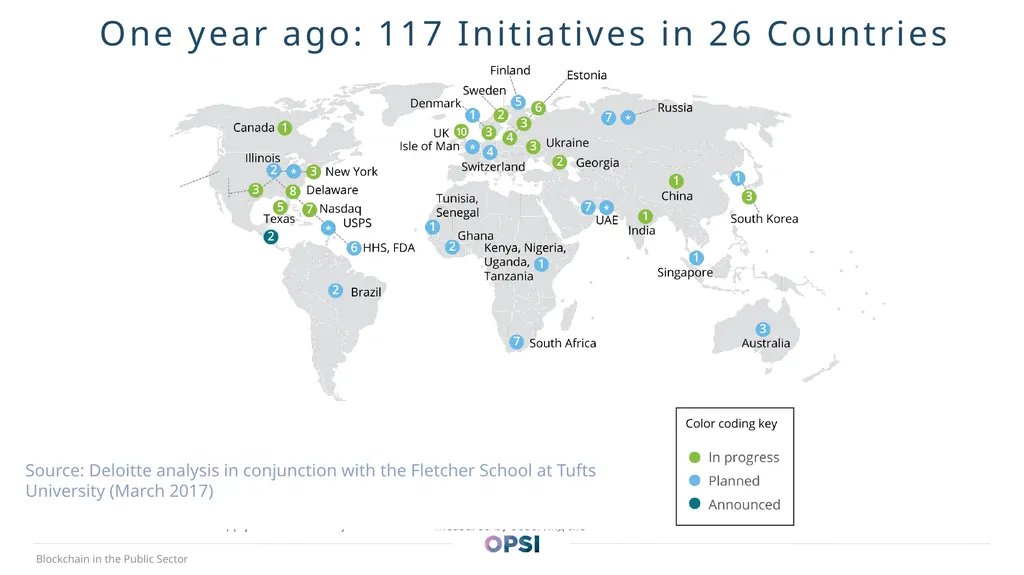
One year ago: 117 Initiatives in 26 Countries Source: Deloitte analysis in conjunction with the Fletcher School at Tufts University (March 2017)<br>
18
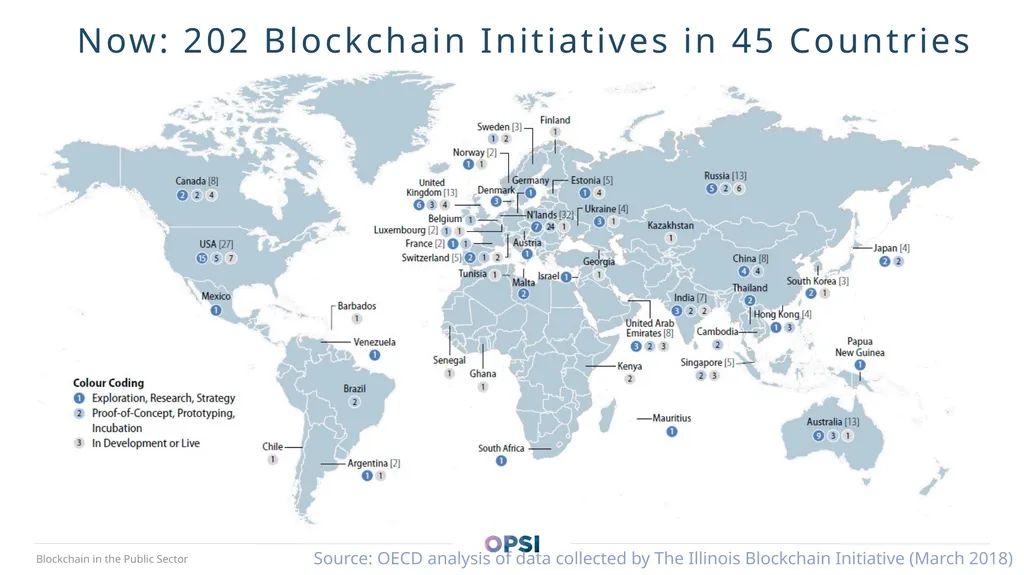
Now: 202 Blockchain Initiatives in 45 Countries Source: OECD analysis of data collected by The Illinois Blockchain Initiative (March 2018)<br>
19
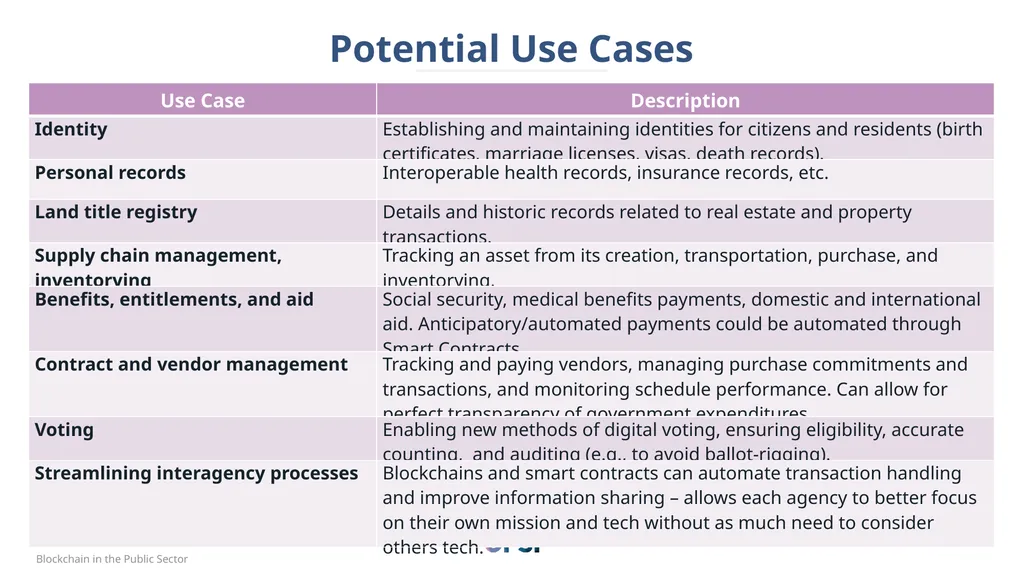
Potential Use Cases<br>
20
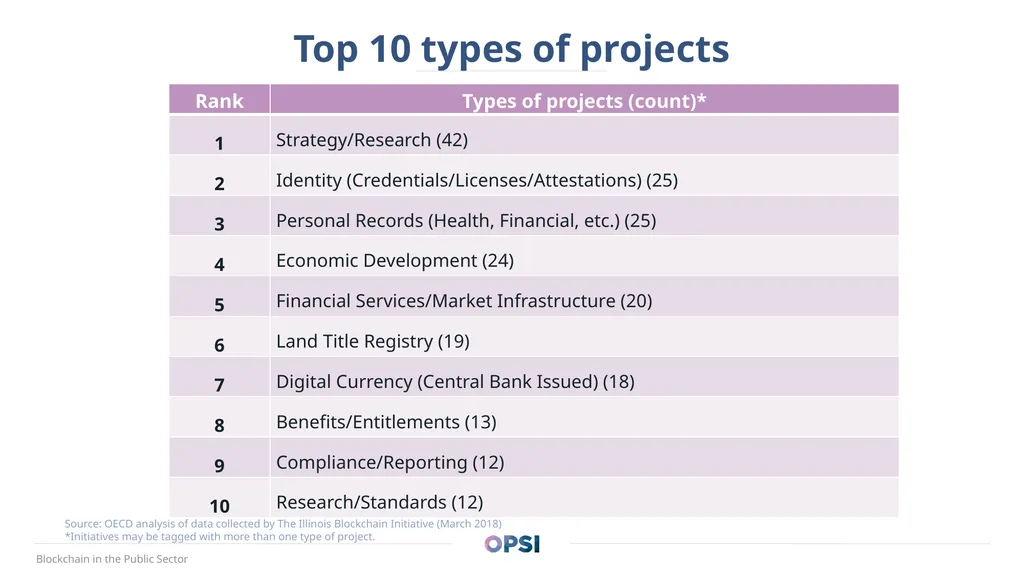
Top 10 types of projects Source: OECD analysis of data collected by The Illinois Blockchain Initiative (March 2018)
*Initiatives may be tagged with more than one type of project.<br>
*Initiatives may be tagged with more than one type of project.<br>
21
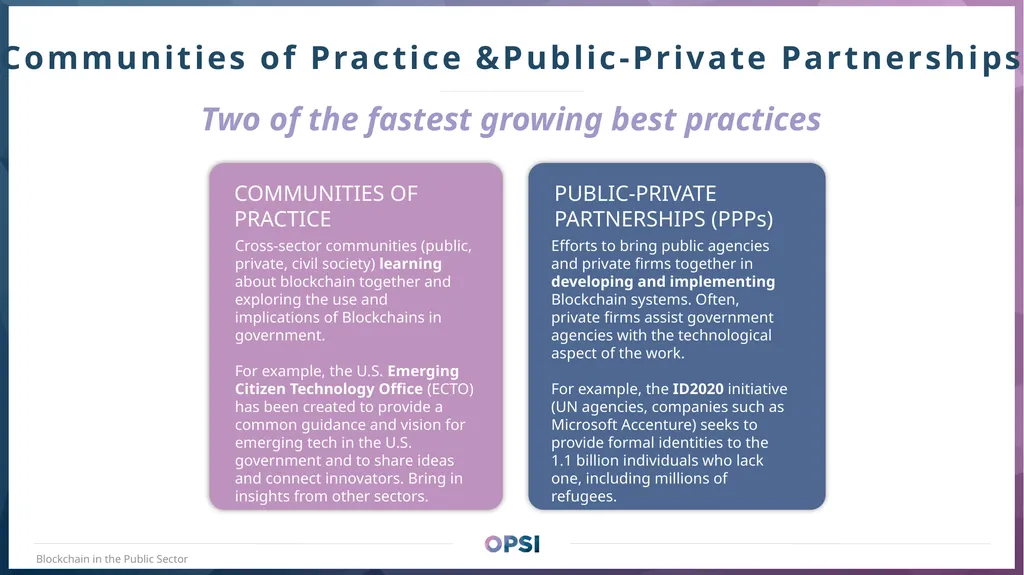
Communities of Practice &Public-Private Partnerships Two of the fastest growing best practices COMMUNITIES OF PRACTICE Efforts to bring public agencies and private firms together in developing and implementing Blockchain systems. Often, private firms assist government agencies with the technological aspect of the work.
For example, the ID2020 initiative (UN agencies, companies such as Microsoft Accenture) seeks to provide formal identities to the 1.1 billion individuals who lack one, including millions of refugees.<br>
For example, the ID2020 initiative (UN agencies, companies such as Microsoft Accenture) seeks to provide formal identities to the 1.1 billion individuals who lack one, including millions of refugees.<br>
22
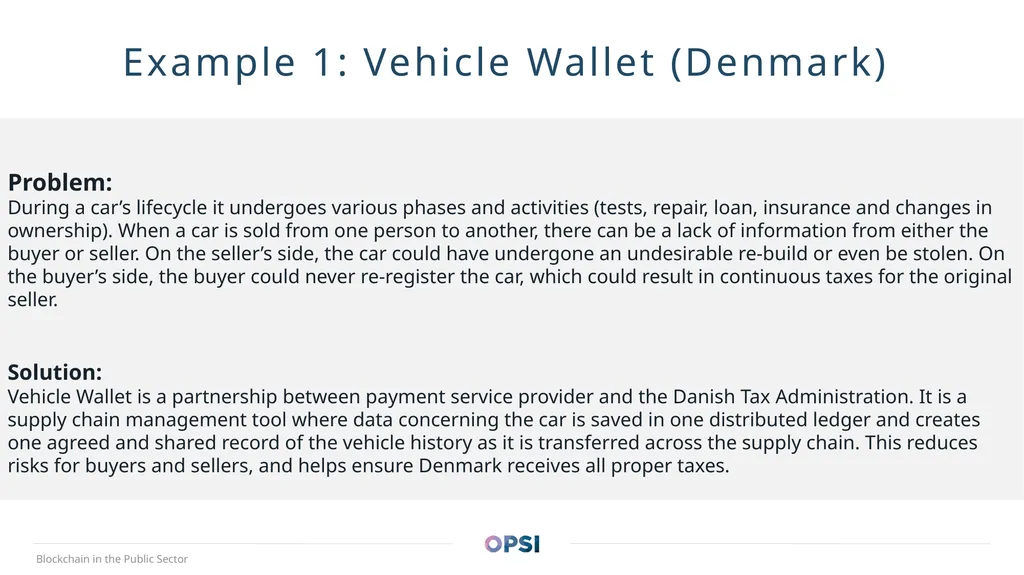
Example 1: Vehicle Wallet (Denmark) Problem:
During a car’s lifecycle it undergoes various phases and activities (tests, repair, loan, insurance and changes in ownership). When a car is sold from one person to another, there can be a lack of information from either the buyer or seller. On the seller’s side, the car could have undergone an undesirable re-build or even be stolen. On the buyer’s side, the buyer could never re-register the car, which could result in continuous taxes for the original seller.
Solution:
Vehicle Wallet is a partnership between payment service provider and the Danish Tax Administration. It is a supply chain management tool where data concerning the car is saved in one distributed ledger and creates one agreed and shared record of the vehicle history as it is transferred across the supply chain. This reduces risks for buyers and sellers, and helps ensure Denmark receives all proper taxes.<br>
During a car’s lifecycle it undergoes various phases and activities (tests, repair, loan, insurance and changes in ownership). When a car is sold from one person to another, there can be a lack of information from either the buyer or seller. On the seller’s side, the car could have undergone an undesirable re-build or even be stolen. On the buyer’s side, the buyer could never re-register the car, which could result in continuous taxes for the original seller.
Solution:
Vehicle Wallet is a partnership between payment service provider and the Danish Tax Administration. It is a supply chain management tool where data concerning the car is saved in one distributed ledger and creates one agreed and shared record of the vehicle history as it is transferred across the supply chain. This reduces risks for buyers and sellers, and helps ensure Denmark receives all proper taxes.<br>
23
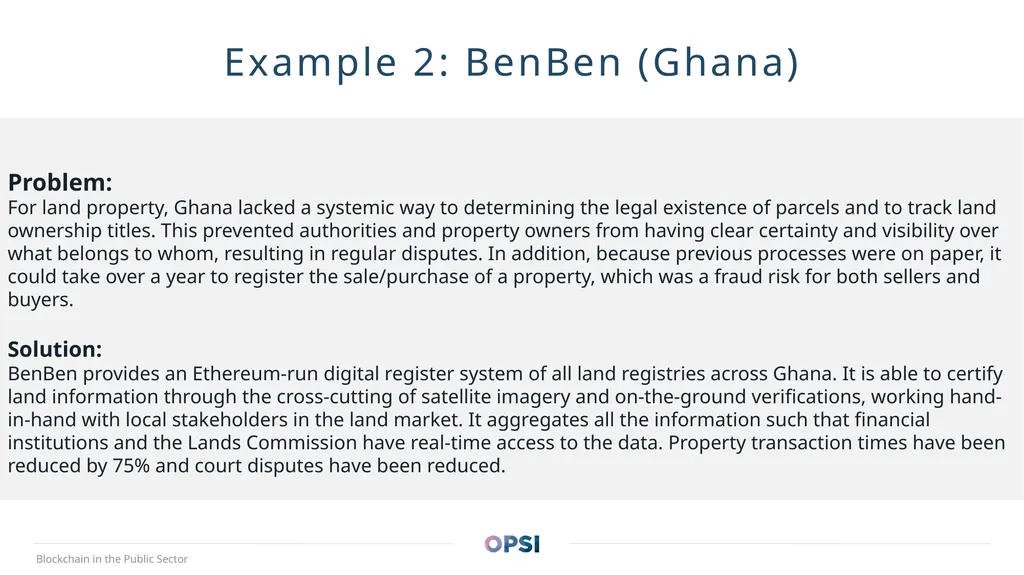
Example 2: BenBen (Ghana) Problem:
For land property, Ghana lacked a systemic way to determining the legal existence of parcels and to track land ownership titles. This prevented authorities and property owners from having clear certainty and visibility over what belongs to whom, resulting in regular disputes. In addition, because previous processes were on paper, it could take over a year to register the sale/purchase of a property, which was a fraud risk for both sellers and buyers.
Solution:
BenBen provides an Ethereum-run digital register system of all land registries across Ghana. It is able to certify land information through the cross-cutting of satellite imagery and on-the-ground verifications, working hand-in-hand with local stakeholders in the land market. It aggregates all the information such that financial institutions and the Lands Commission have real-time access to the data. Property transaction times have been reduced by 75% and court disputes have been reduced.<br>
For land property, Ghana lacked a systemic way to determining the legal existence of parcels and to track land ownership titles. This prevented authorities and property owners from having clear certainty and visibility over what belongs to whom, resulting in regular disputes. In addition, because previous processes were on paper, it could take over a year to register the sale/purchase of a property, which was a fraud risk for both sellers and buyers.
Solution:
BenBen provides an Ethereum-run digital register system of all land registries across Ghana. It is able to certify land information through the cross-cutting of satellite imagery and on-the-ground verifications, working hand-in-hand with local stakeholders in the land market. It aggregates all the information such that financial institutions and the Lands Commission have real-time access to the data. Property transaction times have been reduced by 75% and court disputes have been reduced.<br>
24
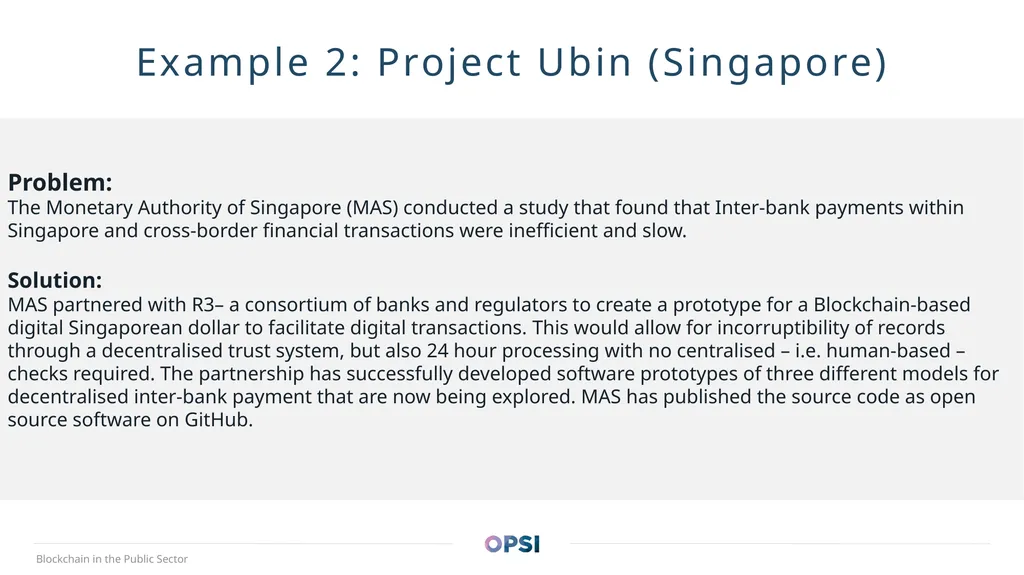
Example 2: Project Ubin (Singapore) Problem:
The Monetary Authority of Singapore (MAS) conducted a study that found that Inter-bank payments within Singapore and cross-border financial transactions were inefficient and slow.
Solution:
MAS partnered with R3– a consortium of banks and regulators to create a prototype for a Blockchain-based digital Singaporean dollar to facilitate digital transactions. This would allow for incorruptibility of records through a decentralised trust system, but also 24 hour processing with no centralised – i.e. human-based – checks required. The partnership has successfully developed software prototypes of three different models for decentralised inter-bank payment that are now being explored. MAS has published the source code as open source software on GitHub.<br>
The Monetary Authority of Singapore (MAS) conducted a study that found that Inter-bank payments within Singapore and cross-border financial transactions were inefficient and slow.
Solution:
MAS partnered with R3– a consortium of banks and regulators to create a prototype for a Blockchain-based digital Singaporean dollar to facilitate digital transactions. This would allow for incorruptibility of records through a decentralised trust system, but also 24 hour processing with no centralised – i.e. human-based – checks required. The partnership has successfully developed software prototypes of three different models for decentralised inter-bank payment that are now being explored. MAS has published the source code as open source software on GitHub.<br>
25
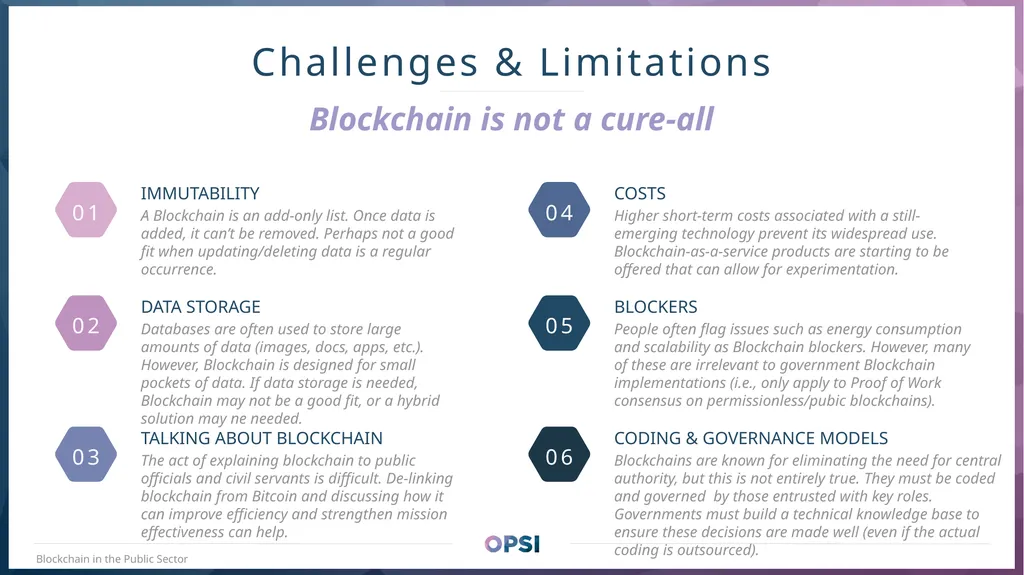
Challenges & Limitations Blockchain is not a cure-all 01 IMMUTABILITY A Blockchain is an add-only list. Once data is added, it can’t be removed. Perhaps not a good fit when updating/deleting data is a regular occurrence. 02 DATA STORAGE Databases are often used to store large amounts of data (images, docs, apps, etc.). However, Blockchain is designed for small pockets of data. If data storage is needed, Blockchain may not be a good fit, or a hybrid solution may ne needed. 03 TALKING ABOUT BLOCKCHAIN The act of explaining blockchain to public officials and civil servants is difficult. De-linking blockchain from Bitcoin and discussing how it can improve efficiency and strengthen mission effectiveness can help. 04 COSTS Higher short-term costs associated with a still-emerging technology prevent its widespread use. Blockchain-as-a-service products are starting to be offered that can allow for experimentation. 05 BLOCKERS People often flag issues such as energy consumption and scalability as Blockchain blockers. However, many of these are irrelevant to government Blockchain implementations (i.e., only apply to Proof of Work consensus on permissionless/pubic blockchains). 06 CODING & GOVERNANCE MODELS Blockchains are known for eliminating the need for central authority, but this is not entirely true. They must be coded and governed by those entrusted with key roles. Governments must build a technical knowledge base to ensure these decisions are made well (even if the actual coding is outsourced).<br>
26
opsi@oecd.org oecd-opsi.org @OPSIgov Join our newsletter at http://tiny.cc/opsinewsletter<br>